PART 2: He Was Crying Alone Deep in the Woods—Then the Vet Showed Me What His Matted Fur Had Been Hiding
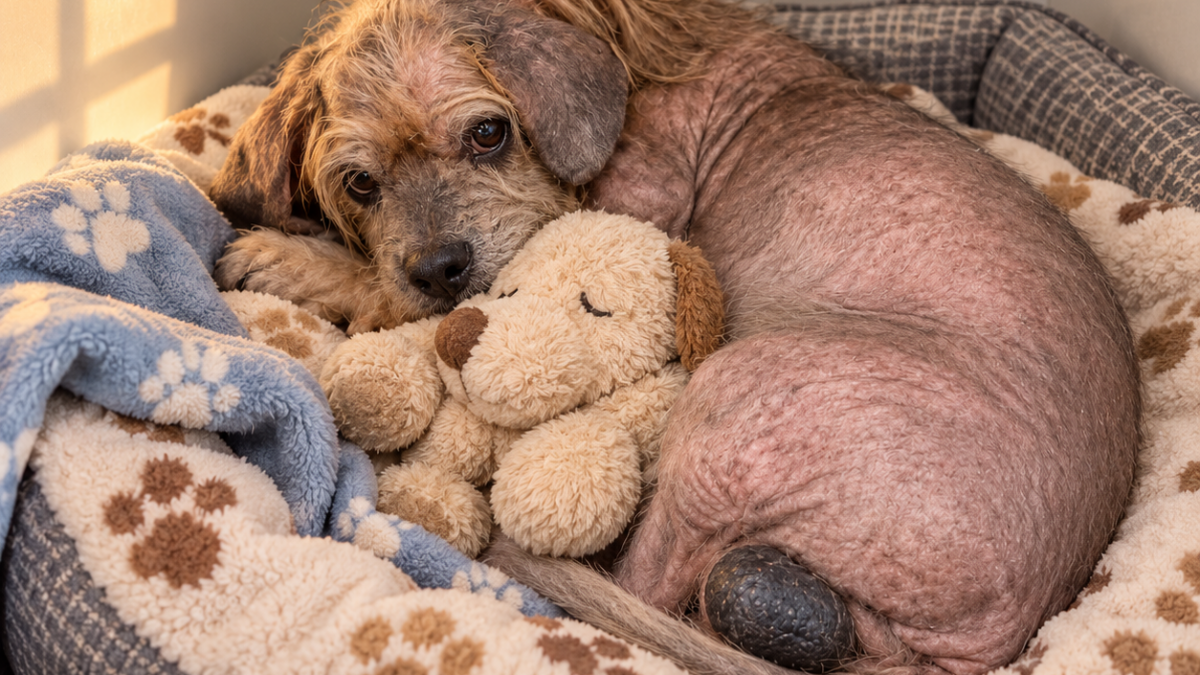
By the time Freddy reached our rescue, his cries had already led a stranger deep into a stretch of woods where no small dog should ever have been alone, and the little body wrapped inside that man’s jacket was so weak that I wondered how he had managed to keep calling for help at all.
There was no collar, no microchip we could immediately find, no report matching his description, and no reasonable explanation for why a tiny companion dog had ended up far beyond the last houses with infected eyes, filthy matted fur, and a body that felt frighteningly light in my hands.
I thought getting Freddy out of those woods had been the rescue, but when our veterinarian began cutting through the hardened mats around his skin, she stopped, looked at me, and said there were things underneath that nobody had been able to see.
The man who found him was named Tom.
He arrived at our shelter just before closing, mud covering the bottoms of his jeans and small scratches running across both forearms.
“I heard him from the trail,” he told me.
“You saw him?”
“Not at first. I heard crying.”
Tom had been hiking alone when the sound reached him through the trees.
He assumed someone else was nearby with a dog.
Then the crying came again.
Fainter.
Farther from the trail.
He followed it.
“Probably twenty minutes,” he said. “Maybe longer.”
“And he was just sitting there?”
Tom nodded.
“Under some brush. Like he’d been waiting.”
I looked at the dog in his arms.
Freddy’s face was almost hidden beneath filthy, tangled hair. Both eyes were crusted with discharge. His nails curled far beyond where they should have, and the odor coming from his skin told me infection had been present for more than a few days.
“How long was he out there?”
“I have no idea.”
“Did you see food? A carrier? Anything?”
“Nothing.”
Tom swallowed.
“No leash. No bowls. No houses nearby. Just him.”
When I reached toward Freddy, he did not growl.
He did not pull away.
He leaned into my hand.
That broke something in me.
Dogs who have every reason to fear people do not always stop trusting them. Sometimes they do the opposite. Sometimes they cling to the first safe touch as if they have been waiting for it.
“We need to get him to the clinic,” I said.
Freddy tried to stand as I transferred him into a blanket.
His back legs trembled.
Then folded.
Tom looked horrified.
“He was walking when I found him.”
“Adrenaline.”
“Is he dying?”
“I don’t know.”
I hated saying it.
But I was not going to lie.
Dr. Patel stayed late for us.
The first examination became a list that kept growing.
Severe eye infections.
Parasites.
Anemia.
Dehydration.
Malnutrition.
Skin inflammation.
Ear infection.
Dental disease.
Possible respiratory infection.
His temperature was low enough that we wrapped him in warmed blankets while blood was drawn.
Then Dr. Patel began examining his coat.
The mats were not ordinary tangles.
Some had tightened directly against his skin.
“This has been here a long time,” she said.
“How long?”
“We can’t date neglect from fur alone, but this did not happen in a weekend.”
She slid clippers carefully beneath one section near his shoulder.
Freddy flinched.
I put my hand near his face.
“Easy, buddy.”
He smelled my fingers.
Then rested his chin against them.
The first sheet of matted fur came away.
Underneath was angry red skin.
Then another section.
A raw wound appeared near his chest.
Dr. Patel stopped.
“That’s infected.”
“How bad?”
“I need to see the rest.”
We worked slowly because pulling could tear already fragile skin.
Each patch revealed more.
Sores.
Scabs.
Inflammation.
Old irritation where moisture and dirt had been trapped beneath the coat.
Tom was still standing near the door.
He looked sick.
“I thought he was just dirty.”
“So did I,” I said.
Dr. Patel removed another mat from Freddy’s side.
Then she became completely still.
“What?”
She didn’t answer immediately.
She moved the clippers lower, exposing more skin.
Then she looked up at me.
“This dog hasn’t only been surviving outside.”
I stared at her.
“What are you saying?”
She pointed toward what the fur had hidden.
And suddenly the question was no longer how Freddy had ended up alone in the woods.
It was what had happened to him before he ever got there.
PART 2
Beneath the coat were wounds in different stages of healing.
Some looked fresh.
Others had begun closing long before Tom ever heard Freddy crying among the trees.
Dr. Patel did not claim she could tell exactly how every injury happened, and neither did I.
That distinction mattered.
Neglect leaves evidence.
It does not always leave a witness.
“What does that mean?” Tom asked.
Dr. Patel set the clippers down.
“It means some of these skin problems existed before he was in the woods.”
“So somebody had him?”
“We can’t prove that yet.”
She touched one thickened area gently.
“But this degree of matting, the nail overgrowth, the chronic eye disease, the dental condition—none of this developed over a couple of nights outdoors.”
I looked at Freddy.
He was lying on his side beneath a warmed blanket, watching us through eyes so irritated that I wondered how much he could actually see.
The question I had been trying not to ask became impossible to avoid.
“Was he dumped?”
Dr. Patel shook her head.
“I can tell you his condition is chronic. I cannot tell you how he reached the woods.”
That frustrated me.
I wanted the story to be clear.
Someone had owned him.
Someone had neglected him.
Someone had driven him into the woods and left him.
That narrative seemed to fit everything.
But seeming to fit is not evidence.
There were other possibilities.
Freddy could have escaped from a terrible situation and wandered.
He could have been abandoned somewhere else and traveled farther than we realized.
He could have been lost for longer than anyone knew.
We had facts.
Everything beyond those facts was still a question.
Tom rubbed both hands over his face.
“I almost didn’t follow the sound.”
I looked at him.
“What?”
“I thought it was somebody’s dog.”
He stared at Freddy.
“I stopped twice. I nearly turned around.”
“But you didn’t.”
“No.”
That was the difference.
Freddy’s life had come down to one man hearing a weak cry and deciding not to ignore it.
Dr. Patel continued the examination.
Freddy weighed less than half of what a healthy dog his size should have weighed.
His ribs were easy to count.
His hips protruded.
He had very little muscle over his hindquarters.
Bloodwork confirmed moderate anemia.
The parasite test came back positive for intestinal parasites.
His ears contained yeast and bacteria.
His eyes concerned Dr. Patel most.
The left was badly scarred.
The right was infected and dry.
After staining and examining them more carefully, she sat back.
“I don’t think his vision is normal.”
“How much can he see?”
“I can’t tell you tonight.”
“Can it be fixed?”
“Some of the infection can be treated. The old damage may be permanent.”
Freddy blinked slowly.
I moved my hand from one side of his face to the other.
His eyes did not track well.
Then I made a small sound with my fingers.
His ears moved instantly.
Hearing, at least, seemed to be helping him navigate what his eyes could not.
Dr. Patel pointed toward his gums.
“He’s pale.”
“The anemia?”
“Yes.”
“Does he need blood?”
“Not right now. But we’re monitoring.”
Then she looked at the blood chemistry.
“Protein is low too.”
“What does that mean?”
“Malnutrition, intestinal disease, parasites, chronic inflammation. Possibly several things together.”
Every answer created another problem.
I had worked with rescue animals long enough to know how dangerous that could become.
One severe issue can sometimes be treated directly.
Ten moderate issues can overwhelm a body just as effectively.
Freddy was not dying from one dramatic injury.
He was exhausted from everything.
We admitted him overnight.
Warm IV fluids.
Antibiotics.
Eye medication.
Pain control.
Parasite treatment had to be planned carefully because his body was already depleted.
His skin needed bathing and clipping, but we could not strip every mat in one session without exhausting him.
Food had to come slowly.
Too much too fast in a severely malnourished animal can create new medical problems.
That surprised Tom.
“You mean you can’t just feed him as much as he wants?”
“No.”
“But he’s starving.”
“I know.”
I hated it too.
Freddy ate his first meal in the clinic like every bite might disappear.
Then looked for more.
We gave him the amount Dr. Patel had calculated.
He licked the empty dish.
Tom turned away.
“Can’t he have another scoop?”
“Not yet.”
“That feels cruel.”
“It’s safer.”
Tom nodded, but I could see he hated it.
So did I.
Rescue is full of moments that look unkind from the outside.
Keeping food from a starving dog.
Clipping painful mats.
Putting medicine into infected eyes.
Restraining an animal for wound cleaning.
The difference is purpose and proportion.
We were not asking Freddy to suffer for convenience.
We were trying not to injure him while helping him recover.
Before leaving that night, Tom asked if we had found a microchip.
We had.
It was not registered.
That was both good and bad.
Good because the chip might still contain a trail through the manufacturer.
Bad because tracing an unregistered chip can lead nowhere.
I wrote down the number.
“We’ll call tomorrow.”
Tom looked relieved.
“You might find his owner.”
The word owner hit me strangely.
Part of me hoped we would.
A loving family desperately searching.
A freak accident.
A dog missing for months.
An explanation that made everything less ugly.
Another part of me looked at Freddy’s infected skin and wondered what kind of home we might be sending him back to.
I kept that thought to myself.
Freddy spent his first night under constant observation.
At 1:17 a.m., the overnight technician texted me.
**He ate again.**
At 3:40:
**Temp normal now. Sleeping.**
At 6:08:
**He cried when I left the kennel, stopped when I sat beside him.**
That last message stayed with me.
Freddy had cried in the woods.
Now he cried when a safe person moved away.
Same sound.
Different meaning.
I arrived at seven-thirty.
He heard my footsteps before I reached his kennel.
His head came up.
One ear lifted.
Then he made the noise.
A thin little cry.
I opened the kennel.
“Hey.”
The crying stopped immediately.
Freddy leaned forward.
I slipped one hand beneath his chest and supported his body.
He pressed against me.
Not cautiously.
Not after investigation.
Immediately.
Dr. Patel entered and watched him.
“That is one social dog.”
“He barely knows me.”
“Apparently he has standards.”
I sat with him in my lap.
Freddy’s body relaxed.
Within a minute, he was asleep.
His trust made no sense to me.
Not because abused or neglected animals always fear humans.
They do not.
Behavior is more complicated than that.
But Freddy seemed desperate for proximity.
The closer a person was, the easier he breathed.
When left alone, he called.
We decided he needed a foster home as soon as he was medically stable enough to leave the clinic.
The problem was finding one.
Freddy needed medication multiple times a day.
Eye drops.
Ear treatment.
Careful feeding.
Skin cleaning.
Monitoring.
Follow-up bloodwork.
He could not go into a busy household with children climbing over him or dogs constantly demanding play.
Our experienced medical fosters were full.
I called five people.
No space.
Sixth.
Out of town.
Seventh.
Already had two critical puppies.
By noon, I knew where this was going.
Elena, our rescue coordinator, looked at me across the office.
“No.”
“I didn’t say anything.”
“You’re making your foster face.”
“I do not have a foster face.”
“You absolutely do.”
“I have Sal.”
“Exactly.”
Sal was my resident dog.
Medium-sized.
Older than Freddy.
Calm.
Patient.
Used to temporary animals coming through my home.
He had helped several frightened fosters learn routines simply by existing near them.
Still, Freddy was medically fragile.
I hesitated.
Elena said, “You don’t have to.”
“I know.”
“We can keep calling.”
“I know.”
“You’re going to take him anyway.”
“I know.”
Freddy came home with me three days later.
He looked terrible.
That sounds harsh.
It was true.
Most of his coat had been shaved away in patches.
Some areas remained longer because the skin underneath needed time before additional clipping.
His eyes were surrounded by medicated residue.
His ribs were visible.
His legs looked too thin to support him.
He wore a soft collar to keep him from rubbing his face.
But he was walking.
Slowly.
That alone felt enormous.
I prepared the guest room.
Low bed.
Washable blankets.
Food and water.
Medication station.
Baby gate across the doorway so he could see and hear the rest of the house without being overwhelmed.
Sal was outside when I carried Freddy in.
I wanted the new dog settled first.
Freddy smelled the room.
Or tried to.
His nose seemed to work far better than his vision.
He bumped lightly against the side of the bed.
Stopped.
Adjusted.
Walked around it.
Then found the water.
He drank.
I watched every movement.
Afterward, he turned toward my voice.
“Good.”
Freddy walked to me.
Pressed his head against my ankle.
Then sat down.
I sat too.
He climbed into my lap.
No hesitation.
His entire body weighed almost nothing.
When Sal came inside, he immediately smelled the newcomer.
His ears lifted.
I closed the gate.
Sal approached.
Freddy heard the nails on the floor.
He stood.
His posture became uncertain.
Sal stopped about three feet away.
No barking.
No stiff body.
Just smelling.
Freddy moved toward the gate.
They touched noses through the bars.
Then Freddy sneezed.
Sal jumped backward.
I laughed.
“Very intimidating.”
Sal looked at me as if I had insulted him.
We kept the introduction short.
That first night, Freddy slept in a crate beside my bed because I wanted to hear him if anything changed.
At 2:12 a.m., he cried.
I woke instantly.
“Freddy?”
The crying stopped.
I put my hand against the crate.
He smelled my fingers.
Then lay back down.
At 4:03, same thing.
Cry.
My voice.
Silence.
At 5:30, another cry.
This time I opened the crate and carried him outside.
He relieved himself.
Then stood in the yard looking confused.
His vision was worse in low light.
I spoke.
“Here.”
Freddy turned immediately toward my voice.
Walked two steps.
Stopped.
I tapped my leg.
He came closer.
That was the beginning of something we had not planned.
Freddy began using people as landmarks.
Voice.
Footsteps.
Touch.
Scent.
If I moved through the house and spoke occasionally, he followed.
If I disappeared silently, he became uncertain.
Dr. Patel referred us to a veterinary ophthalmologist.
The appointment confirmed significant chronic damage.
One eye had very limited functional vision.
The other was somewhat better but still impaired.
The doctor believed the damage came from long-standing disease that had not received treatment.
“Will he go completely blind?”
“Possibly eventually. Maybe not.”
“Can he have a normal life?”
The ophthalmologist smiled.
“Dogs don’t need vision the way humans imagine they do.”
That was true.
Freddy proved it quickly.
Within a week, he had mapped the guest room.
Then the hallway.
Then the kitchen.
I kept furniture stable.
Rugs marked important areas.
A textured mat led toward the back door.
Food remained in one place.
Water in another.
Freddy learned.
The skin infection was harder.
Some wounds healed quickly.
Others developed new irritation as old scabs loosened.
His medication changed after culture results identified resistant bacteria.
That set us back.
For two days, Freddy seemed more tired.
His appetite decreased.
I panicked.
Dr. Patel did not.
“Temperature?”
“Normal.”
“Vomiting?”
“No.”
“Diarrhea?”
“No.”
“Drinking?”
“Yes.”
“Then let’s adjust.”
I wanted every day to be better than the day before.
Recovery refused.
Day nine might be wonderful.
Day ten terrible.
Day eleven somewhere in between.
Freddy taught me to watch trends instead of moments.
Weight increased by six ounces.
Then stayed flat.
Anemia improved slightly.
Skin better.
Eyes less inflamed.
Ear infection nearly resolved.
Parasite burden decreasing.
Those were the trends.
One morning, I woke before Freddy cried.
I lay there waiting.
Silence.
Then a tiny sound from the crate.
Not crying.
Snoring.
I smiled in the dark.
That felt like progress too.
Two weeks after Freddy came home, we began allowing more time with Sal.
Always supervised.
Sal behaved exactly as I hoped.
He did not crowd.
He did not overwhelm.
He let Freddy approach.
At first, Freddy followed me rather than Sal.
Then something shifted.
I noticed it in the backyard.
Sal walked toward the grass.
Freddy heard him.
Turned.
Followed.
Sal stopped to smell a bush.
Freddy stopped behind him.
Sal moved.
Freddy moved.
I stood by the door watching.
Freddy was not simply following another dog.
He was borrowing information.
Where to step.
Where the yard opened.
Where the path turned.
Where the back door was.
Sal became a moving reference point.
The relationship developed slowly.
No dramatic instant friendship.
The first week, they mostly coexisted.
The second, Freddy started choosing Sal’s bed instead of his own.
Sal tolerated this.
Barely.
One afternoon, I walked into the living room and found Freddy asleep against Sal’s back.
Sal looked at me with the expression of someone who had not approved a roommate but lacked the energy to file a complaint.
“Your friend?”
Sal sighed.
Freddy slept.
Within another week, the two were almost always in the same room.
Freddy followed Sal into the kitchen.
Into the yard.
Down the hallway.
When Sal drank, Freddy investigated the water bowl.
When Sal barked at the mail carrier, Freddy barked too, often in the wrong direction.
The first time that happened, I laughed until I cried.
Freddy looked proud.
He had discovered barking.
Then came something even better.
Play.
I had not seen Freddy play.
Not once.
He accepted touch.
Ate.
Slept.
Explored.
Followed.
But toys meant nothing to him.
One evening Sal picked up an old stuffed fox.
He shook it.
Freddy froze.
The toy squeaked.
His head turned.
Sal squeaked it again.
Freddy stepped closer.
Sal dropped the toy.
Freddy smelled it.
Then walked away.
Not ready.
The next evening, same toy.
Sal shook.
Squeak.
Freddy approached faster.
On the third night, Sal dropped it.
Freddy put one paw on it.
The squeaker sounded.
He jumped backward.
I covered my mouth.
Sal picked it up again.
Freddy followed.
Five minutes later, Freddy grabbed one corner.
Sal held the other.
A tiny tug.
Not forceful.
Barely play.
But unmistakable.
I sent Elena a video.
She called immediately.
“He’s playing?”
“With Sal.”
“I’m coming over.”
“You do not need to drive across town because a dog touched a toy.”
“I absolutely do.”
By the time she arrived, Freddy was asleep.
Naturally.
She stared at him.
“You lied.”
“I sent video evidence.”
Freddy woke.
Sal walked past with the fox.
Freddy stood.
Followed.
Elena whispered, “Do it again.”
“They’re dogs, not actors.”
Sal dropped the toy.
Freddy grabbed it.
Elena cried.
Actual tears.
I looked at her.
“You’re ridiculous.”
“Yes.”
Fair.
The medical progress continued.
By week four, Freddy’s skin looked dramatically different.
Healthy pink areas replaced raw inflammation.
New hair appeared in tiny patches.
His eyes remained damaged, but the infection was under control.
The anemia had improved.
He gained more than a pound.
For a dog his size, that was significant.
Dr. Patel held him during the examination.
“You’re getting heavy.”
Freddy leaned into her.
“Never thought I’d say that,” I said.
She looked at his chart.
“His protein is up.”
“How much?”
She showed me.
I had become fluent enough in his bloodwork to recognize improvement.
I smiled.
“Can we say he’s out of danger?”
Dr. Patel hesitated.
I hated that.
“Out of immediate danger,” she said.
I accepted it.
Freddy was not medically normal.
Not yet.
But for the first time, his future felt larger than his diagnosis list.
The microchip investigation led nowhere.
The manufacturer traced the chip to a batch sold to a veterinary distributor years earlier.
The original clinic records had changed systems.
The chip had never been formally registered to an owner.
We posted found-dog notices.
Contacted shelters.
Checked lost-pet pages.
Nobody came forward.
Not one credible claim.
That bothered me.
I wanted someone to say his name.
To tell us how old he was.
What food he liked.
Whether he had always cried when alone.
Whether he had ever been healthy.
Nothing.
Freddy arrived with no history.
Eventually we estimated his age at six to eight years.
The dental disease suggested older than his energy sometimes made him seem.
The truth would remain approximate.
His name was ours.
Tom had called him “little guy” in the woods.
At the clinic, one technician jokingly said he looked like a Freddy.
It stuck.
Freddy did not object.
One month after rescue, Tom visited.
I had sent him updates, but photographs did not prepare him.
When Freddy walked into the room, Tom stopped.
“That’s him?”
Freddy still had patchy hair.
Still looked rough.
But he was standing taller.
Eyes cleaner.
Body fuller.
Tom crouched.
“Hey, buddy.”
Freddy heard the voice.
Stopped.
Then walked toward him.
Tom looked at me.
“You think he remembers?”
“Could be the voice. Could be scent.”
Freddy pressed into Tom’s hands.
Tom’s eyes filled.
“I almost turned around.”
“You’ve told me.”
“I keep thinking about it.”
Freddy climbed partly into his lap.
Tom rubbed his back carefully.
“If I’d kept walking…”
I stopped him.
“But you didn’t.”
He nodded.
Freddy licked his wrist.
For several minutes, Tom said nothing.
Then Sal entered.
Freddy immediately left Tom and followed Sal into the kitchen.
Tom laughed through tears.
“I’ve been replaced.”
“By a professional.”
Sal looked back.
Freddy followed.
That visit closed something for Tom.
I could see it.
He had carried guilt for almost not following the sound.
Freddy did not care about the almost.
Dogs live inside what actually happened.
Tom heard him.
Tom came.
That was the reality.
By month two, Freddy had developed a morning routine.
It began at approximately 6:10.
He cried.
Not frightened.
Demanding.
I answered from bed.
“I’m awake.”
Silence.
If I failed to move quickly enough, another cry.
Then another.
Sal would sigh.
I would stand.
Freddy’s tail started moving the moment he heard my feet hit the floor.
The sound that once brought a stranger through the woods had changed meaning completely.
Freddy had learned something.
If he called, someone answered.
That realization made me emotional every morning for weeks.
Eventually it became annoying.
Which was even better.
“Freddy, it is Sunday.”
Cry.
“Six in the morning.”
Cry.
“You have no job.”
Louder cry.
Sal looked at me as if agreeing with Freddy.
I got up.
Normal problems.
Again.
We began discussing adoption.
I resisted.
Elena noticed.
“You’re doing it again.”
“What?”
“Foster face.”
“I do not have—”
“You do.”
I looked at Freddy.
He was sleeping beside Sal.
Unlike Blue, another foster I once struggled to let go, Freddy presented a different problem.
He relied heavily on Sal.
Not pathologically, according to our behavior consultant.
But clearly.
He navigated new spaces better with another calm dog nearby.
His confidence increased.
His separation vocalization decreased when Sal was present.
That mattered.
The ideal home needed another stable dog.
People home enough to manage his medical care.
Understanding of visual impairment.
Patience.
No obsession with perfection.
Freddy would probably always look slightly unusual.
His eyes would never become normal.
His coat might remain thin in some areas.
His skin disease could recur.
He would need lifelong monitoring.
We wrote all of that honestly.
Applications came.
One family loved him but had two energetic young dogs.
Too much.
Another had no other pets and worked long hours.
Not ideal.
A retired couple looked promising until they told us their home had a steep open staircase and they did not want gates because “dogs figure these things out.”
No.
Freddy had already spent enough of his life figuring things out without help.
Then came an application from a woman named Nora.
She was fifty-eight.
Worked from home as a bookkeeper.
Had one dog.
A twelve-year-old mixed breed named Henry.
Calm.
Gentle.
Used to foster dogs.
Single-story home.
Fenced yard.
No children.
She read every medical note before meeting Freddy.
Her first question was not, “Will his eyes get better?”
It was, “What cues does he already know for navigating?”
I liked her immediately.
“Voice cues,” I said. “Floor textures. He follows another dog well.”
“Does furniture need to stay fixed?”
“Mostly, especially at first.”
“Can he use stairs?”
“Some, with guidance. But your house doesn’t really have them.”
“Good.”
“What about medication?”
“I’ve given eye drops.”
“Skin care?”
“Not yet.”
“You’ll learn.”
She smiled.
“That’s what vets are for.”
Then she met Freddy.
No dramatic connection.
Freddy smelled her.
Accepted a treat.
Returned to Sal.
Nora did not seem disappointed.
She sat on the floor.
Waited.
Ten minutes later, Freddy walked back.
Smelled her hand.
Then leaned against her knee.
Nora did not immediately pet him.
She let him choose.
That mattered.
We arranged a meeting with Henry.
Henry was exactly as advertised.
Older.
Calm.
Uninterested in drama.
Freddy approached.
Henry smelled him.
Walked away.
Freddy followed.
Henry looked back as if asking why a small stranger had become attached to him.
It reminded me so much of Sal that I almost laughed.
During the second meeting, Freddy followed Henry around the yard.
Nora watched.
“He does that with Sal?”
“All day.”
“So Henry’s getting a job.”
“Apparently.”
The home trial began on a Friday.
I cried after Freddy left.
Not dramatically.
Quietly.
Sal surprised me.
He searched the guest room.
Then the hallway.
Then stood near the front door.
That hurt.
I sat beside him.
“He’s okay.”
Sal looked at me.
“You don’t believe me?”
No response.
“Rude.”
Nora sent an update two hours later.
**Freddy ate. Found water. Henry showed him the back door. He cried twice, then settled when I sat nearby.**
I showed Sal.
He smelled the phone.
Not helpful.
That evening:
**Sleeping against Henry.**
Photograph attached.
Of course.
Day two, Freddy mapped the kitchen.
Day three, he walked from bedroom to yard using the textured runner Nora had placed along the hallway.
Day four, he cried when Nora took out the trash.
Henry stayed beside him.
The crying stopped.
Day five, Freddy initiated play with Henry.
Tiny play bow.
Henry declined.
Freddy tried again.
Henry still declined.
Freddy accepted the rejection and stole Henry’s bed instead.
Normal.
At the end of the week, Nora called.
“I have a problem.”
My stomach tightened.
“What happened?”
“Henry has lost his bed.”
I paused.
“That’s the problem?”
“Freddy has taken it permanently.”
I laughed.
“So the trial is going well?”
“I’m keeping him.”
The words hit harder than expected.
“You’re sure?”
“Yes.”
“His skin may flare again.”
“I know.”
“His vision—”
“I know.”
“He may become blind.”
“I know.”
“He cries.”
“I definitely know.”
We both laughed.
Nora became serious.
“He calls because he expects someone now.”
I swallowed.
“Yes.”
“That doesn’t bother me.”
The adoption became official two weeks later.
Freddy returned once for paperwork and a final clinic check.
He greeted Sal first.
No loyalty.
They followed each other around the office.
Then settled on the same blanket.
Nora watched.
“Do you think he’ll miss him?”
“Maybe.”
“I feel guilty.”
“Don’t.”
I looked at Henry waiting beside her.
“He has someone.”
Freddy walked toward Henry as if to prove it.
The transition was easier than I feared.
Freddy bonded deeply with Nora.
His morning crying continued.
At 6:15 instead of 6:10.
Apparently retirement had changed nothing.
Nora sent recordings.
“Freddy,” she would say from another room.
Immediate silence.
Then nails tapping toward her.
Every time.
His hair grew back.
Slowly.
Not perfectly.
Some patches remained thin.
But the filthy, matted coat disappeared from memory.
He became soft.
Fluffy around the ears.
White and tan in areas we had barely been able to see at intake.
His body filled out.
Not fat.
Healthy.
For the first time, photographs made him look like a dog somebody might have deliberately groomed rather than an animal surviving under layers of neglect.
His eyes remained cloudy.
One worsened over time.
The ophthalmologist eventually recommended removing the painful eye after pressure increased.
Nora called me.
“I hate this.”
“I know.”
“He already sees so little.”
“If the eye hurts and isn’t useful—”
“I know.”
Surgery went well.
Freddy returned home with one eye.
His confidence dipped for two days.
Then Henry walked into the yard.
Freddy followed.
Adaptation.
Again.
The second eye retained limited vision for several more years.
Then cataract and chronic disease reduced it further.
By the time Freddy became effectively blind, he already knew how to navigate without relying heavily on sight.
Nora kept furniture stable.
Rugs marked rooms.
Wind chimes near the back door provided sound.
Different floor textures indicated transitions.
Henry remained his moving guide.
Freddy continued.
He even learned to climb onto the couch using a small ramp.
The first time he managed it alone, Nora sent me a video.
Freddy approached the ramp.
Smelled.
Placed front paws.
Walked carefully upward.
Reached the couch.
Then immediately occupied Henry’s favorite spot.
I replied:
**Success used irresponsibly.**
Nora answered:
**He has no regrets.**
Years passed.
The mystery of the woods remained.
No owner appeared.
No confession.
No useful record.
Tom occasionally asked whether we ever learned anything.
We had not.
At first, that bothered me constantly.
Then less.
The missing past still mattered.
But Freddy’s life had stopped depending on it.
One autumn, Tom visited Freddy at Nora’s home.
He had not seen him in nearly three years.
Freddy was older.
Rounder.
Almost completely blind.
Tom entered quietly.
Nora said, “Say something.”
Tom crouched.
“Hey, little guy.”
Freddy’s head lifted.
He stood.
Walked toward the voice.
Not directly.
Slightly left.
Corrected.
Then reached Tom.
Pressed against him.
Tom cried.
“I know dogs don’t remember everything the way we do.”
“No,” I said.
“But he knows me.”
“Maybe.”
I smiled.
“Or he knows you’re safe.”
Tom nodded.
“That’s enough.”
It was.
Henry died when Freddy was estimated to be around eleven.
Old age.
Kidney disease.
Nora called me beforehand.
“He’s declining.”
“How is Freddy?”
“Following him everywhere.”
We discussed letting Freddy smell Henry after the euthanasia if the veterinarian felt it appropriate.
They chose home.
After Henry died, Freddy approached.
Smelled his face.
Chest.
Paws.
Then walked away.
For several days, Freddy searched the house more than usual.
Not frantically.
He paused near Henry’s bed.
Listened.
Called once or twice.
Nora answered.
Always.
That became important.
Freddy lost his guide dog.
But not his map.
Not his person.
He continued navigating.
Slower.
More cautiously.
Nora considered adopting another dog immediately.
We advised waiting.
Not because Freddy needed to forget Henry.
Because grief and transition do not always need to be filled instantly.
Three months later, Nora fostered a calm senior spaniel named Millie.
Freddy disliked her at first.
He barked whenever she approached his bed.
Millie ignored him.
Within two weeks, Freddy followed her to the yard.
Within a month, they slept nearby.
Not pressed together like he had with Sal.
Different relationship.
Still useful.
Nora adopted Millie.
Freddy had another companion.
At thirteen, his skin disease returned.
Not as badly as the original condition.
But enough.
Itching.
Redness.
Hair loss.
Cultures.
Medication.
Diet trial.
We eventually identified environmental allergies contributing to recurrent bacterial infections.
Nora managed it.
Medicated baths.
Topical treatment.
Veterinary monitoring.
Freddy hated baths.
He announced this loudly.
The dog once too exhausted to object now screamed as if hygiene violated international law.
Nora sent me audio.
I laughed.
“Good lungs.”
“Too good.”
That was the part of his recovery people rarely understand.
Getting better did not make Freddy quiet and grateful forever.
It gave him enough strength to become demanding.
Opinionated.
Inconvenient.
Alive.
He barked when dinner was late.
Refused medication hidden in certain foods.
Learned to spit pills.
Stole Millie’s bed.
Cried if Nora spent too long in the bathroom.
Those were privileges.
At fourteen, his hearing began fading.
That worried me more than blindness.
Sound had been his strongest navigation tool from the beginning.
Nora adapted again.
She used floor vibrations.
Touch cues.
Scent markers.
A lightly scented mat near the water.
Another near the back door.
She approached slowly so as not to startle him.
Millie became more important.
Freddy followed her scent and movement.
The little dog who once used crying to summon humans now lived in a world increasingly quiet and dark.
But not empty.
Never empty.
At fifteen, Nora moved his bed into the living room because he no longer wanted to sleep alone.
Not that he ever had.
Freddy’s entire life with us had been built around proximity.
He wanted another breathing creature nearby.
Nora slept on the couch during difficult nights.
Millie lay beside his bed.
If Freddy woke confused, he cried.
Nora touched his shoulder.
The crying stopped.
Exactly like the first night at my house.
Same pattern.
Years later.
The meaning had become even clearer.
I am here.
Are you there?
Yes.
That was all Freddy ever seemed to ask.
His final decline began with appetite loss.
At first, mild.
Then weight loss.
Bloodwork showed kidney disease.
Common in elderly dogs.
Manageable for a while.
Diet.
Fluids.
Medication.
Nausea control.
Freddy improved.
For nearly a year, he remained comfortable.
Then the good periods shortened.
A week eating well.
Two poor days.
Recovery.
Then another decline.
Nora called after one difficult night.
“He cried for almost an hour.”
“Pain?”
“The vet thinks confusion.”
Canine cognitive dysfunction had begun appearing too.
Freddy sometimes woke disoriented.
Walked into corners.
Forgot familiar routes.
The blindness and deafness made it harder.
We adjusted lighting even though his vision was minimal.
Kept pathways open.
Added padded barriers.
Used scent.
Touch.
Routine.
For months, those changes helped.
Then one morning Freddy could not stand.
Nora lifted him.
He urinated while she was holding him.
He seemed embarrassed only because humans assign embarrassment where dogs may simply feel discomfort.
She cleaned him.
Held him.
Called the veterinarian.
By the time I arrived, Freddy was resting on his bed.
Millie beside him.
Nora on the floor.
I sat near his head.
“Hey, Freddy.”
His hearing was almost gone.
No response.
I placed my hand beneath his nose.
He smelled.
Then his head moved toward me.
That was enough.
Nora looked exhausted.
“I don’t know if I’m doing this too early.”
No one ever knows with mathematical certainty.
We looked at his days.
Could he eat?
Barely.
Walk?
No.
Rest comfortably?
Sometimes.
Enjoy touch?
Yes.
Enjoy food?
Less.
Confusion?
Increasing.
Pain?
Manageable but present.
Recovery from this latest decline?
Unlikely, according to the veterinarian.
Nora cried.
“He fought so hard.”
I shook my head.
“That doesn’t mean we make him fight forever.”
That sentence hurt to say.
Freddy’s entire story had become about survival.
The woods.
The infections.
The anemia.
The eyes.
The skin.
The parasites.
Blindness.
Old age.
But survival is not a debt an animal owes because people once saved him.
There comes a point when love changes jobs.
At first, love says stay.
At the end, sometimes it says you don’t have to.
The veterinarian came to Nora’s house that afternoon.
Freddy remained on his favorite bed.
Millie nearby.
Tom arrived too.
He asked if it was okay.
Nora said yes.
That mattered.
The person who had heard Freddy’s first cries would be present for his last quiet hour.
Tom sat on the floor.
He placed his hand near Freddy’s face.
Freddy smelled him.
No dramatic reaction.
Just a small movement toward the scent.
Tom’s face collapsed.
“I’m glad I heard you.”
Nora put one hand on his shoulder.
The veterinarian gave the sedative.
Freddy relaxed.
For the first time that day, his body became completely loose.
Nora held him.
I touched his back.
Tom kept one hand near his paw.
Millie approached.
Smelled him.
Then lay down.
No one spoke for several minutes.
I thought about the woods.
A weak cry traveling through trees.
A man stopping.
Listening.
Following.
That sound had saved Freddy.
Then, for years afterward, Freddy kept using his voice.
Morning.
Night.
When confused.
When lonely.
When demanding breakfast.
He called.
Someone came.
The final medication was given.
Freddy took one slow breath.
Then another.
Then stopped.
Nora pressed her face against his head.
Tom looked away.
I kept my hand on Freddy’s back.
The room became very quiet.
For a dog whose life had changed because someone heard him, silence felt enormous.
Afterward, Nora kept his collar.
The collar he had never possessed in the woods.
Blue fabric.
Small silver tag.
**FREDDY**
Her phone number beneath it.
Proof that for most of the life we knew, Freddy belonged somewhere.
Not as property.
As family.
Months later, Tom and I returned to the trail where he had found him.
Tom remembered the approximate area.
The trees looked ordinary.
That surprised me.
I expected the place to feel haunted by importance.
It did not.
Leaves.
Mud.
Birds.
Wind.
We walked off the trail.
Farther.
Tom stopped near a cluster of brush.
“Here.”
“You’re sure?”
“Close.”
I looked around.
No houses visible.
No road.
Nothing.
I tried to imagine Freddy there.
Sick.
Nearly blind.
Matted.
Weak.
Calling.
I could not understand how the sound reached Tom.
“How loud was he?”
“Not loud.”
“Then how did you hear him?”
Tom looked toward the trail.
“It was quiet that day.”
That answer stayed with me.
Not destiny.
Not magic.
Just conditions.
Quiet woods.
One small dog.
One person close enough.
One sound not ignored.
Before leaving, Tom said, “I used to think finding him was the important part.”
“It was pretty important.”
“You know what I mean.”
I did.
He looked back toward the trees.
“I carried him out. That took twenty minutes.”
Then he smiled faintly.
“You all carried him the rest of the way.”
I thought about everyone.
Dr. Patel.
Elena.
Sal.
Nora.
Henry.
Millie.
Tom.
Technicians.
Fosters.
Veterinarians.
Donors who paid for treatment.
People who transported medication.
All the small hands inside one long life.
“No,” I said. “He walked a lot of it.”
Tom laughed.
“Fair.”
The photograph I keep of Freddy is not from the woods.
It is not the intake photograph either.
Those matter.
But they are not him to me.
My favorite picture was taken about six months after rescue.
Freddy and Sal are on the couch.
Sal is asleep.
Freddy is lying against his side.
Freddy’s hair has begun growing back.
His eyes are still cloudy.
One ear sticks sideways.
His paws are tucked underneath him.
He looks comfortable.
Not triumphant.
Not heroic.
Comfortable.
That word means more to me now.
People like rescue stories to have enormous transformations.
Before.
After.
Pain.
Joy.
Abandoned.
Loved.
Freddy certainly had that.
But when I think about him, the greatest change was smaller.
In the woods, Freddy cried because no one was there.
In every home afterward, he cried because he had learned someone was.
That was the transformation.
The sound stayed.
The world around it changed.
The first time I heard Freddy cry from the guest room, I rushed in because I thought something was wrong.
He stopped the second he saw—or smelled or heard—me.
Years later, Nora told me the same thing.
“He just wants to know I’m here.”
Maybe that was all.
After a life we could never fully reconstruct, Freddy discovered one dependable fact.
If he called, somebody answered.
Every morning.
Every frightened night.
Every confusing old-age moment.
Until eventually he no longer had to call at all.
Because by then, someone was already beside him.
[END OF STORY]








