PART 2: He Thought No One Was Watching When He Pulled a Stray Dog Into His Lap—But Someone Was Recording
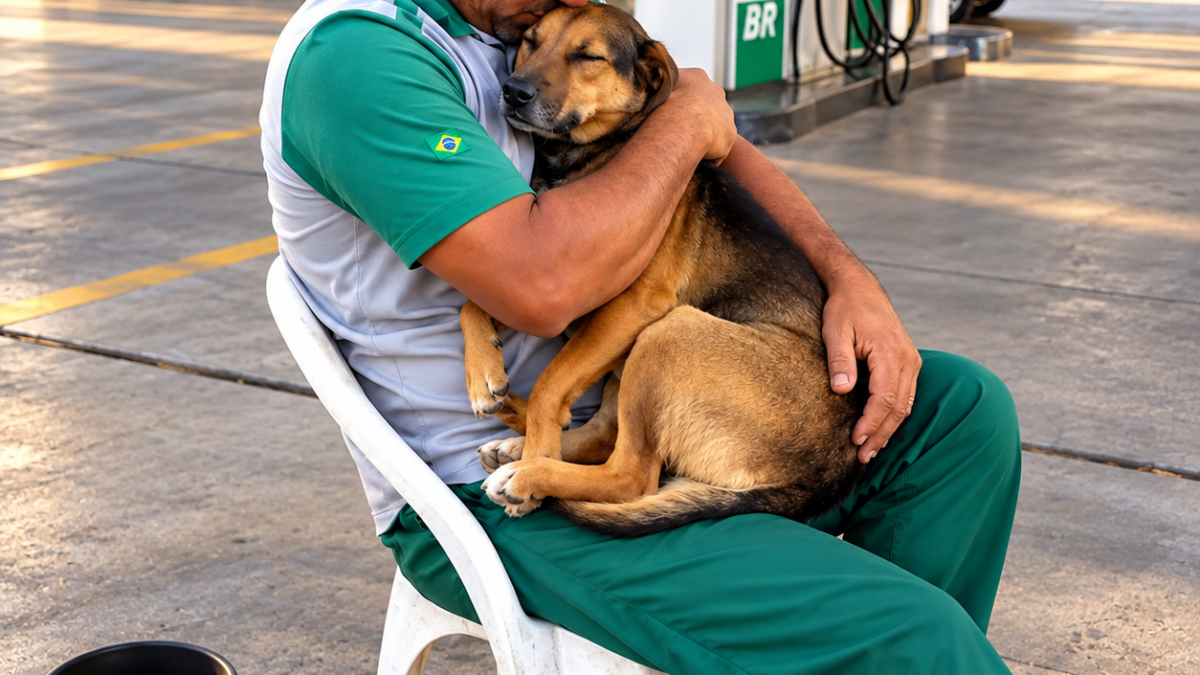
The gas station attendant had no idea I was filming when he sat down between customers, lifted a dusty stray dog into his lap, wrapped both arms around him, and kissed the top of his head as if the animal belonged to someone he loved.
What caught me off guard wasn’t simply the tenderness—it was the way the dog immediately went limp against the man’s chest, eyes closing, paws hanging loose, with the unmistakable trust of an animal that had done this many times before.
Then I noticed two bowls tucked beside the station wall, one filled with clean water and the other with food, and I realized the thirty seconds I was recording were only a tiny piece of a story that had been unfolding there long before I arrived.
I had stopped at the station almost by accident.
I was driving along the coast of São Paulo that afternoon when the fuel light came on. The station wasn’t anything unusual—concrete forecourt, convenience store, a few pumps, trucks passing on the road beyond it.
I pulled beside a pump and waited.
That was when I noticed the dog.
He was medium-sized, thin without looking starved, with the rough coat of an animal that spent most of his life outdoors. He wasn’t begging from customers or wandering between cars.
He was sitting beside one of the attendants.
The attendant finished helping a driver, returned the fuel nozzle, and glanced down.
“Come here, buddy.”
The dog’s tail moved.
The man sat on a low plastic chair near the wall.
Immediately, the dog walked over.
Then something happened that made me reach for my phone.
The attendant bent forward, slid his arms beneath the dog, and pulled him onto his lap.
Not awkwardly.
Not as a joke.
Like this was normal.
The dog curled against him.
The man rubbed both hands slowly along his sides.
“You tired?”
The dog pressed his face beneath the attendant’s chin.
I started recording.
The attendant scratched behind one ear, hugged him closer, and kissed his head.
Once.
Twice.
Then he laughed quietly when the dog tried licking his chin.
“Enough. I’m working.”
The dog ignored him.
A customer pulled into the next pump.
The attendant sighed.
“See? You got me in trouble.”
He carefully lowered the dog.
The dog sat beside the chair while he went back to work.
I watched the entire exchange with a strange tightness in my chest.
There was nothing dramatic about it.
No rescue vehicle.
No emergency.
No injured animal being carried from traffic.
Just an ordinary man in a work uniform giving affection to a dog who apparently had nowhere else to ask for it.
Then I noticed the bowls.
One held water.
Fresh water.
The other contained kibble.
I got out of my car.
When the attendant returned, I pointed toward the dog.
“Is he yours?”
He shook his head.
“No.”
“Someone’s around here?”
“Not that we know.”
The dog walked over and leaned against his leg.
The attendant looked down.
“He just stays.”
“How long?”
He smiled.
“A while.”
Another employee came from the convenience store carrying a small container.
The dog immediately noticed.
“Not again,” the attendant said.
The second worker laughed.
“He didn’t finish breakfast.”
“Because you keep feeding him everything.”
“I feed him dog food.”
“You gave him chicken yesterday.”
“That was different.”
The argument sounded less like coworkers discussing a stray and more like family members arguing over a spoiled pet.
I looked at the dog again.
“Does everyone here take care of him?”
The attendant hesitated, almost embarrassed by the question.
“We just don’t want him hungry.”
He crouched and rubbed the dog’s chest.
“He doesn’t bother anybody.”
The simplicity of the answer stayed with me.
I looked at my phone.
I had captured less than a minute.
Before leaving, I showed him the recording.
“I filmed you. Is that okay?”
He watched a few seconds and immediately laughed.
“I look ridiculous.”
“You look kind.”
He shrugged.
“It’s just a dog.”
But when he said it, his hand automatically reached down and rested on the dog’s head.
I asked whether I could share the clip.
He thought about it.
“As long as people don’t come here bothering him.”
I promised.
I drove away believing I had recorded a sweet little moment that a few friends might appreciate.
That evening, I posted it.
By the time I woke the next morning, my phone had so many notifications that I thought something was wrong.
Then I opened the video.
The number on the screen made me sit upright.
And beneath it were thousands of strangers asking the same question:
**Who is that dog—and who is the man holding him?**
PART 2
I stared at the screen for several seconds before refreshing it.
The number climbed again.
Comments were arriving faster than I could read them.
Some were only hearts.
Some were short.
**This is what kindness looks like when nobody thinks anyone is watching.**
**The dog trusts him completely.**
**Please tell me they feed him every day.**
**Someone needs to help that dog.**
A few people asked whether the attendant could adopt him.
Others wanted the location of the station.
That last part worried me.
I had deliberately avoided identifying the exact place because the attendant had asked me not to send crowds there.
The video had been about a quiet interaction.
I didn’t want that interaction destroyed because hundreds of strangers suddenly wanted photographs.
I scrolled farther.
One comment stopped me.
**The best part is that he wasn’t doing it for the camera. He didn’t even know the camera existed.**
That was exactly what had stayed with me.
I had seen people behave differently when they knew they were being watched.
Everybody has.
Someone sees a phone lifted and suddenly their voice changes.
Their posture changes.
They perform.
This man hadn’t.
He had been tired.
Sweaty from working outside.
Cars were moving around him.
There were no dramatic speeches.
No audience.
He simply had a free moment and used it to make a stray dog feel safe.
I closed the app.
Then opened it again ten minutes later.
More comments.
More shares.
More strangers wanting to know the story.
The problem was that I didn’t know the story.
Not really.
I knew there was a dog.
I knew workers fed him.
I knew one attendant treated him like an oversized child.
Everything else would have been guessing.
So that afternoon, I drove back.
The dog recognized my car before the attendant did.
As soon as I parked, his tail started moving.
“Well,” I said through the open window, “apparently you’re famous.”
He walked toward me.
I stepped out.
The same attendant was working.
When he saw me, his expression immediately changed.
“Oh, no.”
I laughed.
“What?”
“You posted it.”
“I did.”
He pointed at me.
“My sister sent it to me this morning.”
“Is she mad?”
“She called me a celebrity.”
“You don’t sound happy.”
“I pump gas.”
He shook his head.
“I’m not a celebrity.”
The dog leaned against his leg.
I looked down.
“He might be.”
“That, I believe.”
I told him the video had spread much farther than I expected.
His face became serious.
“You didn’t put the address?”
“No.”
“Good.”
“I promised.”
He nodded.
Then another employee came outside.
This was the same man I had seen carrying food the previous day.
He pointed at the attendant.
“Superstar.”
“Go away.”
The second worker laughed.
“You should ask for a raise.”
“I’m going to ask them to transfer you.”
The dog moved between them as though enjoying the attention.
I asked, “Can you tell me more about him?”
Both men looked down.
The first attendant shrugged.
“He showed up.”
“When?”
“A few months ago.”
“What condition was he in?”
That made the joking stop.
The second worker answered.
“Thinner.”
“How thin?”
He held his hands closer together near the dog’s waist.
“You could see more of this.”
“Ribs?”
He nodded.
The first attendant added, “And he didn’t come close.”
That surprised me.
I looked at the dog who had climbed willingly into his lap less than twenty-four hours earlier.
“He was afraid of you?”
“Of everybody.”
“What happened?”
“Nothing.”
I waited.
He smiled.
“We fed him.”
“That’s it?”
“For a while, yes.”
The story came slowly.
Not because they were hiding anything.
Because to them, none of it seemed extraordinary.
The dog had first appeared near the edge of the property one evening.
Nobody knew where he came from.
He lingered beyond the pumps, watching.
One employee left food.
The dog waited until everyone moved away before eating.
The next morning, he was gone.
That evening, he came back.
Food was left again.
For days, the routine repeated.
“He wouldn’t let anyone touch him?” I asked.
“No.”
“Did he growl?”
“Never.”
“Run?”
“Yes.”
The attendant pointed toward a patch of grass beyond the concrete.
“He would stand over there.”
“How did you finally get close?”
He thought about it.
“I stopped trying.”
“What?”
“Every time I walked toward him, he moved away. So I started sitting.”
“Where?”
He pointed toward the same plastic chair where I had filmed them.
“I ate lunch there.”
The second worker laughed.
“He shared lunch.”
“I did not.”
“You absolutely did.”
“I gave the dog meat.”
“That’s sharing.”
The attendant ignored him.
He looked at me.
“For several days, I sat there. I would throw food near him.”
“Did he approach?”
“Closer every day.”
“How long until you touched him?”
“Maybe two weeks.”
“What happened?”
“He touched me first.”
That detail landed harder than I expected.
The attendant smiled slightly at the memory.
“I was sitting. He came behind me. I felt his nose here.”
He touched the back of his elbow.
“I didn’t move.”
“And then?”
“He smelled my hand.”
“Then you touched him?”
“No.”
“Why not?”
“He wasn’t ready.”
That answer was so immediate that I almost forgot my next question.
He continued.
“The next day, he did it again. Then one day he put his head under my hand.”
The dog stood beside him now, listening to nothing we were saying.
The attendant scratched the same spot behind his ear that I had seen him scratch in the video.
“After that, he decided we were friends.”
The second worker shook his head.
“Not friends. Servants.”
“True.”
I crouched.
The dog sniffed my fingers.
Then allowed me to touch his shoulder.
“Does he have a name?”
The two workers exchanged looks.
“Depends who you ask,” the attendant said.
I laughed.
“What do you call him?”
The attendant looked slightly embarrassed.
“Amigo.”
Friend.
The other worker groaned.
“He has other names.”
“What do you call him?”
“Chefe.”
Boss.
That seemed equally appropriate.
Another employee walking past heard us.
“He’s not Chefe. He’s Gordão.”
The first attendant protested.
“He’s not fat.”
“He will be if you keep feeding him.”
Within thirty seconds, three workers were arguing over the correct name of a dog nobody technically owned.
Amigo sat between them wagging his tail.
I understood something then.
He was not owned in the traditional sense.
Nobody had bought him.
Nobody had signed adoption papers.
Nobody had placed a collar around his neck and declared possession.
But he was not entirely homeless either.
He had built a strange kind of home around a fuel station.
His kitchen was beside the office wall.
His water bowl sat near the shade.
His family changed every eight hours depending on who was working.
I asked whether anyone had taken him to a veterinarian.
The atmosphere shifted.
The first attendant looked toward his coworker.
“We talked about it.”
“But?”
“He doesn’t like cars.”
“And nobody knows if he belongs to someone?”
“We asked nearby.”
The second worker added, “Somebody said they had seen him farther down the road before he came here. Nobody knew an owner.”
“Is he neutered?”
They weren’t sure.
“Vaccinated?”
Again, no.
That explained some of the worried comments online.
Food and affection were wonderful.
But a stray animal also needed medical care.
Parasite prevention.
Vaccinations.
An examination.
Possibly neutering.
I told them people online had offered to help.
The first attendant immediately stiffened.
“With money?”
“Some.”
“No.”
The answer was so quick that I blinked.
“What do you mean?”
“We don’t want money.”
“It could help with a vet.”
“We can pay for food.”
“I know. But—”
He shook his head.
“I don’t want people thinking I did that because I wanted something.”
For the first time, I saw how uncomfortable the viral attention made him.
He hadn’t performed compassion.
Now compassion had turned him into content.
I understood the difference.
“I won’t collect money for you.”
“Thank you.”
“But what if a local rescue offered veterinary help directly for the dog?”
He hesitated.
“That’s different.”
“So you’d let someone check him?”
“Yes.”
“Good.”
The dog yawned.
The attendant looked down.
“You see? Everybody discussing his life and he’s bored.”
The next several days became stranger.
The video continued spreading.
A television page reposted it.
Then animal pages.
Then people in other countries.
Messages arrived in Portuguese, English, Spanish.
Someone wrote from Canada.
Another person said they were watching from the Philippines.
I had never expected thirty seconds at a gas station in São Paulo to travel that far.
But the more it spread, the more protective I became of the people in it.
Especially the attendant.
Several pages posted the video with dramatic captions claiming he had “adopted” the dog.
That wasn’t exactly true.
Others claimed the dog had been rescued from abuse.
We had no evidence of that.
One account said the attendant spent “every paycheck” feeding strays.
Also invented.
I began correcting misinformation where I could.
The truth was simpler.
A stray dog appeared.
Workers fed him.
They earned his trust.
One of them loved on him during a break.
Someone happened to record it.
That should have been enough.
I contacted a local animal welfare volunteer named Renata who agreed to help without turning the station into an event.
“We’ll keep it quiet,” she told me.
“What can you do?”
“Examination, vaccines, testing, parasite treatment. If he’s healthy enough, we can schedule neutering.”
“And then?”
“That depends.”
“On what?”
“On whether they want him staying there.”
I hadn’t thought much about that question.
In my mind, Amigo already belonged at the station.
But legally and practically, a dog wandering freely around vehicles created risks.
Traffic.
Customers.
Other animals.
Management.
“What if the station owner says no?”
Renata paused.
“Then we find another solution.”
That sentence stayed with me.
I drove to the station the morning Renata planned to visit.
The attendant was there.
He saw the crate in her vehicle and immediately looked suspicious.
“He’s not going in that.”
Renata laughed.
“We’ll see.”
“He hates cars.”
“So do many dogs.”
Amigo approached her carefully.
Renata didn’t touch him.
She crouched sideways rather than facing him directly.
Smart.
She placed a treat on the ground.
Amigo sniffed.
Ate it.
She placed another closer.
Within five minutes, he was checking her pockets.
The attendant looked betrayed.
“That took me two weeks.”
Renata smiled.
“I brought liver.”
“That’s cheating.”
“It’s professional expertise.”
The basic examination happened right there in a shaded area beside the station.
Amigo tolerated the stethoscope.
He disliked having his paws handled.
He strongly objected to anyone looking inside his mouth.
But he never tried to bite.
Renata checked his ears.
Skin.
Eyes.
Body condition.
“He’s actually doing pretty well.”
The attendant smiled.
“Of course.”
“He needs parasite treatment. Vaccinations. We should test him. And yes, he should be neutered.”
His smile disappeared.
Amigo looked up as if sensing betrayal.
The second worker came over.
“What did she say?”
The attendant answered, “Bad news for him.”
Renata laughed.
We arranged the appointment.
Then management became an issue.
Until that point, I had assumed everyone at the station supported Amigo’s presence.
I was wrong.
Not exactly.
But the situation was more complicated.
The station manager arrived while Renata was still there.
He was a practical man named Sérgio.
He wasn’t cruel.
He also wasn’t sentimental.
He watched the veterinary examination for several minutes.
Then called the attendant aside.
I couldn’t hear everything.
I heard enough.
“Liability.”
“Customers.”
“Cars.”
“Complaint.”
The attendant’s shoulders stiffened.
Amigo sat nearby.
After several minutes, Sérgio walked toward us.
“You’re the person who made the video?”
“Yes.”
He sighed.
“My phone hasn’t stopped.”
“I’m sorry.”
“You didn’t show the station name.”
“No.”
“That helped.”
He looked at Amigo.
“I have nothing against the dog.”
The phrase worried me because people often said that before explaining exactly what they had against the dog.
Sérgio continued.
“But this is a fuel station.”
“I understand.”
“If he runs in front of a vehicle?”
Renata nodded.
“Valid concern.”
“If a customer says he’s afraid?”
“Also valid.”
“If he bites?”
The attendant spoke immediately.
“He doesn’t bite.”
Sérgio turned.
“You cannot guarantee what any animal will do.”
The attendant looked angry.
But Sérgio wasn’t wrong.
That made the conflict harder.
This was not a villain trying to throw a dog onto the road.
It was a manager responsible for employees, customers, safety, insurance, and a business.
Renata stepped in.
“What if we reduce the risks?”
“How?”
“Medical care first. Neutering. Vaccines. Then a designated area away from vehicle traffic.”
Sérgio folded his arms.
“He wanders.”
“Then train him to stay in the safe area.”
The attendant said, “He already stays mostly here.”
“Mostly is not always.”
Silence.
Then I pointed toward the unused strip of shade beside the building.
“What if that became his space?”
Everyone looked.
There was enough room for a shelter.
Bowls.
A bed.
It was separated from the main pump lanes.
Sérgio studied it.
“He cannot sleep inside the store.”
“He doesn’t,” the workers said almost together.
“He cannot approach customers who don’t want him.”
“We can manage that.”
“He has to be clean.”
Renata nodded.
“He will be.”
“And if this becomes a problem?”
The attendant answered.
“We’ll solve it.”
Sérgio looked at him.
“You say that now.”
“I mean it.”
For several seconds, neither man looked away.
Finally Sérgio exhaled.
“Fine.”
The attendant’s expression changed.
“But,” Sérgio added, “you people wanted responsibility for him? Then you have responsibility for him. Not only the fun part.”
That sentence mattered.
Food was easy.
Kisses were easy.
A dog’s real care included appointments.
Bills.
Training.
Cleaning.
Medication.
Bad weather.
Old age.
Responsibility.
The attendant nodded.
“Okay.”
Sérgio looked toward Amigo.
“You hear that?”
Amigo scratched himself.
Sérgio shook his head.
“Useless employee.”
The workers laughed.
A week later, Amigo went to the veterinarian.
Getting him into the vehicle required four people, a trail of treats, and more patience than I knew I had.
Nobody dragged him.
Nobody forced him into panic.
Renata worked slowly.
The attendant climbed into the back first.
Amigo stood outside.
The attendant patted the seat.
“Come on.”
Amigo stared.
“No?”
Nothing.
“You climb onto my lap in front of everybody, but this is where you draw the line?”
The second worker stood behind us.
“He knows where you’re taking him.”
“Be quiet.”
Eventually Amigo placed his front paws inside.
Then backed out.
Again.
Treat.
Paws in.
Back out.
Twenty minutes.
Thirty.
Finally the attendant sat on the floor of the vehicle.
Amigo stepped inside to reach him.
Renata quietly closed the door.
The attendant looked at us.
“I’m going too.”
Nobody argued.
The veterinary tests were reassuring.
No major illness.
Some parasites.
Minor skin irritation.
He needed routine treatment and vaccines.
He was estimated to be a young adult, though nobody could determine his exact age.
After his initial care, neutering was scheduled.
When Amigo returned to the station after the procedure, he wore a protective collar and looked personally betrayed by civilization.
The attendant tried not to laugh.
“You look handsome.”
Amigo stared at him.
“He hates you,” I said.
“He should blame Renata.”
Renata said, “I’m not the one who put him in the car.”
For several days, Amigo’s movements were restricted.
That turned out to be useful.
It gave the staff a chance to establish his new area.
Harmless wooden barriers defined the safe section.
A local carpenter who had seen the video donated a simple raised shelter.
Someone else brought an elevated bed.
The workers rejected a ridiculous number of toys because Amigo showed no interest in most of them.
He liked one rubber ball.
And an old towel.
That was it.
The attendant placed the towel inside the shelter.
Amigo slept on the towel instead of the expensive bed.
“Of course,” the attendant said.
I stood beside him.
“Someone paid good money for that bed.”
“He has taste.”
“He sleeps on concrete.”
“Exactly.”
Over the next month, the station adjusted around him.
So did Amigo.
The workers began using simple commands.
Stay.
Come.
Back.
Wait.
He learned quickly when food was involved.
Less quickly when it wasn’t.
The attendant became his favorite person.
That part never changed.
If two employees called at the same time, Amigo usually chose him.
If the attendant sat down, Amigo appeared.
If he disappeared into the convenience store, Amigo waited by the door.
One afternoon, I arrived and found the attendant eating lunch.
Amigo was sitting beside him.
“What happened to the no-sharing rule?”
“I’m not sharing.”
A piece of chicken disappeared beneath the table.
I raised an eyebrow.
“That fell.”
“Of course.”
“He’s helping clean.”
“Very professional.”
The attendant pointed his fork at me.
“You caused all this.”
“All what?”
He gestured toward the new shelter.
The bowls.
A small sign asking customers not to feed the dog without permission.
The clean bed.
The vaccinated, healthier dog lying at his feet.
“This.”
“I pressed record.”
“Exactly.”
“That’s not the same as causing it.”
He looked down at Amigo.
“No.”
His expression softened.
“He caused it.”
The internet eventually moved on.
It always does.
Another viral video appeared.
Then another.
People stopped messaging me every few minutes.
The view count still climbed, but more slowly.
That relieved everyone at the station.
Normal life returned.
Cars.
Fuel.
Coffee.
Cleaning.
Shift changes.
Rain.
Heat.
Deliveries.
And Amigo.
That was when I started understanding what made the original video matter.
Viral moments can distort ordinary kindness.
They turn seconds into symbols.
The person in the video becomes “the kind gas station worker.”
The dog becomes “the grateful stray.”
The audience sees a perfect little story.
Real life is less tidy.
The attendant sometimes got annoyed when Amigo stepped in freshly cleaned areas.
Once Amigo tore open a bag of trash.
Another time he stole food from a delivery driver.
He barked at a motorcycle and frightened the rider.
Sérgio was furious.
“Again and he stays tied during busy hours.”
The attendant defended him.
“He got excited.”
“That motorcycle almost fell.”
“He didn’t touch him.”
“That is not the point.”
The argument became heated.
For the first time, I saw the attendant truly angry with management.
“You said he could stay.”
“I said he could stay if we manage him.”
“We are managing him.”
“No. You are loving him. Those are not always the same thing.”
The words silenced everyone.
Because Sérgio was right again.
The next week, they brought in a trainer.
Not because Amigo was aggressive.
Because love without structure was not enough to keep him safe.
The trainer taught the workers how to redirect him from motorcycles.
How to reinforce the boundary near the pump lanes.
How to use a long lead safely during high traffic.
How not to reward jumping.
The attendant struggled most with that last one.
“You keep touching him when he jumps,” the trainer said.
“He wants affection.”
“Then affection comes when all four paws are down.”
Amigo jumped.
The attendant immediately rubbed his ears.
The trainer stared.
“What?”
“You just did it.”
“Did what?”
The trainer closed her eyes.
I laughed so hard I had to turn away.
Eventually both of them learned.
Amigo more quickly.
Months passed.
His coat improved.
He gained enough weight that the nickname Gordão became increasingly accurate.
Sérgio finally banned employees from feeding him human food.
The attendant insisted the rule was unnecessary.
Then Renata weighed Amigo.
She looked at the number.
Then looked at him.
Then looked at the workers.
“Who is feeding him?”
Everyone suddenly became interested in something else.
Renata pointed at the attendant.
“You.”
“No.”
Amigo sat directly beside him.
“Traitor,” the attendant muttered.
His portions were adjusted.
Treats became controlled.
Amigo reacted to the diet exactly as expected.
He searched for secondary sources.
Truck drivers.
Customers.
The convenience-store cashier.
One elderly man who stopped every Thursday.
It became a station-wide operation.
“Do not feed the dog.”
Customers would ask, “Why?”
“Because six people already fed the dog.”
Amigo perfected an expression of profound starvation.
It fooled newcomers.
Regulars knew better.
One morning, I arrived early.
The station was quiet.
The attendant was sweeping near Amigo’s area.
Amigo lay on his side watching.
I leaned against the wall.
“Do you ever think about where he came from?”
The attendant stopped sweeping.
“Yes.”
“You think someone abandoned him?”
“Maybe.”
“Think he had a home?”
He considered it.
“He knew people.”
“What makes you say that?”
“He was afraid, but not wild.”
I nodded.
“He understands doors. Cars scare him, but houses don’t. He knew food bowls.”
“Do you wish you knew?”
He looked at Amigo.
“Sometimes.”
“And sometimes?”
“I don’t care.”
That answer surprised me.
He saw my expression.
“I mean, if there is someone looking for him, I want them to find him.”
“Of course.”
“But if nobody is looking?”
He rested the broom against the wall.
“Then why keep making him live in what happened before?”
I looked at the dog.
Amigo rolled onto his back.
The attendant scratched his belly with one foot.
“He knows where breakfast is now.”
That was enough for him.
Maybe it should have been enough for me.
But the internet has a way of creating questions people feel entitled to have answered.
Even months later, strangers still messaged.
**Did the worker adopt the dog?**
**Does he live at the gas station?**
**Is he safe?**
**Who owns him?**
I never knew how to answer the last one.
The station?
The attendant?
All the workers?
Nobody?
Eventually, the question answered itself.
One night, heavy rain hit the coast.
Not gentle rain.
The kind that turns roads shiny and sends water across concrete in sheets.
I wasn’t there.
I heard the story the next morning from the attendant and Sérgio.
Amigo had shelter.
The workers had reinforced it.
But thunder terrified him.
That was something nobody knew until the storm.
At the first major crack of thunder, he bolted from the shelter.
His lead was not attached because the station was nearly empty.
He ran toward the road.
The attendant saw him.
“Amigo!”
The dog kept going.
Another thunderclap.
Traffic was moving slowly because of the rain, but there were still cars.
The attendant ran.
Sérgio shouted at him.
“Stop!”
He didn’t.
Amigo reached the edge of the property.
Then froze.
Headlights moved through the rain.
The attendant stopped several yards behind him.
If he chased, Amigo might run farther.
So he crouched.
Right there in the rain.
“Amigo.”
The dog looked back.
The attendant held out both hands.
“Come here.”
Thunder again.
Amigo flinched.
“Come on.”
For several seconds, nothing happened.
Then Amigo turned.
He ran back.
Straight into the attendant’s chest.
The man wrapped his arms around him.
Amigo was shaking.
The attendant was soaked.
Sérgio reached them.
“Inside.”
Rules said Amigo did not enter the convenience store.
Nobody argued that night.
They brought him into a back utility room away from customers and fuel areas.
The attendant sat on the floor.
Amigo climbed halfway onto his lap.
Exactly like the moment I had filmed months earlier.
Except this time there was no camera.
No internet.
No audience.
Only thunder.
A frightened dog.
And the person he trusted most.
The attendant stayed after his shift ended.
“How long?” I asked.
He shrugged.
“Until the storm passed.”
“You were supposed to leave?”
“Yes.”
“Why didn’t you?”
He gave me the same expression he had given me the first day.
As though the answer should have been obvious.
“He was scared.”
That was all.
Sérgio stood nearby listening.
Then he said something I never expected.
“He should have somewhere indoors for storms.”
The attendant looked at him.
“You’re allowing that?”
“A safe room. Only during extreme weather. Not near customers.”
The attendant smiled.
Sérgio pointed.
“Do not make me regret it.”
“I won’t.”
Sérgio looked down at Amigo.
“I was talking to him.”
After that, nobody at the station used the word stray very often.
Not because his legal status suddenly transformed.
Because the word stopped matching what everyone saw.
A stray is a dog passing through.
Amigo wasn’t passing through anymore.
He had a morning routine.
He knew shift changes.
He recognized the sound of Renata’s vehicle and occasionally tried hiding because he associated her with medical appointments.
He knew which employees allowed extra treats.
He knew Sérgio pretended not to like him.
That last part became increasingly obvious.
One afternoon, I arrived earlier than usual.
Sérgio was sitting outside the office.
Amigo’s head was resting on his knee.
Sérgio was scratching behind his ear.
I raised my phone jokingly.
Sérgio immediately pointed at me.
“Do not.”
I laughed.
“Why?”
“I have a reputation.”
“As what?”
He looked down at Amigo.
“Someone with standards.”
Amigo rolled onto his side.
Sérgio continued scratching.
“Very strict standards.”
I put my phone away.
Some moments deserved not to travel.
The original video had already done more than enough.
Nearly a year after I recorded it, I visited on the same kind of warm afternoon.
The attendant was helping a customer.
Amigo was asleep in the shade.
His water bowl was full.
The food bowl had been put away because it wasn’t mealtime.
His shelter had been repaired twice.
A laminated card nearby listed emergency veterinary numbers and his basic medical information.
The workers had organized a small fund among themselves for routine care.
Not an online fundraiser.
Not charity.
Their own arrangement.
Each person put in a little when needed.
Sérgio contributed too.
He denied this.
The spreadsheet disagreed.
Renata had kept records.
Amigo woke when I approached.
His tail struck the ground.
“Hey.”
He stood.
Walked over.
Leaned into my leg.
I scratched his neck.
The attendant finished with the customer and came toward us.
“He remembers you.”
“He remembers everyone.”
“No.”
The attendant shook his head.
“He ignores plenty of people.”
“Still making me feel special?”
“Maybe.”
He sat on the same plastic chair.
Amigo immediately stepped between his knees.
The attendant opened his arms.
“Come on, then.”
Amigo climbed up.
He was heavier now.
Much heavier.
The attendant grunted.
“You need to lose weight.”
Amigo settled across his lap anyway.
“You see this?” the attendant said to me. “This is your fault.”
“How?”
“People saw the video and started telling him he was beautiful.”
“So?”
“Now he thinks he’s important.”
Amigo rested his chin against the man’s shoulder.
The attendant smiled.
Then kissed the top of his head.
Exactly like the first time.
I didn’t record.
I stood there.
That difference mattered to me.
The first time, the tenderness surprised me because I thought I was witnessing something rare.
A year later, I understood I had witnessed something ordinary for them.
That was better.
The kiss in the video had not been exceptional.
It was routine.
The full water bowl was routine.
The food was routine.
The vet visits had become routine.
The concern when storms arrived was routine.
Calling him back from traffic was routine.
Arguing about his weight was routine.
Cleaning his shelter was routine.
Love, when it lasts, often looks less dramatic than the moment that introduces it.
The internet had seen thirty seconds.
Amigo lived inside the hours nobody recorded.
One afternoon, a family stopped for fuel.
A little girl saw him and asked her father whether she could pet him.
The attendant heard.
He crouched beside Amigo.
“Slowly.”
The child approached.
Amigo sniffed her hand.
The attendant watched his body carefully.
Relaxed.
Tail low and moving.
“Here,” he said, showing her where to touch.
She stroked Amigo’s shoulder.
“He’s soft.”
“Because he gets more baths than I do.”
The child laughed.
Her father recognized the attendant.
“Wait.”
He took out his phone.
“Are you the guy from that video?”
The attendant closed his eyes.
I started laughing.
The father showed the screen.
The old clip.
There it was.
The attendant in his uniform.
Amigo thinner.
The plastic chair.
The hug.
The kisses.
The attendant shook his head.
“That thing will never die.”
The father smiled.
“My wife sent me this months ago.”
He looked at Amigo.
“So this is him?”
“This is him.”
“He stayed?”
The attendant looked down.
Amigo was leaning against the little girl.
“Yeah.”
The father’s expression softened.
“Good.”
Then something happened I loved.
He didn’t ask for a picture.
Didn’t ask the attendant to recreate the hug.
Didn’t ask Amigo to perform.
He simply thanked him.
“For what?” the attendant asked.
The man shrugged.
“For being decent.”
The attendant looked genuinely uncomfortable.
“I fed a dog.”
The father nodded.
“Sometimes that’s enough.”
Then his family left.
The attendant stood beside me watching their car pull away.
“I still don’t understand why people care so much.”
“You really don’t?”
“No.”
I looked toward Amigo.
He had returned to his water bowl.
“Maybe people see a lot of bad things.”
“That’s true.”
“Maybe seeing someone be gentle when he doesn’t have to be reminds them something good still exists.”
The attendant frowned.
“That sounds dramatic.”
“It probably is.”
He smiled.
“You’re the one with the camera.”
Fair point.
Another year passed.
Amigo became part of the station’s identity without anyone formally deciding it.
Regular drivers asked about him.
Delivery workers knew him.
Some people brought appropriate dog treats after checking with staff.
The workers kept the food controlled.
Renata continued vaccinations and parasite prevention.
The trainer returned twice for refresher sessions.
Amigo learned to stay away from motorcycles.
Mostly.
When he forgot, one command brought him back.
The station never became a sanctuary.
The staff did not start collecting dozens of animals.
There were limits.
That mattered too.
Kindness does not require solving every problem in the world.
Sometimes it means taking responsibility for the life already sitting in front of you.
A second stray appeared once.
A young female.
She stayed two days.
The employees fed her and contacted Renata.
She was eventually placed with a foster family.
The attendant looked almost disappointed.
“You wanted another one?” I asked.
“No.”
“You’re lying.”
“One is enough.”
Amigo stood behind him.
The second worker walked past.
“He wanted to keep her.”
“I did not.”
“You named her.”
“That means nothing.”
“What did you call her?” I asked.
The attendant refused to answer.
That told me everything.
By then, the original viral video felt like another lifetime.
Occasionally it resurfaced.
Someone would repost it.
New comments would appear.
People would ask for updates.
So I posted one.
No dramatic music.
No recreated scene.
Just Amigo lying under the shade at the station while the attendant cleaned his water bowl.
I wrote that he was safe.
Healthy.
Vaccinated.
Neutered.
Fed.
Loved by the people who worked there.
I explained that the station had become his home and that the workers had taken responsibility for his ongoing care.
The update spread too.
Not as widely as the original.
That seemed right.
The dramatic discovery had captured attention.
The maintenance of love was quieter.
One comment beneath the update stayed with me.
**The first video showed kindness. The second shows commitment.**
I saved that comment.
Because there is a difference.
Anyone can feel something for a suffering animal.
The emotion comes naturally.
You see hunger.
You feed.
You see fear.
You comfort.
But tomorrow arrives.
And the next day.
Food runs out.
Vaccines are due.
The dog makes a mess.
He barks.
He gains weight.
He gets scared during storms.
He nearly runs toward traffic.
He needs training.
He may eventually become old.
The question is not only whether you were kind once.
It is whether kindness survives inconvenience.
At that station, it did.
I saw it when the attendant stayed after his shift during the storm.
I saw it when Sérgio changed a rule he had made for legitimate reasons because circumstances changed.
I saw it when workers stopped overfeeding Amigo even though giving treats was easier than saying no.
I saw it when they learned training commands.
When they cleaned his shelter.
When they pooled money quietly for medication.
When nobody was recording.
Especially then.
Years later, I stopped at the station again after being away from that stretch of coast for several months.
I wondered whether Amigo would remember me.
The station looked almost exactly the same.
Same pumps.
Same small store.
A newer sign.
Different advertising posters.
I parked.
For several seconds, I didn’t see him.
My chest tightened.
Then a gray muzzle appeared from inside the shaded shelter.
Amigo stood.
Slowly.
He was older.
There was no denying it.
White fur had appeared around his face.
His movements were less elastic.
The explosive run of a young dog had become a measured walk.
But his tail began moving.
I crouched.
“Hey, old man.”
He came to me.
Pressed his body against my legs.
I buried my fingers in his coat.
The attendant came from the pumps.
He had changed too.
Same smile.
A little older.
“You disappeared.”
“I had work.”
“Excuses.”
“How is he?”
The question made him look toward Amigo.
“Older.”
“I can see.”
“Some arthritis.”
“Serious?”
“Managed.”
“Still healthy?”
“Yes.”
Amigo sat between us.
The attendant touched the white fur around his muzzle.
“He sleeps more.”
“That sounds familiar.”
“He has earned it.”
We moved toward the shade.
The original plastic chair was gone.
In its place were two sturdier chairs.
The shelter was larger.
Amigo’s bed was thicker.
The attendant sat.
Amigo looked at him.
“No.”
Amigo stepped closer.
“You’re too heavy.”
Amigo placed one front paw on his leg.
The attendant sighed.
“Every time.”
He helped the old dog up.
Amigo settled awkwardly across him.
He no longer fit.
Maybe he never had.
The attendant adjusted his weight carefully to protect his joints.
Then wrapped one arm around his chest.
I stood a few feet away.
For a second, I saw the original moment layered over the present.
The younger dog.
The thinner body.
The same trusting collapse.
The same arms.
The attendant rubbed his cheek against Amigo’s head.
“Old man.”
Amigo closed his eyes.
I instinctively touched my pocket.
My phone was there.
I could have recorded it.
Another beautiful clip.
Maybe another wave of shares.
An aging stray who had found a family in an unlikely place.
People would have loved it.
I left the phone where it was.
Some moments had already given enough to strangers.
This one belonged to them.
The attendant looked at me.
“No camera?”
“No.”
“Finally learned.”
“Maybe.”
Amigo opened one eye.
Then closed it.
Cars arrived.
Fuel pumps clicked.
Someone called for assistance.
The attendant looked toward the forecourt.
“I have to work.”
But he didn’t move immediately.
He gave Amigo another few seconds.
Then lowered him carefully onto the bed.
“Stay.”
Amigo sighed and remained there.
The attendant returned to the pump.
I sat in the other chair.
For a while, I watched ordinary life move around the dog.
A truck driver paid.
A woman bought water.
An employee swept the concrete.
Sérgio came outside, saw me, and nodded.
He looked at Amigo.
“Did he eat?”
The attendant shouted from the pump.
“Yes.”
Sérgio looked at me.
“He lies.”
“Who?”
“The dog.”
“How?”
“He tells everyone he’s starving.”
Amigo lifted his head.
Sérgio pointed at him.
“See?”
I laughed.
Sérgio crouched.
He checked the water bowl.
Clean.
Full.
Then, believing I wasn’t paying attention, he rubbed Amigo’s forehead twice before standing.
I said nothing.
He gave me a suspicious look anyway.
“No video.”
“No video.”
“Good.”
He went back inside.
The sun moved lower.
The air cooled.
Amigo fell asleep.
His paws twitched once.
Maybe he was dreaming.
I wondered briefly whether dogs remember hunger after they stop being hungry.
Whether they remember the first person who sat still long enough to let them choose trust.
Whether Amigo remembered standing at the far edge of the station refusing to approach.
No one could answer that.
It no longer seemed important.
He knew the attendant’s voice now.
He knew where water appeared every morning.
He knew thunder meant someone would open a safe room.
He knew Renata meant unpleasant medical procedures but also treats afterward.
He knew Sérgio’s fake irritation.
He knew the rhythm of shifts.
He knew this place.
Whatever his life had been before, he had built another one here.
When I finally stood to leave, the attendant walked over.
“You’re not posting anything?”
“Not today.”
He smiled.
“Good.”
Then he surprised me.
“But send me the old video.”
“You don’t have it?”
“My sister does. Everybody has it except me.”
I laughed.
“I’ll send it.”
He glanced at sleeping Amigo.
“I want to keep it.”
“Why now?”
The attendant thought for a moment.
“Because he looks young.”
That sentence hit me harder than anything dramatic could have.
I sent it to him before leaving.
The next day, he messaged me.
Only one sentence.
**I forgot how skinny he was.**
I looked at the old video again.
He was right.
At the time, I had thought Amigo looked reasonably healthy.
Compared with the dog he became, he had been thin.
His coat had been duller.
His body smaller.
His face younger.
And the attendant had been younger too.
The video wasn’t only a record of kindness anymore.
It was a record of the beginning.
Not the beginning of Amigo’s life.
Not even the beginning of his arrival at the station.
The beginning of the part strangers were lucky enough to see.
Years later, people still occasionally send me that clip without realizing I filmed it.
They write:
**Have you seen this?**
I usually smile.
Sometimes I answer.
Sometimes I don’t.
The video belongs to the internet now.
But the memory belongs to me.
I remember what happened before I pressed record.
The attendant finishing with a customer.
The dog waiting.
The tired way the man sat down.
The tiny movement of Amigo’s tail.
I remember what happened after I stopped recording.
The attendant lowering him gently because another car arrived.
The bowls beside the wall.
The casual argument over who had fed him too much.
The way everyone acted as though none of it deserved attention.
That is the part I think about most.
People often imagine kindness as something dramatic.
A rescue.
A sacrifice.
A heroic act witnessed by crowds.
Sometimes it is.
But often it looks like a bowl filled before a shift begins.
A hand reaching down between customers.
A worker sitting in a plastic chair because a frightened animal will only approach if nobody chases him.
A manager reconsidering a rule.
Coworkers putting a few bills aside for vaccines.
Someone staying late because thunder scares a dog.
A kiss on the top of a dirty head when you believe nobody is watching.
The internet saw a gas station employee hugging a stray dog.
I eventually saw something larger.
I saw a dog slowly stop being a stray.
There was no adoption ceremony.
No ribbon.
No official moment when everyone gathered and declared that Amigo belonged.
Belonging happened quietly.
One meal at a time.
One bowl of water.
One vaccination.
One command learned.
One storm survived.
One afternoon nap.
One lap that became too small years before the dog stopped trying to climb into it.
The last time I visited, Amigo woke just as I reached my car.
He stood at the edge of his shaded area.
I opened the door.
“Stay.”
His ears moved.
The attendant was busy at another pump.
Amigo looked toward him.
Then back at me.
I raised one hand.
“Take care of them.”
He wagged his tail once.
I laughed at myself.
Asking an old dog to take care of adults.
Then I looked toward the attendant.
He had finished with the customer.
He turned.
Saw Amigo standing.
Immediately pointed toward the bed.
“Go lie down.”
Amigo ignored him.
The attendant walked over.
“You’re impossible.”
He bent down.
Amigo pushed his head against the man’s chest.
The attendant wrapped one arm around him.
No phone appeared.
Nobody applauded.
Most customers never noticed.
And that was exactly how I wanted to remember them.
Not as the man from a viral video.
Not as the stray dog who made thousands of people emotional.
Just two friends at a gas station on the coast of São Paulo, sharing another ordinary moment while the rest of the world kept moving around them.
A few months after that visit, I received a message from the attendant just before sunrise.
There was no greeting.
No explanation.
Only a photograph.
Amigo was lying on his bed beneath the station awning, his gray muzzle resting between his paws. Beside him sat the attendant, still wearing his uniform, one hand resting lightly on the dog’s shoulder.
Underneath the photograph were six words.
He had a difficult night yesterday.
I stared at the message longer than I should have.
With older dogs, certain sentences carry weight before anyone explains what they mean.
I called him.
He answered almost immediately.
“What happened?”
There was a pause.
“He couldn’t stand.”
My stomach tightened.
“For how long?”
“I don’t know. Maybe a minute. Maybe two.”
“Did you take him to Renata?”
“Yes.”
“What did she say?”
“He’s home.”
That answer didn’t help.
“Tell me what she said.”
The attendant exhaled.
“His hips are worse. Arthritis. She thinks the weakness came from pain and maybe the cold. They did bloodwork too.”
“And?”
“Nothing terrible.”
I closed my eyes.
“Okay.”
“But…”
There it was.
“But what?”
“He’s old.”
I sat on the edge of my bed.
We had known that.
We had joked about the gray muzzle.
The slow walk.
The extra naps.
But saying he’s old in that tone made age stop being a funny detail.
It became a deadline none of us could see.
“How old do they think?”
“No one knows exactly.”
“Right.”
“Maybe ten. Maybe twelve. Maybe older.”
I heard traffic in the background.
He was already at work.
“Did he eat?”
“Yes.”
“Drink?”
“Yes.”
“Walk?”
“A little.”
“Then today is today.”
The attendant was quiet.
That phrase sounded familiar.
It reminded me of something I had once said to someone else about a sick animal.
I wasn’t sure whether I believed it more now or simply needed to.
Finally he said, “He tried climbing into my lap this morning.”
I smiled despite myself.
“Of course he did.”
“I told him no.”
“And?”
“He ignored me.”
“Of course he did.”
“He’s too heavy.”
“You’ve been saying that for years.”
“He’s still too heavy.”
I laughed.
Then the attendant’s voice changed.
Softer.
“He couldn’t get his back legs up.”
The laughter disappeared.
“What did you do?”
“What do you think?”
I knew.
“You lifted him.”
“Yes.”
“And he stayed?”
“Almost an hour.”
I looked at the photograph again.
The attendant’s hand on Amigo’s shoulder.
Amigo’s eyes half closed.
The station beginning another ordinary day around them.
“I’ll come this week.”
“You don’t have to.”
“I know.”
That was why I went.
When I arrived three days later, I almost missed Amigo.
He wasn’t in his usual bed.
The attendant pointed toward the office.
“Inside.”
“During the day?”
“He’s been cold.”
That single decision told me more than a medical report could have.
Years earlier, Sérgio had carefully negotiated when the dog could enter enclosed areas.
Storms.
Emergencies.
Temporary exceptions.
Now nobody was counting.
I walked toward the side office.
Amigo was lying on a thick mat beneath a desk fan that had been turned off despite the heat outside.
A small blanket covered part of his back.
Sérgio sat at the desk doing paperwork.
I stopped in the doorway.
“You let him take over the office?”
Sérgio didn’t look up.
“He is a temporary guest.”
“How temporary?”
“Very.”
Amigo raised his head at the sound of my voice.
His tail struck the mat.
Once.
Twice.
I crouched.
“Hey, buddy.”
He started to stand.
I immediately held up my hand.
“No, no. Stay.”
He ignored me.
His front legs lifted first.
Then his rear legs struggled.
For a second, his body trembled.
Sérgio pushed his chair back.
“Slow.”
Amigo finally stood.
He walked toward me.
The gait was stiff.
Careful.
But when he reached me, he pushed his head into my chest with the same confidence he had shown for years.
I wrapped my arms around him.
He smelled like shampoo and fuel station dust.
“You’re supposed to be resting.”
His tail moved.
Sérgio said, “He has never understood instructions.”
“I’ve noticed.”
“He understands food.”
“Selective intelligence.”
“Very selective.”
The attendant appeared behind me carrying Amigo’s water bowl.
“He got up?”
“Yes.”
“I told him not to.”
Sérgio looked at him.
“He ignored you too?”
“Yes.”
“Good. I feel less insulted.”
The attendant set down the bowl.
Amigo drank.
Then he stood there as though unsure what to do next.
The attendant patted the mat.
“Come on.”
Amigo looked toward him.
“Bed.”
Amigo took one step.
Stopped.
The attendant walked closer.
He didn’t pull.
He simply placed one hand beneath Amigo’s chest and another near his hip.
“Easy.”
Together, they crossed the few feet back to the mat.
That was the first time I saw their relationship reverse.
Years earlier, the dog had needed emotional safety.
Now he needed physical help.
The attendant gave it without embarrassment.
Without frustration.
Without making Amigo feel helpless.
He simply adjusted.
That afternoon, Renata arrived.
She examined Amigo while the attendant hovered so closely that she finally looked up.
“Do you want to become a veterinarian?”
“No.”
“Then move.”
“I’m helping.”
“You’re breathing on me.”
He stepped back approximately six inches.
Renata stared.
“Farther.”
He moved another foot.
Amigo looked between them.
I laughed.
“You created this.”
Renata ignored me.
She flexed Amigo’s rear leg carefully.
He tensed.
“There.”
The attendant immediately leaned forward.
“What?”
“Pain.”
“We know that.”
“I’m checking where.”
She continued.
Amigo tolerated the examination better than he had when younger.
Maybe age had mellowed him.
Maybe he trusted everyone in that room.
Or maybe he had learned that Renata’s annoying hands usually led to feeling better afterward.
When she finished, she sat on the floor beside him.
“We adjust medication.”
“That’s it?” the attendant asked.
“For now.”
“Can you fix it?”
Renata looked at him.
That was not a medical question.
Not really.
“You know arthritis doesn’t disappear.”
“Yes.”
“We control pain. We keep him moving enough to maintain strength without overworking him. We watch his weight.”
She looked directly at the attendant.
“No chicken.”
“I don’t give him chicken.”
Every person in the room looked at him.
He raised both hands.
“Not much.”
Renata continued.
“Soft bedding. Avoid slippery floors. Short walks. No jumping.”
“He doesn’t jump.”
“Good.”
“What about the chair?”
“What chair?”
I explained the lap situation.
Renata stared at him.
“He still puts this dog on his lap?”
“He puts himself there.”
“That does not answer the question.”
The attendant looked offended.
“He likes it.”
“And when he tries?”
“I help.”
Renata sighed.
“If you support him safely and he’s comfortable, fine.”
The attendant smiled victoriously.
“See?”
“That was not permission to carry him around like a baby.”
He immediately looked less pleased.
Amigo slept through the argument.
That became our routine for the next year.
Not every day.
But enough that I watched old age settle onto him in stages.
Medication increased.
Walks shortened.
The shelter received another layer of padding.
A rubber mat covered the slippery tile in the office.
Workers learned to keep pathways clear.
Sérgio installed a small ramp over a step near the staff area.
He claimed the ramp was for deliveries.
Nobody believed him.
One morning I found Amigo standing at the bottom of it while Sérgio coaxed him up with a treat.
“You know,” I said, “deliveries rarely eat biscuits.”
Sérgio turned.
“You saw nothing.”
“Of course.”
“Nothing.”
Amigo ate the treat.
The attendant laughed from across the station.
“Caught you.”
Sérgio pointed toward him.
“You are still on thin ice.”
Nobody knew what that meant anymore.
By then, even customers had adapted.
Regulars no longer tried getting Amigo excited.
People who remembered the younger dog learned to crouch instead of calling him across the forecourt.
Children were told to approach quietly.
The sign near his bed changed.
Originally it had said:
PLEASE DO NOT FEED THE DOG WITHOUT ASKING STAFF.
Someone added another beneath it:
AMIGO IS OLD NOW. PLEASE LET HIM COME TO YOU.
I loved that sign.
It gave him dignity.
Old animals spend years adapting to human schedules.
Eventually humans should return the favor.
There were good months.
Very good months.
On warm days Amigo still walked the entire length of the safe area.
He still barked occasionally when motorcycles arrived, though the bark sounded deeper and less committed.
He still recognized Renata’s vehicle.
He still distrusted baths.
He still manipulated unfamiliar customers into believing he hadn’t eaten in weeks.
Once, I watched him receive a treat from a truck driver.
Five minutes later another driver arrived.
Amigo performed the same routine.
Sad eyes.
Head slightly lowered.
Tiny tail movement.
The attendant came running.
“No.”
The second driver looked confused.
“He looks hungry.”
“He ate ten minutes ago.”
Amigo stared at the ground.
“He looks starving.”
“He is an actor.”
The driver gave him half the treat anyway.
The attendant groaned.
“This is why he’s fat.”
Amigo chewed happily.
Some things age never changes.
Then came the morning he refused breakfast.
The attendant called me again.
This time, he did not need to explain why it mattered.
Amigo never refused food.
Not once in all the years I had known him.
By the time I reached the station, Renata had already taken him to the clinic.
The attendant had gone with her.
Sérgio stood near the empty bed.
“Any news?”
“No.”
He kept wiping the same clean section of counter with a cloth.
I sat.
Neither of us spoke for several minutes.
Finally I said, “You’re worried.”
He stopped wiping.
“He didn’t eat.”
“I know.”
“He always eats.”
“I know.”
Sérgio looked toward the road.
“I used to think keeping him here was a stupid idea.”
“I remember.”
“I was not wrong.”
I smiled faintly.
“No?”
“No. It was a stupid idea.”
He folded the cloth.
“But sometimes stupid ideas become responsibilities.”
“That sounds almost affectionate.”
“Don’t ruin it.”
Another hour passed.
Then the attendant’s car appeared.
He got out alone.
That frightened me.
I stood.
“Where is he?”
“At the clinic.”
“What did they find?”
He walked toward us.
His face looked different.
Not devastated.
Not relieved.
Tired.
“Kidneys.”
Sérgio went still.
“How bad?”
“They’re not sure.”
He explained what Renata had told him.
The bloodwork showed kidney values that concerned them.
Maybe dehydration.
Maybe infection.
Maybe age-related disease.
More tests were needed.
Fluids.
Observation.
Amigo would stay overnight.
The attendant sat in the plastic chair where I had first filmed him years earlier.
For once, there was no dog climbing into his lap.
He looked at the empty space.
“I hate this chair.”
I sat beside him.
“No, you don’t.”
“No.”
He rubbed his face.
“I hate it empty.”
That night, the station workers did something I had never seen before.
They closed Amigo’s safe area completely.
Not because it was necessary.
Because nobody wanted another dog using it.
His bed remained.
Water bowl.
Shelter.
Rubber ball.
Old towel.
Everything untouched.
The station looked as if Amigo had stepped away for five minutes.
Maybe that was easier.
He came home two days later.
The kidney issue was manageable.
Not curable.
Manageable.
Medication.
Diet.
Regular bloodwork.
More water.
Closer monitoring.
The attendant received the instructions like someone being handed custody of a fragile machine.
“How much water exactly?”
“Available all the time.”
“It already is.”
“Good.”
“How much food?”
Renata showed him.
He stared at the portion.
“He’ll think I hate him.”
“He will survive.”
“Barely.”
“Stop.”
The special diet became the next great betrayal of Amigo’s life.
He smelled it.
Looked at the attendant.
Looked at the bowl.
Then looked back at the attendant.
“You have to eat.”
Amigo walked away.
The attendant looked at me.
“He hates it.”
“He hasn’t even tasted it.”
“He knows.”
Sérgio came outside.
“What’s happening?”
“He won’t eat.”
Sérgio looked into the bowl.
“I wouldn’t eat that.”
Renata, who was still there, turned.
“None of you are helping.”
Eventually hunger won.
Amigo ate.
Slowly.
Suspiciously.
Then checked the attendant’s pockets afterward in case real food still existed.
For months, he stabilized.
That gave everyone time to pretend nothing had changed.
But I noticed the attendant taking more photographs.
Not videos.
Photographs.
Amigo sleeping.
Amigo drinking.
Amigo sitting beneath the station sign.
Amigo staring at a sandwich.
Amigo with Sérgio.
Amigo beside Renata.
One afternoon I asked why.
He shrugged.
“My sister says I never take pictures.”
“That’s true.”
“So?”
“So why now?”
He looked at Amigo.
“Because later I might want them.”
There was no good answer.
I understood.
During those months, the old viral video resurfaced again.
A major account reposted it with a caption about “humanity still existing.”
Millions of new people watched.
Messages returned.
Strangers asked for an update.
For the first time, the attendant agreed to appear in one.
We kept it simple.
I filmed from several feet away.
He sat beside Amigo rather than placing him on his lap.
The dog was too stiff for that now.
The attendant rubbed his chest.
I asked, “Do you remember when he first came here?”
“Yes.”
“What was he like?”
“Skinny.”
Amigo opened one eye.
“Scared.”
The attendant scratched his neck.
“Annoying.”
I laughed.
“What changed?”
“He got less scared.”
“And less skinny?”
“Much less skinny.”
“What about annoying?”
“Worse.”
His smile faded slightly.
Then he looked down.
“He stayed.”
That was the line people shared most.
Not anything poetic.
Just:
He stayed.
Maybe because it worked both ways.
Amigo stayed.
So did they.
The updated video reached some of the same people who had watched the first.
Comments poured in.
People noticed the gray muzzle.
The slower movements.
One person wrote:
I watched the original when my son was a baby. He is in school now. I can’t believe this dog is still there.
Time does strange things when measured through animals.
Years that feel ordinary to us become entire lifetimes around them.
One day a puppy.
Then adult.
Then gray.
All while we are busy believing very little has changed.
The attendant read that comment three times.
“My niece was a baby when he came.”
“How old now?”
“Seven.”
He looked at Amigo.
“That’s impossible.”
“It isn’t.”
“I don’t like it.”
“Neither do I.”
The final winter I knew Amigo, storms came frequently.
Thunder still frightened him.
Age had not softened that fear.
If anything, he became more anxious.
The first rumble would make his ears flatten.
Staff stopped waiting for the storm to worsen.
Someone simply opened the office.
“Come on.”
Amigo walked inside.
No rule discussion.
No permission.
Home had expanded enough to include the doorway.
One stormy evening, I happened to be there.
Rain hammered the metal roof.
Amigo lay on his mat.
The attendant sat on the floor beside him.
A bolt of lightning flashed.
Thunder followed almost immediately.
Amigo raised his head.
The attendant placed one hand against his chest.
“It’s okay.”
Another rumble.
Amigo shifted closer.
The attendant adjusted his legs.
“Come here.”
With difficulty, Amigo pushed himself partially onto the man’s lap.
Not all the way.
His body was too large and too stiff.
So the attendant sat against the wall with Amigo’s head and shoulders across his thighs.
He stroked the white fur around his face.
I remembered the first video.
The younger dog completely curled against him.
Kisses.
Laughter.
A customer arriving.
The attendant pretending affection was nothing special.
Now the room was dim.
Rain surrounded us.
Neither of them was young anymore.
The attendant kissed Amigo’s forehead.
“You’re okay.”
I turned toward the window.
Not because I wanted to give them privacy.
Because my eyes had filled.
Later, when the storm passed, Amigo did something unexpected.
He stood.
Walked toward the doorway.
Then looked back.
The attendant got up.
“What?”
Amigo walked outside.
Slowly.
Across the wet concrete.
Toward his old bed.
He circled once.
Lay down.
The attendant shook his head.
“You have an office.”
Amigo sighed.
“He prefers the view,” I said.
“He prefers making my life difficult.”
But he covered the dog with a dry towel anyway.
The following morning, Amigo ate breakfast.
A month later, he stopped again.
This time, the tests were worse.
I knew before anyone called me.
Maybe some part of you learns to recognize the shape of bad news.
The attendant sent:
Can you come?
I drove immediately.
Amigo was at the clinic.
Renata met me outside.
Her face told me everything.
“How long?”
She shook her head.
“We don’t know.”
“What happened?”
“Kidney function has deteriorated significantly. He’s weak. He’s dehydrated despite drinking. His body isn’t compensating well anymore.”
“Can you treat him?”
“We are.”
“That isn’t what I asked.”
She looked at me.
“We can support him.”
My throat tightened.
“What does that mean?”
“It means we see how he responds.”
“And if he doesn’t?”
Renata didn’t answer.
She didn’t need to.
Inside, the attendant sat on the floor beside Amigo’s treatment kennel.
Sérgio was there too.
So was the second worker from the original video—the one who had once argued about chicken.
Nobody was joking.
Amigo lay under a blanket.
An IV line ran to his leg.
His eyes opened when I approached.
His tail did not move.
I crouched.
“Hey, old man.”
His nose shifted.
That was enough.
The attendant rubbed the bridge of his nose.
“He knows you.”
“I know.”
“He knows everybody.”
For the next several hours, people came quietly.
Not crowds.
Only those who had been part of his actual life.
Workers from different shifts.
Renata.
Sérgio.
A delivery driver who had stopped there for years.
The elderly Thursday customer who always wanted to feed him.
No one posted about it.
No one announced anything online.
That felt important.
Amigo had once become public accidentally.
His hardest day belonged to his family.
By evening, he had not improved.
Renata took the attendant aside.
I watched their faces.
Saw the attendant shake his head.
Saw Renata speak again.
Saw him look toward Amigo.
Then he covered his mouth.
Sérgio turned away.
I already knew.
The attendant returned.
He sat beside Amigo.
For several minutes, no one spoke.
Then he said, “Can we take him outside?”
Renata nodded.
They disconnected what could be safely disconnected.
We carried Amigo on a blanket to a small courtyard behind the clinic.
The rain had stopped.
The ground was damp.
Evening air moved through the trees.
The attendant sat down.
This time, Amigo could not climb into his lap.
So the attendant moved to him.
He lowered Amigo’s head onto his thighs.
Exactly where the dog had always wanted to be.
He stroked his ears.
“You remember the station?”
Amigo breathed slowly.
“You caused so much trouble.”
No response.
“You stole my lunch.”
Sérgio whispered, “Many times.”
The attendant laughed once.
Then started crying.
“You made everybody think I was nice.”
That broke something in all of us.
He bent down.
Pressed his forehead against Amigo’s.
“I wasn’t supposed to keep you.”
Amigo’s eyes stayed half open.
“You were just supposed to eat and leave.”
The attendant’s voice cracked.
“But you stayed.”
He kissed his head.
Once.
Twice.
The same way he had in the first video.
Only now no stranger was secretly recording.
I stood several feet away and kept my phone in my pocket.
Renata gave them time.
When the moment came, the attendant did not move from Amigo’s side.
Neither did Sérgio.
Neither did I.
Amigo left this world with his head resting in the same place he had chosen years earlier.
In the lap of the man who first sat still long enough for a frightened stray to come close.
Afterward, the station felt wrong.
There is no better word.
Wrong.
The bed was empty.
The water bowl was gone.
No gray face appeared when cars arrived.
No one hovered around lunch hoping for chicken.
For three days, the attendant refused to move the shelter.
On the fourth, Sérgio tried.
“Not yet.”
Sérgio nodded.
Not yet.
Customers noticed.
Regulars asked.
Some already understood before anyone answered.
The station staff put a small notice near the safe area.
Nothing dramatic.
Only:
Amigo was loved here for many years. Thank you to everyone who was kind to him.
That was all.
The internet eventually learned too.
I posted one photograph.
Not the clinic.
Not his final hours.
A photograph from years earlier.
Amigo asleep in the shade while the attendant sat nearby drinking coffee.
I wrote simply that Amigo had grown old surrounded by people who cared for him, and that he had died peacefully with the person he trusted most beside him.
The response overwhelmed me.
Thousands of people remembered.
Some had watched the original video years earlier.
People wrote that they had shown it to their children.
Their parents.
Their students.
One woman said her father had watched it during chemotherapy because it made him smile.
Another said she began leaving water outside her shop for neighborhood dogs after seeing Amigo.
A gas station employee in another country posted a photograph of the dog his staff had begun caring for.
Stories branched outward.
That surprised the attendant most.
He read some comments.
Then stopped.
“Too much?”
“Yes.”
“You don’t have to read them.”
He looked toward Amigo’s empty space.
“People really remembered him.”
“Yes.”
“Why?”
I almost gave him the same explanation as before.
Because the world sees enough cruelty.
Because kindness matters.
Because people need reminders.
But none of those answers felt right anymore.
So I said, “Maybe because he looked safe with you.”
The attendant’s eyes filled.
“He was.”
“I know.”
A week later, I stopped at the station again.
The shelter was still there.
Empty.
Then I noticed something mounted on the front.
A small metal plaque.
No long dedication.
Just one word.
AMIGO
Below it, someone had placed the old rubber ball.
The attendant caught me staring.
“Sérgio did that.”
From inside the office, Sérgio shouted, “Liar.”
I laughed.
For the first time since Amigo died, the attendant did too.
“What happens to the shelter?” I asked.
He shrugged.
“We keep it.”
“For what?”
“Who knows?”
Three months later, I found out.
I pulled into the station and saw a small brown dog standing near the edge of the property.
Thin.
Nervous.
Watching.
The sight stopped me.
I got out.
The attendant was sitting in his old chair.
Not approaching.
Not calling.
Just sitting.
There was a bowl of food several feet away.
The brown dog stared at him.
I walked closer.
“New friend?”
“Not yet.”
“How long?”
“Four days.”
“Does he come close?”
“No.”
I looked at the food.
Then at the attendant.
“You’re doing it again.”
He kept his eyes on the dog.
“No.”
“No?”
“I’m sitting.”
That was exactly how Amigo had begun.
The dog moved one cautious step forward.
The attendant did not react.
Another step.
Still nothing.
I lowered my voice.
“What did you name him?”
“I didn’t.”
“Sure.”
“I’m serious.”
The dog came closer to the food.
I sat in the second chair.
For several minutes, we stayed quiet.
Cars moved through the station.
Employees worked.
The world continued.
The little dog finally reached the bowl.
He ate quickly.
Then retreated.
The attendant smiled.
Not much.
Just enough.
I looked toward the old shelter.
Amigo’s plaque remained.
No one had removed it.
They never would.
The new dog was not replacing him.
That is something people misunderstand about grief.
Another animal does not occupy the same space.
A heart does not work like a parking lot.
You do not remove one love to make room for another.
The attendant had learned something from Amigo.
Now another frightened dog might benefit from it.
A week later, the brown dog let him touch its nose.
Two weeks after that, he accepted a hand against his shoulder.
A month later, I received a photograph.
The attendant was sitting in the same chair.
The small brown dog sat beside his boot.
Not in his lap.
Not yet.
Under the photograph, the attendant had written:
Slowly.
I saved it.
Years had passed since I first lifted my phone at that gas station.
Back then, I thought I was recording a sweet moment between a worker and a stray.
I didn’t understand what came before it.
I definitely didn’t understand what would come after.
The video showed affection.
Life showed commitment.
It showed morning bowls filled before customers arrived.
Vet appointments.
Arguments about weight.
Storms.
Rules changed.
Training.
Medication.
Old age.
Fear.
Loss.
And then, eventually, another bowl placed on the ground for another dog who was too frightened to come close.
That is the part no thirty-second video could contain.
Kindness is rarely one act.
The act is only the doorway.
What matters is whether someone keeps walking through it.
The last photograph I have of Amigo alive was not taken by me.
The attendant sent it a few weeks before Amigo’s final illness.
Amigo was lying beneath the station awning.
Gray face.
Eyes closed.
The attendant’s boot was visible beside him.
Nothing else.
No hug.
No kiss.
No dramatic moment.
Just proximity.
A dog sleeping beside the person he trusted.
That photograph means more to me now than the viral video.
The video showed the beginning of trust.
The photograph showed what trust became after years of being honored.
Sometimes I still see the original clip online.
The young attendant sitting in a plastic chair.
The dog climbing into his lap.
The affectionate kisses.
The complete lack of awareness that anyone was filming.
People still write:
This restored my faith in humanity.
I understand why.
But when I see those comments now, I always think about everything outside the frame.
I think about Sérgio checking the water bowl when nobody was looking.
Renata telling everyone to stop feeding chicken.
Workers pooling money.
Storm nights.
The office mat.
The ramp.
The special food Amigo hated.
The gray hairs.
The final courtyard.
And the frightened brown dog taking one cautious step toward a bowl years later.
The viral moment lasted less than a minute.
Its consequences lasted far longer.
One afternoon, long after Amigo was gone, I stopped at the station and found the attendant cleaning the old shelter.
The brown dog—now healthy and wearing a collar—was asleep inside.
“What did you finally name him?” I asked.
The attendant smiled.
“Segundo.”
I laughed.
“Second?”
“He was the second one.”
“That’s terrible.”
“He likes it.”
“How do you know?”
“He comes when I call.”
Segundo heard his name and lifted his head.
Then went back to sleep.
I touched Amigo’s plaque.
“You ever think about taking this down?”
The attendant looked genuinely confused.
“Why?”
“I don’t know.”
He stared at the plaque for a moment.
Then at Segundo.
“No.”
“Because it belonged to Amigo?”
“Because this place exists because of him.”
That answer stayed with me.
The shelter.
The safe zone.
The rules.
The relationships with local rescue volunteers.
The knowledge employees now had about vaccines, training and responsible feeding.
Even the habit of watching the edge of the property for animals needing help.
Amigo had changed the station.
Not intentionally.
Dogs rarely know the shape of the things they leave behind.
The attendant sat in the old chair.
Segundo woke.
Stretched.
Walked toward him.
I watched.
Segundo placed his front paws on the attendant’s knees.
The attendant laughed.
“No.”
Segundo tried again.
“You’re not doing this.”
I raised an eyebrow.
The attendant looked at me.
“Don’t.”
I smiled.
Segundo climbed higher.
The attendant gave up.
He lifted him.
Segundo curled awkwardly into his lap.
For a second, the scene looked so much like the original video that my hand almost moved toward my phone.
Almost.
Then I stopped.
The attendant looked down at the dog.
His expression changed.
There was affection there.
But also memory.
He rubbed Segundo’s head.
Very gently.
Then whispered something I barely heard.
“Your brother taught me this.”
My throat tightened.
I looked away toward the road.
Cars moved past.
The ocean air carried the smell of rain.
Customers came and went.
Nobody paid attention.
Nobody knew the history contained in that plastic chair.
And nobody needed to.
I stayed until Segundo fell asleep.
Then I stood.
“I’m heading out.”
The attendant nodded.
“See you.”
I walked toward my car.
Before getting inside, I turned back.
He was still sitting there.
Segundo sleeping against his chest.
Amigo’s plaque visible behind them.
Two bowls beside the wall.
Fresh water.
Food for later.
An ordinary scene.
That was always where the beauty had been.
Not in thousands of shares.
Not in strangers praising a man they had never met.
Not in a viral clip.
In the ordinary decision to care when caring would have been easy to avoid.
The first time I saw that attendant kiss a stray dog, he thought nobody was watching.
Years later, I finally understood why that mattered so much.
Because after the cameras disappeared, he kept doing
[END OF STORY]








