PART 2: He Guarded Her Body for Four Days Beside the Road—And What We Found Later Broke Every Heart in Town
PART 2
He let out one sound.
It was not a hiss. It was not a cry. It was not the kind of noise cats make when they are angry or afraid.
It was lower than that.
Broken.
Almost human.
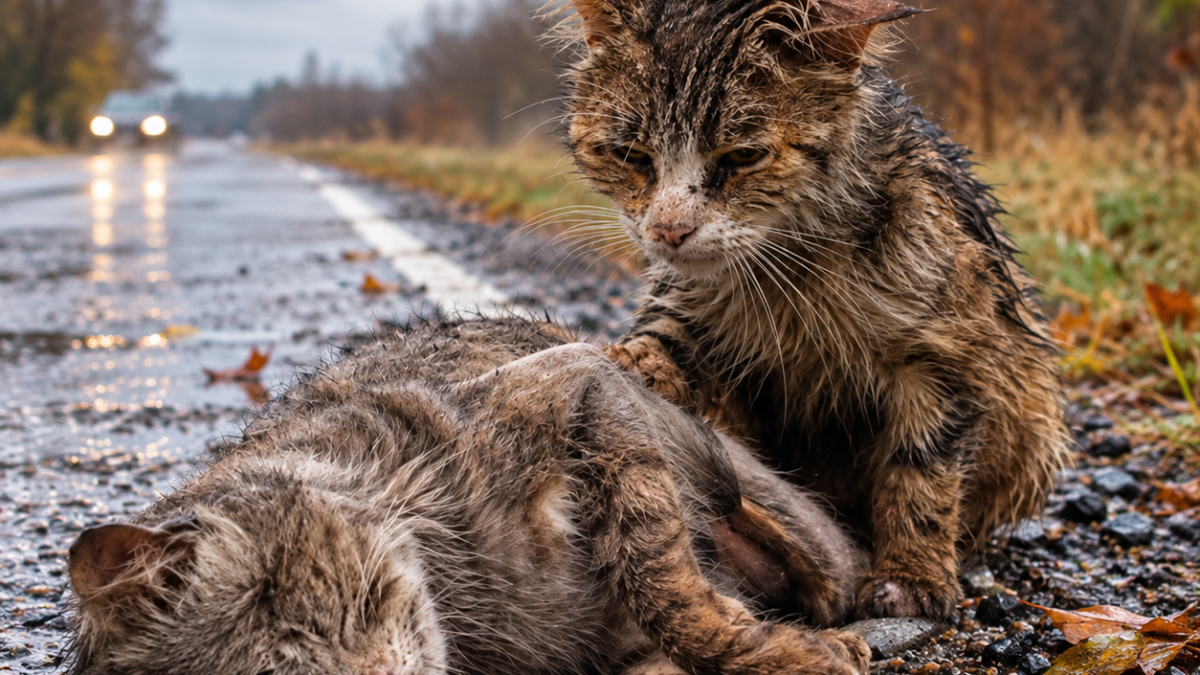
The tabby pressed his forehead against the towel covering her body, and his legs gave out beneath him. For four days, maybe longer, he had stayed upright because she needed him. He had stood against passing cars, rain, hunger, thirst, and pain. But the moment she disappeared beneath that towel, his body seemed to understand what his heart had refused to accept.
She was gone.
I reached for him, expecting him to pull back.
He did not.
He just lay there beside her, trembling, his bleeding paws curled inward as though even the grass hurt to touch.
“Oh, baby,” I whispered.
The man behind me cleared his throat, but when I looked over my shoulder, I saw tears on his face.
“I should’ve called sooner,” he said.
I wanted to tell him yes. I wanted to say that two days mattered, that every hour mattered, that he might have suffered less if someone had stopped instead of assuming a stray cat could figure out grief on his own.
But guilt was already standing beside him. I did not need to give it a louder voice.
“You called now,” I said. “That matters.”
A pickup slowed as it passed. The driver leaned toward the window, curious, then kept going. Another car swerved slightly around us, impatient even with my hazard lights blinking. That road had swallowed enough kindness already.
I lifted the little gray cat first.
The tabby struggled then.
Not with strength. He had almost none left. But his front legs reached toward her, and his mouth opened in another soundless plea.
“No,” I whispered. “I’m not taking her away from you. I promise.”
I placed her gently into a small carrier lined with blankets, then set the carrier where he could see it. His eyes followed every movement. He tried to stand, collapsed, and dragged himself forward using his elbows.
That was when I knew his paws were worse than I had thought.
Both front pads were peeled raw. One rear paw was swollen twice its normal size. There were tiny cuts along his chin where gravel had torn the skin as he pushed and pulled her body. His claws were cracked down to the quick.
Love had nearly destroyed him.
I wrapped him in a second towel. He resisted only until I placed him beside the carrier that held her. Then he went still. His nose pressed against the metal door. His breathing slowed.
“I’m going to take care of you,” I said. “Both of you.”
At my clinic, we named him Henry.
We named her Grace.
I do not know why those names came to me. Maybe because he had endured with the quiet dignity of an old soul, and she looked peaceful once the mud was cleaned from her face. Maybe because after what had happened to them, they deserved names that sounded gentle.
The veterinary technician, Marisol, met me at the back entrance with a clean table ready.
“Oh no,” she breathed when she saw Henry’s feet.
“He wouldn’t leave her,” I said.
Marisol’s face changed. People think animal rescue makes you tough. It does not. It makes you functional while your heart breaks in smaller and smaller pieces.
We sedated Henry lightly so the vet could clean his wounds without causing him more pain. Even half-asleep, he turned his head every time someone moved Grace’s carrier.
“Keep her where he can see her,” Dr. Willis said softly.
So we did.
While Henry’s paws were soaked, cleaned, medicated, and wrapped in tiny white bandages, Grace rested in a blanket-lined box on the counter nearby. She was gone, but for Henry, her presence was still the only thing holding the world in place.
“He’s dehydrated,” Dr. Willis said. “Severely exhausted. Malnourished, but not long-term starvation. These cats had access to food until recently.”
I looked up.
“What does that mean?”
“It means they probably weren’t feral,” he said. “At least not originally.”
Marisol ran the scanner over Grace first.
Nothing.
Then she scanned Henry.
The machine beeped.
We all froze.
“He has a chip,” she said.
For one second, hope opened inside me.
A microchip meant a family. A family meant maybe someone was searching. Maybe these two had escaped. Maybe someone had been crying in front of empty food bowls and open doors.
Marisol wrote down the number and called the registry.
I stood beside Henry, watching his sedated eyes flutter. His bandaged paws looked impossibly small. He had done everything a living creature could do for someone he loved, and now strangers were trying to piece together the story he could not tell.
Marisol turned away from us as she spoke on the phone.
“Yes, we have an adult male tabby,” she said. “Found on Old Mill Road with a deceased female cat. Can you give us the registered owner information?”
She listened.
Then her shoulders tightened.
“What do you mean, disconnected?”
A cold feeling moved through me.
She wrote something on the intake sheet.
“Okay. Last known address?”
Another pause.
“Thank you.”
She hung up slowly.
“The chip is registered to a woman named Evelyn Carter,” she said. “Address is about six miles from where they were found. Phone number no longer works.”
“Do we know when the chip was registered?”
“Eight years ago.”
I looked at Henry.
Eight years.
He had not always been no one’s cat.
“Let’s check Grace again,” I said.
Marisol scanned her one more time, slowly from neck to shoulder, then down her back.
Halfway across her left shoulder, the scanner beeped.
“She has one too,” Marisol said.
The number led to the same name.
Evelyn Carter.
Same address.
Same disconnected phone.
Henry and Grace had belonged to someone.
Together.
That should have comforted me. Instead, it made the room feel heavier.
Because if they had belonged to someone, then somewhere along the way, someone had failed them.
I drove to the address that afternoon.
Henry was sleeping at the clinic under observation, his IV line taped carefully to one leg, his bandaged paws tucked beneath his chest. Grace remained in our care, wrapped in a soft white blanket. I told myself the address might explain everything.
Maybe Evelyn had moved.
Maybe she had passed away.
Maybe a neighbor knew where to find her family.
The house sat at the end of a quiet street lined with maple trees and trimmed lawns. It was small and white, with blue shutters and a porch swing that creaked in the wind. A ceramic cat sat by the front steps, faded from years of sun.
No car in the driveway.
No curtains in the windows.
No sound inside.
I knocked anyway.
Nothing.
The neighbor next door was raking leaves into a paper bag. She watched me with the wary look of someone who had seen enough strangers to expect bad news.
“Can I help you?” she asked.
“I’m looking for Evelyn Carter,” I said. “She used to live here.”
The rake stopped.
“You from the bank?”
“No. Animal rescue.”
Her face softened in a way that told me I had said the right words and opened an old wound.
“Oh,” she said. “This is about her cats, isn’t it?”
My stomach dropped.
“You knew them?”
“Everybody knew them.” She leaned on the rake. “Henry and Grace. She used to sit right there on the porch with both of them. Henry on her lap, Grace on the railing like a queen.”
For a moment, I could see it.
A woman in a cardigan. Two cats in warm sunlight. A porch that once held the whole shape of a small, happy life.
“What happened to Evelyn?” I asked.
The neighbor looked toward the empty house.
“She died last month.”
The words landed quietly, but they changed everything.
“She didn’t have much family,” the woman continued. “A nephew came after the funeral. Cleaned out the house in two days. Furniture, dishes, pictures, everything. I asked him about the cats. He said they were going to a shelter.”
“They never arrived at our shelter,” I said.
Her expression hardened.
“I was afraid of that.”
A truck turned onto the street then, a black pickup with tinted windows and a dent in the tailgate. It slowed in front of Evelyn’s house, then pulled into the driveway.
The neighbor lowered her voice.
“That’s him.”
The driver got out carrying a takeout cup and a ring of keys. He was in his late thirties, broad-shouldered, wearing a clean jacket and work boots that had never seen much work. He noticed us immediately.
“You need something?” he called.
I walked toward him.
“Are you related to Evelyn Carter?”
“Who’s asking?”
“My name is Rachel Miller. I work with county animal rescue. We found two cats registered to Evelyn.”
His face barely moved.
“Not my problem.”
There are moments in rescue when anger comes so fast it feels like heat under the skin. I kept my voice steady because if I lost control, he would use that instead of answering the question.
“Were Henry and Grace in your care after Ms. Carter passed?”
He shrugged and took a sip from his cup.
“They were cats. They came with the house.”
“Where did you take them?”
“I told the old lady next door I handled it.”
“That’s not an answer.”
He looked past me at the neighbor, annoyed.
“Look, I had a lot going on. Funeral, estate paperwork, cleaning this dump out. I couldn’t babysit two animals.”
“So what did you do with them?”
His jaw tightened.
“I dropped them where cats live.”
The neighbor gasped softly behind me.
I heard the cars on the distant main road. I heard a wind chime moving on the porch. I heard my own pulse.
“Where?” I asked.
He looked me straight in the eye.
“I don’t remember.”
But he did remember.
I saw it in the quick flicker of his eyes.
Old Mill Road.
He knew.
I took one step closer.
“One of them is dead,” I said. “The other nearly destroyed his paws trying to drag her body off the road.”
For the first time, something like discomfort crossed his face.
Then it was gone.
“Sad story,” he said. “Still not my problem.”
The neighbor’s rake fell against the grass.
I had met neglect before. I had met cruelty wearing all kinds of faces. Some were drunk, some were desperate, some were ashamed. But this man was different. He was not overwhelmed by what he had done.
He was inconvenienced by being asked about it.
I pulled out my phone.
“What are you doing?” he asked.
“Calling Deputy Harris.”
“For what?”
“For animal abandonment,” I said. “And possibly illegal dumping.”
He laughed once.
“You’re kidding.”
“No.”
“They’re cats.”
“They’re living animals.”
“One of them isn’t.”
I do not remember deciding to step toward him. I only remember the neighbor saying my name, even though I had never told it to her.
I stopped myself.
That was the first revenge I chose that day: not rage, but restraint.
Because rage would have given him a story where I was unstable and he was just a man being harassed by an emotional woman. Restraint kept the truth clean.
Deputy Harris arrived twenty minutes later.
By then, the nephew had stopped laughing.
His name was Travis Carter. Evelyn had left him the house, her car, and what little savings she had. The cats had been mentioned in her handwritten notebook, according to the neighbor, but not in the formal will. That meant Travis had considered them disposable property.
Deputy Harris took my statement first. Then the neighbor’s.
“She loved those cats,” the neighbor said, arms folded tightly across her chest. “She had a folder for them. Vet records. Food instructions. She asked me once if I’d take them if something happened, but I have severe allergies. I told her I’d help find someone. Then she got sick so fast.”
“Did Mr. Carter tell you he was taking them to a shelter?” Harris asked.
“Yes.”
“Which shelter?”
“He didn’t say. He just said he handled it.”
Deputy Harris turned to Travis.
“You want to tell me where you took the cats?”
“I already said I don’t remember.”
“Try.”
Travis stared at the ground.
“They were making noise in the truck,” he said. “I had furniture to move. I opened the carrier near the road and let them out. That’s all.”
The neighbor covered her mouth.
I closed my eyes.
Two house cats.
Dropped beside a road they did not know.
Left to make sense of cars, rain, hunger, and fear.
Grace had probably tried to cross first. Maybe she heard a noise. Maybe she smelled home somewhere beyond the ditch. Maybe Henry followed. Maybe he saw what happened and ran back to her.
And then he stayed.
Not because he understood death in the way humans define it, but because love does not need language to know when someone should not be alone.
Deputy Harris wrote carefully in his notebook.
“You understand abandonment of a companion animal is chargeable in this county.”
Travis rolled his eyes.
“Give me the ticket, then.”
“It may be more than a ticket.”
“For two cats?”
“For one dead cat and one severely injured cat,” Harris said. “And for lying about surrendering them to a shelter.”
That got his attention.
He looked at me.
“You people are insane.”
“No,” I said. “We’re just the people who stopped.”
His face reddened.
“This is harassment.”
“No,” Deputy Harris said. “This is an investigation.”
But investigations do not heal paws. They do not bring back Grace. They do not erase four days of a grieving animal lying beside the road while the world drove past.
Back at the clinic, Henry woke from sedation just before closing.
I was sitting on the floor outside his kennel, my back against the cabinet, filling out paperwork I could barely read through exhaustion. His eyes opened slowly. For a few seconds, he stared at the unfamiliar room. Then he lifted his head and searched.
Not for food.
Not for me.
For her.
My chest tightened.
Grace was in a small private room, prepared for cremation, but I had asked Dr. Willis to wait. Something in me knew Henry needed one more goodbye.
“Can he see her?” I asked.
Dr. Willis looked at me for a long moment.
Then he nodded.
We placed Grace, still wrapped in her blanket, on a clean towel in the quiet exam room. I carried Henry in my arms because he could not walk. His bandaged paws rested against my sleeve. He weighed almost nothing.
When he saw her, he made that sound again.
Softer this time.
I set him beside her.
He pressed his nose into her fur and stayed there.
No one moved.
Marisol stood by the sink, crying silently. Dr. Willis pretended to check something on the counter, but his glasses were fogged. I sat on the floor with one hand near Henry, close enough for comfort but not touching unless he asked.
He stayed beside Grace for nearly twenty minutes.
At first, he nudged her shoulder. Then her face. Then he settled against her the way cats do when they have shared sleep for years. His breathing changed. Some tension left his body. Not peace exactly. But understanding.
Finally, he lifted his head and looked at me.
I do not believe animals think in human sentences.
But I know what grief looks like when it turns a corner.
Henry knew she was not coming with him.
And somehow, he let me pick him up.
The next week became a fight of a different kind.
Henry fought fever.
He fought infection.
He fought the terror of waking in a cage without Grace beside him.
I fought paperwork, county reports, phone calls, and the cold indifference of people who thought justice for a cat was a waste of time.
The first prosecutor I spoke with sighed before I finished explaining.
“Animal abandonment cases are difficult,” he said. “Especially if the defendant claims he released them rather than harmed them directly.”
“He dumped house cats on a dangerous road,” I said. “One died.”
“I understand.”
No, I thought. You don’t.
Aloud, I said, “The male cat’s injuries show prolonged attempts to move her body. We have veterinary documentation. We have microchips. We have a witness who heard him say they were going to a shelter.”
“That helps.”
“Then charge him.”
“We’ll review.”
Review.
It is a quiet word people use when they hope your anger will get tired before their job gets difficult.
Mine did not.
I requested the 911 call log from Old Mill Road. I posted in our local lost-and-found pet group asking if anyone had seen two cats near the area. I did not share the whole story yet. I only asked for dates, times, and dashcam footage from anyone who might have driven that curve.
Most people scrolled past.
Then a message came in from a woman named Dana.
“I think my husband’s truck camera caught something. He drives that road for work. It was raining hard. I don’t know if it helps.”
It helped.
The footage was grainy but clear enough.
At 6:42 p.m., four days before my rescue call, a black pickup pulled onto the shoulder of Old Mill Road. The tailgate had a dent.
Travis Carter got out.
He opened the passenger door.
He removed a plastic pet carrier.
He looked around once.
Then he opened it.
Two cats shot out, terrified and low to the ground. Grace ran toward the ditch. Henry froze near the tire. Travis kicked the carrier aside, got back in his truck, and drove away.
The footage did not show Grace being hit.
But it showed the abandonment.
It showed his lie.
And in court, lies matter.
Deputy Harris called me the next morning.
“You got the video?”
“Yes.”
“Send it to me.”
I did.
By noon, Travis Carter was formally charged.
That should have felt like victory.
It did not.
Victory was Henry eating half a spoonful of warmed chicken from my fingers.
Victory was Henry allowing Marisol to change his bandages without flattening himself in terror.
Victory was Henry sleeping through the night for the first time without waking and crying.
The legal case was not victory.
It was a door opening.
And I intended to walk through it carrying every inch of the truth.
Three weeks after we found them, Evelyn Carter’s neighbor came to the clinic.
Her name was Mrs. Bell.
She was seventy-six, small, and sharp-eyed, with silver hair tucked beneath a knitted hat. She carried a cardboard box against her chest.
“I found this in my garage,” she said. “Evelyn gave it to me when she first got sick. Said if anything happened, I should make sure whoever took the cats had it.”
I opened the box.
Inside were two ceramic bowls, a brush, a fleece blanket covered in gray and brown fur, and a blue folder labeled in shaky handwriting:
HENRY & GRACE — IMPORTANT
My throat tightened before I even opened it.
The first page was a letter.
To whoever loves my cats after me,
Thank you.
Henry is shy until he trusts you. Grace is braver, but she depends on him more than she lets on. They have never been apart for more than a vet appointment. Please do not separate them.
They like chicken baby food when sick.
Grace sleeps on the left side of the bed.
Henry will pretend he does not want attention, then tap your hand when you stop petting him.
They are not “just cats.”
They are my family.
If Travis says he will keep them, please make sure he means it. He never liked animals. I am afraid he will do what is easy instead of what is right.
Please forgive me for leaving this worry behind.
— Evelyn
By the time I finished reading, Mrs. Bell was crying.
“I should have pushed harder,” she said. “I should have taken them even with my allergies. I should have—”
“No,” I said. “Travis should not have lied.”
She nodded, but grief has a way of blaming the nearest kind person because the cruel one feels too far away to reach.
I made copies of the letter for Deputy Harris and the prosecutor.
That letter changed everything.
Not because the law suddenly became tender, but because it showed intent. Travis had been warned. He knew Evelyn feared exactly what he might do. He knew the cats were bonded. He knew there was a plan for their care.
He ignored all of it.
The local paper called two days later.
I almost said no.
Rescue work can turn ugly when a story gets attention. People become armchair judges. They demand punishment, then disappear when donations are needed for the living animal. They cry over the dead one and forget the one still trying to heal.
But Henry’s medical bills were climbing. More importantly, Travis had already begun telling people we were exaggerating.
So I said yes.
The reporter, a young woman named Kelly, came to the clinic with a notebook and eyes that softened the second she saw Henry.
He was sitting in a padded recovery crate near my desk, wearing fresh bandages and a cone he hated with every ounce of his soul. His fur had been cleaned. His tabby stripes showed again. He looked less like a ghost and more like a cat who might one day believe in mornings.
“Is that him?” Kelly asked.
“That’s Henry.”
He looked at her, unimpressed.
She smiled. “He has opinions.”
“Many.”
During the interview, I did not make Travis into a monster. I did not need to. I told the facts plainly.
Two bonded cats.
Their owner died.
The nephew promised a shelter.
He dumped them near a road.
The female died.
The male stayed.
Four days.
Bloody paws.
Microchips.
Dashcam footage.
A letter from Evelyn.
Kelly stopped writing halfway through and just listened.
When the story ran, the headline read:
Cat Guarded Companion for Four Days After Being Abandoned on Rural Road
By evening, the shelter phone would not stop ringing.
People wanted to donate to Henry.
People wanted to send blankets.
People wanted to know if he was available for adoption.
Some wanted Travis’s address, which we refused to give.
Justice is not the same thing as a mob.
I had learned that the hard way. A mob burns hot and careless. Justice takes longer, walks straighter, and leaves a record.
Still, I will admit something I am not proud of.
When I heard Travis lost the quick sale of Evelyn’s house because of the pending animal cruelty case, I smiled.
Not because money could balance what had happened.
It could not.
But for the first time since I saw Henry beside that road, Travis was inconvenienced by the truth.
And he hated it.
His attorney called the clinic the following week.
I knew it was trouble the moment Marisol handed me the phone and mouthed, “Lawyer.”
“This is Rachel,” I said.
“My name is Martin Greeley. I represent Travis Carter. We’re hoping to resolve this unfortunate misunderstanding without further damage to anyone’s reputation.”
“Misunderstanding?”
“My client made a poor decision under emotional stress.”
“He abandoned two elderly cats on a roadside and lied about it.”
A pause.
“I understand emotions are high.”
“My emotions are not evidence. The video is.”
Another pause.
“We are prepared to make a donation to your rescue if you issue a statement clarifying that Mr. Carter did not intentionally harm the animals.”
I looked through the glass window into the recovery room.
Henry was asleep on his side, one bandaged paw resting over the other. The fleece blanket from Evelyn’s box was tucked beneath him. Since we had given it to him, he slept better. Sometimes he kneaded it in his sleep, tiny movements of memory returning through damaged feet.
“No,” I said.
“Ms. Miller, consider the benefits. Your organization could use the funds.”
“My organization could also use people not dumping animals on roads.”
“This is not productive.”
“Neither is bribery dressed as concern.”
His voice cooled.
“Be careful with accusations.”
“Be careful calling me again.”
I hung up.
That night, I sat with Henry long after everyone left. The clinic was quiet except for the hum of machines and the occasional bark from the boarding room. Henry watched me from his bed.
“You know they want this to go away?” I asked him.
He blinked slowly.
“I don’t.”
He tucked his chin against Evelyn’s blanket and closed his eyes.
The court date was set for a Tuesday morning in November.
By then, Henry could stand for short periods. His paws had grown new skin, tender and pink beneath the fur. He still limped. He always might. Dr. Willis said the nerve damage might leave him sensitive to rough surfaces for the rest of his life.
That meant no outdoor life.
No gravel.
No cold pavement.
No world where he had to survive by endurance alone.
He needed softness.
I thought that was fair.
He had earned softness.
The courthouse was busier than I expected.
Animal cases usually drew a few people. This one drew half the town. Some came because of the article. Some came because they had loved Evelyn. Some came because they had driven past Old Mill Road and could not stop wondering if they had missed him.
Mrs. Bell sat beside me with a tissue twisted in her fingers.
Deputy Harris stood near the front.
Travis sat with his attorney, wearing a navy suit and the annoyed expression of a man still convinced consequences were something other people made up to bother him.
The prosecutor, Ms. Alvarez, had taken over the case personally after the public response. She was calm, direct, and terrifying in the way only a prepared woman can be.
The judge entered.
We stood.
The hearing began.
Travis’s attorney spoke first, painting a picture of grief and overwhelm. Travis had lost an aunt, inherited a complicated estate, and made one regrettable choice. He had not meant for any animal to be injured. He had believed cats were resourceful. He had panicked.
I listened.
Every sentence was polished smooth enough to hide the rot underneath.
Then Ms. Alvarez stood.
“Your Honor, the defendant did not make one panicked decision,” she said. “He made several deliberate decisions. He chose not to contact a shelter. He chose not to call the neighbor who had offered help. He chose not to read or follow the written instructions left by the deceased owner. He chose to drive two domesticated, bonded senior cats to a rural road. He chose to open the carrier and abandon them. He then chose to lie about it.”
Travis stared at the table.
Ms. Alvarez continued.
“One cat died. The surviving cat remained beside her for days, sustaining severe injuries while attempting to move her body away from traffic. We have veterinary reports, microchip records, witness testimony, dashcam footage, and a letter written by the deceased owner expressing concern that the defendant might do exactly what he did.”
The courtroom was silent.
Then she called me.
I walked to the stand with my hands cold and steady.
I told the judge about the call.
About Old Mill Road.
About the gray morning and the grass and the little body near the shoulder.
About Henry standing between us, too weak to fight but too loyal to move.
About his paws.
When Ms. Alvarez asked me to describe them, I looked at the judge, not Travis.
“His paw pads were torn open,” I said. “He had worn them down trying to drag Grace away from the road. Based on the injuries and witness timeline, he tried repeatedly over several days. He was dehydrated, exhausted, and in pain. But he would not leave her.”
The judge’s face did not change, but his pen stopped moving.
Ms. Alvarez asked, “In your professional experience, is that behavior common?”
“No,” I said. “But bonded animals grieve. They protect. They stay close. Henry’s injuries were consistent with prolonged physical effort, not random wandering.”
Then Travis’s attorney stood.
“Ms. Miller, you are not a veterinarian, correct?”
“Correct.”
“You are emotionally involved in this case.”
“I was the responding rescuer.”
“That wasn’t my question.”
“I care what happened, yes.”
“So your testimony may be influenced by your emotions.”
I turned toward him.
“My testimony is based on what I saw, what the veterinarian documented, and what the video shows.”
He smiled thinly.
“But you have described the cat’s actions in human terms. Loyalty. Grief. Love. Those are interpretations, aren’t they?”
A few people shifted in the benches.
I paused.
Then I said, “When a living creature stays beside another for four days without food, water, or shelter, you can call it whatever makes you comfortable. I call it love.”
Mrs. Bell began to cry.
The attorney had no further questions.
Next came Dr. Willis.
He explained the injuries clinically, which somehow made them worse. Medical language has no mercy. Abrasions. Infection risk. Dehydration. Soft tissue trauma. Weight loss. Stress response.
Then Mrs. Bell testified.
Her voice shook at first, but it grew stronger when Ms. Alvarez handed her Evelyn’s letter.
“Can you identify this handwriting?” the prosecutor asked.
“Yes,” Mrs. Bell said. “That’s Evelyn’s.”
“Would you read the highlighted portion?”
Mrs. Bell put on her glasses.
Her hands trembled.
“‘They are not just cats. They are my family.’”
That was when Travis looked away.
Not down.
Away.
As if even the wall was easier to face than the truth.
The dashcam footage played last.
No one spoke while it ran.
Rain streaked across the windshield. The black pickup appeared. Travis stepped out, removed the carrier, opened it, and released Henry and Grace onto the shoulder.
Grace ran first.
Henry followed.
Travis left.
The video ended.
The silence afterward felt bigger than the room.
Ms. Alvarez closed with one sentence.
“Your Honor, cruelty is not always loud. Sometimes it looks like a man opening a cage and driving away.”
The judge took off his glasses.
He looked at Travis for a long time.
“Mr. Carter,” he said, “this court sees many kinds of neglect. Some are born of poverty. Some of ignorance. Some of crisis. Yours was born of convenience.”
Travis swallowed.
The judge continued.
“You inherited a home from a woman who trusted that the living beings she loved would be treated with basic decency. Instead, you treated them as an obstacle between you and a faster sale.”
His voice hardened.
“One animal died. Another suffered profoundly. The fact that the surviving cat showed more loyalty to his companion than you showed to your aunt’s final wishes is not legally relevant, but it is morally impossible to ignore.”
The sentence was not everything some people wanted.
It never is.
Travis received fines, probation, mandatory community service with a supervised county animal program, restitution for Henry’s medical care, and a ban on owning or possessing animals for five years. The judge also ordered him to pay for Grace’s cremation and return all remaining pet-related belongings from Evelyn’s house to the rescue.
But then came the part no one expected.
The judge delayed approval of the estate property transfer until the probate court reviewed whether Travis had violated fiduciary responsibilities regarding Evelyn’s written instructions for her animals.
Travis’s attorney stood quickly.
“Your Honor—”
The judge raised one hand.
“I am not ruling on the estate today. I am referring the matter. Sit down.”
And just like that, Travis finally understood that Henry’s bloody paw prints had reached farther than the roadside.
They had reached the house.
The inheritance.
The polished version of himself he had tried to present.
Outside the courthouse, reporters waited.
I did not give them a speech.
I simply said, “Grace mattered. Henry matters. Evelyn mattered. That is all this was ever about.”
But Mrs. Bell stepped forward.
She looked straight into the cameras and said, “My friend was afraid her cats would be thrown away after she died. She was right. I wish she hadn’t been.”
That line traveled farther than any headline.
By evening, donations covered Henry’s care three times over.
We used the extra money to create the Grace Fund, a small emergency account for senior pets whose owners died or entered hospice with no family prepared to help. It paid for temporary boarding, transport, medication, and placement for animals who might otherwise vanish into the cracks between grief and paperwork.
That was the revenge I liked best.
Not Travis being embarrassed.
Not the fines.
Not the delayed estate.
The Grace Fund.
Every time it saved another animal, Travis’s cruelty lost again.
Henry came home with me as a foster two days after court.
I told everyone it was temporary.
Everyone pretended to believe me.
At my house, I set up a recovery room in the sunniest corner of the den. There was a heated bed, low-sided litter box, water fountain, soft rugs, and Evelyn’s blanket folded beside the window. I placed Grace’s small urn on a shelf above him, with a paw print impression and a photograph Mrs. Bell had found of the two cats sitting together on Evelyn’s porch.
In the photo, Grace sat tall with her tail wrapped neatly around her paws.
Henry leaned against her shoulder.
He looked younger then. Rounder. Unscarred by roads and rain.
The first night, he hid under the side table.
I lay on the floor six feet away and read out loud from a mystery novel I did not care about. My voice filled the room without asking anything from him.
On the second night, he came out to eat while I was there.
On the fifth, he slept on the rug instead of under the table.
On the eighth, he tapped my hand with one careful paw when I stopped petting him.
I froze.
Then I laughed and cried at the same time.
“There you are,” I whispered. “Evelyn told me you’d do that.”
His eyes half-closed.
He tapped me again.
The first time Henry purred, it was so quiet I thought I imagined it.
A soft, uneven sound.
Like an old engine trying to start after winter.
I did not move for twenty minutes.
By December, his bandages were gone.
His paws would always be sensitive, but he could walk across carpet without pain. He learned the house slowly. Den first. Hallway next. Kitchen after that. He avoided the front door completely.
I respected that.
Some doors lead to places animals remember too well.
Mrs. Bell visited every Sunday.
The first time she came, Henry watched her from behind the couch. She sat on the floor with a container of chicken baby food and pretended not to look at him.
“I used to bring this when Evelyn went to visit her sister,” she said softly. “Grace would eat first. Henry would wait until he thought no one was watching.”
Henry’s ears twitched.
Mrs. Bell smiled.
“You remember me, don’t you?”
He did not come out that day.
But the next Sunday, he did.
He walked slowly to her, sniffed her shoes, then touched his nose to her hand.
Mrs. Bell covered her mouth.
“Oh, Henry,” she whispered. “I’m so sorry.”
He leaned against her fingers.
Forgiveness, when animals give it, is almost unbearable.
Not because we deserve it.
Because they do not make us beg first.
In January, the probate court made its decision.
Travis did not lose the entire house. Real life rarely hands out perfect punishments tied with ribbons. But he did lose enough to hurt.
The court found that Evelyn’s written instructions, while not a formal pet trust, had been part of her documented final wishes. Travis’s actions created additional estate complications, legal fees, and a settlement with a small animal welfare nonprofit Evelyn had supported. A portion of the house sale proceeds was directed to that nonprofit and to the Grace Fund.
When I heard, I sat at my kitchen table with the letter in my hand and Henry asleep in a patch of winter sun.
“Grace,” I said quietly, “you did it.”
Henry opened one eye.
Maybe he heard her name.
Maybe he heard something in my voice.
He got up, crossed the rug, and climbed into my lap for the first time.
He was not graceful about it. His back foot slipped. He grumbled. One paw landed in my coffee. But then he settled against me with his head beneath my chin, and I forgot every inconvenience in the world.
I held him carefully.
“You’re home,” I whispered.
He purred.
That spring, we held a small memorial for Grace under the maple tree beside Evelyn’s old house.
The new owners were a young couple with a toddler and a rescued beagle. When they heard the story, they asked if we wanted to plant something. Mrs. Bell chose lavender because Evelyn had grown it in pots on the porch.
Only six of us came.
Me, Mrs. Bell, Deputy Harris, Marisol, Dr. Willis, and Kelly the reporter.
Henry did not come. Crowds and roads were too much for him. Instead, I brought the photograph of him and Grace from Evelyn’s porch.
Mrs. Bell placed it against the tree.
“She was a bossy little thing,” she said, smiling through tears. “Always acted like the whole street belonged to her.”
“She sounds perfect,” Marisol said.
“She was.”
Deputy Harris cleared his throat.
“I’ve worked plenty of cases,” he said. “This one stayed with me.”
“Why?” Kelly asked.
He looked at the photograph.
“Because that cat did what people are supposed to do. He stayed.”
No one said anything after that.
We planted the lavender in a half circle where the morning sun would hit it first.
When it was done, Mrs. Bell took a small envelope from her purse and handed it to me.
“I found one more thing,” she said.
Inside was another photo.
Evelyn sat on the porch swing, smiling at the camera. Grace was on her lap. Henry was beside her, one paw resting on Evelyn’s knee.
On the back, in faded ink, Evelyn had written:
My little family. If love could keep us together forever, it would.
I pressed the photo to my chest.
For a while, I hated that sentence.
Because love had not kept them together forever.
Evelyn died.
Grace died.
Henry was left behind.
But later, as months passed and Henry began to live again, I understood it differently.
Love had kept them together as long as it could.
Then it had become something else.
A neighbor who saved a box.
A rescuer who answered a phone.
A deputy who filed the report.
A vet who waited for goodbye.
A courtroom that listened.
A fund that carried Grace’s name into other animals’ lives.
Love had not stopped death.
But it had refused to let cruelty have the final word.
One year after I found Henry, I drove Old Mill Road again.
I had avoided it whenever possible. But that morning, I loaded a small wooden marker into my car and went before traffic got heavy.
The ditch had changed with the seasons. The grass was high and gold. Wildflowers grew near the curve. Cars still came too fast, but in daylight, the road looked ordinary.
That almost made me angrier.
Terrible things often happen in ordinary places.
I parked on the shoulder and stepped out.
For a moment, I was back there again.
Gray sky.
Wet grass.
Grace beneath the towel.
Henry standing between us, shaking and brave.
I pushed the marker into the ground near the fence line, far enough from the road to be safe.
It was simple.
No dramatic words.
Just:
GRACE
She was loved.
He stayed.
I stood there for a long time.
Then a car slowed behind me.
An older man rolled down his window.
“You the lady from the cat story?” he asked.
I hesitated. “Yes.”
He looked at the marker.
“I drove past them,” he said.
The confession came out rough.
“I saw something there. Thought it was trash at first. Then I saw the cat. I was late for work. Told myself somebody else would stop.”
His eyes filled.
“I think about that a lot.”
I did not know what to say.
He wiped his face with the back of his hand.
“I keep blankets and gloves in my truck now. Cat food too. My wife says I’m turning into a shelter on wheels.”
A small laugh escaped me.
“That’s not the worst thing to become.”
“No,” he said. “I guess not.”
He looked once more at Grace’s marker.
“I’m sorry,” he said.
Then he drove away.
I stood by the road with wind moving through the weeds, and I realized something important.
Justice is not only what happens to the person who caused harm.
Sometimes justice is what changes in everyone who witnesses it.
The people who stop next time.
The people who call sooner.
The people who no longer say, “It’s just a cat.”
When I got home, Henry was waiting in the front window.
He never sat there during the first months. The sight of cars frightened him. But slowly, with time and quiet, he had claimed that window as his throne.
He watched birds.
Judged squirrels.
Ignored delivery drivers.
And every afternoon, when sunlight crossed the floor, he curled on Evelyn’s blanket beneath Grace’s photograph.
I opened the door.
“I’m home,” I called.
Henry jumped down, walked across the rug with his careful little limp, and came to meet me.
He sniffed my shoes.
Maybe he smelled the road.
Maybe he smelled the grass.
Maybe he smelled the place where his old life ended and the rest of it began.
For a second, he froze.
Then he pressed his head against my ankle.
Not afraid.
Just remembering.
I picked him up, and he allowed it, which was still a gift he gave only when he felt generous. I carried him to the den and sat in the chair by the window.
The house was quiet.
Safe.
Soft.
Everything he had been denied when he needed it most.
“You did good, Henry,” I told him.
He tucked his face into my elbow.
“You stayed with her. You brought her home. And because of you, everyone knows she mattered.”
His purr started slowly.
Uneven at first.
Then stronger.
Outside, the afternoon light stretched across the floor. The world kept moving, as it always does after heartbreak, careless and beautiful at the same time.
But inside that room, Henry slept without guarding anything.
No road.
No body.
No danger.
Just warmth beneath him, a roof above him, and a love that asked nothing except that he keep living.
And he did.
For Grace.
For Evelyn.
For himself.
And for every forgotten animal whose story still deserves someone willing to stop.








