PART 2: He Grew Up in a Dark Basement, Then Was Dumped in a Landfill—41 Days Later, Angelito Walked Out With a Family
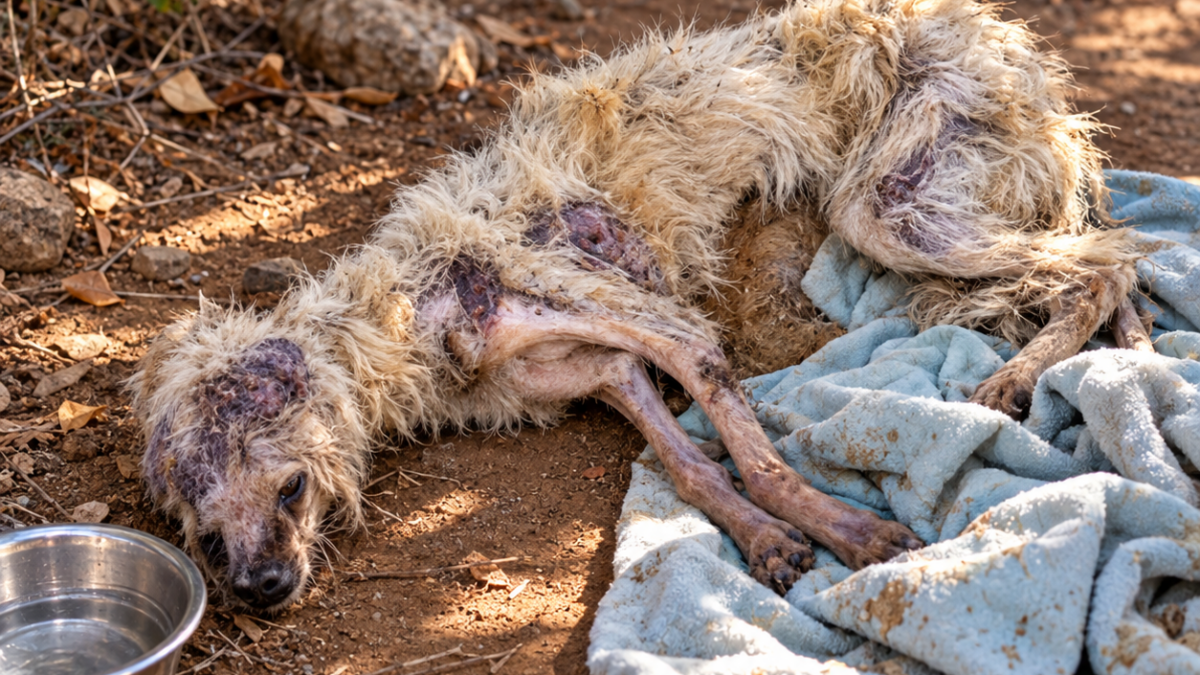
Angelito had spent almost his entire life in darkness, and when I found him in a landfill, he was so weak I had to watch his chest to make sure he was still breathing.
His body was cold, infected, skeletal, and too exhausted to lift his own head, yet somewhere beneath all that damage was a puppy who had never been given the chance to learn what kindness felt like.
What none of us knew as we wrapped him in blankets was that the person who had tried to make him disappear had left behind more than enough for the truth to follow.
My name is Laura Bennett, and I had been working with abandoned and abused animals for almost nine years when the call came.
A plumber had entered a house for a routine repair and found a puppy in the basement.
He said the room was dark.
Not dim.
Dark.
The puppy appeared to have been kept there since he was about a week old.
No proper bedding.
No evidence of regular veterinary care.
Very little food.
The plumber was so disturbed that he contacted police.
By the time authorities followed up, the puppy was gone.
The owner said very little.
Then we received another call.
A tiny dog had been seen at a landfill.
I remember driving there with one thought repeating in my head.
Please let it be him.
Then I saw the bundle near a pile of discarded material.
And immediately wished it wasn’t.
He was lying on his side.
Black-and-white fur almost hidden beneath dirt.
His body was so thin that every rib showed.
His skin was inflamed and crusted.
His legs looked like sticks.
At first, I didn’t see his chest moving.
I dropped beside him.
“Hey, baby.”
Nothing.
I put two fingers against his ribs.
One breath.
Then another.
So faint that I almost doubted what I had felt.
“Oh, God.”
I slid my hands beneath him.
His body was cold.
Dangerously cold.
When I lifted him, his head fell against my arm because he didn’t have enough strength to hold it up.
He didn’t cry.
He didn’t resist.
A puppy should have done something.
Wiggled.
Whined.
Looked around.
Angelito did none of those things.
He simply lay against me as if even existing had become too exhausting.
I started crying before I reached the vehicle.
“Stay with me.”
His eyes barely opened.
“You don’t have to do anything else. Just breathe.”
At the clinic, the team moved immediately.
Warm blankets.
Fluids.
Bandages over damaged skin.
Medication for infection.
Monitoring.
His temperature was frighteningly low, and his body couldn’t regulate it properly.
Once they had cleaned enough dirt away to treat him, the full extent of his condition became clearer.
He was severely emaciated.
His skin was infected.
His muscles were badly wasted.
This was not a puppy who had missed a few meals.
His body had been deprived for a long time.
That first night, Angelito collapsed four times.
Every time a monitor changed, my stomach dropped.
Every time somebody hurried toward him, I thought we were losing him.
At one point he lay completely wrapped in bandages and blankets, and from inside them came the smallest cry.
One of the nurses stopped.
So did I.
It wasn’t loud.
But it was the first real sound I had heard from him.
“I hear you,” I whispered.
“You’re not alone anymore.”
For the first twenty-seven hours, that was our entire world.
Temperature.
Breathing.
Fluids.
Heart rate.
Another blanket.
Another check.
Another hour.
Nobody talked about adoption.
Nobody talked about toys.
Nobody even talked about walking.
We were trying to keep him alive long enough to reach the next morning.
Then, slowly, his temperature began to hold.
Not perfectly.
But better.
A veterinarian looked at the monitor.
Then at me.
“That’s movement in the right direction.”
It wasn’t a promise.
But it was hope.
And after twenty-seven hours of wondering whether Angelito would die before ever seeing daylight as a free puppy, hope felt enormous.
Then someone placed a tiny toy beside him.
Angelito stared at it.
His body could barely move.
For a moment, nothing happened.
Then his tail lifted from the blanket.
One small wag.
Then another.
Every person in that room went silent.
Because the puppy who had been hidden in darkness, thrown away, and carried into our care barely breathing had just discovered that the world might contain something besides pain.
And that was when we decided we were going to fight for every day he had been denied.
PART 2
I wish I could say that little tail wag meant Angelito was suddenly safe.
It didn’t.
Recovery doesn’t work that way.
Sometimes the smallest sign of life appears while death is still standing right beside it.
Angelito’s tail moved twice.
Then he became exhausted and closed his eyes.
I sat beside his enclosure with my hand resting on the floor near him.
Not touching.
Just there.
He was covered with bandages over areas where infection and damaged skin needed treatment.
Only parts of his face were visible.
His eyes looked enormous because the rest of him had become so thin.
A veterinary technician named Maria stood beside me.
“I can’t believe he wagged.”
“Neither can I.”
“He didn’t even lift his head this morning.”
“I know.”
Maria swallowed.
“He’s a baby.”
That was the part none of us could get used to.
Angelito looked old.
Neglect can do that.
Pain can do that.
Malnutrition can take the softness from a young face and replace it with something tired.
But medically, developmentally, he was still a puppy.
He should have been biting shoelaces.
Falling asleep in ridiculous positions.
Learning what grass felt like.
Chasing his own tail.
Instead, we were celebrating because he had enough strength to move that tail an inch.
I looked through the glass.
“We need a name.”
Maria glanced at me.
“You haven’t named him?”
“I didn’t want to.”
“Why?”
I hated admitting it.
“Because I was afraid he wasn’t going to live.”
Maria didn’t judge me.
Rescue people understand superstitions they would laugh at anywhere else.
Sometimes naming feels like an act of faith.
Sometimes you delay it because attachment already hurts enough.
Maria looked at the bundle.
“He needs one now.”
I nodded.
A volunteer had called him “little angel” earlier in the day.
Not because he looked peaceful.
He didn’t.
Because the volunteer kept whispering, “Come on, little angel,” while warming him.
“Angelito,” I said.
Maria smiled.
“Little angel.”
“Angelito.”
The puppy’s ear moved.
“That’s it.”
Maria crouched.
“Hi, Angelito.”
His tail moved once.
We both cried.
Again.
By the second day, the medical team was beginning to understand how deeply damaged his body was.
The freezing warehouse had nearly killed him, but the warehouse did not explain everything.
His muscle loss had developed over time.
His weight could not be explained by three days without proper food.
His skin infections had been there before the landfill.
His nails, coat, posture, and weak limbs all pointed backward.
The story had started long before the plumber opened that basement door.
Dr. Karen Lewis showed me his bloodwork.
“His body has been running without enough resources for too long.”
“How long?”
“We can’t say exactly.”
“Weeks?”
She looked at me.
“For a puppy this young, weeks is most of his life.”
That sentence stayed with me.
Most of his life.
Angelito had not lost a happy adulthood.
He had never received a normal beginning.
If the plumber’s account was accurate, he had been put in that basement when he was roughly a week old.
A week.
At that age, puppies should still be with their mother.
Warm.
Nursing.
Surrounded by littermates.
Their world should be smell, milk, sleep, warmth, contact.
Angelito’s world had become concrete walls and darkness.
I tried not to imagine the nights.
It was useless.
I imagined them anyway.
A puppy too young to understand why nobody came.
Cold.
Hungry.
Crying until crying stopped accomplishing anything.
There are cases where you can tell yourself an animal does not remember.
That helps humans.
I don’t know whether it is true.
What I knew was that his body remembered.
It remembered in every wasted muscle.
Every infection.
Every instinct that expected nothing.
During those early days, Angelito startled whenever the room went quiet.
If someone stepped away, his eyes followed.
If the light dimmed, he became restless.
Maybe that was coincidence.
Maybe not.
So we began leaving a small lamp on near his recovery enclosure.
Always.
Not bright.
Just enough.
I told the night staff:
“He has had enough darkness.”
No one argued.
His second night was better than the first.
Still difficult.
Still fragile.
But he didn’t collapse four times.
He managed to swallow more food.
Tiny amounts.
Highly digestible.
Frequent.
Careful.
His stomach had to learn food the way the rest of him had to learn everything else.
The first time he licked the bowl after eating, Maria called me over.
“Look.”
He licked again.
“What?”
“He wants more.”
I smiled.
“That’s a problem I’ll happily have.”
Dr. Lewis was less sentimental.
“No more yet.”
Angelito looked at her.
Then at the bowl.
Then back at her.
I laughed.
“He already hates medical professionals.”
“Excellent prognosis.”
Day three.
He lifted his head.
Not for long.
Maybe five seconds.
But he did it.
I was entering the room when he heard my voice.
His chin rose from the blanket.
His neck trembled.
His eyes found me.
Then his head dropped again.
I stopped.
Maria said:
“He did that this morning too.”
“He looked at me.”
“He’s learning people.”
That thought hurt.
Learning people.
Not relearning.
Learning.
We approached every interaction carefully.
Hands low.
Soft voices.
No sudden grabbing.
Angelito didn’t growl.
Didn’t bite.
He didn’t really know enough to distrust us properly.
That almost felt worse.
On day four, we removed some of the outer bandaging.
The infected skin beneath was improving.
Not healed.
But cleaner.
His body temperature had become more stable.
He could maintain warmth for longer periods without constant intervention.
That meant he could spend a few minutes outside the warming setup while we cleaned and examined him.
Maria held him against her chest.
His head rested under her chin.
“You know what you smell like?” she asked him.
Angelito blinked.
“Medicine.”
I smiled.
“Better than landfill.”
“Low standard.”
“We’re starting low.”
That became our philosophy.
Small victories.
Extremely low standards.
Did he eat?
Victory.
Did he urinate normally?
Victory.
Did he raise his head?
Victory.
Did he sleep without a medical alarm going off?
Huge victory.
People who haven’t cared for critically neglected animals sometimes expect recovery to look dramatic.
A before photo.
An after photo.
Transformation.
They don’t see the hundred invisible steps between them.
On day five, Angelito scratched his nose.
It took effort.
His paw missed the first time.
Second time too.
Third time, he touched it.
Maria applauded.
Angelito stared at her as if she were unstable.
On day six, he became annoyed during bandage changes.
That thrilled us.
Weak animals tolerate everything because they have no energy to object.
Angelito had enough energy to complain.
A tiny squeak.
A little paw pulling away.
“Good,” I told him.
“You are allowed to have opinions.”
Day seven, he barked.
One bark.
So quiet it almost sounded like a cough.
The entire room turned.
Angelito looked startled by himself.
I laughed.
“Do it again.”
Nothing.
“Come on.”
He closed his eyes.
Performance over.
The toy stayed beside him through all of this.
A small stuffed dog.
Brown.
Soft.
Too large for his mouth.
He had no idea what to do with it.
At first he only looked.
Then one afternoon, I placed it against his paw.
Angelito sniffed.
His nose touched the fabric.
He opened his mouth slightly.
Then stopped.
Maria whispered:
“He doesn’t know.”
I knew what she meant.
Play has to be learned too.
That was one of the hardest things about his case.
Neglect had not only taken food and health.
It had taken experiences.
There were entire categories of normal puppy life Angelito had never encountered.
Toy.
Grass.
Leash.
Sunshine.
Other dogs.
Running.
A human hand reaching toward him because it wanted to pet him instead of move him.
His world was going to have to grow.
By day nine, he could hold his head up reliably.
By day ten, he could shift from lying on one side to the other without assistance.
Day eleven gave us the moment I will never forget.
I opened the special-care room.
Angelito was on his blanket.
His little stuffed dog beside him.
“Hey.”
His ears moved.
I walked closer.
And Angelito pushed his front paws beneath his chest.
He struggled.
His whole body trembled.
But he lifted himself.
Not standing.
Sitting.
Barely.
Crooked.
One hind leg out.
Front legs shaking.
But sitting.
I froze.
Maria was behind me.
“Oh my God.”
Angelito looked at us.
His tail started moving.
The motion nearly knocked him sideways.
I crouched.
“No, no, don’t fall.”
He wagged harder.
Maria started crying.
“You see us?”
Angelito opened his mouth.
A tiny breathy sound came out.
I put my hand over my face.
Eleven days earlier, he couldn’t lift his head.
Now he was sitting up because somebody entered the room.
Because he wanted contact.
That matters.
He wasn’t only becoming stronger.
He was becoming interested in life.
The investigation continued quietly in the background.
The plumber gave a formal statement.
His name was Daniel Ortiz.
He had been sent to the property after a recurring water-pressure problem.
The owner led him through the house.
When Daniel needed access to basement plumbing, the owner initially told him it was unnecessary.
Daniel insisted.
There was a shutoff line below.
Eventually the basement door opened.
Daniel said the smell reached him first.
Damp concrete.
Waste.
Infection.
Then he heard something moving.
A small scrape.
He used his phone flashlight.
There, behind stored boxes, was a puppy.
Angelito.
Daniel told police he asked:
“Is that your dog?”
The owner replied:
“He’s fine.”
Daniel looked closer.
Angelito was anything but fine.
Thin.
Dirty.
Skin inflamed.
Barely moving.
“Why is he down here?”
“He stays there.”
“How old is he?”
The owner shrugged.
Daniel later told us that shrug was the moment he knew something was terribly wrong.
He finished only the portion of the repair necessary to make the property safe.
Then called authorities from his van.
Police made initial contact.
Animal welfare follow-up was planned.
Before that follow-up could be completed, Angelito disappeared.
The owner claimed he had “given the puppy away.”
To whom?
He didn’t remember the full name.
Phone number?
Lost.
Address?
Didn’t have it.
Those answers immediately raised suspicion.
Then Angelito was found at the landfill.
The timeline was impossible to ignore.
Daniel identified him from photographs.
Same markings.
Same thin face.
Same puppy.
Authorities began treating the landfill dumping not as an unrelated abandonment, but as part of the same investigation.
The first time Daniel visited Angelito at the clinic, he stopped in the doorway.
He couldn’t speak.
Angelito was on day thirteen by then.
Still weak.
Still mostly resting.
But awake.
Daniel crouched.
“Hey, buddy.”
Angelito looked at him.
Daniel covered his mouth.
“I’m sorry.”
I stood beside him.
“For what?”
“I left that house.”
“You called police.”
“I left him there.”
“You couldn’t legally take him.”
“I could have done something.”
“You did.”
“Not enough.”
Rescue has a way of creating guilt in the people who care and none in the people who caused the problem.
I had seen it many times.
I pulled over a chair.
“Sit.”
Daniel sat.
Angelito watched him.
Daniel put one hand on the floor.
Angelito sniffed.
Then rested his chin against Daniel’s fingers.
Daniel broke completely.
“I should have taken you.”
“No,” I said gently. “You should have reported it. You did.”
“But he ended up in a dump.”
“Because someone else chose to put him there.”
Daniel closed his eyes.
That distinction mattered.
I repeated it several times over the next few weeks.
Not because it erased his guilt.
Because truth sometimes needs repetition too.
Day fourteen, Angelito ate an entire measured meal.
Day fifteen, he attempted to stand and immediately fell onto his side.
He looked offended.
I laughed.
“Gravity.”
Angelito tried again.
Failed.
His tail moved anyway.
“Stubborn.”
Day sixteen brought a change in his coat.
Fine new hair had started appearing where infection and neglect had left skin exposed.
Maria ran a finger carefully along one patch.
“Look.”
I leaned closer.
“You’re growing clothes.”
Angelito tried chewing my sleeve.
Another victory.
Day seventeen, his right eye looked clear.
The infection there had responded beautifully to treatment.
For the first time, both eyes looked bright.
Alert.
Puppy eyes.
Dr. Lewis stood in front of him.
“You are becoming expensive.”
Angelito wagged.
I crossed my arms.
“You’re the one ordering tests.”
“Medical necessity.”
“You sound defensive.”
“I am.”
Angelito sneezed.
Conversation over.
That same day, we took him into the backyard.
Not to walk.
He wasn’t ready.
We carried him.
The weather was mild.
Sunlight filtered through trees behind the shelter.
I lowered him onto a blanket.
For a few seconds, Angelito froze.
His nose moved.
Air.
Grass.
Leaves.
Birds.
The world.
He had spent almost all of his life indoors in darkness.
The sky itself seemed to confuse him.
He looked up.
Then farther up.
His head tilted.
A bird crossed above.
Angelito tracked it.
Maria sat beside me.
“He’s never seen this.”
“We don’t know that.”
“We pretty much know that.”
Fair.
I put one hand on the grass.
Angelito sniffed it.
Then touched one front paw to the edge of the blanket.
The blades moved.
He pulled his paw back.
I smiled.
“Dangerous plant.”
He tried again.
This time he left the paw there.
A minute later, both front paws were on grass.
Then he became tired.
We carried him inside.
Five minutes outside.
That was enough.
The next day he wanted ten.
By day nineteen, Angelito could stand with support.
A towel beneath his belly.
One hand steadying his chest.
His back legs barely knew what to do.
Muscle had to be built almost from nothing.
The rehabilitation specialist moved each paw into position.
“Weight forward.”
Angelito trembled.
“Good.”
He lasted three seconds.
Then four.
Then collapsed gently into the sling.
We rested.
Tried later.
This became his routine.
Food.
Sleep.
Medication.
Skin treatment.
Eye checks.
Rehabilitation.
Sunlight.
Toy.
Visitors.
Repeat.
His life finally contained structure.
Predictability.
The opposite of neglect.
People from the community had begun hearing about him.
They brought blankets.
Puppy food.
Toys.
One woman arrived carrying an enormous stuffed elephant.
I looked at it.
“He’s smaller than the toy.”
“He’ll grow.”
“She’s optimistic.”
Angelito loved the elephant.
Not immediately.
At first he stared at it suspiciously.
Then climbed partly onto it.
Eventually he slept with his head across one leg.
Photographs spread among volunteers.
The puppy who arrived wrapped in medical bandages now sleeping on an elephant bigger than his entire body.
That image changed the emotional temperature of the case.
For the first time, people were not reacting only with horror.
They smiled.
That mattered.
Animals deserve to become more than pictures of suffering.
On day twenty-one, Angelito took one unsupported step.
One.
He stood.
Moved his front paw.
Shifted weight.
Dragged one rear foot forward.
Then sat.
I shouted so loudly someone came running from reception.
“What happened?”
“He walked.”
“Is he okay?”
“He walked!”
The receptionist looked at me.
“One step?”
“Yes.”
She laughed.
“You scared me.”
“Show some respect.”
Angelito tried getting up again.
That evening, I watched the security camera in his room.
He slept.
Rolled.
Woke.
Adjusted his blanket.
Normal.
The investigative side of the case became clearer around then.
Authorities had obtained evidence tying Angelito to the original owner beyond Daniel’s identification.
Old photographs.
Messages showing the puppy had been adopted by that person.
Neighbors who remembered seeing a small black-and-white puppy briefly.
One neighbor said she had asked:
“When do you walk him?”
The owner replied:
“He doesn’t need that yet.”
Another neighbor heard crying through a basement-level window more than once.
She assumed the puppy was being crate trained.
She felt terrible afterward.
Again.
Guilt flowed toward everyone except where it belonged.
Then investigators learned that after Daniel’s report, the owner had been seen loading a bag and a small box into a vehicle late that evening.
A landfill employee later recalled the same vehicle entering an area adjacent to the dumping grounds.
The evidence was not cinematic.
No dramatic confession captured on camera.
No villain laughing.
Real investigations are mostly small facts refusing to go away.
Timeline.
Witnesses.
Phone records.
Vehicle movement.
Ownership records.
The plumber’s statement.
Angelito himself.
His medical condition told its own story.
Eventually, the owner admitted taking Angelito away from the house after the police contact.
He claimed he had intended to leave him “where somebody would find him.”
At a landfill.
In cold weather.
Weak enough that he couldn’t lift his head.
I read that summary twice.
Then put it down.
Maria was beside me.
“What?”
“He says he thought somebody would find him.”
She stared at me.
“Eventually?”
“Apparently.”
“That’s not rescue.”
“No.”
“That’s disposal.”
Exactly.
And that was the word I could never stop thinking about.
Disposed of.
As if Angelito were an object that had become inconvenient.
The legal case moved forward.
I was warned not to speak publicly about details.
So I didn’t.
But privately, every time I walked into Angelito’s room, I thought:
You failed.
Not Angelito.
The person who tried to make him disappear.
You failed.
Because Angelito was becoming impossible to erase.
Day twenty-four, he walked three steps.
Day twenty-six, six.
Day twenty-eight, he crossed most of a small rehabilitation mat before his legs gave out.
Day thirty, he walked into the yard.
Not carried.
Walked.
Slowly.
Awkwardly.
Every few steps, he stopped.
His rear legs wobbled.
I stayed beside him.
Maria walked backward in front of us with food.
“Come on.”
Angelito followed.
One step.
Two.
Three.
Grass beneath him.
Sun above him.
No basement.
No landfill.
No one pulling.
No one forcing.
He chose every step.
Halfway across the yard, another dog appeared behind a fence.
A gentle adult female named Daisy.
Angelito stopped.
His entire body stiffened.
He had seen dogs at the clinic.
From a distance.
But this was different.
Daisy approached calmly.
Tail low.
Friendly.
Angelito stared.
Daisy sniffed through the fence.
Angelito leaned forward.
Their noses touched.
Angelito’s tail began moving.
Daisy wagged.
For almost a minute, they stood there.
Then Angelito did something unexpected.
He play-bowed.
Poorly.
His front legs spread.
His weak rear end nearly collapsed.
But the posture was unmistakable.
Daisy bounced.
Angelito startled, then tried again.
I laughed.
“He knows dog.”
Maria smiled.
“Some things survive everything.”
That was one of the first times I felt truly hopeful.
Not medically hopeful.
Life hopeful.
Angelito was not just healing tissue.
He was becoming social.
Curious.
Interested.
He began making friends at the shelter.
Daisy became his favorite.
Another young dog named Milo taught him to chase.
At first Angelito could not keep up.
He tried.
Fell.
Got up.
Tried again.
His legs became stronger because he wanted to follow them.
Physical therapy had acquired a purpose.
Fun.
Day thirty-three, Angelito ran two steps.
Technically.
His front half moved faster than his back half.
He toppled.
Rolled.
Stood.
Tail wagging.
I called it running.
Dr. Lewis called it “an uncontrolled forward event.”
She lacked imagination.
He learned to wait for meals.
That surprised me more than almost anything.
At first, food caused panic.
If a bowl appeared, Angelito lunged.
A starving body does not understand manners.
Then, as meals arrived consistently, urgency softened.
We began asking for a brief pause.
One second.
Then bowl.
Angelito learned.
By day thirty-five, he could sit before food.
Sit.
Wait.
Look at us.
Then eat.
His entire nervous system had learned something:
The meal is not disappearing.
That may sound small.
It isn’t.
Security is partly the expectation that good things will happen again.
Angelito was developing that expectation.
The legal hearing occurred while he was still recovering.
Daniel attended.
So did I for part of it.
The owner’s attorney tried to describe the situation as overwhelmed pet ownership followed by a poor decision.
The prosecutor used a simpler sequence.
A puppy acquired.
Confined in a dark basement from approximately one week of age.
No adequate veterinary treatment.
Severe malnutrition.
Skin infection.
Plumber discovers him.
Police notified.
Owner removes puppy.
Puppy found in landfill unable to stand.
The details did not need decoration.
I looked across the room at the man who had once owned Angelito.
He seemed ordinary.
That disturbed me more than if he had looked monstrous.
Cruelty rarely arrives dressed like a movie villain.
Sometimes it looks bored.
Defensive.
Annoyed that consequences are inconvenient.
Daniel testified about opening the basement.
He described the flashlight beam moving across the floor.
The puppy.
The smell.
His question.
Is that your dog?
Yes.
Why is he here?
He stays here.
Then Daniel said something I had not heard before.
“The puppy tried to crawl toward the light.”
The courtroom went silent.
The prosecutor asked:
“What do you mean?”
“When I opened the basement door, there was light from the stairs.”
Daniel swallowed.
“He was too weak to walk normally, but he tried moving toward it.”
I looked down.
That image was worse than anything else.
Angelito, barely more than a baby, crawling toward the first rectangle of light from an open door.
The door later closed.
Then he was removed.
Then dumped.
For a few seconds, anger overwhelmed me.
I imagined getting up.
Walking across the room.
Forcing that man to look at photographs.
Day one.
Bandages.
Collapsed body.
But consequences were already happening in the right place.
Court.
Evidence.
Law.
Not my hands.
That distinction mattered.
The owner eventually faced animal-cruelty and abandonment consequences connected to Angelito’s treatment.
The exact legal outcome mattered to many people.
There were penalties.
Restrictions on animal ownership.
Financial consequences.
Requirements tied to the case.
Some people online said it wasn’t enough.
Others wanted harsher punishment.
I understood.
I had felt it too.
But then I would go back to the shelter.
Angelito would be there.
And punishment would become less interesting.
Because his recovery was more satisfying.
The person who kept him in darkness no longer controlled where Angelito slept.
The person who denied him proper food no longer decided whether he ate.
The person who dumped him no longer decided whether he mattered.
That power was gone.
Completely.
By day thirty-seven, Angelito ran across half the yard.
Actually ran.
No quotation marks.
No medical debate.
Four legs moving together.
Fast enough that Maria yelled:
“Catch him!”
I laughed.
“You catch him!”
Angelito reached Daisy.
Daisy turned.
They chased each other.
Around the tree.
Past the bench.
Angelito’s coordination was imperfect, but enthusiasm compensated.
He was alive in the loudest possible way.
After five minutes, he collapsed in the grass.
I rushed over.
He rolled onto his back.
Tongue out.
Tail hitting the ground.
Exhausted.
Happy.
I sat beside him.
“You scared me.”
He tried biting my sleeve.
“Good.”
The puppy who once lacked enough strength to lift his head now had enough energy to annoy me.
That is the kind of progress charts cannot show.
Around day thirty-eight, adoption conversations became serious.
We had intentionally delayed them.
Angelito was not a symbol.
He was not going to be handed to the first person moved by his story.
Pity is not a qualification for adoption.
Commitment is.
We received many inquiries.
Too many.
Some people wanted “the landfill puppy.”
That phrase made me uncomfortable.
He had a name.
He had preferences.
He would become an adult dog with adult needs.
His story did not guarantee easy behavior.
Traumatized beginnings can appear later in unexpected ways.
We needed someone who wanted Angelito, not a rescue narrative.
Then a woman named Sarah Collins applied.
She had followed his case from early in recovery.
But she did something unusual.
She never asked for special access.
Never demanded updates.
Never wrote emotional messages about how she was “destined” to save him.
Her application was boring.
I loved it.
Stable home.
Fenced yard.
Flexible work schedule.
Previous dog lived to fifteen.
Veterinary references excellent.
No young children.
Another gentle dog in the home.
Experience with rehabilitation.
When I called her, she sounded almost surprised.
“Is this about Angelito?”
“Yes.”
“Oh.”
“You still interested?”
“Yes. Absolutely.”
“You don’t sound excited.”
She laughed nervously.
“I’m trying not to sound insane.”
“Good start.”
She came two days later.
Angelito was in the yard.
He had gained significant weight by then.
Hair returning.
Eyes bright.
Still small.
Still recovering.
Sarah sat on the ground.
She did not call him.
Did not shake treats.
Did not reach.
Just waited.
Angelito noticed her.
He approached Daisy first.
Then circled.
Sniffed the air.
Eventually walked toward Sarah.
She looked at me.
“Should I—”
“Do nothing.”
She nodded.
Angelito sniffed her shoe.
Then knee.
Then hand.
Sarah remained still.
Angelito moved away.
She didn’t look disappointed.
Ten minutes later, he came back carrying a toy.
The tiny stuffed dog.
His first toy.
He dropped it near her foot.
Sarah’s eyes filled.
She looked at me.
“Can I touch it?”
“Sure.”
She picked up the toy.
Angelito watched.
Sarah moved it slightly.
He stepped forward.
She slid it along the grass.
Angelito followed.
No dramatic embrace.
No instant movie moment.
Just a puppy deciding this person might be interesting.
Perfect.
Sarah returned the next day.
And the next.
We introduced her dog, Benny.
Benny was five.
Calm.
Patient.
Angelito immediately attempted to climb onto his head.
Benny looked at us as if asking why we had done this.
Sarah laughed.
“I think that went well.”
Benny disagreed.
But he tolerated Angelito.
That was enough.
On day forty, Dr. Lewis completed another exam.
She weighed him.
Then checked the chart.
“He’s up more than seven kilos from rescue.”
I stared.
“Seven?”
“Just over.”
I looked at Angelito.
The puppy on the scale barely resembled the bundle from the landfill.
Still lean.
But healthy lean now.
Muscle.
Coat.
Life.
“What about his skin?”
“Still needs monitoring, but excellent improvement.”
“Temperature?”
“Normal.”
“Bloodwork?”
“Acceptable.”
“Eye?”
“Clear.”
“Can he go?”
Dr. Lewis smiled.
“I think he’s ready.”
I hated that sentence.
Not because I wanted him to stay.
Because I wanted exactly what it meant.
Rescue is strange that way.
You fight to make yourself unnecessary.
Then success arrives and asks you to say goodbye.
Day forty-one.
Angelito’s adoption day.
Sarah arrived carrying a harness.
Not expensive.
Not dramatic.
Blue.
Simple.
A bed was already at home.
Food ready.
Veterinary appointment scheduled.
Baby gates installed.
Benny had probably filed an appeal.
The community had brought so many toys that we could not send all of them.
We chose favorites.
Stuffed elephant.
First little toy.
Two chew toys.
A blanket from his special-care room.
I packed his medication.
Records.
Feeding schedule.
Skin-care instructions.
Sarah listened carefully.
Asked questions.
Wrote notes.
Angelito wandered around the office investigating boxes.
At one point, he walked past the doorway of the room where he had spent his first nights.
He stopped.
Looked inside.
Then continued.
I don’t know whether it meant anything.
Probably not.
But I remembered him there.
Unable to lift his head.
Covered in bandages.
Temperature failing.
Four collapses in one night.
And now he was impatient because Sarah was taking too long with paperwork.
“Ready?”
Sarah asked him.
Angelito barked.
We laughed.
I knelt.
“Come here.”
He came.
That alone almost broke me.
Forty-one days earlier, he could not come to anyone.
I put both hands around his chest.
His body was warm.
Solid.
I could feel his heart.
Strong.
“You’re leaving.”
Tail wag.
“You are supposed to look sad.”
Tail wag faster.
“Ungrateful.”
Sarah laughed.
I pressed my face briefly against his head.
“You don’t ever have to survive like that again.”
Angelito licked my chin.
Then tried chewing my hair.
Goodbye complete.
We walked outside.
Volunteers stood near the entrance.
Not a huge crowd.
We didn’t want to overwhelm him.
But enough.
Maria.
Dr. Lewis.
Daniel the plumber.
Two technicians.
Several volunteers.
Daniel had brought nothing.
No gift.
He said Angelito already had too much.
When Angelito saw him, he walked over.
Daniel crouched.
“Hey, buddy.”
Angelito placed his paws on Daniel’s knee.
Daniel cried immediately.
“You’re heavy now.”
Angelito licked his hand.
Daniel whispered:
“I’m glad you made it.”
Then Angelito moved to the next person.
That was his gift.
Not staying trapped in our feelings.
Sarah opened the car door.
Benny waited inside.
Angelito climbed up with help.
Turned.
Looked through the open door.
For one second, the entire shelter became still.
Then Angelito wagged.
Sarah closed the door.
The car pulled away.
Maria stood beside me.
“Okay?”
“No.”
“Same.”
We watched until the car disappeared.
Then went back inside.
There were other animals waiting.
That evening, Sarah sent the first photograph.
Angelito asleep.
On a real dog bed.
Benny lying three feet away looking deeply suspicious of the new arrangement.
Caption:
HE ATE DINNER, WALKED AROUND THE YARD, STOLE BENNY’S TOY, THEN PASSED OUT.
I stared at the picture.
Dinner.
Yard.
Toy.
Sleep.
Ordinary things.
Exactly what he should have had from the beginning.
The next morning another message arrived.
Angelito had discovered stairs.
He hated them.
Then loved them.
Then tried jumping the last three steps.
Sarah prevented disaster.
Day three at home:
Angelito stole a sock.
I replied:
PERFECT.
Day five:
He slept through the night.
Day seven:
He barked at a vacuum cleaner.
Day ten:
Benny allowed Angelito to sleep beside him.
The photograph showed the puppy curled against Benny’s side.
Sarah wrote:
I THINK WE HAVE A FAMILY.
I cried.
Again.
Angelito’s new life did not erase the old one.
There were behaviors that worried us.
If a room went completely dark, he sometimes whined.
Sarah began leaving a small night-light.
Just as we had.
Closed basement doors made him hesitate.
He disliked being alone for long periods.
Food could still trigger urgency if meals were late.
But Sarah understood.
She did not punish fear.
She built routine.
Morning walk.
Breakfast.
Rest.
Training.
Play.
Dinner.
Bed.
Again.
Again.
Again.
Benny became important.
Dogs can teach safety differently from humans.
Benny walked into dark rooms.
Angelito followed.
Benny slept when Sarah left briefly.
Angelito watched.
Eventually slept too.
Benny approached food without panic.
Angelito copied.
It was beautiful because it was so ordinary.
A dog teaching another dog:
Nothing bad is happening.
Months passed.
Angelito grew.
Not into a giant dog.
A medium-sized, athletic black-and-white dog with a ridiculous patch over one eye and ears that never quite agreed on what position to take.
His coat filled in completely.
The infections disappeared.
The weak body became strong.
His favorite activity became running in Sarah’s yard with Benny.
Running.
The puppy who once could not lift his head.
Sarah sent videos.
Angelito chasing a ball.
Angelito chasing Benny.
Angelito being chased.
Angelito rolling.
Angelito getting up and doing it again.
Sometimes I watched them after difficult shelter days.
They reminded me why the work mattered.
The legal case ended months after the adoption.
I attended the final proceeding because I needed closure more than I wanted to admit.
The owner received consequences under the animal cruelty and abandonment laws applicable to the case.
There were restrictions preventing him from owning animals for a significant period.
Financial penalties.
Court supervision.
Other requirements.
Some people thought it should have been harsher.
I didn’t disagree emotionally.
But when I walked outside afterward, Daniel was waiting.
“You satisfied?”
“No.”
“Me neither.”
We stood on the courthouse steps.
Then my phone vibrated.
Sarah had sent a video.
Angelito was at a dog park.
He ran past the camera so quickly he became a blur.
Then returned carrying a tennis ball.
I showed Daniel.
He watched twice.
“Maybe that’s the part we’re supposed to care about.”
I nodded.
The man who had confined Angelito lost the right to decide anything about him.
That was enough power removed.
Angelito’s life belonged somewhere else now.
That was better than revenge.
Still, part of me wanted the former owner to see him.
Not to hurt him.
To understand.
You thought this animal was disposable?
Look.
Look what you almost erased.
Look at the dog running.
Look at the coat.
Look at the eyes.
Look at the tail.
Look at all those people who learned his name.
Look at the family who rearranged their home around him.
Look at the dog you put in darkness standing in sunlight.
That was the image I carried.
On the first anniversary of his rescue, Sarah brought Angelito back to the shelter.
I heard barking outside before I saw them.
Then a black-and-white dog exploded through the door on leash.
He recognized the building.
Maybe the smells.
Definitely some people.
Maria crouched.
“Angelito!”
He launched himself at her.
She laughed.
“You’re huge!”
He was not huge.
But compared with the bundle we remembered, he might as well have been.
Daniel arrived later.
Angelito greeted him too.
Dr. Lewis checked his weight out of habit.
“Perfect.”
Sarah smiled.
“He eats better than I do.”
“I believe that.”
We took a photograph.
Not a dramatic before-and-after collage.
Just everyone together.
Angelito in the middle.
Sarah holding the leash.
Benny beside him.
Maria.
Daniel.
Me.
Dr. Lewis.
People who had appeared at different points in his story.
Sarah brought a small cake safe for dogs.
Angelito ate too fast.
Benny attempted theft.
Chaos.
Perfect.
At one point, I sat in the old special-care room alone.
The room had another patient now.
A frightened young dog recovering from surgery.
The night-light was still there.
I remembered Angelito wrapped in bandages.
Tiny tail wagging at the first toy.
Forty-one days.
That was all between landfill and adoption.
Forty-one days can be short.
Or enormous.
It depends what happens inside them.
Angelito gained more than seven kilograms.
Regrew his coat.
Cleared an eye infection.
Learned to sit.
Stand.
Walk.
Run.
Play.
Trust.
Wait for food.
Meet dogs.
Sleep safely.
Forty-one days gave him a beginning.
Years gave him a life.
Sarah kept sending updates.
At two years old, Angelito loved hiking.
That surprised us.
He had spent his first weeks trapped indoors.
Now he wanted trails.
Trees.
Mud.
Streams.
Everything.
Sarah said he stopped constantly to sniff.
A two-mile walk took an hour.
“He’s reading the newspaper,” I told her.
“He’s reading the encyclopedia.”
Fair.
At three, he learned to swim.
Badly.
Benny was elegant.
Angelito slapped the water like he was fighting it.
Still loved it.
At four, he developed a habit of sleeping upside down.
Belly exposed.
Feet against the wall.
Sarah sent a photo.
I thought about the dark basement.
Vulnerability is easier when you know nothing bad will happen.
At five, Benny developed cancer.
The diagnosis changed the household.
For the first time, Angelito became the stronger dog.
He stayed near Benny.
Walked slower.
Waited at doorways.
Sarah said he seemed to know.
Maybe he did.
Maybe he simply noticed his friend changing.
Benny died six months later.
Angelito searched the house.
Bedroom.
Yard.
Kitchen.
Back to the door.
Sarah called me crying.
“He won’t settle.”
“Give him time.”
“He keeps looking.”
“I know.”
Grief belongs to animals too, even if we cannot map it exactly.
Angelito eventually stopped searching.
But he slept on Benny’s old bed for months.
Sarah didn’t move it.
Later, she fostered another dog.
Not as replacement.
Continuation.
Angelito became the older teacher.
A scared female named Rosie arrived.
She hid behind furniture.
Angelito brought toys near her.
Lay down.
Waited.
Eventually Rosie followed him into the yard.
Sarah sent me a video.
Angelito running slowly so Rosie could keep up.
I watched it several times.
The puppy who learned the world late was helping another dog enter it.
I almost turned that into a lesson.
Then stopped.
Angelito didn’t owe anyone symbolism.
He was just being a dog.
That was enough.
At seven, gray appeared around his muzzle.
Sarah was offended.
“He cannot be old.”
“He is not old.”
“He has gray.”
“So do you.”
She stopped complaining.
At eight, his joints became mildly stiff after long hikes.
We adjusted.
Shorter distances.
More sniffing.
Still happy.
At nine, he needed his first real dental cleaning.
I laughed when Sarah told me.
“What?”
“I remember when we were excited he could sit.”
“And now I’m paying for dental X-rays.”
“Progress.”
At ten, Angelito slowed further.
No tragedy.
Just age.
He preferred sunbathing.
Short walks.
Sleeping near Sarah’s desk.
He still hated complete darkness.
The night-light remained.
After all those years.
Sarah once asked:
“Do you think I should remove it?”
“Why?”
“He probably doesn’t need it.”
“Does it hurt anything?”
“No.”
“Then let it stay.”
Some accommodations cost nothing.
There was no prize for proving he had forgotten.
At eleven, Angelito developed kidney changes.
Mild at first.
Diet.
Monitoring.
Medication.
He accepted pills better than expected.
Sarah hid them in chicken.
Angelito believed this was a wonderful medical system.
At twelve, he could no longer jump into the car.
Sarah bought a ramp.
The first time she showed it to him, Angelito walked around it and attempted to jump anyway.
Failed.
Then looked embarrassed.
She sent me the video.
I replied:
STILL STUBBORN.
At thirteen, he slept more than he played.
His coat remained beautiful.
His eyes cloudier.
His hearing weaker.
But if Sarah opened the treat cabinet, hearing returned miraculously.
“Selective deafness,” she said.
“Ancient canine medicine.”
Angelito had become exactly what I once hoped for without knowing how to say it.
Old.
He had become an old dog.
Think about that.
The puppy found in a landfill unable to lift his head lived long enough for age to become his biggest problem.
There are no rescue statistics that explain what that feels like.
People say:
He survived.
The sentence is too small.
He survived long enough to need joint supplements.
Long enough to lose a best friend.
Long enough to help another dog.
Long enough to develop habits.
Preferences.
History.
Long enough for his black fur to turn gray.
Long enough for Sarah to forget sometimes that there had ever been a basement.
That is survival.
On his thirteenth birthday, Sarah invited me over.
Angelito slept through half the visit.
Fine.
He had earned that.
When he woke, he walked toward me slowly.
I crouched.
“Hey, little angel.”
His tail moved.
Not fast.
But familiar.
I touched his face.
“You know, you used to fit inside two hands.”
Sarah laughed.
“No chance.”
“I have pictures.”
She brought out one.
Angelito in bandages.
First week.
We rarely looked at those.
Not because they should be hidden.
Because they were no longer the most important images.
I held the photograph beside the old dog standing in front of me.
Same markings.
Same eyes.
Different everything else.
Sarah sat beside us.
“Do you ever get angry when you see it?”
“Yes.”
“Still?”
“Yes.”
“So do I.”
Angelito rested his head on her knee.
Then Sarah said:
“But not for long anymore.”
I understood.
Anger had become a visitor.
Not a home.
Angelito had taken up too much space for the man who hurt him to occupy it permanently.
That, too, was victory.
His final winter came when he was around fourteen.
We could never know his exact birthday, so Sarah celebrated the date he came home.
By then, kidney disease had progressed.
Arthritis was harder.
He had good days.
Then fewer.
Sarah measured everything.
Food.
Water.
Sleep.
Comfort.
Interest.
She called me one January morning.
“I think we’re close.”
There are sentences you recognize immediately.
I drove over.
Angelito was on a thick bed near a window.
Sunlight touched one side of his face.
He lifted his head when I entered.
Barely.
Tail.
One movement.
I sat beside him.
“Still here.”
His eyes closed.
Sarah sat on the other side.
“He ate chicken yesterday.”
“Good.”
“Nothing today.”
I nodded.
“He tried to get up this morning.”
“Could he?”
“No.”
Silence.
“He looked at me like he was embarrassed.”
“He wasn’t.”
“I know.”
She wiped her face.
“I promised him I would never keep him somewhere he didn’t want to be.”
That sentence carried everything.
Basement.
Landfill.
Hospital.
Home.
Choice.
“What does the veterinarian say?”
“That we can adjust medication again, but it won’t change where this is going.”
“What do you want?”
“I want another year.”
“Of course.”
“What does he need?”
That was the real question.
We called the veterinarian.
She came the next afternoon.
Home.
No clinic.
No cold table.
No fluorescent lights.
Angelito lay on his favorite blanket.
Sarah had left the night-light on even though the room was bright.
Habit.
Love often looks like habit.
I sat on the floor.
Sarah held his head.
The veterinarian gave sedation.
Angelito relaxed.
No fear.
No struggle.
Sarah pressed her forehead to his.
“You know how many people know your name?”
Angelito breathed slowly.
“Thousands.”
Another breath.
“You were never trash.”
That word broke me.
Landfill.
Disposal.
The whole beginning returned.
Sarah continued:
“You were never unwanted.”
Technically, once, someone had treated him that way.
But love does not always speak technically at the end.
“You were never too much.”
Angelito’s tail moved once.
Sarah laughed through tears.
“You were definitely expensive.”
We laughed.
Even the veterinarian smiled.
Then Sarah said:
“You were worth every second.”
Every second.
The exact thing someone else had refused to give him.
Time.
The veterinarian administered the final medication.
Angelito exhaled.
His body softened.
His heart slowed.
Then stopped.
Fourteen years after a plumber opened a basement door and saw a starving puppy crawl toward the light, Angelito died in a bright room with sunlight on his face.
Not alone.
Not cold.
Not on concrete.
Not in garbage.
Home.
Sarah kept one hand on him for a long time.
Finally she whispered:
“He made it.”
I looked at her.
“What?”
“All the way.”
Yes.
He did.
Rescuers often say an animal “made it” when they survive the first night.
We had said it about Angelito after twenty-seven hours.
Too early.
Making it was bigger.
Angelito made it from basement darkness to daylight.
From landfill to clinic.
From bandages to fur.
From collapsed body to sitting.
From sitting to standing.
Standing to walking.
Walking to running.
Shelter to home.
Puppy to adult.
Adult to old dog.
He made it all the way.
That was the ending.
Sarah had Angelito cremated.
His ashes went into a wooden box beside a framed photograph.
Not the landfill photograph.
Not the bandages.
Angelito running through autumn leaves at five years old.
Mouth open.
Ears flying.
Benny chasing behind him.
On the shelf beside the box sat his first toy.
The little stuffed dog from the recovery room.
Old.
Repaired twice.
One eye missing.
Sarah had kept it all those years.
When she showed me, I laughed.
“He never even really liked that toy.”
“I know.”
“Then why keep it?”
“Because it was the first thing anyone ever gave him just for fun.”
I had no answer.
Months later, Sarah returned to the shelter.
She said she wasn’t ready to adopt.
I believed her.
Then she met a twelve-year-old dog named Henry.
Cloudy eyes.
Bad hips.
Terrible breath.
She sat beside his kennel for an hour.
I walked over.
“No.”
Sarah looked at me.
“I didn’t say anything.”
“You’re making the face.”
“What face?”
“The Angelito face.”
“I have no idea what you mean.”
Henry put his paw through the bars.
Sarah took it.
Three weeks later, Henry went home.
Not replacement.
Never replacement.
Continuation.
Daniel the plumber remained involved with rescue too.
He volunteered occasionally.
He never stopped believing he should have done more.
But eventually the guilt changed.
He used it.
He spoke to trade groups about reporting suspected animal abuse encountered during home visits.
Plumbers.
Electricians.
Delivery workers.
Repair technicians.
People who enter homes and sometimes see what neighbors cannot.
His message was simple:
If something feels wrong, don’t assume someone else has reported it.
He always ended with Angelito.
Not the graphic photographs.
A photograph from day forty-one.
Angelito leaving.
Standing.
Coat returning.
Eyes bright.
Daniel would say:
“I opened a basement door because I needed to reach a pipe. That puppy crawled toward the light. I almost convinced myself it wasn’t my business.”
Then:
“It was.”
That mattered.
Because Angelito’s story changed more than one dog.
Not because suffering automatically creates meaning.
It doesn’t.
There is nothing meaningful about starving a puppy.
Nothing inspiring about abandonment.
Meaning came from what people chose afterward.
The plumber reported.
Police investigated.
Rescuers searched.
Veterinarians stayed.
Volunteers fed.
Community members brought toys.
Sarah adopted.
Angelito lived.
One bad person made decisions that nearly killed him.
Dozens of other people made decisions that carried him the rest of the way.
That is the balance I remember.
People ask sometimes what “revenge” looked like in Angelito’s story.
There was no dramatic confrontation.
No one dragged the former owner to the landfill.
No one returned suffering for suffering.
The legal system handled consequences.
For me, the real revenge happened elsewhere.
The man who had hidden Angelito in darkness lost him.
Angelito spent years sleeping in sunlight.
The man who denied him food lost him.
Angelito became the dog who waited politely for meals because he learned there would always be another.
The man who gave him no toys lost him.
Angelito filled Sarah’s floors with them.
The man who confined him lost him.
Angelito spent years hiking trails.
Running fields.
Swimming badly.
Riding in cars.
The man who dumped him like waste lost him.
Angelito became family.
There was no more complete answer.
Someone tried to reduce his life to a dark basement and a landfill.
Angelito answered with fourteen years.
Fourteen years of mornings.
Meals.
Walks.
Mud.
Vet bills.
Toys.
Friends.
Loss.
Aging.
Love.
That is a long answer.
I still keep the first photograph.
Sometimes new volunteers see it.
They ask:
“Did he really look like that?”
“Yes.”
“And he survived?”
“Yes.”
“How?”
I could give the medical version.
Warming.
Fluids.
Infection treatment.
Nutrition.
Bandaging.
Monitoring.
Rehabilitation.
Time.
All true.
But the answer I usually give is simpler.
“People kept showing up.”
That is what Angelito had never had before.
Someone showing up again tomorrow.
And the next day.
And the next.
For twenty-seven hours.
Then eleven days.
Seventeen.
Forty-one.
Then years.
Angelito’s first real lesson about love was repetition.
We came back.
Food came back.
Warmth came back.
Hands came back.
Sarah came back.
Until one day he no longer needed proof.
He simply expected love to be there.
That is the part of his transformation no photograph can show.
The puppy in the landfill was not only weak.
He had no reason to expect tomorrow.
The old dog in Sarah’s home knew exactly what tomorrow meant.
Breakfast.
A walk if his joints allowed.
A nap near the window.
Someone returning through the front door.
Chicken hidden around a pill.
Night-light.
Bed.
Home.
He had learned the future could be safe.
That may be the greatest thing anyone ever gave him.
Years after his death, I still think about the first toy.
The tail wag.
That tiny movement.
Everyone in the room had been focused on survival.
Temperature.
Infection.
Collapse.
Numbers.
Then someone offered something unnecessary.
A toy.
Angelito could not eat it.
Could not use it for warmth.
It had no medical purpose.
That was exactly why it mattered.
It said:
We are planning for a life beyond this crisis.
Someday you might play.
Someday you might be a puppy.
Someday survival may not be the only thing asked of you.
Angelito wagged.
Maybe he understood nothing.
Maybe he understood everything he needed to.
A kind voice.
Soft object.
People nearby.
No darkness.
His tail moved.
That was enough.
Forty-one days later, he walked out.
Fourteen years later, he died at home.
Between those two moments was the life someone once decided he was not worth having.
I wish I could show that entire life to the frightened puppy we found at the landfill.
I wish I could kneel beside him and say:
I know you cannot lift your head.
But someday you are going to run.
I know you are cold.
Someday your person will complain because you refuse to leave the warm side of the bed.
I know you have never had a toy.
Someday there will be so many on the floor someone will trip over them.
I know you have never seen much daylight.
Someday you will hike until the humans ask you to slow down.
I know your body is failing.
Someday that same body will grow old because you used it for years.
I know someone treated you like garbage.
Someday another person will keep your first toy for fourteen years because it means that much to her.
I couldn’t tell him any of that.
All I could say was:
“Stay with me.”
So he did.
One breath.
Then another.
Then another.
Until breathing became living.
And living became a whole life.
Angelito began in darkness.
But darkness did not keep him.
He was dumped where someone hoped he would disappear.
He did not disappear.
He became visible.
Loved.
Remembered.
He became the puppy a community rooted for.
The dog another dog called friend.
The companion Sarah built her days around.
The old animal people mourned because he had mattered for so long.
Someone once closed a basement door on Angelito.
Years later, when I think of him, I don’t see that door.
I see another one.
Sarah’s front door.
Open.
Angelito standing on the other side.
Sunlight behind him.
Gray around his face.
Tail moving.
Waiting for someone he loved to come home.
That is the door that won.








