PART 2: He Dumped a Box Beside a Park Bench and Drove Away—Then I Saw What Was Shivering Inside
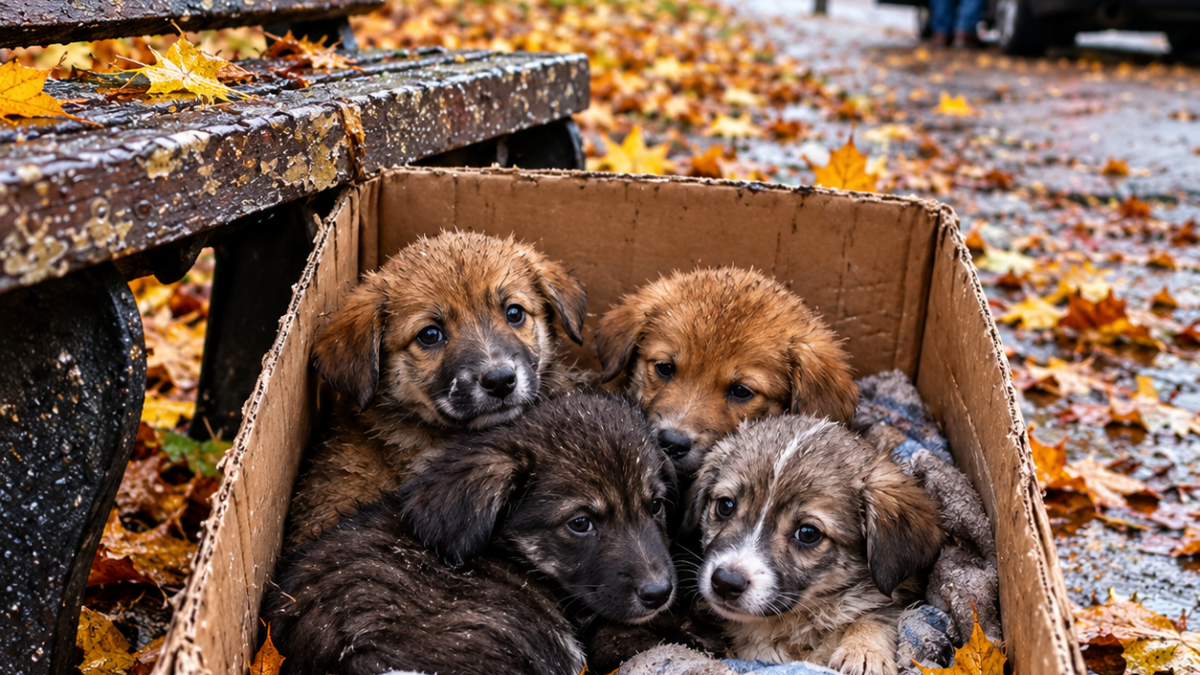
The man set the soggy cardboard box beside an old park bench, glanced around like he was afraid someone might see him, and drove away so fast that gravel sprayed across the pavement—but when I lifted the lid, four puppies no bigger than my hand were huddled together inside, trembling so violently that the smallest one could barely lift his head.
I thought the worst thing I would have to do that night was keep four abandoned puppies alive, but before sunrise I would learn that the man who dumped them had left behind something he never expected anyone to notice.
I will never forget that cold October evening.
The park was nearly empty, the kind of quiet that usually makes you slow down without realizing it. Dry leaves scraped across the walking path whenever the wind picked up, and the old maples along the pond had already lost half their color.
I had gone there because I needed air.
Nothing dramatic. Nothing heroic.
I had worked a long shift, my head was full, and I wanted thirty minutes where nobody needed anything from me.
I was halfway around the eastern loop when a dark SUV pulled into the small parking area beside an old wooden bench.
At first, I barely looked at it.
People stopped there all the time to walk dogs, make phone calls, smoke, or wait for someone.
Then the rear passenger door opened.
A man stepped out carrying a cardboard box.
That caught my attention.
He was moving quickly, but not casually.
There is a difference.
Someone unloading picnic supplies doesn’t keep checking over his shoulder.
Someone dropping off donations doesn’t crouch behind a bench as though trying to stay below the line of sight from the main road.
The man set the box on the ground.
He looked toward the path.
Then toward the parking lot entrance.
Then toward me.
I was far enough away that I don’t think he could see my face clearly, but I instinctively slowed down.
He bent, lifted one flap of the box, looked inside for maybe two seconds, then pressed it closed again.
After that, he went straight back to the SUV.
No hesitation.
No second trip.
No bag.
No leash.
No food.
The door slammed.
The engine revved.
He pulled out hard enough that his rear tires kicked loose gravel behind him.
And he never looked back.
I stopped walking.
Something in my stomach tightened.
The box sat beside the bench.
The wind pushed one of the top flaps open.
Then I saw movement.
At first I thought it might be a kitten.
Or maybe someone had abandoned a rabbit.
I started toward it.
The closer I got, the more I could hear something beneath the rustling leaves.
A tiny sound.
Not barking.
Not even crying exactly.
More like a weak, broken whimper.
I reached the bench and crouched.
The cardboard was damp around the bottom, soft enough that one corner had started collapsing inward. Somebody had put an old towel inside.
Then four tiny heads shifted against one another.
I actually said, “Oh my God,” out loud.
They were puppies.
Four of them.
They couldn’t have been more than four or five weeks old.
Two were reddish brown, one was almost black, and the smallest was gray with a white patch on his chest shaped like a crooked thumbprint.
They were piled together like they had figured out that the only warmth left in the world was each other.
One of the brown puppies gave a faint cry.
The black one had his muzzle tucked beneath his sibling’s belly.
The other reddish puppy barely moved.
Then the gray one looked up at me.
His eyes were huge.
Dark.
Confused.
He tried to push himself onto his front legs.
His paws slipped.
He collapsed back onto the towel.
And then he made that tiny sound again.
A plea so quiet it was almost harder to hear than the leaves.
I put both hands around the sides of the box.
“Who did this to you?”
Of course they couldn’t answer.
But I had watched the answer drive away.
I looked toward the road.
The SUV was gone.
I grabbed my phone and called animal control.
No answer.
It was after regular hours.
The voicemail told me to contact police dispatch for urgent animal emergencies.
So I called.
The dispatcher asked me for my location.
I gave her the park name and described the bench.
“What kind of animals?”
“Four puppies.”
“How old?”
“I don’t know. Maybe a month? They’re tiny.”
“Are they injured?”
“I can’t tell. They’re shaking badly. One of them can barely stand.”
“Did you see who left them?”
“Yes.”
That changed her tone.
“You actually saw the person abandon them?”
“Yes.”
“Do you have a plate number?”
I closed my eyes.
The vehicle had left so fast.
“I saw the back of the car, but I wasn’t expecting to memorize it.”
“Anything at all?”
“Dark SUV. Maybe black or dark blue. Older model. One taillight looked dimmer than the other.”
“Make?”
“I don’t know.”
“Driver description?”
“Man. Maybe thirties or forties. Medium build. Dark jacket. Baseball cap.”
The dispatcher paused.
“An officer is being sent. Can you stay there?”
“I’m not leaving these puppies.”
“Okay. Keep them warm. Don’t give them cow’s milk. If they’re very young, feeding can be complicated.”
“I understand.”
I took off my jacket and wrapped it around the box.
Then I called the only person I knew who might answer faster than animal control.
My friend Megan volunteered with a local rescue group called Second Chance Paws.
She picked up on the second ring.
“What happened?”
She knew me well enough to hear something in my voice.
“I’m in Riverside Park.”
“Okay.”
“Someone dumped four puppies in a box.”
Silence.
Then, “How young?”
“Very.”
“Are their eyes open?”
“Yes.”
“Walking?”
“Barely.”
“Are their gums pale?”
“I don’t know.”
“Can you send me a picture?”
I did.
PART 2
She called me back almost immediately.
“Get them somewhere warm.”
“Police are coming.”
“I’m coming too.”
“Megan—”
“I’m already getting my keys.”
The gray puppy tried to crawl toward my hand.
I slid my fingers beneath him carefully.
He was cold.
Not cool.
Cold.
His belly felt almost chilled through.
“Please hurry,” I said.
“I will.”
I tucked him back beside the others, then pulled my jacket tighter over the box.
That was when I noticed something strange.
Under the dirty towel was another piece of fabric.
Blue plaid.
I lifted one edge.
There was a small plastic grocery bag beneath it.
Inside were two empty cans of puppy food, both rinsed clean.
That made me pause.
Whoever had left these puppies had not simply found them wandering in the woods ten minutes earlier.
Someone had been feeding them.
Handling them.
Keeping them somewhere.
I looked back toward the road.
The abandonment suddenly felt even colder.
This wasn’t panic after discovering a random litter.
This looked planned.
A police cruiser arrived nine minutes later.
Officer Daniel Ruiz stepped out.
He approached slowly, shined his flashlight into the box, then muttered something under his breath.
“You saw the vehicle?”
“Yes.”
He took out a small notebook.
I repeated everything.
Dark SUV.
Male driver.
Baseball cap.
Dark jacket.
One dim rear taillight.
I tried to remember the license plate.
“I think there was a seven.”
Ruiz looked up.
“A seven?”
“Maybe. I’m sorry. I wasn’t paying attention until he drove away.”
“That’s normal.”
“I should’ve gotten the plate.”
“You didn’t know you were witnessing a crime until after he left.”
He crouched near the box.
The gray puppy lifted his head again.
Ruiz’s face tightened.
“Poor little guy.”
Then he looked toward a metal pole near the parking lot.
“Is that a camera?”
I followed his gaze.
Mounted high above the park information board was a black dome-shaped security camera.
I had walked past it dozens of times.
Never noticed it.
“You think it caught him?”
Ruiz stood.
“If it’s working.”
That was the first time all evening I felt something other than helplessness.
Megan arrived with a rescue van and enough blankets to stock a small hospital.
She barely said hello before kneeling by the puppies.
“Oh no.”
She touched each one.
Then the gray puppy.
“We need to move.”
“Is he bad?”
“He’s cold and weak.”
She looked at Ruiz.
“Officer, can we transport?”
“Yes. I’ve got her statement. I’ll contact the parks department about the footage.”
Megan lifted the whole box instead of moving the puppies individually.
“Come with me.”
I followed.
“You don’t need me.”
“Yes, I do.”
“For what?”
“To keep them warm while I drive.”
That was all she had to say.
I climbed into the passenger seat with the box on my lap.
The heat was blasting before we left the parking lot.
Megan drove toward the emergency veterinary clinic while I held my hands beneath the blanket.
The puppies hardly made a sound.
That frightened me more than if they had been screaming.
“Shouldn’t they be crying?”
“Not necessarily.”
“But they’re too quiet.”
“I know.”
The gray one shifted.
I touched his side.
“Come on, little man.”
Megan glanced over.
“Keep rubbing him.”
I did.
His breathing seemed shallow.
“You think they’re littermates?”
“Almost certainly.”
“How old?”
“Four weeks, maybe five.”
“Would they normally still be with their mother?”
“Yes.”
The word hit me.
“Their mother.”
Megan’s hands tightened on the wheel.
“What?”
“What if she’s somewhere?”
“I was thinking the same thing.”
“Could the man have her?”
“Maybe.”
“Or more puppies?”
“Maybe.”
I looked down at the four tiny bodies.
Suddenly this wasn’t only about them.
“What if there are more?”
Megan didn’t answer.
The clinic staff rushed us into an exam room the second we arrived.
Dr. Lewis, the emergency veterinarian, examined the smallest puppy first.
Rectal temperature.
Gums.
Heart.
Blood sugar.
Weight.
He was barely over three pounds.
The black puppy was next.
Then both red ones.
I stood against the wall feeling useless.
Finally Dr. Lewis straightened.
“They’re young, underweight, dehydrated, and all four are cold.”
“Are they going to survive?”
He looked at me.
“I think three are reasonably stable.”
“And the gray one?”
“He’s the one I’m most concerned about.”
My throat tightened.
“Why?”
“His glucose is low. He’s weaker than the others, and his temperature is lower.”
“Can you help him?”
“We’re already helping him.”
A technician placed the gray puppy in a warmed incubator.
He looked unbelievably small behind the clear plastic door.
I hated it.
I hated the box.
I hated the bench.
I hated the man who had checked the box before driving away.
That detail kept replaying in my head.
He had looked inside.
He knew exactly what condition they were in.
Dr. Lewis asked whether we knew how long the puppies had been outside.
“Maybe five minutes before I reached them.”
“That’s good.”
“Good?”
“It means their hypothermia may have started before they were dumped.”
I stared at him.
“So they were already cold?”
“Possibly.”
Megan folded her arms.
“They may have been kept somewhere unheated.”
Dr. Lewis nodded.
“That’s one possibility.”
The idea made my anger sharper.
I asked, “What do they need?”
“Slow warming, fluids, glucose support, parasite testing, nutrition, monitoring.”
“Do it.”
Megan touched my arm.
“The rescue will cover it.”
“I don’t care who covers it.”
“I know.”
The technician reached for the incubator latch.
The gray puppy had tried to lift his head again.
I stepped closer.
“Hey.”
His eyes found me.
“You made it this far.”
He blinked slowly.
“You don’t get to quit now.”
Megan looked at me.
“You just met him.”
“I know.”
She smiled faintly.
“That’s how it starts.”
We stayed for nearly two hours.
Animal control finally called Megan directly and confirmed they would take legal custody of the puppies as abandoned animals while the police looked into the dumping.
Before we left, I asked Dr. Lewis whether I could see the smallest one again.
“He needs rest.”
“I won’t touch him.”
He let me stand outside the incubator.
The gray puppy was sleeping.
His brothers and sister were warming together in another enclosure.
“Does he have a name?” the technician asked.
“No.”
“Well, charting ‘gray male puppy’ gets old quickly.”
I looked at him.
There was that white mark on his chest.
It reminded me of a little splash of snow.
“Finn,” I said.
The technician smiled.
“Finn?”
“Yeah.”
Megan pointed toward the black puppy.
“Then that one’s Oliver.”
“Why?”
“He looks like an Oliver.”
“That’s your reasoning?”
“Exactly.”
The two red puppies became Ruby and Scout.
Temporary names, we told ourselves.
Just for paperwork.
By midnight, I finally went home.
I couldn’t sleep.
Every time I closed my eyes, I saw the SUV pulling away.
At 1:18 a.m., I received a text from Megan.
**All four stable. Finn’s glucose improving.**
I read it three times.
Then another message came.
**Go to sleep.**
I tried.
At 2:07, my phone rang.
I sat upright so fast I almost dropped it.
It was Officer Ruiz.
“I’m sorry to call this late.”
My stomach dropped.
“Did something happen to the puppies?”
“No. This is about the vehicle.”
I turned on the lamp.
“You found it?”
“We pulled the park footage.”
My heart started beating harder.
“Was the plate visible?”
“Partially.”
“Partially?”
“The angle isn’t perfect. But we can see the last four characters.”
I stood.
“Can you identify him from that?”
“Possibly.”
“Then why are you calling me?”
“Because there’s something else on the video.”
I waited.
Ruiz continued.
“Before he drives away, the man opens the rear hatch.”
“Okay.”
“There’s another box inside.”
For several seconds I couldn’t speak.
“What kind of box?”
“Cardboard.”
My mouth went dry.
“Do you see what’s in it?”
“No.”
“Could it be empty?”
“Yes.”
“Could it have puppies?”
“Yes.”
I sat back down.
“What are you doing?”
“We’re trying to identify the vehicle now.”
“And if you do?”
“We’ll follow up.”
“Tonight?”
“If we can establish the owner and probable cause, yes.”
I remembered Megan asking the question in the van.
What if there are more?
Now it wasn’t paranoia.
There really had been another box.
I called Megan immediately.
She answered half asleep.
“What happened?”
“There was another box in his SUV.”
She was quiet.
Then fully awake.
“Animals inside?”
“They don’t know.”
“Damn it.”
“I can’t just sit here.”
“Yes, you can.”
“Megan—”
“Police are handling it.”
“What if there are more puppies freezing somewhere?”
“And what exactly are you going to do? Drive around the county checking dark SUVs?”
I hated when she was reasonable.
“They’ll call.”
“I know.”
“Try to sleep.”
“I know.”
I didn’t.
At 3:42, Ruiz called again.
“We identified the vehicle.”
I was already standing before he finished the sentence.
“Where?”
“Registered to a man named Eric Dalton. Lives about eight miles from the park.”
“Are you going there?”
“Officers are there now with animal control.”
“Did they find the second box?”
“I’m not on scene.”
“Can you call me?”
“I can’t promise.”
“Officer—”
“If there are more animals, they’ll be removed if legally justified.”
That word—if—made me crazy.
I paced my kitchen.
At 4:26, Megan texted.
**Rescue director just got a call from animal control. They found the mother dog.**
I called her.
“The mother?”
“Yes.”
“Alive?”
“Yes.”
“Okay.”
“But there’s more.”
Of course there was.
“What?”
“They found two additional puppies.”
I stopped breathing for a second.
“Where?”
“Same property.”
“In the second box?”
“No.”
“Then where?”
“Garage.”
I leaned against the counter.
“Are they alive?”
“Yes.”
“Condition?”
“Cold. Underweight. One has diarrhea.”
“So there were six.”
“Six puppies and the mother.”
I closed my eyes.
“What kind of person dumps four and keeps two?”
“I don’t know yet.”
That question stayed with me.
Why leave four?
Why keep two?
By sunrise, I had my answer.
And somehow it made the whole thing worse.
I met Megan at the rescue’s intake facility just after seven.
The mother dog had already arrived.
She was a medium-sized mixed breed, maybe thirty-five pounds, reddish coat, white paws, enormous brown eyes.
She looked exhausted.
Her ribs showed.
Her nipples were swollen from nursing.
The second she heard puppies crying in the next room, she stood.
Her entire body went rigid.
Then she started whining.
Not loudly.
But continuously.
A desperate, trembling sound.
“Can she see them?”
I asked.
“Not until vet clearance.”
“They’re her babies.”
“We don’t know infectious status yet.”
She scratched at the kennel door.
My chest hurt watching her.
“What’s her name?”
“The owner called her Daisy.”
“Owner?”
Megan nodded.
“Eric Dalton admitted she’s his.”
I stared.
“He admitted it?”
“Apparently he says he was trying to ‘rehome’ the litter.”
“By dumping four in a park?”
“He claims someone was supposed to pick them up.”
“At eleven o’clock at night?”
“Apparently.”
I laughed once.
There was nothing funny in it.
“And the two he kept?”
Megan’s expression changed.
“That’s the part you’re really going to hate.”
“What?”
“He had people coming to buy them.”
I didn’t understand at first.
Then I did.
“He kept the puppies he thought he could sell.”
“That’s what animal control believes.”
“And dumped the others?”
“The two he kept were the largest.”
I thought of Finn.
Three pounds.
Cold.
Unable to stand.
“He sorted them.”
Megan didn’t answer.
“He chose the valuable ones and threw away the rest.”
“We don’t know exactly what he was thinking.”
I did.
Maybe not every detail.
But enough.
Later that morning, Officer Ruiz confirmed more.
Eric Dalton had posted puppies for sale online.
The photos showed Daisy lying with six newborn puppies on a blanket in a garage.
Six.
The exact litter.
The listing described them as a “designer mix,” although nobody seemed certain what breeds the parents actually were.
He had been asking several hundred dollars each.
Two puppies had deposits.
Four had not.
Those were the four in the box.
Ruiz showed me a screenshot.
Ruby.
Scout.
Oliver.
Finn.
All photographed when they were younger.
All listed for sale.
I stared at Finn’s picture.
He looked healthier there.
Rounder.
Bright-eyed.
“So he couldn’t sell them.”
Ruiz closed the file.
“That appears to be part of the motive.”
“Then why not take them to a shelter?”
“That’s something investigators asked.”
“What did he say?”
Ruiz hesitated.
“He said he assumed shelters were full.”
“Did he call one?”
“Not that we’ve confirmed.”
“Did he contact a rescue?”
“No.”
“Did he post them for free?”
“No.”
“Did he ask anyone for help?”
“Not that we’ve found.”
I looked away.
“So he didn’t assume anything. He just didn’t want the inconvenience.”
Ruiz didn’t argue.
The two puppies found at the property were brought to the rescue after examination.
We named them Hazel and Bear.
Hazel was red with a dark stripe along her nose.
Bear looked almost exactly like Oliver, only larger.
They were weak but stronger than the four dumped in the park.
Daisy was cleared to reunite with them first.
Then with the others.
I stood behind a glass partition when the staff carried the puppies into the room one by one.
Daisy lost her mind.
She licked them frantically.
Nosed them.
Counted them in whatever way a mother dog counts.
Ruby first.
Then Scout.
Oliver.
Hazel.
Bear.
Finn came last because he still needed additional warming.
When the technician set him down, Daisy pushed past the others.
She licked his entire face.
Finn squeaked.
She curled herself around him.
I had spent all night angry.
That was the first moment I cried.
Not dramatically.
I just turned away because tears were suddenly running down my face.
Megan handed me a tissue.
“Don’t.”
“Don’t what?”
“Say anything.”
“I wasn’t going to.”
“You were going to make fun of me.”
“Never.”
I looked at her.
She smiled.
“Okay, maybe a little.”
Over the next three days, Finn scared us twice.
The first time, his blood sugar dropped again.
The second time, he stopped eating.
Dr. Lewis worried about parasites, infection, and something called fading puppy syndrome—a general term for very young puppies who suddenly weaken and fail.
I hated the phrase.
Fading.
As though a living thing could simply dim until nothing remained.
The rescue moved Daisy and the litter into a veterinary foster room where they could remain together.
I visited after work.
Every day.
I told myself I was checking on all seven dogs.
Megan knew better.
“You’re here for Finn.”
“I’m here for everybody.”
“You said Finn’s name before you said hello to me.”
“That proves nothing.”
She handed me a bottle of disinfectant.
“Wash your hands.”
By the end of the week, Finn began gaining weight.
Not much.
But enough.
He became louder.
That felt like victory.
The first time I heard him bark, it was pathetic.
A tiny “yip” directed at Bear because Bear had climbed over him.
I laughed.
“There you are.”
Finn barked again.
Megan looked over.
“Oh, great. You encouraged him.”
“Absolutely.”
Daisy recovered too.
Once she was fed consistently and no longer trying to nurse while underweight, her body began filling out.
But emotionally, she remained nervous.
If a man in a baseball cap entered the room, she flattened herself.
If someone carried a cardboard box nearby, she paced.
That made me wonder what had happened before the park.
Eric Dalton’s version changed twice.
First he claimed someone had arranged to meet him there.
Then he said he believed abandoned animals would be discovered quickly because the park was busy.
Then he insisted he had not intended to harm them.
That last part angered me most.
Not because intention doesn’t matter.
It does.
But harm doesn’t disappear because somebody claims they didn’t picture the consequences.
Four-week-old puppies cannot find shelter.
They cannot regulate their body temperature well.
They cannot open a phone and call for help.
Leaving them outside in October isn’t a misunderstanding.
It’s a decision.
The police report eventually included the security video.
The footage showed Eric arriving at 9:41 p.m.
He sat in the SUV for nearly four minutes.
Then he got out.
Opened the rear hatch.
Removed the box.
Set it down.
Checked inside.
Looked around.
Drove away.
There was no second vehicle waiting.
No person approaching.
No exchange.
No attempt to call anyone.
Nothing.
The second box seen in the rear hatch turned out to be the container he had used to transport Hazel and Bear earlier that day while showing them to potential buyers.
He had returned them to the garage.
He dumped the four that had not sold.
The investigation uncovered messages too.
One buyer had asked whether all six puppies were available.
Eric replied:
**Only two good ones left.**
I saw that line because it appeared in the case packet later.
Only two good ones.
I read it once.
Then again.
Finn was asleep against my leg at the time.
By then he had gained enough strength to spend supervised time away from Daisy.
He was chewing my shoelace.
Only two good ones.
I touched the white patch on his chest.
“Apparently you’re defective.”
Finn sneezed.
I smiled despite myself.
“You seem devastated.”
The case against Eric did not become some huge televised prosecution.
Real life rarely works that way.
There were no dramatic courtroom cameras.
No reporters waiting outside.
No handcuffed villain making a speech.
There was paperwork.
Statements.
Veterinary reports.
Photographs.
Security footage.
Online sales records.
Messages.
Animal-control citations.
A misdemeanor cruelty charge under the applicable local statute.
And one very angry municipal judge.
I attended the hearing because I had witnessed the abandonment.
Eric looked smaller in court than he had in the park.
Maybe because I had spent weeks turning him into something larger in my head.
He wore a button-down shirt.
No baseball cap.
His attorney argued that he had exercised “poor judgment under financial pressure.”
Financial pressure.
The phrase made me look toward Megan.
She raised one eyebrow.
The prosecutor asked me what I saw.
I described it exactly.
The box.
The bench.
The way Eric checked his surroundings.
The way he lifted the flap.
The way he drove away.
His attorney asked whether I could know what Eric intended.
“No.”
“Then you cannot say he intended the puppies to die.”
“No.”
He nodded.
I continued.
“But I can say he left four puppies who were too young to care for themselves in a cardboard box on a cold night and drove away.”
The attorney stopped smiling.
He asked, “You aren’t a veterinarian, correct?”
“No.”
“You cannot personally determine how long they could have survived.”
“No.”
“You also cannot determine whether someone else might have found them within minutes.”
“Someone did.”
He looked at me.
“Exactly.”
“By accident.”
The judge interrupted before the attorney could respond.
“Move on.”
Dr. Lewis testified about the puppies’ condition.
Animal control testified about Daisy and the remaining two puppies.
Officer Ruiz testified about the footage.
Then came the online messages.
The prosecutor read the line aloud.
“Only two good ones left.”
Eric shifted in his seat.
His attorney objected to the characterization that the message proved motive.
The judge allowed the evidence but cautioned that motive would be weighed with everything else.
Then Eric testified.
That surprised me.
His attorney asked him why he left the puppies.
Eric said he had lost his job.
He said the litter had been accidental.
He said Daisy belonged to his former girlfriend originally.
He said he had tried to sell the puppies to recover veterinary and food expenses.
He said people kept backing out.
He said he was behind on rent.
He said the shelter website warned of limited intake capacity.
He said he panicked.
For the first time since that night, I saw him as something other than the man driving away.
He looked tired.
Embarrassed.
Cornered.
Human.
That did not make what he did acceptable.
But it made the story more complicated.
The prosecutor asked, “Did you call the shelter?”
“No.”
“Did you email them?”
“No.”
“Did you call animal control?”
“No.”
“A rescue?”
“No.”
“Your veterinarian?”
“No.”
“Friends?”
“I asked some people.”
“For help placing the puppies?”
“I mentioned them.”
“Did you tell anyone you were considering abandoning them?”
“No.”
“Did you offer the four puppies at no charge?”
“No.”
“Why not?”
Eric looked down.
“I don’t know.”
The prosecutor held up a printout.
“Two hours before you abandoned the puppies, you messaged a potential buyer that you would not take less than three hundred dollars for one of them. Correct?”
Eric swallowed.
“Yes.”
“Which puppy?”
“I don’t remember.”
The prosecutor showed him a photograph.
“Was it this gray puppy?”
I knew the picture.
Finn.
Eric looked at it.
“Yes.”
“And the buyer offered one hundred fifty?”
“Yes.”
“And you declined?”
“Yes.”
“Two hours later you left that same puppy in Riverside Park?”
His attorney stood.
“Objection, argumentative.”
“Sustained.”
But the point was already there.
The courtroom became very quiet.
The judge asked Eric one question directly.
“Why didn’t you take the one hundred fifty dollars if your concern was simply finding the dog a home?”
Eric stared at the table.
“I thought I could get more.”
That answer ended whatever sympathy the room had started to feel.
The judge’s expression hardened.
Eric’s attorney whispered something to him.
Too late.
The court imposed fines, restitution for veterinary and rescue costs, probation, community service, mandatory animal-care education, and a temporary prohibition on owning or selling animals.
Daisy and all six puppies were permanently surrendered.
It wasn’t a life-destroying sentence.
It wasn’t meant to be.
But it meant he could never claim the animals again.
For me, that was enough.
When we walked outside, Megan exhaled.
“Done.”
I shook my head.
“Not yet.”
She looked at me.
“What?”
“The puppies still need homes.”
She smiled slowly.
“Interesting wording.”
“What wording?”
“You said puppies.”
“Yes.”
“Not Finn.”
“Don’t start.”
“I haven’t said anything.”
“You were about to.”
Megan lifted both hands.
“Completely innocent.”
I pointed toward the parking lot.
“Go away.”
She laughed.
By then the litter was nearly nine weeks old.
Healthy.
Vaccinated.
Round-bellied.
Chaotic.
They destroyed everything.
Blankets.
Pee pads.
A cardboard enrichment tunnel that lasted approximately forty seconds.
Scout discovered that if he stepped in the water bowl and shook himself, everyone nearby became wet.
Ruby learned how to climb out of the puppy pen.
Bear learned from Ruby.
Hazel learned faster than Bear.
Oliver screamed whenever someone left the room.
Finn stole socks.
Not chewed.
Stole.
He would grab one and run.
Always one.
Never two.
I started bringing old socks specifically because watching him sprint through the foster room with one hanging from his mouth made me laugh.
Daisy became a different dog.
With her puppies old enough to eat independently, she finally had time to rest.
She began greeting people.
Then asking for affection.
Then demanding it.
One afternoon she climbed into my lap despite weighing thirty-seven pounds.
Megan walked in.
“Comfortable?”
Daisy rested her chin on my shoulder.
“Very.”
“You know she has an adopter interested.”
I looked at Daisy.
“That’s good.”
“A retired couple.”
“House?”
“Yep.”
“Fence?”
“Six-foot.”
“Other dogs?”
“One elderly Lab.”
“Meet-and-greet?”
“Tomorrow.”
I nodded.
“Good.”
Megan watched me.
“You’re learning.”
“What?”
“To let them go.”
I didn’t answer.
Daisy’s adoption was approved three days later.
Her new family, Linda and Mark, had lost their older shepherd mix the previous year.
They were gentle.
Patient.
They understood she might have anxiety.
When they came to pick her up, Linda sat on the floor for twenty minutes before trying to attach the leash.
Daisy eventually walked over and placed her head beneath Linda’s hand.
That decided it for me.
“She picked you,” I said.
Linda’s eyes filled.
“I think she did.”
When Daisy left the rescue, she looked back once.
Not at me.
At the building.
At the place where her puppies had been.
Megan stood beside me.
“She knows.”
“You think?”
“I think mothers know more than we give them credit for.”
I hoped she was right.
Then came the puppies.
Hazel was adopted first.
A family with two older children.
They sent us a photo three days later of her asleep between the kids on a couch.
Bear went to a young couple who already had a calm adult dog.
Scout went to a veterinary technician.
Ruby went to a woman who ran three miles every morning and wanted a future running partner.
Oliver took longer because of his separation distress.
Eventually he found a home with a retired man who was around almost all day.
That left Finn.
Technically, several people applied for him.
He was adorable.
Gray coat.
White chest.
One ear that eventually stood while the other refused.
Everyone loved his photos.
I rejected the first applicant because they worked twelve-hour shifts and planned to crate him the entire time.
The second applicant wanted him as a surprise Christmas gift for a six-year-old.
No.
The third application was good.
Very good.
Married couple.
Fenced yard.
Stable jobs.
Previous dog experience.
Veterinary references.
One adult worked from home.
No young children.
No issue with training.
Megan put the application on my desk.
“You should call them.”
I read it.
“They seem fine.”
“Better than fine.”
“Yes.”
“So?”
I kept reading.
Megan waited.
Finally she said, “You don’t want to call them.”
“I didn’t say that.”
“You’ve read the same page four times.”
“I’m reviewing it.”
“You’ve been reviewing it for twenty minutes.”
I put the paper down.
“They live forty minutes away.”
“So?”
“That’s far.”
“For who?”
“For follow-up.”
“We adopt farther than that every week.”
I hated her.
“They have stairs.”
Megan laughed.
“Rachel.”
“He’s small.”
“He has legs.”
“What if he falls?”
“He climbs your couch like a mountain goat.”
I stared at the application.
Megan sat across from me.
“You know what this is.”
“No.”
“Yes.”
“I’m evaluating placement.”
“No. You’re looking for a reason to reject everyone because you want him.”
“I foster.”
“You don’t currently foster.”
“I could.”
“You’ve had Finn sleeping at your house four nights a week for socialization.”
“He needed individual exposure.”
“You bought him a bed.”
“The rescue beds are ugly.”
“You engraved his name on a food bowl.”
“It was on sale.”
She stared at me.
I sighed.
“He trusts me.”
“Yes.”
“And what if I keep him because he trusts me, but somebody else could give him a better home?”
Megan’s expression softened.
“That’s a real question.”
I looked down.
“I don’t want to be selfish.”
“Then don’t ask whether you want him.”
“What do I ask?”
“Ask whether you can give him what he needs for the next fifteen years.”
That silenced me.
Not the next week.
Not until the rescue story stopped feeling urgent.
Fifteen years.
Training.
Food.
Vet bills.
Travel arrangements.
Emergency expenses.
Muddy floors.
Destroyed furniture.
Old age.
Good days.
Terrible days.
The whole contract.
I looked at the application again.
“They really are good.”
“Yes.”
“They’d probably love him.”
“Yes.”
“Then maybe he should go.”
Megan nodded.
“Maybe.”
I looked at her.
“You’re supposed to stop me.”
“No.”
“Why not?”
“Because if I talk you into adopting him, you’ll always wonder if you did it emotionally.”
“That’s fair.”
“Call them.”
So I did.
Their names were Aaron and Melissa.
They sounded kind.
We scheduled a meet-and-greet for Saturday.
I spent Friday night with Finn at my apartment.
He was almost twelve weeks old and had discovered the joy of pulling tissues from a box one at a time.
When I caught him, the living room looked like a paper storm.
“Seriously?”
Finn froze with a tissue hanging from his mouth.
“Drop it.”
He wagged.
“Drop.”
He ran.
I chased him around the couch.
He squeezed beneath a chair.
I sat on the floor.
“You know you’re meeting potential adopters tomorrow.”
Finn crawled into my lap.
“You could at least pretend to have manners.”
He licked my chin.
I rubbed his chest.
“You’ll like them.”
His eyes started closing.
“They have a yard.”
He settled against me.
“Somebody works from home.”
His breathing slowed.
“They won’t let you eat tissues.”
One eye opened.
“Probably.”
I laughed.
Then, for reasons I couldn’t explain, my throat tightened.
“Don’t make this hard.”
He fell asleep.
Saturday morning, Aaron and Melissa arrived exactly on time.
They brought no toys.
No treats.
That impressed me because people often tried to buy a puppy’s affection during meet-and-greets.
They sat quietly.
Let Finn approach.
Asked about his medical history.
Asked about Daisy.
Asked about training.
Asked whether he showed fear around boxes, cars, or men.
Good questions.
Responsible questions.
Finn liked them.
Of course he did.
He climbed into Melissa’s lap after fifteen minutes.
Aaron rubbed his ears.
“He’s amazing.”
“He is.”
Melissa looked at me.
“How long have you had him?”
“Since the night he was abandoned.”
Her face changed.
“You were the person who found them?”
“Yes.”
“Oh.”
That one syllable held understanding.
She looked down at Finn.
Then at me.
“Are you sure you’re okay with this?”
The question hit harder than I expected.
“This?”
“Us adopting him.”
I opened my mouth.
Nothing came out.
Aaron glanced between us.
Melissa smiled gently.
“You don’t look like someone interviewing applicants.”
“What do I look like?”
“Like someone trying to convince herself she’s not his person.”
I looked at Finn.
He was chewing Aaron’s shoelace.
“I don’t want to keep him just because I was there when he was found.”
“That’s fair.”
“What if he belongs with somebody else?”
Melissa stroked his back.
“Maybe he does.”
She paused.
“But maybe you already know the answer.”
They left without submitting the final adoption paperwork.
Not because they didn’t want him.
Because Melissa quietly told Megan they didn’t want to take a dog from someone who was clearly already attached.
I was furious.
At first.
“You told them something.”
Megan shook her head.
“I said nothing.”
“Then why did they leave?”
“Because they have eyes.”
“That’s ridiculous.”
“Rachel.”
“What?”
“Where is Finn sleeping tonight?”
I folded my arms.
“My place.”
“And tomorrow?”
“My place.”
“Where is his food?”
“My kitchen.”
“Where are his toys?”
“Everywhere.”
“Who is listed as his emergency foster contact?”
“Me.”
“Whose car does he recognize?”
I didn’t answer.
Megan leaned back.
“Adopt your dog.”
The words landed with surprising force.
My dog.
Finn was on the floor beside us wrestling with an empty paper towel tube.
I looked at him.
That night, I went back to Riverside Park.
Alone.
I parked near the old wooden bench.
The weather had turned colder since the night I found them.
The bench was empty.
No box.
No puppies.
No police lights.
Nothing.
I stood where Eric’s SUV had been.
Then where the box had sat.
I could still picture it.
Damp cardboard.
Dirty towel.
Four bodies pressed together.
Finn lifting his head.
That first tiny whimper.
For weeks, I had thought rescuing him was something that happened in that moment.
Lift the box.
Make the call.
Get him warm.
But rescue was not one moment.
It was everything afterward.
It was blood sugar checks at midnight.
It was medication.
Vaccines.
Training.
Socialization.
Saying no when a home wasn’t right.
Saying yes when one was.
And maybe sometimes it was admitting that the home you had been searching for was yours.
My phone rang.
Megan.
“Where are you?”
“The park.”
She was quiet.
“Bench?”
“Yes.”
“Of course.”
I sat down.
Leaves rolled across the ground.
“I’m going to do it.”
“Do what?”
“You know.”
“No, I want you to say it.”
“You’re unbearable.”
“Say it.”
I smiled.
“I’m adopting Finn.”
There was a pause.
Then Megan screamed so loudly I held the phone away from my ear.
“Are you done?”
“No.”
“You’re done.”
“I knew it.”
“Everybody knew it.”
“I hate all of you.”
“We love you too.”
The adoption paperwork took twenty minutes.
The emotional commitment took considerably longer.
Finn officially became mine on a Tuesday afternoon.
The rescue director handed me his file.
Vaccination records.
Microchip information.
Photographs.
The intake report.
At the top of the first page:
**Location Found: Riverside Park. Cardboard box near east bench.**
I stared at those words.
Then I closed the folder.
That location was where his life almost ended.
It wasn’t going to define the rest of it.
Finn grew.
Fast.
Those oversized paws I had noticed the first night turned out to be a warning.
By six months, he was forty pounds.
By ten months, fifty-two.
He never became huge, but he was definitely not the tiny gray puppy who could fit against my forearm.
His ears never agreed on what they wanted to do.
One stood.
One folded.
I loved them.
He remained obsessed with socks.
He graduated from stealing one at a time to stealing entire laundry piles.
He learned sit, stay, down, leave it, place, and an extremely selective version of come.
He hated baths.
Loved sprinklers.
Feared umbrellas for reasons nobody understood.
And for the first year, he hated cardboard boxes.
That one made sense.
The first time a delivery arrived at my apartment, I placed the package on the floor.
Finn entered the room.
Stopped.
His body lowered.
Tail tucked.
He backed away.
I froze.
Of course.
I sat beside the box.
Didn’t call him.
Didn’t force him closer.
I dropped treats five feet away.
Then four.
Then three.
Over days, boxes became treat machines.
Then toy containers.
Then irrelevant objects.
Months later, I found him sleeping inside one.
I took a photo and sent it to Megan.
Her reply came instantly.
**FULL CIRCLE.**
Daisy’s family stayed in touch.
Linda sent pictures.
Daisy gained weight.
Her coat became glossy.
She bonded with their older Lab.
She slept beside Mark’s chair while he read.
The first Christmas after the rescue, Linda sent a picture of Daisy lying under a tree wearing a ridiculous red bandana.
I printed it.
The puppies’ adopters formed a group chat.
Ruby became an athlete.
Scout became a professional troublemaker.
Bear grew to sixty-five pounds and believed he was a lapdog.
Hazel learned to swim.
Oliver’s separation anxiety improved slowly.
Finn sent no messages because Finn had me.
But I sent plenty.
On the one-year anniversary of the rescue, we organized a reunion.
All six puppies.
Daisy.
Seven dogs in one fenced yard.
Absolute chaos.
The puppies were nearly full-grown.
At first they sniffed one another cautiously.
Then something clicked.
Maybe scent.
Maybe memory.
Maybe nothing more than canine excitement.
They exploded.
Running.
Chasing.
Wrestling.
Daisy stood in the middle while six adult-sized children bounced around her.
Linda laughed until she cried.
Megan filmed everything.
I watched Finn tackle Bear, roll into the grass, leap up, and sprint after Ruby.
For one brief second, the image of those same puppies pressed together in the cardboard box flashed through my mind.
Tiny.
Cold.
Silent.
Then Finn flew past me at full speed, stole a tennis ball, and refused to surrender it.
The contrast almost knocked the air out of me.
Officer Ruiz came too.
He had followed the case from beginning to end.
Finn recognized him only as a person who might possess snacks.
Ruiz scratched his neck.
“This is the little gray one?”
“Yep.”
“No way.”
“He got bigger.”
“Clearly.”
Ruiz looked around the yard.
“All six?”
“All six.”
“And the mother.”
Daisy was leaning against Linda.
Ruiz smiled.
“Not a bad outcome.”
“No.”
He looked at me.
“You still think about that night?”
“Sometimes.”
“Me too.”
I hesitated.
“Do you think Eric understood what he did?”
Ruiz thought before answering.
“I think consequences made him understand that other people took it seriously.”
“That’s not what I mean.”
“I know.”
He watched the dogs.
“People don’t always become who we want them to become after they hurt something.”
That stayed with me.
I had spent months wanting Eric to feel exactly what I felt.
Anger.
Shame.
Regret.
I wanted him to see Finn healthy and understand what he had almost destroyed.
Maybe he did.
Maybe he didn’t.
Eventually I realized I didn’t need access to his conscience.
Justice didn’t require me to know what happened inside his head.
It required the puppies to be safe.
They were.
Two years after the rescue, I ran into Eric.
Completely by accident.
It happened outside a hardware store.
Finn was with me.
I had gone in for paint rollers and walked out carrying twice as much as I intended.
I was loading the trunk when Finn stiffened.
Not aggressive.
Alert.
I looked up.
A man stood three cars away.
Eric.
I recognized him instantly.
He recognized me a second later.
Then he saw Finn.
For a moment neither of us moved.
Finn stood beside me.
Tail neutral.
Ears forward.
Eric stared.
“That him?”
His voice was quieter than I remembered.
“Yes.”
“He got big.”
“Yes.”
Eric put his hands into his jacket pockets.
“How is he?”
The question irritated me.
It shouldn’t have.
But it did.
“He’s good.”
Eric nodded.
“Good.”
He looked at Finn again.
“I heard the others got homes.”
“They did.”
“And Daisy?”
“She did too.”
He stared at the pavement.
“I wasn’t trying to kill them.”
There it was.
Two years later.
The sentence he still needed someone to believe.
I closed my trunk.
“I know that’s what you told the court.”
He flinched slightly.
“I messed up.”
“Yes.”
“I was broke.”
“I know.”
“My landlord was threatening me.”
“I heard.”
“My girlfriend left. I had six puppies. Daisy. Bills. Nobody wanted them.”
“People wanted two.”
He looked away.
I didn’t want a fight.
Strangely, I didn’t even feel the rage I expected.
Mostly I felt tired.
He said, “I figured somebody would find them.”
“They did.”
“I knew the park had people.”
“At ten at night in October?”
He said nothing.
I looked at Finn.
Finn looked back at me.
Then Eric asked, “Does he remember me?”
That was the saddest question he could have asked.
I genuinely didn’t know.
“I can’t tell you.”
Eric crouched slightly.
Finn did not approach.
Eric held out his hand.
Finn looked at me.
Then back at him.
He took one step forward.
Sniffed the air.
Stopped.
No tail wag.
No fear.
No recognition I could read.
Nothing.
Eric lowered his hand.
“Guess not.”
I didn’t answer.
He stood.
“I’m sorry.”
I studied him.
Not because I was deciding whether to forgive him.
That wasn’t mine to grant on behalf of seven animals.
I was deciding whether I believed he meant it.
Maybe he did.
Maybe he meant it now because enough time had passed.
Maybe he regretted the fine.
The court.
The embarrassment.
Maybe he regretted the dogs.
Maybe all of it.
Human beings are messy enough for several motives to exist at once.
“I hope you never do anything like that again.”
“I won’t.”
“That matters more than telling me you’re sorry.”
He nodded.
Then he walked away.
Finn watched him for two seconds.
After that, he picked up a crushed leaf and tried to eat it.
That was it.
No dramatic recognition.
No barking.
No trembling.
No revenge.
Just a dog standing in a parking lot beside the person who had become his home.
I loaded him into the car.
As I closed the door, I realized something that felt unexpectedly freeing.
Eric Dalton was no longer important to Finn’s life.
At one time, his decision had controlled everything.
Whether Finn ate.
Whether he stayed warm.
Whether he lived.
Now he was simply a man walking across a parking lot.
Finn had moved beyond him.
I wanted to do the same.
Years passed.
Finn developed a white stripe under his chin.
The other littermates aged too.
We still met when schedules allowed.
Not every year.
Life gets busy.
People move.
Children are born.
Jobs change.
But photos kept coming.
Daisy lived seven more years with Linda and Mark.
When she died, Linda called me herself.
“She went in her sleep,” she said.
“I’m sorry.”
“She had breakfast that morning.”
Her voice broke.
“She stole bacon from Mark.”
I smiled through tears.
“That sounds like Daisy.”
“She was happy.”
That was all I needed to hear.
After the call, I sat beside Finn.
He was older by then.
Slower.
His ears had softened with age.
I rested my hand on his back.
“Your mom had a good life.”
He slept.
Maybe he remembered her.
Maybe he didn’t.
I did.
I remembered her scratching at that kennel door because she could hear her puppies.
I remembered the way she licked Finn’s face.
I remembered seven frightened animals brought back together after one person’s decision tore them apart.
Finn eventually became the kind of dog who could sleep through thunderstorms.
Boxes no longer bothered him.
Cars no longer bothered him.
Men in baseball caps no longer bothered him.
He remained suspicious of umbrellas.
Some mysteries never resolve.
On cold October evenings, though, I sometimes thought about the park.
Not every day.
Not even every month.
But occasionally the air smelled the same—dry leaves, damp earth, wood smoke somewhere far away—and suddenly I was back beside that bench.
I could see the cardboard.
Feel Finn’s cold body.
Hear that whisper of a whimper.
For a long time, those memories made me angry.
Then they started making me grateful.
Not grateful that it happened.
Never that.
Grateful that I happened to be walking there.
Grateful that the camera worked.
Grateful Megan answered.
Grateful Ruiz cared.
Grateful Dr. Lewis didn’t give up on the weak gray puppy.
Grateful animal control searched the property.
Grateful Daisy and the two remaining puppies were found.
A different turn on that path and I might have missed the SUV entirely.
Five minutes later and the park could have been empty.
An hour later, Finn’s temperature might have fallen farther.
Sometimes lives change because of enormous decisions.
Sometimes they change because someone notices a box.
Finn was eleven when we went back to Riverside Park for what turned out to be our last visit together.
He had arthritis by then.
Nothing catastrophic.
Just age.
We walked slowly.
The old wooden bench had been replaced years earlier with a metal one.
That bothered me more than it should have.
I wanted the original bench to still exist.
Some physical proof.
But parks change.
Trees fall.
Wood rots.
People replace things.
Finn sniffed along the grass.
Eventually we reached the spot.
I sat.
He stood between my knees.
His coat had gone silver around his eyes.
I touched the white patch on his chest.
Still there.
Smaller somehow because the rest of him had grown around it.
“This is where I met you.”
Finn looked toward the pond.
“You were terrible company.”
His tail moved once.
“Very dramatic.”
He leaned into me.
“You almost died.”
My voice caught.
I stopped.
There are moments when animals seem to understand language.
This wasn’t one of them.
Finn was watching a squirrel.
I laughed.
“Never mind.”
He tried to pull toward it.
“Absolutely not.”
The squirrel disappeared up a tree.
Finn stared after it, offended.
Then he settled beside the bench.
I looked around.
Families.
Joggers.
A teenager on a bicycle.
A woman pushing a stroller.
Ordinary life.
Eleven years earlier, the same place had felt like the worst corner of the world.
Now it was just a park again.
Maybe that was another kind of healing.
Finn died the following spring.
Cancer.
Fast.
Too fast.
One month he was slowing down.
The next we were discussing options.
Then discussing comfort.
Then discussing the decision every dog owner hates even when they know it is right.
On his last morning, I gave him scrambled eggs.
He ate half.
Stole one piece of bacon.
Daisy would have approved.
Megan came over.
She sat on the floor beside him.
“You know,” she said, “I always knew you’d keep him.”
I laughed quietly.
“You tell that story differently every year.”
“No, I don’t.”
“You absolutely do.”
Finn’s tail moved weakly when she touched him.
We took him to the same veterinary clinic that had treated him the night I found him.
Dr. Lewis had retired, but one of the technicians remembered his name.
“Riverside puppies?”
“Yes.”
“Oh my God.”
She knelt beside him.
“You were the little gray one.”
Finn leaned against her hand.
“Not so little anymore,” I said.
The room was quiet.
Peaceful.
I held him.
My hand rested over the white patch on his chest.
For one strange second, I could feel both versions of him at once.
The old dog in my arms.
The freezing puppy in the box.
Eleven years between them.
Eleven years Eric Dalton had never intended to give him.
Eleven years of stolen socks.
Mud.
Road trips.
Vaccines.
Bad breath.
Christmas mornings.
Walks.
Thunderstorms.
Vet bills.
Couch naps.
Ordinary Tuesdays.
That was the part people sometimes missed when they heard rescue stories.
Saving an animal is not only preventing death.
It is giving them the chance to accumulate ordinary days.
Finn had thousands of them.
His breathing slowed.
I pressed my face against his head.
“You’re okay.”
My voice shook.
“You don’t have to fight anymore.”
Megan put a hand on my shoulder.
Finn exhaled.
Then he was still.
For a long time, I couldn’t move.
Eventually the technician asked whether I wanted his collar.
“Yes.”
I held it all the way home.
For weeks afterward, I kept expecting to hear his nails in the hallway.
I stepped around places where his bed had been.
I opened the door carefully because he used to sleep behind it.
Grief has strange muscle memory.
Three months later, Megan called.
“I need you at the rescue.”
“No.”
“You don’t even know why.”
“I know you.”
“Rachel.”
“No puppies.”
Silence.
Then, “I didn’t say puppies.”
“You were going to.”
“No.”
“You’re lying.”
“Come here.”
I went.
There was no box.
No abandoned litter.
Just an older dog.
Seven years old.
Black coat.
Gray muzzle.
Owner had died.
Family couldn’t keep her.
She sat at the back of the kennel without approaching.
“What are you doing?” I asked.
Megan leaned against the wall.
“Nothing.”
“You brought me here.”
“Yes.”
“For her.”
“Yes.”
“I’m not ready.”
“I didn’t say adopt her.”
The dog looked at me.
Megan handed me a leash.
“Walk her.”
I sighed.
“You’re manipulative.”
“Probably.”
The dog’s name was Molly.
She walked slowly.
No pulling.
No drama.
At the end of the parking lot, she leaned against my leg.
Just once.
I looked down.
Megan stayed twenty feet away and wisely said nothing.
I did not adopt Molly that day.
Or that week.
I fostered her.
Then failed at fostering again.
Finn would have approved.
At least that’s what I choose to believe.
I still keep his collar in a wooden box.
Beside it is one photograph from the first week.
Finn in the rescue room.
Too thin.
One ear folded.
White chest visible.
Staring directly at the camera.
And another photograph from years later.
Finn asleep inside a cardboard box.
Completely relaxed.
Four paws sticking out.
That photograph means more to me than almost any other picture I own.
Because the first box had meant cold.
Abandonment.
Fear.
The second meant nothing.
Just a place to sleep.
One evening, years after Finn died, I found myself telling his story to a new rescue volunteer.
She was nineteen.
It was her first week.
She had just helped intake three kittens found beside a dumpster.
She looked devastated.
“How do people do this?”
I knew exactly what she meant.
I had asked the same question beside that park bench.
I thought about Eric.
About the court.
About poverty.
Greed.
Panic.
Irresponsibility.
Convenience.
All the complicated and ugly reasons people fail animals.
Then I thought about Finn.
“I don’t know,” I said.
She looked disappointed.
She wanted an answer.
I had wanted one too.
“But here’s what I do know.”
She waited.
“You don’t have to understand why someone walked away before you decide not to.”
The kittens cried from the next room.
She wiped her eyes.
Then went back inside.
I stayed in the hallway for a moment.
On the rescue office wall were dozens of photographs.
Dogs.
Cats.
Rabbits.
Animals that had arrived sick, frightened, neglected, injured, unwanted.
Below each intake photo was another one.
Adopted.
Healthy.
Home.
Finn’s picture was there too.
Gray puppy.
White chest.
One floppy ear.
Below it, an older photograph.
Finn beside me at Riverside Park.
The caption simply said:
**Found October 14. Adopted December 3. Loved for 11 years.**
That was the whole story, really.
Not the dumping.
Not the court case.
Not even the rescue.
Eleven years.
That was the part that mattered.
A man once decided a tiny gray puppy wasn’t worth enough money to keep.
He put him in a wet cardboard box.
He left him beside an old wooden bench.
He drove away without looking back.
But Finn’s life did not end where that man’s responsibility did.
It continued through every person who chose differently.
A witness who stopped walking.
A dispatcher who sent help.
A police officer who checked a camera.
A rescue volunteer who drove too fast to the clinic.
A veterinarian who warmed a fading puppy.
An animal-control team that searched a garage.
Families who opened their homes.
And eventually one woman who went to the park looking for thirty minutes of quiet and came home with a dog who would occupy the next eleven years of her life.
Sometimes I still think about the exact second I almost kept walking.
The SUV had already gone.
The box wasn’t making much noise.
I was tired.
It would have been easy to assume it contained trash.
Easy to tell myself someone else would deal with it.
Easy to keep moving.
Instead, I stopped.
That is the only part of the story where I ever allow myself to think in terms of fate.
Not because I believe I was chosen.
Not because I think everything happens for a reason.
I don’t.
Terrible things happen for terrible reasons all the time.
But I do believe moments ask things of us.
Usually quietly.
A box beside a bench.
A weak cry.
A dog behind a fence.
A person who needs help.
Most of those moments don’t look important while they are happening.
You understand their size only later.
The night I found Finn, I thought I was interrupting my walk to help four puppies.
I had no idea I was stepping into eleven years of my own life.
And if I could go back to that cold October evening, knowing every vet bill, every destroyed shoe, every 2:00 a.m. emergency, every muddy car seat, every vacation rearranged around a dog, every tear I would eventually cry in that clinic—
I would still walk toward the box.
I would still lift the flap.
I would still reach down.
And I would still tell that tiny gray puppy exactly what I told him the first night he looked up at me with those enormous frightened eyes:
“Come on, little man. You made it this far.”
Because he did.
Farther than anyone standing beside that old wooden bench could have imagined.








