PART 2: He Chewed a Heavy Chain Until His Teeth Wore Down—Then We Saw What Years of Neglect Had Hidden Under His Fur
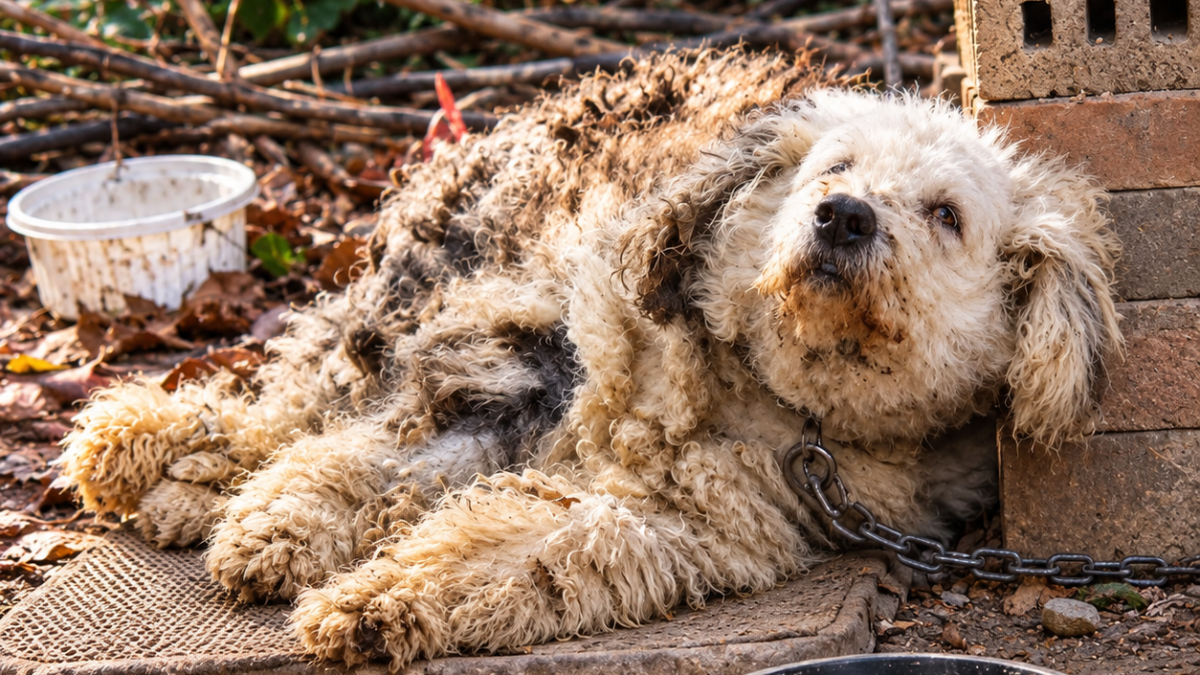
PART 2
We carried Marin to the rescue van on a blanket because there was no safe way to let him walk.
He never tried to bite us.
That may sound like a small detail.
It wasn’t.
Every time pain surprised him, he turned his head away.
Every time one of our hands moved close to his face, he froze instead of snapping.
He had every reason to protect himself, yet somewhere in that exhausted body there was still enough restraint to choose not to hurt us.
The utility worker helped lift the stretcher.
“What’s his name?”
“We don’t know.”
He glanced toward the pole.
“Poor guy.”
I looked at the broken chain lying in the dirt.
One end was still attached to the post.
The other stopped only a few yards from the open gate.
Twelve feet.
Maybe thirteen.
I remember thinking that if the chain had been just a little longer, Marin could have reached the gate.
Then I hated myself for the thought.
A longer chain would not have been freedom.
It only would have made the prison larger.
Dana closed the van doors.
Marin lifted his head when the latch clicked.
I climbed into the back with him.
His breathing was fast.
“Easy.”
He tried to reposition his rear leg.
Whimpered.
Then went silent again.
That silence disturbed me more than crying would have.
Pain had apparently become so ordinary to Marin that he didn’t waste energy announcing it.
I rested one hand near him without touching.
“You don’t have to be quiet anymore.”
His eyes remained open.
I didn’t know whether he understood my tone or simply watched because I was there.
Either way, he didn’t look away.
At the clinic, Dr. Laura Chen met us in the treatment room.
She had worked with our rescue for years and had developed the useful habit of becoming calmer when everyone else was panicking.
One look at Marin, though, and even she stopped moving for half a second.
“Don’t shave him yet.”
I had already reached toward the clippers.
“Why?”
“Because I don’t know what’s under that coat.”
She examined his gums.
“Pale.”
Temperature.
“Low.”
Heart.
“Fast.”
Hydration.
“Bad.”
Then his mouth.
She held his upper lip carefully.
“What happened to these teeth?”
“The chain.”
Laura looked at me.
“What chain?”
“The one he was tied with. There are bite marks all over it.”
She leaned closer to his mouth.
Several front teeth were flattened nearly to the gum line.
One canine had broken diagonally.
Another tooth had a dark center.
Laura’s jaw tightened.
“This didn’t happen in a week.”
“Could it happen in months?”
“Maybe. But the wear pattern suggests repeated metal chewing over a long period.”
Dana looked down at Marin.
“He kept trying to escape.”
Laura didn’t answer.
Veterinarians learn to avoid assigning motives they can’t prove.
Rescuers are worse at that.
We needed answers, and Marin’s body became the record.
Bloodwork came first.
The technician filled tube after tube.
Marin watched but barely resisted.
Then we waited.
The results were ugly.
Severe anemia.
Low protein.
Dehydration.
Elevated inflammatory markers.
Mild liver abnormalities.
Kidney values high enough that Laura circled them twice.
“Could dehydration cause this?”
“Some of it.”
“All of it?”
“No idea yet.”
“So kidney disease?”
“Possibly.”
“How bad?”
“We hydrate him and repeat the labs.”
Dana sighed.
I knew that sigh.
We both wanted certainty immediately.
Medicine rarely gives it.
Next came the coat.
Laura gave Marin light sedation because some mats pulled directly on damaged skin.
The first section came away from his shoulder.
It landed on the table with more weight than fur should have.
Dana held open a trash bag.
I clipped.
Laura examined skin as we exposed it.
The smell worsened.
Not ordinary dirty-dog smell.
Infection.
Moisture trapped beneath mats.
Old urine.
Skin unable to dry.
By the time we cleared one side, Marin looked physically smaller.
The coat had created the illusion of size.
Underneath, his ribs were visible.
His vertebrae stood out sharply.
His pelvis seemed enormous only because there was so little muscle covering it.
Dana stared.
“He looked twice this big.”
Laura nodded.
“That’s why body condition exams matter.”
We reached the hip.
The pressure wound was larger than the opening we had seen outside.
The matted fur had hidden nearly the entire edge.
A raw area covered the point of his hip where he had apparently spent too many hours lying against concrete or packed dirt.
Both elbows had smaller sores.
His chest skin was inflamed.
Around the neck, metal had rubbed away the fur in a complete ring.
“Has the chain embedded?”
“Not fully.”
Laura examined the underside carefully.
“There’s chronic pressure injury, but we’re lucky.”
Lucky.
The word felt obscene.
Still, she was right.
Then came the hind leg.
Laura manipulated it carefully.
Marin woke enough to tense.
“Sorry.”
She stopped immediately.
“X-rays.”
The first image appeared.
Dana didn’t need a medical degree to react.
“Oh, God.”
The right femur showed an old fracture that had healed out of proper alignment.
The bone was solid again.
But wrong.
“How does something heal like that?” Dana asked.
Laura looked at her.
“Without treatment.”
I stared at the screen.
“He was chained out there with a broken leg.”
“At some point.”
“For weeks?”
“At least long enough for bone healing.”
“Months?”
“Possibly.”
“Years ago?”
“Also possible.”
There was no way to date it precisely.
The pelvis showed wear from compensating.
The lower spine showed degenerative changes.
The hips were arthritic.
“How old do you think he is?”
Laura examined his remaining molars rather than the chain-damaged front teeth.
“Maybe six.”
I thought I’d misheard her.
“Six?”
“Six or seven.”
“We thought ten.”
“Neglect ages appearance.”
Dana looked through the window at Marin.
“So he doesn’t look old because he is old.”
“No.”
“He looks old because he lived like that.”
Laura’s expression softened slightly.
“Yes.”
We found more.
A chronic hernia near the groin.
Skin infection.
Dental pain.
Muscle wasting.
Signs of long-term nutritional deficiency.
Every discovery felt like another layer being removed from a story nobody had bothered to read while it was happening.
Eventually I stopped asking, “Anything else?”
There was always something else.
We made a treatment board.
Fluids.
Antibiotics.
Wound cleaning.
Pain medication.
Frequent small meals.
Kidney recheck.
Dental imaging.
Rehabilitation evaluation.
Hernia surgery later if he became stable enough.
Orthopedic consult for the old femur.
I stared at the whiteboard.
“Where do we start?”
Laura looked toward Marin.
“Tonight.”
That became our rule.
Do what the dog in front of us needs today.
Not the whole future.
Today.
Marin stayed at the clinic.
So did I.
Around nine that night, he woke fully.
Most of the mats had been removed.
He looked almost naked.
Patchy skin.
Sharp ribs.
Long legs that appeared too thin to belong to a dog his size.
I opened his kennel.
He lifted his head.
I placed a thick padded mat on the floor outside.
“Want to try?”
Nothing.
“You don’t have to.”
He watched the opening.
For several minutes he simply stared at the space beyond the kennel door.
Then one paw reached out.
Touched the mat.
Pulled back.
I stayed still.
A second attempt.
This time he placed weight on it.
Then another paw.
His rear legs followed carefully.
All four feet outside.
He froze.
Not physically trapped.
Not restrained.
Still unable to move.
Invisible boundaries can outlast real ones.
I sat down several feet away.
“You’re okay.”
One step.
Stop.
Another.
His back legs trembled.
He kept coming.
When Marin reached me, he didn’t sniff my hands.
He lowered his head and pressed his forehead against my chest.
My throat closed.
I did not hug him.
I didn’t wrap my arms around him.
Dogs who have lost control over their bodies deserve choices in how they are touched.
So I rested one hand lightly on his shoulder.
He stayed.
After maybe thirty seconds, his hind legs began shaking harder.
“That’s enough.”
I helped guide him back.
Before the kennel door closed, his tail moved once.
The next morning, Marin ate.
Not politely.
Not cautiously.
He inhaled the food as if it might disappear between bites.
Laura removed the bowl after the prescribed amount.
Marin stared.
“You have to wait.”
He stared harder.
Dana walked in.
“He eat?”
“He intends to eat the clinic.”
Marin pawed at the bowl.
Laura shook her head.
“Small portions.”
Severely malnourished animals can become dangerously ill if nutrition is reintroduced too aggressively.
Try explaining that to a starving dog.
Every meal became an argument conducted entirely through Marin’s eyes.
Food.
Pause.
Food.
Pause.
He licked empty bowls for several minutes.
If another patient was fed nearby, he watched every bite.
At first I thought he was food aggressive.
He wasn’t.
He was food terrified.
There is a difference.
An aggressive dog may guard possession.
Marin seemed frightened the supply might vanish forever.
We began leaving an empty bowl in his kennel after meals instead of removing it.
Strangely, that helped.
Over time, the bowl stopped representing disappearance.
Food came again.
And again.
Breakfast was not the last meal he would ever see.
By day four, Marin could stand without assistance for almost a minute.
We tried walking toward the clinic exit.
The moment he saw daylight, he pulled.
His injured leg buckled.
I caught him with the support sling.
“Easy.”
He pulled again.
“Marin.”
That was the first time we used the name deliberately.
Dana had written it on the chart after noticing the abandoned house sat near Marin Avenue.
It was supposed to be temporary.
Marin turned toward me.
His ears shifted.
I repeated it.
“Marin.”
He looked again.
“Okay.”
The name stayed.
Every door became a challenge.
He wanted through them immediately.
If one opened, he rushed as fast as his damaged body allowed.
If it closed, he paced.
We realized the open gate from his old yard had become psychologically enormous.
For years, Marin had seen the world beyond his chain but could not reach it.
Now every opening seemed like something he needed to use before somebody took it away.
Rebecca, the behavior consultant we eventually hired, would explain this better later.
At the time, we simply slowed him down.
Five steps toward the clinic door.
Rest.
Five more.
Rest.
Turn back.
Repeat.
When he finally reached the courtyard, he stepped onto grass.
Dana held her breath.
Marin sniffed.
Walked three feet.
Lifted one leg against a bush.
Nearly fell over.
Recovered.
Then kicked dirt backward with both hind paws.
Dana laughed.
“That’s it?”
“What did you expect?”
“I don’t know. A spiritual awakening.”
Marin moved to another bush.
For a few seconds, he was not an abuse case.
He was a dog leaving messages for other dogs.
That felt like progress.
While Marin recovered, Officer Sarah Whitman from animal welfare investigated the property.
The tenant was Victor Hale.
He had rented the house for nearly nine years.
Marin had apparently lived there for much of that time.
A neighbor named Melissa agreed to talk with us.
She stood at her fence staring into the abandoned yard.
“How long was he chained?”
“I moved here four years ago. He was already there.”
“Always?”
“Almost always.”
“Winter?”
“Yes.”
“Summer?”
“Yes.”
“Did anyone call animal control?”
“I did.”
“When?”
“About two years ago.”
“What happened?”
“An officer came.”
“And?”
“Victor had food out. Water. The doghouse. They told him he needed to make some improvements.”
“Did he?”
“For a while.”
“What changed?”
Melissa looked toward the house.
“His wife died.”
That was the first piece of Victor’s story that made him more complicated than a faceless villain.
His wife, Marianne, had apparently been the one who fed Marin most consistently.
She walked him occasionally when he was younger.
She died suddenly from a stroke.
Victor deteriorated afterward.
Neighbors described drinking.
Job loss.
Isolation.
Unpaid bills.
The house began falling apart.
Marin’s life shrank with it.
“Did you help him?” I asked.
Melissa’s eyes filled.
“Sometimes.”
“How?”
“I put water over the fence.”
“Food?”
“Yes.”
“Why didn’t you call again?”
“I don’t know.”
She looked ashamed.
“I thought somebody else would.”
That sentence has followed me through years of rescue work.
Somebody else.
Somebody else sees.
Somebody else calls.
Somebody else checks.
Somebody else acts.
Sometimes nobody does.
Melissa showed me photos on her phone.
They were not taken as evidence originally.
Mostly accidental background pictures.
Her children playing near the fence.
Snow in the yard.
A storm-damaged tree.
Marin appeared behind them.
Same pole.
Same chain.
In an older photograph, he looked healthy.
Coat clean.
Body filled out.
Ears upright.
Another photo showed him walking around the pole.
The chain was already heavy.
“How old is that?”
“Three years.”
I zoomed in.
No obvious dental damage.
So something changed over those years.
Maybe the chewing increased when Marianne died.
Maybe when Victor stopped interacting with him.
Maybe after the leg injury.
Maybe after hunger became more frequent.
We could only infer.
Animal welfare eventually found Victor living with a cousin two counties away.
His first interview produced contradictions.
Marin belonged to Marianne.
A friend was supposed to feed him.
Then Melissa was supposedly responsible.
Then Victor claimed he had planned to return to the property.
“Did he know the dog was still chained?” I asked Sarah.
“Yes.”
“What did he say about that?”
“That Marin had always lived outside.”
“And the teeth?”
Sarah hesitated.
“He said, ‘That stupid dog always chewed everything.’”
I felt something in my chest harden.
“Everything?”
“His words.”
“What about the broken leg?”
“He said he didn’t know about it.”
“How do you not know your dog broke a femur?”
Sarah looked tired.
“People don’t notice what they stop looking at.”
That sentence hurt because it felt true.
Investigators collected the chain as evidence.
Later, Sarah showed us close photographs.
One link had visible thinning where Marin’s teeth had repeatedly scraped the metal.
The measurements were small.
Millimeters.
But undeniable.
Marin had altered steel.
At cost to his own mouth.
Laura scheduled dental surgery once his bloodwork improved.
Two teeth needed extraction.
Another required treatment.
The night before the procedure, I sat beside Marin.
He was stronger now.
He had gained almost nine pounds.
His skin looked better.
New hair was appearing in soft patches.
I held one of the chain photographs on my phone.
Marin sniffed the screen.
“You did that.”
He licked my wrist.
“You know, there were easier ways.”
Tail thump.
“Unfortunately none available to you.”
The surgery went well.
When Marin woke, he looked furious.
Laura approached the recovery kennel.
He turned his face toward the wall.
“You’re welcome.”
No response.
She tried again.
“I removed two infected teeth.”
Marin refused to look.
Dana entered carrying soft food.
Marin immediately turned.
Laura put both hands on her hips.
“Unbelievable.”
“He knows who matters.”
“He’s on my medication.”
“He doesn’t know that.”
Marin ate.
Slowly this time.
That was another change.
He no longer inhaled every meal.
Weeks of consistent feeding had begun to teach his nervous system something his mind could not articulate.
There would be more.
The hernia repair happened several weeks later.
Successful.
Then came orthopedic consultation.
The surgeon studied Marin’s femur.
“We could technically break and realign it.”
I hated the sentence immediately.
“But?”
“But he has adapted. It’s healed. Surgery would be invasive and painful, and there’s no guarantee function would improve enough to justify it.”
“So what do we do?”
“Build muscle. Control pain. Keep him lean.”
Physical rehabilitation became Marin’s least favorite chapter.
Especially the underwater treadmill.
At his first session, the therapist, Nicole, guided him inside the clear chamber.
Marin looked suspicious.
The water began rising.
He stared at me.
It was the most betrayed expression I had ever seen.
“Don’t look at me like that.”
Water reached his ankles.
He tried to reverse.
Nicole blocked gently.
Dana held chicken outside the glass.
Marin stopped.
One step.
Chicken.
Another.
Chicken.
By the end, Marin had walked twelve minutes.
He emerged dripping and furious.
The second visit, he refused to enter.
Dana showed him chicken.
Marin entered.
Principles have limits.
Within a month, he was stronger.
Within two, his rear legs had visible muscle again.
Three months after rescue, we took him to a secure field behind the rehabilitation center.
No chain.
No short lead.
Only a long line dragging loosely behind him for safety.
Dana walked to the far end.
“Marin!”
His ears lifted.
She jogged backward.
He followed at a walk.
Then trotted.
Then, for maybe ten yards, ran.
It wasn’t elegant.
His right leg swung differently.
His hips shifted.
But he ran.
Dana dropped to her knees.
Marin reached her and nearly knocked her over.
She hugged him around the chest.
I turned away.
“You’re crying,” she called.
“Wind.”
“There is no wind.”
“Dust.”
“We’re on grass.”
“Leave me alone.”
Marin rolled on his back.
For the first time, his entire body looked relaxed.
That was when we decided he was ready for foster care.
We were wrong.
Or at least early.
The first foster family lasted three nights.
They were kind people.
A couple with a newborn.
They had experience with large dogs.
Marin liked them.
But nighttime destroyed everyone.
He paced.
Door to hallway.
Hallway to kitchen.
Kitchen to back door.
Back door outside.
Outside immediately back toward the house.
He slept in bursts of ten minutes.
If either foster parent moved, Marin followed.
By the third night, the baby was crying, Marin was pacing, and nobody had slept.
The foster father returned him looking ashamed.
“I’m sorry.”
“You don’t need to apologize.”
“I thought we could do it.”
“You have a newborn.”
“He’s a good dog.”
“I know.”
“He just… doesn’t stop.”
I looked at Marin.
He was leaning against Dana’s legs.
Back at the rescue.
Relieved.
That hurt.
The second foster home looked more promising.
Retired couple.
Quiet house.
Fenced yard.
No children.
They kept Marin two weeks.
During the first week, things went well.
Then they left him alone for forty-five minutes.
When they returned, the trim around the back door was destroyed.
Curtain ripped down.
Rug pulled apart.
Marin’s gums were bleeding where he had chewed wood.
The foster mother cried while explaining.
“He wasn’t being bad.”
“No.”
“He was terrified.”
“Yes.”
“I can’t watch him hurt himself.”
Neither could we.
Marin returned again.
He walked into the rescue like a dog coming home.
Tail up.
Recognizing smells.
Heading toward the room he knew.
I sat on the floor after everyone left.
Marin lay beside me.
“What do we do with you?”
He put one paw on my shoe.
“What if nobody can keep you?”
Tail thump.
“You have terrible timing.”
Laura overheard.
“Stop.”
I looked up.
“What?”
“Talking like that.”
“It’s a real question.”
“No. The real question is what skill he doesn’t have yet.”
“Staying alone.”
“Then teach it.”
“We’re rescuers, not magicians.”
“Good. Because magic would be irresponsible.”
I laughed despite myself.
That was when we hired Rebecca Mills.
Certified behavior consultant.
Forty-something.
Calm.
Painfully observant.
She spent nearly an hour watching Marin move through the rescue building.
She opened a door.
Closed it.
Walked away.
Returned.
Asked me to leave.
Asked Dana to leave.
Watched what Marin did.
Finally she sat down.
“He’s not afraid of houses.”
“We know.”
“He’s not primarily afraid of crates either.”
“Then what?”
“Loss of control.”
I frowned.
“Explain.”
“For years, Marin could see exits, people, food, movement, probably other animals. He couldn’t access any of it unless it entered his radius.”
She pointed toward the hallway door.
“Now, when a person goes through a door, he doesn’t know whether that person comes back.”
“That’s separation anxiety.”
“Yes, but the chain history shapes it.”
“So how do we fix it?”
“We don’t fix him.”
I almost rolled my eyes.
Rebecca saw.
“Do that again and I charge double.”
Dana laughed.
“Fine. How do we help?”
“Predictability.”
We started absurdly small.
Rebecca gave us a phrase.
“Back soon.”
I hated it.
“It sounds stupid.”
“It can be ‘banana sandwich’ if you use it consistently.”
“Back soon is fine.”
I walked to the door.
“Back soon.”
Closed it.
One second.
Returned.
Marin stood.
No panic.
Again.
Five seconds.
Return.
Ten.
Twenty.
If he became tense, we shortened the interval.
No sneaking out.
No emotional reunion.
We taught leaving as a pattern.
Departure cue.
Brief absence.
Return.
Nothing catastrophic.
Over weeks, thirty seconds became minutes.
Then five minutes.
Ten.
Fifteen.
The first time Marin stayed relaxed for twenty minutes while Dana and I sat in the parking lot watching on camera, we celebrated like someone had won a trial.
Marin was asleep.
He had no idea.
We tried foster placement again only after Rebecca agreed.
That was when Evelyn Carter applied.
Sixty-one.
Recently retired from managing a public library.
Widowed.
One older Labrador mix named June.
Five fenced acres, though only half an acre was available directly from the house.
Her application contained one line that stayed with me:
I’m not looking for the easiest dog. I’m looking for one who needs enough time to become himself.
She came on a Wednesday afternoon.
Marin barked once when she entered.
Evelyn stopped.
“Well, at least your voice works.”
Marin stared.
She sat on the floor.
Didn’t call him.
Didn’t offer food.
Didn’t stare.
Five minutes passed.
Marin approached.
Sniffed her sleeve.
Walked away.
Returned.
Pressed one shoulder against her knee.
Evelyn looked at me.
“Am I allowed to breathe?”
“Yes.”
“Excellent.”
She touched his shoulder lightly.
Marin stayed.
The meeting with June happened outside.
June was eleven.
Black coat.
Gray muzzle.
The kind of older dog whose patience had limits but whose communication was excellent.
Marin approached too directly.
June gave one low growl.
Marin stopped.
Turned sideways.
Looked away.
Perfect.
They walked parallel.
Then together.
June ignored him.
Marin seemed delighted by this.
The home visit came next.
No chains.
No tie-outs.
No exterior run.
Instead, fenced yard.
Wide doorways.
Rugs.
Several dog beds.
A gated mudroom.
“What happens if he destroys the mudroom?”
Evelyn looked around.
“I fix it.”
“The door?”
“Replace it.”
“The drywall?”
“It’s drywall.”
“What if he destroys the rug?”
“I own scissors.”
I stared.
“You’re unusually calm about property damage.”
“My husband once tried to remodel a bathroom himself.”
I laughed.
“Marin cannot scare me.”
He went for a trial weekend.
I spent the first night staring at my phone.
Nothing.
At 7:12 the next morning, Evelyn sent a picture.
June slept in one bed.
Another bed sat empty.
Marin was asleep on the floor exactly between them.
Caption:
Apparently beds are political.
Day two.
Marin followed Evelyn everywhere.
Bathroom.
Kitchen.
Laundry room.
He checked doors repeatedly.
But he slept.
Day three, she practiced a fifteen-minute absence.
Camera showed pacing.
Door check.
Window check.
Then Marin lay down.
No chewing.
No scratching.
Twenty minutes next.
Then thirty.
End of week one, I called.
“How bad?”
“Terrible.”
My stomach dropped.
“He stole a whole chicken breast.”
“That’s it?”
“He snores.”
“You scared me.”
“That seemed fair after the paperwork you made me complete.”
I laughed.
“You’re keeping him.”
Pause.
“I’d like to.”
Officially we extended foster another month.
Rebecca wanted more data.
I wanted to make sure Marin wasn’t still in honeymoon mode.
Evelyn didn’t complain.
She followed the plan exactly.
Separate routine from June.
Individual walks.
Short absences.
Feeding puzzles.
No tethering.
Never trapping him in a closed crate.
One setback came during a thunderstorm.
Power failed.
House went dark.
A branch hit the roof.
Marin panicked.
He paced from door to door, scratching once at the back exit.
Evelyn called.
“What do I do?”
“Stay boring.”
“What?”
“Don’t panic with him.”
“He’s shaking.”
“Let him stay near you. Keep the exits secure. Use his routine.”
She sat on the kitchen floor.
Marin paced for twenty minutes.
Then stood beside her.
Eventually lay down.
June slept through the entire event.
Evelyn sent a picture.
June would survive the apocalypse by napping.
By week six, Marin was sleeping through most nights.
He could stay alone for an hour.
Then two.
He still waited near the door sometimes.
But waiting is not panic.
That distinction mattered.
The adoption paperwork was signed at Evelyn’s kitchen table.
Marin slept underneath.
June beside him.
I pushed the contract across.
“Last chance.”
Evelyn signed.
“Too late.”
“Regrets?”
“My countertops are now completely empty because he steals food.”
“That sounds healthy.”
“My dog has made me minimalist.”
I signed as rescue representative.
Marin officially had a home.
The biggest test came accidentally several months later.
A delivery driver failed to latch the outer gate.
Evelyn opened the back door.
Marin ran into the yard.
She saw the gate standing open.
Her stomach dropped.
“Marin.”
He walked toward it.
Evelyn did not chase.
Rebecca had warned us.
Chasing could turn movement into flight.
Marin reached the opening.
Beyond it, the gravel road stretched toward fields.
Nothing physically stopped him.
No chain.
No fence.
No person holding a leash.
Evelyn stood on the porch.
“Marin.”
He looked out.
Then back.
Took one step beyond the gate.
Sniffed.
Evelyn’s heart probably stopped.
Then Marin turned around.
Walked back through the opening.
Crossed the yard.
Stopped beside her.
She closed the gate.
Then sat down and cried.
She called me.
“I thought he’d run.”
“I did too.”
“He could have.”
“Yes.”
“But he came back.”
That moment changed the way I thought about his rescue.
For years, everyone assumed freedom would mean distance.
Farther from the chain.
Farther from the pole.
Farther from the yard.
But Marin had reached something more complicated.
Freedom meant the option to leave.
Safety meant having a reason not to.
Marin learned toys late.
Tennis balls bored him.
He shredded soft rope too aggressively, and because of his dental history we removed those.
Then Evelyn bought a green stuffed dinosaur.
Marin became obsessed.
He carried it everywhere.
Kitchen.
Porch.
Bed.
Yard.
Car.
When Evelyn washed it, Marin sat in front of the washing machine staring at the spinning drum.
She texted:
He thinks I’ve murdered his child.
After the dryer, he grabbed the dinosaur and ignored her for an hour.
His coat grew back beautifully.
Sable.
Black along the back.
Pale chest.
Thick tail.
People who saw the intake photo could barely believe he was the same dog.
His face looked years younger.
One volunteer said:
“He became a different dog.”
I corrected her.
“No.”
Marin had been under there all along.
That distinction mattered to me.
We did not build a new animal.
We removed pain.
Hunger.
Mats.
Metal.
Fear.
Then Marin had space to show us who had been waiting underneath.
The neglect case against Victor moved slowly.
Months.
Statements.
Veterinary records.
Photos.
Chain measurements.
Property history.
Victor’s attorney argued that grief and poverty had contributed to the situation.
That was probably true.
It also did not erase responsibility.
At the hearing, Laura testified about the fracture.
Dental damage.
Pressure wounds.
Malnutrition.
Kidney stress.
Anemia.
The attorney asked:
“Doctor, can you prove Mr. Hale intentionally caused every one of these injuries?”
Laura replied:
“No.”
“Can you prove the femur fractured while Mr. Hale was present?”
“No.”
“Can you prove the dog had no access to food every day?”
“No.”
The attorney nodded.
Then Laura continued before he could sit.
“What I can prove is that these conditions existed long enough to become chronic and were not treated.”
The room went quiet.
Victor received fines.
Animal ownership restrictions.
Partial restitution for veterinary costs.
Formal neglect findings.
No dramatic prison sentence.
No cinematic punishment.
I expected anger.
Instead, by then, the legal case felt strangely distant.
I called Evelyn afterward.
“It’s over.”
“What happened?”
I told her.
She was quiet.
“That’s it?”
“That’s it.”
“Will the money fix Marin’s leg?”
“No.”
“Put enamel back on his teeth?”
“No.”
“Then I’m making soup.”
That was Evelyn.
Marin was outside digging a forbidden hole near the fence.
Justice mattered.
But it was no longer the center of his life.
Two years after adoption, one damaged tooth developed an infection.
Another extraction.
The chain was long gone.
The body still carried the invoice.
Evelyn called after surgery.
“He looks ridiculous.”
She sent a picture.
Marin asleep with his tongue hanging slightly from one side.
Caption:
Please respect this brave patient during his recovery from catastrophic inconvenience.
I laughed for five minutes.
Years went by.
June aged.
Marin settled.
His separation anxiety never disappeared completely.
If Evelyn was gone longer than expected, he sometimes waited at the window.
But he no longer destroyed doors.
No longer injured himself.
The phrase “back soon” had become part of his world.
Evelyn said it.
Left.
Returned.
Again.
Again.
Again.
Hundreds of repetitions repairing what abandonment had taught.
Then June developed cancer.
It moved fast.
Within weeks, Evelyn had to let her go.
Marin searched.
June’s bed.
Back door.
Kitchen.
He carried the green dinosaur room to room.
On the third night, he placed it in June’s empty bed.
Then lay beside it.
Evelyn called me crying.
“He keeps waiting.”
“Let him.”
“What if he thinks she’s coming back?”
“We don’t know what he thinks.”
“Should I remove the bed?”
“No.”
“Why?”
“Because you don’t need to solve grief immediately.”
That advice came partly from Marin himself.
For years, people had tried to force him through states he couldn’t yet leave.
Now we let him move at his own pace.
A week later, Marin started eating normally.
Two weeks later, he stopped checking the back door for June.
A month later, Evelyn found him sleeping in her bed.
Not June’s.
Hers.
Loss had not become abandonment.
That was a new skill too.
By age ten, the old femur began collecting interest.
Arthritis worsened.
His lower spine stiffened.
Walks shortened.
Evelyn installed ramps.
Runners over slippery flooring.
Raised food bowls.
Marin received joint medication, anti-inflammatory treatment when appropriate, and physical therapy maintenance.
The same dog who once crossed a bare yard attached to a chain now had a house redesigned around comfort.
Evelyn bought an orthopedic bed that cost more than her first television.
Marin slept beside it.
She called.
“I hate him.”
“No, you don’t.”
“I spent two hundred dollars.”
“He appreciates the floor.”
“This is personal.”
Two weeks later, Marin finally used the bed.
Evelyn sent photographic evidence immediately.
Nobody move. Nobody breathe. We may never see this again.
The photo showed Marin stretched across the center, dinosaur under one paw.
I printed it.
His physical world became smaller as he aged.
But never small in the same way.
A short walk chosen by an old body is different from a short radius enforced by steel.
Marin still decided.
Porch or kitchen.
Sun or shade.
Bed or rug.
Outside or inside.
Follow Evelyn or stay asleep.
Choice became something I noticed constantly around him.
At twelve, decline accelerated.
One winter morning, Evelyn called before seven.
“He can’t get up.”
I drove there.
Laura arranged a home visit because getting Marin into the car would have hurt him.
He lay on the orthopedic bed.
Green dinosaur beside him.
His eyes were clear.
He wagged when I arrived.
But the rear legs no longer worked well enough to support his body.
Laura examined him.
Neurologic decline.
Advanced arthritis.
Progressive spinal disease.
“Can we treat it?”
“Manage it.”
“For how long?”
Laura looked at Evelyn.
“Days comfortably, maybe weeks. Hard to know.”
“Will he walk?”
“Not normally.”
“With a harness?”
“Possibly.”
“Pain?”
“Manageable today.”
Today.
There was that word again.
The word rescue eventually becomes.
Not forever.
Today.
Evelyn sat beside Marin.
“What does he still enjoy?”
Laura asked.
“Food.”
Marin’s ears moved.
We laughed.
“People?”
“Yes.”
“Outside?”
“Always.”
“Then let’s give him those things while they’re still good.”
For three days, Marin rallied.
Chicken.
Sunshine.
Supported walks in the yard.
He barked at a delivery van.
Carried the dinosaur onto the porch.
On the third evening, he lay outside watching birds until sunset.
Evelyn sat beside him.
No leash.
Gate closed.
Nothing attached to his body.
That night was different.
Marin couldn’t settle.
He panted.
Shifted.
Whined when repositioned.
Medication helped briefly.
Then didn’t.
At dawn, Evelyn offered chicken.
Marin turned his head away.
She knew.
She called.
“It’s time.”
I arrived before Laura.
Marin lay near the open back door.
Sunlight crossed the rug.
The dinosaur was tucked beside his chest.
I sat down.
“Hey, old man.”
His tail moved once.
Evelyn was crying quietly.
Then she said:
“I did something this morning.”
“What?”
“I opened the gate.”
I looked at her.
“Why?”
“I needed him to know.”
“Know what?”
“That he wasn’t trapped.”
She had placed Marin in his mobility harness and helped him into the yard.
Then she opened the front gate.
Wide.
No leash.
No barrier.
No chain.
Nothing.
“What did he do?”
“He stood there.”
Her voice cracked.
“He looked through.”
“Did he try to leave?”
“No.”
“Nothing?”
“He took one step.”
I held my breath.
“Then turned around.”
She covered her mouth.
“Came back to me.”
I looked at Marin.
Years earlier, he had nearly destroyed his own mouth trying to change the boundary of his life.
Now the boundary was gone.
And he chose where he wanted to be.
Laura arrived.
She sat beside him.
Listened to his heart.
Checked his gums.
Watched his breathing.
Then nodded at Evelyn.
“You’re making the kind decision.”
Evelyn laughed bitterly through tears.
“I hate that sentence.”
“I know.”
Marin lifted his head.
Evelyn held his face gently.
“You don’t have to bite your way out of anything anymore.”
Laura administered the sedative.
His muscles slowly relaxed.
“No more chains.”
His breathing eased.
I rested a hand on his shoulder.
The same place I had touched that first night when he walked out of the clinic kennel.
Laura waited.
When Marin was fully asleep, she gave the final injection.
His breathing slowed.
One breath.
Then another.
Then none.
There was no chain in the room.
No closed crate.
No leash.
No fence touching his body.
Nothing holding him in place except the people he had chosen to stay near.
We stayed until Evelyn was ready.
Weeks later, she came to the rescue carrying the green dinosaur.
“I can’t keep looking at it.”
“You don’t have to give it away.”
“I know.”
She placed it in my hands.
“But I want some other dog to have something soft.”
The next dog who received it was a frightened shepherd mix from a hoarding case.
He carried it into his kennel.
I took a picture.
Sent it to Evelyn.
She replied:
Marin would complain that nobody asked permission.
I laughed.
Then cried.
One object from Marin’s first life remained with us.
A single heavy chain link.
Animal welfare returned it after the case closed.
I kept it inside a drawer.
Not displayed.
Not framed.
Not turned into a symbol for visitors.
But occasionally a new volunteer asked about Marin’s before-and-after photograph on our office wall.
I would take the link out.
Set it on the desk.
“Pick that up.”
Most were surprised by the weight.
Then I showed them the grooves.
“What made those?”
“A dog’s teeth.”
They usually stared.
Then I showed them the intake photograph.
Marin beneath the utility pole.
Matted coat.
Bent rear leg.
Chain.
Then another.
Marin years later beside Evelyn.
Healthy coat.
Mouth open.
Green dinosaur nearby.
The transformation looked impossible.
It wasn’t.
It was slow.
That is the part rescue stories often leave out.
The months.
The mistakes.
The failed fosters.
The expensive dentistry.
The diarrhea after food changes.
The medication schedules.
The behavior plans.
The doors chewed before they stopped being frightening.
The good days followed by setbacks.
The physical therapy sessions Marin hated.
The nights somebody stayed late because his bloodwork was bad.
The tiny improvements nobody outside the room would consider dramatic.
A full meal eaten slowly.
A door closing without panic.
A ten-minute absence.
A normal bowel movement after surgery.
A longer walk.
A night of sleep.
A gate left open and a dog choosing not to disappear through it.
Marin didn’t transform because one person saved him.
A utility worker stopped.
Dana brought bolt cutters.
Laura looked underneath the fur.
Nicole rebuilt muscle.
Rebecca recognized fear where other people might have called destruction.
Two foster families admitted when they could no longer cope rather than failing him silently.
Animal welfare documented what happened.
Evelyn gave him enough time to learn the difference between staying and being trapped.
All of those things mattered.
But when I think about Marin now, I still return to the chain.
Not because it was the most important part of his life.
Because it eventually became the least important.
At first, the chain explained everything.
Where he could walk.
Where he could sleep.
How far he could reach water.
How much of the world he could touch.
Years later, the chain explained almost nothing about him.
He loved chicken.
Hated water therapy.
Ignored tennis balls.
Worshiped a green dinosaur.
Snored.
Stole food from counters.
Preferred June’s bed after pretending not to like it.
Distrusted veterinarians carrying syringes.
Liked warm sunlight.
Waited by the door when Evelyn was late.
And returned through an open gate when nothing forced him to.
Those were the facts that became Marin.
Not the chain.
I still have one final photograph Evelyn sent before he died.
She took it on the morning she opened the gate.
Marin is standing in the yard wearing his support harness.
His back legs are weak.
His muzzle is almost white.
The open gate is visible several feet away.
He isn’t looking through it.
He is looking backward.
Toward Evelyn.
I once believed the most emotional moment of Marin’s story happened when we cut the chain.
I was wrong.
The chain breaking only gave him physical freedom.
The real change took years.
It happened one ordinary morning when the gate stood wide open, the road stretched beyond it, and there was finally nothing in the world preventing Marin from leaving.
He looked outside.
Then he turned around.
And chose home.
I thought that would be the last lesson Marin left me.
It wasn’t.
For months after his death, I found him in places where he wasn’t supposed to exist anymore.
Not literally.
In routines.
In sounds.
In the way my hand still reached automatically toward the cabinet where we had once kept his joint supplements.
In the way I slowed down whenever I passed a dog chained outside a house, even if the dog looked healthy.
In the way a metal clink from a leash buckle could suddenly put me back in that abandoned yard.
Sometimes memory doesn’t arrive as a story.
Sometimes it arrives as a sound.
Metal dragging over concrete.
I heard it one afternoon behind the rescue building and froze.
My body reacted before my mind did.
Then I saw a volunteer pulling a folding gate across the parking lot.
Nothing was wrong.
Still, my hands shook for several seconds.
Dana noticed.
“Marin?”
I nodded.
She didn’t say anything else.
She didn’t need to.
The strangest thing was that his death made the chain feel heavier again.
While Marin was alive and thriving with Evelyn, I could look at that old metal link and think about survival.
After he died, for a while, all I could see was what had been done to him.
I considered throwing it away.
One evening I actually took the link out of the drawer and carried it toward the trash.
Laura happened to walk into the office.
“What are you doing?”
“Getting rid of this.”
She looked at the chain in my hand.
“Why?”
“I’m tired of looking at it.”
“You keep it in a drawer.”
“I still know it’s there.”
Laura leaned against the doorway.
“Then throw it away.”
I stared at her.
“You’re not going to give me some speech about remembering?”
“No.”
That irritated me.
“You’re supposed to argue.”
“Why?”
“Because now I don’t know what I want.”
Laura smiled faintly.
“That sounds like your problem.”
I nearly threw the link at her.
Instead I sat down.
“It feels wrong keeping it.”
“Then don’t.”
“It also feels wrong throwing it away.”
“Then wait.”
“For what?”
“Until one option stops feeling wrong.”
Veterinarians can be infuriatingly practical.
I put the link back in the drawer.
Several months later, the utility worker who had originally found Marin came to the rescue.
His name was Peter.
I had seen him only twice since the rescue morning.
He stood awkwardly in the lobby holding a paper bag.
“I don’t know if you remember me.”
I stared at him.
“You found Marin.”
His shoulders dropped slightly.
“Yeah.”
“Of course I remember you.”
He looked toward the photograph on the wall.
The later photograph.
Marin beside Evelyn.
Healthy.
Full coat.
Green dinosaur.
Peter walked closer.
“That’s really him?”
“Really him.”
He studied it for a long time.
“I never saw him like that.”
I realized he meant after the rescue.
Peter had gone back to work the morning we carried Marin away.
His role in the story had lasted maybe forty minutes.
He had no idea how important those forty minutes were.
“He had good years,” I said.
“How many?”
I told him.
Peter swallowed.
“That’s good.”
Then he held out the paper bag.
“What’s this?”
“Something from my truck.”
Inside was an old photograph.
Not of Marin.
Of the backyard.
Peter had taken it on his phone the morning he called us, apparently to document the utility access problem for his employer.
The image showed the pole.
The broken fencing.
The doghouse.
And Marin.
Still chained.
Before we arrived.
Peter pointed.
“Look here.”
I leaned closer.
At the far edge of the photo, the gate was visible.
Open.
Exactly as I remembered it.
Marin stood near the end of his chain facing it.
The links were pulled tight.
His body leaned forward.
I had seen that scene with my own eyes.
But the photograph captured something I had forgotten.
Beyond the gate, morning light fell across the alley.
Marin was staring directly at it.
“He kept doing that,” Peter said.
“Doing what?”
“Looking out.”
I felt my throat tighten.
“When I first got there, I thought he was going to attack me.”
“Why?”
“Big dog. Chain. Barked once.”
“He barked at you?”
“Yeah.”
I hadn’t known that.
“Then what happened?”
“I stayed back.”
Peter rubbed one hand across his jaw.
“He kept looking at the gate. Then at me. Gate. Me.”
“And?”
“I figured he wanted out.”
That sounded obvious now.
It probably hadn’t been obvious then.
“What made you call?”
Peter looked embarrassed by the question.
“The teeth.”
“You saw them?”
“He started chewing the chain.”
I had known that.
But I had never heard his description.
“He grabbed it and pulled.”
Peter demonstrated with both hands.
“Not playing. He’d bite down, pull backward, let go, then do it again.”
“How long did you watch?”
“Maybe thirty seconds.”
That was enough.
Peter looked toward Marin’s photograph again.
“I couldn’t leave him after seeing that.”
That sentence stayed with me.
He could have.
That was the point.
Peter had a job.
A schedule.
A supervisor waiting.
A damaged utility line to inspect.
A chained dog on private property wasn’t technically what he had been sent to handle.
He could have said somebody else would deal with it.
Instead, he made a call.
One call.
I showed him the chain link.
Peter held it.
His face changed when he saw the grooves.
“He really did that?”
“Yes.”
“Damn.”
He put it back on my desk carefully.
“Keep it.”
I looked at him.
“Why?”
“Because somebody should know he tried.”
That gave the link a different meaning.
Not suffering.
Effort.
Marin had not simply endured the chain.
He had resisted it.
After Peter left, I put the link back in the drawer.
I never considered throwing it away again.
Evelyn visited less often after Marin died.
Not because she wanted distance from us.
Because coming to the rescue hurt.
The first time she returned, almost six months later, she stood in the lobby staring at his photograph.
“I thought I was ready.”
“You don’t have to stay.”
“I know.”
She stayed anyway.
We made coffee.
Sat in the break room.
For a while we talked about everything except Marin.
Weather.
Laura’s terrible handwriting.
Dana’s new foster dog.
Then Evelyn said, “The house is too quiet.”
I waited.
“I didn’t realize how loud he was.”
“He snored.”
“He groaned every time he stood up.”
“He barked at delivery trucks.”
“He sighed.”
I smiled.
“Yes.”
“He had different sighs.”
“You’re imagining that.”
“I am not.”
“One for what?”
“Food delayed.”
“Okay.”
“One for being asked to move.”
“Fair.”
“One for when I watched television too late.”
“That one I don’t believe.”
Evelyn smiled.
Then the smile disappeared.
“I still say ‘back soon.’”
I looked at her.
“When?”
“Every time I leave the house.”
“To who?”
“No one.”
That hurt in a very specific way.
I reached across the table.
She didn’t cry immediately.
When she did, she looked annoyed with herself.
“I thought after everything he went through, I would be grateful we got the years we did.”
“You are.”
“Then why am I angry?”
“Because gratitude and anger can share a room.”
She laughed weakly.
“Is that one of Laura’s irritating lines?”
“No. Mine.”
“It sounds like hers.”
“I’m offended.”
We sat there.
Eventually Evelyn asked to see the current dogs.
I hesitated.
“Are you sure?”
“No.”
“Good enough.”
We walked the kennel rows.
She stopped at several runs.
Said hello.
Didn’t touch anyone.
Then we reached a large tan dog named Murphy.
He had been surrendered after his owner entered assisted living.
No cruelty history.
No chain.
No dramatic rescue.
Just an eleven-year-old dog who had lost the only home he’d known.
Murphy sat at the back of the kennel.
Evelyn stopped.
“He looks sad.”
“He is.”
“Health?”
“Arthritis. Mild kidney changes.”
She gave me a look.
“No.”
“I didn’t say anything.”
“You were about to.”
“I truly wasn’t.”
“Good.”
She stood there another minute.
Then walked away.
The next morning, she called.
“I hate you.”
“I didn’t do anything.”
“Exactly.”
A week later, Murphy went home with her.
Not as a replacement.
There are no replacements.
Evelyn made that clear from the beginning.
Murphy didn’t like stuffed toys.
Didn’t steal chicken.
Didn’t wait at doors.
He slept constantly and barked at absolutely nothing.
His habits were his own.
That helped.
Sometimes people think healing after loss means finding something that recreates what disappeared.
Often the opposite is easier.
Murphy was nothing like Marin.
Evelyn loved him anyway.
A year later, she told me something I hadn’t expected.
“I don’t say ‘back soon’ to the empty house anymore.”
“Because Murphy is there?”
“No.”
She thought about it.
“Because I finally stopped expecting Marin to answer.”
There was no tragedy in the sentence.
Just change.
Marin’s influence continued at the rescue in practical ways too.
Rebecca helped us build a written protocol for dogs with restraint trauma.
Before Marin, we had treated tether panic as a behavior problem.
After him, we became more precise.
We asked different questions.
Was the dog frightened by pressure on the neck?
By fixed tether points?
By closed crates?
By doors?
By humans leaving?
By the sound of metal?
We stopped lumping everything into “anxiety.”
The distinction mattered.
One dog could tolerate a leash but panic when clipped to a fixed object.
Another could sleep in a crate but panic when a door closed between him and a person.
Behavior had context.
Marin had taught us that.
We changed our intake forms.
Added questions about tethering history.
Previous outdoor confinement.
Known abandonment periods.
Door-related behavior.
Self-injury during separation.
They looked like boring administrative changes.
They helped dogs.
One shepherd mix named Amos arrived two years later with a story uncomfortably similar to Marin’s.
Not as severe.
But chained outdoors for most of his life.
When a volunteer clipped Amos temporarily to a fence while preparing the exercise yard, he immediately began biting the leash.
Old me might have corrected him.
New me unclipped it.
We gave him a handler instead.
No fixed tether.
The behavior stopped.
I thought of Marin.
Not sentimentally.
Practically.
He had left instructions.
Even Laura admitted that.
One afternoon, after treating Amos, she said, “Your chain dog made us better.”
“Marin.”
“I know his name.”
“You called him chain dog.”
“I’m describing the case.”
“You loved him.”
Laura gave me the look she reserved for emotional accusations.
“I treated him.”
“You loved him.”
“I removed his teeth.”
“That sounds worse out of context.”
She tried not to smile.
Failed.
“Fine.”
Years after Marin’s death, the abandoned rental property was demolished.
I found out because Melissa called.
“They’re taking the house down.”
I hadn’t spoken to her in a long time.
“Why are you telling me?”
“I thought you might want to know.”
I wasn’t sure I did.
Still, I drove there.
The house looked smaller than I remembered.
Maybe because Marin wasn’t in the yard.
The weeds were gone.
Workers had removed most of the fencing.
The old plastic doghouse had disappeared years before.
The utility pole remained.
I walked toward it.
There was no chain.
Of course there wasn’t.
But a worn patch near the base remained where metal had scraped for years.
I stood inside the circle Marin had once been able to reach.
Twelve feet suddenly felt even smaller than memory.
A few steps toward the gate.
Stop.
A few steps toward the house.
Stop.
The water bowl had once sat near here.
The doghouse there.
I walked the circumference.
A complete life reduced to a circle I could cross in seconds.
Melissa came outside.
“I still feel guilty.”
I looked at her.
“For what?”
“Not doing more.”
“You fed him.”
“Sometimes.”
“You gave him water.”
“Sometimes.”
“You also waited.”
She nodded.
“I did.”
I could have comforted her completely.
Told her she had done enough.
That wouldn’t have been true.
But cruelty stories become dangerous when everyone except the primary offender is allowed to believe they had no choices.
Melissa had choices.
So had the earlier animal-control officer.
So had neighbors.
So had Victor.
So had Peter.
The outcomes came from those choices.
Some good.
Some bad.
Mostly ordinary.
“I think the useful part of guilt is what you do next,” I said.
Melissa looked at me.
“That’s not very comforting.”
“No.”
She laughed.
“But it’s fair.”
She told me she had reported two neglected dogs in the years since.
One case turned out fine.
The other dog was removed.
“I don’t wait anymore.”
There it was.
That was enough.
The demolition crew eventually knocked down the rear wall.
Dust rose.
I left before the house was completely gone.
I didn’t need to watch every board fall.
The yard had already lost its power over Marin years earlier.
Destroying the building didn’t free him.
He had been free long before that.
The chain link stayed in my drawer.
Occasionally, I used it during volunteer orientation.
Not every class.
Only when restraint history came up.
I would set it on the table.
Let people pass it around.
Nobody expected the weight.
Then I’d show the dental image.
Flattened incisors.
Fractured canine.
I never used Marin’s story to scare volunteers.
I used it to make a specific point.
“Behavior is information.”
Someone would usually ask what I meant.
“If a dog is chewing a leash, don’t stop at ‘the dog chews leashes.’ Ask when. Ask what happened immediately before. Ask what the dog is trying to change.”
One volunteer said, “Trying to change?”
“Yes.”
“Dogs don’t think like that.”
“Not with words.”
I tapped the chain.
“But Marin wanted distance from the pole. Biting the chain changed nothing at first. So he tried again.”
The volunteer looked at the metal.
“That’s horrible.”
“It is.”
“But he never stopped?”
“Apparently not.”
That became the detail people remembered.
Not the wound.
Not the matted coat.
Not even the broken leg.
The teeth.
Marin used the only tool he controlled.
His own mouth.
Years later, when Evelyn moved to a smaller home closer to her sister, she found Marin’s old support harness in a closet.
She brought it to me.
“Can the rescue use this?”
“Probably.”
It had been washed.
Folded.
The straps still had several gray hairs caught near one seam.
I noticed.
Evelyn noticed me noticing.
“Don’t.”
“I didn’t say anything.”
“Your face did.”
We donated the harness to the rehabilitation program.
It eventually went to a large senior dog recovering from spinal surgery.
Then another.
I liked that.
Marin’s green dinosaur comforted one dog.
His harness supported another.
His chain taught volunteers.
Different objects from the same life doing very different work.
The strangest legacy arrived almost ten years after Marin’s rescue.
Peter’s daughter applied to volunteer.
She was seventeen.
On the form, under:
Why do you want to volunteer with animals?
She wrote:
My dad found a chained dog named Marin when I was little. He told me the reason the dog survived was because people stopped assuming somebody else would help.
I read the sentence twice.
Then I called Peter.
“You know your daughter applied?”
“She told you?”
“She wrote about Marin.”
Peter went quiet.
“I probably talked about him too much.”
“No.”
I looked at Marin’s photograph.
“Probably exactly enough.”
His daughter started Saturdays.
Kennel cleaning.
Laundry.
Dog walking after training.
Nothing glamorous.
Months later, I saw her sitting quietly outside the kennel of a frightened dog who refused to approach people.
She wasn’t reaching inside.
Wasn’t calling.
Just sitting.
Waiting.
I asked, “Everything okay?”
“He’s scared.”
“I can see that.”
“He came two feet closer.”
“How long have you been here?”
“Twenty minutes.”
I smiled.
“Keep sitting.”
As I walked away, I thought about Peter standing outside Marin’s chain radius years earlier.
Waiting.
Watching.
Choosing not to leave.
Sometimes rescue passes forward like that.
Not as a grand mission.
As learned attention.
Marin was never famous outside our small network.
His story circulated for a while.
People shared the transformation photos.
Donations came.
Then the internet moved on.
Another dog.
Another rescue.
Another emergency.
That’s normal.
The animals don’t need permanent public attention.
They need permanent private safety.
Marin got that.
His most important years happened after most strangers had stopped watching.
The quiet years.
That is something I wish more rescue stories showed.
The ending isn’t the adoption photo.
The ending is Tuesday six years later when the dog has arthritis medication mixed into breakfast.
It is replacing a worn rug because slippery floors bother his hips.
It is canceling dinner because he has an upset stomach.
It is knowing which veterinarian he tolerates.
It is an old green toy repaired for the third time.
It is someone saying “back soon” on the way to buy groceries and returning forty minutes later exactly like they have hundreds of times before.
Those moments made Marin’s rescue real.
Not the bolt cutters.
The repetition.
The first years of his life taught him bad things through repetition.
Chain tightens.
Person leaves.
Water empties.
No one comes.
Pain stays.
Marin’s later years taught different things the same way.
Bowl empties.
It fills again.
Door closes.
Evelyn returns.
Night comes.
There is a bed.
Pain starts.
Someone notices.
Gate opens.
Nobody forces you through it.
Choice, repeated often enough, became trust.
I eventually moved Marin’s chain link out of the desk drawer.
Not far.
It now sits inside a small box with his intake photograph and Evelyn’s final picture of him near the open gate.
No plaque.
No inspirational quote.
Just those three things.
Before.
Evidence.
After.
Sometimes I open the box.
The images no longer make me angry first.
That surprised me.
I see the photograph of the chained dog and feel sorrow.
Then the link.
Then the old Marin looking back toward Evelyn.
The sequence matters.
A life should not be frozen at its worst moment.
If all I remembered was the yard, Victor would still occupy too much of Marin’s story.
He doesn’t.
When I think of Marin now, I see a badly coordinated run across a rehabilitation field.
I see him glaring through the underwater treadmill glass.
I see him waiting beside a washing machine for his dinosaur.
I see June correcting him with one growl.
I see him stealing chicken.
I see him pretending not to like his expensive bed.
I see him learning “back soon.”
I see an open gate.
And I see him turn around.
That is the version I choose to keep closest.
Not because the suffering didn’t matter.
Because it mattered enough that the rest should not be erased by it.
For years, a chain defined Marin’s world.
It decided where his body stopped.
Then one morning, bolt cutters changed that.
But freedom took longer.
Freedom was physical therapy.
Food arriving every day.
Doors closing and reopening.
People failing him and other people trying again.
Pain becoming something treated instead of ignored.
A home where nobody tied him down.
An old dog discovering that an open gate was no longer a command to run.
And somewhere between that abandoned yard and Evelyn’s porch, Marin stopped measuring the world by the length of metal behind him.
The last time I visited Evelyn before she moved away, we stood beside the new house she had chosen.
Murphy was asleep inside.
On a shelf near the window was a framed photograph of Marin.
The one with the dinosaur.
I pointed.
“You kept that one.”
“Of course.”
“Not the gate picture?”
“That one’s private.”
I smiled.
“Fair.”
Evelyn looked at Marin’s photograph.
“You know, people always say I saved him.”
“You gave him a home.”
“That’s not the same thing.”
“No.”
She nodded.
“He came to me already fighting.”
I thought of the metal grooves.
“Yes.”
“He’d been fighting a long time.”
“He had.”
Evelyn touched the edge of the frame.
“I just gave him something better to fight for.”
I almost corrected her.
Marin had eventually stopped fighting at all.
That was part of the beauty.
But I understood what she meant.
For years he fought against something.
Against confinement.
Hunger.
Pain.
Then his life changed.
He fought to get stronger.
To trust.
To learn doors.
To learn absence.
Eventually he didn’t need to fight anymore.
He could simply live.
Before I left, Evelyn walked me to my car.
At the driveway, she stopped.
“Back soon.”
I turned.
She laughed.
“Habit.”
“To Murphy?”
“No.”
She looked toward the photograph visible through the window.
“Maybe to everybody.”
I got into the car.
As I drove away, I thought about Marin biting steel in that forgotten backyard.
I used to imagine those marks only as evidence of despair.
Now I think there was something else inside them.
Not hope exactly.
Hope is too human a word to prove.
But persistence.
A refusal to accept the boundary without testing it.
Again.
Again.
Again.
The steel lasted longer than his teeth.
But it didn’t get the final word.
Years later, when Marin stood before a gate with no chain around his neck, he finally had everything he had once tried to reach.
Open space.
A road.
A choice.
And for the first time, freedom did not mean getting away from something.
It meant knowing exactly where he wanted to stay.
[END OF STORY]








