PART 2: For Two Months She Was Tied to a Rusted Fence—And Every Car Made Her Look Up
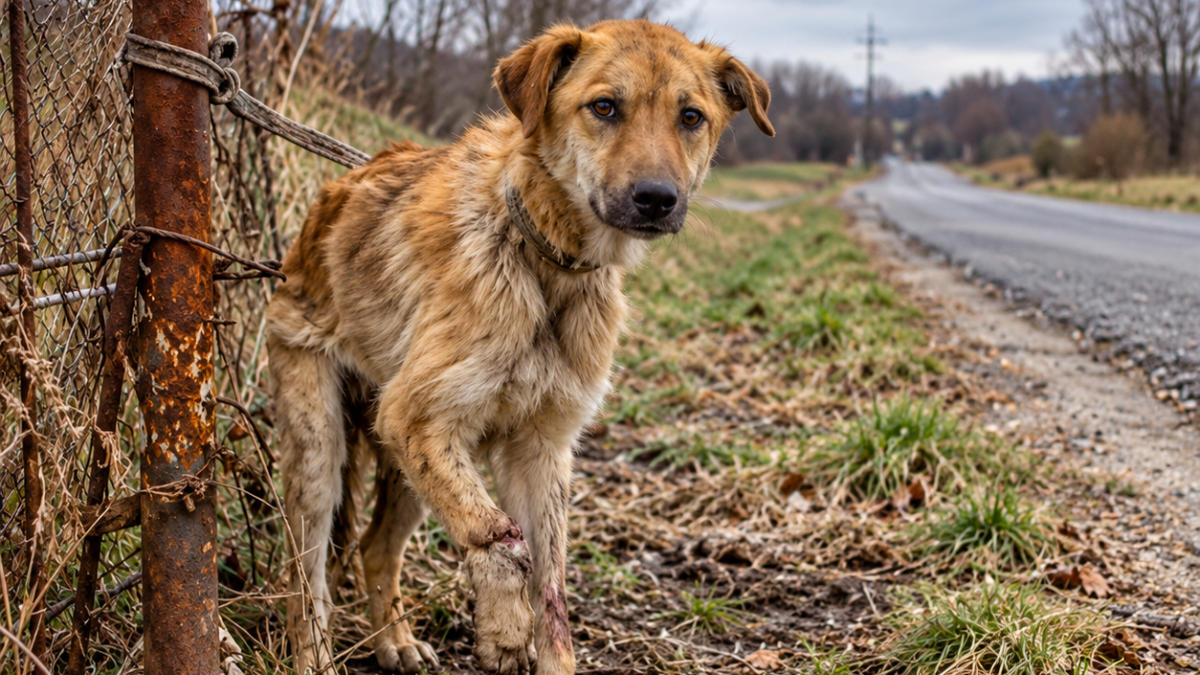
PART 2
I looked at the old man for several seconds.
“Whose car?”
He put one foot on the ground and steadied his bicycle.
“The man who brought her.”
“You saw him?”
“Yes.”
“When?”
“End of August. Maybe the twenty-seventh. Around noon.”
I looked at the dog.
She had lowered herself beside the post again, but her eyes remained fixed on us.
“What happened?”
The old man glanced toward the bend in the road.
“Gray car pulled over. Man got out with the dog. Tied her there.”
“And then?”
“He left.”
“Just left?”
“He was only here a few minutes.”
My stomach tightened.
“Did he say anything to you?”
“I was farther up the road. By the time I reached this part, he was already driving away.”
“And nobody untied her?”
The question came out sharper than I intended.
The old man’s face hardened.
“We fed her.”
“That isn’t what I asked.”
“No.”
“Why?”
He looked uncomfortable.
“Because nobody knew whose dog she was.”
“She was tied to a fence.”
“Yes.”
“For two months.”
“I know.”
“Without shelter.”
“I know.”
His voice dropped.
“Do you think I’m proud of it?”
That stopped me.
I exhaled.
“No.”
He looked at the dog.
“My wife brought water. Other people brought food. A boy from the next farm did too.”
“That’s how she survived.”
“Yes.”
“Did anyone call authorities?”
“Several times.”
“What happened?”
He shrugged helplessly.
“The first person said it was private land. Another said someone would come. Somebody came once when she had pulled the bowl out of reach. I don’t know who. Nothing changed.”
I had no idea which parts were accurate.
Rural complaints can disappear between jurisdictions.
Municipality.
Animal control.
Police.
Private rescue groups.
Property ownership.
People assume someone else has responsibility.
Meanwhile, the animal does not understand any of those distinctions.
“How often did she get food?”
“Not enough.”
At least he was honest.
“Some days several people stopped. Some days nobody.”
“And water?”
“My wife tried every morning.”
He paused.
“Sometimes the bowl was overturned by evening.”
The old man’s eyes lowered.
“We should have done more.”
I could hear the shame.
It did not help the dog, but anger at him would not either.
“What’s your name?”
“Mihai.”
“I may need to speak with you again.”
He nodded.
“Anything.”
A vehicle turned onto the road.
The dog heard it before I did.
Her head rose.
Her ears lifted.
For a moment, the weakness left her posture.
She stared.
The car came closer.
Blue hatchback.
Not gray.
It passed.
The dog followed it with her eyes until it disappeared.
Then she lowered her head.
Mihai whispered, “See?”
I did.
And suddenly I understood why he had said everyone knew her.
They had watched this happen day after day.
Every engine.
Every set of tires.
Every car slowing near the bend.
Hope.
Then disappointment.
I crouched again several feet away.
The dog looked at me.
“You’re not waiting here another night.”
Elena arrived in a small white van seventeen minutes later.
She was somewhere in her forties, wearing jeans, rubber boots, and the expression of someone who had seen too many animals in bad situations to waste time reacting dramatically.
She looked at the dog.
Then the rope.
Then at me.
“How close have you gotten?”
“About six feet.”
“Touch?”
“No.”
“Any aggression?”
“No.”
“That can change when we handle the rope.”
She opened the van.
“Let’s do this slowly.”
She brought a slip lead, towels, thick gloves, and a collapsible crate.
The dog watched everything.
When Elena approached, she backed away.
The rope tightened.
The injured paw touched the ground accidentally.
She yelped.
Elena stopped instantly.
“Okay.”
She lowered herself.
For ten minutes, nothing happened.
We simply sat.
Mihai remained near the road.
Cars passed.
The dog watched each one.
Elena placed pieces of food closer to herself.
The dog ignored them at first.
Then took one.
Another.
Elena did not reach.
Eventually, the dog came close enough for Elena to place the slip lead loosely over her head.
The dog froze.
“That’s it,” Elena whispered. “Nobody’s pulling you.”
She waited.
Then she reached toward the rope knot at the metal post.
The dog jerked back.
I expected a bite.
Instead, she flattened herself against the ground.
That reaction was worse.
Not fight.
Not even flight.
Surrender.
Elena looked at me.
“Someone has handled her roughly.”
“You can tell?”
“I can tell she expects restraint to hurt.”
She pulled a knife from her pocket.
The rope had been knotted tightly and weathered hard.
Rather than fight with it near the dog’s neck, Elena cut it at the post.
The sound was tiny.
A quick slice through old fibers.
The rope fell loose.
The dog stood.
For the first time in almost two months, according to Mihai, there was nothing connecting her to the fence.
She did not run.
That surprised all of us.
She remained beside the post.
One front paw lifted.
Body trembling.
As though freedom itself was another unfamiliar thing she did not trust.
Elena took one step backward.
The dog followed.
Only one step.
Then stopped.
“Come on.”
Another step.
Another.
She reached the edge of the packed circle around the post.
Stopped again.
The ground beyond it seemed to frighten her.
I had never thought of six feet of dirt as a boundary until I saw a dog who had spent two months learning she could not cross it.
Elena did not pull.
She waited.
The dog stretched her neck forward.
Smelled the grass.
One paw crossed the invisible line.
Then another.
Her injured foot never touched the ground.
She walked three steps.
Her rear legs gave way.
I moved instinctively.
Elena caught my arm.
“Slow.”
The dog looked at us.
No panic.
Only exhaustion.
We spread a blanket beside her.
Elena touched her shoulder.
The dog flinched.
But did not move away.
Another touch.
Then Elena slipped one arm beneath her chest.
I supported the back end.
She weighed almost nothing.
Far less than any dog her size should.
The moment we lifted her, she went rigid.
“Easy.”
Her head turned toward the road.
A truck passed.
Even from my arms, she watched it.
Mihai covered his mouth with one hand.
I carried her to the van.
Before the door closed, she looked back toward the fence.
For a second, I thought she wanted to return.
Then another car approached.
Her head lifted.
The car passed.
Not the one.
Elena shut the door.
The veterinary clinic was twenty-five minutes away.
I followed in my car.
Halfway there, Elena called through the hands-free system.
“She’s still awake.”
“Good?”
“Better than not.”
“What about the leg?”
“Swollen. Could be fracture, infection, soft tissue. We’ll know soon.”
“Neck?”
“Bad.”
“How bad?”
“She needs a vet, not roadside guesses.”
Fair.
At the clinic, the dog refused to leave the crate.
Not violently.
She simply pressed herself into the back.
Dr. Irina Popescu, the veterinarian, crouched several feet away.
“Who brought her?”
“I found her.”
“How long tied?”
“Witness says nearly two months.”
Dr. Popescu stopped.
“Two months?”
“Yes.”
“Outside?”
“Yes.”
“No shelter?”
“None when I arrived.”
Her jaw tightened.
Then she looked at the dog.
“All right.”
It took nearly fifteen minutes to get her from the crate without increasing her panic.
Nobody dragged.
Nobody cornered.
When she finally stepped out, she collapsed almost immediately.
The examination took time.
Weight first.
Dr. Popescu looked at the number, then weighed her again.
“That low?”
Elena asked.
“Yes.”
I stared.
“How much should she weigh?”
“Based on frame, probably thirty to forty percent more.”
The list grew.
Severe malnutrition.
Dehydration.
Heavy flea burden.
Intestinal parasites suspected.
Anemia.
Neck wounds from chronic rope friction.
Skin infection.
Damaged paw pads.
The swollen front leg concerned Dr. Popescu most.
X-rays showed no fresh major fracture.
That was the first good news.
But the wrist joint was badly inflamed, and there was an infected puncture between two toes.
“She may have stepped on something,” Dr. Popescu said.
“Why won’t she use it?”
“Pain. Infection. Possibly soft-tissue injury.”
“Will she lose the leg?”
“Nothing here makes me think that right now.”
I exhaled.
Then the vet looked at me.
“Do you know her name?”
“No.”
Mihai had only called her “the dog by the field.”
Elena looked at me.
“Name her.”
“Me?”
“You stopped.”
“That doesn’t make me responsible for naming her.”
Dr. Popescu smiled.
“You already look responsible.”
I looked through the kennel bars.
The dog’s eyes were still following every movement near the entrance.
A car door slammed outside.
Her head lifted.
Again.
Waiting.
“Mara,” I said.
Elena nodded.
“Mara.”
The dog did not react.
Names take time.
The clinic kept her.
She needed fluids.
Antibiotics.
Parasite treatment.
Pain control.
Careful feeding.
Wound cleaning.
Rest.
Dr. Popescu warned us not to overfeed.
“When people see an animal this thin, they want to give a huge meal.”
“Isn’t that what she needs?”
“She needs nutrition. She also needs us not to overwhelm a body that has adapted to starvation.”
Small meals.
Often.
Monitored.
The same patience required for everything else.
Before leaving, Elena asked the clinic to scan Mara for a microchip.
I expected nothing.
The scanner beeped.
We all looked at one another.
“She has one,” the technician said.
That changed the situation immediately.
A microchip meant there had once been records.
Maybe an owner.
Maybe a rescue history.
Maybe someone looking for her.
The number was entered into the database.
Registered name:
**Kira.**
Registered owner:
**Victor Stan.**
Address in a town about forty kilometers away.
The phone number was no longer active.
I looked at Mara—Kira—through the glass.
“She had a name.”
Elena nodded.
“Still does, technically.”
“Should we call her Kira?”
“Let’s see what happens.”
I went near the kennel.
“Kira.”
Her ears moved.
Not much.
I tried again.
“Kira.”
This time her eyes came toward me.
Elena noticed.
“She knows it.”
Something about that hurt more than I expected.
A nameless abandoned dog is terrible.
A dog with a name is terrible differently.
Because a name means someone had once called her inside.
Filled a bowl.
Maybe scratched her ears.
Maybe put her into a car.
And eventually used that same name before tying her to a fence.
The rescue organization notified the appropriate animal welfare office and began tracing the registration.
I went home.
Or tried to.
Instead, I drove back to the field.
The sun was setting.
The post stood exactly where it had that afternoon.
Short piece of rope still attached.
Circle of bare earth.
Empty food container.
A shallow plastic bowl Mihai’s wife had apparently left earlier.
I stood inside the circle.
It was smaller than I expected.
Six or seven steps in one direction.
Maybe five in another.
Two months of life reduced to that.
The road was visible from every point.
I heard a car before it appeared.
Without thinking, I turned toward the curve.
Then I understood.
This was what Mara had done.
Hundreds of times.
Maybe thousands.
Every engine offering the same possibility.
I walked away before the car reached me.
The next morning, the rescue called the registered address.
Victor no longer lived there.
His sister did.
She answered.
Elena later told me the conversation.
At first, the woman said she knew nothing.
Then Elena mentioned the microchip number.
Silence.
Then:
“Is it Kira?”
“Yes.”
“Is she alive?”
Elena noticed the wording.
Not *Where is she?*
Not *How did you get her?*
Is she alive?
“Yes.”
Another pause.
“My brother told us she went to a family.”
“When?”
“August.”
“Do you know which family?”
“No.”
“He said somebody with land.”
“Did you see her leave?”
“No.”
“Did he give you a name?”
“No.”
The woman sounded increasingly upset.
“My brother moved after losing his job. His new landlord wouldn’t allow dogs.”
“Do you have a current number?”
“Yes.”
She gave it.
Victor answered when animal welfare contacted him.
His first story was simple.
He had rehomed Kira.
A man named Costel had agreed to take her.
He did not know what happened after that.
Where did he hand her over?
“Near the village.”
At the house?
“No.”
Farm?
“Sort of.”
At a rusted fence beside the road?
Silence.
Then Victor changed the story.
Costel was supposed to meet him there.
Victor had been in a hurry.
He tied Kira temporarily.
Only for an hour.
Maybe two.
Costel never arrived.
Victor claimed he did not know that until later.
Why had he not returned?
No clear answer.
His phone was off.
He was already moving.
He believed someone in the village would handle it.
Every explanation shifted responsibility one step farther away from him.
Then Costel was contacted.
He gave investigators something Victor apparently had forgotten.
Messages.
One from Victor that afternoon:
**I left Kira at the fence near the old field. Pick her up when you can.**
Costel replied:
**I told you I can’t take her. My wife said no. Go back for her.**
Victor:
**I’m already on the road. I’ll sort something out.**
That was the last message about Kira.
He had known.
Not necessarily that she remained there for every one of the next sixty days.
But he knew the promised pickup had failed.
And he did not go back.
When Elena told me, I sat in my car outside the clinic.
“Why?”
She sighed.
“Because people make one bad decision, then shame makes the next decision easier.”
“That’s generous.”
“Not an excuse.”
“It sounds like one.”
“No.”
Her voice sharpened.
“Understanding how someone gets there is not the same as forgiving it.”
I looked through the windshield.
“So he just kept driving.”
“Yes.”
“Knowing she was tied there.”
“Yes.”
I thought of every vehicle Mara had watched.
Maybe she did not understand dates.
Distance.
Landlords.
Jobs.
Promises between men.
But she understood one thing.
The person who had put her there drove away.
And she had reason to expect he might return.
Dogs learn patterns.
Cars bring people home.
Doors open.
Engines stop.
Familiar footsteps follow.
So Mara had watched.
The medical recovery did not move as quickly as the investigation.
On day two, her temperature stabilized.
On day three, her infected paw worsened before improving.
The vet opened and cleaned the wound more deeply.
No foreign object remained.
That was good.
Her anemia was significant but manageable.
She tested positive for intestinal parasites.
No surprise.
Her neck required daily cleaning.
The first time a technician reached toward the rope wound, Mara flattened herself.
They stopped.
Started again slower.
By the fifth day, she allowed treatment without pressing herself into the floor.
Progress could be measured in inches.
A lifted head.
A full small meal.
A few steps using the injured paw.
One second less hesitation before taking food from a hand.
I visited after work.
At first, Mara seemed more interested in the clinic door than in me.
Someone entered.
Head up.
Car outside.
Head up.
Footsteps in the hall.
Head up.
She was still waiting.
On the sixth evening, I sat on the floor beside her kennel.
“Kira.”
She looked.
I had gotten used to Mara.
But Kira belonged to her past.
I was not sure what to do with that.
Dr. Popescu walked by.
“What are you thinking?”
“Whether changing her name is fair.”
She leaned against the wall.
“Dogs do not attach moral meaning to names the way humans do.”
“She knows Kira.”
“Yes.”
“Then should we keep it?”
“Do you like it?”
“That’s not the point.”
“It may be.”
I looked at the dog.
“Kira.”
Ears.
“Mara.”
Nothing.
Dr. Popescu smiled.
“Scientific study complete.”
“Very funny.”
I kept using Kira for the next few days.
But something strange happened.
Elena continued calling her Mara.
So did the clinic technicians.
The dog began reacting to both.
Maybe names matter less than tone.
Who is saying it.
What follows.
Food.
Safety.
Pain.
Fear.
Eventually, I stayed with Mara.
Not because Kira was a bad name.
Because Mara became the name attached to the part of her life after the rope was cut.
Victor signed legal surrender papers before the welfare case concluded.
That surprised me.
I expected resistance.
Instead, according to Elena, he asked one question.
“Is she going to survive?”
“Yes.”
Then he signed.
He did not ask to see her.
That angered me.
Then, oddly, I became glad.
Mara did not need another moment built around what Victor wanted.
The case proceeded separately.
Witness statements.
Mihai.
His wife.
The messages.
Veterinary documentation.
The microchip records.
Photographs of the rope wound.
The post.
The circle of worn dirt.
There was no dramatic criminal trial while everyone waited outside a courtroom.
Real life was slower and less theatrical.
Animal welfare authorities imposed penalties.
Victor was cited for abandonment and neglect under the applicable process.
He lost any claim to Mara and faced restrictions connected to future animal ownership.
I never met him.
For a while, I wished I had.
I imagined questions.
How could you?
Why didn’t you turn around?
Why not call a shelter?
Why not ask your sister?
Why leave her tied?
Then Mara taught me how useless those questions were to the one who had actually suffered.
She did not need his explanation.
She needed her paw to heal.
Food to keep coming.
The rope wound to close.
A place to sleep.
So I stopped giving Victor more space in her story than he deserved.
After twelve days, Mara could walk on all four paws for short distances.
She still limped.
But she used the leg.
Her appetite became almost comical.
The staff had to slow her down with a special bowl.
If another dog’s food passed the kennel, she watched it like a professional thief.
“That’s a good sign,” I said.
Dr. Popescu pointed at the feeding chart.
“That’s a dog who has learned food can disappear.”
“How long until she stops?”
“She may always eat quickly.”
“She doesn’t need to anymore.”
“Her brain does not know that yet.”
That sentence stayed with me.
The body can leave the fence before the mind does.
On day fourteen, she was medically stable enough to leave the clinic.
The rescue had a problem.
No available foster home experienced with fearful dogs.
Elena called.
“You have a quiet house?”
“Yes.”
“Fenced yard?”
“Small one.”
“Other animals?”
“No.”
“Children?”
“No.”
I already knew where she was going.
“This is temporary.”
“Of course.”
“I mean it.”
“Naturally.”
“You’re mocking me.”
“A little.”
I picked Mara up that afternoon.
She recognized my voice.
I know that because when I said her name, her head came up before I entered the room.
Her tail moved.
Not wildly.
Twice.
That was enough.
At my house, she stopped at the front door.
Would not enter.
I stepped inside.
She remained on the porch.
The leash stayed loose between us.
“Come on.”
Nothing.
I placed food just inside.
She stretched forward.
Back feet outside.
Front paws inside.
A ridiculous split between two worlds.
Then a motorcycle passed.
Mara whipped around toward the road.
The bike continued.
She watched until it disappeared.
Only then did she remember the food.
She stepped inside.
For the first three nights, she slept facing the front door.
Not in the dog bed.
Not beside me.
Directly across from the entrance.
Every passing car woke her.
Head up.
Listen.
Wait.
Relax.
Again.
Again.
Again.
The first morning, I found her already sitting near the window.
Watching the road.
I opened the back door.
“You can go outside.”
She looked at me.
Then the front window.
I began understanding how deeply those sixty days had settled into her.
At first, she did not know how to play.
I rolled a ball.
She flinched.
I offered a rope toy.
Bad idea.
The sight of it made her back away.
I put it in a closet and never brought it out again.
A stuffed rabbit worked better.
She smelled it.
Ignored it for three days.
On the fourth, I found it moved from the living room to her bed.
That counted.
Eating remained urgent.
She finished meals in seconds.
Then searched.
Floor.
Corners.
Under cabinets.
Once she tried chewing through the dog-food bag.
I moved it.
She learned where.
I moved it again.
Elena laughed when I told her.
“Congratulations.”
“For what?”
“You have a dog.”
“I’m fostering.”
“Right.”
The first major setback came after a week.
I went to the grocery store.
Forty minutes.
When I returned, Mara had scratched the front door badly enough to leave marks in the wood.
She was panting.
Drool along her mouth.
Her nails had reopened one small cut.
I sat on the floor.
“Oh, Mara.”
She pushed herself against the wall.
I had left.
In her experience, leaving could mean two months.
Maybe forever.
I called Elena.
“Separation distress.”
“I know.”
“Don’t punish.”
“I’m not.”
“Start shorter.”
“How short?”
“Seconds if necessary.”
That sounded absurd.
It worked.
I picked up my keys.
Walked outside.
Five seconds.
Returned.
Mara stared.
Again.
Ten seconds.
Return.
Thirty.
One minute.
Five.
Some days were better.
Some worse.
The goal was not to trick her into thinking I would never leave.
It was to teach her that leaving and returning could be part of the same event.
That took weeks.
Mara also had a strange reaction to gray cars.
Not every one.
Enough to notice.
If we were walking and a gray sedan slowed, she froze.
Once, one stopped near us.
A man got out to check his mailbox.
Mara pulled toward the vehicle.
Not away.
Toward it.
My throat tightened.
“Mara.”
She ignored me.
The man walked into his house.
The car remained.
Mara smelled the air.
Then her posture changed.
Whatever she expected was not there.
She turned back toward me.
I did not know whether Victor had driven a gray sedan.
Mihai said gray.
That was enough to make the possibility hurt.
At her one-month recheck, Mara had gained several pounds.
The neck wound was nearly closed.
Her paw infection had resolved.
The joint remained sensitive but functional.
Dr. Popescu smiled.
“She looks like a dog now.”
“What did she look like before?”
“An emergency.”
Fair.
Mara stood on the scale.
More weight.
I felt absurdly proud.
Then another client opened the clinic door.
Mara turned.
Gray car outside.
Head high.
Dr. Popescu noticed.
“She still does that?”
“Yes.”
“How often?”
“Every car at home. Less on walks.”
“She may stop.”
“When?”
“No idea.”
“What if she doesn’t?”
“Then she watches cars.”
Her answer annoyed me because it was so reasonable.
Not every scar needs elimination.
Some behaviors fade.
Others become harmless habits.
My job was not to make Mara forget.
It was to make remembering less dangerous.
Around six weeks, she began sleeping with her back to the front door.
The first time I noticed, I almost woke her by reacting.
She was curled on the dog bed.
Facing the fireplace.
Door behind her.
A vehicle passed outside.
Mara’s ear moved.
Her head stayed down.
I stood in the hallway staring.
Tiny changes.
That was how recovery announced itself.
Not with a dramatic transformation.
With an ear that moved while the body stayed relaxed.
Two months after rescue, the adoption coordinator called.
Mara was officially available.
I had known the call was coming.
Still, my stomach dropped.
“We have interest.”
“How much?”
“Several applications.”
“Already?”
“She photographs well.”
Mara was asleep on my sofa despite a rule that had apparently disappeared.
“What kind of applications?”
“One family has another dog.”
“No.”
“Why no?”
“She gets nervous around energetic dogs.”
“We can assess.”
“Next.”
The coordinator laughed.
“You realize this is not your personal interrogation process.”
“It should be.”
Another applicant lived in an apartment in the city.
Maybe workable.
But Mara remained anxious around heavy traffic.
Another had young children.
Potentially fine.
But Mara still startled when approached suddenly while sleeping.
Then came a couple named Ana and Stefan.
Quiet home.
Fenced garden.
No children living at home.
Previous rescue-dog experience.
Excellent veterinary history.
Close enough to Mara’s clinic.
I hated them immediately.
Not because anything was wrong.
Because nothing was.
They met Mara in my garden.
Ana ignored her at first.
Good.
Stefan sat sideways.
Also good.
No reaching.
No baby talk.
No pity.
Mara approached after fifteen minutes.
Took a treat.
Returned to me.
Then approached Ana again.
The coordinator whispered, “This could work.”
I nodded.
My chest felt hollow.
After they left, Mara sat by the front window.
A car approached.
She lifted her head.
It was Ana and Stefan leaving.
Mara watched until they disappeared around the corner.
That image hurt in a way I did not expect.
For two months she had watched one person leave.
Now I was considering becoming the person who sent her away.
I told myself that was unfair.
Adoption is not abandonment.
A good home is not betrayal.
Foster dogs move.
They adjust.
They bond again.
All true.
Still, that night I could not sleep.
Around two, I went to the kitchen.
Mara was lying near the front door.
Her eyes opened.
I sat beside her.
“You liked them.”
Tail.
“They have a bigger yard.”
Tail.
“They seem normal.”
Mara put her head on my knee.
“That is manipulation.”
She closed her eyes.
The next afternoon, Elena came over.
“You’re keeping her.”
“I haven’t decided.”
“You decided six weeks ago.”
“No.”
“You installed a camera so you can check whether she panics while you’re out.”
“That’s responsible fostering.”
“You bought three dog beds.”
“Different rooms.”
“You changed your work schedule.”
“Temporarily.”
“You stopped calling her foster dog.”
I frowned.
“What do I call her?”
“Mara.”
I looked at the dog.
She was asleep under the table.
Elena softened.
“You don’t have to keep her because you feel guilty.”
“I know.”
“And you shouldn’t keep her because you’re afraid she’ll think you abandoned her.”
“I know.”
“She could adapt to another good home.”
“I know.”
“So what do you want?”
That was harder.
Not what was best according to an abstract rule.
Not what the rescue expected.
What did I want?
“I want her to stay.”
“Then ask the better question.”
“What?”
“Can you give her the life she needs?”
I looked around.
Quiet house.
Garden.
Work schedule I could manage.
Veterinary care I could afford.
Training.
Time.
“Yes.”
Elena smiled.
“Then stop making this complicated.”
I adopted Mara.
Officially.
The paperwork took fifteen minutes.
The emotional realization had taken two months.
The day I signed, nothing dramatic happened.
Mara ate dinner.
Went outside.
Barked once at a tractor.
Slept on the sofa.
That was home.
Not paperwork.
Repetition.
Months passed.
Her weight normalized.
Coat became soft.
The light-brown color deepened into warm caramel along her back.
The red line around her neck faded.
Hair grew over most of it.
The injured front leg remained slightly stiff after long walks.
Nothing more.
She learned toys.
The stuffed rabbit became a favorite.
She carried it from room to room.
She never liked rope toys.
I never tried again.
She learned that food appeared twice every day.
At first she still searched after meals.
Then searched less.
One evening, she left three pieces of kibble in the bowl.
I stared at them.
Mara walked away.
I took a photograph.
Elena replied:
**You photographed leftover dog food?**
**Yes.**
**You need hobbies.**
She missed the point.
A dog who had once eaten as if every bite might be stolen had walked away from food because she knew more would come.
That mattered.
Her relationship with cars changed too.
At first:
Every engine.
Head up.
Window.
Road.
Three months:
Only cars slowing near the house.
Six months:
Mostly gray ones.
One year:
Occasional glance.
Then one rainy afternoon, nearly fourteen months after I found her, I heard a car pull into the driveway while Mara slept beside me.
I looked at her.
Nothing.
Door closed outside.
Nothing.
Keys rattled.
Mara opened one eye.
My sister entered.
Only then did Mara get up.
Not because a car had returned.
Because a person she knew had entered the house.
I had to turn away for a second.
My sister noticed.
“What?”
“Nothing.”
“You look like you’re crying.”
“I’m not.”
She looked at Mara.
“Is she okay?”
“Yes.”
That was exactly why.
Mara was okay.
The story could have ended there.
In some ways, it did.
But I remained curious about the field.
Not obsessively.
Just enough.
Mihai and his wife became occasional friends.
I stopped once every few months.
They always asked about Mara.
I showed photographs.
The first one of her at healthy weight made Mihai’s wife cry.
“She looks different.”
“She is.”
“She still watches the road?”
“Less.”
Mihai stared at the picture.
“We should have cut that rope.”
His regret had not disappeared.
I could have agreed.
Instead I said, “You kept her alive.”
“Barely.”
“Still.”
His wife had brought water almost every morning.
Others had brought scraps.
None of it excused two months tied to a fence.
But rescue stories become dishonest when we demand perfect heroes and perfect villains.
Victor had abandoned her.
That was clear.
The villagers had not done enough.
Also clear.
But some did something.
Enough to keep Mara alive until someone finally broke the pattern.
I did not want Mihai spending the rest of his life pretending he had done nothing.
“You know what to do next time,” I said.
He nodded.
“There won’t be a next time.”
“There always is.”
Unfortunately, there usually is.
A year and a half after Mara’s rescue, Mihai called me.
“There’s another dog.”
My heart dropped.
“Same field?”
“No. Other side of the village.”
“Chained?”
“No. Wandering. Hurt.”
He had already called the rescue.
Already brought water.
Already stayed nearby.
By the time I arrived, Elena’s team was loading the dog.
Mihai shrugged.
“I learned.”
That mattered too.
Sometimes one rescue changes more than one life.
Victor disappeared from Mara’s world.
Good.
I heard the welfare case concluded with fines and restrictions.
I did not attend.
Did not need to.
Justice mattered.
But I learned not to confuse legal consequence with Mara’s recovery.
She did not get healthier because Victor was penalized.
She got healthier because meals arrived.
Because the wound was cleaned.
Because the door opened and I returned.
Because days repeated safely.
Real repair happened far from paperwork.
At two years, Mara became almost embarrassingly affectionate.
The dog who once flattened herself when hands approached now leaned into people she trusted.
Not everyone.
She remained cautious with unfamiliar men.
Especially fast movements.
But choice replaced fear.
If she did not want contact, she walked away.
That freedom was new.
One summer afternoon, I watched a visitor reach over her head too quickly.
Mara stepped backward.
The man stopped.
“Sorry.”
He crouched sideways.
Mara looked at him.
Then chose to return.
That tiny choice meant more to me than forced friendliness ever could.
She had spent two months unable to move farther than a rope allowed.
Now she could say no.
And because people respected no, she sometimes chose yes.
At three years, the damaged paw began bothering her after long walks.
The veterinarian diagnosed early arthritis in the joint.
“Could this be from what happened?”
“Possibly contributed.”
I hated that.
The fence had been gone from Mara’s life for years.
Still, her body carried it.
Medication helped.
We shortened long hikes.
Mara did not seem offended.
She preferred sniffing to exercise anyway.
Twenty minutes covering a hundred meters was completely normal to her.
She could inspect one bush with the concentration of a detective.
I learned patience.
At four years, she discovered swimming.
By accident.
We visited friends near a small lake.
Mara stepped into shallow water.
Looked surprised.
Stepped farther.
Then began paddling.
I laughed so hard I nearly dropped the leash.
She returned to shore.
Shook water over everyone.
Went back in.
That day became one of my favorite memories.
Not because it connected to her rescue.
Because it didn’t.
A happy dog discovered water.
Nothing tragic.
No lesson.
No comparison.
Just life.
That became increasingly important.
For years, people who knew Mara’s story would say:
“Poor thing.”
I understood.
But eventually I stopped liking it.
Mara was not “poor Mara.”
She was Mara.
Stubborn.
Food-motivated.
Suspicious of umbrellas.
Obsessed with cheese.
Terrible at catching balls.
Excellent at stealing warm spots on the sofa.
Her abandonment had happened to her.
It was not her personality.
The longer she lived safely, the smaller that field became in the total map of her life.
That was exactly what I wanted.
Five years after the rescue, Elena asked whether I had ever taken Mara back.
“To the fence?”
“Yes.”
“No.”
“Want to?”
“No.”
“Why?”
“What would it do for her?”
Elena smiled.
“You’ve learned.”
Humans love symbolic returns.
We imagine an animal confronting the place of suffering and understanding the transformation.
Dogs may recognize scents.
Places.
Associations.
But Mara did not need a ceremony.
She had already left.
Years passed.
Her muzzle lightened.
The front leg stiffened.
She slept more deeply.
Food remained important enough that I knew old age had not defeated her.
The first time she failed to hear my car pull in, I panicked.
Then discovered she was simply asleep.
The second time, I realized her hearing was changing.
We adapted.
Hand signals.
Touching the floor gently before approaching from behind.
No startling.
Mara adapted faster than I did.
By then, the road-watching habit was almost gone.
Almost.
Every few months, a particular engine tone or gray sedan would make her raise her head.
She would look.
Then return to whatever she was doing.
I stopped feeling sad when it happened.
Memory is not failure.
The past can exist without owning the present.
At around nine, Mara developed more significant arthritis.
Ramps.
Rugs.
Pain medication.
She hated the car ramp.
I tried demonstrating.
She stared at me.
“You saw how it works.”
Nothing.
“Up.”
Nothing.
I placed cheese on the first step.
Mara climbed.
Some training theories are more powerful than others.
At ten, kidney values changed slightly.
Nothing severe.
Monitor.
Diet adjustment.
More water.
At eleven, she became gray around her entire muzzle.
People who had not known her earlier assumed she had always lived an easy life.
I loved that.
One autumn morning, almost exactly eleven years after I found her, I drove near the old field.
Mara was with me.
I had not planned to stop.
The fence had been replaced years earlier.
The old rusted post was still there, though.
Bent.
Half hidden in weeds.
I drove past.
Then slowed.
Mara was awake in the passenger area.
I pulled onto the shoulder.
For several seconds, I sat.
Was I doing this for her?
No.
For me.
I knew that.
I almost drove away.
Then Mara stood.
I helped her down.
Her old front leg was stiff.
We walked slowly.
The field looked different.
Greener.
Partly cultivated now.
The circle of bare dirt was gone.
Grass covered everything.
I stopped near the old post.
Mara smelled the ground.
A long time.
Fence.
Weeds.
Air.
Did she know?
I could not tell.
Her body remained relaxed.
No trembling.
No lowered posture.
No pull toward the road.
I stood beside her.
“This was it.”
She smelled my shoe.
“Very emotional.”
Mara looked toward the road.
A car approached around the bend.
Gray.
My chest tightened before I could stop it.
Eleven years disappeared for a second.
I saw the skinny dog on three legs.
The rope.
The raw neck.
Every engine bringing hope.
The gray car came closer.
Mara heard it.
Her ears moved.
She looked up.
I held my breath.
The car passed.
And Mara never looked at it.
Not once.
Instead, she leaned against my leg.
I put one hand on her back.
The gray car disappeared around the curve.
Mara turned toward my vehicle.
Started walking.
Slowly.
Old dog pace.
She stopped at the door and waited for me to help her inside.
I looked back at the post.
For years, I had imagined that place as something unfinished.
It wasn’t.
The waiting had ended long ago.
I lifted Mara into the car.
Before closing the door, I kissed the top of her head.
She looked mildly annoyed.
Then settled onto her blanket.
We drove home.
The road disappeared behind us.
This time, Mara did not turn around.
[TITLE]
For Two Months She Was Tied to a Rusted Fence—And Every Car Made Her Look Up
[FACEBOOK OPENING — 700–800 WORDS]
For almost two months, a thin brown dog stood tethered to a rusted fence at the edge of an empty field, lifting her head at every engine sound as if the next car might finally be the one that had come back for her.
When I found her on a gray October afternoon, she was balancing on three legs, her neck rubbed raw beneath a short rope, and so hungry that she stared at the food I placed down as though she had forgotten people could give something without taking something first.
I thought I had stopped to help an abandoned dog, but the way she kept watching the bend in the road—and what I learned about the person who had tied her there—made me understand that she had not been waiting for rescue at all.
I first saw her while driving along a country road on the edge of a small village.
At first, I thought the shape beside the fence was an old sack caught in the weeds.
Then it moved.
I slowed.
A dog raised her head.
She was small, light brown, and painfully thin. One front paw never touched the ground. A short piece of rope ran from her neck to a rusted metal post.
There was no doghouse.
No water bowl.
No shade.
Nothing dry to sleep on.
Only burnt grass, cracked soil, and a long road disappearing around a curve.
I pulled over.
The moment I opened my door, her ears lifted.
For one second, something changed in her face.
Hope.
Not friendliness exactly.
Recognition.
As if a car stopping was the thing she had been waiting for.
Then I stepped toward her.
She backed away so quickly that the rope snapped tight.
She cried out.
I stopped immediately.
“Easy, girl. I’m not going to hurt you.”
She trembled.
No growl.
No teeth.
Just fear.
I returned to my car, took out a bottle of water and a small container of food, and placed both several feet from her.
Then I backed away.
She stared at the food for nearly a minute.
Finally, hunger won.
She limped forward.
One step.
Then another.
She smelled the food.
Took one bite.
Then began eating faster.
Too fast.
I moved closer to slow her down, and she flinched so hard that I froze.
“All right. I’m stopping.”
That was when I saw her neck properly.
The rope had rubbed away the fur.
The skin beneath it was red, swollen, and broken in places.
Her ribs stood out sharply.
Her hips looked like corners beneath her coat.
And the paw she was holding up was twice the size it should have been around the joint.
I called a local animal rescue number.
A woman named Elena answered.
“How long has she been there?”
“I don’t know. I just found her.”
“Can she reach the road?”
“No.”
“Any owner nearby?”
“No houses close.”
“I’m twenty minutes away. Don’t cut the rope yet unless she’s in immediate danger. If she panics, she could run straight into traffic.”
I stayed.
Every car made the dog lift her head.
Not just glance.
She stood as tall as her weak body allowed and stared until each vehicle disappeared around the bend.
Then she lowered herself again.
The third time it happened, I felt something cold move through my chest.
She was not watching traffic.
She was waiting for someone.
She finished the water, then moved back toward the fence post and lowered herself onto the bare ground. I noticed a circle of packed dirt worn smooth around the metal stake. Whatever time she had spent there, she had spent it pacing within the same few feet.
An old man on a bicycle came down the road and slowed when he saw me.
“You finally stopping for her?” he asked.
I turned.
“You know this dog?”
His expression changed.
“Everyone around here knows her.”
My hand tightened around the phone.
“How long has she been tied here?”
He looked at the dog.
Then at me.
“Since the end of August.”
It was October.
I stared at him.
“You’re telling me she’s been here nearly two months?”
He nodded slowly.
“And every day,” he said, “she does the same thing.”
“What thing?”
The old man pointed toward the curve.
“She watches the road.”
Then he said, “Because that’s the direction his car went when he left her.”
[END OF FACEBOOK OPENING]
[FULL STORY CONTINUATION]
I looked at him for several seconds.
“Whose car?”
He put one foot on the road to steady his bicycle.
“The man who brought her.”
“You saw him?”
“Yes.”
“When?”
“End of August. Around noon.”
He rubbed one hand over his gray beard, trying to remember.
“Twenty-sixth. Maybe twenty-seventh.”
“What exactly happened?”
“Gray sedan stopped. Man got out. Opened the back door. Dog didn’t want to come out.”
My eyes moved toward the animal.
She was watching us now.
“What do you mean she didn’t want to come out?”
“He pulled her by the collar.”
“Hard?”
The old man hesitated.
“Hard enough.”
My jaw tightened.
“And then?”
“He tied her to the fence.”
“How long was he here?”
“Five minutes. Maybe less.”
“Did he leave food?”
The old man shook his head.
“Water?”
“No.”
“Shelter?”
“No.”
“Did he tell anyone he was coming back?”
“Not to me.”
“Did you speak to him?”
“I was farther down the road. I thought maybe he owned the field.”
The old man looked ashamed.
“By the time I got close, the car was already leaving.”
The dog’s ears moved when another engine appeared around the bend.
A white van passed.
Her body lifted.
Then sank again.
I looked back at the old man.
“And nobody untied her?”
His face hardened slightly.
“We fed her.”
“That isn’t what I asked.”
“No.”
“Why?”
“Because we didn’t know whose dog she was.”
“She was tied to a fence.”
“I know.”
“For nearly two months.”
“I know.”
I heard my own anger rising and forced it back down.
The old man looked toward the field.
“My name is Mihai.”
“All right.”
“My wife brought water almost every morning. People stopped with bread. Meat. Leftovers. One boy from the dairy farm brought dry food.”
“That’s how she survived.”
“Yes.”
“Did anyone contact animal services?”
“Several people.”
“What happened?”
“One man said they told him it was private land. Another was told someone would check. Somebody did come once.”
“Who?”
“I don’t know. A van.”
“What happened?”
“They looked at her. Then left.”
“Why?”
Mihai spread his hands.
“I don’t know.”
“Police?”
“No.”
“Local authorities?”
“I think so.”
“You think?”
His eyes dropped.
“I should have done more.”
The anger left me as quickly as it had come.
Guilt was already doing the work.
“What happened when it rained?”
“Sometimes she stood.”
“All night?”
“I don’t know.”
“Where did she sleep?”
Mihai pointed at the ground.
Exactly where she was lying.
Nothing between her and the dirt.
“What about hot days?”
“There was some shade from the fence in the afternoon.”
Some shade.
I looked around.
It was not enough.
None of it was enough.
Mihai put both hands on the bicycle handlebars.
“My wife wanted me to cut the rope.”
“Why didn’t you?”
“She was afraid the dog would run onto the road.”
That was the same reason Elena had given me.
Only by then the dog had already been tied for weeks.
Mihai continued.
“She tried touching her once. The dog panicked and nearly choked herself.”
I looked at the raw skin around her neck.
That explained some of it.
“She stopped trusting people?”
“She never trusted us much.”
“Except food.”
“Food was different.”
Another car appeared.
Mara—though I did not yet know I would call her that—stood again.
A gray car this time.
For one terrible second, her whole posture changed.
Her ears rose.
Her weight shifted forward.
Even the injured foot touched the ground.
The gray car slowed for the bend.
The dog stared.
Her tail moved.
Once.
My chest tightened.
The car passed us.
She followed it with her eyes.
It disappeared.
Her tail stopped.
She lowered the bad leg.
Then slowly sat.
Mihai whispered, “That’s what I mean.”
I said nothing.
“She’s done it every day.”
The words hurt more than they should have.
Every day.
How many cars passed that road in two months?
Hundreds.
Maybe thousands.
How many times had she believed for one second that the next engine belonged to the person who had left her there?
And how long before hope itself became a habit?
I crouched several feet from her.
“You’re not spending another night here.”
Mihai nodded.
“No.”
A small white van turned onto the road twenty minutes later.
Elena climbed out.
She wore jeans, rubber boots, and an old rescue jacket. Her hair was tied back. Her face had the tired concentration of someone who had spent years entering situations where emotion could not be allowed to interfere with good decisions.
She did not rush toward the dog.
First, she looked.
Rope.
Distance to road.
Fence.
Injured leg.
Water.
Food.
Escape routes.
Then she looked at me.
“How close?”
“Six feet, maybe.”
“Touch?”
“No.”
“Growling?”
“No.”
“Snapping?”
“No.”
“Freezing?”
“Yes.”
“More concerning.”
Mihai frowned.
“Why?”
“A dog that growls is telling you where the line is. A dog that shuts down may give you no warning before panic.”
She opened the van.
Slip lead.
Blankets.
Towels.
Thick gloves.
A crate.
Then she lowered herself into the grass.
No eye contact.
No reaching.
She tossed a tiny piece of food.
The dog looked at it.
Then Elena.
Then the road.
A car passed.
Only after it disappeared did she eat.
Elena tossed another piece closer.
The process took almost fifteen minutes.
Food.
Wait.
Car.
Wait.
Food.
One small step.
Then another.
Eventually, the dog stood within reach of Elena’s slip lead.
Elena moved slowly.
The loop went over the dog’s head.
The dog froze.
Every muscle tightened.
Nobody spoke.
Elena left the lead completely loose.
“Nothing’s pulling you,” she whispered.
The dog stood like stone.
Thirty seconds.
Then her breathing slowed slightly.
Elena reached for the knot at the fence post.
The dog jerked backward.
The rope around her neck snapped tight.
She dropped to the ground.
Not fighting.
Not barking.
Flattening herself into the dirt.
Elena stopped.
“That tells me plenty.”
“What?”
“She’s learned restraint means pain.”
I swallowed.
Elena took out a small knife.
The rope was stiff with weather and dirt.
Rather than untie it near the dog’s throat, she cut it close to the post.
One motion.
The fibers separated.
The loose end fell.
The dog stood.
We all waited.
Nothing held her to the fence anymore.
But she did not move.
For nearly two months, according to Mihai, that six-foot circle had been her entire world.
Now the boundary existed only in her mind.
Elena took one step backward.
The dog watched.
Another.
Food.
Wait.
The dog leaned forward.
One paw crossed the edge of the packed dirt.
Then another.
She stopped.
I realized I was holding my breath.
“Come on,” Elena whispered.
One more step.
Her injured front leg touched the grass.
She cried out.
Her back legs folded.
I moved instinctively.
Elena caught my wrist.
“Slow.”
We approached from the side.
The dog did not try to escape.
She simply looked exhausted.
Elena spread a blanket.
Then touched her shoulder.
Flinch.
Stop.
Touch again.
Less flinch.
She slid one arm under the dog’s chest.
I supported the rear.
The dog weighed almost nothing.
That was the first thing I felt.
Not fear.
Not resistance.
Nothing.
Just bones beneath dirty fur.
The moment we lifted her, she went rigid.
A truck approached.
Her head turned even while she was in my arms.
She watched it pass.
Mihai covered his face with one hand.
I carried her to the van.
Before Elena shut the door, the dog looked back toward the fence.
For one second, I thought she wanted to return.
Then I realized she was looking beyond it.
Toward the bend.
Still waiting.
The clinic was twenty-five minutes away.
I followed Elena.
Halfway there, she called me.
“She’s awake.”
“Good?”
“Better than unconscious.”
“What about the leg?”
“Swollen. We’ll know after imaging.”
“Neck?”
“Bad.”
“How bad?”
“Stop asking me to be a veterinarian.”
“Fair.”
“She’s breathing normally. That’s what matters right now.”
The clinic had already been warned.
Dr. Irina Popescu met us at the entrance.
She crouched beside the crate.
“Hello, sweetheart.”
No response.
The dog had pressed herself into the back.
“Any bite history?”
“Unknown.”
“Likely handling trauma,” Elena said.
“Good to know.”
Dr. Popescu did not drag her out.
They removed the top half of the crate instead.
Only then could they lift her without forcing her through the door.
The examination was slow.
Weight first.
Dr. Popescu stared at the number.
Then weighed her again.
“That low?”
Elena asked.
“Yes.”
“How underweight?”
“Based on frame, at least thirty percent.”
My stomach tightened.
Then came everything else.
Severe dehydration.
Heavy flea infestation.
Anemia.
Likely intestinal parasites.
Open friction wounds beneath the rope.
Skin infection around the neck.
Damaged paw pads.
A swollen front leg.
Multiple healed scratches.
Callused areas over the elbows.
The X-ray brought the first good news.
No major fracture.
The leg was badly inflamed, and a puncture wound between the toes had become infected.
“Could that be why she’s not bearing weight?” I asked.
“Yes.”
“Permanent?”
“Too early to say.”
“Could she lose the leg?”
“Nothing points there right now.”
I finally exhaled.
Blood tests were next.
The values looked ugly even to someone who did not fully understand them.
Low red-cell count.
Low protein.
Electrolyte imbalance.
Evidence of prolonged nutritional deprivation.
Dr. Popescu looked at us.
“How long outside?”
“Nearly two months.”
Her expression changed.
“Tied?”
“Yes.”
“Constantly?”
“As far as witnesses know.”
She removed her gloves.
“Then her body has been surviving on whatever food people brought and on its own reserves.”
“Can we feed her now?”
“Yes, but carefully.”
“She’s starving.”
“Exactly.”
She explained the danger of refeeding too aggressively after prolonged malnutrition.
Small meals.
Frequent.
Monitored.
Gradual correction.
No emotional dumping of a full bowl in front of her just because it made us feel better.
“What about water?”
“Fluids first. Controlled access afterward.”
The dog’s eyes followed every sound from the front of the clinic.
A car door shut outside.
Head up.
I noticed.
Dr. Popescu noticed me noticing.
“She’s alert.”
“She does that with cars.”
“Why?”
“We think she’s waiting for someone.”
Dr. Popescu did not answer.
She had probably heard too many stories to assume.
Then the technician brought over a microchip scanner.
I expected silence.
Instead:
Beep.
All of us looked up.
“Again.”
Beep.
“She’s chipped.”
That changed everything.
The number was entered.
Registered name:
Kira.
Owner:
Victor Stan.
Registered address approximately forty kilometers away.
Telephone number disconnected.
I looked at the dog.
“Kira?”
Her ears moved.
Maybe coincidence.
I tried again.
“Kira.”
Her eyes came toward me.
Elena saw it too.
“She knows it.”
That was the moment abandonment became more personal to me.
Until then, she had been “the dog.”
Someone had once named her.
Registered her.
Taken her to a veterinarian or shelter long enough to implant a chip.
Someone had once considered her identifiable.
Owned.
Known.
“Kira,” I said again.
Her tail moved faintly against the blanket.
I had to look away.
The rescue immediately contacted the animal welfare office.
The registered address no longer belonged to Victor.
His sister lived there.
Elena later told me how the conversation went.
At first, the woman denied knowing where Victor was.
Then Elena said the name Kira.
Silence.
Then:
“Is she alive?”
Not:
Where is she?
Not:
Who found her?
Is she alive?
That question told us something.
“Yes,” Elena said.
“Where?”
“At a veterinary clinic.”
Another pause.
“My brother said he gave her away.”
“When?”
“August.”
“To whom?”
“A man.”
“Name?”
“I don’t know.”
“Did you see that happen?”
“No.”
“Did he tell you where the dog went?”
“No.”
“Do you know why he gave her away?”
The woman sighed.
“He lost his job. Moved into a smaller place. Landlord said no animals.”
“Was Kira his only dog?”
“Yes.”
“How long had he owned her?”
“Five years.”
Five years.
Not a stray picked up last month.
Five years.
I thought about the dog watching the road.
Now it made sense in a way I wished it did not.
Cars had not always meant danger.
For five years, one probably meant home.
Trips.
Food.
Familiar people.
Then one day, that same car had taken her to an empty field.
The animal welfare office contacted Victor.
His first explanation:
He had rehomed Kira to a man named Costel.
Costel was supposed to care for her.
When confronted with the location where she was found, the story shifted.
Costel was supposed to meet him near the field.
Victor claimed he had tied Kira temporarily while waiting.
Then he received a phone call.
Had to leave.
Costel would arrive.
Only he didn’t.
“How long was she supposed to stay there?” Elena asked.
“An hour.”
“Did you confirm Costel collected her?”
Victor said he believed he had.
That claim lasted less than a day.
Costel still had messages.
One from Victor:
I left Kira at the fence near the old field. Pick her up when you can.
Costel replied:
I told you I can’t take her. My wife said no. Go back for her.
Victor:
I’m already too far. I’ll sort something out.
There was no later message showing he did.
Victor knew.
Maybe not that Kira remained there every day for two months.
But he knew the person he expected to collect her had refused.
And he kept going.
When Elena told me, I sat in my car outside the clinic.
For a long time, I said nothing.
Finally:
“Why didn’t he go back?”
“Moving. No money. Shame. Panic. Selfishness. Pick one.”
“That sounds too gentle.”
“I’m not defending him.”
“It sounds like you are.”
“No.”
Her voice sharpened.
“Understanding failure is not forgiving it.”
I rubbed my forehead.
“He lived with her five years.”
“Yes.”
“And tied her to a post.”
“Yes.”
“She waited.”
“I know.”
I looked toward the clinic windows.
“Every gray car.”
Elena was silent.
Then she said, “Do not make the mistake of thinking she spent every second consciously expecting Victor.”
“What?”
“She was stressed. Hungry. Hurt. She may have been responding to engines because they were familiar. Or because cars brought food sometimes. Or because she recognized types of sounds.”
“You saw her.”
“I did.”
“She was waiting.”
“Maybe.”
I hated the uncertainty.
Elena continued.
“You don’t need to prove exactly what she thought for what happened to be terrible.”
She was right.
We often humanize animals because emotion helps us understand.
But Kira did not need to understand betrayal the way I did.
Her body knew enough.
Rope.
Hunger.
Exposure.
Cars leaving.
People approaching.
Pain.
The clinic kept her.
I visited the next day.
Dr. Popescu looked worried.
“What happened?”
“Her temperature is better.”
“That sounds good.”
“It is.”
“But?”
“Her gastrointestinal system is sensitive. She vomited once.”
“Because of food?”
“Could be.”
“Is that dangerous?”
“Everything is dangerous when the patient has this little reserve.”
I looked toward the kennel.
Kira was asleep.
Her head rested on a folded towel.
The old piece of rope had been removed from her neck.
The wound beneath it looked worse without fur hiding it.
Red skin.
Broken areas.
Swelling.
I clenched my jaw.
Dr. Popescu caught me staring.
“It will heal.”
“Completely?”
“The skin probably.”
“And the rest?”
She looked at Kira.
“That depends what you mean.”
The second day was better.
The third was worse.
Her infected paw required more aggressive cleaning.
She developed diarrhea.
More testing.
No major contagious disease.
Parasites likely responsible for much of it.
Medication adjusted.
The fourth day, she refused breakfast.
I arrived to find Dr. Popescu crouched beside her.
“What happened?”
“She ate last night.”
“Not this morning?”
“No.”
“Why?”
“Could be nausea.”
“Is she declining?”
“Marc.”
“I’m asking.”
“I know.”
Dr. Popescu stood.
“Recovery is not a staircase.”
“What does that mean?”
“She can improve, stall, worsen slightly, then improve again.”
“That is a terrible system.”
“Take it up with biology.”
By late afternoon, Kira ate.
Half a measured portion.
I celebrated like it was a feast.
The staff did not.
They were smarter.
They watched trends.
Weight.
Hydration.
Blood values.
Temperature.
I watched moments.
Head raised.
Tail moved.
Meal eaten.
One paw touching the floor.
Both were useful.
On the sixth evening, I sat beside the kennel after work.
“Kira.”
Her eyes moved toward me.
I tried the name I had been thinking about since the field.
“Mara.”
Nothing.
“Kira.”
Ears.
“Mara.”
Her nose moved.
I smiled.
“Not convinced?”
The technician passing behind me laughed.
“You’re trying to rename her?”
“Maybe.”
“Why?”
“I don’t know.”
“Good reason.”
The rescue staff had started calling her Mara because Elena had written that name on one temporary form before the chip result came back.
Soon the clinic did too.
Kira belonged to the before.
Mara belonged to the after.
That interpretation was mostly mine.
Dogs do not create identity narratives out of names.
She simply learned both sounds predicted attention.
By the second week, she responded equally to either.
I chose Mara.
The animal welfare investigation continued.
Mihai provided a formal statement.
So did his wife.
Several villagers confirmed the dog had remained tied to the same post from late August into October.
One woman had photographs on her phone from different dates.
August 31.
September 12.
September 29.
Same dog.
Same fence.
Same rope.
The vegetation changed around her.
Kira did not.
A teenage boy had a short video.
He had filmed himself bringing water.
In the background, Mara stood and looked toward the road when a car approached.
The timestamp was nearly five weeks before I found her.
Watching that video hurt more than photographs.
She had been living the same day over and over.
Stand.
Wait.
Eat if food appeared.
Drink if water remained.
Sleep on dirt.
Listen for engines.
Repeat.
Victor eventually signed surrender paperwork.
He no longer had any legal claim to her.
He faced fines and restrictions under the applicable animal welfare process.
There was no dramatic courtroom scene.
No judge giving an emotional speech.
No crowd applauding.
Paperwork.
Evidence.
Administrative hearings.
Penalties.
Real consequences often look boring from the outside.
Mara did not care about any of it.
She was learning to eat.
By day ten, she used the injured leg for several consecutive steps.
By day twelve, she wagged when Elena entered.
By day thirteen, she stole a piece of food from a technician’s tray.
Dr. Popescu told me proudly.
“She committed theft.”
“Good.”
“Do not encourage crime.”
“I’ll speak to her.”
On day fourteen, she was medically stable enough to leave.
The rescue had no available foster experienced with fear and separation issues.
Elena called me.
“You live alone?”
“Yes.”
“Quiet area?”
“Yes.”
“Garden?”
“Small.”
“Secure?”
“Yes.”
“No other animals?”
“No.”
I knew.
“You’re about to ask me something.”
“Temporary foster.”
I laughed.
“You say that like you already know my answer.”
“I watched you visit a dog every day for two weeks.”
“That proves nothing.”
“You brought your own blanket yesterday.”
“She prefers it.”
“Exactly.”
I took Mara home.
The front door became the first challenge.
She would not cross it.
I stood inside.
Leash loose.
Mara remained on the porch.
No pressure.
I put a few pieces of food just beyond the threshold.
She stretched her neck.
Front paws in.
Back paws out.
Then a car passed.
She spun toward the road.
Head high.
The car disappeared.
Mara looked at the food.
Then me.
Then stepped inside.
That first night, she did not sleep in the bed I had bought.
She lay directly opposite the front door.
Every engine woke her.
Head up.
Listen.
Wait.
Relax.
Again.
At 1:30 in the morning, a car stopped outside a neighbor’s house.
Mara stood.
She walked to my door.
Tail low.
Ears forward.
Footsteps outside.
Male voice.
Car door shut.
Mara waited.
Then the footsteps moved away.
She returned to her blanket.
At 4:00, another vehicle passed.
Head up.
By morning, neither of us had slept well.
I made coffee.
Mara sat at the front window.
The road was quiet.
“You’re safe here.”
She did not look at me.
The phrase was for my benefit.
Safety is not a sentence.
It is evidence accumulated through repetition.
That took months.
Food was another challenge.
At first, Mara ate as if the bowl might vanish.
Her entire body tense.
Shoulders forward.
No chewing.
Dr. Popescu recommended a slow-feeding bowl.
Mara figured out how to overturn it.
I bought another design.
She learned that too.
Elena laughed.
“Starvation teaches problem-solving.”
“Not funny.”
“I wasn’t joking.”
After eating, Mara searched the house.
Corners.
Under furniture.
Kitchen floor.
Sometimes she returned to the empty bowl and licked it.
Then checked again.
I started leaving a few pieces of kibble hidden in a food puzzle.
Not enough to overfeed.
Enough to teach her searching could end in predictable success.
Gradually, frantic eating became fast eating.
Then merely enthusiastic eating.
That took months.
Touch took time too.
Mara tolerated my hands.
That was different from seeking contact.
If I reached toward her too quickly, she ducked.
If I stood over her, she moved away.
If someone reached near her neck, she froze.
So I stopped.
No hand over the head.
No grabbing the collar.
No looming.
I sat sideways.
Let her approach.
The first voluntary contact came on the ninth day.
I was sitting on the floor reading messages.
Something touched my elbow.
Mara’s nose.
I stayed still.
She smelled my sleeve.
Then leaned her shoulder against my arm.
Maybe one second.
Then she walked away.
I smiled like an idiot.
The second time lasted longer.
Within a month, she started placing her head against my knee.
By three months, personal boundaries became mostly my problem.
She discovered the sofa.
The sofa had originally been forbidden.
Then she put one paw on it.
I said no.
Next day, two paws.
No.
Third day, all four while I was in the kitchen.
I came back.
Mara froze.
We looked at each other.
“Down.”
She wagged.
“Down.”
She curled into a ball.
The rule ended.
Separation was harder.
The first time I left for forty minutes, Mara panicked.
Scratches on the door.
Drool.
Pacing captured on the camera I had installed.
At minute eight, she lay down briefly.
Then jumped up when a car passed.
At minute fifteen, pacing.
Minute twenty-two, scratching.
I came home at forty.
Mara exploded toward me.
Not happy excitement alone.
Relief.
Desperation.
Her body pressed into my legs.
She checked behind me.
Then the open doorway.
Then me again.
I sat down.
“You thought I wasn’t coming back.”
Of course I could not know exactly what she thought.
But her behavior was clear enough.
Absence was intolerable.
We began separation work.
Keys.
Door.
Five seconds.
Return.
Ten seconds.
Return.
Thirty.
One minute.
No dramatic greeting.
No long goodbye.
Mara stared at me as though I had lost my mind.
Maybe I had.
The first time I reached ten minutes with her lying calmly, I texted Elena.
Ten minutes.
She replied:
Congratulations on leaving your own house.
I ignored her.
Gradually:
Twenty minutes.
Thirty.
One hour.
Two.
Setbacks happened.
One rainy day, thunder rolled just after I left.
Camera alert.
Mara pacing.
I returned earlier than planned.
Another day, a gray sedan parked outside while I was gone.
Mara spent fifteen minutes at the window.
But she did not scratch the door.
Progress.
One afternoon, I came home after three hours.
Mara was asleep.
Actually asleep.
Not lying down while waiting.
Deep sleep.
I entered quietly.
She opened her eyes.
Stretched.
Then walked toward me.
No panic.
I almost called everyone I knew.
Instead, I made dinner.
Because ordinary responses are sometimes the best reward.
Walks expanded too.
At first, every car mattered.
Then only ones slowing.
Then gray cars.
That detail became impossible to ignore.
Mihai had described Victor’s vehicle as gray.
I never confirmed the exact make.
I did not want to.
The first time a gray sedan stopped beside us, Mara pulled toward it.
Hard.
I barely expected it.
The driver rolled down his window.
“Do you know where the village office is?”
I pointed.
Mara stared at him.
The man drove away.
She followed with her eyes.
Then looked at me.
No one came out.
No familiar person.
We walked on.
That evening, she sat by the window longer than usual.
I wondered if the encounter had reawakened something.
The next morning, she was normal.
Again, recovery did not mean erasure.
At her two-month veterinary recheck, Mara had gained substantial weight.
The neck wound had closed.
Hair was returning.
The leg worked, though with occasional stiffness.
Blood values improved.
Dr. Popescu held the old intake photograph beside Mara.
I stared.
“That cannot be the same dog.”
“You were there.”
“I know.”
“Memory adjusts.”
Mara smelled the photograph.
Then tried to lick the vet’s treat pouch.
Dr. Popescu laughed.
“She has moved on.”
That sentence hit me.
“She has?”
“More than you.”
Probably true.
The rescue began accepting adoption applications.
I pretended that was fine.
It was not.
The first family had three young children.
No.
Elena challenged me.
“Why?”
“Mara startles.”
“Children can learn boundaries.”
“She wakes if someone steps near her bed.”
“That can be managed.”
“No.”
“You are not allowed to reject everyone emotionally.”
“I’m not.”
“You rejected them in eight seconds.”
Another applicant lived beside a highway.
I rejected that one with better reasoning.
Another worked twelve-hour shifts.
Another wanted an outdoor dog.
Immediate no.
Then Ana and Stefan applied.
Quiet home.
Fenced garden.
No resident children.
Experience with a fearful rescue dog.
Good veterinary references.
Stefan worked from home several days a week.
They asked about behavioral support before asking what breed Mara was.
Excellent people.
I hated them.
Their meeting was perfect.
Too perfect.
Ana sat.
Mara approached.
Treat.
Back to me.
Approach again.
Stefan allowed her to set distance.
No pressure.
When Mara flinched at a tractor sound, neither moved toward her.
They let her recover.
Elena looked at me.
“You see?”
“Yes.”
“This is what we want.”
“Yes.”
My voice sounded flat.
Ana asked, “Does she still watch cars?”
“Sometimes.”
“What should we do?”
“Nothing.”
“Nothing?”
“Let her look. Don’t drag her away unless she’s unsafe.”
Stefan nodded.
“What happens if she waits by the door?”
“Let her settle. Avoid making arrivals and departures dramatic.”
They listened.
That made it worse.
After they left, Mara stood at the window and watched their car disappear.
My chest tightened.
Two months at the field.
Watching someone leave.
Now I was considering another departure.
I knew the situations were not the same.
A good adoption is not abandonment.
Still, feelings rarely obey technical definitions.
That night I barely slept.
At two in the morning, Mara came into my bedroom.
She usually slept near the door.
Instead, she walked to the bed.
Put her chin on the mattress.
I opened my eyes.
“What?”
Tail.
“You liked them.”
Tail.
“They have a bigger yard.”
Mara sighed.
“I’m trying to be responsible.”
She put her head on my hand.
“That is extremely manipulative.”
The next day, Elena came over.
“You’re keeping her.”
“I haven’t decided.”
“You decided when you photographed three pieces of leftover kibble.”
“That was important.”
“To you.”
“Exactly.”
She sat.
Mara came over and leaned against her leg.
Elena scratched behind her ear.
“You shouldn’t keep her out of guilt.”
“I know.”
“Not because you think she’ll feel abandoned if she goes to a good home.”
“I know.”
“Not because you want to protect her from every difficult thing forever.”
“I know.”
“So strip all that away.”
I looked at her.
“Then what?”
“Do you want her?”
The answer came instantly.
“Yes.”
“Can you provide what she needs?”
“Yes.”
“Then why are we talking?”
Because I had confused letting go with being morally superior.
As if rescue only counted if I handed Mara to someone else.
But permanent adoption was not a failure of fostering.
It was simply one available outcome.
I signed the papers.
Mara became legally mine.
The day felt almost disappointingly normal.
She ate.
Went outside.
Barked at a crow.
Slept.
Home rarely announces itself.
It repeats until leaving becomes the unusual thing.
Months turned into years.
The frantic food search faded.
One evening, Mara left three pieces of kibble in her bowl.
I stared.
She walked away.
I photographed it.
Elena sent:
Please get a hobby.
She did not understand.
A dog who once swallowed food in terror had left food uneaten because somewhere in her brain, certainty had replaced emergency.
Another breakthrough happened with the front door.
For more than a year, cars still made Mara lift her head.
Then one afternoon my sister arrived.
Her car stopped outside.
Mara slept beside me.
Engine off.
Car door.
Nothing.
Footsteps.
Nothing.
Key at the door.
Mara opened one eye.
Only when my sister entered did she stand.
She had stopped waiting for the vehicle.
She waited for the person.
My sister looked at my face.
“What?”
“Nothing.”
“Are you crying?”
“No.”
“You are.”
“Mara’s fine.”
“That’s why?”
I nodded.
My sister probably thought I had become ridiculous.
Maybe I had.
Mihai and his wife remained part of the story.
I visited them occasionally.
They always asked for Mara.
The first photograph of her at healthy weight made Mihai’s wife cry.
“That’s her?”
“Yes.”
“She looks… normal.”
“She is.”
“Does she still watch the road?”
“Sometimes.”
Mihai looked away.
“We should have cut the rope.”
“You kept bringing food.”
“Not enough.”
“No.”
Honesty mattered.
“Not enough. But enough that she was alive when I arrived.”
His eyes filled.
“That isn’t much.”
“It mattered to her.”
I did not turn him into a hero.
He wasn’t.
Neither was I.
Nobody in that story performed perfectly.
Victor failed most seriously.
The village failed in smaller ways.
Systems failed.
Individuals hesitated.
Then one day, someone stopped.
That is often how rescue happens.
Not because everyone was good.
Because finally enough people became useful at the same time.
A year and a half after Mara’s rescue, Mihai called me.
“There’s another dog.”
My stomach tightened.
“Same field?”
“No. Other side of the village. Limping.”
“Chained?”
“No.”
“Have you called rescue?”
“Already.”
“Water?”
“Already.”
“Near traffic?”
“I’m standing between him and the road.”
I smiled.
“You learned.”
He was silent.
Then:
“Yes.”
By the time I arrived, Elena’s team was there.
The dog had a paw injury and a microchip.
Owner found the same day.
Accidental escape.
No abandonment.
A simple story.
I liked simple.
Mihai stood beside me.
“I didn’t wait this time.”
“No.”
“That’s because of Mara.”
“Partly.”
He nodded.
Sometimes the consequence of one rescue is not another adoption.
It is one person reacting faster the next time.
Mara kept expanding.
Not physically.
Emotionally.
At two years, she started greeting selected visitors.
At three, she stopped leaving the room when men entered.
At four, she discovered swimming.
That was one of my favorite days.
We visited friends near a small lake.
Mara stepped into shallow water accidentally.
Jumped.
Then returned.
Another step.
Another.
Suddenly she was paddling.
I laughed.
She reached shore.
Shook water all over me.
Then went back in.
No connection to the field.
No symbolism.
Just a dog discovering she liked water.
Those became the memories I treasured most.
Not recovery milestones.
Life.
Mara stealing warm sofa space.
Mara hiding cheese under a cushion.
Mara barking at a plastic bag moving in the wind.
Mara losing arguments with a hedgehog.
Mara refusing to walk in heavy rain but voluntarily entering a lake.
Contradictory.
Normal.
Alive.
People who knew her history still called her “poor Mara.”
Eventually, I stopped liking that.
She was not poor Mara.
She was Mara.
Her abandonment was something that happened.
It did not deserve permanent ownership of her identity.
The longer she lived, the smaller those two months became compared with everything after.
That mattered enormously to me.
At five years after rescue, Elena asked:
“You ever taken her back?”
“To the field?”
“Yes.”
“No.”
“Why?”
“What would she gain?”
Elena smiled.
“Good answer.”
Humans want closure scenes.
Return to the place.
Confront the past.
Stand where it happened.
Animals may not need any of that.
Mara had already left.
Her body had crossed the rope circle years earlier.
Her life had kept going.
At around seven or eight, the old front leg began stiffening more noticeably.
Arthritis.
Possibly connected to the original injury.
Possibly age.
Possibly both.
We started medication.
Shorter walks.
Mara adapted immediately.
She had always preferred sniffing to distance.
At ten, her hearing began declining.
At eleven, gray spread across her muzzle.
Her relationship with cars had become almost ordinary.
Most vehicles meant nothing.
Occasionally, a gray sedan still made her look.
Just briefly.
Then back to sleep.
Memory without panic.
That felt like victory.
One autumn day, more than a decade after I found her, I drove the old road with Mara beside me.
I had not intended to stop.
The fence had mostly been replaced.
The old metal post still stood in weeds near the corner.
I drove past.
Then slowed.
Mara lifted her head.
Not because of the location.
Probably because the car slowed.
I pulled over.
For a moment, I sat with both hands on the wheel.
This was for me.
I knew that.
Was that enough reason?
Maybe.
I got out.
Helped Mara down.
Her arthritis made the movement slow.
We walked to the field.
The worn dirt circle was gone.
Grass.
Weeds.
No bowl.
No rope.
No evidence that a dog had once spent nearly two months pacing the same few feet.
Mara smelled the ground.
Fence.
Post.
Grass.
Air.
Her body remained loose.
Tail neutral.
No shaking.
I stood beside her.
“This is where I found you.”
She smelled my shoe.
“Very moving.”
She wandered a few feet.
Then stopped.
A car approached.
Gray.
My body reacted before my brain.
Chest tight.
Memory.
Thin dog.
Three legs.
Raw neck.
Head lifting at every engine.
The gray car came around the bend.
Mara heard it.
Her ears moved.
I watched her.
The car passed.
She never turned her head.
Not once.
She was smelling grass near my boot.
The vehicle disappeared.
Mara leaned against my leg.
I looked toward the bend.
For years, some part of me had imagined that she would always be waiting.
That abandonment created a permanent road inside her.
I had been wrong.
Or at least not completely right.
The past remained.
Her body carried arthritis.
Her neck still had a faint line where the hair grew differently.
Certain sounds still bothered her.
But waiting?
That had ended.
Long ago.
I put one hand on her back.
She looked toward my car.
Then started walking.
Away from the post.
Old dog pace.
No urgency.
No hesitation.
I helped her into the vehicle.
Before closing the door, I looked back at the field.
For the first time, I did not picture Mara tied there.
I saw only an old post.
Grass.
Road.
Nothing waiting.
We drove home.
Mara slept most of the way.
The years afterward became quieter.
She slept more.
Walked less.
Food remained one of her greatest interests.
When she turned twelve—or what we estimated was twelve—the veterinarian suggested joint supplements in addition to medication.
Mara accepted anything hidden in cheese.
Medical compliance through dairy.
At thirteen, kidney values changed.
Nothing catastrophic.
Diet adjustment.
Monitoring.
More water.
At fourteen, she occasionally needed help standing on cold mornings.
I bought rugs for every slippery part of the house.
Mara acted as though she had personally negotiated this renovation.
The old separation anxiety never returned severely.
I could leave.
Come back.
Mara might be sleeping when I entered.
That ordinary trust still amazed me.
One evening, I came home after dinner with friends.
Mara was on the sofa.
She looked at me.
Tail moved twice.
Then she went back to sleep.
I laughed.
“You used to destroy doors over this.”
One eye opened.
“Now I’m barely worth standing for?”
Nothing.
“That’s progress, apparently.”
It was.
The dog who once believed departures might be permanent had become secure enough to be unimpressed by my return.
I loved that.
Her final year brought more difficult days.
Arthritis.
Kidney decline.
Less appetite.
Longer sleep.
The veterinarian and I talked about quality of life.
I hated those conversations.
“What am I watching for?”
“Pain we can’t manage.”
“What else?”
“Persistent refusal of food.”
“Mara refusing food would be serious.”
“Exactly.”
“Movement?”
“If she cannot get comfortable.”
“Interest?”
“Yes.”
“What counts as interest?”
The vet smiled.
“For Mara? Cheese. Sunlight. You.”
“In that order?”
“Probably.”
Fair.
So I watched.
Cheese?
Yes.
Sunlight?
Yes.
Me?
Usually.
We continued.
Until one morning she could not stand.
I found her on the rug near the window.
Awake.
Calm.
Body unwilling.
I crouched.
“Mara.”
Her tail moved.
Once.
Of course.
I called the clinic.
I knew before we arrived.
The veterinarian examined her gently.
Kidney failure progressing.
Weakness severe.
Pain increasing.
Hospitalization might buy time.
The question was what kind.
Days?
Maybe.
Good days?
Uncertain.
I sat beside Mara.
She rested her head on my lap.
For years, I had measured recovery by adding things.
Weight.
Food.
Walks.
Trust.
Miles from the field.
Now the kind thing required subtraction.
No more procedures just because I was afraid of goodbye.
I rubbed her ear.
“You waited long enough.”
Her tail moved.
I laughed through tears.
“Still doing that.”
The veterinarian waited.
No rush.
I thought of the field.
Every engine.
Every disappointment.
Two months of staying because a rope gave her no choice.
Then years of staying because home did.
That difference mattered.
I leaned close.
“You don’t have to wait for anyone anymore.”
The medication was given.
Mara relaxed.
Her breathing slowed.
My hand stayed against her shoulder.
She looked at me once.
Then closed her eyes.
Her tail made one final movement against the blanket.
Small.
Almost nothing.
Then stillness.
For several minutes, I did not move.
The veterinarian remained quiet.
Eventually, she said, “She had a long life.”
“Yes.”
Years.
So many that the field no longer dominated the count.
Thousands of breakfasts.
Thousands of nights indoors.
Rain heard from behind windows instead of endured outside.
Warm beds.
Lake water.
Cheese.
Sofa battles.
Visitors.
Veterinary checkups.
Cars that came and went without taking her world away.
That was rescue.
Not erasing the two terrible months.
Building enough life afterward that they became a fraction.
After Mara died, I kept her collar.
The stuffed rabbit had fallen apart years earlier.
One ear missing.
Fabric worn thin.
I kept that too.
For months, I still looked toward the sofa when I entered.
Then one day I realized I had stopped.
That realization hurt.
Then comforted me.
Grief had become less like an emergency.
More like memory.
Mihai heard she was gone.
He called.
“How old?”
“About fourteen, we think.”
He was silent.
Then:
“She got all that time?”
“Yes.”
He cried.
So did I.
“She waited two months,” he said.
“I know.”
“And then fourteen years.”
“Almost.”
There was another silence.
“Better number.”
“Yes.”
Much better.
A year later, I drove the road again.
Alone.
I did not stop.
I slowed slightly.
Looked at the old post.
Then continued.
That felt right.
I no longer needed to stand in the field.
Mara’s ending was not there.
Her ending had happened in a warm clinic room after a long life.
Her beginning with me was the fence.
But beginnings are not ownership.
Years later, when someone asked why I still remembered one abandoned dog among so many rescue cases, I thought about the obvious answers.
The rope.
The injury.
The starvation.
The two-month wait.
But none were the true reason.
I remembered Mara because she changed what waiting meant to me.
At the field, waiting was helplessness.
A road.
A rope.
A person who never came back.
At home, waiting changed.
She waited for dinner because dinner always arrived.
Waited beside the door because I always returned.
Waited near the kitchen because cheese sometimes appeared.
Waited at the window because life was happening outside, not because she had been forgotten.
The same behavior.
A completely different world.
That was the real distance she traveled.
Not from the field to my house.
From uncertainty to expectation.
From:
Maybe someone will come.
To:
He will come home.
From:
Maybe food appears.
To:
Breakfast is late.
From:
If I sleep, something may happen.
To:
I can sleep through the sound of a car.
The final time I saw Mara near that old post, a gray car had passed.
Once, that would have made her whole body rise.
That day, she never looked.
She chose my car instead.
The one that would take her home.
And whenever I think of her now, that is where I leave the story.
Not tied to rusted metal.
Not staring down an empty road.
Not waiting for someone who had decided not to return.
I see an old brown dog walking slowly away from the fence, gray around the muzzle, leaning slightly on a stiff front leg.
She reaches my car.
Stops.
Looks back at me—not the road.
Then waits for me to lift her inside.
I do.
The door closes.
The engine starts.
And the old field disappears behind us.
This time, nobody leaves her there.








