PART 2: For Four Months, She Waited Where Her Puppies Vanished—Then We Learned How Far She Had Run to Find Them
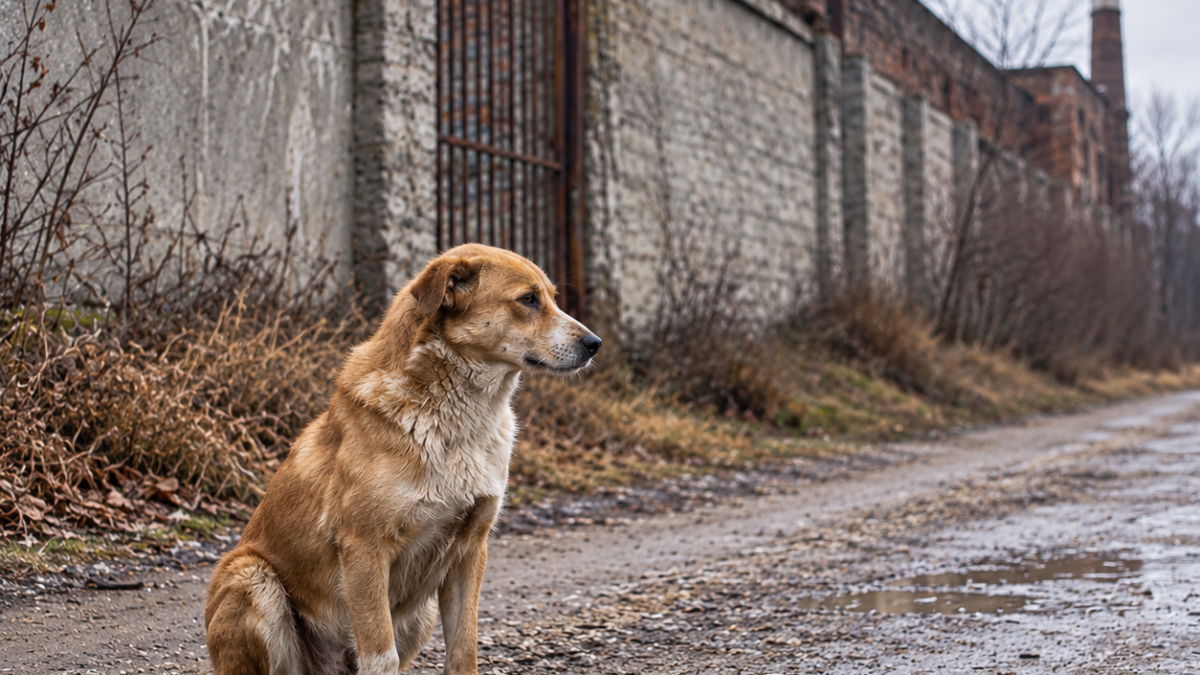
For four months, the same exhausted mother dog returned every morning to the locked gates of an abandoned brick factory, sitting beneath the broken windows as if six puppies might suddenly come running back to her.
She had once chased the vehicle that carried them away for nearly five miles, disappearing for three days before somehow finding her way back alone to the exact place where she had last heard them crying.
But when we finally decided we could not leave her there another day, something happened at that rusted gate that made me realize getting her away from the factory might be far harder than simply putting a leash around her neck.
The call had sounded almost apologetic.
“You’re probably going to think this is strange,” the man said. “There’s a dog outside the old brick factory. She’s been sitting there for months.”
“Months?”
“Same place. Every day.”
I asked whether she was injured.
“Not that I can tell.”
“Does she belong to someone?”
“I don’t know. But she looks like she’s waiting for somebody.”
An hour later, my rescue partner Sarah and I pulled onto a cracked service road at the edge of town.
The factory had been abandoned for years. Rusted chains held the main gates closed, weeds pushed through the pavement, and rows of shattered windows stared down from the empty buildings.
And beside a stained concrete wall sat the dog.
Medium-sized.
Reddish brown and white.
White chest.
A narrow pale stripe between her eyes.
One ear torn slightly along the edge.
Her ribs showed beneath her coat.
Her tail lay motionless against the dirt.
She glanced at us once when we approached, then turned back toward the gate.
Not toward the road.
Not toward the food in my hand.
The gate.
A warehouse worker named Daniel had been the one who called us.
“That’s what she does,” he said quietly. “She comes around sunrise and stays until it gets dark.”
“Every day?”
“Every day I’ve worked.”
I set down a bowl of water.
The dog ignored it for nearly ten minutes.
Then she walked over, drank several quick mouthfuls, and immediately returned to the same patch of dirt.
It felt less like she was living there than keeping an appointment.
Over the next several days, we came back.
Nothing changed.
Rain soaked her coat.
Heat made her pant.
Wind blew dust across the road.
Still she sat there.
Then an elderly security guard from a warehouse across the street finally told us why.
“We call her Mama.”
I looked at him.
“Why?”
His expression changed.
“Because she had puppies.”
The guard, whose name was Walter, removed his cap.
“Six of them. She kept them under a concrete loading platform inside the factory property. We used to leave food near there.”
“What happened to them?”
Walter looked toward the chained gates.
“One afternoon, a vehicle came.”
My stomach tightened.
“What kind?”
“Van. Maybe SUV. I didn’t see it well.”
According to Walter, several strangers had entered the property and taken all six puppies.
Nobody knew exactly who they were.
Some people believed they had intended to find homes for them.
Others thought the puppies had simply been dumped somewhere else.
The mother dog had returned just as the vehicle was leaving.
“She heard them,” Walter said. “You should’ve heard the sound she made.”
He swallowed.
“Then she ran after the vehicle.”
“How far?”
“Nobody knew.”
She disappeared for three days.
Then she came back alone.
Later, a woman from a village outside town heard about Mama and contacted one of the warehouse workers.
She remembered seeing a reddish dog on the same day the puppies disappeared.
The dog had been running along the roadside, stopping at intersections, sniffing tire tracks, then racing forward again.
That village was almost five miles from the factory.
Nearly eight kilometers.
Mama had followed them as far as her body could carry her.
And when she could no longer find them, she somehow returned to the last place where their scent remained.
The factory gate.
The next morning, I arrived before sunrise.
Mama was already there.
At 6:17, a puppy barked somewhere behind a nearby house.
She shot to her feet.
Her ears lifted.
Her entire body leaned toward the sound.
For several seconds she stared down the road.
Then the barking stopped.
Mama slowly sat again.
That was the moment I made the decision.
“We’re taking her out of here.”
Sarah nodded.
I stepped toward Mama with a leash in my hand.
She watched me approach.
For the first time since I had met her, she did not move away.
I thought she might finally be ready.
Then, from inside the abandoned factory, a faint sound drifted through one of the broken windows.
A puppy crying.
Mama exploded to her feet and ran straight toward the chained gate.
PART 2
I heard it too.
It was faint enough that for half a second I wondered if my mind had manufactured it because I had spent too many days watching Mama react to every distant bark.
Then it came again.
A thin, high-pitched whine from somewhere beyond the rusted gates.
Mama shoved her nose between the metal bars.
Her entire body changed.
The tired dog who had spent hours lying almost motionless beside the wall vanished.
Her tail rose.
Her ears went forward.
She scratched at the gate so hard that her nails scraped metal.
Sarah looked at me.
“You heard that.”
“Yes.”
Daniel had been standing several yards away. He walked toward us quickly.
“What happened?”
“There’s something inside.”
He stopped.
“What?”
“A puppy.”
The sound came again.
Mama gave a sharp, desperate bark.
It was the first time I had heard her bark at all.
She pushed against the gate.
I grabbed the chain.
A heavy padlock held it shut.
“Who owns this place?”
Daniel shook his head.
“Some development company bought it years ago. Nobody comes here.”
“Do you have a number?”
“Walter might.”
I turned toward Mama.
She was pacing along the gate now, nose low, trying to locate the sound.
For four months she had stared into the empty property.
Now there was actually something inside.
The possibility hit me so quickly that I almost let myself believe the impossible.
Could one of her puppies still be there?
No.
Four months was too long.
A young puppy could not have survived hidden inside an abandoned factory for that length of time without somebody caring for it.
But the sound was real.
That was enough.
Walter arrived twenty minutes later carrying a ring of keys that turned out to be useless.
“The old owner gave me these when they shut down,” he said. “But the development company changed the lock.”
“Can you call them?”
“I can try.”
Mama refused food.
She refused water.
She remained pressed against the gate.
Every few minutes the whimper came again.
Each time, she became more frantic.
Walter finally reached someone.
The conversation was not encouraging.
He lowered his phone.
“They say nobody is authorized to enter the property.”
“There’s an animal trapped inside.”
“I told them.”
“And?”
“They’re sending somebody.”
“How long?”
He shrugged.
I looked at the sky.
It was already getting hot.
The sound from inside had weakened.
“No.”
Sarah knew what I meant.
“We can’t cut the lock.”
“I know.”
“We also can’t leave whatever’s in there.”
Daniel pulled out his phone.
“I’ll call animal control.”
That solved the legal problem faster than I expected.
An officer arrived about forty minutes later. After speaking with the property representative by phone and documenting the situation, he was given permission to enter.
The company representative arrived soon afterward with bolt cutters and an expression that suggested the whole situation was an inconvenience.
“You’re sure you heard something?”
“Yes.”
He looked through the gate.
“This place is dangerous.”
“We know.”
“No one wanders around.”
“Fine.”
“We go in together,” the animal-control officer said. “And nobody enters unstable structures.”
The chain fell.
Mama pushed forward immediately.
I caught her gently with a slip lead.
She resisted for the first time.
Not because she was frightened of me.
Because I was stopping her.
“I know,” I whispered. “Give us a second.”
The gate opened.
Mama pulled so hard that the leash tightened.
Sarah looked at me.
“We take her?”
I hesitated.
If the sound led into an unsafe building, bringing Mama could complicate everything.
But keeping her outside while we searched might send her into complete panic.
“We take her until we can’t.”
The property looked larger from inside.
Grass grew through broken pavement.
Collapsed pallets lay near loading docks.
Sections of roofing sagged over dark entrances.
Mama did not hesitate.
She knew exactly where she wanted to go.
She pulled us past the first warehouse.
Then the second.
Toward the rear of the property.
Walter followed slowly.
“That’s where she kept them.”
We reached an old loading platform.
Beneath it was a dark opening partly blocked by broken masonry.
Mama began whining.
Not the desperate cry from the gate.
Something softer.
Something almost conversational.
Then the puppy answered.
Sarah dropped to her knees.
“There.”
A pair of tiny eyes reflected in the beam of her flashlight.
Not one of Mama’s original puppies.
This puppy was far too young.
Maybe six or seven weeks old.
He was wedged beneath the platform, trembling behind a broken board.
Mama immediately tried to crawl in.
I stopped her.
“Easy.”
The puppy backed deeper into the space.
Sarah reached for food.
Mama whined again.
The puppy answered.
Then something remarkable happened.
Mama lay down.
She stretched her nose toward the opening.
The puppy crawled forward.
An inch.
Then another.
Mama stayed completely still.
The little dog reached her.
He smelled her face.
Mama began licking him.
Sarah looked at me.
“Oh, no.”
“What?”
“That puppy is trying to nurse.”
He was.
Mama’s body reacted before my mind caught up.
She rolled slightly onto her side.
The puppy pushed against her belly, searching.
There was almost certainly no milk after four months.
But Mama allowed him to try anyway.
I sat back on my heels.
Walter stood behind us.
“That’s exactly what she used to do with hers.”
Nobody spoke for a while.
Eventually, we lifted the puppy out.
Male.
Thin.
Covered in fleas.
Dehydrated, but alert.
He had a small scrape on his nose and no collar.
Mama stayed beside him.
When we carried him toward the gate, she followed without hesitation.
That was the first time I saw her voluntarily walk away from the place where her own puppies had disappeared.
Not far.
Only to our van.
But it mattered.
At the clinic, the puppy was examined first.
No major injuries.
No microchip.
Probably dumped or born to another stray somewhere nearby.
Mama watched every movement.
If the technician carried him out of sight, she stood.
If he cried, she paced.
The veterinarian, Dr. Coleman, looked at me.
“Are these two related?”
“No.”
“You’re sure?”
“Completely.”
Mama had known him less than two hours.
It did not matter.
When the puppy was returned, she curled her body around him.
He fell asleep with his head against her chest.
Dr. Coleman examined Mama next.
She was underweight.
She had old scars.
Her paws were worn.
One ear carried the tear we had noticed.
Her teeth suggested she was probably around three years old.
But physically, she was healthier than she looked.
“What about milk?” I asked.
“She may produce a little again from stimulation, but don’t count on it. We’ll bottle-feed or use puppy formula.”
Mama stared at him.
He smiled.
“I think she plans to disagree.”
We named the puppy Finn.
It was supposed to be temporary.
So was the arrangement.
Mama needed rescue.
Finn needed a foster.
Putting them together for a few days seemed almost obvious.
The problem was getting Mama to leave the clinic.
She happily followed Finn down the hallway.
She followed him through the clinic door.
She followed him toward the van.
Then she looked toward the road.
Toward the direction of the factory.
Her body stopped.
The leash went tight.
I called softly.
“Mama.”
She did not move.
Finn was inside a small carrier.
He whined.
Mama looked at him.
Then toward the road.
Back to Finn.
For almost a minute, she stood caught between two places.
The dog she had lost.
And the puppy standing in front of her now.
Finally, Finn cried again.
Mama stepped toward the van.
Once.
Twice.
Then climbed inside.
I sat beside her during the drive.
She never relaxed.
Every turn made her lift her head.
Every time we slowed, she looked through the windows.
I knew what I was thinking.
I wondered if she was memorizing the route.
Planning how to get back.
Our foster coordinator, Emily, had a quiet property outside town with two adult dogs and a separate room for nursing or recovering animals.
She agreed to take Mama and Finn.
For the first evening, things went surprisingly well.
Mama explored the room.
Drank.
Ate nearly two bowls of food.
Then lay beside Finn.
But shortly after midnight, Emily called me.
“She’s trying to leave.”
I sat up in bed.
“What do you mean?”
“She’s at the door. Scratching.”
“Is she panicking?”
“No. It’s strange. She’s just… determined.”
I drove over.
Mama was standing beside the exterior door.
Finn slept in his bed.
When I entered, she looked at me.
Then looked back at the door.
“She wants the factory,” Emily said.
I knew.
We tried taking her into the yard.
Maybe she simply needed to relieve herself.
The moment she was outside, she pulled toward the gate.
Not randomly.
Toward town.
Toward the factory.
Emily looked at me.
“Eight kilometers.”
“What?”
“She followed that car eight kilometers, right?”
“That’s what the witness said.”
“And found her way back.”
I looked at Mama.
We had moved her only a few miles from the factory.
A fence might slow her.
It would not stop a determined dog forever.
“She can’t be outside unattended.”
“Agreed.”
We took her back in.
For the next several days, Mama existed between two lives.
She cared for Finn with an intensity that surprised everyone.
She cleaned him.
Slept beside him.
Corrected him when he bit too hard.
Followed him if he wandered across the room.
But every morning near sunrise, she went to the door.
The exact time she used to arrive at the brick factory.
At sunset, she became restless again.
Her body still followed the schedule she had maintained for four months.
Emily called it her shift.
At 5:45 each morning, Mama reported for work.
Except there was no factory gate anymore.
Just a closed door.
We tried changing the routine.
Breakfast before sunrise.
Walks.
Puzzle feeders.
Time in the yard.
Nothing completely erased it.
Then, on the sixth morning, she slipped out.
Emily called me before six.
Her voice was shaking.
“I lost her.”
“What happened?”
“I opened the side door to bring in a delivery. I thought the interior gate was latched. It wasn’t. She pushed through.”
“How long ago?”
“Maybe ten minutes.”
“Which direction?”
“You know which direction.”
I did.
I threw on clothes and left.
We searched the roads between Emily’s house and the factory.
Daniel joined.
Walter joined.
Animal control drove the main route.
No sign of Mama.
I kept imagining her hit by a car.
Caught on wire.
Lost.
Everything we had tried to prevent.
Then my phone rang.
Walter.
“I got her.”
My entire body went loose.
“Where?”
A pause.
“The factory.”
Of course.
I arrived twenty minutes later.
Mama was sitting beside the same concrete wall.
Exactly where we had first seen her.
Walter stood several feet away.
“She just showed up.”
“How long?”
“Five minutes before I called.”
Mama looked thinner somehow, though that was impossible after one morning.
I walked toward her.
She did not run.
I clipped the leash to her harness.
“You scared the hell out of me.”
Her ears lowered.
Then something strange happened.
She looked behind me.
As if expecting Finn.
I had left him with Emily.
Mama stood.
Whined.
Then looked toward my vehicle.
I opened the door.
She jumped in.
No resistance.
She wanted the factory.
But she wanted Finn too.
That gave me an idea.
Not a cure.
An idea.
For the next week, we brought Mama to the factory intentionally.
Always on leash.
Always with us.
We allowed her to sit beside the gate.
Ten minutes at first.
Then fifteen.
Finn sometimes came in a secure carrier.
Mama would stare through the fence.
Listen.
Wait.
Then we would turn away together.
At first, leaving required gentle pressure on the leash.
By the fourth visit, Mama walked away after Finn made a sound.
By the seventh, she walked back to the vehicle without pulling toward the gate.
Progress.
Then something else happened.
Daniel found a photograph.
He called me at nearly nine one night.
“Can you come by tomorrow?”
“What did you find?”
“A picture from the day the puppies were taken.”
I sat up.
“Of the vehicle?”
“Part of it.”
The next morning, he showed me the image on his phone.
It had been taken by a warehouse employee photographing storm damage near the property.
In the background was a dark blue van parked beside the brick factory gate.
Only the rear half was visible.
But there was lettering.
Faded.
White.
Sarah leaned closer.
“Can you zoom?”
Daniel did.
The image became blurry.
Still, we could make out part of a name.
Something ending in “Rescue.”
My stomach twisted.
“Those people might actually have been rescuers.”
Walter shook his head.
“If they were rescuers, why take the puppies and leave the mother?”
That was a very good question.
Daniel searched old messages.
One employee remembered the van.
Another remembered a woman and a younger man carrying plastic crates.
Someone else believed they had said they were “taking the litter somewhere safe.”
Nobody had written down a license plate.
The partial organization name gave us a starting point.
We searched every rescue and shelter within fifty miles.
Nothing matched exactly.
Then Sarah found a group that had closed several months earlier.
Pine Ridge Animal Outreach.
Their old social-media logo used faded white lettering on dark blue magnets attached to volunteer vehicles.
One photograph showed a van.
Dark blue.
The size looked right.
I found an archived phone number.
Disconnected.
Their page had not been updated in months.
The last public post had been made shortly after Mama’s puppies disappeared.
It said the organization was “pausing intake due to financial and staffing challenges.”
Sarah stared at the screen.
“That timing is terrible.”
I agreed.
But timing was not evidence.
We searched old adoption posts.
Hundreds of animals.
No obvious match.
Mama’s puppies had been small mixed breeds.
At four months younger, they could have looked like dozens of other dogs.
Then Walter gave us a detail nobody had mentioned before.
“One of them had a black patch.”
“Where?”
“Over the left eye.”
“Are you sure?”
He nodded.
“Looked like he was wearing an eyepatch. The warehouse guys called him Pirate.”
We searched again.
Three weeks after the puppies disappeared, Pine Ridge had posted a litter of six puppies.
My hands stopped moving.
Six.
The caption called them the “Foundry Litter.”
Five had reddish or tan markings.
One had a dark patch over his left eye.
Sarah whispered, “Oh my God.”
The post said they had been “rescued from an unsafe industrial property.”
No mother was mentioned.
No location was specified.
The next posts showed four puppies available for adoption.
Then two.
Then all had been marked adopted.
Mama’s puppies might not be dead.
They might have gone into homes.
The information should have made me happy.
Instead, I felt anger rising.
If Pine Ridge had taken the litter, why had nobody taken Mama?
Why had they separated nursing puppies from their mother?
Why had she been left to chase their vehicle down a road?
We needed facts.
The organization no longer operated, but state nonprofit records listed a former director.
Marissa Cole.
I found an old email.
I wrote a short message.
No accusation.
No drama.
I explained that we had rescued a female dog from the old brick factory and believed Pine Ridge might have removed six puppies from that property four months earlier.
Then I asked whether she could confirm it.
No response that day.
No response the next.
On the third day, I received an email.
One sentence.
*Please call me.*
My hands were shaking when I dialed.
A woman answered.
“Is this the person with the mother dog?”
“Yes.”
Silence.
Then she exhaled.
“I wondered what happened to her.”
I stood from my desk.
“You knew there was a mother?”
“Yes.”
The anger came back immediately.
“Then why did you leave her?”
“It wasn’t supposed to happen that way.”
“What way was it supposed to happen?”
Marissa became quiet.
“We got a report about six puppies on abandoned industrial property. We were told the mother was feral and rarely present.”
“She was not feral.”
“I know that now.”
“You knew enough to know she existed.”
“Yes.”
“Did you see her?”
“No. Not when we collected the puppies.”
I gripped the phone.
“They were still nursing.”
“They were approximately seven or eight weeks.”
“That doesn’t mean removing them without checking on the mother was okay.”
“I’m not saying it was.”
Her answer surprised me enough that I paused.
Marissa continued.
“Our organization was collapsing. We had lost a foster home that morning. Two volunteers went to the factory because someone said the puppies were in danger from demolition work.”
“There was no demolition.”
“We were given bad information.”
“By who?”
“I don’t remember. An anonymous call, maybe someone nearby.”
I thought of the abandoned factory.
The workers.
Anyone could have reported them.
“So your volunteers took the puppies.”
“Yes.”
“And Mama chased the van.”
Another silence.
“I didn’t know that until later.”
“How much later?”
“One volunteer told me she saw a dog running behind them after they got onto the main road.”
I closed my eyes.
“And they didn’t stop?”
“She said traffic was heavy and she thought the dog was a stray following the vehicle because she could smell the puppies.”
“She was their mother.”
“I know.”
“Did anyone go back?”
Marissa’s voice dropped.
“No.”
That answer told me more than any excuse could have.
“Why?”
“Because by the time I heard, the puppies had already been divided between foster homes. We were overwhelmed. We had thirty-seven dogs and almost no money. The organization shut down weeks later.”
“So everyone just moved on.”
“I’m not asking you to forgive us.”
“Good.”
She let that sit.
Then she said, “The puppies survived.”
Every muscle in my body went still.
“All six?”
“Yes.”
“You’re sure?”
“I handled the adoption files myself.”
I sat down.
“Where are they?”
“I can’t give you adopters’ personal information.”
“I’m not asking for addresses.”
“I know.”
“Can you contact them?”
Another pause.
“I can try.”
I called Sarah immediately afterward.
“They’re alive.”
“What?”
“All six.”
She started crying before I did.
I drove to Emily’s.
Mama was in the yard with Finn.
He was larger now, awkward legs and oversized paws.
Mama chased him slowly around a patch of grass.
I stood at the fence.
Emily came beside me.
“What happened?”
“They found the puppies.”
She turned.
“All of them?”
“All six were adopted.”
Emily put a hand over her mouth.
I looked at Mama.
She had spent four months sitting beside a wall waiting for puppies who were no longer anywhere near that factory.
They had not been abandoned on the roadside.
They had not died.
They had homes.
That should have been enough.
But then another thought came.
“What if we could let her see one?”
Emily looked at me carefully.
“You think that would help?”
“I don’t know.”
Neither of us knew.
Dogs do not process reunion and closure the way humans do.
A mother dog does not necessarily maintain a human-like lifelong parental relationship with grown puppies.
After weaning, normal canine relationships change.
I understood that.
But Mama’s behavior was not normal.
She had been trapped in a search pattern for months.
Maybe scent would matter.
Maybe not.
We decided not to force anything.
If one adopter volunteered, we would arrange a controlled meeting.
Marissa contacted all six families.
Three replied quickly.
Two were interested but lived several hours away.
One lived thirty-five minutes from us.
The puppy with the black patch.
Pirate.
His new name was Scout.
His adopter, a woman named Rachel, called me.
“I’ve been staring at his baby picture all morning,” she said.
“You don’t have to do this.”
“I want to.”
“We can’t promise some movie-style reunion.”
“I understand.”
“She may not recognize him.”
“I understand that too.”
“She may become stressed.”
“Then we stop.”
Rachel was exactly the kind of person I hoped she would be.
We arranged the meeting at Emily’s property.
Neutral enough.
Quiet.
Fenced.
Scout arrived in the back seat of Rachel’s SUV.
He was no longer tiny.
Four months had transformed him into a long-legged adolescent dog with a reddish coat, white feet, and a dark patch over his left eye.
The resemblance to Mama was obvious.
My chest tightened.
Rachel kept Scout on leash.
I brought Mama from the house.
At first, she did not react.
Scout did.
His nose lifted.
His tail began wagging.
Mama stopped.
Everything became very still.
She smelled the air.
One step.
Then another.
Scout pulled forward.
Rachel loosened the leash slightly but kept control.
Mama approached.
They touched noses.
Mama smelled his face.
His neck.
His shoulder.
Then moved behind him and smelled along his body.
Scout wagged so hard his entire back end moved.
Mama returned to his face.
And then she began licking him.
Not frantically.
Slowly.
Across his muzzle.
Scout licked her back.
Rachel started crying.
Sarah turned away.
I stared because I was afraid I would miss something.
Mama remained beside him for several minutes.
Then something happened that I did not expect.
She walked away.
Not in distress.
Not searching.
She walked across the yard.
Smelled the grass.
Came back to me.
Then returned to Scout.
There was recognition—or at least familiarity.
But there was no desperation.
The desperate part of her had always been about not knowing.
Now there was a dog in front of her.
Real.
Healthy.
Safe.
We let them spend almost an hour together.
Scout wanted to play.
Mama eventually corrected him when he jumped on her.
Rachel laughed through tears.
“That definitely looked like a mom.”
When it was time for Scout to leave, I became nervous.
Would Mama panic?
Would she chase the SUV?
We brought her inside before Rachel drove away.
Mama watched through the window.
Scout climbed into the vehicle.
The door closed.
The SUV disappeared down the drive.
Mama stood there.
Her ears forward.
Then she turned.
Finn was chewing a toy across the room.
Mama walked over.
Lay down beside him.
And slept.
She did not scratch at the door that night.
The next morning, for the first time since she had arrived at Emily’s, Mama did not stand at the door before sunrise.
Emily called me at 6:30.
“You need to hear this.”
“What happened?”
“Nothing.”
I was confused.
“What?”
“She’s asleep.”
“Where?”
“On the couch.”
“What time did she get up?”
“She hasn’t.”
I drove over anyway.
Mama was lying on a blanket.
Finn stretched across her front legs.
She lifted her head when I entered.
Her tail moved.
The old schedule had broken.
Not completely.
There were relapses.
Two days later, she became restless around sunrise.
A week later, during a walk, she pulled toward the road leading into town.
So we continued controlled visits to the factory.
But the pattern changed.
She no longer sat there for hours.
On the first visit after seeing Scout, Mama walked to the gate.
Smelled the ground.
Stared inside.
Then looked back at me.
I waited.
She stood there perhaps three minutes.
Then walked toward the van.
I did not pull the leash.
She chose it.
Walter had been watching from across the street.
He removed his cap.
“Well, I’ll be damned.”
I smiled.
“She’s ready.”
“You think?”
Mama climbed into the van.
“I think she’s getting there.”
Marissa eventually arranged video calls and photographs from the other families.
We could not explain photographs to Mama, obviously.
But they mattered to us.
One puppy had become a stocky male named Benny who slept in bed with two children.
Another was a female named Daisy living on a small horse farm.
One had been renamed Cooper.
Another, June.
The sixth was called Maple.
Healthy.
Vaccinated.
Loved.
All six.
One adopter agreed to an in-person meeting several weeks later.
Daisy.
That reunion was quieter than Scout’s.
Mama smelled her.
Daisy bounced around like a fool.
Mama corrected her.
Then they shared a water bowl.
Watching it made me smile.
Not because I believed Mama understood that all six puppies were safe.
We could never know that.
But because the story we had feared most was not true.
Her puppies had lived.
The situation with Pine Ridge remained complicated.
I was angry.
Sarah was angrier.
Walter called what happened “the dumbest rescue I ever heard of.”
Marissa never defended the decision.
That mattered to me.
She gave us access to old veterinary and adoption records confirming that the puppies had received appropriate care once taken.
The mistake had happened at the beginning.
Bad information.
Poor coordination.
A collapsing organization.
Volunteers who removed puppies without ensuring the mother was secured too.
Then nobody went back.
There was no dramatic villain.
That almost made it harder.
People like stories with one cruel person responsible for everything.
Real life is often uglier in a quieter way.
One rushed decision.
One assumption.
One exhausted volunteer who thinks somebody else will handle it.
One phone call not made.
And an animal pays for all of it.
Marissa asked to meet Mama.
I hesitated.
Then agreed.
She arrived at Emily’s carrying nothing.
No flowers.
No gifts.
No attempt to perform remorse.
She simply stood several yards from Mama.
“That’s her?”
“Yes.”
Marissa stared.
“She’s smaller than I imagined.”
I almost laughed.
“What did you imagine?”
“I don’t know.”
Mama smelled the air.
She showed no particular reaction to Marissa.
That did not surprise me.
Marissa herself had not been at the factory.
After a while, she said, “I should’ve gone back.”
I looked at her.
“Yes.”
She nodded.
“I know.”
“You had her puppies.”
“I know.”
“She chased your van almost five miles.”
Her face tightened.
“I know.”
“She waited four months.”
“I know.”
I had expected anger to feel satisfying once I had the person connected to the decision standing in front of me.
It did not.
Marissa looked exhausted.
Not absolved.
Not innocent.
Just human.
“My rescue was failing,” she said. “I was behind on rent at the kennel. Volunteers were quitting. We had animals in boarding because foster homes had disappeared. Every phone call was another emergency.”
“That doesn’t excuse leaving her.”
“No.”
“Then why tell me?”
“Because I spent a long time telling myself that’s why it happened.”
She looked at Mama.
“It was still wrong.”
That answer took the fight out of me.
Not the anger.
The fight.
“You could do something useful now.”
“What?”
“Tell people.”
“About Mama?”
“About the mistake.”
Marissa looked at me.
“If you teach rescue volunteers again, tell them never to remove a litter without accounting for the mother.”
She nodded slowly.
“I will.”
“And if the mother isn’t there?”
“You wait. Search. Ask people. Set cameras.”
“Yes.”
“Don’t assume.”
“Exactly.”
Months later, Marissa helped us create a simple intake checklist for abandoned litters.
Mother sighted?
Mother searched for?
Lactation signs?
Witness interviews?
Camera monitoring?
Return visits scheduled?
It was not dramatic.
It would never undo four months of waiting beside a factory wall.
But it might prevent another dog from experiencing the same thing.
Meanwhile, Finn grew.
Fast.
His legs seemed to double in length every week.
Mama treated him as if she had been assigned responsibility for converting him into a respectable dog.
She taught him not to bite ears too hard.
Not to climb into her food bowl.
Not to jump on sleeping dogs.
He ignored most lessons initially.
She repeated them.
Finn adored her.
If Mama walked outside, he followed.
If she slept, he slept against her.
If she barked once at something beyond the fence, Finn barked six times because apparently volume was his contribution.
The irony was obvious.
Mama had spent months waiting for six puppies.
Then the day we finally tried to remove her from that place, she had discovered a seventh puppy who needed somebody.
It would have been easy to turn that into a neat story.
Replacement puppy heals grieving mother.
But that was not what happened.
Finn did not replace her litter.
Scout did not erase four months of searching.
Nothing erased anything.
Instead, Mama gradually learned that life could hold two truths at once.
She had lost something.
And she still had something ahead of her.
The biggest decision came when Finn became old enough for adoption.
Applications poured in.
He was handsome.
Friendly.
Confident.
Young.
The type of puppy families wanted immediately.
Mama had also become available for adoption.
Her applications were different.
Fewer.
People asked whether she was house-trained.
Whether she liked cats.
Whether she could live with children.
Whether she would try to escape.
All reasonable questions.
But each time someone asked about adopting Mama alone, Emily became quiet.
Finally, she told me why.
“I think Finn should go with her.”
I stared at her.
“That cuts their chances dramatically.”
“I know.”
“Adopting one dog is hard enough. An adult and a puppy?”
“I know.”
“Finn doesn’t need Mama forever.”
“No.”
She paused.
“But maybe Mama needs one dog who feels like family while she learns a new home.”
I looked through the glass door.
Mama was lying in the yard.
Finn was asleep across her back.
“He’ll get adopted in a week by himself.”
“Probably.”
“And Mama could wait months.”
“Probably.”
I hated that she was right.
We decided to list them as a bonded pair, with one condition: we would reassess if no appropriate home appeared after several weeks.
Most applications disappeared.
Then came one from a couple named Laura and Ben.
They lived about forty minutes outside town.
No children at home.
Large fenced property.
Ben was a high-school science teacher.
Laura worked three days a week as a physical therapist.
They had recently lost their twelve-year-old dog to kidney disease.
Their application said:
*We were looking for one dog. Then we read their story. We have room for two.*
I distrusted the sentence immediately.
Emotion makes people apply for animals they are not prepared to keep.
So I called Laura.
“Why two?”
She laughed.
“I assume that’s a test.”
“It’s a question.”
“We had two dogs for eleven years. One died three years ago. The other died in March. The house feels strange without them.”
“Finn is young and energetic.”
“We know.”
“Mama has an escape history.”
“We know.”
“She may try to return to the factory.”
“Then she doesn’t go outside without a leash until she understands where home is.”
Good answer.
“She can be emotionally shut down.”
“That’s okay.”
“She may never be a cuddly dog.”
“That’s okay too.”
“Finn might eat your furniture.”
Laura paused.
“That one concerns me more.”
I laughed before I could stop myself.
We arranged the visit.
Ben and Laura came on Saturday morning.
They did almost everything right.
They did not overwhelm Mama.
They let Finn act like a lunatic without encouraging him too much.
Ben sat on the ground.
Finn climbed directly into his lap.
Mama stayed beside Emily.
Laura talked quietly.
After twenty minutes, Mama approached her.
Not close enough to touch.
Close enough to smell.
Laura did not reach.
Mama walked away.
Ben looked at me.
“Is that good?”
“For her? Very.”
They visited three more times.
On the final visit, Mama allowed Laura to scratch beneath her chin.
Ben pretended not to notice.
Later he admitted he had been afraid reacting would scare her away.
We conducted the home check.
The property was nearly ideal.
Six-foot fencing.
Double-gated entry.
Quiet road.
Separate room for decompression.
No livestock.
No immediate neighbors with loose dogs.
They even installed a second barrier near the front door after I explained Mama’s history.
“She ran eight kilometers once,” Ben said. “I’m not competing with that.”
We scheduled the move.
The morning Mama left Emily’s house, she seemed to know something was different.
Finn jumped into Laura’s SUV happily.
Mama did not.
She stood beside me.
Looked at the vehicle.
Then back toward Emily’s house.
I felt the old fear return.
Was this another van?
Another separation?
Another moment when she would watch something she loved disappear?
We had planned for that.
Laura sat in the back beside Finn.
I climbed in first.
Mama followed me.
Then Emily joined.
We all drove to the new home together.
No sudden separation.
No mysterious vehicle taking somebody away.
At Laura and Ben’s house, Mama stepped onto the lawn.
Finn dragged his leash toward a tree.
Mama smelled the grass.
Then the fence.
Then the porch.
We stayed almost two hours.
She never completely relaxed.
But she ate treats.
She drank water.
She followed Finn into the house.
Eventually, I had to leave.
That was the hardest part.
Mama saw me pick up my keys.
She stood.
I crouched.
“You’re staying.”
Her eyes followed my hands.
“You’re okay.”
Laura stood several feet away.
Finn chewed a toy.
Mama looked toward the door.
I left.
I hated every mile home.
At 9:14 that night, Laura sent a photograph.
Finn asleep on his back.
Mama beside him.
Caption:
*She ate dinner. She’s still watching the door, but she’s okay.*
The next morning:
*No escape attempts. She slept by Finn.*
Day three:
*She let Ben put on her leash.*
Day five:
*She wagged when I came home.*
Day eight:
*She stole half a sandwich.*
I responded:
*Excellent. Criminal behavior means she’s settling in.*
Two weeks later, we visited.
I worried Mama would become frantic when she saw me.
She did become excited.
Tail wagging.
Whining.
She pressed herself against my legs.
Then something happened that made the entire visit worth it.
After greeting me, Mama turned and ran back toward Laura.
Not away from me.
Toward her.
Laura bent down.
Mama leaned against her.
I looked at Sarah.
She smiled.
“Home.”
I nodded.
Home.
The factory visits stopped.
Not because we were afraid to test her.
Because she no longer needed them.
Three months after the adoption, Laura asked if we wanted to meet at a park near town.
Mama arrived in the back seat beside Finn.
She jumped out wearing a red harness.
Healthy weight.
Glossy coat.
Tail up.
The transformation was not dramatic in the way photographs sometimes make rescue transformations look.
She still had the torn ear.
The pale stripe.
The same eyes.
But her posture had changed.
That was everything.
She no longer seemed to be listening for something behind her.
We walked.
At one point, a small puppy barked across the park.
I stopped without meaning to.
Months earlier, that sound would have made Mama freeze.
She did glance toward it.
Her ears lifted.
Then Finn bumped into her.
Mama turned.
Chased him three steps.
That was it.
She did not stare down the path.
She did not sit and wait.
The sound passed through her world without becoming her whole world.
A month later, Rachel brought Scout for another visit.
This time the reunion looked different.
Scout was nearly adult-sized.
He ran toward Mama.
She smelled him.
Licked his muzzle once.
Then immediately corrected him for trying to climb over her.
Rachel laughed.
“Definitely family.”
Scout and Finn played until both collapsed.
Mama watched them from the shade.
Laura sat beside me.
“Do you think she knows?”
“That he’s her puppy?”
“Yeah.”
I looked at Mama.
“I think scent tells dogs things we don’t understand.”
“That’s not an answer.”
“It’s the only one I have.”
We would never know exactly what Mama understood.
Maybe Scout smelled familiar.
Maybe she remembered nursing him.
Maybe she simply accepted him as a friendly younger dog.
The human part of me wanted a clean answer.
The dog did not owe me one.
The important thing was what I could see.
Scout was safe.
Mama was safe.
They could meet without either one losing the life they had built.
Over the next year, we stayed in contact with all six families.
We arranged one larger reunion once.
I almost regretted it.
Six adolescent dogs plus Finn was chaos.
Benny knocked over a water bucket.
June stole treats from someone’s bag.
Scout chased a ball.
Daisy barked at everybody.
Maple hid behind her adopter until she relaxed.
Cooper immediately found mud.
Mama walked through all of them slowly.
Sniffing.
Being sniffed.
Tolerating nonsense.
At one point, five of the six crowded around her.
For a second, an image flashed in my mind.
The loading platform.
Six tiny puppies beneath concrete.
Mama bringing them whatever food she could find.
Then the van.
The chase.
The empty gate.
I felt tears rise.
Sarah noticed.
“Don’t.”
“I’m not doing anything.”
“You’re crying.”
“It’s windy.”
“There is no wind.”
I laughed.
Mama moved away from the group and lay beside Laura.
That mattered too.
Her puppies had homes.
And she had hers.
She did not need to gather everyone back together.
The point was not restoration.
It was survival after separation.
Walter came to one reunion.
He stood beside the fence watching.
Scout wandered toward him.
Walter stared at the black patch over his eye.
“Pirate.”
Rachel smiled.
“That was his name?”
Walter crouched.
“When he was tiny.”
Scout smelled his hands.
Walter’s face changed.
“He used to bite my shoelaces.”
“He still does.”
Walter laughed.
Then he looked toward Mama.
“She waited so long.”
“I know.”
“I used to tell her they weren’t coming back.”
He swallowed.
“Every morning. Like she understood.”
“Maybe she understood more than we think.”
Walter shook his head.
“No. If she understood, she wouldn’t have waited.”
That sentence stayed with me.
Maybe he was right.
Or maybe waiting was all she knew how to do.
There is a difference.
The old brick factory was eventually sold.
A year after Mama’s adoption, demolition equipment appeared.
This time the demolition was real.
Daniel called me.
“They’re tearing it down next month.”
I told Laura.
She became quiet.
“Do you think we should bring Mama?”
I did not know.
Part of me wanted one final visit.
Another part thought that was a human need, not hers.
We decided to try.
If she became distressed, we would leave immediately.
We met on a cool morning.
The gates had been replaced with temporary construction fencing.
Large machines stood where weeds had once grown.
The concrete wall remained.
The exact patch where Mama had waited for months was still visible.
Laura opened the vehicle.
Mama jumped out.
Finn followed.
We walked toward the old gate.
Mama slowed.
She smelled the ground.
She looked through the fence.
I watched every movement.
No trembling.
No pulling.
No whining.
She walked to the wall.
Sniffed.
Then looked at Laura.
Laura said softly, “Want to go?”
Mama turned around.
That was it.
She walked back toward the vehicle.
Finn trotted beside her.
I stood there for another moment.
The place that had once controlled every day of her life had become just a place.
Concrete.
Rust.
Dust.
Nothing more.
A month later, it was gone.
Daniel sent me a photograph.
The loading platform had been demolished.
The wall removed.
The gate hauled away.
For some reason, seeing the empty lot affected me more than I expected.
That evening, I drove to Laura and Ben’s house.
Mama greeted me at the fence.
Finn barked.
Ben opened the gate.
“You okay?”
“Yeah.”
He looked at me.
“You don’t look okay.”
“The factory’s gone.”
He understood immediately.
Mama ran past us toward Laura.
Laura was carrying a basket of laundry across the porch.
Mama stole a sock.
Laura shouted, “Hey!”
Mama took off across the yard.
Finn chased her.
For several minutes, everybody forgot about the factory.
That was probably the correct response.
Life continued.
Mama aged.
Her muzzle gradually became lighter.
Finn grew into a broad-chested adult dog who still behaved like an idiot whenever anyone mentioned food.
Mama remained calmer.
She never became fearless.
Fireworks frightened her.
Vehicles that slowed suddenly near her made her cautious.
The first time a dark blue van parked outside Laura’s house, Mama stood at the window for several minutes.
Laura noticed.
She moved beside her.
Mama leaned against her leg.
Then walked away.
Small things.
That is what recovery looked like.
Not forgetting.
Choosing something else despite remembering.
Four years after her rescue, I visited on a rainy afternoon.
Mama was sleeping in the living room.
Finn lay upside down on a rug.
Laura made coffee.
We talked about ordinary things.
Work.
Rescue cases.
Walter’s retirement.
Daniel moving away.
Then a puppy cried on television.
Mama lifted her head.
I noticed immediately.
So did Laura.
Mama listened.
For one second, the old expression appeared.
Alert.
Searching.
Then she looked toward Finn.
Looked toward Laura.
Lowered her head.
Went back to sleep.
Laura smiled.
“She still hears them.”
“Maybe.”
“But she doesn’t have to go looking anymore.”
I nodded.
That was probably the closest anyone ever came to explaining her.
Years later, when Mama was almost eleven, Laura called me.
Her voice was different.
“Can you come?”
I knew before she explained.
Mama had been slowing down for months.
Arthritis.
Kidney disease.
Then a mass near her liver.
The veterinarian had tried medication and supportive care, but the decline accelerated.
I drove out that afternoon.
Mama was lying beneath a tree in the backyard.
Finn, gray around the muzzle himself, rested several feet away.
She lifted her head when she saw me.
Her tail moved once.
I sat beside her.
“Hey, Mama.”
She smelled my hand.
Then rested her head on my knee.
I had called her Mama for so long that I sometimes forgot the name was never really hers.
It had been given by warehouse workers because of what they saw her lose.
Laura sat on the grass.
“We named her officially, you know.”
I looked up.
“What?”
“Years ago.”
“You never told me.”
“She’s Mama on all the vet records. But Ben said she deserved a name that wasn’t only about being somebody’s mother.”
“What did you choose?”
Laura smiled.
“Hope.”
I laughed softly.
“That’s terrible.”
“I know.”
“Very rescue-person name.”
“Absolutely.”
Mama—Hope—opened one eye.
Laura stroked her shoulder.
“But it stuck between us.”
I looked down at the dog who had spent four months waiting beside a factory gate.
Hope.
Maybe it was obvious.
Maybe obvious was fine.
The veterinarian came the following morning.
Scout’s family brought him by the evening before.
He was an older dog now too.
No longer the ridiculous adolescent with the black patch.
He approached Mama carefully.
They smelled each other.
Scout lay beside her.
Nobody tried to turn it into something bigger than it was.
No one knew whether Mama understood he had once been one of the six tiny puppies beneath that loading platform.
But he was there.
Alive.
Loved.
Gray around the muzzle.
That alone felt extraordinary.
Finn remained nearby.
Laura and Ben sat on the porch.
I sat on the grass.
For a while, Mama slept with two dogs beside her—one puppy she had lost and somehow met again, and one puppy she had found by accident on the day we tried to pull her away from the past.
The next morning was warm.
Mama could no longer stand without help.
The veterinarian spread a blanket beneath the tree.
Laura brought chicken.
Mama ate several pieces.
Finn received several pieces he had not earned.
Nobody cared.
Ben sat behind Mama, his hand on her shoulder.
Laura held her face.
I sat near her front paws.
For years, I had remembered the first morning at the factory.
The motionless tail.
The ribs.
The eyes staring through a gate.
I had wondered what she thought she was waiting for.
A smell?
A sound?
Six puppies suddenly returning?
Maybe she did not think in any way I could translate.
Maybe waiting itself had become her purpose.
Now there was no gate.
No road.
No search.
Only grass.
People she trusted.
Dogs she knew.
The veterinarian gave the sedative.
Mama relaxed gradually.
Laura whispered, “Good girl.”
Her eyes grew heavy.
Finn moved closer.
Mama’s nose touched his paw.
I placed my hand against her shoulder.
“You can stop waiting now.”
That was the last thing I said to her.
Her breathing slowed.
Then stopped.
Nobody moved for a long time.
Finn smelled her after she was gone.
He remained beside the blanket for several minutes.
Then he walked toward Laura.
Scout had come again that morning with Rachel.
He smelled Mama too.
Then returned to Rachel.
It was strangely peaceful.
No dramatic reaction.
No desperate searching.
That mattered to me more than I expected.
Mama had spent enough of her life searching for someone who had disappeared.
We wanted the dogs who loved her to understand, in whatever way dogs understand these things, that she had not simply vanished.
Laura kept her collar.
Ben planted a dogwood tree where she liked to sleep.
At the base, they placed a small stone.
Not a long inscription.
Just:
HOPE
SHE CAME HOME.
Months later, I visited.
The tree was still small.
Finn lay nearby.
Laura handed me an envelope.
Inside was the original adoption photograph we had taken of Mama and Finn.
Mama was sitting stiffly beside him.
Her eyes still looked uncertain.
Finn looked ridiculous.
On the back Laura had written the date they came home.
I looked toward the tree.
“You know what I keep thinking about?” I asked.
“What?”
“That first call.”
Laura sat beside me.
“Nobody even asked us to rescue her.”
They had only called because a dog kept sitting in the same place.
That was all.
A strange dog.
A strange habit.
A woman or man driving past could easily have dismissed it.
Instead, Daniel noticed.
Walter remembered.
A woman eight kilometers away remembered seeing her run.
One photograph caught part of a van.
Old records led us to six puppies.
One little abandoned puppy cried behind a broken loading platform at exactly the moment we were about to take Mama away.
None of those things erased what happened.
But together, they gave us enough pieces to understand the story.
Years after Mama died, I still think about her whenever somebody tells me an animal should “just move on.”
Animals adapt.
They survive.
They form new attachments.
But behavior carries history.
Sometimes a dog shaking at a doorway is not stubborn.
Sometimes a dog guarding food is not mean.
Sometimes a dog returning to the same place is not stupid.
There may be a reason.
And sometimes the reason is waiting eight kilometers away in somebody else’s house, renamed Scout, sleeping safely on a couch.
The old factory is now a commercial building.
Bright windows.
Fresh pavement.
Delivery trucks.
People who work there have no idea what stood on that ground before.
A few years ago, I drove past and almost missed it.
I pulled over farther down the road.
The concrete wall where Mama used to sit was gone.
So was the gate.
I tried to identify the exact spot.
I couldn’t.
For some reason, that made me smile.
There was no place left for her to wait.
No landmark holding the story in place.
No broken factory demanding that memory remain exactly where it had happened.
I took out my phone and found an old photograph.
Mama beside the rusted gate.
Thin.
Tail down.
Watching.
Then I opened another.
Taken years later.
She was in Laura and Ben’s yard.
Finn beside her.
Scout visiting.
Mama’s mouth slightly open.
Eyes soft.
There was a difference between those photographs that had nothing to do with weight or age.
In the first, every part of her body faced something that was gone.
In the second, she was surrounded by what remained.
I put the phone away.
Before driving home, I passed the old factory site once more.
A delivery van turned into the new parking lot.
For a second, I remembered the story Walter had told me.
Mama hearing six puppies inside a vehicle.
Running.
Following it until her paws hurt.
Losing the scent.
Finding the road back.
Then returning every morning for four months because she had no other place to look.
But that was not the final image I carried with me.
The final image was simpler.
Mama beneath a tree many years later.
No gate in front of her.
No road to chase.
Finn sleeping nearby.
Scout alive.
Laura’s hand resting against her face.
And for the first time since the day her puppies disappeared, there was absolutely no one left for her to wait for.
[END OF STORY]








