PART 2: For Four Days, an Injured Mother Dog Refused to Leave One Spot by the Highway—Then I Saw What She Was Guarding
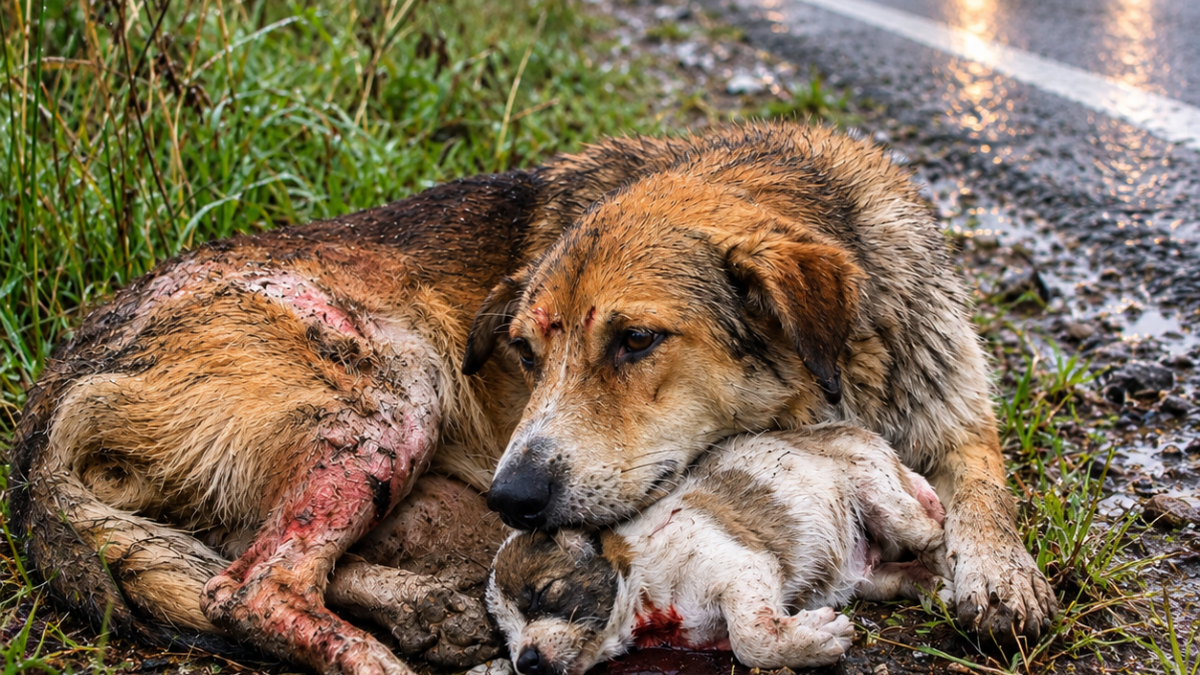
The first thing I saw beside the highway was a mud-covered dog struggling to stand on three legs, and the second was the tiny body she immediately dragged herself toward when she realized my truck had stopped.
Her rear leg was badly injured, the pads of her front paws were torn and bleeding, and she looked as if she had spent days surviving on pain alone—yet she still positioned herself between me and whatever lay hidden in the weeds.
I thought I was dealing with one injured stray and one terrible roadside accident, but before that afternoon was over, I would discover why she had refused food, water, and every chance to save herself for nearly four days.
I was driving home from a repair job outside town when I noticed her near the shoulder.
At first, I nearly passed.
The road was narrow, traffic moved fast, and all I saw was a brown shape curled beside the drainage ditch.
Then it lifted its head.
I hit the brakes.
By the time I pulled onto the gravel shoulder and got out, the dog was trying to rise.
She was medium-sized, tan with a darker muzzle, and so filthy that dried mud covered most of her coat. One hind leg hung awkwardly. Her front paws were raw.
“Easy,” I said.
Her eyes locked on me.
Then she turned toward the ditch.
That was the first thing that felt wrong.
An injured stray should have been focused on me.
This dog was focused on something behind her.
I stepped closer.
She pushed herself up.
Her injured leg buckled.
She fell, then dragged herself sideways with her front legs until her body blocked a clump of tall grass.
“I’m not going to hurt you.”
She panted hard.
I went back to my truck, grabbed water and the remains of my lunch, then placed both on the gravel several feet away.
Her nose moved immediately.
She smelled the food.
She wanted it.
But she did not move toward it.
Instead, she crawled back toward the weeds.
That was when I noticed the flies.
My stomach tightened.
Something small was lying behind her.
I shifted sideways.
A low sound came from her throat.
Not a full growl.
A warning from a body that barely had enough strength left to make one.
I stopped.
“All right.”
I called the nearest animal rescue organization.
A woman answered.
“I found an injured dog near Route 18, about six kilometers north of the village. Rear leg looks bad. Possible vehicle strike.”
“Can she walk?”
“Barely.”
“Any active bleeding?”
“Mostly her paws.”
“Can you approach?”
“She lets me get close, but she’s guarding something.”
“What?”
“I can’t see it yet.”
The woman paused.
“Don’t force her away from it. We’re sending a team. Can you stay?”
“Yes.”
I sat on the gravel twenty feet away.
Cars passed.
Every time one came close, the dog raised her head.
But she never moved away from the weeds.
Ten minutes later, an older farmer slowed his truck when he saw me.
“You found her?”
I stood.
“You know this dog?”
His face changed.
“I saw her yesterday.”
“Yesterday?”
He nodded.
“She was right there.”
“Injured?”
“Yes.”
“You didn’t call anyone?”
“I brought food.”
My anger rose immediately.
“She needs a veterinarian.”
“I know.”
“Then why—”
“I tried getting close.”
He pointed toward the ditch.
“She wouldn’t leave that spot.”
“What’s there?”
The farmer looked down.
“I think it’s her puppy.”
I stared at him.
“Alive?”
He did not answer.
I turned slowly toward the mother.
She had lowered herself again.
One front paw rested over the edge of something hidden in the grass.
The farmer spoke behind me.
“She’s been here longer than yesterday.”
“How long?”
“My neighbor says the accident happened four nights ago.”
I looked back.
“What accident?”
“A delivery truck hit two dogs.”
My eyes moved from him to the mother, then to the tiny shape beneath her paw.
And suddenly I understood that she had not been unable to leave that roadside.
She had been refusing to.
PART 2
I turned toward the farmer.
“Four nights?”
“That’s what Petru says.”
“In this condition?”
He nodded reluctantly.
“Petru lives up the hill. His camera catches part of the road.”
I looked back at the dog.
Four nights.
I tried to imagine spending one night beside that highway with traffic roaring past, rain coming and going, and no shelter.
Then I looked at her front paws.
The pads were not merely scraped.
They were worn open.
“How much has she moved?”
The farmer shrugged.
“I don’t know.”
“Did anyone bring water?”
“I left some yesterday.”
“Did she drink?”
“Not while I was here.”
I set the water closer again.
The mother lifted her nose.
She could smell it.
She needed it.
Yet she remained beside the grass.
I moved the bottle another foot toward her.
She watched.
Still nothing.
“She’ll die if she doesn’t drink,” I said.
The farmer said quietly, “Maybe she thinks he’ll die if she leaves.”
I looked at him.
Neither of us knew what she understood.
But whatever was holding her there was stronger than thirst.
The rescue van arrived about fifteen minutes later.
Two women climbed out.
The older one introduced herself as Ana.
The younger was Mirela.
Ana had the calm, efficient manner of someone who had seen too many emergencies to waste time reacting dramatically.
She looked once at the dog, once at the traffic, once at the ditch.
“How close?”
“Ten feet before she warns.”
“Bite attempt?”
“No.”
“Food?”
“Won’t leave the spot.”
“Water?”
“Same.”
Ana crouched.
The mother watched her.
Mirela unloaded a crate, stretcher, towels, blankets, a slip lead, and a muzzle.
The muzzle stayed in the van.
“That’s last resort,” Ana said.
She tossed a piece of food toward the mother.
The dog smelled it.
Took one step.
Then stopped.
Looked behind herself.
Returned to the weeds.
Ana exhaled.
“She’s making a choice.”
“You think she knows the puppy is dead?”
Ana glanced at me.
“I think she knows that body matters to her. I’m not going to pretend I know more than that.”
Another piece of food.
Closer.
The mother stretched forward far enough to take it.
Immediately crawled backward again.
Every movement cost her.
Her rear leg dragged.
One paw left a faint red mark in the gravel.
“Can we just pick her up?” I asked.
“If she panics, she may injure the pelvis or leg worse.”
“So what do we do?”
“Slow first. Fast only if slow fails.”
The farmer moved his truck farther behind us with hazard lights flashing.
I pulled my pickup ahead.
The two vehicles gave us a small buffer from traffic.
Ana sat on the ground.
Food.
Wait.
Food again.
The mother took another piece.
Then another.
Each time, she returned to the same patch of grass.
Eventually Ana got close enough to slip a loose lead over her head.
The dog froze.
Ana did not tighten it.
“You’re okay.”
No response.
Mirela began approaching the weeds from the side.
The mother’s head snapped toward her.
She struggled up.
Her injured leg buckled.
She dragged herself sideways.
Blocking the weeds.
Mirela stopped.
“She’s going to hurt herself.”
Ana nodded.
“We move both together.”
Both.
That single word made my stomach drop.
Mirela put on gloves.
She crouched and gently moved aside the grass.
I finally saw the puppy.
Small.
Maybe three months old.
Tan like his mother.
White patch across the chest.
Motionless.
There was no doubt.
The flies told the truth before anyone said it.
The farmer crossed himself.
I looked away for a moment.
Not because the sight was graphic.
Because the puppy looked so ordinary.
A small dog who should have been sleeping against his mother.
Instead, he lay beside a highway while she destroyed herself trying to stay with him.
Ana’s voice brought me back.
“We’re going to wrap him first.”
The mother made that low warning sound.
Ana put one hand near her shoulder.
“Easy.”
Mirela slid a clean towel beneath the puppy.
The mother watched every inch.
When Mirela lifted him, the mother tried to follow.
Her back end collapsed.
I moved.
This time Ana nodded.
“Support the chest.”
I slid my arms under her.
She was shockingly light.
Not emaciated like a long-term stray, but depleted.
Dehydrated.
Exhausted.
The moment I lifted her, her head twisted toward Mirela.
“She sees him,” I said.
“Keep them close.”
Mirela walked beside me.
The mother’s nose reached toward the towel.
Once she smelled the pup, her body stopped struggling.
That changed me.
We carried them to the van together.
The puppy went into a padded crate.
The mother was placed on the stretcher beside it.
She stretched her neck.
Smelled him.
Then lowered her head.
Ana offered water.
For the first time, the dog drank.
Too quickly.
Ana pulled the bowl away.
“Slow.”
The dog searched for it.
“We’ll give you more.”
Another measured amount.
Then food.
She ate.
Not because hunger had appeared suddenly.
Because the thing she refused to leave was now beside her.
I stood outside the van watching.
Four days.
If the farmer’s story was right, she had chosen him over herself for four days.
Ana closed the door.
“We need to go.”
I followed them to the clinic.
The entire drive, I kept replaying the image of the mother crawling sideways to block Mirela.
By the time we arrived, I had given her a personality in my head.
Brave.
Devoted.
Self-sacrificing.
I would later learn to be more careful with those words.
Dogs do not need human mythology to make their behavior meaningful.
The facts were enough.
At the clinic, Dr. Luca Marin met us with two technicians.
“What happened?”
“Possible vehicle strike four days ago.”
He stared at Ana.
“Four?”
“She’s been roadside since.”
“With the puppy.”
Dr. Marin looked toward the second crate.
He understood.
The mother was moved into examination.
Temperature low.
Heart rate elevated.
Severe dehydration.
Dry gums.
Multiple abrasions.
The front paw pads were badly worn and cracked.
The rear leg showed swelling from hip to hock.
There was bruising over the pelvis.
Dr. Marin ran his hands carefully along her spine.
She flinched.
“Pain response.”
X-rays followed.
I waited outside.
Ana filled in paperwork.
“What happens to the puppy?”
“Vet confirms death. Then cremation unless someone claims ownership.”
“Owner?”
“No chip on the mother so far.”
I looked toward the treatment-room door.
“Does she need to see him again?”
Ana looked at me.
“Maybe.”
“Maybe?”
“We don’t know how dogs understand death. Some professionals think allowing an animal to inspect a deceased companion can reduce searching behavior. Sometimes it doesn’t change anything.”
“So?”
“We let the vet decide based on her medical stability.”
Dr. Marin came out twenty minutes later.
“Pelvic fracture.”
My stomach dropped.
“How bad?”
“Stable fracture. No obvious displacement requiring immediate surgery.”
“And leg?”
“Significant soft-tissue trauma. No major long-bone fracture.”
“Can she walk?”
“Eventually, probably.”
“Probably?”
“There may be nerve damage. Too early.”
Those words appeared again.
Too early.
“What about the paws?”
He held up a photo.
The pads looked terrible.
“These are not from the collision alone.”
“What do you mean?”
“She’s been moving on them.”
I thought of her dragging herself through gravel.
“Could she have pulled the puppy?”
Dr. Marin hesitated.
“Possible.”
Ana looked at me.
We were all thinking about the same footage we had not yet seen.
The puppy’s examination confirmed death from injuries consistent with vehicle trauma.
Likely very soon after impact.
The mother had survived the same collision.
Dr. Marin agreed to let her spend a controlled period near the pup once she was stabilized.
The puppy was wrapped in a clean blanket.
Placed beside her.
The mother’s reaction was immediate.
Head up.
Nose working.
She leaned toward him.
Smelled the face.
Then began licking one ear.
Once.
Twice.
Again.
No whining.
No barking.
She simply groomed him.
I turned away.
Ana did not.
She watched carefully.
After several minutes, the mother stopped licking.
She rested her chin across the blanket.
Dr. Marin whispered, “Give her a few minutes.”
No one moved.
Eventually the dog’s eyes closed.
When they opened again, she remained still while the technician took the puppy away.
She watched him disappear through the doorway.
Did she understand?
I will never know.
But she did not try to stand.
That mattered.
I crouched beside the kennel.
“You did enough.”
Her eyes shifted toward me.
“You can stop now.”
It was more for me than for her.
The rescue named her Alma.
The name came from Ana.
“Why Alma?”
“She needs something for the records.”
“That’s not an answer.”
She smiled slightly.
“It fits.”
So Alma she became.
The first night was dangerous.
Fluids.
Pain control.
Monitoring.
Bloodwork.
Warming.
Kidney values showed stress from dehydration and trauma.
Her red-cell count was low but not catastrophic.
There were signs of infection around the paw wounds.
At midnight, Ana messaged me:
Stable.
At three:
Still stable.
At seven:
Ate a few bites.
I had barely slept.
I returned before work.
Alma looked worse.
Her eyes were dull.
She barely lifted her head.
“What happened?”
Ana stopped me.
“She isn’t necessarily worse.”
“She looks worse.”
“The adrenaline is gone.”
Dr. Marin joined us.
“Her body is finally resting.”
“That’s good?”
“It can be.”
“Can be?”
He sighed.
“You ask questions as if biology owes you certainty.”
“I’d prefer it.”
“So would I.”
He showed me the latest bloodwork.
Kidneys strained but functioning.
Dehydration improving.
Temperature better.
Pain significant.
“She has a reasonable chance.”
“Reasonable?”
“That is optimism from me.”
I accepted it.
Around noon, the farmer called.
“We found the video.”
“Petru’s camera?”
“Yes.”
“What does it show?”
He was silent.
“Petru?”
“No, this is Ion. The farmer you met.”
“Right.”
“You should come.”
I did.
Petru lived in a white house on the hillside above the road.
His security camera had been installed after tools were stolen from a shed.
It captured the driveway, part of the road, and a section of the ditch.
Four clips had been saved.
The first was time-stamped 7:18 p.m. four nights before I found Alma.
Petru pressed play.
Headlights.
A large delivery truck.
Two dogs entered the frame.
Alma first.
The puppy behind.
They were crossing.
Brakes.
Impact.
The puppy stopped moving almost immediately.
Alma was thrown farther.
The truck stopped.
For fourteen seconds nothing happened.
Then the driver climbed down.
He walked toward them.
Looked.
I leaned closer.
“He sees them.”
“Yes.”
The driver stood there perhaps ten seconds.
Then returned to the truck.
The engine started.
He left.
“That’s it?”
Petru nodded.
I watched the empty road.
Alma lay motionless.
One minute.
Then two.
At two minutes and forty-one seconds, her head lifted.
I froze.
She tried standing.
Collapsed.
Again.
Collapsed.
Then she turned toward the puppy.
What happened next took twenty-three minutes.
Alma crawled toward him.
Rested.
Moved.
Reached him.
Smelled his body.
Pushed him with her nose.
Waited.
Pushed again.
Then she gripped him by the scruff.
Pulled.
Her rear leg dragged.
She moved the puppy perhaps half a meter.
Collapsed.
Rested.
Tried again.
The entire time, vehicles passed.
One.
Two.
Three.
Five.
One slowed.
No one stopped.
By the end, Alma had dragged the puppy off the main pavement and into the grass.
Then the camera lost them.
Nobody in Petru’s kitchen spoke.
I looked at the time counter.
Twenty-three minutes.
Twenty-three minutes of movement from an animal whose pelvis was fractured.
The second clip came from the following morning.
Alma lay beside the ditch.
A vehicle passed.
She raised her head.
The third showed rain during the second night.
She curled around the puppy.
Her body covered most of him.
The fourth came from day three.
Alma left the ditch.
Walked toward a shallow puddle near a farm entrance.
Ten meters.
Twenty.
Then she stopped.
Turned.
Walked back.
Whether she drank later, the camera did not show.
But she returned to the puppy.
Always.
My hands were shaking when the video ended.
“Can we identify the truck?”
Petru zoomed in.
Part of the license plate was visible.
Enough, combined with the company logo.
Local delivery contractor.
Police received the footage.
The driver was identified as Adrian Muresan.
I was not part of that investigation.
But Ana kept me informed because the rescue had filed an animal welfare complaint.
Adrian admitted hitting the dogs.
He said they ran into the road.
The video supported that.
The collision itself appeared accidental.
No one needed to invent a villain.
Road accidents happen.
The decision after was different.
“Why didn’t you call?”
“I thought both dogs were dead.”
“Did you check?”
“I got out.”
“You walked toward them.”
“Yes.”
“Did you touch either dog?”
“No.”
“Did you see breathing?”
“I don’t remember.”
“Why not call anyway?”
He said he panicked.
Then:
“I had deliveries.”
That phrase infuriated everyone who heard it.
I had deliveries.
As though schedules had value and bleeding animals did not.
Still, I forced myself to separate anger from fact.
He had not intentionally hit them.
He had made a selfish decision afterward.
That was enough.
The company eventually disciplined him and changed policy: any collision involving an animal had to be reported immediately, regardless of whether the driver believed the animal was dead.
Adrian also faced penalties under local requirements for leaving without notification.
People wanted something bigger.
Public outrage.
Firing.
Courtroom drama.
What Alma needed was neither revenge nor spectacle.
She needed her kidneys to keep working.
On the second hospital day, they worsened.
Dr. Marin called.
“Urine output is down.”
I left work early.
“What does that mean?”
“Could be dehydration. Could be kidney injury.”
“Can you fix it?”
“We’re adjusting fluids.”
“If it doesn’t improve?”
His silence answered before his words.
“Then prognosis changes.”
I sat beside Alma’s kennel.
She looked at me.
No tail movement.
No energy.
Her body seemed smaller beneath the blankets.
“Come on.”
Nothing.
I did not say brave girl.
Did not tell her to fight.
Animals do not owe us fighting simply because we are frightened of losing them.
I just sat.
Around seven, Dr. Marin checked output again.
Better.
Not normal.
Better.
By morning, better again.
Small victory.
Then fever.
Antibiotics adjusted.
Another problem.
That became the rhythm.
Improvement.
Setback.
Improvement.
New worry.
On day four, Alma ate from my hand.
Tiny pieces of soft food.
One bite.
Chew.
Pause.
Another.
I smiled.
Dr. Marin saw me.
“Do not celebrate yet.”
“Too late.”
“She ate six grams.”
“Six excellent grams.”
“You rescue people are impossible.”
“I am not rescue people.”
Ana walked past.
“You are now.”
By day five, Alma stood with assistance.
Three legs.
Two seconds.
Then sat.
Day six:
Four seconds.
Day seven:
Three steps.
The injured rear leg touched the floor only lightly.
But it touched.
The front paws began healing under bandages.
The pelvic fracture remained stable.
Dr. Marin used a new word.
“Rehabilitation.”
That word felt enormous.
Not survive.
Rehabilitate.
Future tense.
Alma remained in the clinic for three weeks.
During that time, her personality began appearing.
She disliked loud voices.
Loved chicken.
Hated thermometers.
Accepted women faster than men.
Watched the front door whenever a puppy cried elsewhere.
Sometimes she raised her head sharply.
Listened.
Then lowered it again.
The first few days, I interpreted every reaction through the dead pup.
Ana corrected me.
“Maybe.”
“You don’t think she misses him?”
“I think she notices puppy sounds.”
“That’s not the same thing.”
“Exactly.”
I frowned.
She continued.
“You want the story to fit neatly because it hurts less if you understand it.”
“That sounds like psychology.”
“It sounds like rescue.”
She was right.
Alma’s behavior could involve maternal attachment, hormones, memory, stress, instinct, or all of them.
We did not need to claim more.
At the end of week three, Ana told me they needed a foster.
“Ground-floor home.”
“Yes.”
“No stairs if possible.”
“Yes.”
“Quiet.”
“Yes.”
“Someone able to manage medication.”
“Yes.”
She looked at me.
“You’re volunteering?”
“I have a house.”
“That’s not training.”
“I can learn.”
“Good answer.”
Dr. Marin spent an hour teaching me.
How to support Alma using a sling.
How to check paw wounds.
How to monitor appetite.
How to recognize increased pain.
Medication timing.
Restricted activity.
No running.
No stairs.
No jumping.
No heroic walks because she looked happier.
“Recovery is boring,” he said.
“Good.”
“People sabotage it when they get excited.”
“I won’t.”
“You will want to.”
“Probably.”
Alma came home with me on a Thursday.
I had prepared a spare room.
Orthopedic bed.
Water.
Non-slip mats.
Baby gate.
Blankets.
Food.
I carried her inside.
The moment her paws touched the floor, she smelled everything.
Wall.
Mat.
Door frame.
Then she limped directly toward the front entrance.
She stood there.
Listening.
A truck passed outside.
Her ears moved.
I felt an ache I had not expected.
“You’re not going back.”
Alma looked at me.
Then lowered herself onto the mat.
The first night, she refused the expensive orthopedic bed.
She slept beside the front door.
At 2:00 a.m., I came downstairs.
Alma was awake.
“Everything okay?”
One tail movement.
I sat several feet away.
No touching.
No talking after that.
Eventually she put her head down.
For the first month, she responded to every puppy sound.
Television.
Phone.
Neighbor’s dog.
Once a woman passed outside carrying a whining puppy.
Alma stood so quickly she lost balance.
I grabbed the support harness.
“Easy.”
She stared toward the street until the sound disappeared.
That night she paced.
No crying.
No destruction.
Just pacing.
I called Ana.
“You think she’s searching?”
“Maybe.”
“You always say maybe.”
“Because I respect what I don’t know.”
I hated that answer.
Then learned from it.
Physical therapy began twice a week.
The first session involved controlled weight shifting.
Alma hated it.
The therapist touched the injured leg.
Alma froze.
“Too much?”
“No. She’s anticipating pain.”
“How can you tell?”
“She’s tense before I move the joint.”
We reduced pressure.
Rewarded relaxation.
Weeks later came hydrotherapy.
Alma panicked the first time her feet left the platform.
I stepped toward the pool.
The therapist put out an arm.
“No.”
“She’s scared.”
“She’s supported.”
“I can get in.”
“You’ll teach her that panic makes you remove every challenge.”
That irritated me.
It was also correct.
Alma paddled.
Awkwardly.
Then found rhythm.
Thirty seconds.
Rest.
Again.
By the fourth visit, she entered willingly.
By the eighth, she seemed to like it.
Strength returned.
The rear leg remained weaker.
But usable.
At two months, Alma ran five steps after a rubber ball.
Five.
She stopped.
Looked surprised.
I laughed.
Tossed it again.
She watched the ball roll away.
Apparently once had been enough.
That was the day she started becoming something other than a patient.
Food helped.
Alma learned the refrigerator opening meant opportunity.
She learned the sound of cheese packaging.
She stole half a loaf of bread.
I found crumbs beneath the table.
She looked completely innocent.
“You almost died.”
Tail wag.
“And now you’re a thief.”
More wagging.
I could not be angry.
The front door remained her sleeping place for months.
Then one evening, she was missing from it.
I checked the spare room.
Nothing.
Kitchen.
Nothing.
Then the living room.
Alma was asleep on the sofa.
On her back.
One front paw hanging over the edge.
Her entire body loose.
The dog who had spent four days sleeping beside a dead puppy next to traffic was now sleeping so deeply she did not hear me enter.
I took a picture.
Ana replied:
Temporary foster looking comfortable.
I responded:
Very temporary.
She sent laughing faces.
I ignored her.
The adoption conversation arrived seven months after rescue.
Ana called.
“Alma is medically ready.”
“For what?”
“You know.”
“I don’t.”
“Adoption.”
“She still limps.”
“Stable.”
“Arthritis risk.”
“Manageable.”
“Still reacts to some trucks.”
“Improving.”
“She’s complicated.”
“So are you.”
I frowned.
“Who applied?”
“Several.”
I rejected the first in my head.
Young couple in a third-floor apartment.
“No.”
“Elevator.”
“Still.”
Second:
Family with energetic young dog.
“No.”
“Why?”
“Alma likes quiet.”
“Meet-and-greet could tell us.”
“No.”
Ana sighed.
“You are emotionally disqualifying everyone.”
“I am evaluating.”
“You criticized one family because their floors looked slippery.”
“They were.”
“Rugs exist.”
Then came a retired couple outside town.
Ground-floor house.
Large fenced garden.
No resident children.
Previous experience with an orthopedic dog.
Excellent references.
Nothing wrong.
I felt sick.
They met Alma.
The woman sat sideways.
Ignored her.
Alma approached.
Smelled her.
Accepted food.
The man allowed distance.
No grabbing.
No pity.
No “poor baby.”
They asked good questions.
“What happens when a truck passes?”
“Give her space.”
“What if she freezes?”
“Don’t drag her.”
“Can she hike?”
“Short distances.”
“Other dogs?”
“Calm dogs only until she chooses.”
They were excellent.
That was the problem.
After they left, Alma watched their car disappear.
For a moment, I saw her beside the highway again.
Watching vehicles.
Waiting.
I knew adoption was not abandonment.
I knew a responsible transition to a loving home could be completely appropriate.
Still, my chest hurt.
That night Alma slept beside the sofa.
At 1:00 a.m., I was still awake.
She stood.
Walked over.
Placed her head on my knee.
“You liked them.”
Tail.
“Big yard.”
Tail.
“They understand your leg.”
Alma sighed.
“You are not helping.”
She closed her eyes.
The next day, Ana came over.
“You’re keeping her.”
“I haven’t decided.”
“You did months ago.”
“No.”
“Do you want her to stay?”
The answer came immediately.
“Yes.”
“Can you care for her?”
“Yes.”
“Financially?”
“Yes.”
“Physically?”
“Yes.”
“Long-term?”
“Yes.”
“Then what are you afraid of?”
I looked at Alma.
“That I’m keeping her for me.”
Ana nodded.
“Good question.”
“See?”
“But every adoption includes human attachment.”
“What if she’d be happier elsewhere?”
“Maybe she would.”
That hurt.
Ana continued.
“Maybe she’d be equally happy. Maybe happier here. Nobody can know alternate lives.”
“So how do you decide?”
“You assess whether this life is good.”
I looked around.
Alma had a routine.
Medical care.
Space.
Trust.
Food.
Freedom.
A sofa she had stolen.
“This life is good.”
“Then there’s your answer.”
I adopted her.
Officially.
The paperwork took fifteen minutes.
Alma celebrated by stealing my sandwich.
Home.
Years passed.
The limp never fully disappeared.
Cold weather made it more noticeable.
Trucks remained difficult for a while.
At first, Alma froze when they approached.
I would move farther from the road.
No forcing.
No “face your fear.”
Over time:
Fifty meters.
Thirty.
Ten.
Eventually a truck could pass and she would only glance.
Then one afternoon, a delivery truck from the same company involved in the crash passed our house.
Same logo.
Different driver.
Alma was asleep in the yard.
The truck rumbled past.
Her ear moved.
Nothing else.
That gave me more satisfaction than Adrian’s fine ever had.
The thing that once nearly ended her life had become background noise.
The puppy’s ashes remained with the rescue initially.
Eventually Ana asked what I wanted to do.
“Me?”
“You’re Alma’s owner.”
“That doesn’t make me his.”
“No.”
I thought for days.
Finally, I brought the small container home.
I planted a young tree at the back of the yard.
Buried the ashes beneath it.
No plaque.
No name.
We never knew his name.
Privately, I called him Little One.
Alma watched me dig.
When I finished, she smelled the soil.
Then walked away.
No dramatic recognition.
Good.
I did not need one.
The tree grew.
Alma discovered it provided shade.
She began sleeping beneath it during summer.
People later found that beautiful when they heard what was buried there.
Maybe it was.
But I think Alma simply liked cool dirt.
Not everything needs symbolism.
At three years after rescue, she discovered a neighbor’s elderly Labrador named Bruno.
At first, Alma ignored him.
Bruno had the social subtlety of a large sofa.
He approached slowly.
Lay down.
Waited.
Eventually Alma smelled him.
A week later, they walked together.
A month later, Bruno was allowed into the yard.
Alma shared nothing voluntarily.
Not toys.
Not bed.
Not food.
But she tolerated him.
For Alma, that was friendship.
At four years, she discovered swimming.
I had taken her to a friend’s lake.
She stepped into shallow water.
Jumped backward.
Then stepped in again.
Another step.
Suddenly she was paddling.
Her damaged rear leg moved with the others.
I laughed.
Alma returned to shore.
Shook water across everyone.
Then went back in.
That memory became one of my favorites precisely because it had nothing to do with rescue.
No tragedy.
No rehabilitation.
No dead puppy.
No truck.
A dog discovered water.
That was all.
Those ordinary memories became more important every year.
Alma stealing warm spots.
Alma refusing rain while voluntarily swimming.
Alma barking at the vacuum cleaner.
Alma sitting in the kitchen whenever cheese was opened.
Alma losing an argument with a hedgehog.
Alma sleeping under the tree.
The accident became one part of her life.
Not the center.
People still called her “that poor mother dog.”
Eventually I disliked it.
She was not tragedy preserved in fur.
She was Alma.
Stubborn.
Funny.
Food-obsessed.
Bad at fetch.
Good at naps.
As the years accumulated, four terrible days became mathematically smaller.
Four days.
Then four years.
Then eight.
That mattered.
Adrian’s delivery company eventually implemented a formal animal-collision protocol.
Drivers had to stop safely.
Notify dispatch.
Call police or animal services.
Document location.
No leaving based on assumption.
Ana sent me the policy when she obtained a copy through local welfare contacts.
I stared at it.
“This came from Alma?”
“Partly.”
“Too late for her pup.”
“Yes.”
She never tried making it prettier.
That was why I trusted her.
A policy cannot undo a dead puppy.
But maybe another animal would not spend four days roadside.
That was enough reason for the change to matter.
At seven years, Alma developed arthritis.
Earlier than ideal.
Likely connected partly to old trauma.
Medication helped.
Shorter walks.
Rugs.
Joint supplements.
She adapted.
At eight, white appeared around her muzzle.
At nine, hearing decreased.
At ten, she needed a ramp into the car.
She refused.
I demonstrated.
Alma stared.
I tried again.
Nothing.
I put cheese on the ramp.
She understood immediately.
“Manipulative animal.”
Tail.
The tree over Little One’s ashes became large.
Its branches shaded a wide patch of yard.
Alma still slept there.
One afternoon, a friend asked why I had planted it.
“Something’s buried there.”
He understood enough not to ask.
That night I thought about the puppy.
The story everyone told belonged to Alma.
The mother who refused to leave.
The mother who survived.
The mother rescued after four days.
But his story ended at the road.
No recovery.
No second chance.
I stopped calling the whole thing beautiful.
Some parts were beautiful.
Alma surviving.
The rescue team.
The years after.
His death was not.
Her pain was not.
A moving story does not make the suffering necessary.
By eleven, Alma slept most afternoons.
Food remained sacred.
She could hear cheese packaging from distances where she apparently could not hear her own name.
Selective aging.
At twelve, kidney values changed.
Diet adjustment.
More monitoring.
At thirteen, the arthritis became difficult.
I started tracking good days.
Not formally at first.
Then on a calendar.
Green mark:
Ate.
Walked.
Wanted outside.
Interested in food.
Comfortable sleep.
Red mark:
Refused meals.
Could not settle.
Struggled to rise.
Whined from pain.
At first, almost all green.
Then the colors changed slowly.
I hated the calendar.
Needed it anyway.
One autumn afternoon, Alma walked beneath the tree.
Circled twice.
Lay down.
Leaves moved above her.
One landed on her back.
She did not care.
I sat beside her.
Her muzzle was white.
The scar on her rear leg nearly hidden.
I ran my hand along her shoulder.
“You stayed beside him four days.”
Alma opened one eye.
“Then stayed with me thirteen years.”
Tail.
Slow wag.
“Better deal.”
She closed her eye.
A large truck passed on the distant road.
Alma kept sleeping.
I sat there until the light changed.
A few months later, she stopped eating breakfast.
That was the sign.
Alma refusing food was not normal aging.
I offered cheese.
She smelled it.
Turned away.
My stomach tightened.
The veterinarian examined her that afternoon.
Kidney disease worsening.
Arthritis severe.
More pain.
Hospitalization was possible.
Fluids.
Medication adjustment.
Tests.
Maybe days.
Maybe weeks.
I asked the only question that mattered.
“Would they be good?”
The veterinarian hesitated.
“Maybe some.”
Not enough certainty.
I took Alma home.
One last night.
Not for a miracle.
For home.
She lay beneath the tree before sunset.
I brought a blanket.
Sat beside her.
Later, she tried standing.
Could not.
I lifted her carefully.
The dog I carried now was heavier than the injured mother from years before.
But age made her feel fragile in another way.
I carried her inside.
At midnight, she became restless.
I offered water.
A little.
Food.
No.
She looked toward the back door.
I carried her outside again.
Under the tree.
She rested her head on my leg.
I thought about love at the beginning of rescue.
It says:
Stay.
Eat.
Breathe.
One more hour.
Fight.
At the end, love sometimes has to reverse itself.
You have done enough.
You do not have to stay because I am scared to lose you.
The next morning, the veterinarian came to the house.
We placed a blanket under the tree.
The same place Alma had chosen for years.
I sat beside her.
The veterinarian explained the process.
I heard maybe half.
“Ready?”
No.
“Yes.”
The first medication relaxed Alma.
Her breathing softened.
I rubbed her ear.
“Easy, girl.”
Words I had said a thousand times.
Trucks.
Storms.
Therapy.
Vet appointments.
Pain.
The final medication went in.
Alma looked at me.
Her tail moved once.
Then her eyes closed.
Breathing slowed.
Stopped.
The yard became impossibly quiet.
I kept one hand against her shoulder.
Minutes passed.
The veterinarian waited without speaking.
Eventually, I looked up into the tree.
Branches moving.
Little One beneath the roots.
Alma beside me.
Later, I had Alma cremated.
Her ashes were buried on the opposite side of the same tree.
No plaque.
No inscription.
I did not need the yard turned into a memorial.
The tree already knew what it meant to me.
Weeks later, a delivery truck passed the distant road.
For thirteen years, whenever I heard one, I automatically looked toward Alma.
This time, the space beneath the tree was empty.
I looked anyway.
Leaves moved.
Nothing else.
Years have passed.
The tree is taller.
The low branch still hangs awkwardly.
Someone once suggested cutting it.
I refused.
“Why?”
“Shade.”
That was all I said.
The real reason:
Alma used to sleep beneath it.
I no longer tell her story beginning with the truck.
Not in my own head.
If I think of her now, I usually see an older dog lying on the sofa, annoyed because dinner is late.
Or Alma waist-deep in lake water, shocked that her own feet have stopped touching the ground.
Or her staring accusingly at the empty cheese wrapper.
The roadside version still exists.
Mud.
Blood.
Three legs.
Protecting a body she would not leave.
But it does not own her anymore.
Four days nearly defined her.
Thirteen years replaced them.
That is the ending I choose.
Not that a mother dog suffered beautifully.
Not that tragedy somehow produced something necessary.
Only that someone stopped.
Then others helped.
And Alma got time.
Enough time for road noise to become meaningless.
Enough time for a damaged leg to become an old arthritic leg.
Enough time for fear to become preference.
Enough time for the puppy she guarded to stop being the only center of her world.
Enough time to sleep.
The final picture I keep in my mind is simple.
Alma beneath the tree.
Old.
Gray.
One ear folded.
Head on her paws.
A truck moves along the distant road.
Years earlier, that sound would have pulled her upright.
Instead, she stays asleep.
The truck fades away.
Leaves move above her.
Nothing needs rescuing.
Nothing needs guarding.
Nothing is lying beside the road waiting for her to protect it.
For the first time in her story, there is nowhere she needs to go.
And nobody she needs to save.
She is home.
[FACEBOOK OPENING — 700–800 WORDS]
The first thing I saw beside the highway was a mud-covered dog struggling to stand on three legs, and the second was the tiny body she immediately dragged herself toward when she realized my truck had stopped.
Her rear leg was badly injured, the pads of her front paws were torn and bleeding, and she looked as if she had spent days surviving on pain alone—yet she still positioned herself between me and whatever lay hidden in the weeds.
I thought I was dealing with one injured stray and one terrible roadside accident, but before that afternoon was over, I would discover why she had refused food, water, and every chance to save herself for nearly four days.
I was driving home from a repair job outside town when I noticed her near the shoulder.
At first, I nearly passed.
The road was narrow, traffic moved fast, and all I saw was a brown shape curled beside the drainage ditch.
Then it lifted its head.
I hit the brakes.
By the time I pulled onto the gravel shoulder and got out, the dog was trying to rise.
She was medium-sized, tan with a darker muzzle, and so filthy that dried mud covered most of her coat. One hind leg hung awkwardly. Her front paws were raw.
“Easy,” I said.
Her eyes locked on me.
Then she turned toward the ditch.
That was the first thing that felt wrong.
An injured stray should have been focused on me.
This dog was focused on something behind her.
I stepped closer.
She pushed herself up.
Her injured leg buckled.
She fell, then dragged herself sideways with her front legs until her body blocked a clump of tall grass.
“I’m not going to hurt you.”
She panted hard.
I went back to my truck, grabbed water and the remains of my lunch, then placed both on the gravel several feet away.
Her nose moved immediately.
She smelled the food.
She wanted it.
But she did not move toward it.
Instead, she crawled back toward the weeds.
That was when I noticed the flies.
My stomach tightened.
Something small was lying behind her.
I shifted sideways.
A low sound came from her throat.
Not a full growl.
A warning from a body that barely had enough strength left to make one.
I stopped.
“All right.”
I called the nearest animal rescue organization.
A woman answered.
“I found an injured dog near Route 18, about six kilometers north of the village. Rear leg looks bad. Possible vehicle strike.”
“Can she walk?”
“Barely.”
“Any active bleeding?”
“Mostly her paws.”
“Can you approach?”
“She lets me get close, but she’s guarding something.”
“What?”
“I can’t see it yet.”
The woman paused.
“Don’t force her away from it. We’re sending a team. Can you stay?”
“Yes.”
I sat on the gravel twenty feet away.
Cars passed.
Every time one came close, the dog raised her head.
But she never moved away from the weeds.
Ten minutes later, an older farmer slowed his truck when he saw me.
“You found her?”
I stood.
“You know this dog?”
His face changed.
“I saw her yesterday.”
“Yesterday?”
He nodded.
“She was right there.”
“Injured?”
“Yes.”
“You didn’t call anyone?”
“I brought food.”
My anger rose immediately.
“She needs a veterinarian.”
“I know.”
“Then why—”
“I tried getting close.”
He pointed toward the ditch.
“She wouldn’t leave that spot.”
“What’s there?”
The farmer looked down.
“I think it’s her puppy.”
I stared at him.
“Alive?”
He did not answer.
I turned slowly toward the mother.
She had lowered herself again.
One front paw rested over the edge of something hidden in the grass.
The farmer spoke behind me.
“She’s been here longer than yesterday.”
“How long?”
“My neighbor says the accident happened four nights ago.”
I looked back.
“What accident?”
“A delivery truck hit two dogs.”
My eyes moved from him to the mother, then to the tiny shape beneath her paw.
And suddenly I understood that she had not been unable to leave that roadside.
She had been refusing to.
[END OF FACEBOOK OPENING]
[FULL STORY CONTINUATION]
I turned toward the farmer.
“Four nights?”
“That’s what Petru says.”
“In this condition?”
He nodded reluctantly.
“Petru lives up the hill. His camera catches part of the road.”
I looked back at the dog.
Four nights.
I tried to imagine one night beside that highway with traffic roaring past, rain sweeping across the ditch, and no shelter.
Then I looked at her front paws.
The pads were not merely scraped.
They were worn open.
“How much has she moved?”
The farmer shrugged.
“I don’t know.”
“Did anyone bring water?”
“I left some yesterday.”
“Did she drink?”
“Not while I was here.”
I placed water closer.
Her nose moved.
She could smell it.
She needed it.
Still, she remained beside the grass.
“She’ll die.”
The farmer said quietly, “Maybe she thinks he’ll die if she leaves.”
Neither of us knew what she understood.
But whatever was holding her there was stronger than thirst.
The rescue van arrived fifteen minutes later.
Two women climbed out.
The older introduced herself as Ana.
The younger was Mirela.
Ana looked once at the dog, once at the highway, and once at the ditch.
“How close?”
“Ten feet before she warns.”
“Bite attempt?”
“No.”
“Food?”
“Won’t leave the spot.”
“Water?”
“Same.”
Ana crouched.
The mother watched her.
Mirela unloaded a crate, stretcher, towels, blankets, and a slip lead.
Ana tossed food toward the dog.
She smelled it.
Moved one step.
Then stopped.
Looked behind herself.
Returned.
Ana exhaled.
“She’s making a choice.”
“You think she knows the puppy is dead?”
“I think she knows that body matters to her. I’m not going to pretend I know more than that.”
Another piece of food.
Closer.
The dog stretched forward.
Ate.
Returned.
Again.
Every movement cost her.
Her rear leg dragged.
One front paw left a faint red stain on the gravel.
The farmer parked his truck behind us with hazard lights flashing while I moved mine farther ahead, creating a small buffer from passing traffic.
Ana sat on the ground.
Food.
Wait.
Another piece.
Wait.
Eventually the mother came close enough for Ana to slip a loose lead over her head.
She froze.
Ana did not tighten it.
“You’re okay.”
Mirela moved slowly toward the weeds.
The mother’s head snapped toward her.
She tried to stand.
Her injured leg folded.
She dragged herself sideways.
Blocking the grass.
“Stop,” Ana said.
Mirela stopped immediately.
Ana looked toward me.
“We move both.”
The word hit me hard.
Both.
Mirela put on gloves.
She crouched and gently pulled the grass aside.
I finally saw him.
Small.
Maybe three months old.
Tan like the mother, with a white patch on his chest.
Motionless.
The flies told the truth before anyone had to.
The farmer crossed himself.
I stared at the highway.
Cars continued passing.
People going home.
Deliveries.
Dinner.
Ordinary lives.
Four days earlier, one small life had ended there.
Another had refused to move on.
Ana spoke softly.
“We’ll wrap him first.”
The mother made a low warning sound.
Ana rested one hand near her shoulder.
“Easy.”
Mirela slid a clean towel beneath the puppy.
When she lifted him, the mother tried to follow.
Her back end collapsed.
I moved.
Ana nodded.
“Support her chest.”
I slid both arms under the mother.
She was frighteningly light.
The moment I lifted her, her head twisted toward Mirela.
“She’s looking for him.”
“Keep them close.”
Mirela walked beside me.
The mother stretched her nose toward the towel.
Once she smelled him, she stopped struggling.
We carried them to the van.
The puppy was placed in a padded crate.
The mother lay beside it.
She reached forward.
Smelled him.
Then rested her head.
Only then did Ana offer water again.
The dog drank.
Fast.
Ana pulled the bowl back.
“Slow.”
Another measured amount.
Then food.
This time she ate.
That detail stayed with me more than almost anything else.
She had not lost her appetite.
She had refused to move away from him.
Now he was beside her.
She allowed herself to drink.
To eat.
To survive.
The clinic was twenty kilometers away.
I followed the rescue van.
The veterinarian on duty, Dr. Luca Marin, met us with two technicians.
“What happened?”
“Possible vehicle strike four days ago.”
He stopped.
“Four?”
“She’s been at the roadside since.”
“With the puppy.”
Dr. Marin looked toward the second crate.
He understood.
The mother went into examination first.
Temperature low.
Heart rate elevated.
Severe dehydration.
Dry gums.
Multiple abrasions.
Front pads badly worn.
Rear leg swollen.
Bruising over the pelvis.
Dr. Marin carefully palpated her spine and hips.
She flinched.
“Pain response.”
X-rays followed.
Ana and I waited.
“What happens to the puppy?”
“The clinic confirms death formally. Then cremation unless ownership appears.”
“Should she see him again?”
Ana looked at me.
“Maybe.”
“You always say maybe?”
“When nobody actually knows the answer, yes.”
The X-rays showed a stable pelvic fracture and extensive soft-tissue damage to the rear leg.
No major fracture in the leg itself.
“Can she walk again?” I asked.
“Likely.”
“Will the limp remain?”
“Possible.”
“Could she lose the leg?”
“Nothing here says that right now.”
I exhaled.
The puppy’s injuries were consistent with a high-impact vehicle strike.
Death had probably come very quickly.
Dr. Marin allowed the mother to spend a short controlled period beside him after she had received fluids and pain relief.
The puppy was wrapped in a clean blanket.
When he was placed near her, she raised her head immediately.
Smelled him.
Then began licking his ear.
Once.
Twice.
Again.
No whining.
No barking.
Only grooming.
I turned away.
Ana watched.
After several minutes, the mother stopped.
She laid her chin across the blanket.
Her eyes closed.
When the technician eventually removed the puppy, she watched.
She did not stand.
Did not fight.
She only watched until he disappeared through the doorway.
I crouched beside her kennel.
“You did enough.”
Her eyes moved toward me.
“You can stop now.”
The words were probably for me.
Maybe entirely.
The rescue named her Alma.
The first night remained dangerous.
Fluids.
Pain control.
Warming.
Antibiotics.
Monitoring.
Her kidney values showed stress.
Anemia.
Dehydration.
Exhaustion.
At midnight, Ana sent me a message.
Stable.
At three:
Still stable.
At seven:
Ate a little.
I had barely slept.
I returned that morning.
Alma looked worse.
Her head barely moved.
“What happened?”
Ana stopped me before I panicked further.
“She isn’t necessarily worse.”
“She looks worse.”
“Adrenaline is gone. She’s exhausted.”
Dr. Marin joined us.
“The first forty-eight hours are critical.”
“What are you watching?”
“Kidney function. Infection. Internal complications. Temperature.”
“Is she going to make it?”
He looked at Alma.
“I think she has a reasonable chance.”
Reasonable.
I accepted it.
The farmer called around noon.
“Petru found the footage.”
“What does it show?”
Silence.
“You should see it.”
Petru lived on a hill above the road.
His security camera had been installed after tools disappeared from a shed.
Four saved clips mattered.
The first was time-stamped 7:18 p.m. four nights before I found Alma.
Headlights.
A delivery truck.
Two dogs entering the road.
Alma first.
Puppy behind.
Brakes.
Impact.
The puppy stopped moving immediately.
Alma was thrown farther.
The truck stopped.
The driver climbed down.
Walked toward them.
Looked.
Then returned to the truck.
The engine started.
He left.
“That’s it?”
Petru nodded.
Alma remained motionless.
One minute.
Two.
Then her head lifted.
She tried standing.
Collapsed.
Again.
Collapsed.
Then she turned toward the puppy.
What followed took twenty-three minutes.
She crawled.
Rested.
Crawled again.
Reached him.
Smelled him.
Pushed him with her nose.
Waited.
Pushed again.
Then gripped him by the scruff.
Pulled.
Her rear leg dragged.
She collapsed.
Rested.
Tried again.
Five vehicles passed during those twenty-three minutes.
One slowed.
None stopped.
Finally, Alma dragged the puppy into the grass.
The camera lost them.
The next clip showed the following morning.
Alma beside the ditch.
A car passed.
Her head lifted.
The third showed rain.
She curled around the puppy.
The fourth, from day three, showed Alma leaving the ditch.
Ten meters.
Twenty.
Toward a shallow puddle near a farm entrance.
Then she stopped.
Turned.
Returned to the puppy.
I sat in Petru’s kitchen long after the screen went dark.
“Can we identify the truck?”
Part of the plate was visible.
The company logo clearer.
Police identified the driver.
His name was Adrian.
The collision itself appeared accidental.
The dogs had entered the road unexpectedly.
The difficult part was what happened after.
Adrian admitted stopping.
He admitted seeing the dogs.
He said he thought both were dead.
Why didn’t he call?
He panicked.
Why did he leave?
“I had deliveries.”
That sentence made people furious.
But Alma did not need public fury.
She needed her kidneys to keep working.
On hospital day two, they worsened.
Urine output dropped.
Dr. Marin adjusted fluids.
“What happens if they fail?”
“We support her as far as we reasonably can.”
“That’s not an answer.”
“No.”
His face softened.
“If the values worsen significantly, the prognosis becomes guarded.”
I sat with Alma.
No motivational speech.
No demand that she fight.
She had already done enough.
By evening, urine output improved.
The following morning, better again.
Then fever.
Another adjustment.
Recovery became waves.
Improvement.
Fear.
Improvement.
Another problem.
On day four, she ate from my hand.
Tiny pieces.
Slowly.
I celebrated.
Dr. Marin looked unimpressed.
“She ate six grams.”
“Six excellent grams.”
He shook his head.
By day five, Alma stood with assistance.
Two seconds.
Then sat.
Day six:
Four seconds.
Day seven:
Three steps.
Her injured leg barely touched the floor.
But it touched.
The wounds on her front pads began closing.
The pelvis remained stable.
Then Dr. Marin used a word that changed the atmosphere.
“Rehabilitation.”
Not survival.
Rehabilitation.
Future tense.
Alma remained in the clinic for three weeks.
During that time, her personality started appearing.
She loved chicken.
Hated thermometers.
Disliked loud male voices.
Accepted Ana quickly.
Accepted me more slowly.
Whenever a puppy cried elsewhere in the clinic, her head came up.
Sometimes she listened for a long time.
At first, I interpreted every reaction through the puppy she had lost.
Ana corrected me.
“You don’t know what she’s thinking.”
“I know.”
“No, you know what you’re feeling.”
That stung because it was accurate.
I wanted a clean emotional story.
Mother grieves.
Mother heals.
Mother understands.
Animals do not organize themselves for our narratives.
Alma’s reactions could have been maternal attachment, hormones, memory, stress, instinct, or several things at once.
The behavior remained meaningful without my explanation.
At the end of week three, Ana needed a foster.
“Ground-floor home.”
“Yes.”
“Quiet?”
“Yes.”
“No other dogs?”
“No.”
“Fenced yard?”
“Yes.”
She looked at me.
“You’re volunteering?”
“I can.”
“You’ve never fostered.”
“I can learn.”
That answer apparently mattered.
Dr. Marin spent an hour showing me everything.
How to support Alma with a sling.
Medication schedule.
Restricted walking.
How to examine her paws.
When to call.
What worsening pain looked like.
No stairs.
No jumping.
No running because she suddenly felt better.
“Recovery is boring,” he told me.
“Good.”
“People ruin it by getting excited.”
“I won’t.”
“You will want to.”
He was right.
Alma came home with me on a Thursday.
I had prepared a spare room.
Orthopedic bed.
Non-slip mats.
Water.
Baby gate.
Blankets.
I carried her inside.
She smelled everything.
Then limped directly toward the front door.
She stood there.
Listening.
A truck passed.
Her ears moved.
“You’re not going back.”
She looked at me.
Then lowered herself onto the mat.
The first night, she ignored the expensive bed.
She slept beside the door.
At two in the morning, I came downstairs.
Alma was awake.
“You okay?”
Her tail moved once.
I sat several feet away.
No touching.
No talking.
After ten minutes, she lowered her head.
That became our routine.
Physical rehabilitation was easier to measure than emotional recovery.
Weight gain.
Range of motion.
Pain.
Steps.
Strength.
The rest came in smaller signs.
At first, puppy sounds stopped her completely.
A puppy on television.
A neighbor’s dog.
A video on my phone.
One afternoon, a woman walked past carrying a whining puppy.
Alma stood too quickly.
Her rear leg buckled.
I caught the harness.
“Easy.”
She stared toward the road until the sound disappeared.
That evening she paced.
I called Ana.
“You think she’s searching?”
“Maybe.”
“You always say maybe.”
“Because I don’t know.”
Neither did I.
Hydrotherapy began several weeks later.
Alma panicked during the first session.
When her feet lost contact with the platform, she struggled.
I stepped toward the pool.
The therapist held up one hand.
“No.”
“She’s scared.”
“She’s supported.”
“I can help.”
“You are helping by not turning every discomfort into an emergency.”
I hated that.
Then understood.
Rescue had required immediate action on the highway.
Recovery required a different skill.
Allowing manageable difficulty.
Alma paddled.
Stopped struggling.
Found rhythm.
By the fourth session, she entered voluntarily.
By the eighth, her injured leg was visibly stronger.
Not normal.
Better.
Two months after rescue, Alma ran five steps after a ball.
She stopped and looked almost confused.
I laughed.
Tossed it again.
She watched it roll away.
One attempt had apparently satisfied her lifetime interest in fetch.
That was good.
She was becoming a dog with preferences rather than a patient with symptoms.
Food became an obsession.
The refrigerator.
Cupboards.
Cheese wrappers.
One afternoon, Alma stole half a loaf of bread.
I found crumbs beneath the table.
She stared at me with complete innocence.
“You nearly died beside a highway.”
Tail wag.
“And now this?”
More wagging.
I could not stay angry.
The front door remained her preferred sleeping place for months.
Then one evening I noticed she wasn’t there.
I searched.
Kitchen.
Empty.
Spare room.
Empty.
Living room.
Alma was asleep on the sofa.
On her back.
Front paw hanging over the edge.
Her entire body loose.
She did not hear me enter.
The dog who had spent four days sleeping beside a body while traffic passed was finally sleeping deeply enough to miss footsteps.
I photographed her.
Ana replied:
Your temporary foster seems settled.
I wrote:
Very temporary.
She did not believe me.
By month seven, Alma was medically ready for adoption.
Ana called.
I pretended not to understand.
“Ready for what?”
“Don’t.”
“She still limps.”
“Stable.”
“She needs supplements.”
“Manageable.”
“Trucks still bother her.”
“Improving.”
“She’s complicated.”
“So are you.”
Several applications arrived.
I rejected the first almost instantly.
Third-floor apartment.
Ana pointed out the building had an elevator.
Still no.
Second applicant had an energetic young dog.
No.
Third had slippery floors.
“Rugs exist,” Ana said.
“I’m evaluating.”
“You are eliminating.”
Then came a retired couple.
Ground-floor home.
Large fenced garden.
No children living there.
Experience with orthopedic dogs.
Excellent veterinary history.
They did everything right.
The woman sat quietly.
Alma approached.
Took food.
Returned to me.
Approached again.
The man never reached.
They asked about trucks.
Pain.
Medication.
Her habits.
They were almost perfect.
I hated them.
After they left, Alma watched their car disappear.
My chest hurt.
I knew adoption was not abandonment.
I knew a responsible move into a loving home could be healthy.
Still, I could not separate the image from the highway.
A vehicle leaving.
A dog remaining.
That night Alma came to me.
Placed her head on my knee.
“You liked them.”
Tail.
“They have a larger yard.”
Tail.
“You are terrible at helping.”
She closed her eyes.
Ana came over the next day.
“You’re keeping her.”
“I haven’t decided.”
“You did months ago.”
“What if I’m keeping her for me?”
“Good question.”
“What if she’d be happier somewhere else?”
“Possible.”
That hurt.
Ana continued.
“Possible she’d be equally happy. Possible happier here. We don’t get to live alternate futures.”
“So how do you decide?”
“Is this life good?”
I looked around.
Quiet house.
Routine.
Medical care.
Freedom.
Trust.
A sofa Alma had stolen.
“Yes.”
“Can you provide it long-term?”
“Yes.”
“Do you want her?”
“Yes.”
“Then there’s your answer.”
I adopted Alma.
The paperwork took fifteen minutes.
Nothing changed afterward.
Dinner still arrived at six.
Medication hidden in cheese.
Short evening walk.
Sofa.
That was home.
Years passed.
The limp remained.
Cold mornings made it worse.
Trucks gradually became less frightening.
At first, Alma froze whenever one approached.
Then only large delivery trucks.
Then only those moving fast.
Eventually, one could pass and she merely looked.
One afternoon, a truck from the same delivery company involved in the accident rolled down our street.
Same logo.
Different driver.
Alma was asleep in the yard.
The truck passed.
One ear moved.
Nothing else.
I watched until it disappeared.
That moment meant more to me than Adrian’s penalty ever had.
The thing that had once represented pain had become noise.
The company had changed its procedures after the incident.
Drivers were now instructed to stop safely, report animal collisions, record the location, and contact authorities or animal services regardless of whether the animal appeared dead.
It would not bring the puppy back.
It would not erase Alma’s four days.
But maybe another animal would not wait as long.
That mattered.
The puppy’s ashes remained with the rescue for several months.
Eventually Ana asked what I wanted to do.
“Why me?”
“You’re Alma’s owner.”
“That doesn’t make me his.”
“No.”
I thought about it for days.
Finally, I planted a young tree behind the house.
Buried the ashes beneath it.
No marker.
No name.
We never knew his name.
Privately, I called him Little One.
Alma watched from several feet away.
When I finished, she smelled the turned soil.
Then walked away.
No dramatic recognition.
Good.
I had become careful about forcing meaning onto her behavior.
The tree grew.
Alma discovered its shade.
She began sleeping there on hot afternoons.
People who knew the story found that symbolic.
Maybe.
Mostly, I think the dirt was cool.
At three years, Alma met Bruno, the neighbor’s elderly Labrador.
Bruno moved slowly.
That helped.
He did not crowd.
He approached.
Lay down.
Waited.
Eventually Alma smelled him.
A week later, they walked together.
A month after that, Bruno was allowed into our yard.
Alma shared nothing voluntarily.
Not toys.
Not food.
Not beds.
But she allowed him to sleep several feet away.
For her, that was friendship.
At four years, she discovered swimming.
We visited friends near a small lake.
Alma stepped into shallow water.
Jumped backward.
Then tried again.
Farther.
Then suddenly she was paddling.
Her injured leg moved with the others.
I laughed so hard I nearly dropped the leash.
She returned.
Shook water everywhere.
Then went back in.
That became one of my favorite memories because it had nothing to do with tragedy.
No rescue.
No loss.
No rehabilitation milestone.
A dog discovered she liked water.
Nothing more.
Those ordinary memories slowly replaced the highway.
Alma sitting in the kitchen when cheese opened.
Alma hiding bread.
Alma refusing rain while loving the lake.
Alma barking at a vacuum cleaner as if it were a personal enemy.
Alma investigating one bush for ten minutes.
Alma sleeping under the tree.
People still called her “the poor mother dog.”
Eventually, I disliked it.
She was not poor Alma.
She was Alma.
The accident happened to her.
It was not her personality.
As years passed, four terrible days became smaller compared with everything after them.
At seven, arthritis appeared.
Probably related partly to age and old trauma.
Medication helped.
Shorter walks.
Rugs.
Alma adjusted.
At eight, her muzzle began turning white.
At nine, hearing became selective.
She often failed to hear her own name but could detect cheese packaging from another room.
At ten, she needed a ramp into the car.
She refused it.
I demonstrated.
She stared at me.
I placed cheese along the ramp.
Engineering understood.
The tree over Little One’s ashes grew large enough to shade much of the yard.
Alma still slept beneath it.
One afternoon, a friend asked why I had planted it.
“Something’s buried there.”
He did not ask more.
That night, I thought about the puppy.
The story everyone remembered belonged mostly to Alma.
Mother refuses to leave.
Mother survives.
Mother gets rescued.
But his story ended on the road.
There was no happy reversal for him.
That kept me from calling the whole thing beautiful.
Some parts were.
Alma’s recovery.
The people who stopped.
Her later life.
His death was not.
Her suffering was not.
A moving story does not make suffering necessary.
By eleven, Alma slept most afternoons.
At twelve, her kidney values began changing.
Diet adjustment.
Hydration.
Monitoring.
At thirteen, arthritis became severe enough that I started tracking good and bad days.
Green:
Ate.
Wanted to walk.
Interested in smells.
Comfortable sleep.
Asked for cheese.
Red:
Refused food.
Could not settle.
Struggled to stand.
Whined from pain.
At first, green dominated.
Then the balance shifted.
Slowly.
That was worse than sudden change.
One autumn afternoon, Alma walked beneath the tree.
Circled twice.
Lay down.
Leaves moved above her.
One landed on her back.
She ignored it.
I sat beside her.
Her muzzle nearly white.
The scar along her rear leg barely visible.
I rubbed her shoulder.
“You stayed beside him four days.”
Alma opened one eye.
“Then you stayed with me thirteen years.”
One slow tail wag.
“Better arrangement.”
She closed her eye.
A truck passed on the distant road.
Alma slept through it.
I stayed beside her until the light changed.
A few months later, she refused breakfast.
For Alma, that was serious.
I offered cheese.
She smelled it.
Turned away.
My stomach dropped.
The veterinarian saw us that afternoon.
Kidney disease worsening.
Arthritis severe.
More pain.
Could we hospitalize?
Yes.
Could we buy time?
Possibly.
Would it be good time?
Uncertain.
I took Alma home for one more night.
Not because I expected a miracle.
Because home mattered.
She spent an hour beneath the tree before sunset.
I brought a blanket.
Sat beside her.
Later, she tried standing and couldn’t.
I carried her inside.
At midnight, she became restless.
I offered water.
A little.
Food.
No.
She looked toward the back door.
I carried her outside again.
Under the tree.
Her head rested on my leg.
I thought about the beginning of rescue.
At the beginning, love says:
Stay.
Eat.
Breathe.
One more day.
Do not give up.
At the end, sometimes love has to say something harder.
You do not have to stay because I am afraid.
The next morning, the veterinarian came to the house.
We placed a blanket beneath the tree.
Alma rested.
Sunlight moved through the branches.
I held her head.
The veterinarian explained each step.
“Ready?”
No.
“Yes.”
The first medication relaxed her.
Her breathing softened.
I rubbed her ear.
“Easy, girl.”
Words I had used through storms.
Truck noises.
Hydrotherapy.
Vet visits.
Bad mornings.
The final medication went in.
Alma looked at me.
Her tail moved once.
Then her eyes closed.
Breathing slowed.
Stopped.
The yard became impossibly quiet.
I kept one hand against her shoulder.
Minutes passed.
The veterinarian waited.
Later, Alma was cremated.
I buried her ashes on the opposite side of the tree from Little One.
No plaque.
No inscription.
Just soil.
For several weeks, whenever a delivery truck passed the distant road, I automatically looked toward the place where Alma used to lie.
Nothing.
Only leaves moving.
Years have passed.
The tree is much larger.
A low branch hangs awkwardly over the lawn.
Someone once suggested cutting it.
I refused.
“Why?”
“Shade.”
I did not explain.
Alma used to sleep beneath it.
For a while, I thought that was the end of everything connected to her.
I was wrong.
About two years after Alma died, Ana called me.
I had not heard from her in months.
“Are you home?”
“Yes.”
“Can you come to the rescue center?”
“What happened?”
“Nothing bad.”
“That sounds suspicious.”
“Just come.”
I drove over that afternoon.
The rescue center had changed.
New fencing.
Larger isolation area.
Different volunteers.
Ana had more gray in her hair.
She met me near the office.
“What is this about?”
“Come inside.”
On the wall hung photographs of animals adopted over the years.
Cats.
Dogs.
Rabbits.
Some stories I knew.
Most I did not.
Near the center was a photograph of Alma.
Healthy.
Older.
Lying beneath the tree.
I stopped.
“Where did you get that?”
“You sent it to me.”
“I don’t remember.”
“You send too many dog photos.”
Fair.
Beneath the image was a small card.
ALMA EMERGENCY ROAD FUND
I stared.
“What is that?”
Ana crossed her arms.
“A small fund.”
“For?”
“Roadside animal emergencies. Transport, first veterinary assessment, overnight stabilization when owners aren’t immediately known.”
I looked at her.
“You named it after her?”
“Yes.”
“You should have asked.”
“I knew you’d say no.”
“Then that is exactly why you should have asked.”
She smiled.
“You’re proving my point.”
I looked back at the card.
“How long?”
“Six months.”
“You hid this from me for six months?”
“Very successfully.”
“How much is in it?”
“Enough.”
“Ana.”
She gave me the figure.
It was not enormous.
Enough to matter.
“Where did the money come from?”
“Small donations. A veterinary clinic contributed. The delivery company donated too.”
I turned.
“The same company?”
“Yes.”
That stopped me.
“Why?”
“New regional manager heard the story during safety training. They wanted to support roadside animal response.”
I did not know how to feel.
Part of me resisted.
Money did not change what happened.
It did not bring Little One back.
It did not undo Alma’s pain.
Ana seemed to read my face.
“It isn’t absolution.”
“I know.”
“Good.”
“What has the fund paid for?”
She handed me a folder.
The first case was a cat found with a broken pelvis near a bypass.
Transport.
X-rays.
Pain management.
Owner located two days later.
Second case:
An elderly dog hit by a bicycle.
No chip.
Overnight stabilization.
Later adopted.
Third:
A young shepherd with paw injuries after being found on a motorway shoulder.
That one caught me.
“Did he survive?”
“Yes.”
I looked at Alma’s photograph.
“So this is what you wanted to show me?”
“Partly.”
“What’s the other part?”
Ana led me through the rear corridor.
A kennel door stood open.
Inside was a small tan puppy.
White chest.
I stopped.
For one second, my brain betrayed me.
The resemblance was enough.
Not identical.
Not even particularly unusual coloring.
But enough to hit something old.
Ana saw it.
“I know.”
“What happened?”
“Found yesterday near another road.”
“Mother?”
“No.”
“Hit?”
“No. Dehydrated, hungry, scared.”
“Age?”
“About three months.”
The same estimated age Little One had been.
I crouched outside the kennel.
The puppy backed away.
I stayed where I was.
“Why are you showing me this one?”
“I’m not asking you to adopt him.”
“Good.”
“You look terrified.”
“I’m not.”
“You are.”
The puppy smelled the air.
Then stepped forward.
One paw.
Another.
I kept my hand on my knee.
No reaching.
He stopped three feet away.
Ana said, “His treatment was the fourth case paid by Alma’s fund.”
I looked at her.
Something in my chest tightened.
Not because I believed in circles.
Or fate.
Or that Little One had somehow sent another puppy.
I did not.
But money raised because people remembered Alma had paid for this animal to be examined before his condition became critical.
That was concrete.
Useful.
Enough.
“What’s his name?”
“Nothing official.”
“Don’t look at me.”
“I’m not.”
“You are.”
The puppy sat.
Tilted his head.
I laughed despite myself.
“Absolutely not.”
Ana smiled.
“Good.”
I did not adopt him.
That surprised everyone except me.
A family did two weeks later.
Young couple.
Fenced yard.
Experienced with dogs.
The puppy grew into a healthy animal named Toby.
Ana sent photographs for years.
I kept them.
That was another thing Alma taught me.
Not every rescue needed to become mine.
Sometimes the job was simply to help an animal reach the next safe person.
The Alma Fund continued.
Quietly.
No huge publicity.
No dramatic fundraising campaigns.
A few hundred here.
A veterinarian waiving fees there.
Enough to make the first decision easier when someone found an animal beside a road.
Do we stop?
Do we call?
Can anyone pay?
Money should not be the reason a bleeding animal waits another night.
The fund could not solve that completely.
It reduced one barrier.
Mihai heard about it.
He donated every year.
Small amount.
Always anonymous.
I knew because Ana told me despite claiming donor confidentiality.
“You’re terrible at confidentiality.”
“He asked if I could tell you.”
That changed it.
One winter, Mihai called.
“My wife died.”
I had met her several times.
The woman who carried water to Alma when she was still tied to the fence.
“I’m sorry.”
“She always asked about Alma.”
“I know.”
“She felt guilty.”
“She helped keep her alive.”
“I told her.”
He was quiet.
Then:
“Do you think that mattered to her?”
“Your wife?”
“No. Alma.”
I thought about the question.
Food mattered.
Water mattered.
Who carried it?
Maybe less.
“Yes,” I said. “It mattered.”
Mihai breathed out.
“Good.”
After his wife died, he volunteered occasionally with the rescue.
Not handling frightened dogs.
He was older.
Instead, he transported food.
Blankets.
Supplies.
The man who once watched a dog tied to a fence because he did not know what authority he had became the person who would call three different agencies if he thought an animal needed help.
People can learn late.
Late is still better than never.
The old highway changed too.
A warning sign was added near the curve after several animal collisions and two human crashes.
Vegetation was cut back.
Visibility improved.
The delivery company distributed a reporting card to drivers with local emergency numbers.
None of that belonged solely to Alma’s story.
It came from several incidents.
But she was one of them.
For years, I had believed the only satisfying ending would be Alma forgetting the road.
Eventually I understood something else.
The road could change too.
Not emotionally.
Practically.
Better visibility.
Faster calls.
Clear procedures.
Drivers trained not to assume motionless means dead.
Those were small things.
But the difference between life and death is often small.
A phone call.
Five minutes.
One person stopping.
One person looking twice.
I knew that too well.
Several years after Alma died, I attended a rescue training day because Ana insisted.
I was not staff.
I sat in the back.
A veterinarian spoke about roadside animal trauma.
Then a behaviorist discussed injured dogs guarding companions or offspring.
She said something that brought me back instantly.
“Do not interpret protective proximity as proof that an animal understands death the way humans do. But do not dismiss the attachment either.”
That balance.
I wished I had heard it the first day.
She continued.
“The safest response is to reduce threat, move bonded animals together when possible, and avoid forcing separation unless medical urgency requires it.”
I pictured Alma blocking Mirela from the weeds.
Dragging herself sideways.
Not aggression.
Not irrationality.
Attachment under extreme stress.
The presenter showed no photograph of Alma.
Good.
I did not want her turned into a training slide.
Afterward, a young volunteer recognized me.
“You’re Alma’s foster, right?”
“Owner.”
“Right. Sorry.”
“No problem.”
“She was the dog who guarded her puppy?”
“Yes.”
“That story is why I started volunteering.”
I did not know what to say.
Eventually:
“I hope you got better reasons later.”
She laughed.
“I did.”
Good.
I did not want Alma remembered only because she suffered.
If her story brought someone into rescue, I wanted the work itself to teach them the rest.
Cleaning kennels.
Transporting scared animals.
Medication schedules.
Calls that end badly.
Animals who recover slowly.
Animals who do not recover.
Adoptions that work.
Adoptions that fail and require returns.
The unglamorous middle.
That is where rescue actually lives.
One spring, the Alma Fund paid for an old dog found beside a ditch.
Brown.
Gray muzzle.
Arthritic.
For a second, the photograph hurt.
He looked nothing like Alma except in the broadest possible way.
Still, memory does not care about accuracy.
The dog had collapsed from dehydration.
No accident.
No dead companion.
He was chipped.
Owner was in hospital and believed a neighbor was caring for him.
The neighbor had accidentally left a gate unlatched.
Simple mistake.
Dog wandered.
Found.
Treated.
Returned.
Happy ending in forty-eight hours.
I loved that case.
No villain.
No abandonment.
No years of recovery.
Someone made a mistake.
Someone else stopped.
The system worked.
That was the world I wished Alma had encountered.
The fund eventually outlived Ana’s active rescue work.
She retired.
Another coordinator took over.
The name stayed.
I considered asking them to change it.
Then decided not to.
Names change meaning over time.
To me, Alma meant one dog.
To younger volunteers, it meant:
Roadside emergency.
Stop.
Check.
Call.
Act.
Maybe that was enough.
I grew older too.
The house changed.
I replaced the old sofa.
The new one still felt wrong for months.
The tree remained.
Much larger now.
The branch Alma slept under grew thicker.
Some summers, I put a chair beneath it.
Not intentionally at first.
Then habit.
I would sit there in the evening.
No grand ritual.
Sometimes coffee.
Sometimes nothing.
One day, a child from next door asked why there were no flowers or marker near the tree.
“What do you mean?”
“My mom said your dog is buried there.”
“Her ashes are.”
“Why no sign?”
I thought.
“Because I know where she is.”
The child accepted that immediately.
Children are good at answers adults overcomplicate.
A few years later, a storm broke one of the upper branches.
Not the low branch.
I spent an afternoon cutting damaged wood.
The smell of fresh sap filled the yard.
For a moment, I worried the tree might die.
Ridiculous, maybe.
It was a tree.
Still, I called an arborist.
He inspected it.
“Healthy.”
“You sure?”
“Yes.”
“Storm damage won’t kill it?”
“No.”
I laughed at myself.
Apparently, after spending years monitoring Alma’s kidneys, gait, appetite, and breathing, I had transferred some of that anxiety to a tree.
The arborist had no idea why.
“Just prune here and here.”
I did.
The tree survived.
Of course.
Time continued.
Mihai eventually died too.
His son contacted the rescue because Mihai had left a small donation in his will.
To the Alma Fund.
Ana called me even though she had retired.
“Thought you should know.”
I sat quietly.
“How much?”
“Doesn’t matter.”
She was right.
“What did he write?”
“There’s a note.”
She read it.
For the animals people think someone else will help.
I had to put the phone down for a minute.
That was exactly what had happened with Alma before I found her.
People saw.
Fed.
Waited.
Called someone.
Assumed someone else had authority.
No single person believed the responsibility belonged fully to them.
Until eventually enough days passed that waiting itself became normal.
Mihai had spent years regretting that.
Then turned the regret into something useful.
That was all anyone could do with guilt after the fact.
Use it.
Not worship it.
Not drown in it.
Use it.
The fund expanded slightly after his donation.
Still small.
Still practical.
It paid transport mileage.
Emergency imaging.
Pain medication.
Sometimes cremation when an animal did not survive and no owner could be found.
That last category mattered to me more than I expected.
Not every animal got Alma’s thirteen years.
Some only got a warm room instead of asphalt.
Someone present.
Pain controlled.
A body handled gently.
That counted too.
Rescue cannot promise survival.
Only response.
I thought often about Little One in those years.
His life had been so short that almost everything known about him came from the footage.
Following Alma across the road.
Impact.
Stillness.
Her reaching him.
That was it.
I had no funny memories.
No habits.
No favorite food.
No old-age story.
For a long time, that felt unfair even to remember.
Then I realized his short life had still affected what came later.
Not because suffering needed purpose.
It did not.
But because Alma refused to leave him, people paid attention to a scene they might otherwise have passed.
The bond between them was why I stopped longer.
Why the rescue understood something unusual was happening.
Why the video was sought.
Why the company changed procedure.
That does not justify his death.
Nothing could.
It simply means consequences continued.
Life is full of consequences that are not reasons.
That distinction kept the story honest for me.
One evening, more than fifteen years after I first saw Alma, I drove Route 18 again.
The road was wider.
New reflective markers.
Fresh shoulder gravel.
The drainage ditch cleaned.
Petru’s old house had been sold.
I almost missed the place.
Then I recognized the curve.
I slowed.
There was no reason to stop.
Still, I pulled over safely.
Traffic was lighter than I remembered.
I walked toward the ditch.
The exact patch of grass had changed completely.
Of course.
Years of rain.
Mowing.
Seasons.
Nothing remained.
I stood there.
For once, I did not picture Alma immediately.
I heard insects.
Wind.
A truck far away.
Then memory arrived slowly.
Her body blocking the grass.
Raw paws.
Eyes fixed on me.
The warning sound.
The puppy beneath her.
I felt sadness.
Not the sharp kind from before.
Something quieter.
Then a vehicle approached.
Delivery truck.
Different company.
The driver slowed slightly because I was standing near the shoulder.
He moved wide around me.
Safe distance.
Continued.
I watched it disappear.
No dog raised her head.
No one waited.
The ditch was empty.
That emptiness once would have hurt.
Now it felt peaceful.
I returned home.
The tree was moving gently in the evening wind.
I sat beneath it.
For a while, nothing happened.
Then a neighbor’s dog barked.
A car door closed.
Someone laughed two houses away.
Normal sounds.
Alma’s life after the accident had been built from normal sounds.
Eventually, those sounds became more important than the truck.
That was the greatest thing time gave her.
Not forgetting.
Replacement.
Enough ordinary experiences piled on top of terror until terror was no longer the loudest thing in her world.
Years later, when the rescue replaced the old Alma Fund sign, they gave me the original.
Small metal plaque.
Scratched.
Faded.
I did not hang it.
I put it in a drawer.
Beside one of Alma’s old tags.
The tag was worn almost smooth.
I held it for a while.
Then remembered something ridiculous.
Alma once stole an entire block of cheese from the counter.
Not a slice.
A block.
I found her beneath the tree with it between her paws.
Half gone.
“Alma!”
She froze.
Then tried swallowing faster.
I had forgotten that memory for years.
I started laughing alone in the kitchen.
That was when I realized something.
The good memories were still arriving.
Not new events.
New recollections.
Grief had spent years bringing me the highway first.
Then one day, memory started offering cheese.
Swimming.
The vacuum cleaner.
The sofa.
Bruno.
The ramp.
Those memories had been there all along.
They finally became louder.
That was another form of healing.
Mine, not hers.
The last time Ana and I spoke about Alma at length, we were both older.
She had moved away from active rescue.
We sat at a café.
“You still think about the first day?” she asked.
“Sometimes.”
“What part?”
“The food.”
“What food?”
“When I put food out and she wouldn’t leave the puppy.”
Ana nodded.
“I remember.”
“I thought she wasn’t hungry.”
“You learned.”
“Yes.”
“She was starving.”
“Yes.”
I looked out the window.
“What do you remember?”
Ana answered without hesitation.
“The sofa picture.”
I laughed.
“Really?”
“Absolutely.”
“Not the clinic?”
“No.”
“Not carrying the puppy?”
“No.”
“Why?”
“Because the sofa meant we were done.”
I looked at her.
“Done?”
“With the emergency. Not her whole life.”
She stirred her coffee.
“People in rescue spend so much time in the worst day of an animal’s life that we forget the goal is to make the worst day boring compared with everything later.”
That stayed with me.
The worst day becoming small.
Not erased.
Small.
Four days by the highway.
Then thirteen years.
The ratio mattered.
When I returned home, I walked into the yard.
The tree cast a long shadow.
I sat under the low branch.
No memorial plaque.
No flowers.
Just grass.
I thought about Alma’s final afternoon there.
White muzzle.
Slow breathing.
Truck passing far away.
No reaction.
Then the final morning.
My hand on her.
One tail movement.
Stillness.
For years, I had thought the ending was death.
It wasn’t.
Death was only the last event.
The ending was everything the life had become before it.
That is how I remember Alma now.
Not as a mother frozen beside a body.
Not as a patient.
Not even as a rescue dog.
As an old dog asleep beneath a tree.
The puppy she once refused to leave resting somewhere beneath those roots.
The highway miles away.
A truck passing.
Her ears not moving.
Her body completely relaxed.
Nothing demanding vigilance.
Nothing she has to protect.
Nothing she has to drag out of danger.
She sleeps.
And the world finally passes without asking anything from her.
[END OF STORY]








