PART 2: For Four Days, a Puppy Cried Beneath Concrete—Then I Realized the Only Way to Reach Him Could Kill Him
PART 2
For several seconds, nobody said anything.
The entire rescue had just become more complicated.
I looked down through the narrow opening again.
The puppy’s face was barely visible.
Only the top of his head, one eye, and part of his mud-covered muzzle caught the light.
He had no idea what we were discussing above him.
He only knew people were finally there.
That made the decision feel heavier.
“What do we do?” I asked.
Marcus remained crouched beside the slab.
“We stabilize everything before we lift.”
“How?”
“Support beams underneath whatever we can reach. Timber cribbing around the edges. Then we take pressure off the main slab a fraction at a time.”
“How long?”
He glanced at me.
“A while.”
The puppy cried.
Marcus looked down.
“I know.”
One of the workers, Luis, crawled around the far side of the debris.
“There’s a cavity back here.”
“Can you reach him?”
“No. But I can see water.”
“How deep?”
Luis pushed a measuring rod through the gap.
“Maybe eight inches where he is.”
Eight inches did not sound like much.
For a puppy that small, it was.
Especially if he was too weak to keep his head raised.
I knelt again.
“Hey, buddy.”
His eye moved toward me.
“We’re still here.”
One of the men nearby asked, “Does he have a name?”
“No.”
“Four days and nobody named him?”
I looked around.
Nobody answered.
An older woman from a house across the road said quietly, “Some children called him Chico.”
“Chico?”
She nodded.
“They could hear him crying at night.”
I looked into the hole.
“Okay, Chico.”
The puppy’s ear twitched.
Maybe coincidence.
I chose to believe otherwise.
Marcus began directing the crew.
The crane’s stabilizers came down.
Chains were positioned.
Wood supports were carried in.
Everything moved painfully slowly.
That was the hardest part.
Every instinct screamed to hurry.
The puppy had already spent four days trapped in contaminated water.
Flies had laid eggs around some of his wounds. His cries were weakening.
But speed could kill him.
So we worked slowly.
A veterinarian named Dr. Maya Patel arrived after I called a rescue organization in town.
She brought medical supplies but could do very little until Chico was free.
She looked through the opening.
“How old?”
“Maybe three months?”
She watched him breathe.
“Possibly younger.”
“Can he survive much longer?”
Maya did not answer immediately.
“That depends on what we can’t see.”
“What does that mean?”
“He may have crush injuries. Infection. Dehydration. Hypothermia. The water could have caused skin damage. And if those flies have been on open wounds for days…”
She stopped.
I knew enough.
“Can you sedate him before we move the slab?”
“Not safely without assessing him.”
“So we just keep going.”
“Yes.”
She lowered a syringe without a needle through the opening and slowly gave him an electrolyte solution.
Chico licked weakly.
“That’s good,” I said.
Maya shook her head.
“It’s something.”
Not the same.
I learned that day how dangerous hope can become when you mistake every tiny improvement for certainty.
Chico drinking did not mean he was safe.
Crying did not mean his lungs were healthy.
Moving his head did not mean his spine was intact.
Being alive did not mean he could survive being rescued.
Still, we held onto every small sign.
At one point the crane took tension on the slab.
The concrete made a low grinding noise.
Chico screamed.
“Stop!”
Marcus raised one hand.
Everything froze.
The slab had shifted less than half an inch.
Dust fell into the opening.
I dropped to my knees.
“Chico!”
Nothing.
My heart stopped.
“Chico!”
Then a weak whimper came back.
I closed my eyes.
Maya touched my shoulder.
“He’s there.”
Marcus crouched beside us.
“That’s why we go slow.”
Nobody blamed him.
He had done exactly what he was supposed to do.
The sound still stayed with me.
We changed the angle of the chains.
Added another support.
Luis spent nearly forty minutes digging dirt from beneath one edge of the lower concrete piece using nothing but a narrow hand tool.
Sweat ran down his face despite the cool weather.
“You okay?” I asked.
“Ask me when the dog’s out.”
Another worker, Andre, lay on his stomach and reached into the side opening as far as he could.
His fingertips came within inches of Chico.
“I can see his back now.”
Maya moved beside him.
“What does it look like?”
“Bad.”
She closed her eyes briefly.
“Describe it.”
“Wounds near the tail. Something moving.”
Flies.
Maggots.
Maya’s jaw tightened.
“We need him out today.”
Marcus looked at the sun.
“We’re getting him out.”
There was no bravado in his voice.
Just commitment.
More people gathered as the afternoon passed.
Some brought water for the workers.
Someone brought sandwiches.
A woman held an umbrella over Maya while she worked beside the opening.
Two teenagers stood fifty feet away crying quietly.
I later learned they were among the children who had heard Chico at night.
They had tried to feed him by lowering pieces of bread through the crack.
One of them came to me.
“Is he going to die?”
The question hit harder because she was maybe thirteen.
“I don’t know.”
She looked disappointed.
I could have lied.
Told her he would be fine.
I didn’t.
“But we’re not leaving him there.”
She nodded.
“That I can promise.”
By late afternoon, Marcus believed the slab was stable enough for the first major lift.
“Everybody back.”
Maya and I stayed near the opening.
The crane operator took tension.
The chain tightened.
The slab rose.
One inch.
Two.
Three.
Dust fell.
Wood supports creaked.
“Hold.”
Marcus checked everything.
The opening widened enough for my whole hand.
Not enough for Chico.
Luis crawled to the opposite side.
“Lower piece is holding.”
“Another inch.”
The crane moved.
Then we heard a crack.
Every person froze.
Not the puppy.
Concrete.
Marcus shouted, “Stop!”
A fracture line appeared along the neighboring slab.
If it broke, part of it could drop into the cavity.
Marcus swore.
“Set it down?”
I asked.
“No. If we set it down now, the load changes again.”
“So what?”
“We brace it where it is.”
More timber.
More supports.
Every minute felt stolen from Chico.
His crying had nearly stopped.
That frightened me more than the screaming.
Maya lowered her hand through the wider gap.
Her fingers finally touched his head.
“I’ve got him.”
Chico made the faintest sound.
Maya’s face changed.
“He’s cold.”
“How cold?”
“Too cold.”
She stroked his ear with one finger.
“Stay with us.”
I don’t know whether Chico understood words.
Probably not.
But he leaned toward her touch.
That was enough to keep all of us moving.
Once the slab was braced, we could finally begin removing smaller pieces by hand.
The workers stopped using large tools.
Nobody wanted vibrations.
They used pry bars gently.
Small hammers.
Their hands.
Every piece removed exposed another layer of mud and debris.
At one point Luis pulled out an old sheet of plastic.
Then a broken brick.
Then another block.
The opening widened.
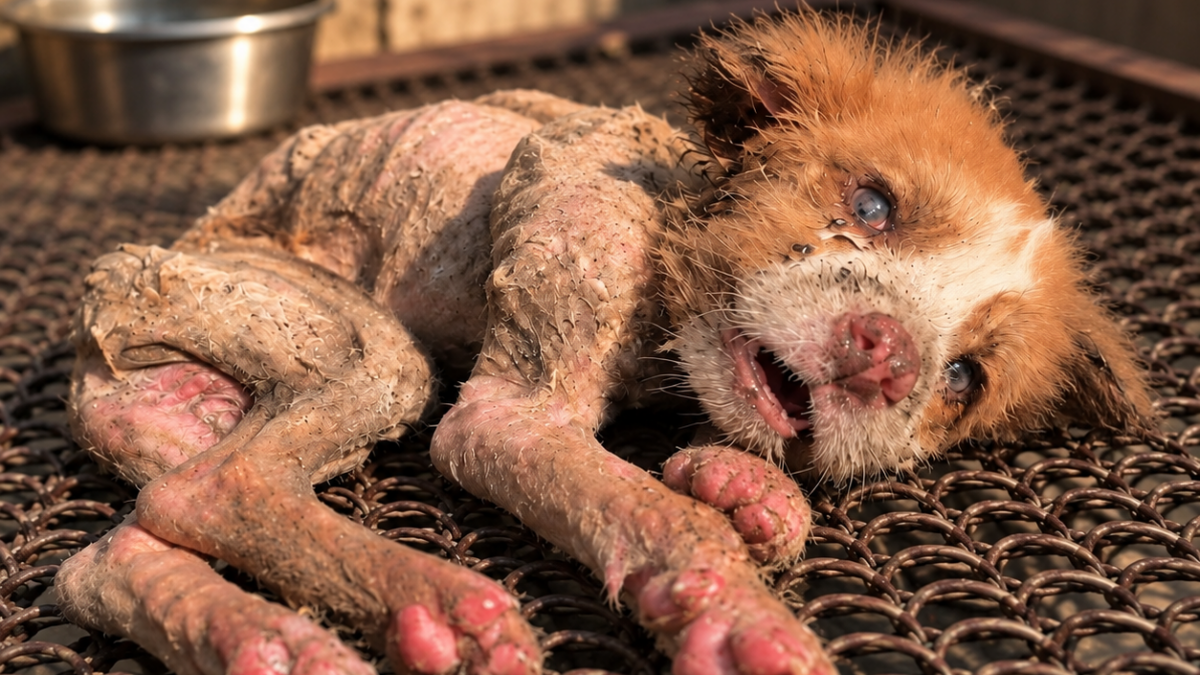
I could finally see most of Chico’s body.
I wish I couldn’t.
He was smaller than I had imagined.
His ribs showed beneath wet fur.
His hind legs were twisted underneath him because there had been no room to reposition them.
The skin over his back was damaged.
Maggots clustered around one wound.
Maya whispered something I didn’t hear.
I looked at her.
“What?”
“Nothing.”
“What did you say?”
She shook her head.
“Just get him out.”
Another twenty minutes.
Then Marcus said, “We can reach him.”
I moved forward.
Maya stopped me.
“Not yet.”
“He’s right there.”
“If his legs are trapped beneath something and you pull, you could injure him.”
She reached inside.
Felt carefully along his back.
Shoulders.
Hips.
“His right hind leg is under a piece.”
Luis found it.
A wedge of concrete no larger than a dinner plate.
Small compared with everything else.
Heavy enough to pin a puppy.
He dug around it.
“It won’t move.”
Marcus got beside him.
“Don’t pry toward the dog.”
“I know.”
Another ten minutes.
Then the piece shifted.
Chico screamed.
Maya stopped everyone.
“What?”
“Leg.”
She felt again.
“It’s free.”
“Broken?”
“Maybe.”
We were finally ready.
Maya wrapped a towel around her forearms.
“I’m taking his chest.”
I positioned myself beside her.
“What do I do?”
“Support the hips when I tell you.”
She slid both hands beneath Chico.
He was wedged tightly enough that even free, he did not come easily.
His fur had dried into mud against the concrete.
Maya lifted slightly.
Nothing.
Again.
Chico cried.
“Easy.”
She adjusted.
“Daniel, now.”
I reached under.
My hands closed around his hips.
He was terrifyingly light.
“Pull?”
“Slowly.”
We moved him an inch.
Then another.
His front legs came free.
His body slid upward.
For one second his hind leg caught again.
Then released.
And suddenly he was in our hands.
People cheered.
Not loudly.
Almost immediately the sound died.
Because once everyone saw Chico fully, celebration felt wrong.
He hung limp in the towel.
His eyes half-open.
Mud covered him from nose to tail.
His fur was missing in places.
The wounds along his back were worse than we had seen.
His legs trembled but did not support him.
His head rolled toward my arm.
“Chico.”
Maya put her fingers against his gums.
“Pale.”
She listened to his chest.
“Fast heart rate.”
She looked toward the rescue van.
“Now.”
I carried him.
That surprised me.
Maya had planned to.
But when she reached for him, Chico’s tiny paw caught my shirt.
Probably reflex.
I held him closer.
“I’ve got him.”
She nodded.
“Then move.”
We laid him on blankets in the back of the van.
Maya cut away muddy fur around the wounds.
I held a bottle cap of water near his mouth.
“Small amount,” she warned.
Chico licked.
Once.
Twice.
Then rested his face against my palm.
All around us, grown men who had spent hours moving thousands of pounds of concrete stood silently watching a puppy drink.
Marcus rubbed his eyes.
Dust, he later claimed.
Nobody believed him.
At the veterinary hospital, Chico was rushed directly into treatment.
The waiting room became unbearable.
For the first time all day, I had nothing to do.
No concrete to move.
No rope to hold.
No hole to dig.
Only wait.
Marcus stayed.
So did Luis.
“I thought you had another job,” I said.
Marcus shrugged.
“Customer can yell tomorrow.”
Luis sat with both hands clasped.
“My wife says I’m not allowed home until I know if he lives.”
“You told her?”
“She’s been getting updates all day.”
Apparently half the city had.
Maya emerged after nearly forty minutes.
We all stood.
“He’s alive.”
Nobody relaxed.
She saw that.
“He’s severely dehydrated. His blood sugar was dangerously low. He has anemia, most likely from parasites and the wounds. His body temperature is below normal.”
“Infection?” I asked.
“Yes.”
“How bad?”
“Too early to know.”
“His leg?”
“Not broken.”
That was the first truly good thing.
“Then why can’t he stand?”
“Weakness. Pain. Possibly nerve compression from being trapped. We’ll reassess.”
“And the wounds?”
Maya inhaled.
“Fly larvae caused significant tissue damage, but most appears superficial so far. We cleaned what we could. We’ll need repeated treatment.”
“Viruses?”
“We ran rapid tests for parvovirus and distemper. Negative.”
Luis crossed himself.
Marcus sat down.
I remained standing.
“Will he live?”
Maya met my eyes.
“I don’t know.”
Again.
The answer nobody wants.
The only honest one.
“He survived four days,” I said.
“Yes.”
“That has to mean something.”
“It means he’s fighting.”
“Then help him fight.”
“We are.”
Chico spent his first night on IV fluids, glucose support, antibiotics, pain medication, and warming blankets.
I went home because Maya practically forced me.
“You need sleep.”
“He’s alone.”
“He is surrounded by technicians.”
“He doesn’t know them.”
“He barely knows you.”
That hurt more than it should have.
Maya softened.
“Daniel, go home. Come back in the morning.”
I drove home with concrete dust in my hair and dried mud on my clothes.
The sound of Chico crying followed me.
I showered.
It didn’t disappear.
I lay down.
Still heard it.
Around two in the morning, my phone rang.
Maya.
I answered instantly.
“What happened?”
“He had a rough period.”
I sat upright.
“What does rough mean?”
“His blood pressure dropped.”
“And now?”
“Responding to fluids.”
“Should I come?”
“No.”
“Maya—”
“If he deteriorates critically, I’ll call you.”
I hated that phrase.
“Is he awake?”
“Sometimes.”
“Can you do something for me?”
“What?”
“Say his name.”
She was quiet.
Then:
“I will.”
I barely slept.
At seven, I was at the hospital.
Maya looked like she had slept even less.
She led me to the treatment room.
Chico was curled beneath blankets.
Clean now.
Or cleaner.
Without mud covering him, he looked even smaller.
One ear was folded.
A bandage covered part of his back.
An IV line ran into his front leg.
I approached quietly.
“Hey.”
His eyes opened.
I didn’t expect more.
Then his tail moved.
Once.
Barely.
But it moved.
Maya saw it.
“That’s new.”
I crouched beside him.
“Was that for me?”
Another tiny movement.
My throat tightened.
“No pressure.”
Maya smiled.
“He likes you.”
“He remembers the idiot yelling into a concrete hole.”
“Maybe.”
I put my hand beside his face.
Chico rested his chin across my fingers.
We stayed like that for several minutes.
Later that morning, he ate.
Not much.
A spoonful of soft food from Maya’s hand.
Then a little more from mine.
By afternoon he could lift his head without shaking.
The next day, he tried to stand.
His front legs worked.
His back legs folded.
He fell.
I moved instinctively.
Maya stopped me.
“Let him try.”
“He fell.”
“He needs to learn what his body can do again.”
Chico tried a second time.
Failed.
Third.
One hind leg supported him for half a second.
He collapsed.
Exhausted.
I thought he would quit.
He rested.
Then tried again.
That puppy had spent four days unable to turn around.
The first freedom he got, he used to keep trying to stand.
On the fifth attempt, he stayed upright long enough to take one step.
Maya started crying.
She turned away before I could say anything.
“Dust?” I asked.
She laughed through it.
“Shut up.”
Chico took another step.
Fell directly onto my shoe.
I picked him up.
“Good enough.”
He licked my thumb.
His wounds took longer.
The tissue damage required daily cleaning.
Some areas had to be debrided.
The smell of the infected tissue disappeared gradually.
Healthy pink skin appeared underneath.
Chico hated every dressing change.
He complained loudly.
Maya considered that progress.
“He has opinions.”
“He screamed for four days.”
“Different scream.”
She was right.
The old sound had been pain and desperation.
This was outrage.
Normal puppy outrage.
By the end of the first week, Chico could walk across the treatment room.
Crookedly.
Slowly.
But independently.
At the end of the second week, he chased a rolled piece of gauze.
Three feet.
Then tripped over himself.
I laughed so hard I had to sit down.
Maya looked offended.
“You’re laughing at a disabled patient.”
“He attacked medical supplies.”
“He’s recovering.”
“He’s terrible at it.”
Chico picked up the gauze and carried it proudly.
For the first time, he looked like a puppy instead of a survivor.
That distinction mattered.
A survivor is what happens after disaster.
A puppy is supposed to chew things, fall down, demand food, and make unreasonable noise at inconvenient times.
I wanted that for him.
Ordinary life.
The story of the rescue spread.
Someone had filmed the crane lifting the slab.
Another person had recorded the moment Chico came out.
Local news called.
Rescue pages reposted it.
Messages arrived from people wanting to adopt him.
Dozens.
Then hundreds.
One family offered to drive six hours.
Another said they had a large farm.
A woman sent pictures of a custom dog bed she wanted to buy.
I should have been happy.
Instead, I became strangely irritated.
“They don’t know him.”
Maya looked at me over her coffee.
“They want to help.”
“They saw a video.”
“Yes.”
“He bites shoelaces.”
“They’ll survive.”
“He wakes up at five.”
“He’s a puppy.”
“He hates baths.”
“Every dog hates something.”
I crossed my arms.
Maya stared.
“What?”
“You know what this is.”
“No.”
“You’re jealous.”
“Of strangers?”
“Of adopters.”
“That’s ridiculous.”
Chico was asleep against my leg.
Maya pointed.
“Is it?”
I looked down.
“No.”
“Daniel.”
“I work too much.”
“You run your own business.”
“I travel.”
“You have employees.”
“I don’t have a fenced yard.”
“You have money for a crane but apparently fences are impossible.”
“That was different.”
“Why?”
“A puppy was dying.”
Maya leaned back.
“And now?”
I looked at Chico.
Now he was living.
That was different too.
For several days, I refused to discuss adoption.
Then I received a message from one of the teenagers who had been there during the rescue.
Her name was Elena.
She sent me a picture.
It showed Chico’s hole after the concrete had been removed.
At the bottom lay pieces of bread.
Tiny scraps.
The food the neighborhood children had lowered through the gap.
Under the photograph she wrote:
**We thought he would die before someone came. Thank you for not leaving him there.**
I read it three times.
Then I drove back to the site.
The construction debris was still there, though Marcus had arranged for the most dangerous slabs to be moved.
Children were playing soccer nearby.
Elena recognized me.
“How’s Chico?”
“Annoying.”
She smiled.
“So good?”
“Very.”
Several children came over.
They asked questions.
Does he walk?
Does he eat?
Does he remember the hole?
Does he cry at night?
One boy asked, “Can we see him?”
A week later, after Maya approved it, I brought Chico.
The moment I got him out of the truck, the children went silent.
They had known him as eyes in a hole.
A cry beneath concrete.
Now he stood in sunlight.
Thin still.
Bandage around his back.
But standing.
Elena crouched.
“Chico.”
His tail started moving.
She cried.
He walked toward her.
Then the entire group cried.
I pretended I didn’t.
Chico licked Elena’s face.
The boy beside her said, “He remembers us.”
Maybe.
Maybe not.
But he knew kindness when it was in front of him.
That was enough.
One older man approached me.
The same man who had said the puppy had been trapped four days.
He looked uncomfortable.
“I should’ve done more.”
I didn’t answer immediately.
He stared toward the children.
“We all kept saying somebody would come.”
I understood that sentence.
It is one of the easiest sentences in the world.
Somebody will come.
Somebody will call.
Somebody has equipment.
Somebody knows what to do.
Responsibility becomes lighter when you put it on an imaginary person.
“What stopped you?” I asked.
“The concrete.”
“You tried?”
“First day.”
“What happened?”
“We almost shifted one slab. The puppy screamed. Everybody got scared.”
“That was probably good.”
He looked surprised.
“You stopped before you crushed him.”
“Still left him there.”
“You didn’t leave. You brought water.”
“How do you know?”
“Kids told me.”
The man looked away.
“That doesn’t feel like enough.”
“No.”
It wasn’t.
But guilt after the fact did nothing for Chico.
I didn’t want the rescue to become a story where everyone except me had failed.
That wasn’t true.
The children had fed him.
Residents had called people.
Someone had covered part of the opening when rain came.
Marcus had brought equipment.
Workers had risked hours under unstable concrete.
Maya and the hospital had saved his life after we got him out.
A rescue becomes smaller when we force one person to be the hero.
Chico had been saved by a chain of decisions.
Some late.
Some imperfect.
All necessary.
Three weeks after rescue, Maya removed his final large bandage.
His skin was healing.
Fur would eventually cover most scars.
One area along his back might remain thin.
“He’s medically ready for foster-to-adopt placement,” she said.
I hated those words.
“Good.”
“You don’t sound good.”
“I said good.”
“You also took Chico’s blanket home to wash yesterday.”
“It smelled.”
“You bought the blanket.”
“Clinic ones are terrible.”
She smiled.
“I already filled out your foster paperwork.”
I stared.
“You what?”
“You can refuse.”
“I didn’t ask.”
“No.”
“That seems unethical.”
“You signed half of it during his first week.”
I remembered signing something.
“I thought that was treatment authorization.”
“Part of it was.”
“Maya.”
She laughed.
“Take the dog home.”
So I did.
Temporarily.
That was the plan.
Chico’s first night in my house was chaos.
He peed near the door.
Chewed a charging cable.
Cried when I put him in a crate.
Cried louder when I left the room.
The sound froze me.
Not because it was loud.
Because for one instant, I heard the hole again.
I went back immediately.
Chico was standing inside the crate.
Safe.
Blanket.
Water.
Toy.
No concrete.
No filthy water.
Still crying.
I opened the door.
He climbed into my lap.
I sat on the floor.
“You can’t do that every time.”
He tucked his nose under my arm.
“This is manipulation.”
Tail.
“I know veterinarians who warned me about this.”
He fell asleep.
I remained on the floor for almost an hour because I didn’t want to move him.
The next morning, my back hurt so badly I called Maya.
“This dog is medically dangerous.”
“To you?”
“Yes.”
“How?”
“Floor sleeping.”
She laughed.
“He has a crate.”
“He dislikes it.”
“He’ll learn.”
“How?”
“Routine.”
I hated routine training.
Chico hated it more.
But we learned.
Five minutes in the crate.
Reward.
Ten.
Reward.
I left the room.
Came back.
Left the house for two minutes.
Came back.
Gradually, his crying changed.
Then stopped.
Not because he stopped caring.
Because he learned one important thing.
People could leave.
And return.
That was something his first four days had never taught him.
Recovery became less about wounds and more about trust.
Chico was afraid of narrow spaces.
If a toy rolled beneath furniture, he would stand several feet away and bark.
He hated puddles.
He refused to step into muddy water.
Construction noise terrified him.
The first time a neighbor used a concrete saw, Chico bolted into my bedroom and hid beside the bed.
I sat on the floor.
Not touching him.
Just there.
When the noise stopped, he came out.
I did not know whether dogs remember trauma the way humans do.
I still don’t.
But bodies remember patterns.
Sounds.
Pressure.
Fear.
We worked slowly.
A trainer named Sarah helped.
“No forcing.”
“I know.”
“You say that, but your instinct is to solve things.”
“That’s bad?”
“For machinery? No. For a frightened dog? Sometimes.”
She placed treats near a cardboard tunnel.
Chico refused to approach.
“Today we do nothing.”
“Then why am I paying you?”
“To learn that doing nothing can be training.”
I looked at her.
“You and Maya should form a company called People Who Annoy Daniel.”
“Already incorporated.”
Two months later, Chico walked through the tunnel.
Nobody pushed him.
He chose.
I nearly cried.
Sarah did not make fun of me.
Much.
At six months old, Chico barely resembled the puppy from the concrete hole.
He had grown into a lean tan-and-white dog with oversized ears and dark eyes.
The scars remained.
One patch along his back never grew fur properly.
People asked what happened.
Sometimes I told them.
Sometimes I didn’t.
I did not want his life reduced to an injury story.
He loved tennis balls.
Hated bananas.
Slept upside down.
Barked at delivery boxes.
Adored children.
Stole socks.
Those facts mattered too.
The children from the old neighborhood remained part of his life.
We visited several times a year.
Eventually, with help from Marcus and the local community, the abandoned construction area was cleared properly.
The dangerous open cavities were filled.
Concrete removed.
The city had ignored the site for too long.
Chico’s rescue brought attention.
Complaints that had gone unanswered suddenly received responses once cameras arrived.
I had mixed feelings about that.
It should not take a suffering puppy to make dangerous conditions matter.
But if attention made the place safer, I wasn’t going to reject it.
Marcus donated equipment time.
Local contractors contributed labor.
Residents cleaned garbage.
The children painted a small wooden sign near the cleared area.
Not dramatic.
Just:
**CHICO’S FIELD**
That made me uncomfortable.
“It’s not his field.”
Elena rolled her eyes.
“You always complain.”
“I do not.”
“You complained about the crane price.”
“It was expensive.”
“You complained about people calling you a hero.”
“I’m not.”
“You complain about Chico eating your shoes.”
“He ate three.”
Elena smiled.
“So the sign stays.”
The sign stayed.
A year after the rescue, we held a small community day there.
Chico ran across grass where the slabs had once been.
I stood with Marcus.
He watched the dog.
“You remember how close that upper slab was?”
“Yes.”
“I still think about it.”
“So do I.”
“One wrong lift.”
“I know.”
Marcus crossed his arms.
“You know what bothers me?”
“What?”
“People see the video and say it was a miracle.”
I looked at him.
“You don’t believe in miracles?”
“That’s not what I said.”
He pointed toward the field.
“The crane had maintenance. Luis dug by hand. Maya stayed ten hours. You rented equipment. The neighborhood kept him alive long enough. Calling it a miracle makes it sound like none of that mattered.”
I thought about that.
“Maybe miracles need labor.”
Marcus laughed.
“That sounds like something you’d put on a coffee mug.”
“I’m not putting anything on a mug.”
Someone eventually did.
Elena gave it to me at Christmas.
I still have it.
Chico officially became mine a few months after his first birthday.
The rescue coordinator stopped pretending the adoption was undecided.
She handed me papers.
“Sign.”
“I already foster him.”
“You’ve fostered him for nine months.”
“Exactly.”
“That is not what foster means anymore.”
“Could still find him a better home.”
She looked around my house.
Fenced yard.
Dog bed.
Training toys.
Photographs of Chico everywhere.
He was asleep with his head on my foot.
“Better?”
“Potentially.”
Chico rolled onto his back.
The coordinator handed me the pen.
I signed.
I expected a stronger emotion.
Some huge feeling.
Instead, I mostly felt relief.
His microchip was updated.
My name.
My phone number.
My address.
No hole.
No unknown past.
A place to return.
When Chico was two, something happened that I never expected.
We were walking near a drainage project when we heard crying.
A kitten.
Stuck behind temporary fencing.
Not dangerous.
Not four days.
Nothing like Chico’s rescue.
But the sound made Chico stop.
He pulled toward it.
Found the kitten before I did.
He stood beside the fence whining.
“You hear her?”
His tail stiffened.
The worker opened the gate.
The kitten ran out.
Chico smelled her carefully.
Then sat.
I laughed.
“Of course.”
The worker looked at me.
“What?”
“Nothing.”
We found the kitten’s owner that afternoon.
Still, I thought about Chico recognizing distress.
Maybe he didn’t connect it to his past.
Maybe he simply heard an animal crying.
It didn’t matter.
His life had gone from needing people to hear him to being the one who stopped when something else cried.
I liked that.
Years passed.
Chico became the dog everyone knew.
Children who had once lowered bread into his hole grew up.
Elena went to college.
One of the boys became a construction worker.
Another joined the fire department.
I became older.
Maya became more gray-haired but denied it.
Marcus bought a newer crane.
Luis started his own contracting company.
Chico attended the opening.
He peed on one tire.
Luis considered it a blessing.
At age seven, Chico developed arthritis in the hind leg that had been pinned under concrete.
Maya was not surprised.
“Trauma can catch up later.”
“Can we treat it?”
“Yes.”
Medication.
Weight management.
Physical therapy.
Chico hated swimming therapy, which made perfect sense.
The rehabilitation center had an underwater treadmill.
His first session lasted twelve seconds before he looked at me with an expression of profound betrayal.
“You’re safe.”
He disagreed.
By the fourth session, he tolerated it.
By the tenth, he walked stronger.
I learned again that recovery is rarely one event.
We called the day he came out of the hole “his rescue day.”
But he had been rescued many times afterward.
From infection.
From fear.
From weakness.
From isolation.
From the habits his body had learned while trapped.
Maybe that is true of more than dogs.
At ten, Chico’s face began turning white.
His ears remained absurdly large.
He slept longer.
Stopped stealing shoes.
Mostly.
He still visited Chico’s Field.
Children there no longer knew his original story firsthand.
Their older siblings told them.
Sometimes incorrectly.
One kid asked whether Chico had been trapped underground for three months.
“No.”
Another said a helicopter rescued him.
“No.”
“Did you climb into the hole?”
“No.”
“Did he bite a snake?”
“Definitely no.”
Stories grow when people repeat them.
I started telling the children something simple.
“He got trapped. People heard him. People worked together. He got out.”
That was enough.
The frightening details belonged to those who needed them.
Chico did not.
At twelve, routine bloodwork showed kidney changes.
Mild.
Manageable.
Maya adjusted his food.
He hated the new diet.
I negotiated.
Maya said I was weak.
She was correct.
At thirteen, Chico developed a heart murmur.
Medication eventually followed.
Our walks shortened.
He still insisted on going.
Some mornings, we made it only halfway down the street.
Then he would stop.
Look at me.
Turn around.
No pride.
Animals are smarter than humans about limits.
They rest when tired.
Humans often turn exhaustion into a moral failure.
Chico simply went home.
At fourteen, his back legs weakened more quickly.
The old pinned leg became especially stiff.
I bought ramps.
Rugs.
A support harness.
He accepted all of it with far less complaint than young Chico would have.
One evening, Elena visited.
She was twenty-seven by then.
Married.
Pregnant.
I stared at her stomach.
“You were thirteen yesterday.”
She laughed.
“That’s not how time works.”
“It should.”
Chico recognized her.
Slowly.
He lifted his head.
Tail moved.
Elena sat beside him.
“Hey, concrete boy.”
I hated that nickname.
She knew it.
Chico rested his head in her lap.
Elena cried.
“What?”
“He’s old.”
“So am I.”
“You’re not helping.”
She stroked the scar along his back.
“I remember hearing him at night.”
I sat across from her.
“We all thought someone else would save him.”
“You were a child.”
“I still remember.”
She looked down.
“That sound.”
“So do I.”
“Does it ever go away?”
I knew what she meant.
“No.”
Her eyes filled.
“But it gets quieter.”
She nodded.
Chico sighed.
We sat in silence.
Then Elena said, “My baby’s middle name is going to be Hope.”
“That has nothing to do with Chico, right?”
She smiled.
“Maybe a little.”
I groaned.
“You people are impossible.”
Chico’s tail moved.
Age eventually narrowed his world.
First the neighborhood.
Then the yard.
Then the house.
I remembered another narrow world.
Concrete pressing on every side.
Dirty water below him.
The difference mattered.
Now the smaller world was soft.
Warm.
Chosen around his comfort.
His bed near the window.
Water within reach.
My chair beside him.
Maya visited the house more often.
Each time I asked:
“Is it time?”
Each time she asked me:
“Is he eating?”
“Yes.”
“Enjoying anything?”
“Yes.”
“Pain controlled?”
Mostly.
Then not mostly.
Medication changed.
More good days.
I learned not to count only bad hours.
Then came a morning when Chico did not get up.
I helped him.
His back legs collapsed.
He looked at me.
Not frightened.
Tired.
That expression was worse.
He ate half his breakfast.
Ignored the tennis ball.
That had never happened.
I called Maya.
She arrived in the afternoon.
Examined him.
Listened to his heart.
Checked his gums.
Felt his abdomen.
Then sat on the floor.
I knew.
“I can increase pain medication.”
“For how long?”
“I don’t know.”
“Will he walk?”
“Probably not much.”
“Does he hurt?”
“Yes.”
The word landed differently because she did not soften it.
“Yes.”
I looked at Chico.
He was watching us.
“Today?”
Maya did not answer for me.
I hated her for that.
I also loved her for it.
“I don’t want his last day to be the worst day.”
She nodded.
“That’s what we try for.”
I called Marcus.
Luis.
Elena.
Not because Chico needed a crowd.
Because these people had been there at the beginning.
They came quietly.
Marcus knelt beside him.
“You cost me a crane job.”
Chico smelled his hand.
“You remember?”
Tail.
Marcus laughed.
“Liar.”
Luis brought the old photograph of the crew beside the slabs.
Chico in my arms.
All of us filthy.
Exhausted.
Terrified.
He placed it on the table.
Elena sat near Chico’s bed.
No one made speeches.
That helped.
We told ordinary stories.
Chico stealing sandwiches.
Chico urinating on Luis’s crane tire.
Chico refusing the swimming treadmill.
Chico barking at a statue for six months.
The room filled with laughter more than tears.
I was grateful.
Near sunset, everyone left except Maya.
I took Chico outside one last time.
With the support harness.
We walked maybe ten yards into the yard.
He stood in the grass.
Wind moved through his fur.
He smelled the air.
Then lowered himself.
I sat beside him.
“Fourteen years.”
He looked at me.
“Not bad for a dog everyone thought wouldn’t survive the night.”
I hated myself for saying it.
As if survival had been a competition.
I corrected myself.
“No.”
I rubbed his chest.
“You didn’t owe us fourteen years.”
His eyes closed.
“We were lucky to get them.”
That felt right.
Inside, Maya prepared everything.
Chico lay on his favorite blanket.
The original concrete-rescue video had millions of views by then.
I had not watched it in years.
I didn’t need to.
I knew every second.
The cries.
The crane.
The slab moving.
The mud.
The moment his paw caught my shirt.
But that night, looking at old Chico, those images felt like the opening paragraph of a very long book.
Not the whole book.
Maya gave the sedative.
Chico relaxed.
His breathing slowed.
I rested one hand against his ribs.
“You know what I remember most?”
Maya sat quietly.
“The first water.”
She looked at me.
“What?”
“When we got him out. I gave him water.”
Chico’s eyes opened slightly.
“He could barely drink.”
My voice broke.
“And he kept trying.”
Maya wiped her face.
I touched Chico’s ear.
“You don’t have to try anymore.”
The words almost stopped me.
But I meant them.
For four days inside that hole, his entire existence had required effort.
Lift the head.
Breathe.
Cry.
Stay above water.
Endure the flies.
Wait.
Even after rescue, he fought infection, weakness, fear, rehabilitation.
He had spent a lifetime trying.
He had earned rest.
I nodded to Maya.
The final medication went in.
Chico exhaled.
His body softened beneath my hand.
No concrete.
No water.
No crying.
Just his blanket.
My hand.
A quiet room.
He died peacefully.
For a long time, I stayed beside him.
Then Maya touched my shoulder.
“He had a beautiful life.”
I nodded.
Words were impossible.
Weeks later, Marcus called.
“Come to the field.”
“Why?”
“Just come.”
I drove there.
Chico’s Field had changed again.
Near the edge stood a small concrete bench.
I stared at it.
“You made a memorial out of concrete?”
Marcus smiled.
“Seems appropriate.”
“You’re sick.”
“Read it.”
A small metal plaque was set into the front.
Not dramatic.
No picture of the rescue.
No description of suffering.
Just:
**CHICO**
**HE WAS HEARD**
I stopped breathing for a second.
Marcus stood beside me.
“We argued about wording.”
“Who is we?”
“Everyone.”
“Of course.”
“Elena wanted something longer.”
“Of course.”
“Luis wanted ‘Four Days, One Chance.’”
“That’s terrible.”
“I told him.”
“What did Maya want?”
Marcus smiled.
“‘He Was Heard.’”
I sat on the bench.
Concrete.
Warm from sunlight.
Nothing like the slabs that had trapped him.
Elena eventually arrived with her baby.
She sat beside me.
Her daughter was six months old.
“Hope?” I asked.
“Hope.”
I shook my head.
“You actually did it.”
“Yes.”
She placed the baby’s tiny hand against the plaque.
“Tell her the real story when she’s older,” I said.
“I will.”
“Not the helicopter version.”
She laughed.
“No helicopter.”
We sat there watching children play.
The field where a puppy had nearly disappeared beneath concrete had become ordinary again.
That was the best part.
Ordinary places should not remain monuments to suffering forever.
They should become places where life continues.
Years after Chico died, people still occasionally sent me the old video.
“Is this your dog?”
Yes.
“That rescue was unbelievable.”
Yes.
“Did he really survive?”
For fourteen years.
People always wanted the dramatic part.
The crane.
The hole.
The flies.
The four days.
I understood.
That is what catches attention.
But when I remembered Chico, I rarely saw the hole first.
I saw him sleeping upside down on my couch.
Standing in the kitchen with one of my shoes in his mouth.
Refusing to step into the therapy pool.
Waiting by the door when I came home.
Running across Chico’s Field while children chased him.
Growing gray.
Growing slow.
Growing old.
That was the miracle, if anyone insists on using the word.
Not that he survived four days.
That afterward, he was allowed to stop being a suffering puppy and become an ordinary dog.
One rainy afternoon, several years after his death, I visited the field alone.
Water collected briefly near one corner.
Nothing dangerous.
Just a shallow puddle.
A young dog was playing nearby with a family.
The dog charged through the water.
Splashed everyone.
Children screamed with laughter.
I sat on Chico’s concrete bench.
For a second, the sound of the rain brought back the hole.
Darkness.
Filthy water.
That distant childlike cry.
Then the young dog ran past again.
Water flying everywhere.
I smiled.
Memory shifted.
The old sound faded.
I touched the plaque.
“He was heard.”
Two words.
Maybe that was all rescue ever began with.
Somebody suffering.
Somebody else willing to hear it.
The first time Chico cried beneath those slabs, people thought he sounded like a child.
By the fourth day, his voice had nearly disappeared.
But it had not disappeared completely.
I heard it.
The children heard it.
The neighborhood heard it.
Marcus heard it.
Luis heard it.
Maya heard it.
And once enough people stopped walking past that sound, thousands of pounds of concrete were no longer enough to keep one tiny puppy buried.
I stood and headed toward my truck.
Behind me, the young dog splashed through the puddle again.
No fear.
No hesitation.
Just play.
I did not look back at the bench.
I didn’t need to.
Chico was no longer the puppy waiting beneath concrete in my memory.
He was already free.
He was already free.
For a while, I believed that was where Chico’s story finally stopped.
I was wrong.
Not because anything mysterious happened after he died. I never claimed to hear him barking in an empty room, never saw his shape in clouds, never tried to convince myself that every tan dog I passed was some kind of sign.
What happened was quieter.
Chico simply kept showing up in the choices people made.
The first time I noticed it was almost a year after we placed the bench at Chico’s Field.
Marcus called me on a Tuesday morning.
“You busy?”
“Yes.”
“With what?”
I looked around my kitchen.
Coffee.
Newspaper.
Absolutely nothing.
“Important retirement activities.”
“So nothing.”
“Correct.”
“Come to the field.”
I sighed.
“You people only call me there when you’ve done something without asking.”
“That’s not true.”
“You installed a memorial bench without asking.”
“You liked it.”
“That is not a defense.”
Marcus laughed.
“Just come.”
When I arrived, there were two trucks parked beside the field.
One belonged to Marcus.
The other belonged to the city public works department.
A crew was installing a long section of drainage pipe along the edge of the property.
I found Marcus talking to a city engineer.
“What’s happening?”
Marcus pointed.
“Remember how rain used to collect near the old slab area?”
“Yes.”
“They’re fixing it permanently.”
I looked toward the trench.
“That’s good.”
“Chico paid for part of it.”
I stared at him.
“Chico was notoriously unemployed.”
Marcus smiled.
“After the rescue video resurfaced last year, people donated money to the neighborhood association.”
“How much?”
“Enough.”
“For drainage?”
“Drainage, fencing, lighting.”
I looked around.
New safety fencing had already gone up along one boundary.
A solar-powered light stood near the walking path.
“You did all this because of a dog?”
The engineer overheard me.
“No.”
I looked at him.
He pointed toward several houses.
“Residents have been requesting improvements for years. The attention from the rescue finally gave the neighborhood leverage.”
That answer mattered.
Not Chico as mascot.
Not Chico as miracle.
People.
Complaints.
Paperwork.
Pressure.
Funding.
The things that rarely make emotional videos because they take too long.
The engineer continued.
“We found two additional unstable drainage cavities during inspection.”
My stomach tightened.
“Like the one Chico fell into?”
“Not exactly. But dangerous enough.”
“Were they open?”
“One partially.”
“Kids play here.”
“I know.”
That afternoon, I sat on Chico’s bench watching workers install barriers around the area.
A little girl ran past carrying a soccer ball.
Maybe seven years old.
She had no idea what used to sit beneath that patch of ground.
Good.
That was the point.
A place is truly repaired when new children no longer need to know where the danger was.
A few weeks later, Elena called.
“Hope wants to meet you.”
“She already met me.”
“She was six months old.”
“She seemed impressed.”
“She drooled on you.”
“Exactly.”
Hope was almost four now.
Elena brought her to my house on a Saturday.
She walked inside holding her mother’s hand and staring at everything.
Then she saw the photograph of Chico on my bookshelf.
Old Chico.
Gray muzzle.
Ridiculous ears.
She pointed.
“Dog.”
“That is an excellent observation.”
Elena laughed.
“His name was Chico.”
Hope looked at me.
“Where Chico?”
The question hit harder than it should have.
Elena started to answer.
I shook my head slightly.
“I’ll tell her.”
I crouched as much as my knees allowed.
“Chico lived with me for a long time.”
Hope listened seriously.
“He got very old.”
“How old?”
“Fourteen.”
She looked at Elena.
“Is fourteen old?”
“For dogs, yes.”
Hope considered that.
“Then what?”
Kids always go directly toward the thing adults circle around.
“Then he died.”
Hope’s face changed.
Not grief.
Curiosity mixed with concern.
“Why?”
“His body got tired.”
“Doctor fix?”
“The doctor helped him for many years.”
“But not fix?”
“No.”
She accepted this more easily than most adults.
Then she walked to the photograph.
“Chico happy?”
I looked at the picture.
He was lying on his back, mouth open, one paw hanging off the couch.
“Yes.”
Hope nodded.
“Okay.”
That was apparently all she needed.
Ten minutes later, she was drawing at my kitchen table.
When she finished, she brought me the paper.
It showed a brown dog standing beside a blue square.
“What’s the blue thing?”
“A pool.”
I looked at Elena.
She started laughing.
“You told her he hated water?”
“I may have.”
Hope pointed at the picture.
“Chico not scared now.”
My throat tightened.
“No.”
I put the drawing beside his photographs.
“He’s not.”
The next year, Maya retired.
Officially.
She had threatened retirement at least four times before actually doing it.
Her clinic held a small gathering after closing.
Former employees came.
Longtime clients.
Too many dogs.
One extremely angry cat.
I brought the coffee mug Elena had given me years earlier.
MIRACLES NEED LABOR.
Maya saw it.
“You kept that?”
“Against my better judgment.”
“You used to hate that phrase.”
“I still do.”
“Then why keep it?”
“It holds coffee.”
She rolled her eyes.
Near the end of the evening, she pulled me aside.
“I have something for you.”
“That sentence worries me.”
She handed me a thin folder.
Inside were copies of Chico’s original medical records.
The first night.
Temperature.
Weight.
Blood glucose.
Wound assessment.
Medication.
Every clinical detail from the little body we had carried out of the hole.
“I already have some of this.”
“Keep reading.”
Near the back were progress notes written by different technicians.
Day two:
Patient stood briefly with assistance.
Day three:
Eating voluntarily. Vocal when dressing changed.
Day five:
Walked several steps independently.
Day eight:
Attempted to steal gauze.
I laughed.
“Attempted?”
“He succeeded.”
Another note:
Patient appears strongly bonded to finder. Tail movement when Daniel enters room.
I stopped.
“I never saw this.”
“You weren’t supposed to. Internal note.”
“Why give it to me now?”
Maya shrugged.
“Because I’m retiring and no one can fire me.”
I kept reading.
On the final page was something Maya had written herself the day Chico left the hospital:
Prognosis: Good. Patient medically improved. Long-term emotional adjustment unknown. Daniel appears unlikely to return dog willingly once foster placement begins.
I stared at her.
“You knew.”
“Everyone knew.”
“I thought I was subtle.”
“You built a fence before he was officially discharged.”
“That was practical.”
“You bought six dog beds.”
“Different rooms.”
“You argued with three adoption applicants you had never met.”
“They sounded suspicious.”
“One was a pediatric nurse.”
“She mentioned having white carpet.”
Maya crossed her arms.
“Monster.”
I closed the folder.
“Thank you.”
She nodded.
Then her expression softened.
“You know what I remember?”
“What?”
“Not the wounds.”
I waited.
“The first morning after he crashed.”
My mind went directly there.
The call at two.
The blood pressure.
The drive back.
“He wagged his tail,” I said.
“Barely.”
“I saw it.”
“I know.”
Maya touched the folder.
“That was the moment I thought he might really make it.”
I looked down.
“For me it was when he stood.”
“For Marcus it was when they lifted the slab.”
“For Elena it was probably when he visited the neighborhood.”
“So which one was the rescue?”
Maya smiled.
“All of them.”
After Maya retired, I started volunteering occasionally with the rescue group that had helped us.
Not often.
I was terrible at fundraising.
Worse at paperwork.
But I could drive.
So once or twice a month I transported animals between clinics, foster homes, and shelters.
The first time someone called me an animal rescuer, I corrected them.
“I’m a guy with a truck.”
The coordinator replied, “That is approximately seventy percent of rescue.”
Fair.
Most trips were uneventful.
A litter of kittens.
An elderly beagle.
A terrified German Shepherd who vomited twice in my truck.
Then, one winter morning, I was asked to transport a small black puppy from an overcrowded shelter to a foster family.
The puppy cried the moment I closed the crate.
A high, desperate sound.
My hand froze on the ignition.
For one second I wasn’t in the parking lot.
I was back beside the slabs.
Four days.
Dirty water.
Flies.
That childlike cry rising through concrete.
I turned around.
The puppy pressed against the crate door.
“Hey.”
He cried again.
“You’re okay.”
I sat there for nearly five minutes.
Didn’t open the crate.
Didn’t take him out.
Just stayed where he could see me.
Eventually, he stopped crying.
I started the truck.
Halfway to the foster home, he fell asleep.
When I delivered him, the foster woman smiled.
“Was he good?”
“Perfect.”
That was a lie.
He had screamed, chewed the blanket, and somehow stepped in his own water dish.
But perfect enough.
Driving home, I realized something.
For years, Chico’s cry had existed in my memory as an alarm.
A sound that meant something terrible was happening and I was already late.
That morning, another puppy had cried.
Nothing terrible followed.
He was simply scared.
Then comforted.
Then safe.
The memory changed slightly.
Not erased.
Changed.
Maybe that was how healing worked for people too.
Not deleting what happened.
Teaching your body that the same sound could eventually lead somewhere different.
Hope grew old enough to understand Chico’s story properly.
When she was seven, Elena brought her to the field.
I happened to be there.
Hope ran to the bench.
She could read the plaque by herself now.
“CHICO. HE WAS HEARD.”
She looked at me.
“Was this where he got stuck?”
“Close.”
“Show me.”
I hesitated.
Elena watched quietly.
The actual hole was gone.
Filled.
Reinforced.
Covered with grass.
I walked them to the approximate place.
“Somewhere around here.”
Hope stared at the ground.
“That small?”
“The opening was.”
“How did he get inside?”
“We never knew.”
“Did somebody put him there?”
“We never found evidence of that.”
“So he fell?”
“Probably.”
She looked toward the bench.
“Mom says you saved him.”
I shook my head.
“A lot of people saved him.”
“But you heard him.”
“Other people heard him too.”
“You got the crane.”
“Yes.”
“Why?”
The simplest questions were always the hardest.
“Because he couldn’t get out.”
Hope frowned.
“That’s obvious.”
I laughed.
“It is.”
She walked back toward the bench.
Then turned.
“If I hear something crying, I should check?”
Elena immediately said, “Safely.”
“Obviously, Mom.”
I added, “And get an adult.”
Hope sighed like we were both unreasonable.
“Fine.”
Before leaving, she placed a small stone beneath the plaque.
It had a paw print painted on it.
“Did you make that?”
“Yes.”
“What’s it for?”
“So he has something.”
I almost told her Chico didn’t need anything.
Then I stopped.
The stone mattered to her.
That was enough.
Years passed, and the bench collected little things.
Not constantly.
A tennis ball sometimes.
A flower.
Painted stones.
Once, inexplicably, a banana.
I suspected Marcus.
Chico hated bananas.
Marcus denied everything.
The rescue organization began using the field for an annual safety event.
They taught children what to do if they found trapped or injured animals.
Do not crawl into unstable spaces.
Do not move heavy debris.
Call adults.
Call emergency services.
Keep distance from frightened animals.
Bring water only when safe.
The first year, Marcus stood beside a small model made of wooden blocks and explained why lifting heavy material without stabilization could make a collapse worse.
A boy asked, “Why didn’t you just yank the concrete up fast?”
Marcus stared at him.
“Because then Chico might have become approximately one inch tall.”
Every parent looked horrified.
I burst out laughing.
Marcus shrugged.
“He’ll remember.”
He was right.
Luis taught older kids how cribbing worked.
Maya came out of retirement for one afternoon to discuss animal first aid.
Elena organized the whole thing.
I did almost nothing.
Which was exactly how I liked it.
At the end of the day, a reporter approached me.
“Can we interview you about Chico?”
“No.”
“Just a few questions.”
“No.”
“Why not?”
“Because you already know the rescue story.”
“We want to ask about his legacy.”
I looked toward the field.
Children practicing how to call for help.
Marcus correcting a volunteer’s support stack.
Maya showing a girl how to approach an injured dog without putting her face near its mouth.
Elena carrying a box of pamphlets while Hope followed her.
I pointed.
“There.”
The reporter turned.
“That’s the story.”
For once, he understood.
He interviewed them instead.
The article that appeared the next week barely mentioned me.
Best article anyone ever wrote about Chico.
When Marcus turned seventy, he finally sold his crane business to Luis.
We held a party at Chico’s Field.
Luis gave him a miniature toy crane.
Marcus looked disgusted.
“This is cheap plastic.”
“You deserve cheap plastic.”
“I taught you everything.”
“And now you can stop charging me for advice.”
Chico’s bench sat twenty feet away.
At one point Marcus walked over and sat alone.
I joined him.
“Regret selling?”
“No.”
“Liar.”
“Maybe a little.”
We watched Luis talking to younger employees.
Marcus said, “You know I almost said no that day.”
“What day?”
“The crane.”
I looked at him.
“You never told me that.”
“You called asking for equipment for a puppy. I thought you’d lost your mind.”
“That part was accurate.”
“I had a commercial lift scheduled.”
“I remember.”
“I almost told you to call somebody else.”
“What changed your mind?”
Marcus thought.
“The sound.”
“What sound?”
“You held the phone near the hole.”
I didn’t remember doing that.
“He cried while you were talking.”
Marcus stared toward the field.
“I heard him through the phone.”
For all those years, I had believed Marcus came because I convinced him.
Apparently Chico had called his own crane.
“That was enough?”
“No.”
Marcus smiled slightly.
“It was too much.”
We sat quietly.
Then he added, “Best job I ever lost money on.”
“That crane bill was outrageous.”
“There he is.”
Some things never changed.
Marcus died three years later.
Heart attack.
Fast.
Unexpected.
Luis called me.
I sat at my kitchen table holding the phone long after the conversation ended.
At the funeral, there were photographs from his construction career.
Bridges.
Commercial buildings.
Excavators.
Cranes.
Family vacations.
Then I found one photograph near the end of the display.
Marcus kneeling beside Chico during the first community day at the field.
Chico licking his chin.
Marcus laughing.
Under it, his daughter had written:
Dad said this was the smallest job he ever took and the one people remembered most.
I had to walk outside.
Luis followed me.
“He talked about that rescue constantly.”
“He complained about it constantly.”
“Same thing for Marcus.”
True.
After the funeral, Luis asked whether we could place something for Marcus near Chico’s bench.
I resisted.
“It’ll become a cemetery.”
“Not another plaque.”
“What then?”
“A tree.”
That I liked.
We planted a young oak several yards behind the bench.
No sign.
No name.
Just a tree.
Hope helped shovel dirt.
Maya stood nearby.
Elena brought water.
Luis pressed the soil down with his boot.
I touched the trunk once.
“That’s enough.”
It was.
Over the next few years, the tree grew.
Slowly.
Branches widened over the field.
Children tied ribbons to it once and were immediately told to stop by the city because apparently trees have regulations too.
Marcus would have found that hilarious.
I grew older too.
My knees became worse.
Driving at night became unpleasant.
Eventually I sold the truck I had transported Chico in.
The buyer was a young contractor.
When he came to pick it up, he noticed scratches in the interior door panel.
“What happened here?”
“Dog.”
“Big dog?”
“Eventually.”
I didn’t explain.
Some history does not increase resale value.
Before the truck left, I sat in the driver’s seat one final time.
I could still remember muddy Chico curled on blankets in the back.
Then healthy Chico riding beside me years later, trying to climb into my lap at stoplights.
I put one hand on the steering wheel.
“Good truck.”
Then immediately felt ridiculous for talking to machinery.
Marcus would have mocked me.
I sold it anyway.
My last visit with Maya before she moved closer to her son happened at the field.
We sat on the bench.
Marcus’s oak was tall enough to cast partial shade now.
“You still hear him?” she asked.
I knew exactly what she meant.
“Sometimes.”
“The hole?”
“Yes.”
“Bad?”
“Not anymore.”
She nodded.
“What do you hear now?”
I thought about it.
The sound had changed in memory.
For years, the first thing I heard was the weak cry beneath concrete.
Now another sound often came first.
Chico barking because someone walked past the house.
Chico whining for tennis balls.
Chico complaining during physical therapy.
Chico snoring.
All the ridiculous sounds of fourteen ordinary years.
“Noise,” I said.
Maya smiled.
“He was good at that.”
“Yes.”
We sat there while a family walked past with a young dog.
The dog pulled toward the puddle near the field.
Its owner tried to stop it.
Failed.
Water sprayed everywhere.
Maya laughed.
“Chico would’ve hated that.”
“Absolutely.”
The old memory rose for a second.
Water around his trapped body.
Then faded beneath the sight of a happy dog splashing for no reason.
That was how I knew the ending had finally changed inside me.
Chico’s story no longer ended with me walking away from the memorial bench.
It didn’t end with his death either.
It kept moving through other people.
Marcus choosing to bring a crane.
Luis teaching younger workers.
Maya training technicians.
Elena teaching Hope.
Children learning to stop safely when something was wrong.
A neighborhood demanding that dangerous ground be repaired.
A rescue group transporting animals before they became emergencies.
None of that made Chico immortal.
I never liked that kind of language.
He was mortal.
Painfully so.
He lived.
He aged.
He died.
That was exactly why the years mattered.
On the fifteenth anniversary of his rescue, Elena organized one final gathering.
I objected to the word “anniversary.”
“Sounds like a wedding.”
“What would you call it?”
“A Saturday.”
She ignored me.
People came anyway.
Not hundreds.
Maybe forty.
Some workers.
Residents.
Children.
Maya returned from out of town.
Luis brought his crew.
Hope was nineteen now.
That was offensive.
She had grown into a young woman while I had somehow become ancient.
She sat beside me on the bench.
“You okay?”
“Define okay.”
“You’ve been complaining since I was born.”
“That means excellent.”
She laughed.
Then she looked at the plaque.
“I’m studying civil engineering.”
I turned.
“What?”
“Civil engineering.”
“I heard you. Why?”
She pointed around the field.
“Maybe because I grew up hearing about a collapsing construction site.”
I stared at Elena across the field.
She raised both hands.
“Not me!”
Hope smiled.
“I like infrastructure.”
“That may be the most disturbing sentence a teenager has ever said.”
“I’m nineteen.”
“Same thing.”
She leaned forward.
“I want to work on public safety projects.”
Something tightened in my chest.
“Because of Chico?”
“Not only.”
Good answer.
“But partly?”
She nodded.
“Partly.”
I looked at Marcus’s tree.
At the drainage system.
At the field.
At the concrete bench beneath us.
A puppy had fallen into a hole.
That should have been the end of the significance.
A terrible accident.
Instead, consequences traveled outward for decades.
Not mystical.
Human.
One choice causing another.
Then another.
Hope touched the plaque.
“Mom says you hate being called a hero.”
“Your mother is occasionally correct.”
“Why?”
“Because I wasn’t.”
“You rented a crane.”
“So?”
“You stayed.”
“So did other people.”
“But you started it.”
I looked at her.
“No.”
She waited.
“Chico started it.”
Hope laughed.
“I’m serious.”
“He cried.”
I tapped the plaque.
“He was heard.”
“That’s really all you think it was?”
“No.”
I looked across the field.
“That’s all it needed to begin.”
Later, after everyone left, I stayed behind.
The sun was dropping.
Marcus’s oak moved gently in the wind.
The bench was warm beneath me.
For the first time in years, I deliberately remembered the hole.
Not accidentally.
I let myself go back.
I saw my flashlight beam finding two eyes.
The filthy water.
Flies.
Concrete pressing around his body.
I heard that small cry.
Then I kept going.
The crane.
Marcus shouting.
Luis digging.
Maya reaching through the gap.
Chico’s paw catching my shirt.
The first water.
The first tail wag.
The first step.
The first night at my house.
The tunnel he eventually walked through.
The field.
The years.
The gray muzzle.
The last breath.
All of it belonged together.
I used to want to separate the terrible part from the beautiful part.
Now I understood I didn’t have to.
A life can contain both without one canceling the other.
I touched the plaque one last time.
The metal had warmed in the sun.
“I heard you,” I said quietly.
The field stayed silent.
That was fine.
I wasn’t waiting for an answer.
Across the grass, a boy threw a tennis ball for his dog.
The ball bounced once.
Twice.
Rolled directly beneath Marcus’s tree.
The dog raced after it.
For one second, the dog disappeared behind the trunk.
Then came running out again with the ball in his mouth.
Tail high.
Completely free.
I smiled.
Then I stood.
My knees complained.
I walked toward the parking lot slowly.
Behind me were concrete, grass, a tree, a bench, and a place where something terrible had once happened.
Ahead of me was home.
For four days, Chico had waited in darkness for someone to hear him.
For fourteen years afterward, I had the privilege of hearing every ridiculous sound he made.
The barking.
The whining.
The snoring.
The paws running across my floor.
Even the silence at the end.
And after all those years, when I thought about the tiny puppy beneath the slabs, I no longer heard a cry disappearing into concrete.
I heard a life answering back.
[END OF STORY]








