PART 2: For 26 Days, This Mother Dog Licked the Same Patch of Concrete—We Thought She Was Losing Her Mind
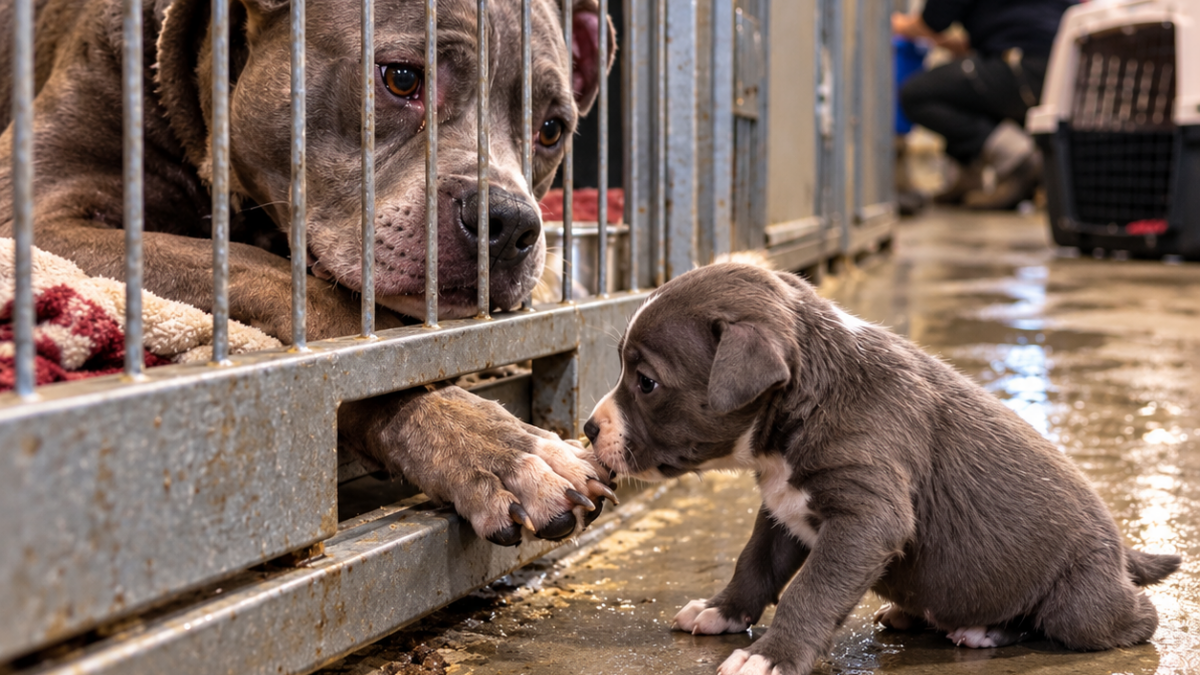
PART 2
For several seconds, none of us moved.
I kept looking from Romy to the damp patch beneath the hatch as if the concrete itself might explain everything we had missed.
Leah was the first to speak.
“That’s possible?”
Camille nodded slowly.
“Possible, yes. Can I prove she was consciously thinking, ‘I’m leaving a scent marker for my blind puppy’? No. We shouldn’t pretend we know exactly what’s in her head.”
She looked down at Feather.
“But we do know this puppy relies heavily on scent. We know Romy repeatedly marked the same point closest to the neighboring kennel. We know she resumed the behavior after we cleaned it. And we just watched Feather orient toward that spot.”
I felt my face grow hot.
Twenty-six days of watching Romy.
Twenty-six days of discussing behavior modification.
Twenty-six days of describing a mother as compulsive because we could not understand the purpose of something she refused to stop doing.
I looked at the kennel card clipped to the door.
**ROMY — FEMALE — APPROX. 3 YEARS**
Beneath it, in my handwriting:
**Repetitive licking behavior. Redirect with enrichment.**
I pulled the card free.
“What are you doing?” Leah asked.
“Fixing something.”
I crossed out the sentence.
Not because it had been dishonest.
At the time, it had been the best interpretation I had.
That almost made it worse.
Romy had never once looked insane.
She had looked focused.
There is a difference.
We had mistaken persistence for pathology because we did not know what she knew.
Feather made a tiny sound.
Romy’s eyes opened.
The puppy was still curled against her paw through the gap, nose pressed deep into the fur.
Romy did not move.
I had seen her restless for nearly a month.
Pacing.
Licking.
Dragging blankets toward the wall.
Standing whenever a puppy cried anywhere in the building.
That evening, for the first time since she had arrived, she slept.
Not lightly.
Not with one ear raised.
She slept so deeply that when someone dropped a stainless-steel bowl farther down the hallway, she barely opened her eyes.
We decided not to put them together immediately.
That was harder than it sounds.
Emotion said open the partition.
Training said slow down.
Feather had spent almost four weeks in intensive veterinary care. She was underweight, weak, visually impaired, and still medically fragile. Romy had recently finished nursing seven other puppies and had been separated from the entire litter after they were transferred to foster homes.
We needed to know how she would respond physically and behaviorally.
So we began with the hatch.
Paw through.
Nose through.
Scent.
Touch.
For the first hour, that was enough.
Feather slept against Romy’s leg.
Romy slept against the wall.
At seven that evening, Camille checked the puppy’s temperature.
Normal.
At seven-thirty, Feather took formula.
At eight, Romy ate her first complete meal in three days.
That alone nearly made me cry.
She had been losing interest in food again.
Not enough to become medically unstable, but enough that we had started discussing appetite stimulants.
That night, she cleaned her bowl.
Then returned to the hatch.
Leah stood beside me.
“You staying?”
“Yes.”
“You’re off at eight.”
“I know.”
It was already eight-ten.
Leah sighed.
“I’ll make coffee.”
That was how the longest night of my shelter career began.
Not with an emergency.
With two animals sleeping on opposite sides of a wall.
And a question none of us knew how to answer.
How had Feather disappeared in the first place?
To explain that, I have to go back twenty-seven days.
Romy had arrived on a Monday morning in the back of an animal-control truck.
I remember the time because I had just poured coffee.
The officer who brought her in, Marcus Bell, came through the intake door and said, “I’ve got a mama and seven.”
I looked inside the truck.
Romy was curled around a pile of puppies inside a large crate.
She was filthy.
Thin.
Gray-brown coat.
White toes.
Long scar across one shoulder.
But alert.
Very alert.
Every time Marcus moved near the crate, her eyes followed his hands.
“Friendly?”
“Depends what you mean.”
“That’s encouraging.”
“She hasn’t tried to bite me.”
“Less encouraging.”
Marcus smiled.
“She lets me get close if I don’t touch the pups.”
The family had been found behind an abandoned tire shop after a delivery driver heard puppies crying beneath a loading platform.
It had taken animal control almost six hours to get everyone out.
At least, everyone they knew about.
That phrase would become important later.
The puppies looked approximately five weeks old.
We counted them during intake.
One.
Two.
Three.
Four.
Five.
Six.
Seven.
Romy kept repositioning herself whenever we moved one.
All normal maternal behavior.
We scanned her.
No microchip.
Checked for tags.
Nothing.
Her body condition was poor but not catastrophic.
She had fleas.
An ear infection.
A healing cut across one rear paw.
Nothing we could not treat.
The puppies were in better shape than expected.
Seven little mixed-breed disasters.
Four boys.
Three girls.
One black.
Two gray.
Three brown-and-white.
One almost cream colored.
They climbed over each other, complained loudly when separated, and attempted to eat anything that smelled remotely edible.
Romy was exhausted by them.
But fiercely attentive.
The moment one squeaked, her head came up.
Our shelter had no room for a nursing family in the main adoption wing, so we placed them in an isolation kennel with a heated nesting area.
For the first twenty-four hours, everything looked straightforward.
Then, on Tuesday afternoon, Romy began searching.
At first we thought she needed outside.
She stood at the kennel door.
Whined.
Turned in a circle.
Checked the puppies.
Returned to the door.
I took her into the enclosed yard.
She relieved herself.
Then dragged me toward the parking lot.
“Easy.”
She pulled.
Hard.
I redirected.
She pulled again.
When we returned to the kennel, she immediately counted—or seemed to count—the puppies with her nose.
One after another.
Then she started pacing.
I wrote in the notes:
**Maternal restlessness. Monitor.**
That evening, she scratched at the back corner of the kennel.
The corner closest to the outside wall.
Wednesday morning, she did it again.
That was when Camille visited.
She worked as a veterinary technician at Oak Ridge Animal Hospital and volunteered with us twice a week.
Camille watched Romy for ten minutes.
“How many pups?”
“Seven.”
“You sure?”
I laughed.
“I can count to seven.”
“I didn’t ask if you could count.”
She pointed to Romy.
“I’m asking whether she can.”
I looked at her.
“You think one is missing?”
“I think she acts like something is missing.”
That was the first time anybody said it aloud.
We called Marcus.
“Did you search the entire site?”
“As much as we could.”
“Could there have been another puppy?”
“There could always be another puppy.”
That answer bothered me.
“Did anyone hear one?”
“No.”
“See one?”
“No.”
“How far did you search?”
“The loading platform, drainage ditch, tire piles, back lot. We even used a thermal camera.”
Nothing.
The property owner had already boarded up the space beneath the loading platform after animal control removed Romy and the litter.
Marcus agreed to go back.
I went with him.
The tire shop had been abandoned for almost two years.
Broken signage.
Weeds through asphalt.
Stacks of old tires beneath a leaning metal awning.
The place smelled like wet rubber and oil.
We searched again.
Under pallets.
Behind scrap.
Inside drainage pipes.
Nothing.
Marcus crouched near the platform where Romy had been found.
“There were seven.”
“You don’t know that.”
“No.”
He sighed.
“I know there were seven we saw.”
I stood.
“What if one wandered?”
“At five weeks?”
“Puppies wander.”
“Not usually far.”
“Usually.”
We expanded the search.
Two neighboring businesses checked security footage.
The rear cameras did not cover the tire-shop platform.
A mechanic from across the alley remembered hearing dogs at night but could not tell us how many.
A homeless man who sometimes slept beneath a nearby overpass said he had seen Romy carrying “something small” across the lot several days earlier.
One puppy?
Food?
Trash?
He could not say.
By sunset, we had found nothing.
I returned to the shelter discouraged.
Romy knew before I reached her kennel that I had been somewhere important.
I still believe that.
Maybe it was the tire-shop smell on my boots.
Maybe grease.
Maybe the scent of the place where she had been living.
She went crazy when I stepped inside.
Not aggressive.
Desperate.
She smelled my shoes.
My jeans.
My hands.
Then ran to the door.
The seven puppies woke and began squeaking.
Romy barely looked at them.
She wanted out.
That was when I stopped thinking Camille was imagining things.
Something was missing.
We searched again Thursday.
Nothing.
Friday, animal control checked nearby storm drains.
Nothing.
Saturday, a volunteer walked the drainage canal half a mile in both directions.
Nothing.
By Sunday, hope began changing shape.
At first we had hoped to find a puppy.
Then we hoped to find evidence.
A sighting.
A sound.
Anything.
We found nothing.
Meanwhile, Romy’s seven known puppies became old enough for foster placement.
Normally we would have kept the family together a little longer.
But space mattered, and the puppies were eating well independently.
More importantly, Romy seemed increasingly distressed by noise in the nursery.
Every cry from a kennel she could not access sent her into another search.
Our veterinarian recommended gradual separation.
The first two puppies left with an experienced foster.
Romy paced for an hour.
Then settled.
Two more left the next day.
Same response.
When the last three transferred, Romy became quiet.
Too quiet.
I expected searching.
Instead, she walked into the empty nesting area.
Smelled every blanket.
Then lay down.
That evening, she began licking the concrete.
The exact square beneath the hatch.
At first, I assumed spilled food.
I cleaned it.
She returned.
Licked again.
The next morning, same spot.
We disinfected.
She waited until it dried.
Started again.
I covered it with a towel.
She moved the towel.
We placed a rubber mat.
She scratched until she exposed the edge.
Then licked the concrete beside it.
Camille watched.
“Maybe self-soothing.”
That made sense.
At least it seemed to.
Dogs develop repetitive behaviors under stress.
Licking can reduce arousal.
Loss of puppies.
Shelter noise.
Confinement.
Everything pointed toward anxiety.
So we treated it like anxiety.
More walks.
Food puzzles.
Quiet time.
Training games.
A calming diffuser.
Extra human contact.
Romy participated in all of it.
Then returned to the wall.
Day five.
Day six.
Day seven.
She licked.
By day ten, the skin on her tongue looked irritated.
That worried us.
We moved her to another kennel.
She spent forty minutes exploring.
Then dragged her bedding across the floor until she had piled it against the wall closest to her original kennel.
That was when we added:
**Possible compulsive component.**
I hate that phrase now.
Not because compulsive behavior does not exist.
Because we had used a label before exhausting the possibility that the behavior had information in it.
Two foster families met Romy.
The first woman watched her lick for almost fifteen minutes.
“Does she do that at home?”
“We don’t know.”
“You think she’ll damage hardwood?”
“Possibly.”
She chose another dog.
The second family had two children.
They loved Romy.
Romy loved them.
Then the father asked why her tongue kept going to the concrete.
I explained.
He frowned.
“I don’t know if we can manage something obsessive.”
They left.
I understood.
That is the part I wish I could change.
I understood too quickly.
On day twelve, Romy heard a puppy crying in intake.
She stood so fast her water bowl overturned.
She pressed her entire body against the kennel door.
When the puppy stopped crying, Romy returned to the concrete.
Lick.
Pause.
Listen.
Lick.
That pattern should have told us something.
It did not.
Day fifteen.
Camille went back to the old tire shop alone.
She did not tell me until later.
At 9:40 that night, my phone rang.
“I found tracks.”
“What?”
“Small canine tracks.”
“Where?”
“In the storm overflow channel behind the lot.”
“How old?”
“No idea.”
“That could be anything.”
“I know.”
“You’re there now?”
“Yes.”
“Camille.”
“I have a flashlight.”
“That was not the concern.”
She ignored me.
“There’s a culvert under the service road. I can’t get through it.”
“Call animal control.”
“I already did.”
Marcus met her.
They searched until nearly midnight.
Again, nothing.
But now Camille became stubborn.
Every free hour she returned to the area.
She placed trail cameras.
Food.
Water.
A humane trap.
Three nights.
Raccoon.
Stray cat.
Raccoon again.
No puppy.
Then, on the fourth morning, one camera recorded movement at 3:17 a.m.
A tiny shape.
Gray.
It appeared for less than four seconds.
Camille called me before sunrise.
“I saw her.”
I sat upright.
“Who?”
“The eighth puppy.”
“How do you know?”
“I don’t.”
Her voice was shaking.
“But there’s a puppy out there.”
The footage was terrible.
Gray blur.
White flash on one rear foot.
Nothing more.
Still, we had a target.
Animal control joined the effort.
The trap was repositioned.
Fresh food.
A small blanket taken from Romy’s kennel.
We did not use the square she had been licking.
At the time, we did not think it mattered.
For two nights, nothing.
On the third night, the camera showed the puppy approach the trap.
She smelled the blanket.
Came closer.
Then walked directly into the side of the cage.
Not the entrance.
The side.
Camille replayed the video.
Again.
Again.
“She can’t see.”
That realization changed the rescue strategy.
A visually impaired puppy navigating an industrial lot was at enormous risk.
Vehicles.
Open drains.
Predators.
Exposure.
We could no longer rely on her finding the trap entrance.
So Camille sat out there.
All night.
She placed food in a long scent trail.
No sudden movements.
No bright lights.
At 4:22 a.m., the puppy appeared.
Camille heard her before she saw her.
Tiny paws on gravel.
A sniff.
Then a collision with a cardboard box placed near the trap.
Camille remained still.
The puppy smelled the food.
Followed it.
Lost the trail.
Circled.
Found it again.
When she came within arm’s reach, Camille did not grab her.
She waited.
The puppy touched Camille’s shoe.
Sniffed her pant leg.
Then sat.
Camille lowered one hand.
The puppy smelled it.
And licked her finger.
That was how Number Eight was found.
Twenty-one days after Romy arrived at the shelter.
The puppy should not have survived that long.
That was what Dr. Singh said when she examined her.
Severe malnutrition.
Dehydration.
Parasites.
An infected scrape along her abdomen.
Congenital visual impairment.
She weighed less than half what her siblings weighed.
Her glucose was dangerously low.
Body temperature low.
The clinic admitted her immediately.
The first night, Camille called me at eleven.
“They don’t think she’ll make it.”
I looked down the hallway toward Romy’s kennel.
“What do we do?”
“We wait.”
I hated that word.
At one in the morning, Number Eight’s glucose dropped again.
At three, she developed diarrhea.
At five, she was still alive.
At seven, she drank formula.
By noon, she drank more.
The clinic staff stopped calling her Number Eight.
Camille named her Feather because she weighed almost nothing when lifted.
I told Romy that evening.
I sat inside her kennel.
“Your baby’s alive.”
Romy smelled my shirt.
Camille had held Feather while wearing it earlier.
Romy’s nose stayed against my sleeve for almost a minute.
Then she walked to the concrete.
Licked.
Paused.
Licked again.
I remember thinking grief had made the behavior worse.
I could not have been more wrong.
Feather remained hospitalized five more days.
She gained ounces.
Her infection responded.
Her hydration improved.
A veterinary ophthalmologist examined her and determined that her vision loss was developmental, not caused by her time outside.
She could perceive brightness.
Large nearby movement.
Maybe some contrast.
But detailed vision was absent.
“How did she survive?” I asked Camille.
“Scent.”
“Twenty-one days?”
“Scent. Sound. Luck. Hiding.”
“And Romy.”
Camille looked at me.
“What about her?”
“Do you think she knew the puppy couldn’t see?”
Camille thought.
“She raised her from birth.”
That was all she said.
At the time, I did not understand the importance.
On day twenty-six, Feather returned.
And followed the wet concrete to her mother’s paw.
That night, we moved them into our medical family room.
No partition.
No hatch.
I expected Romy to rush Feather.
She did not.
When we opened the connecting door, Romy entered slowly.
Feather was lying on a blanket.
Romy approached.
Smelled her head.
Her ears.
Her back.
Then she reached the white hind paw.
Romy stopped.
Her nose remained there.
Feather turned.
Touched Romy’s chest.
Then suddenly began crawling beneath her belly.
Romy lay down immediately.
Feather searched for a nipple.
Romy’s milk had mostly dried up.
There was very little to offer.
Feather did not seem to care.
She nursed for comfort.
Romy cleaned her.
Slowly.
Methodically.
Head.
Ears.
Back.
White paw.
Then again.
I sat on the floor with Camille.
“You really think the licking was for her?”
Camille watched them.
“I think Romy built routines around this puppy before we ever met either of them.”
“What kind?”
“We don’t know.”
She pointed toward Feather.
“She probably learned early that Feather didn’t orient like the others. Maybe Romy used scent more. Maybe she licked bedding, floors, her own paws. Maybe Feather learned to find her through those markers.”
“And Romy kept doing it when Feather was missing?”
“Maybe.”
“That sounds almost too deliberate.”
“Then don’t call it deliberate.”
Camille looked at me.
“Call it a behavior that had meaning before we decided it was meaningless.”
That was the lesson.
Not that Romy had developed a human plan.
Not that she understood blindness in medical terms.
We did not need to invent any of that.
The observable facts were already remarkable enough.
Romy marked.
Feather oriented.
Mother and puppy had developed a system.
And we had almost trained Romy out of it.
The next morning, Romy did not lick the old concrete square.
Not once.
I checked at seven.
Nothing.
Nine.
Nothing.
Noon.
Still dry.
Leah walked past me.
“You’ve checked that floor five times.”
“I know.”
“You realize Romy isn’t even in that kennel anymore.”
“I know.”
“Then why are you checking?”
I didn’t answer.
Because part of me needed proof.
At two, I went into the family room.
Romy was asleep.
Feather was three feet away, wandering.
She bumped gently into the side of a dog bed.
Stopped.
Sniffed.
Turned.
Romy opened one eye.
Then lowered her muzzle and licked her own front paw.
Feather’s head lifted.
She changed direction.
Walked toward the sound and scent.
Reached Romy.
Curled against her.
I sat down on the floor.
There it was.
Not the concrete.
The system.
Over the next two weeks, Feather improved dramatically.
Not visually.
That did not change.
But strength transformed her.
The trembling puppy became curious.
Then stubborn.
Then surprisingly fast.
She learned the family room in less than two days.
Food bowl beside textured mat.
Water dish near the wall.
Bed with a raised edge.
Doorway marked by another kind of rug.
We began using different floor textures to help her orient.
Rubber mat meant water.
Soft runner meant resting area.
Ribbed mat meant door.
Camille added small scent cues.
Nothing strong or irritating.
Tiny, distinct safe smells placed consistently near important locations.
Feather learned faster than we did.
Within a week, she could navigate the room without bumping into anything unless somebody moved furniture.
The first time I moved a stool three feet to the left, Feather walked directly into it.
Not hard.
Still, I felt terrible.
Camille looked at me.
“Congratulations.”
“For what?”
“You just learned the first rule.”
“Don’t move furniture.”
“Exactly.”
Romy learned too.
If we changed something, she investigated first.
Then returned to Feather.
Sometimes she would walk from the puppy to the new object and back again.
Was she teaching?
Maybe.
Was Feather following Romy’s scent and movement?
Certainly.
The distinction mattered.
We stopped assigning complex human motives to everything.
We also stopped underestimating them.
Feather’s siblings were thriving in foster homes.
We contacted every foster family with an update.
One by one, photos came back.
Big bellies.
Longer legs.
Chewed shoes.
Destroyed beds.
Normal puppy chaos.
Romy saw none of those photographs in the way we did, of course.
But when two siblings returned for vaccinations, we arranged a controlled reunion.
Feather was in the family room.
Romy recognized the puppies instantly.
The reaction was much louder than her reunion with Feather.
Tail wagging.
Whining.
Sniffing.
One puppy attempted to climb onto her back.
The other grabbed her ear.
Romy corrected them both.
Then Feather wandered toward the noise.
One brother barreled into her.
Feather yelped.
Romy stepped between them immediately.
Not aggressive.
Firm.
The brother backed off.
Feather smelled him.
Tail wagged.
Within minutes, all three puppies were rolling around on a blanket.
I watched Romy.
She did something I had never noticed before.
Whenever Feather drifted too far from the group, Romy went to her.
Touched noses.
Then returned.
Feather followed.
Again.
And again.
Camille stood beside me.
“See it?”
“Yes.”
This time I did.
Romy was not treating Feather exactly like the others.
She adjusted.
Whatever that meant inside a dog’s mind, the behavior was real.
The shelter’s original plan had been simple.
Once Romy was medically cleared, find an adult-dog foster.
Once Feather was stable, find an experienced special-needs puppy foster.
Separate placements.
Now nobody liked that plan.
Not because separation was automatically cruel.
Puppies normally leave their mothers.
They grow.
They form new bonds.
Keeping every mother with every puppy forever is neither necessary nor practical.
But Feather’s situation was different.
She used Romy as an orientation anchor.
Romy’s anxiety had dramatically decreased after Feather returned.
When separated even briefly for veterinary checks, both became more unsettled.
So we postponed.
“Bonded pair?” Leah asked during our placement meeting.
Our behavior consultant, Dr. Melissa Chen, shook her head.
“Not yet.”
I expected the opposite.
“Why not?”
“Because ‘bonded’ is a useful term, but people use it too quickly.”
She looked at her notes.
“We need to know whether they truly function poorly apart, or whether this is simply a strong maternal relationship during recovery.”
“So what do we do?”
“Test carefully.”
I hated the word test.
But she was right.
We started with two-minute separations.
Romy in the hallway.
Feather in the room with Camille.
Feather searched.
Romy whined.
Two minutes.
Reunite.
Then five.
Then ten.
By ten minutes, Romy could settle with a handler if she had a scent item from Feather.
Feather could settle if the room remained familiar.
That was good.
It meant we were not dealing with a relationship so dependent that separation caused panic.
But something else became clear.
Feather learned new spaces dramatically faster with Romy present.
At our training room, Feather needed twenty-four minutes to confidently locate water when introduced alone.
With Romy walking the perimeter first?
Seven minutes.
Repeated trials showed the same pattern.
Romy was not required for Feather to function.
She made the world easier to understand.
That was different.
And perhaps more important.
We decided to seek a home willing to adopt both.
That decision caused immediate trouble.
Not malicious trouble.
Practical trouble.
Adult dog plus special-needs puppy.
Two veterinary histories.
Training requirements.
A puppy who could not see normally.
A mother with a documented history—now corrected—of repetitive licking.
Applications came in.
Many disappeared after a phone conversation.
One family loved Romy but wanted a “normal puppy.”
Another loved Feather’s story but already had three dogs and could not add an adult.
A woman offered to adopt Feather alone because she had experience with blind dogs.
We considered it seriously.
She had a good home.
Fenced yard.
Quiet routine.
Excellent references.
If we could not place them together, she would have been a strong candidate.
Then something happened during her meet-and-greet.
The woman, Sandra, sat on the floor.
Feather approached.
Smelled her.
Accepted treats.
All good.
Romy rested six feet away.
Sandra asked, “Can I take Feather into the next room alone?”
Dr. Chen nodded.
They went.
For the first two minutes, Romy remained calm.
At minute three, she stood.
At minute four, she walked to the door.
At minute five, she began licking the threshold.
Not compulsively.
Once.
Twice.
Pause.
Listen.
Lick.
My stomach turned.
Sandra returned with Feather.
The puppy crossed the room directly to the threshold.
Smelled the spot.
Then found Romy.
Sandra looked at us.
“Oh.”
That was all.
She understood.
Afterward, she withdrew her application.
Not because she no longer wanted Feather.
Because she wanted what was best for her.
“If you ever decide they truly need separate homes, call me,” she said.
I promised we would.
Another six days passed.
Then an application arrived from a couple named Aaron and Maya Collins.
Their first sentence worried me.
**We saw Romy and Feather’s story online and fell in love immediately.**
Emotional applications can be dangerous.
People fall in love with narratives.
Then the animal arrives.
The dog urinates on a rug.
The puppy screams at 3 a.m.
The special-needs animal requires management.
The story stops feeling magical.
So I called them prepared to be difficult.
“You understand Feather is visually impaired?”
Maya said, “Yes.”
“How impaired?”
“She has light perception and probably some close movement detection, but functionally she should be treated as blind in unfamiliar environments.”
I paused.
Correct answer.
“Where did you get that?”
“Your adoption notes.”
“You read all of them?”
“All eleven pages.”
That was annoying.
Promising, but annoying.
I continued.
“Romy may lick surfaces.”
Aaron answered this time.
“If it increases again, we’d first look for stress or a communication pattern before calling it compulsive.”
I stared at my notes.
“Who are you people?”
Maya laughed.
“My sister trains service dogs.”
That explained some of it.
Their house was outside town.
One level.
Fenced yard.
No children under twelve.
One older dog named Gus.
They had owned him for ten years.
No cats.
Maya worked from home three days a week.
Aaron was a middle-school music teacher.
They were looking for two dogs after losing their second senior dog six months earlier.
I still distrusted them.
That is my job.
We scheduled a meeting.
Gus came first.
Neutral territory.
Romy approached him cautiously.
He smelled her.
She smelled him.
Both decided the other was boring.
Excellent.
Feather approached next.
Gus looked at her.
Feather walked into his chest.
He stepped back.
She smelled his front leg.
Gus sat down.
Feather leaned against him.
Maya covered her mouth.
I pointed at her.
“Don’t.”
“What?”
“Fall in love yet.”
“Too late.”
“I’m serious.”
“I know.”
Aaron crouched but did not call Feather.
That mattered.
He waited for her to find him.
She did.
He held his fingers near the ground.
Feather smelled them.
Then sat on his shoe.
Romy watched.
After twenty minutes, Romy walked over.
Aaron did not touch her.
She smelled his shoulder.
His hair.
Then his hand.
Finally, she leaned into him.
I looked at Leah.
Leah looked away because she was smiling.
Still, one good meeting means very little.
We visited their house.
That mattered more.
The first thing I noticed was the furniture.
Stable.
Wide pathways.
No open staircase.
No pool.
No clutter at dog height.
The yard fence was secure.
Maya had already added textured mats at the patio door and water station.
“You didn’t need to do that before approval.”
“I know.”
“What if we say no?”
She shrugged.
“Then Gus gets fancy mats.”
Gus was lying on one.
He seemed satisfied.
Dr. Chen tested Feather in the home.
We placed her near the living-room entrance.
She hesitated.
Romy entered first.
Walked the room.
Smelled the couch.
Water.
Gus.
Patio door.
Then came back.
Feather found her.
Within fifteen minutes, Feather had mapped half the room.
Within thirty, she found the water independently.
That was faster than expected.
Then Aaron accidentally dropped a metal travel mug.
The clang echoed.
Feather froze.
Romy immediately moved beside her.
Nose to cheek.
One lick.
Feather relaxed.
I wrote nothing.
There was no need.
We all saw it.
The adoption trial began the following week.
I cried in the parking lot.
Quietly.
Camille caught me.
“You’re terrible at goodbyes.”
“I’m not crying.”
“You are.”
“Wind.”
“We’re indoors.”
“Air conditioning.”
She handed me a tissue.
Romy and Feather left together.
For the first time since arriving at our shelter, Romy walked through the front doors without looking back toward the kennel corridor.
Maya sent updates every few hours.
**5:40 p.m. — Both ate.**
**7:15 — Feather found water.**
**8:02 — Romy stole Gus’s bed. Gus accepted defeat.**
Then a photograph.
Romy asleep.
Feather curled against her left foreleg.
The same leg Romy had pushed beneath the hatch twenty-six days after they were separated.
I stared at that photo for a long time.
The first night went well.
The second did not.
At 2:13 a.m., Maya called.
My heart jumped.
“What happened?”
“Feather’s crying.”
“Where’s Romy?”
“Right beside her.”
That confused me.
“What changed?”
“We moved their bed.”
I sat up.
“You what?”
“Only across the room. Gus kept blocking the hallway.”
There it was.
The first rule.
Don’t move things casually.
“Put it back.”
They did.
Feather stopped crying within minutes.
Maya sounded embarrassed.
“I knew that.”
“Knowing and living with it are different.”
“Are you mad?”
“No.”
I smiled in the dark.
“You just learned your first lesson.”
By the end of the first week, they had learned twenty more.
Do not leave dining chairs pulled out unpredictably.
Do not move water bowls.
Use words before touching Feather when she is asleep.
Give her time to locate unfamiliar voices.
Let Romy investigate new spaces first when possible.
Do not assume a blind puppy is helpless.
That last one mattered.
Feather was not helpless.
She was chaos.
She learned to climb onto the couch.
Then learned to jump off.
Then learned that jumping from the back of the couch was also physically possible and emotionally devastating to every human in the room.
She chased Gus by sound.
Stole Romy’s toys.
Learned the kitchen boundaries.
Found dropped food faster than sighted dogs.
And developed the alarming ability to locate Aaron whenever he opened peanut butter.
“She can’t see,” he told me during our first follow-up, “but apparently she can detect peanut butter through walls.”
“That’s not a visual skill.”
“It feels supernatural.”
Romy changed too.
At the shelter, there had always been tension in her body.
Even after Feather returned.
A readiness.
At Maya and Aaron’s house, it gradually disappeared.
Her shoulders softened.
She slept on her side.
Then on her back.
She stopped waking at every small noise.
Most importantly, the licking decreased.
Not vanished.
Decreased.
She still licked thresholds sometimes when Feather was in another room.
She licked her paw to call Feather’s attention.
She occasionally licked a mat near the back door when everyone prepared to go outside.
Now we watched before labeling.
What happened next?
Usually Feather appeared.
That was enough.
The two-week adoption trial became a month.
Then permanent.
Maya signed first.
Aaron signed second.
Romy placed one paw directly on the paperwork.
“Witness,” Aaron said.
Feather attempted to eat the corner.
“Legal counsel,” I replied.
Gus slept through the entire proceeding.
Three months later, Feather underwent another ophthalmology evaluation.
No meaningful improvement.
Her visual limitation was permanent.
Maya called me afterward.
“She’s blind.”
“You knew that.”
“I know.”
Her voice sounded strange.
“Are you okay?”
“Yes. I think part of me kept hoping there’d be surgery.”
“There isn’t?”
“Not for what she has.”
I sat with that.
“How are you feeling?”
“Sad.”
“That’s allowed.”
“She doesn’t seem sad.”
“No.”
In the background, I heard a crash.
Then Aaron shouted, “Feather!”
Maya sighed.
“She just stole the recycling.”
I laughed.
“Definitely devastated.”
That became our running joke.
Feather never got the memo that she was supposed to live cautiously.
At six months, she learned the yard so thoroughly that she could run full speed along a route between the porch, maple tree, fence, and back door.
The first time I saw it, I panicked.
“Slow down!”
Maya grabbed my arm.
“Watch.”
Feather ran.
Six strides.
Slight left.
Four strides.
Around the tree.
Straight to the fence.
Turn.
Back.
No collision.
No hesitation.
Romy ran behind her.
Not guiding.
Just running.
Feather knew.
Her body had mapped the world.
That was another thing Romy taught us.
Guidance is not the same as control.
At first, everyone wanted to help Feather constantly.
Move obstacles.
Touch her before she bumped something.
Carry her.
Call her repeatedly.
Romy did not do that.
She allowed Feather to make mistakes.
If Feather bumped a bed, Romy did not panic.
If she went the wrong direction, Romy sometimes waited.
If Feather became truly confused, Romy intervened.
That distinction made Feather independent.
Dr. Chen later used videos of them in educational sessions for foster families raising blind dogs.
Not because Romy was a trained guide dog.
She was not.
Because her behavior showed how much information dogs exchange through scent, proximity, touch, and routine—channels humans often ignore because vision dominates our own experience.
The old concrete square became famous around the shelter.
I wish I could say I was proud of that.
Mostly, it embarrassed me.
Visitors sometimes asked to see it.
I hated that.
“It’s just concrete,” I would say.
But one afternoon a new volunteer named Noah stood beside it.
“This is where she kept licking?”
“Yes.”
“And you thought she had OCD?”
“We thought several things.”
“What made you realize?”
“Feather.”
He looked at the floor.
Then at me.
“How do you know when a weird behavior means something?”
That was a good question.
“You don’t always.”
“That’s not helpful.”
“It’s accurate.”
I leaned against the kennel door.
“You rule out medical problems. Look at context. Track when it happens. What happened before? What happens after? Does the environment change the behavior? Does another animal respond?”
“And if you still don’t understand?”
“Stay curious longer.”
I wish someone had told me that years earlier.
Stay curious longer.
Not romantic.
Not dramatic.
Useful.
Six months after adoption, one of Romy’s other puppies developed a problem.
A male named Jasper had been adopted by a family with two teenagers.
Wonderful home.
Then suddenly he began refusing to enter the laundry room.
The family assumed he had slipped.
Maybe a machine frightened him.
They contacted us.
Normally it would have been a minor behavior consultation.
But after Romy, I asked more questions.
“When did it start?”
“Tuesday.”
“What changed Tuesday?”
“Nothing.”
“Nothing at all?”
Silence.
Then the mother said, “We replaced the dryer.”
Different sound.
Different vibration.
Different smell.
Jasper was not stubborn.
The new machine frightened him.
Simple.
We introduced it gradually.
Treats.
Distance.
Door open.
Machine off.
Then on briefly.
Within a week, he entered normally.
That problem would have been solved eventually anyway.
But I noticed something.
My first question had changed.
I no longer asked:
**How do we stop this behavior?**
I asked:
**What is the behavior responding to?**
Romy had changed the way I worked.
A year after her adoption, Maya invited the shelter staff to their home.
Almost everyone came.
Romy greeted us as if she remembered every scent.
Feather was fully grown.
Not large.
Maybe thirty-five pounds.
Blue-gray coat.
White chin.
White rear paw.
She navigated the crowd beautifully until someone left a purse in the middle of the hallway.
Feather walked into it.
Stopped.
Smelled it.
Then stole a granola bar from an open pocket.
Maya pointed.
“Crime victim.”
The purse owner laughed.
Romy lay beneath the dining table.
At one point, Feather lost track of her in the crowd.
I watched closely.
Feather stopped.
Listened.
People were talking.
Music low.
Gus snoring.
Feather turned her head.
Romy stood.
Walked two steps toward the hallway.
Then lowered her head.
Lick.
Once.
On the hardwood.
Feather’s nose lifted.
She crossed the room.
Found Romy.
I looked at Camille.
Camille looked at me.
Neither of us said anything.
We did not need to.
Later that evening, I sat on the back steps with Maya.
“You ever think about separating them?”
“No.”
“Not even once?”
She considered.
“When Feather was about nine months old, I wondered if keeping them together was stopping her from becoming independent.”
“And?”
“So I watched.”
Maya pointed toward the yard.
Feather was exploring alone near the fence.
Romy was asleep on the porch.
“Turns out independence doesn’t require distance.”
That sentence stayed with me.
Feather could function without Romy.
She played without her.
Slept separately sometimes.
Worked with trainers alone.
Went to veterinary appointments alone.
But when the world became confusing, Romy remained a reference point.
That was not weakness.
Humans do the same thing.
We just use different signals.
Two years passed.
Gus died at fifteen.
His decline had been slow.
Arthritis.
Kidney disease.
Then appetite loss.
Maya called me afterward.
“I’m worried about Feather.”
“Why?”
“She keeps checking his bed.”
That was normal enough.
“What does Romy do?”
“Nothing.”
“Nothing?”
“Mostly sleeps.”
We talked about grief in dogs.
Routine disruption.
Scent persistence.
Searching.
For several days, Feather visited Gus’s bed.
Smelled it.
Walked away.
Then less often.
Romy never developed a new repetitive behavior.
No concrete licking.
No pacing.
Nothing like before.
That mattered.
It suggested the original behavior had been specific.
Not simply Romy’s universal response to loss.
A particular relationship.
A particular puppy.
A particular system.
Another year passed.
Romy was around six.
Feather almost three.
Maya and Aaron moved.
I was terrified for Feather.
They were careful.
They brought rugs, beds, bowls, and familiar furniture first.
They mapped the new house with textured runners.
Kept layouts simple.
Introduced one room at a time.
Romy walked each room before Feather.
For the first two nights, Feather slept poorly.
On the third day, she ran into a coffee table hard enough to bruise her shoulder.
Maya cried when she called.
“I failed.”
“No.”
“I knew better.”
“You moved to a new house. She’s learning.”
“I should’ve blocked the table.”
“Maybe.”
Silence.
“That’s not very comforting.”
“You don’t need comforting. You need a plan.”
We moved the table.
Added texture.
Reduced the accessible area temporarily.
Within a week, Feather knew the main floor.
Within three weeks, the yard.
Within two months, she moved as confidently as before.
Romy adapted faster.
One night, Maya sent me a video.
Feather had become disoriented after a thunderclap.
Romy walked to the bedroom doorway.
Licked the threshold.
Feather found her.
Then both climbed onto the bed.
Aaron’s voice came from behind the camera.
“I have accepted that our floors are part of a canine navigation system.”
I replayed that video at least ten times.
Not because the behavior was miraculous.
Because it was so ordinary to them now.
The thing we had once pathologized had become household language.
Five years after the shelter, Camille and I returned to the abandoned tire shop.
It was scheduled for demolition.
The property had finally been sold.
I had not been there since Feather’s rescue.
The loading platform remained.
So did the drainage culvert.
Camille stood beside it.
“She was somewhere in there.”
“You really thought she was going to die?”
“Yes.”
“You never told me how close.”
Camille looked at the ground.
“The first night at the clinic, her glucose crashed twice. Dr. Singh thought she might arrest.”
I swallowed.
“Why didn’t you tell me?”
“What would you have done?”
“Panicked.”
“Exactly.”
We walked behind the building.
The trail-camera location was overgrown.
The humane trap had been placed near a concrete drainage wall.
I tried to imagine Feather navigating it blind.
Every edge.
Every noise.
Every unknown surface.
“How did she survive?”
Camille shrugged.
“We’ve asked that for five years.”
Then she smiled.
“Apparently stubbornness runs in the family.”
Before leaving, I looked beneath the old loading platform where Romy’s litter had been found.
Seven puppies removed.
One left behind.
For years, I had imagined it as a mistake by animal control.
But even that interpretation became less certain.
Feather may have wandered before rescuers arrived.
She may have been hiding deeper than the others.
Romy may have moved her.
We would never know.
I had learned to tolerate that.
Not every blank needs to be filled.
Not knowing does not weaken what we do know.
Romy had eight puppies.
Seven came out with her.
One survived alone.
Romy behaved as if someone was missing.
Feather returned.
The behavior stopped.
Years later, it still guided her.
That was enough.
As Romy aged, her muzzle became white.
Feather remained attached to her, but their relationship changed.
Romy stopped mothering her in obvious ways.
Feather became the energetic one.
The instigator.
The toy thief.
Sometimes Romy would be sleeping and Feather would drop a ball directly onto her head.
Romy would growl.
Feather would do it again.
No reverence.
No sentimental gratitude.
They were family.
Family is annoying.
At eight, Romy developed arthritis.
For the first time, Feather began adjusting to her.
When Romy slowed on walks, Feather stopped rushing ahead.
When Romy struggled getting onto the couch, Feather waited on the floor.
At night, Feather started sleeping closer.
Maya noticed something else.
“She’s licking.”
My body reacted before my mind did.
“Where?”
“Romy.”
“What do you mean?”
“Her front paw.”
I asked Maya to send video.
Feather lay beside Romy.
Romy’s left front paw stretched between them.
Feather licked it slowly.
The same paw that had gone beneath the shelter hatch years earlier.
I watched once.
Twice.
Then stopped.
We did not need to explain it.
Not medically.
Not behaviorally.
Not poetically.
It was simply part of how those two dogs touched the world.
Romy reached eleven before serious illness came.
A routine blood panel showed abnormalities.
Further testing found a mass near her spleen.
Surgery was possible.
Risky, but reasonable.
The mass was removed.
Benign.
We celebrated.
Romy recovered.
Another year.
Then heart disease.
Medication.
Slower walks.
More sleep.
At twelve and a half, she began refusing breakfast.
Maya called me.
I knew from her voice.
The veterinarian found advanced heart failure.
Medication could buy time.
Not much.
A week.
Maybe several.
Maya chose comfort care at home.
I visited the following Saturday.
Romy was lying near the sliding door in a square of sun.
Feather rested beside her.
Romy lifted her head when I entered.
Her tail moved.
Once.
I sat beside her.
“Hey, floor licker.”
Maya laughed through tears.
“That’s awful.”
“She knows I mean it affectionately.”
Romy put her nose against my wrist.
Feather smelled my shoes.
Then climbed partly into my lap despite being much too large.
We sat there for an hour.
At one point, Romy stood to drink.
Her legs shook.
Feather followed.
Not touching.
Just close.
Romy returned to bed.
Feather returned too.
I remembered the shelter hatch.
The white paw.
Romy’s left leg sliding beneath the gap.
It felt like another lifetime.
The veterinarian came to the house four days later.
Maya called me that morning.
“If you want to be here.”
I did.
Camille came too.
Aaron sat on the floor.
Maya beside him.
Romy on her favorite bed.
Feather paced.
That concerned us.
So Dr. Chen, who had become a friend of the family over the years, suggested we let Feather investigate everything.
The medical bag.
The blanket.
The veterinarian.
No rushing.
Feather smelled them all.
Then returned to Romy.
The sedative was given.
Romy relaxed.
Her breathing eased.
Feather lay beside her.
For several minutes, nothing happened.
Then Romy moved her left front paw.
Barely.
It slid across the blanket until it touched Feather.
Feather froze.
Her nose dropped.
She licked Romy’s paw.
Once.
Romy’s eyes closed.
Feather licked again.
I turned my face away.
Camille was crying openly.
No one tried to stop Feather.
The veterinarian waited.
When Romy was fully asleep, Maya leaned close.
“You found her.”
Her voice broke.
“You kept finding her.”
Then the final medication was given.
Romy’s breathing slowed.
Stopped.
Feather remained beside the paw.
She smelled Romy’s face.
Chest.
Leg.
Returned to the paw.
Licked once.
Then lay down.
We gave her time.
Nobody knew exactly what Feather understood.
Again, we refused to invent certainty.
But she did not search the house afterward.
That mattered to Maya.
For the first few days, Feather was quieter.
She slept on Romy’s bed.
Ate.
Walked.
Played less.
Then gradually resumed routine.
One evening, Maya called me.
“She’s at the back door.”
“Okay.”
“She keeps waiting.”
My stomach tightened.
“For Romy?”
“I don’t know.”
“What happens if you open it?”
“She goes outside. Smells around. Comes back.”
“Any licking?”
“No.”
“Eating?”
“Yes.”
“Sleeping?”
“Yes.”
We monitored.
The behavior faded.
Feather grieved.
But she did not become Romy.
She did not recreate the twenty-six days.
There was no need.
Her world had been built differently.
Years earlier, Romy had been separated from a vulnerable puppy whose location she could not know.
Feather had been present when Romy died.
No mystery.
No missing scent trail to maintain.
Maybe that difference mattered.
Maybe not.
But watching Feather adapt made the original story even clearer to me.
Romy’s licking had never simply meant sadness.
It belonged to a very specific situation.
Six months after Romy’s death, Maya brought Feather to the shelter.
By then, nearly thirteen years had passed since that evening at 5:11.
The facility had been renovated.
New flooring.
New kennel doors.
Better soundproofing.
The old concrete section was scheduled for replacement.
I had asked maintenance to delay one square.
Not forever.
Just long enough.
Maya thought I was ridiculous.
She brought Feather anyway.
The hallway smelled different.
Feather moved slowly.
Age had caught up with her too.
Gray chin.
Stiff rear legs.
But her nose still worked.
We approached the old kennel.
The hatch had been removed years earlier.
Only the outline remained.
Feather stepped inside.
She smelled the floor.
The walls.
The drain.
Then she reached the square.
The exact one.
I held my breath.
Feather stopped.
Her nose moved over the concrete.
Once.
Twice.
She stood there for perhaps ten seconds.
Then she turned toward Maya.
That was all.
No dramatic reaction.
No collapse.
No miraculous recognition we could prove.
She simply smelled an old place and walked away.
At first, I felt disappointed.
Then I realized why.
I had been doing it again.
Trying to make animal behavior satisfy a human story.
Feather did not owe me a scene.
Romy did not owe me a symbol.
The concrete mattered because of what we had witnessed there.
It did not need to remain sacred to the dog.
The following week, maintenance removed the floor.
I watched them jackhammer the square apart.
No ceremony.
Dust.
Noise.
Chunks of concrete in a wheelbarrow.
Noah, now one of our senior technicians, stood beside me.
“Want me to save a piece?”
I almost said yes.
Then I laughed.
“No.”
“You sure?”
“It’s concrete.”
He smiled.
“That’s what you always said.”
This time I meant it.
Romy was not in that floor.
Neither was Feather.
What mattered had already moved beyond it.
Into a house.
Across years.
Through routines.
Into the way our shelter evaluated behavior.
Into every staff member who learned to ask one extra question before using a label.
Into every foster home that heard Feather’s story and stopped treating blind dogs as broken.
Into me.
Feather lived another year and a half.
At fourteen, she was almost completely deaf in addition to being blind.
That created new challenges.
Vibration became more important.
Maya would tap the floor before approaching.
Textured paths mattered even more.
Feather adjusted.
She always adjusted.
Her final decline was kidney disease.
Slow.
Manageable until it wasn’t.
When the time came, Maya did not bring her to the shelter or clinic.
The veterinarian came home.
Feather lay on Romy’s old bed.
Maya called me afterward.
“She went quietly.”
I sat at my kitchen table.
For a while neither of us spoke.
Then Maya said, “I did something stupid.”
“What?”
“I put my hand on the floor beside her.”
I knew immediately.
“And?”
“I licked my finger and touched the floor.”
I closed my eyes.
“Maya.”
“I told you it was stupid.”
“No.”
She was crying now.
“She smelled it.”
I couldn’t speak.
“She moved her nose to my hand and fell asleep.”
After we hung up, I stayed at the table until it was dark.
I thought about 5:11.
The carrier.
Camille’s wrinkled scrubs.
Feather walking the wrong direction.
Romy lowering her muzzle.
One lick.
Pause.
Another.
A puppy turning toward a signal the rest of us could neither see nor understand.
For twenty-six days, we had looked at the same behavior and asked what was wrong with the dog.
We never asked the more important question.
Who was she trying to reach?
That question followed me through the rest of my career.
Every frightened dog.
Every pacing dog.
Every animal that refused a doorway, guarded a blanket, stared at an empty kennel, barked at a specific sound, or repeated something we could not immediately explain.
Sometimes the answer was pain.
Sometimes anxiety.
Sometimes habit.
Sometimes a neurological problem.
Sometimes trauma.
And sometimes the behavior was carrying information we had not learned how to read yet.
Years after Romy and Feather were gone, a young staff member brought me a chart.
“Can you look at this dog?”
“What’s happening?”
“He keeps scratching the same wall.”
“How long?”
“Three days.”
“What have you tried?”
“More exercise. Enrichment. Redirecting.”
I almost smiled.
“Good.”
She looked confused.
“Good?”
“You tried reasonable things.”
I stood.
“Now show me the wall.”
We went together.
I did not know what we would find.
Maybe nothing.
Maybe mice behind drywall.
Maybe a smell.
Maybe anxiety.
Maybe a behavior without some hidden dramatic explanation.
That was okay.
Understanding is not about forcing every act to become meaningful.
It is about refusing to declare something meaningless simply because the meaning has not reached us yet.
We entered the kennel.
The dog scratched.
Then stopped.
Pressed his nose to a vent.
I crouched.
From somewhere on the other side came the faintest sound.
A puppy barking in intake.
The young technician looked at me.
I smiled.
“Start there.”
Sometimes I still think about that square of concrete.
Not because Romy licked it.
Because of the arrogance with which I once believed seeing a behavior meant understanding it.
Romy taught me otherwise without ever knowing she was teaching anything.
She simply kept doing what made sense in her world until, finally, we caught up.
And when Feather returned after twenty-six days, half blind, weak, and following a trail none of us could see, Romy did not celebrate the way humans imagine mothers should.
She did something much quieter.
She put one paw beneath a door.
She waited.
And this time, the puppy she had been calling finally found her.
[END OF STORY]








