PART 2: For 19 Nights, a Starving Cat Left Her Dead Kitten at Our Fire Station—On Night 20, I Finally Understood Why
PART 2
The station went quiet.
Nobody needed to tell anyone to stop talking.
We had spent nineteen nights watching that cat appear from the same darkness, and by then the sound of the door opening felt almost like part of a ritual.
I stood several feet back from the entrance.
Owen was behind me.
Gareth leaned against the wall.
Nobody moved.
The Siamese emerged slowly.
The kitten hung from her mouth.
Even after nineteen nights, seeing that tiny gray body still tightened something in my chest.
She crossed the edge of the light.
One step.
Another.
Then she climbed onto the concrete step and lowered the kitten exactly where she always did.
Center.
Directly in front of the entrance.
She released it.
Then backed away.
Four feet.
She sat.
Her ribs showed beneath her filthy coat.
Her ears remained forward.
Her blue eyes locked on the doorway.
I opened it.
The cat tensed.
Normally, this was the point when everything happened quickly.
One of us stepped toward the kitten.
She moved.
We moved.
She grabbed it.
Then disappeared.
This time I ignored the kitten completely.
I stepped outside.
The cat’s body lowered.
I stopped.
“Easy.”
Behind me, Owen whispered, “Claire.”
I lifted one hand without turning around.
Stay.
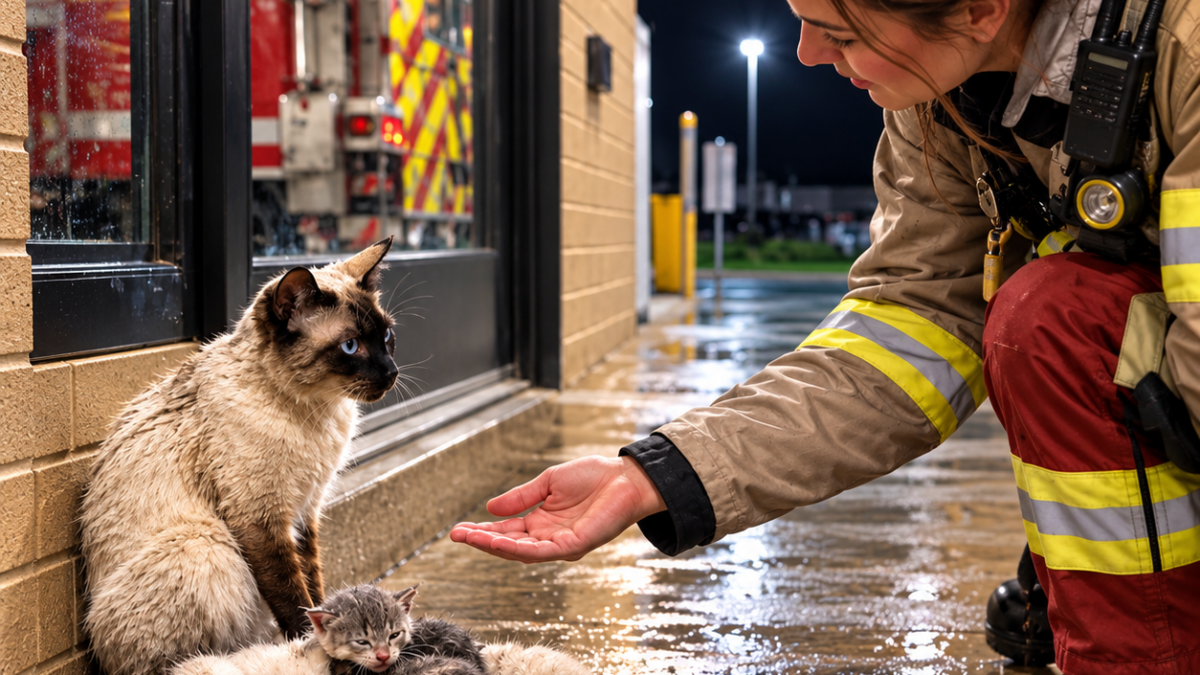
I lowered myself to the concrete.
Not close to the kitten.
Not close enough to corner the mother.
Just low.
Small.
Still.
Her eyes moved to my hands.
I put both palms flat on my knees.
For perhaps twenty seconds, nobody moved.
The wind carried the smell of salt from the harbor mixed with old diesel and wet metal.
The cat looked at the dead kitten.
Then at me.
I slowly extended one hand.
Not toward the kitten.
Toward her.
She froze.
Every muscle in her narrow body seemed to tighten.
“Come on,” I whispered.
She did not come.
I had not expected her to.
But she did not pick up the kitten either.
That was new.
I stayed exactly where I was.
Thirty seconds.
Maybe a minute.
The cat looked behind her.
Toward the abandoned warehouses.
Then at me again.
Her body rose.
I thought I had lost her.
I thought she would grab the kitten and run.
Instead, she left it.
For the first time in nineteen nights, she left the dead kitten on our doorstep.
She turned.
Walked several feet.
Stopped.
Looked back.
My heart started pounding.
Owen whispered behind me.
“She’s waiting.”
I nodded.
The cat walked farther.
Stopped again.
Looked back.
“She wants you to follow,” Gareth said.
Maybe.
But after nineteen nights of misunderstanding her, I was terrified of making another wrong move.
I stood slowly.
The Siamese disappeared into the darkness.
I waited.
One minute.
Two.
Nothing.
Owen stepped closer to the doorway.
“Should we go?”
“I don’t know.”
Three minutes.
The dead kitten remained between us.
For the first time, it looked less like an object she was protecting and more like something she had deliberately left.
I was about to move toward the alley when Gareth said, “There.”
A pale shape appeared beyond the light.
The mother was coming back.
But something was different.
There was movement beneath her chin.
Not the gray body on our doorstep.
Something smaller.
Something moving.
“Oh my God.”
The cat approached carefully.
A tiny kitten squirmed from her mouth.
Alive.
She walked directly to the dead sibling.
Placed the living kitten beside it.
Then turned around and disappeared again.
Nobody spoke.
The kitten moved weakly.
Its eyes were crusted shut.
Its body was so thin that its legs looked almost too small to support it.
I started forward instinctively.
Then stopped myself.
“No.”
Owen looked at me.
“What?”
“Wait.”
The mother had not finished.
Four minutes later, she returned.
Another kitten.
She put it down.
Left again.
The second living kitten barely moved after touching the concrete.
Then came the third.
Gareth whispered something I could not hear.
Then the fourth.
Four living kittens.
One after another.
Each carried from somewhere beyond the station lights.
Each placed beside the dead baby.
When the Siamese returned after the fourth trip, she was not carrying anything.
She walked toward the group.
My chest tightened.
For nineteen nights, she had kept four feet between herself and us.
Now she crossed that distance.
She sat beside her kittens.
Right beside them.
Then she looked directly at me.
No backing away.
No grabbing the dead kitten.
No escape.
She simply sat.
And waited.
I had spent almost three weeks thinking she could not let go of one dead baby.
Standing there on the twentieth night, I finally understood.
This had never been only about the kitten she lost.
She had four more hidden somewhere in those warehouses.
Four living babies.
Four sick babies.
And she had been trying to get us to follow her.
The dead kitten was not something she wanted us to bury.
It was evidence.
Proof.
One of them was already gone.
The others were next.
I lowered myself beside her again.
She watched me.
I moved my hand toward the nearest living kitten.
The Siamese did not react.
I touched the kitten.
Cold.
Too cold.
“Blankets,” I said.
Everything changed at once.
The station exploded into movement.
Owen went for towels.
Gareth brought a box.
Rhys called the emergency veterinary service.
Someone filled hot-water bottles and wrapped them carefully so the kittens would not burn.
Someone else brought a shallow bowl of water for the mother.
I expected her to run once we started moving.
She did not.
She stayed.
I lifted the first kitten.
The mother watched.
No growl.
No hiss.
Nothing.
The kitten weighed almost nothing.
Its eyes were sealed shut with thick discharge.
Fleas moved through the thin coat around its neck.
I wrapped it in a towel.
The second kitten was worse.
When I lifted it, its head dropped backward.
“Stay with me.”
I rubbed gently.
A tiny mouth opened.
No sound came out.
Owen crouched beside me.
“Breathing?”
“Yes.”
“Good?”
“No.”
The third kitten cried when Gareth picked it up.
The sound was faint.
Still, hearing it felt encouraging.
The fourth remained pressed against the mother.
I looked at her.
“Can I?”
She stared at my hand.
I moved slowly.
Her body tensed.
Then relaxed.
I picked up the fourth kitten.
The mother stood.
For a second, I thought she might finally run.
Instead, she climbed into the cardboard box after them.
I looked at Owen.
“She’s coming too.”
He nodded.
“Wasn’t planning on leaving her.”
The dead kitten remained on the step.
I stared at it.
“What about—”
“We’ll bring it,” Gareth said.
I swallowed.
The mother had carried that baby for nineteen nights.
Whatever happened next, I could not leave it lying there.
We placed the dead kitten in a separate towel-lined box.
Then loaded the mother and four survivors into the station vehicle.
I sat in back beside them.
The mother pressed herself against the box wall.
Her eyes stayed on the kittens.
One of them whimpered.
She immediately moved closer.
“You did it,” I whispered.
She looked at me.
“You got somebody to listen.”
The veterinary clinic was twenty minutes away.
At that hour, the roads were nearly empty.
Owen drove.
I kept one hand inside the box, not touching the mother, just resting nearby.
She could have scratched me.
Bitten me.
Panicked.
She did none of those things.
Mostly, she watched her kittens.
At one point, she smelled my fingers.
That was all.
The emergency veterinarian met us at the door.
“What have we got?”
“Mother cat. Four live kittens. One deceased.”
“How old?”
“We don’t know.”
“History?”
I looked at Owen.
“That’s complicated.”
We told her during the initial examination.
Nineteen nights.
The doorway.
The dead kitten.
The twentieth night.
The four survivors.
The veterinarian stopped writing twice.
“She carried the dead kitten every night?”
“Yes.”
“For nineteen nights?”
“Yes.”
“And tonight she brought the live ones?”
“One by one.”
The veterinarian looked at the Siamese.
“Well.”
That was all she said.
Then the medical work began.
The kittens were dangerously sick.
Dehydrated.
Severely underweight.
Flea-infested.
Eyes infected.
Weak.
Two had temperatures low enough to worry the veterinarian immediately.
The first kitten’s blood glucose was poor.
The second was barely responsive.
“We need to warm before aggressive feeding,” the veterinarian said.
“Can they survive?”
“They’re alive now.”
I hated that answer.
“What does that mean?”
“It means that is all I’m promising tonight.”
The mother was examined next.
The scale stopped below five pounds.
I stared.
“That can’t be right.”
The veterinarian checked again.
Same result.
The Siamese’s spine stood sharply beneath her fur.
Her gums were almost white.
“Severe anemia,” the veterinarian said.
“From fleas?”
“Could contribute. Malnutrition. Parasites. Pregnancy and nursing. Possibly infection.”
She listened to the cat’s lungs.
Then listened again.
“Respiratory infection too.”
The mother coughed almost immediately afterward.
A rough, dry sound.
“How did she keep feeding four kittens?”
The veterinarian looked at me.
“By using herself.”
“What?”
“Her body has been consuming its own reserves.”
She ran a hand gently along the cat’s back.
“She’s been breaking down fat and muscle to maintain basic function and produce whatever milk she can.”
I looked at those jutting bones.
“She was starving herself to feed them.”
The veterinarian shook her head slightly.
“I’d phrase it differently.”
I looked up.
“She didn’t choose malnutrition as a sacrifice. She had inadequate access to food and continued nursing because she was lactating and caring for kittens.”
The distinction mattered.
Even in the middle of something emotional, facts mattered.
But emotionally?
It still landed the same way.
The cat had almost nothing left.
And four kittens were alive because she had kept giving them what little her body could produce.
Her teeth created another surprise.
Several were chipped or cracked.
Not recent enough to explain everything.
Maybe scavenging.
Chewing hard objects.
Surviving outside.
She had likely been struggling long before she discovered our station.
We never learned her full history.
No microchip.
No collar.
No owner ever appeared.
For all we knew, she had been abandoned.
Or born outside.
Or wandered from somewhere miles away.
The night staff worked for hours.
Fluids.
Warming.
Flea treatment appropriate for their condition.
Eye medication.
Nutritional support.
Bloodwork.
Respiratory support for the mother.
Antibiotics after assessment.
I sat in the waiting room with Owen and Gareth.
Nobody wanted to leave.
At three in the morning, Gareth rubbed his face.
“We had nineteen chances.”
I looked at him.
“What?”
“We watched her nineteen nights.”
“So did I.”
“We could’ve followed her sooner.”
The thought had already been eating at me.
“I know.”
Owen shook his head.
“No.”
Gareth looked over.
“No what?”
“We didn’t know.”
“We should’ve.”
“How?”
“She kept bringing the kitten.”
“And every time we moved, she ran.”
Owen leaned forward.
“If somebody showed me that behavior without context, I’d think grief too.”
Gareth looked toward the treatment-room door.
“Doesn’t make me feel better.”
“No.”
Owen sighed.
“But guilt doesn’t change what happened.”
I almost laughed.
“You’re surprisingly philosophical at three in the morning.”
“I’m exhausted.”
The veterinarian came out around 3:40.
We all stood.
“The two weakest are stabilized for the moment.”
“For the moment?”
“Yes.”
“Are they going to make it?”
“I don’t know.”
My hands tightened.
She continued.
“The other two are stronger. Still very sick.”
“And the mother?”
“Stable.”
“Can she stay near them?”
“Yes, with monitoring.”
We followed her to the treatment area.
The Siamese lay in a warmed enclosure.
Her four kittens were beside her.
For the first time since I had seen her, she looked less like a creature preparing to flee.
She looked exhausted.
Deeply exhausted.
Her eyes closed.
Opened.
Closed again.
One kitten moved toward her.
She turned her head and began cleaning its face.
I stood outside the enclosure.
“She’s still doing it.”
The veterinarian nodded.
“She’s a mother.”
“What do we call her?”
Owen asked.
We had been saying “the Siamese” for nearly three weeks.
“Doorstep,” Gareth suggested.
“No.”
“Eleven Forty-Five.”
“Absolutely not.”
Owen looked at me.
“Claire?”
I stared at the cat.
Night twenty.
The first night she trusted us enough to stop running.
“Twenty.”
Gareth frowned.
“Twenty?”
“Because it took twenty nights.”
Owen smiled.
“For us to get smart?”
“Exactly.”
So she became Twenty.
The dead kitten received no official name.
That bothered me initially.
Then I decided it did not need one from us.
Twenty had known that baby in ways we never could.
We arranged for a private cremation.
I paid for it.
Not because I thought Twenty understood cremation.
Because I needed to do something respectful with the tiny body she had carried so far.
I kept wondering where she had kept it during those nineteen days.
Had she returned to the same nest each morning?
Had she hidden it?
Stayed beside the living kittens?
Carried it between locations?
We never knew.
A camera gave us only the station portion of the story.
Everything before and after belonged to Twenty.
The next morning, I went home for two hours.
I showered.
Changed.
Tried to sleep.
Couldn’t.
At nine, I was back at the clinic.
The veterinarian looked almost annoyed.
“You know there are phones.”
“I prefer visual confirmation.”
“You’re a firefighter.”
“Yes.”
“Not veterinary staff.”
“Also true.”
She sighed.
Then smiled.
“They made it through the night.”
All four.
I had not realized how tightly I was holding myself until those words loosened something.
“All?”
“All.”
“And Twenty?”
“Eating.”
That word sounded miraculous.
I followed her.
Twenty was eating from a shallow dish.
Slowly.
Small bites.
She stopped when I entered.
Blue eyes fixed on me.
I froze.
“Sorry.”
Then something happened.
She went back to eating.
She had noticed me.
Evaluated me.
And decided food mattered more.
Trust rarely arrives as dramatic affection.
Sometimes it is simply an animal deciding not to run.
The first forty-eight hours remained dangerous.
One kitten developed worsening respiratory symptoms.
Another struggled with feeding.
Two required supplemental nutrition beyond what Twenty could safely provide.
The veterinarian made a decision.
“We need to reduce how much they nurse.”
“Won’t that stress her?”
“Possibly.”
“Then why?”
“Because she cannot rebuild her own body while supporting four kittens exclusively.”
Twenty needed calories for herself.
Her milk production had been purchased with muscle.
If we allowed the kittens to drain her completely, saving them could kill her.
So we supplemented.
Bottle feeding.
Careful nutritional schedules.
Daily weights.
The kittens resisted at first.
One pushed the nipple away.
Another inhaled too quickly and had to be slowed.
Twenty watched every feeding.
She did not panic.
But she watched.
Always.
After feeding, we returned each kitten immediately.
Twenty counted them in her own way.
One.
Two.
Three.
Four.
Only then would she rest.
The station crew started visiting in shifts.
Not all at once.
Twenty still disliked crowds.
Owen became popular because he brought cooked chicken approved by the veterinary staff.
Gareth became useful because he had surprisingly steady hands for bottle feeding.
Rhys claimed cats did not like him.
One kitten climbed his jacket and fell asleep under his chin.
Nobody allowed him to forget it.
“What’s his name?” Rhys asked.
“We’re not naming them yet.”
“Why?”
“Because I’m trying to be emotionally responsible.”
Owen laughed.
“You named the mother Twenty.”
“That was operational identification.”
“Sure.”
By day four, we had names.
The strongest male became Ember.
A small female with dark ears became Cinder.
Another male became Ash.
The weakest little girl became Spark.
Firefighter names.
Predictable.
Nobody apologized.
Spark frightened us the most.
On the fifth evening, her temperature dropped.
She stopped feeding.
The veterinarian called.
I drove back immediately.
Twenty was restless.
She paced the enclosure.
Every time Spark made a tiny sound, Twenty returned to her.
The vet increased support.
I sat nearby.
“Not again.”
Twenty looked at me.
The dead kitten came back into my mind.
One lost already.
Was this what she had been trying to prevent?
Had she sensed the others weakening?
Had she learned that our doorway was the only place where humans repeatedly appeared?
Maybe.
We could not know.
But I understood the stakes now.
Spark survived the night.
Barely.
Then the next.
On day seven, she gained weight.
Three grams.
That is almost nothing.
We celebrated.
“Three grams?” Gareth said.
“Three beautiful grams.”
“You people have lost perspective.”
The veterinarian looked at him.
“Three grams can matter when the patient weighs less than your lunch.”
Gareth never questioned three grams again.
Twenty improved more slowly.
Her respiratory infection required treatment.
One round of antibiotics helped.
Then symptoms returned.
A second course followed after reassessment.
Her anemia gradually improved.
She began grooming herself.
The filthy cream fur changed first.
Beneath the grime appeared the warmer coloring of a Siamese coat.
Dark points on her ears.
Face.
Tail.
The transformation was not immediate.
But every week, more of Twenty appeared.
Not the desperate animal standing four feet from our door.
A cat.
An ordinary cat.
She liked chicken.
Hated being restrained.
Preferred blankets folded twice.
Ignored expensive cat beds.
Disliked sudden male voices.
Loved sitting on windowsills.
And, unexpectedly, she liked me.
Not instantly.
The first time she approached voluntarily happened almost three weeks after the twentieth night.
I was sitting on the floor in the clinic room.
Twenty had been cleared from intensive isolation but remained under care with the kittens.
I was reading messages on my phone.
Something touched my boot.
I looked down.
Twenty stood beside me.
I did not move.
She smelled my trouser leg.
Then my hand.
I kept my fingers loose.
She rubbed her cheek against one knuckle.
Once.
Then walked away.
I stared after her.
Owen was in the doorway.
“Did she just—”
“Yes.”
“You look ridiculous.”
“I know.”
“Going to cry?”
“No.”
I was.
Six weeks passed before all four kittens were medically stable enough for ordinary foster care.
Six weeks of medication.
Fluids.
Supplemental feeding.
Eye treatment.
Weight charts.
Cleaning.
Rechecks.
Setbacks.
Improvement.
Spark eventually became the loudest kitten in the group.
Of course she did.
The one we worried might die discovered yelling.
If breakfast was late, Spark announced it.
If someone closed a door, Spark announced that too.
Rhys adored her.
“I’m adopting that one.”
“You said you weren’t a cat person.”
“I was misinformed.”
“By whom?”
“Myself.”
Ember went to Owen’s sister and her family.
Cinder eventually went home with Gareth and his wife.
Ash went to another firefighter’s parents, who had recently lost an elderly cat.
Spark went with Rhys.
Four kittens.
Four homes connected to the same station door their mother had spent nineteen nights visiting.
Twenty remained.
By then, everyone knew where she was going.
Everyone except me, apparently.
The veterinarian asked, “When are you taking your cat home?”
“She’s not my cat.”
Twenty was sitting in my lap.
The vet looked at her.
Then at me.
“That argument lacks evidence.”
“I’m fostering her.”
“Through which organization?”
I had no answer.
Owen later asked the same thing.
“You adopting Twenty?”
“I’m thinking.”
“About?”
“My shifts.”
“You live five minutes away.”
“Cats need care.”
“We all need care.”
“Veterinary costs.”
“The station already raised money.”
“Space.”
“You have a house.”
“I rent.”
“Pets allowed?”
“Yes.”
Owen folded his arms.
“Any other imaginary obstacles?”
“She might prefer a quieter home.”
Twenty walked toward me and rubbed against my leg.
Owen pointed.
“She has submitted her preference.”
I adopted her.
The paperwork felt almost absurd after everything.
Name:
Twenty.
Age:
Estimated two to three years.
Breed:
Domestic shorthair, Siamese-type.
Color:
Cream with dark points.
Owner:
Claire Morgan.
I stared at that last line before signing.
Owner.
The cat who had spent nineteen nights staying four feet away from me would now sleep under my roof.
The first night in my house, Twenty disappeared under the sofa.
Expected.
I left food.
Water.
Litter.
A covered bed.
No pressure.
At around eleven, she came out.
Slowly.
Investigated the living room.
Kitchen.
Hallway.
Front door.
Then she stopped.
11:43.
I noticed because the clock was directly above the doorway.
Twenty sat.
Facing the door.
I froze.
At 11:45, she remained there.
I sat several feet behind her.
She did not look at me.
11:46.
11:47.
11:48.
11:49.
11:50.
Twenty stood.
Turned.
Walked past me.
Then disappeared upstairs.
I stared at the door.
The next night, she did it again.
11:45.
Sit.
Wait.
Five minutes.
Leave.
Third night.
Same.
Fourth.
Same.
I mentioned it to the station.
Owen looked at me.
“That’s creepy.”
“It isn’t creepy.”
“It’s a little creepy.”
Gareth said, “She expects kittens.”
“No.”
“What then?”
“I don’t know.”
I asked the veterinarian.
She shrugged.
“Conditioned behavior.”
“After nineteen nights?”
“Potentially.”
“She goes at the exact time.”
“Cats notice routines better than people think.”
“Will she stop?”
“Maybe.”
She didn’t.
Weeks passed.
Twenty regained weight.
Her body changed.
Five pounds.
Then six.
Then seven.
Muscle returned along her spine.
Her coat became smoother.
The respiratory infection cleared after the second treatment.
Her gums regained color.
But the months outside had left marks.
Her hind legs never moved quite normally.
The veterinarian suspected an old injury, nutritional damage, or both.
Her left side dragged slightly when she was tired.
Not enough to stop her.
Just enough to remain.
A physical reminder of a history we never fully knew.
She adapted to the house.
Claimed the warmest windowsill.
Learned the sound of my car.
Became deeply offended by closed bathroom doors.
Discovered canned tuna.
Stole half a chicken sandwich from Owen during a station visit.
Nobody sympathized with him.
The kittens visited occasionally.
Not all at once at first.
Twenty recognized them by scent.
Whether the relationship meant “mother and grown offspring” in the human emotional sense, I cannot say.
But she tolerated them.
Spark remained particularly attached.
The first time Rhys brought her over after adoption, Spark walked into the house like she owned it.
Twenty smelled her.
Then licked her head.
Once.
Spark immediately attacked Twenty’s tail.
Motherhood apparently had limits.
The four kittens grew.
Ember became huge.
Cinder remained small.
Ash developed the loudest purr I had ever heard.
Spark became fearless.
Healthy.
Infuriating.
Alive.
That last word mattered most.
Because every time I saw the four of them together, I remembered the fifth.
The kitten Twenty carried for nineteen nights.
The one we could not save because help came too late.
I kept the ashes.
At first, I did not know what to do with them.
A tiny wooden container sat on a shelf in my house.
Twenty ignored it.
Of course she did.
To her, whatever meaning the dead kitten had carried existed through scent, presence, instinct, and loss.
Not a box.
Eventually, I buried the ashes beneath a small tree in my garden.
Nothing elaborate.
No plaque.
No dramatic inscription.
Just a place.
Twenty watched me dig from the kitchen window.
That evening, at 11:45, she performed her five-minute vigil by the front door.
Then went upstairs.
For months, I assumed the habit would fade.
It did not.
One year.
11:45.
Five minutes.
Two years.
Same.
If I was working at the station and Twenty was home with my sister checking on her, my sister reported the same behavior.
11:45.
Door.
Five minutes.
Leave.
If I was home, I never interrupted.
Never called her away.
Never offered treats.
Never opened the door unnecessarily.
Those five minutes belonged to her.
People began asking about it when they stayed over.
“What is she doing?”
“Waiting.”
“For what?”
“I don’t know.”
One night, Owen was at my house after a late call.
Twenty walked to the door.
Sat.
Owen looked at the clock.
11:45.
“She still does it.”
“Every night.”
“For how long?”
“Five minutes.”
We watched quietly.
At 11:50, Twenty stood.
Walked to the living room.
Jumped onto the sofa.
Curled up.
Owen looked at me.
“What do you think she thinks is out there?”
“I don’t know.”
“Kittens?”
“Maybe nothing.”
“She has to be waiting for something.”
“Not necessarily.”
He frowned.
“What does that mean?”
“Maybe the waiting itself became part of her.”
Owen considered that.
Then nodded.
We never solved it.
That was okay.
Not everything an animal does needs a satisfying human explanation.
Years passed.
The fire station changed.
Rhys transferred.
Owen became crew lead.
Two of the original firefighters retired.
The warehouses behind us were eventually purchased for redevelopment.
One was demolished.
New fencing appeared.
Streetlights were installed.
The darkness that had hidden Twenty’s family slowly disappeared.
I remember standing outside the station one evening watching contractors remove part of the rusted machinery.
“That was where she came from,” Gareth said.
“Somewhere back there.”
“You ever find the nest?”
“No.”
We tried on the twentieth night after the clinic admitted them.
The next day, several of us followed the route Twenty had taken between buildings.
We found an old storage space beneath collapsed boards.
Fur.
Scraps of cloth.
Food wrappers.
Likely hers.
But we could never prove it.
Twenty had survived in a place everyone else treated as empty.
The redevelopment eventually erased that too.
I expected it to bother me.
Instead, I felt relieved.
No more kittens would have to hide there.
Twenty’s life became wonderfully boring.
Annual vaccinations.
Dental cleaning.
Weight checks.
Arguments about food.
She became slightly too heavy at one point.
The veterinarian looked at me.
“This is the cat who arrived under five pounds?”
“Yes.”
“She’s now overweight.”
I smiled.
The veterinarian frowned.
“This is not a victory.”
“It feels like one.”
“Reduce the treats.”
I did.
Twenty objected.
Ordinary problems.
The best kind.
At night, she usually slept at the foot of my bed.
Sometimes beside my head.
During winter, she climbed under the blankets and trapped my legs.
When rain hit the windows, she watched from the sill.
She did not appear frightened by storms.
Loud engines did not bother her.
Sirens sometimes made her ears move.
That was all.
Her one ritual remained.
11:45.
The door.
Five minutes.
When she turned nine, the slight weakness in her hind legs became more noticeable.
We added steps to the sofa.
A low-sided litter box.
Rugs on slippery floors.
The veterinarian started treatment for arthritis.
Twenty accepted all of it with the dignity of a queen receiving infrastructure upgrades.
Spark was still alive then.
So were all four kittens.
They were middle-aged cats now.
The station crew jokingly called them the Twenty Brigade.
I hated the name.
Everyone continued using it.
One Christmas, all four families brought photographs.
Ember asleep beside a child.
Cinder on Gareth’s kitchen counter despite being forbidden there.
Ash occupying his owners’ laundry basket.
Spark sitting inside a cardboard box labeled FRAGILE.
I put the photos together.
Four kittens who once had maybe a day or two left.
Four adult cats.
Years of life.
All because their mother kept returning to one door.
That part still humbled me.
Not because Twenty understood our profession.
She did not know what firefighters were.
She did not know emergency response.
She probably did not know the building was different from any other place where humans appeared.
Maybe she noticed light.
Movement.
Voices.
Doors opening late at night.
Maybe she learned that the humans inside did not chase her.
Maybe she tested us.
Maybe that first dead kitten ended up on the step almost accidentally.
Then something about our response made her return.
We built stories around behavior because that is what humans do.
But we knew only one thing with certainty.
She kept coming.
Nineteen nights.
That persistence gave us the chance to understand.
When Twenty was around eleven, someone interviewing our station for an unrelated community project heard her story.
He came to my house and asked about the 11:45 ritual.
Twenty performed it while he was there.
He watched from the kitchen.
She sat by the door.
Five minutes.
Then left.
He whispered, “Why do you let her do that?”
The question annoyed me more than it should have.
“Why would I stop her?”
“I just wondered if it reinforces anxiety.”
“Maybe.”
“Have you asked a behaviorist?”
“Yes.”
“And?”
“No one is concerned. She eats. Sleeps. Plays. Uses the litter box. Socializes. She’s healthy.”
He nodded.
“But what do you think she’s doing?”
I looked at Twenty.
She was approaching 11:50.
Her ears were relaxed.
Body calm.
No frantic pacing.
No crying.
Just sitting.
Waiting.
The clock changed.
Twenty stood.
Turned.
Walked toward me.
I rubbed her head.
Then I told him the only answer that ever felt right.
“That’s her time.”
He waited.
I continued.
“She earned it.”
“What do you mean?”
I looked toward the door.
“I think she’s just checking that nobody is out there who needs her to try again.”
The sentence was printed later.
People repeated it back to me as though I had said something profound.
I hadn’t meant to.
It was simply the closest explanation I had.
Maybe Twenty was not checking for anyone.
Maybe it was conditioned behavior.
Maybe her internal clock remembered a period when survival required leaving her nest at the same time every night.
Maybe five minutes at the door meant nothing beyond habit.
But habits are often scars written as behavior.
I did not need to erase hers.
Twenty lived with me for nine years.
Nine years after nineteen desperate nights.
I sometimes thought about that ratio.
Nineteen nights defined how we met.
More than three thousand ordinary nights came afterward.
That was what I wanted for her.
Enough time that the tragedy became mathematically small.
Enough meals.
Enough mornings in sunlight.
Enough arguments about tuna.
Enough naps.
Enough visits from the kittens.
Enough years that the fire station doorstep became only the beginning.
Her final year was slower.
Arthritis.
Kidney values we monitored.
More sleep.
Less jumping.
But she remained Twenty.
Still demanding.
Still selective.
Still blue-eyed and opinionated.
Still appearing at the door at 11:45.
On one of the last nights before her health declined seriously, I sat beside her.
She was older now.
Her cream coat had faded slightly.
Her hind leg dragged more.
But at 11:45, she walked to the door.
Slowly.
Sat.
I sat two feet away.
For years, I had given her those minutes alone.
That night, she looked at me.
So I stayed.
11:46.
No movement.
11:47.
Twenty’s eyes remained on the bottom of the door.
11:48.
I remembered the first dead kitten.
The concrete step.
Four feet between us.
11:49.
I remembered extending my hand.
Twenty turning away.
Me thinking she had left.
Then her return with something alive.
11:50.
Twenty stood.
Instead of walking upstairs, she came to me.
She pressed the side of her face into my palm.
I rubbed beneath her chin.
“Nothing out there tonight.”
She purred.
I do not know whether she understood.
She did not need to.
Eventually, age caught up with her.
There was no dramatic final rescue.
No last-minute miracle.
Just a very old cat whose body had carried more than anyone would ever fully know.
When the time came, I was with her.
I held her.
Owen visited before.
Gareth too.
Rhys brought a photograph of Spark.
The veterinarian who had treated Twenty during that first terrible night had long since retired, but the clinic still had copies of her original records.
Under five pounds.
Severe anemia.
Respiratory infection.
Malnutrition.
Four nursing kittens.
I looked at the old weight.
Then at the cat in my lap.
Nine additional years.
That was what rescue had given her.
Not immortality.
Time.
The night after Twenty died, I came home alone.
At 11:44, I found myself standing in the hallway.
I do not remember deciding to go there.
I simply was.
11:45.
The space beside the front door was empty.
For nine years, she had sat there.
I lowered myself to the floor.
One minute.
Two.
Three.
Four.
Five.
At 11:50, I stood.
I touched the door.
Then turned off the hallway light.
I did the same thing the next night.
Only once more.
After that, I stopped.
The ritual belonged to Twenty.
Not me.
Her ashes eventually went beneath the same tree where I had buried the kitten she carried.
It felt right.
Mother and baby.
Not because I knew Twenty would have understood.
Because I did.
The four surviving kittens outlived her for different lengths of time.
Their families kept me updated.
Spark remained ridiculous.
Ember became gentle with children.
Cinder ruled Gareth’s house.
Ash slept in laundry baskets until old age.
Every year they lived felt connected to one simple event.
A starving mother cat kept returning to a door.
That is what remains with me.
Not that Twenty was magical.
Not that she spoke in some secret language.
Not that we decoded an animal mystery perfectly.
We did not.
We misunderstood her for nineteen nights.
That matters.
Her behavior looked like grief.
Maybe part of it was.
But we interpreted everything through what made sense to us.
Dead kitten.
Mother cat.
Therefore grief.
We kept trying to solve the problem we thought she had presented.
Take the kitten.
Remove the object.
End the ritual.
What we did not do was ask why she kept waiting after putting it down.
Why she looked toward the warehouses.
Why she never simply abandoned the body.
Why she returned at roughly the same time.
Why she made herself visible to humans despite clearly fearing us.
The answer only appeared when we stopped reaching for what was obvious.
And reached toward her instead.
That difference saved four lives.
Years later, the station doorstep was replaced during renovations.
The old cracked concrete came out.
A new ramp went in.
One of the younger firefighters asked whether I wanted a piece of the old step.
I almost said yes.
Then I looked at the rubble.
“No.”
“You sure?”
“Yes.”
I did not need it.
The important part had never been the concrete.
It was the crossing of four feet.
The distance between Twenty and the station door.
The distance she refused to cross for nineteen nights.
The distance she finally crossed when she placed four living kittens beside the one she had lost.
For years afterward, whenever I pictured her, I did not see the starving cat.
I saw the later Twenty.
Healthy.
Cream coat clean.
Blue eyes bright.
Sitting beside my front door at 11:45.
Waiting.
Five minutes.
Then walking away because, for that night at least, no one else needed her.
Maybe that explanation was human.
Maybe the truth was simpler.
Maybe the old rhythm of survival never fully left her.
Either way, I never interrupted it.
Some scars need treatment.
Others only need room.
Twenty had spent nineteen nights asking for help in the only way she knew.
On the twentieth night, we finally changed how we listened.
And four kittens lived because of it.
That was enough.
For a while, I thought that was where Twenty’s story ended.
Not because I stopped thinking about her.
I didn’t.
For months after she died, I still looked toward the front door whenever the clock approached 11:45.
Sometimes I would be washing dishes and suddenly realize I had slowed down.
Sometimes I would be reading on the couch and catch myself listening for the soft scrape of her paws against the hallway floor.
Nothing came.
The house was quieter without her in ways I had not expected.
Twenty had never been a noisy cat.
She was not constantly meowing.
She rarely knocked things over.
She did not race through the house at three in the morning like some cats do.
But she had always been present.
A body in the windowsill.
Cream-colored fur on the sofa.
Blue eyes watching from the kitchen doorway.
A slight drag in her left hind leg as she crossed the room.
And every night, the same five minutes.
11:45.
Sit by the door.
Wait.
Leave.
After nine years, that small ritual had become one of the fixed points of my life.
Its absence felt louder than any siren.
About three months after Twenty died, I returned to the fire station for an overnight shift.
The station had changed a lot since the night she first appeared.
New equipment.
New lockers.
A renovated kitchen.
Several firefighters who had never met Twenty in person.
To them, she was mostly a story told by the older crew.
I was putting away gear when one of the younger volunteers, Lewis, pointed toward a framed photograph hanging near the office.
It showed Twenty sitting outside the station after she had recovered.
Healthy coat.
Bright eyes.
Front paws neatly together.
Behind the photograph was a smaller collage of Ember, Cinder, Ash, and Spark as kittens.
“That’s her, right?” he asked.
“Twenty?”
“Yeah.”
I nodded.
Lewis had joined only two years earlier.
He knew the story.
Everyone did.
But stories become cleaner with time.
The difficult parts get compressed.
Nineteen nights becomes a number.
Four critically ill kittens becomes a dramatic reveal.
Six weeks of veterinary care becomes “they recovered.”
Nine years becomes “she lived happily afterward.”
All true.
None complete.
Lewis studied the photograph.
“You really thought she was grieving?”
“Yes.”
“For nineteen nights?”
“Yes.”
He smiled slightly.
“Not your best work.”
“No.”
He expected me to laugh.
I did.
Because he was right.
But then I looked at the photograph again.
“We saw what made sense to us.”
“What do you mean?”
“She kept bringing a dead kitten.”
“That seems pretty obvious.”
“Exactly.”
I leaned against the counter.
“We thought the obvious thing was the whole thing.”
Lewis glanced at the picture.
“And it wasn’t.”
“No.”
He was quiet.
Then he asked, “Do you think she knew you were firefighters?”
“No.”
“Did she know this was a fire station?”
“Probably not.”
“Then why here?”
That question had followed me for years.
I gave him the same answer I had eventually settled on.
“Because the lights were on.”
He frowned.
“That simple?”
“Maybe.”
Our station was one of the few occupied buildings in that industrial area late at night.
Doors opened.
People came and went.
Vehicles moved.
Voices carried.
Perhaps Twenty had spent days or weeks watching from the darkness.
Maybe she noticed humans reliably appeared at that doorway.
Maybe she had approached other buildings before ours and found nobody.
We never knew.
Sometimes survival depends on reasons no one can reconstruct afterward.
“She found an open door,” I said.
Lewis nodded.
Then the station alarm sounded, and the conversation ended.
That was how Twenty remained part of my life.
Not always in dramatic memories.
Sometimes in unfinished conversations.
A photograph on a wall.
A new firefighter asking a question.
A cat appearing in another rescue call.
An old habit resurfacing when the clock reached 11:45.
The four kittens grew older too.
They had outlived the tiny bodies I remembered lifting from the station step.
Ember became a huge, confident cat with a habit of sleeping on Owen’s niece’s schoolbooks whenever she tried to study.
Cinder ruled Gareth’s house with the kind of quiet authority usually associated with military commanders.
Ash became so attached to his elderly owners that he followed them from room to room just as Twenty had once followed me.
And Spark remained Spark.
Loud.
Demanding.
Curious.
Completely unwilling to accept that any closed cabinet might not contain something intended for her.
Rhys sent updates more often than anyone.
Usually photographs of Spark doing something she had been told not to do.
On the kitchen counter.
Inside a laundry basket.
On top of a wardrobe.
Halfway inside a grocery bag.
The messages always followed the same pattern.
Your rescue cat is committing crimes again.
I always answered:
Your cat.
He would respond:
Temporary technicality.
Spark was the kitten we had nearly lost.
The one who could barely maintain her body temperature.
The one who gained three grams and made an entire group of exhausted firefighters celebrate like we had won something enormous.
Years later, she became slightly overweight.
When Rhys told me the veterinarian wanted her to lose half a kilogram, I laughed for so long he hung up.
He called back.
“It isn’t funny.”
“It is absolutely funny.”
“She’s on a diet.”
“Spark?”
“Yes.”
“The cat we used to measure in grams?”
“Yes.”
I wiped my eyes.
“Please tell her I’m proud.”
“She is not proud.”
“Good.”
Those were the updates I loved most.
Not dramatic ones.
Ordinary ones.
Cinder needed a dental cleaning.
Ember developed a mild allergy.
Ash stole roast chicken.
Spark was too fat.
The kittens Twenty had carried to us half dead had lived long enough to develop boring middle-aged-cat problems.
That was victory in its least cinematic form.
About a year after Twenty died, Spark became seriously ill.
Rhys called me from the veterinary hospital.
The moment I heard his voice, I knew.
“She’s not eating.”
“How long?”
“Yesterday morning.”
“What did the vet say?”
“They’re running tests.”
“How old is she now?”
Rhys answered.
The number startled me.
I knew the years had passed.
Still, part of me expected those kittens to remain six weeks old forever.
I drove to meet him.
Spark was in a treatment cage with fluids running.
She looked smaller than I remembered.
Older.
Gray hairs around her face.
But when I put my fingers near the bars, she came forward.
Her purr started almost immediately.
“You still yell at everyone?”
Rhys smiled weakly.
“She yelled at the technician ten minutes ago.”
“Good.”
The tests eventually showed kidney disease.
Not an emergency that could be fixed and forgotten.
A chronic condition.
Manageable for a while.
Rhys learned fluid administration.
Changed food.
Tracked weight.
Spark improved.
Then stabilized.
For nearly two more years, she lived a comfortable life.
But watching her age forced me to confront something I had avoided.
Saving an animal does not cancel death.
It delays it.
Sometimes by days.
Sometimes months.
Sometimes years.
Sometimes nine years, like Twenty.
Sometimes longer.
Rescue does not promise forever.
It creates time.
I knew that intellectually.
Spark made me feel it.
When she eventually died, Rhys called me again.
This time, neither of us pretended there might be another outcome.
“I was with her,” he said.
“I know.”
“She was purring.”
I closed my eyes.
“That sounds like her.”
He laughed once.
Then stopped.
“I keep thinking about the first night.”
“So do I.”
“She fit in one hand.”
“She nearly did.”
“And she became this enormous pain in my life.”
“That was always the goal.”
He was quiet.
Then he said, “I got twelve years.”
I looked toward the photograph of Twenty in my living room.
“Twelve years she almost didn’t have.”
“Yeah.”
That was the measurement.
Not the final day.
The years in between.
Rhys had a small clay paw print made.
He placed it beside a photograph of Spark sitting in the infamous cardboard box marked FRAGILE.
The irony was perfect.
One by one, the others eventually aged too.
Not immediately.
Time stretched the process out.
Ember lived long enough to watch Owen’s niece leave for university.
Cinder reached old age and became partially deaf, which apparently did nothing to reduce her authority over Gareth’s household.
Ash developed arthritis and preferred sleeping near radiators.
Their deaths came in different years.
Different seasons.
Different circumstances.
Each one hurt.
Each one also carried something strange.
Gratitude.
Not for losing them.
For how long we had not.
The night after Cinder died, Gareth came to the station.
He placed a photograph on the table.
Cinder stretched across his wife’s pillow.
“She wasn’t supposed to sleep there,” he said.
“How long did that rule survive?”
“Maybe two days.”
I smiled.
He sat down.
“Remember how small she was?”
“Yes.”
“I could feel every bone.”
“Yes.”
He stared at the photograph.
“I used to worry she’d stop breathing in the night.”
“So did I.”
“Then eventually I started worrying she’d knock my glass off the nightstand.”
I laughed.
“There it is.”
“What?”
“The whole point.”
He looked at me.
“You know what I mean.”
He did.
A rescued animal’s best ending is not remaining fragile forever.
It is becoming inconvenient.
Taking up room.
Demanding food.
Ruining furniture.
Waking people up.
Getting old.
Cinder had done all of that.
Twenty had too.
As the original kittens disappeared one by one into memory, I worried the story would begin to feel more tragic again.
Instead, the opposite happened.
Their lives became larger.
The station had photographs from birthdays.
Christmases.
Vet visits.
Children growing beside them.
Houses changing.
Furniture changing.
People aging.
Those four cats had not simply survived six weeks of treatment.
They had entered families and altered them.
When the last of Twenty’s kittens died, nearly fifteen years had passed since the twentieth night.
I sat alone in my living room afterward.
The house was different by then.
Different furniture.
Different paint.
The same front door.
I looked at the place where Twenty had performed her nightly ritual.
For a moment, I pictured all five kittens there.
One dead.
Four alive.
Twenty sitting beside them.
Then I pictured everything that followed.
The clinic.
The tiny feeding syringes.
Three grams.
Rhys holding Spark.
Cinder on Gareth’s pillow.
Ember blocking schoolbooks.
Ash asleep in laundry baskets.
The timeline stretched forward until the terrible beginning became almost impossibly far away.
That was when I understood something I had not understood while Twenty was alive.
Her persistence had not saved four kittens once.
It had saved every ordinary day that came afterward.
Every breakfast.
Every nap.
Every child who grew up with one of those cats.
Every vet appointment.
Every scratched sofa.
Every photograph.
Every goodbye.
Nineteen nights had purchased decades of combined life.
Not because Twenty understood that future.
She could not.
She only knew something was wrong now.
That was enough.
The station eventually started working with a local animal welfare group.
Nothing formal at first.
A collection box.
Food donations.
Then a small emergency fund.
The idea came from Gareth.
“Call it the Twenty Fund.”
I objected immediately.
“No.”
“Why?”
“She was a cat, not a charity mascot.”
“She also saved four kittens.”
“She got help.”
“That’s the point.”
We argued for twenty minutes.
I lost.
The fund began quietly.
No huge campaign.
No sentimental posters.
Money was used for emergency veterinary care for stray animals found during calls or around the industrial area.
A dog injured near the docks.
A cat with an infected wound.
A litter discovered beneath a shipping container.
Nothing massive.
But useful.
I insisted the fund remain practical.
No dramatic promises.
No pretending we could save everything.
Just this:
If an animal needed immediate care and cost was the barrier, we would try to remove the barrier.
The first animal helped by the fund was a black-and-white kitten found inside an abandoned vehicle.
Lewis brought it into the station wrapped in his jacket.
I looked at him.
“You found it?”
“It found me.”
“That isn’t how rescue works.”
“It screamed until I opened the bonnet.”
The kitten was dehydrated but otherwise healthy.
The fund covered its exam, flea treatment, and vaccinations until a rescue organization took over.
Lewis watched the kitten eating from a small dish.
“So this is Twenty’s fault.”
I looked at him.
“Apparently.”
He smiled.
“She’s still causing trouble.”
That I could accept.
Years later, younger firefighters knew Twenty only because her name was attached to that fund.
Some knew the entire story.
Others knew only fragments.
Cat.
Dead kitten.
Doorstep.
Four survivors.
I occasionally corrected exaggerated versions.
“No, she didn’t ring the station bell.”
“No, she did not scratch SOS into the door.”
“No, she did not understand we were emergency responders.”
People improve stories until the truth almost disappears.
I resisted that.
Twenty did not need improvement.
The real behavior was enough.
A starving cat repeatedly approached humans she feared.
That alone was extraordinary.
I wanted the younger crew to understand something else too.
We had failed to understand for nineteen nights.
That was part of the story.
Not something embarrassing to edit out.
One evening, a trainee said, “But you still saved them.”
“Eventually.”
“That’s what matters.”
“Partly.”
He looked confused.
I pointed toward Twenty’s photograph.
“The other part is remembering that help can look strange when the one asking doesn’t know your language.”
He nodded.
Then I immediately regretted how philosophical it sounded.
“Also,” I added, “if a cat repeatedly leaves something at your door for nineteen nights, maybe stop assuming you understand the cat.”
He laughed.
Better.
The Twenty Fund grew slowly.
Former firefighters contributed.
Families of the four kittens donated on anniversaries.
A local veterinarian matched part of the fund one year.
Nobody became wealthy.
Nobody built a shelter.
But animals got treatment.
That was enough.
One December night, many years after Twenty died, the station received a call about smoke near one of the renovated warehouses.
The fire itself was minor.
Electrical fault.
No injuries.
While crews packed equipment, I heard something beneath a stack of materials.
A small cry.
Lewis heard it too.
We moved carefully.
A cat emerged.
Young.
Terrified.
Then disappeared beneath a pallet.
Three kittens were tucked behind her.
Healthy enough.
Cold.
We contacted animal welfare.
The mother would not allow anyone close.
One of the younger firefighters looked at me.
“What do we do?”
I smiled despite myself.
“Nothing stupid.”
“Specific.”
“Food. Water. Give her space. Let the rescue team trap properly.”
He nodded.
Then asked, “Is this one another Twenty?”
“No.”
“How do you know?”
“Because she gets to be herself.”
That mattered to me.
Not every mother cat was Twenty.
Not every rescue needed to be turned into the old story.
We helped because these animals needed help now.
Not because they resembled something meaningful from my past.
The rescue group trapped the mother the next morning.
All three kittens were healthy enough for foster care.
I visited once.
Then stayed out of the way.
I had learned something else over the years.
Sometimes helping means knowing when your part is finished.
Twenty had brought her problem to our doorstep.
We took over because she had no other option.
These cats had professionals involved.
They did not need me inserting myself because the situation touched an old wound.
I went home.
At 11:45 that night, I noticed the clock.
I smiled.
Did not walk toward the door.
That felt like progress.
Another year passed.
Then another.
Eventually, I retired from active fire service.
The final night was strange.
The crew cooked dinner.
There was cake I had specifically said I did not want.
People ignored me.
Old photographs came out.
Calls.
Training.
Ridiculous haircuts.
Broken equipment.
Weddings.
Retirements.
Then someone placed the photograph of Twenty on the table.
I groaned.
“No.”
Lewis grinned.
“You knew this was coming.”
“I did not.”
“You absolutely did.”
Beside the photograph sat a small envelope.
“What’s that?”
“The current balance of the Twenty Fund.”
I opened it.
The number was larger than I expected.
Not enormous.
But enough to help several animals.
“We’re keeping it going,” Lewis said.
“You don’t need my permission.”
“I know.”
“Then why tell me?”
“Because you’re annoying about control.”
Everyone laughed.
Fair.
I looked around the station.
Some faces had been there on the twentieth night.
Most had not.
The story had outlived the original crew.
That felt strange.
Good.
But strange.
Owen raised a mug.
“To Twenty.”
I shook my head.
“Do not make this sentimental.”
He ignored me.
“To the cat who had to explain herself twenty times because we were idiots.”
“That’s better.”
Glasses lifted.
People laughed.
I looked toward the front door.
That old concrete step was gone.
The warehouses were different.
The road had proper lighting now.
Nothing physical remained exactly as it had that October.
Except memory.
And consequences.
Four cats had lived full lives.
A fund continued helping animals.
A station had learned to pay closer attention.
I had spent nine years sharing my home with a cat who once refused to come within four feet of me.
That was enough legacy for any stray.
Retirement gave me more quiet than I expected.
For the first few months, I missed the alarms.
Then I did not.
I volunteered occasionally with animal welfare.
Mostly transport.
Fundraising.
Nothing heroic.
One afternoon, a young volunteer asked how I got involved with cats.
“Accidentally.”
She laughed.
“No, really.”
I told her the short version.
She already knew part of it.
Apparently Twenty’s story had become something people in the local rescue community repeated.
When I finished, the volunteer said, “You must have known immediately she was special.”
“No.”
She seemed disappointed.
“I thought she was a confused grieving cat.”
“Oh.”
“That’s the honest answer.”
She nodded.
Then smiled.
“Still special.”
“Yes.”
But not because I recognized it immediately.
Special because she kept trying after I failed to recognize it.
That distinction mattered.
The final physical connection to Twenty disappeared when I eventually moved house.
I had lived there many years.
Long enough that the front door had needed repainting twice.
Packing was exhausting.
Boxes everywhere.
I found old veterinary records.
Twenty’s adoption papers.
The original photograph from the station.
Her weight on intake.
Under five pounds.
Her ashes were already beneath the tree in the garden.
That created a problem.
I stood outside one morning staring at the tree.
My sister joined me.
“You can take some soil.”
“No.”
“A cutting?”
“No.”
“Then what?”
“Nothing.”
“You’re moving.”
“I know.”
“You’re leaving her here?”
I looked at the tree.
“She’s not here.”
My sister nodded.
It was obvious once I said it.
The ashes mattered when I placed them there.
The tree mattered.
But Twenty was not trapped beneath it any more than she had ever been contained by the doorstep.
I left the tree.
The new owners knew nothing about what was beneath it.
I preferred that.
No shrine.
No obligation.
Just a tree.
In my new house, the front door looked completely different.
For the first few nights, I still noticed 11:45.
Old habits survive geography.
One evening, I sat by the window with tea.
11:44.
Then 11:45.
I thought of Twenty.
Not the dying kittens.
Not even the fire station.
I remembered something smaller.
Her stealing Owen’s chicken sandwich.
That made me laugh.
Then another memory.
Twenty refusing the expensive cat bed I bought and sleeping in the cardboard packaging instead.
Her climbing onto my chest at six in the morning.
Her sitting directly on paperwork whenever I tried to complete it.
Her face after the veterinarian put her on a diet.
Those memories had gradually replaced the dramatic ones.
That was what nine years had accomplished.
Twenty was no longer mainly the starving Siamese carrying a dead kitten.
She was my cat.
Difficult.
Funny.
Selective.
Loved.
Her crisis introduced us.
It did not define everything after.
The same had been true for her kittens.
Eventually, even the 11:45 ritual became only one of many things about her.
Years after retirement, I attended the station’s anniversary dinner.
Lewis had become crew lead.
That made me feel ancient.
Near the end of the evening, he brought over a folder.
“What is this?”
“Twenty Fund report.”
“I’m retired.”
“You started this.”
“I specifically did not.”
“You lost the vote.”
True.
The report listed animals helped that year.
Two dogs.
Seven cats.
One rabbit.
I looked up.
“A rabbit?”
“Car accident.”
“Of course.”
One line caught my eye.
A nursing mother cat with three kittens.
Severe malnutrition.
All survived.
I stared at it.
Lewis noticed.
“That one got you?”
“A little.”
“Mother okay?”
“Yes. Adopted with one kitten. Other two separate homes.”
I closed the folder.
“Good.”
He waited.
“You going to say something meaningful?”
“No.”
“Disappointing.”
“They lived.”
He smiled.
“Good enough?”
“Yes.”
Always.
That was the end I had finally learned to accept.
Not every rescue required an extraordinary explanation.
Not every saved animal needed to become famous.
Not every mother had to carry a dead kitten nineteen nights.
Sometimes the ending was simply:
They lived.
Years later, when people still asked me about Twenty, they almost always focused on the twentieth night.
The reveal.
The four kittens.
The moment she stayed beside them.
I understood why.
That was the dramatic part.
But if someone asked what mattered most to me, I rarely chose that scene anymore.
I chose 11:50.
Any ordinary night years later.
Twenty sitting at my front door.
Five quiet minutes.
Then standing.
Turning around.
Walking away.
Nothing outside.
No kittens.
No emergency.
No reason to keep trying that night.
Food waiting in the kitchen.
Warm bed upstairs.
Home behind her.
For nineteen nights, she had stood near a doorway because something terrible was happening somewhere in the darkness.
For nine years afterward, she checked.
Then walked away.
Maybe the habit meant nothing like the story I attached to it.
That was possible.
But I think about what changed around the behavior.
At the station, she waited because she needed something.
In my house, she waited with everything she needed already inside.
That difference was enough for me.
On the final anniversary I marked privately—the twentieth year since the night we finally understood her—I did something I had never done before.
At 11:45, I opened my front door.
Not the old one.
A different house.
Different town.
Different night.
Cold air came inside.
The street was empty.
I stood there for five minutes.
No cat appeared.
No kitten.
No emergency.
At 11:50, I closed the door.
For a second, I imagined cream-colored fur disappearing around the corner.
Then I let the image go.
Twenty had done enough waiting.
So had I.
I turned off the light and went to bed.
And for the first time, I did not think of those five minutes as hers.
They belonged to nobody now.
Which, somehow, felt like the right ending.
Because the door no longer needed watching.
The kittens no longer needed saving.
The station had learned.
The fund continued.
The four survivors had lived their years.
Twenty had lived hers.
Nothing was waiting in the dark asking her to try again.
And after all that time, she was finally allowed to be finished.
[END OF STORY]








