PART 2: For 11 Nights, a Scarred Dog Came to Our Porch at Exactly 6:02—Then I Finally Saw the Side of His Face He Was Hiding
PART 2
I stayed in the chair.
Every instinct told me to move toward him.
To reassure him.
To say something ridiculous like, “It’s okay, buddy. I don’t care.”
But I knew better.
Dogs don’t understand apologies delivered in English.
They understand posture.
Distance.
Tone.
Whether hands reach too quickly.
Whether a person respects the moment they say no.
So I stayed exactly where I was.
The dog turned his left side toward me again.
His shoulders had stiffened.
I lowered my gaze.
Not all the way.
Just enough that I wasn’t staring directly into his face.
“I’m sorry,” I said anyway.
He watched me.
I don’t know whether the words mattered.
Maybe only the softness did.
Several seconds passed.
Then he sat.
Still six feet away.
Still angled carefully.
But he stayed.
My wife watched from behind the kitchen window.
She had seen enough through the glass to understand something had happened.
I could see the question on her face.
I didn’t answer.
Not yet.
The dog sat until the light began changing.
Then, as he had every evening, he stood.
He looked toward the horizon.
Then at me.
A brief glance.
After that, he walked away through the field.
His gait was slow but steady.
The inward-turning front paw became more obvious once I knew to watch for it.
He crossed into the tall grass.
His back disappeared.
Then his head.
Finally nothing remained except the moving tips of grass where he’d passed.
I sat there another minute.
My wife opened the door.
“What did you see?”
I turned toward her.
“His face.”
She stepped onto the porch.
“How bad?”
“Old injury.”
“Like what?”
I tried to describe it.
The scar.
The missing portion of his ear.
The cloudy eye.
Her expression changed.
“Do you think someone did that to him?”
“I don’t know.”
“Could’ve been an animal?”
“Could’ve been anything.”
I looked toward the tree line.
“But it’s old.”
“How old?”
“Years, maybe.”
She sat in the chair beside mine.
For a while we didn’t speak.
Eventually she said, “He knows.”
“What?”
“That people look.”
I understood immediately.
The constant positioning.
The left side.
The way he shifted whenever we moved.
My wife looked toward where he’d disappeared.
“He’s learned to show strangers the good side.”
The sentence made my stomach twist.
We had no evidence that people had rejected him because of his injuries.
Maybe he turned that way because the damaged eye couldn’t see.
Maybe positioning the healthy eye toward us simply helped him track movement.
That explanation would have made perfect sense.
But there was something about the precision of it.
He wasn’t just keeping the good eye toward us.
Sometimes he positioned the blind side toward the field and the intact side toward the house.
Other times he’d adjust specifically when we moved to see around him.
Whatever had caused it, the result was the same.
He guarded that side of himself.
That night, we talked about what to do.
“Animal control?” my wife asked.
“Maybe.”
“What if he belongs to somebody?”
“We should check.”
“What if calling somebody scares him off?”
“That too.”
Neither of us wanted to treat him like property before we understood what he needed.
So we started with the practical things.
I checked local lost-dog pages.
Nothing.
I called the nearest neighbors.
No one recognized him.
A farmer about two miles away said he’d seen a dog matching the description once near an old service road, but that had been weeks earlier.
“Thought he was somebody’s farm dog,” the man said.
“Any collar?”
“Didn’t notice one.”
Our visitor had no collar either.
No visible tag.
Nothing that tied him to anyone.
My wife posted a carefully worded notice in a community group.
Found or wandering dog, mixed breed, older, male, distinctive facial scarring.
She didn’t post the exact location.
We wanted anyone claiming him to provide enough information to prove they knew him.
Several people shared the post.
A woman asked whether he might be a missing shepherd from another county.
The markings didn’t match.
Someone else thought he resembled a dog lost almost a year earlier.
The age was wrong.
No clear owner appeared.
Meanwhile, 6:02 kept arriving.
Night ten.
The dog came.
Food waited near the porch.
We stayed inside.
He sat.
Stared across the pasture.
Once our dogs whined through the glass.
His ears moved.
He glanced toward them.
That was the first time he seemed to acknowledge them.
Our female rescue, Molly, wagged so hard her entire body moved.
The stranger looked away.
But he didn’t leave.
“Progress,” my wife whispered.
I smiled.
“Maybe.”
When we went upstairs later, the bowl still held food.
By dawn it was empty.
Night eleven came with cooler weather.
I spent most of the afternoon thinking about him.
I wasn’t sure what I wanted.
Did I want him to come closer?
Yes.
Did I want him to walk into our house?
I wasn’t ready to admit that yet.
Two rescue dogs already lived with us.
Taking in another animal wasn’t as simple as opening a door.
There were health concerns.
Introductions.
Veterinary costs.
The possibility he belonged to someone who might suddenly appear.
The possibility his trust issues were more serious than they looked.
Compassion doesn’t eliminate logistics.
Sometimes it makes you face them more honestly.
My wife seemed to know where my mind had gone.
“You’re thinking about keeping him.”
I was washing dishes.
“No.”
“You are.”
“We don’t even know if he’ll let us touch him.”
“You’re still thinking about it.”
I put the plate down.
“What are you thinking?”
She smiled.
“That we should stop pretending we’re not both checking the clock at six every night.”
At 5:55, we set two chairs on the porch.
The bowl was filled with warm food.
Not much.
Enough.
Our dogs stayed inside but could see through the screen.
At exactly 6:02, the stranger emerged from the trees.
My wife looked at me.
Neither of us said anything.
He noticed us immediately.
Stopped.
His body turned as though he might leave.
I kept my hands on my knees.
My wife spoke quietly.
“Hi.”
The dog stared.
Then he looked toward the bowl.
Then toward the woods.
Back to us.
The conflict was visible in every inch of him.
Food.
People.
Escape.
Trust.
Old memory.
New possibility.
He stepped forward.
Stopped.
Another step.
My wife didn’t move.
Neither did I.
The bowl sat perhaps four feet from us.
He reached it.
Paused.
Looked directly at me.
Then lowered his head.
The first bite was slow.
So was the second.
He wasn’t gulping.
That surprised me.
A dog starving for food would usually inhale a meal.
He ate like an animal who could afford manners but not trust.
Every few bites, he looked at us.
Neither of us reached out.
Eventually, the bowl was empty.
The dog licked the bottom once.
He lifted his head.
I expected him to turn toward the field.
He always left after eating.
Instead, he took one step to the side.
Then sat.
Three feet from my wife.
No touch.
No leaning.
No request.
Just presence.
My wife slowly breathed out.
I glanced at her.
She didn’t look back.
We both understood how fragile the moment was.
The dog shifted.
For the first time, he wasn’t controlling the angle of his face.
His head turned naturally.
The scarred side came fully into view.
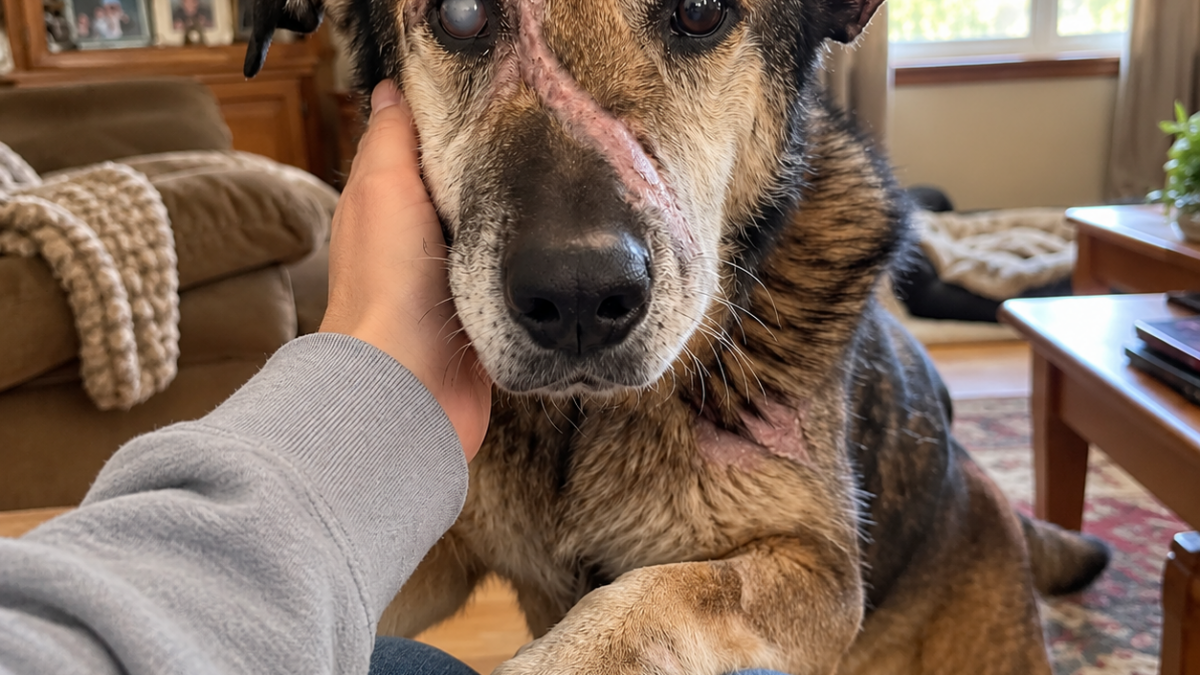
Up close, it was even more extensive than I’d realized.
The scar began above the right eye and crossed downward.
Part of the ear was gone.
The skin beneath the missing fur had healed unevenly.
The eye itself was pale and cloudy, likely offering little or no vision.
My wife saw it.
Her face didn’t change.
That mattered.
She didn’t gasp.
Didn’t frown.
Didn’t lean closer for a better look.
She simply remained sitting.
The dog watched her with his good eye.
She said quietly, “You’re okay.”
His ear moved.
Several minutes passed.
A strange calm settled over the porch.
Birds called from the trees.
Our dogs shifted behind the screen.
Somewhere far beyond the pasture, machinery hummed from another property.
The visitor sat between us and the open field.
Not hiding.
For the first time, he let the right side of his face exist without managing what we could see.
That is the moment I think he made the first real decision.
Not when he came closer.
Not when he ate.
When he stopped arranging himself for us.
Eventually he stood.
My heart sank slightly.
I assumed he was leaving.
Instead, he walked toward the door.
Molly appeared behind the screen.
Our other dog, Ben, stood farther back.
The stranger stopped.
Noses moved.
Molly wagged.
Ben remained cautious.
The stranger looked at them.
Then at the open doorway.
My wife whispered, “Don’t.”
“I wasn’t going to do anything.”
“Good.”
We stayed seated.
The dog stepped onto the porch.
One paw over the threshold.
Pause.
Second paw.
He walked into the kitchen.
My wife covered her mouth.
I stood slowly.
“Okay.”
The dog glanced back.
Not frightened.
Checking.
Then he continued.
He sniffed the kitchen floor.
The cabinet corner.
A chair.
Molly and Ben waited behind an interior gate we’d installed for introductions.
Molly whined.
The stranger approached the barrier.
Noses touched through the gap.
Ben came closer.
A low sound came from him.
Not a growl exactly.
A warning of uncertainty.
The stranger stopped.
Turned sideways.
Looked away.
Perfect dog manners.
Ben relaxed slightly.
“That was good,” my wife whispered.
I nodded.
The stranger moved into the living room.
He inspected the couch.
A bookshelf.
The fireplace.
Then an old woven rug near the hearth.
He turned once.
Twice.
Lowered himself.
And sighed.
Not a little breath.
A deep, full-body exhale.
His shoulders dropped.
His head sank onto his paws.
My wife looked at me.
Neither of us had invited him in.
Not verbally.
Apparently he had finished waiting.
That night, he stayed.
We didn’t know what else to do.
I blocked off a quiet section of the living room so the dogs could smell one another safely without direct contact.
We offered water.
He drank.
We placed an old dog bed near the rug.
He ignored it.
The rug had already been chosen.
At ten, I sat several feet away.
The dog was asleep.
Or almost.
Every time I shifted, his good eye opened.
Then closed again.
At midnight, I checked.
Still there.
At two, I woke for no reason and walked downstairs.
Still there.
He lifted his head.
“You’re real,” I whispered.
Tail movement.
Tiny.
Almost invisible.
I smiled.
“Goodnight.”
In the morning, he was still on the rug.
The first practical problem arrived with daylight.
“What do we call him?” my wife asked.
“We don’t even know if we’re keeping him.”
She raised an eyebrow.
The dog was asleep beside the fireplace.
I ignored her expression.
“We need to get him scanned for a chip.”
“Agreed.”
“And checked medically before full introductions.”
“Yes.”
“And we need to keep looking for an owner.”
“Yes.”
She poured coffee.
“So what do we call him while doing all that?”
I looked at the dog.
“Dog.”
She laughed.
“Excellent.”
We settled temporarily on Buddy.
It lasted about six hours.
At the veterinary clinic, “Buddy” stood calmly beside me.
Getting him into the truck had been easier than expected.
He hesitated at the open door.
Then climbed in when I placed a blanket on the floorboard.
The clinic waiting room made him more cautious.
His body remained close to my leg.
Every time someone approached from his right side, he turned.
I noticed immediately.
The receptionist did too.
“Does he see out of that eye?”
“We don’t think so.”
A technician came out.
“Buddy?”
My wife coughed to hide a laugh.
I gave her a look.
The dog stood.
The technician crouched rather than reaching over his head.
“Hi, handsome.”
His tail moved once.
The exam revealed a lot.
Some of it expected.
Some not.
He was older than we first thought.
Probably between seven and nine, according to the veterinarian.
Maybe older.
His teeth showed years.
His body told the same story.
The front paw had healed from a previous injury, leaving an unusual angle but no obvious current instability.
The shoulder scars were old.
The shortened tail had also healed long ago.
Then she examined his face.
The veterinarian was careful.
He tolerated everything.
She used a light near the cloudy eye.
No reaction consistent with useful vision.
“He’s likely blind on this side.”
“Can it hurt him?”
“Not necessarily. I don’t see acute inflammation. We’ll evaluate more carefully, but whatever damaged it happened a long time ago.”
“How long?”
“Hard to say.”
“Years?”
“Very possibly.”
She examined the ear.
Part missing.
Edges fully scarred.
Old trauma.
“Vehicle?” I asked.
“Possible.”
“Animal attack?”
“Possible.”
“Farm equipment?”
“Also possible.”
“So basically we’ll never know.”
She nodded.
“Unless somebody knows his history.”
The microchip scanner came back empty.
No chip.
That disappointed me more than I expected.
A chip could have answered everything.
Owner.
Name.
History.
Maybe somebody looking for him.
Instead, he remained anonymous.
The vet continued examining him.
Blood work.
Parasite testing.
General senior screening.
He stood patiently.
At one point, she lifted his paw.
He watched.
No struggle.
When she touched near the scar on his neck, he stiffened slightly.
Then relaxed.
The veterinarian noticed.
“He’s remarkably tolerant.”
“He’s never tried to bite.”
“That’s not always the case after significant trauma.”
“What do you mean?”
“Dogs who experience severe injuries and poor handling afterward can become defensive. Understandably.”
She looked at his face.
“He isn’t.”
“He doesn’t exactly trust everyone.”
“No.”
She smiled.
“But he wants to.”
That sentence stayed with me.
After the exam, she sat on the stool while the dog lay beside the table.
My wife asked, “Do you think he was wandering because he got lost?”
The vet looked down at him.
“Maybe.”
She scratched lightly under his chin.
Then said, “Some dogs wander because they’re lost.”
She paused.
“And some dogs wander because they’re searching.”
The dog’s eyes were already closing.
The vet smiled.
“I think this one may have found what he was looking for.”
My wife looked at me.
I knew immediately that “Buddy” was over.
On the drive home, she said, “Traveler.”
“What?”
“His name.”
“Traveler?”
“He came out of the woods every night like he’d crossed half of Minnesota.”
“He may have crossed one field.”
“Don’t ruin this.”
I looked in the mirror.
The dog was lying across the back seat.
“Traveler.”
His ear moved.
My wife smiled.
“There.”
“That proves nothing.”
“It proves everything.”
Traveler it was.
The next few days were careful.
We followed veterinary guidance while waiting for test results and continued searching for an owner.
Nobody credible came forward.
Our post spread into nearby community pages.
A local rescue shared it.
I called county animal services to report him found and confirm procedures.
We did everything we reasonably could.
Still nothing.
The blood work showed no catastrophic problem.
He needed routine care, parasite treatment, nutrition and monitoring typical for an older dog who had spent substantial time outdoors.
Nothing explained his history.
So we focused on his future.
Introductions with Molly and Ben progressed slowly.
Molly loved Traveler immediately.
She had apparently decided he was her project.
Whenever she saw him through the gate, her tail moved.
Traveler mostly ignored her.
That made her want him more.
Ben was different.
Ben had his own history.
He’d been rescued after living chained outdoors and could be suspicious of unfamiliar adult male dogs.
We knew forcing them together would be foolish.
So we did structured introductions.
Distance first.
Leashes.
Parallel walks.
Reward calm behavior.
No toys between them initially.
No crowded doorways.
No food conflicts.
Traveler handled all of it with extraordinary restraint.
If Ben stiffened, Traveler looked away.
If Ben approached too quickly, Traveler curved his body instead of meeting him head-on.
If Molly bounced into his space, Traveler simply stepped aside.
“He knows dogs,” my wife said.
“Better than we do.”
Within two weeks, the three could share the yard calmly.
Within a month, Molly was sleeping beside Traveler.
Ben took longer.
Then one afternoon, I walked into the living room and found them lying on opposite ends of the same rug.
No tension.
No supervision required.
I called my wife quietly.
She looked.
“Don’t take a picture.”
“Why?”
“You’ll move and ruin it.”
We stood in the hallway like idiots admiring two sleeping dogs.
Traveler adjusted surprisingly quickly to indoor life.
The first few nights, he woke at small sounds.
A furnace clicking on.
Ice falling in the freezer.
A vehicle far down the road.
His head rose.
His good eye scanned the room.
Then he’d settle.
Over time, the reactions decreased.
The fireplace rug remained his favorite place.
We bought him a better orthopedic bed.
He occasionally used it.
But if there was sunlight, he preferred the floor.
Specifically the brightest patch near the living room window.
Every afternoon, sunlight shifted across the room.
Traveler shifted with it.
My wife started calling him a solar-powered dog.
He followed us too.
Not at first.
For the first week, he stayed mostly in the living room unless food was involved.
Then he began appearing at the kitchen entrance.
Later, outside the bathroom.
Eventually, wherever one of us went, Traveler would show up a minute later.
Not anxiously.
He didn’t panic if separated.
He simply seemed to prefer being where people were.
The scarred side of his face remained an interesting barometer of trust.
With us, he stopped hiding it completely.
He’d sleep with the damaged side facing upward.
Rest against my leg with the scar visible.
Allow my wife to clean around the old ear injury.
But strangers changed him.
If someone new entered the house, Traveler positioned his good side toward them almost instantly.
Sometimes he moved behind me.
Not cowering.
Managing.
A friend visited about six weeks after Traveler arrived.
She saw him lying near the fireplace.
“Oh, he’s beautiful.”
Traveler stood.
Approached.
Then turned his left side toward her.
Our friend reached out slowly.
Traveler allowed a brief scratch.
Then stepped away.
“Is that the dog you told me about?”
“Yes.”
She moved slightly.
Traveler adjusted.
She noticed.
“He’s hiding the other side.”
“Yeah.”
“Should I avoid looking?”
“Just let him decide.”
She nodded.
For almost an hour, Traveler remained aware of her.
Later, when everyone sat quietly, he walked into the center of the room.
He turned.
The scar came into view.
Our friend did nothing.
No pity.
No shocked expression.
Eventually Traveler lay down.
That became our approach with visitors.
We didn’t introduce him as:
This is Traveler, look what happened to his face.
His scars weren’t a conversation piece.
If people noticed, fine.
If they asked respectfully, we’d explain that the injury was old and the cause unknown.
But we stopped telling his story for him while he was standing there.
He had spent enough time having his appearance determine the way people understood him.
At home, he was simply Traveler.
That first winter brought changes.
Minnesota cold made outdoor time shorter.
Traveler didn’t mind snow as much as I expected.
The first serious snowfall covered the pasture overnight.
When I opened the door the next morning, Molly launched herself outside.
Ben followed.
Traveler stood at the threshold.
Snow fell.
He stared.
“You’ve seen snow before.”
No movement.
Molly ran back, face covered in white.
Traveler looked at her.
Then stepped out.
One paw.
Another.
He sniffed.
Then walked into the yard.
Five minutes later, something remarkable happened.
Molly ran.
Traveler followed.
Not fast.
His old front-paw injury limited how hard he pushed.
But he chased her.
Across the snow.
Around the fence.
Back toward the porch.
For the first time, I saw his tail—what remained of it—moving with full enthusiasm.
My wife stood beside me.
“Look at him.”
“I am.”
Traveler slipped slightly.
Recovered.
Molly circled.
He followed.
Ben joined.
Three rescue dogs running through snow.
Nothing heroic.
Nothing cinematic.
Just dogs.
I had to look away for a second.
My wife touched my arm.
“You okay?”
“Yeah.”
Traveler stopped near the porch.
His mouth was open.
Snow clung to his muzzle, including the old scar.
He looked ridiculous.
Beautiful.
Whole.
The old injury didn’t disappear.
We simply stopped seeing it first.
That became one of the strangest transformations.
When Traveler arrived, the damaged side of his face was almost impossible not to notice.
Months later, sometimes I forgot.
Not because the scar changed.
Our perception did.
I noticed how he leaned into scratches.
How he slept.
His habit of standing beside the refrigerator whenever cheese came out.
His annoyance when Molly stole his sunspot.
His way of placing one paw on my boot when he wanted to go outside.
The scar became one fact among hundreds.
That was how I think he began understanding our home too.
The wound didn’t need to be hidden because nobody here treated it like the main thing about him.
Spring arrived slowly.
Snow withdrew from the pasture.
The tree line became green again.
That was when we noticed something strange.
6:02 still mattered.
The first time, I thought it was coincidence.
Traveler had been inside for months.
One evening, just after six, he stood from the living room.
Walked to the back door.
Sat.
I checked the clock.
6:02.
I stared.
My wife saw my face.
“What?”
“Look at the time.”
She checked.
“Oh.”
Traveler waited.
I opened the door.
He stepped onto the porch.
Then stopped near the same bottom step where he had sat during those first eleven evenings.
He looked across the pasture.
My chest tightened.
Was he waiting again?
Did that time correspond to something from his former life?
Feeding?
A person coming home?
An old routine?
Had someone once met him at 6:02 every evening?
We would never know.
Traveler stood there for several minutes.
Then he turned.
Looked at me.
And came inside.
The next evening:
6:03.
Same thing.
He went out.
Looked across the field.
Returned.
My wife said, “Maybe that’s why he came here every night.”
“What?”
“His body knew the time.”
“Dogs don’t read clocks.”
“No, but they know routines.”
She was right.
Animals can become remarkably precise around repeated schedules.
Whatever 6:02 had once meant to Traveler, it remained inside him.
But now something was different.
Before, he came from the woods, sat outside, and disappeared.
Now he walked out of our house.
Looked.
Then came back into it.
Eventually, the ritual faded.
Some nights he didn’t go outside until seven.
Some nights he slept through six entirely.
I remember the first time that happened.
I glanced at the clock.
6:08.
Traveler snored in the sunspot.
I smiled.
Something had finally become more important than waiting.
Months after Traveler arrived, an unexpected message appeared on the old community post.
A man said he might recognize the dog.
My heart jumped.
By then, legally and emotionally, Traveler had become ours after all required found-dog procedures and reasonable search efforts.
Still, the message mattered.
I answered carefully.
“What do you know about him?”
The man said he’d seen a scarred dog several times near properties farther north.
Not close.
Miles away.
He thought the dog had been living semi-feral around old farm roads.
“Do you know who owned him?”
“No.”
“Any idea how long?”
“At least a couple years, off and on.”
My stomach tightened.
“Did anyone feed him?”
“Probably. Folks leave food out.”
“Did he belong to a farm?”
“Not that I know.”
I asked about the facial injury.
The man had already seen the scar the first time he’d noticed Traveler.
So the injury was older still.
“How far north?”
He gave me a rough location.
After the call, I opened a map.
Depending on the route, Traveler might have traveled miles through fields, woods and rural roads before establishing his evening visit at our house.
Maybe farther.
We had imagined him coming from somewhere nearby.
Now I pictured years.
One farm.
Another field.
A roadside ditch.
Barns.
Woodlots.
Winters.
How many doors had he passed?
How many bowls had people left?
How many times had somebody tried to approach him?
How had he survived with vision on only one side?
I looked at Traveler.
He was upside down on the living-room rug.
Molly had stolen his bed.
He seemed untroubled by the possibility that his entire history was being reconsidered.
My wife read the message.
“So Traveler really is a traveler.”
“Possibly.”
“You mocked the name.”
“I withdraw my objection.”
She smiled.
That evening, at 6:02, Traveler didn’t move.
He was asleep.
Some mysteries never received answers.
We never learned exactly how his face was injured.
We never learned who had owned him first.
We didn’t discover why his tail was shortened.
No person arrived with photographs proving a previous life.
No dramatic villain appeared.
No hidden tag revealed a name.
For a while, I wanted answers.
I thought answers would give his story shape.
Eventually, I understood that the absence of answers was part of the truth.
Some animals arrive carrying histories nobody can translate.
The job isn’t always to solve the past.
Sometimes it’s simply to stop forcing them to live inside it.
Traveler’s vet visits became routine.
Senior blood work.
Joint assessment.
Monitoring the blind eye.
Dental care.
No sudden medical twist.
No miracle transformation.
Just maintenance.
At one appointment, the same veterinarian who first examined him walked into the room.
Traveler was asleep beside my chair.
She smiled.
“Still traveling?”
“Mostly between the couch and refrigerator.”
“Good route.”
She examined him.
At one point, she touched the scarred side.
Traveler didn’t stiffen.
Not even slightly.
She looked at me.
“He’s relaxed.”
“He likes you.”
“Maybe.”
She finished checking the eye.
Stable.
No obvious pain.
Then she rubbed the top of his head.
“Remember what I told you?”
“About searching?”
She nodded.
I looked down at Traveler.
“Yeah.”
She smiled.
“I think I was right.”
By summer, Traveler had developed routines that had nothing to do with six o’clock.
Morning began with Ben.
Ben woke first and walked to our bedroom.
Molly followed.
Traveler came last.
He stood in the doorway.
Never jumped on the bed.
He simply waited until I acknowledged him.
“Morning.”
Tail movement.
Then breakfast.
Traveler had long since stopped hiding while he ate.
He ate beside the other dogs.
Calmly.
No guarding.
No rushing.
The first time that happened, I thought about the bowls we’d left outside.
How he had waited until nobody watched.
Now he would occasionally stop eating to look at us.
Not fearfully.
Checking whether more might be coming.
After breakfast, he inspected the yard.
Midday belonged to the sunspot.
Afternoon sometimes meant a slow walk along the edge of the property.
Evening meant family.
He’d lie near the couch while we watched television.
Molly often pressed against his back.
Ben preferred more distance but had accepted Traveler completely.
Once, during a thunderstorm, something happened that told me more about their relationship than any introduction ever had.
Thunder shook the house.
Ben hated storms.
His entire body tightened.
He paced.
Normally we’d guide him to a safe interior room with blankets and background noise.
That night, before we could, Ben walked directly to Traveler.
Traveler was asleep near the fireplace.
Ben lay down beside him.
Pressed his shoulder against Traveler’s side.
Traveler lifted his head.
Looked.
Then put it back down.
Ben stayed.
Thunder again.
Traveler didn’t move.
Neither did Ben.
My wife whispered, “Look.”
I nodded.
Two damaged dogs helping each other without ceremony.
Ben’s fear had once made him suspicious of Traveler.
Now Traveler was where he went to feel safe.
That was family.
Traveler still had moments with strangers.
Not aggression.
Instinct.
If someone approached quickly from his blind side, he’d startle.
Sometimes sharply.
We learned to warn people.
“Let him see you first.”
Most understood.
A delivery driver once didn’t.
He came around the side of the house unexpectedly while Traveler was outside with me.
The driver stepped toward Traveler’s right.
Traveler spun.
Barked.
One loud bark.
The man froze.
I immediately called Traveler back.
He came.
I apologized.
The driver said, “I didn’t see his eye.”
“Yeah. He didn’t see you either.”
Traveler stood beside my leg, breathing faster.
I put a hand near his shoulder without gripping.
The driver softened.
“Sorry, buddy.”
Traveler watched him with the good eye.
No further barking.
That incident reminded me that healing isn’t erasure.
Traveler trusted us.
He trusted many people.
He had not magically become a dog with two functioning eyes and no history.
Accommodating him meant understanding what remained.
That didn’t make him broken.
It made him specific.
All animals are.
All people too.
We adjusted.
Visitors learned.
Life continued.
One evening, almost a year after his first appearance, I sat on the porch alone.
The clock inside read 5:58.
Traveler lay beside me.
I hadn’t planned anything.
The date simply brought the memory back.
I looked toward the tree line.
“That’s where you came from.”
Traveler lifted his head.
“You remember?”
Probably not the way I did.
The grass moved in the evening wind.
At 6:01, Traveler stood.
My heart skipped.
He walked toward the bottom step.
6:02.
I nearly laughed.
“You have got to be kidding me.”
He stepped into the grass.
Stopped.
Looked toward the trees.
I stayed seated.
For a moment, time folded in on itself.
The same dog.
Same pasture.
Same evening light.
Same hour.
Except everything important had changed.
Traveler’s coat was healthier.
His body held more weight.
A collar rested comfortably around his neck.
His tags carried our phone number.
Behind him, inside the house, Molly whined through the screen.
Ben stood nearby.
Traveler looked toward the woods.
Then turned.
For once, his scarred side faced the tree line.
His good eye faced home.
He climbed the step.
Walked past me.
Went inside.
I sat alone another minute.
That image stayed with me.
The first eleven nights, Traveler had faced outward.
Toward distance.
Toward whatever memory or expectation pulled him there.
Now he looked homeward with the eye that could still see.
A year changed many things.
We stopped switching on the porch light specifically for Traveler because he no longer needed it.
But the habit never disappeared completely.
Around six, especially in fall and winter, one of us would still turn it on.
My wife once asked, “Why do we still do that?”
I looked outside.
The light spread across the steps and part of the grass beyond.
“I don’t know.”
She smiled.
“Yes, you do.”
Maybe I did.
It had become connected to the moment our understanding of home changed.
Before Traveler, our porch light was practical.
A way to see steps in the dark.
After Traveler, it felt like a signal.
Not to him.
He was usually asleep inside.
A signal to ourselves, maybe.
The door could open.
The house had room.
Not unlimited room.
Not reckless rescue of every animal wandering across Minnesota.
We still believed in doing things responsibly.
Veterinary checks.
Lost-dog reports.
Introductions.
Safety.
Capacity.
But Traveler had reminded us how much can happen in the small gap between noticing something and walking past it.
One winter night, snow fell heavily.
I turned on the porch light.
Traveler was asleep near the fireplace.
Outside, the field disappeared under white.
For a second, I imagined another silhouette emerging.
Another dog.
Another animal carrying some story we couldn’t see from a distance.
Nothing appeared.
That was okay.
The light stayed on.
Traveler grew older.
Gray expanded across his muzzle.
His injured paw became stiffer in the mornings.
Walks shortened.
We added rugs over slippery floor sections.
Another orthopedic bed appeared.
He actually used this one.
Sometimes.
His favorite location remained wherever we were.
One morning, my wife found him asleep halfway into the kitchen because I’d been making coffee there.
“He couldn’t move another three feet?”
“Apparently not.”
Traveler opened his good eye.
“Lazy,” she told him.
Tail wag.
He knew affection when he heard it, regardless of vocabulary.
The scar changed very little.
The rest of us changed around it.
Children who visited sometimes asked.
“What happened to his face?”
“We don’t know.”
“Does it hurt?”
“Not now.”
“Can he see?”
“Only from the other eye.”
Most children accepted that in seconds.
One girl touched her own cheek.
“Can I pet the scar side?”
I crouched.
“Let him decide.”
She approached from where he could see her.
Held out her hand.
Traveler sniffed.
She touched the side of his neck, not the scar itself.
He leaned into her.
She smiled.
“He’s nice.”
“Yeah.”
That was the whole assessment.
No tragedy.
No ugliness.
Nice dog.
Sometimes children understand the important part faster.
Years of experience with Traveler taught us to stop inventing motives for things we couldn’t know.
At first, we’d said:
He hides his scars because people rejected him.
Maybe.
Or he had learned to protect his blind side.
Maybe.
He arrives at 6:02 because someone used to meet him then.
Maybe.
He stared across the pasture waiting for an owner.
Maybe.
Or perhaps he was simply tracking some route he’d learned while wandering.
We couldn’t know.
What we did know was enough.
He came.
He stayed.
He learned our house.
We learned him.
That is often all relationship requires.
One afternoon, I was cleaning the storage closet when I found the first photograph my wife had taken of Traveler.
Night three or four.
He sat near the porch.
Only the left side of his face showed.
I stared at it.
The posture looked familiar and foreign at once.
Body upright.
Attention aimed outward.
Distance maintained.
Then I looked into the living room.
Traveler was sleeping on his back.
Scarred side completely exposed.
One front leg bent awkwardly.
Mouth slightly open.
No dignity whatsoever.
I held the old picture beside the doorway.
Same dog.
I took another photo.
Later, I put them side by side.
No dramatic weight transformation.
No before-and-after medical miracle.
The difference was posture.
In the first picture, Traveler managed himself.
In the second, he surrendered to sleep.
Trust is hard to photograph.
Sometimes that’s what it looks like.
A dog willing to sleep ugly.
Another anniversary passed.
6:02 arrived.
Traveler was eating dinner.
He did not care.
I smiled.
The ritual was finally ours, not his.
We still turned on the porch light.
But he no longer watched the horizon.
His world had come closer.
Kitchen.
Living room.
Yard.
Molly.
Ben.
My wife.
Me.
Sunlight.
Dinner.
An occasional treat from the vet.
The old rug by the fireplace.
His needs weren’t grand.
Safety rarely is.
One spring evening, Traveler lay beside me on the porch while distant geese crossed the sky.
I rested my hand on his shoulders.
The old scars were underneath my fingers.
Raised lines.
Permanent.
I had once imagined those scars represented the central story of his life.
Now I knew better.
Scars only tell you that something happened.
They don’t tell you everything that came after.
Traveler lifted his head.
A sound moved through the woods.
He listened.
I did too.
Nothing emerged.
He put his head back down.
The sun lowered.
At 6:02, my wife opened the screen door.
“Dinner.”
Traveler stood instantly.
I laughed.
“So much for searching the horizon.”
Food had become a stronger calling.
He walked inside.
I stayed on the porch for another minute.
The light wasn’t needed yet.
Still, I switched it on.
Warm yellow spread across the steps.
When Traveler first came to us, I had assumed he belonged somewhere else.
Then I assumed he was lost.
Then damaged.
Then wary.
For eleven evenings, I kept trying to solve him from a distance.
Eventually, the dog solved the problem himself.
He crossed the porch.
Walked through the door.
Lay down beside the fireplace.
Stayed.
Maybe the veterinarian was right.
Maybe some dogs wander because they’re lost.
Maybe some wander because they’re searching.
Or maybe we humans need those words more than dogs do.
Traveler never explained what he’d been looking for.
He didn’t have to.
He stopped leaving.
That was explanation enough.
Years after that first autumn, the porch light still came on just before evening.
Sometimes automatically.
Sometimes because one of us remembered.
Traveler no longer sat outside waiting beneath it.
He was usually indoors, sleeping beside the other dogs or following someone toward the kitchen.
His scarred side remained scarred.
His blind eye remained cloudy.
His ear never grew back.
Nothing about loving him erased what had happened.
That wasn’t the point.
The point was that he no longer rearranged himself to make the damage invisible.
At home, he slept with either side exposed.
He walked past us without calculating angles.
He accepted hands near his face.
He trusted us behind him.
And when strangers visited, even if the old instinct returned and he briefly showed only the left side, he knew there was a room he could retreat to where nobody required that performance.
That was home.
Not a place where scars disappear.
A place where they stop deciding whether you belong.
One evening, long after 6:02 had lost all meaning to Traveler, I came in through the back door.
He was asleep on the old rug.
The same rug he’d chosen on his first night.
The fireplace was dark.
Molly lay nearby.
Ben slept at the other end of the room.
Traveler’s scarred cheek rested flat against the floor.
Completely visible.
Completely unprotected.
I stopped in the doorway.
His good eye opened.
He saw me.
His short tail moved against the rug.
Once.
Twice.
Then he closed his eye again.
No getting up.
No searching.
No need to check whether I would leave.
He already knew the answer that mattered.
I would come back.
The porch light clicked on behind me as evening settled over the pasture.
Traveler didn’t look toward it.
He was home.
[END OF STORY]
:::








