PART 2: Five Puppies Cried for Their Mother in a Snowstorm—But Someone Had Made Sure They Couldn’t See Each Other
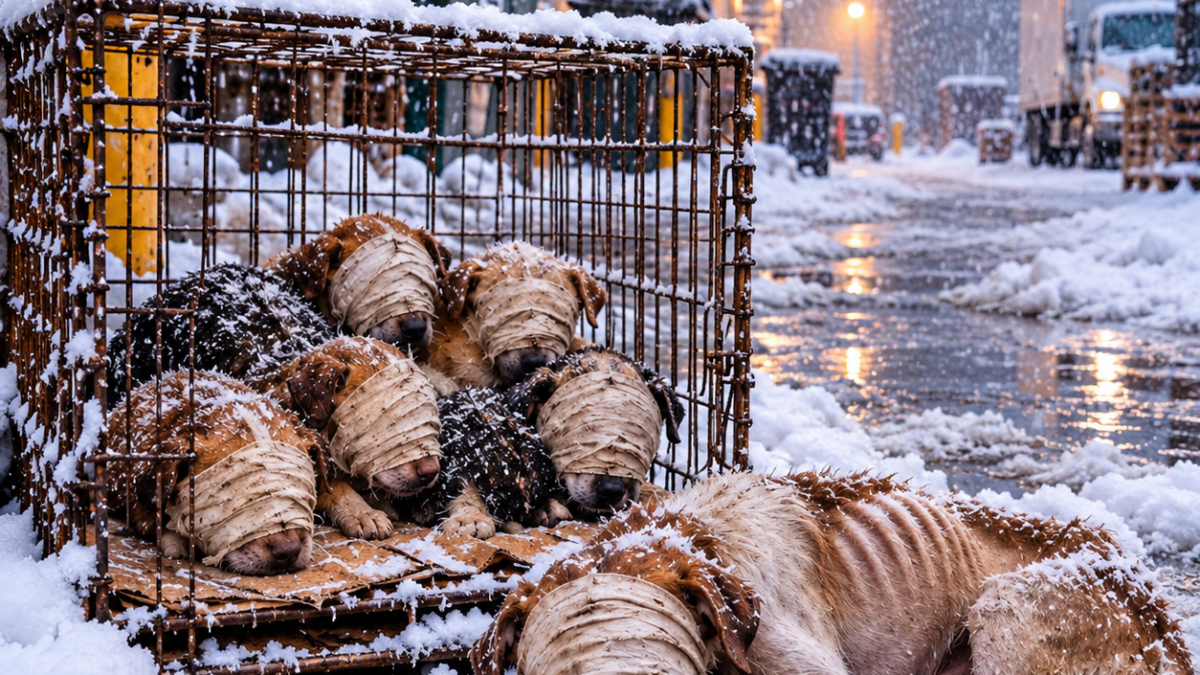
PART 2
The wire finally snapped loose.
I pulled the cage door open and reached toward the smallest puppy.
He was lying on his side beneath two of his littermates.
His body felt terribly cold through my gloves.
“Come on, sweetheart.”
No response.
I carefully lifted him.
His head rested against my palm.
For one frightening second, I couldn’t tell whether he was breathing.
“Leah!”
She was already beside me.
“Is he—”
“I don’t know.”
I moved him closer to my face.
There.
A breath.
So faint I almost missed it.
“He’s alive.”
Leah opened the insulated carrier.
“Get him inside.”
I removed the dirty cloth from his face.
His eyes were closed.
His little muzzle was damp.
He looked impossibly small.
“Stay with me.”
I wrapped him in a dry towel and placed him inside the protected carrier.
We needed controlled warming and immediate veterinary care.
I knew that.
But knowing the correct thing to do didn’t make my hands stop shaking.
Behind us, the mother began whining.
Not loudly.
Just one desperate sound after another.
I turned.
Her head was lifted now.
She was staring toward the cage.
“Your babies are coming,” I whispered.
Then I went back for the others.
The second puppy was brown.
The third was almost entirely white.
The fourth had black markings around both eyes.
The fifth was golden, with a dark stripe running down his back.
Every one of them was freezing.
Every one had wet fur.
Every one had been trapped beneath a dirty cloth.
Some struggled weakly when I lifted them.
Others barely moved.
We removed the coverings carefully, checked that their noses and mouths were clear, and placed them into dry, protected carriers.
Leah was already speaking to the emergency veterinary clinic.
“Five puppies,” she said into the phone. “And the mother. Severe cold exposure. One puppy barely responsive.”
She listened.
“Yes, we’re coming now.”
Then she looked at me.
“They’re ready.”
I glanced toward the mother.
She was still lying beside the pallet.
Now that the cage was empty, she had begun dragging herself forward.
Her front paws scraped against the snow.
She moved perhaps six inches.
Then collapsed.
I rushed toward her.
“No, no. Don’t try.”
She looked at me.
Her entire body trembled.
I crouched beside her and gently placed my hand against her shoulder.
She didn’t growl.
She didn’t bare her teeth.
She simply looked toward the carriers.
“She wants them,” Leah said.
“I know.”
We couldn’t allow her to struggle through the snow.
Her body was too weak.
I wrapped her in a dry blanket while Leah prepared a larger carrier.
The mother tried once more to lift her head.
I leaned close.
“Listen to me.”
Her ears shifted.
“We have them.”
She looked at me.
“All five.”
I don’t know whether dogs understand numbers.
I don’t know whether she understood my words.
But when Leah brought the carrier close enough for the puppies’ faint cries to reach her, the mother became completely still.
Then she made a soft sound.
A quiet, exhausted whine.
One of the puppies answered.
The mother pushed her nose toward the carrier door.
I covered my mouth.
“She knows.”
Leah nodded.
“She knows they’re here.”
We secured everyone for transport.
Then I looked back at the cage.
It sat empty in the snow.
Rust on the bars.
Wet cardboard underneath.
Dirty strips of cloth scattered nearby.
I felt anger rising so quickly that my chest tightened.
Somebody had put those puppies there.
Somebody had covered their faces.
Somebody had left their mother close enough to hear them but too far away to protect them.
I looked toward the street.
Trucks were still passing.
The loading bay lights were still on.
The world had continued operating around a family that was quietly freezing.
I took photographs.
The cage.
The wire.
The cardboard.
The location.
The surrounding buildings.
Leah watched me.
“We should leave.”
“I know.”
“Now.”
I took one final photograph.
Then we drove.
The emergency veterinary clinic was twenty-three minutes away.
Under normal conditions, that wasn’t far.
That morning, it felt like crossing an entire state.
Snow covered the road.
Traffic moved slowly.
My windshield wipers struggled to keep up.
Every red light felt cruel.
Leah sat beside the carriers.
The mother was closest to her.
The puppies were secured nearby.
Every few minutes, Leah checked them without unnecessarily disturbing their warmth.
The smallest puppy remained dangerously quiet.
“Still breathing?” I asked.
“Yes.”
A minute later:
“Still?”
“Yes.”
I gripped the steering wheel.
“Come on.”
Leah looked at me.
“Drive carefully.”
“I am.”
“You’re holding your breath.”
I exhaled.
She was right.
The mother lifted her head.
Her nose pointed toward the puppy carrier.
A faint cry came from inside.
She answered.
Then rested her chin against the blanket.
I glanced in the mirror.
For a moment, I imagined what her night had been like.
The snow falling.
The metal cage growing colder.
Her babies crying.
Her own face covered.
Her body too weak to stand.
How many times had she tried to reach them?
How many times had she heard them calling and been unable to answer?
I couldn’t know.
But the thought followed me all the way to the clinic.
When we arrived, the veterinary team was waiting.
Two technicians came out with warmed transport equipment.
A veterinarian named Dr. Morgan approached us.
“Which one is most critical?”
“The smallest.”
I handed over the carrier.
She looked inside.
Her expression changed.
“Let’s get him into treatment.”
Another technician took the other puppies.
The mother was carried inside separately for examination.
The moment she lost sight of the carriers, she began whining.
“She’s very attached,” Leah explained.
Dr. Morgan nodded.
“We’ll keep that in mind.”
The doors closed.
And suddenly there was nothing for us to do.
I stood in the hallway.
My gloves were wet.
My coat was covered in snow.
There was a dark stain on my sleeve from the dirty cardboard.
Leah placed a hand on my shoulder.
“We got them here.”
I nodded.
But I couldn’t speak.
Because getting them there wasn’t the same as saving them.
Not yet.
The next hour passed in fragments.
A technician entered.
Another left.
Someone carried clean blankets down the hallway.
A door opened briefly.
I caught a glimpse of one puppy lying beneath carefully controlled warming equipment.
Then the door closed again.
Dr. Morgan came to speak with us.
“The puppies are significantly cold and dehydrated.”
I swallowed.
“All five?”
“Yes. Some more severely than others.”
“And the smallest?”
“He’s our biggest concern right now.”
“Is he going to survive?”
“We’re working to stabilize him.”
That was all she could promise.
She explained that the puppies needed to be warmed carefully, monitored closely, and assessed before feeding.
Their tiny bodies had been exposed to dangerous cold.
Simply putting food into a severely chilled puppy could create additional risks.
So the team focused on temperature, circulation, hydration, and breathing.
I listened.
Nodded.
Asked questions.
But one image remained in my mind.
The smallest puppy lying beneath his siblings.
Not moving.
“Can we see him?”
“Not yet.”
I looked down.
Dr. Morgan softened her voice.
“We’ll tell you as soon as we know more.”
Then she turned toward the next room.
“The mother is also in serious condition.”
My stomach dropped.
“What happened?”
“She’s severely underweight and exhausted. We’re checking for complications from cold exposure, dehydration, and possible illness.”
“Will she be okay?”
“I can’t give you that answer yet.”
I stared at her.
Five puppies.
One mother.
Six lives.
And not one guarantee.
We waited in the consultation room.
Leah brought me coffee from a machine near the entrance.
I held it without drinking.
After a while, she sat opposite me.
“You should take off your coat.”
I looked down.
Snow had melted into the sleeves.
I hadn’t noticed.
I removed it.
Then stared at my hands.
They were red from the cold.
A small cut crossed one finger where the wire had caught my glove.
Leah noticed.
“You’re bleeding.”
“It’s nothing.”
She handed me a tissue.
I pressed it against the cut.
For some reason, that was when I began crying.
Not because of my finger.
Because the cut reminded me of the cage.
The twisted wire.
The cloth.
The wet cardboard.
I covered my face.
Leah moved beside me.
“Hey.”
I shook my head.
“I don’t understand.”
“What?”
“Why would someone cover their eyes?”
Leah went quiet.
“They were babies.”
“I know.”
“They couldn’t even see where they were.”
Her hand rested against my shoulder.
I looked at her.
“And their mother was right there.”
Leah’s eyes filled.
“I know.”
For a while, we simply sat.
Then I wiped my face.
“I want whoever did this found.”
Leah nodded.
“So do I.”
I looked toward the treatment rooms.
“But first…”
She finished the sentence.
“First we save them.”
The smallest puppy survived the first hour.
Then the second.
By late morning, his temperature was improving.
He remained weak, but the veterinary team was cautiously encouraged by his response.
When Dr. Morgan told us, I almost laughed from relief.
“He’s responding?”
“Yes.”
“He’s actually improving?”
“Slowly.”
I closed my eyes.
“Thank God.”
The other four puppies were also receiving treatment.
Two were more responsive.
One had begun making stronger little cries.
Another was still very quiet but stable enough for continued observation.
The mother remained exhausted.
Her condition worried the team.
She was painfully thin.
Her fur was matted.
Her paws showed signs of exposure and irritation.
There were pressure marks where the cloth had rubbed against her face.
But what concerned Dr. Morgan most was how depleted she appeared.
“She hasn’t been getting adequate nutrition.”
“For how long?”
“We can’t determine that from one examination.”
I looked toward the treatment room.
“She’s been trying to care for five puppies.”
“Yes.”
“While starving herself.”
Dr. Morgan paused.
“We can see she’s severely undernourished. We don’t know exactly what happened before today.”
I nodded.
Facts.
Not guesses.
I understood.
But that didn’t stop my heart from breaking.
That afternoon, the team allowed us to see the mother briefly.
She was resting beneath a clean blanket.
An IV line provided necessary support.
Her face was uncovered.
For the first time, I could see her properly.
She was beautiful.
Not in the polished way people imagine when they think of a perfect pet.
Her coat was rough.
Her body was painfully thin.
Her ears were uneven.
There was a small scar near one eye.
But her expression was gentle.
She looked at me when I entered.
Then toward the door.
I knew what she wanted.
“Your babies are here.”
Her ears lifted.
“They’re being taken care of.”
She continued watching the doorway.
I sat beside her.
“We’re going to bring them back when it’s safe.”
She made a low sound.
I reached toward her slowly.
She smelled my fingers.
Then rested her chin against my hand.
I froze.
Leah stood behind me.
“She remembers you.”
“Maybe.”
The mother closed her eyes.
I stroked her cheek.
“We need a name for you.”
Leah smiled.
“What are you thinking?”
I looked at the exhausted dog.
“Mara.”
Leah repeated it.
“Mara.”
The mother opened one eye.
I smiled.
“Hello, Mara.”
She rested her chin against my hand again.
And for the first time that day, I felt something other than fear.
Hope.
The investigation began while the dogs were still receiving treatment.
I contacted animal control and provided the photographs from the alley.
An officer named Elena Morales called me that afternoon.
She asked detailed questions.
Where exactly had we found the cage?
What time had we arrived?
Who had reported the animals?
Were there witnesses?
Had anyone seen a vehicle?
Had we moved anything other than what was necessary to rescue the dogs?
I answered carefully.
Then she said, “I want to inspect the location.”
“Can I come?”
“Yes, but don’t disturb anything else.”
I agreed.
Leah stayed at the clinic.
I drove back toward the industrial district.
The snow had slowed.
The roads were beginning to clear.
When I reached the alley, Officer Morales was already there with an animal control investigator.
The cage remained where we had left it.
Snow had collected inside.
The wet cardboard was nearly hidden.
Morales photographed everything.
The cage.
The cut wire.
The cloth.
The pallet near where Mara had been lying.
The surrounding loading bay.
Then she looked toward the security camera mounted above the building entrance.
“Who owns that warehouse?”
I glanced at the faded company sign.
“I’m not sure.”
She wrote something down.
“Let’s find out.”
A man in a heavy work jacket appeared from a side door.
He looked irritated.
“Can I help you?”
Morales introduced herself.
“We’re investigating an animal cruelty complaint.”
The man looked toward the cage.
His expression changed.
“Oh.”
“You know about this?”
“I heard somebody found dogs.”
“Were you here last night?”
“Yes.”
“Did you see anyone?”
He hesitated.
“Not exactly.”
Morales looked toward the camera.
“Does that record the alley?”
The man followed her gaze.
“Yes.”
My heart began pounding.
“Can we see the footage?”
Morales held up one hand.
She looked at the man.
“Who manages the system?”
“I do.”
“Then we need to talk.”
The man’s name was Peter Ames.
He managed building security for the industrial property.
Inside his small office, several monitors showed views of the loading docks.
One camera faced the alley.
Another covered the rear service entrance.
A third pointed toward the main road.
Peter sat at the computer while Morales took notes.
“What time did you last inspect this area?”
“Around ten yesterday evening.”
“Anything unusual?”
“Not that I noticed.”
“Were the dogs there?”
“I didn’t see them.”
Morales looked toward the screen.
“Let’s review the footage.”
Peter opened the previous night’s recordings.
We watched.
At 9:30, a delivery truck backed toward the loading bay.
Workers moved boxes.
At 10:15, the area was mostly empty.
At 11:02, snow began falling harder.
At 11:47, headlights appeared at the mouth of the alley.
A dark van stopped.
I leaned forward.
Peter paused the video.
Morales looked at him.
“Keep going.”
The driver’s door opened.
A man stepped out.
He moved toward the rear of the vehicle.
Another person appeared on the passenger side.
They opened the back doors.
Then something came into view.
A cage.
My stomach turned.
The man and his companion carried it toward the dumpsters.
They set it down.
One person appeared to adjust something around the cage door.
Then they returned to the van.
But before leaving, the man went back.
He opened the rear doors again.
This time, he carried something larger.
A dog.
Mara.
I stopped breathing.
She appeared to be struggling weakly.
The man placed her beside the pallet.
Then he bent over her.
When he stood, I could see a dark strip of cloth around her face.
My hands began shaking.
Peter whispered, “Jesus.”
The video continued.
The man returned to the van.
The passenger climbed inside.
The vehicle drove away.
Mara remained beside the pallet.
The cage sat a few feet away.
Snow began covering both.
Morales paused the footage.
Nobody spoke.
I stared at the screen.
There it was.
Not a guess.
Not a theory.
Someone had deliberately placed that mother and her puppies in the alley.
And left.
I wanted to scream.
I wanted to reach through the screen and stop the van.
I wanted to go back to 11:47 the previous night and stand in that alley before the first snowflake touched the cage.
But I couldn’t.
I had only the recording.
The soundless image of a mother being left beside her babies.
Morales turned toward Peter.
“We need a copy of the original footage.”
He nodded immediately.
“Of course.”
“And recordings from the other cameras.”
“I’ll get them.”
I looked toward the screen.
“Can you identify the license plate?”
Peter enlarged the rear-road footage.
The van passed beneath a streetlight.
The plate was partly obscured by snow.
But several characters were visible.
Morales wrote them down.
“Don’t alter the original file,” she instructed.
Peter nodded.
“I won’t.”
Then he looked at me.
“Are the dogs alive?”
My throat tightened.
“Yes.”
“All of them?”
“So far.”
He lowered his head.
“I was here.”
I looked at him.
“You didn’t know.”
“The camera was recording the whole time.”
I glanced toward the monitor.
“But no one was watching it.”
Peter closed his eyes.
“I wish I had.”
I understood.
So did I.
Back at the clinic, Leah was waiting.
She saw my face.
“What happened?”
I handed her my phone.
Morales had allowed me to review a still image from the footage for identification purposes.
Leah looked at it.
Her expression changed.
“No.”
I nodded.
“They left them.”
She stared.
“With their faces covered?”
“Yes.”
She sat down.
For a moment, she couldn’t speak.
Then she looked toward the treatment rooms.
“Mara heard them all night.”
I nodded.
Leah covered her mouth.
The thought was unbearable.
But the next update from Dr. Morgan forced us to focus on the present.
“The smallest puppy is responding better.”
I stood.
“Really?”
She nodded.
“His temperature has improved, and he’s showing more activity.”
I felt tears gathering.
“Can we see him?”
“Briefly.”
She led us toward the treatment area.
The tiny puppy lay on a warm, clean surface beneath careful supervision.
His body was no longer as cold.
His breathing was more regular.
Then he moved.
One tiny front paw stretched forward.
His mouth opened.
And he made a weak sound.
I covered my face.
Leah laughed through tears.
“There he is.”
Dr. Morgan smiled.
“He’s still fragile.”
“I know.”
“We have to take things carefully.”
“I know.”
But I couldn’t stop staring.
The puppy who had been motionless beneath his siblings was moving.
He was still here.
And for that moment, nothing else mattered.
We named him Pip.
Because he was the smallest.
Because his cry was barely louder than a squeak.
And because every time he moved, Leah said he reminded her of a tiny seed trying to grow.
The other puppies received names over the following days.
The brown puppy became Rowan.
The white one became Snow.
The black-faced puppy became Scout.
And the golden puppy became Clover.
Five names.
Five lives.
And one mother whose entire body seemed to relax whenever she heard their voices.
Mara remained too weak to care for them independently.
The puppies also needed monitoring and supplemental care.
So the veterinary team managed their feeding and warmth carefully while assessing when supervised reunification would be safe.
That first reunion happened two days after their rescue.
I will remember it for the rest of my life.
We prepared a quiet room.
Warm blankets covered the floor.
Mara was resting on a thick padded bed.
She had eaten a small meal earlier.
Her temperature had stabilized.
She was still painfully thin, but her eyes looked more alert.
Dr. Morgan examined her one final time before allowing the puppies near.
“Short visit,” she said.
I nodded.
“We’ll follow your lead.”
A technician carried the puppies inside in a warm carrier.
Mara heard them before she saw them.
Her head lifted.
Her ears pointed forward.
Then came a tiny cry.
Pip.
Mara made a sound I had never heard from her before.
Not a whine.
Not a bark.
Something low and urgent.
She tried to rise.
“Easy, Mama,” I whispered.
The technician placed the first puppy near her front paws.
Mara stretched her neck.
Her nose touched the puppy.
She sniffed his head.
Then his back.
Then she began licking him.
Slowly.
Carefully.
The puppy squeaked.
Mara’s tail moved against the blanket.
Leah covered her mouth.
The second puppy came.
Then the third.
Then Scout.
Then Clover.
Mara moved her head from one to another.
Sniffing.
Licking.
Checking.
Almost as though she couldn’t believe they were all there.
When Pip was placed closest to her chest, she curled her neck protectively around him.
He moved toward the warmth of her body.
Mara closed her eyes.
And for the first time since we found her, she looked peaceful.
I began crying.
Not the frightened tears from the clinic hallway.
These were different.
Relief.
Love.
The overwhelming feeling of watching something that should never have been broken begin to come together again.
Leah whispered, “They’re home.”
I looked at Mara.
Her puppies were pressed against her body.
“No,” I said softly.
“They’re together.”
And right then, together was enough.
The investigation continued.
Officer Morales returned to the clinic several times.
She collected veterinary documentation through the proper channels.
Photographs of the puppies’ condition.
Records of their temperatures and treatment.
Mara’s body condition.
The circumstances of their rescue.
Every detail mattered.
We learned that identifying the van would take time.
The license plate was incomplete.
The driver was difficult to recognize from the original angle.
But the footage showed enough to establish that the animals had been deliberately deposited at the location.
That was important.
Still, Morales warned us not to assume a conviction would be simple.
“We need to identify who was responsible,” she said.
“And prove it.”
I looked at her.
“We watched them leave the dogs.”
“We watched two people on camera. We need reliable identification and evidence connecting them to the animals.”
I knew she was right.
I hated the delay.
But I understood.
A strong case needed more than anger.
It needed evidence.
So we gave her everything we had.
And then we returned to the puppies.
Because while the legal process moved forward, six living animals still needed us every single day.
Mara’s recovery was not easy.
She had been severely underweight.
Her body had been trying to support five puppies while receiving far too little nutrition.
The cold had exhausted her further.
She needed careful feeding, medical monitoring, and rest.
Some days she ate eagerly.
Other days she seemed tired.
We learned to watch her closely.
If she became uncomfortable, we adjusted her care.
If the puppies needed supplemental feeding, the veterinary team provided it.
If Mara needed a break, we gave her one while keeping the puppies safe.
There were no heroic shortcuts.
No sudden miracle.
Just daily work.
But slowly, her body began changing.
Her ribs became less prominent.
Her coat started looking healthier.
Her eyes brightened.
She began lifting her head when we entered.
Then, one morning, she wagged her tail.
I froze.
“Mara?”
She looked at me.
Her tail moved again.
Leah laughed.
“Oh, there she is.”
I crouched.
“Good morning, beautiful.”
Mara pushed her nose toward my hand.
I scratched beneath her chin.
She leaned closer.
The mother who had once lain helpless in the snow was asking for affection.
I felt my throat tighten.
For weeks, I had thought of her almost entirely as a mother.
A mother who had suffered.
A mother who had listened to her babies crying.
A mother who had nearly frozen trying to stay near them.
But she was also a dog.
An individual.
A gentle animal who deserved comfort and joy even when she wasn’t caring for puppies.
That realization changed the way I looked at her.
Mara needed more than survival.
She needed a life of her own.
The puppies changed almost daily.
Rowan became the loudest.
He announced every meal as though the clinic had forgotten him.
Snow became the explorer.
She was always the first to investigate a new blanket or toy.
Scout loved sleeping on top of his siblings.
Clover developed an impressive talent for finding the warmest place in any room.
And Pip—
Pip remained the smallest.
But he was growing.
Slowly.
Steadily.
Every day, we measured his progress.
Weight.
Feeding.
Activity.
Temperature.
Development.
The veterinary team remained attentive because he had been the most severely affected by the cold.
But little by little, he began catching up.
One morning, I found him wrestling with Rowan.
Not successfully.
Rowan was much bigger.
But Pip seemed determined.
He grabbed Rowan’s ear.
Rowan squeaked.
Pip held on.
I laughed.
“Look at you.”
Leah came over.
“What?”
“Our little emergency patient has become a criminal.”
She watched Pip tugging Rowan’s ear.
Then she laughed.
“He’s definitely feeling better.”
Mara lifted her head.
She watched the puppies.
Then lowered it again.
I looked at her.
“Your children are impossible.”
Her tail moved.
“Don’t encourage them.”
A week after the rescue, Morales called with news.
They had identified the van.
Not through the partial plate alone.
A second camera farther down the road had captured clearer footage.
The van belonged to a man named Grant Mercer.
He operated a small, poorly maintained dog-breeding business outside town.
The moment I heard the word breeding, my stomach tightened.
“Were these his dogs?”
“We’re investigating ownership,” Morales said.
“Do you think they were?”
“We have leads.”
“What kind?”
“Records indicating he had a nursing female and a recent litter.”
I closed my eyes.
Mara.
Five puppies.
“Does he know you’re investigating?”
“Yes.”
“What did he say?”
“He denied abandoning any animals.”
I stared at the wall.
“Even with the footage?”
“He disputes that the dogs in the video belonged to him.”
I took a slow breath.
“What happens next?”
“We keep gathering evidence.”
I looked toward Mara’s room.
She was resting beside her puppies.
“Please find out what else he has.”
Morales became quiet.
Then said, “That’s part of the investigation.”
Two days later, animal control officers inspected Mercer’s property under the appropriate legal authority.
Several dogs were found there.
Some appeared healthy.
Others needed veterinary attention.
They were assessed, and where necessary, authorities arranged protective care.
I didn’t go.
I wanted to.
But Morales had been clear.
Our job was to help care for Mara and her puppies.
The investigation belonged to trained officers.
Still, when she called that evening, I answered immediately.
“Did you find anything?”
“Yes.”
My stomach tightened.
“What?”
“Records.”
“Of Mara?”
“Possibly.”
She explained that investigators had recovered documents and photographs connected to a nursing female dog and five puppies.
One photograph showed a dog with markings consistent with Mara.
Another showed a litter matching the approximate ages and appearances of the puppies.
The records would need verification.
But the evidence was growing stronger.
Then Morales said something that made me sit down.
“We also found messages discussing the puppies.”
I stared at the phone.
“What messages?”
She paused.
“I can’t share everything yet.”
“Morales—”
“I know.”
I looked toward the treatment room.
Mara was licking Scout’s face while Rowan climbed over her front leg.
“What did he say about them?”
Morales was quiet.
Then she answered carefully.
“The messages suggest he was having trouble selling the litter and didn’t want to pay for additional care.”
I closed my eyes.
There it was.
Money.
Convenience.
The possibility that someone had looked at a mother and five helpless puppies and decided their lives weren’t worth the expense.
I felt physically sick.
The next morning, I sat beside Mara longer than usual.
She had finished breakfast.
The puppies were sleeping nearby.
I stroked her neck.
“You know something?”
She looked at me.
“Some people think love is expensive.”
Her ears moved.
“They think food costs too much.”
I swallowed.
“Blankets cost too much.”
Mara rested her chin against my knee.
“Medical care costs too much.”
I looked toward the puppies.
“But the people who take responsibility for animals are supposed to understand those costs before bringing them into the world.”
Mara closed her eyes.
I continued stroking her.
“You didn’t get to choose any of that.”
She leaned closer.
“But you chose to stay near them.”
I remembered the snow.
Her body beside the pallet.
The desperate sounds she made when the puppies cried.
I pressed my cheek briefly against her head.
“And we’re going to make sure somebody finally chooses you.”
The turning point in the investigation came from a former employee.
Her name was Rachel Collins.
She had worked part-time for Mercer.
When she saw the investigation reported locally, she contacted animal control.
She said she recognized Mara.
And the litter.
According to her statement, Mara had given birth weeks earlier.
The puppies had been difficult to sell.
Mercer had complained about feeding costs and the mother’s deteriorating condition.
Rachel said she had urged him to seek veterinary care.
He refused.
Eventually, she quit.
I learned these details later, after the case entered public court proceedings.
But one part of her testimony stayed with me.
She had told him the puppies needed help.
He had answered that he wasn’t going to spend more money on dogs he couldn’t sell.
Then, on the night of the storm, someone had loaded a cage into his van.
The evidence didn’t yet tell us every thought behind those actions.
But it painted a terrible picture.
A mother.
Five babies.
An approaching winter storm.
And a decision to leave them where they were unlikely to survive without help.
Meanwhile, Mara was learning to play.
That sounds simple.
It wasn’t.
During the first weeks, she had been too exhausted to show much interest in anything except her puppies, food, and rest.
Then one afternoon, Leah placed a soft blue toy beside her.
Mara sniffed it.
Looked away.
Leah laughed.
“Not impressed.”
We left the toy nearby.
The next morning, it had moved.
I assumed one of the puppies had dragged it.
Then I saw Mara pick it up.
She held it gently between her teeth.
Looked at me.
And wagged her tail.
I stopped.
“Mara?”
She lowered her head.
Then lifted the toy again.
I smiled.
“You want to play?”
She moved closer.
I gently reached toward the toy.
Mara held on.
I laughed.
“Oh, now you have opinions.”
She tugged lightly.
I let her win.
She carried the toy back to her bed and rested beside it.
Leah came into the room.
“What’s happening?”
I pointed.
“Mara just defeated me in a very serious competition.”
Leah watched her.
The dog was lying proudly beside the blue toy.
“Clearly.”
We laughed.
And Mara’s tail moved again.
It was the first time I had seen her look playful.
Not protective.
Not frightened.
Not exhausted.
Just happy.
That moment mattered more than I expected.
Because Mara had spent so much of her life being needed.
Needed by her puppies.
Needed to produce milk.
Needed to endure.
Now she was discovering what it felt like to want something simply because it was enjoyable.
A toy.
A scratch behind the ears.
A comfortable bed.
A little attention.
Those were things she deserved for herself.
The puppies eventually became strong enough to move into a larger foster environment with Mara.
We prepared a warm room at our rescue center.
Clean bedding.
A secure play area.
Food and water for the mother.
Age-appropriate supplies for the puppies.
And enough space for everyone to explore safely.
The first day, Mara inspected every corner.
She sniffed the walls.
The doorway.
The blankets.
The food bowls.
Then she returned to the puppies.
One by one, she checked them.
Only after that did she settle onto her bed.
I sat nearby.
“What do you think?”
She looked at me.
“Better than the alley?”
Her tail moved.
I smiled.
“That’s what I thought.”
Pip wandered toward my shoe.
He sniffed the laces.
Then attacked them.
I laughed.
“Hey!”
He tugged.
Snow joined him.
Then Rowan.
Within seconds, three puppies were chewing my shoelaces.
Leah walked into the room.
She stopped.
“What happened to you?”
“I’ve been ambushed.”
She laughed.
Mara lifted her head.
She watched her puppies.
Then rested again.
For the first time, she didn’t seem worried about every movement they made.
She was beginning to trust that the room itself was safe.
That the world around her babies would not suddenly turn dangerous.
The first night in foster care, Mara slept deeply.
I know because I stayed longer than necessary.
I told myself I was checking the room.
In reality, I wanted to watch her.
She lay on her side.
Her puppies rested nearby.
The room was warm.
Outside, snow began falling again.
I stood by the window.
White flakes drifted beneath the streetlights.
For a moment, I was back in the alley.
The rusty cage.
The wet cardboard.
The mother lying beside the pallet.
Then I turned.
Mara was asleep.
Her face uncovered.
Her body warm.
The puppies resting safely nearby.
I walked toward her bed.
She opened one eye.
“It’s snowing again,” I whispered.
Her ear moved.
“But you don’t have to worry.”
She closed her eye.
I smiled.
“Not tonight.”
Weeks passed.
The puppies grew stronger.
They developed personalities so distinct that I could identify them without looking at their markings.
Rowan was fearless until something actually surprised him.
Then he ran straight to Mara.
Snow loved exploring.
Scout liked carrying toys bigger than his head.
Clover preferred food over nearly everything else.
And Pip remained determined to prove he was not the smallest.
He challenged his siblings constantly.
Usually lost.
Then tried again.
Mara watched them with the patience of a mother who had survived far too much to be impressed by puppy drama.
One afternoon, Rowan stole Pip’s toy.
Pip chased him.
Scout joined.
Clover ran in the wrong direction.
Snow barked at everyone.
Mara lifted her head.
Looked at me.
Then sighed.
I burst out laughing.
“I know.”
She rested her chin down again.
“Your children are exhausting.”
Her tail moved.
The puppies needed to remain with their mother and littermates through the appropriate developmental period.
We weren’t rushing adoption.
Their early trauma had already placed them at a disadvantage.
We wanted them to experience normal puppy development.
Play.
Socialization.
Gentle handling.
Good nutrition.
Predictable routines.
And time with Mara.
The veterinary team continued checking their growth.
Pip received extra attention because of his difficult beginning.
But he surprised everyone.
He gained weight.
Became playful.
And developed an extraordinary talent for finding trouble.
One morning, Leah discovered him asleep inside an empty food container.
She stared.
“How did you get in there?”
Pip opened one eye.
Then went back to sleep.
She took a photograph.
When she showed me, I laughed until I cried.
“That is the same puppy we thought we might lose?”
“The very same.”
I looked at the picture.
A tiny dog sleeping peacefully inside a container, apparently convinced he owned the entire world.
I smiled.
“Good.”
Leah looked at me.
“What?”
“Let him own it.”
As the puppies grew, Mara began allowing herself more distance from them.
At first, she followed every movement.
Then she started spending time on her own bed while they played.
Eventually, she began enjoying short walks in the rescue garden.
Those walks were some of my favorite moments.
Mara moved slowly at first.
She smelled everything.
Grass.
Trees.
Fence posts.
Old leaves.
The world seemed full of discoveries.
One afternoon, she stopped beside a small patch of flowers.
She lowered her nose.
Sniffed.
Then sneezed.
I laughed.
She looked at me.
“Sorry.”
She sneezed again.
I laughed harder.
Mara wagged her tail.
I crouched.
“You’re allowed to enjoy things, you know.”
She approached.
Pressed her head beneath my hand.
I scratched her ears.
For a moment, I thought about the woman she had been in that alley.
Not a literal woman, of course.
But a mother.
A living soul whose entire world had narrowed to keeping her babies alive.
Now she was discovering a larger world.
One with flowers.
Walks.
Toys.
People.
Warmth.
And afternoons when nothing frightening happened.
The criminal case moved forward.
Mercer was formally charged with offenses related to animal abandonment and neglect under the applicable local law.
The exact legal process took months.
There were hearings.
Evidence reviews.
Witness statements.
Arguments about ownership and responsibility.
Mercer’s attorney challenged the identification from the surveillance footage.
He questioned whether the animals were already sick when they were left.
He argued that the rescue team couldn’t know their condition before they were placed in the alley.
Dr. Morgan’s medical records became important.
So did the surveillance footage.
So did Rachel Collins’s testimony.
So did the recovered messages.
But what changed the case most was a statement Mercer had made during an interview.
He claimed someone else had taken the puppies without his permission.
Then investigators presented a message from his phone discussing the van trip.
He changed his explanation.
The contradictions became difficult to ignore.
When I learned the details, I felt no satisfaction.
Not yet.
I wanted accountability.
But I also wanted something more important.
I wanted Mara and her puppies legally protected from ever being returned to the people responsible for their suffering.
That became our priority.
The custody hearing happened before the final resolution of the criminal case.
I attended with Leah.
Dr. Morgan testified about the animals’ condition when they arrived.
She described the cold exposure.
The puppies’ dangerous temperatures.
Mara’s severe undernourishment.
The need for emergency treatment.
The risk they had faced.
Mercer’s attorney asked whether she could prove all six animals would have died if left in the alley.
Dr. Morgan looked at him.
“No veterinarian can testify with certainty about an event that didn’t occur.”
The attorney nodded.
“So you cannot say they would have died.”
“I can say their condition was medically serious.”
“But death wasn’t guaranteed.”
“No.”
He turned toward the judge.
Then Dr. Morgan continued.
“Survival wasn’t guaranteed either.”
The room became quiet.
She explained that the smallest puppy had been dangerously compromised.
That all five needed urgent warming and care.
That their mother had been too weak to protect them.
And that exposing such vulnerable animals to freezing conditions created obvious and serious risks.
I watched the judge.
His face remained unreadable.
Then the prosecutor played the surveillance video.
The cage.
The van.
The mother.
The snow.
The cloth.
The departure.
I had seen it before.
I still couldn’t watch without feeling sick.
Beside me, Leah gripped my hand.
When the video ended, nobody spoke.
The judge reviewed the evidence.
Then issued the appropriate protective custody orders while the proceedings continued.
Mara and the puppies would not be returned to Mercer.
I exhaled.
Leah squeezed my hand.
“That matters,” she whispered.
I nodded.
It mattered enormously.
Outside the courthouse, Mercer approached us.
His attorney was several steps behind him.
Mercer looked angry.
“You people have turned this into some huge thing.”
I stared at him.
Leah touched my arm.
“Don’t.”
But I couldn’t stay silent.
“Six dogs were left outside in a winter storm.”
He shook his head.
“They weren’t worth anything.”
The words landed like a physical blow.
I looked at him.
“What?”
He glanced toward his attorney.
Then back at me.
“They were sick. Nobody wanted them.”
I felt my entire body go cold.
For a moment, I couldn’t speak.
Then I thought about Mara.
Her head resting against my hand.
Her blue toy.
The puppies chasing each other through the foster room.
Pip sleeping inside the food container.
I looked directly at Mercer.
“You’re right about one thing.”
He frowned.
“They weren’t worth anything to you.”
His jaw tightened.
I continued.
“But you didn’t get to decide what their lives were worth.”
His attorney stepped forward.
“Mr. Mercer, let’s go.”
Mercer looked away.
I took a slow breath.
“And you were wrong about nobody wanting them.”
Then Leah guided me toward the car.
I didn’t look back.
The adoption applications began arriving when the puppies were old enough for us to consider their future placements.
At first, I felt overwhelmed.
So many people wanted them.
Families.
Couples.
Single adults.
Experienced dog owners.
People with yards.
People with other dogs.
Some had seen photographs of the rescue.
Others had learned about the puppies through the shelter.
We reviewed every application carefully.
The puppies were not prizes.
They were living animals who would need responsible care for years.
We wanted homes prepared for that.
Mara needed a home too.
That worried me most.
Puppies attract attention.
Mother dogs are sometimes overlooked.
Especially mothers who arrive underweight and exhausted.
I didn’t want Mara to spend the rest of her life watching everyone else leave.
Leah understood.
“We’ll find her someone.”
I looked at Mara.
She was sleeping on her bed.
Pip curled beside her.
“I hope so.”
Leah smiled.
“You know what?”
“What?”
“She might already be choosing.”
I looked back.
Mara had one front paw resting lightly over Pip.
He slept beneath it.
Leah watched them.
“Those two are pretty attached.”
I smiled.
“Yes.”
She continued.
“Maybe somebody needs two dogs.”
I looked at her.
Then at Mara.
And for the first time, I began imagining a future where the mother who had nearly lost everything could keep one of her babies beside her.
A woman named Ruth Bennett contacted the shelter several weeks later.
She was sixty-eight.
Retired.
Recently widowed.
She lived in a small house with a fenced backyard and a sunny kitchen.
She had owned dogs for most of her life.
Her last dog had died the previous year.
When she called, she didn’t ask which puppy was cutest.
She asked about Mara.
I almost dropped my pen.
“The mother?”
“Yes.”
“Can I ask why?”
Ruth was quiet for a moment.
Then she said, “Because everyone seems to be talking about the puppies.”
I smiled.
“They’re pretty popular.”
“I imagine.”
She paused.
“But that poor mama.”
My throat tightened.
“What about her?”
“She was out there too.”
“Yes.”
“She was the one listening to them cry.”
I swallowed.
Ruth continued.
“I keep thinking she must have been terrified.”
I looked toward Mara’s room.
“She was very weak.”
“I know.”
Ruth took a breath.
“I’d like to meet her.”
I smiled.
“Of course.”
Then she added, “And the little one.”
I froze.
“Which one?”
“The smallest.”
“Pip?”
“Yes.”
I looked toward the window.
Mara was sleeping.
Pip had somehow climbed onto her back.
Ruth continued.
“I’ve been thinking that maybe they shouldn’t have to say goodbye.”
I couldn’t speak for several seconds.
Then I managed, “I think you should come meet them.”
Ruth arrived on a Tuesday afternoon.
She wore a navy coat and carried a small bag of treats approved by our veterinary team.
She didn’t rush toward Mara.
Instead, she sat in a chair and waited.
Mara watched her.
Ruth smiled.
“Hello, sweetheart.”
Mara remained on her bed.
Ruth didn’t move.
After several minutes, Mara stood.
She walked toward the woman.
Sniffed her shoes.
Then her hands.
Ruth held still.
Mara leaned forward.
Rested her head against Ruth’s knee.
The woman’s eyes filled.
“Oh.”
I watched silently.
Ruth slowly stroked her cheek.
“You’re a beautiful girl.”
Mara closed her eyes.
Ruth began crying.
I looked at Leah.
She was already crying too.
Then Pip came running.
He headed directly toward Ruth’s shoes.
Grabbed a shoelace.
And began pulling.
Ruth laughed through tears.
“Well, hello to you too.”
Pip tugged harder.
Mara lifted her head.
She watched him.
Then wagged her tail.
I smiled.
“That’s Pip.”
Ruth looked down.
“He’s trouble.”
“Yes.”
She laughed.
“Good.”
Ruth visited several more times.
She learned Mara’s routines.
Her feeding needs.
Her history.
Her continuing medical considerations.
She met the puppies.
Spent time with Pip.
Asked questions.
Listened carefully.
Her home was assessed.
We discussed introductions, supplies, veterinary follow-up, and the responsibilities of adopting two dogs at different life stages.
Ruth never complained.
She simply said, “I want them comfortable.”
One afternoon, she brought photographs of her house.
The kitchen.
The backyard.
A covered porch.
Two dog beds beside a window.
I looked at the photograph.
“Two beds?”
She smiled.
“Well, I don’t know where they like sleeping.”
I laughed.
“Mara likes soft blankets.”
“I have plenty.”
“Pip likes climbing on things.”
Ruth nodded.
“I noticed.”
“He’s going to chew something expensive.”
“I’ve raised children.”
“Fair point.”
She smiled.
Then became serious.
“I can’t give them a perfect life.”
I looked at her.
“Nobody can.”
“But I can give them a good one.”
I thought about the snow.
The cage.
The dirty cloth.
The mother lying helpless beside her babies.
Then I looked at the two empty beds in Ruth’s sunny kitchen.
“Yes,” I whispered.
“You can.”
The other puppies found homes too.
Rowan went to a family with two teenagers who promised to give him plenty of exercise and structure.
Snow was adopted by a couple who already had an older, gentle dog.
Scout found a home with a veterinary technician.
And Clover went to a family who fell in love with her the moment she tried to climb into their daughter’s lap.
Each adoption required careful screening.
Each goodbye hurt.
But the families sent updates.
Photographs.
Videos.
Little stories.
Rowan learning to sit.
Snow stealing a slipper.
Scout falling asleep beside his new family’s older dog.
Clover discovering that couch cushions were apparently designed for digging.
I laughed at every update.
And I cried at more of them than I admitted.
Because each photograph showed something that had once seemed impossible.
A puppy safe in a home.
A puppy expected at breakfast.
A puppy sleeping in warmth.
A puppy who had survived the storm long enough to become somebody’s whole world.
Mara and Pip left together.
That was the hardest goodbye.
Ruth arrived with two secure travel carriers.
Blankets.
Food.
Records.
Toys.
Everything ready.
Mara greeted her immediately.
Pip attacked her shoelaces.
Nothing had changed.
Ruth laughed.
“There you are.”
I knelt beside Mara.
She leaned against me.
I stroked her neck.
“Remember the snow?”
Her ears moved.
I smiled sadly.
“I hope you don’t.”
Pip climbed halfway into my lap.
I picked him up.
He licked my chin.
“You almost gave me a heart attack, little man.”
He wagged his tail.
I kissed the top of his head.
Then I looked at Mara.
“You kept them alive as long as you could.”
She rested her head against my chest.
“And now somebody gets to take care of you.”
Ruth stood nearby.
Her eyes were wet.
I looked at her.
“Please don’t let them forget they’re loved.”
She smiled through tears.
“They won’t have to remember.”
I paused.
She continued.
“They’ll be reminded every day.”
I couldn’t answer.
I simply nodded.
The first photograph arrived that evening.
Mara was lying on a soft bed beside Ruth’s fireplace.
Pip was curled against her stomach.
A blue toy rested near her front paws.
I stared.
The same mother.
The same smallest puppy.
But now they were inside a warm house.
No snow.
No cage.
No cloth covering their faces.
No desperate cries.
Just two dogs sleeping together because they wanted to.
The message from Ruth read:
They’ve eaten, explored the house, and settled down. Mara keeps checking on Pip, but she seems comfortable. I think they’re beginning to understand this is home.
I sent the photograph to Leah.
She replied immediately.
I’M CRYING.
I smiled.
Then I wrote:
Me too.
The criminal case reached its conclusion several months later.
Mercer ultimately faced court-ordered consequences for the abandonment and neglect established by the evidence.
He lost any legal claim to the animals involved.
The court imposed penalties, restitution obligations, and restrictions relating to animal ownership and breeding, consistent with the offenses and the jurisdiction’s requirements.
It wasn’t a dramatic movie scene.
Nobody cheered.
Nobody shouted.
The judge didn’t deliver a long speech about evil.
The law moved through evidence, responsibility, and consequences.
But I remember one moment clearly.
The prosecutor displayed a photograph of the cage.
The wet cardboard.
The rusted bars.
The snow.
Then she displayed another photograph.
Mara and Pip sleeping beside Ruth’s fireplace.
The room became quiet.
The prosecutor looked toward the judge.
“These are the same animals.”
That was all.
She didn’t need to say more.
I watched Mercer.
For the first time, he looked away.
I don’t know what he felt.
Regret.
Embarrassment.
Anger.
Perhaps nothing.
I stopped trying to guess.
Because his feelings were no longer the center of the story.
Mara and her puppies were.
And they were safe.
Outside the courthouse, Leah and I stood beside the steps.
Snow had begun falling again.
Not heavily.
Just a few flakes drifting through the cold air.
Leah looked up.
“Remember that morning?”
I nodded.
“I’ll never forget it.”
She smiled sadly.
“Six in the morning.”
“The loading dock.”
“The cage.”
“The little one who wasn’t moving.”
I swallowed.
“Pip.”
She nodded.
Then she pulled out her phone.
“Look.”
It was a video from Ruth.
Mara was running across a backyard covered in fresh snow.
Pip chased her.
Both dogs wore appropriate winter protection for the short outing.
Mara stopped.
Turned.
Pip ran into her.
They tumbled gently into the grass.
Then Mara jumped up and ran again.
I watched.
Once.
Twice.
Then a third time.
The mother who had once lain helpless in the snow was now running through it because she wanted to.
The puppy who had nearly stopped breathing was chasing her.
Leah wiped her eyes.
“That’s the ending.”
I looked at the video.
“No.”
She turned toward me.
“What?”
I smiled.
“That’s the beginning.”
A year passed.
The puppies grew.
Rowan became a large, energetic dog who loved hiking.
Snow developed an obsession with tennis balls.
Scout became inseparable from his family’s older Labrador.
Clover turned into a gentle, affectionate dog who preferred sleeping with her head on someone’s feet.
And Pip—
Pip became enormous.
Not literally.
But compared with the tiny bundle I had lifted from the cage, he seemed enormous.
He was healthy.
Strong.
Playful.
And completely convinced that Ruth’s house belonged to him.
Mara became calmer.
Her coat grew thick and healthy.
Her body filled out.
Her ribs were no longer visible.
She loved sleeping beside the fireplace.
She liked short walks.
She adored Ruth.
And she remained deeply attached to Pip.
But the most beautiful change was in her relationship with the world.
Mara no longer seemed afraid that everything good would disappear.
She learned the sounds of Ruth’s routine.
The kettle in the morning.
The back door opening.
The cupboard where treats were kept.
The footsteps that meant someone she loved was coming home.
Ordinary sounds.
Ordinary days.
A life built from predictability.
One winter morning, Ruth called me.
“Are you busy?”
I immediately panicked.
“Is Mara okay?”
She laughed.
“Yes.”
“Pip?”
“Also fine.”
I exhaled.
“Then why are you calling so early?”
“Because I thought you might want to come over.”
“For what?”
“It’s snowing.”
I looked out my window.
White flakes were drifting past the glass.
Ruth continued.
“Mara is acting like a puppy.”
I smiled.
“What do you mean?”
“You should see her.”
An hour later, I was standing in Ruth’s backyard.
Mara was running in circles.
Pip chased her.
They stopped.
Sniffed the snow.
Then ran again.
Ruth stood beside me laughing.
“She loves it.”
I watched Mara.
Her tail was high.
Her ears bounced.
Her paws struck the snow confidently.
I thought about the alley.
The mother too weak to stand.
Her face covered.
Her puppies calling from behind rusted bars.
Then I looked at the dog in front of me.
She was running.
Free.
Healthy.
Happy.
I crouched.
“Mara!”
She stopped.
Looked toward me.
Then raced across the yard.
I barely had time to brace before she reached me.
She pressed her head into my chest.
I wrapped my arms around her.
“Oh, sweetheart.”
Her tail moved wildly.
Pip arrived a second later.
He jumped against my leg.
Then tried to lick my face.
I laughed.
“Okay! Both of you!”
Ruth stood nearby smiling.
I looked up at her.
“Thank you.”
She shook her head.
“No.”
I frowned.
“What?”
She looked toward Mara.
“She gave me something too.”
I watched her.
Ruth’s eyes filled.
“After my husband died, the house was so quiet.”
I swallowed.
“I know.”
“Some mornings, I didn’t want to get out of bed.”
She looked toward Pip.
“Now somebody steals my slippers before breakfast.”
I laughed through tears.
“And somebody else follows me into the kitchen every morning.”
Mara leaned against Ruth’s legs.
The older woman stroked her head.
“I thought I was giving them a home.”
She smiled.
“Turns out they were giving one back to me.”
Later that afternoon, we sat beside the fireplace.
Mara slept near Ruth’s chair.
Pip lay upside down on the rug.
His paws twitched in his sleep.
I looked at the wall.
Photographs covered a small section near the window.
Mara on her first day home.
Pip sleeping beside her.
Both dogs in the garden.
Mara carrying her blue toy.
Pip standing beside Ruth in the kitchen.
Then one photograph caught my attention.
It showed Mara looking directly at the camera.
Her eyes were bright.
Her face relaxed.
She was sitting in the snow.
I smiled.
Ruth noticed.
“That’s my favorite.”
I pointed.
“Why?”
She looked toward Mara.
“Because she isn’t afraid of winter anymore.”
I turned back to the photograph.
The words settled somewhere deep inside me.
She isn’t afraid of winter anymore.
Of course, we couldn’t know exactly what Mara remembered.
Dogs don’t tell us their memories in words.
But we could see what she did.
She stepped into the snow willingly.
She played.
She ran.
She returned to the warm house whenever she wanted.
And she knew someone would open the door.
That was the difference.
Snow had once meant danger.
Now it meant a game.
A walk.
Something interesting to smell.
Then a warm bed afterward.
Over the following years, our rescue organization continued helping abandoned animals.
Some stories ended happily.
Others were more complicated.
There were difficult medical cases.
Animals who needed months of rehabilitation.
Families who couldn’t afford veterinary care.
Dogs who had never learned to trust humans.
Puppies born into neglect.
And too many calls that began with someone saying, “I don’t know if you can help.”
Every time we entered a difficult rescue, I remembered Mara.
Not because every animal would recover the way she did.
There are no guarantees.
But because her story reminded me what stopping could accomplish.
Someone heard crying.
Someone called.
We went.
A cage opened.
Six lives reached the clinic.
And everything that followed became possible because someone refused to ignore the sound.
One evening, Leah and I were reviewing photographs from earlier rescues.
She stopped at Mara’s original picture.
The one taken beside the pallet.
Snow on her fur.
Cloth covering her face.
Her body painfully thin.
Leah stared.
“I forgot how bad it was.”
I moved closer.
“I didn’t.”
She looked at me.
“Sometimes I wish I could.”
I nodded.
Then she opened another photograph.
Mara sitting beside Ruth’s fireplace.
Pip sleeping against her.
Leah smiled.
“Same dog.”
I looked at the screen.
Same dog.
Same eyes.
Same ears.
Same little scar near her face.
But everything around her had changed.
That was what struck me.
Mara hadn’t needed to become a different dog to deserve love.
She had deserved it in the alley.
When she was starving.
When her face was covered.
When she was too weak to stand.
When her puppies were crying.
Her worth had never changed.
Only the people around her had.
I sometimes thought about the man who left them.
Grant Mercer.
I remembered his words outside the courthouse.
“They weren’t worth anything.”
For a long time, those words made me furious.
Now they made me think about something else.
The people who had adopted the puppies.
The families who sent pictures.
The veterinary staff who stayed late.
The volunteers who washed blankets.
Ruth sitting beside Mara.
Pip racing through the snow.
Six dogs who had become deeply important to people who once hadn’t even known their names.
Mercer had looked at them and seen a cost.
Everyone else eventually saw lives.
He had tried to leave them behind.
Instead, they became the reason an entire community learned what compassion could accomplish.
That was the part he never understood.
A living creature doesn’t become worthless because someone decides caring for it is inconvenient.
Mara and her puppies had been worth saving before anyone knew their story.
Before the photographs.
Before the adoption applications.
Before the medical bills.
Before the happy ending.
They were worth saving when they were cold, frightened, and alone.
Especially then.
Several years later, Ruth invited everyone who had adopted one of Mara’s puppies to a reunion.
I was nervous.
The puppies had grown into adult dogs.
They had different personalities.
Different homes.
Different routines.
We planned carefully, with gradual introductions and enough space for everyone.
Nobody wanted to create stress simply because humans thought a family reunion would be cute.
But the gathering went beautifully.
Rowan arrived first.
Then Snow.
Scout followed.
Clover came with her family.
Finally, Mara and Pip entered the garden.
I watched Mara.
She sniffed the air.
Looked around.
Then approached the other dogs.
They greeted one another with cautious curiosity.
Some recognized familiar scents.
Others needed more time.
We let them choose.
Eventually, several began playing.
Rowan chased Scout.
Snow stole a ball.
Clover watched from beside her owner.
Pip ran from one group to another as though he had been appointed supervisor.
Mara stood near Ruth.
Her tail moved.
Then she walked toward the grass.
I followed.
She stopped beneath a tree.
Sniffed the ground.
Then lay down.
I sat beside her.
Around us, five healthy dogs played in the sunshine.
Five puppies who had once been trapped in a rusty cage.
Five tiny bodies we had carried through the snow.
Five lives that had almost ended before they properly began.
I felt tears gathering.
Mara looked at me.
I smiled.
“Look at them.”
She rested her head against my leg.
“They made it.”
Pip raced past us.
Rowan followed.
Snow barked.
Scout stole the ball.
Clover finally joined the chase.
I laughed.
“Your children are still impossible.”
Mara closed her eyes.
She seemed completely unconcerned.
That afternoon, the families gathered for photographs.
One picture showed all five dogs together.
Another showed Mara with Pip.
A third captured Mara resting beneath the tree while the others played behind her.
I loved that one.
Because Mara wasn’t doing anything dramatic.
She wasn’t protecting them from danger.
She wasn’t fighting the cold.
She wasn’t struggling to reach them.
She was simply resting.
Her babies were safe.
She knew the people around her.
The sun was warm.
There was nothing she needed to fight.
For a mother who had once spent a freezing night unable to reach her crying puppies, that peaceful afternoon felt like the greatest gift imaginable.
After the reunion, Ruth handed me a small envelope.
“What’s this?”
She smiled.
“Open it.”
Inside was a photograph.
Mara and Pip sleeping beside the fireplace.
Below it, Ruth had written a short message.
Thank you for opening the cage. You gave six lives a second chance, and you gave me a family again.
I read it twice.
Then looked at her.
“Ruth…”
She hugged me.
For a while, neither of us spoke.
Then she whispered, “They saved me too.”
I closed my eyes.
I thought about all the people who had entered Mara’s life since the rescue.
Veterinarians.
Technicians.
Volunteers.
Investigators.
Foster families.
Adopters.
Children.
Neighbors.
People who had learned something because six animals survived a winter storm.
Mara and her puppies hadn’t simply received kindness.
They had created more of it.
That was something no one could have predicted when we first opened the cage.
The years continued.
Mara grew older.
Her muzzle began turning gray.
Pip became a confident adult dog who still believed Ruth’s slippers belonged to him.
Their days settled into a comfortable rhythm.
Breakfast.
Walks.
Sunshine.
Naps.
Visits from family.
A soft bed near the fireplace.
Mara still carried her blue toy occasionally.
It became worn.
Ruth repaired it more than once.
Pip tried to steal it.
Mara usually let him.
Sometimes she didn’t.
Then the house filled with barking.
Ruth would laugh.
“Children.”
Even when they were older, Mara and Pip remained a little family.
Not because they needed to cling to each other for survival anymore.
Because they enjoyed being together.
That was another kind of healing.
Their bond had begun in desperation.
It continued in comfort.
One winter evening, Ruth sent me a video.
Mara was standing beside the back door.
Snow covered the yard.
Pip waited behind her.
Ruth opened the door.
Both dogs raced outside.
They rolled.
Ran.
Chased each other.
Then returned to the porch.
Ruth opened the door again.
They hurried inside.
Straight toward their warm beds.
I watched the video several times.
Then I remembered the industrial alley.
The wet cardboard.
The rusted cage.
The cloth covering their eyes.
The mother lying helpless nearby.
The snow falling around them.
I looked at the dogs in Ruth’s video.
They could go outside.
They could come back.
They could choose.
And every time they returned, the door opened.
That was the freedom their first night had tried to take away.
The freedom to move.
To see.
To stay together.
To seek warmth.
To trust that someone would be waiting.
People sometimes ask me what justice looked like in Mara’s story.
They expect a dramatic answer.
A confrontation.
An arrest.
A punishment.
And yes, the legal consequences mattered.
The evidence mattered.
The surveillance footage mattered.
The court’s decision mattered.
Without accountability, the people responsible might have continued treating animals as disposable.
But the deepest justice wasn’t something that happened inside a courtroom.
It happened afterward.
In six homes.
At breakfast tables.
Beside fireplaces.
In backyards.
On walks.
During birthday celebrations.
In photographs sent by proud families.
It happened every time one of those dogs fell asleep without being afraid.
Every time someone called their name.
Every time a food bowl was filled.
Every time a door opened.
Every time Mara stepped into the snow and returned to warmth.
That was the real reversal.
The person who abandoned them had tried to make them disappear.
Instead, their lives became impossible to overlook.
I still remember the delivery driver’s voice on the phone.
“I heard more than one.”
He hadn’t known what he was hearing.
He thought an animal might be trapped beneath a loading dock.
But he stopped.
He listened.
He called.
That was all.
No grand speech.
No dramatic rescue by himself.
Just one person deciding that the crying behind a building mattered enough to report.
Sometimes I wonder what would have happened if he had kept driving.
I try not to.
There is no value in imagining every possible tragedy.
But the thought reminds me how close the beginning was to becoming an ending.
One call.
One drive through the snow.
One rusty cage.
One tiny puppy barely breathing.
Six lives balanced on decisions that took only seconds.
And then, because someone acted, years became possible.
The last time I visited Mara, she was lying beside Ruth’s fireplace.
Her muzzle was gray.
Her movements were slower.
Pip slept nearby.
Ruth sat in her favorite chair.
The house smelled like coffee and fresh bread.
Outside, snow was falling.
I sat on the rug beside Mara.
She lifted her head when she heard my voice.
“Hello, beautiful.”
Her tail moved.
I scratched behind her ears.
She leaned into my hand.
The same gentle movement she had made at the clinic years before.
I smiled.
“You still remember me?”
She pressed closer.
I laughed softly.
“I’ll take that as yes.”
Ruth watched from her chair.
“She always gets excited when you come.”
I looked at Mara.
Her eyes were relaxed.
Her breathing steady.
Her body warm.
For a moment, I pictured the alley again.
Then I looked around Ruth’s living room.
The blankets.
The dog beds.
The family photographs.
The warm fire.
The toys.
The quiet certainty that these dogs belonged here.
I stroked Mara’s neck.
“You know something?”
Her ears moved.
“You won.”
She rested her chin on my knee.
I smiled.
“Every single one of you.”
When I first found Mara, her puppies were trapped inside a cage with their faces covered.
They couldn’t see the world.
They couldn’t reach their mother.
They couldn’t escape the cold.
And Mara couldn’t reach them.
But she stayed as close as her weakened body allowed.
She listened.
She answered their cries.
And somehow, through that terrible night, they held on long enough for help to arrive.
I used to think that was the most powerful part of their story.
A mother’s determination.
Five tiny lives.
The strength to survive.
But years later, I understood something even more important.
Survival was only the beginning.
What mattered was everything they were given afterward.
The chance to grow.
The chance to play.
The chance to trust.
The chance to be loved.
And the chance to become more than the worst thing that had ever happened to them.
Mara lifted her head once more.
Pip stirred beside her.
He walked over and settled against her back.
She didn’t move away.
Instead, she shifted slightly to make room.
I watched them.
The mother.
The smallest puppy.
Together.
Still.
After all those years.
Ruth smiled.
“They always do that.”
I nodded.
“Some things never change.”
Mara closed her eyes.
Pip rested his head against her side.
Outside, snow continued falling.
Inside, the fire crackled softly.
I looked toward the window.
Once, snow had nearly taken everything from this little family.
Now it was simply weather outside a warm home.
The cage was gone.
The dirty cloth was gone.
The alley was far behind them.
The people who abandoned them had no place in their everyday lives.
And the mother who once lay helpless beside her crying babies was now sleeping peacefully with one of them against her side.
That was the ending I had hoped for.
Not revenge through cruelty.
Not suffering returned for suffering.
Something far more powerful.
A life so full of love that the people who tried to discard it became nothing more than a distant part of the beginning.
I sat beside Mara until she fell asleep.
Then I whispered the words I had been carrying since that freezing morning.
“You don’t have to listen for them anymore.”
Her breathing remained slow and peaceful.
“You don’t have to wonder whether they’re safe.”
Pip shifted closer.
“You don’t have to fight the cold.”
I stroked her head.
“And you never have to be alone again.”
Mara rested against my hand.
Outside, the snow kept falling.
But this time, every puppy had grown into a dog with a home.
Every one had people waiting for them.
Every one had survived long enough to discover that human hands could be gentle.
And Mara—
Mara had lived long enough to see her babies safe.
She had lived long enough to play.
To run.
To sleep in warmth.
To become someone’s beloved companion.
To grow older beside the puppy who had nearly stopped breathing in that cage.
I looked at Ruth.
She smiled.
I looked back at Mara.
Then I finally understood what the greatest revenge against abandonment truly was.
Someone had once decided that this mother and her five babies were not worth protecting.
But six lives survived to prove that person wrong.
The cage had been meant to leave them helpless. Instead, it became the beginning of a story about survival, justice, and six second chances.
And the mother who once listened helplessly as her blindfolded puppies cried in the snow finally got what she had wanted from the very beginning.
Her babies were safe.
She was safe.
And they were loved.








