PART 2: Five Dogs Refused to Leave Their Injured Friend in the Road—Then We Learned What They Had Escaped From
PART 2
They didn’t.
The brindle female turned.
She barked once.
Just once.
Short.
Sharp.
The car stopped immediately.
The female did not chase it.
She returned to the shepherd’s head and stood there.
That was when something shifted inside me.
I had grown up around dogs.
My father had kept two hunting dogs when I was a boy.
I had seen dogs protect food.
I had seen dogs fight.
I had seen frightened animals bolt in every direction.
This was different.
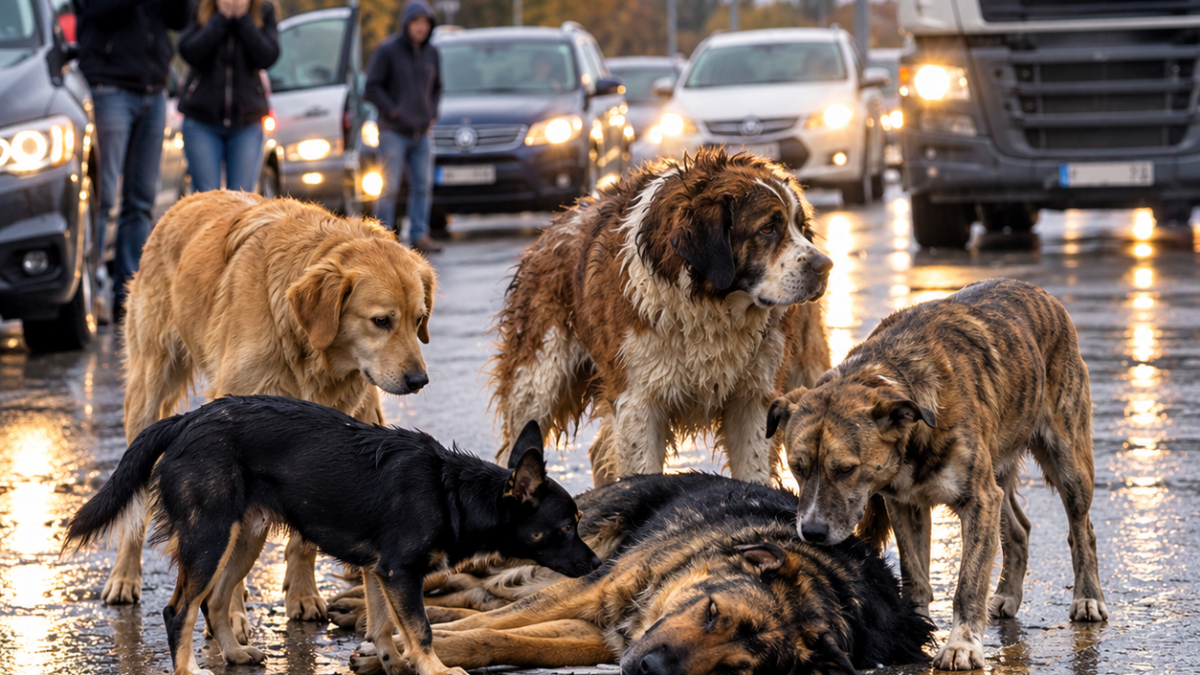
They were not behaving like five unrelated strays who had accidentally ended up in the same place.
They were organized.
The big brown-and-white dog protected the injured shepherd’s rear body.
The brindle female guarded his head.
The honey-colored dog watched the vehicles.
The little black one stayed in physical contact with him.
Each dog had a place.
Each dog had a job.
And not one of them looked willing to abandon it.
A woman stepped beside me.
She was probably in her sixties, wearing a red scarf and holding her phone at her side now.
“They know what they’re doing,” she whispered.
I nodded.
“I think so.”
Another man said, “Somebody should drag them off the road.”
The woman snapped her head toward him.
“You go try.”
He didn’t.
Someone had already called the police.
Someone else called an animal rescue service.
Traffic backed up in both directions.
For the first five minutes, people complained.
After ten minutes, almost nobody did.
The injured shepherd tried to rise again.
The brindle female immediately lowered her body beside his face.
The little black dog licked his mouth.
The big dog moved closer behind him.
The shepherd stopped struggling.
It looked less like restraint than reassurance.
Stay down.
We are here.
That was what it looked like.
Maybe I was projecting human meaning onto animals.
Maybe.
But everybody standing there seemed to see the same thing.
A rescue van arrived around twenty minutes later.
A woman stepped out.
Early forties.
Dark hair tied back.
Green waterproof jacket.
No sudden movements.
She spoke first to the drivers.
“Everybody stay back. Please. No shouting. No horns.”
A younger rescue worker began positioning cones.
The woman approached the dogs slowly.
She turned her body slightly sideways instead of walking straight at them.
She never locked eyes with the brindle female.
Later I learned her name was Léa Martin and that she had worked with traumatized animals for more than fifteen years.
At that moment all I knew was that the dogs watched her differently.
She stopped about twenty feet away.
Then she crouched.
“It’s okay,” she said.
Her voice was barely louder than the wind.
“You don’t have to move.”
The brindle female stared at her.
Léa took a few pieces of food from a pouch.
She tossed one toward the sidewalk.
No dog moved.
She tossed another.
Then one closer.
The honey-colored dog glanced toward the food.
His ribs were visible.
Even from where I stood, I could see how thin he was.
He took two steps.
Stopped.
Looked at the brindle female.
Then at the injured shepherd.
Finally he approached the food.
The woman beside me whispered, “He must be starving.”
He probably was.
He picked up the piece.
Then turned around.
He carried it straight back to the shepherd.
He placed it on the asphalt beside his mouth.
Nobody spoke.
The shepherd sniffed it.
He did not eat.
The honey-colored dog waited.
Then lowered himself beside him.
A man who had been recording with his phone slowly dropped his hand.
I remember that more clearly than almost anything else.
All morning people had treated the road like an inconvenience.
Then one starving dog gave away his food to another.
Suddenly we were embarrassed to be spectators.
Léa kept working.
Slowly.
Patiently.
Eventually the dogs allowed her close enough to inspect the shepherd without touching him.
She looked at his gums.
Watched his breathing.
Then she stood and called to her partner.
“We need the board.”
The next forty minutes felt longer than the previous hour.
Two vehicles were moved sideways to block traffic entirely.
Police arrived and redirected cars.
The rescue team brought a rigid transport board and blankets.
Every movement made the brindle female tense.
Léa talked constantly.
Not loudly.
Not baby talk.
Just a calm stream of words.
“You’re okay.”
“We’re helping him.”
“That’s it.”
“Good girl.”
When a male rescuer reached toward the shepherd’s rear legs, the big brown-and-white dog stepped between them.
He did not growl.
He just stood there.
The rescuer froze.
Léa walked around.
She held out her hand.
The big dog sniffed it.
Then looked at the injured shepherd.
“I know,” Léa said.
“We’re not taking him away from you.”
Maybe the words meant nothing.
The tone didn’t.
The big dog finally moved aside.
The rescuers slid the board underneath the shepherd.
He cried out once.
The brindle female pressed her muzzle against his cheek.
The little black dog panicked and tried to climb onto the board.
One of the rescuers laughed softly through tears.
“Not yet, little man.”
They lifted the shepherd.
The big dog followed the stretcher so closely his chest almost touched it.
The honey-colored dog stayed at the other side.
The little black dog jumped into the van before the door was fully opened.
Several people laughed.
Nobody laughed at him.
The big dog climbed in.
Then the honey-colored one.
The brindle female remained in the road.
Alone.
For maybe five seconds.
She looked down at the damp impression the shepherd’s body had left between the yellow lines.
Then she looked at the van.
Léa stood at the open door.
“Come on.”
The female jumped inside.
The door closed.
Traffic began moving again.
I should have returned to work.
I almost did.
Instead, I found myself standing beside my truck staring at the road where they had been.
The woman with the red scarf touched my arm.
“Do you think he’ll survive?”
“I don’t know.”
She looked toward the rescue van disappearing in the distance.
“I hope so.”
So did I.
I was already late for my first delivery.
I climbed back into the cab.
My phone had three missed calls from my supervisor.
I should have been thinking about work.
Instead I kept seeing the honey-colored dog carrying that piece of food back.
I drove maybe fifteen minutes before realizing something else.
My dash camera had been running the entire time.
I didn’t know then how important that would become.
At the shelter clinic, the injured shepherd was examined immediately.
I learned the details later.
A fractured pelvis.
Heavy bruising around the right hip.
Severe dehydration.
An infected wound near the shoulder.
An older scar running almost the full length of his left front leg.
Part of the right ear torn long before that morning.
But no internal bleeding.
That mattered.
He had a chance.
The other four were examined too.
All were underweight.
All had damaged paw pads.
All had parasites.
Their nails were long enough to suggest months without proper care.
None wore collars.
None had microchips.
None had identifying marks connected to a registered owner.
But all five dogs had the same reddish dirt packed between their paw pads.
At first nobody thought much of it.
They had been running through fields.
Of course they had dirt on them.
But one of the veterinary assistants noticed the color.
Dark rust-red.
Clay-heavy.
Not the normal gray-brown mud around the industrial road.
She mentioned it to Léa.
Léa collected samples almost as an afterthought.
That small decision changed everything.
I got home after seven that evening.
My apartment felt unusually quiet.
I heated leftover pasta.
Didn’t eat it.
Around eight-thirty, my phone rang.
Unknown number.
“Hello?”
“Julien Mercier?”
“Yes?”
“This is Léa Martin. From this morning.”
I sat up.
“The dogs?”
“The shepherd made it through the first treatment. He’s stable.”
I exhaled.
I hadn’t realized I had been holding my breath.
“Good.”
“He still needs surgery.”
“And the others?”
“They’re exhausted. Frightened. But stable.”
“Okay.”
There was a pause.
Then her voice changed.
“Julien, your vehicle has a dash camera, right?”
I looked toward my keys on the counter.
“Yes.”
“Does it continuously record?”
“Yes.”
“Do you still have the card from this morning?”
“I haven’t touched it.”
“Don’t.”
Something cold moved through my stomach.
“Why?”
“The dirt on those dogs’ paws came from a very specific area.”
“What area?”
“About eleven kilometers northeast of where you found them.”
I waited.
“So?”
Another pause.
“Because there’s a property in that area that has come up before.”
“Come up in what?”
“I’d rather not explain over the phone.”
“Léa.”
She lowered her voice.
“I don’t think those dogs were wandering.”
“What do you think?”
“I think they were running.”
I stood.
“Running from what?”
She didn’t answer immediately.
Then she said:
“Tomorrow morning. Seven-thirty. Bring the entire dashcam card.”
That night I slept maybe two hours.
Every time I closed my eyes, I saw the five dogs.
But now the scene looked different.
I imagined them before the road.
Running through darkness.
Behind them, headlights.
Shouting.
Maybe a gate.
Maybe a fence.
Maybe someone chasing them.
At 7:20 the next morning, I arrived at the shelter with the memory card inside an envelope.
Léa met me at a side entrance.
Her eyes were red.
“You sleep?”
“No.”
“Me neither.”
She led me to a small office.
A man stood beside the desk.
Mid-fifties.
Gray hair.
Weathered face.
Dark green field jacket.
He introduced himself as Captain Renaud Besson.
He worked in rural and environmental enforcement.
I looked at Léa.
“Why is environmental enforcement involved?”
Renaud pulled out a chair.
“Let’s look at your footage first.”
We loaded the dashcam recording.
Most of it was useless.
Traffic.
Warehouses.
Roundabouts.
My own dashboard.
At 8:03, the dogs were not yet visible.
At 8:04, Renaud raised one finger.
“Back.”
Léa reversed.
“Slowly.”
On the far right edge of the screen, near a drainage ditch, five shapes appeared.
Running.
My heart accelerated.
“There.”
Léa froze the frame.
The image was grainy.
But there they were.
The brindle female in front.
The little black dog close behind.
The honey-colored dog.
The large brown-and-white dog.
And the shepherd.
Atlas, though he did not have that name yet.
He was already limping.
“Keep going,” Renaud said.
They disappeared behind vegetation.
Then something else came into view.
A white utility vehicle.
It turned off a gravel track.
Only part of it was visible.
A damaged rear panel.
A dark green triangular shape on the door.
Renaud leaned closer.
“Stop.”
Léa enlarged the frame.
The image blurred.
Still, the logo remained visible enough.
Renaud sat back.
“You know it?” I asked.
“Yes.”
“Whose?”
“Montferrand Agricultural Services.”
I waited.
The name meant nothing to me.
“What do they do?”
Renaud gave a humorless smile.
“That depends on which document you read.”
He unfolded a map.
Montferrand Agricultural Services owned a large property several kilometers beyond the industrial zone.
The land included old clay fields.
That explained the red dirt.
Officially the business handled agricultural storage, pest control, equipment transport, and rural property management.
Unofficially, complaints had surfaced over the years.
Dogs barking at night.
Unknown trucks arriving after midnight.
Animals occasionally seen behind secondary fences.
Every inspection had produced almost nothing.
No large group of dogs.
No obvious violations.
No illegal operation.
“Then maybe it’s nothing,” I said.
Renaud looked at me.
“Maybe.”
But his face said the opposite.
He asked if my camera recorded sound.
It did.
We replayed the footage with headphones.
At first there was only road noise.
My engine.
Rain against the windshield.
Then Renaud lifted his hand.
“Again.”
We replayed five seconds.
I heard nothing.
He increased the volume.
This time I heard a metallic bang.
Then a distant shout.
Then words.
Faint.
But clear enough.
“Get them before they reach the road!”
Nobody moved.
Léa slowly took off her headphones.
Renaud stared at the screen.
“Now,” he said, “it’s not nothing.”
The shepherd underwent surgery that afternoon.
Léa named him Atlas because, she said, “He looks like he’s been carrying the world for too long.”
The big brown-and-white dog became Bruno.
The brindle female became Maya.
The honey-colored dog became Sunny.
The small black dog was named Pixel because he never seemed to occupy one place for more than half a second.
For the first several days, the four healthier dogs refused to relax if they could not smell Atlas.
The shelter placed them in a kennel beside the recovery room.
Maya slept against the door.
Bruno often remained standing even when exhaustion made his legs buckle.
Sunny would take food, carry it near the door, and wait.
Pixel pushed one paw through the gap beneath it.
Whenever Atlas made a sound, four heads lifted.
Once, during the second night, Atlas cried from pain.
Maya began whining.
Bruno moved toward the wall.
Sunny stood.
Pixel scratched at the door.
A nurse opened it just enough for them to see Atlas through a glass partition.
All four settled down.
That was when Léa stopped calling them “the five dogs.”
She started calling them “the family.”
Investigators visited Montferrand’s property two days later.
The owner was Étienne Vautrin.
Fifty-two.
Well known locally.
His father had owned feed stores.
His grandfather had served on a regional agricultural board.
Étienne donated to town festivals.
Sponsored a youth football club.
Paid for Christmas decorations outside the church one year.
The type of man people described as “established.”
Police asked him about the five dogs.
He said he had never seen them.
They showed him a still image of the utility vehicle.
He said several companies used similar vehicles.
They showed him the partial logo.
He claimed one of his drivers had probably been in the area on unrelated business.
Had his employees chased dogs?
Absolutely not.
Did his company house animals?
Occasionally, temporarily, for pest-control clients or property security.
Did he own Atlas?
No.
Maya?
No.
Bruno?
No.
Sunny?
Pixel?
Never seen them.
Without stronger evidence, investigators could ask questions.
They could not tear apart the property.
Then an old man named Marcel Girard saw the shelter notice.
Marcel owned a small orchard bordering Montferrand land.
He was seventy-one.
Widowed.
Thin as a fence post.
He arrived carrying an old phone and a printed photograph.
When Léa placed the photograph on the desk, she stopped breathing for a second.
The dog in the picture was Atlas.
Younger.
Standing behind a rusted wire enclosure.
His right ear already torn.
“Where did you take this?” she asked.
Marcel looked toward the door.
“Vautrin’s back field.”
Renaud, who had been called immediately, sat across from him.
“When?”
“Last winter.”
“Why?”
Marcel rubbed both hands together.
“For years I heard dogs at night. Sometimes ten. Sometimes twenty. Sometimes more.”
“Did you report it?”
“Twice.”
“What happened?”
“People came.”
“And?”
Marcel laughed without humor.
“On inspection days, there were never dogs.”
Renaud’s eyes narrowed.
“You think Vautrin knew inspections were coming?”
“I think Étienne Vautrin knows things before most people do.”
Marcel explained that one January morning he had found blood on his boundary fence.
He followed tracks along the property edge.
That was when he saw Atlas and another dog inside separate runs.
He took one photograph before a worker approached.
“Did you show this to anyone?”
“I did.”
“And nothing happened?”
“Nothing.”
That word landed heavily.
Nothing.
The photograph still contained original metadata.
Location.
Time.
Date.
The coordinates placed Atlas inside Vautrin’s property.
For the first time, Vautrin’s denial had a visible crack.
Yet investigators still needed more.
Then Maya gave it to them.
Six mornings later, shelter workers arrived to find one rehabilitation enclosure empty.
Four dogs missing.
Maya.
Bruno.
Sunny.
Pixel.
Panic spread instantly.
Atlas was still inside.
Léa checked the outdoor camera.
At 5:17 a.m., Pixel had squeezed beneath a section of softened fence.
Maya followed.
Then Sunny.
Bruno pushed through last.
“Why would they leave Atlas?” one employee asked.
Léa stared at the screen.
“They wouldn’t.”
The day before, Maya had been fitted with a GPS training collar.
Léa opened the tracking app.
The blinking dot was moving northeast.
Directly toward Montferrand.
“They’re going back,” she whispered.
I got the call at 5:43.
“They escaped.”
“What?”
“The four.”
I was already pulling on my jeans.
“Where?”
“Heading toward Vautrin’s land.”
I don’t know why I went.
Maybe because I had been on the road when the story started.
Maybe because the dogs had become something personal.
Maybe because once you witness an animal willing to die for another, walking away becomes harder.
By the time I reached Marcel’s orchard, police were there.
The GPS signal had stopped near the north boundary.
Bruno was found first.
He stood beside thick brush.
Maya was digging.
Sunny paced.
Pixel was gone.
Then we heard barking.
Muffled.
Underground.
Léa dropped to her knees.
The sound came from an old drainage culvert running beneath the fence.
“Pixel!”
A bark answered.
Not one.
Several.
Renaud looked at the officers.
One said, “That culvert enters private land.”
Another dog barked from beneath the property.
Then another.
Léa looked furious.
“There are dogs under there.”
Within hours, emergency animal welfare grounds helped secure legal entry.
The warrant arrived before noon.
I remained outside.
I had no official reason to enter.
What I saw from the road was enough.
The first animal came out on a stretcher.
Then another.
Then another.
Twenty-three dogs were removed that day.
Some walked.
Some had to be carried.
Several crawled backward when rescuers approached.
One elderly retriever pressed himself so flat against the floor of his cage that workers initially thought he was unconscious.
Behind one warehouse, investigators found narrow runs covered with camouflage netting.
Inside another building they found veterinary drugs.
Transport cages.
Chains.
Paperwork.
Blank identification forms.
Burners for removing tags.
A cabinet filled with collars.
And ledgers.
Renaud came out after sunset.
His face looked gray.
“What did you find?”
He did not answer at first.
Then:
“Enough to keep people busy for a long time.”
Étienne Vautrin was arrested the following morning.
Two employees were detained too.
People in town were stunned.
Some refused to believe it.
I heard the same phrases repeatedly.
“He donates to charity.”
“He has a good family.”
“I’ve known him twenty years.”
“He would never.”
People love believing evil looks obvious.
It usually doesn’t.
Sometimes it sponsors football jerseys.
Vautrin’s attorney appeared before cameras immediately.
His client, he said, ran legal animal management operations.
The dogs were rescues.
The poor conditions resulted from an employee shortage.
The prosecution was overreacting to “images without context.”
And Atlas?
A stray.
He had never belonged to Vautrin.
Then investigators showed the photograph Marcel had taken.
The attorney changed language.
Perhaps Atlas had briefly been housed there.
Records were incomplete.
An administrative oversight.
Every answer created another question.
The ledgers created hundreds.
Dogs were described by color, approximate age and behavior.
Beside some names were letters.
S.
T.
D.
R.
Beside Atlas’s description was a notation:
D — FAILED.
When Léa first showed me, I stared at the page.
“What does D mean?”
“We don’t know yet.”
Her voice suggested she feared she did.
The investigation expanded.
Families who had lost dogs over the previous three years began calling.
Some pets had vanished from fenced gardens.
Some disappeared during walks.
Some had been given away through online advertisements to people claiming they represented rural families.
One woman came to the shelter after seeing a news photograph.
Her name was Isabelle.
She walked past three kennels before screaming.
“Luna!”
A thin German shepherd inside turned.
The woman dropped to her knees.
“Luna!”
The dog froze.
Then moved toward the bars.
Her tail made one tiny movement.
Isabelle began crying so hard a shelter worker had to hold her up.
Her dog had been missing fourteen months.
That reunion destroyed something in me.
Until then the case had been terrible.
Now it became personal in a different way.
These animals had not simply existed behind a fence.
People had searched for them.
Children had gone to bed asking when they were coming home.
Families had posted notices.
Walked roads.
Checked shelters.
Blamed themselves.
Someone had known where some of those animals were the entire time.
The police discovered collars in a storage building owned by Étienne’s brother, Thierry Vautrin.
Dozens.
Some tags still had phone numbers.
One belonged to Oscar, a Labrador missing for ten months.
Another belonged to a border collie named Max.
Another to Luna.
Thierry claimed he collected discarded collars.
Nobody believed him.
Then things became uglier.
Marcel had become a key witness.
His photograph placed Atlas inside the property.
His history of complaints suggested the operation had been hidden deliberately.
Two weeks after Vautrin’s arrest, Marcel’s barn burned.
The call came after midnight.
By the time I arrived, flames had already eaten through most of the roof.
Firefighters sprayed water into black smoke.
Marcel stood in the orchard in pajamas, boots and an old coat thrown over his shoulders.
Bruno was not with him yet—he was still at the shelter—but somehow I could already imagine the dog standing beside the old man.
I walked over.
“You okay?”
“My house is fine.”
“I asked about you.”
He looked at the burning barn.
“I’m angry.”
Investigators later classified the fire as suspicious.
No direct evidence tied it to Étienne Vautrin.
But the timing terrified everyone.
The shelter increased security.
Witnesses received warnings.
Léa moved Atlas, Maya, Bruno, Sunny and Pixel into an area not accessible to the general public.
Three nights later, a man arrived at the shelter carrying a clipboard.
He said he was from a sanitation contractor.
The night employee checked the schedule.
No appointment.
She refused entry.
The man became agitated.
He left.
Cameras captured his face.
Marcel recognized him.
Thierry.
Police searched his garage the next day.
That was where the collars were found.
Along with a notebook containing addresses.
Several belonged to people whose dogs had disappeared.
Any remaining illusion collapsed.
By then Atlas had started rehabilitation.
His first attempt at standing lasted less than ten seconds.
Two workers supported him with a sling.
His hind legs shook violently.
Maya watched from behind the gate.
Bruno whined.
Sunny stood still.
Pixel spun in circles.
Atlas placed one paw forward.
Then another.
He fell.
Léa caught him.
She pressed her face against his neck.
“That counts,” she whispered.
The next day he took three steps.
Then five.
Then seven.
Every time Atlas practiced, the other four watched.
On the afternoon he crossed the rehabilitation room without collapsing, Pixel barked so loudly everyone laughed.
Bruno wagged his entire rear body.
Maya walked to Atlas and touched her forehead against his.
Sunny brought him a toy.
The same dog who had carried him food on the road now carried him a shredded blue rope.
Atlas took it.
For the first time, I saw him play.
Barely.
But he did.
The dogs changed slowly.
Bruno had been frightened of men.
If a male worker raised an arm to reach a shelf, Bruno ducked.
Marcel began visiting him.
He never forced touch.
He simply sat outside the kennel reading newspapers aloud.
After three weeks, Bruno rested his head against the bars.
After five, Marcel touched his nose.
“Looks like I got permission,” he told me.
Sunny had an unusual problem.
He would not eat until every other dog had eaten first.
Léa suspected he had learned that food disappeared unless distributed carefully.
Workers began feeding him separately.
For several days, he waited anyway.
Eventually hunger defeated habit.
Pixel discovered toys.
This became everybody’s problem.
He stole gloves.
Towels.
Pens.
A visitor’s hat.
One morning he dragged a roll of paper towels through three rooms and looked proud enough to receive a medal.
Maya remained the hardest to read.
She tolerated people.
She accepted food.
She walked on leash.
But her attention always returned to Atlas.
If he disappeared behind a door, she waited.
If he cried, she stood.
If another dog approached too quickly, she placed herself between them.
One afternoon, Léa called me into her office.
“We reconstructed the escape.”
Investigators had matched damaged fencing, paw prints and internal camera fragments.
A storm had loosened a drainage barrier.
Maya escaped first.
“She could have run straight into the woods,” Léa said.
“She didn’t?”
“No.”
Maya crossed the compound.
She went to Pixel’s enclosure.
She scratched and bit at weakened wire until he got out.
Together they reached Sunny.
Then Bruno.
Atlas was last.
His kennel latch had jammed.
Marks beneath the gate showed multiple dogs had scratched there.
They created enough space for him to squeeze through.
“Then the worker saw them,” Léa said.
The white utility vehicle pursued.
Atlas was struck somewhere along the gravel road.
That most likely caused the fractured pelvis.
Yet he kept moving.
The others slowed down with him.
They reached the highway.
Atlas collapsed.
Freedom was ahead.
Four dogs could have kept running.
None did.
I sat there staring at the floor.
“So Maya came back for everybody.”
“It looks that way.”
“And when Atlas fell…”
“They stayed.”
I had seen it with my own eyes.
Still, hearing the sequence made my throat tighten.
The criminal case grew stronger.
One employee agreed to cooperate.
His name was Pascal Roux.
He had worked for Vautrin almost nine years.
At first Pascal denied knowing anything.
Then police showed him financial records.
Messages.
Collars.
His own signatures.
He asked for a lawyer.
A week later, he started talking.
The business was more complicated than anyone expected.
Some dogs were stolen.
Some acquired through misleading advertisements.
Some were purchased cheaply.
Some were transported across borders with falsified papers.
Some were used for illegal security training.
Others were subjected to aggressive conditioning.
Dogs who did not perform were marked.
That was where the ledger letters came in.
D stood for dominance-conditioning category.
Atlas had failed.
Not because he was weak.
Because he would not attack.
Pascal described one incident.
A smaller terrified dog had been placed into a training run.
A handler wanted Atlas to react aggressively.
Atlas backed away.
The handler pressured him.
Atlas still refused.
Finally Atlas moved in front of the smaller dog.
Not to attack it.
To shield it.
Pascal remembered because Vautrin became furious.
He struck Atlas.
That explained part of the old scarring.
When Pascal testified months later, the courtroom was silent.
The prosecutor asked:
“What did ‘failed’ mean?”
Pascal looked toward Vautrin.
“He wouldn’t become what they wanted.”
“What did they want?”
“A dog that would attack on command.”
“And Atlas?”
“He wouldn’t.”
The prosecutor paused.
“What happened to dogs who failed?”
Pascal looked down.
“They were held.”
“For what purpose?”
“Until Mr. Vautrin decided.”
“Decided what?”
Defense counsel objected.
The judge allowed the question.
Pascal’s voice dropped.
“What to do with them.”
“And what did that sometimes mean?”
“They disappeared.”
Léa sat beside me.
Her hand tightened around a tissue.
Vautrin stared straight ahead.
I remember thinking how strange it was.
Atlas had probably never understood why humans hurt him.
Never understood why refusing violence earned punishment.
Never understood the ledger.
But in that courtroom, his refusal became evidence of his character.
The prosecution played my dashcam audio.
“Get them before they reach the road!”
Then they displayed the vehicle.
The dent.
The logo.
Maintenance records.
Pascal confirmed the vehicle.
He confirmed the chase.
He was not driving.
A supervisor was.
Then investigators presented recovered security footage from Vautrin’s property.
Twenty-seven seconds.
Grainy.
No sound.
Maya ran across frame.
Pixel behind her.
Sunny.
Bruno.
Then Atlas.
Limping.
The outer gate opened.
A worker appeared.
The white vehicle accelerated.
Video ended.
The defense tried to argue the dogs were being recovered for their own safety.
Then the prosecutor asked:
“If these were simply legally housed animals, why did your client initially deny ever seeing them?”
No answer sounded convincing.
The trial lasted weeks.
Families testified.
Veterinarians testified.
Investigators testified.
Marcel testified.
So did I.
During my testimony, Vautrin looked at me for the first time.
His expression was not angry.
That would have been easier.
He looked annoyed.
As if I were a delivery driver who had brought the wrong package.
The prosecutor asked me to describe what I saw on the road.
I told the truth.
“They stayed around the injured dog.”
“How close?”
“Close enough that traffic couldn’t move.”
“Did the four healthy dogs try to abandon him?”
“No.”
“Did they appear aggressive toward people?”
“No.”
“What happened when food was offered?”
I looked at the jury.
“One dog took it back to the injured one.”
The courtroom became quiet again.
“What did you think when you saw that?”
The defense objected.
The prosecutor rephrased.
“What did you observe?”
“I observed a starving animal refusing to eat because another animal was hurt.”
That was allowed.
I looked toward Vautrin.
For the first time, he looked away.
The defense’s strongest strategy was to separate every fact.
A collar meant nothing.
A kennel meant nothing.
A van meant nothing.
A missing dog meant nothing.
A ledger notation meant nothing.
But together they formed a story.
And stories become difficult to escape when every piece points the same direction.
The jury returned guilty verdicts on multiple charges tied to cruelty, illegal trafficking, falsified records, theft-related conduct, and intimidation.
Thierry faced separate convictions connected to stolen animal property and the attempted shelter access.
Some charges did not hold.
The barn fire could not be proved beyond reasonable doubt.
A few suspected thefts remained unresolved.
Not every missing dog was found.
That bothered people.
It still bothers me.
Justice rarely closes every door.
But it closed enough.
Vautrin lost his business.
His property was seized through the legal process connected to fines, restitution and financial crimes.
His carefully maintained public reputation evaporated.
Families he had lied to sat in court as he was sentenced.
He had spent years hiding animals behind fences.
Now every door that closed behind him was locked from the outside.
People called that revenge.
Marcel disagreed.
One afternoon, after sentencing, we sat beside the shelter yard.
Atlas was walking slowly across the grass.
Maya beside him.
Bruno nearby.
Sunny lying in sunlight.
Pixel digging a hole he had no permission to dig.
Marcel pointed.
“That’s revenge.”
I smiled.
“Dogs living?”
“Dogs living well.”
He leaned back.
“Men like Vautrin think winning means making something afraid of you.”
Atlas stumbled slightly.
Maya stopped.
Waited.
Atlas steadied himself.
They continued.
Marcel said, “Look at that. He failed.”
“What?”
“Vautrin.”
I understood.
He had wanted obedience through fear.
Instead, the dogs had formed loyalty through suffering.
He had wanted to isolate them.
Instead, they became inseparable.
He had wanted Atlas aggressive.
Atlas protected weaker animals.
He wanted Maya contained.
She broke everyone out.
He wanted evidence hidden.
Five dogs carried it straight into the middle of a public highway.
That was revenge.
Not blood.
Not violence.
Survival.
Bruno was the first adopted.
Marcel took him.
Nobody was surprised.
The first night, Bruno refused to enter Marcel’s house.
He stopped at the doorway.
Marcel didn’t pull.
He brought a blanket outside.
Then a pillow.
He slept on the porch.
At dawn, Bruno was still beside him.
The second night, same thing.
The third night, rain started.
Marcel opened the door.
“You can be stubborn,” he told him. “But I’m too old to sleep wet.”
He went inside.
Ten minutes later, Bruno stepped through.
By the end of the week he had discovered the sofa.
By the end of the month Marcel complained he owned only “twelve percent of it.”
Sunny was adopted by Claire Renard, a retired teacher.
She wanted a calm dog.
Sunny seemed calm.
For twenty-four hours.
Then he learned how to open her pantry.
He stole bread.
Cheese.
A bag of flour.
He once carried an entire baguette into the garden and buried half of it.
Claire sent us a photograph.
Sunny sat beside the hole looking innocent.
Her caption read:
YOUR “CALM DOG” HAS STARTED A BAKERY.
Pixel went to a young paramedic couple named Antoine and Camille.
They had no children.
They had a fenced yard.
They had experience with rescue dogs.
They also had absolutely no idea what Pixel was capable of.
Within two weeks he had stolen fourteen socks, two gloves, one television remote, a sandwich and a plastic medical training model.
Antoine told me:
“He’s a criminal.”
Pixel adored him.
Maya was offered adoption several times.
Every meeting ended the same way.
She was polite.
She accepted treats.
She walked beside the family.
Then she turned toward Atlas.
If someone tried leading her farther away, she stopped.
Eventually Léa stopped scheduling meetings.
“You’re keeping her,” I said.
“I am fostering her.”
“For how long?”
“Until the right situation comes.”
I looked at Maya sleeping under her desk.
“The right situation is your house.”
Léa ignored me.
Atlas required more recovery.
His pelvis healed.
The joint damage did not disappear.
He would always walk unevenly.
He hated slippery floors.
He hated sudden metallic noises.
He especially hated white utility vehicles.
The first time one passed outside the shelter, he froze.
Maya pressed against him.
After several seconds he started breathing again.
Léa eventually brought him home “temporarily.”
Three months later I visited.
Atlas was asleep under her kitchen table.
Maya occupied the sofa.
I looked at Léa.
“Temporary?”
“Don’t start.”
“You now have two dogs.”
“I’m aware.”
“No. You have Maya, Atlas, three dog beds, two ramps, six medication bottles and a freezer full of chicken.”
“They have dietary needs.”
“Of course.”
Atlas opened one eye.
His tail tapped the floor.
That dog had changed me.
Before him, I liked animals.
After him, I paid attention.
There’s a difference.
One year after the highway rescue, Marcel invited everyone to his orchard.
His barn had been rebuilt.
Neighbors donated lumber.
A construction company provided labor.
Local students painted walls.
Marcel turned one section into temporary recovery space for rescue animals.
Above the entrance hung a small wooden sign.
THE FIVE.
Bruno was already there.
Sunny arrived with Claire.
Pixel arrived dragging Antoine toward the orchard.
Maya jumped from Léa’s car.
Atlas took longer.
He lowered himself carefully onto the grass.
Then Bruno saw him.
The big dog moved faster than I had ever seen.
Marcel shouted, “Slow down, you idiot!”
Bruno did not slow down.
He reached Atlas.
Stopped at the last second.
Then leaned his entire body against him.
Atlas almost fell.
Maya nudged Bruno away.
Claire laughed.
Sunny began sniffing the food table.
Pixel stole a gardening glove.
For several minutes, the five dogs moved around each other.
Sniffing.
Touching.
Circling.
Then, without instruction, they settled beneath an apple tree.
Atlas in the middle.
Maya beside his head.
Bruno near his rear legs.
Sunny opposite him.
Pixel pressed against his shoulder.
The same positions.
Almost.
My throat closed.
Léa noticed.
“You okay?”
“Yeah.”
“You’re crying.”
“No.”
“You absolutely are.”
“Allergies.”
“In October?”
“Very aggressive apples.”
She laughed.
Later that afternoon Marcel joined me by the fence.
“I should have done more,” he said.
I knew immediately what he meant.
“You reported it.”
“I stopped after they ignored me.”
“You took the photograph.”
“I should have kept pushing.”
“Maybe.”
He looked surprised.
Most people would have told him he had done enough.
I knew guilt didn’t respond to easy comfort.
“So should everyone else who noticed something,” I continued. “But you know who didn’t spend time wondering whether they had done enough?”
He glanced toward the dogs.
“Maya?”
“She found a gap and went back for the others.”
Marcel smiled faintly.
“Dogs make us look complicated.”
“They make us look ridiculous.”
We watched Atlas sleep.
Sometimes people imagine heroism as one enormous act.
It usually isn’t.
Maya could not rescue every dog.
She rescued those she could reach.
Pixel could not fight the men who kept them.
He followed Maya and stayed with Atlas.
Bruno could not heal Atlas’s pelvis.
He stood over his body.
Sunny could not carry Atlas to safety.
He gave him food.
Each one did something small.
Together, those small things became escape.
A traffic jam.
A dashcam recording.
A warrant.
An investigation.
A prosecution.
Dozens of animals discovered.
Families reunited.
That was the part I eventually understood.
You do not always have to save everyone.
Sometimes you only have to refuse to abandon the one beside you.
Years passed.
Bruno grew old first.
His muzzle turned white.
Marcel claimed he became more stubborn with age.
“He ignores me now.”
“He ignored you before.”
“Yes, but now it’s disrespectful.”
Bruno died peacefully one winter at almost thirteen.
Marcel called me after.
His voice shook once.
Only once.
“I buried him beside the barn.”
I drove there.
We didn’t talk much.
The sofa inside still carried an enormous depression where Bruno had slept.
Marcel refused to replace it.
Sunny aged next.
Claire continued feeding him too much cheese.
Every veterinarian told her to stop.
Every time she nodded.
Every time Sunny got cheese.
Pixel remained Pixel.
Even at ten years old he stole objects.
His face grayed.
His ears still looked too large.
Maya became quieter.
Atlas slower.
Every anniversary, they met when they could.
The fifth anniversary remains my favorite.
Atlas had difficulty getting out of the car.
I crouched beside him.
“Need help, old man?”
He stared at me.
“You are getting ancient.”
He sneezed directly onto my shirt.
“Okay. Message received.”
Maya waited beside him.
The moment Atlas stood, she pressed her shoulder into his.
They walked toward the orchard like that.
Bruno was still alive then.
He lay beneath the apple tree.
Sunny arrived shortly afterward.
Pixel carried a glove he had stolen from Marcel.
All five settled together.
Marcel sat beside me.
“Remember the highway?”
“Every second.”
“What did you think?”
“That they were going to die.”
“And?”
I looked at them.
“They destroyed the man who thought he owned them.”
Marcel shook his head.
“No.”
“What?”
“They didn’t destroy him.”
He pointed toward Atlas.
“He destroyed himself.”
That stayed with me.
Vautrin’s cruelty built the evidence.
His lies created contradictions.
His intimidation created more witnesses.
His arrogance made him believe frightened animals were powerless.
The dogs simply survived long enough for the truth to catch up.
Atlas never knew any of this.
That might be the most beautiful part.
He didn’t know Vautrin went to prison.
He didn’t know his story spread far beyond Lyon.
He didn’t know shelters used photographs of the five dogs to encourage people to report suspected abuse.
He didn’t know donations paid for new rescue equipment.
He didn’t know Marcel’s barn became a recovery space.
He didn’t know a local animal welfare group created a fund in their name.
He didn’t understand justice.
He understood food.
Grass.
Sunlight.
Léa’s kitchen.
Maya sleeping near him.
That was enough.
Atlas lived longer than veterinarians expected.
The last year became difficult.
Arthritis settled into his damaged hip.
Ramps appeared throughout Léa’s house.
Rugs covered every smooth floor.
His walks shortened.
Maya shortened hers too.
If Atlas stopped, Maya stopped.
If he slept, she slept nearby.
One evening I visited.
The sky was orange.
Atlas lay in the garden.
Maya beside him.
I sat down.
Atlas raised his head.
“Hey, traffic criminal.”
His tail moved once.
I scratched behind his torn ear.
“You know everybody thinks you were brave.”
He closed his eyes.
“I think you were terrified.”
Maya looked at me.
“And you stayed anyway.”
That, I had learned, was what courage looked like.
Not absence of fear.
Staying.
Atlas died several weeks later.
At home.
Léa beside him.
Maya touching his shoulder.
When Léa called me, neither of us spoke for several seconds.
“He’s gone,” she finally said.
“I know.”
“I thought I was ready.”
“No one is.”
Maya searched the house for him afterward.
That broke Léa more than the death itself.
She checked the kitchen.
The bedroom.
The garden.
Then returned to Atlas’s empty bed.
For several nights, Maya slept there.
We buried Atlas’s ashes beneath the apple tree at Marcel’s orchard.
Bruno had already passed.
Sunny was too frail to travel.
Pixel came.
Maya came.
Renaud came too, retired by then.
Marcel placed a small stone beneath the tree.
ATLAS.
Below it was the date of the highway rescue.
Nothing more.
No heroic quote.
No long explanation.
He didn’t need one.
I stood there after everyone began leaving.
The orchard was quiet.
Wind moved through the branches.
Maya remained beside the stone.
I thought about the first time I saw Atlas.
Broken pelvis.
Wet asphalt.
Traffic.
Horns.
Four dogs surrounding him.
Back then, I believed I was witnessing a traffic obstruction.
I had no idea I was looking at the end of an escape.
No idea those animals had run from hidden kennels through mud and darkness.
No idea Maya had doubled back for the others.
No idea Atlas had once been punished because he refused to attack.
No idea Bruno had learned to fear raised hands.
No idea Sunny had learned hunger so deeply he gave away food.
No idea Pixel had lived behind wire.
No idea that five dogs reaching a public road would eventually expose years of cruelty.
I only knew one thing.
Four dogs were free to run.
One could not.
So four stayed.
I have thought about that moment more times than I can count.
We humans say we love each other.
We say family means everything.
We say friendship matters.
Then life becomes difficult and people disappear.
Those dogs had almost nothing.
No home.
No food.
No names.
No guarantee that the humans approaching them were safe.
Freedom was literally a few hundred yards away.
And when Atlas collapsed, not one kept going.
Bruno stood over his broken body.
Sunny brought him food.
Pixel kept touching his face.
Maya guarded his head.
The truck horn screamed.
Cars moved toward them.
People shouted.
They did not leave.
Maybe that is why so many people eventually cared about their story.
Not because Vautrin was evil.
The world already knows evil exists.
Not because police made arrests.
Arrests happen every day.
Not because Atlas survived surgery.
Animals survive terrible things more often than we realize.
People cared because those dogs showed us something we desperately wanted to believe still existed.
Loyalty without negotiation.
Love without reward.
Courage without applause.
They had been starved.
Confined.
Used.
Frightened.
Yet somehow the worst people had done to them had not changed the best thing inside them.
Years after Atlas died, I drove that industrial road again.
The traffic lights had changed.
One warehouse was gone.
The center lines had been repainted.
There was no trace of the dark wet mark his body had left on the road.
I pulled over farther ahead.
For a minute I sat inside my truck.
Then I walked back.
Cars passed.
Nobody knew why I was standing there.
I remembered the horn.
The rain.
The brindle female’s single bark.
The little black dog touching Atlas’s muzzle.
Sunny placing food beside him.
Bruno refusing to sit despite shaking legs.
I remembered Léa saying:
“We’re not taking him away from you.”
And I realized something.
That was exactly what the dogs had been telling each other.
Maybe from the moment the gate opened.
Maybe from long before.
We’re not leaving you.
We’re not taking freedom without you.
We’re not surviving alone.
I stood beside that road until another truck passed.
Then I went back to my vehicle.
Before I drove away, I looked once more in the mirror.
Five dogs had crossed that road years earlier.
One almost didn’t make it.
But because four refused to abandon him, people stopped.
Because people stopped, we looked.
Because we looked, the truth surfaced.
Because the truth surfaced, cages opened.
Families got dogs back.
A cruel business ended.
Witnesses finally spoke.
And an old injured shepherd who had been labeled a failure spent the rest of his life loved.
That word from Vautrin’s ledger stayed with me.
FAILED.
Atlas failed to attack.
Failed to become cruel.
Failed to obey fear.
Failed to abandon weaker dogs.
Failed to turn into the animal those men wanted.
If that was failure, then I hope more of us fail exactly the same way.
Maya failed too.
She failed to run away alone.
Bruno failed to protect himself first.
Sunny failed to keep his own food.
Pixel failed to understand that the sensible thing was to save himself.
Five failures.
That was how Vautrin saw them.
Five animals that were too difficult, too gentle, too damaged, too useless.
Years later, I know better.
They were five lives he could never fully control.
And in the end, the qualities he despised were exactly the ones that defeated him.
Atlas’s gentleness.
Maya’s loyalty.
Bruno’s protectiveness.
Sunny’s generosity.
Pixel’s attachment.
Those things put five dogs in the middle of the highway.
Those things forced cars to stop.
Those things placed witnesses around them.
Those things made one delivery driver save a dashcam card.
Sometimes justice does not arrive wearing a badge.
Sometimes it arrives exhausted, muddy and terrified.
Sometimes it has four paws.
Sometimes five sets.
And sometimes it simply lies down beside a wounded friend and refuses to move.
I still visit Marcel.
The orchard is quieter now.
The old sign remains above the barn.
THE FIVE.
New rescue dogs come through every year.
Some stay a night.
Some for months.
Marcel is older.
So am I.
One afternoon recently, we sat beneath Atlas’s apple tree.
A young rescue dog slept nearby.
She had been terrified when she arrived.
Now she was stretched on her side in the grass.
Marcel looked at the stone.
“You ever think about how close we came to never knowing?”
“All the time.”
“If Atlas had made it another mile…”
“Maybe nobody stops.”
“If Maya had kept running…”
“Maybe no investigation.”
“If your camera was off…”
“No van.”
We sat quietly.
So much had depended on accidents.
A broken fence.
A muddy paw.
A running camera.
A dog collapsing in the right place.
But maybe that is how truth often works.
It escapes through cracks.
Marcel looked toward the sleeping rescue dog.
“You know what Bruno taught me?”
“What?”
“That something can be terrified of you and still want to trust you.”
I nodded.
“What did Atlas teach you?”
I looked up through the apple branches.
For years I would have answered loyalty.
Now I knew better.
“He taught me that being unable to keep going doesn’t make you a burden.”
Marcel turned toward me.
I continued.
“Sometimes when you fall, the people who love you show you who they are.”
He smiled.
“That’s pretty good.”
“I’ve had years to think about it.”
Maya lived almost a year after Atlas.
Léa said she became quieter but not unhappy.
She slept in Atlas’s bed.
Walked the same garden paths.
Sometimes stopped near the gate as if listening.
When Maya died, her ashes were placed beside his.
No one debated it.
Years earlier she had found a way out.
Then turned back.
That choice defined everything after.
Today, the apple tree shades both stones.
Most visitors do not know the whole story.
Some ask.
Marcel tells them.
Sometimes I do.
Usually we begin with the road.
The horn.
The traffic.
The five dogs.
Because that is where the story became visible to us.
But it really began before that.
Behind fences.
In darkness.
With a brindle dog discovering a gap.
She could have disappeared into the night.
Instead, she went back.
Back for Pixel.
Back for Sunny.
Back for Bruno.
Back for Atlas.
And when Atlas fell, they all chose him again.
That is the part I want people to remember.
Not the cruelty.
Not the courtroom.
Not the revenge.
Remember the choice.
Freedom was ahead.
Their friend was behind.
They turned around.
When Atlas could no longer stand, they became his legs.
When traffic threatened him, they became his wall.
When hunger hurt, Sunny gave him food.
When strangers approached, Maya stayed beside his face.
When Atlas finally died years later, he was not lying between yellow lines on cold asphalt.
He was home.
Maya was beside him.
Léa’s hand rested on his body.
He was warm.
He was safe.
He was loved.
Vautrin had once written that Atlas failed.
I wish I could have taken that ledger page and placed it beside him on his final day.
I would have crossed out the word.
FAILED.
And underneath, I would have written:
HE REFUSED TO BECOME CRUEL.
Maybe that was Atlas’s greatest victory.
Maybe it was all of theirs.
They walked through cruelty without learning cruelty.
They were betrayed by humans without losing the ability to trust them.
They were starved without becoming selfish.
They were frightened without abandoning each other.
And when one fell, the others stopped.
People often ask me whether dogs really understand loyalty the way humans do.
I don’t know.
I’m a delivery driver.
Not a scientist.
I cannot tell you what Maya was thinking when she stayed beside Atlas.
I cannot tell you whether Bruno understood sacrifice.
I cannot tell you whether Sunny knew giving away food was generosity.
I cannot tell you what Pixel felt every time he touched Atlas’s face.
I only know what they did.
Sometimes actions are enough.
A horn sounded.
They stayed.
Cars approached.
They stayed.
Strangers surrounded them.
They stayed.
Atlas couldn’t stand.
They stayed.
And because they stayed, the world finally saw what someone had tried so hard to hide.
If I live to be ninety, I think I will still remember that morning.
Five exhausted dogs in the middle of a wet road.
Four standing.
One down.
Traffic waiting.
And for one rare moment, hundreds of impatient human beings forced to stop and witness something simple.
Nobody gets left behind.
Not today.
Not after everything they survived.
Not when freedom is only worth having if the ones you love reach it too.
That was their revenge.
That was their victory.
And that was the day five dogs reminded an entire town what loyalty was supposed to look like.








