PART 2: Five Days After the Tornado Took Our Home, My Missing Lab Walked Out of the Wreckage Carrying Something in His Teeth
PART 2
I do not remember the drive clearly.
I remember red lights.
I remember gripping the steering wheel hard enough that my fingers hurt.
I remember calling my husband and saying only, “They found him.”
He said, “Alive?”
“Yes.”
Then there was silence on his end.
“Where?”
“Our place.”
“I’m coming.”
I reached the road first.
Calling it a road was generous by then.
Utility trucks, emergency vehicles, volunteers, and heavy equipment filled what had once been an ordinary stretch of rural Oklahoma. Pieces of insulation hung from fences. Sheet metal wrapped around broken trees. Every few hundred yards, another home looked as if a giant hand had crushed it.
A volunteer in an orange vest waved me down.
“You Mrs. Carter?”
“Yes.”
She pointed toward our property.
“He’s over there.”
I looked.
At first, I did not see him.
There was too much debris.
Our property had become a field of colors and shapes that no longer belonged together.
A section of white siding.
A red kitchen cabinet.
Broken roof shingles.
Dark lumber.
A mattress twisted around what remained of a fence.
Then something moved.
Yellow.
My heart stopped.
“Buddy.”
He was maybe fifty yards away.
Walking slowly.
His coat was gray with dust and dried mud. His ribs showed more than they had five days earlier. He favored his left front leg.
But it was Buddy.
My Buddy.
“Buddy!”
His head came up.
He froze.
For one second, he stared at me.
Then his tail moved.
Once.
Twice.
Harder.
“Buddy!”
I started toward him.
The volunteer caught my arm.
“Careful. There’s broken glass everywhere.”
I wanted to pull away from her.
Instead I forced myself to slow down.
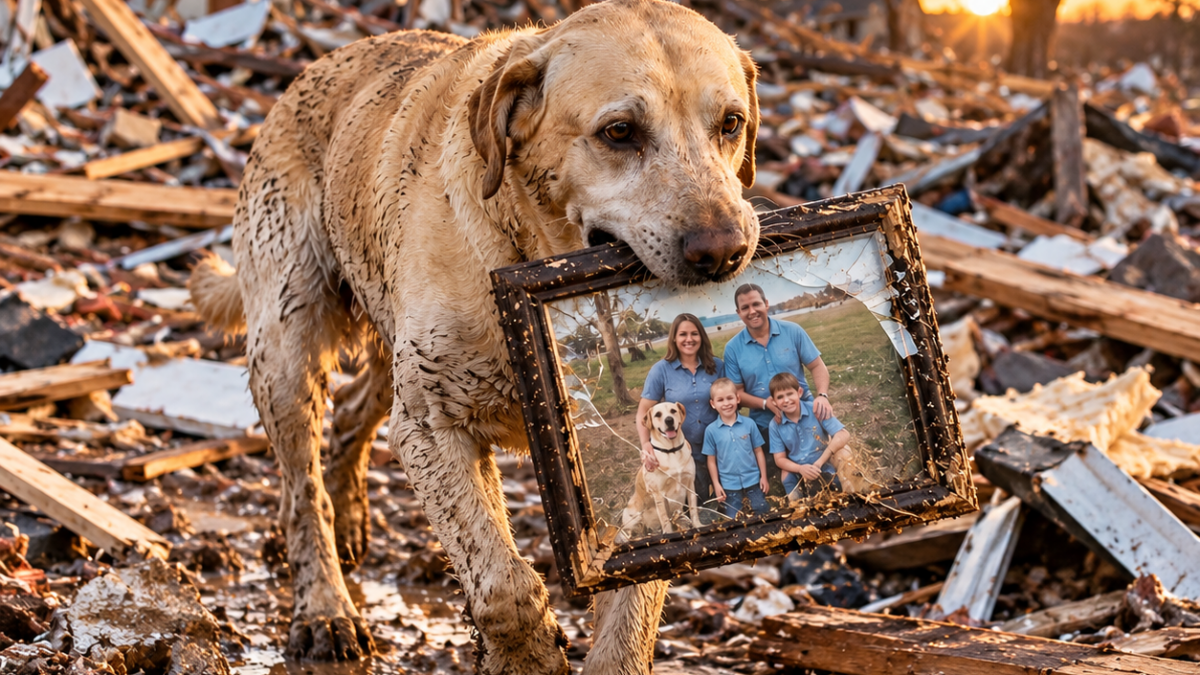
That was when I finally saw what Buddy was carrying.
At first, my brain could not make sense of it.
A rectangle.
Dark wood around the edges.
Something pale in the center.
One corner dragged against the ground.
Then the morning sun caught it.
A photograph.
Not just any photograph.
Our family portrait.
I stopped.
“No.”
The volunteer beside me whispered, “That’s what I was trying to tell you.”
I knew the picture immediately.
We had taken it three summers earlier.
My husband had complained about the matching blue shirts.
Our daughters had argued over where to stand.
Buddy had refused to look at the camera until the photographer held a tennis ball above her head.
The finished portrait had hung in our living room.
The frame was broken now.
Most of the glass was gone.
The photograph itself was folded near one corner, streaked with mud and water.
But I could still see us.
My husband.
Me.
Our girls.
Buddy sitting in front.
And the real Buddy was carrying it.
“Buddy,” I whispered.
He started moving again.
Toward me.
Slowly.
His injured paw made him limp.
Every few yards, he stopped and raised his head.
He sniffed.
Then continued.
The photograph remained clamped gently between his teeth.
The broken frame looked dangerous.
I wanted him to drop it.
I also could not make myself call the command.
Something about the way he carried it made me afraid to interrupt him.
So I waited.
Behind me, vehicles continued moving.
Volunteers talked over radios.
Chainsaws ran somewhere down the road.
But all of it seemed far away.
There was only Buddy.
Forty feet.
Thirty.
Twenty.
His tail was moving constantly now.
I dropped to my knees.
“Come here, baby.”
He reached me.
For a moment, he stood there holding the picture.
His eyes looked tired.
Not frightened exactly.
Just exhausted.
Then he lowered his head.
Placed the portrait at my knees.
And sat.
I looked down at it.
Mud covered part of my husband’s face.
One of our daughters was creased across the middle.
Buddy’s printed image had a puncture near one ear.
Tiny tooth marks lined the bottom corner.
I picked up the frame.
Then I wrapped both arms around the real dog.
He leaned into me so hard I nearly fell backward.
I put my face against his neck.
“You’re here.”
His tail struck the ground.
“You’re here.”
I did not realize I was crying until Buddy started licking my cheek.
He smelled terrible.
Mud.
Wet fur.
Smoke.
Dust.
Something metallic.
I did not care.
The volunteer stepped away to give us space.
I heard another truck pull up.
My husband.
He jumped out before the engine fully stopped.
“Buddy!”
The dog turned.
For the first time since I saw him, he left my side.
He ran.
Not well.
Not fast.
But he ran.
My husband dropped to his knees.
Buddy hit him square in the chest.
My husband wrapped his arms around him.
Then our daughters arrived with a neighbor.
The older one screamed his name.
The younger one started crying before she even reached him.
For several minutes, Buddy moved between all four of us.
Touching.
Smelling.
Checking.
He would press against one person, then turn toward another.
My husband kept rubbing his ears.
The girls touched his face.
Buddy’s tail never stopped.
Then he walked back to the damaged portrait.
He smelled it.
Looked at us.
And lay down beside it.
My older daughter stared.
“Is that our picture?”
I nodded.
“From the living room?”
“Yes.”
She looked toward the debris.
“How did he find that?”
Nobody knew.
The volunteer who first spotted him walked closer.
“My name’s Rachel,” she said.
I had forgotten to even ask.
“Thank you.”
“I didn’t do much.”
“You called.”
She looked at Buddy.
“He did the hard part.”
“What did you see?”
Rachel glanced toward the far edge of the debris field.
“We were checking a property about a quarter mile east when somebody spotted movement.”
She had initially thought Buddy was carrying insulation.
Yellow dog.
Pale object.
From a distance it made sense.
Then she assumed it might be a stuffed toy.
“We see animals carrying all kinds of things after storms,” she explained.
“Food packaging. Clothes. Toys. Anything familiar.”
Buddy had not approached immediately.
He moved through debris as if following a route he already knew.
Stop.
Sniff.
Walk.
Stop again.
“He kept returning toward your foundation,” Rachel said.
“Returning?”
“That’s what it looked like.”
I looked at her.
“You mean he had been somewhere else?”
“I can’t know for sure. But when we first saw him, he was east of here. Then he worked his way back.”
“Carrying the frame?”
“The whole time we watched.”
She crouched near the photograph without touching it.
“I’ve never seen anything like it.”
My younger daughter sat beside Buddy.
“Maybe he knew we were in it.”
Rachel looked at me.
I wanted to say yes.
I wanted that explanation.
Buddy knew our faces.
He understood the photograph.
He had rescued a picture because he knew it represented us.
But something in me knew dogs did not think exactly that way.
“I don’t know,” I said.
My daughter looked disappointed.
I put a hand on her shoulder.
“But he knew it belonged to home.”
That was enough for the moment.
Then my husband noticed Buddy’s mouth.
“Wait.”
He lifted the dog’s lip gently.
There was blood.
Not much.
But enough.
“His gums are cut.”
I looked closer.
Small abrasions lined the inside of Buddy’s mouth.
One looked fresh.
Another had begun healing.
The broken wooden frame suddenly looked much more dangerous in my hands.
“We need a vet.”
Buddy also had several cuts on his legs.
One paw was swollen.
His claws looked worn.
There was no question.
We had our dog back.
Now we had to find out what surviving five days alone had cost him.
The closest veterinary clinic still operating after the storm was packed.
Dogs.
Cats.
One goat.
I am not exaggerating.
A family had brought in a goat with a cut on its shoulder because their usual large-animal veterinarian could not reach them.
The waiting room smelled like antiseptic, wet fur, and disaster.
Buddy sat pressed against my legs.
Every time someone opened the front door, he looked up sharply.
If one of us moved too far away, he followed.
“We’re not leaving,” I told him.
He did not understand the words.
But I kept saying them.
Eventually, a veterinarian named Dr. Lane brought us into an exam room.
He examined Buddy from nose to tail.
Weight.
Temperature.
Heart.
Lungs.
Eyes.
Abdomen.
Paws.
Cuts.
Mouth.
Buddy tolerated everything until Dr. Lane tried moving him away from us for an X-ray.
Then Buddy planted all four feet.
Well, three and a half.
“No,” my husband said quietly. “He thinks we’re leaving.”
Dr. Lane nodded.
“We can adjust.”
They let me walk with him until the last possible point.
The X-rays showed no broken bones.
That felt like a miracle.
His front paw was badly bruised and swollen, probably from stepping wrong repeatedly on unstable debris.
Several claws were worn nearly to the quick.
He was dehydrated.
Underweight.
Covered in dozens of tiny superficial cuts.
But nothing life-threatening.
Then Dr. Lane examined his mouth again.
“How long was he carrying that frame?”
“We don’t know.”
“Volunteer saw him with it this morning.”
The veterinarian shook his head.
“These injuries aren’t all from this morning.”
My husband leaned forward.
“What do you mean?”
Dr. Lane pointed toward Buddy’s inner lip.
“This cut is newer. This one is older. See the edge? It’s already beginning to heal.”
I leaned closer.
“So?”
“He may have picked the frame up more than once.”
The room became quiet.
“How many times?”
“No way to know.”
My older daughter frowned.
“Why would he do that?”
Dr. Lane sat back on his stool.
“Where was the photograph before the tornado?”
“Living room wall.”
“For how long?”
“Three years.”
“And before that?”
“It sat on a shelf for a few months after we had it printed.”
He nodded.
“So it spent years inside your home.”
“Yes.”
My daughter said, “But he doesn’t know what pictures are, right?”
Dr. Lane smiled gently.
“Probably not the way you do.”
He held up the damaged portrait.
“Dogs don’t interpret a family photo as a symbolic representation of people the way humans do.”
My younger daughter looked down.
“So he didn’t know it was us?”
“Not visually in the way you mean.”
He tapped the edge of the frame.
“But this object spent years absorbing the smells of your home.”
My husband looked at him.
“What smells?”
“All of them.”
Dr. Lane counted them almost casually.
“Cooking oils. Laundry detergent. Cleaning products. Skin cells. Perfume. Soap. Dust from your house. Airborne particles. Whatever furniture it hung near.”
He looked at Buddy.
“To him, that frame and photograph may have carried a concentrated version of what home smelled like.”
I stared at Buddy.
He was resting his head on my daughter’s knee.
Dr. Lane continued.
“After a tornado, the scent landscape is destroyed. Everything is scattered. Rain comes through. Materials are exposed to wind. Familiar objects end up hundreds of yards apart.”
He held the portrait carefully.
“If he found something that still smelled strongly like his family and his home, he may have stayed near it, returned to it, or carried it.”
My husband’s eyes filled.
“So he wasn’t saving the picture.”
Dr. Lane shook his head.
“Not because he understood photography.”
He looked at all four of us.
“He may have been holding on to the strongest piece of home he could still find.”
Nobody spoke.
My younger daughter started crying again.
Buddy lifted his head.
Immediately.
He pushed his muzzle toward her.
She wrapped both arms around him.
“Sorry.”
Dr. Lane handed me the portrait.
“Don’t be.”
He looked at Buddy.
“I think he already knew what mattered.”
Buddy received fluids.
His paw was wrapped.
His mouth was cleaned.
We were given antibiotics for a few deeper cuts, pain medication, instructions for his paw, and strict orders to limit activity.
“Limit activity?” my husband said.
“He’s ten.”
Dr. Lane glanced at Buddy.
“After five days surviving a tornado, I suspect he’s earned the right to sleep.”
That was the first night Buddy stayed with us in our temporary rental.
Calling it home felt strange.
The Red Cross and relatives had helped us find a furnished house about twenty minutes away.
It belonged to a family who normally rented it short-term.
For us, it was shelter.
Beds.
Hot water.
A kitchen.
Four walls.
The first night after the tornado, that had felt luxurious.
But it had never felt like ours.
When Buddy entered, everything changed.
He stopped at the front door.
Sniffed.
His body stiffened.
This place smelled wrong.
No familiar furniture.
No familiar hallway.
No usual dog bed.
No scratched section of floor where he always turned toward the kitchen.
I knelt beside him.
“It’s okay.”
He looked at me.
The girls walked farther inside.
Buddy watched them.
My husband entered carrying the damaged portrait in a plastic storage sleeve the veterinarian had given us.
Buddy saw it.
His ears moved.
He walked toward my husband.
Smelled the sleeve.
Then followed him inside.
That night, Buddy refused to sleep outside our bedroom.
That part was familiar.
What changed was distance.
Before the storm, he slept on a dog bed in the hallway.
Now he slept directly against the closed bedroom door.
When my husband got up for water at two in the morning, Buddy jumped up.
Followed him to the kitchen.
Followed him back.
At six, one daughter went to the bathroom.
Buddy followed her.
At seven, our other daughter walked into the living room.
Buddy went with her.
“He’s counting us,” she said.
I thought she was joking.
She was not.
For weeks afterward, Buddy conducted what we eventually started calling head counts.
One person upstairs?
Buddy checked.
Someone in the backyard?
Buddy checked.
My husband went outside to take a phone call?
Buddy sat at the door until he came back.
If both girls left together, Buddy lay in the entryway.
If one returned first, he greeted her, then resumed watching the door.
At first I worried.
Dr. Lane told us not to make a joke of genuine anxiety.
But he also said some increased attachment was understandable after trauma.
“His entire environment disappeared,” he explained during Buddy’s follow-up appointment.
“So did you, from his perspective.”
That sentence hurt.
“He thought we abandoned him?”
“I didn’t say that.”
“What did he think?”
“We can’t know.”
Dr. Lane leaned against the counter.
“But imagine every familiar reference vanishing at once. Your house. Scent trails. Routine. People. Sounds.”
He looked at Buddy.
“He survived. Now he’s making sure the important things stay where he can find them.”
That became most obvious during the first thunderstorm.
It came three weeks after the tornado.
Not severe.
Ordinary Oklahoma spring weather.
Rain.
Lightning.
Distant thunder.
The weather app showed no tornado threat.
I told myself we were fine.
Buddy disagreed.
The first rumble came around eight at night.
He stood so fast that his water bowl tipped.
“Buddy?”
His ears went back.
He went to the hallway.
Then the living room.
Then back.
My older daughter was upstairs.
Buddy stood at the bottom of the stairs.
Whined.
“She’s okay.”
Another thunderclap.
Buddy barked.
One sharp bark.
Then another.
My husband called upstairs.
“Come down for a minute.”
She appeared.
Buddy immediately ran to her.
Then looked around.
My younger daughter was in the kitchen.
He found her.
My husband.
Me.
All four.
Only then did he lie down.
Right in the center of the living room.
Lightning flashed.
His body trembled.
We sat around him.
Not because we planned it.
Because that was what he seemed to need.
My husband sat on the floor.
One daughter leaned against the couch.
The other brought a blanket.
I stroked Buddy’s neck.
Another thunderclap rolled across the house.
He lifted his head.
Looked at each of us.
Then lowered it again.
My husband said quietly, “He really is counting.”
Nobody laughed.
Rebuilding our lives was slower than Buddy’s physical recovery.
His paw improved in a few weeks.
His mouth healed.
He regained the weight he had lost.
The cuts disappeared beneath new fur.
But our house was still a concrete slab surrounded by debris.
Insurance adjusters came.
Contractors came.
Engineers came.
Forms multiplied.
People asked questions about replacement cost.
Square footage.
Deductibles.
Roof materials.
Appliances.
Furniture.
Every conversation required us to reduce our old life to an inventory.
One sofa.
One oak dining table.
Four chairs.
Three beds.
Two televisions.
Kitchenware.
Books.
Clothes.
Photographs.
That category hurt the most.
Photographs.
We had digital copies of many newer pictures.
But older family albums were gone.
My husband’s grandparents.
My parents.
Baby photos.
School pictures.
Handwritten notes tucked between pages.
The tornado had not simply destroyed expensive things.
It had scattered objects whose value could not be entered honestly on an insurance form.
Then there was the portrait.
We kept it in the plastic sleeve at first.
I laid it on a shelf in the rental.
Buddy often smelled it.
Not obsessively.
Just occasionally.
One day my husband said, “We should get it restored.”
I looked at him.
“Digitally?”
“Maybe.”
“The frame too?”
“Replace the frame. Clean up the image.”
Our older daughter overheard us.
“No.”
My husband turned.
“No?”
“Don’t fix it.”
“It’s damaged.”
“That’s why.”
She walked over and picked it up carefully.
The photograph was wrinkled.
Water stains marked the edges.
Mud discoloration crossed the bottom.
The little punctures from Buddy’s teeth remained in one corner.
She touched them.
“These stay.”
My husband looked at me.
I understood immediately.
“She’s right.”
He sighed.
“I wasn’t saying throw this one away.”
“We know.”
“I meant make a clean copy.”
“That’s fine.”
Our daughter shook her head.
“I want this one on the wall.”
“Why?”
She looked at Buddy.
“Because this is the version he brought back.”
That settled it.
We bought a simple replacement frame.
Nothing expensive.
No restoration.
No attempt to hide the stains.
My husband carefully removed the broken pieces of wood.
We kept them too.
I do not know why.
Maybe by then throwing away anything Buddy had carried felt wrong.
We placed the weather-damaged photograph inside the new frame.
The tooth marks were visible near the lower corner.
The crease crossed our daughters.
Rainwater had faded part of my shirt.
It looked terrible by normal standards.
We hung it anyway.
The first evening it was on the wall, Buddy noticed.
He stood beneath it.
Raised his nose.
Sniffed the air.
Then walked away.
My husband laughed softly.
“Apparently the gallery has been approved.”
I smiled.
Over time, people who visited asked about the picture.
Some knew the story.
Others did not.
One contractor stared at it.
“Did that survive the tornado?”
“Sort of.”
“Looks rough.”
“It had a rough week.”
When I explained, he went quiet.
Friends offered to scan and restore it professionally.
We always declined.
A cousin said, “At least let me remove the punctures digitally.”
I pointed at them.
“That’s the part we’re keeping.”
She understood.
Those tiny holes had become the most important damage in the entire photograph.
Because the tornado caused the stains.
The rain caused the wrinkles.
Buddy caused the tooth marks.
They were proof of what happened after the storm.
As the months passed, we learned more about the path Buddy may have taken.
Not certainty.
Fragments.
A farmer two roads east remembered seeing a yellow dog near his equipment shed the second day after the tornado.
A volunteer reported paw prints near a creek where standing water had collected.
Someone else remembered leaving food near a damaged barn and finding it gone the next morning.
Was that Buddy?
Maybe.
Maybe not.
We would never reconstruct all five days.
I stopped trying.
Sometimes mystery is part of survival.
What mattered was that somehow he had navigated a landscape where his familiar world had been erased.
He had found water.
Perhaps scavenged food.
Avoided exposed nails, sharp metal, downed lines, vehicles, and frightened animals.
Then somewhere inside the ruins of our home, he found the portrait.
Dr. Lane believed Buddy likely discovered it before the morning rescue crews saw him.
The mouth injuries suggested repeated contact.
Maybe he carried it.
Dropped it.
Returned.
Carried it again.
Maybe he slept beside it.
That possibility haunted me more than any other.
Our dog alone in the ruins at night.
Wind moving through broken wood.
Emergency lights flashing in the distance.
Rain falling through what had once been our roof.
Buddy curled beside a damaged picture because it smelled like us.
I tried not to imagine it too often.
The girls did too.
Our younger daughter once asked, “Do you think he was scared?”
I wanted to protect her.
I almost said no.
Then I decided she deserved truth.
“Yes.”
She looked at Buddy sleeping near her feet.
“Really scared?”
“Probably.”
She swallowed.
“Then why didn’t he run far away?”
“I don’t know.”
She thought for a moment.
“Maybe he thought we were coming back.”
That hurt enough that I had to look away.
Our family carried guilt differently.
My husband carried the heaviest part.
For months, he replayed the shelter door.
“I should’ve gone after him.”
I heard it one night after the girls went to bed.
We were sitting at the kitchen table surrounded by insurance paperwork.
“No.”
“I had time.”
“You did not.”
“I took one step.”
“And then?”
“You grabbed me.”
“Because the tornado was on top of us.”
“I might have gotten him.”
“You might have died.”
He looked away.
“Buddy almost died anyway.”
“But he didn’t.”
“That’s luck.”
“Yes.”
I reached across the table.
“And all four of us being alive is luck too.”
His jaw tightened.
“I left him.”
“You saved our daughters.”
He said nothing.
“You held that shelter door while debris was hitting it.”
“I still left him.”
“No.”
I made him look at me.
“You made the only decision you could make with seconds left.”
He stared at the damaged portrait on the wall.
“I keep seeing him turn toward the house.”
“So do I.”
“What if he thought I called him and then disappeared?”
I did not have an answer.
Buddy did.
At that moment, he walked into the kitchen.
He went directly to my husband.
Put his head on his knee.
My husband closed his eyes.
Then both hands went into Buddy’s fur.
“Yeah,” he whispered. “I know.”
I do not know what he believed Buddy was telling him.
Maybe forgiveness.
Maybe nothing.
Maybe simply that the dog wanted his ears scratched.
Sometimes the simple explanation is enough.
The girls carried different guilt.
Our older daughter blamed herself for not insisting Buddy go first into the shelter.
The younger one believed the crashing sound from the kitchen might have been something she had left unsecured.
None of it was rational.
Trauma rarely is.
We eventually spoke with a counselor through a disaster-assistance program.
Buddy attended several family sessions without being invited.
The counselor did not object.
“He’s part of the event,” she said.
That was true.
In some ways, Buddy’s behavior helped the girls more than our explanations did.
They saw fear in him.
Then recovery.
He trembled during storms.
So did they.
He wanted everybody together.
So did we.
He checked doors.
We checked weather apps.
He needed routines.
We needed them too.
None of us returned instantly to normal.
We created a new version.
Buddy became healthier faster than the rest of us expected.
Six weeks after the tornado, Dr. Lane examined his paw.
“Looks good.”
Buddy stood normally.
His nails were growing back.
Mouth completely healed.
Weight nearly restored.
“No restrictions?”
“Reasonable activity.”
My husband smiled.
“That means truck rides?”
Dr. Lane looked at Buddy.
“I suspect refusing him would create more stress.”
Buddy started riding with my husband again.
At first, he would not lie down.
He sat upright.
Watching.
If they passed construction debris, his ears moved.
If a truck backfired, Buddy startled.
But he kept going.
The girls resumed school.
That was another adjustment.
Before the tornado, Buddy had waited near the road when their bus came.
The temporary rental was in a different district route, and relatives drove the girls for a while.
The first afternoon our older daughter returned from school, Buddy was at the front window.
The second she opened the door, he ran to her.
She dropped her backpack.
“Hi!”
Buddy circled her.
Smelled her hands.
Her legs.
Her shoes.
Then sat.
She looked at me.
“Head count.”
“Head count.”
Eventually, construction began on our new house.
Not an exact replica.
We did not want one.
That surprised us.
For months, I thought rebuilding meant recovering what we lost as closely as possible.
Same kitchen.
Same porch.
Same layout.
Then the architect asked whether we wanted the storm shelter incorporated differently.
That question changed everything.
We built the new house around the fact that we had survived the old one.
The shelter entrance was closer.
Wider.
Accessible from inside.
No crossing the backyard.
No running through weather.
And beside the shelter door, my husband included something nobody else might have noticed.
A low dog gate.
“Buddy goes first next time,” he said.
I touched his arm.
“There isn’t going to be a next time.”
He looked at me.
“We live in Oklahoma.”
Fair.
When the new house was nearly finished, we brought Buddy before moving furniture in.
I was curious what he would do.
Maybe afraid too.
The new construction smelled nothing like our old home.
Fresh lumber.
Paint.
Concrete.
New cabinets.
Buddy entered cautiously.
He walked through the living room.
Kitchen.
Hallway.
Bedrooms.
Then stopped near the new shelter entrance.
My husband opened it.
Buddy looked down the stairs.
He did not move.
“It’s okay,” my husband said.
Buddy backed away.
My husband immediately closed the door.
“No pressure.”
Weeks later, during calm weather, we tried again.
Treats.
No alarms.
No urgency.
Buddy eventually walked down.
Then up.
The girls praised him.
He seemed unimpressed.
But the next storm season, when sirens sounded during a warning, Buddy went into that shelter with us.
All four of us.
Buddy first.
My husband closed the door.
For several minutes, Buddy panted.
Then he looked around.
One.
Two.
Three.
Four.
Everybody there.
He lay down.
My husband stared at me across the small shelter.
I knew exactly what he was thinking.
Not this time.
The storm passed without damage.
When we emerged, the house was still there.
Buddy walked through every room anyway.
Checking.
Only after that did he settle.
We moved the damaged photograph into the new house last.
That was deliberate.
My younger daughter carried it.
She refused to put it into the moving truck.
“This goes with us.”
So it rode in her lap.
When we reached the new living room, my husband asked where we wanted it.
Everyone had the same answer.
Not hidden in a hallway.
Not upstairs.
The living room.
Almost where the original had hung.
He drove a nail.
I lifted the frame.
The picture looked even more damaged against a clean new wall.
Wrinkled paper.
Mud stains.
Tooth marks.
Perfect.
Buddy walked beneath it.
Smelled the wall.
Then lay down in the middle of the room.
Home had moved again.
This time, he moved with it.
The story of Buddy and the photograph spread farther than we expected.
One volunteer posted about the rescue.
Then a local reporter called.
We almost declined.
Everything was still raw.
But Rachel, the volunteer who found him, said people needed good news after the destruction.
So we agreed.
The reporter came to the rental before our new house was finished.
Buddy spent the interview lying beneath the table.
The reporter asked my younger daughter what she thought Buddy had been doing.
She answered more simply than any adult.
“Looking for us.”
The reporter asked, “Do you think he understood the picture?”
She shook her head.
“No.”
Then she pointed at Buddy.
“I think he understood it smelled right.”
That quote appeared in the story.
So did Dr. Lane’s explanation.
Dogs do not understand photographs like humans.
Scent matters more.
Familiar objects can become anchors in a radically changed environment.
People sent messages.
Hundreds.
Some shared stories about dogs waiting after fires.
Cats found near tornado debris.
Animals returning to foundations after floods.
A woman wrote about her father’s dog sleeping on his jacket after he died.
A veteran wrote that his service dog carried one of his shirts around when he was hospitalized.
Different circumstances.
Same strange truth.
Animals do not need our symbols to understand attachment.
They have their own.
Buddy never cared that our faces were printed on the paper.
He cared that something inside the ruins still carried us.
Months became a year.
The new house settled around us.
The daughters grew.
One started driving.
The other joined a school club that kept her late twice a week.
Buddy adjusted to both developments poorly.
A teenager leaving the house in a car without him was unacceptable.
He waited.
Every time.
If she returned at 10:00 p.m., Buddy was near the door at 9:45.
“How does he know?” she asked.
“He doesn’t.”
“He’s always waiting.”
“He waits starting approximately fifteen minutes after you leave.”
“Oh.”
Buddy had become older.
Eleven.
Then twelve.
His muzzle whitened.
His hips stiffened.
But the tornado habits remained.
Doors mattered.
Head counts mattered.
Storms mattered.
During quiet weather, he could nap anywhere in the house.
During thunder, everybody needed to be visible.
One summer evening, our older daughter went to a friend’s house just before a storm rolled in.
Buddy paced.
“She’s not here,” I told him.
He went to the door.
“She’s safe.”
Door.
“We’re not going to get her because of rain.”
Door.
My husband eventually called our daughter.
“Your dog is filing a complaint.”
She put the phone on speaker.
“Buddy!”
His ears came forward.
“It’s okay. I’m at Emma’s house.”
Buddy stared at the phone.
Then at the door.
Then back at us.
My husband laughed.
“He remains unconvinced by telecommunications.”
She came home an hour later.
Buddy greeted her with such intensity that she nearly fell.
“You are ridiculous.”
He followed her to her room.
Head count complete.
We joked about it.
But we never mocked him.
There is a difference.
His anxiety was not cute to him.
He had spent five days in a world without us.
We could afford patience.
Sometimes he improved.
Sometimes old fears returned suddenly.
Fireworks were difficult.
Construction noises occasionally bothered him.
One day a contractor dropped a sheet of plywood behind our garage.
The crack echoed.
Buddy sprinted inside.
I found him standing near the storm shelter.
I sat beside him.
“You’re okay.”
His breathing was fast.
I did not drag him out.
Did not tell him there was nothing to fear.
Something had scared him.
That fact was enough.
We waited.
Eventually he stepped closer.
Placed his head against my shoulder.
Then followed me back to the kitchen.
Recovery is not forgetting.
That was another lesson.
People asked whether Buddy had “gotten over” the tornado.
No.
Neither had we.
We had lived past it.
Different thing.
The portrait remained on the wall.
Its meaning shifted over time.
At first, it represented the storm.
Then Buddy.
Then survival.
Eventually, it became part of the room.
Visitors sometimes did not notice the damage.
That surprised me.
I noticed it every day.
The punctures in the corner.
Tiny.
Permanent.
One afternoon, a professional photographer friend visited.
She stood beneath it.
“I could make this look new.”
“I know.”
“Not the original. Digitally.”
“I know.”
“Remove water stains. Reconstruct the missing edge. Correct color.”
“No.”
She smiled.
“You didn’t even let me finish.”
“I’ve heard the pitch.”
She looked closer.
“What are these?”
“Buddy.”
“The dog did that?”
“Carrying it.”
Her expression changed.
“Oh.”
I nodded.
“That’s why.”
She stepped back.
“Then absolutely don’t fix it.”
Exactly.
By Buddy’s thirteenth year, arthritis made truck rides harder.
My husband bought a ramp.
Buddy hated the ramp.
He preferred pretending he could still jump.
“You are eighty years old,” my husband told him.
Buddy attempted to climb into the truck.
Failed.
Looked insulted.
“Ramp.”
Buddy stared.
“Pride isn’t a joint supplement.”
Eventually, with treats, he accepted it.
My husband still took him along.
Short trips.
Feed store.
Hardware store.
Sometimes nowhere important.
Those rides had been part of Buddy’s life before the tornado.
Keeping them afterward mattered.
He waited for the girls less frequently because one eventually left for college.
That transition was hardest.
Our older daughter packed her car in August.
Buddy watched the boxes.
I recognized that look.
So did she.
“No.”
She sat beside him.
“I’m not disappearing.”
Buddy smelled her suitcase.
She wrapped her arms around his neck.
“I’m coming back.”
He followed her outside.
When she drove away, he sat near the front door.
For hours.
That evening, he checked her bedroom.
Empty.
He returned to the front.
My husband sighed.
“This could take a while.”
It did.
Our daughter video-called that night.
“Show me Buddy.”
I turned the phone.
“Buddy!”
He looked toward her voice.
Head tilted.
She laughed and cried.
“I’m here, okay?”
He smelled the phone.
Not good enough.
But over time he adjusted.
When she came home six weeks later, Buddy’s reaction was almost violent with joy.
Not aggression.
Pure physical happiness.
He ran circles around her.
Barked.
Leaned.
Whined.
She fell to her knees.
“I told you I was coming back.”
Buddy buried his face against her.
That became another piece of his life after the storm.
People could leave.
And return.
Over and over.
Maybe each return taught him something.
Our younger daughter eventually left too.
Buddy became an old dog in a quieter house.
My husband and I remained.
His head counts became easier.
Two people.
He still performed them.
Especially during storms.
One spring evening, nearly three years after the tornado, another severe-weather warning appeared.
The sky turned the strange green-gray color people in Oklahoma recognize too well.
My phone alerted.
Then the county sirens started.
Buddy was old enough that standing quickly had become difficult.
The sound changed him instantly.
He rose.
Went toward the shelter.
My husband looked at me.
“He remembers.”
“Of course he does.”
We brought water.
Phones.
Emergency bag.
Then Buddy.
He entered before us.
No hesitation this time.
I sat on the bench.
My husband closed the shelter door.
Buddy looked around.
Me.
My husband.
Then toward the empty space where the girls once sat.
His ears moved.
I knew what he was doing.
“They’re safe,” I told him.
One daughter lived hundreds of miles away.
The other was at college outside the warning area.
Buddy could not know that.
I called them anyway.
My husband laughed.
“You know he doesn’t understand.”
“I understand.”
Both answered.
They were safe.
I put the phone down.
Buddy lay between us.
Wind moved above.
Rain hammered the house.
The power flickered and died.
For a moment, the darkness inside that shelter took me straight back to 2024.
The girls younger.
My husband holding the latch.
Buddy outside.
The roar.
The helplessness.
I reached down.
Buddy’s fur was beneath my hand.
Inside.
With us.
The storm moved on.
No tornado touched our property.
When we opened the shelter, Buddy walked out slowly.
He checked the living room.
Kitchen.
Hallway.
Front door.
Then he stopped beneath the damaged family portrait.
Our old four-person family smiled from the paper.
A younger Buddy sat proudly in front.
The real Buddy looked up.
Maybe because I was standing there.
Maybe because the frame smelled faintly familiar even after all those years.
Maybe coincidence.
He stood for a few seconds.
Then went to his bed.
I stayed looking at the photograph.
The stains had faded somewhat.
Or maybe I had simply become accustomed to them.
The tooth marks remained.
Those would outlast everything.
Friends sometimes asked whether I thought Buddy truly spent five days “searching for us.”
I learned to answer carefully.
I do not know.
I do not know whether dogs build stories in their minds.
I do not know whether Buddy believed we were missing.
I do not know whether he understood that the broken foundation had once been home.
I do not know how many times he carried that frame.
I do not know where he slept.
I do not know what he ate.
I do not know whether he returned to the same location every night waiting for our truck.
What I know is simpler.
Our dog survived five days in a disaster zone.
He was seen returning through the wreckage.
He carried an object that had spent years inside our home.
The injuries in his mouth suggested he had handled broken frame material for longer than the final few minutes before rescuers found him.
And when he heard my voice, he brought that object to me.
That is enough.
The facts do not need help.
Buddy grew older.
Much older.
His world became smaller again.
Not because of fear.
Because of age.
The truck rides decreased.
Walks shortened.
Stairs became difficult.
We moved a bed into nearly every room so he never had to choose between comfort and being near us.
He chose the room we occupied.
Always.
If my husband watched television, Buddy slept nearby.
If I cooked, Buddy lay at the kitchen entrance.
If we went outside, he wanted the porch.
The rule had not changed.
Keep the family together.
One afternoon, our daughters both came home.
No holiday.
No special reason.
Just a rare weekend when schedules aligned.
Buddy was asleep when the first walked inside.
She called his name.
His head came up.
Then the second daughter entered behind her.
For a moment, he seemed confused.
Both girls.
Same room.
My husband came from the garage.
I stood in the kitchen.
Buddy looked at each of us.
One.
Two.
Three.
Four.
His whole tail began moving.
Slowly at first.
Then harder.
Our younger daughter laughed.
“He got everyone.”
He tried to stand too quickly.
We helped him.
All four of us sat on the living-room floor around him.
Exactly the arrangement he always tried to create during thunderstorms.
Only there was no storm.
Just afternoon sunlight.
Buddy moved from person to person.
Then lay in the middle.
My husband pointed toward the photograph.
“Same group.”
Our older daughter looked at it.
“Almost.”
“What?”
She pointed toward Buddy.
“He’s in the picture too.”
Of course.
Five.
That old portrait had never been four people and a dog.
It had always been the whole family.
The tornado had not understood that distinction.
Neither had Buddy.
Months later, Buddy’s health began declining more noticeably.
Nothing sudden.
Age.
Arthritis.
A heart that had worked for many years.
Kidneys that required monitoring.
We adjusted medication.
Changed food.
Added more rugs.
Helped him stand.
He still followed us, but sometimes only with his eyes.
One evening, thunder rolled far in the distance.
Buddy lifted his head.
I sat beside him.
“We’re all here.”
My husband was in the kitchen.
I was beside Buddy.
The daughters were not physically home.
That worried him less by then.
Maybe he had finally learned that absence could be temporary.
Or maybe he was simply too tired to conduct inspections.
He rested his head against my hand.
I looked toward the portrait.
The little tooth holes seemed darker in the evening light.
I thought again about that fifth morning.
Buddy walking through wreckage.
Thin.
Injured.
Carrying home in his mouth.
For years, I had told the story as something he did for us.
Maybe that was wrong.
Maybe he carried the frame for himself.
Maybe he needed something familiar.
Maybe the scent calmed him.
Maybe he dragged it from place to place because losing it felt like losing us again.
If so, that did not make the story less powerful.
It made it more honest.
Love is not always sacrifice.
Sometimes love is survival.
Sometimes holding on to another being is how you keep yourself moving.
Buddy had held on to us.
We had held on to him.
That was the entire story.
After Buddy’s recovery from the tornado, reporters sometimes used the phrase “miracle dog.”
I never liked it much.
Buddy was not magic.
He was an old Labrador.
He got hungry.
He stole food if given the opportunity.
He smelled terrible when wet.
He ignored commands when distracted.
He snored.
He shed on everything.
He once ate half a birthday cake.
Nothing about him was mythical.
That was what made the photograph matter.
The thing carrying it was not a symbol.
It was a dog.
A real dog with sore paws and cuts in his mouth who found one familiar-smelling object inside a destroyed world and did not want to leave it.
Years after the tornado, people stopped asking about the storm.
New stories replaced ours.
Other weather came.
Other disasters.
Other families rebuilt.
Our community healed the way communities do—unevenly.
New barns appeared.
Trees were replanted.
Some families returned.
Others moved away.
Fields swallowed pieces of debris nobody ever recovered.
The scar on the land became harder to see.
But the photograph remained.
Visitors occasionally assumed it had been damaged in storage.
Then they noticed the tooth marks.
That was when I told them.
Not the whole story every time.
Sometimes only one sentence.
“Our dog brought that back five days after the tornado.”
Most people looked at Buddy afterward.
When he was still young enough, he would wag.
Later, he slept through the explanation.
He did not care about being famous.
He cared whether visitors had food.
Eventually our older daughter had a frame made with a small plaque.
I refused it.
“No text.”
“Why?”
“Because it doesn’t need explaining.”
She looked at the photograph.
Then at the tooth marks.
“Fair.”
We kept the plain frame.
That felt right.
The last time all five of us posed together for a professional family photograph, Buddy was too old to sit upright for long.
The photographer suggested placing him on a blanket.
We did.
The girls sat beside him.
My husband and I stood behind.
The photographer held a squeaky toy.
Buddy did not care.
“Buddy!”
Nothing.
My husband said, “Dinner.”
Buddy looked immediately at the camera.
Everyone laughed.
The shutter clicked.
That newer portrait was perfect.
Clear.
Bright.
Nobody blinking.
No mud.
No water damage.
No punctures.
We framed it too.
But we hung it on a different wall.
The old damaged photograph stayed where it was.
It was not replaced.
Some things become valuable because they survive damage, not despite it.
On quiet evenings, I sometimes looked from one photograph to the other.
Young family.
Older family.
Young Buddy.
Old Buddy.
Same people.
Same dog.
Everything else changed.
One night my husband stood beside me.
“Which one do you like better?”
“That’s a trap.”
“Why?”
“If I say the new one, I’m disrespecting history.”
“And the old one?”
“I’m insulting the photographer we paid too much money.”
He smiled.
Then touched the damaged frame.
“This one.”
“Me too.”
“Not even close.”
“No.”
Buddy was asleep below us.
My husband looked down.
“You know what I think about sometimes?”
“What?”
“If Rachel’s team had been working a different road that morning.”
I knew.
“Don’t.”
“If he’d gone another direction—”
“Don’t.”
He nodded.
We had learned not to feed the alternate endings.
There were too many.
If we had waited thirty seconds longer before entering the storm shelter.
If Buddy had followed immediately.
If the tornado shifted slightly.
If debris hit the shelter.
If Buddy stepped on something worse.
If he never found water.
If volunteers never saw him.
If rain destroyed the scent on the picture.
If.
If.
If.
You can drown in the versions of life that did not happen.
We had the one that did.
That had to be enough.
Buddy spent the rest of his life knowing where we were.
That mattered to me.
Even when the girls left.
Even when schedules changed.
Even as his hearing weakened.
He knew this house.
He knew our routines.
He knew our smells.
He knew the sound of my husband’s truck.
He knew my footsteps.
He knew which cabinet held treats.
He knew which bed belonged to him, though he preferred ours.
Home had become concentrated again.
Not in one object.
Everywhere.
The portrait on the wall no longer had to carry that burden for him.
One morning, years after the storm, I found Buddy sitting beneath it.
He was not looking up.
Dogs do not admire photographs.
He was waiting because I had gone into the kitchen and he knew breakfast was coming.
I laughed.
“You know, people think you’re very profound.”
Buddy stared at me.
“You have a reputation.”
He stood slowly.
Walked to his bowl.
“That’s what I thought.”
I fed him.
He ate.
Then drank clean water from a full bowl.
He walked to the living room and lay in a patch of sunlight beneath a picture he once carried through disaster.
I stood there longer than necessary.
Because that was the ending I had wanted for him all along.
Not bravery.
Not symbolism.
Not another miracle.
Ordinary life.
Full bowls.
Warm floors.
Family moving through rooms nearby.
Nothing to search for.
Nothing to carry.
Nothing missing.
The tornado had taken our house in twelve minutes.
Buddy spent five days trying to find his way through what remained.
When rescuers finally saw him, he had a weather-damaged family portrait between his teeth.
He did not know it was a photograph.
He did not understand that those shapes represented faces.
He could not know humans would someday point at the punctures in the corner and cry.
He knew something simpler.
It smelled familiar.
It smelled like the rooms where he had slept.
The hands that had touched him.
The clothes of the girls he waited for every afternoon.
My husband’s truck.
My soap.
Our kitchen.
Home.
And when everything familiar had been scattered across fields, that damaged object still carried enough of us for Buddy to recognize.
So he did what dogs do with things that matter.
He stayed close.
He picked it up.
He carried it.
And when he found us again, he put it at my feet.
The photograph still hangs on our wall.
Wrinkled.
Water-stained.
Bent near one corner.
Marked by tiny holes from Buddy’s teeth.
The newer family portrait beside it is cleaner.
Better lit.
Perfectly framed.
But perfection is not the one I stop in front of.
I stop at the damaged one.
I look at the young Labrador sitting in front of us.
Then at the marks left by the older dog who carried it home.
And I remember the morning he came walking out of a field of broken wood, limping on a bruised paw, refusing to release the closest thing he could find that still smelled like his family.
People sometimes say Buddy rescued the photograph.
Maybe.
I think the photograph rescued something in Buddy too.
For five days, it gave him one piece of the world that had not disappeared completely.
Something familiar enough to follow.
Something worth returning to.
Something he could hold while everything else was gone.
And then he found us.
After that, he never needed to carry it again.
[END OF STORY]








