PART 2: Fake HOA Cops Tried to Force Me Off My Inherited Gold Land—Then I Found the File My Grandfather Hid
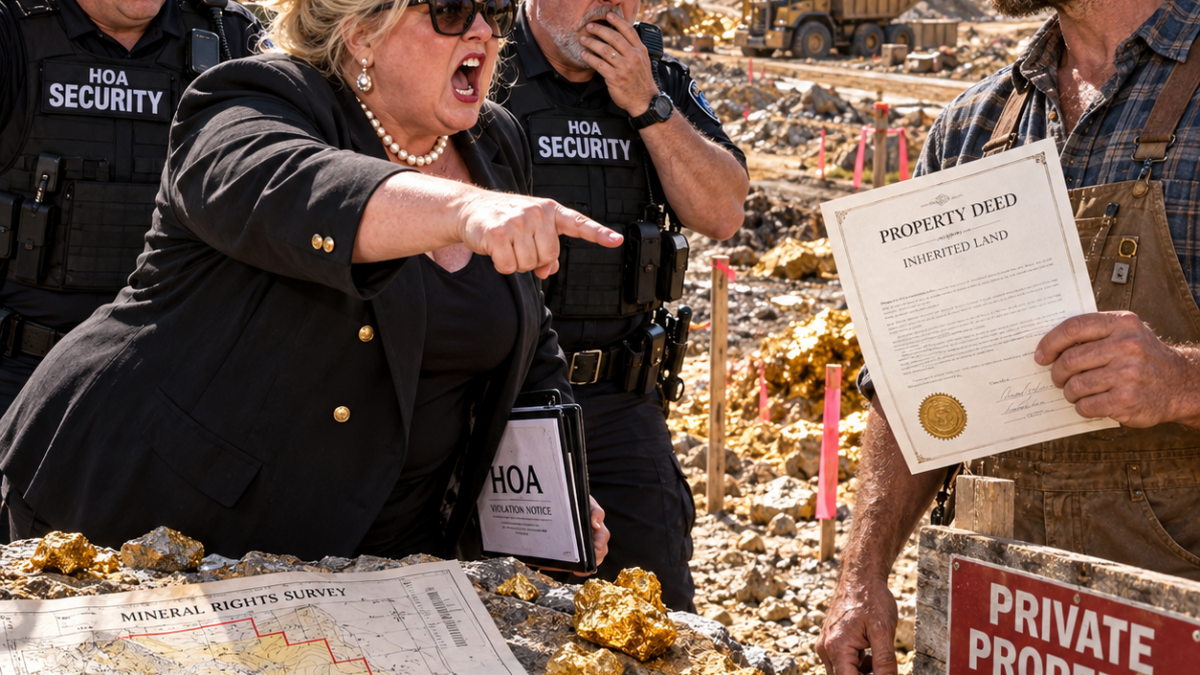
PART 2
For several seconds, I thought I had misheard him.
“What?”
“We don’t have an enforcement division.”
Glenn’s voice had changed completely.
Friendly disappeared.
Concern took its place.
“We don’t employ security personnel. Nobody working for Sierra Ridge should be walking onto your property wearing a badge.”
I stared at Victor Crane’s first citation lying beside my laptop.
“Then why is your association’s name on these notices?”
“I don’t know.”
“They’ve threatened fines.”
“We don’t issue fines like that.”
“They’ve threatened a lien.”
“Absolutely not.”
“Toward foreclosure?”
“Derek, stop.”
I did.
Glenn exhaled slowly.
“Whatever these people are doing, they aren’t doing it for Sierra Ridge.”
I opened the association’s PDF bylaws again.
“Section Twelve, Subsection C?”
“No enforcement authority like what you described.”
“I already checked.”
“Then why ask me?”
“Independent verification.”
There was a pause.
“You really are a cybersecurity guy.”
“That obvious?”
“You sound like you’re taking a deposition.”
“I’m trying to understand who’s impersonating your organization.”
Another silence.
Then Glenn said:
“Walter called me about this.”
My fingers stopped above the keyboard.
“When?”
“Maybe a year before he died.”
“What exactly did he say?”
“That men were claiming to enforce community rules.”
“Same uniforms?”
“He described badges.”
“Victor Crane?”
“He didn’t give me a name.”
“Tony Miller?”
“No.”
“What did you tell him?”
“That Sierra Ridge had no security operation.”
“Did he report them?”
“He said he was handling it.”
Of course he did.
Walter Marshall viewed asking for help the way some men view asking for directions.
An admission of weakness.
“What else did he say?”
Glenn hesitated.
“There were companies asking about land around here.”
“What companies?”
“Mining. Acquisitions. Mineral rights.”
My eyes shifted toward the window.
Beyond the kitchen stood forty-five acres of sun-baked foothill land that had looked ordinary when I arrived.
“What did that have to do with Grandpa?”
“I don’t know. He once asked me whether Sierra Ridge had any authority to force a property sale.”
“What did you say?”
“No.”
“And?”
“He laughed and said, ‘That’s what I thought.’”
That sounded exactly like Grandpa.
I thanked Glenn and asked him to email me a short written confirmation that Sierra Ridge employed no enforcement officers.
“I’ll do better,” he said. “I’ll put it on association letterhead.”
“Thank you.”
“And Derek?”
“Yes?”
“Be careful.”
The line ended.
I sat alone in Walter’s kitchen.
The grandfather clock he never bothered fixing ticked unevenly behind me.
Two fake citations.
A blocked call.
A black SUV.
Men pretending to represent an HOA that had never hired them.
And a dead eighty-nine-year-old man who had apparently seen the same act before I did.
Whatever Victor wanted, it wasn’t $1,250.
That was too small.
The fines were pressure.
Not profit.
Something larger sat behind them.
I just had to figure out what.
I didn’t find the gold by accident.
I found it because I stopped thinking like a grandson and started thinking like an analyst.
Who benefits?
What changed?
Why this property?
Why now?
Grandpa’s death explained the timing.
Inheritance creates transition.
Transition creates uncertainty.
New owners sell.
Especially owners who live two hours away and have no emotional investment in rural land.
That described me perfectly.
At least on paper.
I searched county parcel records.
Nearby transactions.
Mineral-rights filings.
Environmental surveys.
Historic mining maps.
The Sierra Nevada foothills are full of gold stories.
Most mean nothing.
Old shafts.
Played-out claims.
Family legends.
Tourist brochures.
Then I found a geological assessment from three years earlier.
The report covered multiple parcels.
I searched Walter’s parcel number.
Match.
The property sat inside a zone flagged for renewed mineral exploration.
Not guaranteed reserves.
Not a treasure chest.
Potential.
Gold-bearing formations.
Modern extraction economics.
Further survey recommended.
That was enough.
I searched nearby acquisitions again.
Several parcels had changed hands.
Different LLCs.
Different names.
One corporate relationship kept surfacing:
Apex Mineral Resources.
Then:
Western Land Solutions.
A property-acquisition company that worked with Apex projects.
I wrote both names on a yellow legal pad.
Grandpa had received offers.
Martha had confirmed it.
The fake “security” showed up after he refused.
Now Walter was dead, ownership had transferred, and within weeks the pressure restarted.
That was no coincidence.
Not proof either.
Yet.
I spent the rest of the night searching Walter’s office.
Desk drawers.
Filing cabinets.
Closet shelves.
Old bank envelopes.
Insurance binders.
I found taxes going back twenty-five years.
Medical bills.
Receipts for tractor parts.
A warranty for a refrigerator purchased in 1997.
No land offers.
At three in the morning, I gave up.
Before bed, I stood at the kitchen window.
The property was dark.
Somewhere beneath it, maybe hundreds of feet down, was enough gold potential to attract companies with real money.
If Victor knew that and thought I didn’t, then the fake HOA act made sense.
Make ownership exhausting.
Create fines.
Invent liens.
Spread fear.
Then arrive with a low offer disguised as rescue.
Cybercriminals do the same thing.
Create the emergency.
Sell the solution.
Victor returned four days later.
This time he left the costume at home.
No uniform.
No badge.
No handcuffs.
Tan slacks.
Dark polo.
Expensive watch.
He looked like a regional sales manager.
Which was probably closer to the truth.
I was reviewing Walter’s probate paperwork on the porch when the SUV stopped.
Victor walked up slowly with his hands visible.
“Mr. Marshall.”
“Victor.”
He smiled as if we were old friends.
“I think we started badly.”
“You gave me a fake fine.”
“There’s disagreement about enforcement jurisdiction.”
“No. There’s confirmation that you don’t have any.”
His smile held.
“I didn’t come to argue.”
“Good.”
“I came to offer a solution.”
He produced a folded piece of paper.
“A buyer is prepared to offer two hundred thousand dollars for your property.”
For a moment, I thought I had misheard.
“All forty-five acres?”
“Yes.”
“Cash?”
“Fast closing. Minimal contingency.”
I laughed.
Victor didn’t.
“The county assessed this place at more than four hundred thousand.”
“Tax assessment isn’t market value.”
“And the mineral rights?”
Tiny reaction.
His right thumb stopped rubbing the edge of the paper.
Just for a second.
“What mineral rights?”
I leaned back.
“I didn’t say there were valuable minerals.”
“You asked about mineral rights.”
“Because you’re offering to buy land in gold country.”
He recovered quickly.
“This is remote property. Limited development potential. Significant maintenance.”
“And fake HOA problems.”
“Complications reduce value.”
There it was.
“You create the complications, then use them to justify a lower price?”
“That isn’t what I said.”
“It is.”
Victor’s expression cooled.
“Two hundred thousand is generous.”
“Who’s the buyer?”
“That information becomes available after you indicate serious interest.”
“Then I’m not interested.”
“Think carefully.”
“I have.”
“Your grandfather refused good opportunities too.”
I closed the probate file.
“Were you the one making them?”
“Sometimes.”
“For who?”
“Various investors.”
“Western Land Solutions?”
That hit him.
Not dramatically.
A blink.
A pause.
Then:
“You’ve been researching.”
“Yes.”
He shifted his weight.
“Western Land is one of many companies active in this region.”
“And you?”
“I consult.”
“For them?”
“Occasionally.”
“Then why were you wearing a fake HOA uniform?”
Victor’s smile vanished.
“You don’t understand how community compliance works.”
“Glenn Sawyer says you have nothing to do with Sierra Ridge.”
“Glenn doesn’t understand every layer.”
“Interesting.”
“What?”
“He’s the president.”
Victor said nothing.
“So show me the contract.”
“What contract?”
“The one authorizing you to issue fines in Sierra Ridge’s name.”
“Different entities coordinate compliance.”
“That isn’t a contract.”
“You’re being difficult.”
“Show me one legitimate document.”
He stared.
I continued.
“One recorded covenant.”
Silence.
“One board resolution.”
Nothing.
“One agreement with Sierra Ridge.”
Victor’s jaw tightened.
“You’re making Walter’s mistake.”
I stood.
The air changed instantly.
“What mistake?”
“He believed the deed made him untouchable.”
“What did you do to my grandfather?”
“Nothing.”
“What does that mean?”
Victor looked up at me.
“Your grandfather spent the last years of his life angry at people who were trying to help him.”
“Help him sell?”
“Help him make rational decisions.”
“He said no.”
“And he became isolated.”
“That was his choice.”
“He was stubborn.”
“Runs in the family.”
Victor’s eyes narrowed.
“Look where stubbornness got him.”
I felt the words physically.
“What did you just say?”
Victor paused.
Then smiled again.
Too late.
“My grandfather died at eighty-nine.”
“I know.”
“Peacefully.”
“Of course.”
The tone was deliberate.
Designed to leave poison without making a direct threat.
“What are you implying?”
“Nothing.”
“You knew exactly what you were implying.”
“I’m telling you that fighting everyone around you has consequences.”
I stepped down one porch stair.
“Get off my property.”
“Derek—”
“Now.”
For the first time, his smile vanished completely.
“You will regret refusing this offer.”
“Is that another threat?”
“It’s advice.”
“Leave.”
He turned.
Walked back toward the SUV.
Before he reached it, I said:
“I’m not selling.”
Victor stopped.
Didn’t turn.
“Everyone sells eventually.”
Then he drove away.
I stayed on the porch with my phone recording still running in my shirt pocket.
My hands were shaking.
He had accomplished exactly what he wanted.
For thirty minutes afterward, I wondered if Walter’s death had really been natural.
Then I hated myself for wondering.
That was Victor’s weapon.
Uncertainty.
Grandpa had heart disease.
He was eighty-nine.
He died in his sleep.
Nothing about the medical records had ever suggested foul play.
Victor didn’t need to kill him.
He only needed to convince me that refusing to sell might be dangerous.
It was psychological intimidation.
Ugly.
Effective.
And now recorded.
Marie Robinson listened to Victor’s conversation twice.
She was a Sacramento property and fraud attorney recommended by a colleague.
Her office occupied the third floor of a converted Victorian with old hardwood floors and modern security glass.
She had the kind of face that revealed almost nothing until she wanted it to.
When the recording reached:
Look where stubbornness got him, she paused it.
“You think Victor was admitting something about Walter’s death?”
“No.”
“Good.”
“I think he wanted me to imagine he was.”
“Better.”
“You sound pleased.”
“I’m pleased you’re separating fact from fear.”
She resumed playback.
When it ended, she removed her glasses.
“What you have already supports contacting law enforcement.”
“I know.”
“Then why are you here instead?”
I showed her the geology report.
Apex.
Western Land.
Nearby sales.
Victor’s lowball offer.
His reaction to the mineral-rights question.
She read quietly.
“This gives us motive.”
“Gold.”
“Potential mineral value.”
“Same general idea.”
“No.”
She tapped the report.
“This report says geological potential. Do not tell people you have millions in proven gold reserves.”
“Fine.”
“Words matter.”
“I work in cybersecurity. I’m painfully familiar with words mattering.”
“Good.”
Then I gave her Victor’s full legal name.
Marie searched databases.
Business registrations.
Litigation exhibits.
Corporate records.
After ten minutes, she stopped.
“Here.”
Western Land Solutions had disclosed consulting expenses in another property dispute.
Victor Crane appeared.
More than once.
Approximately $47,000 in invoices across eighteen months.
I leaned toward the monitor.
“He works for them.”
“He has been paid by them.”
“Same thing.”
“No. One is a conclusion. One is evidence.”
I liked her.
Annoyingly.
She opened another file.
“Apex Mineral Resources controls Western Land?”
“Subsidiary relationship appears complicated, but Western has worked property acquisition for Apex projects.”
“My land is in their target zone.”
“Yes.”
“Grandpa refused offers.”
“Yes.”
“Victor pressured him.”
“According to your neighbor and likely Walter’s own records, if we find them.”
“Now he’s pressuring me.”
“Yes.”
She folded her hands.
“What outcome do you want?”
“Stop them.”
“We can report Victor today.”
“And then?”
“Criminal investigation.”
“Apex hires somebody else.”
“Possibly.”
“So we solve the visible problem.”
“Maybe.”
“I want the structure.”
Marie looked at me for several seconds.
“That’s investigator thinking.”
“Security analyst.”
“Close enough.”
She leaned back.
“The problem with people who want the structure is that structures fight back.”
“I understand.”
“You don’t.”
“I’ve dealt with sophisticated attackers for ten years.”
“From behind screens.”
“Not always.”
“Derek, Victor has already trespassed, impersonated authority, threatened financial harm, and used your grandfather’s death to frighten you.”
“I know.”
“If they escalate physically, strategy ends. Safety takes over.”
“Agreed.”
She picked up the phone.
“I’m calling Sheriff Raymond Ortega.”
Sheriff Ortega was not enthusiastic about using me as bait.
That increased my confidence in him.
He listened to everything in Marie’s office.
Then he said:
“I have enough to start asking questions.”
Marie nodded.
“We know.”
“So why wait?”
I answered.
“Because Victor appears tied to a land-acquisition company.”
“I saw the invoices.”
“If he’s just a contractor doing this independently, arresting him solves it.”
“And if he’s not?”
“It gives whoever hired him time to destroy distance between themselves and him.”
Ortega looked at Marie.
“He always like this?”
“First meeting.”
“Lucky you.”
He turned back to me.
“You’re proposing cameras and documentation.”
“Yes.”
“No confrontation.”
“Yes.”
“No trespass traps.”
“Correct.”
“No provoking people into committing crimes.”
“Absolutely.”
“If they show up with a weapon?”
“I call 911.”
“If they try entering the house?”
“911.”
“If they damage property?”
“Same.”
He studied me.
“You understand that your desire to prove the bigger case doesn’t override public safety.”
“I do.”
“Good.”
He gave me his card.
“Personal cell on the back.”
“That seems generous.”
“It’s so you don’t decide you’re Batman.”
“I’m not particularly athletic.”
“Good.”
Marie almost smiled.
Ortega continued:
“I’ll increase patrol presence discreetly. We’ll preserve your complaint now. If there’s enough probable cause to move before your corporate connection develops, we move.”
“Understood.”
“Your grandfather kept records?”
“Martha says yes.”
“Find them.”
“I’m trying.”
“Then let law enforcement do law enforcement.”
That was the agreement.
I left with less control than I wanted.
Which was exactly how it should have been.
The certified cease-contact letter went out Monday.
Marie wrote it.
No emotion.
No accusations beyond what we could support.
It rejected every fake citation.
Denied Victor’s claimed authority.
Directed all communications through counsel.
Most importantly:
Any person entering the property without permission would be treated as a trespasser.
Copies went to:
Sheriff Ortega.
Glenn Sawyer.
Marie’s office.
Me.
The P.O. box listed on Victor’s notices.
For two days, silence.
On the third, the black SUV returned.
Victor and Tony parked fifty yards down the county road.
They stayed on public land.
Smart.
I sat on the porch.
Coffee.
Victor raised a clipboard.
“This property will be under lien within forty-eight hours!”
I took a sip.
“After that, foreclosure review!”
No response.
“You’ve been warned!”
Nothing.
The performance became embarrassing because I refused to participate.
They stood there fifteen minutes.
Tony crossed his arms.
Victor shifted his weight.
Eventually they left.
My cameras recorded the whole thing.
I saved the file.
Another threat.
Another claim without authority.
Then Martha called.
“They’re telling neighbors you’re contaminating groundwater.”
I nearly dropped my sandwich.
“What?”
“They’ve talked to the Hendersons. Castillos. Maybe the Jennings family up the hill.”
“About what?”
“Saying you’re under environmental investigation.”
“For what?”
“Mining chemicals.”
“I haven’t mined anything.”
“I know.”
“Did they say where they got that information?”
“They said community enforcement.”
Of course.
The strategy was obvious.
If they couldn’t make me leave, they could make neighbors pressure me.
Wells matter here.
A rumor about contamination can turn ordinary people hostile overnight.
I called Marie.
“They’ve started an environmental smear.”
She took notes.
“Specific witnesses?”
I gave names.
“Provably false?”
“The county has clean groundwater reports.”
“Good.”
“Good?”
“Legally useful.”
“Socially terrible.”
“Don’t fight the rumor yourself.”
“Why?”
“Because Victor wants you running house to house defending yourself.”
“I can show reports.”
“Later.”
“These people are scared.”
“I understand.”
“So why not correct it?”
“Because one calm written statement to the community after we identify exactly what he said is stronger than ten emotional conversations.”
I hated the advice.
Which usually meant it was sound.
“Document names. Let neighbors tell you what they heard. Don’t ask leading questions.”
“Understood.”
“And Derek?”
“Yes?”
“No social media.”
“I wasn’t going to.”
“Everyone says that.”
The Hendersons came to me the next morning.
Not because I went looking.
Tom Henderson drove his pickup through my gate and parked beside the barn.
His wife Lisa sat in the passenger seat.
They both looked uncomfortable.
Tom stepped out.
“Can we talk?”
“Of course.”
We sat under the porch.
He got straight to it.
“Victor says you’ve been storing mining chemicals.”
“I haven’t.”
“He says there’s a county investigation.”
“There isn’t.”
“Can you prove that?”
Fair question.
I brought out the county groundwater reports.
Recent tests.
No contamination.
No enforcement action.
Tom read.
Lisa barely looked.
Instead, she stared toward the black SUV’s usual parking spot.
Then said:
“They took our truck.”
I stopped.
“What?”
“Eighteen months ago.”
Tom exhaled.
“Our truck was parked at home. Lisa had knee surgery.”
She continued.
“I couldn’t drive for six weeks.”
“Who took it?”
“Arizona Valley Recovery.”
“That name familiar to you?”
“No.”
Different tow operator.
“Who authorized it?”
“Victor.”
My attention sharpened.
“Why?”
“Inactive vehicle.”
“Was that in Sierra Ridge rules?”
“We never found anything.”
“How much?”
“Nine hundred dollars.”
Lisa’s face tightened.
“Victor offered six hundred if I signed a form.”
She reached into her purse.
Folded photocopy.
I read it.
Not an acknowledgment.
A liability release.
She had waived future claims against multiple parties in exchange for reduced fees.
“Did he explain what this was?”
“No.”
“Did he call it a waiver?”
“No.”
“He said it proved we accepted the discount.”
Tom looked ashamed.
“I should’ve read it.”
“No.”
“Yes, I should.”
“You were trying to get a truck back while your wife was recovering.”
“I still signed.”
Lisa touched his arm.
I said:
“Being deceived isn’t the same as being careless.”
Tom looked at me.
“Can this help?”
“Yes.”
“Against Victor?”
“Possibly.”
“And whoever he works for?”
“Maybe.”
“Then take it.”
I scanned the document.
Asked permission before giving it to Marie and Ortega.
They agreed.
Before leaving, Tom said:
“Victor told us you were dangerous.”
“What changed your mind?”
He looked at the groundwater report.
“He said the same kind of things about Lisa when she complained.”
That was the first sign Victor’s smear campaign might backfire.
People who have been lied to once recognize the shape of the second lie faster.
The Castillo family had another story.
Their parents owned sixteen acres near the creek.
No gold survey that I knew of.
But valuable road frontage.
Victor had cited them for unauthorized equipment storage.
Then Western Land offered to buy part of their acreage.
They refused.
Two weeks later, county complaints appeared about an unpermitted shed.
The shed was permitted.
Then wildfire-clearance accusations.
Then drainage complaints.
None became serious violations.
But the pattern looked familiar.
Pressure.
Offer.
More pressure.
I did not assume Victor had caused every complaint.
That would have been sloppy.
But I documented chronology.
Dates matter.
Especially when people insist events are unrelated.
The Chen family gave us money records.
David Chen ran a catering company.
His delivery van had been towed after Victor claimed commercial signage violated community rules.
David paid $1,400 to recover it.
Tow.
Storage.
Administrative fee.
Processing.
He saved every receipt.
One administrative payment went to a Nevada P.O. box.
Another processed through:
Silver Ridge Administrative Services.
Nevada corporation.
Different from Sierra Ridge.
Conveniently similar name.
I showed Marie.
“This is interesting.”
“Federal interesting?”
“Don’t jump.”
“I asked.”
“It could create interstate commerce issues if fraud is established. It could also be a boring payment processor.”
“So investigate.”
“Law enforcement investigates.”
“Right.”
Precision.
Boundaries.
I was learning.
David also had emails from Victor.
One read:
Failure to cooperate with community standards may affect future property disposition options.
I reread it.
“What does that even mean?”
David shrugged.
“At the time I thought it was legal language.”
“It means nothing specific.”
“It scared me.”
That was the point.
People assume obscure wording carries authority because they don’t want to risk discovering too late that it did.
Victor lived on that fear.
Then I found Walter’s lockbox.
It was behind irrigation pipe in the workshop.
Gray metal.
Scratched paint.
Key hanging ten feet away on a nail.
Walter’s idea of hiding something important was apparently making thieves work for thirty seconds.
Inside:
Purchase offers.
Photographs.
Handwritten logs.
Fake citations.
Vehicle descriptions.
Business cards.
Certified-mail receipts.
Grandpa had documented everything.
The oldest Western Land offer was four years old.
$310,000.
Another:
$335,000.
Then:
$400,000.
Grandpa wrote across one in black marker:
NO.
Classic Walter.
The fake enforcement started months after the first rejection.
His notes were brief.
March 14 — 2 men claim HOA authority. Called Glenn. False.
April 2 — Crane again. Threatened fine.
May 17 — offered $175k through “private buyer.” Laughable.
June 8 — SUV after midnight. Martha saw.
September 9 — warned about lien. County shows nothing.
Then one line:
They want what’s underneath, not what’s above.
I sat on the workshop floor.
Grandpa knew.
Maybe not exact valuation.
But enough.
At the bottom sat a digital recorder.
Three audio files.
The first:
Victor.
Younger voice but unmistakable.
“Mr. Marshall, you keep making this harder than it needs to be.”
Grandpa:
“Hard for who?”
“For everyone.”
“Seems easy from where I’m sitting.”
“Western is offering fair value.”
“No.”
“Your property requires expensive upkeep.”
“No.”
“You haven’t even heard the new number.”
“No.”
Victor sighed.
“Why are you like this?”
Grandpa laughed.
“Born that way.”
I had to pause the recording because I was smiling too hard.
Second file:
Tony.
Different fake violation.
Grandpa demanded a badge number.
Tony refused.
Walter said:
“Then get off my porch before I put that shiny toy where you’ll need a surgeon to recover it.”
I winced.
Grandpa was not Marie-approved.
Third recording.
Unknown male voice.
“Mr. Marshall, you don’t have to sell the surface. We can separate the mineral estate.”
Grandpa:
“No.”
“Recent exploration suggests significant potential.”
“No.”
“You could receive substantial compensation.”
“No.”
“Your heirs may view this differently.”
Long silence.
Then Walter:
“Ask them when I’m dead.”
The man laughed.
“We probably will.”
I stopped the recording.
That sentence changed the emotional weight of everything.
They had waited.
Not necessarily passively.
Not necessarily sinisterly.
But they had looked at an eighty-something owner and considered succession part of the acquisition timeline.
Grandpa’s death created opportunity.
Three weeks later, they were at my gate.
I sat on the floor among his tools.
And grief hit.
Real grief.
At the funeral, I had functioned.
Talked to relatives.
Handled probate.
Signed forms.
Packed clothes.
Now I held a recorder containing my grandfather fighting the same people who had just tried to intimidate me.
He had done it alone.
For years.
I called Martha.
“I found his box.”
She went quiet.
“I knew he kept records.”
“Why didn’t he tell us?”
“You know Walter.”
“That’s not an answer.”
“It is.”
I rubbed my face.
“He was sick.”
“Yes.”
“He was getting threatened.”
“Yes.”
“And nobody told me.”
“He didn’t want anyone hovering.”
“I should’ve been here.”
“No.”
“Martha.”
“He would’ve hated hearing that.”
“I don’t care.”
“I do.”
Her voice hardened.
“Walter chose to stay. Chose not to sell. Chose not to involve family more than he thought necessary. Don’t turn his stubbornness into your guilt.”
That stopped me.
I looked at the box.
“What if they made his last years miserable?”
“Then make sure they don’t do it to anyone else.”
Simple.
Not easy.
But simple.
Marie copied everything.
The recorder mattered most.
Not because it proved a crime by itself.
Because it extended the pattern backward.
Victor could no longer claim a misunderstanding involving a new owner.
He had been doing this to Walter.
Same themes.
Same buyer relationships.
Same pressure.
The unknown man’s reference to heirs also made the timing harder to dismiss as coincidence.
Marie called Ortega.
Then she called counsel in two older civil cases involving Apex-related land acquisitions.
She could not simply violate confidentiality agreements.
But investigators could seek lawful records if probable cause developed.
One attorney confirmed, carefully, that his clients had alleged pressure tactics before settlement.
No details.
Enough to justify more questions.
The case was widening.
Sunday morning became the turning point.
Three vehicles.
Black SUV.
White pickup.
Silver sedan.
Victor arrived in full fake uniform.
So did Tony.
Third man:
James Ward.
Mid-thirties.
Nervous.
The moment they crossed my gate, my phone was already sending a message to Ortega.
Three on property. Written trespass notice previously served. No weapons visible. Cameras recording.
Reply:
Deputies en route. Do not engage physically.
Victor stopped twenty feet from the porch.
“Mr. Marshall, we are here to execute a lien.”
“You mean a lien you don’t have?”
He held up a paper.
“This is a court order authorizing seizure of assets.”
I didn’t stand.
“What court?”
“That information is contained in the order.”
“Read me the case number.”
“You’re wasting time.”
“Court.”
Silence.
“Case number.”
Nothing.
“Judge.”
Tony stepped forward.
“You’ve got five minutes.”
“For what?”
“To gather personal belongings before the property is secured.”
Martha appeared near the road.
Phone raised.
Good.
Then Glenn Sawyer’s truck pulled behind their convoy.
Better.
He got out.
Walked toward the gate.
Victor glanced back.
Glenn raised his voice.
“Those men do not represent Sierra Ridge.”
James turned.
Victor said:
“Stay out of this.”
Glenn walked closer.
“I’m the president.”
“This is separate contracted enforcement.”
“Contracted by who?”
Victor ignored him.
Glenn continued.
“There is no separate enforcement organization.”
Tony said:
“You don’t have oversight.”
Glenn laughed.
“I’m president of the association whose name is on your uniform.”
James looked at Victor.
“You said this was cleared.”
“Shut up.”
“Victor—”
“I said shut up.”
Sirens approached.
Victor’s face changed.
Not full panic.
Calculation.
Sheriff Ortega arrived first.
Deputy behind him.
Ortega stopped at the gate.
“Who called?”
“I did.”
He looked at Victor.
“What’s the issue?”
Victor tried to assume control.
“Civil enforcement.”
“Paperwork?”
Victor handed over the alleged court order.
Ortega read.
Turned it over.
Read again.
“No court seal.”
Victor stayed silent.
“No case number.”
Nothing.
“No filing stamp.”
Silence.
“No judge’s signature.”
James stepped backward.
Ortega held up the page.
“This is not a court order.”
Victor said:
“It derives from contractual enforcement authority.”
“Then why does the top say COURT ORDER?”
No answer.
James blurted:
“I didn’t make that.”
Victor snapped:
“Stop talking.”
“I didn’t know this was fake.”
“James.”
“You told me the county approved this.”
“Shut up.”
That was enough to tell Ortega where the weakest point stood.
He nodded to a deputy.
“Separate Mr. Ward.”
Tony’s hands dropped from his belt.
Ortega looked at him.
“Keep your hands visible.”
Tony obeyed.
Victor’s face had gone pale.
“Sheriff, this is a misunderstanding.”
“Then you can explain it downtown.”
Victor tried one last angle.
“You can’t arrest people over an HOA dispute.”
Ortega looked at the fake order.
“This isn’t about your HOA dispute anymore.”
Handcuffs closed around Victor’s wrists.
No struggle.
Tony next.
James started talking before anyone cuffed him.
“I’ll cooperate.”
Victor twisted toward him.
“Don’t say a word.”
James ignored him.
“He hired me three weeks ago. I thought this was legitimate. I swear.”
The deputy guided him toward the second cruiser.
Martha crossed her arms.
“Walter would’ve enjoyed this.”
I almost smiled.
“He would’ve complained they parked on the grass.”
Glenn laughed despite the tension.
Victor heard us.
He looked at me once.
No confidence left.
No fake authority.
No smile.
Only anger.
“Happy now?”
I shook my head.
“No.”
I wasn’t.
This wasn’t revenge.
It was relief.
And even that felt incomplete.
Victor was one man.
The documents in Walter’s lockbox pointed beyond him.
James became the bridge.
He had been recruited by Tony.
Cash job.
Uniform provided.
Told they handled “contracted compliance.”
At first, James believed it.
Then odd things started bothering him.
No company license displayed.
No real dispatch.
No HR paperwork.
No formal training.
Instructions arrived through encrypted messages.
Targets described as:
resistant.
noncompliant.
pressure eligible.
James had screenshots.
Because he was nervous.
That single habit saved investigators weeks.
One conversation showed Victor telling Tony:
Marshall successor is tech worker, likely easier than Walter. Begin compliance phase before purchase approach.
I stared when Marie showed me the discovery later.
They had profiled me.
Not deeply.
Enough.
Tech worker.
Lives away.
Inheritor.
Likely seller.
They had decided I would fold faster than Grandpa.
Another message:
If no movement after notices, environmental angle may work. Nearby wells make social pressure useful.
That made the groundwater rumors no longer random.
They were planned.
The fraud was becoming structured.
Search warrants produced Victor’s devices.
Emails.
Financial records.
Contracts.
Western Land invoices.
Some were legitimate consulting fees.
Property research.
Owner outreach.
Negotiation.
Others used vague descriptions:
resistance management.
compliance facilitation.
local stakeholder coordination.
What those phrases meant became one of the central legal questions.
Prosecutors needed evidence connecting words to conduct.
James helped.
So did Tony eventually.
Not immediately.
Tony spent the first week blaming everyone.
Victor.
Western.
James.
Homeowners.
He insisted he thought all enforcement was lawful.
Then investigators showed him video after video.
Threats.
Fake citations.
Badges.
The nighttime visits.
Walter’s recordings.
His own messages joking about “scaring another holdout.”
His position changed.
Not because conscience suddenly appeared.
Because evidence removed options.
He began cooperating.
Not enough to erase responsibility.
Enough to help map the chain.
Western Land’s response was predictable.
Victor acted outside his authority.
The company never directed anyone to impersonate peace officers.
They never approved fake court documents.
They hired consultants to negotiate lawful acquisitions.
All true as statements of official policy.
The harder question was:
What did they know?
Emails showed frustration with holdout owners.
Pressure for acquisition deadlines.
Instructions to increase contact.
But investigators had to distinguish aggressive business tactics from criminal direction.
That took months.
Apex went further.
They denied involvement in Victor’s specific conduct entirely.
Their lawyers argued Western operated with independence.
The press wanted simple villains.
Reality supplied contracts.
Subsidiaries.
Consultants.
Intermediaries.
Plausible deniability.
That made the case harder.
Not weaker.
Just slower.
Victor’s state case moved first.
Forgery-related conduct.
False documents.
Extortion theories.
Criminal impersonation.
Trespass.
Conspiracy.
The prosecution avoided overcharging.
That frustrated neighbors.
People wanted twenty felonies.
Life sentences.
A dramatic judge.
Prosecutors wanted convictions that would survive appeal.
Marie agreed.
“Don’t confuse satisfying headlines with good cases.”
I sat through pretrial hearings.
Victor looked smaller every month.
Not physically.
Contextually.
At my gate, he controlled the script.
In court, rules belonged to someone else.
His attorney was competent.
She challenged recordings.
Authentication.
Context.
The meaning of his threats.
Whether the badge genuinely resembled law enforcement.
Whether fake citations constituted extortion when no money was actually paid by me.
Real defenses.
Some stronger than others.
The jury eventually heard the core evidence.
Glenn testified first.
“No security division.”
Simple.
Devastating.
Martha described Walter’s history.
“She saw cars?”
“Yes.”
“Did she know who employed them?”
Not always.
The defense used that.
Fairly.
Then Grandpa’s recordings.
Victor’s voice.
Walter’s voice.
My throat tightened hearing him in the courtroom.
The prosecutor played:
Your heirs may not feel the same.
Then:
Ask them when I’m dead.
Then the reply:
We probably will.
Nobody in the jury box moved.
My own recordings followed.
$200,000 offer.
Fake fines.
Threats.
Look how stubbornness ended for him.
Then fake court order.
Victor’s personal authorization.
James’s testimony tied the documents to the operation.
Tony corroborated pieces after his plea negotiations.
The defense argued Victor was an aggressive consultant using bad tactics, not part of a criminal land-theft conspiracy.
That distinction mattered.
The jury deliberated several hours.
Convicted him on the principal charges.
Not every count.
Enough.
At sentencing, victims spoke.
Not me first.
Lisa Henderson.
She described signing the waiver while recovering from surgery.
David Chen described nearly losing catering contracts.
Mrs. Martinez’s daughter described the ramp.
Then me.
I kept it short.
“Victor’s conduct worked because every victim thought their problem was isolated. My grandfather spent years documenting his. I inherited his land and accidentally inherited his evidence. I hope the sentence reflects not just what happened to me, but the pattern that made each person believe resistance was pointless.”
Victor never looked at me.
The judge imposed a multi-year state prison sentence and restitution.
Not cinematic.
Not endless.
Real.
Tony received less because of his cooperation and subordinate role, though the judge made clear that “following orders” did not excuse threats and impersonation.
James received the most lenient treatment after substantial cooperation and because evidence supported his claim that he entered late and understood less than the others.
No one walked away untouched.
Then the corporate investigation broke open.
Not because of Victor.
Because of Walter.
One document in Grandpa’s box contained a name nobody had focused on.
Elliot Brand.
A Western Land regional acquisition manager.
Grandpa had written beside it:
This one gives orders.
Investigators obtained communications involving Brand.
One email referred to Walter as:
legacy resistance case.
Another:
successor contact should begin immediately after estate transfer.
Then one line prosecutors later highlighted:
Use existing local compliance resources to improve disposition probability.
The phrase was vague.
Lawyers argued over it for months.
What were “local compliance resources”?
Legitimate community contacts?
Victor?
Fake enforcement?
Investigators found invoices to Victor around the same periods.
Still not perfect proof.
Then Tony produced a saved audio message.
Brand’s voice could be authenticated.
“Victor, I don’t care how you make the parcel uncomfortable. Just keep us out of anything stupid.”
That sentence did two things.
Showed knowledge of pressure.
Also showed an attempt at distance.
The prosecution still had to prove what “uncomfortable” meant.
But now Western Land could no longer pretend Victor was random.
More subpoenas followed.
More employees cooperated.
A larger picture emerged.
Not every Apex acquisition was dirty.
Most were normal.
Offers.
Negotiations.
Contracts.
But a subset of stubborn owners had been flagged for “enhanced acquisition strategy.”
Victor and others provided pressure.
Fake community authority.
Anonymous complaints.
Nuisance allegations.
Social isolation.
Low offers presented after the pressure increased.
The method wasn’t designed to steal deeds directly.
It was designed to make voluntary sale feel like the only comfortable option.
That was harder to explain to a jury than a man grabbing a wallet.
But once documents aligned with witness stories, it became powerful.
The Henderson case became a model.
Timeline:
Offer.
Refusal.
Fake violations.
Tow.
Waiver.
Renewed purchase inquiry.
The Castillo timeline looked similar.
Offer.
Refusal.
Complaints.
Second offer.
Then Walter.
Offer.
Refusal.
Fake enforcement.
Threats.
Low offer after succession.
Three separate families.
Same structure.
Pattern.
Civil plaintiffs organized.
A consolidated lawsuit alleged deceptive land-acquisition practices.
Some cases settled.
Others continued.
Western Land eventually dissolved operations in the region.
Apex replaced leadership and publicly announced acquisition-compliance reforms.
Whether that reflected genuine change or legal survival wasn’t my concern.
The important part was sunlight.
Hidden methods became discoverable.
Future landowners would know what to look for.
Victor’s greatest advantage had been that every target thought the problem was personal.
Once people realized the same script had been used elsewhere, the script lost power.
Months after Victor’s conviction, a legitimate mineral company contacted me.
I almost hung up.
The representative laughed when I said:
“If anyone in a uniform comes with you, the meeting’s over.”
“No uniforms.”
“Fake court orders?”
“No.”
“Good start.”
They approached differently.
Geologist.
Attorney.
Clear company identification.
Written proposal.
Independent appraisal rights.
No pressure.
No false deadlines.
They asked permission before sampling.
That alone felt revolutionary.
The geological work confirmed meaningful gold potential.
Not guaranteed extraction profit.
But enough to justify serious interest.
Their proposed mineral-rights package, bonuses, and long-term access considerations could be worth roughly $2.3 million under the assumptions they presented.
I took the offer to Marie.
She read everything.
“This is real.”
“Meaning?”
“Meaning they’re actually using lawyers instead of fake cops.”
“High standard.”
“Apparently.”
“Should I take it?”
She closed the folder.
“That’s not a legal question.”
“What would you do?”
“I bill people specifically to avoid answering that.”
I took the proposal home.
Set it on Walter’s kitchen table.
Two point three million.
I imagined Grandpa.
He would ask:
“How much land do they tear up?”
“What happens to the water?”
“Where’s the access road?”
“What happens when they leave?”
He would not care about the headline number first.
So I asked those questions.
Surface disturbance.
Environmental monitoring.
Reclamation.
Noise.
Water.
Liability.
Insurance.
Road traffic.
Once I understood the actual impact, I realized I wasn’t ready.
Maybe someday.
Not now.
I declined.
The company representative asked:
“Is the problem the price?”
“No.”
“Then what?”
“I just finished getting strangers to stop telling me what this land should become.”
He was quiet.
Then:
“Fair enough.”
That was how legitimate negotiation ended.
No threat.
No fake lien.
No black SUV.
Just:
Fair enough.
I decided to stay.
At first, that surprised everyone.
My mother most of all.
“You’re moving to Walter’s place?”
“Mostly.”
“You complained about that house every summer as a kid.”
“I was fourteen.”
“You said there was nothing to do.”
“There still isn’t.”
“So why?”
I looked out the kitchen window.
“Because I like that now.”
She laughed.
I repaired the roof.
Replaced dangerous wiring.
Serviced the well.
Turned Grandpa’s office into a work room.
Kept the workshop almost untouched.
Martha kept bringing pies.
Glenn became a friend.
The Hendersons stopped treating me like a suspected polluter.
The Castillos invited me to dinner.
Little by little, the property stopped feeling like Walter’s abandoned house.
It became mine without becoming less his.
One afternoon, I found another note inside an old book.
Grandpa’s handwriting.
No date.
Land people always ask what a place is worth. Wrong question. Ask what you lose if you let it go.
I sat with that for a long time.
Walter was not anti-money.
He had sold timber.
Leased grazing.
Negotiated easements.
He understood value.
But ownership gave him something money couldn’t automatically replace.
Autonomy.
That was why Victor’s tactics enraged him.
Not because selling was wrong.
Because coercion stole the choice.
That became the center of everything for me too.
If I sold tomorrow for five million dollars, it would still be different from selling for two hundred thousand because someone frightened me into it.
Consent changes value.
Glenn asked me to speak at a Sierra Ridge meeting.
Thirty-two people attended.
I stood near a folding table where somebody had placed cookies.
“First thing,” I said, “you do not have HOA cops.”
People laughed.
Glenn raised a hand.
“Confirmed.”
“Second, if someone claims authority, verification should not offend them.”
A woman asked:
“What do you ask?”
“Name. Organization. Exact rule. Recorded authority. Appeal process. Contact number you verify independently.”
Another man:
“What if they threaten a lien?”
“Check county records and talk to qualified counsel before assuming the threat is real.”
“What about badges?”
“Ask who issued them.”
“Can private security wear badges?”
“Sometimes private personnel can wear identification depending on law and context, but a badge doesn’t turn someone into a peace officer.”
A resident near the back said:
“Victor looked real.”
“That was the business model.”
Silence.
I continued.
“Fraud usually doesn’t succeed because victims are stupid. It succeeds because fraud imitates something legitimate closely enough to make resistance feel risky.”
That point mattered to me.
I had almost believed Victor for the first minute.
And this was literally my profession.
Imagine an eighty-year-old landowner.
A nurse after a twelve-hour shift.
A family rushing to recover a work van.
People don’t pay because they’re foolish.
They pay because time, uncertainty, and authority create pressure.
After the meeting, one neighbor apologized.
“I believed the contamination story.”
“You were worried about your well.”
“I repeated it.”
“Then correct it when it comes up.”
“I already have.”
Good enough.
Martha found me on the porch that evening.
Another pie.
“You know grocery stores sell food now.”
“This is better.”
“Debatable.”
She sat.
Sunset turned the foothills orange.
For a while we didn’t speak.
Then:
“Walter would’ve been proud.”
I looked toward the workshop.
“I wish he’d asked for help.”
“He did.”
“When?”
“He asked me to photograph cars.”
“That’s not what I mean.”
“He asked Glenn questions.”
“Still not what I mean.”
Martha smiled sadly.
“You wanted him to call you.”
“Yes.”
“He wanted you to be his grandson.”
“I could’ve been both.”
“He didn’t know how to ask.”
That hurt because it was true.
People romanticize stubborn old men.
Stubbornness can also be lonely.
Walter protected the land.
He also carried too much alone.
I could honor one without copying the other.
“You think he was scared?” I asked.
Martha thought.
“Yes.”
The answer surprised me.
“He never acted scared.”
“That’s not the same thing.”
“What scared him?”
“That they’d win after he got too old to fight.”
I stared across the fields.
“They didn’t.”
“No.”
“Barely.”
“No, Derek.”
She shook her head.
“He spent years making sure whoever came after him had something to work with.”
The lockbox.
Recordings.
Notes.
Receipts.
He hadn’t finished the fight.
But he had prepared the handoff.
That changed how I saw everything.
Walter hadn’t failed because he died before Victor faced consequences.
He had preserved truth long enough for somebody else to use it.
A year after the trial, I repaired the fence where everything began.
Another rotten post.
Same eastern boundary.
I was halfway through digging when a truck slowed on the road.
My body tightened automatically.
Then I recognized the UPS logo.
I laughed at myself.
Martha happened to be walking over.
“Trouble?”
“Package.”
“Dangerous.”
“Extremely.”
She looked at the new fence post.
“Permit?”
I stared.
“What?”
“Section Twelve, Subsection C.”
I threw my glove.
She ducked.
“Assault!”
“Get off my property.”
“HOA Security.”
We both laughed.
It felt good.
Not because what happened was funny.
Because Victor no longer owned the meaning of those words.
Later that spring, I walked the western ridge.
Grandpa used to bring me there as a kid.
Back then, I complained about the climb.
Now I understood why he loved it.
From the top, the property looked small.
House.
Barn.
Workshop.
Oak trees.
Fence lines.
Forty-five acres surrounded by miles of foothills.
Somewhere beneath my boots lay gold.
Enough potential to motivate companies.
Enough to motivate Victor.
Enough to make people assign numbers to ground Walter had known by seasons.
I sat on a rock.
Pulled Grandpa’s pocketknife from my jacket.
Blade worn thin.
I thought about the $2.3 million offer.
Maybe someday I would accept something like it.
Keeping the property forever just because Walter did could become another form of obedience.
He had never told me never sell.
He had simply refused to sell when the choice wasn’t right for him.
That distinction mattered.
The inheritance was not a command.
It was control.
The right to decide.
Victor tried to make fear decide.
Western Land tried to make exhaustion decide.
Apex’s acquisition pressure tried to make urgency decide.
Walter said no.
I said no.
Someday, maybe someone in my family would say yes.
That would be fine.
If the choice was truly theirs.
I eventually opened the lockbox one last time before putting it into a fireproof cabinet.
I added copies of my own evidence.
First fake citation.
$500.
Second.
$750.
Photograph of black SUV.
Transcript of Victor’s phone threats.
The $200,000 offer.
Fake court order.
Court judgment.
Then one page I wrote myself.
They came back after you died.
I stared at the sentence.
Too dramatic.
Walter would’ve mocked it.
I continued.
They didn’t get the land. Victor was convicted. The company connection came out. Martha still makes too much pie. Glenn still talks too much. I fixed the eastern fence.
That sounded more like something Walter might tolerate.
At the bottom:
You were right to keep records.
I folded it.
Put it inside.
Locked the cabinet.
Two years later, Sierra Ridge was boring again.
No fake patrol SUV.
No mysterious fines.
No men measuring fences.
The real association continued meeting once a month.
Road maintenance.
Shared drainage.
Fire-clearance coordination.
A heated debate about mailboxes that nearly destroyed Glenn’s faith in democracy.
Normal HOA nonsense.
That was fine.
I attended occasionally.
Mostly when Martha guilted me.
The first time someone proposed hiring private security, the room went silent.
Glenn looked at me.
I raised both hands.
“Don’t involve me.”
They laughed.
The proposal failed anyway.
Not because private security is automatically bad.
Because Pinewood had learned that vague authority is dangerous.
If they ever hired anyone, people wanted written duties.
Licensing verification.
Complaint procedures.
No police-style uniforms.
No ambiguous badges.
Accountability.
The scam had left scars.
Some were useful.
The corporate litigation eventually settled in parts.
I received no giant personal payday.
That surprised acquaintances who assumed lawsuits always end with mansions.
I wasn’t suing for a lottery ticket.
My direct financial loss had been limited because I never paid Victor.
Other victims had real losses.
Restitution prioritized them.
Western Land’s assets were consumed by litigation and claims.
Apex paid settlements without admitting every allegation.
Several executives left.
Compliance programs appeared.
Consultants were terminated.
Regulators issued findings.
The machine didn’t explode.
It was dismantled through paper.
Slowly.
Contracts canceled.
Licenses reviewed.
Bank accounts traced.
Witnesses interviewed.
Claims paid.
That was justice more often than television admits.
Unromantic.
Administrative.
Expensive.
Effective.
I saw James Ward once after everything ended.
Gas station.
He recognized me.
I almost didn’t recognize him without the uniform.
Jeans.
Work boots.
Construction-company shirt.
He walked over carefully.
“Derek.”
“James.”
“I wanted to say thanks.”
“For what?”
“Not treating me like Crane.”
“I didn’t know enough about you to decide anything.”
He nodded.
“That’s kind of what I mean.”
He looked toward my truck.
“I was stupid.”
“You needed work.”
“Both can be true.”
Fair.
“I knew things were off.”
“How early?”
“Second week.”
“Why stay?”
“Money.”
He looked embarrassed.
“My daughter was six months old. Rent behind. Tony said it was cash security work.”
“That doesn’t excuse the fake court order.”
“I know.”
“Or trespassing.”
“I know.”
He met my eyes.
“I should’ve walked.”
“Yes.”
He accepted it.
No argument.
“I do real security now.”
“Licensed?”
He laughed.
“Very.”
“Good.”
We shook hands.
That was it.
Not forgiveness exactly.
Not resentment either.
Life moves people forward even when stories want everyone frozen in the role they played at the worst moment.
Tony took longer.
I never spoke with him again.
According to court records, his probation included employment restrictions and community service after his incarceration period.
He tried blaming Victor repeatedly.
Maybe Victor did shape him.
But Tony enjoyed the costume.
Witnesses could see it.
The way he stood.
The threats.
The silence while residents panicked.
Power had given him identity.
Losing it seemed to hurt more than punishment.
I sometimes wondered what happened after the uniform was gone.
Then I stopped wondering.
He was responsible for his life.
I was responsible for mine.
Victor never apologized.
That bothered Martha more than me.
“He should have to say it.”
“Why?”
“Because he was wrong.”
“He was convicted.”
“Still.”
“What would an apology change?”
She thought.
“Nothing.”
“Exactly.”
Some apologies exist only to make observers feel the universe has returned to moral order.
Victor did not believe he was the villain.
From everything investigators learned, he saw himself as practical.
Landowners were obstacles.
Companies wanted deals.
Communities wanted order.
He solved problems.
The fact that his methods frightened people became evidence of effectiveness, not wrongdoing.
That mindset does not disappear because a judge reads a sentence.
I learned not to require his understanding.
Consequences were enough.
On the third anniversary of Walter’s death, my mother visited.
We walked the property.
She had not seen it since the funeral.
The house looked better.
Roof replaced.
Porch repaired.
Electrical upgraded.
Workshop stabilized.
She stopped at the eastern fence.
“This was where those fake cops came?”
“Yes.”
She touched the new post.
“Your grandfather would’ve enjoyed chasing them away.”
“He tried for years.”
“I know.”
I looked at her.
“You knew?”
“Not details.”
“Why didn’t you tell me?”
“Because Dad made me promise not to interfere.”
I felt anger flare.
“You could have broken the promise.”
“Yes.”
“Why didn’t you?”
“Because I thought he was dealing with annoying buyers, not criminals.”
That was fair.
Still hurt.
She looked toward the house.
“He told me once somebody wanted the mineral rights.”
“When?”
“A year before he died.”
“And you didn’t think that mattered?”
“He had companies asking for land his whole life.”
“Mom.”
“I know.”
She stopped.
“I should’ve asked more questions.”
There it was.
Not villainy.
Not neglect.
Just family members assuming a stubborn old man had things under control because he always had.
“I should have too.”
She shook her head.
“No.”
“Mom—”
“Derek. You were living your life. He wanted that.”
“Martha says the same thing.”
“Then Martha is right.”
“That sounds suspicious.”
She laughed.
We walked on.
At sunset, Mom stood beside the workshop.
“He was proud of you.”
“You know that?”
“He talked about your job constantly.”
“He barely understood what I did.”
“He told people you caught computer spies.”
I laughed.
“That is not what I do.”
“He didn’t care.”
That was Walter.
Technical accuracy optional when bragging about family.
That night, Mom asked about the gold.
“You going to mine it?”
“No.”
“Ever?”
“Maybe.”
“What would Dad say?”
“Something irritating.”
“Probably.”
“I think he’d say it’s mine now.”
Mom smiled.
“That’s exactly what he’d say.”
Then she added:
“And then spend forty minutes telling you what decision to make.”
Also exactly Walter.
Five years after I inherited the property, another legitimate mining company approached.
Different terms.
Higher numbers.
Better reclamation protections.
I did not reject it immediately.
That surprised me.
I met their geologists.
Environmental consultants.
Lawyers.
Asked questions.
Walked potential access routes.
Studied the economics.
Then I negotiated.
Not because I suddenly cared more about money.
Because the ability to choose had finally stopped feeling threatened.
I eventually agreed to a limited exploration lease on a small portion of the mineral estate.
Not full extraction.
Not sale of the land.
Exploration.
Strict access.
Water monitoring.
Restoration bonds.
Termination rights.
Independent environmental review.
Marie handled the agreement.
She looked at me across the conference table.
“Walter haunting you?”
“Constantly.”
“You think he’d approve?”
“No idea.”
“Does that matter?”
I thought.
“No.”
“Good.”
That was growth.
Grandpa had protected the land so I could make my own decisions.
Not imitate his forever.
The exploration found mineralization.
Enough to remain interesting.
Not enough yet to justify major extraction at current economics.
The company exercised part of its option, then paused.
Gold stayed underground.
I received lease income.
The land remained mostly unchanged.
That outcome felt fitting.
Potential without surrender.
Martha turned eighty.
We held her birthday on my porch.
Glenn came.
Hendersons.
Castillos.
David Chen catered.
Luis Martinez attended with his daughter.
Someone brought a cake large enough for thirty people.
Martha brought her own pie to her own birthday because apparently trust had limits.
At sunset, she raised a glass.
“To Walter.”
Everyone followed.
Then she pointed at me.
“And to Derek, who finally learned to stop working long enough to live here.”
“Unnecessary attack.”
“Truth.”
People laughed.
I looked around.
Years earlier, Victor had tried turning these neighbors against me.
Now they were sitting on the land he wanted, eating barbecue.
That was the kind of ending I appreciated.
Not humiliation.
Belonging.
After everyone left, I stayed on the porch.
The sky went dark over the foothills.
No SUV on the road.
No fake citations.
No blocked phone calls.
The eastern fence was barely visible in moonlight.
That fence had started everything.
I remembered Victor raising one hand like a traffic cop.
Stop all activity immediately.
At the time, I had almost accepted the premise that he had authority.
Only for a few seconds.
But sometimes a few seconds is all intimidation needs.
Then instinct took over.
Verify.
That single habit opened the entire scheme.
Not genius.
Not courage.
Verification.
Call the organization.
Read the rule.
Check the county.
Ask who issued the badge.
Look up the company.
Follow the money.
Compare stories.
Preserve evidence.
The fraud depended on nobody doing all of those things at once.
Walter did some.
I did others.
Law enforcement finished the rest.
Before going inside, I walked to the workshop.
Opened the fireproof cabinet.
Pulled out the lockbox.
The first note on top was mine.
They came back after you died.
I smiled.
Still dramatic.
I turned beneath it.
Walter’s handwriting.
They want what’s underneath, not what’s above.
He had been right about motive.
But years later, I thought he had missed something too.
What mattered most wasn’t the gold underneath.
It was the authority above it.
Who gets to decide?
Owner?
Scammer?
Corporation?
Community?
Family?
Law?
Everything in the story had been a fight over that question.
Victor thought confidence created authority.
Western Land thought pressure created consent.
Apex’s acquisition machine assumed enough discomfort could produce a signature.
Walter believed ownership meant no until he chose yes.
That was the version that survived.
I closed the box.
Turned off the workshop light.
Walked back toward the house.
The property was quiet.
Forty-five acres.
Oak trees.
Dry grass.
Old fences.
Possible gold.
A porch light glowing in the darkness.
For years, men had looked at this land and seen something to extract.
Victor saw leverage.
Western Land saw a resistant parcel.
Apex saw mineral potential.
Grandpa saw home.
For a long time, I thought I had to choose which interpretation was correct.
Now I understood all of them could be true.
The land could have gold and still be home.
It could be valuable and still be unsold.
It could be developed someday without meaning Walter lost.
The only thing that mattered was that the decision belonged to the person who actually owned it.
Victor Crane had tried to steal that decision before he ever tried to steal the land.
That was his real crime against us.
He failed.
I stepped onto the porch.
Somewhere beyond the ridge, an owl called.
The workshop door was locked.
The gate was closed.
The eastern fence stood straight.
And beneath my feet, the gold was still exactly where it had been when Walter told the first buyer no.
Waiting.
Not for the highest bidder.
For the right answer.
Mine.
[END OF STORY]








