PART 2: Fake HOA “Cops” Handcuffed My Guest at My Backyard Party—They Had No Idea Who Was Watching
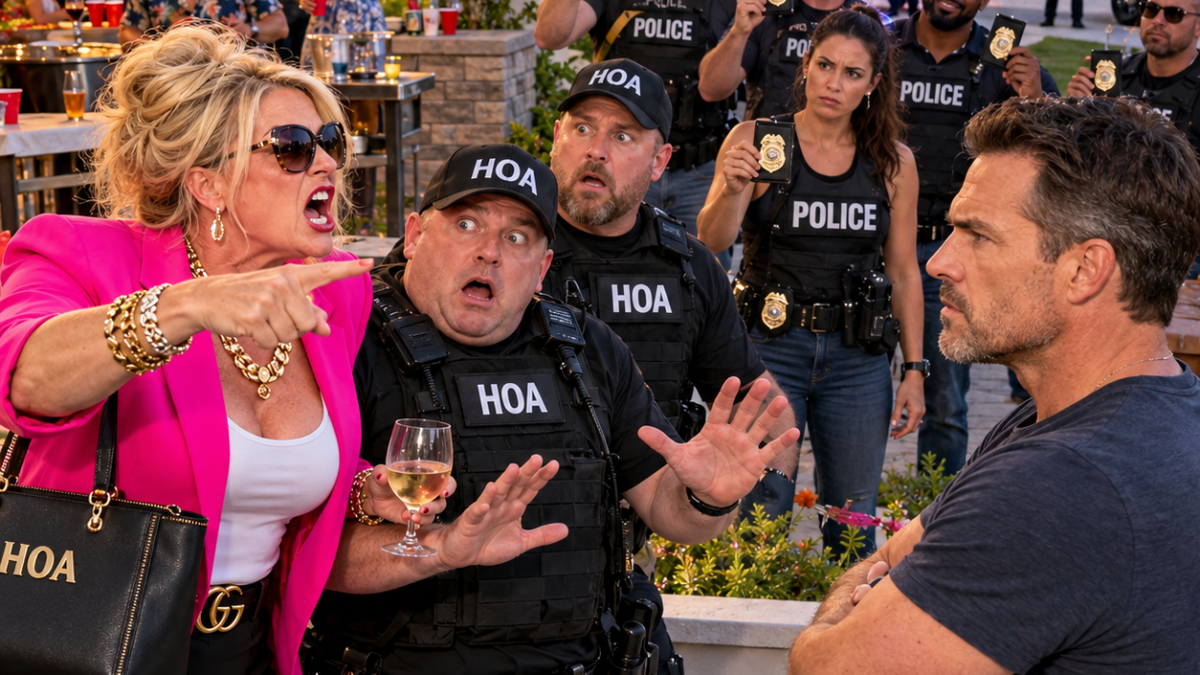
PART 2
The radio crackled.
Cole spoke again.
“Hostile residence. Multiple noncompliant subjects. Supervisor requested.”
I watched Nash process the badge in Hayes’s hand.
His eyes moved from Robert to Carolyn, then toward the living room.
He was finally noticing details.
The haircuts.
The posture.
The way nobody panicked.
The way several people had positioned themselves without being told.
The sudden absence of alcohol in anyone’s hands.
But instead of backing down, Nash did what insecure men with borrowed authority often do.
He doubled down.
“Your employment does not exempt you from HOA regulations.”
Hayes didn’t blink.
“This isn’t about an HOA regulation anymore.”
Nash’s fingers tightened around Linda’s arm.
She winced.
That was enough for me.
I stepped forward, not toward him, but into a position where he could see my hands clearly.
“Derek.”
His eyes snapped toward me.
“You are inside my home without permission. Remove the cuff from Mrs. Hayes and step back onto the porch.”
“I have enforcement authority.”
“You have been told to leave.”
“We’re acting under HOA direction.”
“That does not give you police powers.”
“You don’t know our contract.”
“I don’t need your contract to know what handcuffs mean.”
Cole stopped writing.
Nash looked toward him.
For half a second, I saw uncertainty pass between them.
Then headlights swept across my living-room wall.
A white SUV pulled to the curb.
Roof light bar.
Red and blue lenses.
No municipal markings.
No unit number.
A man in another Oak Ridge Community Security uniform stepped out.
Nash exhaled.
Confidence returned.
“There.”
He pointed.
“My supervisor.”
O’Brien muttered behind me.
“That’s unfortunate.”
For them.
The third man walked toward the porch.
Name tag:
M. RUSSELL.
He took in the scene.
Linda cuffed.
Hayes holding a Phoenix PD credential.
Nearly thirty people filling the living room and hallway.
He stopped.
“What happened?”
Nash answered immediately.
“Obstructive subjects. Refusal to provide identification. Female interfered. I detained her.”
Russell’s face changed.
“Detained her?”
“Yes.”
“With cuffs?”
“Yes.”
Russell looked at Hayes.
Then the badge.
Then me.
“Mr. Baker, I’m sure we can de-escalate.”
“Start by uncuffing her.”
He looked toward Nash.
“Derek.”
Nash hesitated.
That hesitation mattered.
Russell said it again.
“Take it off.”
Nash unlocked the cuff.
Linda pulled her hand against her chest.
A red ring already marked her wrist.
Hayes moved beside her.
“You okay?”
“I’m fine.”
She wasn’t.
Anyone married thirty years knows the difference.
Russell raised both hands.
“Let’s reset.”
Carolyn laughed once.
Nothing amused in it.
“You don’t reset an unlawful detention.”
Russell ignored her.
“Mr. Baker, we received resident complaints. Our officers attempted to address an active violation.”
“Your officers?”
“Community officers.”
“Licensed security guards?”
He paused.
“Contract personnel.”
That was answer number two that evening designed to avoid a direct question.
I said:
“Leave the property.”
Russell nodded.
“Fine. You’ll receive formal notices.”
Nash straightened his uniform.
“Five thousand minimum.”
Russell looked at him sharply.
“Derek.”
“What?”
“Stop talking.”
Interesting.
Nash didn’t.
“All vehicles will be cited if they remain after thirty minutes. Noncompliance will be reported. Future gatherings may require advance approval.”
He looked at me.
“And this incident will be documented as resident hostility.”
I almost thanked him.
Instead I said:
“Please document every word.”
He thought I was being sarcastic.
I wasn’t.
Russell guided him toward the porch.
Cole followed, photographing license plates as he went.
When the three reached the sidewalk, Captain Hayes spoke quietly beside me.
“You calling it?”
“I already did.”
He turned.
“When?”
“While Russell was walking up.”
I held up my phone.
Phoenix dispatch had been notified through the non-emergency supervisor channel first, then upgraded once Linda was physically restrained.
I did not want the officers in my living room becoming the responding agency.
Too many conflicts.
Too many witnesses personally connected to the event.
So I asked for an on-duty patrol supervisor from a different precinct and requested county coordination if needed.
Real sirens arrived six minutes later.
This time the vehicles had agency markings.
Unit numbers.
Municipal plates.
No one had to guess who they were.
Sergeant Andrea Ruiz stepped out with two patrol officers.
She knew several people at my party.
That made the first five minutes awkward.
“Douglas.”
“Andrea.”
She looked at the Oak Ridge SUV.
Then at the number of off-duty cops standing in my front yard.
“You people know how to ruin a quiet Saturday.”
“I made ribs.”
“Of course you did.”
Then her face changed.
Professional.
“Who is the complainant?”
“Linda Hayes.”
“Who is the homeowner?”
“I am.”
“Who touched whom?”
“Nash restrained Linda.”
“Anybody else put hands on anyone?”
“No.”
“Any weapons displayed?”
“No.”
“Any threats of physical harm?”
“Not from us.”
Ruiz nodded.
“Good. Everybody stays separate.”
She treated us exactly as she would have treated strangers.
That was important.
Nash immediately tried to control the narrative.
“These individuals are intoxicated and interfering with official HOA enforcement.”
Ruiz looked at him.
“Official what?”
“Community enforcement.”
“Are you a sworn peace officer?”
“No.”
“Are you a licensed private security officer?”
Nash hesitated.
Russell stepped in.
“Our licensing paperwork is maintained by the association.”
Ruiz turned toward him.
“That wasn’t my question.”
No answer.
She separated them.
Took statements.
Photographed Linda’s wrist.
Collected names.
Requested my exterior camera footage.
Requested Maria’s recording but did not seize her personal device.
She noted the SUV’s emergency-style lighting equipment and left its legality to investigators.
No one announced charges on my lawn.
No one performed a dramatic arrest because nineteen cops wanted one.
That mattered too.
We had an allegation.
Witnesses.
Video.
Physical marks.
Potential licensing issues.
The system still had to process them.
Before leaving, Ruiz pulled me aside.
“Douglas.”
“Yes?”
“You know you’re too close to this.”
“I do.”
“So is Hayes.”
“I know.”
“Do not investigate it officially.”
“I won’t.”
“Not unofficially either.”
I smiled.
“That sounds personal.”
“It’s professional.”
She lowered her voice.
“You can collect your own records as a homeowner. You can encourage neighbors to report their own experiences. But if this becomes criminal, another unit owns it.”
“I understand.”
She studied me.
“Do you?”
“Yes.”
“You have that look.”
“What look?”
“The one detectives get when they already built a conspiracy board in their head.”
I glanced through the window at O’Brien.
He was literally standing beside my dining table arranging citation forms Linda had found on the foyer shelf.
Ruiz followed my eyes.
“Tell him too.”
“I will.”
The fake security team left after Ruiz documented their identification and vehicle information.
No sirens.
No emergency lights.
Just a white SUV disappearing around the corner.
The moment they were gone, the backyard party effectively ended.
No one cared about burgers.
Captain Hayes sat on my couch beside Linda.
She held an ice pack against her wrist.
Carolyn occupied the armchair.
O’Brien leaned against the fireplace.
Maria had already saved her video in two separate locations.
Ruiz’s warning sat in my head.
Don’t investigate it officially.
Good advice.
Necessary advice.
But being a witness did not require pretending I hadn’t seen a pattern.
Hayes spoke first.
“You think this is isolated?”
“No.”
“How sure?”
“Neighbor mentioned something two months ago.”
“Who?”
“Kayla Young.”
I told them.
Sixty-seven.
Lived alone.
Late-night “security” visit because her porch light was supposedly too bright.
They made her sign a form.
I had shrugged it off as HOA nonsense.
That bothered me now.
Carolyn said:
“How often?”
“I don’t know.”
“Then that’s the first question.”
O’Brien raised a hand.
“Careful.”
We all looked at him.
“Andrea was right.”
He pointed around the room.
“We are witnesses. If we start acting like investigators, defense counsel will have a field day.”
Hayes nodded.
“So we report.”
“Yes.”
“And residents can choose whether to come forward.”
“Yes.”
“And the department can assign it outside our chain.”
“That’s what I want.”
Maria said:
“Professional Standards?”
“Potentially. Or another investigative unit. Maybe county if Phoenix wants distance.”
Hayes looked at Linda.
“What do you want?”
She had been quiet since the cuffs came off.
Now she lowered the ice pack.
“I want that man never to put handcuffs on another person who thinks the uniform means they have no choice.”
Nobody answered.
Then she looked at me.
“And I don’t want them to say this only mattered because he picked a house full of police.”
That sentence became the center of everything.
If Nash had done the same thing to Kayla Young, would anybody have listened?
If he handcuffed an elderly man living alone?
A young immigrant family?
Someone who didn’t know the difference between a police badge and a shiny piece of metal attached to an HOA uniform?
The answer made me uncomfortable.
Maybe not.
That night, after everyone left, I stood in the backyard alone.
Paper plates remained on the table.
Burgers had gone cold.
Smoke hung low above the grill.
I had spent twenty-two years believing I understood what police authority looked like from the outside.
I wore a real badge.
I knew exactly what it did and did not allow.
But I had almost missed what imitation authority looked like because it came packaged as neighborhood management.
I thought about Kayla.
I had heard her story.
I had simply failed to hear what it meant.
At nine the next morning, I knocked on her door.
She answered in a robe.
Coffee cup in hand.
“Douglas?”
“Can we talk?”
Her face changed immediately.
“What happened?”
I told her.
Not all the legal theories.
Just facts.
Two Oak Ridge security men.
Uniforms.
Handcuffs.
Linda.
Police report.
Kayla listened without interrupting.
Then she stepped aside.
“Come in.”
Her living room looked exactly like I expected.
Clean.
Quiet.
Family photographs arranged on a bookshelf.
A crocheted blanket folded over the couch.
Nothing about the room suggested a woman who should be afraid of people knocking on her door.
Yet when I mentioned Derek Nash’s name, she set her coffee down with both hands.
“You know him.”
“Yes.”
“He’s the one.”
“The one who came here?”
“Most times.”
“Most?”
She looked at me.
“Seven visits.”
I sat forward.
“Seven?”
“In three years.”
“Why?”
She gave a tired laugh.
“Depends which paper you read.”
Mailbox.
Porch light.
Lawn ornament.
Guest parking.
Noise.
Unapproved modification.
One citation accused her of creating an obstruction because a flowerpot sat too close to the walkway.
“Did you pay?”
“Some.”
“How much?”
“Maybe twelve hundred total.”
“Did you appeal?”
“The first time.”
“What happened?”
“Victoria called me.”
“Victoria Ashford?”
Kayla nodded.
I knew the name.
HOA president.
Fifteen years in Oak Ridge.
Seven as president.
Very visible at neighborhood events.
“Why did she call?”
“She said appeals create unnecessary conflict.”
“That’s interesting.”
“She asked whether I was happy here.”
“When?”
“After I challenged the second fine.”
Kayla got up.
Walked to a filing cabinet.
Returned with a manila folder.
Inside were forms designed to resemble municipal citations.
Structured boxes.
Case numbers.
Officer names.
Violation categories.
At the top:
OAK RIDGE COMMUNITY ENFORCEMENT DIVISION.
Not security.
Enforcement Division.
I picked one up.
D. Nash.
Signature.
Time:
10:14 p.m.
“Why were they here after ten?”
“They said nighttime compliance checks.”
“Did they enter?”
“Not the house.”
“Did they threaten arrest?”
“Not exactly.”
“What exactly?”
Kayla looked embarrassed.
“They said failure to cooperate could result in further legal action.”
“Police?”
“They said authorities.”
“Did you think they were cops?”
“The first time?”
“Yes.”
That answer hit harder than anything else she had said.
“They never corrected you?”
“No.”
“What changed after Victoria asked whether you were happy?”
Kayla stared at the floor.
“She mentioned buyers.”
My pen stopped.
“What buyers?”
“She said there were investors looking for properties in Oak Ridge. That if I ever felt the neighborhood rules were too stressful, she could introduce me.”
“Did you say you wanted to sell?”
“No.”
“What happened after you declined?”
Kayla looked at the folder.
“More visits.”
I did not build a theory out loud.
I was not the investigator.
But something cold settled in my chest.
“Kayla, would you be willing to make a formal statement to the assigned investigator?”
Her fingers tightened.
“Will Victoria know?”
“Eventually, maybe.”
“She knows everything.”
“Then don’t decide now.”
“What would you do?”
“That’s not fair.”
“Why?”
“Because I have backup you didn’t have.”
Her eyes filled.
“I thought I was crazy.”
“You’re not.”
“You don’t know that.”
“I know these forms don’t look normal.”
I pointed at the header.
“And I know no HOA security contractor gets to create police-style authority out of typography.”
She almost smiled.
Then she said:
“I’ll talk.”
By noon, I had not knocked on another door.
I called Sergeant Ruiz instead.
Told her what Kayla had.
Ruiz sighed.
“I told you not to investigate.”
“I asked one neighbor if she wanted to make a report.”
“That is dangerously close to a technicality.”
“She has seven citations.”
Pause.
“Send her to the assigned detective. Not you.”
“Who is assigned?”
“Financial Crimes is consulting because of the fines. Special Investigations may take lead.”
“Who?”
“Detective Alan Mercer.”
I knew Alan.
Different bureau.
Never worked under Hayes.
No personal connection to Linda.
Good.
“Give Kayla his number.”
“I will.”
“And Douglas?”
“Yes?”
“Stop knocking.”
“Fine.”
“You’re lying.”
“Probably.”
“Do better.”
I did.
Mostly.
Residents started coming to me instead.
Word spread that something had happened at my barbecue.
Not the full story.
Enough.
A young couple, Luis and Elena Martinez, stopped me while I was collecting mail.
“Are you Officer Baker?”
“Off duty, yes.”
“We heard there’s an investigation.”
“Possible investigation.”
Luis glanced toward their house.
“We have papers.”
“What papers?”
“Security citations.”
I gave them Mercer’s contact information.
“Call him.”
“Can we show you first?”
I almost said yes.
Then Ruiz’s voice entered my head.
Too close.
“No.”
They looked disappointed.
I explained.
“I’m part of the original incident. If this turns into a prosecution, the cleanest thing is for your evidence to go directly to the assigned detective.”
Elena nodded slowly.
“So you believe us?”
“I haven’t heard your story.”
“But you think we should report it.”
“Yes.”
That was enough.
By the end of the week, Mercer had statements from eight households.
I learned details only later through court records, victim meetings, and conversations after people had been interviewed.
Kayla.
The Martinez family.
Mr. Stewart.
Patricia Chan.
Marcus Webb.
The Nguyens.
Two others.
The pattern was ugly.
New arrivals.
Minority families.
Older residents living alone.
People who challenged fines.
People who questioned budgets.
The Martinez family had been cited for music at six in the evening.
Mr. Stewart, seventy years old and born in Ohio, had allegedly been told that immigration authorities might become interested if he continued disputing violations.
When Mercer told me that during a victim-witness meeting weeks later, I thought I misheard him.
“Immigration?”
“Yes.”
“He’s from Ohio.”
“Correct.”
“What did Stewart say?”
Mercer looked at me.
“He keeps his birth certificate beside the citation.”
I stared at the wall.
Some intimidation is loud.
Some is so absurd that the victim feels embarrassed repeating it.
That embarrassment becomes part of the weapon.
The licensing check made things worse.
Derek Nash had applied for a state security credential four years earlier.
Denied.
Randy Cole had never held one.
Russell had limited credentials through a previous employer that did not authorize what Oak Ridge appeared to have been using him for.
The company itself was called Oak Ridge Protection Services LLC.
Contract value:
roughly $300,000 annually.
That number shocked me.
Oak Ridge wasn’t a gated luxury development requiring twenty-four-hour staffing.
There were neighborhoods twice the size spending far less.
But again:
Not my investigation.
Mercer traced it.
I waited.
Three days after the barbecue, Victoria Ashford came to my door.
Cream blazer.
Pearl earrings.
Silver Mercedes idling by the curb.
She smiled when I opened the door.
“Mr. Baker.”
“Mrs. Ashford.”
“I hope this is a good time.”
“No.”
She looked past me as if expecting an invitation anyway.
I did not give one.
“I wanted to personally apologize for the misunderstanding involving our security team.”
“What misunderstanding?”
“The gathering Saturday.”
“My guest was handcuffed.”
“Yes.”
“That seems fairly unambiguous.”
She kept smiling.
“Derek can be overly assertive.”
“Overly assertive is using a stern tone. He physically restrained someone in my house.”
“I have spoken to him.”
“Good.”
“We want to resolve this constructively.”
“What does that mean?”
“No fines related to the gathering.”
“I wasn’t planning to pay them.”
“No further enforcement visits unless absolutely necessary.”
“They shouldn’t have been here in the first place.”
Her smile thinned.
“Mr. Baker, I know now that you’re a police officer.”
There it was.
Now.
After.
“I’ve been one for twenty-two years.”
“I respect that.”
“Okay.”
“And because I respect your position, I think it would benefit everyone to handle this privately.”
“Privately?”
“No complaints to outside agencies. No media. No unnecessary escalation.”
“Why would my job make privacy more important?”
She hesitated.
Barely.
Then:
“Professional courtesy.”
I almost laughed.
Before I could answer, footsteps sounded behind me.
Captain Hayes had come by to drop off a signed medical release for investigators.
He appeared at my shoulder.
Victoria recognized him immediately.
Of course she did.
By then, someone had told her exactly who had been in my house.
“Captain Hayes.”
“Mrs. Ashford.”
“I was just apologizing.”
“For the man who handcuffed my wife.”
“For an unfortunate misunderstanding.”
Robert’s expression didn’t change.
“How long has Nash worked for your association?”
“Several years.”
“Licensed?”
“The board uses a contractor.”
“That wasn’t the question.”
Victoria looked at me.
Then back at Hayes.
“I’m not personally responsible for individual credentialing.”
Hayes nodded slowly.
“Interesting.”
She adjusted one cuff of her blazer.
“I’m sure the company can provide all necessary records.”
I said:
“Several residents have reported similar conduct.”
Her eyes moved toward me.
“Residents?”
“Yes.”
“I’m not aware of any pattern.”
“Then the investigation should help.”
That was the first time her smile disappeared entirely.
“What investigation?”
I didn’t answer.
I had no right to reveal details.
Hayes didn’t either.
So we stood there.
Silence does useful work when someone expects information.
Victoria filled it.
“I’ve lived here fifteen years.”
No response.
“I know the board.”
Still nothing.
“I know council members.”
Hayes’s eyebrows rose.
She continued.
“I know people in the city who understand how sensitive neighborhood matters can become.”
I finally said:
“Is that supposed to concern me?”
“No.”
She smiled again.
“I’m simply saying public disputes create complications.”
“For whom?”
“Everyone.”
“Kayla Young?”
The name slipped out before I could stop it.
Victoria’s eyes changed.
Tiny reaction.
Enough.
Then she recovered.
“I don’t discuss private homeowner matters.”
“Good policy.”
“Mr. Baker, you’re new here.”
“Eight months.”
“I’ve spent years protecting property values.”
“From porch lights?”
Her jaw tightened.
“You don’t understand the history of this community.”
“Then explain it.”
“I didn’t come to argue.”
“No. You came to make this disappear.”
She took one step backward.
“Good evening, Mr. Baker.”
Hayes spoke.
“Mrs. Ashford.”
She stopped.
“If you or anyone acting on behalf of the HOA contacts my wife about the incident, direct communication should go through counsel or investigators.”
Victoria’s face hardened.
“Is that a threat?”
“No.”
Hayes smiled without warmth.
“That is what an actual boundary sounds like.”
She left.
The Mercedes pulled away slowly.
I watched the taillights disappear.
Hayes stood beside me.
“She’s scared.”
“Yes.”
“Scared people do stupid things.”
“That’s what worries me.”
The first search warrants came two weeks later.
Not because of anything Hayes or I ordered.
The case had moved through Mercer to prosecutors after enough independent victim statements, licensing records, and financial irregularities accumulated.
A county prosecutor named Rachel Morrison took interest.
Then the warrants went to a judge.
Real process.
Affidavits.
Probable cause.
Signed authorization.
No HOA letterhead pretending to be law.
Nash was arrested at his apartment at six in the morning.
I wasn’t there.
Good.
Cole was arrested separately.
Russell was questioned and later charged on narrower counts related to the operation, though his role remained different from Nash’s.
The most important arrest did not happen that day.
Victoria remained free.
That frustrated some people.
Especially Kayla.
She called me.
“They arrested the men but not her.”
“I know.”
“She sent them.”
“Maybe.”
“You believe that.”
“What I believe isn’t enough.”
“So she gets to sit in that house?”
“For now.”
Kayla was quiet.
Then:
“I hate ‘for now.’”
“I know.”
Cole talked.
According to later discovery, he broke almost immediately.
He had never expected felony exposure.
Had never understood how serious the impersonation allegations could become.
He kept saying:
“I was following Derek.”
Then:
“I was following company policy.”
Then:
“Victoria knew.”
That was the sentence prosecutors needed corroborated.
Cole described a list.
Residents to receive “encouragement visits.”
People deemed “noncooperative.”
People “unlikely to integrate.”
He said Nash submitted written reports after every visit.
Where?
Victoria’s HOA office.
Investigators executed another warrant.
They found the list.
Kayla Young.
Luis and Elena Martinez.
Mr. Stewart.
Patricia Chan.
Marcus Webb.
The Nguyens.
More.
Beside several names were notations.
NEW.
DIFFICULT.
SELL?
OUTSIDE CULTURE FIT.
My stomach turned when Mercer showed me a redacted copy during the victim briefing.
“What does ‘outside culture fit’ mean?”
“We’re still documenting how they used the term.”
“You know what it means.”
“I know what it suggests.”
Again.
Precision.
Then the money trail surfaced.
Oak Ridge Protection Services LLC was legally owned by Thomas Ashford’s brother.
Thomas was Victoria’s husband.
The HOA paid approximately $300,000 a year to the company.
No competitive bidding for several years.
Sparse licensing review.
Weak oversight.
Then Mercer compared targeted homes to property sales.
Three families on the “encouragement” list had sold below recent neighborhood comps after prolonged enforcement pressure.
Purchaser entities differed.
But beneficial ownership records, financing documents, and closing records tied two of them to a real-estate investment partnership in which Thomas Ashford held an interest.
The third was later assigned to a company connected to one of his business associates.
That changed the case.
Harassment could be dismissed as abusive governance.
Financial gain gave prosecutors motive.
I remember sitting in my dining room when Hayes called.
“You heard?”
“Yes.”
“It was profitable.”
“Looks that way.”
“I thought Victoria was a control freak.”
“She may be both.”
That mattered.
Villains are easier to understand when they have one motive.
Real people don’t.
Victoria seemed to believe she was preserving Oak Ridge.
Property values.
A certain look.
A certain kind of resident.
And her family benefited financially when the pressure drove people out.
Ideology and greed had learned to cooperate.
Rachel Morrison referred portions of the case to the Arizona Attorney General’s office for review because the pattern crossed beyond a simple neighborhood dispute.
People started using the word racketeering.
I was careful with it.
Lawyers love big labels when cameras are present.
Actual prosecutors need statutes, predicate acts, evidence, and jurisdiction.
Whatever the final charging theory became, the underlying evidence was bad enough without exaggeration.
Victoria was arrested six weeks after Nash.
She surrendered through counsel.
No dawn raid.
No dramatic driveway scene.
She walked into a booking facility wearing a dark suit beside her attorney.
The HOA president who had once sent fake “officers” to elderly residents now had to follow instructions from actual deputies.
Photograph.
Fingerprints.
Property inventory.
Release conditions.
No contact with witnesses.
No participation in HOA enforcement while the case remained pending.
The neighborhood exploded.
Board meeting attendance tripled.
Then quadrupled.
Victoria’s allies initially insisted she had been framed by rogue contractors.
At the first emergency meeting after her arrest, a man named Gerald Price stood and said:
“Victoria has given fifteen years to this community.”
Kayla stood.
“And I gave three years being afraid to answer my door.”
Silence.
Gerald sat down.
The security contract was suspended immediately.
Then terminated.
The white SUV with the light bar was impounded during the investigation and later disposed of according to lawful process.
The fake citations stopped.
Overnight.
That fact alone enraged people.
If the citations had truly been essential to community safety, why did Oak Ridge survive perfectly well without them?
Mr. Stewart turned his porch light on brighter.
Deliberately.
The Martinez family held a birthday party.
Music until eight.
Nobody arrived with handcuffs.
Kayla invited six friends over for dinner.
She called me the next morning.
“No one came.”
“Good.”
“I kept waiting.”
“I know.”
“At ten o’clock, I checked the window.”
“Kayla.”
“I know.”
Fear outlives the person who creates it.
That became obvious as more residents spoke.
Patricia Chan had been targeted after questioning a board assessment.
Marcus Webb, a retired firefighter, received repeated notices about an oversized American flag despite similar flags elsewhere.
The Nguyens were visited monthly after asking for a written appeal hearing.
Not every victim belonged to a minority group.
Not every enforcement action was fabricated.
That nuance mattered.
Some people had genuinely violated parking or maintenance rules.
But the pattern of who received aggressive nighttime visits, police-style forms, and sales pressure was impossible to ignore.
The HOA commissioned an independent audit.
Financial records showed Oak Ridge Protection Services had billed for patrol hours that could not always be verified.
Vehicle expenses exceeded contract assumptions.
Equipment charges included restraints, light bars, uniform upgrades, and “enforcement materials.”
Residents had literally financed the props used to frighten them.
I saw one invoice later.
CUSTOM BADGE PACKAGE.
Twelve units.
That line made me angrier than I expected.
Not because badges are magical.
Because somebody had spent community money making imitation authority more convincing.
The preliminary hearing packed the courtroom.
Maricopa County Superior Court.
Department Twelve.
Kayla sat beside Mr. Stewart.
The Martinez family came without their toddler.
Linda Hayes wore long sleeves despite the heat.
Her wrist had healed months earlier.
She still rubbed it unconsciously when Nash entered.
He wore jail clothing.
No black uniform.
No plastic badge.
No belt.
Just a defendant following a deputy’s instructions.
Victoria sat at a separate table with retained counsel.
Perfect posture.
Eyes forward.
Cole’s case had already been severed because he agreed to cooperate.
Judge Diane Daniels took the bench.
Rachel Morrison stood for the state.
She began with the barbecue video.
Maria’s recording filled the screen.
Nash stepping inside.
Linda asking:
“You’re not real cops, are you?”
The wrist grab.
The cuff.
“Ma’am, you are being detained.”
Nobody in the courtroom moved.
I had watched the video several times.
It still made my shoulders tighten.
Morrison paused on Nash’s uniform.
Badge visible.
Patch.
Cuffs.
Then she introduced several earlier citation forms from other residents.
Same language.
Same branding.
Same false aura of government process.
Defense counsel argued the forms were clearly HOA documents.
Morrison enlarged the header.
OAK RIDGE COMMUNITY ENFORCEMENT DIVISION.
Citation number.
Officer identification.
Failure-to-comply language.
Potential referral to “authorities.”
Then the list.
The clear evidence sleeve looked almost ridiculous.
One sheet of paper.
So much damage compressed into a spreadsheet printout.
Morrison said:
“This document was recovered pursuant to warrant from the association office.”
Defense objected.
Foundation.
Relevance.
Judge overruled after the proper custodian testimony.
Morrison continued.
“Residents selected for encouragement visits.”
Names.
Categories.
Notes.
Then money.
Oak Ridge Protection Services.
Family connection.
Property acquisitions tied to the Ashford household’s investment interests.
Victoria’s attorney argued she relied on contractors.
That she had never instructed anyone to impersonate police.
That HOA enforcement sometimes required firmness.
That the financial relationships were disclosed in accounting records.
Morrison called Cole.
He looked twenty-five years older than the night at my house.
His voice shook.
“Who gave you the resident lists?”
“Derek.”
“Who gave them to Derek?”
“Mrs. Ashford.”
Victoria’s attorney objected.
Hearsay in part.
The judge required foundation.
Morrison slowed down.
“How do you know?”
“I was in the office.”
“When?”
Cole gave a date.
“Who was present?”
“Derek, me, Mrs. Ashford, Mr. Russell.”
“What did Mrs. Ashford say?”
Victoria’s attorney objected again.
Judge Daniels allowed testimony subject to evidentiary rules applicable at that stage.
Cole swallowed.
“She said some residents needed to understand Oak Ridge wasn’t for everyone.”
A murmur moved through the gallery.
The judge looked up.
Silence returned.
Morrison asked:
“Did she tell you to pretend to be police officers?”
“No.”
That answer mattered.
“Did she tell you that you could arrest people?”
“No.”
Another important answer.
“What did she tell you?”
“That residents needed to believe noncompliance had consequences.”
“How?”
“She told Derek to make the program look official.”
“Official how?”
“Uniforms. Badges. Citation forms. Vehicle lights.”
Victoria stared straight ahead.
The defense later attacked Cole hard.
He had cooperated to help himself.
True.
He wanted probation.
True.
He had participated willingly.
True.
That was why prosecutors needed independent corroboration.
And they had some.
Invoices.
Emails.
A message from Victoria to Nash:
Presentation matters. Residents cooperate when enforcement looks professional.
Another:
Do not use police terminology in written reports.
That line was devastating in a quiet way.
If there was nothing wrong with the terminology, why avoid writing it?
Another email after a complaint:
Verbal authority is sufficient. No need to create discoverable drama.
Rachel Morrison did not smile when she read it.
She didn’t need to.
Judge Daniels found sufficient probable cause for the major charges to proceed.
The exact final counts shifted later through motions and plea negotiations, but the court allowed the state to continue on impersonation-related conspiracy theories, unlawful restraint allegations tied to specific incidents, fraud-based conduct, and intimidation-related counts supported by individual victims.
Bail conditions tightened.
Victoria surrendered her passport.
No witness contact.
No HOA board activity.
Nash remained in custody because he could not post the amount set in his case.
After the hearing, Victoria had to walk past the victims.
Kayla.
Mr. Stewart.
Linda.
The Martinez family.
Patricia.
No one shouted.
That would have made it easier for her.
She walked through silence.
At the door, she finally looked toward Kayla.
Kayla did not look away.
Three years earlier, Kayla had signed a paper at ten at night because a man in a uniform told her she had no choice.
Now that man was facing trial.
The woman behind the system was walking past her under court supervision.
Power changes hands quietly sometimes.
The criminal cases took months.
Longer than neighbors expected.
Motions.
Discovery.
Expert review.
Licensing testimony.
Financial analysis.
Arguments over what evidence belonged in which case.
The internet wanted instant endings.
Courts did not care.
Victoria’s lawyers attacked the financial theory.
They argued the family relationships had been disclosed informally.
That below-market sales were voluntary.
That distressed homeowners often sell quickly.
That Oak Ridge Protection Services was a legitimate company even if employees had licensing problems.
Some of those arguments had legal weight.
That forced prosecutors to narrow.
Not every suspicious thing became a charge.
Not every ugly act fit neatly into a statute.
That disappointed residents who wanted one giant indictment explaining everything morally wrong with Oak Ridge.
The law does not prosecute morality in bulk.
It prosecutes provable conduct.
Eventually, Victoria accepted a plea resolution shortly before trial.
The agreement required her to admit to conduct tied to the fraudulent enforcement scheme and intimidation of residents, while more aggressive theories were dismissed.
She received supervised probation.
Two hundred hours of community service.
Financial restitution tied to documented victims and improper collections.
A court-enforceable prohibition against serving in association leadership during the term of the sentence.
Separate civil settlement provisions extended restrictions on her future HOA involvement.
People argued about whether she should have gone to prison.
Kayla thought so initially.
Linda did too.
I understood.
But plea agreements are risk management.
Witness problems.
Evidentiary disputes.
Appeal risk.
Age.
Prior record.
Restitution.
Cooperation from other defendants.
Prosecutors weigh all of it.
Victoria had to stand in court and answer the judge.
“Did you knowingly participate in an enforcement operation that used deceptive representations of authority to pressure residents?”
“Yes.”
“Did residents suffer financial and emotional harm?”
“Yes.”
“Did you understand some individuals believed your contractors possessed government authority they did not possess?”
Her attorney leaned toward her.
Victoria closed her eyes.
“Yes.”
That was the moment Kayla started crying.
Not when probation was announced.
Not when restitution was ordered.
When Victoria admitted she knew people were confused about the authority and allowed the system to continue.
Afterward, Kayla said:
“For three years she made me think I was stupid.”
“You weren’t.”
“I know that now.”
Nash refused a plea for much longer.
He insisted he had only enforced private rules.
His attorney challenged whether his conduct legally met every impersonation element alleged.
Some counts were dismissed before trial.
Others survived.
The unlawful restraint involving Linda was among the strongest because the video showed exactly what happened.
At trial, Nash took the stand.
Against his attorney’s advice, according to courtroom gossip.
He said he believed HOA policy gave him detention authority.
The prosecutor asked:
“Who trained you on detention law?”
“Security management.”
“Name the instructor.”
“I don’t remember.”
“What statute gave you authority to handcuff Mrs. Hayes?”
“I’m not a lawyer.”
“Then why did you tell her your order was lawful?”
Nash paused.
“That was the terminology we used.”
“Police terminology?”
“No.”
“You called her detained.”
“Yes.”
“You told Mr. Hayes he could also be detained.”
“Yes.”
“You wore a badge.”
“Yes.”
“You carried cuffs.”
“Yes.”
“You drove a vehicle with emergency-style lights.”
“Yes.”
“You told homeowners refusal could bring authorities.”
“Yes.”
“But you want this jury to believe you were never trying to make anybody think you had police authority?”
His face reddened.
“We were community enforcement.”
The prosecutor stepped back.
“That wasn’t my question.”
The jury deliberated several hours.
Convicted him on the strongest impersonation-related and unlawful-restraint counts that survived to verdict.
The sentencing judge imposed a custodial term followed by probation.
Not decades.
Not the cartoon punishment people online predicted.
Enough to make the consequences unmistakable.
Cole received probation after cooperation.
Community service.
Licensing restrictions.
Russell resolved his case separately on lesser charges based on his narrower involvement and cooperation.
Then came the civil aftermath.
The HOA’s insurer and Oak Ridge Protection Services faced claims.
Families forced into questionable property sales pursued separate litigation.
Some cases settled.
Others didn’t.
The $75,000 figure people repeated online represented only one restitution component and did not magically make everyone whole.
Kayla got money back for improper fines.
The Martinez family recovered fees.
Mr. Stewart received a written settlement and reimbursement.
Former homeowners negotiated claims tied to losses where causation could be documented.
None of them received perfect restoration.
A family that sold a home under pressure cannot be given back three years.
That was the part no courtroom fixed.
Oak Ridge held elections two months after Victoria stepped down.
Kayla ran.
I did not encourage her.
She decided on her own.
Her campaign flyer made me laugh.
KAYLA YOUNG
NO NIGHTTIME “ENFORCEMENT.”
NO SECRET CONTRACTS.
NO FAKE AUTHORITY.
She won with seventy-three percent of the vote.
Her first board meeting lasted four hours.
She called me afterward.
“This was a terrible idea.”
“You ran voluntarily.”
“I was emotionally compromised.”
“Democracy is cruel.”
“Someone argued forty minutes about mailbox paint.”
“Justice.”
“I hate you.”
The Martinez family joined the architectural committee.
Mr. Stewart began attending meetings with a yellow legal pad.
Anytime somebody used vague language like “community standards,” he raised his hand.
“Define it.”
People initially found him annoying.
Then useful.
Financial records went online.
Security contracts required competitive bidding.
Any guard company had to provide proof of licensing and insurance.
No cuffs without lawful statutory authority and company policy—and the new licensed security contractor’s policy effectively prohibited using restraints for ordinary HOA enforcement.
No police-like citations.
No emergency-style lights designed to create confusion.
Complaint appeals went through a separate review panel.
Most importantly, security stopped acting like an occupying force.
The first licensed guard Oak Ridge hired was a woman named Brenda Liu.
Retired military police.
State credential.
Body camera.
Simple gray uniform.
Large patch:
PRIVATE SECURITY — NOT POLICE.
I saw her one evening near the clubhouse.
“Subtle patch.”
She smiled.
“I heard this neighborhood appreciates clarity.”
“Yes.”
“How’s your party situation?”
“Traumatized.”
“Keep the music down.”
“Are you threatening me?”
She laughed.
“No, sir. I’m asking because I go off shift at eight and would like ribs.”
That was the kind of community-security relationship Oak Ridge should have had from the beginning.
Six months after the original barbecue, I hosted another one.
Same backyard.
Same grill.
Different feeling.
I almost canceled.
The closer the date came, the more I remembered Nash at the door.
Linda’s wrist.
The radio.
“Send the second unit.”
It bothered me that one bad night could rewrite a place I had bought to feel like home.
So I lit the grill.
Hayes came.
Linda too.
Carolyn.
O’Brien.
Maria.
Ruiz came off duty later and spent ten minutes complaining that nobody saved her ribs.
Kayla showed up carrying potato salad.
The Martinez family brought their toddler.
Mr. Stewart arrived in a shirt that said:
BORN IN OHIO.
I laughed so hard I nearly dropped a tray.
“You had that made?”
“Custom.”
“Subtle.”
“I considered carrying my birth certificate around my neck.”
“Don’t.”
“Coward.”
He took a burger.
Near sunset, I stood by the grill and watched everyone move through the yard.
Something felt different.
Not safer exactly.
Safety is never absolute.
More honest.
That was better.
Kayla came over.
“You know what’s weird?”
“What?”
“I walked here.”
“You live next door.”
“I know.”
She looked toward her house.
“I left the porch light on.”
“Reckless.”
“Very.”
We smiled.
Then she said:
“Thank you.”
“For what?”
“For believing us.”
I had spent months receiving versions of that sentence.
Every time, I felt uncomfortable.
“I didn’t at first.”
She frowned.
“What?”
“When you told me about the late-night visit months before the barbecue, I thought it was normal HOA nonsense.”
“You didn’t know.”
“I could have asked.”
She studied me.
“Douglas.”
“Yes?”
“I didn’t even know how to explain it then.”
“That doesn’t mean I couldn’t have listened better.”
She nodded.
“Fair.”
I appreciated that she didn’t immediately absolve me.
I had missed something.
Good intentions don’t erase that.
Later, Linda sat beside me on the patio.
Her wrist had healed completely.
“You ever think about how stupid that night was?”
“Daily.”
“Nineteen cops at one barbecue.”
“Twenty if you count retired.”
“I don’t.”
“Harsh.”
She smiled.
Then her expression softened.
“When he grabbed me, I wasn’t scared.”
“I know.”
“I was angry.”
“I know that too.”
“You know when I got scared?”
“When?”
“When Robert showed the badge.”
That surprised me.
“Why?”
“Because Nash paused and then kept going.”
I remembered.
“That’s when I realized he didn’t just misunderstand his authority.”
She looked toward the yard.
“He needed to have authority.”
That was exactly right.
Some people wear uniforms to perform a job.
Others wear them to feel larger than themselves.
Organizations have to know the difference.
And if they don’t know, someone eventually pays for it.
I asked:
“Do you wish we had arrested him that night?”
Linda thought.
“I wished that for a while.”
“And now?”
“I’m glad Andrea handled it.”
“So am I.”
“If twenty angry cops had piled on him in your living room, Victoria’s lawyer would still be talking about it.”
“Probably.”
“And Kayla’s story might never have become the story.”
She reached for her drink.
“The restraint mattered.”
There was that word again.
Restraint.
People usually associate police restraint with physical control.
Handcuffs.
Commands.
Force.
The harder form is often choosing not to use power just because you possess it.
That night, almost everyone in my house had the training to take Nash down physically.
We didn’t.
The uniform he wore was fake.
The discipline in the room wasn’t.
A year after Victoria’s plea, Oak Ridge held its annual meeting.
I went reluctantly.
Kayla had called three times.
“You have to come.”
“No.”
“We’re reviewing the new enforcement policy.”
“You have lawyers.”
“I need someone who enjoys arguing.”
“You have an entire HOA.”
“Douglas.”
“What?”
“You’re coming.”
I went.
The community center was full.
Not because people were scared.
Because people had learned attendance mattered.
Brenda Liu, the new security supervisor, presented the policy.
Clear complaint process.
No entering homes.
No claiming governmental authority.
No physical detention except the narrow circumstances available to any properly trained private security professional under applicable law, and never for ordinary covenant violations.
All contacts logged.
Body-camera retention.
Independent complaint review.
Then a resident raised his hand.
“What if someone refuses to give security their name?”
Brenda answered:
“If there’s no legal requirement, they don’t have to.”
The resident frowned.
“Then how do you enforce?”
“Through the HOA’s civil process.”
“Letters?”
“Yes.”
“Hearings?”
“Yes.”
“Lawyers?”
“If necessary.”
“That seems weak.”
Brenda smiled.
“No. It seems lawful.”
I liked her more every time she spoke.
Afterward, Kayla caught me near the door.
“We’re boring now.”
“Congratulations.”
“Last meeting we spent an hour on irrigation.”
“Civilization.”
“I miss crime.”
“No, you don’t.”
“No.”
She smiled.
“I really don’t.”
Captain Hayes retired the following year.
Thirty-five years.
His retirement dinner filled a banquet room.
Linda gave the best speech.
She talked about missed holidays.
Late-night calls.
Children learning not to worry when Dad left the table suddenly.
Then she held up one wrist.
“And in retirement, Robert has promised he will no longer bring me to social events where fake police officers might handcuff me.”
The room broke apart laughing.
Hayes looked at me.
“This is still your fault.”
“My house.”
“Exactly.”
After dinner, he pulled me aside.
“You planning to stay in Oak Ridge?”
“Yes.”
“Good.”
“Why?”
“Because leaving would let the stupidest night become your final memory of the place.”
Linda had said something similar months earlier.
Apparently married people share wisdom and coordinate attacks.
Hayes looked older after retirement.
Lighter too.
“You know what bothers me?”
“What?”
“Nash wasn’t sophisticated.”
“No.”
“Neither was Cole.”
“No.”
“And they still scared people for years.”
I knew where he was going.
“They had costume plus institutional backing.”
“Exactly.”
He pointed a finger at me.
“Never underestimate paperwork.”
“I learned that.”
“Good.”
Then he left with Linda.
Years passed.
The story got exaggerated.
People in other neighborhoods heard versions where thirty armed cops surrounded two fake HOA officers and arrested them on my lawn.
Never happened.
Another version claimed Nash pulled a gun.
He didn’t.
One version said Victoria owned half the neighborhood.
False.
Another said the FBI raided the clubhouse.
Also false.
The actual story was less cinematic.
Which is why I trust it more.
A man wore a uniform that made people think he had authority.
An HOA president benefited from that confusion.
Residents were targeted.
Some were financially pressured.
A family-linked contractor made money.
Victims stayed quiet because each believed their experience was isolated.
Then Nash made one enormous mistake.
He performed the same routine in front of witnesses trained to recognize exactly where lawful authority ended.
That exposed the pattern.
But even then, the badge in my pocket didn’t solve it.
Witness statements did.
Videos did.
Licensing records did.
Invoices did.
Property records did.
Emails did.
A judge did.
A jury did.
Residents did.
The system worked because people finally connected evidence that had been scattered across separate homes for years.
That became the lasting change in Oak Ridge.
Not just a new board.
People talked.
If one resident got a strange notice, they asked neighbors whether anybody else had received one.
Contracts were discussed openly.
Minutes mattered.
Silence stopped being considered politeness.
That made Victoria’s old system impossible to rebuild.
Transparency doesn’t guarantee good people.
It simply makes bad behavior more expensive to hide.
Three years after the barbecue, Kayla sold her house.
On her terms.
That mattered.
She called me over before the closing.
Her living room looked half empty.
Boxes everywhere.
“You’re leaving?”
“My sister lives in Oregon.”
“You hate rain.”
“I’m evolving.”
“Why now?”
She looked around.
“Because I want to.”
That answer made me smile.
No enforcement pressure.
No nighttime visit.
No investor call after a citation.
She had listed publicly.
Received three offers.
Accepted one above asking.
Freedom feels ordinary when it finally returns.
Before leaving, she handed me the old manila folder.
Seven fake citations.
“What do you want me to do with these?”
“I don’t know.”
“Burn them?”
She considered.
“No.”
Then:
“Keep one.”
“Why?”
“To remember how official fear can look.”
I kept the first citation.
Porch light.
Excessive illumination.
Signed by Derek Nash.
I eventually framed nothing.
Records belong in files.
Not on walls.
Kayla hugged me.
“Visit Oregon.”
“No.”
“You haven’t even asked where.”
“Rain.”
She laughed.
Then drove away.
The new owner was a young teacher named Alyssa Morgan.
Her first week, she knocked on my door.
“Are you Douglas?”
“Yes.”
“Kayla said you’re the neighborhood cop.”
“I’m a police officer who lives in the neighborhood. Different thing.”
“She said you’d say that.”
I liked Kayla less from Oregon already.
Alyssa held a letter.
“HOA notice.”
My stomach tightened reflexively.
Old habits.
She opened it.
“Welcome packet.”
I laughed.
“What?”
“Nothing.”
She frowned.
“There’s a section about private security.”
“Read it.”
She did.
PRIVATE SECURITY PERSONNEL ARE NOT LAW ENFORCEMENT OFFICERS AND DO NOT POSSESS POLICE AUTHORITY BY VIRTUE OF HOA EMPLOYMENT.
Alyssa looked up.
“That seems very specific.”
“It is.”
“Story?”
“Long one.”
“Bad?”
“Depends who you ask.”
She smiled.
“Kayla said never let you grill ribs without supervision.”
“Get off my porch.”
Normal.
That became my favorite part.
The house stopped feeling like the scene of an incident.
The front doorway was just a doorway again.
The living room was where I watched football.
The backyard smelled like charcoal instead of evidence.
I retired several years after Hayes.
Not because of Oak Ridge.
Time.
Twenty-eight years total by then.
My final week, Maria Santos—now a sergeant—brought me a small box.
Inside was an old-style plastic toy badge.
CHEAP gold.
My name taped beneath it.
“What is this?”
“Your retirement credential.”
“You’re fired.”
“You don’t have authority anymore.”
“That hurts.”
She smiled.
Then handed me the real retirement plaque.
At the party, somebody told the Oak Ridge story.
Of course.
They exaggerated.
Of course.
I corrected them.
“Only nineteen cops were close enough to see the cuff go on.”
Someone shouted:
“Only?”
The room laughed.
Then Linda raised her glass.
“The important part is Douglas didn’t tackle him.”
“I considered it.”
“You always consider it.”
Hayes said:
“That’s why supervisors exist.”
Retirement changed my relationship with the neighborhood too.
For the first time in decades, I was not the person people expected to know what to do when something went wrong.
A resident called me about a parking dispute.
“I’m retired.”
“But you know law.”
“Call the HOA.”
Another asked me whether a contractor could tow his truck.
“I’m retired.”
“Can you just look?”
“No.”
That boundary took practice.
Authority can become identity if you wear it long enough.
Victoria Ashford had built her life around titles.
President.
Board leader.
Community protector.
Nash built his around a uniform.
When the titles disappeared, neither seemed to know who they were.
I didn’t want that.
So I learned to be Douglas.
Grill badly.
Garden worse.
Drink coffee.
Complain about property taxes.
Watch other people solve problems.
One summer evening, Brenda Liu stopped by during a walk.
Still security supervisor.
Still wearing the big PRIVATE SECURITY patch.
“You retired people are dangerous.”
“Why?”
“Too much free time.”
“I’m monitoring suspicious neighborhood activity.”
“You’re pulling weeds.”
“They know what they did.”
She laughed.
Then nodded toward my front porch.
“You ever think about moving?”
“No.”
“Even after everything?”
“Especially after.”
She looked toward the street.
Oak Ridge kids rode bicycles under the streetlights.
Mr. Stewart sat outside with a radio.
The Martinez boy—no longer a toddler—was shooting baskets in the driveway.
Nothing dramatic.
Brenda said:
“Good neighborhood.”
“Usually.”
“Every neighborhood is usually good.”
That was wiser than it sounded.
Bad systems often hide inside mostly normal places.
Oak Ridge hadn’t been a nightmare twenty-four hours a day.
There were block parties.
Good neighbors.
Christmas lights.
People mowing each other’s lawns.
That normality was part of why the abuse lasted.
Residents could explain every incident away.
Derek is intense.
Victoria is difficult.
HOA rules are annoying.
Maybe I misunderstood.
Maybe I deserved the fine.
Maybe complaining will make things worse.
Normal life provides camouflage.
The barbecue tore it away.
On the tenth anniversary of my move into Oak Ridge, I hosted another party.
I didn’t call it an anniversary.
I just invited people.
Some from the original night.
Some new.
Hayes and Linda came.
Carolyn had moved to Nevada after retirement but flew in.
O’Brien arrived late.
Maria brought her daughter.
Mr. Stewart was eighty.
Still wearing obnoxious shirts.
The Martinez family brought teenagers now.
Alyssa, who bought Kayla’s house, handled dessert.
Brenda came after shift.
No uniform.
Kayla surprised me by flying in from Oregon.
She walked through the gate carrying an umbrella.
“Why do you have that?”
“Emotional support.”
“You live in the wrong state.”
We hugged.
Later, as the sun dropped, Kayla stood near the spot where Nash’s SUV had once been parked.
“You kept the house.”
“Yes.”
“You kept the grill.”
“Barely.”
“You still burn burgers.”
“Tradition.”
She looked around.
“Do you remember how quiet everyone got?”
“Yes.”
“When Linda got cuffed.”
“Yes.”
“I wish I had been there.”
“No, you don’t.”
She thought.
“You’re right.”
Then she said:
“I’m glad it happened.”
I looked at her.
“That sounds terrible.”
“It does.”
She corrected herself.
“I’m glad it happened where it happened.”
That I understood.
Not glad Linda was grabbed.
Not glad Nash crossed the line.
Glad he exposed himself in the one room where intimidation could not remain invisible.
I said:
“He had done it so many times he thought it was normal.”
“Exactly.”
“He just chose the wrong house.”
Kayla shook her head.
“No.”
“What?”
“He chose the right house.”
I looked at her.
She continued.
“Wrong house for him. Right house for everyone else.”
That stayed with me.
Later, Mr. Stewart came over holding a burger.
No bun.
He was watching his sugar.
“Douglas.”
“Yes?”
“You still have that citation?”
“Which one?”
“Mine.”
“No. You kept yours.”
“Good.”
“Why?”
He looked toward the lights strung above the patio.
“I used to keep it beside my birth certificate.”
“I remember.”
“I threw it away last year.”
I smiled.
“That seems healthy.”
“I kept the birth certificate.”
“Probably wise.”
He chewed thoughtfully.
Then:
“You know why I threw it away?”
“Why?”
“I realized I didn’t need proof I belonged here.”
I didn’t say anything.
There wasn’t anything useful to add.
He walked back toward the table.
The party continued.
Laughter.
Music.
A kid spilled soda.
Someone burned corn.
Hayes argued with O’Brien about whether retirement had improved his personality.
It had not.
At some point, the doorbell rang.
The entire patio went quiet.
Then everyone started laughing.
I walked through the house.
Opened the door.
Brenda Liu stood there.
She had gone home earlier to change.
Now she held a pie.
“No uniform.”
“Disappointed?”
“Deeply.”
She handed me the pie.
Then looked behind me.
“Why is everyone laughing?”
“Trauma.”
“Healthy.”
“Debatable.”
I stepped aside.
“Come in.”
She did.
No badge displayed.
No clipboard.
No commands.
Just a neighbor carrying dessert.
I closed the door.
For a second, my hand rested on the knob.
I remembered Derek Nash standing on the porch years earlier.
Feet apart.
Hand on belt.
Badge shining.
Certain that appearance could manufacture authority.
He was wrong.
Authority is not fabric.
Not metal.
Not a title.
Not a light bar.
It comes with law, limits, accountability, and consequences.
I had spent most of my career learning that from inside a real uniform.
Oak Ridge taught me what happens when people on the outside cannot tell the difference.
Back in the yard, Linda was laughing.
No mark on her wrist.
No ice pack.
No one watching the front windows.
Kayla stood beside Alyssa, the woman who now lived in her former house.
Mr. Stewart was explaining something to a teenager who clearly wanted to escape.
Maria’s daughter was stealing cookies.
Ordinary things.
That was the outcome I cared about.
Not Victoria’s probation.
Not Nash’s prison sentence.
Not the HOA election.
Those mattered.
But punishment is only half of justice.
The other half is whether people get their lives back.
Kayla sold when she wanted.
Mr. Stewart stopped carrying proof he belonged.
The Martinez family played music.
Residents questioned contracts.
Security guards introduced themselves accurately.
The front door became a front door again.
I went back to the grill.
Hayes handed me the tongs.
“You’re burning them.”
“I’m retired.”
“That doesn’t excuse incompetence.”
Linda called from across the patio.
“Robert, leave him alone.”
“Yes, ma’am.”
He looked at me.
“Still scary.”
“Thirty years as an ER nurse.”
“Exactly.”
We both smiled.
The sun dropped behind the rooftops.
I flipped the burgers.
Someone turned the music up slightly.
Not enough for a complaint.
Probably.
I looked toward the front of the house once.
No flashing lights.
No fake uniforms.
No knock demanding names.
Just neighbors arriving late, walking through the side gate carrying food.
I had moved to Oak Ridge because I wanted a house big enough to bring people together.
For a while, one Saturday night nearly made me forget that.
Years later, with the yard full again, I finally understood the difference between a place being quiet and a place being safe.
Oak Ridge had been quiet under Victoria.
People whispered.
Signed papers.
Closed curtains.
Stopped inviting friends.
Sold homes.
That wasn’t peace.
It was compliance.
The yard around me was louder now.
Messier.
People disagreed at meetings.
Budgets were challenged.
Security complaints got investigated.
Neighbors asked questions.
Kids played music.
Mr. Stewart wore offensive T-shirts about Ohio.
That was community.
Not perfect.
Not obedient.
Alive.
I handed him another burger.
He looked at it.
“No bun?”
“You’re watching your sugar.”
“I’m eighty. I’m watching nothing.”
He stole a bun from the table.
I let him.
Some rules deserved enforcement.
That one didn’t.
By the time the last guests left, charcoal had turned gray.
I stood alone beside the grill.
Same place I had stood years earlier when Nash rang the bell.
The house was quiet again.
But not frightened.
I turned off the patio lights.
Locked the back door.
Then walked toward the front.
For a moment, I paused where Linda had been handcuffed.
There was no mark.
No memorial.
No plaque.
Good.
Some places deserve to become ordinary again.
I switched off the hall light.
And went to bed.
[END OF STORY]








