PART 2: Fake HOA Cops Broke Into My Garage and Destroyed My Father’s Mustang—Then Their Faces Changed When I Opened My FBI Badge
PART 2
The forty-eight-hour deadline expired Monday night.
Nothing happened.
For a few hours, I wondered whether Jacob Torres had decided I was too much trouble.
Maybe the cameras bothered him.
Maybe Simmons had realized I wasn’t reacting the way their previous victims reacted.
Maybe somebody inside the HOA had finally told them they were crossing a line.
Then Tuesday morning came.
At 6:30, I was two miles from home on my usual running route when my phone vibrated.
MOTION DETECTED — GARAGE.
I slowed immediately.
Opened the security app.
And stopped in the middle of the sidewalk.
A flatbed tow truck was backing into my driveway.
Two white Oakwood Security SUVs had boxed it in.
Derek Simmons stood at my garage door with three of his men.
A fourth man held bolt cutters.
For several seconds, nobody moved.
Then Simmons pointed at my garage lock.
The cutters closed.
Metal snapped.
My padlock fell.
I turned and started running home.
But I kept the video open.
I needed to see every second.
I needed the record.
And somewhere beneath the professional part of my brain, the part trained to preserve evidence and resist emotional reaction, was a son watching men enter the last place his father still lived.
The garage door rolled upward.
Simmons stepped inside.
One of his men pulled the fitted cover from the Mustang.
Highland Red appeared beneath the fluorescent lights.
Even through the phone screen, I could see Simmons smile.
“There she is.”
The Mustang’s dash camera was already recording.
Audio too.
Another man said, “Boss, parking brake’s on.”
A tow operator leaned inside.
“It’s in gear.”
“We can’t roll it.”
Simmons didn’t hesitate.
“Then drag it.”
The tow operator looked at him.
“You’ll tear up the transmission.”
“I don’t care.”
My lungs burned as I ran.
On the phone, a chain disappeared beneath the Mustang.
The flatbed winch tightened.
The car moved a few inches.
Stopped.
Then moved again.
The rear tires dragged across the concrete.
The sound came through my earbuds.
Metal.
Rubber.
Concrete.
Then something deeper.
Mechanical resistance.
A car being forced to move in a way it was never designed to move.
“Keep pulling,” Simmons ordered.
The Mustang shifted sideways.
The front bumper struck the garage opening.
Metal folded.
A taillight shattered.
Then another.
Someone shouted:
“You’re tearing it up!”
Simmons responded:
“We’re not leaving without that car.”
I ran faster.
But I already knew I would be too late.
Fifteen minutes later, I turned onto my street.
The tow truck was gone.
My garage was open.
The concrete floor carried long black drag marks and deep gouges.
A piece of red plastic lay near the entrance.
Taillight.
Gerald Lewis stood near my property line.
He looked pale.
“I tried to stop them.”
I stopped beside him, breathing hard.
“What happened?”
“I came outside when I heard the noise.”
His voice shook.
“I told Simmons the Mustang wasn’t abandoned.”
“What did he say?”
“That the HOA had classified it.”
“He saw me drive it last week.”
“I told him.”
Gerald looked toward the empty garage.
“He laughed.”
For a moment, I couldn’t answer.
Gerald put a hand on my shoulder.
“I’m sorry.”
“It’s not your fault.”
“He destroyed that car.”
I looked inside.
Above my workbench hung a framed photograph.
Dad and me.
The day he signed the Mustang over.
His hand was resting on my shoulder.
His face looked younger than I remembered him.
Healthy.
Proud.
Alive.
Take care of her.
That was what he told me.
I had spent nearly thirty years trying to do exactly that.
Now the garage was empty.
I walked inside.
I didn’t shout.
I didn’t punch anything.
Undercover work teaches you how to take fear, grief, rage, and adrenaline and put them in separate mental boxes.
You deal with each later.
When the operation is safe.
When everybody survives.
I had learned to control my breathing during situations far more dangerous than this.
But none of them had involved my father.
I stood beneath his photograph and breathed slowly.
Then I took out my phone.
Diana Walsh answered almost immediately.
“Aaron?”
“They took it.”
Silence.
“The Mustang?”
“Yes.”
“How?”
“Cut my garage lock. Forced entry. Dragged the vehicle out while it was in gear.”
“Cameras?”
“Everything.”
“Audio?”
“Yes.”
“Damage?”
“Significant.”
“Estimated value?”
“Over one hundred thousand.”
Another pause.
Then her voice changed.
No longer friend.
Supervisor.
“What do you need?”
“I need to report burglary, theft, destruction of property, possible extortion, and an ongoing vehicle-seizure operation.”
“You’re still on leave.”
“I know.”
“You are not opening your own case.”
“I know.”
“You’re a victim.”
“I know.”
She paused.
“You hate saying that.”
“Yes.”
“Good. Keep hating it while somebody else handles this correctly.”
“I understand.”
“I’ll send two agents for preliminary assessment.”
“Thank you.”
“And Aaron?”
“Yes?”
“Do not go arrest Simmons yourself.”
“I wasn’t planning to.”
“Were you thinking about it?”
I looked toward the gouges in the concrete.
“No comment.”
“Stay out of trouble.”
I ended the call.
Then drove to Oakwood Towing.
The property sat behind chain-link fencing topped with barbed wire.
Rows of vehicles filled the lot.
Some ordinary.
Some valuable.
Several looked too clean to belong in an impound yard.
The attendant barely looked up when I entered the office.
“Name?”
“Aaron Evans.”
He typed.
“Sixty-nine Mustang.”
“Yes.”
“Eight hundred fifty dollars.”
“For what?”
“Tow, intake, storage.”
“It’s been here less than an hour.”
“Administrative fee.”
“I want to inspect it.”
The attendant shrugged and pressed a buzzer.
I walked through the gate.
The Mustang sat in the back corner between a minivan and a pickup missing two wheels.
Up close, the damage hurt worse.
The Highland Red paint was gouged where the tow chain had rubbed.
Front bumper crushed.
Both rear taillights shattered.
One corner of the bodywork bent.
Fluid beneath the transmission.
The damage looked less like careless towing and more like punishment.
I rested my hand on the roof.
For a second, I remembered my father standing beside me in our old garage.
I was twelve.
Too short to reach the roof properly.
He had put a milk crate beside the Mustang.
“Circular motions, Aaron.”
“What happens if I do it wrong?”
“You buy me new paint.”
“I’m twelve.”
“Then you’ll be paying a long time.”
I could hear his laugh.
Back in the impound lot, I closed my eyes.
Then took out my phone.
Thirty-seven photographs.
Every angle.
Every damaged panel.
VIN.
Transmission leak.
Wheel position.
Chain marks.
I returned to the booth.
“Eight fifty,” the attendant repeated.
“I’m not paying you.”
“Then you don’t get the car.”
“I suggest nobody touches that Mustang again.”
He finally looked at me.
“Excuse me?”
“You’re going to receive legal preservation instructions.”
“From who?”
“The appropriate authorities.”
He laughed.
I didn’t.
That ended the laughter.
When I reached home, two FBI agents were standing in my driveway.
Special Agents Morrison and Keller.
Morrison shook my hand.
“We’re here for preliminary assessment only.”
“Understood.”
“This is not officially your case.”
“I know.”
“You are not investigating.”
“I know.”
“You are providing evidence as a private citizen and victim.”
I nodded.
“Let’s begin.”
For three hours, my dining table became an evidence desk.
Violation letters.
Photographs.
Security footage.
Business records.
Jacob Torres’s ownership interest in Oakwood Towing.
Gerald’s five-year archive.
The anonymous threat.
Drone video.
Simmons’s final warning.
Then the garage raid.
Multiple cameras.
Clean audio.
Simmons’s voice filled the room.
Then drag it. Hook the chain and pull. I don’t care if you have to rip the transmission out.
Morrison stopped the video.
Looked at Keller.
Then replayed it.
Neither spoke for several seconds.
Finally Morrison said:
“This is not a normal HOA dispute.”
“No.”
“Public records show Torres benefits financially from the towing company?”
“Yes.”
“Did he personally demand money from you?”
“Five hundred dollars monthly for an exemption.”
“Recorded?”
“No.”
“Witness?”
“No.”
“Contemporaneous notes?”
“Yes.”
“Good.”
Keller leaned forward.
“And neighbors report similar seizures?”
“At least several.”
“Documentation?”
“Gerald has five years.”
Morrison closed his notebook.
“If the pattern holds, we could be looking at wire fraud, extortion, conspiracy, theft, potentially a broader enterprise theory depending on what financial records show.”
I felt no satisfaction.
My garage was still empty.
“When do you know?”
“When we know.”
He stood.
“And Aaron?”
“Yes?”
“You don’t contact Torres.”
I stared at him.
“Unless we ask.”
Fair.
Forty-eight hours later, Diana called.
“The U.S. Attorney authorized a formal investigation.”
I said nothing.
“Your evidence package is strong.”
“What’s my role?”
“Victim. Witness. Nothing else.”
“Understood.”
“Everything you collected before the investigation was opened gets preserved exactly as originally stored.”
“Already done.”
“I know.”
“You say that like it annoys you.”
“It does.”
I almost smiled.
The federal investigation moved quickly.
A forensic accountant named Sandra Chen arrived with Morrison and Keller.
She spent nearly four hours studying corporate registrations and publicly obtained records I had already collected.
Oakwood Towing.
Oakwood Asset Auctions.
A used-car dealership two counties away.
Three businesses.
Different names.
Same people circling through ownership and management.
When Sandra finally leaned back, her expression was grim.
“Torres built a pipeline.”
“Meaning?”
“Vehicle gets cited.”
She pointed at the page.
“Tow company collects exaggerated fees.”
Next.
“If owner pays, money stays inside the network.”
Next.
“If owner cannot pay, vehicle transfers to auction.”
Next.
“Then frequently reappears through the dealership.”
“Controlled by?”
“Related parties.”
“How many vehicles?”
“Preliminary estimate over two hundred in five years.”
The number landed hard.
“From Oakwood?”
“Oakwood and surrounding communities using related security services.”
“How much money?”
“Current estimate around $1.8 million.”
Gerald had suspected abuse.
I had suspected extortion.
Neither of us understood the scale.
Sandra continued.
“Average tow fee roughly eight hundred.”
“Mine was eight-fifty.”
“Storage fifty a day.”
“Market rate?”
“Far lower.”
She tapped the spreadsheet.
“The longer the owner fights, the more profitable resistance becomes.”
That was the brilliance of the scheme.
Not criminal brilliance.
Predatory simplicity.
Challenge the fine?
Storage increases.
Hire an attorney?
Storage increases.
Wait for appeal?
Storage increases.
By the time an elderly resident could prove the original seizure wrongful, the economic cost of being right was higher than surrendering.
That was how Torres converted legal uncertainty into cash.
Then people began coming forward.
Gerald introduced the agents to Emma Lopez.
Retired nurse.
Fixed income.
She had planned a cross-country RV trip after forty years of hospital work.
Oakwood cited the RV.
Three-thousand-dollar penalty.
She contested it.
They towed it anyway.
“I went to Torres,” Emma said.
“What did he tell you?” Morrison asked.
“That if I kept complaining publicly, the HOA would consider legal action for damaging the neighborhood.”
“Did you receive your RV back?”
“No.”
“What happened?”
“Auctioned.”
“Payment to you?”
“Nothing.”
“What did the RV mean?”
Emma looked down.
“Retirement.”
She folded her hands.
“My husband died before we could travel.”
Her voice broke.
“So I was going to do the trip for both of us.”
Nobody spoke.
Emma continued.
“After they sold it, I stopped planning.”
“Why?”
“Made me feel stupid.”
The sentence stayed with me.
Torres didn’t just steal vehicles.
He made victims ashamed of caring about them.
The Rodriguez family had paid $2,500 to recover their son’s car.
Their son lost his job anyway because he missed too many shifts while they fought the towing company.
Then William Park came forward.
Seventy-eight.
Retired teacher.
His 1967 Camaro had been a thirtieth-anniversary gift from his wife.
She had died.
He kept the car.
Rarely drove it.
Oakwood classified it as inactive.
Towed.
Auctioned for eleven thousand dollars.
William got nothing.
He held out a photograph.
His wife stood beside the Camaro.
Cherry red.
Big smile.
“That was all I had left that still felt young.”
I understood that immediately.
The Mustang wasn’t transportation either.
It was memory with an engine.
By the end of the week, fifteen victims had documented nearly $300,000 in direct losses.
The real case was much larger.
Diana called Friday afternoon.
“The U.S. Attorney wants speed.”
“Why?”
“Evidence-destruction risk.”
I looked toward Torres’s house from my window.
“What do you need?”
“Something directly tying him to your Mustang release.”
“The five-hundred-dollar exemption.”
“Unrecorded.”
“I can get him talking.”
“Aaron.”
“You asked what you need.”
She sighed.
“We would coordinate it.”
“Fine.”
“You do exactly what Morrison instructs.”
“I know.”
“You don’t improvise.”
“I spent eighteen months undercover.”
“And that is exactly why I’m saying it twice.”
The call was arranged.
Recorded legally.
Monitored.
I phoned Jacob Torres.
He answered in the confident voice of a man who believed the pressure had finally worked.
“Mr. Evans.”
“Jacob.”
“You sound tired.”
“I am.”
“I warned you this could have been easier.”
I swallowed the anger.
“I just want my father’s car back.”
Silence.
Then:
“That can be arranged.”
“What will it cost?”
“Well, towing.”
“Yes.”
“Storage.”
“Yes.”
“Administrative charges.”
“Give me a number.”
He paused.
“Five thousand.”
Five thousand dollars to recover property his organization had destroyed and stolen.
I let several seconds pass.
“If I pay five thousand, you release the Mustang?”
“I’ll personally make sure of it.”
“All violations dismissed?”
“Yes.”
“And no more problems?”
“As long as you cooperate.”
“That includes the preservation permit?”
“We can revisit that later.”
I forced my voice to remain calm.
“When can we meet?”
“Saturday.”
“Where?”
“Community center. After the annual HOA meeting.”
“What time?”
“Six.”
“What do I bring?”
“Cashier’s check.”
“And this ends everything?”
Torres chuckled.
“Welcome to being reasonable, Mr. Evans.”
I ended the call.
For a few seconds, I stared at the phone.
Morrison’s text arrived.
Perfect.
Another:
Arrest warrants will be presented Saturday morning if the remaining evidence clears review.
Then:
Bring your badge to the meeting.
I sat in my empty garage that night.
The Mustang should have been there.
Instead, the overhead light illuminated gouges in the floor.
Dad’s photograph above the workbench.
A broken taillight fragment sitting beside my tools.
I picked it up.
My father had survived Vietnam.
Two tours.
He came home.
Bought that car because, in his words, “a man needs something loud enough to remind him he’s still alive.”
Decades later, Derek Simmons had dragged that car across concrete because Jacob Torres wanted another profitable asset.
I wanted revenge.
I won’t pretend otherwise.
I wanted Torres scared.
I wanted Simmons humiliated.
I wanted them to lose money.
Status.
Freedom.
Everything.
Then I remembered what Dad used to say whenever I became angry enough to stop thinking.
“Don’t let somebody else decide what kind of man you become.”
I set the broken plastic down.
Saturday evening, Oakwood’s community center was overflowing.
One hundred fifty residents sat in folding chairs.
Another thirty stood along the walls.
Normal annual meetings attracted maybe fifty.
This one had rumor surrounding it.
The new resident.
The Mustang.
Federal agents visiting.
Gerald talking.
Emma talking.
People knew something was changing.
Jacob Torres stood behind the podium.
Tailored blazer.
Perfect hair.
Confident.
Derek Simmons stood nearby in tactical black, handcuffs and pepper spray still hanging from his belt.
The same costume.
The same performance.
Torres displayed a slide.
47 NONCOMPLIANT VEHICLES REMOVED.
“Property values increased twelve percent,” he announced.
Scattered applause.
I stood near the back.
He continued.
“Our security program remains one of the most successful in the county.”
I looked at Emma.
Her RV had been counted as success.
William’s Camaro too.
Torres smiled.
“I want to recognize Derek Simmons and his team—”
I stood.
The motion caught his attention.
His smile vanished.
“Mr. Evans.”
I stepped into the aisle.
“We’re conducting association business.”
“I know.”
“Return to your seat.”
I walked forward.
Simmons intercepted me.
“Sir.”
I stopped six feet away.
“You need to sit down.”
“No.”
His hand moved toward his pepper spray.
“You’re disrupting an official meeting.”
“I have something relevant.”
Torres slammed one hand against the podium.
“You are not recognized.”
I reached inside my jacket.
Simmons’s body tightened.
His hand closed around the spray.
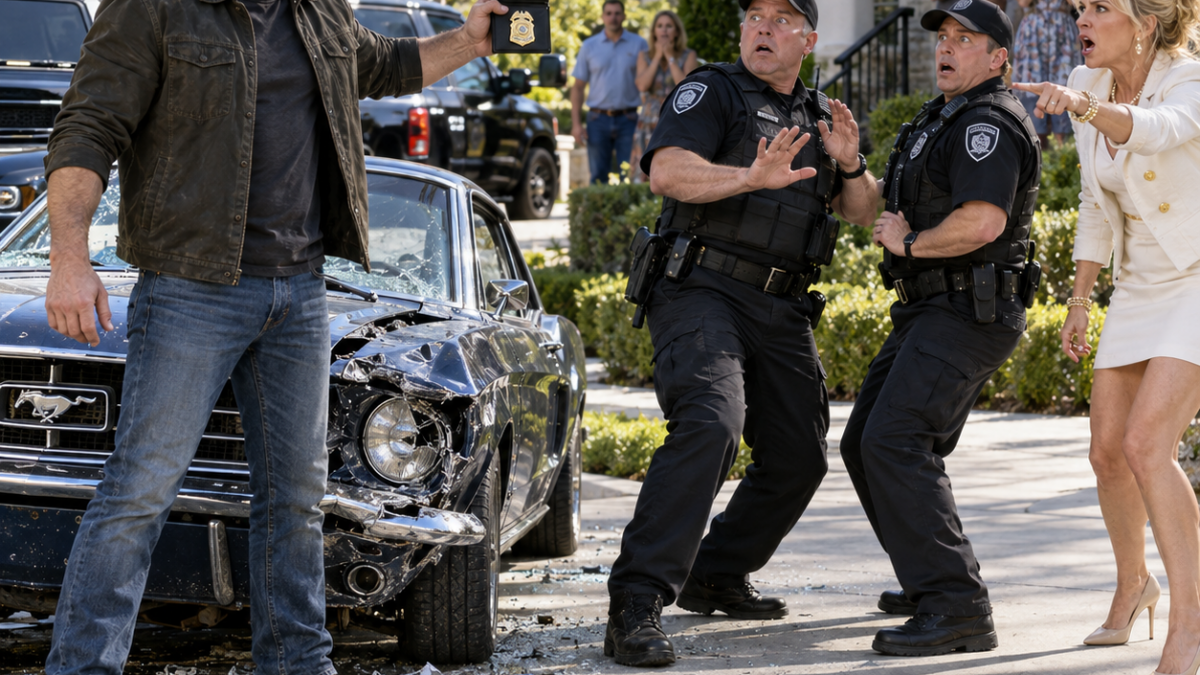
Then I removed my credential wallet.
Opened it.
Held the gold badge beneath the lights.
“My name is Aaron Evans.”
Silence.
“Special Agent, Federal Bureau of Investigation.”
The room changed.
Not gradually.
Immediately.
Simmons’s hand dropped.
The aggression left his face.
Jacob Torres stared at me.
His complexion drained.
“No.”
I lowered the badge.
“Yes.”
Someone whispered:
“FBI?”
I turned toward the residents.
“For the past several weeks, Mr. Torres and Mr. Simmons have treated me exactly the way they believed they could treat any ordinary resident.”
Simmons backed away slightly.
“Six days ago, Oakwood Security broke into my locked garage.”
I connected my phone to the projector.
Torres’s slide disappeared.
The garage footage appeared.
Bolt cutters.
Broken lock.
Mustang.
Chain.
Residents watched.
Then Simmons’s voice came through the speakers.
There she is. Beautiful. This one is going to fetch a nice price at auction.
People began murmuring.
Then the towing operator:
It’s in gear. Parking brake’s on.
Simmons:
Then drag it. I don’t care if you have to rip the transmission out.
The metal scream filled the room.
Emma put both hands over her mouth.
William closed his eyes.
Gerald stared directly at Simmons.
Torres stepped toward me.
“Turn that off.”
“No.”
“You have no right—”
“It happened on my property.”
“This is selective editing.”
I switched screens.
Corporate records.
Oakwood Towing.
Auction company.
Dealership.
Ownership connections.
More than two hundred vehicle seizures.
Preliminary financial flow approaching $1.8 million.
Torres stared.
“What is this?”
“A federal financial investigation.”
The room erupted.
He raised his voice.
“This is illegal!”
Then I played our phone call.
His voice filled the community hall.
Let’s call it five thousand.
My voice:
Five thousand and I get my car back?
Yes.
All violations dismissed?
I’ll personally ensure it.
Then the part that mattered most.
That’s paperwork, Aaron. Paperwork says whatever it needs to say.
Nobody moved.
Torres looked trapped.
“This is entrapment.”
“No.”
“You tricked me.”
“You demanded money to return property your security team had already taken.”
“You called me.”
“After you seized the Mustang.”
Torres pointed at me.
“You’re abusing federal power.”
“The case is being handled by agents who are not me.”
That mattered.
“I am a victim and witness.”
Then I looked toward Simmons.
“The same legal protections applied to me before anyone knew I was FBI.”
His jaw tightened.
The side doors opened.
Four FBI agents entered.
Morrison first.
Keller behind him.
Two sheriff’s deputies followed.
Blue jackets.
Yellow FBI lettering.
Simmons froze.
Torres took one step backward.
Morrison approached the podium.
“Jacob Torres?”
Torres swallowed.
“I want my attorney.”
“You’ll have one.”
Morrison produced the warrant.
“You are under arrest.”
Emma began crying.
Not because Torres was going to jail.
Because somebody had finally believed her.
William stood slowly.
He held up his photograph of the Camaro.
“My wife gave me this.”
Torres looked toward him.
“You sold it while I was having heart surgery.”
Torres said nothing.
William’s voice remained almost gentle.
“You told me rules were rules.”
Another resident shouted:
“You took my daughter’s car!”
Then:
“You charged me two thousand dollars!”
Another:
“You threatened to put a lien on my house!”
Years of private humiliation became public all at once.
Simmons turned toward the side exit.
Keller stepped in front of him.
“Derek Simmons?”
Simmons stopped.
“Hands where I can see them.”
“I was following orders.”
Torres’s head snapped toward him.
“Derek.”
“I was following HOA policy.”
“Stop talking.”
An agent moved behind Simmons.
The cuffs closed.
The man who had spent years wearing restraints as decoration finally wore them for real.
Torres continued protesting.
“I have connections.”
Morrison answered calmly.
“So does the United States Attorney’s Office.”
Gerald met my eyes from across the room.
He didn’t smile.
He simply nodded.
That was enough.
The case had already been made.
The arrests were only the moment Oakwood finally saw it.
Seventy-two hours of searches followed.
Federal agents hit the HOA office.
Torres’s residence.
Oakwood Towing.
Auction facility.
Dealership.
They found more than we expected.
Torres kept a leather-bound ledger.
OPPORTUNITY LIST.
Victims.
Vehicles.
Estimated values.
Vulnerabilities.
Widowed.
Medical debt.
Divorce.
Fixed income.
Unlikely to litigate.
Emma appeared.
William appeared.
Gerald appeared.
My name appeared.
1969 Boss 302. High value. Resistant. Escalate.
I read the word resistant several times.
That was the real offense in Oakwood.
Resistance.
The people who paid quickly remained invisible.
The ones who questioned bills became problems.
The ones who demanded explanations became targets.
Then investigators found emails.
Torres to Simmons:
Auction numbers are low. Need better inventory this month.
Simmons:
Evans Mustang could bring six figures.
Torres:
Push him. Either exemption pays or tow pays.
Another regarding William:
Old man hospitalized. Move before family gets involved.
That one made my stomach turn.
Then financial records.
Hundreds of thousands moved through related entities.
Around $400,000 transferred offshore.
Three HOA employees receiving payments.
Kickbacks.
Side agreements.
False invoices.
Torres had not created bad HOA enforcement.
He had created a criminal business disguised as governance.
Simmons’s personnel history surfaced too.
Previous private-security employer.
Excessive-force incident involving a teenager.
Termination.
Settlement.
Jacob Torres had known.
He hired Simmons anyway.
Aggression wasn’t a liability.
It was useful.
The grand jury heard evidence eight days later.
I testified for three hours.
Emma followed.
Then Gerald.
Rodriguez family.
William.
By the end of day two, indictments were returned.
Torres faced wire-fraud, extortion-conspiracy, theft-related, and racketeering counts arising from the enterprise.
Simmons faced conspiracy, theft, burglary-related conduct, impersonation-related allegations, and other charges tied to the operation.
Other employees were charged according to their roles.
The towing-yard manager faced receiving-stolen-property charges.
Seven people altogether.
More victims appeared every week.
Sixty-three families eventually documented losses.
Some lost cars.
Others paid thousands.
One couple sold their home because they believed Oakwood was untouchable.
Total documented economic damage exceeded $2.3 million.
Prosecutors believed the full impact approached $3 million.
At arraignment, Torres and Simmons pleaded not guilty.
Torres no longer looked like the man who had stood inside my garage explaining how peace could be purchased for five hundred dollars monthly.
He wore jail orange.
No golf shirt.
No HOA pin.
No Mercedes.
Simmons looked even smaller.
The uniform had been most of him.
Without it, he was just another defendant.
Their lawyers tried several strategies.
Everything had been authorized.
Residents had agreed to covenants.
The HOA had broad discretion.
No criminal intent.
The vehicles were legitimately abandoned.
Then prosecutors displayed the actual documents.
No forced-garage-entry authority.
No provision allowing HOA officers to secretly profit from towing.
No right to seize properly stored, legally owned vehicles because they were visually undesirable.
Then the prosecutor played the garage footage.
Again.
I don’t care if you have to rip the transmission out.
Simmons looked down.
Torres stared ahead.
The trial lasted two weeks.
The defense argued I had abused my FBI position.
On cross-examination, Torres’s lawyer stood in front of me.
“You deliberately concealed your employment.”
“I didn’t announce it.”
“You wanted these people to believe you were powerless.”
“I moved there while on leave.”
“You documented every interaction.”
“After they began issuing false violations.”
“You had surveillance cameras.”
“Yes.”
“You researched my client.”
“Using public records.”
“You contacted the FBI.”
“After forced entry, property destruction, and a pattern involving multiple victims.”
“You participated in a controlled call designed to get my client to make incriminating statements.”
“With federal investigators’ authorization.”
He paced.
“You could have stopped this entire situation the first day.”
“Possibly for myself.”
He stopped.
“What does that mean?”
“I could have shown Simmons my FBI badge the first time he approached.”
“Yes.”
“And he might have backed off.”
“Exactly.”
“But Emma Lopez didn’t have an FBI badge.”
The lawyer opened his mouth.
“William Park didn’t have one.”
“Agent Evans—”
“Gerald Lewis didn’t have one.”
The judge warned me to answer only the question.
I did.
“My federal credentials were not what made their conduct wrong.”
The jury heard that.
That mattered.
Emma testified.
She described the RV.
The trip she never took.
The humiliation.
Then William testified.
He held the photograph of his wife standing beside the red Camaro.
The prosecutor asked:
“Why did you keep the vehicle after your wife died?”
William stared at the photograph.
“When I sat in it, I remembered us before we got old.”
The courtroom went silent.
“What happened after Oakwood seized it?”
“They auctioned it.”
“How much?”
“Eleven thousand.”
“Did you receive any proceeds?”
“No.”
“What did Mr. Torres tell you?”
“That I missed the deadline.”
“Where had you been?”
“Hospital.”
“For what?”
“Heart surgery.”
Even Torres’s attorney stopped writing.
Gerald testified with his folder.
Five years of receipts.
Letters.
Photographs.
The defense attorney tried to paint him as obsessed.
“You’re not an accountant, correct?”
“No.”
“Not an attorney?”
“No.”
“Law enforcement?”
“No.”
“So when you believed something criminal was happening, that was speculation.”
Gerald nodded.
“Yes.”
The attorney smiled.
“Thank you.”
Gerald continued:
“That’s why I didn’t throw away the paperwork.”
The smile disappeared.
The prosecution didn’t need a dramatic redirect.
Documents spoke.
The jury deliberated six hours.
Guilty.
Major counts.
Torres closed his eyes.
Simmons stared at the table.
I felt no rush of triumph.
Just exhaustion.
Diana asked if I wanted to attend sentencing.
“No.”
“You sure?”
“I’ve seen enough.”
She called me afterward.
Jacob Torres received fourteen years in federal prison, followed by supervised release, and was ordered to pay substantial restitution.
Derek Simmons received eight years, followed by supervised release, plus restitution.
Other participants received sentences based on their involvement.
The tow-yard manager received a shorter prison term.
The judge wrote that the defendants had exploited their neighbors’ trust, targeted vulnerable residents, and acted for years because they assumed nobody would challenge them.
I read the final sentence three times.
They were wrong.
Then I closed my laptop.
Walked into my garage.
Still empty.
Justice had arrived.
My father’s Mustang was still broken.
That was the part nobody puts in the headline.
Court victories don’t restore paint.
Prison sentences don’t rebuild transmissions.
Restitution doesn’t reverse the moment you watch something irreplaceable dragged across concrete.
Punishment matters.
But repair is a separate process.
The Mustang went to a specialist restoration shop one county over.
Vincent owned it.
Sixty years old.
Former racing mechanic.
Hands permanently stained by decades of engines.
He spent two hours inspecting the car.
Finally he walked toward me.
“Want good news first?”
“Yes.”
“Frame’s solid.”
I exhaled.
“Engine?”
“Untouched.”
“Transmission?”
“Destroyed.”
I nodded.
“Body?”
“Repairable.”
“Paint?”
“Can match the original Highland Red.”
“How long?”
“Four months.”
He ran one hand gently along the damaged fender.
“Someone loved this car.”
“Someone still does.”
Vincent looked at me.
“That’s the answer I wanted.”
“What do you mean?”
“There are cars people want repaired.”
He nodded toward the Mustang.
“And cars people want brought home.”
I left it with him.
Oakwood began changing almost immediately after the arrests.
The old board collapsed.
Members resigned.
Those implicated faced investigation.
A temporary administrator handled community operations until elections could be held.
Oakwood Security disappeared.
White SUVs gone.
Fake light bars gone.
Tactical uniforms gone.
No one parked across from houses photographing residents.
No drones.
No towing crews arriving before sunrise.
People started behaving normally again.
It took me a while to notice.
A teenager worked on an old pickup in his parents’ driveway.
Nobody fined him.
A woman washed an RV at the curb.
Nobody photographed it.
Children drew with chalk near parked cars.
Nobody called it visual pollution.
Freedom rarely looks dramatic.
Sometimes it looks like people becoming boring again.
The victim restitution process started within weeks of sentencing.
Emma received around nine thousand dollars representing the RV’s value and fees.
She bought a smaller camper.
Several months later she mailed me a photograph.
Utah.
Red cliffs.
Emma standing beside the camper.
On the back she wrote:
FINALLY TOOK THE TRIP.
I kept the photograph.
The Rodriguez family received their money back plus compensation.
Their son bought another car.
Found better work.
William received seventeen thousand dollars for the Camaro.
He called me.
“They say that’s fair market value.”
“It probably is.”
“Doesn’t feel fair.”
“No.”
“My granddaughter found another sixty-seven.”
“Same color?”
“Blue.”
“Your wife would approve?”
“She would hate it.”
I laughed.
“Buying it?”
“Yes.”
“Why?”
“So I can imagine her yelling at me.”
Gerald was offered restitution.
He declined part of it.
Asked that the money go to residents who had lost more.
“You don’t need to do that,” I told him.
“I got my truck back.”
“You still lost money.”
“I’m seventy-two.”
“So?”
“So I get to be stubborn with my money.”
Hard to argue with that.
Oakwood held new elections.
Gerald was nominated for HOA president.
He immediately refused.
Emma nominated him again.
“I said no.”
“You kept records for five years.”
“That means I’m good at filing.”
“It means you kept believing someone might listen.”
The residents refused to accept his refusal.
Eventually Gerald agreed under one condition.
“No one person ever controls finances again.”
That became the first reform.
Rotating oversight committee.
Published accounts.
Independent audits.
Vendor disclosures.
Competitive bids.
No incentive-based security enforcement.
No towing from private property without legitimate authority.
No security employee carrying police-style equipment beyond what was actually necessary for ordinary private security.
The bylaws were rewritten.
Gerald’s first meeting as president began awkwardly.
He walked to the podium.
Adjusted the microphone.
“Good evening.”
Someone shouted:
“Don’t steal our cars!”
The room erupted.
Gerald pointed toward Emma.
“I know that was you.”
It was.
People laughed.
That laughter mattered.
For five years, Oakwood meetings had been places residents whispered because Torres could punish disagreement.
Now people joked with the president.
Messy.
Loud.
Healthy.
They asked me to join the board.
“No.”
Gerald frowned.
“You’re FBI.”
“Yes.”
“We could use you.”
“That’s exactly why I shouldn’t.”
“Explain.”
“If Oakwood behaves only because a federal agent sits on the board, you learned nothing.”
Gerald thought about it.
“We need to govern ourselves.”
“Exactly.”
“That sounds terrible.”
“It probably will be.”
He laughed.
I returned to active duty around the same time.
Diana assigned me to a financial-crimes task force closer to home.
No deep undercover work.
At least not then.
I was grateful.
Those eighteen months had taken more out of me than I had wanted to admit.
Oakwood, strangely enough, helped.
Not because of the arrests.
Because residents like Emma and Gerald reminded me what the work was supposed to protect.
Ordinary life.
Retirement trips.
Family cars.
The right to question powerful people without having property taken in retaliation.
I had spent years chasing organized crime in dangerous places.
Then discovered a smaller version operating behind manicured lawns and HOA newsletters.
Different scale.
Same logic.
Fear plus money plus silence.
Vincent called one Thursday afternoon.
“She’s ready.”
I stood immediately.
“When can I come?”
“Now.”
I drove to his shop.
The Mustang sat under fluorescent lights in the center of the garage.
Highland Red.
White stripes.
Chrome polished.
Body straight.
For several seconds, I couldn’t move.
Vincent stood beside it.
“Factory paint match.”
I walked closer.
The damaged bumper was gone.
Taillights restored.
Transmission rebuilt.
Interior detailed.
Every scar Simmons’s team had created was gone.
Vincent held out the keys.
“Start her.”
I opened the driver’s door.
Sat down.
Placed one hand on the steering wheel.
Turned the key.
The V8 came alive.
That sound went through me.
Sunday mornings.
Dad’s garage.
Coffee on his workbench.
His old radio playing.
Him complaining that I never put tools back where they belonged.
My mother shouting from inside that lunch was ready.
Dad answering:
“Five minutes!”
Always five minutes.
Never five minutes.
I closed my eyes.
For months, I had held everything together.
Undercover trauma.
Anger.
Oakwood.
The theft.
The trial.
The Mustang.
That engine sound broke something loose.
I cried.
Vincent looked away.
Gave me privacy without leaving.
After a while, he said:
“Your father?”
I nodded.
“He’d be proud.”
“You didn’t know him.”
“No.”
Vincent smiled.
“But I know men who keep cars fifty years.”
Fair enough.
I drove home on back roads.
No hurry.
The sun was lowering.
The engine sounded exactly the way I remembered.
When I turned onto Oakwood’s main street, Emma was walking near the entrance.
She stopped.
Stared.
Then smiled.
Gerald appeared outside before I reached my driveway.
Apparently the neighborhood had developed its own intelligence network.
I parked in front of the garage.
Shut the engine off.
Gerald approached slowly.
“She’s beautiful.”
“Yeah.”
“Your dad would be proud.”
I looked toward the concrete.
The gouges from the tow chain were still there.
Vincent had asked if I wanted somebody to repair them.
I had not decided.
Now I knew.
They stayed.
Not because I wanted to remember Torres.
Because scars are evidence that something survived.
That evening, Emma came over.
Then William.
Then the Rodriguez family.
Nobody had planned it.
People simply gathered around the Mustang.
William walked around it once.
“Good restoration.”
“You approve?”
“I’m a Chevy man.”
“Then your opinion is irrelevant.”
He laughed.
The sound seemed to surprise him.
Emma touched the fender.
“May I?”
“Of course.”
She ran one hand carefully along the paint.
“You know what’s strange?”
“What?”
“They thought taking our vehicles would make us easier to control.”
William nodded.
“It worked for a while.”
Gerald looked at him.
“Because none of us knew it was happening to everybody else.”
There it was.
The real mechanism.
Isolation.
Torres never confronted Oakwood as a whole.
He confronted one resident.
Then another.
Then another.
Every victim believed their case was unique.
A tire issue.
A registration issue.
A parking problem.
An RV problem.
A classic-car problem.
By separating victims, Torres prevented them from seeing the pattern.
Gerald’s folder connected it.
My case exposed it.
The Bureau proved it.
But the neighbors speaking to one another destroyed the fear.
Weeks later, Oakwood held a barbecue.
I almost skipped it.
My therapist strongly suggested I attend something social that did not involve witness interviews.
Diana agreed.
I suspected conspiracy.
I went.
Gerald burned hamburgers.
Emma complained.
William arrived in his new blue Camaro.
I stared.
“That color is terrible.”
“My wife agrees.”
“She’s dead.”
“Exactly. You see how strongly she feels about it?”
I laughed harder than I expected.
Residents apologized.
Some awkwardly.
One woman approached.
“I believed Torres when he said you were dangerous.”
“I know.”
“I avoided you.”
“I noticed.”
“I’m sorry.”
I nodded.
“Thank you.”
She looked surprised.
“You’re not angry?”
“I was.”
“And now?”
“I’m tired.”
She smiled.
“I understand.”
Not every apology needs a dramatic reconciliation.
Sometimes acknowledgment is enough.
Oakwood eventually became ordinary.
Board meetings about landscaping.
Pool maintenance.
Snow removal.
One meeting spent forty minutes debating mailbox finishes.
I nearly applauded.
Gerald served two terms.
Emma later joined the board.
Financial reports went online.
Vendor ownership disclosed.
Residents challenged decisions openly.
Sometimes the board won.
Sometimes homeowners did.
Nobody was targeted afterward.
That was the measure of improvement.
William occasionally drove the blue Camaro to my house.
We would sit in the garage and complain about each other’s cars.
He once said:
“Your Mustang is too loud.”
“You’re driving a Camaro.”
“Yes, but mine is tastefully loud.”
“Your wife bought the original red one.”
“She had excellent taste.”
“She’d hate the blue.”
“She already does.”
The grief in him never disappeared.
Neither did mine.
But it changed.
Pain can become something you carry instead of something that carries you.
The Mustang helped.
Years later, somebody asked me why I had hidden the fact that I was FBI.
The popular version of the story made it sound strategic from the beginning.
Federal agent secretly tests corrupt HOA.
That wasn’t true.
I did not move there looking for a case.
I moved there because I was exhausted.
I wanted silence.
When Simmons first approached, I kept my credentials hidden because I wanted to be treated like a normal resident.
That decision became useful later.
But it wasn’t a trap.
Torres and Simmons trapped themselves.
Every false violation was their choice.
Every surveillance pass.
Every threat.
Every tow.
Every stolen vehicle.
Every fee.
Every email.
Every order.
Every time they saw someone vulnerable and decided vulnerability meant opportunity.
My FBI badge didn’t make those actions illegal.
They already were.
The badge only created the moment when Simmons realized the man he had been intimidating for weeks understood exactly how evidence worked.
That was why he froze.
Not because FBI agents are magical.
Because he suddenly understood everything he had done might already be documented.
And it was.
Diana visited one afternoon.
She stood in my garage staring at the Mustang.
“Nice.”
“Nice?”
“I’m not a car person.”
“You may leave.”
She smiled.
Then looked at the gouges in the concrete.
“You kept them.”
“Yes.”
“Why?”
“Reminder.”
“Of Torres?”
“No.”
“What?”
I thought about it.
“That damaged isn’t the same as destroyed.”
She nodded.
“Therapy working?”
“Don’t ruin the moment.”
She laughed.
We sat on the porch.
After a while, Diana said:
“You know Oakwood isn’t why we moved you away from long-term undercover.”
“I know.”
“You were disappearing.”
I looked at her.
“Into what?”
“Whoever you needed to be for the operation.”
That was fair.
“You need ordinary things, Aaron.”
I looked toward the Mustang.
“Like HOA crimes?”
“Not what I meant.”
“Classic cars?”
“Closer.”
I smiled.
For the first time, I understood why Oakwood had affected me so deeply.
My undercover life had been built around pretending.
Fake identities.
Fake relationships.
Fake motives.
Then I moved into a neighborhood where private guards dressed like police and an HOA president dressed extortion like governance.
More costumes.
I had wanted reality.
Dad’s Mustang was reality.
Metal.
Memory.
History.
No role.
No cover name.
No operation.
Just something that belonged to my real life.
That was why watching them destroy it felt worse than the property value suggested.
They had attacked the one thing I used to remember who I was when I wasn’t an agent.
My father had given me that.
And eventually, restoring the Mustang helped restore something else too.
I began driving it more.
Not every day.
Dad would haunt me if I used it for grocery parking lots.
But Sunday mornings.
Mountain roads.
Sometimes no destination.
At first, every mile made me anxious.
What if somebody damaged it again?
What if something broke?
Then I realized protecting something by never using it is another form of losing it.
Dad didn’t buy a Boss 302 to turn it into furniture.
So I drove.
One Sunday, I stopped at an overlook.
Turned off the engine.
Pulled our old photograph from the glove compartment.
Dad and me.
His hand on my shoulder.
I remembered the day he signed the title.
“You sure?” I had asked.
“No.”
I laughed.
“Then why?”
“Your mother says I’m too old to drive like an idiot.”
“She’s right.”
He pointed at me.
“Careful.”
Then he put the keys in my hand.
“Take care of her.”
For months after the tow, that promise felt broken.
At the overlook, years later, I finally understood something.
Taking care of something doesn’t mean preventing every bad thing from happening.
Nobody can promise that.
Taking care means showing up afterward.
Recovering what can be recovered.
Repairing what can be repaired.
Refusing to let somebody else’s cruelty define the final condition.
Maybe that applies to people as much as cars.
I looked at Dad’s photograph.
“Still running.”
Then started the Mustang.
The sound rolled across the mountains.
Eventually Oakwood organized a neighborhood car show.
The irony was so perfect I had to attend.
William brought his blue Camaro.
Rodriguez family brought a restored pickup.
My Mustang sat beneath a small information card.
No FBI reference.
No Torres.
No crime story.
Just:
1969 FORD MUSTANG BOSS 302
Originally owned by SFC William Evans
Vietnam Veteran — Two Tours
Family-owned since 1970
That was enough.
A nine-year-old boy stared under the hood.
“Is it fast?”
“Very.”
“My dad says electric cars are faster.”
“Your dad sounds disrespectful.”
The boy laughed.
“Can I sit in it?”
My first instinct was no.
Then I remembered being his age.
“Don’t touch the shifter.”
He climbed inside.
Held the steering wheel.
His face changed.
Pure wonder.
Dad used to let neighborhood kids sit in the Mustang too.
I had forgotten.
Watching that boy, I realized the car didn’t have to remain only a memorial.
It could still create memories.
That was better.
At sunset, I drove home.
Oakwood’s streets were quiet.
A man was packing an RV for vacation.
Nobody fined him.
Someone was repairing an old truck in the driveway.
No security patrol.
No photographs.
A teenager was washing a car at the curb.
Ordinary life.
When I pulled into my garage, the chain gouges remained visible under the Mustang.
A younger relative once asked why I never repaired them.
“Evidence?”
“No.”
“Then why?”
“Because they remind me of something.”
“What?”
I looked at the restored Highland Red body above those scars.
“They damaged it.”
I smiled.
“They didn’t decide how the story ended.”
That became the part of Oakwood I remembered most.
Not the badge reveal.
Not Torres in handcuffs.
Not Simmons frozen beneath the community-center lights.
Not even the guilty verdicts.
The ending happened months later.
Vincent returning my father’s Mustang.
Emma finally taking her trip.
William buying another Camaro because he wanted to hear his wife complain in his imagination.
Gerald standing behind an HOA podium and letting residents joke without fear.
Families parking vehicles on their own property without wondering whether somebody would seize them before morning.
That was victory.
Punishment is necessary sometimes.
But restoration is where justice becomes human.
Jacob Torres spent years believing money and position made him untouchable.
Derek Simmons believed a tactical uniform gave him authority he never earned.
They both misunderstood power.
Real authority has boundaries.
It can be reviewed.
Challenged.
Documented.
Fake authority depends on fear and confusion.
That’s why people like Simmons need the uniform.
The lights.
The cuffs.
The aggressive voice.
The performance.
Without those things, residents might ask the most dangerous question possible:
What gives you the right?
Gerald eventually asked.
Emma asked.
William asked.
I asked.
Torres had no legitimate answer.
So he substituted pressure.
When pressure stopped working, the criminal structure became visible.
On my final evening before returning fully to active federal duty, I sat in the Mustang inside the garage.
Door open.
Dad’s photograph on the workbench.
The neighborhood quiet beyond the driveway.
No surveillance.
No security SUV.
No tow truck.
I placed my hands on the steering wheel.
The same wheel Dad had held after Vietnam.
The same wheel I held as a teenager.
The same wheel that remained after Simmons’s men dragged the Mustang across concrete trying to make me surrender.
I turned the key.
The V8 fired.
The sound filled the garage.
Deep.
Steady.
Alive.
I closed my eyes.
For one moment, I was back in my childhood.
Dad beside me.
Sunday morning.
Grease on our hands.
The world simpler than it would ever be again.
He had told me to take care of her.
I had thought I failed.
I hadn’t.
The car was home.
The men who destroyed it were in prison.
The residents they had terrorized had their voices back.
Oakwood finally understood that HOA authority stopped where private rights began.
And those scars in the concrete beneath the Mustang were no longer evidence of what Torres and Simmons had taken.
They were evidence of what they had failed to take.
My father’s memory.
My patience.
My home.
My neighbors’ courage.
The truth.
That was the real mistake they made when they came into my garage believing they were untouchable.
They thought they were stealing a valuable car from one quiet homeowner.
They had no idea they were destroying the last thing my father left me.
They had no idea their entire towing operation was already being documented.
And they definitely had no idea that when I finally walked into that HOA meeting, reached inside my jacket, and opened my FBI credentials, the federal case against them was already strong enough that the badge itself barely mattered.
Simmons froze.
Torres went white.
The room fell silent.
But the most important thing had already happened.
Their victims had stopped being alone.
The Mustang eventually came home.
So did the peace I had originally moved to Oakwood looking for.
Not the fragile peace of people too frightened to argue.
Real peace.
The kind that exists because everybody finally understands where power ends.
That night, I let the Mustang idle for a few seconds longer.
Then I shut off the engine.
The garage became quiet.
I looked at my father’s photograph.
“Promise kept.”
And for the first time since the day Oakwood Security dragged his car away, I believed it.
[END OF FULL STORY]








