PART 2: Fake HOA “Cop” Smashed Through My Gate and Attacked My Wife—Then My Shotgun Stopped Him, and the HOA’s Entire Scheme Came Apart
PART 2
Then I mentioned security.
Marcus stopped smiling.
“Was it Garrett?”
“Don’t know his name.”
“Big guy?”
“Yes.”
“Black SUV?”
“Yes.”
Marcus looked toward the street.
“Garrett Wade.”
“You know him?”
“Everybody knows him.”
“What’s his deal?”
Marcus lowered his voice.
“Used to be Houston PD.”
“Used to?”
“Fired.”
“For what?”
His expression hardened.
“Excessive force.”
“Confirmed?”
“That’s what I heard.”
“From?”
“A guy who worked with him.”
“What happened?”
“Woman during a traffic stop.”
I said nothing.
Marcus continued.
“After that, Margaret Sinclair hired him.”
“Who?”
“HOA president.”
I had seen Margaret’s name on newsletters.
“She runs him?”
“She runs everything.”
“Is Garrett licensed?”
Marcus gave me a tired smile.
“You’re the first person I know who’s even asked that.”
He told me Garrett had issued him seven notices over the previous year.
Parking.
Lawn.
Garage.
Trash.
Things that either didn’t exist or were so minor nobody else would have cared.
Marcus complained.
Margaret called him paranoid.
A week later, somebody keyed his car.
Three deep scratches from headlight to taillight.
“Garrett?”
“Couldn’t prove it.”
“Camera?”
“Not then.”
He looked toward our house.
“Be careful.”
“I am.”
“Especially Elena.”
That caught me.
“Why?”
Marcus hesitated.
Then said:
“Men like Garrett don’t like being challenged.”
“I know the type.”
“And they really don’t like women challenging them.”
No drama.
No exaggeration.
Just experience.
I went home and installed two more cameras.
Front approach.
Back entrance.
We already had a doorbell camera.
Now I wanted redundancy.
Old habits.
I had spent years learning that the event you fail to record is usually the event everyone argues about later.
Three days after Elena’s first encounter, the HOA emailed.
**VIOLATION NOTICE.**
My truck had been parked “in a manner inconsistent with community aesthetic standards.”
Fine:
$150.
I reread the message.
My truck had been parked in my driveway.
Centered.
Facing the street.
No oil leak.
No damage.
No commercial logos.
Nothing.
At the bottom:
**Garrett Wade
Security Enforcement Officer**
I pulled up the covenants.
No rule matched his accusation.
I photographed the truck.
Recorded the position.
Saved the email.
Then I looked outside.
The black SUV was parked at the corner.
Engine off.
Garrett inside.
Watching.
He stayed until dark.
That was the moment I stopped calling this enforcement.
It was attention.
Focused attention.
The notices multiplied.
Trash container supposedly placed at the curb two minutes too early.
$100.
Grass allegedly one-quarter inch above community standard.
$150.
A garden gnome Elena’s late grandmother had given her was suddenly an “unauthorized decorative object.”
$200.
Elena held the notice in disbelief.
“They’re fining Grandma.”
“Technically the gnome.”
“She would haunt him.”
“That might be our cheapest option.”
She smiled.
But the smile didn’t last.
The thing that bothered me wasn’t the money.
It was how quickly Garrett noticed everything.
The gnome had been outside for only a few hours.
Someone was watching closely.
Every notice bore Garrett’s signature.
I created a digital folder.
**CYPRESS GROVE — WADE.**
Subfolders:
Violations.
Video.
Emails.
Photos.
Licensing.
Contacts.
Timeline.
If nothing happened, I would feel foolish.
I hoped to feel foolish.
Saturday afternoon, I was trimming hedges when the black SUV rolled up.
Garrett parked.
Got out.
No greeting.
He walked to the sidewalk and watched me.
I kept trimming.
Finally:
“You need to come with me.”
I shut off the trimmer.
“Where?”
“HOA office.”
“Why?”
“We need to discuss your violations.”
“Schedule a meeting.”
“You need to come now.”
I put the trimmer down.
“Do you have authority to arrest me?”
His jaw shifted.
“I have HOA enforcement authority.”
“That wasn’t my question.”
He stepped off the sidewalk.
Onto my driveway.
“Stop.”
He kept walking.
“This is private property. You don’t have permission.”
Garrett stopped about ten feet away.
Then smiled.
“I have inspection authority.”
“Show me.”
“It’s in the governing documents.”
“Which section?”
“You’re being difficult.”
“No. I’m asking for the rule.”
He hooked his thumbs into his belt.
There was no gun.
Radio.
Flashlight.
Utility pouch.
Badge.
Costume authority.
“I don’t need to explain my job to you.”
“You do if your job involves entering my property.”
“I can make things difficult for you here.”
The cameras were capturing everything.
I pointed toward one.
“Good.”
His eyes followed my finger.
“What?”
“My cameras recorded you entering after I told you to stop.”
His smile disappeared.
“Are you threatening me?”
“No.”
“Sounds like it.”
“Criminal trespass complaints are easier when the video has sound.”
He stared.
I stared back.
Then he stepped off the driveway.
“This isn’t over.”
“I know.”
That was the first time I saw real anger in his face.
Not professional irritation.
Personal anger.
He drove away slowly.
That evening, Elena told me Garrett’s SUV had passed the house four times while I was out buying supplies.
First pass:
Slow.
Second:
Stopped thirty seconds.
Third:
Drove past normally.
Fourth:
Parked at the curb.
She had been in the kitchen.
She turned.
He was looking directly through the window toward her.
“How long?”
“I don’t know.”
“Seconds?”
“Maybe thirty.”
“Did he get out?”
“No.”
“Did you record it?”
“Camera did.”
Her hands were around a coffee mug.
Both hands.
Tight.
“Elena.”
“I’m okay.”
“I know.”
“I deal with angry parents every week. I deal with sick children. I’ve had people scream at me in emergency rooms.”
“I know.”
“This is different.”
“How?”
She looked toward the window.
“He looks at me like I’m something he’s waiting to get alone.”
That moved the problem into a different category.
Monday morning, I requested Garrett’s public employment records from Houston PD.
Then I emailed the HOA board.
Formal complaint.
Request for meeting.
Margaret Sinclair responded in three sentences.
**Mr. Wade is a licensed security professional whose credentials have been verified by the board.**
**All enforcement complaints must follow proper association channels.**
**Continued harassment of HOA personnel may result in sanctions.**
Licensed.
I checked the database again.
Nothing.
Either Margaret had seen credentials I couldn’t find.
Or she was lying.
Marcus wasn’t surprised.
We stood in his garage that evening.
He told me something else.
“Margaret’s son owns the security company.”
I stared.
“Say that again.”
“Brian Sinclair.”
“Her son?”
“Yes.”
“Cypress Grove Security Services?”
“Yes.”
“How much is the contract?”
Marcus shook his head.
“I’ve heard fifteen grand a month.”
“For one guard?”
“One guard.”
The county already patrolled regularly.
We were paying additional HOA money—apparently close to $180,000 a year—for one unlicensed man with a fake-looking badge to stare through residents’ windows.
Now the shape of the problem was changing.
I spent that night reviewing a week of camera footage.
Garrett’s SUV appeared eleven times on one day.
Eleven.
Morning.
Noon.
Late afternoon.
Night.
One recording showed the SUV stopping at the corner for nearly ten minutes with the headlights off.
Not patrol.
Surveillance.
I contacted Victoria Reyes the next morning.
Civil-rights and HOA attorney.
She had the reputation of a person you hired after politeness failed.
Her office was downtown.
I placed everything across her conference table.
She read.
Watched footage.
Checked the licensing search.
Reviewed Margaret’s email.
Listened to Marcus’s account.
Then she said:
“You’re not overreacting.”
I hadn’t realized how badly I needed to hear that.
“What do you see?”
“Harassment.”
She tapped the surveillance logs.
“Potential stalking if the pattern continues.”
Another tap.
“Possible unlicensed security operation.”
Then Margaret’s email.
“And an HOA board that may be knowingly misrepresenting his status.”
“What do we do?”
“Cease-and-desist first.”
“That stops him?”
“No.”
“Then why?”
“Because later nobody can say they didn’t know.”
She drafted it.
Garrett Wade.
Cypress Grove Security Services.
HOA board.
All unnecessary direct contact with our family to cease.
No entry on property.
No surveillance beyond legitimate community functions.
Future disputes routed through counsel.
Evidence preserved.
Licensing status questioned.
HPD records requested.
Delivered Thursday.
Friday morning, Garrett parked directly in front of our house.
Engine idling.
For forty minutes.
Elena called me from inside.
“He’s here.”
I checked remote cameras.
There he was.
Not even pretending.
I called the sheriff’s non-emergency line.
Deputy James Hartley responded.
He spoke to Garrett.
Garrett left.
Later, Hartley called me.
“I’m going to speak plainly.”
“Please.”
“Wade is known.”
“How known?”
“Multiple calls.”
“Why isn’t he arrested?”
“Because being an asshole isn’t illegal.”
“Stalking?”
“We need threshold evidence.”
“He’s sitting outside my house after written notice.”
“I documented today.”
“What else?”
“Keep recording.”
I asked the question I had been avoiding.
“What if he enters?”
Hartley paused.
“Your home?”
“Yes.”
“Unlawfully?”
“Yes.”
“With apparent intent to hurt Elena?”
His voice became more careful.
“You have strong protections in your own residence.”
I knew Texas self-defense law.
He wasn’t telling me anything new.
But hearing a deputy acknowledge the danger made it feel more real.
Hartley continued.
“What matters is everything before that moment.”
“What do you mean?”
“Your warnings.”
“Documented.”
“Attempts to stop contact peacefully.”
“Documented.”
“Cameras.”
“Yes.”
“Good.”
Then:
“Don’t give him anything.”
“I won’t.”
Victoria’s investigator returned a report Monday.
Brian Sinclair had formed Cypress Grove Security Services two months after Margaret became HOA president.
One employee.
Garrett Wade.
One client.
Cypress Grove Estates.
Monthly payment:
$15,000.
Nearly $200,000 annually with extras.
Then the complaint file.
Three written complaints in eighteen months.
All personally dismissed by Margaret.
One complainant was Helen Kelly.
She lived across the neighborhood.
I visited her.
She opened the door only a few inches at first.
When I explained why I was there, she stared at me.
Then let me inside.
Her experience was worse.
Garrett first confronted her over her elderly mother’s visiting car.
After Helen challenged him, he began appearing elsewhere.
Mailbox.
Grocery store.
Restaurant.
She described seeing him at the bar watching her eat with a friend.
When she noticed him, he left.
Then came messages from an unknown number.
Not direct threats.
Worse.
Observations.
**Home late tonight.**
**Living room light still on?**
**You look tired.**
She showed me screenshots.
My stomach turned.
“Did you report this?”
“Yes.”
“To Margaret?”
“Yes.”
“What did she say?”
“That I was being dramatic.”
“Police?”
“I was afraid they’d say the same thing.”
“Will you testify?”
Helen looked toward the window.
For a long time, no answer.
Then:
“Yes.”
“Sure?”
“I’ve spent six months wondering if I imagined it.”
“You didn’t.”
“I know that now.”
That night, Elena and I sat in the kitchen long after dinner.
No television.
No distractions.
I told her everything.
Garrett’s history.
The complaints.
Helen.
The surveillance.
Margaret’s connection.
I expected Elena to tell me she wanted to leave.
She didn’t.
“I’ve been scared since the first day.”
“I know.”
“No. I mean really scared.”
I reached across the table.
She continued.
“But scared isn’t helpless.”
“No.”
“I grew up around guns.”
“I know.”
“I’ve trained.”
“I know.”
“If something happens, I’m not going to freeze.”
I looked at my wife.
Strong.
Tired.
Angry.
Afraid.
All can exist together.
“I don’t want you proving anything.”
“I’m not.”
“We leave if we need to.”
“This is our home.”
“A home isn’t worth you getting hurt.”
She squeezed my hand.
“Neither is surrendering every time someone dangerous decides we should.”
I installed another camera.
Living room.
Wide view of the entrance.
Redundancy.
Tuesday afternoon, I was forty-five minutes away at a client meeting.
My phone buzzed.
Text from Elena.
**He’s here.**
I stood before my brain caught up.
Called.
She answered in a whisper.
“Front door.”
“What’s he doing?”
“Knocking.”
“Why?”
“Says gas leak.”
“What?”
“He says someone reported gas and he needs to inspect.”
“Do you smell gas?”
“No.”
“Do not open the door.”
“I’m not.”
“Call 911 if he tries to enter.”
“I will.”
I left the building at a run.
The drive normally took forty-five minutes.
Seven minutes later, Elena called again.
Breathing faster.
“He moved.”
“Where?”
“Backyard.”
My grip tightened on the wheel.
“What’s he doing?”
“Gate.”
Then I heard rattling through the phone.
Metal.
Wood.
“Elena, move away.”
A heavy impact.
Crack.
She stopped speaking.
Another impact.
Then wood splintering.
“Elena?”
Glass shattered.
I heard her yell.
Then the line stayed open but no voice came through.
I drove faster than I should have.
Those eighteen minutes lasted years.
When I reached our street, my body was operating before thought.
Gate:
Down.
Not unlocked.
Not opened.
Ripped away.
Back door:
Glass shattered.
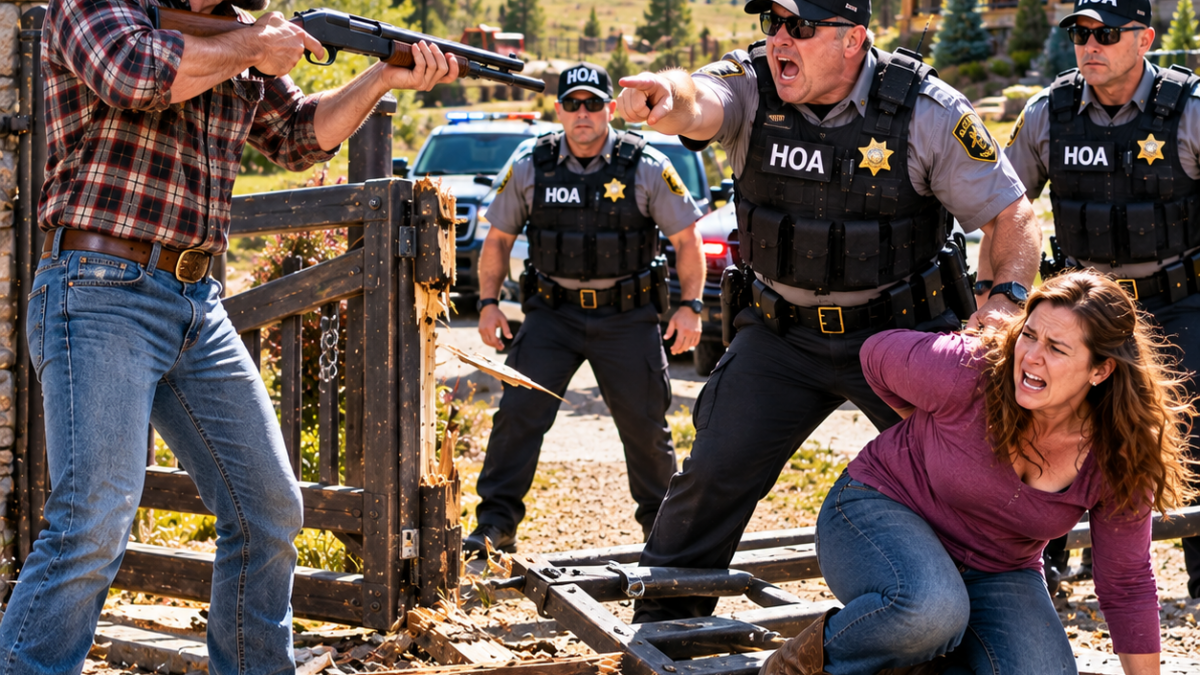
I retrieved the shotgun from its secured place in the truck.
Entered.
The living room appeared in fragments.
Elena against the couch.
Trying to stand.
Split lip.
Swollen cheek.
Left wrist held close.
Garrett ten feet away.
Turning.
He saw me.
Saw the gun.
His expression changed.
I aimed center mass.
Finger straight alongside the trigger guard.
“Don’t move.”
He raised one hand.
“Put the weapon down.”
“No.”
“I’m law enforcement.”
“No, you’re not.”
“I’m conducting a welfare check.”
“You broke into my house.”
“There was an emergency.”
“You hit my wife.”
“She assaulted me.”
Elena said:
“You broke my door.”
Her voice shook.
Garrett glanced at her.
I moved slightly.
“Eyes on me.”
He looked back.
That moment is still clear in my mind.
The law gave me broad rights to protect my wife and home.
Garrett had made violent entry.
Elena was visibly injured.
I had every reason to believe he had harmed her.
But circumstances change by the second.
He was now facing me.
Hands visible.
Not advancing.
Not reaching.
I could fire.
But could and should are not the same word.
War teaches that quickly.
Self-defense is about stopping danger.
Revenge is what happens after danger is controlled.
I wasn’t going to confuse them.
“Down.”
Garrett hesitated.
“Face down.”
He stared at me.
I racked the shotgun.
The sound settled the argument.
He went to the floor.
“Hands where I can see them.”
Elena had gotten the 911 call connected during the struggle.
Garrett had knocked the phone away.
The dispatcher heard enough.
Sirens arrived.
I heard boots outside.
“Homeowner armed!” I shouted.
“I’m setting it down!”
I placed the shotgun on the floor and stepped away with empty hands raised.
Deputies entered.
Garrett was arrested.
Paramedics reached Elena.
Only when they touched her did the adrenaline leave me.
I started shaking.
Not from Garrett.
From seeing Elena.
They took her to the hospital.
Concussion.
Facial contusions.
Hairline fracture in her wrist from falling.
No life-threatening injuries.
I repeated that to myself until it almost sounded believable as comfort.
Hartley arrived.
I showed him the video.
Every angle.
Garrett at the front door.
False gas-leak claim.
Moving around the house.
Breaking the gate.
Smashing the back door.
Elena backing away.
Garrett entering.
Physical struggle.
Her falling.
Me arriving.
The shotgun.
The commands.
Garrett going down.
Hartley watched silently.
Then:
“You did exactly what you needed to do.”
“I almost shot him.”
“But you didn’t.”
“I could have.”
“Yes.”
“That bothers me.”
“It should.”
I looked at him.
He continued.
“The day it stops bothering you is the day I’d worry.”
Garrett was charged that night.
Burglary of a habitation.
Assault causing bodily injury.
Criminal trespass.
Other potential charges under review.
I sat beside Elena in the hospital.
She was asleep after the CT scan.
Purple already forming along her cheek.
Wrist braced.
I felt rage in waves.
At Garrett.
At Margaret.
At Brian.
At every complaint dismissed.
At every person who decided it was easier to call residents dramatic than investigate the man they were paying to intimidate them.
Victoria called at nine.
“I saw the report.”
“Elena’s okay.”
“How okay?”
“Concussion. Wrist fracture.”
“I’m sorry.”
I said nothing.
Then Victoria said:
“This just became much bigger.”
“He attacked my wife. How much bigger does it need to be?”
“I mean legally.”
She softened her voice.
“Garrett is the weapon. I want the people who aimed him.”
That was when the second half began.
Elena came home two days later.
Plywood covered the broken door.
Temporary fencing replaced the gate.
She hated the way it looked.
I didn’t care.
Neither of us slept properly.
Elena woke suddenly at two.
Then four.
Sometimes from dreams.
Sometimes from nothing.
I checked cameras too often.
If headlights moved across the ceiling, my body woke before my mind.
We barely discussed the attack.
There are experiences too large to process while you’re still living inside them.
Garrett’s bail was set at $75,000.
Then something happened that changed Victoria’s expression when she called.
“Guess who posted it.”
“Family?”
“Cypress Grove Security Services.”
“Brian?”
“His company.”
I sat down.
The company was paying to release the employee who had committed a violent felony while supposedly performing work connected to the neighborhood.
Victoria said:
“That’s not proof of liability by itself.”
“But?”
“It tells me where loyalties are.”
Local news picked up the story.
We refused interviews.
Garrett’s face appeared anyway.
Former officer.
HOA security.
Home invasion.
Homeowner assaulted.
The phone started ringing.
Helen called first.
“I’ll testify publicly.”
Then David Henderson.
His seventeen-year-old daughter had been cornered by Garrett while parking.
He stood too close.
Wouldn’t let her leave easily.
Told her a “pretty girl” should be more respectful to authority.
She stopped driving alone for months.
Then Sarah Nguyen.
She and her wife returned from vacation and found the backyard gate open.
Furniture shifted.
Cigarette butts near the patio.
Neighbor saw Garrett’s SUV there.
Complaint filed.
Margaret dismissed it.
Victim after victim.
Twelve formal complaints.
Eighteen months.
Every one buried or rejected.
Then the money.
Discovery exposed the structure.
Brian Sinclair’s company:
$15,000 monthly.
Then:
$5,000 monthly transferred to Margaret’s personal account.
**CONSULTING FEES.**
Sixty thousand a year.
The HOA president had approved a lucrative contract with her son’s company.
Then money flowed back to her.
She dismissed complaints against the only employee whose intimidation helped justify that contract.
Victoria placed the bank records in front of me.
“This is why he stayed.”
I stared.
“They were making money.”
“Yes.”
“Off fear.”
“Yes.”
“Did the board know?”
“We’ll find out.”
The civil complaint named:
Garrett Wade.
Cypress Grove Security Services.
Brian Sinclair.
Margaret Sinclair.
Cypress Grove HOA.
Claims included assault, battery, negligent hiring, negligent supervision, conspiracy-related claims, intentional infliction of emotional distress, and other civil theories Victoria believed the evidence supported.
Demand:
$2.5 million.
I told her:
“I don’t care about becoming rich.”
“I know.”
“Then why that number?”
“Because this isn’t a broken window case.”
She pointed toward Elena’s medical records.
“It’s years of ignored risk culminating in exactly the type of harm those complaints warned about.”
Three days later, Garrett started talking.
Against his lawyer’s advice.
He said Margaret told him to “handle the Callahan situation.”
That Elena and I were causing trouble.
That we needed to be made uncomfortable enough to move.
Bonus if we sold within six months.
At first I thought Garrett was shifting blame to save himself.
He was.
But that doesn’t make the information false.
Then discovery produced his employment file.
Houston PD termination.
Excessive force.
Female motorist.
The report was attached.
And there was an acknowledgment.
Signed by Margaret Sinclair.
She had reviewed it before Garrett was hired.
She knew.
Not rumor.
Not “someone should have checked.”
Her signature.
Victoria tapped it.
“This document is devastating.”
“Because she knew?”
“Because she later told residents she didn’t.”
The annual HOA meeting was scheduled the following week.
Two hundred homeowners.
Margaret would be there.
Brian would be there.
Elena insisted on attending.
“No.”
“Yes.”
“You’re still healing.”
“My wrist is healing.”
“Your head—”
“Is attached.”
“Elena.”
She took my hand.
“I’m not hiding in my own house while they tell everyone what happened to me.”
I couldn’t argue with that.
The Cypress Grove Community Center was packed.
Over two hundred residents.
People standing along walls.
Local television camera near the back.
Deputy Hartley attended.
Officially for community safety.
Margaret sat at the board table.
Navy blazer.
Pearls.
Controlled expression.
Brian sat beside her.
He looked less composed.
Margaret rushed through routine business.
Budget.
Landscaping.
Holiday decorations.
Pool maintenance.
Then:
“Motion to adjourn.”
I stood.
“Homeowner comment period.”
She stared.
“We’re out of time.”
Victoria stood beside me.
“The bylaws guarantee comment.”
Margaret’s face tightened.
“Five minutes.”
I connected my laptop.
First slide:
**TWELVE COMPLAINTS.**
Names removed where appropriate.
Dates.
Nature of concern.
Every complaint closed by Margaret.
“Three weeks ago, Garrett Wade broke into my home and assaulted my wife.”
Room silent.
“He is facing felony charges.”
People knew that.
“What many of you don’t know is that his conduct did not begin at our house.”
Next slide.
Garrett’s employment history.
HPD termination.
Excessive force.
Then Margaret’s signed acknowledgment.
She had reviewed it.
Murmurs.
Margaret leaned toward her microphone.
“This is being taken out of context.”
I continued.
Next:
Security contract.
$15,000 monthly.
Brian’s company.
One employee.
Then:
Monthly $5,000 payments to Margaret.
Consulting.
The room erupted.
“What?”
“Five thousand a month?”
“Our dues?”
“Are you serious?”
Hartley started writing.
Helen Kelly stood.
Her hands shook.
“I complained six months ago.”
The room quieted.
She looked directly at Margaret.
“I told you Garrett followed me.”
Margaret opened her mouth.
Helen continued.
“You told me I was dramatic.”
She described the grocery store.
Restaurant.
Texts.
Not every detail.
Enough.
Marcus stood.
“Seven violation notices after I complained.”
Then:
“My car was keyed.”
David Henderson stood.
“My daughter was seventeen.”
His voice broke.
“She was afraid to drive.”
Sarah spoke.
Backyard intrusion.
Garrett’s SUV.
Dismissed complaint.
One story can be doubted.
Twelve becomes a system.
Margaret stood.
“This is defamatory.”
Victoria responded:
“These are documented complaints.”
“I did not know his full employment history.”
I changed the screen.
Her signature.
Every page.
Margaret stared.
Then turned toward Brian.
He looked at the floor.
“What about the consulting fees?”
Someone shouted.
Margaret’s composure cracked.
“I worked for that money.”
“What work?”
Another resident.
“You were already HOA president!”
Another:
“You paid your son!”
“Then your son paid you!”
The room turned from disbelief to fury.
Margaret raised her hands.
“I protected this community for eight years!”
That sentence did not help.
Someone called:
“From who?”
Another:
“From us?”
A motion came from the crowd.
“Remove the board.”
Seconded immediately.
Thirded.
Margaret objected.
“Not procedurally valid.”
Victoria opened the bylaws.
“It is.”
Emergency removal.
Quorum.
Vote.
The result was overwhelming.
Margaret removed.
Brian removed.
Two remaining allies removed.
Less than one minute.
Eight years of control ended faster than a coffee break.
Hartley stepped forward.
Professional.
Calm.
He informed Margaret and Brian that the district attorney’s office would be contacting them regarding the financial records.
Not arrest.
Not yet.
But the room understood.
Outside, Brian approached Victoria.
They spoke privately.
When she returned:
“He wants to cooperate.”
“Against his mother?”
“Yes.”
“That was fast.”
“People become practical when prison enters the conversation.”
“What does he have?”
“Everything.”
Brian had kept records.
Emails.
Transfers.
Instructions.
Probably because he never fully trusted Margaret.
Maybe because he wanted insurance.
Now that insurance became evidence.
Elena and I walked toward our car.
She squeezed my hand.
“Is it over?”
“No.”
“I knew you’d say that.”
“But tonight mattered.”
She looked back at the community center.
People were still standing in groups.
Talking.
For years, Margaret’s greatest advantage had been isolation.
Every victim thought they were the only one.
Now the stories were in one room.
That changes power.
Six weeks later, the grand jury convened.
Brian cooperated.
According to the evidence summaries, Margaret hadn’t merely tolerated Garrett’s violent past.
She liked it.
Brian quoted her.
A man willing to use force could “keep residents compliant.”
When complaints came in:
Dismiss.
When homeowners challenged fines:
Increase pressure.
When Elena and I hired Victoria:
Margaret identified us as threats.
Then came the email.
Three days before the attack.
**Make sure Garrett handles the Callahan situation. Whatever it takes.**
Whatever it takes.
Four ordinary words.
Garrett testified too.
He claimed he only intended to intimidate Elena.
The prosecutor reportedly asked whether breaking a gate, shattering a door, entering a home, and striking a woman were consistent with intimidation remaining “under control.”
He had no answer.
Garrett eventually agreed to plead to serious felony charges.
Margaret’s defense attempted distance.
Brian misled her.
Garrett acted independently.
The board trusted professionals.
But every path returned to her signature.
Employment acknowledgment.
Complaint dismissals.
Contract approval.
Money.
Emails.
The sentencing hearing happened on a gray Thursday in February.
Elena’s wrist had healed.
Mostly.
Cold weather still bothered it.
Her cheek had healed physically.
The nightmares took longer.
When Elena walked to the podium, I expected her to talk about the attack.
She didn’t.
She talked about the aftermath.
“The first week I came home, I couldn’t stand with my back to a window.”
Her voice was calm.
“I stopped taking showers when my husband wasn’t home because I was afraid I wouldn’t hear someone come in.”
The courtroom was silent.
“I knew that fear was irrational sometimes.”
She looked toward Garrett.
“But trauma doesn’t ask permission to make sense.”
She talked about waking at night.
Avoiding the backyard.
Flinching at black SUVs.
Then she said:
“I started running again last month.”
I looked at her.
She had not told me she planned to include that.
“The first time, I made it six houses before I turned around.”
A faint smile.
“Last week I ran three miles.”
Her voice grew stronger.
“I’m not here because I want anyone to see me as what happened to me.”
She looked at the judge.
“I’m here because what happened mattered. What the people who ignored the warnings did mattered. And recovery matters too.”
Helen spoke.
She no longer changed her route to work.
No longer checked restaurant windows for Garrett.
Marcus said his family had considered selling.
They stayed.
David Henderson thanked the court for hearing his daughter when the HOA would not.
Then sentences.
Garrett Wade:
Twelve years in state prison for felony assault and burglary-related offenses under the negotiated resolution.
Margaret Sinclair:
Five years tied to the fraud, conspiracy, and conduct established through the investigation, along with substantial restitution.
Brian:
Probation.
Restitution.
Permanent professional restrictions connected to the corporate arrangement.
His cooperation spared him prison.
It did not spare his name.
Two weeks later came the civil settlement.
Insurance.
Liquidated assets.
Negotiation.
Total:
$1.8 million.
Our portion:
$650,000.
Other victims received shares based on their claims.
People assume money feels like victory.
It doesn’t.
Money pays bills.
Lawyers.
Security.
Medical treatment.
Therapy.
Repairs.
It recognizes harm.
It does not reverse time.
Elena’s wrist had already been broken.
The fear had already entered our house.
No check changed that.
But the money mattered because for eight years the financial flow went one direction.
Residents paid.
Margaret profited.
Brian profited.
Garrett exercised power.
Now resources flowed back toward people they had harmed.
That was different.
The HOA changed.
Helen Kelly became president.
Not because she wanted the title.
Because nobody else wanted it more than they trusted her.
First action:
Terminate the security contract.
Second:
Independent audit.
Third:
New controls.
No related-party contract without disclosure.
Multiple board approvals.
Public financial reporting.
Outside review.
Term limits.
No single president dismissing complaints alone.
The audit uncovered more.
Maintenance companies that barely existed.
Meetings billed that never occurred.
Reimbursements without support.
Small theft layered over years until “small” no longer described it.
Some money was recovered.
Some wasn’t.
But every homeowner finally saw the cost of not asking questions.
Our house changed too.
The shattered door was replaced.
Gate rebuilt.
Cameras stayed.
For a while I checked them constantly.
Every notification.
Every motion alert.
Every unfamiliar car.
Then one day I realized I had gone six hours without opening the app.
Progress.
A week later:
A whole day.
Elena transformed the backyard.
That surprised me.
For months, she wouldn’t sit near the fence Garrett had crossed.
Then one Saturday she came home with tomato plants.
“Where are those going?”
“Back fence.”
I stared.
“You sure?”
“Yes.”
Next week:
Basil.
Rosemary.
Flowers.
Raised beds.
The place where Garrett forced entry became a garden.
I asked whether that was intentional.
She shrugged.
“Maybe.”
“Very subtle.”
“I’m a pediatric nurse, not a poet.”
But I understood.
Life grew where violence happened.
That mattered.
Marcus organized a community gathering in April.
No speeches planned.
He planted a magnolia tree near the playground.
About fifty residents attended.
His wife helped dig.
Son carried the tree.
Marcus stood beside it.
“I’m not good at this.”
Someone said:
“We know.”
People laughed.
He smiled.
“This tree is just a reminder.”
“Of what?”
someone asked.
Marcus looked toward Elena.
Then Helen.
Then me.
“That silence feels safe until you realize silence is exactly what the wrong people need.”
No long speech.
Perfect.
Children ran around while adults stayed talking for more than an hour.
Phone numbers exchanged.
Neighborhood watch.
Nothing militarized.
Nothing paranoid.
Just people knowing each other.
Elena returned to work full-time two months after the trial.
First week was rough.
Crowded halls.
Sudden noises.
A father yelling at a nurse triggered something in her.
She went into a supply room and cried.
Then came home furious at herself.
“I hate this.”
“What?”
“That he gets to follow me into work.”
“He doesn’t.”
“It feels like he does.”
I held her.
“Then tomorrow you take back another hallway.”
She did.
Eventually she started a weekly support group for women recovering from stalking, violence, or coercive relationships.
Eight regular members.
Sometimes more.
She never positioned herself as an expert.
Just a person who knew what it meant to rebuild routine.
I watched her become stronger in a way that wasn’t hard.
That distinction mattered.
People often call trauma survivors “strong” as though strength means becoming untouchable.
Elena became more open.
More precise about boundaries.
More willing to say:
“No.”
Not louder.
Clearer.
Hartley stopped by one afternoon off duty.
We sat on the patio.
Iced tea.
He looked toward the repaired back door.
“You still think about it?”
“Every day.”
“The gun?”
“Yes.”
“You regret not firing?”
“No.”
“Sure?”
I thought.
“Sometimes I imagine what would’ve happened if I did.”
“And?”
“Elena would still have been hurt.”
“Yes.”
“Garrett would be dead.”
“Yes.”
“Maybe Margaret says he was a rogue employee.”
Hartley nodded.
“Possibly.”
“No testimony.”
“Correct.”
“No one learns who sent him.”
“Maybe.”
“The whole thing becomes about whether I was justified.”
“It would.”
I looked toward the garden.
“Instead, he lived.”
Hartley took a sip.
“And talked.”
“Yes.”
He was quiet.
Then said:
“I’ve seen a lot of armed people believe restraint makes them weaker.”
“They’re wrong.”
“Yes.”
I knew that before.
Now I understood it differently.
The shotgun had been necessary in that moment.
But the most important thing I did with it was stop using it the second the danger stopped moving toward us.
That distinction protected Garrett’s life.
It protected mine.
More importantly, it protected the truth.
He went to court.
He testified.
Margaret’s instructions surfaced.
The financial arrangement collapsed.
Other victims were believed.
One shot might have ended Garrett.
Restraint helped end the system.
That isn’t a lesson about hesitation when someone is in danger.
It is a lesson about knowing when defense ends.
Elena and I discussed moving.
Seriously.
We toured houses.
One farther west.
One near her hospital.
A quiet place with no history.
The second house had a beautiful kitchen.
Elena walked through the backyard.
Then looked at me.
“I hate it.”
“What?”
“All of it.”
“You said you liked the kitchen.”
“I do.”
“So?”
“It’s not ours.”
“That’s the point.”
She shook her head.
“No.”
We sat in the car afterward.
“Do you want to stay in Cypress Grove?”
“Yes.”
“Even after everything?”
“Especially after everything.”
I didn’t understand.
She explained.
“If we leave because we want somewhere else, fine.”
She looked out the windshield.
“But if we leave because Garrett made our house feel poisoned, then he still decides something about our future.”
That was enough.
We stayed.
Paid down the mortgage.
Upgraded security.
Reinforced the gate.
Not fortress-level.
Normal.
Reasonable.
The rest of the settlement went into savings and investments.
Some to charitable work Elena cared about.
We did not build our lives around the attack.
That was part of refusing to let it win.
Six months after sentencing, the neighborhood looked ordinary again.
Oak leaves.
Kids riding bikes.
Dogs barking.
Garbage cans coming out on Thursdays.
People complaining about pool hours.
Beautifully boring.
Board meetings changed.
Thirty residents showing up instead of four.
Financial packets distributed beforehand.
Questions allowed.
Helen never sat at the head of the table unless she needed to see the room.
She said it made her uncomfortable.
Good sign.
One night, somebody complained that board meetings were “too transparent.”
Helen asked what that meant.
The man said:
“We don’t need to hear every detail.”
Helen smiled.
“Then don’t come.”
People laughed.
She continued.
“But the details remain available.”
That became the culture.
No more single person deciding what residents were allowed to know.
Marcus became chair of the safety committee.
His first proposal:
No private pseudo-police.
If the community needed professional security for events, they would hire properly licensed personnel under clear written limits.
Otherwise, real crimes went to real law enforcement.
He looked at me during the vote.
I gave him a thumbs-up.
A year after the attack, Elena and I sat on the same patio where the story had begun.
Coffee again.
Sun climbing over the same fence.
Tomatoes behind Elena.
Magnolia tree visible down the street if you looked through the gap between houses.
She leaned against me.
“Do you remember that morning?”
“Yes.”
“We thought the renovation was the hard part.”
I laughed.
“We were idiots.”
“Happy idiots.”
“Best kind.”
She became quiet.
“Do you regret coming here?”
I thought about Garrett.
Margaret.
The broken gate.
Hospital.
Courtroom.
Nightmares.
Then:
Helen finding her voice.
Marcus staying.
David’s daughter driving again.
Sarah sleeping without wondering who had been in the yard.
The new board.
Elena’s support group.
The garden.
“No.”
“Really?”
“Ask me again on a bad day.”
She smiled.
“But today?”
“No.”
“Me neither.”
She took my hand.
“We’re staying.”
“This is ours.”
She nodded.
The sentence was simple.
But after everything, ownership meant more than a deed.
It meant choosing a place even after someone violated it.
Rebuilding without pretending nothing happened.
The physical scars faded faster than the emotional ones.
Elena’s wrist aches when storms come.
Mine does too, though for older reasons.
She still dislikes black SUVs idling too long.
I still check license plates sometimes without meaning to.
Neither of us apologizes for that.
Healing is not returning to who you were.
It is learning to live without the injury making every decision.
Garrett’s case eventually came up for parole review years later.
We received notice.
Elena read it twice.
“You going?”
“If you want.”
“I do.”
At the hearing, she spoke briefly.
No anger.
No dramatic demand.
She told the board she believed people could change.
Then:
“But change requires responsibility before freedom.”
Garrett sat behind glass.
Older.
He looked at her.
Didn’t look at me.
Parole was denied that time.
Elena did not celebrate.
On the drive home she said:
“I thought I’d feel something bigger.”
“Like what?”
“Victory.”
“You already won.”
“When?”
“When you planted tomatoes.”
She laughed.
“That’s annoyingly sentimental.”
“I’ve been practicing.”
Years passed.
Cypress Grove became known locally for the scandal for a while.
Then people forgot.
New residents moved in.
Some had no idea who Margaret Sinclair was.
I liked that.
At one annual meeting, a new homeowner asked why the bylaws contained such detailed conflict-of-interest provisions.
Helen told him:
“Because somebody taught us why they matter.”
No names.
No long history.
Just institutional memory.
That is what reform should become.
Not an endless shrine to the worst person.
A rule that makes repeating the harm harder.
Margaret served her sentence.
Eventually she was released under supervision.
Brian disappeared from community life.
His company dissolved.
His name remained on records.
Garrett remained incarcerated much longer.
Sometimes reporters called on anniversaries.
We declined.
Our lives were not content for strangers forever.
One exception came when a state legislative committee considered rules governing HOA security contracts.
Victoria asked whether we would submit written testimony.
Elena agreed.
Her statement was one page.
She wrote:
**A uniform can make ordinary people assume authority exists even when the law does not grant it. Homeowners should never have to discover after an assault that the person policing their neighborhood was never properly licensed, supervised, or accountable.**
No graphic details.
No shotgun.
No Garrett.
Just policy.
That made me proud.
I submitted financial documentation concerning related-party contracts and complaint procedures.
Some reforms passed.
Some didn’t.
Politics.
But the discussion changed.
That mattered.
Years later, Marcus and I were standing near the community magnolia.
It had grown taller.
Children climbing around the base.
He looked at it.
“You know, I thought you were nuts when you first moved in.”
“Why?”
“You installed cameras everywhere.”
“After Garrett.”
“Still.”
“You’re a firefighter. You people collect axes.”
“Fair.”
He laughed.
Then:
“You really never thought about shooting him after he was down?”
I looked at him.
“No.”
“Never?”
“I thought about what he had done.”
“That’s not what I asked.”
“I know.”
I took a breath.
“The moment he complied, the decision changed.”
Marcus nodded.
“You military guys.”
“It isn’t military.”
“What is it?”
“Basic.”
I pointed toward the kids.
“You protect people so they get to keep living.”
He looked toward Elena, talking with Helen near the benches.
“Yeah.”
“Not so you get to punish somebody while holding a weapon.”
Marcus was quiet.
Then:
“Good thing you knew the difference.”
“Yes.”
That sentence stayed with me.
A few inches.
A few seconds.
A decision.
Stories like ours often get told as if the shotgun was the climax.
It wasn’t.
The climax was restraint.
The gun got Garrett onto the floor.
Evidence brought down the structure behind him.
Every complaint.
Every bank transfer.
Every dismissed warning.
Every signature.
Every video.
Every person who finally stood up and said:
“It happened to me too.”
That was what exploded.
Not gunfire.
The lie.
The entire system they built around it.
For eight years, Margaret and Brian profited from a simple arrangement.
Residents paid dues.
Their company received money.
Garrett enforced fear.
Complaints returned to Margaret.
Margaret dismissed them.
Garrett remained.
Fear justified security.
Security justified money.
Money rewarded the people sustaining fear.
Perfect loop.
Until Garrett broke through our door.
Violence shattered the illusion of professionalism.
Then records showed everything else.
The morning I first searched the Texas database, I thought I was checking one man.
I was really pulling on a thread connected to an entire operation.
The strange thing is how ordinary corruption looks before somebody connects it.
One contract.
One conflict.
One dismissed complaint.
One unusually aggressive employee.
One $5,000 consulting payment.
Separated, people explain them.
Together, they become a system.
That lesson followed me into my consulting work.
Whenever a company said:
“That’s just how we’ve always done it,”
I heard Margaret.
Whenever someone said:
“Everybody trusts him,”
I thought of Garrett’s badge.
Whenever someone said:
“We don’t need formal oversight because we’re a community,”
I thought of Brian’s bank transfers.
Trust is valuable.
Trust without verification is an invitation.
Elena says I sound like an accountant now.
I remind her I work in security.
She says same personality disorder.
Probably fair.
We eventually had the children we once talked about on that first quiet morning.
A daughter first.
Then a son.
The timing surprised us.
Life often does.
When our daughter was little, she loved the backyard garden.
She had no idea what happened there.
For years, we didn’t tell her.
Why would we?
To her, the fence was where tomatoes grew.
The patio was where Dad burned burgers.
The living room was where Christmas happened.
That felt like victory.
A place can absorb a bad memory when enough good memories are layered over it.
One day she noticed the reinforced back door.
“Why is this door so strong?”
I told her:
“Because Dad overbuilds everything.”
Elena laughed from the kitchen.
True enough.
Eventually, when the kids were old enough, we told them a simple version.
Someone dangerous came into the house.
Mom and Dad stayed safe.
Police came.
Courts handled it.
The neighborhood changed.
No mythology.
No glorification.
I did not want my son growing up thinking the important part was that his father had a shotgun.
The important part was that his mother survived.
The important part was that we kept our heads.
The important part was that people spoke.
The important part was that power got checked.
Elena once asked what I would change if I could go back.
Easy answer:
Garrett never shows up.
Margaret never hires him.
No attack.
No case.
But she meant realistically.
“Would you have moved after the first warning?”
I thought.
“No.”
“After Helen told us her story?”
“Maybe.”
She raised an eyebrow.
“Maybe?”
“I was stubborn.”
“You?”
“Occasionally.”
She laughed.
Then became serious.
“I used to blame myself for opening the conversation at the door.”
“You never opened it.”
“I answered.”
“That isn’t blameworthy.”
“I know.”
“Do you?”
“Now.”
She looked toward the garden.
“For months I replayed everything.”
“What should I have done?”
“What should I have seen?”
“What should I have locked?”
“What should I have said?”
She shook her head.
“He broke in.”
“Yes.”
“That was his decision.”
“Yes.”
“Not mine.”
“No.”
She smiled faintly.
“Took therapy a while to get that through my head.”
I kissed her forehead.
“Therapy smarter than me.”
“Much.”
Our marriage changed in ways I wouldn’t romanticize.
Trauma does not automatically make couples stronger.
Sometimes it makes people short-tempered.
Exhausted.
Withdrawn.
I wanted to fix everything.
Elena sometimes wanted me to stop asking whether she was okay.
I checked locks repeatedly.
She hated feeling like the whole house had become an operation.
We argued.
One night she shouted:
“I survived Garrett. I don’t want to spend the rest of my life surviving your fear of Garrett.”
That hurt.
Because it was true.
I reduced the checking.
She agreed not to mock me when I checked once.
Compromise.
Love after violence looks less like speeches and more like negotiating how many times someone tests the back door before bed.
Years after the case, Deputy Hartley retired.
At his retirement barbecue, he pulled me aside.
“Remember what you asked me?”
“When?”
“Before the break-in.”
I knew.
“What happens if he enters.”
“Yes.”
“Unfortunately.”
Hartley nodded.
“You built the record.”
“We did.”
“That saved you.”
“Cameras saved me.”
“No.”
He shook his head.
“Your behavior before the incident saved you.”
I waited.
“If you’d been threatening him for weeks, flashing weapons, talking tough, the same video could have been interpreted differently.”
“Context.”
“Exactly.”
I thought about it.
We had complained.
Lawyered up.
Documented.
Called deputies.
Never threatened.
Never touched Garrett.
Never retaliated.
When the worst moment arrived, the story was clear.
He escalated.
We didn’t.
That clarity mattered.
Hartley raised his beer.
“To boring responsible people.”
I laughed.
“Best toast I’ve heard.”
Eventually Helen stepped down as HOA president.
Voluntarily.
Term limits.
She was almost relieved.
At her last meeting, somebody thanked her for “saving Cypress Grove.”
She corrected them.
“No single president should be able to save or ruin Cypress Grove.”
Then she pointed toward the bylaws.
“That is the point.”
The new president was boring.
Accountant.
Wonderful.
Meetings got shorter.
Attendance dropped.
People complained less.
That is success.
Healthy communities rarely feel dramatic.
They feel predictable.
One spring afternoon, I walked past the magnolia with Elena.
The trunk had thickened.
Branches spreading.
A metal plaque had appeared near the base.
**FOR THOSE WHO SPOKE WHEN SILENCE WAS EASIER.**
No names.
Elena read it.
“Marcus.”
“Definitely.”
She touched the bark.
“You know what I like?”
“What?”
“It doesn’t say survived.”
“What does it say?”
“Spoke.”
She looked at me.
“That’s what changed everything.”
She was right.
Survival kept us alive.
Speaking changed the system.
I sometimes receive messages from former residents who heard the story.
A woman who moved years before our attack wrote:
“I thought I was crazy.”
That sentence appeared again and again.
Garrett’s greatest damage before violence wasn’t physical.
It was uncertainty.
Did he really follow me?
Did he really threaten me?
Am I overreacting?
Is the HOA right?
Why doesn’t anyone else complain?
Isolation makes victims doubt their own evidence.
Community breaks that.
When Helen said:
“Me too,”
she gave Elena context.
When Marcus said:
“Me too,”
he gave me a pattern.
When twelve complaints appeared together, Margaret lost the ability to call everyone dramatic individually.
That is why the annual meeting mattered so much.
Not because we humiliated Margaret.
Because people heard each other.
Power shifted horizontally.
Resident to resident.
Not downward from president to homeowner.
That was the real rebuild.
The physical gate at our house was replaced years ago.
Better hinges.
Stronger frame.
Normal-looking.
No fortress.
Elena insisted.
“I refuse to live behind bars.”
Fair.
The Remington remains secured.
Rarely touched.
Hunting season maybe.
Routine maintenance.
Never displayed.
Never turned into a souvenir.
One day my son asked why we owned it.
I said:
“Tools have purposes.”
“Was this for the bad guy?”
“No.”
“It was there before him.”
“Did you point it at him?”
Elena and I looked at each other.
I answered honestly.
“Yes.”
“Did you shoot?”
“No.”
“Why?”
“Because he stopped.”
My son thought.
“Was that hard?”
“Yes.”
“Why?”
“Because I was angry.”
He looked confused.
“If you’re angry, shouldn’t you stop?”
Exactly.
“Yes.”
I smiled.
“That is exactly when you stop.”
Maybe that was the most important conversation from the whole story.
Not legal doctrine.
Not heroics.
Anger is not permission.
Fear is not instruction.
A weapon does not make your decision for you.
You still have to be a human being.
Garrett failed that repeatedly.
Margaret failed differently.
She outsourced violence.
That allowed her to feel clean.
No broken door on her hands.
No bruise caused directly by her fist.
Just emails.
Contracts.
Bonuses.
Dismissed complaints.
But distance does not erase responsibility.
The courts understood that.
So did the neighborhood.
I think about Margaret occasionally.
Not often.
At sentencing, when she was led away, she looked smaller.
For years she had filled rooms.
Navy blazer.
Pearls.
Agenda control.
Gavel.
Authority.
Then handcuffs reduced the illusion.
Still, I never enjoyed that image.
Something about cheering another person’s collapse felt too close to the appetite that created her in the first place.
I wanted accountability.
We got it.
That was enough.
Brian’s outcome bothered Marcus.
“He should’ve gone to prison.”
“Maybe.”
“He helped.”
“Yes.”
“He profited.”
“Yes.”
“Then flipped.”
“Yes.”
“That annoys you?”
“Of course.”
“Why aren’t you angrier?”
“Because without him, proving Margaret’s instructions gets harder.”
Marcus shook his head.
“Justice is messy.”
“Very.”
I had learned that in the military.
Learned it again here.
Clean endings are usually stories people tell afterward.
Reality contains compromise.
Cooperation agreements.
Reduced charges.
Insurance disputes.
Partial recovery.
Therapy.
Bad nights after good months.
A wrist that hurts in cold weather.
Still:
The dangerous man went to prison.
The corrupt president lost power and freedom.
The company collapsed.
Victims were compensated.
Rules changed.
People stayed in their homes.
That is a satisfying ending even if it isn’t perfect.
One anniversary of the attack, Elena came home with a new garden bench.
“Why today?”
“Because I’m tired of today meaning one thing.”
We put it near the fence.
Same area Garrett entered.
We sat there at sunset.
No ceremony.
No speeches.
Our daughter ran through the yard.
Our son dug in dirt.
Elena leaned against me.
“Better memory.”
“Yes.”
“Still remember?”
“Always.”
“Me too.”
She squeezed my hand.
“That’s okay.”
That was healing.
Not erasure.
Choice.
Now when I think about that Tuesday afternoon, I still see the broken glass first.
For a second.
Then other images arrive.
Elena at the courtroom podium.
Helen speaking at the annual meeting.
Marcus planting the magnolia.
Our children in the garden.
The new board publishing records.
Cypress Grove becoming ordinary.
The story no longer ends with Garrett turning toward me.
It ends here.
Home.
The people who enabled him believed authority was something you could manufacture.
Put **SECURITY** on an SUV.
Pin on a badge.
Create a title.
Send violation notices.
Call residents noncompliant.
Repeat it often enough and people start treating costume as law.
That worked for years.
Until somebody checked.
Licensing database:
Nothing.
Complaint history:
Buried.
Employment record:
Violence.
Financial contract:
Conflict.
Bank transfers:
Personal profit.
Emails:
Instructions.
Camera footage:
Truth.
Margaret’s system did not collapse because we were more powerful.
It collapsed because once light reached every part of it, nobody could pretend it was normal anymore.
That is the lesson I carry.
Not:
Get a bigger weapon.
Not:
Fight harder.
Not:
Never back down.
Something quieter.
Check authority.
Document patterns.
Believe people when several independent stories point the same direction.
Build the record before emotions make the record messy.
And if danger finally crosses the threshold, stop the danger without becoming the danger yourself.
I could have pulled the trigger that afternoon.
The law might have protected me.
Maybe a prosecutor would have agreed.
Maybe a jury would too.
But Garrett stopped advancing.
He complied.
And I made the choice I still believe was right.
He lived.
He talked.
He testified.
He exposed Margaret.
His survival became part of the evidence that destroyed the system protecting him.
Life is strange like that.
Sometimes the man you most want silenced becomes the witness who proves you were telling the truth.
Elena once asked:
“Do you think Garrett knows you saved his life?”
“Yes.”
“How?”
“He looked at the shotgun.”
“No. I mean does he understand that you chose not to shoot?”
I thought.
“I don’t know.”
“Do you care?”
“No.”
She nodded.
“Good.”
Because that choice was never for Garrett.
It was for me.
For Elena.
For the person I intended to remain after the worst day of our lives.
Garrett didn’t get to decide that either.
Neither did Margaret.
That is the piece I am proudest of.
Not the settlement.
Not the courtroom.
Not the fact that the HOA board was removed in under a minute.
Not even the fact that our evidence helped put dangerous people behind bars.
I am proud that when I came through that shattered door and saw my wife injured, I still knew the difference between stopping violence and taking revenge.
Everything that followed grew from that difference.
Elena survived.
The truth survived.
Other victims spoke.
The money trail surfaced.
The HOA rebuilt.
And our house became home again.
Years ago, before all this, I thought safety meant buying a house in a gated community.
A guarded entrance.
Rules.
Standards.
Someone supposedly watching.
Now I know better.
A gate can protect you.
A gate can also hide abuse.
A uniform can reassure you.
A uniform can also disguise someone who has no business wearing authority.
Rules can preserve community.
Rules can also become tools when one person controls how they are enforced.
Real safety is harder.
It requires oversight.
Neighbors who talk.
Boards that can be questioned.
Records that can be inspected.
Law enforcement that remains separate from private ego.
And people willing to say something before the worst day arrives.
Cypress Grove learned that lesson at enormous cost.
So did we.
But we learned it.
On warm evenings, Elena and I still sit on the back patio.
Same view.
Same fence line.
Different people.
Sometimes we talk about moving someday.
Not because of Garrett.
Because life changes.
Maybe closer to the kids’ schools.
Maybe somewhere with a little land.
Maybe not.
The important part is the choice belongs to us.
Nobody scared us out.
Nobody fined us out.
Nobody watched us until we surrendered.
Nobody forced Elena to abandon the place where she rebuilt herself.
That matters.
The night Garrett broke into our house, he believed he was teaching us who had power.
He broke our gate.
Broke our door.
Hit my wife.
Then turned around and saw a shotgun.
For a few seconds, he finally understood what genuine danger looked like.
But the shotgun was not his real mistake.
His real mistake was surviving long enough to face the evidence.
Margaret’s real mistake was believing she could keep paying fear to protect profit.
Brian’s real mistake was keeping records of the corruption he thought might someday protect him.
The HOA’s real mistake was treating twelve complaints as twelve separate inconveniences instead of twelve warnings about one dangerous man.
And my mistake—if I had one—was believing a gated neighborhood automatically meant someone responsible was guarding the gate.
Now the gate opens and closes normally.
No Garrett.
No fake badge.
No black SUV idling nearby.
Children ride bicycles through Cypress Grove.
Neighbors stop to talk.
Helen eventually retired from the board.
Marcus still complains about everybody’s grilling technique.
Elena grows tomatoes better than I do.
The magnolia tree is taller than any of us expected.
And sometimes, late at night, I walk through the living room where Garrett once stood and realize I haven’t thought about him all day.
That is what peace looks like.
Not forgetting.
Not pretending.
Simply having enough life around the memory that it no longer fills the room.
The people who hurt us wanted fear to make us smaller.
Instead, the neighborhood became larger.
More connected.
More accountable.
More human.
Garrett Wade broke through my gate believing he was entering the home of two people he could intimidate.
He left in handcuffs.
Margaret Sinclair protected him because she thought money and authority could bury every complaint.
She left court in handcuffs too.
And Elena and I stayed exactly where they wanted us to disappear from.
Home.
Not because we were fearless.
Because fear never became the person making our decisions.
That was the victory.
And long after the money, the headlines, the trials, and the shotgun faded into the background, that was the part that remained.








