PART 2: Everyone Was Saying Goodbye to a Paralyzed Dog—But Sarita Kept Doing One Thing We Couldn’t Ignore
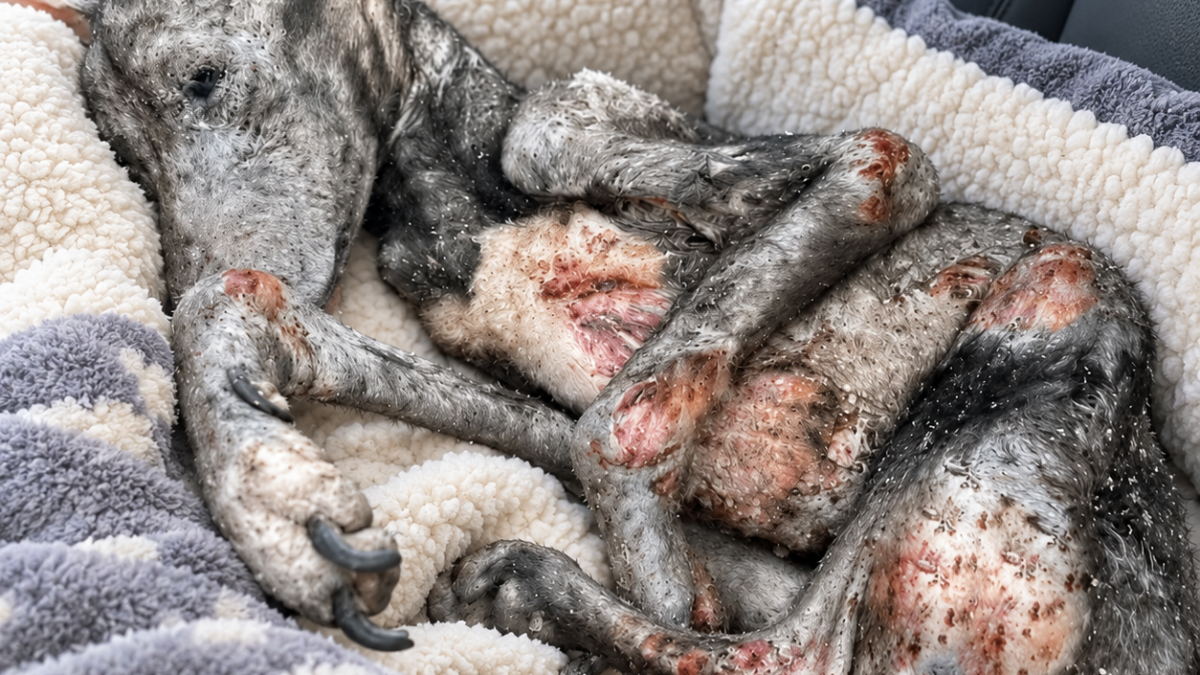
PART 2
The veterinarian looked at me for a long moment.
Then he nodded.
“Okay.”
That single word started everything.
Not a miracle.
Not a guarantee.
A process.
Sarita was transferred that afternoon to a larger veterinary hospital where specialists could evaluate her neurological function, fractures, nutritional condition, and infectious disease problems in one place.
I rode beside her.
She lay inside a padded carrier with towels supporting both sides of her body.
Every turn of the vehicle made her slide slightly because she had almost no strength to stabilize herself.
I kept one hand through the carrier door.
Not holding her.
Just there.
Every few minutes, Sarita opened her eyes and sniffed my fingers.
“You only have to get through today,” I told her.
I said it because “get well” felt too large.
“Today” was manageable.
Today meant breathe.
Drink.
Tolerate the trip.
Stay warm.
We reached the specialty hospital before evening.
The neurologist examined Sarita first.
He tested her reflexes.
Pinched gently between the toes.
Moved each limb.
Checked her spine.
Watched her eyes.
Pressed along her neck.
Sarita hated all of it.
She couldn’t escape, so her breathing became faster.
I stood near her face.
“You’re okay.”
The neurologist glanced at me.
“She has deep pain sensation.”
I looked up.
“That’s good?”
“It’s better than not having it.”
“Does that mean she’ll walk?”
“No.”
The word landed hard.
“Then what does it mean?”
“It means the neurological pathways aren’t completely absent. But her weakness is likely complicated by more than one issue.”
More testing followed.
Radiographs confirmed that several bones had suffered fractures or changes associated with severe nutritional compromise.
Her skeleton looked like a body that had been asked to grow without receiving what growth required.
Some fractures were healing.
Others looked older.
None appeared to require emergency surgical stabilization in the condition she was in.
That was good.
What wasn’t good was how weak everything else had become.
The neurologist explained that Sarita’s paralysis might not come from one single catastrophic spinal injury.
Severe malnutrition alone can destroy muscle.
Certain infections can affect neurological function.
Electrolyte abnormalities can worsen weakness.
Pain from fractures can prevent movement.
Prolonged immobility then creates its own cycle.
Muscles disappear.
Joints stiffen.
Nerves become less effective.
The body learns not to move.
“So what is the diagnosis?” I asked.
He gave me a tired smile.
“Several.”
I hated that answer.
But it was honest.
We had spent the morning thinking there might be one enemy.
A spinal lesion.
A disease.
A broken bone.
Something we could point to.
Instead, Sarita’s body seemed to have been attacked from several directions at once.
The internal medicine doctor entered with the blood results.
Anemia.
Protein deficiency.
Signs of infection and inflammation.
Abnormal mineral balance consistent with severe nutritional deprivation.
Dehydration.
Parasites.
The list kept growing.
I finally asked:
“Can we stop discovering things?”
The doctor smiled sympathetically.
“I’d prefer that too.”
She sat down beside me.
“The biggest mistake would be trying to fix everything aggressively at once.”
“Why?”
“Because her body is fragile.”
“So we go slow.”
“Very.”
Nutrition would have to be increased carefully.
Some deficiencies needed correction.
Parasites treated.
Infections addressed.
Pain controlled.
Hydration restored.
But even food, something so basic, could become dangerous if given too aggressively to a severely malnourished animal.
The body needed time to remember what to do with nourishment.
Sarita stayed hospitalized.
That first night, I expected a crisis.
There wasn’t one.
There was no dramatic improvement either.
She slept.
Woke.
Drank a little.
Refused food.
Accepted a few bites later.
Slept again.
At midnight, a technician sent me an update.
**Stable. No worsening.**
I read the message five times.
Stable.
That became victory number one.
The next morning, I arrived before visiting hours officially began.
The nurse let me in anyway.
Sarita was awake.
Her head lifted when she saw me.
“Hey.”
Her tail did not move.
It couldn’t.
Her legs did not move.
But her eyes changed.
Maybe recognition.
Maybe curiosity.
Maybe I wanted to see recognition.
I sat beside the kennel.
A bowl of soft food sat untouched.
“You’re making everyone nervous.”
Sarita looked at me.
“You know that?”
Nothing.
I dipped one finger into the food and held it near her nose.
She sniffed.
Turned away.
“Rude.”
A nurse laughed behind me.
“She ate a little overnight.”
“How much?”
“Not enough to impress anyone.”
I waited.
Tried again.
Sarita licked my fingertip.
Then another.
Within ten minutes, she had eaten several spoonfuls.
Not much.
Enough.
By day three, the specialists had constructed a treatment plan that looked almost absurd when written out.
Medication schedules.
Nutrition targets.
Fluid adjustments.
Parasite treatment.
Antibiotics.
Mineral supplementation carefully calibrated by the veterinary team.
Position changes every few hours so she wouldn’t develop pressure sores.
Gentle passive range-of-motion exercises.
Support beneath her chest.
Soft bedding.
Monitoring urine and stool because a paralyzed dog can develop secondary problems quickly.
Every part of Sarita had become somebody’s responsibility.
I worried that was exactly the problem.
What would happen when she left the hospital?
Who could manage all of it?
I pushed the question away.
Today.
Only today.
On the fourth morning, physical rehabilitation began.
The therapist’s name was Jenna.
She was annoyingly cheerful.
Not fake cheerful.
The dangerous kind.
The kind who could watch a dog fail to move and still say, “Good effort.”
I distrusted her immediately.
Jenna placed Sarita on a padded mat.
Supported the chest.
Positioned each paw correctly.
Then gently shifted weight.
Sarita collapsed sideways.
“Good.”
I stared.
“She fell.”
“She tolerated weight.”
“For two seconds.”
“Two seconds is more than zero.”
Sarita tried again.
Her front legs trembled.
One elbow folded.
Jenna adjusted it.
“Again.”
I understood then.
The optimism wasn’t denial.
She simply measured differently.
Not walking versus not walking.
One muscle contraction versus none.
Two seconds versus one.
Head control.
Shoulder engagement.
Weight transfer.
Tiny numbers.
That was how we would survive this.
Rehabilitation began with almost embarrassingly small goals.
Lift head for ten seconds.
Maintain chest position.
Move one front paw voluntarily.
Tolerate supported standing.
Engage hind-limb muscles even if the leg didn’t move.
Sarita hated the exercises at first.
If Jenna touched her hind legs, Sarita turned her head as if offended.
When we rolled her onto one side, she tried to resist with the only muscles that worked reliably.
“You’re stubborn,” I told her.
Jenna smiled.
“Good.”
“You say everything is good.”
“No.”
“What’s bad?”
“Giving up.”
There it was.
The phrase everyone kept trying not to say.
Giving up.
I became uncomfortable with it.
Animals don’t choose illness.
They don’t fail recovery because they lack courage.
Sometimes bodies cannot heal.
I didn’t want Sarita’s outcome to become a moral test.
If she died, that would not mean she hadn’t fought hard enough.
If she never walked, that wouldn’t mean she had failed.
I told Jenna that.
She nodded.
“You’re right.”
That surprised me.
“So stop saying she’s fighting.”
“I can say her effort is useful.”
“Better.”
“She is extremely persistent.”
“That I’ll accept.”
Sarita was persistent.
She complained through rehabilitation with small grunts.
She tried to pull away from stretching.
She attempted to bite a towel once and missed.
She became furious when we supported her in a sling and her feet wouldn’t cooperate.
That anger reassured me more than passive sweetness would have.
Pain had not erased her opinion.
A week passed.
Then another.
Progress was slow enough to make us question whether it was progress at all.
Her appetite improved.
Weight rose.
Blood values began stabilizing.
Some infections responded to treatment.
Her coat looked better.
Her eyes brighter.
But movement remained almost unchanged.
A paw.
A shoulder.
A slight pull.
Nothing resembling standing.
One afternoon, the neurologist repeated parts of the examination.
Deep pain intact.
Reflexes variable.
Muscle wasting severe.
He did not look optimistic.
“What are you thinking?”
“That we continue.”
“For how long?”
“As long as quality of life remains acceptable and we’re seeing medical improvement.”
“Movement?”
“Not enough yet.”
My chest tightened.
“So we could do all this and she never walks.”
“Yes.”
“Can she have a good life if she doesn’t?”
“Yes.”
That answer mattered.
Until then, somewhere inside me, I had been treating walking as the finish line.
He changed that.
A dog does not need four normally functioning legs to deserve life.
If Sarita stabilized medically and remained paralyzed, carts existed.
Mobility aids.
Adapted homes.
Bladder management.
Rehabilitation.
The goal was not to force her body into some ideal version of a dog.
The goal was comfort, function, and joy.
That took pressure off both of us.
Strangely, Sarita began improving more visibly after that.
Not because my expectations caused it.
Bodies do not respond to human philosophy.
But I did.
I stopped staring at her hind legs every day waiting for a miracle.
I noticed other things.
She barked.
The first bark came when a technician walked past carrying another dog’s food.
Sarita lifted her head and made a tiny sharp sound.
Everyone in the room stopped.
“What was that?”
Sarita barked again.
Jenna laughed.
“She has opinions.”
Food.
Of course.
Her appetite had become enormous once her system adjusted.
She watched every bowl.
If another patient was fed nearby, Sarita stared until the food disappeared.
I started calling her management.
“She wants to inspect portions.”
A nurse said, “She wants to steal portions.”
Both were true.
Then her tail moved.
Not a full wag.
At first we weren’t even sure.
Sarita was lying on her side while I scratched her chest.
Something shifted behind her.
I looked.
Nothing.
“Do that again.”
I scratched the same spot.
The tail moved perhaps half an inch.
I shouted for Jenna.
She ran in expecting an emergency.
“What?”
“Tail.”
“What about it?”
“It moved.”
Jenna scratched.
Movement.
Again.
Movement.
Sarita looked annoyed by our excitement.
Jenna crouched closer.
“Voluntary?”
“Looks like it.”
The neurologist later agreed it could represent improving motor function.
He refused to predict more.
I learned to stop demanding predictions.
Day by day, the tail movement strengthened.
Then one hind leg showed the slightest voluntary pull.
That evening, I cried in the parking lot.
Not because Sarita was cured.
Because for the first time, the direction felt different.
We weren’t only preventing decline.
Something was coming back.
The next setback arrived three days later.
Fever.
Poor appetite.
Lethargy.
Bloodwork showed inflammation rising again.
One of the infectious problems had flared.
Sarita stopped participating in rehabilitation.
Every movement exhausted her.
The tiny hind-leg response seemed weaker.
I sat beside the hospital kennel feeling like we had been thrown back to the beginning.
The internal medicine doctor adjusted medications.
Changed part of the treatment plan.
Additional testing.
More waiting.
That night, the question returned.
Was this fair?
Sarita had been in care for weeks.
Needles.
Medication.
Baths.
Physical therapy.
Manipulation.
Hospitalization.
What if the “chance” we gave her had become a way of avoiding the harder decision?
I asked Rachel, one of the overnight veterinarians.
“If she were yours, what would you do?”
She didn’t answer immediately.
“I would ask whether she still has good experiences.”
I looked at Sarita.
“What counts?”
“Food.”
“She likes food.”
“Attention?”
“Yes.”
“Comfort?”
“With pain medication.”
“Interest in surroundings?”
“Yes.”
“Does treatment distress her constantly?”
“No.”
“Then I wouldn’t make a decision based only on walking.”
Again.
Walking.
I had promised myself I understood.
Apparently I needed to keep relearning.
Sarita recovered from the relapse.
Slowly.
She lost some weight.
Gained it again.
Rehabilitation restarted at a lower intensity.
One month became two.
The hospital staff knew her completely by then.
Which nurse she preferred.
Which food she would take medicine with.
Which position made her complain.
Which towel she liked.
She had a pink blanket donated by a volunteer.
Sarita became possessive of it.
Whenever we changed bedding, she watched the blanket leave.
When it returned clean, she immediately rested her chin on it.
Jenna called it her royal property.
At two and a half months, Sarita could maintain supported standing for almost thirty seconds.
That statement would have sounded pathetic to anyone who hadn’t seen day one.
To us, thirty seconds felt enormous.
We used a sling beneath her abdomen.
Jenna aligned the paws.
“Ready?”
Sarita stood.
Front legs trembling.
Hind legs shaking.
Her spine curved.
“Good.”
Ten seconds.
Fifteen.
Twenty.
At twenty-eight, one hind leg buckled.
Sarita collapsed into the sling.
I laughed.
Jenna looked at me.
“You’re laughing?”
“I’m happy.”
“That’s a concerning expression of happiness.”
“She stood.”
“With support.”
“She stood.”
The next week, she reached forty seconds.
Then almost a minute.
We added hydrotherapy once the specialists cleared her medically.
The warm water supported her body, reducing load on fragile bones and weak muscles.
The first time we placed Sarita in the rehabilitation pool, she looked personally betrayed.
Jenna held her beneath the chest.
I supported the rear.
“You’re okay.”
Sarita kicked once.
Not a purposeful swimming stroke.
Still movement.
Then another.
Water changed everything.
Her legs could practice patterns without carrying full body weight.
At first, the movements were disorganized.
One leg moved.
Another didn’t.
Front limbs worked harder than the rear.
But sessions continued.
Short.
Careful.
Never exhausting.
The next milestone came unexpectedly.
Sarita was on a padded mat after therapy.
No sling.
She was lying on her chest.
Jenna stepped away to grab a towel.
I was sitting two feet in front of Sarita.
She looked at me.
I held a piece of chicken.
“No.”
Jenna had told me not to encourage unsupported movement yet.
Sarita stared at the chicken.
I laughed.
“You cannot bribe yourself into medical clearance.”
She planted both front paws.
Pushed.
Her chest lifted.
I froze.
“Sarita.”
The hindquarters shifted.
One leg came beneath her.
Then the other partly.
For maybe one second, Sarita was standing.
No sling.
No hands.
Nothing beneath her.
Then she fell sideways.
I shouted.
Jenna ran back.
“What happened?”
“She stood.”
“Supported?”
“No.”
“How long?”
“One second. Maybe two.”
Jenna looked at Sarita.
Then at me.
“Show me.”
“I can’t make her.”
We positioned her safely.
Waited.
Nothing.
Chicken.
Sarita pushed.
Front legs straightened.
Hind leg tucked.
She rose.
Again.
One second.
Collapse.
Jenna’s hand covered her mouth.
That scared me.
Jenna never reacted like that.
“What?”
“Nothing.”
“You’re crying.”
“No.”
“You are.”
“Allergies.”
“In a therapy room?”
“Very aggressive allergies.”
I laughed while crying too.
We filmed the next attempt for the neurologist.
He watched twice.
Then once in slow motion.
“That is voluntary standing.”
The sentence became one of those moments memory preserves perfectly.
The hum of the air conditioner.
Sarita panting.
My hand still holding chicken.
The doctor’s finger resting on the screen.
Voluntary standing.
No one said she would walk.
No one promised anything.
We simply changed the goal.
Hold it longer.
Three seconds.
Five.
Ten.
Sarita became stronger.
The first actual step happened weeks later.
We had been practicing standing from a supported crouch.
Sarita rose.
Jenna moved one treat slightly forward.
Sarita shifted weight.
Her right front paw advanced.
Then the left.
The hind legs trembled.
One moved.
A tiny forward placement.
Her body followed.
One step.
Technically maybe half a step.
I didn’t care.
“Sarita.”
She advanced again.
Then collapsed.
Jenna immediately lowered her onto the mat.
Sarita grabbed the treat.
I sat down on the floor.
For months, I had imagined this moment would feel explosive.
It didn’t.
It felt quiet.
Almost frightening.
As if reacting too loudly might scare the progress away.
Jenna sat beside me.
“You okay?”
“She walked.”
“She took a couple of steps.”
“She walked.”
“Fine.”
Sarita chewed.
Completely unimpressed.
The video circulated among the hospital staff.
Not online.
Not yet.
Just between people who had carried her through the months.
The internal medicine doctor replied with seven exclamation points.
The neurologist wrote:
**Very encouraging. Continue cautiously.**
Classic neurologist.
No exclamation points.
Within two weeks, Sarita could take four steps.
Then six.
Usually ugly.
Unbalanced.
Sometimes crossing her legs.
Sometimes falling.
We padded everything.
No slippery floors.
No sharp furniture.
No stairs.
No unsupervised movement.
She wore a support harness even when walking independently because one fall could fracture another vulnerable bone.
I hated the fear.
Every success came with a new way to worry.
If she stood, what if she fell?
If she walked, what if she fractured something?
If she gained independence, what if we allowed too much?
Leah once told me rescue work was mostly learning new reasons to be anxious.
She wasn’t wrong.
Sarita didn’t care.
She wanted movement.
Now that she had discovered forward motion, she constantly tried to use it.
If we left her on a mat and someone opened a food container across the room, Sarita pushed up.
“Stay.”
She ignored me.
“You do not understand stay.”
She moved two steps.
“Exactly.”
We introduced a lightweight support harness that allowed us to catch her without carrying all her weight.
Sarita hated being restricted.
That amused me.
The dog who once could not move now resented anything that slowed her.
Three months became four.
Her medical problems continued requiring management.
Some improved dramatically.
Some lingered.
Bloodwork became more normal.
Fractures healed.
Bone density gradually improved with appropriate veterinary care and nutrition.
Muscle returned in thin lines along her shoulders and thighs.
The shape of her body changed.
For the first time, her legs looked like they belonged to her.
At five months, Sarita walked across an entire room.
Not smoothly.
Not quickly.
But without falling.
Eight yards.
Maybe ten.
I walked backward in front of her.
Jenna stayed behind with the support strap loose.
Sarita moved.
Right.
Left.
Pause.
Right.
Left.
At the halfway point she sat abruptly.
I offered water.
She ignored it.
Stared at the chicken in my hand.
“Of course.”
We continued.
She crossed the finish line—which was simply the edge of a blue mat—and everyone clapped.
Sarita barked.
Probably because she wanted chicken.
We interpreted it as a speech.
Her first outdoor steps happened several days later.
We chose a flat patch of grass.
The ground was soft but stable.
Sarita stood.
Wind moved across her face.
She lifted her nose.
For a moment she forgot to walk.
She simply smelled.
I realized she had spent months experiencing the outdoors mostly from someone’s arms or a stroller used during rehabilitation.
This was different.
Grass beneath her own feet.
Jenna loosened the support harness.
“Go.”
Sarita took two steps.
Stopped.
Sniffed.
Another.
Then another.
She found something interesting in the dirt.
Probably disgusting.
She lowered her nose.
Tried to follow it.
Her rear legs wobbled.
We steadied her.
“No eating dirt.”
Sarita ignored me.
That afternoon she slept for hours.
Rehabilitation exhausted her in ways enthusiasm hid.
So we learned to protect her from herself.
One day of increased movement.
Then recovery.
Monitor soreness.
Watch appetite.
Check temperature.
Keep progress slow.
She eventually moved from hospital care into a specialized foster home.
Her foster was Maya, a veterinary technician with experience managing mobility-impaired animals.
Maya’s house had rugs everywhere.
No stairs to the main living area.
A low yard step covered with a ramp.
Dog beds placed like islands across every room.
I walked through the house.
“You planned this.”
Maya laughed.
“I have three senior dogs.”
Sarita met them one by one.
An elderly terrier named Beans ignored her.
A twelve-year-old shepherd mix sniffed and walked away.
A tiny Chihuahua named Cricket growled like Sarita owed money.
Sarita stared.
Cricket growled again.
Sarita barked.
Maya laughed.
“Perfect.”
I looked at her.
“Perfect?”
“If she’s arguing with Cricket, she’s feeling normal.”
Sarita adapted faster than I expected.
Hospital life had made her comfortable with routines and human handling.
Home life introduced new challenges.
Doorways.
Furniture.
Different floor textures.
More space.
At first, Sarita became confused if Maya moved a dog bed.
She relied on familiar routes because balance demanded concentration.
Living room to kitchen.
Kitchen to water.
Water to yard.
We kept furniture stable.
Added textured mats near transitions.
Sarita mapped the house.
Within two weeks, she could move from bed to water without assistance.
Within four, she followed Maya into the kitchen.
Within six, she began trying to chase Beans.
Beans was not interested.
Then came the digging.
It started with one hole.
Maya called me laughing.
“You need to come see your miracle dog.”
“Why?”
“She’s destroyed my yard.”
I drove over.
Sarita was outside.
Her front half disappeared into a shallow hole.
Only her rear end and tail were visible.
“What is she doing?”
Maya crossed her arms.
“Apparently archaeology.”
Sarita backed out.
Her nose covered in dirt.
She sneezed.
Then resumed digging.
I stared.
This was a dog we had once repositioned every few hours because she couldn’t move enough to prevent pressure sores.
Now she was excavating Maya’s garden.
Maya looked at me.
“You’re crying.”
“No.”
“You are.”
“I’m angry about the landscaping.”
“Sure.”
Sarita dug harder.
Her legs had become strong enough not just to support her.
They supported mischief.
That may have been my favorite phase.
She became a problem.
A normal one.
She stole socks.
Carried food bowls from one room to another.
Barked at birds.
Started arguments with Cricket.
Learned that if she stood beside the refrigerator and stared at Maya long enough, food sometimes appeared.
Then she learned to run.
Not suddenly.
It came out of a trot.
We had watched her walk faster over several weeks.
One morning in the yard, Maya called her.
“Sarita!”
Sarita moved.
Walk.
Quick walk.
Then something shifted.
Both hind legs began cycling more naturally.
Her front body lowered.
She accelerated.
Three seconds.
Maybe four.
A run.
She reached Maya.
Nearly fell.
Recovered.
Maya screamed.
Sarita barked at her.
The video arrived on my phone thirty seconds later.
I watched it once.
Then again.
Then ten times.
Paralyzed.
Standing.
Walking.
Running.
The words looked ridiculous beside each other.
But there they were.
The specialists remained careful.
Recovery did not mean Sarita’s body had never been damaged.
She still had an abnormal gait.
Fatigue came more quickly than in a healthy dog of similar age.
Her bones required monitoring.
Her medical history meant she needed follow-up.
But none of that prevented joy.
And Sarita had joy.
She liked puddles.
Hated rain.
Loved dirt.
Hated being cleaned after enjoying dirt.
Preferred chicken.
Would accept beef.
Considered vegetables an insult.
She slept under blankets even in warm weather.
She learned the sound of Maya opening a cheese wrapper from three rooms away.
Those details began replacing diagnoses.
That mattered to me.
For months, Sarita had been a list.
Paralysis.
Malnutrition.
Fractures.
Infections.
Neurologic impairment.
Anemia.
Now she was also:
Digging enthusiast.
Cheese criminal.
Blanket thief.
Cricket’s primary political opponent.
That was a better medical chart.
Her foster period stretched longer than usual because we wanted to be certain she was stable before adoption.
Applications arrived.
Many were moved by her story.
That worried me.
People sometimes fall in love with transformation rather than the animal.
Sarita still needed a home prepared for possible future mobility issues.
Follow-up care.
Weight control.
Safe flooring.
No expectation that she was magically cured forever.
One application said:
**We want to adopt the miracle dog.**
I rejected it.
Not because the applicants were bad people.
Because Sarita was not a miracle product.
Another wrote:
**Our children would be inspired by her story.**
Also no.
Sarita did not exist to teach children perseverance.
She needed a family who would refill prescriptions.
Take her to follow-up appointments.
Notice subtle changes in gait.
Keep her from getting overweight.
Clean dirt from her nose after she dug illegal holes.
Then came Emma and David.
No dramatic language.
They lived in a one-story house.
Fenced yard.
No stairs except one shallow porch step.
Their previous dog had developed degenerative mobility problems late in life, so they already owned rugs, a ramp, and support harnesses.
Under:
**Why Sarita?**
Emma wrote:
**She seems funny. We understand she also has long-term medical needs.**
I read that twice.
Funny.
Not brave.
Not inspiring.
Not miracle.
Funny.
They came for a meeting.
Sarita barked at David.
He stopped.
“Should I sit?”
“Yes.”
He sat.
Sarita approached.
Sniffed his shoe.
Then walked away.
Emma knelt.
Sarita went straight to her.
Sniff.
Tail wag.
Then Sarita saw Emma’s purse.
The purse contained treats.
Relationship accelerated.
Maya laughed.
“She has values.”
They stayed for ninety minutes.
David asked about future orthopedic risks.
Emma asked whether the neurological weakness could relapse.
We answered carefully.
Some issues had resolved.
Others might have long-term consequences.
No one could guarantee Sarita would remain as mobile at ten as she was now.
Emma shrugged.
“No one guaranteed our last dog that either.”
Good answer.
The home visit went perfectly.
Maybe too perfectly.
I became suspicious.
Maya noticed.
“You’re looking for a problem.”
“I’m being thorough.”
“You’re looking for a reason to keep her.”
“She has been through a lot.”
“So?”
“What if they miss something?”
“What if we keep every recovered dog because something could happen?”
I glared.
Maya smiled.
“That’s what I thought.”
Sarita began a two-week foster-to-adopt trial.
The first day, Emma sent one photograph.
Sarita asleep under the dining table.
Second:
Sarita in the yard.
Third:
Sarita halfway into a newly dug hole.
Caption:
**She has begun construction.**
Maya replied:
**No refunds.**
Day five, Sarita refused breakfast.
Emma called immediately.
Good.
We asked questions.
Energy?
Normal.
Water?
Normal.
Vomiting?
No.
Diarrhea?
No.
Pain?
None obvious.
She ate chicken twenty minutes later.
“She manipulated you,” I told Emma.
“I know that now.”
“Congratulations. You’re family.”
At the end of two weeks, David called.
“We have a problem.”
My stomach dropped.
“What happened?”
“She dug under one of Emma’s flower beds.”
I waited.
“That’s the problem?”
“She destroyed three plants.”
“Medical emergency?”
“No.”
“Behavioral crisis?”
“Emma is emotionally attached to the plants.”
In the background Emma yelled:
“I can hear you.”
I laughed.
“You’re keeping her.”
“We’re keeping her.”
The adoption was finalized.
Sarita walked into the rescue office for paperwork.
No sling.
No cart.
No one carrying her.
She walked.
That fact still had the power to stop me.
Emma signed.
David signed.
I reviewed medical notes.
Sarita wandered beneath the desk.
Found a dropped crumb.
Ate it.
Maya watched.
“You remember when she couldn’t lift herself?”
I nodded.
“Stop.”
“I’m not crying.”
“You are.”
“I have chronic allergies.”
Sarita came out from under the desk with dust on her nose.
Perfect.
Her new life became quieter.
That was good.
Updates arrived less often.
A dog becoming ordinary is one of the best outcomes.
Sarita slept in sunbeams.
Took short hikes adapted to her endurance.
Went on car rides.
Destroyed garden edges.
Learned to wait by the pantry.
Her gait became smoother as muscle developed.
The run became more coordinated.
She never moved exactly like a dog with an uncomplicated body.
But she moved enough.
More than enough.
One year after adoption, Emma sent a video.
Sarita was chasing a ball.
She ran across the yard.
Stopped.
Grabbed it.
Then, instead of returning, dug a hole beside it.
David’s voice in the background:
“That’s not fetch.”
Emma replied:
“She has modified the sport.”
Sarita continued digging.
I watched the video three times.
The dog people once gathered around to discuss euthanasia was now being criticized for refusing to follow the rules of fetch.
I loved that.
Several years passed.
Sarita’s medical history still mattered.
A period of increased stiffness prompted new imaging.
No catastrophic decline.
Physical therapy restarted.
Weight was adjusted.
Medication changed.
She improved.
Another year, she developed gastrointestinal illness unrelated to her original condition.
Emma panicked.
So did I.
Sarita recovered.
That was something I eventually had to learn.
Not every future illness belonged to the original story.
Once a rescued animal survives something extraordinary, we sometimes interpret every later problem through that lens.
But Sarita was allowed to have normal dog problems too.
A stomach bug.
A torn nail.
An ear infection.
A mild strain from doing something stupid in the yard.
Those problems were almost comforting.
They meant life had moved on.
When Sarita reached middle age, I visited.
She recognized my voice before I reached the gate.
Bark.
Then another.
Emma opened the door.
Sarita ran toward me.
Not fast like a young athlete.
But definitely running.
She reached my legs.
Jumped slightly.
I caught her chest.
“Hey.”
Her tail whipped.
Emma laughed.
“She remembers.”
Maybe.
Maybe she just liked visitors.
Either way, I accepted the greeting.
We sat outside.
Sarita dug.
Of course.
The hole was beneath a shrub.
“Do you ever stop her?”
Emma looked offended.
“We try.”
Sarita emerged.
Dirt covering her muzzle.
I laughed.
That image hit me harder than any dramatic reunion.
The original story had said everyone thought she had no future.
Future is an abstract word.
This was the future.
Dirt.
A shrub.
A homeowner annoyed about landscaping.
A dog deciding the yard needed another hole.
Not extraordinary.
Exactly why it mattered.
Sarita aged.
Slowly.
Her gait stiffened.
Her medical team added more support as needed.
Hydrotherapy returned.
She loved it more as an older dog than she had as a patient.
Warm water helped her joints.
Emma sent a photo of Sarita floating in a rehabilitation pool wearing a life jacket.
Caption:
**She now believes spa treatment is a constitutional right.**
I wrote back:
**She has suffered enough to be annoying forever.**
Years earlier, I would have said she earned this life by fighting.
I stopped saying that.
Animals do not need to earn rescue through courage.
Sarita deserved treatment because she was alive and had a reasonable chance at comfort.
If she had been quieter, she still would have mattered.
If she had never walked, she still would have deserved a good life.
Her persistence influenced our decision, yes.
But the lesson was not that only fighters deserve chances.
The lesson was to look carefully before deciding no chance exists.
That distinction became important in my rescue work.
Whenever someone said:
“This animal has given up.”
I became cautious.
How do we know?
Sometimes an exhausted animal lies still because they are dying.
Sometimes because they are conserving energy.
Sometimes because movement hurts.
Sometimes because fear freezes them.
Behavior is information.
Not prophecy.
Sarita had looked finished.
She wasn’t.
Years later, a young volunteer named Grace joined our team.
She knew Sarita only from photographs.
One afternoon, we received another severely weak dog.
Not identical.
Different disease.
Different prognosis.
Grace looked frightened.
“Do you think she’ll be like Sarita?”
I stopped her.
“No.”
“But—”
“No.”
She looked confused.
“Every dog gets their own prognosis.”
“So Sarita’s story doesn’t matter?”
“It matters because it teaches us not to decide before the medical facts are clear.”
I pointed toward the new patient.
“It does not promise this dog the same outcome.”
That was another lesson Sarita left us.
Hope must be specific.
Not magical.
Her recovery came from specialists.
Testing.
Nutrition.
Medication.
Rehabilitation.
Months of work.
Setbacks.
Constant reassessment.
Not simply because she wanted it enough.
I became protective of that truth.
People called her a miracle.
I understood why.
But miracles can erase labor.
Sarita’s first steps looked miraculous.
Behind them were hundreds of repetitions.
Passive range of motion.
Supported standing.
Nutrition.
Medical stabilization.
Hydrotherapy.
Rest.
Again.
Again.
Again.
Her run looked impossible only if you skipped the months in the middle.
I didn’t skip them.
I remembered every ugly part.
The relapse.
The fever.
The night I wondered if keeping her alive had become selfish.
The bowl she refused.
The fractures.
The first failed attempts to stand.
The tremors.
The fear of every fall.
Those things made the run more meaningful, not less.
Eventually Sarita became an old dog.
That sentence alone would once have felt impossible.
Old.
Her face grayed.
Hearing declined.
She slept longer.
Digging slowed.
Not stopped.
Slowed.
Emma called one spring.
“She’s having trouble getting up.”
We already knew arthritis and her old skeletal issues would likely make aging harder.
The veterinarian adjusted treatment.
Support harness.
Non-slip rugs.
Shorter walks.
Hydrotherapy.
Pain control.
Sarita rallied.
For almost another year, she remained comfortable.
Then weakness progressed.
Different from the original paralysis.
This was aging.
A body with a long complicated history reaching its limits.
Emma struggled with the difference.
“It feels like we’re back at the beginning.”
“No.”
“She can’t walk far.”
“That’s not the beginning.”
“She falls sometimes.”
“She’s also thirteen.”
Emma went quiet.
I continued.
“The first time, she was young and medically unstable. Now she’s old and loved.”
That mattered.
Endings can resemble beginnings from the outside.
Weak body.
Difficulty standing.
Someone carrying the dog.
But context changes everything.
Sarita was no longer an abandoned animal surrounded by strangers discussing whether her life had ever contained enough good to justify more suffering.
She was an old dog in her own house.
Her bed smelled like home.
Her people knew every expression.
Her veterinarian knew her history.
There was no panic.
Only grief.
Her final decline lasted weeks.
Not months.
She still ate.
Then became selective.
Chicken.
Cheese.
Anything Emma cooked.
One morning she refused her regular meal but ate part of scrambled egg.
David laughed.
“She’s running a restaurant now.”
Sarita looked at him expectantly.
Two days later, she stopped wanting eggs.
Then chicken.
That was when Emma called.
“I think we’re there.”
I drove over.
Sarita was lying in the yard.
Near one of her old digging areas.
Her paws were clean.
Too clean.
She hadn’t dug in weeks.
I sat beside her.
She raised her head.
Tail moved slowly.
“Hey, dirt monster.”
Her eyes softened.
Emma sat on the grass.
“I thought when this came, I’d know exactly what to do because of her history.”
“No.”
“I keep thinking, what if she gets another comeback?”
I understood.
Sarita had trained all of us to expect one more recovery.
One more impossible step.
One more surprise.
But bodies change.
“What does the vet think?”
“That treatment can keep her comfortable briefly. It won’t reverse this.”
“Is she comfortable today?”
“Yes.”
“Then today.”
Again.
The word that began everything.
Today.
Sarita spent that afternoon outside.
She drank water.
Ate three pieces of chicken.
Slept beneath the porch.
At sunset she attempted to dig.
One paw scraped the dirt.
Then another.
The hole was pathetic.
Barely an inch.
Emma laughed and cried simultaneously.
“She still has to destroy something.”
Sarita rested her nose in the dirt.
We let her.
The following morning, her pain worsened.
The family chose in-home euthanasia.
I came because they asked.
The veterinarian placed a soft blanket on the lawn.
Sarita lay in the sun.
The same dog who once could only move her head now had a lifetime of movement behind her.
Running.
Walking.
Digging.
Falling.
Standing again.
All of it.
Emma held her face.
“You proved everyone wrong.”
I almost corrected her.
Not because it wasn’t emotionally true.
Because Sarita had never known she was proving anything.
She had just lived.
The veterinarian gave the sedative.
Sarita relaxed.
David scratched her chest.
I touched one paw.
The same kind of paw I had watched scrape a towel less than an inch the first day.
Emma whispered:
“You can stop now.”
That sentence broke me.
For years, people had praised Sarita for not giving up.
Now the kindest thing anyone could tell her was that she didn’t need to keep going.
Her breathing slowed.
The veterinarian waited.
Then gave the final medication.
Sarita died in the grass.
Sunlight across her back.
Family around her.
Dirt under one paw.
Afterward, Emma stayed beside her.
She looked toward the shallow hole Sarita had started the evening before.
“We’re leaving that.”
“What?”
“The hole.”
David smiled weakly.
“She’ll change her mind when it rains.”
“I won’t.”
She didn’t.
Months later, I visited.
Grass had grown around the little depression.
Not inside it.
Emma pointed.
“See?”
Still there.
I laughed.
“Of course.”
They had placed no monument.
No stone.
No plaque.
Just a small unfinished hole beside a shrub.
That felt more like Sarita than anything else could.
Her story was never really about death being defeated.
Death came eventually.
It comes for every dog.
Her story was about all the ordinary life that fit between two moments when people believed her body had reached its end.
The first time, they were wrong.
The second time, years later, they were right.
Knowing the difference was the work.
When I think about Sarita now, I don’t picture the cage.
I don’t picture her motionless body.
I don’t picture the medical records.
I picture dirt on her nose.
A yard full of holes.
A ridiculous run that looked more like controlled falling.
A small dog barking because someone else had food.
Those images are quieter.
They’re also more important.
The first day, I stopped a goodbye because one paw moved toward my hand.
Months later, Sarita stood.
Then stepped.
Then walked.
Then ran.
For years after that, nobody needed her to prove anything again.
She had already gained the only outcome that mattered.
Enough strength to stop being a prognosis and start being a dog.
[END OF STORY]








