PART 2: Everyone Told Me the German Shepherd in Kennel 22 Was Too Broken to Save—Then She Finally Turned Around
PART 2
I returned at 2:15 the next afternoon.
I know the exact time because I had spent half the morning arguing with myself about whether going back was a good idea.
The rational part of me had a list.
I had never owned a German Shepherd.
I was fifty-two.
I lived alone.
My backyard fence needed repair.
I had not even decided whether I wanted a dog.
Luna was seven, traumatized, underweight, and emotionally shut down.
Every sensible argument pointed in one direction.
Then I pictured her facing that wall.
At 1:45, I put on my raincoat.
At 2:15, I was standing outside kennel 22.
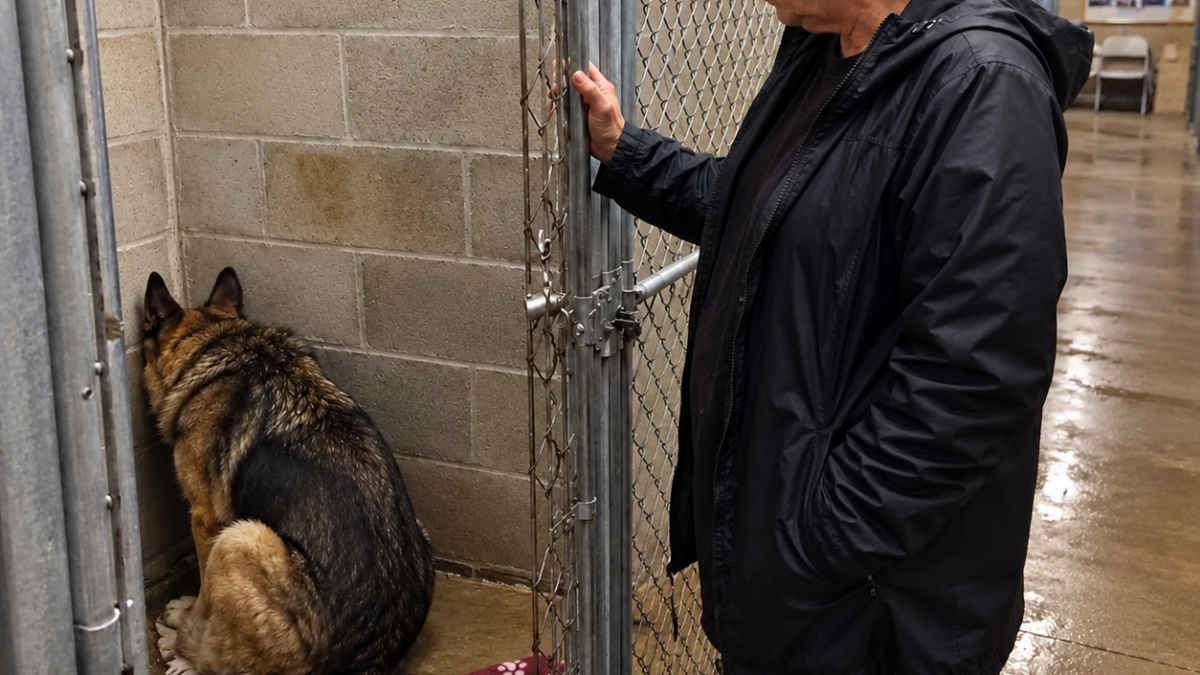
Luna was in the corner again.
Same position.
Same wall.
A different volunteer greeted me.
“You interested in her?”
“I’m visiting.”
The woman looked confused.
“Just visiting?”
“Yes.”
I sat in the same place.
Luna did not turn.
“Hey,” I said. “It’s me.”
Nothing.
“I realize that means absolutely nothing to you.”
Her ear moved.
I smiled.
“There you are.”
I stayed for forty minutes.
I talked about my garden.
Not because I thought Luna cared about tomatoes.
Because ordinary conversation gave me something to do that didn’t demand anything from her.
I told her the squirrels had destroyed my strawberries.
I told her my neighbor, Frank, believed every plant could be fixed with coffee grounds.
I told her Mark used to kill every houseplant we owned while insisting they were “dramatic.”
Luna eventually turned her head.
Only once.
When I stood to leave, she faced the wall again.
That should have discouraged me.
Instead, I came back Saturday.
Then Sunday.
By Monday, the shelter staff knew my name.
One of the younger volunteers, Mia, met me near the front desk.
“You know she doesn’t have to be adopted immediately.”
“I know.”
“You could foster first.”
“I’m not adopting her.”
Mia smiled.
“What?”
“Nothing.”
“Why are you smiling?”
“I didn’t say anything.”
“You’re very annoying.”
“So I’ve been told.”
On the fourth visit, Luna did something new.
She lay down facing sideways instead of directly at the wall.
That was it.
To anyone else, meaningless.
To me, enormous.
I sat outside the kennel.
“You’re getting reckless.”
One ear tilted.
“Next thing I know, you’ll acknowledge the entire room.”
No response.
But I noticed her eyes no longer stayed shut whenever people passed.
She watched.
Carefully.
That told me something.
Luna was not indifferent.
She was monitoring.
There is a difference.
Indifference means you do not care what happens.
Fear means you care too much.
On day six, I arrived with a paperback and sat quietly.
For almost twenty minutes, neither of us moved.
Then I heard nails scrape concrete.
I kept my eyes on the page.
One step.
Pause.
Another.
I wanted desperately to look.
I didn’t.
Luna came halfway across the kennel.
Stopped.
Her body became rigid.
I read the same paragraph six times without absorbing a word.
Then a metal pan crashed two kennels away.
Luna bolted backward.
Corner.
Wall.
Gone.
My chest hurt.
Mia had been watching.
“She came farther than she has for anyone.”
“And then I lost her.”
“You didn’t.”
“I should have—”
“You didn’t drop the pan.”
“She was trying.”
“She’ll try again.”
I looked toward the corner.
“How do you know?”
Mia shrugged.
“Because she did once.”
That sentence stayed with me.
Because she did once.
Grief had taught me to see setbacks as proof.
You have one terrible morning, so you decide you’re back at the beginning.
You leave a party early, so you tell yourself you will never enjoy people again.
Luna walked halfway across a kennel and ran back.
Mia saw the first part.
I saw the second.
That was one of many things Luna would teach me without meaning to.
On the ninth day, she accepted a treat.
Not from my hand.
I placed a piece of chicken near the bars.
She waited until I looked away.
Then moved forward.
I heard chewing.
I kept my head turned.
“You know I can hear you.”
Silence.
I looked.
Chicken gone.
Luna back three feet.
Her eyes on me.
“Thief.”
The upright ear twitched.
On day twelve, I held the chicken on my open palm.
Luna stared for nearly five minutes.
My arm went numb.
Mia passed behind me.
“You can put your hand down.”
“No.”
“You look ridiculous.”
“I am committed.”
“You are going to lose circulation.”
“I have another hand.”
Mia laughed quietly.
Luna’s nose moved.
Then she stepped forward.
One step.
Pause.
Another.
Her body stayed low.
Head stretched out.
Back legs prepared to retreat.
She reached my hand.
Sniffed.
I did not move.
Her nose touched my palm.
Then she took the chicken.
Very gently.
She backed away immediately.
I sat frozen.
Mia covered her mouth.
I looked at Luna.
She chewed.
For some reason, that nearly broke me more than anything else.
“Thank you,” I whispered.
Luna looked away.
The staff began talking about my visits.
I knew because people who had never introduced themselves started giving me updates.
“She came to the gate this morning.”
“She ate breakfast while I was still in the room.”
“She sniffed a leash yesterday.”
“Didn’t panic when maintenance came through.”
Every piece of progress became news.
The shelter director, Karen Alvarez, stopped me after two weeks.
“You understand she may never become a typical dog.”
“What’s typical?”
“You know what I mean.”
“I actually don’t.”
Karen smiled despite herself.
“She may always be fearful.”
“Okay.”
“She may not like strangers.”
“I don’t particularly like strangers.”
“Claire.”
“I’m listening.”
“She may have separation problems. Noise sensitivity. She may regress when moved into a home.”
“I know.”
“No, you know intellectually.”
That was fair.
Karen continued.
“A shelter is predictable. Your house is new. Doors, appliances, stairs, neighborhood sounds, cars, visitors. Adoption can make traumatized dogs look worse before they look better.”
I looked through the window toward Luna’s kennel.
“I’m not asking you to approve me today.”
“I know.”
“What are you asking?”
Karen leaned against the counter.
“Why Luna?”
I should have had an answer ready.
I didn’t.
I looked back at kennel 22.
“She reminds me of someone.”
Karen waited.
“Who?”
“Me.”
That was the first time I said it aloud.
I expected embarrassment.
Instead, relief.
Karen did not give me sympathy eyes.
Thank God.
“What happened?”
“My husband died.”
“I’m sorry.”
“Two years.”
She nodded.
“I stopped doing things.”
“What things?”
“Most things.”
I tried to laugh.
It came out thin.
“I went to work. Grocery store. Home. Repeat.”
“Friends?”
“I declined them until they stopped asking.”
“Family?”
“My sister calls.”
“Do you answer?”
“Sometimes.”
Karen’s face softened.
I immediately became defensive.
“I’m not trying to adopt Luna as therapy.”
“I didn’t say you were.”
“She doesn’t owe me healing.”
“I know.”
I looked at her.
“I think that matters.”
Karen nodded slowly.
“Yes.”
The next phase was getting inside the kennel.
Not touching Luna.
Just sharing the space.
Mia opened the gate while Luna stood in the back.
I entered sideways.
Sat near the front.
Mia locked it behind me.
“Feel trapped?” she asked.
“Deeply.”
“Good.”
“Why good?”
“Now you understand her.”
She left.
Luna watched.
Her body was rigid.
I opened my book.
“Apparently we’re roommates.”
No movement.
“I need you to know I don’t do dishes.”
Her good ear shifted.
We sat together for twenty-five minutes.
I left.
Next day, thirty.
Third day, Luna lay down while I was inside.
That was the first time.
By the end of the third week, she rested near the front whenever I arrived.
She still did not greet me.
But she no longer disappeared.
Progress changed from dramatic to subtle.
Her body softened.
Her breathing slowed sooner.
She began blinking normally instead of staring.
One afternoon, while I sat on the kennel floor, Luna stood.
Walked toward me.
Stopped.
Then lowered herself onto the concrete about four feet away.
I said nothing.
Five minutes passed.
Then three feet.
She stood.
Moved.
Lay down again.
My heart was beating absurdly fast.
“Whatever you’re doing,” I whispered, “you can stop whenever you want.”
Luna looked at me.
Then put her head on her paws.
Two feet away.
I cried in my car afterward.
Not because she had touched me.
She hadn’t.
Because she had chosen less distance.
That was enough.
At home, my own routines began changing.
Without consciously deciding to, I started preparing for Luna.
I repaired the fence.
Then told myself that needed to happen anyway.
I bought two baby gates.
For “future use.”
I rolled up the living-room rug because someone told me frightened dogs sometimes urinated indoors.
I moved Mark’s old guitar case from the hallway so the narrow passage would feel more open.
That one stopped me.
The guitar case had sat there for two years.
Mark had played badly.
Enthusiastically.
Every Friday night he would pick up that guitar and destroy whichever classic rock song had offended him that week.
After he died, I could not move it.
Not because it had sacred value.
Because moving his things felt like confirming he was not coming back.
I stood in the hallway with one hand on the handle.
Then carried the case into the spare room.
Nothing terrible happened.
The house did not forget him.
That surprised me.
Maybe memory did not require turning the house into a museum.
The following afternoon, I told Luna.
“I moved Mark’s guitar.”
She was lying six feet away.
“I know you have no idea who Mark is.”
Her eyes opened.
“He would have liked you.”
One ear moved.
“He liked difficult women.”
I smiled.
“Obviously.”
That was when Luna stood.
She crossed the distance between us.
Slow.
No treat.
No coaxing.
No hand extended.
She came beside me.
Stopped.
Her shoulder touched my sleeve.
Barely.
I did not breathe.
She stayed three seconds.
Then backed away.
That was our first contact.
I sat motionless after she moved.
Mia appeared at the gate.
“I saw.”
“Don’t.”
“I didn’t say anything.”
“Do not cry.”
“I’m not.”
“You are.”
“So are you.”
“I have allergies.”
“Inside?”
“Severe kennel allergies.”
We both laughed quietly.
Luna watched us.
For the first time, I saw something in her face that was not fear.
Curiosity.
The adoption conversation became real after that.
Karen required a home visit.
Reasonable.
I panicked.
I cleaned my house like the president was coming.
When Karen arrived, she stared at the spotless kitchen.
“Do you live here?”
“Yes.”
“Are you expecting health inspectors?”
“I wanted it nice.”
“For the dog?”
“For you.”
“I work in an animal shelter.”
“Point taken.”
She checked the fence.
Gates.
Sleeping areas.
Doors.
Windows.
Then she asked where Luna would sleep.
“Wherever she chooses at first.”
“Bedroom?”
“If she wants.”
“Crate?”
“I have one, but I’m not forcing her inside.”
“Visitors?”
“I don’t have many.”
“Backup caregiver?”
That one caught me.
“I…”
Karen waited.
“My sister, maybe.”
“Maybe is not a plan.”
She was right.
I hated that.
I called my sister, Jenna, that evening.
She answered on the second ring.
“Claire?”
“Why do you sound scared?”
“Because you called voluntarily.”
“That’s rude.”
“It’s accurate.”
I sat at my kitchen table.
“I’m adopting a dog.”
Silence.
Then:
“What?”
“A German Shepherd.”
Longer silence.
“You?”
“Yes.”
“Claire.”
“What?”
“You once returned a houseplant to me because it was ‘emotionally demanding.’”
“Plants don’t communicate clearly.”
“And German Shepherds do?”
“This one mostly faces walls.”
Jenna’s voice changed.
“What happened to her?”
I explained.
Owner died.
Family tied her outside.
Animal control.
Shelter.
Shutdown.
When I finished, Jenna was quiet.
Then she said, “Of course.”
“What does that mean?”
“Of course you picked that dog.”
“I didn’t pick her because she’s sad.”
“Okay.”
“I’m serious.”
“I know.”
I told her about the backup caregiver requirement.
“Would you help if I’m sick or hospitalized?”
“Yes.”
“You didn’t even think.”
“You’re my sister.”
That answer hurt.
Because while I had been hiding in grief, I had treated everyone’s eventual distance as proof that I was alone.
Sometimes I had simply stopped opening the door.
“When can you meet her?” I asked.
Jenna laughed.
“Now I know this is serious.”
The shelter arranged a controlled introduction.
Luna did not approach Jenna.
But she did not retreat to the wall either.
Jenna sat beside me outside the kennel.
After fifteen minutes, she whispered, “She keeps looking at you.”
“I know.”
“No. I mean every time you move.”
I looked.
Luna’s eyes followed me.
Jenna smiled.
“You’re already her person.”
“Don’t say that.”
“Why?”
“Too much pressure.”
“For you or her?”
I did not answer.
Probably both.
The adoption was scheduled for the following Friday.
I barely slept Thursday night.
Every doubt arrived around 2:00 a.m.
What if I ruined her progress?
What if she panicked in my house?
What if I resented the work?
What if she never loved me?
That one embarrassed me.
She did not owe me love.
I knew that.
Still, somewhere beneath every responsible thought was a lonely woman hoping a dog might choose her.
At nine Friday morning, I almost called the shelter to postpone.
Instead, Mia called me.
“You coming?”
“Yes.”
“You sound strange.”
“I’m fine.”
“Claire.”
“What?”
“Luna is sitting at the kennel gate.”
I stopped.
“What?”
“She’s been there since breakfast.”
That got me into the car.
The shelter staff had apparently decided my adoption was a major institutional event.
Everyone found reasons to be near the lobby.
Mia handled the paperwork.
Karen reviewed medical records.
Vaccines.
Medications.
Feeding schedule.
Behavior plan.
Veterinary follow-up.
No forced interaction.
No dog park.
No crowded introductions.
Secure leash and harness.
Slow decompression.
Predictable routine.
“Any questions?” Karen asked.
“About four thousand.”
“Good.”
“That’s good?”
“People with zero questions worry me.”
Then came the leash.
Luna froze when Mia clipped it to her harness.
I immediately crouched.
“It’s okay.”
Her eyes flicked toward me.
We waited.
The shelter exit was twenty feet away.
It might as well have been another country.
Luna took one step.
Stopped.
Another.
The automatic doors opened.
She backed up.
We waited.
They closed.
Opened again when someone passed.
Luna stared.
I sat beside her.
People moved around us.
Nobody rushed.
“Listen,” I whispered, “I am also terrified.”
One ear moved.
“I have no idea what I’m doing.”
She looked at me.
“So that makes two of us.”
I stood.
Luna followed.
At the threshold, she stopped again.
Outside waited sky.
Cars.
Wind.
Birds.
Traffic.
A world larger than kennel 22.
Luna looked backward.
Toward the shelter hallway.
I felt fear rise inside me.
What if she did not want to leave?
Then she looked at me.
I took one step.
She followed.
The entire staff pretended not to cry.
Badly.
By the parking lot, Luna was walking beside me instead of behind.
Not confidently.
But choosing the same direction.
The car was harder.
She refused to enter.
We waited twenty-two minutes.
I sat in the back seat with the door open.
Mia placed treats near the floor.
Luna approached.
Retreated.
Approached.
Finally, she put two paws inside.
Then four.
I did not celebrate.
Outwardly.
Internally, there were fireworks.
The ride home took eighteen minutes.
Luna stood the whole way despite the padded bed.
At every turn, she braced.
At every stoplight, she looked toward the window.
When we reached my driveway, she would not get out.
So we waited again.
That became the pattern of our first months.
Wait.
Do not force.
Offer.
Wait.
Home overwhelmed her.
The refrigerator motor startled her.
The furnace made her run.
The television confused her.
She refused the hallway at night.
She would not enter my bedroom.
She chose a corner of the living room near the wall.
Of course she did.
I put her bed there.
For the first three days, Luna barely ate when I was present.
So I fed her and went into the kitchen.
I sat on the floor behind the counter where she could not see me.
I heard the bowl move.
Chewing.
Good.
On day four, I remained in the doorway.
She stared at me.
Then ate one piece.
Paused.
Ate another.
On day six, she finished breakfast while I sat across the room.
That felt bigger than any trick.
People asked whether she knew commands.
I did not care.
Sit could wait.
Trust could not.
The first major setback came one week after adoption.
A delivery driver dropped a metal package cart on my porch.
The crash sent Luna into complete panic.
She ran.
Hit the baby gate.
Knocked it loose.
Scrambled into the kitchen.
I followed too quickly.
“Luna!”
Wrong.
She flattened against the cabinets.
Eyes wide.
Body shaking.
I stopped.
Everything Karen had taught me returned.
Give space.
Turn sideways.
Lower pressure.
No direct reach.
I sat on the floor ten feet away.
“I’m sorry.”
Luna trembled.
I wanted desperately to touch her.
That desire was about me.
So I didn’t.
Forty minutes passed before she moved.
She went to the living room.
Then the corner.
That night, she would not come near me.
I cried in bed.
The next morning, I called Mia.
“I ruined it.”
“No.”
“She won’t look at me.”
“She had a panic response.”
“I chased her.”
“For three seconds.”
“That was enough.”
“Claire.”
“I knew better.”
“Yes.”
That silenced me.
Mia continued.
“You made a mistake.”
I hated hearing it.
“Now what?”
“Now you become predictable again.”
“That’s it?”
“That’s most of behavior work. Not never making mistakes. Repairing through consistency.”
I sat at the kitchen table.
“What if she doesn’t trust me again?”
“She decides that.”
Painful.
True.
So I stopped trying to fix it immediately.
I fed her.
Opened the yard.
Sat quietly.
No apology campaign.
No bribery.
By evening, Luna took chicken from my hand.
Not forgiveness exactly.
But not the end either.
The next morning, she followed me into the kitchen.
I almost cried into my coffee.
Weeks passed.
Luna began learning the house.
She chose three safe places.
Living-room corner.
Under the dining table.
Beside the back door.
She still avoided my bedroom.
That was fine.
One night during a thunderstorm, everything changed.
Mark had loved storms.
I hated them after he died because he used to stand at the window and count seconds between lightning and thunder.
That night, a crack of thunder shook the house.
Luna panicked.
I found her pacing.
I sat on the living-room floor.
No touching.
Another thunderclap.
She ran.
Not toward the corner.
Toward me.
Luna pressed her body against my side.
Hard.
I froze.
Her whole body shook.
I put one hand on the floor instead of on her.
“You can stay.”
Lightning flashed.
She leaned harder.
Slowly, I placed my hand against her shoulder.
She did not flinch.
We remained there almost an hour.
At some point, Luna lowered her head onto my thigh.
That was the first time she fell asleep touching me.
I did not move until my leg went numb.
Afterward, something shifted.
Not completely.
But the bedroom stopped being forbidden.
Two nights later, I woke around three.
Luna was standing in the doorway.
I lifted my head.
“Hi.”
She stared.
I did not call.
Eventually she entered.
Walked to Mark’s side of the bed.
Sniffed.
Turned twice.
Lay on the floor.
I stared into darkness.
Mark’s side.
For two years, even I had avoided that side.
His nightstand still held an old paperback.
A watch that no longer worked.
A phone charger for a phone I had thrown away.
Luna slept there until morning.
The next day, I cleared the nightstand.
Not everything.
I kept the watch.
Moved the book to a shelf.
Threw away the charger.
I expected guilt.
Instead, space.
Jenna visited regularly.
The first time Luna willingly sniffed her hand, my sister texted me afterward.
She likes me.
I responded:
She tolerated your existence.
Jenna:
Same thing in this family.
Luna began walking farther.
At first, only the backyard.
Then driveway.
Then half a block.
Cars frightened her.
People frightened her.
Children frightened her most—not because she disliked them, but because they moved unpredictably.
We crossed streets to create distance.
Some neighbors did not understand.
“Can I pet her?”
“No.”
“She looks friendly.”
“No.”
“I’m good with dogs.”
“Still no.”
One man actually said, “Dogs need socialization.”
I smiled.
“She’s being socialized right now by learning strangers can pass without touching her.”
He looked offended.
I did not care.
Protecting Luna gave me practice saying no.
I had spent much of my life trying to make everyone comfortable.
Grief had taken that energy out of me.
Luna taught me to use the absence constructively.
Three months after adoption, she wagged when I came home.
Not a huge wag.
Three movements.
I saw them.
Dropped my purse.
“Oh.”
Luna froze as if she had accidentally revealed classified information.
I crouched.
“You did that.”
No wag.
“I saw it.”
She walked away.
I followed.
“You cannot take it back.”
By month four, I got five wags.
By month six, sometimes her entire back end moved.
The shelter asked if we would visit.
I hesitated.
Would the building upset her?
Karen suggested starting outside.
We met in the shelter parking lot.
Mia came through the doors.
Luna saw her.
Stopped.
Mia crouched.
“Hey, girl.”
Luna stared.
Then walked forward.
Sniffed her.
Tail moved.
Mia started crying.
“Don’t,” I said.
“Shut up.”
“You’re going to scare her.”
“I have kennel allergies.”
I laughed.
Luna looked between us.
Karen joined later.
She barely recognized the dog.
Weight restored.
Coat healthier.
Muscle returning.
Eyes alert.
But the biggest difference was posture.
Luna no longer tried to disappear.
She stood.
Observed.
Chose.
Karen said quietly, “I didn’t know if she’d get here.”
“Neither did I.”
“You did.”
“No.”
I looked at Luna.
“I hoped.”
There is a difference.
A year after adoption, the shelter asked me to speak to volunteers about shutdown dogs.
I refused.
Then accepted.
I stood in the room where I had once filled out Luna’s adoption paperwork.
About twenty people attended.
Mia introduced me.
I hated that.
Then I told them what I had learned.
Not that patience fixes everything.
It doesn’t.
Not that every traumatized dog will transform.
They won’t.
Not that love is enough.
It often isn’t.
Love without management can be careless.
Love without boundaries can overwhelm.
Love without understanding can make frightened animals less safe.
What mattered with Luna was choice.
“If she backs away,” I told them, “that is communication.”
One volunteer asked, “What if she never came around?”
“I still would have kept the commitment.”
“Even if she never bonded with you?”
I paused.
“Yes.”
I wanted the answer to sound easy.
It wasn’t.
“I adopted a dog, not a promise that she’d make me feel loved.”
That line surprised even me.
After the talk, I found Luna outside with Jenna.
My sister held the leash.
Luna saw me.
Her tail started.
Big.
Immediate.
No secrecy anymore.
She pulled gently toward me.
I smiled.
Apparently Luna had decided to make me feel loved anyway.
My own life changed alongside hers.
Not because Luna healed me.
I refuse to give her that job.
I started answering phone calls again.
Accepted dinner invitations.
Joined a gardening group.
Then quit because everyone took mulch too seriously.
I volunteered at the shelter twice a month.
I became friends with Mia.
Jenna and I grew closer than we had been in years.
On the third anniversary of Mark’s death, I did something I had never managed before.
I invited people over.
Dinner.
Not memorial food.
Real dinner.
Jenna came.
Two of Mark’s old friends.
My neighbors.
Mia.
Luna spent the first half under the dining table.
Nobody touched her.
I had warned everyone.
Eventually she emerged.
Walked around.
Sniffed shoes.
Sat near me.
Mark’s friend Daniel looked down.
“So this is Luna.”
“Yes.”
“She’s beautiful.”
“I know.”
He smiled.
“Mark would have loved her.”
That sentence used to destroy me.
This time it hurt.
But it also felt warm.
“I think so.”
Daniel looked around.
“The house feels like you again.”
I almost corrected him.
Then realized he was right.
Not the old me.
Not the woman before grief.
Something new.
Luna was new too.
Not the dog before trauma.
We could not return either of us to an earlier version.
Healing was not restoration.
It was construction.
By the time Luna was ten, gray had spread across her muzzle.
Her injured ear still tilted sideways.
I loved that ear.
It made her look permanently skeptical.
She developed arthritis in her hips.
Medication helped.
Walks shortened.
She still insisted on going every morning.
Rain annoyed her.
Snow delighted her.
At eleven, she started sleeping later.
At twelve, stairs became difficult.
My house had three steps from the back door to the yard.
I built a ramp.
Badly.
Jenna inspected it.
“You built this?”
“Yes.”
“Should I call someone?”
“It holds me.”
“That does not reassure me.”
We hired someone to rebuild it.
Luna approved.
The shelter staff changed over the years.
Mia eventually became the adoption coordinator.
Karen retired.
Kennel 22 was renovated during a major facility update.
The concrete walls were repainted.
Drainage improved.
New acoustic panels reduced noise.
I visited after construction.
Mia showed me.
“This was hers.”
I stood outside the kennel.
Different dog inside now.
A young hound.
Barking joyfully.
No wall-facing shepherd.
I expected emotion.
Instead, relief.
Places do not have to remain frozen in the worst thing that happened there.
I knew that better than I once had.
On Luna’s thirteenth birthday—or the date we chose because nobody knew her exact birthday—we held a small gathering.
Jenna.
Mia.
A few friends.
Luna received a ridiculous dog-safe cake.
She ate it with no dignity.
Afterward, she fell asleep beneath the dining table while we talked.
Mia looked down.
“Remember when she wouldn’t turn around?”
“Yes.”
“I really thought…”
“What?”
“I thought she was gone.”
I knew what she meant.
Not dead.
Gone somewhere inside herself.
“I think I was wrong about something back then,” I said.
“What?”
“We all talked about bringing her back.”
Mia waited.
“I don’t think she came back.”
“What do you mean?”
“She became someone else.”
Mia smiled.
“Better?”
“No.”
I shook my head.
“Just different.”
That was important.
We did not need to make suffering valuable by claiming it improved us.
Some things only hurt.
Some losses remain losses.
Mark’s death did not make me wiser in exchange for taking him.
Luna’s neglect did not improve her character.
The good came afterward because we built something despite what happened.
Not because it happened.
Luna’s final year arrived quietly.
Kidney disease.
Then weakness in her back legs.
Medication adjustments.
More veterinary visits.
Rugs everywhere.
A harness to help her stand.
The dog who once hated being restrained learned to let me support her with a sling because years had taught her what my hands meant.
That realization almost broke me one morning.
I slid the support beneath her belly.
Luna leaned into it.
No panic.
No freezing.
Complete trust.
“Look at you.”
She glanced back.
“You used to barely let me sit near you.”
Tail movement.
“And now I’m carrying your butt.”
She looked offended.
“Sorry.”
One evening, I found her standing in the hallway.
Staring into the bedroom.
“Need something?”
She slowly walked inside.
Crossed to Mark’s side of the bed.
That had been her sleeping place for years.
She lowered herself.
I lay down on the floor beside her.
My joints immediately objected.
“This was easier twelve years ago.”
Luna breathed heavily.
I rested my hand near hers.
“I want you to know something.”
Her eyes opened.
“You never had to save me.”
One ear moved.
“I know people say things like that.”
I swallowed.
“You helped. A lot.”
Her breathing slowed.
“But you didn’t owe me that.”
I touched her paw.
“You didn’t owe me anything.”
Luna closed her eyes.
“And I’m glad I didn’t listen when they said not to waste my time.”
Her tail tapped the floor once.
A week later, she stopped eating.
Not entirely.
Then completely.
The veterinarian came to the house.
Dr. Patel had cared for Luna for years.
She examined her gently.
Checked her heart.
Kidneys.
Pain.
Then sat beside me.
“Claire.”
I knew.
“How long?”
“There’s no exact clock.”
“Is she hurting?”
“She’s uncomfortable. We can adjust medication, but…”
She did not finish.
I looked at Luna.
She lay near the back door where afternoon sunlight crossed the floor.
“Would another hospitalization help?”
“Maybe temporarily.”
“How temporarily?”
“Days. Possibly a little longer.”
“And she’d be there?”
“Yes.”
Away from home.
Away from me.
Luna hated clinics less than she once had, but she never liked them.
I thought about the first time we met.
Kennel 22.
Concrete.
Noise.
Bars.
No.
“She stays home.”
Dr. Patel nodded.
Two days later, Jenna came.
Mia too.
Luna recognized Mia’s voice.
Her eyes opened.
Mia sat beside her.
“Hey, kennel 22.”
I smiled through tears.
“That’s rude.”
“She knows.”
Mia touched the floor near Luna’s paw.
Not Luna.
Still respecting the old rule even now.
Luna moved her paw.
Placed it on Mia’s hand.
Mia’s face collapsed.
“She did that on purpose.”
“Yes.”
“I’m going to lose it.”
“You already have.”
Mia laughed and cried at the same time.
That evening, Jenna made dinner.
Nobody ate much.
Luna accepted a tiny piece of chicken.
Then another.
“Good girl,” Jenna whispered.
Luna stopped after two.
The next morning, she could not stand.
I used the sling.
Her legs folded.
I lowered her gently.
“Okay.”
She looked at me.
“Okay.”
I called Dr. Patel.
The decision was compassionate.
Correct.
Unbearable.
All three can be true.
I asked for one hour.
I opened the back door.
Luna loved the yard in the mornings.
Dr. Patel and Jenna helped carry her outside on a thick blanket.
We placed her under the maple tree.
The tree Mark had planted fifteen years before his death.
Its leaves moved softly above us.
Luna smelled the air.
Her nose lifted.
For several minutes, she looked awake in a way she hadn’t all week.
A bird landed near the fence.
Luna watched.
Her ear tilted.
The bad one.
The beautiful crooked one.
I sat beside her.
“Remember the shelter?”
Her eyes moved toward me.
“I sat on the floor like an idiot.”
Tail movement.
“Everyone thought I was wasting my time.”
I laughed.
“You probably did too.”
Jenna turned away.
Mia wiped her face.
I leaned closer.
“You were never a waste of time.”
Luna exhaled.
“You hear me?”
Her eyes stayed on mine.
“Not one minute.”
Dr. Patel gave the sedative.
Luna relaxed gradually.
Her head became heavier against my leg.
I stroked her neck.
The fur had gone soft and gray there.
No chain.
No scars visible beneath it anymore.
No fear of my hand.
“You can sleep.”
Her breathing slowed.
“I’ll stay.”
Those were the words I had wanted someone to say to me after Mark died.
Not move on.
Not be strong.
Not find closure.
I’ll stay.
Luna had given me years of that without language.
Now I gave it back.
The final medication went in.
She took one breath.
Then another.
Her paw rested against my leg.
The next breath was smaller.
Then stillness.
Dr. Patel listened.
Waited.
Then nodded.
I did not scream.
I thought I might.
Instead, I bent over Luna and pressed my forehead against hers.
The same dog who had once refused to turn around toward the world died facing me.
That mattered more than I can explain.
Afterward, I left her bed in the living room for three months.
People suggested moving it.
I didn’t.
Then one morning, I picked it up.
Washed the cover.
Drove to the shelter.
Mia met me outside.
“You sure?”
“Yes.”
We donated the bed to the senior-dog room.
I did not ask which dog used it.
That seemed healthier.
Later, Mia took me to kennel 22.
Another shepherd was there.
Young.
Nervous.
Not shut down.
Just overwhelmed.
I stood outside.
Mia looked at me.
“You’re thinking.”
“No.”
“You are.”
“I am absolutely not adopting another shepherd today.”
“Today?”
I glared.
She smiled.
The young dog came toward the bars.
I crouched.
Not because I had replaced Luna.
You do not replace a relationship.
But grief had changed shape.
Once, loss had taught me to close doors.
Luna taught me I could leave one open.
The dog sniffed my fingers.
I smiled.
“Hi.”
Behind me, Mia said quietly, “Want a chair?”
I looked at the cold floor.
“No.”
Then I sat down anyway.
[END OF STORY]








