PART 2: Everyone Said Milo Would Be Adopted in Days—Four Months Later, He Had Almost Stopped Believing Anyone Would Choose Him
PART 2
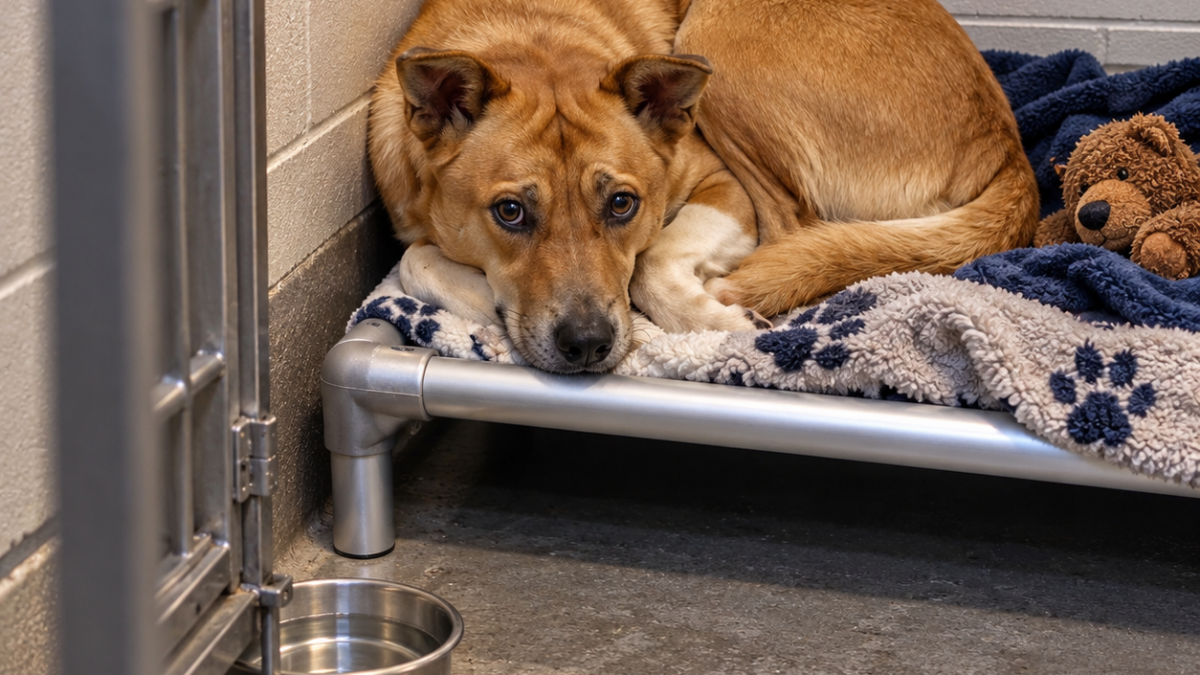
Evelyn stayed crouched in front of Milo’s kennel for nearly ten minutes.
She didn’t reach through the bars right away.
That mattered.
Most people did.
They saw his soft coat, his big ears, the white paws, and their first instinct was to touch.
Milo usually welcomed it.
But Evelyn simply rested her hand against the door and waited.
Milo kept his head there.
His eyes remained closed.
For a dog who had spent months lifting his head at every footstep, that moment looked almost like surrender.
Not the bad kind.
Relief.
I stood several feet away and watched.
One of our younger volunteers, Casey, came beside me.
“Who is she?”
“Walk-in.”
“She interested in Milo?”
“I don’t know yet.”
Casey watched them.
“She looks like she’s crying.”
She was.
Not dramatically.
No sobbing.
One tear moved down Evelyn’s cheek.
She wiped it quickly.
Then Milo opened his eyes.
He looked at her.
Evelyn whispered something I couldn’t hear.
His tail moved once.
Then again.
Not the wild full-body wag from October.
But more than I had seen in days.
I walked over slowly.
“Would you like me to open the kennel?”
Evelyn looked up.
Her expression changed immediately.
Fear.
Not of Milo.
Of the question.
“I don’t know.”
“That’s okay.”
“I wasn’t planning to adopt today.”
“You don’t have to.”
“I just wanted to look.”
“That’s allowed too.”
She looked at Milo again.
“My daughter told me to come.”
“Oh?”
“She said the house was too quiet.”
Milo lifted his head.
Evelyn smiled weakly.
“It is.”
I unlocked the kennel.
“Would you like to meet him in one of our visiting rooms?”
She hesitated.
Then nodded.
“All right.”
Milo stood the moment the latch clicked.
That alone nearly broke me.
For weeks, he had started approaching his own kennel door slowly.
Sometimes he stayed halfway back.
That day, when the door opened, Milo stepped out.
No jumping.
No pulling.
He stood beside Evelyn.
I handed her the leash.
She stared at it.
“I haven’t held one of these since Charlie died.”
“Charlie?”
“My dog.”
I nodded.
“What was he?”
“Golden retriever.”
“How old?”
“Thirteen.”
Her mouth tightened.
“My husband died first. Charlie lasted another four months.”
I didn’t know what to say.
Sometimes shelter work teaches you not to rush into comforting sentences.
There are losses too large for “I’m sorry” to hold.
So I simply said, “Milo walks gently.”
Evelyn took the leash.
“Okay.”
We moved toward the visiting room.
Milo stayed beside her.
Not perfectly in heel position.
He sniffed the wall once.
Paused at a door.
Then looked back at Evelyn as though checking whether they were still going the same way.
She smiled.
“He keeps looking at me.”
“He does that.”
“Why?”
“He pays attention to people.”
The room had two chairs, a small bench, a basket of toys, and a rug that had survived more accidents than any rug should.
Evelyn sat.
Milo remained standing at first.
She didn’t call him.
Didn’t pat her knees.
She just held the leash loosely.
Milo sniffed the room.
Then came toward her.
He pressed his side against her shin.
Evelyn froze.
“Milo.”
His head lifted.
She looked at me.
“Does he know his name?”
“Yes.”
Milo’s ears perked.
One almost stood.
The other folded sideways.
Evelyn laughed.
It was the first real laugh I heard from her.
“He looks ridiculous.”
“That ear has been making bad decisions since October.”
She laughed again.
Milo wagged.
Then he sat beside her.
Not facing me.
Facing the door.
But his shoulder remained against her leg.
I watched Evelyn put one hand on his back.
Slowly.
Milo leaned.
Her face collapsed.
She began crying.
“I’m sorry.”
“You don’t have to apologize.”
She kept petting him.
“My husband used to say Charlie knew whenever I was sad.”
Milo looked up.
She laughed through tears.
“Maybe all dogs know.”
“Some are very good at it.”
She stayed forty-five minutes.
When the session ended, Evelyn stood reluctantly.
Milo stood too.
She handed me the leash.
“I need to think.”
“That’s fine.”
“I don’t want to take a dog home just because I’m lonely.”
“That’s a good reason to think.”
“I don’t want him to be a replacement.”
“That’s also good.”
Evelyn looked at Milo.
“He’s not.”
“No.”
“He couldn’t be.”
“No dog can.”
She nodded.
Then walked toward the lobby.
Milo followed until the leash stopped him.
He watched her leave.
I prepared myself for the old sadness.
The ears lowering.
Body softening.
Retreat to the blanket.
Instead, Milo kept staring at the door.
His tail moved.
As though he expected something.
I crouched beside him.
“Don’t do this to yourself.”
He looked at me.
“I mean it.”
Tail wag.
“You don’t know.”
I led him back.
That evening, Milo ate normally.
The next morning, he was at the front of his kennel when I arrived.
I noticed immediately.
“Who are you waiting for?”
His ears lifted at my voice.
I laughed.
“You’re ridiculous.”
At 1:17 p.m., the lobby phone rang.
I wasn’t at the desk, but Casey answered.
A few minutes later she found me cleaning a water bowl.
“You have a girlfriend calling.”
“What?”
“Evelyn.”
My heart jumped.
“What did she say?”
“She asked if she could visit Milo.”
“When?”
“Today.”
I looked toward the kennel hallway.
“Of course.”
Evelyn arrived at three.
This time Milo heard her before he saw her.
Her voice carried from the lobby.
His head came up.
Then he stood.
Not slowly.
Immediately.
He moved to the door.
I stared.
The old Milo.
Not completely.
But a piece of him.
Evelyn entered the hallway.
Milo’s tail started.
Faster.
She stopped.
“Oh.”
I smiled.
“He remembers you.”
“Are you sure?”
Milo pressed against the kennel.
“Yes.”
She crouched.
“Hi, Milo.”
His entire body curved sideways.
Evelyn looked at me, stunned.
“He didn’t do that yesterday.”
“No.”
“Why today?”
“Because yesterday you were a stranger.”
Her eyes filled again.
That second visit lasted almost an hour.
They walked outside.
Milo rolled in the grass.
Evelyn laughed when dirt got on her coat.
She threw a tennis ball.
Milo chased it once, brought it halfway back, then became distracted by a leaf.
“Not much of a retriever.”
“Definitely not Charlie.”
“No.”
Evelyn smiled.
“That’s good.”
I understood exactly what she meant.
She came again the next day.
Then the next.
Three days in a row.
Each time, Milo’s reaction grew bigger.
By the third visit, he was making a small sound when she appeared.
Not barking.
A kind of breathy whine.
The sound he used when excitement became too big to fit inside his body.
Casey looked at me.
“He picked her.”
I crossed my arms.
“Dogs don’t make adoption decisions.”
“Tell him.”
Milo was leaning against the kennel door watching Evelyn sign in.
I smiled.
“Okay. He picked her.”
Still, we did not rush Evelyn.
Shelter staff sometimes become emotionally invested in placements, and that can be dangerous.
Wanting a happy ending cannot become pressure.
So I asked the practical questions.
Housing.
Fenced yard.
Other pets.
Schedule.
Veterinary plan.
Financial readiness.
Travel.
Long-term care.
Evelyn answered patiently.
She lived alone in a yellow farmhouse thirty minutes outside town.
Her granddaughter stayed after school several days a week.
Her daughter lived ten minutes away.
There was a fenced backyard.
She worked part-time from home doing bookkeeping for two local businesses.
The house had no other pets.
She had a veterinarian.
And she had one concern.
“What if I’m doing this because I miss Charlie?”
I looked at Milo through the window.
He was lying outside the interview room.
Waiting.
“Do you expect Milo to be Charlie?”
“No.”
“Do you want him to behave like Charlie?”
“No.”
“Do you think he’ll make you stop missing Charlie?”
Evelyn looked down.
“No.”
“Then maybe missing Charlie is simply the reason your house has space for another dog.”
She looked at me.
“That sounds like something you’ve said before.”
“I haven’t.”
“Good line.”
“I’m stealing it for future use.”
She laughed.
The fourth day, she brought a leash.
Not ours.
New.
Dark green.
Milo saw it.
His entire body changed.
I pretended not to notice because I was already emotional enough.
Evelyn signed the final papers.
Casey cried while printing them.
“You are embarrassing.”
“I don’t care.”
Another volunteer came by.
“Is Milo leaving?”
“Yes.”
Within fifteen minutes, word spread.
People who were not scheduled near the adoption desk suddenly found reasons to walk through the lobby.
One technician needed “forms.”
A kennel attendant brought a bag of food nobody had asked for.
The shelter director came out of her office.
Everyone wanted to see.
Milo’s kennel door opened.
He stepped out.
For four months, that hallway had been the center of his world.
He knew every sound.
Every corner.
Every door.
He could have pulled toward the exit.
Instead, he looked at Evelyn.
She held the green leash.
“All right, buddy.”
Milo walked beside her.
Calmly.
Too calmly.
I expected him to realize what was happening.
Maybe he did.
Maybe he didn’t.
At the lobby door, Evelyn stopped.
She turned toward us.
“Thank you.”
Her voice broke.
I shook my head.
“Take care of him.”
“I will.”
“Seriously.”
“I know.”
“He likes sleeping on soft blankets.”
“I bought three.”
“He steals pieces of cheese if you leave them low enough.”
“I heard.”
“He doesn’t like the loud dryer near the kennel room.”
“I don’t own a loud dryer.”
“He sleeps better after a long walk.”
“Anna.”
I stopped.
Evelyn smiled through tears.
“He’s going to be okay.”
That was exactly what I needed to hear.
I nodded.
“I know.”
The door opened.
Cold January air entered.
Milo stepped outside.
Then suddenly he turned around.
Looked through the glass at us.
Every shelter employee froze.
His tail started.
Slow.
Then full speed.
His entire body moved.
The Milo from October.
The dog we thought we had lost.
Evelyn laughed.
“Come on.”
Milo turned.
They walked toward the parking lot.
We watched through the windows.
Evelyn opened the rear door of her SUV.
Milo looked inside.
Then jumped.
No hesitation.
He spun twice on the back seat and pressed his face to the glass.
Casey started crying harder.
“I hate this job.”
“No, you don’t.”
“I hate the good parts.”
“That doesn’t make sense.”
“I know.”
Evelyn pulled away.
Milo remained at the window until the vehicle disappeared.
For several seconds, nobody moved.
Then our director clapped her hands once.
“All right. There are thirty-seven other dogs here.”
That was shelter life.
No credits.
No ending music.
Someone gets adopted.
Another dog needs medication.
Another needs a walk.
Another just arrived.
Milo’s kennel was cleaned that afternoon.
That hurt more than I expected.
His blanket went into laundry.
Food bowl removed.
Information card taken down.
The kennel looked too empty.
I stood there.
Casey came beside me.
“Feels weird.”
“Yes.”
“You think he’s okay?”
“I hope so.”
“You know you’re going to check.”
“Obviously.”
Our shelter gave adopters space.
We didn’t call two hours later demanding emotional updates.
But Evelyn beat us to it.
That evening, my phone buzzed.
A picture.
Milo lying on a kitchen rug.
Next to him sat a stainless-steel bowl, completely empty.
Caption:
**Dinner successful. He inspected every room twice and is currently supervising me.**
I laughed.
Another photo came.
Milo standing beside a couch.
Caption:
**He has been informed he is not allowed on this couch. He appears unconvinced.**
I replied:
**Stay strong.**
Evelyn sent:
**I don’t think I will.**
The next morning:
Milo on the couch.
Of course.
I showed Casey.
“She lasted twelve hours.”
“Told you.”
Milo’s transition was not perfect.
That part matters.
Happy adoption photos can create the illusion that shelter stress disappears at the front door.
It doesn’t.
For the first two nights, Milo paced.
He slept near the hallway.
Every unfamiliar sound made him lift his head.
When Evelyn walked out of a room, he followed immediately.
She told me he seemed afraid to lose sight of her.
That made sense.
People had been walking away from him for months.
Not cruelly.
But repeatedly.
Shelter visitors.
Volunteers finishing shifts.
Families leaving.
Everyone left eventually.
A home had to teach him something new.
This person comes back.
On the third night, Evelyn woke around two.
Milo was sitting beside her bed.
Not whining.
Just watching.
She reached down.
“You want up?”
Technically, the plan had been dog bed only.
Milo placed one paw on the mattress.
Plan over.
He climbed up.
Curled near her feet.
And slept until morning.
When Evelyn told me, she sounded embarrassed.
“I’m ruining him.”
“No.”
“He’s on the bed now.”
“Charlie slept there?”
“Yes.”
“For thirteen years?”
“Yes.”
“Then your standards were never real.”
She laughed.
“That’s fair.”
Within two weeks, Milo learned the farmhouse.
Kitchen.
Bedroom.
Backyard.
Porch.
Garden.
The room Evelyn called the den but used mostly to store unopened mail.
He learned the sound of her coffee grinder.
The squeak of the back gate.
The drawer where treats lived.
The schedule of the school bus.
The last one fascinated me.
Evelyn’s granddaughter, Sophie, was twelve.
She got off the bus near the end of the long driveway every weekday at 3:42.
By the second week, Milo began going to the front window around 3:30.
No one taught him.
He simply learned.
At 3:41, he stood.
At 3:42, bus brakes squealed on the road.
Milo’s tail exploded.
Sophie came running up the driveway.
The first video Evelyn sent showed Milo bouncing between the window and front door.
The dog who had once stopped walking to his kennel entrance for strangers now waited every afternoon for a specific person.
That difference mattered.
Shelter hope had been general.
Anyone.
Please.
Maybe you.
Maybe today.
Home gave hope names.
Evelyn.
Sophie.
People who came back.
One month after adoption, Evelyn brought Milo to the shelter for a visit.
We almost told her not to.
Some dogs become anxious returning.
But Milo’s behavior had been stable, and our behavior coordinator thought a brief positive visit was safe.
I was walking a nervous hound in the yard when Casey ran outside.
“Milo!”
I nearly dropped the leash.
“Where?”
“Lobby.”
I handed the hound to another volunteer and went inside.
Milo saw me.
For one second, he stared.
Then his tail started.
He ran.
Not away from Evelyn.
Toward me.
He hit my knees hard enough that I staggered.
“Milo!”
I crouched.
He shoved his head under my chin.
I laughed.
“You remember me.”
Evelyn stood nearby smiling.
“He remembers everyone.”
Casey came next.
Milo lost his mind again.
Our director.
Another volunteer.
He greeted everyone.
But something had changed.
After each greeting, Milo returned to Evelyn.
Sometimes only for a second.
Touching her leg.
Looking up.
Then moving away again.
Our behavior coordinator noticed.
“Secure base.”
Evelyn frowned.
“What?”
“He checks in with you.”
“Is that bad?”
“No.”
She smiled.
“It means he knows who his person is.”
I looked away before anyone saw my face.
Four months earlier, every stranger had looked important to Milo.
Now everyone could be loved.
But one person meant home.
That was better.
During that visit, Milo passed his old kennel.
I watched carefully.
He stopped.
Sniffed the door.
It belonged to another dog now.
A black Lab mix named Pepper.
Pepper approached the bars.
Milo sniffed.
Tail wag.
Then he moved on.
No hesitation.
No sadness that I could read.
He did not stare.
Did not resist leaving.
The kennel that had once contained his whole world had become just a smell.
I loved that.
Before they left, Evelyn handed us a bag.
“What’s this?”
“Toys.”
“For Milo?”
“No. He has enough.”
She looked embarrassed.
“I bought too many when I first brought him home.”
“How many is too many?”
“Twelve.”
Casey laughed.
“Twelve is normal rescue-adopter behavior.”
“So these are extras.”
We accepted them.
Milo tried to steal one before leaving.
“Sir,” I said.
He froze with a stuffed fox in his mouth.
“That is not yours.”
Tail wag.
Evelyn shook her head.
“You told me he was polite.”
“He was institutionalized.”
Milo ran behind Evelyn with the fox.
“Take it.”
She laughed.
“He’s spoiled.”
“Excellent.”
They left.
This time I did not cry.
Okay.
I cried a little.
But less.
The shelter moved on.
More dogs arrived.
More adoptions.
More returns.
That last word is the one people don’t like discussing.
Returns.
Not every adoption works.
Sometimes housing falls apart.
Sometimes behavioral needs exceed what people can manage.
Sometimes families underestimate time.
Sometimes dogs and resident pets are incompatible.
Sometimes expectations are unrealistic.
I had seen dogs come back.
Many recovered quickly.
Some did not.
Milo’s months at the shelter had taught me how repeated disappointment can quietly change an animal.
That made every update from Evelyn feel precious.
Two months.
Three.
Four.
Still home.
At three months, Milo had his first scare.
Evelyn called.
Not texted.
Called.
My stomach dropped the moment I saw her name.
“Is Milo okay?”
“Yes.”
“Then why are you calling like this?”
“He got out.”
I stood.
“What?”
“The side gate didn’t latch.”
“When?”
“Twenty minutes ago.”
“Do you see him?”
“No.”
I was already grabbing my jacket.
“Call animal control and your neighbors. I’m coming.”
Then Evelyn started crying.
“Anna—”
“We’ll find him.”
“What if he goes back to the highway?”
“We’ll find him.”
I repeated it with more certainty than I had.
The farmhouse sat near open fields, wooded patches, and scattered roads.
A scared dog could travel.
But Milo knew Evelyn.
He knew home.
That mattered.
By the time I arrived, several neighbors were searching.
Sophie was crying on the porch.
Evelyn looked pale.
“What happened?”
“I was bringing groceries in. I thought the gate clicked.”
“It happens.”
“I should’ve checked.”
“Later.”
We divided search areas.
I carried a leash, treats, and Milo’s favorite squeaky fox—the replacement for the one he had stolen from us.
We searched the road.
Fields.
Ditches.
I hated ditches.
Too many animals begin stories there.
Forty minutes.
Nothing.
Then Sophie shouted from behind the house.
“Grandma!”
We ran.
Milo was sitting outside the back gate.
Just sitting.
Mud on his paws.
Tail wagging.
Evelyn stopped so hard I nearly hit her.
“Milo.”
His tail moved harder.
She crossed the yard.
Milo stood.
Evelyn dropped to her knees and wrapped both arms around him.
He licked her face.
I bent over laughing from relief.
“You idiot.”
Milo looked at me.
“You had an entire county.”
Tail wag.
“And you came back here?”
Evelyn buried her face against him.
Sophie hugged them both.
That moment changed something for Evelyn.
Later, after everyone left, she called me.
“He came back.”
“Yes.”
“On his own.”
“Yes.”
“I know that sounds obvious.”
“It doesn’t.”
She was quiet.
Then she said, “My husband never got to come home.”
I closed my eyes.
There it was.
The deeper fear.
Not the gate.
Loss.
She continued.
“When Charlie died, I took him to the hospital and came home without him.”
I said nothing.
“When Milo got out, all I could think was, not again.”
“He came back.”
“I know.”
Her voice softened.
“He came back.”
Sometimes a dog does not heal only his own abandonment.
Sometimes his return becomes medicine for someone else’s.
Milo’s first summer at the farmhouse was absurdly happy.
Evelyn gardened.
Milo destroyed parts of the garden.
There was conflict.
She planted tomatoes.
Milo dug beside them.
She planted lavender.
Milo slept on it.
She installed a small fence around one bed.
Milo jumped it once, then looked offended when asked to leave.
She called me.
“You told me he was well-behaved.”
“He sat for food.”
“That is not the same as well-behaved.”
“Correct.”
“He has removed a pepper plant.”
“Evidence?”
“I watched him.”
“Alleged.”
“You’re useless.”
Milo learned to patrol rows with Evelyn.
She talked to him constantly.
Not baby talk.
Conversations.
Her daughter said Evelyn had always talked while gardening, even when her husband was alive.
Now Milo became the listener.
“What do you think, tomatoes here?”
Milo sniffed.
“Exactly.”
“Should I move the rosemary?”
Milo lay down.
“You never help.”
He followed anyway.
The yellow farmhouse changed too.
Evelyn had stopped using several rooms after her husband died.
Too painful.
One was his study.
Door closed.
Dust gathering.
Milo discovered it because the latch failed to catch one afternoon.
Evelyn found him asleep beneath the desk.
She stood in the doorway.
For months she had not entered.
Milo lifted his head.
Tail wag.
She almost called him out.
Instead, she stepped inside.
On the desk were her husband’s reading glasses.
A pen.
An old stack of bills.
Nothing dramatic.
The ordinary remains of someone’s life.
Evelyn sat in his chair.
Milo came over.
Placed his head on her knee.
She cried.
Then opened the curtains.
That evening, she called Sophie’s mother and asked for help sorting the room.
Not erasing it.
Using it.
Eventually it became a reading room.
Her husband’s books stayed.
So did his chair.
Milo slept there often.
Evelyn told me, “I think he makes rooms less haunted.”
I understood.
Dogs are good at filling empty spaces without asking you to deny why they became empty.
By fall, one year after Milo arrived at the shelter, we held our annual adoption day.
Evelyn agreed to bring him.
We used before-and-after photos for several dogs.
Milo’s shelter photo showed him at the front of the kennel.
Ears uneven.
Eyes bright.
His later photo showed him on Evelyn’s porch, one paw hanging off the top step, completely relaxed.
People loved his story.
A woman asked Evelyn:
“Did you know right away?”
Evelyn smiled.
“No.”
Milo leaned against her.
“I was actually trying not to adopt him.”
Everyone laughed.
“Why?”
“Because I was afraid loving another dog meant I was replacing the one I lost.”
She scratched Milo’s neck.
“Then I realized love doesn’t work like furniture. You don’t remove one piece and put another in the same spot.”
I looked at her.
That line was better than mine.
I made a mental note.
Another visitor asked:
“Did he save you?”
I expected the usual sentimental answer.
Instead, Evelyn thought.
Then said, “We gave each other somewhere to go next.”
That stayed with me.
Some rescue stories become simplified.
Dog saves grieving woman.
Woman saves lonely dog.
The truth was less dramatic and more beautiful.
They met at the right moment.
Milo had spent four months learning what it felt like to wait.
Evelyn had spent six months learning what it felt like when someone never came home.
Neither needed a hero.
They needed routine.
Presence.
Someone to expect.
That is what they gave each other.
Milo’s “revenge,” if you want to call it that, was never against a cruel person.
No one had intentionally wronged him.
That mattered.
There was no villain.
His bad luck had been ordinary.
Invisible.
A dog overlooked while other dogs went home.
People often find that harder to accept because anger likes a target.
But sometimes pain has no villain.
Sometimes the enemy is timing.
Crowded shelters.
Too many animals.
Too few adopters.
A photograph nobody noticed online.
A family choosing a puppy instead.
A dog who becomes background.
Milo’s victory was not watching anyone suffer.
It was becoming impossible to overlook in one person’s life.
He had spent months watching people walk away.
Now Evelyn noticed when he moved rooms.
Not because she was anxious.
Because he mattered.
If Milo slept longer than usual, she noticed.
If he left food, she noticed.
If he waited by the window, she knew why.
He was no longer one dog among dozens.
He was Milo.
Her Milo.
That individuality was the comeback.
Winter returned.
One year since Evelyn’s first visit.
She sent us a Christmas card.
A real paper card.
On the front was a photograph of the yellow farmhouse covered in snow.
Milo sat on the porch wearing a red scarf.
He looked deeply embarrassed.
Inside, Evelyn wrote:
**Milo has been informed he is not human. He disagrees.**
Then:
**He still waits for Sophie’s bus. He still sleeps on the couch he was never allowed to use. He knows when I’m sad before I do. Thank you for letting us find each other.**
Casey read it twice.
Then taped it to the break-room refrigerator.
We kept shelter success stories there.
Not because happy endings erased hard days.
Because some days were brutal.
An injured intake.
A surrender after ten years.
A dog returned because the family moved.
A puppy too sick to save.
On those days, we looked at the refrigerator.
Milo.
And others.
Proof that shelter walls were not always endings.
Sometimes waiting eventually became leaving.
The good kind.
A year and a half after adoption, Milo became sick.
Nothing catastrophic at first.
He stopped eating breakfast.
Evelyn knew immediately.
She called her veterinarian.
An examination found a gastrointestinal issue requiring medication and monitoring.
He would likely recover quickly.
Rationally, Evelyn understood.
Emotionally, she panicked.
She called me that evening.
“He won’t eat.”
“What did the vet say?”
“That he may not tonight.”
“Is he drinking?”
“Yes.”
“Medication?”
“Yes.”
“Then follow the plan.”
Silence.
“Evelyn?”
“I’m scared.”
I softened.
“I know.”
“What if something happens?”
“He’s young.”
“I know.”
“This is treatable.”
“I know.”
“Then what are you actually scared of?”
She was quiet for a long time.
Finally:
“I know how fast a house can become empty.”
That sentence stayed between us.
I understood.
Milo lay beside her while we spoke.
I could hear his collar move.
I said, “You don’t have to solve the future tonight.”
“What do I do?”
“Take care of tonight.”
She exhaled.
“Medication?”
“Yes.”
“Water?”
“Yes.”
“Stay near him?”
“If he wants.”
“He always wants.”
“Then do that.”
The next morning, Milo ate three bites.
Evelyn texted me immediately.
**THREE BITES.**
I replied:
**Good.**
Two hours later:
**Seven more.**
**Better.**
By evening:
**He stole chicken from my plate.**
I responded:
**Fully recovered.**
She called me rude.
Milo was fine within days.
But the incident changed Evelyn too.
She realized loving again had not removed fear of losing again.
That is another truth people rarely include in rescue stories.
A happy ending does not make you invulnerable.
It gives you something valuable enough to fear losing.
That fear can become the cost of attachment.
But the alternative is emptiness.
Evelyn chose the risk.
So did Milo.
A few months later, Sophie wrote a school essay about him.
Her teacher gave it to Evelyn, who sent me a copy.
The title was:
**The Dog Who Waits for My Bus**
Sophie wrote about how Milo seemed to know exactly when she arrived.
How he met her at the door.
How he sat beside her during homework.
How he once stole half a peanut-butter sandwich.
Then came a paragraph that made me stop.
**Grandma used to be quiet after Grandpa died. She still misses him, but now she talks more because Milo is always listening. I think Milo had to wait at the shelter so he could be there when Grandma was ready.**
I’m not sure I believe fate works that neatly.
Shelter workers see too much randomness to romanticize every delay.
I wish Milo had been adopted immediately.
I wish no dog had to spend months behind bars waiting for the right person.
But I understood what Sophie meant.
Looking backward, the timing felt meaningful.
Milo was still there.
Evelyn finally walked in.
Two lonely timelines crossed.
That was enough.
Two years after Milo’s intake, animal control called us about another stray found near the same gas station off Highway 14.
A brindle female.
No collar.
Scared.
When I heard the location, Milo flashed into my mind.
We took her in.
Her name became Maple.
Unlike Milo, Maple was terrified.
She hid at the back of her kennel.
Would not walk on leash.
Avoided hands.
I found myself thinking about how easy Milo had been by comparison.
And still he waited four months.
Maple would likely wait longer.
That frightened me.
One afternoon, Evelyn visited to donate blankets.
Milo came too.
He could not enter intake areas freely, but our behavior coordinator suggested introducing him to Maple through the yard fence because she responded well to other dogs.
Milo approached.
Maple retreated.
He stopped.
Perfect.
No pressure.
He sniffed grass.
Looked away.
Maple watched.
Ten minutes later, she came closer.
Milo remained casual.
They sniffed through the fence.
Maple’s tail moved.
Evelyn smiled.
“He’s good at this.”
“He always liked other dogs.”
We arranged several controlled meetings over the next weeks.
Milo became one of Maple’s confidence dogs.
Watching him, I felt something close to pride.
The dog who once needed us to protect his hope now helped another dog find hers.
Maple eventually got adopted by a young family.
On adoption day, Evelyn brought Milo.
Not necessary.
We simply wanted him there.
Maple walked out beside her new people.
Milo watched.
I scratched his neck.
“Look at you.”
His tail moved.
“You’re staff now.”
Evelyn laughed.
“He’ll want benefits.”
“He already has a couch.”
“Two couches.”
“Unacceptable.”
Milo looked at us.
Completely unashamed.
Years passed.
Not many.
Enough for routines to become history.
Milo’s ears never fully decided what they were doing.
One usually stood.
The other flopped slightly.
His white paws remained ridiculous.
His amber eyes softened.
The yellow farmhouse became inseparable from him.
People in town knew “Evelyn and Milo.”
Not Evelyn.
Not Milo.
Together.
The hardware store kept treats behind the counter.
The mail carrier knew not to leave boxes where Milo would investigate them.
Sophie grew taller.
Then entered high school.
The bus schedule changed.
Milo adjusted within four days.
Of course.
Evelyn gardened every spring.
Milo continued sleeping on whichever plants were most expensive.
One year she built raised beds.
“Dog-proof.”
Milo learned to rest beneath them.
Compromise.
I visited sometimes.
Not often enough to feel intrusive.
Every time, Milo greeted me.
Then returned to Evelyn.
That always made me happy.
I didn’t need to remain central to his life.
Shelter workers are bridges.
If we do the job right, dogs cross us and keep going.
We should become less necessary.
Milo taught me that.
At the shelter, I had once been one of his favorite people.
Later, I became someone he was happy to see.
Evelyn became home.
That was success.
During one visit, I noticed something else.
Milo did not watch the door when Evelyn left the room.
In the early months, he followed.
Now she went into the kitchen.
Milo stayed stretched on the rug.
I pointed.
“He didn’t follow you.”
Evelyn returned holding coffee.
“He’s gotten lazy.”
“No.”
I smiled.
“He trusts you.”
She looked at him.
Her expression softened.
“I suppose he does.”
Trust eventually becomes boring.
That is one of my favorite things about it.
The first time a dog lets someone leave a room without panicking can be huge.
Years later, nobody notices.
That is healing.
Safety becoming unremarkable.
Milo still greeted Evelyn at the door like she had returned from war even if she had only taken trash outside.
Some habits were joyful enough to stay.
When Evelyn traveled overnight for a family wedding, Milo stayed with her daughter.
He did fine.
But when Evelyn returned, Sophie filmed the reunion.
Milo heard the car.
Ran to the door.
Whined.
Spun.
When Evelyn entered, he pressed his entire body against her.
She laughed.
“You saw me yesterday!”
Milo disagreed.
The video lasted forty seconds.
I watched it ten times.
Not because it was dramatic.
Because I remembered the shelter hallway.
Milo’s eyes following strangers.
Every departure uncertain.
Now absence had an ending he understood.
She returns.
That knowledge changed everything.
On the third anniversary of his adoption, Evelyn came by alone.
No Milo.
That worried me.
“Is he okay?”
“Yes.”
She laughed.
“He’s at the groomer.”
“Oh.”
“You look terrified.”
“Occupational hazard.”
She handed me a small box.
Inside was a framed photograph.
Milo beneath the oak tree behind the shelter.
I had taken it during one of our lunch breaks years earlier.
He was lying beside me.
Head up.
Watching the parking lot.
I stared.
“How did you get this?”
“You sent it to me after the adoption.”
I barely remembered.
She pointed to the inscription beneath it.
**For the place that kept him safe until I was ready.**
I could not speak for a moment.
Evelyn touched my arm.
“I know shelters get blamed for being sad places.”
“We are sad sometimes.”
“I know.”
She looked down the adoption hallway.
“But you held him until I got here.”
That sentence changed how I thought about Milo’s four months.
I had always viewed them as failure.
Four months nobody chose him.
Four months of noise.
Disappointment.
Hope wearing thin.
And yes, those months were hard.
They mattered.
But the shelter had also done something essential.
It held him.
Fed him.
Walked him.
Let him nap under an oak tree.
Kept hope alive enough that when Evelyn came, there was still something left to meet her.
Shelter time is not home.
It should not become home when adoption is possible.
But it can be a bridge.
That matters.
I hung the photograph in the break room beside the Christmas card.
New volunteers asked about him.
I told them:
“That dog taught me you can’t always predict who leaves quickly.”
“What happened?”
“He found his person.”
“How long?”
“Four months.”
Some looked shocked.
“That’s not that long.”
They were right in calendar terms.
For Milo, it had been thousands of hours.
We never forgot that.
His story changed how we handled long-stay dogs.
We increased quiet breaks.
More off-site walks.
More foster weekends when possible.
We trained volunteers to recognize subtle shutdown.
Not every dog stops eating.
Not every dog growls.
Some simply stop coming to the front.
Milo had shown us what disappearing hope can look like.
We became better because of him.
Maybe that was another part of his comeback.
His waiting helped dogs after him wait more safely.
One dog named Jasper stayed six months.
We used a “Milo routine.”
Daily yard nap.
Predictable volunteer team.
Weekly off-site outing.
Rotating enrichment.
Jasper never shut down the same way.
When he was adopted, Casey said:
“Tell Milo thanks.”
I did.
I texted Evelyn.
**Your dog is now an unofficial shelter policy.**
She replied:
**He has always been management material.**
Milo’s fifth Christmas card showed him with a gray hair around his muzzle.
Not much.
One small patch.
I stared longer than necessary.
Time moves differently after adoption too.
Shelter staff meet a dog in crisis and freeze them mentally at that age.
Seeing gray felt impossible.
I called Evelyn.
“Your dog is aging without permission.”
“He’s offended by the accusation.”
“How is he?”
“Currently asleep on my coat.”
“Of course.”
She paused.
“Anna?”
“Yes?”
“Thank you.”
“For what?”
“For still caring.”
I smiled.
“You never stop caring about some of them.”
Milo was one.
Not because he was the saddest case.
He wasn’t.
Not the most medically complicated.
Not the most dramatic.
He was memorable because hope changed visibly inside him.
Then came back.
That is hard to forget.
As Milo got older, Evelyn slowed too.
Knees.
Back.
Ordinary aging.
Their walks became shorter.
Less mileage.
More porch time.
Milo did not mind.
He had always been good at simply being near someone.
They sat outside together.
Evelyn with coffee.
Milo in the sun.
Sophie, now driving herself, still visited.
Milo recognized her car before it turned into the driveway.
No more bus brakes.
New sound.
Same expectation.
One afternoon, Sophie brought her boyfriend.
Milo inspected him seriously.
Evelyn told me:
“He passed.”
“What was the test?”
“Milo leaned against him.”
“High standards.”
“Very.”
Years earlier, any stranger had been a chance at adoption.
Now strangers were evaluated for entrance into Milo’s existing family.
That reversal amused me.
He no longer needed everyone.
He had people.
That changes a dog.
It changes humans too.
When Milo was around eight, he developed arthritis.
Nothing catastrophic.
Manageable.
Medication.
Weight control.
Modified exercise.
Evelyn called me after the diagnosis.
“He’s getting old.”
I remembered the first time she met him.
Sixty-three.
Recently widowed.
Afraid of another loss.
Years had passed anyway.
That is the price of staying.
I said, “He’s lucky.”
She laughed sadly.
“How is arthritis lucky?”
“He got old.”
Silence.
Then:
“Oh.”
“He got years.”
Evelyn exhaled.
“Yes.”
The same dog once lying halfway back in a shelter kennel because hope had become tiring now had enough time to develop old joints.
That is not tragedy.
That is privilege.
We should all be so lucky after abandonment.
Milo adapted.
Shorter walks.
Orthopedic bed.
Rug runners on slippery floors.
Couch ramp.
Yes.
A ramp for the couch he was never supposed to use.
I reminded Evelyn of that.
She said, “I was young and foolish.”
“You were sixty-three.”
“Exactly.”
Milo used the ramp.
Mostly.
Sometimes he waited until Evelyn helped him because manipulation does not disappear with arthritis.
“He can do it himself,” I said during a visit.
“I know.”
“You still help.”
“He likes it.”
“He trained you.”
“Yes.”
No shame.
One evening, we sat on her porch.
Milo asleep between us.
Golden light across the fields.
Evelyn said, “Do you remember what you told me?”
“What?”
“That maybe missing Charlie was why my house had space for another dog.”
I smiled.
“I stole that from myself many times.”
“It was true.”
Milo’s ear moved in sleep.
Evelyn continued.
“I thought if I loved him, it would somehow reduce what Charlie meant.”
“It didn’t.”
“No.”
She looked toward Milo.
“It made my life bigger.”
That was the simplest explanation.
Grief tells people love is a finite room.
Filled once.
Then emptied.
But Milo had not entered Charlie’s place.
He created his own.
Different routines.
Different personality.
Different memories.
The house became layered.
Her husband.
Charlie.
Milo.
Sophie.
Loss and life occupying the same space.
That is what healing often looks like.
Not replacement.
Expansion.
At the shelter, new dogs kept arriving.
I became senior staff.
Casey became behavior coordinator.
The oak tree got struck by lightning one spring.
Not destroyed.
Split.
We had to remove one large branch.
I stood beneath it afterward.
Remembered Milo sleeping in the grass.
Head lifting at every car door.
That memory hurt less now.
Because I knew what came next.
Some memories become easier when the ending changes their weight.
Milo had once made me feel powerless.
Nothing was wrong with him.
Still nobody chose him.
That kind of waiting can make shelter staff question everything.
Then Evelyn taught me something too.
You cannot manufacture timing.
We could advertise.
Advocate.
Enrich.
Protect.
But we could not force the right connection.
When it came, our job was to recognize it.
Milo walked to the front.
Evelyn stopped.
The rest grew from there.
One winter, Milo had a more serious health scare.
He collapsed briefly after a walk.
Evelyn rushed him to the vet.
Heart issue.
Treatable but concerning.
Medication began.
Monitoring.
His age suddenly felt real.
Evelyn called me after midnight.
I answered immediately.
“They let him come home.”
“Good.”
“He’s sleeping.”
“Good.”
“I’m sitting on the floor beside him.”
I smiled sadly.
“He knows you’re there.”
“What if I lose him?”
There was no clever answer.
Eventually all rescue stories contain that possibility.
The happiest adoption still moves toward goodbye.
I said, “Then you will lose a dog who knew he was loved every day after January.”
She cried.
“So I’m supposed to be grateful?”
“No.”
That mattered.
“You’re allowed to hate it.”
Silence.
“But don’t grieve tomorrow so hard that you miss tonight.”
Evelyn breathed out.
“You sound older.”
“I work at a shelter.”
“Fair.”
Milo stabilized.
Medication helped.
Months passed.
Then another year.
He surprised everyone.
As dogs often do.
He still greeted Sophie.
Still monitored the kitchen.
Still found sun.
Still expected couch access.
His body slowed.
His joy did not disappear.
Evelyn began sending fewer photographs because daily life no longer felt photograph-worthy.
I loved that.
A dog becoming so integrated into family that nobody thinks to document every nap.
Then one spring morning, years after his adoption, Evelyn called the shelter.
I heard her voice and knew.
You learn that tone.
Milo had declined overnight.
He could not get comfortable.
The veterinarian believed something serious had changed.
Evelyn was taking him in.
I asked, “Do you want me there?”
Long silence.
“Yes.”
I left immediately.
The drive to her veterinarian felt longer than it was.
I thought about October.
Highway 14.
Caramel coat.
White paws.
I thought about four months.
The oak tree.
January.
Evelyn’s hand at the kennel door.
When I arrived, Milo was lying on a blanket.
Older.
Gray muzzle.
Still the same amber eyes.
Evelyn sat beside him.
Sophie, now a young adult, stood near the wall crying.
I crouched.
“Milo.”
His eyes moved toward me.
Tail.
One small thump.
I laughed through tears.
“You remember.”
Of course he did.
I placed my hand near his cheek.
He leaned slightly.
The veterinarian gave us time.
There are moments when every year collapses into one room.
I saw shelter Milo.
Farmhouse Milo.
Young Milo.
Old Milo.
Evelyn kept one hand on his shoulder.
She whispered:
“You stayed.”
That sentence destroyed me.
Not “I stayed.”
You stayed.
Because Milo had.
He survived the shelter.
He came home.
He came back through the gate.
He stayed through grief.
Birthdays.
School buses.
Gardens.
Snow.
Arthritis.
Heart medicine.
Years.
He stayed.
Until his body couldn’t.
The final decision belonged to Evelyn and her veterinarian.
It was time.
No emergency panic.
No suffering stretched for our comfort.
Love sometimes means holding on.
Sometimes letting go.
Evelyn bent over him.
“You were never second.”
Her voice broke.
“Do you hear me?”
Milo breathed slowly.
“You were never Charlie’s replacement.”
She kissed his head.
“You were Milo.”
Sophie held his paw.
I kept my hand on his back.
Milo left surrounded by people who knew his name.
That mattered to me.
He had entered our shelter with no owner.
No chip.
No history.
Nobody came searching.
Years later, when he died, the room was full.
There is a brutal beauty in that difference.
Evelyn remained beside him after.
Nobody rushed her.
Eventually she looked at me.
“You said he would be okay.”
I cried.
“I was right for a long time.”
She laughed through tears.
“Yes.”
We sat there.
No need to turn grief into inspiration immediately.
Sometimes sadness deserves its own room.
Weeks later, a card arrived at the shelter.
From Evelyn.
No photograph.
Just words.
**The house is unbearably quiet again. But this time, the quiet is full of Milo.**
I read it alone.
Then taped it beside his first Christmas card.
Casey found me.
“She okay?”
“Not yet.”
“Will she be?”
“I don’t know.”
Months passed.
Evelyn still volunteered occasionally.
Not with adoptions at first.
Laundry.
Donations.
Tasks where nobody asked whether she was ready for another dog.
One day she stood in the hallway.
Looked at the kennels.
I watched from a distance.
A young dog barked.
Another spun.
A senior mixed breed lay quietly.
Evelyn noticed him.
Of course.
She did not adopt that day.
Or the next.
I won’t turn grief into a cycle that always ends with another dog.
That would cheapen it.
Maybe someday.
Maybe not.
Milo’s story did not need a replacement ending.
His life had been complete.
That is enough.
We eventually created a long-stay enrichment fund in his name.
Not because Milo was famous.
Because he taught us something concrete.
The Milo Fund paid for foster weekends, quiet-yard sessions, off-site walks, enrichment, and behavioral support for dogs who remained longer than expected.
A small plaque near the volunteer room read:
**FOR THE DOGS WHO ARE STILL WAITING**
No dramatic slogan.
No promise.
Just recognition.
Every time a dog stayed past sixty days, we used the fund.
One shepherd named Remy got weekly hikes.
A senior beagle named June spent Sundays with a foster family.
A pit mix named Arthur learned to relax outside the kennel.
Some got adopted.
Some took longer.
But nobody was allowed to disappear quietly into the back of their kennel without us noticing.
That was Milo’s legacy inside the shelter.
Evelyn visited the plaque once.
She ran her fingers over his name.
“He hated waiting.”
“Yes.”
“He was good at it.”
“No.”
I smiled.
“He endured it.”
She nodded.
“Different.”
Very.
People romanticize patience.
Sometimes waiting is not noble.
It is simply what happens when you have no choice.
Milo deserved more than being praised for enduring loneliness.
He deserved what eventually happened.
Selection.
Belonging.
Specific love.
That was why his story mattered.
Years later, a new volunteer asked me:
“What was the hardest part about Milo?”
I thought they meant the ending.
I surprised myself.
“The middle.”
“What do you mean?”
“When nothing was happening.”
The volunteer frowned.
“Before adoption?”
“Yes.”
I looked down the hallway.
“The beginning had hope. The ending had love. The middle was just days.”
That is where people get lost.
Humans can tolerate crisis because crisis demands action.
But long waiting?
That wears you down.
Milo’s story taught me to respect the middle.
The dog still waiting after thirty days.
Sixty.
Ninety.
The staff still showing up.
Still walking.
Still cleaning.
Still saying names.
Still creating moments.
The middle matters because the right ending cannot happen if nobody protects the dog long enough to reach it.
We protected Milo’s middle.
Evelyn gave him the rest.
One late January afternoon, almost exactly the anniversary of their first meeting, I drove past Evelyn’s yellow farmhouse.
I had been visiting another adopter nearby.
I did not stop.
The house looked the same.
Porch.
Fence.
Bare garden beds.
For one second, I could see Milo there in memory.
Sleeping in the sun.
Not shelter Milo.
Home Milo.
That distinction mattered.
I kept driving.
At the shelter, his photograph still hung on the refrigerator.
Young.
Red scarf.
Mildly offended.
Underneath, someone had taped a newer note:
**MILO FUND HELPED 43 LONG-STAY DOGS THIS YEAR.**
I smiled.
Forty-three.
Milo had spent months waiting for one person.
Now his name helped dozens survive waiting better.
That felt like the right kind of revenge against everything that almost wore him down.
Not vengeance.
Continuation.
The lonely kennel did not get the final word.
The people who passed him did not get the final word.
Bad timing did not get the final word.
Milo did.
He left.
He belonged.
He grew old.
He was loved long enough to become gray.
And after he was gone, dogs he never met received afternoons in grass because staff remembered what waiting had done to him.
That is a complete life.
Not perfect.
Complete.
If you had shown me Milo’s whole story during that first October week, I probably would have rejected it.
Four months in shelter?
Too long.
Widow?
Too sentimental.
Years at a farmhouse?
Too neat.
A fund in his name?
Too perfect.
Real life rarely feels believable when seen all at once.
Living it is different.
You get only the next hour.
Next walk.
Next visitor.
Next disappointment.
Then one day, one woman stops.
That is all.
Evelyn did not know she was the ending to Milo’s waiting.
Milo did not know he was the next chapter of her grief.
They simply met.
She crouched.
He walked forward.
That was enough to begin.
I still think about his face the first time she touched him.
Head against the kennel.
Eyes closed.
At the time, I thought he looked tired.
Now I think maybe some part of him had finally recognized what rest could feel like.
Not because he knew Evelyn.
He didn’t.
But perhaps the body understands gentleness before the mind can explain it.
She did not demand.
He did not perform.
For the first time in weeks, Milo approached without trying to impress anyone.
No perfect sit.
No toy.
No desperate tail.
He simply rested.
And she stayed.
That was the beginning of home.
When people ask me which shelter dog I remember most, I never answer easily.
There are too many.
But Milo is one of them.
Because his story was not about dramatic rescue from abuse.
No chains.
No courtroom.
No villain.
Just a good dog waiting too long.
That happens every day.
Maybe that is why his story hurts.
It feels ordinary.
And ordinary heartbreak is easy to ignore.
But ordinary love can be powerful too.
A woman sitting in a parking lot for twenty minutes gathering courage.
A dog standing when he had stopped standing for everyone.
Three visits.
Then four.
A green leash.
A yellow farmhouse.
Coffee on the porch.
A school bus.
A couch rule destroyed immediately.
Years.
Gray hair.
A goodbye.
Then a fund for the next dog.
That was Milo.
He arrived without anyone asking where he was.
He left this world with people wishing desperately he could stay.
I cannot imagine a greater reversal.
The last photograph Evelyn ever gave me sits on my desk now.
Milo is old in it.
Gray around the face.
Lying on the farmhouse porch.
Evelyn’s hand rests beside him.
Not touching.
Just there.
His eyes are closed.
Sun across his white paws.
On the back she wrote:
**He waited four months for me. I got years with him. I still think I got the better deal.**
Maybe she did.
Maybe Milo did.
I think both were finally chosen.
That is enough.
And whenever I walk past a kennel now and see a dog lying halfway back instead of coming forward, I stop.
I sit.
I say the name.
I open the door when I can.
Because I remember Milo.
Hope can get tired.
That does not mean it is gone.
Sometimes it is only waiting for the right footsteps to stop outside the door.








