PART 2: Every Afternoon at 1:15, the Same Dog Walked Into My Bookstore to Sleep—So I Sent a Note Home
PART 2
The handwriting was neat, slightly slanted, written in blue ink.
I started again from the top.
**Dear Bookstore Owner,**
**Thank you for writing. Your note solved a mystery in our house too.**
That first line was what made me laugh.
Then I continued.
**Walter belongs to my father, although at this point the entire family claims partial ownership of him. My mother passed away last year, and since then Dad has been helping me raise my three children while I work double shifts at the hospital.**
I stopped.
Jenna leaned across the counter.
“What?”
I held up one finger and kept reading.
**The children adore Walter. Unfortunately, they believe that means he should participate in everything they do. Tea parties. Blanket forts. Pretend school. Dress-up. Indoor camping. Doctor appointments performed with plastic stethoscopes. He has been a horse, a patient, a student, a dragon, and once, apparently, the mayor.**
Jenna started laughing before I did.
I read the next paragraph aloud.
“Walter is eight years old. He loves the children, but he is exhausted.”
Jenna covered her mouth.
“No.”
I kept going.
**A few months ago, Dad walked Walter past your store and apparently brought him inside. Walter discovered the chair beside the fireplace. After that, he began slipping away every afternoon after lunch. We assumed he was wandering into Dad’s backyard or visiting a neighbor.**
I glanced toward the reading area.
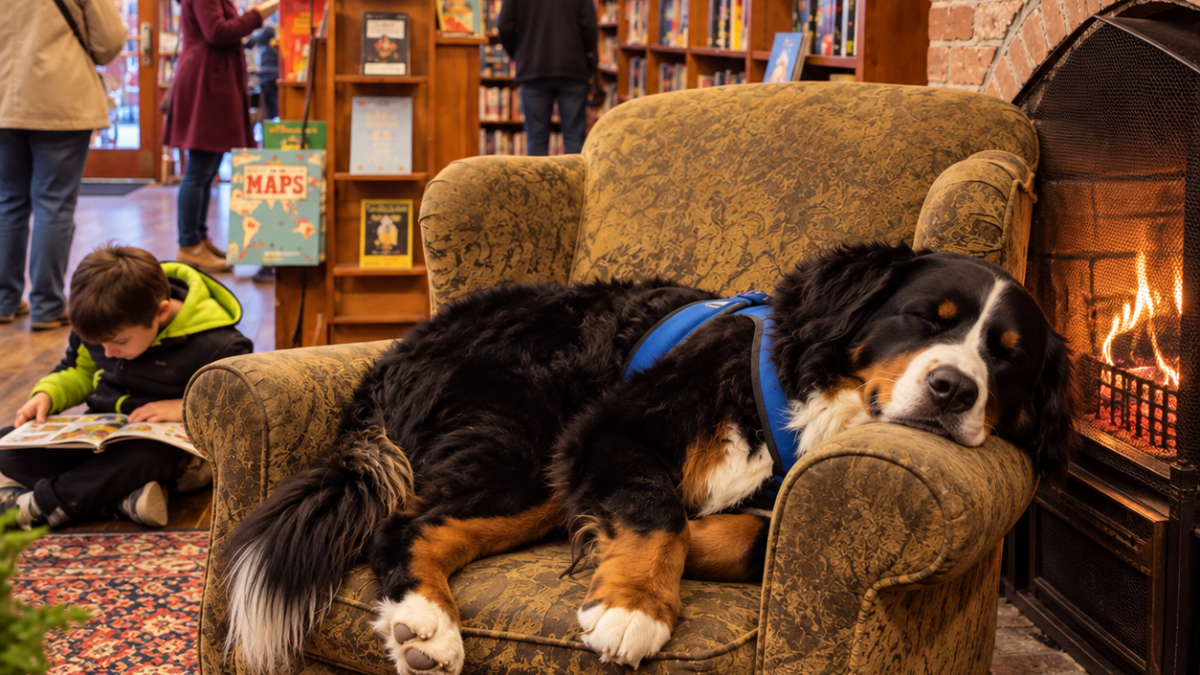
Walter was already curled into the chair.
One enormous paw hung over the armrest.
His eyes were closed.
The note continued.
**Now we know he has been going to your bookstore for uninterrupted sleep.**
**Honestly, we think those two hours may be the happiest part of his day. Thank you for letting him rest.**
**Sincerely,**
**Emily**
For a few seconds neither Jenna nor I said anything.
Then Walter released a deep sigh from across the store.
Jenna pointed at him.
“He’s escaping children.”
I started laughing.
“He has a secret apartment.”
“He basically commutes here for a nap.”
A customer standing near the register had overheard enough of the conversation to become curious.
“What happened?”
I hesitated.
The note was personal.
“I found out why Walter visits us.”
She looked toward him.
“Well?”
I smiled.
“He has three kids at home.”
The woman stared.
“His?”
“Emotionally, apparently.”
That afternoon, Walter’s reputation changed completely.
Until then, customers had viewed him as mysterious.
Afterward, he became relatable.
Retired people nodded knowingly.
Parents looked at him with sympathy.
One exhausted mother of twins crouched beside his chair and whispered, “I understand, Walter.”
He opened one eye.
She laughed.
“Exactly.”
I placed Emily’s note in the drawer beneath the register.
I didn’t display it.
It felt like something entrusted to me rather than something intended for public consumption.
But the explanation spread naturally among our regulars.
“Walter’s on his break.”
“Walter works the morning shift at home.”
“Walter has childcare responsibilities.”
Someone even brought him a tiny cardboard sign that read:
**ON LUNCH—DO NOT DISTURB**
Jenna set it near the chair.
Walter slept through the joke.
For the next several weeks, his routine continued with astonishing consistency.
1:15.
Walk through the front door.
Inspect the room.
Head to the back.
Two hours of sleep.
Wake.
Stretch.
Leave.
Occasionally he arrived five minutes early.
Once he was nearly twenty minutes late, which apparently concerned half the bookstore.
At 1:30, Ruth looked repeatedly toward the door.
“Something’s wrong.”
“He’s a dog, Ruth.”
“He’s punctual.”
At 1:32, Walter appeared.
Ruth shook her head at him.
“You had people worried.”
Walter walked straight past her.
“He’s not even apologizing,” she said.
The funny part was that Walter had never technically been invited.
Nobody had trained him to come.
Nobody brought him.
Nobody picked him up.
He had simply decided that my bookstore was where he wanted to spend his afternoons.
And because he was gentle, clean, quiet, and seemingly incapable of causing trouble, I let him.
I did eventually call the number on his tag.
Emily answered.
“Hi, this is Daniel from Bellweather Books.”
There was a pause.
“The bookstore?”
“Yes.”
“Oh, Walter.”
The way she said his name told me this was not the first phone call he had generated in his life.
“I got your note.”
She laughed.
“And we got yours.”
“I just wanted to make sure everyone actually knows where he is.”
“We do now.”
“You’re comfortable with him coming?”
“If you are.”
“He’s never caused a problem.”
“He won’t. Walter believes himself to be an elderly gentleman.”
“He’s eight.”
“Tell him that.”
I looked across the store.
Walter was lying with his nose pressed against the cushion.
“Does your father know he leaves?”
“He does now. Dad thought Walter was sleeping under the porch.”
“How does he get out?”
“Side gate. Walter learned how to push the latch with his nose.”
“You might want to fix that.”
“We did.”
“And?”
“He figured out the other gate.”
I laughed.
Emily sighed.
“Dad finally decided that a dog who walks three blocks to take a nap and returns home at the same time every day probably has earned some independence.”
“Three blocks?”
“That’s all.”
That made me feel better.
I had imagined Walter crossing busy roads.
Emily continued.
“He never goes anywhere else. We checked.”
“How?”
“My oldest daughter followed him.”
“Secretly?”
“As secretly as an eleven-year-old can follow a hundred-pound dog.”
“So Walter knew.”
“Almost certainly.”
I heard children shouting in the background.
Then a young voice yelled, “Mom! Olivia took my charger!”
Emily covered the phone.
“Give me thirty seconds!”
Another voice shouted something unintelligible.
Emily returned.
“Do you see why he leaves?”
I looked at Walter sleeping peacefully.
“I’m starting to.”
That conversation was the beginning of my friendship with Emily’s family.
Her father’s name was Frank.
A retired electrician.
Seventy-one.
Widowed after forty-six years of marriage.
Emily later told me her mother, Susan, had died after a brief battle with pancreatic cancer.
The loss had rearranged the entire family.
Frank had gone from living quietly with his wife and Walter to sharing most days with three grandchildren.
Emily worked as an emergency-room nurse.
Her schedule was unpredictable.
Some weeks she managed normal shifts.
Other weeks somebody called in sick, the hospital overflowed, or emergencies kept her hours longer than planned.
Frank filled every gap.
School pickups.
Homework.
Dinner.
Laundry.
Soccer practice.
He loved his grandchildren fiercely.
But when I met him, I understood immediately where Walter’s exhaustion came from.
Frank brought the children into the bookstore one Saturday morning.
I knew them before anyone introduced themselves.
A girl carrying three stuffed animals walked through the door first.
Behind her came a boy arguing about a science project.
Then an older girl wearing headphones.
Walter walked in last.
He saw me.
His tail wagged.
Then he looked toward the back of the store.
“You’re not napping,” Frank told him. “It’s Saturday.”
Walter stared at him.
Frank pointed.
“Family outing.”
Walter sighed.
Actually sighed.
I laughed.
“You must be Frank.”
He shook my hand.
“And you must be the man encouraging my dog’s second life.”
“I provide furniture. Walter handles the rest.”
The youngest child stepped forward.
“I’m Lily.”
“Nice to meet you.”
She pointed at Walter.
“He’s my student.”
Walter closed his eyes.
“I teach him math.”
“Is he good?”
“No.”
Frank said, “That’s because you ask him questions while he’s sleeping.”
Lily ignored him.
Her brother, Ethan, corrected her.
“Dogs can’t do math.”
“They can if you teach them.”
The oldest girl removed one headphone.
“I’m Sophie.”
She looked at the armchair.
“So that’s the famous chair.”
“That’s it.”
She turned to Walter.
“You walk all the way here for that?”
Walter headed toward it.
Frank laughed.
“Apparently he does.”
I watched the family spread through the bookstore.
Within ten minutes, Lily was reading picture books to Walter.
Ethan had found the science section.
Sophie disappeared toward young adult fiction.
Frank stood near the fireplace watching all of them.
Something changed in his expression.
I couldn’t name it then.
Later, I understood.
He was tired too.
Not in the same way Walter was.
But grief leaves its own exhaustion.
Frank had lost the person he expected to grow old beside.
Before he had time to understand the silence of that loss, his home filled with children and responsibilities.
He never complained.
Not once.
But sometimes people who are holding everyone else together don’t notice how tired they’ve become.
Maybe Walter did.
That day, Frank sat in the second chair beside Walter.
Within fifteen minutes, both of them were asleep.
Lily whispered to me, “Grandpa snores louder.”
She was correct.
After that, Frank occasionally came with Walter.
Not every day.
Maybe once or twice a week.
He would buy coffee, choose a newspaper or history book, and sit nearby.
Sometimes we talked.
Sometimes we didn’t.
That was the beauty of the bookstore.
Silence didn’t feel awkward there.
It had purpose.
Meanwhile, Walter’s presence began changing other people.
The first person I noticed was a teenager named Maya.
She was sixteen when she started coming in.
Thin, dark hair, oversized sweatshirt, always carrying the same canvas backpack.
The first few visits, she didn’t buy anything.
She simply walked around.
Then she discovered Walter.
I saw her stop several feet from his chair.
She looked at him for almost a minute.
“Does he bite?” she asked.
“No.”
“Can I touch him?”
“If he’s awake.”
Walter was awake.
Barely.
Maya approached slowly.
She held out her hand.
Walter sniffed her fingers.
Then rested his chin on her knee.
Maya froze.
“He likes you.”
“How do you know?”
“He ignores people he doesn’t care about.”
That wasn’t entirely true, but it made her smile.
After that, she started sitting on the floor near him.
She would open a book and read.
Sometimes for twenty minutes.
Sometimes for two hours.
For several weeks, I didn’t know anything about her.
Then one afternoon her mother came in looking worried.
“Is Maya here?”
I pointed toward the back.
Maya was sitting beside Walter.
Her mother’s shoulders dropped with relief.
“Thank God.”
“Is everything okay?”
She hesitated.
“She’s been having a hard time.”
I waited.
“Anxiety. Panic attacks. School has become… difficult.”
I glanced toward Maya.
Walter’s head rested across her shoe.
“She comes here often.”
“I know.”
Her mother looked embarrassed.
“She tells me she’s at the bookstore, but today she didn’t answer her phone.”
“I can remind her.”
“Please.”
Then she looked at Walter.
“That dog yours?”
“No.”
She blinked.
“That’s a longer story.”
A week later, Maya bought her first book from us.
Then another.
Eventually she started helping younger children choose fantasy novels.
Walter remained part of her routine.
She never made a big production out of him.
She simply sat beside him.
Sometimes I would hear her whispering.
Not conversations.
Just thoughts.
The kind teenagers don’t always know where else to put.
Walter listened with his eyes closed.
Another regular was Mr. Carver.
His first name was Thomas, though I didn’t learn that for nearly six months because everybody called him Mr. Carver.
He was in his late seventies and had been married for fifty-three years.
His wife died shortly before Walter began visiting.
Mr. Carver came into the bookstore almost every day.
He bought the newspaper.
Black coffee.
Nothing else.
“Morning,” I would say.
He nodded.
“Afternoon.”
That was the extent of most conversations.
Then one day he came later than usual and found Walter.
Mr. Carver stopped.
Walter lifted his head.
They looked at each other.
I watched from the counter.
Mr. Carver walked over and sat beside him.
Walter placed one paw on the man’s shoe.
That was it.
The next day Mr. Carver came at 1:30.
Then again.
One afternoon, nearly two months later, he spoke to me while I was pouring coffee.
“My wife liked dogs.”
I looked at him.
“That so?”
“Always wanted one.”
“Why didn’t you get one?”
“I said we traveled too much.”
He stared toward Walter.
“We didn’t travel that much.”
There was no response I could give that would improve the sentence.
So I just said, “Walter’s here most afternoons.”
Mr. Carver nodded.
“I know.”
A few weeks later, he brought Walter a biscuit from the bakery next door.
I checked the ingredients first.
Walter accepted it with no understanding that the moment mattered.
Maybe that was part of his gift.
He never treated anyone like a tragedy.
To Walter, Maya wasn’t a teenager with anxiety.
Mr. Carver wasn’t a widower.
Frank wasn’t grieving.
Ruth wasn’t lonely.
They were simply people who happened to be near his chair.
He accepted them without requiring explanations.
Months passed.
Walter became so woven into our days that I stopped thinking of his visits as unusual.
At 1:10, Jenna would clear anything left on his chair.
At 1:15, the bell above the front door would ring.
At 1:17, Walter would settle down.
At 3:10 or 3:15, he would stretch.
Then he would leave.
Customers learned the schedule.
Tourists occasionally thought he belonged to the bookstore.
“He’s the shop dog?” they asked.
“Part-time.”
“What does he do?”
“Mostly sleep.”
“Good job.”
“Strong benefits package.”
Someone posted a photograph of him online.
Then another.
Soon people I had never seen before arrived asking, “Is Walter here?”
I was cautious about it.
I didn’t want the bookstore turning into a spectacle.
Walter wasn’t an attraction.
He was a dog who wanted somewhere peaceful to sleep.
If people became noisy, I asked them to give him space.
Most understood.
One woman didn’t.
She crouched inches from his face with her phone.
“Can you make him look at me?”
“No.”
She waved a treat.
“Walter!”
His eyes opened.
I stepped between them.
“Please don’t.”
She stood.
“I’m just taking a picture.”
“He’s resting.”
“It’s a dog.”
“Yes.”
She looked offended.
“So?”
“So he didn’t come here to perform.”
Jenna heard that conversation.
After the woman left, she said, “That was very dramatic.”
“I meant it.”
“I know.”
She placed a handwritten card beside Walter’s chair:
**PLEASE LET SLEEPING DOGS LIE.**
That sign stayed.
Strangely, people respected it.
The first year passed.
On the anniversary of Walter’s first visit, Jenna bought him a new orthopedic cushion to place on the chair.
I thought he would reject it.
Dogs can be particular about routines.
Walter climbed up, sniffed the new cushion once, circled twice, and fell asleep.
“Five-star review,” Jenna said.
Emily brought the children after school with cupcakes for the staff.
Frank stood near the chair.
“You realize you’ve spoiled him.”
“He was already spoiled.”
“Not like this.”
Walter opened one eye.
Frank pointed at him.
“You have an orthopedic bed at home.”
Walter closed his eye.
“See?” Frank said. “No respect.”
Life continued.
There were school years.
Birthdays.
Hospital schedules.
Book launches.
Snowstorms.
Summer heat.
Maya graduated high school.
Mr. Carver started speaking more.
Frank began volunteering at the bookstore twice a month, mostly repairing things I had been meaning to fix for years.
And Walter kept coming.
Until one January afternoon.
1:15 passed.
No Walter.
At 1:25, Ruth checked the door.
“He’s late.”
“He’s probably staying home. It’s cold.”
At 1:45, Maya—home from college for winter break—looked at me.
“Did Emily call?”
“No.”
By 2:00, I had checked my phone three times.
I told myself not to be ridiculous.
Dogs miss routines.
Families get busy.
Weather changes plans.
At 3:00, his chair remained empty.
The next day, he didn’t come.
The third day, nothing.
I called Emily.
No answer.
I left a message.
“Hi, it’s Daniel. Just checking on Walter. Everybody here noticed he hasn’t visited. Hope everything’s okay.”
Hours passed.
No reply.
By the fourth day, customers were asking.
“Where’s Walter?”
“Is he sick?”
“Did something happen?”
I had no answer.
The empty chair became impossible not to notice.
For nearly two years, Walter’s body had filled that space every afternoon.
Now the chair looked too large.
Jenna stopped putting up the little **ON LUNCH** sign.
Ruth sat beside it anyway.
Mr. Carver came in, looked toward the fireplace, and immediately walked to the counter.
“Anything?”
“No.”
He frowned.
“You called?”
“Yes.”
“Again?”
“I’m trying not to harass them.”
“That dog is nine years old.”
“I know.”
“Large dogs don’t—”
“I know, Thomas.”
He stopped.
It was the first time I had used his first name.
Neither of us mentioned it.
On the sixth day, Emily finally called.
I answered before the second ring.
“Emily?”
“Hi.”
Her voice sounded exhausted.
“Is Walter okay?”
“He’s okay.”
I closed my eyes.
Behind me, Jenna looked over.
I gave her a thumbs-up.
She exhaled.
“What happened?”
“His hips.”
My relief shifted immediately into concern.
Emily explained that Walter had been slowing down for months.
At home, the changes were subtle.
He took longer getting up.
Avoided stairs.
Paused before climbing into the car.
Frank assumed age was catching up with him.
Then one morning, Walter tried standing and cried.
They rushed him to the veterinarian.
Imaging showed severe joint degeneration and other orthopedic problems that had progressed significantly.
The veterinarian recommended specialist treatment, including surgery and a long rehabilitation period.
“How serious?”
“The doctor thinks the prognosis is good. But it’s going to be months.”
“Can he walk?”
“Yes. Carefully.”
“Is he in pain?”
“They’ve got it controlled.”
I heard Emily inhale.
“Daniel, he tried to leave yesterday.”
“What?”
“Dad opened the front door to get the mail. Walter stood up and headed toward the sidewalk.”
Despite myself, I laughed.
“He was going to work.”
“We think so.”
“You stopped him?”
“Obviously.”
“How offended was he?”
“Deeply.”
I looked toward the empty chair.
“Tell him his seat is safe.”
“I will.”
The following day, Emily came to the bookstore.
She looked tired.
Her hair was tied back, and she was still wearing hospital scrubs beneath her coat.
She carried an envelope.
“I brought an update.”
Within fifteen minutes, half the regular customers knew.
Not because we announced anything dramatically.
News simply traveled.
Walter needed surgery.
Then rest.
Then rehabilitation.
He would not be visiting for a long time.
Ruth was the first person to say, “We should send him something.”
By the end of the week, we had a basket near the register.
I labeled it:
**MAIL FOR WALTER**
I expected a few cards.
We filled the basket in three days.
Children drew pictures.
One showed Walter in his chair wearing a crown.
Another showed him reading a book, which was generous considering Walter had never demonstrated literacy.
Maya wrote him a two-page letter.
I didn’t read it.
Mr. Carver brought a plain white envelope.
No decoration.
He placed it in the basket and walked away.
A customer knitted a blanket.
Someone else brought soft treats approved for his diet.
A painter named Denise created a watercolor portrait of Walter asleep beside the fireplace.
Then a retired carpenter named Harold came in.
“I heard the dog’s having hip surgery.”
“Yes.”
“He’ll have trouble with steps.”
“Probably.”
“What’s their address?”
“I can’t give you that.”
“I’m not asking to bother them. I want measurements.”
“For what?”
“A ramp.”
Two days later, Harold met Frank outside the bookstore.
A week after that, a custom wooden ramp appeared at Walter’s house.
Frank sent me a photograph.
Walter stood at the bottom inspecting it.
The next photograph showed him halfway up.
Then came a third.
Walter at the top.
Caption:
**Apparently approved.**
His surgery happened in February.
Emily kept us updated.
The first procedure went well.
Recovery was slow.
Walter hated confinement.
He hated his rehabilitation exercises.
He hated wearing a support sling.
He developed a particularly intense dislike for one physical therapist named Kevin.
According to Emily, Kevin arrived three times a week.
Walter would see his car.
Turn around.
And attempt to hide.
A Bernese Mountain Dog is not designed for stealth.
His preferred hiding location was behind a dining chair.
Emily sent a photograph.
Walter’s entire rear half was visible.
**Kevin has been defeated by camouflage.**
For the first few weeks, those funny updates helped.
Then Walter had a setback.
Inflammation developed around the surgical area.
His rehabilitation had to pause.
More tests.
More medication.
Emily called one evening.
“He’s miserable.”
The laughter was gone from her voice.
I sat behind the bookstore counter after closing.
“How bad?”
“He won’t eat much. He doesn’t want to move. Dad’s sleeping downstairs because Walter can’t go up.”
“What does the veterinarian say?”
“They think they can manage it. But he’s frustrated.”
“So are you.”
She was quiet.
“I know he’s a dog.”
“Don’t say that like it makes this smaller.”
“I’m just tired.”
“I know.”
“No, I mean…” She stopped. “Mom died. Dad moved in and basically became another parent to my kids. Walter kept Dad moving when I thought grief was going to swallow him. And then Walter found you people, and somehow this ridiculous dog has this entire second family…”
Her voice broke.
“I’m not ready.”
I knew what she meant.
She was not ready for the possibility hidden underneath every conversation about aging dogs.
I didn’t tell her not to think about it.
I didn’t promise Walter would live forever.
I said, “Then today we only worry about today.”
She exhaled.
“That sounds like something a nurse should know.”
“Nurses are terrible at taking their own advice.”
“That’s fair.”
Walter improved.
Slowly.
Painfully.
The inflammation resolved.
Physical therapy restarted.
Kevin remained his enemy.
By March, Walter could walk longer distances.
By early April, he could manage the ramp without help.
Then Emily sent me a video.
Walter stood at the end of her driveway.
Frank held the leash.
Walter looked down the sidewalk.
Toward town.
Toward us.
Frank said, “Not yet.”
Walter pulled forward.
The video ended.
I showed Jenna.
“He remembers.”
“Of course he remembers.”
“When do you think he’ll come back?”
She looked toward the chair.
“When he’s ready.”
Spring arrived.
We moved the seasonal display.
Children returned from school break.
Maya called to say she had been accepted into a graduate program.
Mr. Carver began volunteering at the animal shelter once a week after telling me, with great seriousness, that he was “only walking dogs.”
Three months after Walter disappeared, the chair still stayed empty.
We never let anyone else use it.
At first that had been accidental.
Then intentional.
A tourist tried sitting there one afternoon.
Ruth said, “That seat is taken.”
The woman looked around.
“By who?”
Ruth pointed at the small sign.
**WALTER’S CHAIR**
The tourist stood immediately.
That gave me an idea.
I contacted a local engraver.
I ordered a small brass plaque.
Nothing elaborate.
Just:
**WALTER’S SEAT**
I mounted it to the chair.
Jenna saw it the next morning.
“You think he’s coming back?”
“Yes.”
“You know that?”
“No.”
She looked at the plaque.
“Good answer.”
Two weeks later, on a bright Thursday afternoon, the bell above the bookstore door rang.
I was carrying a box of new releases.
I didn’t look up immediately.
Then I heard someone gasp.
The box nearly slipped from my hands.
Walter stood inside the doorway.
His muzzle had more white than I remembered.
His body looked slightly leaner.
His steps were careful.
Frank held the door open behind him.
Emily stood outside crying before she had even entered.
For one heartbeat, nobody moved.
Then Ruth stood.
“Oh, sweetheart.”
Someone started clapping.
Another person joined.
Within seconds the entire bookstore erupted.
Walter stopped.
His ears shifted.
He looked around with an expression of profound confusion.
The applause grew louder.
Children cheered.
Jenna had both hands over her mouth.
Mr. Carver was crying openly and making no attempt to hide it.
Walter turned to Frank as if asking what everyone’s problem was.
Frank unclipped the leash.
“Go ahead.”
Walter looked toward the back.
Then he started walking.
Slowly.
Past Mystery.
Past History.
Past the children’s section.
People stepped aside.
Nobody tried touching him.
We simply watched.
He reached the reading area.
Stopped in front of the old chair.
Sniffed it.
Then noticed the orthopedic cushion.
Same one.
Still there.
Walter placed his front paws against the chair.
For a second, my stomach tightened.
Could he climb?
Frank moved forward.
Walter tried.
His rear legs hesitated.
Emily whispered, “Wait.”
Walter pushed again.
Slowly, carefully, he climbed onto the cushion.
He turned around.
Once.
Twice.
Dropped his head.
And went to sleep.
The entire room laughed through tears.
Ruth sat beside him.
“Three months away and no manners.”
Walter closed his eyes.
That afternoon, nobody asked for photographs.
Nobody crowded him.
People read.
Drank coffee.
Spoke softly.
At 3:12, Walter woke.
He stretched carefully.
Climbed down with Frank’s help.
Then headed toward the door.
Exactly as before.
The routine returned, though not every day.
His veterinarian didn’t want him making the walk daily.
So Frank brought him three afternoons a week.
Sometimes by car.
Sometimes on foot when the weather was mild.
Walter no longer jumped easily into the chair.
Harold solved that too.
He built a small carpeted step.
When he installed it, Walter tested it.
Harold watched closely.
“Well?”
Walter climbed onto the chair.
Harold nodded.
“Good enough.”
As months passed, Walter’s return affected people in ways I hadn’t expected.
Maya, who had once sat silently beside him during panic attacks, came home during college breaks and volunteered at a crisis-text nonprofit.
She told me one afternoon, “I learned something sitting next to him.”
“What?”
“That you don’t always have to fix somebody.”
I looked at Walter.
“No.”
“Sometimes you just sit there.”
Mr. Carver eventually adopted a dog.
That shocked everyone.
A ten-year-old beagle mix named Rosie.
When he brought her into the bookstore, I stared.
“You?”
“Don’t start.”
“I didn’t say anything.”
“You were about to.”
Rosie sniffed Walter.
Walter opened one eye.
She climbed into the neighboring chair.
Mr. Carver sat between them.
“My wife would’ve liked her.”
I nodded.
“I think so.”
“She would’ve said I waited too long.”
“What would you say?”
He looked down at Rosie.
“She’d be right.”
Frank changed too.
Over time, the frantic rhythm in Emily’s household eased.
Sophie started driving.
Ethan became more interested in friends than blanket forts.
Lily stopped making Walter attend pretend school.
One afternoon, Emily came into the bookstore alone.
Walter was asleep.
She bought coffee and sat with me.
“The house is quiet now.”
“You used to dream about that.”
“I know.”
“Not what you expected?”
She smiled sadly.
“No.”
“Kids grow.”
“Apparently without permission.”
We looked toward Walter.
“He doesn’t need to escape anymore,” she said.
“No.”
“He still comes.”
“Yes.”
Emily watched him for a long moment.
“I think that bothers Dad a little.”
“Why?”
“He thought the bookstore was Walter’s hiding place.”
“It was.”
“So if home is quiet now…”
“Why leave?”
“Exactly.”
I smiled.
“Maybe he isn’t leaving home.”
She looked at me.
“Maybe he’s going to another one.”
Emily’s eyes filled.
“That’s annoyingly sentimental.”
“I own an independent bookstore. It’s an occupational hazard.”
Walter turned eleven.
Large dogs age quickly.
By then, white fur surrounded his muzzle.
His eyes had softened.
Arthritis remained manageable, but his movements were deliberate.
He no longer walked from home to the bookstore alone.
Frank brought him.
Eventually Emily did too.
Sometimes Sophie, now in college, drove him when she visited.
But he still recognized the turn onto our street.
Emily told me he would sit up in the back seat as soon as they got close.
The bell above the door would ring.
Walter would enter.
People smiled.
He would climb the little step.
Circle twice.
Sleep.
The bookstore changed around him.
Jenna became assistant manager.
Then, eventually, co-manager.
We renovated the children’s area.
The bakery next door changed owners.
The pharmacy became a stationery shop.
Maya moved to another city.
Ruth began using a cane.
Mr. Carver’s hair went completely white.
Children who had once sat cross-legged reading beside Walter came back taller than me.
One boy pointed at the chair and told his younger sister, “That dog was here when I was little.”
Walter slept through the insult.
The plaque remained polished.
**WALTER’S SEAT.**
People occasionally asked me how it started.
I would tell them about the rainy Tuesday.
The enormous dog waiting at the door.
The mysterious two-hour naps.
The note.
They always laughed when they heard about the tea parties and blanket forts.
But the story was never really about a tired dog escaping children.
Not anymore.
That was merely how it began.
One winter afternoon, Walter arrived during light snow.
Emily helped him from the car.
He stood on the sidewalk for a moment before walking inside.
His steps were slower than I liked.
I tried not to show it.
“Rough day?”
Emily nodded.
“Cold bothers his joints.”
“Should he be home?”
“I asked the vet. Short outing is fine.”
Walter headed toward his chair.
Halfway there, he stopped beside Mr. Carver.
Thomas leaned down.
“Hey, old man.”
Walter pressed his head against Thomas’s hand.
“Yeah,” Thomas whispered. “Me too.”
Walter continued.
He reached the chair.
Climbed the step.
Settled down.
That afternoon, Maya happened to visit.
She had come home for the holidays.
When she saw Walter, her entire face changed.
She sat on the floor beside him exactly as she had at sixteen.
She was twenty-three now.
Walter opened his eyes.
His tail moved once.
Maya touched his paw.
“You remember me?”
I said, “He remembers everyone who lets him nap.”
She smiled.
We closed early because of the snow.
Emily arrived to pick him up.
Walter did not want to stand.
For one terrible second, fear shot through me.
Then he yawned.
Emily laughed.
“He’s asleep.”
She coaxed him up.
Walter stretched.
He descended the step.
At the door, he turned back.
Not toward me.
Toward the chair.
Then he followed Emily outside.
I stood behind the glass watching them cross the snowy sidewalk.
Jenna came beside me.
“He’s getting old.”
“I know.”
“You hate that.”
“Yes.”
She folded her arms.
“Everybody gets old, Daniel.”
“That’s a terrible bookstore slogan.”
“I’m serious.”
“So am I.”
She looked at Walter climbing slowly into Emily’s car.
“He got years he might not have had without that surgery.”
“I know.”
“He has a family.”
“I know.”
“He has two families.”
I looked at her.
She nodded toward the store.
“That’s not nothing.”
The following spring, Frank stopped coming as often.
His knee needed replacement surgery.
The man who had spent years caring for everybody finally became the patient.
Emily joked that she now had “two elderly men complaining from different rooms,” meaning Frank and Walter.
Walter visited less frequently during Frank’s recovery.
Once a week.
Sometimes once every two weeks.
Nobody removed the cushion.
Nobody used the chair.
Then one afternoon, Emily arrived without Walter.
My stomach tightened out of habit.
“He’s okay,” she said immediately.
“You people have trained yourselves to say that.”
“He’s sleeping at home.”
“Good.”
She held a small framed photograph.
“What’s this?”
“For the store.”
I turned it over.
Walter sat in the middle of Emily’s backyard.
Around him were Sophie, Ethan, Lily, Emily, and Frank.
Walter’s face was almost completely gray.
But his expression looked content.
On the back, someone—probably Lily—had written:
**Walter’s other family.**
I swallowed.
“I’m putting this beside his chair.”
“That’s why we brought it.”
We set the photograph on a shelf near the fireplace.
When Walter returned the next week, he sniffed it.
Then sneezed.
Emily said, “Very emotional reaction.”
Walter climbed into his chair.
By then, Lily was thirteen.
She sat beside him.
“You know, I don’t make you do tea parties anymore.”
Walter stared at her.
“You could appreciate that.”
His eyes closed.
“I think he forgives you,” I said.
“For what?”
“Making him the mayor.”
Lily laughed.
“He was good at it.”
A year later, Ruth died.
Her daughter came into the bookstore to tell us.
Ruth had been eighty-seven.
She passed peacefully at home.
Her daughter brought a box of books Ruth wanted us to have.
Inside the box was a small envelope marked:
**For Walter.**
I waited until Emily brought him in.
We opened it together.
Inside was a photograph.
Ruth sitting beside Walter’s chair years earlier.
He was asleep.
She was reading.
On the back she had written:
**Thank you for the quiet afternoons.**
Emily cried.
So did I.
Walter sniffed the photograph.
Then went to sleep.
We framed it.
It joined the family picture.
More photographs appeared over time.
Maya at sixteen beside Walter.
Mr. Carver and Rosie.
Harold standing beside the little step he built.
Frank asleep in the neighboring chair.
Children reading.
Walter sleeping through all of it.
Eventually the wall beside the fireplace became a history of ordinary afternoons.
That was what moved me most.
Nothing spectacular had happened in those photographs.
Nobody won an award.
Nobody crossed a finish line.
Nobody knew they were participating in a story.
They were simply sitting near a dog.
But lives had been moving around him.
People grieving.
Growing.
Recovering.
Leaving.
Returning.
Walter had been there.
One afternoon, a young mother came in carrying a baby.
She stopped beside his chair.
“Is this Walter?”
“It is.”
“I used to come here after school.”
I studied her face.
Then recognized her.
“Claire?”
She laughed.
“You remember?”
“You used to read mystery books under that table.”
She pointed toward Walter.
“I used to read to him.”
Walter slept.
Claire bounced her baby gently.
“I wanted her to meet him.”
That nearly broke me.
A child who had once read beside Walter had returned carrying her own child.
I crouched near his chair.
“Wake up. You’re making me feel ancient.”
Walter ignored me.
Claire laughed.
“Still the same.”
Not exactly.
None of us were.
Walter’s visits eventually became shorter.
Two hours turned into ninety minutes.
Then sometimes one.
He tired more easily.
Emily watched him closely.
His veterinarian adjusted his arthritis medication.
Nobody pretended time wasn’t passing.
But nobody treated every afternoon like a goodbye either.
That would have ruined them.
Instead, when Walter arrived, we simply made room.
One summer afternoon, the store was unusually quiet.
Thunderstorms had kept most people home.
Walter slept beside the unlit fireplace.
Frank sat nearby reading.
His knee surgery had gone well.
I was restocking books when he said my name.
“Daniel.”
I looked over.
“What?”
“Come sit down.”
“That sounds ominous.”
“Just sit.”
I took the chair opposite him.
Walter snored softly between us.
Frank closed his book.
“You know Susan would’ve loved this place.”
“Your wife?”
He nodded.
“She read constantly.”
“What kind of books?”
“Everything. Annoyed the hell out of me because we had books in every room.”
“That sounds reasonable.”
“No. Books on kitchen counters. Books in the bathroom. Books in the car.”
“Still reasonable.”
He smiled.
Then looked at Walter.
“When she died, that dog stopped sleeping in our bedroom.”
I had never heard this.
“Why?”
“He slept by the front door.”
“For how long?”
“Months.”
Frank rubbed his hands together.
“I think he was waiting for her.”
I didn’t speak.
“Every night, same place. Front door.”
Walter shifted in his sleep.
“Then Emily and the kids started coming over more. House got noisy. Walter started following them around.”
“The tea parties.”
“All of it.”
Frank smiled.
“I thought they saved him from waiting.”
“Maybe they did.”
“Then he found this place.”
I looked around the bookstore.
Frank continued.
“For a long time, I thought he came here because the kids wore him out.”
“They did.”
“Oh, absolutely.”
We both laughed.
Then his expression became serious.
“But now I wonder if he needed somewhere quiet because he’d had enough noise and enough silence, if that makes any sense.”
It did.
More than Frank probably realized.
After Susan died, silence had meant absence.
Then the children arrived, and home became chaos.
The bookstore gave Walter something between those worlds.
Not loneliness.
Not noise.
Quiet company.
People near him without demanding anything.
Maybe that was what all of them had found.
Maya.
Thomas.
Ruth.
Frank.
Even me.
We had assumed Walter came because he needed us to leave him alone.
Somehow, leaving him alone together had made us a community.
Frank scratched Walter gently behind the ear.
“He picked a good place.”
I swallowed.
“Yeah.”
“He always had better judgment than me.”
“That’s not a high bar.”
Frank laughed.
Walter woke at the sound.
He lifted his head.
Looked at Frank.
Looked at me.
Then put his head back down.
The storm passed.
Sunlight returned through the front windows.
At three o’clock, Frank clipped on Walter’s leash.
“Ready?”
Walter stood slowly.
They walked toward the door.
Frank stopped.
“You know something?”
“What?”
“If he ever stops coming, don’t get rid of that chair.”
My throat tightened.
“I won’t.”
“Promise.”
“I promise.”
Walter looked back at us.
Then Frank opened the door.
They left.
I kept the promise.
Years after that first rainy afternoon, the chair still stands beside the fireplace.
The cushion has been replaced twice.
The brass plaque remains.
**WALTER’S SEAT.**
Walter is eleven now.
His muzzle is white.
His steps are slower.
He no longer makes the journey by himself.
Emily or Frank brings him, and sometimes one of the children—though calling them children feels strange now.
Sophie is in college.
Ethan towers over me.
Lily, once the small girl forcing Walter to attend pretend school, is old enough to roll her eyes when I remind her that she once appointed him mayor.
The blanket forts disappeared.
The plastic tea set went into storage.
The house Walter once escaped every afternoon became quieter.
But he still comes.
That might be my favorite part.
He no longer needs the bookstore as a refuge from three energetic children.
He no longer has to sneak through a gate.
Nobody wonders where he is.
His secret is gone.
Still, when the car pulls up outside, Walter lifts his head.
The door opens.
He walks in.
He passes the shelves.
He reaches the fireplace.
He climbs the little step Harold built for him.
Then he settles into the same chair he chose years ago.
Some afternoons Maya visits when she is in town.
Thomas brings Rosie, who is old now too.
Frank drinks coffee.
Emily reads.
Children who have never known the bookstore without Walter sit nearby with picture books.
Nobody asks much of him anymore.
They don’t need to.
His presence is enough.
One afternoon recently, the store was full but quiet.
I looked toward the fireplace.
Walter was asleep.
Frank sat beside him.
Emily was in the other chair reading.
Lily was on the floor with a textbook.
A little boy I didn’t know was sitting cross-legged several feet away, reading a story aloud in a whisper.
Walter’s breathing was slow.
Peaceful.
I remembered the first day.
The rain.
The huge dog outside my door.
The tag.
The phone number.
The certainty that he must be lost.
I had been wrong.
Walter knew exactly where he was going.
At the time, he was looking for two hours of rest.
A chair.
A warm room.
A place where nobody dressed him up, enrolled him in pretend school, or demanded his participation in a blanket fort.
He found those things.
But he found something else too.
So did we.
At 3:05, Walter opened his eyes.
He lifted his head.
Waited.
Then slowly pushed himself upright.
Frank moved to help.
Walter gave him a look.
Frank raised both hands.
“Fine. Do it yourself.”
Walter climbed carefully down the step.
The little boy stopped reading.
“Is he leaving?”
“For today,” I said.
Walter walked toward the front door.
Halfway there, he paused.
He looked back toward the fireplace.
Toward the chair.
Toward all of us.
Then his tail moved once.
I opened the door.
Warm afternoon light spilled across the sidewalk.
Emily waited outside beside the car.
Walter walked toward her.
She bent down and rested one hand against his neck.
Together, they moved slowly toward the curb.
Before closing the door, I looked back at the chair beside the fireplace.
The cushion still held the shallow impression of Walter’s body.
Above it, the little brass plaque caught the light.
**WALTER’S SEAT.**
The first time he walked into my bookstore, I thought I was helping a lost dog find his way home.
It took me years to understand that Walter had never been lost at all.
He had simply found another home on his own.
Years after that first rainy afternoon, the chair still stands beside the fireplace.
The cushion has been replaced twice. One arm had to be repaired after the fabric finally split along the seam. Jenna tried to convince me to buy a newer chair once, something more supportive and easier to clean.
I refused.
“That chair has seniority over both of us,” I told her.
She rolled her eyes.
But she never suggested replacing it again.
The brass plaque remains screwed into the wooden frame beneath the armrest.
WALTER’S SEAT.
Walter is eleven now.
His muzzle has gone almost completely white, and the deep rust markings above his eyes have faded with age. When he first started coming to the bookstore, he could jump onto the chair without thinking.
Now there is a carpeted wooden step beside it.
Harold built the first one after Walter’s surgery. When that step eventually wore down, Harold built another, even though arthritis in his own hands made woodworking harder.
“You could buy one online,” I told him.
He looked offended.
“For Walter?”
Apparently that settled the matter.
Walter no longer walks the three blocks from Frank’s house by himself.
Those independent afternoon escapes ended years ago.
Now somebody brings him.
Sometimes Emily.
Sometimes Frank.
Sometimes Sophie when she is home from college.
Occasionally Ethan drives him, although the first time he did, Walter refused to get out of the car until Ethan opened the passenger door instead of the rear one.
“He thinks he rides shotgun now,” Ethan told me.
“He has standards.”
“He has entitlement.”
Walter finally stepped down and walked toward the bookstore.
The instant he recognized the door, his tail began moving.
That was how I knew the visits still mattered to him.
The house he once escaped every afternoon had changed.
The children were older.
The plastic tea set was packed in a box in the basement.
The blanket forts stopped appearing across the living room.
Nobody tried to make Walter attend pretend school anymore.
Lily had become a teenager who would rather disappear into her phone than dress a hundred-pound dog in scarves.
Ethan spent more time with friends.
Sophie was away much of the year.
The noise had faded.
Walter didn’t need to run away for rest.
That was what made his continued visits mean more.
One afternoon, Emily and I stood at the counter while Walter slept.
She looked toward him and said, “You know, I used to think this was his escape.”
“It was.”
“He doesn’t need one anymore.”
“No.”
“So why does he still insist on coming?”
I looked toward the chair.
Frank was nearby reading the paper.
Thomas sat on the other side of the fireplace with Rosie sleeping across his shoes.
Two children whispered over a puzzle.
Walter was asleep in the middle of all of it.
“I don’t think he’s escaping anymore.”
Emily turned toward me.
“What’s he doing?”
“Coming home.”
She stared at me for a second.
Then she shook her head.
“You own a bookstore. You’re legally required to say things like that.”
“Probably.”
But she wiped beneath one eye before looking away.
Walter’s world had become smaller as he aged.
That happens slowly with old dogs.
At first, they stop doing things because they choose not to.
Then one day you realize they stopped because they can’t.
Walter no longer jumped into cars.
He waited for someone to help.
He no longer raced toward children when they called him.
He lifted his head instead.
His naps grew longer.
Cold weather made him stiff.
On wet afternoons, he sometimes arrived wearing a dark blue coat that Emily insisted he hated.
Walter would enter with the expression of a man who had been publicly humiliated.
“Nice jacket,” Jenna would say.
Walter refused to look at her.
Once, Lily put a red scarf around his neck.
He stood perfectly still.
His eyes moved toward me.
“He wants help,” I said.
“He looks handsome,” Lily argued.
Walter walked directly to the chair, climbed up, and buried his face beneath the cushion.
That picture stayed on our staff bulletin board for months.
The older Walter became, the more people seemed to recognize parts of their own lives in him.
Ruth had once joked that she and Walter were “aging together.”
After she passed away, her usual chair near the fireplace remained empty for several weeks.
I kept expecting the door to open and hear her say, “Is my boyfriend here?”
That was what she called Walter during her final year.
The first afternoon after we received the photograph she had left for him, Emily brought Walter in.
I placed the framed picture on the shelf.
Ruth was seated beside him years earlier, reading while Walter slept.
On the back she had written:
Thank you for the quiet afternoons.
Emily read the sentence twice.
“She knew?”
“Knew what?”
“That these afternoons mattered.”
“I think Ruth understood quiet better than most people.”
Walter approached the shelf.
He sniffed the frame.
Then he sneezed.
Emily laughed through her tears.
“That was sentimental.”
“He’s overwhelmed.”
Walter walked to the chair and went to sleep.
We placed Ruth’s photograph beside the fireplace permanently.
After that, other pictures slowly joined it.
Maya sitting cross-legged on the rug when she was sixteen, Walter’s head resting against her shoe.
Thomas beside Walter holding the biscuit he brought from the bakery.
Harold installing the wooden step.
Frank asleep in the chair next to Walter.
Lily reading a picture book aloud while Walter appeared profoundly uninterested.
Children grew up in those photographs.
Adults grew older.
Hair changed.
Glasses appeared.
People disappeared.
Walter stayed in nearly all of them.
Eventually, what began as a few pictures became an entire section of the wall.
Tourists sometimes asked whether Walter had been our bookstore mascot.
I never liked that word.
Mascot made him sound decorative.
Walter had never been decoration.
He had been tired.
That was all.
A tired old dog looking for somewhere quiet.
Everything else happened because people kept sitting beside him.
One Saturday, a young woman entered carrying a baby.
She stood near the door for several seconds, looking around as though trying to match the store with something in her memory.
“Can I help you?” I asked.
She smiled.
“You probably don’t remember me.”
I looked at her.
There was something familiar around the eyes.
Then she pointed toward the reading area.
“I used to sit under that table.”
“Claire?”
Her smile widened.
“You remember.”
“You used to read Nancy Drew books and refuse to go home.”
“My mom hated you.”
“She bought coffee every time she waited. I liked her.”
Claire laughed.
Then she looked toward Walter.
“Is that really him?”
“It is.”
She adjusted the baby against her chest.
“He was here when I was twelve.”
Walter was asleep.
Claire walked closer.
The baby stirred.
“I used to read to him,” she whispered.
“I remember.”
“He never listened.”
“Still doesn’t.”
She laughed softly.
Then her expression changed.
“I wanted her to meet him.”
She looked down at her daughter.
That sentence almost undid me.
Claire had been a child when Walter first started visiting.
Now she had brought her own child to meet him.
I watched her kneel beside the chair.
“Hey, Walter.”
His eyes opened.
He looked at her.
Maybe he remembered.
Maybe he didn’t.
It didn’t matter.
Claire let him sniff her fingers.
Then she held the baby slightly closer.
Walter raised his head.
His nose moved.
The baby opened her eyes.
For several quiet seconds, an old dog and a newborn stared at each other.
Claire started crying.
“I’m sorry.”
“Don’t be.”
“He’s just been here so long.”
“Yes.”
Walter rested his head again.
Claire stayed beside him until he fell asleep.
That evening, after everyone left, I looked at the photograph wall.
For the first time, I understood that Walter had become part of people’s timelines.
Not because he had done anything extraordinary.
Because he had been there.
There are people in our lives like that too.
The neighbor who always waves.
The cashier who knows your order.
The teacher who remembers your name years later.
The person who sits in the same pew every Sunday.
We rarely understand the importance of familiar things until they are missing.
Walter was familiar.
At 1:15, people expected him.
They expected the bell to ring.
Expected the heavy footsteps.
Expected him to ignore everyone and walk toward the back.
Expected the long sigh when he settled into his chair.
For years, that had made the bookstore feel complete.
As Walter aged, his arrival time became less predictable.
Sometimes 1:15.
Sometimes 1:40.
Sometimes not until two.
Nobody complained.
Thomas still looked toward the door whenever the clock passed one.
“You waiting for someone?” I asked him once.
“No.”
“You’ve checked the window six times.”
“I’m watching traffic.”
“There’s hardly any traffic.”
Thomas frowned.
Then Walter appeared outside with Emily.
Thomas stood immediately.
“I knew he was coming.”
“Of course.”
Walter walked in.
Rosie was with Thomas that day.
She had become old too.
Gray around the muzzle.
Slower rising.
She and Walter sniffed each other politely, then settled into neighboring spots.
Thomas looked at them.
“Pathetic.”
“They seem comfortable.”
“I mean us.”
I glanced at him.
He smiled.
“Two widowers sitting around watching old dogs sleep.”
“You’re not watching.”
“I’m absolutely watching.”
A year earlier, Thomas had told me he would never adopt again after Rosie.
“Too hard,” he said.
I understood.
Loving old animals means agreeing to lose them sooner than you want.
But Thomas had also told me something else.
“I spent fifty-three years with my wife. If somebody had told me I shouldn’t marry her because eventually one of us would die, that would’ve been the stupidest advice I ever heard.”
I remembered that sentence every time Walter looked older.
There were days I caught myself measuring him.
How slowly did he stand?
Had he eaten?
Was his breathing different?
Did his eyes look tired?
Emily noticed me doing it once.
Walter had struggled slightly climbing onto the wooden step.
My face must have changed.
“He’s okay,” she said.
“I know.”
“You’re doing that thing.”
“What thing?”
“Watching him like he’s disappearing.”
I looked away.
She sat beside me.
“He’s still here.”
“I know.”
“Then be here too.”
That embarrassed me because she was right.
I had begun turning every afternoon into a countdown.
That wasn’t fair to Walter.
He didn’t know he was old.
Not the way we knew.
He knew whether his legs hurt.
Whether his bowl was full.
Whether the chair was warm.
Whether Frank was nearby.
Whether someone had dropped food.
His life happened in the present.
I decided to learn from him.
So when Walter came, I stopped studying him.
I enjoyed him.
If he slept, I let him sleep.
If he wanted a biscuit, I gave him one after checking with Emily.
If he woke and wandered behind the counter, I let him inspect the staff area even though he knew perfectly well he wasn’t allowed.
One afternoon he stole half a turkey sandwich from Jenna.
She shouted, “Walter!”
He froze.
Half the sandwich was hanging from his mouth.
I stared at him.
“Drop it.”
He swallowed.
Jenna put both hands on her hips.
“He’s eleven years old.”
“Old enough to know better.”
“No,” I said. “Old enough not to care.”
Walter looked pleased with himself.
The entire store laughed.
That became my favorite version of him.
Not the symbolic Walter.
Not the dog who helped lonely people.
Not the bookstore legend.
Just Walter.
A stubborn old dog stealing food.
Frank understood that better than anybody.
One summer afternoon, thunderstorms emptied the store.
Walter slept by the fireplace even though there was no fire lit.
Frank sat nearby with a history book open on his lap.
After a while he closed it.
“Daniel.”
“What?”
“Sit down.”
I sat across from him.
Walter snored between us.
Frank looked older too.
His hair was almost completely white.
A knee replacement had changed the way he walked.
He rubbed one hand against his thigh.
“Susan would’ve loved this place.”
“You told me that once.”
“I did?”
“You said she kept books everywhere.”
“She did.”
“Kitchen counters. Bathroom. Car.”
Frank smiled.
“She ruined every clean surface we had.”
“Sounds wonderful.”
“It was.”
He looked at Walter.
“For months after she died, he slept by the front door.”
I had heard the story before, but Frank had never told it with much detail.
“He waited for her?”
“I think so.”
“Every night?”
“Every night.”
Frank stared down at his hands.
“At first, I left him there. Thought maybe he liked the floor because it was cool.”
He swallowed.
“Then I realized.”
Rain tapped softly against the windows.
“After Susan got sick, Walter followed her everywhere. Bathroom. Bedroom. Kitchen. If she moved, he moved.”
Frank smiled faintly.
“She used to complain he was trying to trip her.”
“And after she died…”
“He waited.”
Walter shifted.
Frank reached down and touched his head.
“When Emily started bringing the kids over more, that changed. Suddenly there was noise everywhere.”
“Tea parties.”
“God help us.”
“Pretend school.”
“Worse.”
We both laughed.
Frank continued.
“I thought the kids saved him from waiting.”
“Maybe they did.”
“Then the old fool starts disappearing every afternoon.”
“And finds us.”
Frank nodded.
“For years, I thought he came here because he was tired of those kids.”
“He definitely was.”
“He was exhausted.”
We laughed again.
Then Frank became quiet.
“But maybe this place gave him something else.”
“What?”
He looked around.
“Quiet without being alone.”
I didn’t answer immediately.
That was exactly it.
The bookstore was never silent.
Pages turning.
Coffee cups touching tables.
Floorboards creaking.
Rain on windows.
Children whispering.
The fireplace snapping during winter.
But none of those sounds demanded anything from Walter.
He could be surrounded without being needed.
Maybe humans needed that too.
Frank looked toward the front window.
“When Susan died, silence at home felt terrible.”
“I’m sorry.”
“Then the kids came, and there was too much noise.”
He smiled.
“Maybe Walter was smarter than all of us.”
“That seems increasingly likely.”
Frank rubbed Walter’s ear.
“He picked the middle.”
Quiet company.
I kept thinking about that phrase after Frank left.
It described the bookstore better than anything I had ever written in an advertisement.
Walter’s visits became shorter during his twelfth year.
Some days he slept only forty-five minutes before waking.
Other days he stayed longer because standing seemed like too much effort.
The veterinarian changed his medication again.
Emily bought a ramp for the car.
Frank stopped pretending he didn’t worry.
Still, Walter came whenever he felt well enough.
One autumn afternoon, Sophie brought him.
She was twenty-one.
The little girl from those early days had become a young woman.
She sat near the chair working on her laptop while Walter slept.
After almost an hour, she shut the computer.
“I used to make him wear crowns.”
“I remember.”
“He hated me.”
“No.”
“He definitely hated the crowns.”
“That part is possible.”
She smiled.
“We drove him crazy.”
“Yes.”
“Do you think that’s really why he started coming here?”
“Probably.”
She looked guilty.
I laughed.
“Sophie, he loved you.”
“How do you know?”
“Because he kept going home.”
She looked toward Walter.
That silenced her.
Dogs do not understand family the way humans describe it.
They do not care about surnames.
Paperwork.
Family trees.
But they understand return.
Where they sleep.
Where they eat.
Whose footsteps they recognize.
Who opens the door.
Walter had always returned to Frank’s house after his afternoon naps.
Even when it was loud.
Even when Lily turned him into a dragon.
Even when Ethan built forts around him.
Even when Sophie placed ridiculous hats on his head.
The bookstore was his refuge.
Their house was his first home.
One did not replace the other.
That mattered.
That winter, we had one afternoon I still think about often.
Snow had started falling before noon.
By two, the sidewalks were covered.
I assumed Walter would stay home.
Then a car pulled up.
Emily stepped out.
She opened the passenger door.
Walter looked toward the bookstore.
“He insisted,” she said when they entered.
“You drove through snow because the dog insisted?”
“You’ve met him.”
Fair enough.
Walter was wearing his blue coat.
He walked slowly across the store.
There were only six customers inside.
Thomas.
Rosie.
A college student.
A mother and two children.
And Maya.
She had come home for the holidays.
When Walter reached the fireplace, Maya stood.
“Oh, buddy.”
She had been sixteen when she first sat beside him.
Now she was twenty-four.
Walter sniffed her hand.
His tail moved once.
She sat on the rug beside his chair.
“I used to tell you everything.”
Walter climbed onto the cushion.
She smiled.
“You were cheaper than therapy.”
Thomas said from nearby, “Don’t let him hear you. He’ll start charging.”
Walter closed his eyes.
For the next hour, snow fell outside.
Nobody talked much.
Maya read.
Thomas drank coffee.
Rosie slept.
Walter slept.
A little girl sat on the rug with a picture book.
I stood behind the counter looking at all of them.
That was when I finally understood why Walter’s story had stayed with people.
There had never been one giant heroic moment.
He did not pull a child from a burning building.
He did not detect disease.
He did not save someone from an attacker.
Walter slept.
That was almost all he did.
But by choosing the same chair, at the same time, day after day, he accidentally created a place where people felt safe being quiet.
That was enough.
Eventually, the bookstore became part of him.
And he became part of us.
Near closing time, Emily came to help Walter stand.
He opened his eyes reluctantly.
“Come on, old man.”
He stretched.
Maya touched his paw.
“Bye, Walter.”
Thomas said, “See you next week.”
The little girl waved.
Walter climbed carefully down the step.
He walked toward the door.
Halfway there, he stopped.
He turned.
For a second, he looked toward the fireplace.
The chair.
The photographs.
The people.
Then he continued.
Emily opened the door.
Cold air entered.
Snowflakes landed on Walter’s dark coat.
He stepped outside.
I watched him walk carefully toward the car.
Jenna came beside me.
“He’s really old now.”
“Yes.”
“You okay?”
“No.”
She nodded.
“Me neither.”
The car drove away.
The bookstore felt too quiet afterward.
I looked toward Walter’s chair.
The cushion still held the shallow impression of his body.
That sight used to make me sad.
Now it doesn’t.
Not entirely.
Because an empty chair can mean different things.
The first time Walter failed to arrive after his surgery, the empty chair meant fear.
Later, after Ruth died, her empty chair meant absence.
But Walter’s chair after he goes home each afternoon means something else.
It means he was there.
That matters.
Today, whenever Walter visits, I try not to think about how many more afternoons we will have.
Maybe dozens.
Maybe fewer.
It isn’t information anyone gets in advance.
So I open the door.
He walks in.
Someone smiles.
He makes his slow journey toward the fireplace.
He climbs Harold’s little wooden step.
Turns around twice.
And sleeps.
Sometimes Frank sits beside him.
Sometimes Emily.
Sometimes Lily, though she pretends she is too old to care.
Sometimes Thomas brings Rosie.
Occasionally Maya visits from out of town.
New children sit where old children once sat.
Walter never asks who they are.
He accepts them all.
That is how an ordinary afternoon becomes part of someone’s life without anyone noticing.
At around three, Walter wakes.
He stretches as much as his aging hips allow.
Then he looks toward the door.
Someone helps him down if he needs it.
Nobody makes a fuss.
That is important.
Walter has always hated fuss.
One recent afternoon, Frank came to collect him.
Walter was sleeping deeply.
Frank stood over him.
“Ready?”
No movement.
“Walter.”
One eye opened.
“Time to go home.”
Walter closed the eye again.
Frank looked at me.
“He heard me.”
“I know.”
“He’s ignoring me.”
“Also know.”
Frank sighed.
“Same dog.”
Eventually Walter stood.
He climbed down.
Frank clipped the leash onto his harness.
The harness is different now.
The old blue one wore out years ago.
But sometimes when I see the strap across Walter’s chest, I remember that first note tucked beneath it.
Why?
Such a simple question.
Why did this dog come into my bookstore every afternoon?
The answer had seemed funny at first.
Three children.
Tea parties.
Blanket forts.
A tired dog desperate for uninterrupted sleep.
But if I could send another note back through time to the person I was that day, I think I would write something different beneath the question.
Don’t worry about understanding it yet. Just leave the chair open.
Because Walter needed a place to rest.
Frank needed a place where grief did not feel like silence.
Maya needed somewhere she could sit during days when her own mind felt too loud.
Thomas needed companionship before he was ready to admit he was lonely.
Ruth needed quiet afternoons.
Claire needed a childhood memory she could one day bring her daughter back to see.
I needed to learn that a bookstore could offer people more than books.
None of us knew that when Walter walked through the door.
Walter certainly didn’t.
He just wanted a nap.
Maybe that is why it worked.
Nothing was planned.
Nobody tried to turn him into something important.
Importance happened around him.
Now, whenever Walter pauses at the doorway before leaving, I watch him carefully.
Not because I am afraid.
Not anymore.
I think he is simply checking the room.
His chair.
The fireplace.
The shelves.
The people.
Then his tail moves once.
I open the door.
He walks toward whichever member of his family is waiting outside.
And I look back toward the reading area.
At the brass plaque.
At the photographs.
At the little wooden step.
At the cushion shaped by years of the same enormous dog sleeping in the same place.
The first afternoon Walter appeared outside my bookstore, I thought I had found a lost dog.
I reached for his tag because I assumed my job was to return him to wherever he belonged.
I understand now how wrong I was.
Walter already knew exactly where he belonged.
He belonged with Frank.
With Emily.
With Sophie, Ethan, and Lily.
He belonged in the noisy house that once exhausted him.
And somehow, without anyone deciding it officially, he belonged here too.
Dogs are apparently allowed more than one home.
Walter taught me that.
One can be the place where your bowl sits.
Where your family sleeps.
Where people wait for you at night.
And another can be the place where you walk in without asking, climb into an old chair beside the fireplace, close your eyes, and trust completely that when you wake up, everyone you left there will still be around.
That is what Walter found.
Not an escape.
Not eventually.
Something better.
A second home.
And every afternoon that old dog still walks through my door, I leave his chair exactly where he chose it all those years ago.
Waiting beside the fireplace.
Waiting for Walter.
[END OF STORY]








