PART 2: Duke Walked Toward Us on a Leg Swollen by a Massive Tumor—Then One Woman Kept Coming Back
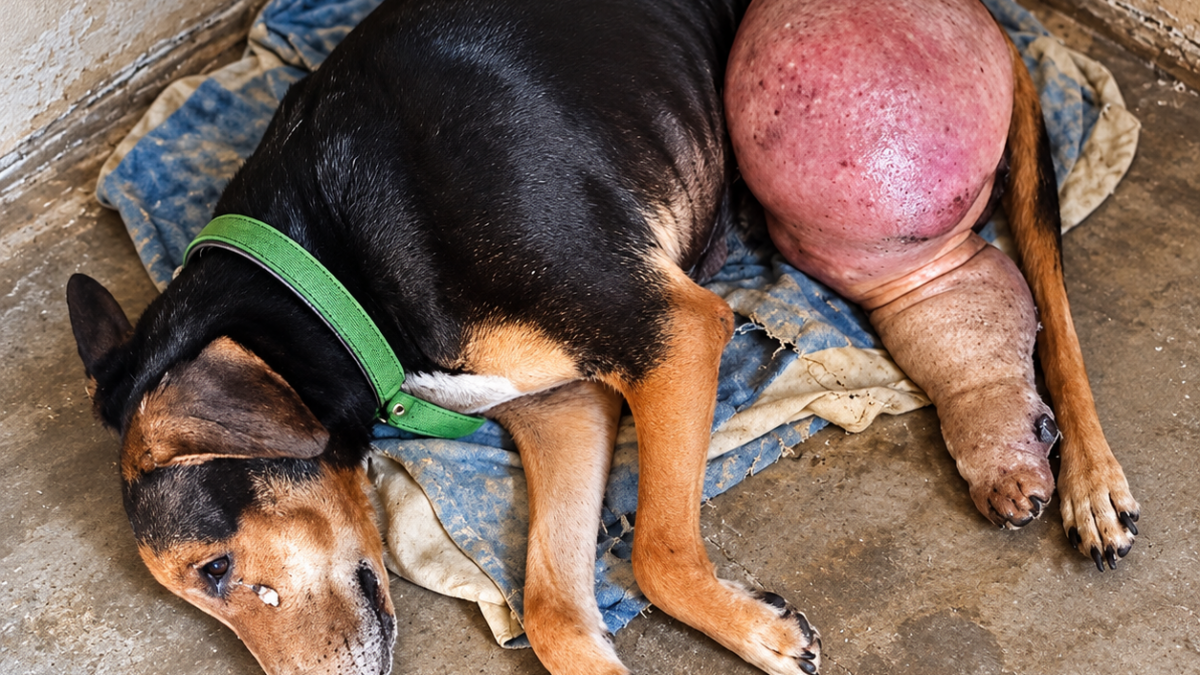
PART 2
I stepped closer to the light panel.
The images meant almost nothing to me until Sarah traced the outline with one finger.
“This is the main body of the mass,” she said. “But part of it extends deeper into the soft tissue.”
“Into the bone?”
“Not obviously.”
Daniel exhaled.
“So that’s good.”
“It is.”
I had already learned to distrust good news that came before a pause.
Sarah pointed to several pale branching lines.
“Those are blood vessels.”
“What about them?”
“The mass appears highly vascular.”
I looked at her.
“And that means?”
“Bleeding.”
One word.
Enough.
“How bad?”
“We can prepare for it. But it increases surgical risk.”
I looked through the glass toward Duke.
He was asleep, or trying to be.
Even resting, he kept shifting because no position seemed comfortable.
The tumor pulled when he lay one way and pressed into the bedding when he lay another.
“So he needs surgery,” I said.
“Yes.”
“But the surgery could kill him.”
“In his condition right now, the anesthesia alone worries me.”
Daniel crossed his arms.
“What condition?”
Sarah looked down at the bloodwork.
“Severe malnutrition. Dehydration. Anemia. Low protein. His body doesn’t have much reserve.”
I felt my stomach knot.
“How long does it take to fix that?”
“You don’t fix malnutrition in a day.”
“So how long?”
“Several days, maybe more, before I’m comfortable calling a surgeon.”
I hated the answer.
Duke’s leg looked like an emergency.
The natural instinct was to remove the problem immediately.
But medicine doesn’t care how unbearable something looks.
Sometimes the first step toward surgery is doing nothing dramatic at all.
Food.
Fluids.
Rest.
Pain control.
Waiting.
Sarah laid the bloodwork on the counter.
“He needs small meals. Frequent ones. We’ll support him, monitor his blood values, treat pain, and see how his body responds.”
“And the mass just stays there?”
“For now.”
I looked toward Duke again.
He opened his eyes.
Even from across the room, they found me.
That became one of the first things I noticed about him.
He watched people.
Not like a fearful dog trying to predict violence.
More like a dog trying to understand whether someone might leave.
I went back into the treatment room.
Duke’s head rested on a folded blanket.
I crouched beside him.
“You heard that?”
His ears moved slightly.
“We’re apparently feeding you before we save you.”
His eyes stayed on me.
“That part should be easy.”
It wasn’t.
The first meal arrived forty minutes later.
Prescription food mixed with a little warm water.
Duke sniffed it.
Turned away.
I looked at Sarah.
“You said he needed food.”
“He does.”
“He disagrees.”
“Nausea. Stress. Pain. Any of those can reduce appetite.”
“What do we do?”
“Try again later.”
That answer annoyed me too.
I was beginning to realize I had brought my impatience into a situation where almost nothing would happen on my schedule.
I sat beside Duke after the staff finished evening treatments.
Twenty minutes later, I offered a small spoonful.
He sniffed.
Nothing.
“Come on.”
He looked at me.
“You walked down an entire street with that thing hanging off your leg. You can manage one bite.”
Duke looked away.
I waited.
Then he licked the spoon.
Once.
I froze.
“Good.”
Another lick.
Then a small bite.
I didn’t move.
Duke swallowed.
Another.
By the time Sarah came back, he had eaten maybe three tablespoons.
Not much.
It felt enormous.
“He ate.”
“I can see.”
“You don’t sound impressed.”
“I work with animals who eat every day.”
“This one didn’t.”
Sarah smiled.
“Then I’m impressed.”
That night, Duke stayed at the hospital.
So did I longer than I needed to.
Daniel finally stood near the door.
“You going home?”
“In a minute.”
“You said that forty minutes ago.”
“He keeps waking up when I leave.”
“He wakes up when anyone walks past.”
“Exactly.”
Daniel stared at me.
“You’re already attached.”
“I’m doing my job.”
“Sure.”
He left.
I stayed another hour.
Duke woke twice.
Both times, his eyes found me.
Both times, he settled again.
The next morning, Sarah called before I reached the clinic.
“Don’t panic.”
Terrible opening.
“What happened?”
“Nothing dramatic.”
“Then why are you telling me not to panic?”
“His red blood cell count dropped slightly.”
I stopped in the parking lot.
“Bleeding?”
“Not from the tumor, as far as we can tell. Some of this may be dilution after fluids. But we’re watching him closely.”
“Can he still have surgery?”
“Not today.”
I closed my eyes.
“How is he otherwise?”
“He ate breakfast.”
“How much?”
“More than yesterday.”
That mattered.
I went inside.
Duke looked terrible.
Less dehydrated, yes.
But still thin enough that his ribs seemed drawn onto his body.
The tumor dominated the leg.
Someone had padded the floor beneath it so it wouldn’t rub.
When I entered, his tail moved.
Barely.
One small sweep.
I stopped.
“Was that for me?”
A technician named Rosa laughed.
“Could’ve been gas.”
“Thank you.”
Duke’s tail moved again.
I pointed at Rosa.
“Witness.”
She held up both hands.
“I saw nothing.”
Duke ate better that day.
Small meals.
Then smaller snacks.
Chicken helped.
The clinic approved plain boiled chicken mixed into his prescribed diet.
It became his currency.
Food meant strength.
Strength meant surgery.
So every bite felt connected to the operating room we were trying to reach.
The second day was harder.
Duke became nauseated after medication.
He refused lunch.
Then dinner.
I sat beside him with chicken in my hand.
“Please.”
No response.
I hated hearing myself beg a dog to eat.
Duke looked tired.
I touched the blanket near his front paw, not him.
“You don’t have to trust me. You don’t have to like the food. Just help us out.”
He closed his eyes.
For the first time since finding him, I wondered whether we were asking too much.
The tumor was enormous.
His body was depleted.
The surgery would be difficult.
What if we strengthened him just enough to put him through a procedure that still killed him?
Rescue work sounds noble when people describe it from the outside.
Inside, it is full of ugly questions.
How much treatment is reasonable?
When does hope become selfish?
What if money spent on one animal could have saved several others?
What if the animal can’t understand why pain now might lead to relief later?
Sarah found me there.
“You’re doing the face.”
“What face?”
“The one people make before asking me whether treatment is fair.”
I looked at her.
“You can tell?”
“I’ve been doing this a while.”
I glanced toward Duke.
“What do you think?”
“I think his pain is controlled enough that he can rest.”
“Enough.”
“Yes.”
“He isn’t eating.”
“Today.”
“He needs surgery.”
“I know.”
“What if he never gets strong enough?”
“Then we have another conversation.”
I hated that.
But I respected it.
Sarah wasn’t selling hope.
She was watching Duke.
That became our rule.
Not the tumor.
Duke.
Was he comfortable enough to rest?
Was he eating?
Was he interested in people?
Could we control pain?
Was the treatment giving him more than it was taking?
That afternoon, Duke ate four pieces of chicken from Rosa’s hand.
Then three from mine.
Dinner followed.
The next morning, his blood values held steady.
The day after that, they improved.
Small victories.
No music.
No dramatic moment.
Numbers moving in the right direction.
On the fourth day, a woman named Claire Bennett walked into the clinic carrying two paper bags.
I assumed she was visiting another animal.
Then she asked:
“Is Duke here?”
I looked up.
“Who are you?”
She stopped.
“Sorry. That sounds weird.”
“A little.”
“My sister sent me the rescue post.”
We had shared a short medical update and fundraiser for Duke.
Claire held up one paper bag.
“I brought chicken.”
I stared at her.
“For him?”
“Yes. Plain. No seasoning. I called first.”
That detail mattered.
People sometimes showed up with food without asking whether it was safe.
Claire had asked.
I pointed toward the treatment area.
“He’s resting.”
“Can I see him?”
“If the clinic says yes.”
Sarah approved.
Claire washed her hands, sat on a stool outside Duke’s kennel, and didn’t immediately reach toward him.
That also mattered.
She looked at the tumor.
Her face changed.
In photographs, it was awful.
In person, it was harder.
“What happened to him?”
“We don’t know.”
“Someone owned him?”
“Maybe.”
“No chip?”
“No.”
She held one small piece of chicken near the kennel opening.
Duke raised his head.
Sniffed.
Ate.
Claire smiled.
“Hi.”
Duke ate another.
Then another.
After five pieces, he stopped.
Claire stopped too.
No pushing.
No “one more.”
She simply folded the bag closed.
“You’re done.”
Duke lowered his head.
She stayed.
Twenty minutes.
Thirty.
Mostly silent.
Before leaving, she asked:
“Can I come back?”
“Sure.”
“When?”
“Whenever visiting rules allow.”
“Tomorrow?”
I smiled.
“Sure.”
She came tomorrow.
And the day after that.
Then Monday after work.
Then Wednesday.
I expected her visits to fade.
They didn’t.
At first she brought food every time.
Then Sarah gently told her we had enough chicken for a small restaurant.
Claire laughed.
After that, she brought nothing.
She just came.
Some evenings Duke was awake.
Other times he slept.
Claire sat anyway.
She began reading beside him.
Actual books.
Not her phone.
Duke became used to the sound of pages turning.
By her fifth visit, he raised his head when she entered.
By the sixth, his tail moved.
Claire froze.
“Was that for me?”
I leaned against the wall.
“Gas.”
She glared at me.
The tail moved again.
“Still gas?”
“Unclear.”
Claire smiled.
That was when Sarah walked past me in the hallway and whispered:
“She’s going to adopt him.”
I looked at her.
“What?”
“Claire.”
“She hasn’t said anything.”
“She asked me whether he can manage stairs after surgery.”
“Medical curiosity.”
“She asked whether a cat would stress him.”
I paused.
“She has a cat?”
“Lily.”
“Fine.”
Sarah smiled.
“Fine what?”
“She might be thinking about it.”
“She’s gone.”
“What does that mean?”
“Emotionally? Finished. Duke owns her.”
I looked back through the glass.
Claire sat beside Duke with one hand resting near his paw.
Not touching.
Waiting.
Duke’s eyes were closed.
He knew she was there.
That part was obvious.
By the sixth day, Duke had gained almost a pound.
His protein values improved.
His hydration stabilized.
The anemia remained a concern but wasn’t worsening.
Sarah consulted a surgical specialist named Dr. Marcus Lee.
Marcus arrived early the next morning.
He examined Duke in silence.
That made me nervous.
Some doctors talk through every thought.
Marcus didn’t.
He measured the mass.
Palpated around its base.
Reviewed the scans.
Then reviewed them again.
Finally, he stood.
“I think it’s operable.”
Claire was visiting.
She immediately looked at me.
I asked:
“Think?”
Marcus nodded.
“I won’t promise what I can’t see.”
“Can you keep the leg?”
“That is the goal.”
“Goal?”
He met my eyes.
“If the tumor extends farther than imaging shows, or if blood supply becomes difficult to control, we may have to make a decision during surgery.”
Claire spoke.
“Amputation?”
“Possibly.”
Duke was chewing a tiny piece of chicken.
Completely unaware that three humans were discussing whether he would wake up with the same number of legs.
I swallowed.
“What gives him the best chance?”
Marcus answered immediately.
“Saving Duke.”
Not the leg.
Duke.
I nodded.
Claire nodded too.
No hesitation.
That was the moment I stopped thinking of her as a visitor.
She still hadn’t asked to adopt him.
But she was already thinking in the language of his future.
Marcus wanted two more days of nutritional support before surgery.
I almost argued.
Then I stopped myself.
Waiting had gotten Duke strong enough to reach this point.
Two more days were not cruelty.
They were preparation.
Still, Duke’s tumor seemed heavier every time he stood.
Bathroom trips were brutal.
We used a support sling under his abdomen.
Duke would rise slowly, put most of his weight on the other three legs, then hobble toward the outside area.
The mass swung slightly.
He hated that.
I could tell.
Once he stopped halfway and simply looked at me.
“I know.”
He stood there breathing hard.
“We’re almost there.”
One more step.
Pause.
Another.
Duke did what he had apparently been doing long before we found him.
He kept moving.
That evening, Claire stayed until visiting hours ended.
A receptionist finally came in.
“Claire?”
“I know.”
“You really have to go.”
“Five minutes.”
“You said that fifteen minutes ago.”
Claire looked at Duke.
“Fine.”
She stood.
Duke’s eyes opened.
She crouched again.
“I’ll be back tomorrow.”
His tail moved.
Claire looked at me.
“Tell him.”
“He doesn’t speak English.”
“Tell him anyway.”
“You’re coming back tomorrow.”
Duke blinked.
Claire smiled.
“There.”
She left.
Duke watched the door.
I sat beside him.
“You too?”
He sighed.
“Pathetic.”
The night before surgery, I barely slept.
At 4:30 a.m., I stopped pretending.
I got up.
At six, I was at the clinic.
Claire arrived at 6:05 carrying coffee.
“Visiting doesn’t start until seven.”
“I brought bribery.”
“For who?”
“Everyone.”
Sarah came through the doors.
“Is that coffee?”
“Yes.”
“Claire may stay.”
I pointed.
“Corruption.”
Duke was fasting.
He was offended.
He sniffed every person who entered as if somebody might have forgotten the rule.
Nobody had.
Claire sat beside him.
“No breakfast.”
Duke stared.
“I know.”
He stared harder.
“Don’t look at me.”
His eyes shifted toward me.
“Also no.”
Marcus arrived after seven.
He reviewed Duke’s morning bloodwork.
“Good enough.”
I hated and loved those two words.
Good enough.
Not perfect.
Enough to proceed.
The surgical consent included every risk.
Bleeding.
Anesthetic complications.
Wound breakdown.
Need for transfusion.
Possible amputation.
Death.
Claire read the page even though she wasn’t the legal decision-maker.
Our rescue was.
I signed.
My hand shook slightly.
Marcus noticed.
“That’s normal.”
“What?”
“The shaking.”
“I’m not shaking.”
He looked at my hand.
“Right.”
The technician gave Duke his pre-anesthetic medication.
His eyes became heavy.
Claire crouched.
“I’ll be here when you wake up.”
Duke’s head lowered.
She placed her palm gently beneath his chin.
No dramatic goodbye.
No speech.
Just:
“I’ll be here.”
They wheeled him away.
The surgical doors closed.
Then came waiting.
I hate waiting more than almost anything in rescue.
There is nothing useful to do.
You can’t feed.
Can’t comfort.
Can’t drive faster.
Can’t research your way into control.
You sit while somebody else’s hands do the thing that may decide whether the animal you carried in survives.
Claire paced.
Daniel arrived with breakfast nobody wanted.
Sarah came out once.
“No update yet.”
Claire looked at the clock.
“It’s been an hour.”
Sarah nodded.
“That’s normal.”
Another hour.
Claire stopped sitting entirely.
At two hours and twenty minutes, she stood near the hallway.
I said:
“Sit.”
“No.”
“Claire.”
“It’s too long.”
“Marcus said it could take hours.”
“I know.”
“Then sit.”
“No.”
At two hours and forty minutes, she walked toward the restricted hallway.
I stepped in front of her.
“You can’t go back.”
“I just want someone to tell me he’s alive.”
“They will.”
“What if he isn’t?”
The words came out too fast.
Then she stopped.
Her face broke.
It was the first time I saw her cry.
Not a tear.
Not damp eyes.
Actually cry.
“What if he dies?”
I didn’t lie.
“He could.”
Claire looked at me.
“You’re supposed to say he won’t.”
“No.”
“That’s terrible.”
“I know.”
She sat.
“I shouldn’t be this attached.”
“Too late.”
“I’ve known him nine days.”
“Apparently you’re efficient.”
She laughed once through tears.
Then covered her face.
“He walked toward strangers with that thing on his leg.”
“I know.”
“He did all that just to die on an operating table?”
“No.”
“You don’t know that.”
“No. I don’t.”
I sat beside her.
“But surgery is his best chance.”
She nodded.
That was all we had.
Best chance.
Not guarantee.
Another thirty-five minutes passed.
Then Marcus appeared.
Still wearing his surgical cap.
Mask hanging around his neck.
Claire stood so quickly her chair scraped backward.
“Well?”
Marcus looked tired.
“He’s alive.”
My knees weakened.
Claire closed her eyes.
“The tumor?”
“Removed.”
“The leg?”
“Still there.”
Claire laughed and cried at the same time.
Marcus held up one hand.
“Slow down. We’re not done worrying.”
Of course not.
“Blood loss was significant but controlled. We were prepared. The mass was difficult, but I’m satisfied with what I could see and remove.”
“Could you close the wound?”
“Yes. It was tight.”
“Transfusion?”
“Not required yet, but we’re monitoring him.”
“Is he awake?”
“Starting to.”
“Can we see him?”
“Not yet.”
Claire nodded.
Everything Marcus said became law.
Duke woke roughly.
Anesthesia left him disoriented.
He whined.
Once.
A small, broken sound.
Claire’s face collapsed.
Sarah let us stand near recovery after Duke was stable enough.
We couldn’t touch him yet.
Couldn’t crowd.
He shifted.
His freshly operated leg was wrapped.
The giant tumor was gone.
The empty visual space where it had been shocked me.
For days, Duke had looked like dog plus tumor.
Now he looked like a small dog with a thin bandaged leg.
His body suddenly seemed even more fragile.
Claire whispered:
“Duke.”
His eyes opened.
Slowly.
They moved.
Found her.
His tail shifted against the blanket.
One tiny sweep.
Claire covered her mouth.
“He knows me.”
“Yes.”
“He knows me.”
“I saw.”
She laughed through tears.
Duke’s eyes closed again.
He slept.
For the first time since we found him, the worst weight was no longer attached to his body.
That didn’t mean recovery became easy.
The first night was difficult.
Pain control required adjustment.
Duke was nauseated.
He refused food.
His blood values were monitored.
The incision had to be checked constantly for bleeding or swelling.
At midnight, Sarah called me.
“He’s stable.”
“Stable good or stable bad?”
“Stable means stable.”
“I hate that word.”
“I know.”
The next morning, Duke took a bite of chicken.
Claire was there.
Of course.
Then a second bite.
Then he turned away.
She immediately stopped.
“Good.”
I watched.
“You’re learning.”
“From him.”
That was true.
Duke taught people how to care for him because he communicated quietly.
If he wanted more, he leaned.
If he was done, he turned.
If he hurt, his face tightened.
If he trusted you, his body softened.
Claire learned fast.
On the second day after surgery, Duke placed the operated foot on the floor.
Only his toes.
Barely.
Claire almost shouted.
Sarah pointed at her.
“Do not scare him.”
Claire covered her mouth.
Duke stood with a sling for support.
One second.
Two.
The leg touched down.
His body trembled.
Then he sat.
Claire wiped her eyes.
“I’m becoming embarrassing.”
“Becoming?”
She glared at me.
By day three, Duke took one step.
Then another.
The absence of the tumor changed his balance.
His body had adapted to carrying a huge uneven weight.
Now the weight was gone.
That freedom came with confusion.
Duke would sometimes shift as if compensating for something no longer there.
Sarah called it motor adjustment.
I called it heartbreaking.
His body remembered pain even after the source had been removed.
That happens to people too.
By day four, the incision looked good.
His appetite improved.
Pathology was still pending.
That became the new fear.
We had survived surgery.
Now we waited to learn what we had removed.
Claire asked Marcus every day.
He gave the same answer.
“Not yet.”
“What if it’s cancer?”
“It may be.”
“What if it spread?”
“Imaging showed no obvious distant spread.”
“That doesn’t mean none.”
“No.”
She hated uncertainty as much as I did.
One afternoon, while Duke slept, Claire followed me into the hallway.
“I need to ask something.”
“Okay.”
“What happens after discharge?”
“Foster care.”
Her expression changed.
“Foster?”
“Yes.”
“For how long?”
“Depends on pathology and follow-up.”
“And then?”
“If he’s medically cleared, adoption.”
Claire stared at me.
I waited.
Finally:
“I want him.”
There it was.
No music.
No dramatic declaration.
“I want to adopt Duke.”
I folded my arms.
“You have a cat.”
“Lily.”
“Does Lily like dogs?”
“She lived with one.”
“Fenced yard?”
“Yes.”
“Work schedule?”
“Three days from home. My neighbor helps if needed.”
“Financial plan for continued care?”
“I have pet insurance options, savings, and my veterinarian has already reviewed his preliminary records.”
I paused.
“You already called your vet?”
“Yesterday.”
“You are terrifying.”
“Is that a no?”
“No. It’s an application.”
“You know me.”
“Application.”
“I’ve practically lived here.”
“Application.”
“I have brought enough chicken to earn partial ownership.”
“Not legally.”
Claire laughed.
“Fine.”
She completed every form.
Detailed answers.
No fantasy.
No promise that love would cure Duke.
She understood follow-up imaging might be needed.
She understood recurrence was possible.
She understood the leg could remain weak.
She understood medical costs might continue.
Her home check was scheduled before Duke left the hospital.
Daniel and I went.
Claire lived in a small house on a quiet street.
Fenced yard.
Few stairs.
Washable rugs.
Baby gates.
A soft bed already set up.
I stared at it.
“You bought him a bed?”
“Preparedness.”
“Before approval.”
“Preparedness.”
Beside the bed sat a folded fleece blanket identical to the kind the hospital used.
I looked at her.
“He likes them.”
That detail was what got me.
Not the fence.
Not the forms.
She noticed what comfort looked like to him.
Lily appeared at the end of the hallway.
Gray cat.
Green eyes.
Immediate judgment.
Daniel crouched.
“Hi.”
Lily walked away.
“Excellent.”
“She’s shy.”
“She hates me.”
“She hates everybody for ten minutes.”
“Reasonable.”
The home passed.
The veterinary reference passed.
The application passed preliminary review.
Still, we wouldn’t finalize anything until Duke was medically stable.
Claire accepted that.
Barely.
The pathology report arrived on Duke’s fifth day after surgery.
Marcus called us into a consultation room.
Claire sat beside me.
Sarah stood near the door.
Marcus placed the report on the table.
The mass was a serious tumor.
But the surgical margins were encouraging.
Current imaging did not show obvious distant spread.
Follow-up would matter.
Monitoring would matter.
Nothing could be promised.
Claire asked:
“What signs do I watch?”
Not:
Is he cured?
Not:
How long will he live?
What do I watch?
Marcus listed them.
New swelling.
Changes around the scar.
Lameness.
Weight loss.
Pain.
Any new mass.
Periodic rechecks.
Claire wrote everything down.
I watched her.
She was already living in Duke’s future.
Discharge came the next day.
Claire arrived early.
Her car looked as if she were transporting fragile medical equipment.
Thick bed across the back.
Safety restraint.
Water.
Medication list.
Extra towels.
Daniel looked inside.
“Where are you sitting?”
“Driver seat.”
“Duke gets the entire car?”
“Yes.”
“Healthy dynamic.”
Duke walked out of the clinic wearing a soft recovery collar.
His operated leg looked thin.
The tumor had hidden how much muscle he’d lost.
When he saw Claire, his tail moved.
Not one sweep.
Several.
She crouched.
“Hey.”
Duke limped toward her.
One step.
Another.
Slow but determined.
The same dog who had once walked toward me because he needed help was now walking toward the person taking him home.
Claire stayed where she was.
She let him reach her.
Duke pressed his head against her chest.
She wrapped one arm around him.
“Ready?”
His tail moved again.
I looked away.
Some rescue moments hurt even when they’re good.
Especially when they’re good.
Claire carried Duke to the car.
The man who had dragged pain down a street no longer had to walk unless he wanted to.
The first night at Claire’s house went better than expected.
The cat introduction did not.
Claire sent me a video.
Duke stood behind a baby gate.
Lily approached.
Duke wagged.
Lily hissed.
Duke immediately stepped backward.
Claire’s message:
Good sign?
I replied:
He has excellent judgment.
Day two, Lily watched from the stairs.
Day three, she ate treats in the same room.
Day five, she walked past Duke as if he were furniture.
By the end of week two, both animals slept in the living room.
Not together.
But peacefully.
Claire called it friendship.
I called it a nonaggression pact.
Duke’s recovery at home came in layers.
The incision healed.
The bandage disappeared.
Fur began growing.
His appetite became ridiculous.
The street dog who had once been too weak for surgery developed strong opinions about breakfast timing.
Claire called me at 7:12 one morning.
“Something is wrong.”
My heart jumped.
“What?”
“He keeps whining.”
“Pain?”
“No.”
“Limp?”
“No.”
“Eating?”
“That’s the problem. He ate.”
I paused.
“What time?”
“Six-thirty.”
“And now?”
“He wants more.”
I sighed.
“Claire.”
“What?”
“He’s hungry.”
“He ate.”
“Dogs are capable of lying about starvation.”
“That’s a thing?”
“Very.”
Duke barked in the background.
“See?”
“Do not feed him again.”
Claire lowered her voice.
“He looks sad.”
“Manipulation.”
“You’re cruel.”
“Your veterinarian gave calorie instructions for a reason.”
She hung up.
Five minutes later:
I DID NOT FEED HIM.
Then:
LILY DID.
Apparently the cat had knocked a treat container onto the floor.
Duke recovered emotionally.
Physical therapy began once Marcus approved it.
Short controlled walks.
Weight shifting.
Gentle muscle rebuilding.
No dramatic exercise.
Duke’s body needed time.
The tumor had forced him into an abnormal gait for months.
His good legs had compensated.
His back had compensated.
Even his shoulders showed tension.
At first, walking without the mass looked easier but unfamiliar.
Claire moved beside him slowly.
She never pulled.
If Duke stopped, she waited.
If he looked tired, they went home.
One afternoon, I joined them.
Duke made it to the end of the block.
Claire looked triumphant.
“Best yet.”
He sniffed a mailbox.
Then peed on it.
I nodded.
“Peak rehabilitation.”
“Very advanced.”
The next week, he reached the small park.
His limp remained.
Probably always would to some degree.
But his head stayed higher.
That mattered.
Pain changes how animals occupy space.
Before surgery, Duke walked as if the ground might disappear.
After, he began looking around.
Trees.
People.
Other dogs.
Smells.
The world stopped being something he had to move through and became something he could notice.
We never found a previous owner.
That bothered Claire more than me.
Months after adoption, we sat in her kitchen while Duke slept under the table.
She asked:
“Do you think somebody loved him?”
“I don’t know.”
“I want to think so.”
“Why?”
“Because the idea that no one did is awful.”
I looked at Duke.
His surgical leg stretched behind him.
“What if someone did?”
Claire looked at me.
“Then why was he on the street?”
“There are a hundred possibilities.”
“None make me feel better.”
“They aren’t supposed to.”
She stared into her coffee.
“I keep imagining the tumor small.”
I knew what she meant.
The beginning.
When someone could have acted.
A little swelling.
A lump.
Then bigger.
Then too big to pretend not to see.
“What kind of person watches that?”
“I don’t know.”
“Money?”
“Maybe.”
“Fear?”
“Maybe.”
“Denial?”
“Maybe.”
“Then abandonment?”
“Maybe.”
Claire shook her head.
“I hate maybe.”
“So do veterinarians.”
She smiled faintly.
I continued:
“But Duke isn’t asking us to solve who failed him.”
“How do you know?”
“He’s asleep.”
We looked down.
Duke snored.
Claire laughed.
Maybe that was the first time she let the unanswered past stay unanswered.
Three months after surgery, Marcus cleared Duke for more normal activity.
The leg was functional.
He had regained muscle.
No new mass.
Bloodwork looked good.
The first major recheck went well.
Claire celebrated by taking Duke to the park.
Daniel and I joined.
A child nearby rolled a tennis ball accidentally toward Duke.
It stopped near his paw.
Duke sniffed it.
Picked it up.
Claire gasped.
“Does he fetch?”
“I have no idea.”
She took the ball.
Threw it five feet.
Duke watched.
Then looked at her.
No movement.
Daniel laughed.
“He thinks you lost it.”
Claire retrieved the ball.
Duke followed her.
Technically movement.
Not fetch.
They tried again.
By the fifth throw, Duke trotted halfway.
Stopped to smell a tree.
Forgot the ball existed.
Claire threw her hands up.
“Hopeless.”
I smiled.
“Normal.”
That word meant more than I expected.
Normal.
A dog ignoring fetch.
A dog begging for food.
A dog afraid of the vacuum.
A dog sleeping through television.
A dog living in a house.
No crisis.
No operating room.
No massive tumor defining every conversation.
Normal became the best thing we could give Duke.
The first anniversary of his rescue arrived quietly.
Claire remembered the date.
So did I.
Sarah sent me the original intake photograph.
I regretted opening it immediately.
Duke on the exam table.
Ribs visible.
Head low.
The tumor enormous.
Then Claire sent a new photograph.
Duke in her backyard.
Healthy weight.
Chest broader.
Coat clean.
Operated leg stretched comfortably.
Lily sleeping nearby.
No text.
I looked between the two images.
Same dog.
Different life.
We gathered at Claire’s house that weekend.
No fundraiser.
No speeches.
No dramatic cake.
Sarah came after her shift.
Daniel brought takeout.
Marcus sent a message:
Tell Duke his scar is still my best work.
I read it aloud.
Claire looked at Duke.
“Your surgeon is arrogant.”
Duke licked his leg.
Daniel nodded.
“Five-star review.”
At one point, Duke moved from Sarah to Daniel to Claire collecting attention.
No hesitation.
No pain with every step.
I remembered the street.
Duke walking toward me.
That image had become fixed in my mind.
Sometimes I wondered why he came closer.
Maybe he smelled food.
Maybe exhaustion made escape impossible.
Maybe he had known kind people before.
Maybe dogs simply understand more about posture and voice than we give them credit for.
Whatever the reason, every painful step toward us created another possibility.
Treatment.
Surgery.
Claire.
Home.
But I never called that Duke saving himself.
Animals shouldn’t have to save themselves.
People still had to stop.
Someone had to make the call.
We had to drive.
Sarah had to treat.
Marcus had to operate.
Claire had to keep returning.
Survival was not one heroic choice.
It was many people refusing to look away in sequence.
Months turned into years.
Duke aged.
The tumor never returned in the devastating form we’d feared.
Every recheck still frightened Claire.
She would send me messages before appointments.
I FEEL SOMETHING NEAR HIS LEG.
Usually normal scar tissue.
Once a harmless fatty lump.
Another time inflammation after a minor strain.
Each scare reminded us that surgery doesn’t erase fear as cleanly as it removes tissue.
Claire once called after finding a bump near Duke’s shoulder.
“I think it’s another tumor.”
“How large?”
“Pea.”
“How long?”
“I found it today.”
“Vet?”
“Tomorrow.”
“Good.”
“What if—”
“No.”
“What?”
“You’re not allowed to kill Duke in your imagination before the appointment.”
Silence.
“That was harsh.”
“Yes.”
“I hate when you’re right.”
The bump was benign.
Claire bought me coffee afterward.
“Apology?”
“For being dramatic.”
“Rejected.”
Duke developed stronger relationships with the family around him.
Lily eventually became something close to a friend.
Not affectionate.
Lily had standards.
But they shared rooms.
They watched the yard together.
Sometimes Duke slept beneath the chair where Lily rested.
When another dog barked through the fence, Lily appeared at the window behind Duke as if joining the security team.
Claire wanted one photograph of them touching.
She never got it.
“They love each other privately,” she insisted.
“They tolerate one another publicly.”
“Same thing.”
When Lily grew old, Duke changed around her.
He stopped bumping into her.
Waited when she crossed doorways.
Once I watched him leave half a treat on the floor near her.
Claire almost cried.
Then Duke ate it himself thirty seconds later.
“Never mind,” she said.
“Character restored.”
Lily died when Duke was around nine.
The loss affected him.
He checked her favorite chair.
The stairs.
The window.
For several days, he stood outside the room where her litter box had been.
Claire called me crying.
“He’s looking for her.”
I didn’t have an answer.
There was no way to explain death to a dog.
We could only keep routines predictable.
Food.
Walks.
Sleep.
Company.
Eventually, Duke stopped searching.
But he began sleeping near Lily’s window.
Maybe coincidence.
Maybe not.
Claire waited two years before fostering another animal.
Then came Penny.
Tiny.
Black-and-white kitten.
Supposed to stay seven days.
I laughed when Claire told me.
“What?”
“You’ve already lost.”
“No.”
“Yes.”
“It’s one week.”
“Sure.”
Duke hated Penny.
Penny adored Duke.
The first video showed Penny climbing onto his back.
Duke stared at Claire with the expression of a retired man discovering teenagers had moved next door.
“Help him,” I said.
“She weighs two pounds.”
“She is armed.”
Penny bit his ear.
Duke stood.
Penny remained attached.
Claire laughed so hard the camera shook.
By day five, Penny slept inside Duke’s bed.
Duke lay half outside it.
Day seven came.
Then day ten.
Then the rescue asked whether Claire wanted to extend.
She pretended to consider.
Penny stayed.
Duke accepted the situation.
Eventually, they became inseparable in the strange way animals sometimes do.
Penny slept against his stomach.
Duke groomed her ears occasionally.
If Duke went outside, Penny waited at the glass door.
If Penny knocked something down, Duke usually appeared first to investigate.
Claire told people Duke raised her.
I said he survived her.
Both were probably true.
As Duke entered his senior years, the old surgical leg became arthritic.
We had expected that.
Months of carrying the tumor.
Major surgery.
Altered gait.
Age.
His body kept receipts.
At ten, he rose more slowly.
At eleven, stairs became difficult.
Claire added runners.
Then a ramp.
At twelve, pain medication became part of daily life.
His walks shortened.
Not his appetite.
Duke remained convinced breakfast was a human rights issue.
Claire called one morning.
“He didn’t finish.”
My heart tightened.
“What?”
“Breakfast.”
That was serious enough to get my attention.
“What did he eat before breakfast?”
Silence.
“Claire.”
“A little scrambled egg.”
“How much?”
“Half.”
“And?”
“Some cheese.”
“And?”
“A biscuit.”
I closed my eyes.
“He is not sick.”
“You don’t know that.”
“He is full.”
“You aren’t a vet.”
“Neither are you.”
Duke barked in the background.
“What’s he doing?”
“Begging for my toast.”
“Case closed.”
He ate dinner normally.
The dog who once nearly starved became old enough to manipulate a woman into believing four meals were medically necessary.
I considered that a success.
Duke hated snow.
That surprised me.
A dog who had survived the street apparently decided weather was optional once he acquired a home.
One winter afternoon, Claire opened the back door.
Snow covered the yard.
Duke stepped forward.
Looked.
Stepped backward.
I laughed.
“You used to live outside.”
Duke walked toward his bed.
Claire put on his coat.
Still no.
Penny ran outside.
Duke watched.
Barked once.
Claire translated:
“Idiot.”
“Probably.”
He eventually went out because nature required it.
He completed business in record time and returned to his bed.
Comfort had spoiled him.
Good.
I wanted every rescued animal to become spoiled enough to reject conditions they once endured.
Around thirteen, Duke’s world grew smaller.
Not unhappier.
Smaller.
Long park walks became neighborhood walks.
Then short loops.
Then the yard some days.
He slept more.
His hearing faded slightly.
His muzzle turned almost entirely gray.
Penny adapted.
She stopped attacking his tail.
Mostly.
Claire moved his bed closer to the living room so he never had to choose between rest and being near people.
That detail stayed with me.
When animals age, companionship becomes geography.
Where the bed is.
How far the water is.
Whether the family sits near enough.
Duke had spent his early unknown life searching.
His old age was designed so he barely had to move to find anything he needed.
One morning, Claire called.
Not texted.
Called.
Her voice was different.
“He won’t stand.”
I was already reaching for my keys.
“Pain?”
“I don’t know.”
“Breathing?”
“Normal.”
“Alert?”
“Yes.”
“Clinic.”
“We’re going.”
I met them there.
Duke lay on a blanket in the back seat.
Old.
Gray.
Smaller than I remembered from the previous month.
Claire sat beside him.
“I tried the harness.”
“Did he try?”
“He pushed, then stopped.”
Testing found no sudden recurrence of cancer.
Instead, several age-related problems had converged.
Arthritis.
Spinal changes.
Weakness.
Kidney values beginning to drift in the wrong direction.
Nothing dramatic alone.
Together, enough.
The veterinarian adjusted medication.
Gave fluids.
Recommended rest.
Duke stood the next day.
Claire called it a miracle.
I didn’t correct her.
At that age, getting another comfortable morning can feel miraculous even when medicine deserves the credit.
Duke came home.
He lived another year.
Slowly.
Comfortably most days.
The harness became normal.
Claire supported part of his weight when he walked.
Duke accepted it completely.
That moved me more than I expected.
Trust isn’t always enthusiasm.
Sometimes it is allowing another body to become part of your balance.
He knew Claire would not drop him.
That was enough.
His final decline did not come as one emergency.
It arrived gradually.
Food became less exciting.
Sleep longer.
Walks shorter.
Kidney disease advanced.
Pain from arthritis became harder to control.
Claire adjusted everything.
Soft food.
Medication schedule.
Extra water.
More frequent veterinary checks.
Orthopedic bedding.
Non-slip mats.
Penny slept near him.
Then one morning Duke refused scrambled eggs.
Claire called me.
“He won’t eat.”
“Anything?”
“Chicken too.”
That was different.
“Vet?”
“Coming here.”
Claire had decided years earlier that if possible, Duke’s last days would happen at home.
The veterinarian examined him in his bed.
No fluorescent room.
No steel table.
Penny watched from the couch.
Bloodwork confirmed what we already suspected.
Kidney failure had advanced.
Medication could ease nausea.
Fluids might buy time.
Pain could be managed for a while.
But the larger question had changed.
Not:
Can we keep Duke alive?
Can we keep Duke comfortable enough that being alive still belongs to him?
Claire sat on the floor.
“How do I know?”
The veterinarian spoke gently.
“Look at the things he values.”
“Food.”
“Yes.”
“He isn’t eating.”
“Company?”
Claire looked at Duke.
He still lifted his head when she moved.
“Rest?”
“He sleeps.”
“Comfort?”
“Some days.”
“Mobility?”
“Barely.”
Claire started crying.
“What if tomorrow is better?”
“It may be.”
“What if I wait and tomorrow is worse?”
“It may be.”
No answer.
That’s the cruelty of loving an old animal.
At the beginning, every decision is about adding life.
At the end, sometimes the kindest decision is about preventing pain from becoming the last thing left.
We gave Duke another day.
Not because we couldn’t let go.
Because his pain was controlled, he rested, and he still wanted to lie in the sun.
The next morning, Claire supported him outside.
The weather was mild.
Duke stood in the grass.
His legs trembled.
He sniffed the air.
For a few seconds, he looked almost like himself from years earlier.
Then he tried to take a step.
Stopped.
Claire held the harness.
“Take your time.”
Duke took one step.
Another.
Then instead of moving toward the yard, he turned toward Claire.
Pressed his head into her chest.
The same gesture he had given me on the street.
The same gesture he had given her in the clinic.
Claire dropped to her knees.
“Okay.”
She buried her face in his fur.
Duke stood only because the harness and Claire held him together.
“Okay, buddy.”
She cried quietly.
I stood several feet away.
There was nothing to say.
The decision had arrived without words.
The veterinarian returned that evening.
Duke lay in his favorite bed.
Penny sat nearby.
Daniel came.
Sarah joined us briefly by video.
She had moved to another clinic years earlier but still remembered every detail.
Of course she did.
Claire gave Duke one tiny piece of chicken.
He licked it.
Didn’t swallow.
She smiled through tears.
“Of all days, you decide to diet.”
Duke rested his head on her hand.
The veterinarian gave the first medication.
His body relaxed.
The tightness left his face.
Claire whispered:
“I told you I’d keep coming back.”
I remembered the hospital.
Paper bag of chicken.
Day after day.
Duke watching the door.
Claire appearing.
She had kept that promise before she even knew she’d made it.
The final medication was given.
Duke’s breathing slowed.
One breath.
Another.
Long pause.
One more.
Then quiet.
No fear.
No street.
No tumor.
No searching.
Just Claire’s hand beneath his head.
Penny approached after a few minutes.
Sniffed Duke’s blanket.
Then sat beside the bed.
Claire stroked the old surgical leg.
The scar was faint beneath thin fur.
I thought about Marcus in the operating room.
The tumor.
The blood loss.
The fear he wouldn’t wake.
All those years that followed had once depended on a body being strong enough for one surgery.
Duke got them.
Years.
Not just survival.
A life.
Weeks later, I visited Claire.
The house felt wrong without Duke.
Penny was in the window.
Duke’s bed was gone.
That empty patch of floor hurt more than I expected.
Claire made coffee.
For twenty minutes, we talked about everything except him.
Weather.
Work.
Penny.
Then she brought out a box.
Inside:
Duke’s collar.
Medication labels.
His adoption paperwork.
The hospital discharge instructions.
I laughed.
“You kept these?”
“Every page.”
“There are twelve.”
“I know.”
“Why?”
“That was the day he came home.”
She handed me a photograph.
Duke standing in the clinic hallway after surgery.
Thin.
Shaved leg.
Recovery collar.
Claire crouched beside him.
Duke wasn’t looking at the camera.
He was looking at her.
“I didn’t know this existed.”
“Daniel took it.”
“Traitor.”
Claire smiled.
Then her eyes filled.
“Do you think he knew I was coming back?”
“When?”
“Before surgery.”
I thought about the daily visits.
Food.
Pages turning.
Same voice.
Same scent.
Same person appearing again and again.
Animals learn reliability through repetition.
Maybe trust is simply the memory of somebody doing the same kind thing enough times.
“I think he learned.”
Claire nodded.
That seemed to matter.
A few months later, our rescue received another dog with a large mass.
Different dog.
Different diagnosis.
Different outcome still unknown.
A new volunteer looked at the photograph.
“How can somebody let it get that big?”
Years earlier, I would have answered with anger.
Cruelty.
Neglect.
Indifference.
Sometimes those answers are correct.
But Duke had changed the part of me that wanted every rescue to come with a villain.
Knowing who failed an animal doesn’t always help the animal in front of you.
So I said:
“I don’t know yet. Let’s deal with the dog we have.”
We did.
That became Duke’s legacy for me.
Not a grand lesson.
A practical one.
Look at what’s still possible.
Duke’s tumor had dominated every early image of him.
It was the first thing people saw.
For a while, it was the first thing I remembered too.
I hated that.
Eventually I trained myself to remember something else first.
The street.
Our van.
Duke lifting his head.
Then moving toward us.
One painful step.
Pause.
Another.
No guarantee we would help.
No reason to trust us.
Still, he came closer.
Years later, his body failed for the last time, and the person beside him was the woman who had done the exact same thing in reverse.
Duke walked toward us once.
Claire kept walking toward him every day after.
She came with chicken.
Then books.
Then questions.
Then paperwork.
Then a car prepared to take him home.
She came for checkups.
For scares.
For normal mornings.
For arthritis.
For old age.
And when Duke could no longer stand up and walk toward anyone, she was already there.
That was the ending I chose to remember.
Not the tumor.
Not the operation.
Not even the adoption paperwork.
The first Duke I knew had to drag pain down a street searching for someone who might stop.
The last Duke never had to search.
Help lived in his house.
It knew the sound he made when he wanted outside.
It knew which pills went with breakfast.
It knew he hated snow.
It knew that scrambled eggs were almost always worth getting up for.
It knew when his limp was normal and when it meant something.
It knew when he needed support beneath his belly.
And when medicine could no longer give him another comfortable chapter, that same help knew him well enough to stop asking him to carry more.
I still keep one photograph of Duke on my desk.
Not the first.
I don’t need the tumor to remember what he survived.
Not the surgery either.
The photograph is ordinary.
Duke lies on Claire’s porch.
Healthy weight.
Gray beginning around his muzzle.
The old surgical leg stretched into sunlight.
Penny sits several feet behind him.
At the edge of the picture, Claire’s hand rests near his back.
No emergency.
No rescue van.
No hospital.
Just a dog resting because he knows he doesn’t have to get up and keep searching.
Whenever I think about that painful walk toward us years earlier, I put the two images together in my mind.
The dog who took those first desperate steps.
And the life waiting at the end of them.
[END OF STORY]








