PART 2: Brody Waited Behind Shelter Glass for Nearly 300 Days—Then One Question Made Thousands Finally See Him
PART 2
The family from Olathe was scheduled to arrive the next afternoon.
I wish I could say I felt nothing but excitement.
I didn’t.
I was scared.
That may sound strange when you have spent months hoping someone will ask about a dog.
But anyone who works with long-term shelter animals understands the fear.
Interest is not adoption.
A phone call is not adoption.
A meeting is not adoption.
People change their minds.
Dogs behave differently when they are nervous.
Families fall in love with the idea of a rescue story and then discover that the actual animal standing in front of them is not a perfect symbol.
Brody had been waiting too long for me to celebrate early.
So I didn’t tell myself he was going home.
I told myself only this:
Tomorrow, someone is going to see him.
That alone mattered.
That evening, the shelter settled into its usual rhythm.
Bowls were washed.
Dogs were taken out.
Medication was given.
Lights were dimmed.
I stopped at Brody’s kennel before leaving.
He was lying near the glass.
“You have visitors tomorrow.”
His eyes lifted.
I smiled.
“Don’t make me look stupid.”
His tail moved once.
I laughed.
“Good talk.”
Then I went home and thought about him far more than I wanted to admit.
The next morning, I arrived early.
Not because I needed to.
Because I was nervous.
Brody was already awake.
When I approached, he stood.
“Big day.”
He stretched.
“You have no idea.”
I spent too long deciding which collar looked best.
One of the staff members caught me.
“Maria.”
“What?”
“You’re changing his collar?”
“The blue one looks better.”
“It’s an adoption meeting, not a wedding.”
I looked at her.
“After 300 days, he deserves the blue collar.”
She laughed.
“Fine.”
We put on the blue collar.
Brody looked exactly the same.
Of course.
But I felt better.
The family arrived just after lunch.
There were three of them.
A husband and wife and their teenage daughter.
I immediately watched how they entered the shelter.
That matters.
Some people walk into an animal shelter already pointing.
“That one.”
“Oh, look at that puppy.”
“I want the fluffy one.”
This family didn’t.
They came to the desk.
Introduced themselves.
Then the woman asked:
“Can we meet Brody?”
Not:
“Can we look around first?”
Brody.
Specifically.
My chest tightened.
“Absolutely.”
I explained what we knew.
Found outside the library.
Abandoned.
Long shelter stay.
Gentle temperament.
Basic commands.
No guarantees about how he would behave in a new home.
Adjustment could take time.
They listened.
Actually listened.
Then the father asked:
“What does he do when he’s nervous?”
Good question.
“He gets quieter.”
“Does he hide?”
“Sometimes he withdraws.”
The daughter asked:
“Does he like toys?”
“Some. He likes people more.”
The mother smiled.
“What does he like most?”
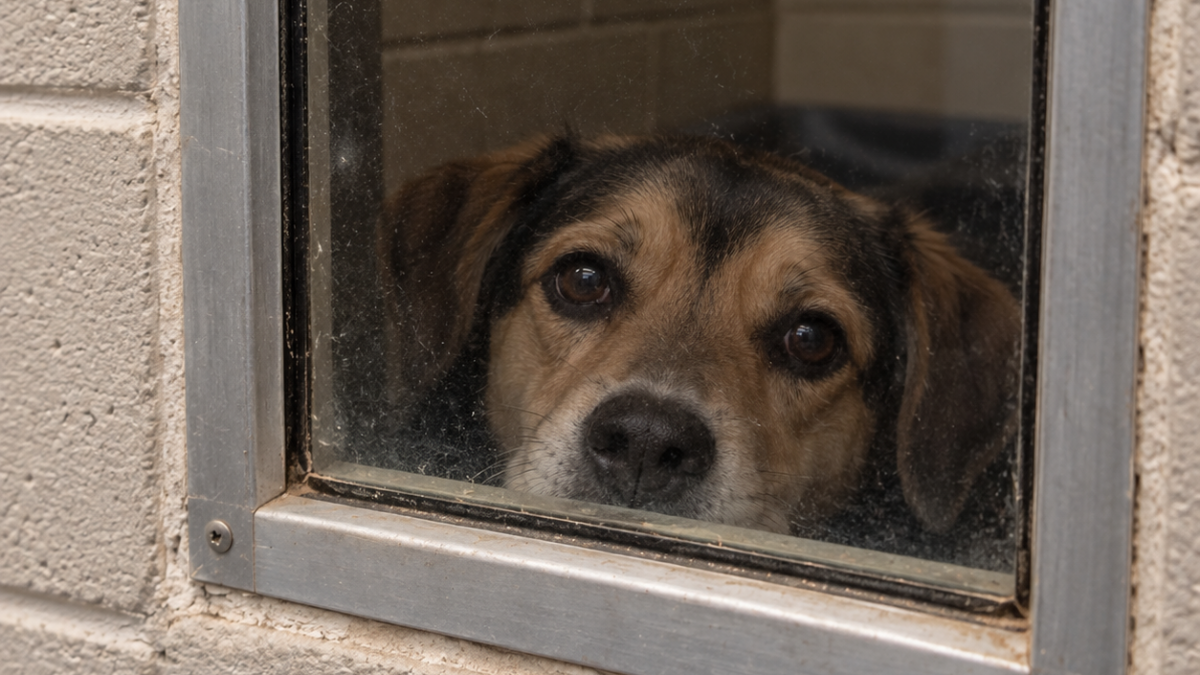
I looked through the glass at Brody.
“Being near someone.”
The family became quiet.
We brought Brody into the meet-and-greet area.
At first, he entered like he always did.
Calm.
Polite.
His nose worked the room.
He noticed the strangers.
Then he looked at me.
I sat down.
“It’s okay.”
The daughter crouched sideways rather than facing him directly.
Smart.
She didn’t reach.
Brody approached.
Sniffed her jeans.
Then moved toward the father.
Another sniff.
Then the mother.
He returned to the daughter.
She kept her hand low.
Brody touched his nose to her fingers.
Her face changed immediately.
Not dramatic.
Soft.
“Hi, Brody.”
His tail moved.
Once.
Twice.
Then faster.
I almost cried right there.
Because I knew that tail.
I knew the slow polite wag he gave volunteers.
I knew the halfhearted movement after another family walked past.
This was different.
Brody stepped closer.
The girl touched the side of his neck.
He leaned.
Actually leaned.
All that affection that had spent months waiting behind glass came forward at once.
The father laughed.
“I think he likes her.”
Brody leaned harder.
The girl nearly lost her balance.
“He’s heavy.”
“That’s your fault,” her mother said. “You started it.”
Everyone laughed.
Brody’s tail kept going.
Then he did something I had seen hundreds of times with staff.
He sat.
The father raised an eyebrow.
“Did you ask him?”
“No.”
Brody lifted one paw.
The man looked at me.
“He shakes?”
“Try.”
He took the paw.
Brody held it there.
The father looked at his wife.
His wife was already crying.
I turned away for a second.
I had promised myself I would stay professional.
That lasted about eleven minutes.
### The Question Every Shelter Worker Fears
The meeting went beautifully.
Too beautifully.
That made me nervous.
After nearly forty minutes, the family sat down together.
Brody lay near their feet.
The mother looked at me.
“We want him.”
My heart jumped.
Then training took over.
“We should talk through everything first.”
“We know.”
“I mean really talk.”
The father nodded.
“Go ahead.”
So I did.
“Brody has spent almost a year in a shelter environment.”
They listened.
“He might be wonderful tonight and anxious tomorrow.”
Nod.
“He may have accidents.”
Nod.
“He may pace.”
Nod.
“He may struggle sleeping.”
Nod.
“He may follow you constantly.”
The daughter smiled.
“That’s okay.”
“He may do the opposite and withdraw.”
Her smile faded.
“But that’s okay too.”
Good answer.
I continued.
“Sometimes shelter dogs shut down when they finally get home because the environment is so different. Sometimes behaviors appear later after they feel secure.”
The father said:
“We’re not expecting him to be grateful.”
I stopped.
That sentence matters enormously.
Too many people adopt rescue animals expecting gratitude.
As though a dog should understand a contract.
We saved you, therefore you owe us perfect behavior.
Animals do not work that way.
“Good,” I said.
“We want him to be a dog,” the man continued.
I looked at the mother.
She nodded.
The daughter had one hand resting gently on Brody’s shoulder.
I asked the final question.
“If he needs months?”
“We give him months.”
“If he never becomes outgoing?”
“We didn’t come here for an outgoing dog.”
The mother looked down.
“We came for Brody.”
There it was.
The sentence I had wanted someone to say for almost a year.
Not:
We want a dog.
We want Brody.
### Nearly 300 Days
While staff prepared the adoption paperwork, I returned Brody briefly to his kennel.
He walked inside.
Turned around.
Looked at me.
I stood outside the glass.
For months, this door had closed after every walk.
Every play session.
Every visitor.
He always came back here.
This time felt unbearable.
I crouched.
“You’re not sleeping here tonight.”
Brody looked down the hallway.
Maybe he heard his family.
His family.
I was already calling them that in my head.
“You don’t know it yet.”
He pressed closer to the glass.
I put my palm against it.
For almost 300 days, glass had been the boundary between Brody and everyone who came to choose a dog.
That afternoon, it finally became temporary.
The paperwork took less than an hour.
The waiting had taken almost a year.
I thought about that as his new leash was clipped on.
The daughter held it.
Brody stood beside her.
Everyone in the shelter seemed to know what was happening.
Volunteers appeared from nowhere.
One staff member whispered:
“Is this real?”
“Yes.”
“You’re sure?”
“The paperwork is signed.”
She covered her mouth.
Brody looked around at all of us, confused by the attention.
Someone brought his small bag of belongings.
Not much.
A blanket.
A toy.
Some food.
Medical records.
Almost a year of his life reduced to one bag.
Then they walked toward the front doors.
Brody stopped.
My heart dropped.
The daughter looked at him.
“Come on.”
He stared at the doorway.
Outside was sunlight.
Cars.
Open space.
He had passed through that door before on walks, but always with someone who brought him back.
Maybe that was why he hesitated.
The father crouched.
“No rush.”
Nobody pulled him.
Good.
Brody looked behind him.
At us.
At the hallway.
At the kennel area he had known longer than any dog should.
Then he stepped forward.
One paw.
Then another.
He walked through.
I started crying.
There was no avoiding it anymore.
The daughter looked back at me.
“Thank you.”
I shook my head.
“Just take care of him.”
“We will.”
Brody reached the parking lot.
His tail was moving.
The car door opened.
He sniffed.
Hesitated again.
Then climbed inside.
The last thing I saw before the door closed was Brody looking through the window.
Behind glass again.
But this time the glass was moving away from the shelter.
### The Empty Kennel
After an adoption, shelter workers usually clean the kennel quickly.
Another dog may need it.
Practicality does not wait for emotion.
I returned to Brody’s kennel.
His water bowl was still there.
His blanket had been removed.
A few hairs remained on the floor.
The room looked larger without him.
One volunteer stood behind me.
“I hated seeing him in here.”
“Me too.”
“Why does it feel sad empty?”
I laughed through tears.
“Because humans are ridiculous.”
We cleaned.
Disinfected.
Dried the floor.
Prepared the space for another dog.
That is one of the strange realities of animal rescue.
The best possible ending for one animal creates an empty kennel that immediately reminds you another animal needs help.
Celebration and urgency coexist.
Before the day ended, a new dog occupied Brody’s old space.
A nervous black dog.
Young.
Noisy.
He paced.
Visitors would meet him soon.
Brody’s chapter at the shelter had ended.
The shelter did not stop.
### First Night Home
At 7:16 that evening, my phone buzzed.
A photograph.
Brody was lying on a rug.
Not a dog bed.
The rug beside it.
Of course.
The message read:
HE’S EXPLORING SLOWLY. ATE HALF HIS DINNER. FOLLOWING OUR DAUGHTER EVERYWHERE.
I smiled.
Half dinner was fine.
Following her made sense.
Then:
HE KEEPS CHECKING THE FRONT DOOR.
That one hurt.
I called.
The mother answered.
“Is he okay?”
“Yes.”
“Anxious?”
“A little.”
“What does he do?”
“He walks to the door, looks at it, then comes back.”
I knew what I thought.
He was waiting for the return trip.
Shelter dogs learn routines.
Leave kennel.
Walk.
Return.
Leave building.
Return.
Go in a car for an event.
Return.
Brody had no reason to know this journey was different.
“Don’t make a big deal of it,” I said.
“We aren’t.”
“Keep things quiet.”
“Okay.”
“If he wants space, give it.”
“We will.”
Then the daughter’s voice came through.
“He just lay down.”
“Where?”
“On my foot.”
I smiled.
“He’ll be okay.”
That night, I kept my phone beside me.
No emergency call came.
At 6:40 the next morning, another photograph arrived.
Brody was on a dog bed.
Actually on it this time.
Curled.
Asleep.
The message:
HE SLEPT MOST OF THE NIGHT. WOKE UP AT 4 AND CHECKED THE HOUSE. THEN CAME BACK TO BED.
I stared at the photograph.
The dog who had spent nearly 300 days sleeping within shelter walls had woken in a strange house, looked around, and chosen to lie down again.
That was the first step.
### Learning That He Wasn’t Going Back
The first week was not perfect.
I was glad.
Perfect adoption stories make people think adjustment should be effortless.
Brody paced the first two evenings.
He startled at household sounds.
The dishwasher confused him.
The television fascinated him.
He was suspicious of the vacuum cleaner.
Very reasonable.
He followed the daughter constantly.
If she closed the bathroom door, Brody waited outside.
At bedtime, he resisted settling unless he could see someone.
They let him.
No forced independence.
No “he needs to learn.”
Safety first.
Independence can come later.
On day three, Brody refused breakfast.
His family called.
I asked the usual questions.
Energy?
Good.
Water?
Yes.
Vomiting?
No.
Diarrhea?
No.
Treats?
He would eat those.
I laughed.
“He may just be figuring out the menu.”
The father said:
“So we should not panic?”
“Monitor him.”
The daughter yelled from the background:
“He ate my toast!”
I paused.
“What?”
“My toast.”
The father sighed.
“He appears cured.”
I laughed.
“Your dog is adjusting beautifully.”
My dog.
Their dog.
Every time I heard someone call Brody that, something inside me relaxed.
By the end of the first week, he stopped checking the front door as often.
After two weeks, almost completely.
Then came the moment his family later told me mattered most.
The father returned from work.
Brody was sleeping.
He heard the garage door.
His head came up.
The man opened the house door.
Brody ran toward him.
Not because someone was leaving.
Because someone had come home.
There is a major difference.
His tail wagged wildly.
He leaned into the man’s legs.
The father sent me a message:
I THINK HE FINALLY UNDERSTANDS PEOPLE COME BACK HERE.
I saved it.
### The Video
Meanwhile, Brody’s original video kept circulating.
That created another strange problem.
People who had never noticed him before suddenly wanted him.
Calls came.
Applications.
Messages.
“Is Brody still available?”
“No. He was adopted.”
“Can I get on a waiting list?”
“For Brody?”
“Yes.”
“He has a family.”
Some people were disappointed.
One person even complained:
“I just saw the video today!”
I wanted to say:
He was available for almost 300 days.
Instead, I explained politely.
Then something useful happened.
We started answering:
“Brody has been adopted, but would you like to meet another dog who has been waiting?”
Some said no.
They wanted the famous dog.
Those people were never the point.
Others said:
“Sure.”
One woman came for Brody and left with a senior beagle.
A couple came asking about him and adopted a shepherd mix that had been waiting six months.
Another family asked:
“Which dog has been here the longest now?”
That question hit me.
The longest.
After Brody, another dog inherited that title.
There is always another.
The video that freed one dog began opening doors for others.
That was when I understood how large one story could become.
### Why Had Nobody Chosen Him?
People kept asking why Brody had waited so long.
I hated the question because there was no satisfying answer.
Was he the wrong color?
Wrong size?
Not flashy enough?
Too calm?
Did younger dogs attract attention first?
Did visitors assume a long-term dog had something wrong with him?
Probably a mixture.
Animal adoption contains randomness people don’t like admitting.
A dog can be wonderful and still wait.
A photograph can fail to connect.
A family arrives on one particular Saturday instead of another.
A kennel is farther from the entrance.
A dog sleeps while visitors walk by.
Another dog barks and catches their eye first.
Weeks become months.
Then a long stay becomes its own stigma.
“Why has he been here so long?”
People assume there must be a reason.
Sometimes the reason is simply that nobody has said yes yet.
Brody taught me that.
### The Library
Months after Brody’s adoption, I drove past the library where he had originally been found.
I hadn’t planned to stop.
I did anyway.
It was cold.
Not as cold as the day Brody was discovered, but enough that I could imagine him there.
Alone.
Trembling.
Waiting.
People entering.
People leaving.
A dog who had once known a family suddenly outside with no explanation.
I stood near the entrance.
I thought about whoever had left him.
I had spent months angry at them.
How could someone abandon a dog this gentle?
How could someone teach him commands, live with him, make him trust human routines, and then simply disappear from his life?
Part of me wanted them to see the video.
I wanted them to recognize him.
To see nearly 300 days written in the way he watched shelter doors.
To understand what they had done.
Then I thought of the Olathe family.
Brody running toward the father when he came home.
Brody asleep on the daughter’s foot.
Brody stealing toast.
And suddenly the old family mattered less.
That felt right.
Brody’s story did not need to end with revenge against the people who abandoned him.
The better ending was that their decision stopped defining him.
They left him outside a library.
Someone else opened a home.
They disappeared.
Someone else kept coming back.
That was justice enough.
### Three Months
Three months after adoption, Brody returned to Leavenworth Animal Shelter.
For a visit.
I knew in advance.
I still became nervous.
Would he remember?
Would returning stress him?
Would he think he was being surrendered?
His family was careful.
They parked outside.
Walked him around first.
Then approached the door.
Brody stopped.
My heart tightened.
The daughter crouched.
“It’s okay.”
Brody sniffed.
Then walked in.
Dogs started barking.
Familiar sound.
His ears moved.
He looked down the kennel hallway.
For several seconds, he stood very still.
I approached slowly.
“Brody?”
His head snapped toward me.
Then the tail started.
I laughed.
“Hi.”
He came forward.
Pressed his body against my legs.
I knelt and hugged him.
“You remember.”
His daughter smiled.
“Of course he does.”
Brody greeted volunteers.
Walked through the lobby.
He seemed curious but not panicked.
Then something extraordinary happened.
A kennel door slammed somewhere down the hallway.
Brody looked.
Then turned back toward his family.
Not toward his old kennel.
Toward them.
His choice was clear.
I almost cried again.
When they prepared to leave, Brody walked straight to the exit.
No hesitation.
At the car, he climbed in immediately.
The shelter had become somewhere he visited.
Home was somewhere else.
That was exactly what I wanted.
### The Dog Bed
Brody’s family sent updates regularly.
One photograph became my favorite.
Brody lay on his dog bed beside a large living-room window.
Sunlight across his face.
I stared at it.
For almost a year, Brody had sat beside shelter glass watching people go somewhere else.
Now he still liked windows.
But the meaning had changed.
He wasn’t trapped behind one.
He could stand up.
Walk to the kitchen.
Find his family.
Go outside.
Return.
The window was simply part of his home.
A view.
Not a barrier.
I saved the photograph beside a still frame from the original video.
Brody behind shelter glass.
Brody beside his own window.
Same eyes.
Different expectation.
That difference is difficult to describe unless you see it.
Shelter Brody watched doors open for other people.
Home Brody expected doors to open for him.
### The First Snow
That winter, Olathe got snow.
Brody’s family sent me a video.
I expected something sentimental.
Instead, Brody ran into the yard, discovered snow, and immediately lost his mind.
He sprinted.
Dropped his shoulder into it.
Rolled.
Jumped up.
Ran again.
The daughter was laughing so hard she could barely hold the camera.
Brody buried his nose in the snow.
Sneezed.
Then did it again.
I replayed the video.
That was the same dog found trembling outside a library in winter.
Cold had once been part of abandonment.
Now snow meant play.
That reversal felt almost too perfect.
The father later told me:
“We couldn’t get him inside.”
I laughed.
“Good problem.”
“He looked offended when we closed the door.”
“Excellent.”
The things that once represented suffering lose their power when safety changes the context.
A window becomes a view.
Cold becomes snow to play in.
A door becomes something family comes through.
That was Brody’s real recovery.
### The Old Family
About a year after Brody’s adoption, a message reached the shelter.
Someone claimed to recognize him from before he was found.
They knew the family who had once had him.
I felt my anger return immediately.
“Do they want him back?”
“No.”
“Good.”
The information was limited.
The family had gone through changes.
There were explanations.
Excuses.
Confusion.
Whatever the details, one fact remained:
Brody had been left behind.
No one had reclaimed him during the appropriate process.
No one had spent those 300 days waiting outside his kennel.
I decided I did not need more.
People expected me to want confrontation.
I didn’t.
Not anymore.
Brody’s life was stable.
Digging into old excuses would not improve it.
Sometimes closure is choosing not to reopen a door.
The family who abandoned him became irrelevant.
That was perhaps the strongest consequence.
Brody no longer waited for them.
### The Dog Who Waited Helped Another Dog
Two years after the viral video, I received a photograph from Brody’s family.
He was lying beside another dog.
Small.
Nervous-looking.
I called.
“Who is that?”
The mother laughed.
“Temporary.”
I knew that word.
“Foster?”
“Yes.”
The little dog had been shut down in the shelter.
Brody, apparently, had taken interest.
At first, the new dog hid.
Brody would lie nearby.
No pressure.
When Brody went outside, the dog watched.
When Brody ate, the dog eventually ate.
When Brody approached the family, the dog came closer.
The daughter said:
“He’s teaching him.”
I sat quietly.
Once, Brody had watched other dogs leave the shelter.
Now another frightened dog watched Brody live normally and learned that a home could be safe.
The foster was adopted two months later.
Not by Brody’s family.
By someone else.
But he left their house more confident than he entered.
One life opening another.
That mattered.
### Growing Older
Time passed.
Brody’s muzzle slowly lightened.
When his family sent the first photograph where I could clearly see gray beneath his mouth, I protested.
“He is not allowed.”
The daughter, now older herself, replied:
YOU KNOW THAT IS NOT HOW DOGS WORK.
I knew.
But aging rescue dogs creates complicated feelings.
Part of you resents time.
Another part celebrates every gray hair.
Brody had once been abandoned.
Then he spent nearly a year waiting.
Every year afterward was time he actually got to keep.
He developed arthritis eventually.
Nothing severe at first.
His family adjusted.
Shorter walks.
Joint support under veterinary care.
A better orthopedic bed.
The same dog who once slept on cold shelter floors now had a bed expensive enough that I made fun of them.
The father said:
“He likes it.”
“I hope so.”
“He has two.”
“You’ve lost control.”
“Years ago.”
Brody still waited near the window sometimes.
But now when a familiar car arrived, his tail moved before the door opened.
Waiting had become something different.
Not wondering whether anyone would choose him.
Knowing his people were coming home.
### The Day the Video Came Back
One afternoon, years after I first posted Brody’s video, someone sent it to me again.
It had resurfaced online.
There was Brody.
Younger.
Behind the glass.
My voice:
“Do you know if anyone asked to meet me today?”
I almost couldn’t watch.
Not because the ending was sad.
Because I knew what Brody did not know in that moment.
Somewhere in Kansas, a family he had never met was eventually going to see his face.
A girl was going to put her hand down.
Brody was going to lean into it.
He would sleep on rugs.
Steal toast.
Play in snow.
Teach a foster dog.
Grow gray.
He was going to have years beyond the kennel.
But the dog in the video didn’t know.
He only knew nobody had asked that day.
That is why shelter waiting is so painful.
Humans can imagine future possibilities.
Dogs live much closer to what is happening now.
Today, still here.
Tonight, kennel.
Tomorrow?
Unknown.
That is why one day matters.
One visitor.
One share.
One person stopping.
The future can change before the animal understands it has.
### Brody Comes Back One Last Time
When Brody was older, his family brought him to a shelter fundraiser.
By then, very few of the original volunteers still worked there.
But I was there.
Brody walked slowly.
Gray around the face.
Still gentle.
Still polite.
A young volunteer asked:
“Is that Brody?”
I smiled.
“Yes.”
“The Brody?”
I laughed.
“He has become historically significant apparently.”
She knelt.
Brody offered his paw.
The same trick.
The volunteer’s face lit up.
“He still does it.”
“He always will if food is involved.”
Brody looked toward me.
I gave him a treat.
Of course.
During the event, an older man stopped near us.
He had been looking at dogs available for adoption.
He pointed toward Brody.
“How long did he wait?”
“Almost 300 days.”
The man looked shocked.
“Why?”
“There wasn’t anything wrong with him.”
The man became quiet.
Then asked:
“Who’s been here the longest now?”
That question.
Again.
I led him toward a dog named Sadie.
She had been waiting eight months.
Older.
Quiet.
Easy to overlook.
The man sat with her for an hour.
Two days later, he adopted her.
I told Brody’s family.
His daughter smiled.
“He’s still doing it.”
“Doing what?”
“Getting dogs adopted.”
Maybe she was right.
Brody’s wait had created attention.
Attention had moved outward.
The glass that once trapped him had become a window through which people learned to see other animals.
### When Brody Slowed Down
Brody’s final years were gentle.
That is the word I choose.
Not perfect.
He had health problems that come with age.
More veterinary visits.
Medication.
Slower mornings.
Sometimes he needed help getting up.
His family gave it without complaint.
That mattered to me.
Because once, someone had walked away.
Now people rearranged their lives around him.
The daughter who first crouched in the shelter grew into a young woman.
When she came home from college, Brody still met her at the door.
Slowly.
But he came.
One holiday, she sent me a video.
Brody heard her voice.
He was lying down.
His ears lifted.
Then he stood with effort.
Walked toward her.
She dropped her bags and knelt.
Brody put his head against her chest.
I watched it three times.
Almost 300 days without a family.
Then enough years with one that the little girl who adopted him grew up beside him.
That was the scale of the ending.
### The Hard Call
Eventually, the call came.
They always do.
The mother’s voice was quiet.
“Maria?”
I knew.
“What happened?”
“He’s not doing well.”
Brody had stopped eating reliably.
His arthritis had worsened.
Another medical condition complicated things.
The veterinarians could manage some symptoms.
Not reverse age.
The family had started tracking good days and bad.
I had learned to respect that method.
Love lies to us when we are scared.
A written record can be kinder.
The mother said:
“We think we’re getting close.”
I closed my eyes.
“Does he still enjoy things?”
“Sometimes.”
“Food?”
“Not much.”
“Family?”
“Yes.”
“Outside?”
“Less.”
She started crying.
“I don’t want to do it too early.”
“No one does.”
“And I don’t want to do it too late.”
“That’s the promise.”
“What?”
“To not make him stay in pain just because we can’t bear the room without him.”
Silence.
Then:
“Will you come?”
“Yes.”
### The Dog Who Waited No More
Brody’s final day happened at home.
Not behind shelter glass.
Not on a cold kennel floor.
Home.
His dog bed had been moved near the window he loved.
The same kind of place he always chose.
But this window looked out over his own yard.
His family sat around him.
The daughter—now no longer a teenage girl—sat on the floor with his head in her lap.
I entered quietly.
Brody opened his eyes.
His tail moved once.
“Hi, Brody.”
I sat beside him.
“You remember me?”
His nose touched my hand.
That was enough.
The veterinarian gave us time.
Nobody rushed.
The father rubbed Brody’s chest.
The mother held one paw.
The daughter whispered:
“You were worth waiting for.”
I looked away.
Because technically Brody had been the one waiting.
But she was right in another way.
All those days.
All those people who passed.
All that uncertainty.
None of it changed what he was worth.
Not on day one.
Not on day 299.
Worth does not increase when someone finally recognizes it.
Recognition simply arrives late.
The veterinarian gave the first medication.
Brody relaxed.
His breathing softened.
His daughter stroked his ears.
I thought of the viral video.
Do you know if anyone asked to meet me today?
If I could somehow answer the younger Brody through time, I would have told him:
Not today.
But someone will.
And when they do, they will stay.
The final medication was given.
Brody died peacefully.
His head in the lap of the person he had chosen during that first shelter meeting.
No glass between them.
No kennel door.
No waiting.
### The Window
Weeks later, Brody’s family sent me one final photograph.
His bed remained by the window.
Empty.
Sunlight fell across it.
Beside the bed was a framed picture.
Brody in the snow.
Mouth open.
Tail high.
The message said:
WE HAVEN’T MOVED HIS BED YET.
I replied:
YOU DON’T HAVE TO.
Eventually, they did.
Not because they were forgetting.
Because grief shifts.
The window remained.
Of course.
Years later, another dog slept near it.
A rescue.
I smiled when I heard.
Brody was not replaced.
Dogs aren’t furniture.
The new dog had another name.
Another personality.
Another history.
But Brody had changed what that family would do whenever there was room in their life.
They would look toward shelters.
That is continuation.
### What Happened to the Glass?
I still think about the shelter glass sometimes.
Not literally.
The building changed over the years.
Kennels were updated.
Staff changed.
Dogs came and went.
But in my memory, Brody remains sitting there.
Watching.
Every person passing.
Every opening door.
The old image used to make me sad.
Now it does something else.
It reminds me how little difference there can be between being invisible and being seen.
Brody did not suddenly become sweeter the day his video spread.
He had already been sweet.
He did not become smarter.
He was already smart.
He did not become worthy.
He had always been worthy.
Nothing about Brody changed when thousands of people finally watched the video.
People changed.
They looked.
That is all.
And sometimes that is enough to alter an entire life.
The family in Olathe saw him.
Then they drove to Leavenworth.
Then they walked into the shelter and said his name.
That was the turning point.
Brody.
Not kennel number.
Not “the dog from the video.”
Brody.
### The Revenge I Never Needed
For a long time, I imagined I wanted the people who abandoned him to know.
I wanted them to see how gentle he remained.
How long he waited.
How much another family loved what they had discarded.
I wanted regret.
That desire faded.
Because revenge would have kept them at the center of Brody’s story.
They did not deserve that position.
They were one chapter.
An ugly one.
They left him.
That was true.
But another family came.
That became more important.
One family taught Brody that people could disappear.
Another spent years teaching him that people came home.
Which truth should define his life?
I choose the second.
That was the satisfying ending.
Not punishment.
Replacement of one expectation with another.
Door opens.
Nobody for me.
Became:
Door opens.
My person is home.
A dog who once watched strangers leave eventually became the dog waiting confidently for familiar footsteps.
That is justice at the level animals understand.
Consistency.
Safety.
Belonging.
### What Brody Taught Me
Brody changed how I walk through shelters.
I slow down near the quiet ones.
The dogs who don’t jump.
The ones who sleep when visitors arrive.
The seniors.
The shy dogs.
The animals who have been available long enough that their cards begin feeling permanent.
I ask:
Who has been waiting?
Not because the longest-stay dog is automatically right for every family.
Adoption has to fit.
But waiting should not become invisibility.
Brody almost disappeared in plain sight.
A good dog.
Right there.
For nearly 300 days.
Sometimes I wonder how many Brodys are behind glass right now.
Sitting politely.
Watching.
No viral video yet.
No family already driving toward them.
Just another morning.
Another visitor passing.
Another night.
That thought is why I never tell Brody’s story as only a happy ending.
The happy ending matters.
But so does the waiting.
Because compassion came late for Brody.
It still came.
That is beautiful.
Earlier would have been better.
### The Last Image
When I think of Brody now, I no longer see the original shelter clip first.
I see a photograph his family sent during his middle years.
Brody lying on his dog bed beside the window.
Sunlight covering half his body.
One toy near his paws.
Eyes almost closed.
Completely relaxed.
Outside, life was happening.
Cars.
People.
Weather.
Doors opening and closing.
But Brody was not watching because he needed someone to choose him anymore.
He had already been chosen.
That is the difference one family made.
For nearly 300 days, he had lived behind glass and watched the world leave without him.
Then one day, someone saw a video.
A family stopped scrolling.
They drove across Kansas.
They said:
“We want to meet Brody.”
And for the first time in almost a year, the shelter door did not close with him still on the wrong side.
Brody walked through it.
He went home.
He stayed home.
He grew old there.
And when his life finally ended, he was surrounded by the people he had spent so long waiting to find.
The family that abandoned him controlled one winter afternoon.
They did not get the next years.
Those belonged to Brody.
To the girl whose hand he leaned into.
To the father he eventually ran to at the door.
To the mother who called when he skipped breakfast.
To the home where he learned that footsteps in the driveway meant someone was returning.
To snow.
Dog beds.
Toys.
Toast he wasn’t supposed to steal.
Windows that were only windows.
And doors that always opened for him.
That is how I remember Brody.
Not as the dog nobody wanted.
As the dog people almost failed to notice.
There is a difference.
He had always been worthy of a home.
The world simply took almost 300 days to catch up.
And once it finally did, Brody never had to wonder again whether anyone had asked to meet him.
Someone had.
Then they spent the rest of his life proving they were glad they did.








