PART 2: At Nine, My Son Saved $240 for a Dog—Then He Asked the Shelter One Question That Silenced the Entire Room
PART 2
The shelter director’s name was Sophie.
Until that moment, she had been cheerful and efficient, explaining vaccination records, adoption paperwork, food schedules, and the usual adjustment period for a rescue dog.
Now she looked completely different.
Not frightened.
Not exactly.
Sad.
“There is one,” she said.
Theo leaned closer.
“One what?”
“One dog who has been here longer than the others.”
“How long?”
Sophie hesitated.
“Four hundred and twenty-three days.”
Theo’s eyes widened.
I did the math automatically.
More than a year.
“Why?” he asked.
Sophie glanced at me.
It was the kind of look adults exchange when deciding how much truth a child can handle.
Theo noticed.
“You can tell me.”
“Theo—”
“Mom, I asked.”
There was no disrespect in his voice.
Just determination.
Sophie folded her hands over the paperwork.
“His name is Gaston.”
“What kind of dog?”
“Probably a shepherd mix.”
“How old?”
“Eleven, maybe twelve.”
Theo’s face changed slightly.
Not disappointment.
Concentration.
“Is he sick?”
“He has arthritis. One eye is cloudy. His hearing isn’t as good as it used to be.”
“But is he nice?”
Sophie smiled sadly.
“He is very nice.”
“Then why doesn’t anybody want him?”
There are questions children ask that adults spend years learning how to avoid.
Sophie didn’t avoid this one.
“Because most families who come here want young dogs.”
Theo said nothing.
“They want a dog they imagine having for ten or fifteen years,” Sophie continued. “They want a dog that can run, hike, play for hours. Gaston sleeps a lot. He walks slowly. He needs medication.”
“How much?”
“His medicine?”
Theo nodded.
“Not very much. But there may be more veterinary care as he gets older.”
“Has anyone tried to adopt him?”
“A few people have met him.”
“And?”
“They chose someone else.”
Theo looked toward the door again.
“Can I see him?”
Sophie looked at me.
I nodded.
“All right.”
She came out from behind the desk.
Theo immediately followed.
I caught his shoulder.
“Remember something.”
“What?”
“We’re already adopting one dog.”
“I know.”
“One.”
“I know, Mom.”
“I mean it.”
Theo gave me the deeply offended look only children can give when adults accuse them of forgetting the exact rule they have already memorized.
“I said I know.”
We followed Sophie down the corridor.
The shelter smelled like disinfectant, dog food, damp fur, and that strange mixture of hope and sadness every animal shelter seems to carry.
Young dogs barked as we passed.
One jumped repeatedly against his kennel door.
Another spun in circles.
A small white terrier shoved a squeaky toy through the bars as if presenting a business proposal.
Theo normally would have stopped for all of them.
He didn’t.
He walked straight toward the back.
Sophie unlocked the final door.
Behind it was a quieter section.
Four kennels.
Three were empty.
In the last one, an old dog was sleeping on a thick blanket.
He was larger than I expected.
His fur had probably once been dark brown and black, but gray now covered his muzzle and eyebrows.
One ear stood upright.
The other leaned sideways.
His front legs were crossed.
A faded blue stuffed rabbit lay beside his paws.
“Gaston,” Sophie said softly.
The old dog opened his eyes.
One was brown.
The other was milky with age.
His tail thumped once.
Then twice.
He stood.
Slowly.
Very slowly.
I saw immediately what Sophie meant about arthritis.
His hindquarters trembled.
It took effort simply to straighten his legs.
But once he was upright, he walked toward the kennel door.
Theo crouched.
“Hi.”
Gaston sniffed his fingers through the bars.
Then licked them.
Once.
Nothing dramatic.
No jumping.
No barking.
No frantic excitement.
Just one slow lick.
Theo smiled.
“How come you’re back here?”
Sophie answered.
“He gets overwhelmed when there’s too much noise.”
Theo looked around.
“So you keep him somewhere quiet.”
“Yes.”
“But then people don’t see him.”
Sophie went silent.
Theo looked at her.
“You said people don’t choose him.”
“We bring him out when someone specifically asks about older dogs.”
“How many people ask that?”
Sophie looked at the floor.
“Not many.”
Theo turned back to Gaston.
For several seconds, he said nothing.
Then he stood and reached into his pocket.
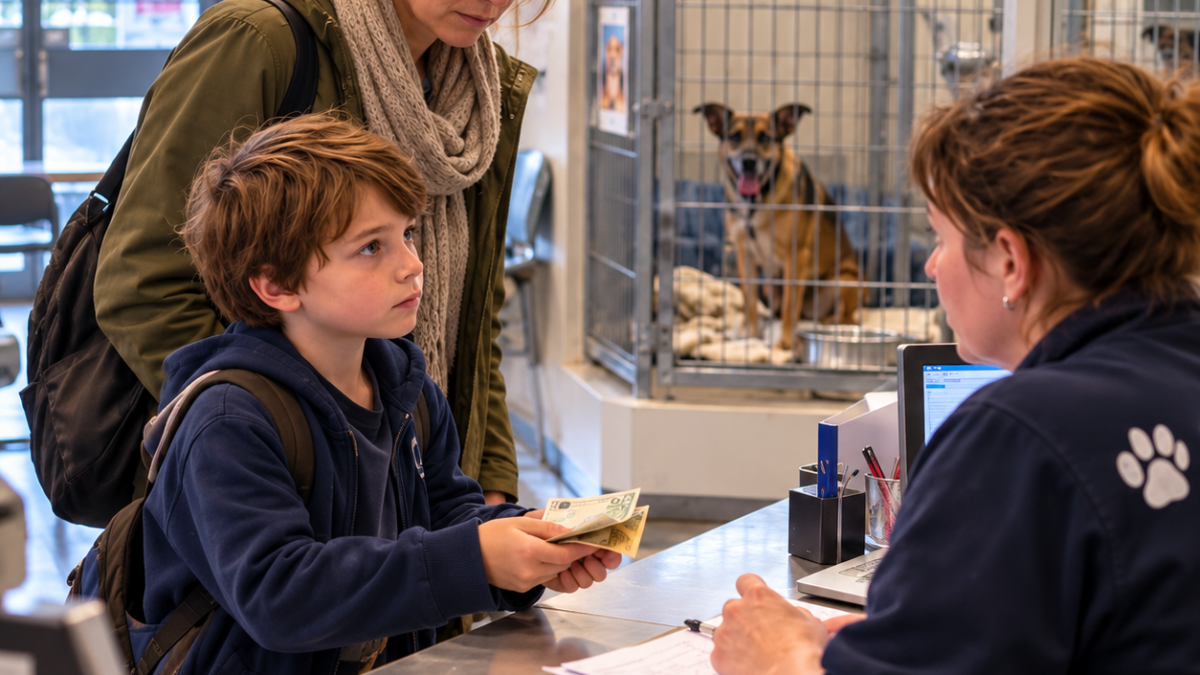
He removed the money he had separated from the rest.
Fifty euros.
He walked straight back toward the front desk.
Sophie followed.
So did I.
And that was how we arrived at the moment I had misunderstood.
“Fifty euros for him,” Theo said.
Sophie stared at the bills.
“But you said you’re adopting Milo.”
Milo was the young brown dog Theo had chosen.
“Yes.”
“And you can’t adopt Gaston too.”
“My mom already told me.”
“I definitely did,” I said.
Theo pushed the money closer.
“So make Gaston free.”
Sophie blinked.
Theo explained it as though the solution were painfully obvious.
“If somebody likes him but thinks he costs too much because he needs medicine, then tell them his adoption is already paid.”
Sophie looked at him.
“That’s what you want to do?”
“Yes.”
“With fifty euros you spent nearly two years saving?”
“No.”
Theo reached into his other pocket.
My heart sank.
He pulled out more bills.
“How much is Gaston’s adoption?”
Sophie’s voice softened.
“Fifty.”
“Good.”
He left the money on the counter.
Then separated another small stack.
“What’s that for?” I asked.
“Milo.”
“Theo.”
He looked at me.
“How much money do you have left?”
He began counting.
We had counted it before leaving home.
Two hundred forty euros.
Milo’s adoption fee was eighty.
Gaston’s was fifty.
That left one hundred ten euros.
“Theo, you still need a leash, bowls, a bed—”
“I know.”
“We discussed this.”
“I know.”
“Then why are you giving away fifty euros?”
His answer stopped me.
“Because Milo already has me.”
I didn’t say anything.
Theo pointed toward the back of the shelter.
“Gaston doesn’t have anybody.”
There are moments as a parent when your child makes you proud.
A good report card.
A thoughtful apology.
A brave decision.
And then there are rarer moments when your child quietly reveals something about himself that makes you wonder whether you have been paying enough attention.
This was one of those moments.
I thought Theo had spent two years saving for possession.
A dog.
His dog.
His dream.
But somewhere during those two years, the dream had changed.
He had started thinking not only about what he wanted from an animal.
He had begun thinking about what an animal might need from him.
Sophie picked up the fifty euros.
Then put them back down.
“I can’t take this.”
Theo frowned.
“Why?”
“Because I’m going to pay Gaston’s fee.”
Theo immediately shook his head.
“That’s cheating.”
For the first time all morning, Sophie laughed.
“How is that cheating?”
“Because I asked first.”
She pressed her lips together, trying not to laugh again.
I touched Theo’s shoulder.
“Sophie is trying to be kind.”
“So am I.”
That silenced us both.
Finally Sophie leaned down until she was at eye level with him.
“All right. We’ll do it your way.”
Theo nodded seriously.
“But,” Sophie continued, “I have one condition.”
“What?”
“You let us put a note on Gaston’s kennel.”
“What note?”
Sophie thought.
Then she said, “Something like: My adoption fee has already been paid by a boy who believes someone should choose me.”
Theo immediately shook his head.
“No.”
“Why?”
“Don’t put my name.”
“I wasn’t going to.”
“And don’t say a kid did it.”
Sophie looked surprised.
“Why not?”
“Because then someone might take him because they feel bad for me.”
Theo pointed toward the kennel hallway.
“They should take him because they want Gaston.”
I turned away.
Not because I was upset.
Because my eyes were suddenly burning and I didn’t want him to see.
We completed Milo’s paperwork.
Theo paid his adoption fee himself.
That mattered to him.
While Sophie prepared the documents, I bought the leash, collar, and starter food with my own money.
Theo objected.
I ignored him.
“This is my contribution.”
“But—”
“I waited two years too.”
That seemed to satisfy him.
Milo came home with us that afternoon.
The first week was chaos.
He stole one of my slippers.
Chewed the corner of a cushion.
Barked at our vacuum cleaner like it had personally insulted his ancestors.
Theo loved every second.
He woke early.
Walked Milo before school.
Filled his water.
Measured his food.
Checked the list he had written two years earlier, now taped to the refrigerator.
He never once complained.
But every evening, he asked the same question.
“Did Gaston get adopted?”
I had no idea.
On the fourth day, Theo asked me to call.
Sophie answered.
“No,” she said gently. “Not yet.”
The seventh day.
Still no.
The twelfth day.
No.
Three weeks passed.
Nothing.
Theo’s excitement about Milo remained.
But I could see another concern sitting behind it.
One rainy Wednesday afternoon, he was doing homework at the kitchen table when he suddenly asked:
“What happens if nobody takes Gaston before he dies?”
I stopped washing a plate.
“Theo.”
“I’m asking.”
I dried my hands.
“Sophie told us they’ll keep taking care of him.”
“But he could die there.”
I sat across from him.
“Yes.”
He stared down at his math worksheet.
“That’s not fair.”
“No.”
“Why do people only want pretty dogs?”
“They don’t only want pretty dogs.”
“You know what I mean.”
I did.
He continued.
“Milo was going to get adopted.”
“How do you know?”
“He’s young. He’s funny. He has stupid ears.”
From beneath the table, Milo lifted his oversized ears at exactly the right moment.
Theo almost smiled.
“He didn’t need me the same way.”
“You love him.”
“I know.”
“And there’s nothing wrong with choosing him.”
“I know.”
But he didn’t sound convinced.
I reached across the table.
“Theo, you cannot save every animal.”
He looked at me.
“I know.”
“That’s going to be important for you to understand.”
“I know.”
“You helped Gaston.”
“But he’s still there.”
“Yes.”
He stared at his pencil.
Then whispered:
“Then I didn’t help enough.”
That frightened me.
Kindness is beautiful.
But children who feel responsible for every suffering thing can eventually break themselves trying to carry weight that never belonged entirely to them.
“You did enough,” I said firmly.
He looked unconvinced.
“You did something. That matters. But the rest is not yours to control.”
He nodded.
I wasn’t sure he believed me.
A month after we adopted Milo, Sophie called.
Theo was at school.
“I have news.”
My heart jumped.
“Gaston?”
“Yes.”
“Someone adopted him?”
“Someone wants to meet him tomorrow.”
I nearly shouted.
“Seriously?”
“Yes.”
“Who?”
“A woman named Madeleine.”
Sophie explained.
Madeleine was sixty-two.
Her husband had died the previous year.
They had always owned dogs, but after his death she had refused to adopt another.
Her daughter finally convinced her to visit the shelter.
Madeleine had walked past every kennel.
She liked several dogs.
Then she saw Gaston’s note.
His adoption fee had been paid.
Not by the shelter.
By someone who believed he deserved another chance.
She asked to meet him.
“What happened?”
“She sat on the floor with him for forty-five minutes.”
“And?”
“He put his head in her lap and fell asleep.”
I smiled.
“That sounds promising.”
“She’s coming back tomorrow.”
I could hardly wait for Theo to come home.
He dropped his backpack by the door.
“Milo!”
Milo skidded through the hallway and nearly crashed into the wall.
Theo knelt, laughing.
I waited.
Eventually he looked up.
“What?”
“Gaston has someone coming tomorrow.”
He froze.
“A family?”
“A woman.”
“Does she like old dogs?”
“Apparently.”
“Does she know about his leg?”
“Yes.”
“His eye?”
“Yes.”
“Medicine?”
“Yes.”
“Does she have stairs?”
“I don’t know.”
He stared at me.
“Call Sophie.”
“Theo!”
“What? That matters.”
I laughed.
“I’m sure the shelter will check.”
The next day felt ridiculous.
I was nervous.
Theo was nervous.
Milo was the only creature in the apartment not emotionally invested in Gaston’s adoption, and he spent most of the day trying to destroy a tennis ball.
At 4:16 p.m., my phone rang.
Sophie.
Theo practically climbed over the couch.
I answered on speaker.
“Well?”
Sophie didn’t speak immediately.
Then we heard laughter.
“He went home.”
Theo stopped breathing.
“What?”
“Gaston went home.”
“With the lady?”
“With Madeleine.”
Theo sat down.
Hard.
On the floor.
Milo immediately brought him the damaged tennis ball.
Theo pushed it aside.
“Does she have stairs?”
Sophie laughed.
“One small step at the front door.”
“Does she know he needs medicine?”
“Yes.”
“Does she have another dog?”
“No.”
“Is she nice?”
“She cried when she signed the papers.”
Theo’s face crumpled.
For one horrible second, I thought something was wrong.
Then he covered his mouth.
He was crying.
Not loud.
Not dramatically.
Just silent tears.
I sat beside him.
He leaned against me.
“He got a house?”
“Yes.”
“A real house?”
“Yes.”
“Can he sleep on the couch?”
Sophie answered.
“Madeleine specifically asked whether he was allowed on furniture.”
Theo immediately sat upright.
“What did you say?”
“I told her that was her decision.”
“And?”
“She said good, because she already bought him a blanket for the couch.”
Theo burst into tears again.
I wrapped both arms around him.
Milo shoved his enormous ears between us, confused by the sudden group hug.
That should have been the end of the story.
It wasn’t.
Two weeks later, Sophie invited us back to the shelter.
“I have something to show Theo.”
We arrived Saturday morning.
Milo came with us.
Theo immediately looked toward Gaston’s old kennel.
Empty.
A new dog occupied the room beside it.
A black-and-white senior spaniel named Pauline.
She was ten.
One ear had been damaged years earlier.
Theo stared at her.
“Is she like Gaston?”
Sophie smiled.
“In some ways.”
Theo looked at me.
I knew that look.
“No.”
“I didn’t say anything.”
“You were going to.”
“I was just looking.”
“You have your dog.”
“I know.”
Sophie laughed.
“Relax, Claire. I didn’t invite him here to adopt Pauline.”
She led us toward the front desk.
Behind it was a glass jar.
A large one.
Inside were coins and bills.
Across the front, in black letters, was a label.
THE NEXT ONE.
Theo read it twice.
“What’s that?”
Sophie pointed toward him.
“You started it.”
“I did?”
“After Gaston was adopted, Madeleine came back.”
Theo smiled.
“She did?”
“She brought fifty euros.”
“Why?”
“She said she wanted to pay the adoption fee for another older dog.”
Theo stared at the jar.
“Then one of our volunteers added twenty.”
Sophie continued.
“One of the delivery drivers who brings food added ten. A family who adopted a cat added five. Then someone else added thirty.”
“How much is in there?”
“Two hundred and eighty-seven euros.”
Theo looked stunned.
Sophie rested her hands on the counter.
“When enough money is collected, we use it to sponsor the adoption fee of an older animal or one that has been overlooked for a long time.”
Theo walked closer.
“Does Pauline count?”
“She might.”
He looked at the dog through the glass.
Then at the jar.
“Can I put money in?”
I closed my eyes.
“Theo.”
“Two euros.”
I looked at him.
“Two.”
He pulled two coins from his pocket.
I sighed.
“Fine.”
He dropped them into the jar.
That should have been enough emotion for one day.
Then the front door opened.
A woman entered.
She had silver hair tied loosely at the back of her neck.
Beside her walked Gaston.
I recognized him immediately.
Theo didn’t.
Not at first.
Gaston had gained weight.
His coat had been brushed until it shone.
He wore a red bandana around his neck.
He still walked slowly.
His cloudy eye had not changed.
But something else had.
He no longer looked like a dog waiting.
He looked like a dog who belonged somewhere.
“Gaston?”
Theo whispered.
The old dog lifted his head.
He sniffed.
Then his tail began moving.
Theo dropped to his knees.
Gaston walked toward him.
Slowly.
One stiff step at a time.
Then he pressed his entire head against Theo’s chest.
Theo wrapped his arms around him.
Madeleine covered her mouth.
Sophie turned away.
I didn’t even bother pretending not to cry.
“He remembers me,” Theo said.
Madeleine smiled.
“I think he remembers everyone who was kind to him.”
Theo stroked Gaston’s gray face.
“Is he good?”
“He snores.”
Theo laughed.
“He steals my side of the couch.”
More laughter.
“He refuses to eat his medicine unless I hide it in cheese.”
Theo looked serious.
“That’s smart.”
“And every morning at exactly six-thirty, he puts his nose against my bedroom door.”
“Because he needs to go outside?”
“No.”
Madeleine shook her head.
“He wants breakfast.”
Theo laughed so hard that Gaston began wagging faster.
Then Madeleine reached into her purse.
She took out a photograph.
It showed Gaston asleep on a blue couch.
His old stuffed rabbit was tucked under his chin.
Theo stared.
“Is that his?”
“Sophie sent it with him.”
Theo touched the photograph.
“He looks happy.”
“He is.”
Madeleine hesitated.
Then said something I will never forget.
“And so am I.”
The room became quiet.
“My husband died fourteen months before I adopted Gaston,” she said. “After that, the house became very quiet.”
Theo listened.
“I stopped going for walks because I didn’t have anywhere I needed to go. I stopped talking much at home because there was nobody there.”
She touched Gaston’s back.
“This old man changed that.”
Theo looked at him.
“So you saved him?”
Madeleine smiled.
“I’m not sure which one of us did the saving.”
Years later, that sentence would still come back to me.
But our story took another turn before then.
About six months after Gaston’s adoption, the shelter received a call.
A man claimed Gaston belonged to him.
Sophie called me that evening.
At first, I didn’t understand why.
Then she explained.
The man had seen a photograph of Gaston online.
The shelter had posted an update about the senior-dog sponsorship fund.
Gaston was pictured with Madeleine.
The post had spread widely through local community groups.
Someone recognized him.
A former owner.
“What does he want?” I asked.
“He says he wants Gaston back.”
My stomach turned.
“But didn’t he surrender him?”
“No.”
That was the problem.
Gaston had originally been found tied to a fence near a rural road.
No chip.
No tag.
No identification.
The shelter had followed the required procedures.
Nobody claimed him.
Eventually, he became legally available for adoption.
Now, nearly two years later, a man named Laurent claimed Gaston had been his dog.
“What proof does he have?”
“Photos.”
“And why did Gaston end up tied to a fence?”
Sophie’s voice hardened.
“He says the dog disappeared.”
I didn’t believe it.
Neither did she.
But belief wasn’t evidence.
Laurent came to the shelter.
He brought photographs.
They were clearly Gaston.
Younger.
Less gray.
The same bent ear.
The same markings.
The same cloudy eye beginning to form.
Laurent insisted someone must have stolen him.
Then abandoned him.
He wanted the shelter to make Madeleine return the dog.
Theo learned about it because I made the mistake of discussing the situation with my brother while Theo was supposed to be upstairs.
He appeared in the kitchen doorway.
“What do you mean somebody wants Gaston back?”
I closed my eyes.
“Theo.”
“Who?”
“It’s complicated.”
“Who?”
“A man who says Gaston used to be his dog.”
Theo’s face turned pale.
“Is he taking him?”
“No one is taking anyone right now.”
“But can he?”
“We don’t know.”
Theo looked furious.
I had rarely seen him truly angry.
Not annoyed.
Not frustrated.
Angry.
“Where was he for four hundred days?”
“Theo—”
“Where was he?”
“He says Gaston disappeared.”
“Then why didn’t he look at shelters?”
“I don’t know.”
“Why didn’t he put posters up?”
“I don’t know.”
“Why didn’t Gaston have a chip?”
“I don’t know.”
Theo’s eyes filled.
“That’s not fair.”
No.
It wasn’t.
But fairness and law are not always identical things.
Fortunately, in this case, the records mattered.
Sophie had documented everything.
The date Gaston was found.
Photographs of the rope attached to the fence.
His condition on arrival.
He had been underweight.
His nails were severely overgrown.
He had untreated arthritis.
He had an ear infection.
He had dental disease.
More importantly, the shelter had reported the found dog through the proper channels.
No one responded.
The legal waiting period expired.
Then months passed.
Then more months.
Gaston had remained publicly listed for adoption.
Laurent had never contacted them.
When Sophie asked him why, his story began changing.
First, he said he had moved away.
Then he said he had searched online but never saw the listing.
Then he blamed his former girlfriend.
Then his brother.
Finally Sophie asked:
“When was the last time you personally saw Gaston before he was found?”
Laurent refused to answer.
That was when things began unraveling.
A volunteer recognized Laurent’s surname.
She remembered something.
Months before Gaston appeared, a dog with the same name had been listed on a local classified website.
“Older shepherd dog. Free to good home. Moving. Must go quickly.”
The listing was gone.
But screenshots existed.
A local rescue volunteer had saved it because she had considered contacting the owner.
The telephone number matched Laurent’s old number.
The photograph showed Gaston.
Suddenly, the story looked very different.
Laurent had tried to give the dog away.
Weeks later, Gaston was found tied to a fence.
Now, after Gaston’s story had become popular online, Laurent wanted him back.
Why?
We never knew for certain.
Maybe guilt.
Maybe attention.
Maybe he genuinely regretted what happened.
Maybe someone else abandoned Gaston after taking him.
There was no way to prove every detail.
But there was enough to establish something important.
Gaston was not going anywhere.
The adoption had been legal.
Madeleine was his owner.
The shelter informed Laurent in writing.
He became angry.
He threatened lawyers.
He threatened social media.
He accused Sophie of stealing his dog.
For several days, the shelter received unpleasant messages.
Then Sophie published a calm statement.
No names.
No accusations.
Just dates.
Dog found.
Legal process followed.
Search for owner completed.
Required waiting period completed.
Medical treatment provided.
Dog publicly available for adoption for more than a year.
Adoption legally finalized.
Current owner secure.
The community responded.
Not with threats.
With donations.
The sponsorship jar that held less than three hundred euros suddenly climbed past one thousand.
Then two thousand.
Then three.
People began writing notes.
FOR THE OLD ONES.
FOR THE SCARED ONES.
FOR THE ONES WHO WAIT.
One envelope contained twenty euros and a child’s handwriting:
FOR A DOG LIKE GASTON.
Theo read it twice.
Then he looked at me.
“Mom?”
“Yes?”
“I think Gaston won.”
I smiled.
“What do you mean?”
“The bad thing happened to him.”
He thought carefully.
“But it didn’t get the last part.”
I didn’t correct him.
Because that was exactly right.
Whatever had happened before Gaston reached the shelter did not get to decide the final chapter.
Laurent disappeared from the story.
Madeleine did not.
Gaston remained with her.
He lived another three years.
Three very good years.
He walked slowly through the same neighborhood every morning.
He slept on the blue couch.
He ate medication hidden in cheese.
He attended shelter fundraising days wearing increasingly ridiculous bandanas Madeleine bought for him.
One had yellow ducks.
Another had Christmas trees.
Theo hated the pink one.
“Gaston is dignified,” he complained.
Madeleine laughed.
“Gaston does not care.”
She was right.
By then Theo was twelve.
Milo had finally grown into his ears.
The jar at the shelter had become something much bigger.
They no longer called it a jar.
They called it the Second Chance Fund.
It helped with adoption fees.
Medication.
Dental work.
Occasionally transportation for elderly adopters who wanted senior dogs but couldn’t drive.
Theo hated having his name attached to any of it.
When a local newspaper wanted to interview him, he refused.
“Interview Sophie.”
When the reporter asked why he had started helping overlooked dogs, Theo gave the shortest possible answer.
“Because being old shouldn’t make you invisible.”
That sentence became the headline anyway.
He was furious.
I secretly bought three copies.
The fund continued growing.
Pauline, the damaged-eared spaniel we had seen that first Saturday, was adopted by a retired schoolteacher.
A thirteen-year-old Labrador named Bruno went to live with a widower who wanted a dog that walked exactly as slowly as he did.
A frightened terrier named Mimi, returned twice because she hid under furniture, was finally adopted by a quiet couple with no children.
Theo met some of them.
Others he never did.
That was important.
The point was never for him to become the hero.
The point was for the animals to stop being overlooked.
Then one February morning, Madeleine called.
I knew before she told me.
Something in her voice had changed.
“Claire?”
“Yes.”
“It’s Gaston.”
Theo was thirteen.
He was in school.
I sat down.
“What happened?”
“He didn’t want breakfast.”
For Gaston, that was serious.
“He wouldn’t take his cheese.”
She laughed once, but her voice cracked.
“He always takes the cheese.”
Gaston had been declining for several months.
His arthritis worsened.
His hearing had nearly disappeared.
His good eye had developed cataracts.
Still, he remained comfortable.
Until that morning.
Madeleine took him to the veterinarian.
Blood tests showed kidney failure.
Advanced.
There were treatment options.
But none promised much time.
More importantly, Gaston was tired.
Madeleine called us before making the final decision.
Not because she needed permission.
Because she knew Theo would want to see him.
I picked him up early from school.
The moment he got into the car, he knew.
“Gaston?”
I nodded.
He stared out the window.
“Is he dying?”
“Yes.”
Theo was quiet for almost the entire drive.
Then he asked:
“Does he hurt?”
“They’re keeping him comfortable.”
“Are we saying goodbye?”
“Yes.”
He nodded once.
When we reached Madeleine’s house, Gaston was lying on his blue couch.
The same couch from the photograph.
His head rested on the faded blue rabbit from the shelter.
Madeleine sat beside him.
Milo came with us.
We had debated whether bringing him was wise.
Madeleine said yes.
Gaston knew Milo from years of shelter events.
Milo entered quietly.
Unusually quietly.
He sniffed Gaston’s face.
Gaston opened his eyes.
His tail moved.
Once.
Theo knelt.
For several seconds, he didn’t touch him.
Then he whispered:
“Hi, old man.”
Gaston lifted his head slightly.
Theo put both hands around his face.
“You got really old.”
Madeleine laughed through tears.
“So did you.”
Theo looked at her.
“I was nine.”
“You looked six.”
“I did not.”
“You absolutely did.”
Even I laughed.
Gaston sighed.
Theo sat beside him.
For the next hour, nobody talked much.
Theo stroked the gray fur between Gaston’s eyes.
Madeleine told stories.
The time Gaston stole an entire roast chicken from the kitchen counter.
The morning he barked at a garden statue for twenty straight minutes.
The day he refused to walk because a plastic bag was blowing across the sidewalk.
“He was terrified of that bag,” Madeleine said.
Theo looked offended on Gaston’s behalf.
“He fought a plastic bag?”
“He lost.”
We laughed again.
Then Madeleine said something that made Theo stop smiling.
“I need you to know something.”
“What?”
She touched his hand.
“Those fifty euros gave me three years I would not have had.”
Theo shook his head.
“No. You adopted him.”
“Because someone had already told me he mattered.”
Theo looked down.
Madeleine continued.
“After my husband died, I thought the loving part of my life was finished.”
Her voice broke.
“Then this ridiculous old dog took over my couch.”
Theo wiped his eyes.
“You saved him.”
Madeleine shook her head.
“We’ve already had this argument.”
Theo smiled through his tears.
“Who won?”
“Gaston.”
That afternoon, Gaston died peacefully with Madeleine beside him.
Theo was there.
So was I.
Milo lay on the floor nearby.
Gaston’s final moments were quiet.
No kennel.
No concrete.
No rope.
No waiting for somebody to choose him.
He was on the couch he had claimed as his own.
His head was in Madeleine’s lap.
Theo’s hand rested on his shoulder.
When it was over, Theo didn’t cry immediately.
He simply stared.
Then he leaned down and whispered:
“You weren’t unwanted.”
That was what broke everyone.
Madeleine sobbed.
I covered my face.
Even the veterinarian looked away.
Theo pressed his forehead against Gaston’s.
“You were just waiting for the right person.”
Afterward, Madeleine gave Theo the old blue stuffed rabbit.
He refused.
“That belongs with you.”
She shook her head.
“No.”
“With Gaston?”
“I kept his collar.”
She pressed the rabbit into Theo’s hands.
“You keep the beginning.”
Theo held it against his chest.
We drove home in silence.
That night, he put the rabbit beside the original DOG jar.
The jar was empty.
The masking tape had yellowed.
The black letters were fading.
DOG.
Two years of saving had once filled that jar.
But the money had disappeared long ago.
Eighty euros to bring Milo home.
Fifty euros to make Gaston easier for someone else to choose.
The rest had eventually gone toward Milo’s supplies and another small donation to the shelter.
Financially, the jar was worthless.
I asked Theo once if he wanted me to throw it away.
“No.”
“Why?”
“Because that’s where Gaston started.”
Technically, that wasn’t true.
Gaston’s story had started years before Theo ever knew he existed.
But I understood.
For us, that jar was where one choice began.
And choices spread.
A nine-year-old paid fifty euros.
Madeleine later paid fifty for another dog.
A volunteer added twenty.
Then another family contributed.
Then strangers.
The Second Chance Fund eventually helped hundreds of animals.
Not all were old.
Some had medical problems.
Some were shy.
Some were too large.
Some were the wrong color, wrong breed, wrong age, or simply had the bad luck of being surrounded by animals people found easier to love at first glance.
Years passed.
Theo became taller than me.
That felt deeply unfair.
Milo grew gray around his muzzle.
The original shelter building was renovated.
Sophie eventually retired.
On her final day, she invited us to a small gathering.
There were cake, coffee, volunteers, several adopters, and far too many dogs in one room.
Before leaving, Sophie handed Theo an envelope.
“What’s this?”
“Open it at home.”
“Why?”
“Because if you open it here, your mother will cry.”
“I’m already suspicious,” I said.
Theo waited until that evening.
Inside the envelope was a photograph.
It showed a nine-year-old boy kneeling beside an elderly shepherd mix.
Gaston’s cloudy eye faced the camera.
His head was pressed against Theo’s chest.
I had forgotten Sophie took that photograph.
On the back she had written:
The dog everybody passed became the reason hundreds of others were seen.
Theo read it.
He went quiet.
Then he turned the photograph over again.
For a long time, he studied nine-year-old himself.
Finally he said:
“I look six.”
I laughed so hard I cried anyway.
Today, when people hear the story, they often focus on the money.
Two hundred forty euros.
Two years of saving.
A nine-year-old giving fifty euros to a dog he could not take home.
But that isn’t the part I remember most.
I remember the questions.
“Do old dogs still play?”
“What happens if nobody chooses them?”
“Who has been waiting the longest?”
Children notice what adults teach them to notice.
But sometimes they also notice what adults have learned not to see.
Theo walked into that shelter wanting a dog.
He walked out with Milo.
So in one sense, he got exactly what he had worked for.
But before he left, he looked toward the back of the building.
Toward the kennel families rarely visited.
Toward an old dog with stiff legs, a cloudy eye, and a stuffed rabbit.
And instead of asking:
What can this dog give me?
He asked:
What can I give him if I cannot take him home?
Fifty euros did not rescue Gaston.
Not by itself.
Sophie cared for him.
Veterinarians treated him.
Volunteers walked him.
Madeleine chose him.
The shelter followed through.
A community later supported the fund.
No single person was the hero.
That may be the most important part.
Kindness rarely works because one extraordinary person changes everything.
More often, someone does one small thing.
Another person sees it.
Then they do something.
And the circle widens.
Years after Gaston died, Theo and I attended the shelter’s anniversary event.
A large board near the entrance displayed photographs of animals adopted through the Second Chance Fund.
There were dozens.
Then hundreds.
Some photos had notes beneath them.
ADOPTED AFTER 312 DAYS.
ADOPTED AT AGE 14.
RETURNED THREE TIMES. NOW HOME.
BLIND, BUT LOVED.
OWNER DIED. FAMILY FOUND.
Theo walked slowly along the wall.
Near the center was Gaston’s photograph.
Not the sad shelter photograph.
The couch photograph.
Blue blanket.
Blue rabbit.
Gray face.
Completely asleep.
Below it was a small plaque.
THE FIRST ONE.
Theo stared.
“You knew about this?” he asked.
“No.”
He looked embarrassed.
“I told them not to use my name.”
“They didn’t.”
“They know it was me.”
“They know Gaston was Gaston.”
That answer seemed to satisfy him.
Beside Gaston’s photo was another.
A very old black Labrador lying beside an elderly man.
Then Pauline.
Then Bruno.
Then Mimi.
Animals Theo had helped indirectly without ever knowing their whole stories.
A little girl was standing nearby with her father.
She looked about eight.
Maybe nine.
She pointed toward a gray dog inside one of the visiting rooms.
“Dad?”
“Yes?”
“How long has that one been here?”
Her father leaned down to read the card.
“A while.”
The girl looked at the donation box.
Then back at her father.
“Can I use my birthday money?”
Theo heard her.
He froze.
I watched his expression.
For a moment, he looked exactly like the child who once stood beside a jam jar labeled DOG.
He didn’t walk over.
He didn’t tell the girl his story.
He didn’t make himself part of her decision.
He simply smiled.
We walked outside.
Milo was waiting with my brother.
By then, Milo was old too.
His ridiculous ears had never become proportionate to the rest of his body.
Theo crouched beside him.
Milo pushed his gray muzzle into Theo’s chest.
“Slow down,” I told him. “His hips hurt.”
“I know.”
Theo rubbed gently behind his ears.
Milo closed his eyes.
Watching them, I remembered what I had told Theo years earlier.
You cannot save every animal.
I still believed it.
You cannot.
Nobody can.
But I had been wrong about one thing.
I used to think that meant small acts were insignificant because they could not solve the entire problem.
Theo taught me the opposite.
You don’t have to save every dog.
Sometimes you help one.
Then someone else helps the next.
Gaston lived more than four hundred days in a shelter before anyone chose him.
Hundreds of people walked past.
Maybe they had good reasons.
Young children.
Small apartments.
Other animals.
Medical costs.
Fear of losing an elderly dog too soon.
I don’t blame them.
Adoption has to fit a family.
But Gaston’s long wait created the question that changed my son.
Who does nobody want?
Years later, I realized that wasn’t really the question.
The real question was:
Who keeps being overlooked?
There is a difference.
“Unwanted” sounds permanent.
As though something inside the animal makes him impossible to love.
Overlooked means something else.
It means the right person has not stopped yet.
Gaston was never unlovable.
Madeleine proved that.
He was simply waiting where too few people looked.
And maybe that is why the ending still satisfies me more than any dramatic revenge ever could.
The person who abandoned or failed Gaston did not get the final word.
Age did not get the final word.
His cloudy eye did not get the final word.
Four hundred twenty-three days behind kennel doors did not get the final word.
Even death did not erase what came after.
Gaston got a couch.
He got cheese.
He got morning walks.
He got ridiculous bandanas.
He got a woman who needed him as much as he needed her.
He got three years in a home where nobody asked whether a younger, prettier dog might be better.
And the fifty euros Theo slid across a shelter counter kept moving long after Gaston was gone.
That was the real payback.
Neglect said he was disposable.
His life proved otherwise.
Being overlooked said he did not matter.
Hundreds of later adoptions proved otherwise.
Someone once left an old dog with a rope around his neck.
Years later, that same dog became the reason strangers opened their wallets, children emptied birthday envelopes, lonely people visited shelters, and other old animals finally went home.
Gaston never knew any of this.
He didn’t need to.
Dogs rarely care about legacy.
They care about today.
Food in the bowl.
A familiar hand.
A warm place.
A person returning through the door.
And for the final years of his life, Gaston had all of those things.
Theo still has the old jar.
He is older now.
The handwriting looks impossibly childish.
DOG.
Beside it sits Gaston’s blue rabbit.
One ear is torn.
The stuffing has flattened.
Milo sometimes used to sniff it, but Theo never let him take it.
“That one’s important,” he would say.
Sometimes I think about throwing away the jar.
Then I remember a Saturday morning.
A shelter counter.
A stack of wrinkled bills.
A nine-year-old boy who had finally saved enough money to get exactly what he wanted.
And instead of spending every last euro on himself, he looked toward the part of the shelter nobody was visiting and asked:
“Which dog has been waiting the longest?”
That question cost him fifty euros.
It gave Gaston a chance.
It gave Madeleine three more years of companionship.
And without any of us knowing it, it started something that would outlive the old dog, the jar, and eventually even the shelter director who first heard it.
People sometimes ask me what I taught Theo about kindness.
I never know how to answer.
Because when I look back at that day, the truth is embarrassingly simple.
I was the adult.
I was supposed to be teaching him.
But I was standing beside a child who had spent two years saving for his own dream, and when he finally had enough money to make that dream real, he still remembered to ask who had been forgotten.
So no.
I don’t think I taught Theo that.
I think he taught me.
And somewhere in my mind, whenever I picture Gaston now, I no longer see the old shelter kennel.
I see the photograph from Madeleine’s living room.
Gaston on the blue couch.
His gray muzzle resting on his ridiculous stuffed rabbit.
His cloudy eye closed.
His body relaxed.
No rope.
No concrete floor.
No strangers passing.
No waiting.
Just an old dog sleeping deeply because, at last, he knew exactly where he belonged.
And if there is any revenge worth remembering, maybe it is that.
To take a life someone treated as disposable and make it precious.
To take an animal people passed without seeing and make him impossible to forget.
To answer abandonment with a home.
To answer loneliness with companionship.
To answer four hundred and twenty-three days of waiting with three years of being loved.
Gaston had been the dog nobody seemed to want.
But that was never the truth.
The truth was that his person simply had not arrived yet.
And thanks to a nine-year-old boy with fifty wrinkled euros and one stubborn question, when she finally did arrive, there was nothing left standing between them.
Gaston went home.
And after that, so did hundreds of others.








