PART 2: An Old German Shepherd Waited Three Days Outside My Veteran Neighbor’s Door—What Happened When It Finally Opened Broke My Heart
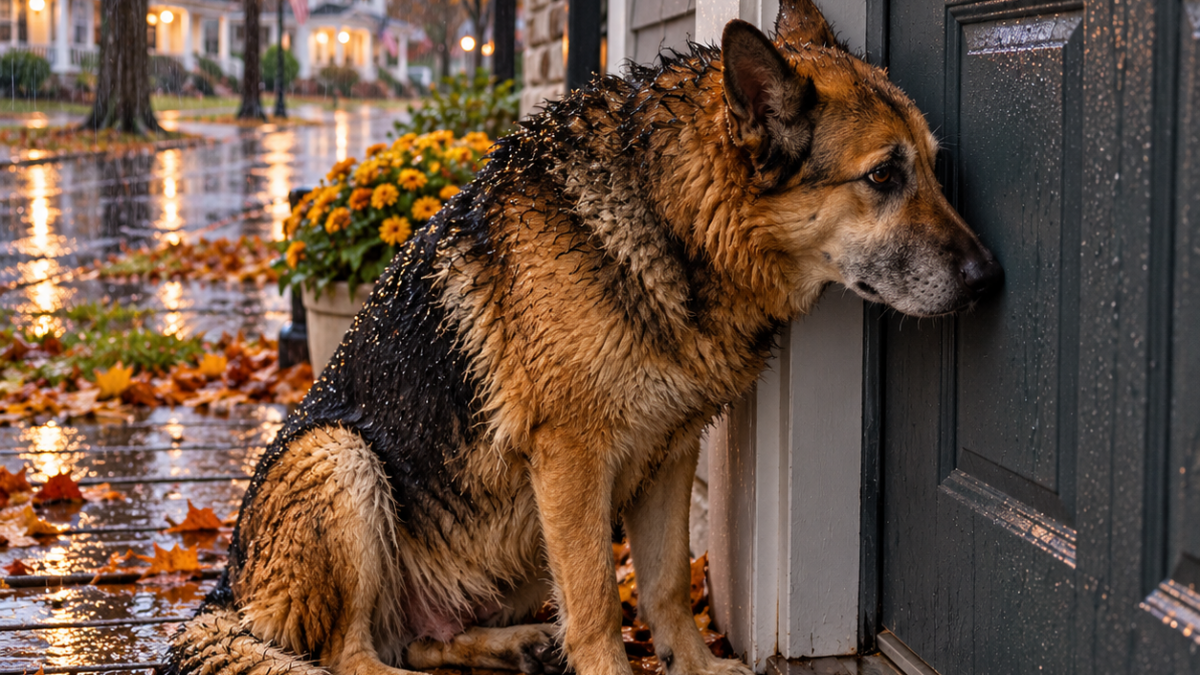
PART 2
“Ranger?”
The German Shepherd’s entire body changed.
His ears rose.
His head tilted.
Then a sound escaped his throat that I will remember for the rest of my life.
It wasn’t a bark.
It wasn’t a growl.
It sounded like a sob.
The door opened another few inches.
Mr. Harrison stood behind it, gripping a wooden cane.
He was wearing an old Army sweatshirt and pajama pants. His white hair stuck out in every direction, and his face was so pale that for a moment I wondered whether he might collapse.
But he wasn’t looking at me.
He was staring at the dog.
“Ranger?”
The Shepherd pushed forward.
His tail began moving so hard that his injured back legs struggled to hold him upright.
Mr. Harrison dropped his cane.
It struck the floor with a loud crack.
Neither of them noticed.
“Oh, my God.”
His voice broke.
“No.”
He shook his head.
“No, no, no.”
The dog pressed his nose against the old man’s knees.
Mr. Harrison reached down with both hands.
His fingers moved over the dog’s ears.
Across his gray muzzle.
Down the familiar ridge of his forehead.
As if he were trying to convince himself that what he was touching was real.
“Ranger?”
The dog whined.
Mr. Harrison made a terrible, broken sound.
Then he began crying.
Not quietly.
Not the restrained tears of someone trying to maintain his dignity.
He cried like a man whose heart had been holding something unbearable for far too long.
“My boy.”
He sank slowly onto the floor.
I caught his elbow before he could lose his balance.
“Mr. Harrison!”
He barely seemed to hear me.
He wrapped both arms around the Shepherd’s neck.
The dog pressed himself against the old man’s chest.
And there, in the doorway of the quietest house on our street, I watched a seventy-four-year-old Army veteran hold an exhausted dog as if he’d just been given back someone he thought he’d buried.
“You came home.”
His voice trembled.
“You came home to me.”
I stood beside them, completely stunned.
Then Mr. Harrison looked up.
His eyes were red.
His hands were shaking.
And he whispered five words that made my stomach turn.
“They told me he was dead.”
I lowered myself onto the porch.
For several seconds, I couldn’t speak.
The rain had stopped, but water still dripped from the roof.
Ranger was leaning so heavily against Mr. Harrison that I worried both of them might fall.
“Who told you that?” I finally asked.
Mr. Harrison closed his eyes.
“My son.”
I stared.
“Your son?”
He nodded.
“Evan.”
His fingers tightened in Ranger’s fur.
“He told me Ranger had been put down.”
I looked at the dog.
The old Shepherd’s paws were raw.
His ribs were faintly visible beneath his thick coat.
He had spent three days waiting outside this door.
And the man inside had been grieving him.
“How long ago?”
Mr. Harrison swallowed.
“Almost four months.”
My chest tightened.
Four months.
Four months believing his dog was dead.
Four months of an empty house.
Four months without the animal who was now trying to climb into his lap despite being far too large.
I looked toward the living room.
The curtains were drawn.
A medication bottle stood on a small table.
There was a plate with a piece of dry toast beside the recliner.
“Mr. Harrison, are you feeling okay?”
He nodded automatically.
Then tried to stand.
His legs trembled.
I caught his arm.
“Easy.”
“I’m fine.”
“You don’t look fine.”
He almost smiled.
“Neither do you.”
I glanced at my rain-soaked clothes.
Under different circumstances, I might have laughed.
Instead, I helped him into the living room.
Ranger followed.
Not three feet behind.
Not beside me.
Directly against Mr. Harrison’s leg.
Every time the old man stopped, the dog stopped.
Every time he moved, Ranger moved.
When we reached the recliner, Mr. Harrison sat.
Ranger lowered himself beside his feet.
Then placed his head on the old man’s knee.
Mr. Harrison began crying again.
I looked around the room.
The house was clean enough, but there was a neglected feeling to it.
Unopened mail lay on the table.
The kitchen trash hadn’t been emptied.
A stack of newspapers sat beside the door.
And the air felt cold.
Too cold for a man his age.
“Have you eaten today?” I asked.
Mr. Harrison looked embarrassed.
“A little.”
“Are you taking your medications?”
He hesitated.
That frightened me.
I took out my phone.
“I’m calling for medical help.”
His head snapped up.
“No.”
“Mr. Harrison—”
“No hospitals.”
His voice rose.
Ranger lifted his head.
The old man immediately softened.
“Sorry, boy.”
Then he looked at me.
“Please don’t send me away.”
I stared.
“Why would I send you away?”
He looked toward the front door.
Then whispered, “Because Evan said that’s what happens when people decide you can’t take care of yourself.”
I had no idea what to say.
I was a thirty-nine-year-old office administrator who knew more about invoices and employee schedules than medical emergencies.
I wasn’t trained to decide whether an elderly man needed hospitalization.
But I knew what I was seeing.
He was weak.
He appeared dehydrated.
He was frightened of asking for help.
And something about his son’s name caused him to pull inward.
I crouched beside the chair.
“Mr. Harrison, I’m not trying to take you away from your home.”
He looked at me.
“Then what?”
“I want someone to make sure you’re okay.”
His eyes moved toward Ranger.
The dog was lying against his feet.
“Will they take him?”
My throat tightened.
“No one should make decisions about Ranger without understanding what’s happened.”
He studied my face.
“You promise?”
I hesitated.
I couldn’t promise things I didn’t control.
But I could promise one thing.
“I won’t let anyone quietly take him away while you’re asking questions.”
Mr. Harrison closed his eyes.
Then nodded.
I called for medical assistance and explained the situation.
I also contacted county animal services.
Ranger needed a veterinarian.
His paws were injured, and after three days in the cold and rain, I worried about dehydration and exhaustion.
While we waited, I brought Mr. Harrison water.
He drank slowly.
Then I brought Ranger’s bowl inside.
The dog drank, too.
But after a few swallows, he returned to Mr. Harrison.
The old man smiled weakly.
“Still stubborn.”
I looked at him.
“Ranger?”
He nodded.
“Always was.”
He rested his hand on the dog’s head.
“Never left my side.”
Then his expression changed.
“Until Evan took him.”
The paramedics arrived twenty minutes later.
Mr. Harrison didn’t want to let them inside.
But when I explained that they could begin by assessing him at home, he reluctantly agreed.
They checked his vital signs.
Asked about medications.
Discussed his recent eating and drinking.
They were patient.
Respectful.
They spoke to him directly rather than treating him as if he couldn’t understand.
That seemed to help.
One paramedic, a woman named Lisa, asked whether he’d been having trouble sleeping.
Mr. Harrison looked toward Ranger.
“Since he died.”
Lisa paused.
I quietly explained what had happened.
Her face softened.
“Oh.”
Mr. Harrison looked embarrassed.
“I know how it sounds.”
Lisa shook her head.
“It sounds like you missed your dog.”
He stared at her.
Then nodded.
She continued the assessment.
Eventually, they recommended further medical evaluation because of his weakness and poor intake.
Mr. Harrison looked toward Ranger again.
I could see the fear returning.
I moved closer.
“Let me arrange care for him.”
The old man swallowed.
“Don’t let him disappear.”
I rested a hand on his shoulder.
“I’ll stay involved.”
He looked into my eyes.
Then nodded.
“Okay.”
It was the first time I’d heard him agree to help without sounding defeated.
Ranger was examined by a veterinarian that afternoon.
I followed the transport arrangements with the permission of the people caring for him.
The clinic was only fifteen minutes away.
Dr. Melissa Carter met us in an examination room.
Ranger stood beside me, uncertain.
His ears moved toward every noise.
Whenever a door opened, he looked up.
He was searching for Mr. Harrison.
“Hey, buddy.”
I crouched.
“He’s getting checked out.”
Ranger stared toward the hallway.
I scratched his shoulder.
“He didn’t leave you.”
That was something I hoped the dog could understand.
Dr. Carter examined his paws.
Several pads were abraded.
There was minor swelling around one joint.
He had lost weight.
His coat was tangled and dirty.
But his breathing was normal, and the initial examination gave us reason to hope the damage was treatable.
“How old is he?” she asked.
“I don’t know exactly.”
She scanned his microchip.
The machine beeped.
Then she looked at the screen.
“Well.”
I leaned forward.
“What?”
“His chip is registered.”
“To who?”
She read the information.
“Thomas Harrison.”
My chest tightened.
“That’s him.”
She nodded.
“Ranger Harrison. Male German Shepherd. Estimated age twelve.”
Twelve.
An old dog.
Old enough that walking several miles could take a serious toll.
Old enough that standing outside a door for three days might have cost him more than anyone realized.
Dr. Carter looked at me.
“Is the owner available?”
“He’s being evaluated at the hospital.”
She nodded.
“We’ll contact the registered owner through the appropriate process.”
I looked toward Ranger.
He was standing near the door.
Waiting.
And suddenly, I understood why he had refused to follow me home.
He wasn’t lost.
He had already found the only place he wanted to be.
That evening, I visited Mr. Harrison at the hospital.
He looked better.
Not dramatically.
But his color had improved.
He had eaten.
And the nurse said he was cooperating with the evaluation.
When I entered, he looked toward the door.
“Ranger?”
“Not yet.”
His expression fell.
I pulled a chair beside his bed.
“But he’s okay.”
Mr. Harrison closed his eyes.
“Thank God.”
“He’s being treated for sore paws and exhaustion.”
The old man’s face tightened.
“He walked a long way.”
“I think so.”
“Stubborn boy.”
I smiled.
“That’s what everybody keeps saying.”
He looked toward the window.
For a while, neither of us spoke.
Then I asked quietly, “Would you tell me what happened four months ago?”
Mr. Harrison stared at his hands.
I waited.
He took a slow breath.
“I got pneumonia.”
I nodded.
“Spent eleven days in the hospital.”
His voice was rough.
“Then three weeks in rehabilitation.”
“Was Ranger at home?”
“At first.”
He swallowed.
“My son said he’d take care of him.”
I looked at him.
“And?”
“Evan told me the dog wasn’t doing well.”
Mr. Harrison stared at the blanket.
“Said Ranger stopped eating.”
I felt my stomach tighten.
“Did you get to see him?”
“No.”
“Why?”
“Evan said visitors weren’t allowed at the place where he was staying.”
I frowned.
“What place?”
“He never told me.”
For several seconds, the room was silent.
Then Mr. Harrison continued.
“One afternoon, Evan came to the rehabilitation center.”
His hands began trembling.
“He sat beside my bed and told me Ranger had gotten sick.”
My throat tightened.
“He said the veterinarian couldn’t save him.”
I looked away.
Mr. Harrison’s voice broke.
“He told me Ranger was gone.”
I asked what happened afterward.
Mr. Harrison stared at the ceiling.
“I cried.”
He looked embarrassed.
“Not a proud thing for an old soldier to admit.”
I shook my head.
“There’s nothing wrong with crying.”
He smiled sadly.
“Tell that to the men I grew up with.”
I leaned forward.
“What did Evan do?”
“He told me not to upset myself.”
The words made something inside me tighten.
Mr. Harrison continued.
“Then he started talking about the house.”
“What about it?”
“Said it was too much for me.”
I looked at him.
“He wanted you to move?”
Mr. Harrison nodded.
“Assisted living.”
I waited.
“He said I couldn’t manage the stairs, the yard, the bills.”
His jaw tightened.
“Maybe some of that was true.”
I looked around the hospital room.
“Needing help doesn’t mean you lose every decision.”
Mr. Harrison stared at me.
For a moment, he looked surprised.
Then he whispered, “That’s what I thought.”
He looked toward the window again.
“But when you’re seventy-four and everybody keeps telling you what you can’t do anymore…”
He swallowed.
“Eventually, you start believing them.”
The next day, I learned that Mr. Harrison had a daughter.
Her name was Molly.
She lived in Buffalo, New York.
I discovered that because the old man mentioned her while we were talking about his late wife.
“Anne would’ve called Molly,” he said.
I looked up.
“Molly?”
“My daughter.”
“Does she know you’re here?”
He shook his head.
“She doesn’t call much.”
“Do you have her number?”
He hesitated.
“Somewhere.”
I didn’t want to intrude.
But after everything that had happened, I felt uneasy.
“Would you like me to help you contact her?”
Mr. Harrison looked away.
“She has her own life.”
I waited.
“Family. Job. Kids.”
He smiled sadly.
“Doesn’t need an old man bothering her.”
I looked at him.
“Did she tell you that?”
He shook his head.
“No.”
“Then maybe don’t decide for her.”
He stared at me.
Then looked down.
For a moment, I thought he might refuse.
Instead, he nodded.
“It’s in the address book beside my kitchen phone.”
I smiled.
“I can get it.”
He looked toward the door.
“Rachel?”
“Yeah?”
“Would you tell her I’m okay?”
My throat tightened.
“Of course.”
Then he added quietly, “And tell her Ranger came home.”
Molly answered on the third ring.
“Hello?”
“Hi. My name is Rachel Sullivan. I’m your father’s neighbor.”
There was silence.
Then her voice changed.
“Is Dad okay?”
“He’s stable. He’s at the hospital for evaluation.”
I heard something fall in the background.
“What happened?”
I explained carefully.
The dog.
The porch.
The three days.
The door finally opening.
Mr. Harrison’s weakness.
Then I mentioned Ranger.
Molly stopped breathing for a moment.
“Ranger?”
“Yes.”
“The German Shepherd?”
“Yes.”
A long silence followed.
Then Molly whispered, “I thought he died.”
My stomach tightened.
“Your brother told you that?”
“Yes.”
I closed my eyes.
She continued.
“Evan said Dad was devastated.”
I waited.
“He told me not to call for a while because Dad didn’t want to talk.”
My pulse quickened.
“Did you try?”
“Of course.”
Her voice broke.
“I called every week.”
I stood very still.
“What happened?”
“Sometimes Evan answered. Sometimes nobody did.”
I looked toward Mr. Harrison’s hospital room.
Molly continued.
“He said Dad didn’t want visitors.”
Her voice rose.
“Rachel, I’ve been trying to see my father for months.”
I swallowed.
“He thinks you stopped calling.”
Silence.
Then I heard her begin crying.
“No.”
I closed my eyes.
“No, no, no.”
She took a shaky breath.
“My dad thinks I abandoned him?”
I couldn’t answer immediately.
Then I whispered, “I think there have been some terrible misunderstandings.”
Molly’s voice hardened.
“I’m coming.”
She arrived the following afternoon.
I met her outside the hospital.
She was forty-six, with shoulder-length brown hair and the same gray-blue eyes as her father.
She looked exhausted.
She’d driven for hours.
Her hands were shaking.
“Rachel?”
I nodded.
She hugged me before I could speak.
“Thank you.”
I stepped back.
“You should see him.”
She looked toward the entrance.
For a moment, she seemed afraid.
“What if he doesn’t want me here?”
My throat tightened.
“He asked me to call you.”
Her face changed.
“He did?”
“Yes.”
Tears filled her eyes.
I smiled gently.
“Come on.”
We walked down the hallway together.
When we reached his room, Molly stopped in the doorway.
Mr. Harrison was sitting upright in bed.
He was looking at a photograph on his phone.
Ranger.
I’d sent it to him that morning.
Molly whispered, “Dad?”
The old man lifted his head.
For one second, neither moved.
Then he said, “Molly?”
She crossed the room.
He held out his arms.
And his daughter fell into them.
I stepped back.
I had never seen Mr. Harrison hug anyone.
Not once in the years I’d lived across from him.
Now he held his daughter so tightly that she began laughing through tears.
“Dad.”
His voice broke.
“Thought you were angry with me.”
She pulled back.
“What?”
He looked embarrassed.
“Evan said you needed space.”
Molly shook her head.
“No.”
Her eyes filled.
“No, Dad.”
He stared at her.
“I called,” she whispered.
“I called so many times.”
Mr. Harrison’s hands began trembling.
“I never knew.”
Molly covered her face.
And I realized that whatever Evan had done to Ranger, he had also managed to separate an old man from his daughter.
That evening, Molly and I sat in the hospital cafeteria.
She held a paper cup of coffee she hadn’t touched.
“Tell me everything.”
I did.
I explained what I’d seen.
What Mr. Harrison had told me.
The veterinary appointment.
The microchip.
Ranger’s condition.
Molly listened.
Then she stared into her coffee.
“Evan was supposed to help.”
I waited.
She looked up.
“After Dad got pneumonia, Evan said he’d take over the bills and the house.”
I frowned.
“Was he living nearby?”
“About twenty minutes away.”
“Did your father agree?”
“At first.”
Molly rubbed her forehead.
“Dad had trouble keeping track of things during his recovery. Evan offered to help with the paperwork.”
She paused.
“He said it would be easier if one person handled everything.”
I nodded.
“That sounds reasonable.”
“It did.”
Her voice hardened.
“Until he stopped telling me anything.”
She stared at me.
“Then Dad stopped answering my calls.”
I thought about the quiet house.
The old man behind the closed door.
The dog waiting outside.
Molly continued.
“Evan kept saying Dad was confused.”
I looked at her.
“Was he?”
She hesitated.
“After the pneumonia, he was tired. Forgetful sometimes.”
She swallowed.
“But he knew who we were. He knew what he wanted.”
I nodded.
Molly stared toward the window.
“Rachel, I think my brother was making decisions nobody gave him permission to make.”
We started with Ranger.
Not the house.
Not the money.
The dog.
Because Ranger was the reason any of us had discovered something was wrong.
Molly contacted the veterinarian who had cared for him for years.
The clinic confirmed that Ranger had been a longtime patient.
His vaccinations were documented.
His arthritis had been monitored.
There was no record of him being euthanized.
No record of a terminal illness.
No record of the sudden medical crisis Evan described.
Molly stared at the information.
“He lied.”
I looked toward her.
“We know what the clinic records show.”
She nodded.
Then called Evan.
I sat beside her.
The phone rang four times.
He answered.
“Molly?”
Her voice was steady.
“Where did you take Ranger?”
Silence.
Then—
“What?”
“Dad’s dog.”
Evan sighed.
“I told you what happened.”
“No.”
Molly’s voice hardened.
“You told me he died.”
“He was old.”
“That wasn’t my question.”
I watched her face.
She continued.
“Where did you take him?”
Evan was silent.
Then he said, “Why are you bringing this up now?”
Molly closed her eyes.
“Because he’s alive.”
For several seconds, nothing came through the phone.
Then Evan whispered, “What?”
Molly stared straight ahead.
“Ranger walked home.”
Another silence.
Then Evan said something that made every hair on my arms rise.
“That’s impossible.”
Molly put the call on speaker.
“Why is that impossible, Evan?”
He hesitated.
“I mean… how could he find the house?”
Molly’s jaw tightened.
“It’s the house he lived in for eleven years.”
Evan said nothing.
She continued.
“Where did you take him?”
He sighed.
“Look, I did what was necessary.”
My stomach tightened.
“What does that mean?”
Evan’s voice hardened.
“Dad couldn’t care for him anymore.”
“Then why did you tell us he died?”
“Molly—”
“Answer me.”
He raised his voice.
“Because Dad wouldn’t have agreed!”
The room went completely silent.
I watched Molly’s face.
She closed her eyes.
Then spoke very slowly.
“So you lied.”
Evan didn’t answer.
“You took his dog because you knew he would say no.”
“Molly, you don’t understand.”
“Then explain.”
He sighed.
“Dad needed to move.”
Molly stared.
“And Ranger was the reason he wouldn’t?”
Another silence.
Then Evan said, “That dog was keeping him tied to a house he couldn’t manage.”
Molly began shaking.
I put a hand on her arm.
Evan continued.
“I was trying to do what was best for him.”
Molly whispered, “By telling him his best friend was dead?”
He said nothing.
She ended the call.
For a long time, neither of us moved.
Then Molly began crying.
Not because she had discovered Ranger was alive.
Because she had finally understood why her father had stopped opening his door.
Ranger returned to Mr. Harrison three days later.
The veterinarian cleared him for a supervised reunion.
His paws were improving.
His appetite had returned.
He was still stiff and tired.
But when Molly brought his old harness into the clinic, he stood immediately.
She crouched beside him.
“Hey, Ranger.”
The dog sniffed her.
Then his tail began wagging.
Molly’s face crumpled.
“Oh, buddy.”
She wrapped her arms around him.
He leaned against her.
“It’s me.”
His ears moved.
“Molly.”
He nudged her hand.
And she began crying harder.
“I thought I’d never see you again.”
I stood near the door.
Watching.
For the first time, I began to understand how much history Ranger carried.
Eleven years.
Eleven years of mornings.
Walks.
Family dinners.
Storms.
Birthdays.
A daughter visiting from another state.
A father growing older.
A wife dying.
An entire family changing around one loyal dog.
Then someone had taken him away.
And Ranger had spent months trying to find his way back.
Mr. Harrison was waiting in a quiet room at the hospital.
Molly opened the door.
Ranger lifted his head.
For a second, he stopped.
Then he heard the old man’s voice.
“Ranger?”
The dog pulled forward.
Molly loosened the leash enough for him to approach safely.
Mr. Harrison leaned down.
Ranger pressed his head against the old man’s knees.
Then he did something none of us expected.
He lifted one front paw.
And rested it gently on Mr. Harrison’s leg.
The old man froze.
His face changed.
Then he began crying.
“Oh, boy.”
He covered Ranger’s paw with his hand.
“You remember.”
Molly put a hand over her mouth.
I looked at her.
“What?”
She swallowed.
“That was their signal.”
I frowned.
“What signal?”
Molly looked toward her father.
“He used to have terrible nights after Mom died.”
Mr. Harrison lowered his head.
Ranger remained still.
Molly continued.
“He’d wake up frightened or overwhelmed, and Ranger would put a paw on his knee.”
My throat tightened.
“Like that?”
She nodded.
“It meant, ‘I’m here.’”
I looked toward the dog.
His paw remained against Mr. Harrison.
The old man bent forward.
Pressed his forehead against Ranger’s.
And whispered, “I know, buddy.”
His voice broke.
“I know you’re here.”
That night, Mr. Harrison finally told me the story of Ranger.
His wife, Anne, had died eleven years earlier.
Cancer.
Forty-one years of marriage.
Four decades of building a life together.
Then, in the space of six months, everything changed.
After Anne died, Mr. Harrison stopped leaving the house.
He stopped attending veterans’ breakfasts.
Stopped visiting friends.
Stopped answering the phone.
Molly worried.
She lived several hours away and couldn’t be there every day.
So she contacted a local organization that helped veterans adopt companion animals.
That’s where Ranger came from.
He was a young German Shepherd then.
Not a trained military working dog.
Not a decorated K9.
Just a strong, intelligent dog who needed a permanent home.
Mr. Harrison wanted nothing to do with him.
“He’s too much work,” he told Molly.
She smiled.
“That’s the idea.”
He refused.
She brought Ranger anyway.
For the first week, the dog slept near the front door.
For the second, he followed Mr. Harrison into the kitchen.
By the third, he had figured out exactly when breakfast happened.
And by the end of the month, Mr. Harrison couldn’t imagine the house without him.
“He saved my life before,” the old man told me.
I looked at him.
“What do you mean?”
He stared toward the window.
“Not from a fire.”
His voice softened.
“From the quiet.”
He told me about the first winter without Anne.
The house had felt enormous.
Every room reminded him of something he’d lost.
The empty chair.
The untouched sewing basket.
The second coffee mug he kept reaching for.
Some nights, he sat awake until morning.
Ranger would come into the living room.
Rest his head on the old man’s knee.
Wait.
And when Mr. Harrison finally moved, the dog followed.
They walked together.
A little farther each day.
First to the mailbox.
Then to the end of the driveway.
Then around the block.
Eventually, Mr. Harrison started attending veterans’ breakfasts again.
Ranger waited at home.
Or rode along when a trip permitted it.
The old man began talking to people.
Laughing occasionally.
Doing small repairs around the house.
Ranger didn’t erase Anne’s death.
Nothing could.
But he made living afterward possible.
“He gave me a reason to get dressed,” Mr. Harrison said.
I looked toward the dog.
Ranger was sleeping beside the chair.
The old man smiled sadly.
“And after Evan told me he was dead…”
His voice broke.
“I felt like I’d lost Anne all over again.”
The investigation into Ranger’s disappearance began with a simple question.
Where had Evan taken him?
Molly obtained permission from her father to help review the relevant records.
Together, we contacted the county shelter, veterinary clinics, and local boarding facilities.
The shelter had no surrender record matching Ranger.
The veterinarian had no euthanasia record.
The animal control department hadn’t picked him up.
Then Molly found a charge on her father’s bank statement.
Pine Hollow Boarding.
The amount was small.
But the date mattered.
It was from the week Ranger disappeared.
Molly looked at me.
“That’s it.”
I stared at the screen.
“Are you sure?”
“Look at the date.”
I nodded.
She called the facility.
A woman named Denise answered.
Molly explained that she was trying to locate a German Shepherd who had been boarded months earlier.
Denise asked for identifying information.
Molly provided Ranger’s name, approximate age, and description.
There was a pause.
Then Denise said, “I remember him.”
My heart jumped.
Molly gripped the phone.
“What happened to him?”
Denise hesitated.
“He was brought in by a man who said the owner had entered long-term care.”
Molly closed her eyes.
“That wasn’t true.”
Denise was quiet.
Then she continued.
“The man arranged temporary boarding. After several weeks, he stopped responding to our calls.”
I stared.
Molly whispered, “What did you do?”
“We contacted local rescue partners about placement options.”
“And Ranger?”
Denise’s voice changed.
“He escaped.”
Molly sat straighter.
“When?”
“About ten days ago.”
I stared at her.
Ten days.
Ranger had been missing from the facility for ten days.
He’d spent three of them on Mr. Harrison’s porch.
Which meant he’d been traveling, searching, and surviving before I ever saw him.
“How far away is Pine Hollow?” I whispered.
Molly checked the address.
Seven miles.
Seven miles from Mr. Harrison’s house.
I looked toward Ranger.
The old dog slept peacefully beside the chair.
And I realized the journey that had brought him home had been far harder than I imagined.
Molly asked the boarding facility to preserve its records for the appropriate authorities.
There were questions about the authorization Evan had provided.
The agreement reportedly stated that he was acting on behalf of Ranger’s owner.
But Mr. Harrison had never authorized a permanent surrender.
Denise sounded distressed when she learned the truth.
“We were told Mr. Harrison could no longer care for the dog.”
Molly’s voice was controlled.
“He was recovering from pneumonia.”
Denise was quiet.
“And the dog was supposed to return home.”
Molly swallowed.
“My father was told Ranger died.”
A long silence followed.
Then Denise whispered, “I’m so sorry.”
I believed her.
From what we’d learned, the facility had been given a false story too.
It had made mistakes in verifying who had authority to make decisions about Ranger.
But it hadn’t set out to destroy a family.
Evan had.
At least, that was how it was beginning to look.
And the more we learned, the more I worried the dog wasn’t the only thing he’d tried to take.
Molly found the next problem while sorting through the unopened mail in her father’s house.
A letter from a real estate company.
Then another.
Then a notice from a title office.
All addressed to Mr. Harrison.
But none opened.
I stood beside Molly at the kitchen table.
“What are these?”
She unfolded one letter.
Her expression changed.
“Dad’s house.”
I frowned.
“What about it?”
She handed me the paper.
Someone had requested information about transferring ownership.
My stomach tightened.
“Did your father know?”
“I don’t think so.”
Molly called him.
He was staying temporarily at a rehabilitation facility while his strength improved.
She put the call on speaker.
“Dad?”
“Yeah?”
“Have you agreed to sell the house?”
Silence.
Then—
“What?”
“The house.”
His voice hardened.
“No.”
Molly looked at me.
“Have you signed anything?”
“No.”
“Anything giving Evan permission to sell?”
He hesitated.
“I signed some paperwork when I was sick.”
My stomach tightened.
“What paperwork?”
“Banking. Bills. I don’t know.”
Molly closed her eyes.
“Dad.”
He sounded frightened.
“Did I do something wrong?”
She immediately softened.
“No.”
Her voice broke.
“No, Dad.”
She looked at the letters again.
“We’re going to get someone to review this.”
We contacted an elder-law attorney.
Her name was Rebecca Park.
She agreed to meet with Mr. Harrison and Molly.
I attended at the old man’s request.
Rebecca began by speaking directly to him.
Not Molly.
Not me.
Mr. Harrison.
She asked what he wanted.
He answered immediately.
“My house.”
Rebecca smiled gently.
“You want to remain in your home?”
“Yes.”
“And Ranger?”
“He stays with me.”
She nodded.
“What help would make that possible?”
Mr. Harrison thought for a moment.
“Somebody to check on me.”
Rebecca waited.
“Maybe help with groceries.”
Another pause.
“And the stairs.”
She nodded.
“Those are problems we can evaluate.”
Then she looked at the documents.
The limited financial authorization Evan had been given.
The banking records.
The property correspondence.
Rebecca studied them carefully.
Finally, she said, “Mr. Harrison, you have the right to understand and review every decision being made on your behalf.”
He looked at her.
“Even if I’m old?”
She smiled.
“Especially when other people are making decisions about your property.”
For a moment, the old man seemed unable to speak.
Then he nodded.
“Good.”
The financial records showed troubling transactions.
Payments from Mr. Harrison’s accounts to a small contracting business.
Repair charges.
Property management fees.
Administrative expenses.
Some were legitimate.
Others were difficult to explain.
Molly recognized the company’s name.
“Evan’s friend owns this business.”
Rebecca made a note.
There were also withdrawals that Mr. Harrison couldn’t remember authorizing.
That alone didn’t prove fraud.
But combined with the house documents and Ranger’s disappearance, it raised serious questions.
Rebecca advised Mr. Harrison about protecting his accounts and reviewing the authority Evan had been given.
With his consent, appropriate professionals became involved.
The bank’s fraud department reviewed the suspicious transactions.
Adult Protective Services was contacted to assess potential financial exploitation.
A county investigator began gathering records.
And for the first time in months, Mr. Harrison wasn’t facing everything alone.
Evan arrived at his father’s house the following Saturday.
I was helping Molly rearrange the living room so Mr. Harrison could move around more safely when a black pickup stopped in the driveway.
Molly looked through the window.
Her expression changed.
“Evan.”
I put down the rug I’d been carrying.
A car door slammed.
Footsteps approached.
Then the front door opened.
Evan entered without knocking.
He was in his mid-forties, with dark hair, a heavy jacket, and the kind of impatient expression that made ordinary conversation feel like an argument waiting to happen.
He stopped when he saw us.
“What are you doing?”
Molly stood.
“Helping Dad.”
His eyes moved across the room.
The rugs.
The cleared walkway.
The new dog bed beside the recliner.
Then he saw Ranger.
The dog was lying near the window.
Evan’s face changed.
For one second, he looked almost frightened.
Then he recovered.
“So it’s true.”
Molly crossed her arms.
“Yes.”
Evan stared at the dog.
“That animal shouldn’t be here.”
I felt my jaw tighten.
Molly answered before I could.
“It’s Dad’s dog.”
“He can’t manage him.”
“Then we’ll arrange help.”
Evan laughed bitterly.
“You’ve been back for five minutes and suddenly you know everything?”
Molly’s face hardened.
“I’ve been back for a week.”
He looked away.
“And I wouldn’t have had to come back at all if you’d told me what was happening.”
Evan stared at her.
Then at me.
“Who’s she?”
I stood.
“Rachel Sullivan. Neighbor.”
His eyes narrowed.
“The woman who found the dog?”
“Yes.”
He crossed his arms.
“Great.”
Then he said something that made my stomach turn.
“You should’ve taken him to animal control.”
Molly stepped forward.
“Why?”
Evan stared.
“What?”
“Why should Rachel have taken Ranger away?”
“Because he’s old, unstable, and dangerous for Dad.”
I looked toward the dog.
Ranger was lying quietly near the window.
His ears moved toward the raised voices.
Nothing about him seemed aggressive.
Molly’s expression hardened.
“Did Ranger bite someone?”
Evan hesitated.
“He could.”
“That’s not what I asked.”
He looked away.
Molly continued.
“Did he attack anyone?”
“No.”
“Did a veterinarian say he needed to be euthanized?”
Silence.
“Evan.”
His jaw tightened.
“No.”
Molly stared.
“Then why did you tell Dad he was dead?”
Evan threw up his hands.
“Because Dad wouldn’t listen!”
The room went quiet.
I watched Molly’s face.
Her eyes filled.
But her voice remained steady.
“Listen to what?”
“That he couldn’t live here anymore!”
She stared.
“He had pneumonia.”
“He nearly died!”
“I know.”
Evan pointed toward the stairs.
“He couldn’t even get upstairs after rehab!”
“Then we could’ve moved his bedroom downstairs.”
“It’s not that simple!”
Molly took a breath.
“Maybe not.”
Then she looked directly at him.
“But lying about Ranger wasn’t a solution.”
Evan turned toward me.
“This isn’t your business.”
I looked at him.
“Your father asked me to help.”
“He doesn’t know what he wants anymore.”
That was when Molly stepped between us.
“Stop.”
Evan stared at her.
“What?”
“Stop talking about Dad like he’s not a person.”
He laughed.
“Oh, come on.”
Molly shook her head.
“You keep saying he can’t decide.”
“He can’t.”
“Then why did you have him sign banking documents?”
Evan went silent.
Molly continued.
“Why are there payments to companies he doesn’t recognize?”
His expression changed.
“And why have real estate offices been contacting him?”
Evan’s jaw tightened.
“You’ve been digging through his private records?”
“Dad asked me to help review them.”
He stared.
Then smiled coldly.
“You think you can show up and take over?”
Molly shook her head.
“No.”
She paused.
“That’s what you’ve been doing.”
For several seconds, neither spoke.
Then Evan looked toward Ranger.
The dog had stood.
He walked slowly toward the center of the room.
Stopped beside Molly.
Then sat.
Not growling.
Not barking.
Just watching.
Evan stared.
Then said quietly, “That dog is the whole problem.”
I looked at him.
And for the first time, I understood how someone could become angry at an animal for loving the person they wanted to control.
Mr. Harrison returned home two days later.
Not alone.
Molly had arranged for appropriate support.
A visiting nurse would help during recovery.
A local service would deliver meals temporarily.
A contractor would evaluate the stairs and install additional handrails.
The bedroom had been moved to the first floor.
His medications were organized.
And Ranger had been cleared by the veterinarian to return to the home with a manageable exercise routine.
The old man stood in the doorway.
I watched him look around.
The house was brighter.
The curtains were open.
The floor was clear.
There was a new orthopedic dog bed beside the recliner.
Mr. Harrison looked toward Molly.
“You did all this?”
She smiled.
“We all did.”
He looked at me.
Then toward Ranger.
The dog stood beside the chair.
Waiting.
Mr. Harrison smiled.
“Looks like somebody’s been promoted.”
I laughed.
“Ranger?”
He nodded.
“House manager.”
Molly shook her head.
“He already was.”
The old man crossed the room slowly.
Sat in his recliner.
And held out one hand.
Ranger walked toward him.
Rested his head against his knee.
Mr. Harrison closed his eyes.
For a long moment, neither moved.
Then he whispered, “Home.”
That evening, I stayed for dinner.
Molly cooked chicken and vegetables.
Mr. Harrison complained that the potatoes needed more salt.
Ranger lay beneath the table.
Every few minutes, the old man reached down and touched the dog’s head.
As though checking that he was still there.
Molly noticed.
“Dad.”
He looked up.
“What?”
“You know Ranger isn’t going anywhere.”
Mr. Harrison smiled faintly.
“Old habit.”
Then his face changed.
He looked toward the dog.
“Four months.”
Molly’s expression softened.
“I know.”
The old man swallowed.
“Every morning I woke up thinking he was gone.”
I looked down.
He continued.
“Sometimes I’d hear something in the hallway.”
His voice broke.
“Nails on the floor.”
Ranger lifted his head.
Mr. Harrison looked at him.
“I’d turn around.”
He paused.
“And there’d be nothing.”
Molly began crying.
The old man reached for her hand.
“It’s okay.”
She shook her head.
“No, Dad.”
Her voice trembled.
“It wasn’t okay.”
He looked at her.
Then nodded slowly.
“No.”
He rested his hand on Ranger’s head.
“But it is now.”
The investigation continued for months.
There were bank records.
Statements.
Financial authorizations.
The boarding agreement.
Real estate correspondence.
And messages between Evan and a property investor who had expressed interest in buying Mr. Harrison’s house.
I wasn’t involved in every detail.
Nor should I have been.
My role was to tell the truth about what I’d witnessed.
The dog.
The porch.
The closed door.
The condition of Mr. Harrison when he finally opened it.
Everything else belonged to the people trained to investigate it.
But Molly kept me informed.
One evening, she called.
“Rachel, they found something.”
My stomach tightened.
“What?”
“Messages.”
I sat down.
“Between Evan and the investor?”
“Yes.”
Her voice shook.
She explained that investigators had obtained communications through the appropriate legal process.
The messages concerned the planned sale.
And her father’s resistance.
One exchange stood out.
The investor asked whether Mr. Harrison was ready to move.
Evan replied that his father was still refusing.
Then came a message that made my hands go cold.
“Without the dog, he’ll have less reason to stay.”
I stared at the wall.
Molly continued.
“There was another one.”
I swallowed.
“What?”
She took a shaky breath.
“Once he accepts assisted living, we can finish the property paperwork.”
For several seconds, I couldn’t speak.
Ranger wasn’t an inconvenience.
He was an obstacle.
And someone had decided to remove that obstacle by taking away the one companion Mr. Harrison trusted most.
I thought about the three days on the porch.
The rain.
The old dog’s trembling body.
His refusal to leave.
The way he’d listened to every sound inside the house.
Then I thought about Mr. Harrison.
Sitting alone.
Believing Ranger was dead.
Believing Molly had stopped calling.
Believing he was becoming too much trouble for the people who loved him.
The cruelty of it made me physically sick.
But anger alone wouldn’t fix anything.
Molly understood that.
So did Rebecca Park.
They continued working through the legal process.
The property transfer had not been completed.
Mr. Harrison had not knowingly agreed to sell.
The questionable financial authority was reviewed and changed through appropriate procedures.
His accounts were protected.
Independent assistance was arranged.
And evidence of possible fraud was referred for further investigation.
For the first time in months, the direction of his life was being determined by what he wanted.
Not by what someone else could take from him.
One afternoon, Mr. Harrison asked me to sit with him on the porch.
It was early summer.
The rain had finally given way to warm weather.
Ranger lay beside his chair.
His paws had healed.
His weight was improving.
The gray around his muzzle looked almost silver in the sunlight.
Mr. Harrison handed me a glass of lemonade.
“Rachel.”
“Yeah?”
“Can I ask you something?”
“Of course.”
He looked toward the street.
“Why did you stop?”
I frowned.
“What?”
“The dog.”
He glanced down at Ranger.
“Why didn’t you just leave him?”
I stared at him.
For a moment, I didn’t know how to answer.
Then I said, “Because he looked like he was waiting for someone.”
Mr. Harrison nodded.
He was quiet for a while.
Then he said, “I was too.”
My throat tightened.
He continued.
“After Anne died, the house got quiet.”
I looked toward the open front door.
“After Ranger disappeared…”
His voice broke.
“It got quiet again.”
He looked down.
“Evan told me I needed to stop holding on to things.”
I didn’t answer.
Mr. Harrison swallowed.
“He said old men get stuck in the past.”
He stared toward the street.
“Maybe we do.”
I shook my head.
“Missing someone isn’t the same as being stuck.”
He looked at me.
I continued.
“And loving your dog isn’t a reason to lose your home.”
His eyes filled.
For a moment, he seemed unable to speak.
Then he smiled faintly.
“Anne would’ve liked you.”
I smiled through tears.
“I think I would’ve liked her too.”
The neighborhood began changing.
Not suddenly.
Not dramatically.
But in small ways.
Mrs. Delgado from two houses down started bringing soup every Thursday.
Mr. Franklin, the retired electrician, helped fix the porch light.
Molly arranged for a local veteran volunteer to stop by once a week.
And I began joining Mr. Harrison for coffee on Saturday mornings.
At first, he barely spoke.
Then he started telling stories.
About growing up on a farm.
About joining the Army.
About meeting Anne at a county fair.
About the first house they bought.
About raising Molly and Evan.
He rarely discussed his military experiences unless he wanted to.
I never pushed.
The neighborhood had spent years inventing explanations for his silence.
I decided it was more important to listen to what he actually chose to say.
One Saturday, he told me about Anne’s terrible cooking.
I laughed.
“Terrible?”
“Absolutely.”
He shook his head.
“Burned toast every morning.”
I smiled.
“Did you complain?”
“Not once.”
“Why?”
He looked toward the empty chair beside him.
“Because she made breakfast for me for forty-one years.”
His voice softened.
“After she died, I’d have eaten burned toast every day just to hear her moving around the kitchen again.”
I looked away.
Ranger lifted his head.
Mr. Harrison rested a hand against his ears.
“And this boy knew it.”
The first real setback came in August.
Ranger collapsed during a short walk.
Not completely unconscious.
But his back legs gave way.
Mr. Harrison called me immediately.
His voice was shaking.
“Rachel.”
I stood.
“What happened?”
“Ranger.”
My stomach dropped.
“Is he breathing?”
“Yes.”
“Is he responsive?”
“Yes.”
I grabbed my keys.
“I’m coming.”
When I reached the house, Ranger was lying on the living room rug.
Mr. Harrison knelt beside him.
One hand rested against the dog’s shoulder.
He was crying.
“Please.”
He looked up when I entered.
“Don’t let him go again.”
My chest tightened.
I crouched beside Ranger.
The dog lifted his head.
His tail moved.
I exhaled.
We contacted the veterinarian immediately.
Ranger was transported carefully for evaluation.
The examination suggested that his arthritis and weakness had worsened, and further testing was needed to assess his condition.
Thankfully, the episode did not reveal the catastrophic emergency Mr. Harrison feared.
But it reminded all of us of something we had tried not to think about.
Ranger was old.
And loving him wouldn’t make him young again.
At the clinic, Mr. Harrison sat beside Ranger’s examination table.
His hands trembled.
Dr. Carter explained the findings.
The dog’s joints were painful.
His muscle strength needed support.
He would benefit from changes to activity, traction, and medication under veterinary supervision.
Mr. Harrison listened.
Then asked one question.
“Is he dying?”
The veterinarian paused.
“Not from what we’re seeing today.”
The old man closed his eyes.
“But he’s aging.”
“Yes.”
He nodded slowly.
Dr. Carter continued.
“We can help him remain comfortable. We also need to watch his quality of life.”
Mr. Harrison looked toward Ranger.
The dog rested his chin against the blanket.
Then lifted one paw.
Placed it gently on the old man’s knee.
Mr. Harrison began crying.
I turned away.
Because that little movement said more than anything I could have told him.
Ranger was still there.
Still reaching for the person he loved.
Still reminding him that he didn’t have to face another difficult day alone.
The legal case reached a turning point that fall.
Investigators concluded that multiple financial transactions required criminal scrutiny.
The evidence concerning the property plans, misrepresentations, and authorization documents became part of the proceedings.
Evan was charged in connection with financial exploitation and fraudulent transactions.
The criminal allegations did not turn on the dog’s disappearance alone.
The broader case involved money, records, and attempts to exercise authority he did not lawfully possess.
But Ranger’s return had exposed the situation.
Without the old dog sitting outside the door, no one on our street might have realized how isolated Mr. Harrison had become.
Molly might have continued believing her father wanted distance.
Mr. Harrison might have continued believing his daughter had abandoned him.
And Evan might have completed the property arrangements before anyone asked the right questions.
When Molly called to tell me about the charges, I was quiet for a long time.
Then I asked, “How’s your dad?”
She sighed.
“Sad.”
I looked toward the window.
“Not relieved?”
“Some.”
She paused.
“But Evan’s still his son.”
I nodded.
Of course he was.
Justice doesn’t erase love.
And betrayal hurts more when the person responsible is somebody you raised.
Mr. Harrison struggled with the news.
He spent several days avoiding visitors.
Even me.
I respected that.
Then, on a Thursday afternoon, he called.
“Rachel.”
“Hey.”
“Got a minute?”
“Of course.”
He was quiet.
Then he said, “I keep wondering what I did wrong.”
My chest tightened.
“With Evan?”
He nodded.
I could hear it in his breathing.
“I raised him.”
I sat down.
“Mr. Harrison…”
He continued.
“I taught that boy to ride a bike.”
His voice broke.
“Taught him to change a tire.”
A pause.
“Sat beside him when he broke his arm in third grade.”
I closed my eyes.
“And somewhere along the way, he became a man who could look me in the eye and tell me Ranger was dead.”
I didn’t know what to say.
So I didn’t pretend there was an easy answer.
I let him talk.
Eventually, he whispered, “I still love him.”
My throat tightened.
“I know.”
“But I don’t trust him.”
I nodded.
“You don’t have to pretend trust has survived when it hasn’t.”
The old man was quiet.
Then he said something I will never forget.
“I thought being a father meant keeping the door open.”
I swallowed.
He continued.
“But maybe sometimes you have to lock it until the person outside learns how to knock.”
The case proceeded through the courts.
There were hearings.
Document reviews.
Statements.
Expert testimony concerning the financial records.
The boarding paperwork was examined as part of the broader timeline.
Evan’s attorney challenged aspects of the allegations.
The prosecution relied on the records and supporting evidence it could establish.
I was asked to describe what I’d witnessed.
The three days Ranger waited.
The condition of the dog.
The closed house.
The moment Mr. Harrison finally opened the door.
I agreed.
The hearing took place on a cold November morning.
Molly sat beside her father.
I sat a few rows behind them.
Ranger stayed safely at home with a trusted caregiver.
When my name was called, I walked to the witness stand.
I described Tuesday morning.
The old Shepherd sitting on the porch.
The bowl of water.
The chicken he barely touched.
The way he refused to leave.
Then Wednesday.
The rain.
The unchanged newspaper.
The unanswered knocking.
And finally Thursday.
The breathing behind the door.
The footsteps.
The lock.
I paused.
The prosecutor asked, “What happened when the door opened?”
My throat tightened.
I looked toward Mr. Harrison.
He was staring at his hands.
Then I answered.
“He recognized the dog.”
The prosecutor nodded.
“How?”
“He said his name.”
I swallowed.
“Ranger.”
The room was quiet.
“And what did the dog do?”
I closed my eyes briefly.
“He cried.”
The prosecutor waited.
Then I continued.
“He pressed himself against Mr. Harrison. And Mr. Harrison sat down on the floor and held him.”
My voice broke.
“Then he told me he’d been informed the dog was dead.”
The prosecutor nodded.
“No further questions.”
Molly testified later.
She described her father’s recovery from pneumonia.
Her difficulty contacting him.
The explanations Evan had given.
The financial arrangements.
The house.
The documents.
Her attempts to reconnect.
She spoke carefully.
Sometimes her voice shook.
But she never exaggerated.
When asked whether her father had expressed a desire to sell his home, she answered no.
When asked whether she had known Ranger was alive, she shook her head.
“No.”
Her eyes filled.
“I thought he died.”
She looked toward her father.
“And I thought Dad didn’t want to speak to me.”
Mr. Harrison lowered his head.
Molly continued.
“For months, I believed I was respecting his wishes.”
She swallowed.
“But those weren’t his wishes.”
The room became very still.
I looked toward Evan.
He sat beside his attorney.
His face was pale.
For a moment, he looked at Molly.
Then away.
Mr. Harrison also spoke during the proceedings.
He walked slowly to the front.
His cane tapped against the floor.
When he sat, he looked smaller than he had on the day I first noticed him across the street.
But his voice was steady.
He described the house.
The years he’d lived there.
His wife.
His children.
Ranger.
Then the pneumonia.
The hospital.
The rehabilitation facility.
And the day Evan told him his dog had died.
The prosecutor asked, “What did you believe had happened?”
Mr. Harrison took a slow breath.
“That Ranger was gone.”
His voice tightened.
“And how did that affect you?”
The old man stared at his hands.
“I stopped trying.”
The room became silent.
He swallowed.
“Stopped getting up early.”
A pause.
“Stopped walking.”
His eyes filled.
“Stopped caring much whether the curtains were open.”
I looked down.
The prosecutor waited.
Then asked, “What happened when you learned Ranger was alive?”
Mr. Harrison smiled through tears.
“He came home.”
The prosecutor nodded.
“And after that?”
The old man looked toward Molly.
“My daughter came home too.”
The most difficult testimony came when the court examined the financial records.
There were payments that could not be justified as legitimate expenses for Mr. Harrison.
Documents that had been represented as authorizations without his informed agreement.
Communications concerning a planned property sale.
And evidence of attempts to influence the decisions made about where he would live.
The prosecutor presented the relevant records.
The defense challenged interpretations of some transactions.
The court considered the evidence under the applicable legal standards.
I won’t pretend I understood every accounting detail.
I didn’t.
But I understood the central issue.
Mr. Harrison had trusted someone to help him.
And that trust had been used to make decisions that benefited somebody else.
The dog’s removal wasn’t the only wrong.
It was part of a pattern.
A pattern that made the old man’s world smaller.
First his dog.
Then his contact with Molly.
Then his confidence.
Then his control over the house.
And eventually, perhaps, the house itself.
But Ranger had walked home.
And one closed door had reopened everything.
The criminal case eventually ended with Evan accepting responsibility for financial wrongdoing through a negotiated legal resolution.
The court imposed a custodial sentence, restitution obligations, and restrictions relating to financial authority over his father’s affairs.
The disputed property transaction did not proceed.
Mr. Harrison retained his home.
Separate arrangements were established to protect his accounts and ensure decisions about his care remained properly authorized.
The outcome didn’t repair every emotional injury.
No sentence could return the months Mr. Harrison spent grieving a living dog.
No restitution payment could erase the nights he believed Molly had stopped loving him.
And no legal order could make Evan’s choices harmless.
But there were consequences.
Real ones.
The secrecy ended.
The financial control ended.
And the attempts to force Mr. Harrison out of his home ended.
When the proceedings were finally over, Molly asked her father whether he felt better.
He thought about it.
Then shook his head.
“Not yet.”
Her eyes filled.
He took her hand.
“But I think I might.”
A week later, Mr. Harrison asked to see Evan.
Not alone.
And not to argue about the case.
He wanted one conversation.
His attorney helped arrange it under appropriate conditions.
Molly went with him.
I wasn’t there.
But Mr. Harrison told me about it afterward.
He said Evan looked thinner.
Tired.
Older than his forty-six years.
For several minutes, neither of them spoke.
Then Evan said, “Dad.”
Mr. Harrison nodded.
“Son.”
Evan looked down.
“I’m sorry.”
The old man remained quiet.
Evan continued.
“I thought I could fix everything.”
Mr. Harrison looked at him.
“By taking my dog?”
Evan closed his eyes.
“I didn’t know what else to do.”
The old man shook his head.
“You could’ve asked.”
Evan began crying.
Mr. Harrison continued.
“You could’ve told me the house needed work.”
He paused.
“You could’ve told me you were in trouble.”
Another pause.
“You could’ve told me you couldn’t handle it anymore.”
His voice broke.
“But you told me my best friend was dead.”
Evan covered his face.
Mr. Harrison waited.
Then said quietly, “You didn’t make me safer.”
He swallowed.
“You made me smaller.”
Evan tried to explain.
He spoke about debts.
Pressure.
Fear.
The responsibility of caring for an aging parent.
He said he’d become overwhelmed.
He said he hadn’t intended for the lies to grow.
Mr. Harrison listened.
Then asked one question.
“Did you ever think about what it would feel like for Ranger?”
Evan looked up.
“What?”
“He’d spent eleven years with me.”
The old man’s voice trembled.
“Eleven years.”
He looked toward the table.
“He knew where I kept his food.”
A pause.
“He knew what time I woke up.”
His eyes filled.
“He knew when I was having a bad day before I did.”
Evan began crying again.
Mr. Harrison continued.
“And you took him somewhere he didn’t know.”
He swallowed.
“Then you told me he was dead.”
For a long time, neither spoke.
Finally, Evan whispered, “I’m sorry.”
Mr. Harrison nodded slowly.
“I believe you.”
Evan looked relieved.
Then his father added, “But believing you’re sorry doesn’t mean I can trust you yet.”
The relief disappeared.
Mr. Harrison took a breath.
“I still love you.”
His voice broke.
“But I won’t let you make decisions about my life anymore.”
Afterward, Mr. Harrison told me he hadn’t felt victorious.
He’d felt exhausted.
I understood.
People imagine justice as one great moment.
A verdict.
A sentence.
An apology.
A door closing behind the person responsible.
But real justice is often quieter.
It looks like a man keeping his house.
A daughter being able to call her father.
A bank account being protected.
A dog sleeping beside the person he loves.
And an elderly veteran learning that needing help doesn’t mean surrendering control of his life.
That was what Mr. Harrison had gained.
Not revenge in the way movies describe it.
Something better.
The ability to live without being afraid of the next decision someone else might make for him.
Winter came.
Then spring.
Ranger’s health improved with consistent care.
He still had arthritis.
Still moved slowly in the mornings.
Still needed medication and shorter walks.
But his appetite returned.
His coat became thick and glossy again.
And he developed a habit of carrying one particular stuffed toy from room to room.
A little brown bear.
Molly had bought it for him.
One Saturday, I arrived for coffee and found Ranger standing in the hallway with the bear in his mouth.
I laughed.
“Well, hello.”
His tail wagged.
Mr. Harrison looked up from the kitchen.
“Don’t encourage him.”
I smiled.
“Why?”
“Because now he thinks everybody has to admire that thing.”
Ranger walked toward me.
Placed the bear at my feet.
Then looked up.
I crouched.
“It’s beautiful.”
Mr. Harrison groaned.
“See?”
I laughed.
Ranger picked up the bear.
Carried it to the living room.
Then settled onto his bed.
Mr. Harrison watched him.
His expression softened.
“Stubborn old fool.”
I smiled.
“You love him.”
He looked at me.
“More than I know how to explain.”
The next summer, Mr. Harrison began sitting outside again.
At first, only for a few minutes.
Then longer.
He started waving to neighbors.
He even accepted an invitation to the monthly veterans’ breakfast at the community center.
Molly came down to visit.
Ranger stayed home with me while they went.
When Mr. Harrison returned, he looked exhausted.
But happy.
“How was it?” I asked.
He sat in his chair.
“Too loud.”
I laughed.
“Did you enjoy yourself?”
He smiled.
“Terrible coffee.”
“That’s not an answer.”
He looked down at Ranger.
The dog had pressed his head against his knee.
Mr. Harrison scratched behind his ear.
Then he said quietly, “Yeah.”
I smiled.
“Yeah?”
He nodded.
“It was good.”
For a moment, I remembered the man who hadn’t opened his door for three days.
The drawn curtains.
The untouched newspaper.
The fear in his eyes.
And now he was sitting outside, complaining about coffee because he’d spent the morning with friends.
Sometimes recovery doesn’t look dramatic.
Sometimes it looks like an old man deciding to leave the house for breakfast.
A year after Ranger returned, the neighborhood organized a small gathering.
Molly called it a homecoming anniversary.
Mr. Harrison hated the idea.
“I’m not having a party because my dog knows how to walk home.”
Molly laughed.
“Dad.”
“It’s ridiculous.”
I smiled.
“Then we’ll keep it small.”
He narrowed his eyes.
“How small?”
“Just a few neighbors.”
That was technically true.
A few neighbors.
A few friends from the veterans’ breakfast.
The veterinarian.
Rosa from the local rescue organization.
And several people who had helped Mr. Harrison during his recovery.
By noon, the backyard was full.
Mr. Harrison stood near the porch looking completely overwhelmed.
I approached with a plate of food.
“You okay?”
He looked at the crowd.
“Thought you said small.”
I shrugged.
“Small by neighborhood standards.”
He shook his head.
“Traitor.”
I laughed.
Then Ranger appeared.
The dog walked slowly across the grass.
His tail moved.
People stepped aside to let him pass.
He went straight to Mr. Harrison.
Sat.
And rested his head against the old man’s knee.
The crowd became quiet.
Mr. Harrison looked down.
Then smiled.
“There you are.”
Molly had prepared a small surprise.
A framed photograph.
It showed Ranger sitting beside the blue-gray front door on the day Mr. Harrison returned home from the hospital.
The old man’s hand rested on the dog’s head.
Both looked tired.
But peaceful.
Beneath the photograph was a small engraved plate.
HE NEVER STOPPED WAITING.
Mr. Harrison stared at it.
For a long time, he didn’t speak.
Then he looked at Molly.
“You did this?”
She nodded.
He swallowed.
“Thank you.”
She hugged him.
Ranger pressed himself against both of them.
I stood nearby, smiling through tears.
Because for once, the house across the street wasn’t silent.
People were laughing.
Talking.
Eating.
Children were playing in the yard.
And Mr. Harrison was standing in the middle of it all.
Not because somebody had forced him to socialize.
Because he wanted to be there.
Later that afternoon, he asked me to walk with him toward the front porch.
Ranger followed.
The weather was warm.
The street was quiet.
Mr. Harrison stopped beside the door.
“This is where you found him?”
I nodded.
“Right there.”
I pointed toward the worn patch of wood near the threshold.
He looked down.
For several seconds, he was silent.
Then he whispered, “Three days.”
I nodded.
“Yeah.”
He crouched slowly.
Ranger approached.
The old man rested a hand on his head.
“Three days, buddy.”
His eyes filled.
“You could’ve gone anywhere.”
Ranger’s tail moved.
Mr. Harrison laughed softly.
“But you came here.”
He looked toward me.
“Rachel.”
“Yeah?”
“Do you know what the strangest part is?”
“What?”
“I thought I was alone.”
My throat tightened.
He looked down at the dog.
“Whole time, he was right outside.”
I couldn’t speak.
Mr. Harrison continued.
“And I was so afraid of opening the door that I nearly missed him.”
I rested my hand against the porch railing.
“But you opened it.”
He nodded.
“Because you told me he was there.”
I looked at Ranger.
The old Shepherd pressed his head against the old man’s hand.
And I realized something.
Ranger had waited three days for Mr. Harrison to open the door.
But Mr. Harrison had been waiting far longer for someone to give him a reason.
The following year brought challenges.
Ranger grew older.
His hips stiffened.
His walks shortened.
Sometimes he needed help standing after a long nap.
Mr. Harrison worried constantly.
He called the veterinarian whenever Ranger seemed uncomfortable.
Molly bought another orthopedic bed.
Then a ramp for the porch.
Then nonslip runners for the hallway.
I helped install them.
Mr. Harrison watched from his chair.
“You’re making this house look like a rehabilitation center.”
I laughed.
“That’s because you and Ranger both need the same equipment.”
He narrowed his eyes.
“Watch it.”
Ranger lifted his head.
His tail moved.
Mr. Harrison pointed toward him.
“Don’t take her side.”
I laughed harder.
For the first time since I’d known him, the old veteran had begun making jokes without waiting to see whether the other person would understand.
That mattered.
Because humor is often one of the first things loneliness takes away.
And one of the last things people notice returning.
One cold October evening, Mr. Harrison called me.
“Rachel.”
His voice was quiet.
“Can you come over?”
I stood immediately.
“Is Ranger okay?”
“He’s sleeping.”
“Are you okay?”
A pause.
Then—
“Just need some company.”
I looked toward the window.
The porch light across the street was glowing.
“I’ll be right there.”
I carried a plate of leftover chicken soup.
When I arrived, Mr. Harrison was sitting in the living room.
Ranger lay beside him.
The dog lifted his head when I entered.
Then settled again.
Mr. Harrison looked toward the window.
“Bad night?”
I asked.
He nodded.
“Thinking about Anne.”
I sat.
He was quiet for several minutes.
Then he told me a story.
About their wedding.
The rain that ruined the outdoor photographs.
The cake that leaned sideways.
The way Anne laughed when the band played the wrong song for their first dance.
I listened.
Then he showed me an old photograph.
Anne standing beside a younger Mr. Harrison.
Both smiling.
Both looking completely unaware of how difficult life would become.
He stared at the picture.
“Forty-one years.”
I nodded.
“That’s a long time.”
He smiled sadly.
“Not nearly long enough.”
Ranger lifted his head.
Then placed one paw on Mr. Harrison’s knee.
The old man looked down.
His eyes filled.
“Yeah, buddy.”
He scratched the dog’s ear.
“I know.”
That moment changed how I understood Ranger.
He wasn’t simply a loyal animal.
He had become part of the language Mr. Harrison used to survive grief.
When words failed, Ranger stayed.
When nights became difficult, Ranger came closer.
When Mr. Harrison withdrew from the world, Ranger gave him a reason to step outside.
And when someone tried to sever that bond, the old dog refused to accept the separation.
He traveled miles.
Through unfamiliar roads.
With stiff legs and injured paws.
He found the right street.
The right house.
The right door.
Then waited.
Not because anyone had ordered him to.
Because that was where the person he loved belonged.
One morning, nearly two years after the reunion, I found Mr. Harrison outside washing his pickup.
I stopped on my side of the street.
For a moment, I couldn’t believe what I was seeing.
The same man who once barely opened his door was standing in the sunshine with a bucket and sponge.
Ranger lay in the shade nearby.
I crossed over.
“Morning.”
Mr. Harrison looked up.
“Don’t say it.”
I smiled.
“Say what?”
“That I shouldn’t be doing this.”
I laughed.
“I wasn’t going to.”
He narrowed his eyes.
“Liar.”
I picked up a second sponge.
“Want help?”
He considered it.
Then handed me the bucket.
“Do the tires.”
I smiled.
“Yes, sir.”
We worked quietly.
After a while, he spoke.
“Rachel.”
“Yeah?”
“Remember the first time you offered to help me?”
I looked up.
“The branches after the storm?”
He nodded.
“What did I say?”
I smiled.
“Got it.”
He laughed.
“Sounds like me.”
I nodded.
He looked toward Ranger.
Then back at me.
“I didn’t have it.”
My throat tightened.
He shrugged.
“Not really.”
I rested the sponge against the truck.
Mr. Harrison continued.
“Spent years thinking needing somebody meant I’d failed.”
He looked toward the house.
“Funny thing.”
“What?”
“Turns out it just means you’re human.”
I smiled.
“Yeah.”
He looked toward Ranger.
“Or a dog.”
The neighborhood eventually stopped treating Mr. Harrison’s house as the place nobody visited.
Children sometimes waved when he sat outside.
Neighbors asked about Ranger.
Molly came down more often.
The veterans’ group helped organize transportation for appointments.
And Mr. Harrison began accepting assistance without treating every offer like an insult.
He still had difficult days.
He still missed Anne.
He still carried pain from Evan’s betrayal.
And the relationship with his son remained complicated.
Some wounds don’t close just because the legal case ends.
But the house no longer felt abandoned.
The curtains stayed open.
The porch light worked.
The newspapers were collected.
And every morning, when Ranger felt strong enough, he followed Mr. Harrison into the kitchen.
Some days the dog walked first.
Some days the old man did.
It didn’t matter.
They were moving in the same direction.
Together.
Then came the day that made me understand the true cost of those three days on the porch.
It was a quiet Saturday morning.
I arrived for coffee.
Mr. Harrison was sitting at the kitchen table.
Ranger lay near the doorway.
The old man’s expression was thoughtful.
“Rachel.”
“Yeah?”
“I found something.”
He pushed a small envelope toward me.
Inside was a photograph.
Ranger as a young dog.
Standing beside Anne’s favorite rosebush.
Mr. Harrison sat in a lawn chair nearby.
His face looked healthier.
His hair darker.
But his eyes held the same gentle sadness I’d come to recognize.
On the back of the photograph, Anne had written a sentence.
I read it slowly.
“He doesn’t need to understand our words to know when we need him.”
My throat tightened.
I looked up.
Mr. Harrison smiled sadly.
“Anne wrote that before she died.”
I stared.
“She knew?”
He nodded.
“She knew how much I loved that dog.”
His eyes filled.
“And she knew I’d need him when she was gone.”
I looked down at the photograph.
Then toward Ranger.
The dog was sleeping.
His gray muzzle rested between his paws.
Mr. Harrison continued.
“When Evan told me Ranger died, I thought I’d lost the last part of the life Anne left me.”
His voice broke.
I sat beside him.
He looked toward the window.
“Then that dog walked home.”
I nodded.
“He did.”
Mr. Harrison smiled through tears.
“And you knocked.”
I have thought about that sentence many times.
And you knocked.
At first, it sounded too simple to mean much.
I hadn’t pulled anyone from a burning building.
I hadn’t performed surgery.
I hadn’t solved a mystery with extraordinary intelligence.
I was just a neighbor who noticed an old dog sitting somewhere he shouldn’t have been.
I brought water.
Chicken.
A blanket.
I asked questions.
I knocked.
And when nobody answered, I kept trying to get help.
That’s all.
But sometimes small actions become important because they interrupt something terrible.
A lie.
An isolation.
A silence that has lasted too long.
Ranger had already done the impossible part.
He had found his way home.
He just needed someone to help him get through the door.
People sometimes ask me why Mr. Harrison didn’t open the door sooner.
It’s a fair question.
For three days, Ranger sat outside.
For three days, the old man remained inside.
Couldn’t he hear him?
Didn’t he recognize the sound?
Mr. Harrison eventually explained it to me.
His hearing had become worse with age.
He often left his hearing aids off when he was resting.
And during those months after Ranger disappeared, he sometimes thought he heard the dog moving through the house.
Nails clicking.
A collar jingling.
Breathing near his chair.
At first, he would get up and look.
Then he stopped.
Because every time he searched, the house was empty.
So when faint sounds came from the porch, he assumed they were another reminder of the dog he’d lost.
He didn’t believe Ranger could be there.
Not after what Evan told him.
Not after four months of grief.
Then, on Thursday morning, he heard a woman outside say there was a German Shepherd waiting.
And something inside him finally allowed the possibility.
What if the sound was real?
What if the footsteps belonged to Ranger?
What if the world hadn’t taken everything after all?
So he stood.
Picked up his cane.
Walked slowly toward the door.
And opened it.
The last photograph I keep on my desk was taken on Ranger’s thirteenth birthday.
Mr. Harrison is sitting on the porch.
The old German Shepherd lies beside him.
Both have gray hair.
Both move slowly.
Both look wonderfully stubborn.
Molly is standing behind them.
One hand rests on her father’s shoulder.
And I’m sitting on the steps, laughing because Ranger has just stolen a biscuit from Mr. Harrison’s plate.
The front door is open behind us.
That detail matters more to me than anything else in the photograph.
Because the first time I saw Ranger there, the door was closed.
He sat outside for three days.
Cold.
Hungry.
Exhausted.
Waiting for someone to recognize him.
And inside, the man he loved was grieving a dog who was only a few feet away.
Now that door opens every morning.
Sometimes for Molly.
Sometimes for me.
Sometimes for a neighbor bringing soup.
Sometimes for a friend from the veterans’ breakfast.
And sometimes simply because Mr. Harrison wants to sit outside and enjoy the day.
The house no longer belongs to silence.
It belongs to life.
Last Sunday, I crossed the street carrying two cups of coffee.
The sky was clear.
The morning was cool.
Mr. Harrison sat in his usual chair.
Ranger lay beside him.
I climbed the porch steps.
“Morning.”
The old man looked up.
“Coffee?”
I smiled.
“Unless you’ve changed your mind about drinking it.”
He held out his hand.
“Never.”
I gave him a cup.
Then crouched beside Ranger.
“Hey, handsome.”
The dog’s tail moved.
His amber eyes lifted toward mine.
I scratched behind his ear.
He sighed.
Mr. Harrison smiled.
“He likes you.”
I laughed.
“He has excellent taste.”
The old man shook his head.
“Debatable.”
We sat together.
Cars passed.
Birds moved through the trees.
Somewhere down the street, a lawn mower started.
Ordinary sounds.
Ordinary life.
Then Ranger lifted his head.
A delivery truck had stopped near the corner.
The dog listened.
His ears turned.
For one second, I remembered the three days he had waited outside the door.
But then he looked toward Mr. Harrison.
The old man rested a hand against his head.
“I’m here, buddy.”
Ranger’s tail moved.
He lowered his head again.
And went back to sleep.
I watched them for a long time.
Then Mr. Harrison looked at me.
“Rachel.”
“Yeah?”
“Do you ever think about that morning?”
I smiled.
“All the time.”
He nodded.
“Me too.”
For a moment, neither of us spoke.
Then he said quietly, “I thought I’d lost him.”
My throat tightened.
“I know.”
He looked down at Ranger.
“And I thought I was losing everything else.”
I nodded.
The old man’s voice softened.
“But he came back.”
I looked at the dog.
“Yes.”
Mr. Harrison smiled.
“And somebody cared enough to knock.”
I swallowed.
Then reached down and touched Ranger’s shoulder.
The old Shepherd opened one eye.
His tail brushed the porch.
Once.
Twice.
The same gentle movement I’d seen on that first rainy morning.
Only now, he wasn’t waiting.
He wasn’t frightened.
He wasn’t trying to convince anyone to open the door.
He was home.
With the person he loved.
Exactly where he’d always wanted to be.
I used to think loyalty meant staying beside someone when life was easy.
Ranger taught me something different.
Loyalty can mean walking unfamiliar roads with tired legs.
Waiting through rain.
Returning to the same doorstep even when nobody answers.
Believing that the person behind a closed door still matters.
But Mr. Harrison taught me something just as important.
Sometimes the person inside needs rescuing too.
Not because they’re weak.
Not because they’re incapable of living.
But because grief, fear, and betrayal can convince someone that opening the door will only bring more pain.
For months, Mr. Harrison believed the people he loved were disappearing.
His wife was gone.
His dog was gone.
His daughter seemed distant.
His son was telling him he couldn’t manage his own life.
And the world outside his windows kept moving without him.
Then an elderly German Shepherd returned.
Sat down.
And waited.
Three days.
Through hunger.
Through rain.
Through exhaustion.
Until someone noticed.
Until someone knocked.
Until the old man finally found the courage to turn the lock.
And when the door opened, it wasn’t only Ranger who came home.
Mr. Harrison came back to life too.
His daughter came back into his life.
His neighbors became friends.
His house became a home again.
And the person who had tried to take those things away was finally held accountable.
That is the ending I remember.
Not the courthouse.
Not the financial records.
Not the betrayal.
The porch.
The old man.
The dog.
The open door.
And the simple, extraordinary fact that after everything they’d endured, they were still together.
For three days, Ranger waited outside a locked door because he refused to believe the man he loved was gone.
And when that door finally opened, he didn’t just get his owner back.
He gave a lonely veteran a reason to open his heart to the world again.
THE END








