PART 2: A Two-Week-Old Puppy Arrived Screaming With Blood in His Ear—Then His Tiny Body Started Convulsing
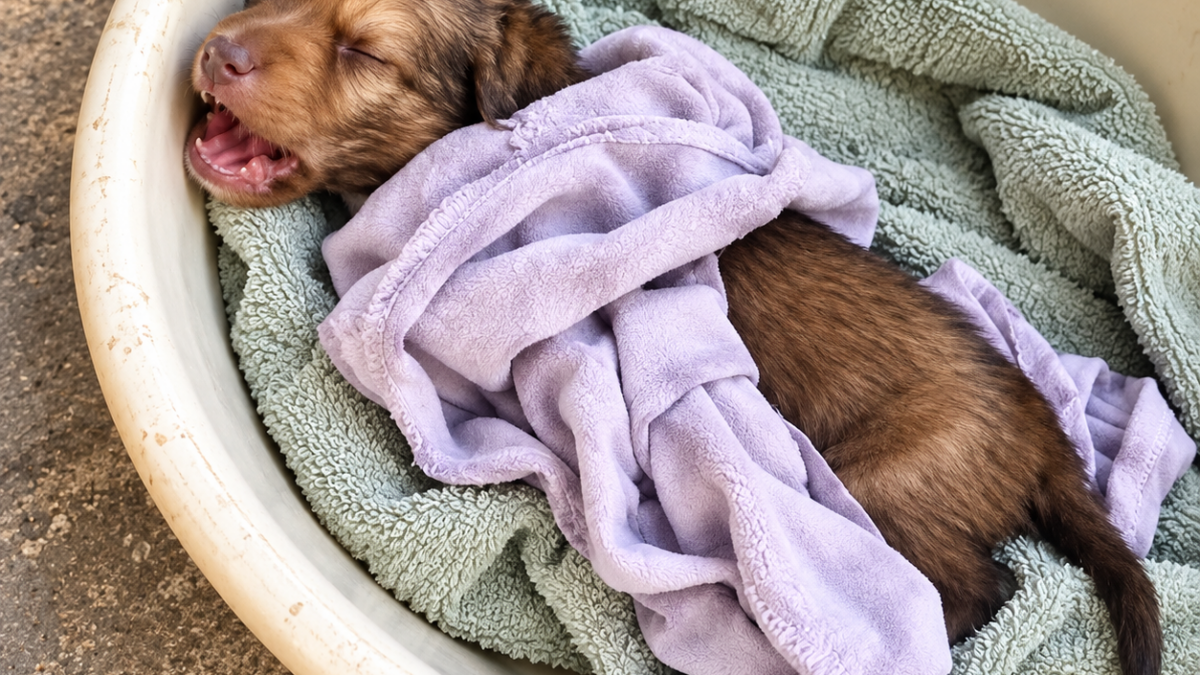
PART 2
I moved my hand slowly from one side of Valentine’s face to the other.
Nothing.
No tracking.
No small turn of his head.
No blink of recognition.
I tried again.
“Valentine?”
His ears moved at the sound of my voice.
His eyes did not.
Dr. Morris caught my wrist gently.
“Don’t assume the worst yet.”
“You saw that.”
“I did.”
“He can’t see.”
“I said don’t assume the worst.”
Her voice was firm, not because she was dismissing what I had seen, but because she knew exactly where my mind was going.
Permanent blindness.
Brain damage.
A life defined before it had even properly begun.
I stared at the tiny puppy between us.
“What else could it be?”
“Swelling. Neurological trauma. Delayed visual development complicated by the injury. We don’t have enough information yet.”
“But you’re worried.”
“Yes.”
That single word settled heavily between us.
Dr. Morris ordered additional bloodwork and repeated the neurological examination. Valentine reacted to sound and touch, but his responses were inconsistent. Sometimes he pulled away when she touched one side of his face. Sometimes he seemed delayed.
His liver values were abnormal but not catastrophic.
The bruising around the organ suggested blunt trauma.
Again, it gave us a clue without giving us an answer.
Something significant had happened to that puppy.
We just couldn’t prove what.
I hated that uncertainty almost as much as I hated the injuries.
If someone had hurt Valentine deliberately, there was no confession waiting for us.
No clear security footage.
No witness giving us a name.
We filed the appropriate report and documented everything we could: photographs, medical findings, the condition in which he arrived, the blood at his ear, the seizures, the abdominal bruising.
But documentation and answers are not the same thing.
Sometimes rescue means standing in front of an injured animal knowing exactly what happened.
Other times it means staring at evidence and realizing the only living creature who truly knows the truth cannot tell you.
That afternoon, I sat beside Valentine’s enclosure while he slept.
Rachel pulled a chair next to mine.
“You haven’t gone home.”
“I went home yesterday.”
“For three hours.”
“I showered.”
“That isn’t the same as sleeping.”
I ignored her.
She handed me a sandwich.
“Eat.”
“I’m not hungry.”
“I wasn’t asking.”
I unwrapped it because arguing took more energy than eating.
For a while, neither of us spoke.
Then Rachel said, “What are you afraid of?”
I looked at her.
“What kind of question is that?”
“The kind where you’re supposed to answer.”
I glanced toward Valentine.
“That he survives all this and never gets to be a puppy.”
Rachel followed my gaze.
Valentine twitched in his sleep.
“He’s already a puppy.”
“You know what I mean.”
“Yes.”
I pressed my hands together.
“I keep thinking about what should have been happening to him right now. He should be with his mother. He should be sleeping most of the day, nursing, crawling over his littermates. He shouldn’t know what a seizure is.”
“He doesn’t know what a seizure is.”
“That’s worse.”
Rachel was quiet.
I continued.
“He only knows that it hurts.”
For the first time that day, my voice broke.
Rachel leaned back in the chair.
“We can’t change the part before he got here.”
“I know.”
“But we can make sure every hour after that is different.”
That became our rule.
We could not fix the unknown past.
We could control the next hour.
Then the hour after that.
Valentine still needed frequent feedings, medication and careful monitoring. Because he was so young, we couldn’t simply put food in a bowl and wait.
Someone had to hold him.
Someone had to make sure he swallowed.
Someone had to watch for aspiration.
Someone had to stimulate him after feedings the way his mother normally would.
The work was repetitive, exhausting and strangely intimate.
At three in the morning, when the rest of the building was quiet, I would cradle him against a folded towel and feed him drop by drop.
Sometimes he fought.
Sometimes he seemed too tired.
Sometimes he latched with surprising determination and drank until his belly rounded beneath my fingers.
Those were the moments I lived for.
“You’re greedy tonight,” I whispered once.
His mouth stayed firmly attached.
Rachel looked over.
“That’s the first normal puppy thing he’s done.”
I smiled.
“Then he can be as greedy as he wants.”
By the end of the first week, Valentine had gained a little weight.
Not much.
But enough that Dr. Morris allowed herself the smallest smile when she looked at the scale.
“I’ll take it.”
“So will I.”
His seizures had also become less frequent.
The medication was helping.
His crying decreased.
His sleep grew deeper.
But his vision remained unclear.
When we moved a hand in front of him, he still didn’t consistently follow.
Bright light produced some response, but not enough to tell us what the future held.
Then came the next problem.
Valentine started trying to walk.
At first it was almost funny.
He was still young enough that even a healthy puppy would have been clumsy.
He planted all four paws beneath himself, lifted his belly from the towel and took one wobbling step.
Then another.
I held my breath.
“Come on.”
He moved toward my voice.
Three steps.
Four.
His rear legs trembled.
Then they folded.
He rolled onto his side.
I caught him before his head hit the floor.
My smile vanished.
Dr. Morris saw it too.
“Again,” she said.
We waited until Valentine settled.
Then she placed him on a padded mat.
He stood.
Walked.
Wobbled.
Collapsed.
She checked his reflexes.
“Is that from the head injury?” I asked.
“Possibly.”
“Possibly?”
“He’s very young. His nervous system is still developing. Severe illness can weaken him. Trauma can affect coordination. We need time.”
I had started hating those words.
We need time.
Time felt passive.
I wanted treatment.
A procedure.
A medication.
Something I could point to and say, This will fix him.
Instead, much of Valentine’s recovery depended on something more frustrating.
Waiting while his body revealed what it could repair.
Over the next two weeks, we built his days around tiny goals.
Stand for five seconds.
Walk toward a voice.
Turn toward a sound.
Finish a feeding.
Sleep without crying.
Take medication without fighting us like a miniature alligator.
That last one became increasingly difficult.
As Valentine began feeling better, he developed opinions.
Strong ones.
He hated one particular medication.
The moment he smelled it, his entire face wrinkled.
“Oh, don’t start,” I told him.
He turned his head away.
“You have to take it.”
He tried crawling under the towel.
Rachel laughed from across the room.
“That’s neurological progress.”
“He’s hiding.”
“Exactly.”
I lifted him.
“You’re two pounds of trouble.”
Valentine made a tiny sound that was not quite a growl.
Rachel stared at me.
“Did he just threaten you?”
“He did.”
We both laughed.
It felt almost wrong at first.
There had been so much fear around Valentine that laughter seemed out of place.
Then I realized that was exactly why we needed it.
Pain had occupied enough of his life.
We were allowed to make room for something else.
His personality arrived before his balance did.
He was stubborn.
Demanding.
Affectionate when he wanted to be.
Offended when he didn’t.
He learned my voice quickly.
If I entered the room and spoke, his head turned toward me.
That made the vision issue even harder.
He knew me.
He recognized me.
But we didn’t know whether he could see me.
One morning, I decided to test something.
I sat on the mat a few feet away without speaking.
Valentine was awake.
He lifted his head.
I moved my hand.
Nothing.
I shifted my body.
Nothing.
Then I tapped my finger lightly against the floor.
His head snapped toward the sound.
He crawled toward me.
When he reached my leg, he pressed his face against my jeans.
I picked him up.
“You found me.”
He settled beneath my chin.
I told myself it was enough.
But I still wanted him to see.
I wanted him to chase movement.
I wanted him to know sunlight.
I wanted him to look into someone’s face and understand that the person touching him was safe.
That desire became dangerous.
Not to Valentine.
To me.
Because I started treating every uncertain reaction as evidence.
“He looked at the toy.”
“Maybe.”
“He followed me.”
“He may have followed the sound.”
“He blinked when I moved my hand.”
“You created air movement.”
Each time Dr. Morris answered cautiously, I became more frustrated.
One afternoon, I snapped.
“You don’t think he’ll see.”
She stopped writing.
“I didn’t say that.”
“You never say anything.”
“I say what I know.”
“And you don’t know.”
“That’s correct.”
I pushed my chair back.
“I’m tired of hearing that.”
Dr. Morris looked at me for a long moment.
Then she closed Valentine’s chart.
“Do you think I enjoy saying it?”
I said nothing.
She lowered her voice.
“If I tell you his sight will return and it doesn’t, I haven’t helped you. If I tell you he’ll stay blind and next month he starts tracking movement, I haven’t helped you. My job is not to give you the answer that lets you sleep tonight.”
The anger drained out of me as quickly as it had arrived.
She continued.
“My job is to give him the best chance possible and tell you the truth while we wait.”
I stared at the floor.
“You’re right.”
“I know.”
That made me laugh despite myself.
She smiled.
“Go home tonight.”
“I can stay.”
“Go home.”
“What if—”
“We have staff.”
“Elena—”
“You’re no good to him exhausted.”
I looked through the glass.
Valentine was asleep with his chin on the edge of a rolled towel.
“I hate leaving him.”
“He doesn’t know you’re martyring yourself.”
“That’s rude.”
“It’s also true.”
So I went home.
I slept six hours.
When I returned the next morning, Rachel was waiting near the treatment room.
She had a strange expression.
“What?”
“Come here.”
My heart accelerated.
“What happened?”
“Nothing bad.”
“You can’t stand there looking like that and say nothing bad.”
“Just come.”
I followed her.
Valentine was on the padded mat.
Dr. Morris sat several feet away.
Between them was a small red ball.
“What are we doing?”
“Be quiet,” Rachel whispered.
Dr. Morris rolled the ball gently across the mat.
Valentine’s head moved.
I froze.
The ball stopped.
He crawled toward it.
Not toward Dr. Morris.
Toward the ball.
She rolled it again.
His eyes moved with it.
My hand found Rachel’s arm.
“Did you see that?”
“Yes.”
Dr. Morris repeated the test from the other side.
Valentine tracked it again.
Not perfectly.
Not smoothly.
But clearly.
I dropped to my knees.
“Valentine.”
He turned toward my voice.
I could barely get the words out.
“You can see something.”
Dr. Morris raised a hand.
“Remember our conversation.”
“I know. I know.”
“We still don’t know how much.”
“I don’t care.”
I started crying.
“I’ll take something.”
That was the first day we had objective reason to believe Valentine had functional vision.
The next question was how much.
We learned slowly.
He reacted better to high-contrast objects than subtle ones.
Movement caught his attention more easily than stationary objects.
He seemed stronger in brighter environments.
Whether that would continue improving, we couldn’t say.
But something was reaching him.
Light.
Motion.
Shape.
The world.
That afternoon, I carried him near a window.
Sunlight fell across his face.
He blinked.
Then turned his head slightly toward the brightness.
I had seen hundreds of dogs stand in sunlight.
I had never cried over it before.
“You see that?” I whispered.
Valentine squirmed against me.
“That’s outside.”
He had no idea what I was saying.
He tried chewing my thumb.
That felt even better.
His legs improved too, though less dramatically.
We started simple physical therapy under veterinary guidance.
Soft surfaces.
Short sessions.
Carefully supported standing.
Nothing aggressive.
He was still growing, and the goal was not to push his body faster than it could safely develop.
At first, five steps tired him.
Then ten.
Then he crossed the treatment room.
His gait remained awkward.
His hindquarters sometimes drifted sideways.
When excited, he moved too fast and toppled over.
But each week he spent more time upright.
And the stronger he became, the harder he was to contain.
Valentine discovered socks.
Not toys shaped like socks.
Actual socks.
Rachel lost one first.
She had kicked off her shoe beneath the desk during a long overnight shift.
A few minutes later, she looked down.
“Where is my sock?”
I glanced toward Valentine’s play area.
A tiny white tail disappeared behind a blanket.
“No.”
Rachel leaned over the gate.
Valentine was chewing the sock.
“That little criminal.”
I started laughing.
She reached for it.
He clamped down.
“Give it.”
He pulled backward.
“Valentine.”
He pulled harder.
“You have no teeth worth mentioning.”
Apparently that didn’t matter.
For nearly thirty seconds, a two-pound neurological patient fought a grown woman over a sock.
Then his rear legs gave out.
He fell backward, still holding the prize.
Rachel stared at him.
I said, “I think he won.”
She surrendered the sock.
“That is medical equipment now.”
A month earlier, we had begged him to eat.
Now he was stealing laundry.
That mattered.
Everything ordinary mattered.
Around that time, we moved Valentine from intensive medical care into a foster environment.
I volunteered before anyone finished asking.
Rachel raised an eyebrow.
“You?”
“What?”
“You’ve been pretending for weeks that you’re objective.”
“I am objective.”
“You carry his picture on your phone.”
“I carry everyone’s pictures.”
“You made him a blanket with his name on it.”
“That proves nothing.”
Dr. Morris looked between us.
“He needs a quiet foster with someone who understands his medication schedule and neurological history.”
I folded my arms.
“So me.”
Rachel nodded.
“So definitely you.”
That was how Valentine came home with me.
I prepared everything as if I were bringing home a newborn.
Which, in many ways, I was.
Soft bed.
Low-sided playpen.
Heating pad designed for animals and carefully regulated.
Food.
Medication.
Towels.
Puppy-safe toys.
More towels.
An absurd number of towels.
My older dog, Daisy, was twelve and deeply unimpressed.
She stood several feet away while I carried Valentine inside.
“This is temporary,” I told her.
Daisy looked at me.
“I mean it.”
She walked away.
Valentine heard her nails clicking across the floor and immediately tried to follow.
He made it three feet before tipping over.
Daisy turned around.
She stared at him.
Valentine stood again.
He marched toward her with the determination of a drunk toddler.
Daisy looked at me as if I had personally betrayed her.
“Be nice.”
She sighed.
When Valentine reached her, he pushed his nose into her chest.
Daisy stiffened.
Then sniffed him.
Valentine attempted to climb onto her front paw.
Daisy stepped away.
He followed.
“That’s your problem now,” I told her.
For the first two days, Daisy avoided him.
On the third night, I woke around two in the morning and checked the playpen.
Valentine wasn’t alone.
Daisy was lying beside the outside edge.
Her back rested against the mesh.
Valentine was curled on the other side, pressed as close to her warmth as the barrier allowed.
I stood in the dark hallway for several seconds.
That image hurt in a way I wasn’t prepared for.
He should have known that kind of closeness from birth.
Maybe he had.
We didn’t know enough about his first days.
But whatever happened afterward had torn safety away from him.
Now an elderly dog who wanted absolutely nothing to do with puppies was giving a little of it back.
The next morning, I opened the playpen.
Daisy walked away as if the entire thing had never happened.
I didn’t embarrass her by mentioning it.
Valentine’s foster period gave me a better view of his limitations.
Inside the clinic, everything had been controlled.
At home, ordinary life created challenges.
Furniture.
Corners.
Changes in flooring.
Doorways.
Sounds coming from different rooms.
Valentine occasionally bumped into objects, especially in dim light.
He hesitated at transitions between surfaces.
He disliked stairs.
His balance worsened when he was tired.
But he adapted quickly.
He learned where the water was.
He learned the distance between his bed and the kitchen.
He learned Daisy’s favorite sleeping spots.
He learned that the refrigerator door opening sometimes meant food.
That particular skill developed with remarkable speed.
He also began playing.
Real play.
Not simply chewing whatever happened to be nearby.
One evening, I rolled the red ball across the living room.
Valentine watched.
Then chased it.
His legs scrambled against the floor.
He veered too far left.
Corrected himself.
Caught up with the ball.
Pounced.
Missed.
Tried again.
When he finally trapped it between his paws, he barked.
A tiny, sharp sound.
He startled himself.
Daisy lifted her head.
Valentine barked again.
Daisy groaned and put her head back down.
I sat on the floor and laughed until I cried.
That was the moment I stopped seeing him as the injured puppy first.
He was Valentine.
The injury was part of him.
It was no longer the whole of him.
A week later, however, we had our first serious setback.
I woke before dawn to a strange sound.
Not crying.
Rhythmic tapping.
I ran into the living room.
Valentine was seizing.
His body struck lightly against the padded side of the playpen.
“Valentine.”
I checked the time.
It lasted less than a minute.
Still too long.
When it ended, he lay disoriented.
I called the emergency number and drove him to the clinic with one hand constantly checking the carrier beside me.
Dr. Morris was already there.
She examined him while I stood against the wall.
“I thought we were past this.”
“We knew seizures could recur.”
“He was doing so well.”
“He still is.”
“He had another seizure.”
“One seizure does not erase four weeks of progress.”
I knew that.
Emotion did not care.
Bloodwork showed no sudden crisis.
His medication level needed adjustment as he gained weight.
That was the likely reason.
But the episode reminded me that recovery is not a straight line.
We like stories where the sick animal gets steadily better.
Day one terrible.
Day five better.
Day ten walking.
Day twenty cured.
Real bodies are messier.
Healing loops backward.
Something improves while something else appears.
Fear leaves and then returns.
Medication works until a growing puppy needs a new dose.
A leg gets stronger while balance still lags.
Valentine came home later that day.
I placed him in his bed.
Daisy walked over and sniffed him.
Then lay down nearby.
I sat between them.
“I thought I was going to lose you again.”
Valentine bit the edge of my sleeve.
I laughed weakly.
“You really don’t care about my emotional state.”
He pulled harder.
That evening, he ate his entire meal.
The next morning, he tried stealing Daisy’s.
Progress.
By the time Valentine was about ten weeks old, he was nearly unrecognizable from the puppy we had first treated.
His coat was healthy.
His weight was appropriate.
The blood in his ear was long gone.
His liver values had improved.
He had gone weeks without another seizure after the medication adjustment.
His vision remained imperfect, but he could clearly navigate, follow movement and recognize people at close range.
His balance was still unusual.
When he ran, his back end sometimes swung slightly sideways.
When he stopped too fast, momentum could sit him down without permission.
Valentine responded by getting up immediately.
He seemed personally offended by gravity.
We consulted a veterinary neurologist to better understand his prognosis.
After examining him and reviewing the records, she sat with me in a small consultation room.
“Will he ever be normal?” I asked.
The moment I said it, I hated the word.
She noticed.
“What does normal mean to you?”
“You know what I mean.”
“I do. But I want you to think about the question.”
I looked through the glass where Valentine was trying to pull a towel off a chair.
“He can play.”
“Yes.”
“He can eat.”
“Very enthusiastically.”
“He can see.”
“He has functional vision.”
“He walks.”
“He does.”
I smiled despite myself.
“Badly.”
“He disagrees.”
“So what should I expect?”
She folded her hands.
“There may be permanent neurological effects. His visual processing may never be perfect. His coordination may remain different. There is a risk of future seizures, which means he’ll need monitoring. But I’m not seeing a puppy whose life is defined by incapacity.”
I swallowed.
“You think he can have a good life.”
“I think he already has one.”
I looked through the glass again.
Valentine had successfully pulled the towel down.
It covered his entire body.
A moment later his head popped out.
The neurologist laughed.
“That puppy?”
“Yes.”
“He’s going to keep you busy.”
For the first time, hearing that felt like good news.
The next question was harder.
Adoption.
Everyone at the rescue knew I loved Valentine.
Everyone also knew I fostered animals because I could not keep every one.
That is one of the most difficult parts of rescue.
You hold them when they are broken.
You wake up for feedings.
You carry them through emergencies.
You memorize their fears.
Then, if everything goes right, you say goodbye.
Valentine’s case made that process especially difficult because he would need a specific kind of home.
His adopters had to understand his neurological history.
They had to accept the possibility of future seizures.
They needed patience.
They needed to keep him safe without treating him as fragile.
They needed to understand that imperfect vision did not mean helplessness.
We rejected two applications.
The first family had young children and a chaotic home environment that probably would have overwhelmed him.
The second applicant seemed kind but repeatedly referred to Valentine as “the blind puppy.”
“He isn’t blind,” I explained.
“Well, mostly blind.”
“No.”
“But disabled.”
“He has neurological differences.”
“That’s what I mean.”
Except it wasn’t.
Language told me how she saw him.
As a condition first.
A dog second.
I wanted someone who understood his medical history without building his entire identity around it.
Then came Laura Bennett.
Her application looked almost too simple.
Forty-two.
Veterinary receptionist.
Worked four days a week.
No children at home.
One six-year-old mixed-breed dog named Milo.
Fenced yard.
Previous experience with epileptic dogs.
I read that line twice.
When Laura came to meet Valentine, she didn’t rush toward him.
She sat on the floor.
Valentine noticed her shoes first.
He sniffed them.
Then her knee.
Laura held out one hand.
He leaned forward.
“You’re smaller than your pictures,” she said.
I smiled.
“He has a large personality.”
Valentine climbed directly into her lap.
I stared.
Laura looked at me.
“Is that good?”
“He doesn’t usually do that.”
Valentine circled twice and sat against her stomach.
Laura touched his back gently.
“Hi.”
He looked up.
His eyes didn’t focus perfectly, but they found her face.
Laura’s expression changed.
Not pity.
Something softer.
Recognition.
“He can see me.”
“At this distance, yes.”
She moved her fingers slowly.
Valentine followed.
“How much can he see?”
“We don’t know exactly. His functional vision is good enough for daily life. Dim light is harder. Fast movement at a distance can be confusing.”
She nodded.
“Does he compensate with hearing?”
“A lot.”
“Medication schedule?”
I explained.
“Last seizure?”
I told her.
“Triggers?”
“No confirmed triggers. Growth affected his dosage before, so medication levels have to be monitored.”
She asked intelligent questions.
Not performative ones.
Practical ones.
What did an episode look like?
How long before emergency care was required?
Did he recover quickly afterward?
How did he handle stairs?
What flooring gave him trouble?
What games did he like?
That last question made me smile.
“Anything involving theft.”
Laura laughed.
“What does he steal?”
“Socks. Dish towels. Daisy’s toys. Once my wallet.”
“Money?”
“Apparently.”
Then Laura became serious.
“Does he scare easily if someone approaches from behind?”
“Yes.”
“What do you do?”
“Speak first. Let him know where you are.”
“I can do that.”
She looked down at him.
Valentine had fallen asleep against her.
The room became quiet.
Finally she said, “I’m not looking for a perfect dog.”
I felt myself tense slightly.
People said things like that sometimes right before describing an animal as damaged.
Laura continued.
“I’m looking for my dog.”
I said nothing.
“And if he needs medication for the rest of his life, that’s okay. If he never walks perfectly, that’s okay. If his vision never gets better than this, that’s okay.”
She rubbed Valentine’s side.
“But I also don’t want everybody wrapping him in bubble wrap. Look at him.”
Valentine was sleeping with one rear leg sticking straight into the air.
Laura smiled.
“He clearly thinks he can run the world.”
That was the moment I knew she understood him.
We arranged a meeting with Milo.
Milo was a calm tan dog with a white chest and one bent ear.
Valentine approached him with his usual complete lack of respect for personal boundaries.
Milo sniffed.
Valentine licked his face.
Milo looked away.
Valentine followed.
Milo walked three feet.
Valentine followed.
Milo walked another three feet.
Valentine followed.
I started laughing.
Laura said, “Milo, congratulations. You have a stalker.”
Eventually Milo gave up and lay down.
Valentine climbed partially on top of him.
Milo sighed.
I knew that sigh.
Daisy made the same one.
The trial adoption was scheduled for the following week.
The night before Valentine left my house, I packed his things.
Medication.
Records.
Favorite blanket.
Red ball.
Two soft toys.
One sock I had sacrificed permanently.
Daisy watched me from her bed.
“You’re going to miss him.”
She closed her eyes.
“You can pretend you won’t.”
Valentine waddled into the room carrying the sock.
His coordination had improved enough that the old sideways swing was now subtle.
He dropped the sock at my feet.
I picked it up.
“You’re leaving tomorrow.”
His tail moved.
“You don’t understand.”
He grabbed the other end.
I held on.
“You’re supposed to let me have an emotional moment.”
He pulled.
“Seriously?”
He pulled harder.
I released it.
Valentine fell backward.
Then jumped up as if nothing happened.
I laughed.
That helped.
The next morning, Laura arrived with Milo.
We reviewed everything twice.
Then a third time.
“Medication at seven and seven.”
“Got it.”
“If he has a seizure longer than—”
“I wrote it down.”
“He occasionally wakes confused.”
“I know.”
“Dim rooms—”
“I have night-lights.”
“Stairs—”
“Baby gate until he knows the house.”
I stopped.
Laura smiled gently.
“You can call me.”
“I’m not worried.”
“You’re absolutely worried.”
“I’m being responsible.”
“You packed six pages of notes.”
“Five and a half.”
She laughed.
Valentine was already at the door beside Milo.
He didn’t look back at me.
That hurt.
Then I realized it was supposed to.
He wasn’t scared.
He wasn’t clinging to the only person he trusted.
He was curious about where he was going.
That was success.
Laura lifted him into the car.
I crouched beside the open door.
“Behave.”
He licked my chin.
“That is not a promise.”
I kissed his head.
“Go be a puppy.”
Laura closed the door.
I watched the car leave.
Daisy stood beside me.
For once, she did not immediately go back inside.
We watched until the vehicle disappeared.
Then she leaned against my leg.
“I know.”
The first update came forty-five minutes later.
A photograph.
Valentine asleep in Milo’s bed.
Milo sitting beside the bed looking deeply inconvenienced.
The message read:
**He has stolen the large bed. Milo would like to file a complaint.**
I laughed out loud.
That night, Laura sent another picture.
Valentine had discovered a basket of toys.
Every single toy had been pulled onto the floor.
**Vision seems adequate for locating chaos.**
The trial week went better than any of us expected.
Valentine learned the layout of Laura’s house quickly.
Night-lights helped in darker hallways.
He learned where the back door was.
He learned Milo’s food dish, which required management because Valentine considered boundaries a personal insult.
He slept through most nights.
No seizures.
No crying.
On day four, Laura sent me a video.
She was in the backyard.
Milo ran past the camera.
Valentine chased him.
Not carefully.
Not cautiously.
Ran.
His legs moved fast.
His rear end swung slightly when he changed direction.
He nearly collided with a patio chair, corrected at the last second and continued.
Laura laughed behind the camera.
“Milo, he’s coming!”
Valentine caught up.
The two dogs circled the yard.
At one point Valentine stumbled.
He rolled.
For half a second my old fear returned.
Then he jumped up and chased Milo again.
I replayed the video.
Once.
Twice.
Five times.
The puppy who once could not stand for more than a few steps was running because another dog had dared him to.
The adoption became official.
I thought that would end the hardest part.
Instead, a month later, Valentine had another seizure.
Laura called me afterward.
Not during.
That told me she had handled it.
“He’s okay,” she said immediately.
My knees almost gave out anyway.
“How long?”
“Thirty-eight seconds.”
“Recovery?”
“Confused for about ten minutes. Then hungry.”
“Of course.”
“I called the neurologist. They’re checking his level tomorrow.”
“You did everything right.”
There was a pause.
“I was scared.”
“I know.”
“Really scared.”
“I know.”
For the first time, I realized Laura needed something too.
Not instructions.
Permission to admit that loving a medically complicated animal could be frightening.
“He scared me every time,” I told her.
“Even after you knew what to do?”
“Especially then.”
“Why?”
“Because knowing what to do doesn’t mean you stop loving him while you do it.”
She was quiet.
Then she said, “That makes sense.”
The medication was adjusted again.
Valentine stabilized.
Months passed.
Then something remarkable happened.
His vision improved further.
Not perfectly.
The neurologist believed some early deficits may have been connected to swelling and neurological recovery after the original trauma.
He remained weaker in low light and sometimes misjudged depth, but during daylight he tracked movement far better than he had as a young puppy.
Laura sent me a video one afternoon.
She stood at one end of the yard holding the red ball.
Valentine waited.
She threw it.
His eyes followed the arc.
He ran.
The ball bounced.
He changed direction.
Caught it.
Brought it back.
I called her immediately.
“Do it again.”
She laughed.
“What?”
“Throw the ball again.”
“You just watched the video.”
“I want to watch live.”
She switched to video call.
Valentine stood in the grass.
Milo wandered nearby.
Laura raised the ball.
Valentine’s eyes locked onto it.
“Ready?”
She threw.
He ran after it.
I watched from my kitchen, crying like an idiot.
He returned carrying the ball.
Laura knelt.
“Good boy.”
Valentine dropped it.
Then stole her gardening glove.
Some things improved.
Some things remained constant.
By his first birthday, Valentine weighed just over twenty pounds.
He had grown into a compact mixed-breed dog with oversized ears, bright eyes and a slightly crooked gait that became more noticeable when he was tired.
Laura threw him a birthday party.
Nothing elaborate.
A dog-safe cake.
Milo.
Daisy.
A few members of the rescue team.
Dr. Morris came too.
When she walked in, Valentine ran toward her.
She crouched.
“Look at you.”
He jumped against her knees.
“You used to fit in one hand.”
Valentine licked her face.
Rachel pointed.
“He has no respect for medical professionals.”
“He never did.”
I watched Dr. Morris examine him casually while petting him.
His eyes tracked her hand.
His legs were strong.
His coat shone.
The contrast with the first night was so extreme that for several seconds I could hear those cries again in my memory.
Dr. Morris looked at me.
“You’re doing it.”
“What?”
“Going back there.”
I knew what she meant.
“I can’t help it.”
“Yes, you can.”
She stood.
“Look at him now.”
Valentine was trying to steal a paper plate from the table.
Rachel grabbed it first.
“Absolutely not.”
He barked at her.
Dr. Morris smiled.
“That is the patient.”
Not the bleeding puppy.
Not the seizure.
Not the ultrasound.
Not the fear.
This.
I tried to remember that.
We never learned exactly what happened to Valentine before he reached us.
The investigation could document trauma.
It could record medical findings.
It could preserve what evidence existed.
But no reliable witness emerged who could prove who caused the injuries or how.
That frustrated me for a long time.
I wanted a person to blame.
A name.
A confrontation.
A consequence.
There is something comforting about a story where wrongdoing leads neatly to accountability.
Real life does not always cooperate.
Sometimes evidence proves an animal was hurt without proving who hurt him.
Sometimes the closest thing to justice is making sure the victim survives.
I struggled with that.
One afternoon, long after Valentine’s adoption, I found myself looking through his original intake photographs.
Blood around the ear.
Body tense.
Eyes unfocused.
I felt the old anger rise.
Laura happened to call.
“What are you doing?”
“Nothing.”
“That sounds convincing.”
I hesitated.
“Looking at old pictures.”
“His?”
“Yes.”
“Why?”
“I don’t know.”
She was quiet.
Then she said, “He’s currently asleep upside down on my couch.”
I smiled.
“That doesn’t answer my question.”
“I think it does.”
Another pause.
“He doesn’t live in those pictures anymore.”
The sentence stopped me.
I looked again at the image on my phone.
She was right.
The photograph mattered.
The documentation mattered.
What happened to Valentine mattered.
But we could keep honoring his pain until we accidentally made it larger than his life.
He had moved forward.
Maybe I needed to follow.
A few weeks later, Laura invited me over.
When I arrived, Milo greeted me first.
Valentine came racing from the hallway.
He recognized my voice before he reached the room.
His tail moved so hard that his whole body bent.
I sat on the floor.
He climbed into my lap.
“You remember me.”
Laura laughed.
“He remembers anyone who once had access to formula.”
“That’s hurtful.”
Valentine licked my nose.
Then jumped down.
He ran toward a low shelf and returned with the red ball.
The same type we had used when we first realized he could follow movement.
He dropped it beside me.
I stared at it.
Laura noticed.
“Throw it.”
I picked up the ball.
Valentine backed away.
His eyes stayed fixed on my hand.
I threw it down the hallway.
He ran.
No hesitation.
No fear.
His nails clicked across the floor.
He caught the ball near the end of the hall and turned too sharply.
His rear feet slipped.
He bumped gently against the wall.
My heart jumped.
Valentine simply picked up the ball and ran back.
Laura shook her head.
“He does that five times a day.”
“Still scares me.”
“It stopped scaring me.”
“Really?”
“No.”
We both laughed.
Valentine dropped the ball again.
I threw it.
He chased it.
Again.
Again.
On the fourth throw, Milo intercepted.
Valentine stopped.
He stared.
Milo carried the ball to his bed.
Valentine followed.
For several seconds, he stood there.
Then he barked.
Milo ignored him.
Valentine barked louder.
Milo turned his head away.
Valentine grabbed the edge of Milo’s bed and began pulling.
Laura covered her face.
“Oh, no.”
Milo remained lying on it.
Valentine pulled anyway.
The bed moved three inches.
I laughed so hard I had to sit back against the couch.
The puppy who once barely had enough strength to stand was now attempting to relocate another dog and his furniture because he wanted a ball.
That was the kind of victory no court could have given me.
As Valentine grew older, his seizure disorder became manageable.
He still required medication and routine monitoring.
There were occasional episodes.
Each one scared Laura.
Each one scared me when she told me.
But they became part of responsible care rather than a constant emergency hanging over his life.
His vision stabilized.
The neurologist believed he would probably always have some processing differences.
Valentine did not appear interested in the diagnosis.
He learned to catch treats.
He learned to climb onto the couch.
He learned that if he stood beneath Laura’s desk during work and made a small whining sound, she would eventually give him attention.
He learned that Milo could be persuaded to play by biting gently at his ankles.
He learned to navigate the backyard at full speed.
He learned where Laura kept socks.
Especially where Laura kept socks.
She eventually installed a laundry hamper with a lid.
Valentine considered this an escalation.
One Saturday morning, she sent me a photograph of the closed hamper lying sideways in the hallway.
The lid had been removed.
A trail of socks led toward the living room.
The message said:
**Your patient has entered organized crime.**
I forwarded it to Dr. Morris.
She replied:
**Excellent neurological problem-solving skills.**
That became our joke.
Anything troublesome Valentine did was evidence of neurological progress.
He opened a cabinet.
Progress.
He escaped a baby gate.
Progress.
He learned how to pull tissues from a box one at a time until seventy covered the floor.
Advanced progress.
He dug beneath a section of garden fencing to reach Laura’s tomatoes.
Disturbing levels of progress.
The fact that we could laugh about him felt like a miracle.
Then, two years after I first met Valentine, Laura called me late one evening.
Her voice sounded strange.
My chest tightened automatically.
“What happened?”
“He’s okay.”
“People need to stop beginning calls like that.”
She laughed softly.
“He did something today.”
“What?”
“You remember the first time you told me about him?”
“Yes.”
“You said there were nights when nothing settled him.”
I looked out my kitchen window.
“Yes.”
“That his crying filled the room.”
“Yes.”
Laura took a breath.
“My sister brought over a foster puppy today.”
I sat down.
The puppy had been surrendered with the rest of a litter after their mother stopped nursing.
Healthy, but frightened.
“He cried almost the entire first hour,” Laura said.
“What did Valentine do?”
“That’s why I’m calling.”
She sent me a video.
I opened it.
A tiny puppy was inside a small padded pen.
Valentine lay outside it.
At first, nothing happened.
The puppy cried.
Valentine lifted his head.
Then he stood, walked closer and lay beside the edge.
The puppy moved toward him.
Their noses touched through the mesh.
The crying slowed.
Valentine stayed.
Minutes passed.
The puppy curled against the side nearest him.
Valentine rested his head beside it.
The video ended.
I stared at the screen.
Laura said, “He stayed there almost two hours.”
I couldn’t speak.
“He didn’t try to play?”
“No.”
“Didn’t bark?”
“No.”
“He just stayed?”
“Yes.”
I remembered the first night.
My fingers resting beside Valentine because touching him sometimes made the pain worse.
My voice telling him he was not alone.
He could not have understood me.
But perhaps bodies remember safety in ways words cannot explain.
Years later, Valentine was offering it to someone else.
That image stayed with me longer than any photograph of his injuries.
His story could easily have become a tragedy defined by what someone may have done to him.
Instead, it became something more complicated.
He carried consequences.
Medication bottles were real.
Neurological exams were real.
The occasional seizure was real.
The imperfect gait was real.
Healing had not rewritten history.
It had built a life around it.
There is a difference.
By Valentine’s third birthday, Laura no longer described him as a special-needs adoption unless someone specifically asked about his medical care.
“He’s Valentine,” she told people.
That covered most things.
When strangers noticed his gait, she explained.
When they didn’t, she didn’t.
When somebody said, “Poor thing,” after hearing his history, Laura usually smiled politely.
Then Valentine would steal something from their bag.
Pity rarely survived the encounter.
One afternoon at an adoption event, a woman crouched beside him.
“I heard what happened to you,” she said sadly.
Valentine sniffed her purse.
Laura saw it.
“Valentine.”
Too late.
He pulled out a glove.
The woman gasped.
He ran.
Three volunteers chased him around a table.
Milo barked.
Children laughed.
Valentine ducked beneath a chair, glove hanging from his mouth.
The woman started laughing too.
“Is he always like this?”
Laura nodded.
“Unfortunately.”
I stood nearby watching.
The woman had approached a victim.
Within thirty seconds, Valentine had refused the role.
That felt appropriate.
There were still moments when the past surfaced.
A loud metallic impact could make him freeze.
Sudden touch near his head sometimes caused him to flinch.
Veterinary visits required patience.
During one exam, a new technician reached quickly toward his ear.
Valentine jerked backward.
Laura immediately said, “Slow down.”
The technician apologized.
Valentine settled when Laura placed a hand against his chest.
Nobody forced him.
Nobody pinned him unnecessarily.
Nobody treated fear as disobedience.
The exam continued at his pace.
Afterward, he accepted a treat from the technician.
That was healing too.
Not the absence of fear.
The presence of people who respected it.
As the years passed, I saw Valentine less often.
That was another sign of success.
Rescue relationships are strange.
When an animal is critical, your entire world narrows around them.
Then they recover.
They leave.
Their family sends fewer updates because ordinary life takes over.
At first, you miss the photographs.
Then you realize ordinary life is exactly what you wanted.
No emergency.
No crisis.
No daily medical update.
Just Tuesday.
Breakfast.
A walk.
A nap.
A stolen sock.
Dinner.
Sleep.
For animals who come to us in terrible condition, ordinary can be the most beautiful outcome imaginable.
Laura still sent birthday pictures.
Valentine in a paper hat he clearly hated.
Valentine beside Milo.
Valentine asleep under a blanket.
Valentine standing in autumn leaves.
Valentine trying to steal cake.
In every photograph, his eyes looked brighter than I remembered from those first days.
Not perfect.
Bright.
One winter, several years after his rescue, Milo became ill.
He had developed heart disease and was slowing down.
Valentine changed around him.
He stopped crashing into Milo during play.
He waited when they went outside.
He slept closer.
Laura told me one evening, “It’s like he knows.”
Dogs notice weakness.
They notice changes in smell, movement and routine.
Whether Valentine understood illness the way we did was impossible to know.
But he knew his friend was different.
Milo had been the first dog in Laura’s home to tolerate the wobbly little puppy who invaded his bed.
Now Valentine adjusted to him.
When Milo had difficulty climbing a small step from the yard, Valentine would stand nearby.
Not helping.
Just waiting.
The roles had shifted.
Milo died the following spring.
Laura called me crying.
Valentine searched for him for days.
He checked Milo’s bed.
The yard.
The hallway.
At night, he sometimes stood near the room where Milo used to sleep.
There was nothing we could do to explain death to him.
So Laura did the same thing we had once done for Valentine.
She stayed.
She sat on the floor when he seemed restless.
She kept routine.
She let him sleep close.
She did not rush his grief.
A month later, Valentine began carrying Milo’s old toy around the house.
A faded blue rope.
He rarely played with it.
He simply moved it.
Bed to couch.
Couch to hallway.
Hallway back to bed.
Laura never took it away.
When I visited, I saw Valentine sleeping with one paw resting over the rope.
I sat beside him.
He opened one eye.
“Getting old?”
His tail tapped once.
He was not old.
But he was no longer the tiny puppy I could hold in one hand.
I touched the fur behind his ear.
The place where I remembered blood.
There was no visible sign now.
Just warm fur.
Laura sat across from me.
“Do you ever think about whoever hurt him?”
The question surprised me.
“Sometimes.”
“Still angry?”
I considered it.
“Yes.”
She nodded.
“Me too.”
“But less.”
“Why?”
I looked down at Valentine.
“Because whoever did it doesn’t get the biggest part of his story.”
Laura’s eyes filled.
“That’s what I think too.”
Valentine woke, stretched and stood.
Then he picked up Milo’s rope toy and walked toward the kitchen.
The conversation ended because he wanted dinner.
As usual, Valentine had better priorities.
Eventually Laura adopted another dog.
Not immediately.
Almost a year passed.
The new dog was a shy female named Penny who had been surrendered after her owner died.
Penny was afraid of doorways.
Afraid of men.
Afraid of quick movements.
The first meeting between Penny and Valentine lasted less than ten minutes.
Penny stayed near the fence.
Valentine approached halfway.
Stopped.
Waited.
That surprised me.
Young Valentine would have charged directly into her space.
Older Valentine had learned something.
Maybe from Milo.
Maybe from life.
Penny took one step.
Valentine sat down.
She took another.
He remained still.
Eventually she sniffed him.
He turned his face slightly away, offering no pressure.
Laura looked at me.
“Who taught him manners?”
“Definitely not me.”
Penny followed him into the house that afternoon.
The dog afraid of doorways crossed one because Valentine crossed first.
Over the next several weeks, he became her guide.
He showed her the yard.
The beds.
The water bowl.
The couch.
He also showed her how to steal socks.
No rehabilitation plan is perfect.
Laura caught them both in the hallway one morning with laundry scattered around them.
Penny looked terrified.
Valentine looked delighted.
Laura sent me the picture.
**He is corrupting her.**
I replied:
**Social confidence building.**
She responded:
**You’re banned from writing medical notes.**
Valentine grew older.
His seizure medication continued.
His bloodwork was monitored.
His gait remained crooked but functional.
His eyesight never became perfect.
It did not need to.
He knew his world.
He knew Laura.
He knew Penny.
He knew the route from the bedroom to the kitchen better than any sighted creature on earth when breakfast was late.
On the anniversary of the day he entered the rescue, Laura sometimes sent me a simple photograph.
No dramatic caption.
Just Valentine.
Year one: chasing Milo.
Year two: asleep on Laura’s chest.
Year three: covered in mud.
Year four: standing beside Penny.
Year five: gray beginning to appear around his muzzle.
That fifth photograph stopped me.
I enlarged it.
Gray.
Not much.
A few silver hairs.
I remembered the first night when we did not know whether Valentine would survive until morning.
Now he was old enough to begin going gray.
I called Laura.
“You made me cry.”
“I knew you’d see it.”
“He has gray hair.”
“I told him.”
“What did he say?”
“He stole my slipper.”
“Sensitive subject.”
That evening, I looked again at the original intake picture.
This time, it did not pull me backward.
I could hold both images at once.
The injured puppy.
The aging dog.
They belonged to the same life.
One did not erase the other.
One proved the other was not the ending.
Years after Valentine first arrived bleeding and crying, Dr. Morris retired from full-time practice.
At her small farewell gathering, several former patients came with their families.
Valentine was invited.
Laura brought him wearing a red bandana.
He moved slower than he once had.
The crooked gait had become more pronounced with age and arthritis.
But when Dr. Morris knelt in front of him, his tail began moving.
“Do you remember me?”
He sniffed her face.
Then licked her nose.
She laughed.
“I’ll take that as a yes.”
I stood nearby.
Dr. Morris rubbed the side of Valentine’s head.
“You were not supposed to make my career this stressful.”
Laura said, “He’s been stressful ever since.”
“I believe it.”
For a moment, Dr. Morris’s expression changed.
She looked at me.
“Do you remember those first three nights?”
“Yes.”
“I thought we might lose him.”
“So did I.”
She looked down at Valentine.
He had become distracted by crumbs beneath a table.
“You kept asking me whether he’d see.”
“I remember.”
“You were very annoying.”
“I remember that too.”
Laura laughed.
Then Dr. Morris grew quiet.
“I’m glad I didn’t know the answer.”
I understood immediately.
If someone had shown us the full story on that first night—years of life, stolen socks, Milo, Penny, red balls, seizures managed, imperfect vision used boldly, ordinary mornings—we would have wanted to believe it too badly.
Instead, Valentine gave it to us one small piece at a time.
One feeding.
One peaceful sleep.
One tracked movement.
One step.
One fall.
One recovery.
One adoption.
One birthday.
One year.
Then another.
There had been no single miraculous moment.
His life was built from hundreds of small ones.
Near the end of the party, Valentine became tired.
Laura sat in a chair.
He stood between her knees.
Then she lifted him carefully onto her lap.
He was much too large for it compared with the puppy I remembered, but he settled against her anyway.
His head rested over her heart.
I froze.
The first time I held Valentine, he had screamed in pain.
His tiny body had shaken in my hands.
Blood had marked the fur near his ear.
We had whispered to him because we could not explain that he was safe.
Now he closed his eyes against Laura’s chest.
Her hand moved slowly over his back.
The room around him was noisy.
People talking.
Dogs moving.
Chairs scraping.
Valentine slept.
Deeply.
Peacefully.
Laura looked at me.
“What?”
I shook my head.
“Nothing.”
But it wasn’t nothing.
It was everything we had wanted on those first nights.
Not perfection.
Not a body untouched by the past.
Not an answer to every question.
Peace.
Years earlier, I had named him Valentine because I hoped that whatever his life had held before reaching us, love might become the larger part of what came after.
At the time, it had felt like a wish.
Now I was looking at the answer.
The person who may have hurt him remained unknown.
The exact moment his injuries happened remained unknown.
We never got the confrontation I once imagined.
No dramatic confession.
No courtroom revelation.
No punishment I could point to and call balance.
For a long time, that bothered me.
Then Valentine grew up.
He chased balls he once could not see.
He ran on legs we feared might never carry him properly.
He survived seizures.
He stole socks.
He grieved a friend.
He comforted frightened puppies.
He helped another scared dog walk through a doorway.
He lived long enough for gray hairs to appear on the face we once feared might never reach adulthood.
Whoever hurt him had controlled a few terrible moments of his life.
They did not get the rest.
Laura did.
Milo did.
Penny did.
Daisy did.
Dr. Morris did.
Rachel did.
I did.
Most importantly, Valentine did.
When Laura finally stood to leave the retirement party, Valentine woke.
She clipped on his leash.
He stretched slowly.
Then he turned toward me.
I crouched and held out my hand.
He walked over.
Older now.
A little stiff.
Still slightly crooked.
He pressed his head beneath my palm exactly as he had learned to do years earlier.
I rubbed behind his ear.
“No stealing anything on the way out.”
His tail moved.
Laura laughed.
“That means nothing to him.”
“I know.”
Valentine turned and followed her toward the door.
He paused briefly beneath the bright light of the hallway.
Years earlier, I had carried him to a window and cried because he turned his face toward sunlight.
Now he looked ahead.
Laura opened the door.
Late-afternoon sun spilled across the floor.
Valentine walked through it without hesitation.
[END OF STORY]








