PART 2: A Truck Hit Her and Left Her Dying by the Road—Then One Detail on the Shoulder Told Us It Wasn’t Just an Accident
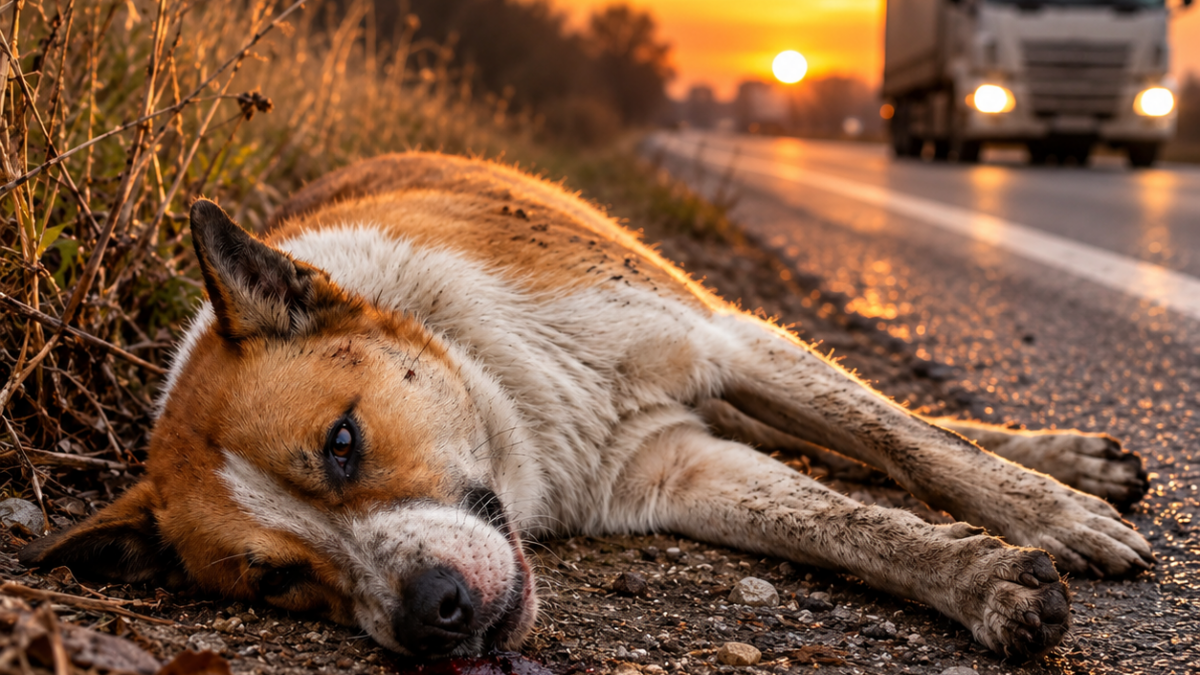
PART 2
The deputy placed the evidence bag on the counter.
I looked at the letters.
**VALLEY FARM TRANSPORT.**
The name meant something immediately.
Not because I knew the company personally.
Because anyone who lived within thirty miles of Miller Creek knew those trucks.
Valley Farm Transport hauled feed, livestock supplies, fertilizer, and packaged produce between farms, warehouses, and distribution centers throughout three counties. Their trucks were white with dark green lettering and a red reflective stripe along the lower cargo box.
The metal fragment in the deputy’s bag had that same stripe.
Deputy Aaron Mills looked from the fragment to me.
“You said you found another piece?”
I reached into my jacket.
“Yes.”
“Don’t wipe it.”
“I didn’t.”
I handed it over carefully.
He put on gloves.
The two broken edges fit together.
Not perfectly enough to make a movie scene out of it.
Enough.
“Where did you find yours?”
“Beside the tire marks, maybe six feet from her.”
He nodded.
“I found mine about twenty yards farther up, near the ditch.”
Hannah was still in treatment with the dog.
I could see staff moving quickly through the glass.
“What does this prove?” I asked.
“Right now? That something belonging to a Valley Farm truck broke near the roadway.”
“Beside a dog that was hit.”
“Yes.”
“You’re being very careful.”
“I’m a deputy.”
“Occupational problem?”
“Pretty much.”
He asked when we arrived, who called, what we saw, whether anyone moved debris before him, whether I had taken photographs.
I had.
Lots.
Aaron copied them from my phone.
Then he asked the question I had been avoiding.
“Dog have a name?”
“No.”
“You want one for the report?”
I looked through the glass.
The dog lay beneath bright lights with an oxygen line near her face.
Her red fur looked almost copper under the fluorescent lamps.
“Ruby.”
Aaron glanced at me.
“Ruby?”
“For now.”
He wrote it down.
“Ruby it is.”
At 7:10, the emergency veterinarian came out.
Dr. Evan Pierce was in his early fifties, calm in the way doctors become when panic around them is somebody else’s job.
“We’ve stabilized her blood pressure somewhat.”
“Somewhat?”
“She’s still bleeding internally.”
“Where?”
“Likely splenic and soft-tissue injury. We’re monitoring whether surgery becomes necessary. Right now, anesthesia would add risk.”
“What about the spine?”
“There’s trauma around the lower cervical and upper thoracic region.”
I stared at him.
“That’s where the front legs—”
“Yes.”
“Paralysis?”
“Possibly temporary. Possibly permanent. There is some deep pain response in one limb, which is better than none.”
“What about the other?”
“Very little.”
Hannah came out behind him.
She looked exhausted already.
“What can we do?”
“Wait,” Dr. Pierce said.
I hated that word.
“How much will this cost?”
He started giving me numbers.
Initial stabilization.
Imaging.
Possible transfusion.
Hospitalization.
Potential surgery.
Rehabilitation if she survived.
The amount climbed quickly past what our rescue kept available for emergencies.
I looked at Hannah.
She knew exactly what I was thinking.
“We’ll find it,” she said.
Dr. Pierce looked between us.
“You’re a nonprofit?”
“Yes.”
“We can work with your rescue discount, but I don’t want to pretend this is going to be inexpensive.”
“Do what she needs.”
He nodded.
“We already are.”
At 8:30, Linda Mercer arrived.
The woman who had called.
She was sixty-one, gray-haired, wearing a rain jacket and muddy boots.
The moment she saw me, she started apologizing.
“I should’ve stopped earlier.”
“You weren’t there.”
“My husband passed her this morning.”
“He thought she was dead.”
“That’s what he said.”
Linda sat down heavily.
“He told me at lunch there was something on the shoulder. I didn’t think about it until I drove that way after work.”
She looked toward the treatment room.
“When I saw her eyes…”
Her voice broke.
“You stopped.”
“Too late.”
“You stopped.”
She wiped her face.
“I pulled over and called you because I was afraid to move her.”
“That was the right thing.”
“Cars kept passing while I waited.”
“How many?”
“Dozens.”
One driver rolled down his window and asked whether the dog was dead.
Another honked because Linda’s car partially blocked the shoulder.
One man slowed, stared, then drove off.
Linda shook her head.
“I kept thinking maybe somebody had already called.”
That sentence stayed with me.
Maybe somebody already called.
It is one of the most dangerous comforts people give themselves.
At 9:12, Aaron returned.
“Valley Farm Transport runs that road daily.”
“How many trucks?”
“Depends on the day.”
“Can they tell you which one?”
“They can.”
“Will they?”
“They say they’re checking.”
The answer sounded wrong.
“Who did you speak to?”
“Operations manager. Dale Carver.”
I knew the name.
Everybody did.
Dale sponsored the county high-school football booster club, sat on a regional agricultural board, and appeared in local newspaper photos every Christmas handing oversized checks to charities.
“What did he say?”
“That none of their drivers reported an animal strike.”
I laughed once.
Aaron didn’t.
“Does that mean none happened?”
“No.”
“Do the trucks have cameras?”
His eyes shifted slightly.
“That’s one of the questions we asked.”
“And?”
“Company policy says most fleet trucks have forward-facing dash cameras.”
“Most?”
“Yes.”
“So there could be video.”
“If it still exists.”
That phrase made me look at him.
“What does that mean?”
“Data gets overwritten.”
“How fast?”
“Depends on the system.”
“Hours?”
“Usually days, not hours.”
“So get it.”
“I’m working on it.”
He started walking away.
“Aaron.”
He stopped.
“If a driver hit Ruby and didn’t know, that’s one thing.”
“Yes.”
“If he knew?”
Aaron looked through the treatment-room window.
“Then we find out what happened next.”
Near midnight, Ruby crashed.
Her blood pressure dropped.
Heart rate climbed.
Internal bleeding had worsened.
Dr. Pierce recommended surgery.
“Will she survive anesthesia?”
“I don’t know.”
The answer cut through me.
“If we don’t?”
“I don’t think she makes it until morning.”
There was no decision.
“Do it.”
The clinic required a deposit larger than our rescue card could cover.
I called our director, Maggie.
She answered on the second ring.
“How much?”
I told her.
Silence.
Then:
“Give them my personal card number.”
“Maggie—”
“Write it down.”
“We can fundraise tomorrow.”
“Tomorrow is irrelevant if she dies tonight.”
I wrote the number.
Ruby went into surgery at 12:41 a.m.
Linda stayed.
So did Hannah.
Marcus brought coffee at one and fell asleep sitting upright.
I couldn’t.
I kept seeing Ruby beside the road.
The still eyes.
The tiny tail movement.
Her nose pressed into my palm.
At 2:16, my phone rang.
Aaron.
“What happened?”
“I found the truck.”
I stood.
“Which truck?”
“Unit 47.”
“How?”
“The metal fragment has a stamped supplier code. Company maintenance records show Unit 47 had body repair in that exact section last month.”
“Driver?”
“Caleb Warren.”
“Did he admit it?”
“No.”
“What did he say?”
“He says he never hit a dog.”
I walked toward the empty hallway.
“Dashcam?”
Pause.
“Aaron.”
“The company says Unit 47’s camera malfunctioned yesterday.”
Of course it did.
“When?”
“They haven’t given us a precise answer.”
I closed my eyes.
“GPS?”
“Truck passed Miller Creek Road at 8:17 yesterday morning.”
Exactly where Ruby had been.
“Speed?”
“Telematics records show a sudden speed reduction.”
“How sudden?”
“From fifty-two to twenty-one.”
“Then back up?”
“Yes.”
“How long?”
“About forty seconds.”
“So he hit her.”
“It strongly supports that something happened there.”
“Come on.”
“Claire.”
“I know. Evidence.”
“Exactly.”
“What about Caleb?”
“He says a deer crossed the road.”
“In October? Sure.”
“Possible.”
“Did anyone see a deer?”
“No.”
“Did anybody see a dog?”
“We’re asking.”
I stared through the glass.
“Find the dashcam.”
“We’re trying.”
He hung up.
At 3:08, Dr. Pierce came out.
His cap was still on.
There was blood on one sleeve.
I stood.
“Ruby?”
“She made it through surgery.”
My knees nearly gave out.
“What did you find?”
“Small tear in the spleen. Significant abdominal bleeding. We controlled it. Pelvic fracture is stable enough that we’re not repairing it tonight.”
“Spine?”
“Same uncertainty.”
“Is she awake?”
“No.”
“Will she make it?”
He looked at me.
“She survived the part I was most afraid she wouldn’t.”
That was all he would give me.
I took it.
At 5:30, Ruby opened her eyes.
At 6:02, she moved her right front paw.
Not much.
A twitch.
But Hannah saw it.
“Do that again.”
Ruby stared at her.
Nothing.
Hannah touched between her toes.
Ruby pulled slightly.
Hannah looked at me.
“That’s better.”
“What about left?”
“Not yet.”
“Could come?”
“Yes.”
“Could not?”
“Yes.”
It became a pattern.
Good news paired with a warning.
Ruby was alive, but unstable.
She could move one paw, but not the other.
Her lungs were clear, but broken ribs hurt.
Pelvis might heal without surgery, but she couldn’t stand.
One hour at a time.
At 7:45, a man walked into the clinic and asked for me.
I expected Aaron.
It wasn’t.
He was maybe thirty-six.
Work jacket.
Baseball cap.
Face gray with exhaustion.
“I’m Caleb Warren.”
Everything inside me stopped.
The driver.
I stared at him.
“You hit Ruby?”
His eyes closed.
“Yes.”
It was not how I expected the confrontation to happen.
No denial.
No lawyer.
No shouting.
Just yes.
“Why did you tell the deputy it was a deer?”
Caleb swallowed.
“Dale told me to.”
That answer changed the entire case.
We stepped into the consultation room.
I called Aaron immediately.
Caleb said he would wait.
Ten minutes later, Aaron arrived.
Body camera on.
Notebook out.
Caleb sat with both hands locked together.
Aaron began:
“Before we continue, you understand you are not under arrest at this time.”
“Yes.”
“You came voluntarily?”
“Yes.”
“Tell me what happened.”
Caleb stared at the table.
“I was driving Unit 47.”
“What time?”
“A little after eight.”
“Where?”
“Miller Creek.”
“What happened?”
“I saw the dog late.”
“How late?”
“Maybe twenty yards.”
“Speed?”
“Fifty?”
“Truck logs show fifty-two.”
Caleb nodded.
“She came out of the ditch.”
My head lifted.
Ruby had not been lying in the road already.
“What happened?”
“I braked.”
“Did you strike her?”
“Yes.”
“Where?”
“Front right corner, I think.”
The broken metal.
Aaron asked, “Did you stop?”
Caleb hesitated.
“For a second.”
“Did you exit the truck?”
“No.”
My hands tightened.
Aaron kept his voice level.
“Why?”
“I called dispatch.”
“Who answered?”
“Dale.”
“What did you tell him?”
“That I hit a dog.”
“And?”
Caleb rubbed his hands together.
“He asked if the truck was damaged.”
Silence.
Aaron asked, “What did you say?”
“I said maybe. I could see something hanging from the lower panel.”
“And the dog?”
“I told him she was moving.”
I closed my eyes.
He knew.
Aaron continued.
“What did Dale say?”
Caleb looked sick.
“He told me to keep moving.”
“Exact words?”
Caleb swallowed.
“He said, ‘If the truck drives, you drive. We’re already behind.’”
My pulse hammered.
“Did you ask about the dog?”
“Yes.”
“What did he say?”
Caleb looked toward me for the first time.
“He said somebody local would deal with it.”
There was that imaginary somebody again.
The person who absorbs responsibility when another person refuses it.
Aaron asked:
“Why did you obey?”
Caleb’s jaw tightened.
“I’ve been written up twice for late deliveries.”
“So?”
“I have two kids.”
I stood.
Aaron glanced at me.
I sat back down.
Caleb continued.
“My wife hasn’t worked since surgery. I’m the insurance. Dale told me last month one more delay and I’m gone.”
“You chose your job.”
He looked at me.
“Yes.”
No excuse.
That almost made it harder.
“Did you ever think she might die?”
“Yes.”
“Then why didn’t you call 911 or animal control yourself?”
“Because Dale said if I made it a report, insurance would get involved.”
“So?”
“He said they’d test me.”
“Were you impaired?”
“No.”
“Then why care?”
“I take a prescription pain medication for my back.”
“Legal prescription?”
“Yes.”
“Would it make you unsafe to drive?”
“Not if I take it at night like I’m supposed to.”
“Had you taken it that morning?”
“No.”
“Then what were you afraid of?”
Caleb’s face twisted.
“Being fired anyway.”
I hated how human the answer was.
Cowardice becomes harder to dismiss when it wears rent, children, health insurance, and fear.
That did not make Ruby less injured.
Aaron asked about the dashcam.
Caleb looked surprised.
“It was working.”
The room went silent.
Aaron leaned forward.
“Yesterday?”
“Yes.”
“Dale says it malfunctioned.”
“It didn’t.”
“Did you view the footage?”
“No.”
“Who can access it?”
“Operations. Safety manager. Maybe corporate.”
“Can drivers delete it?”
“No.”
Aaron closed his notebook.
That was the first moment I saw anger on his face.
He stood.
“Mr. Warren, I need you not to contact Dale Carver until I tell you otherwise.”
Caleb nodded.
“What happens to me?”
“I don’t know yet.”
Caleb looked toward me.
“Can I see the dog?”
My answer came immediately.
“No.”
He nodded.
“I understand.”
Then he reached into his jacket.
I tensed.
He pulled out an envelope.
“I brought this.”
He placed it on the table.
Cash.
Eight hundred dollars.
“I know it’s nothing compared to the bill.”
I stared at him.
“I don’t want your money.”
“It’s what I have.”
“Then keep it for your kids.”
His eyes filled.
“I keep seeing her.”
I said nothing.
“Every time I close my eyes, I see her head lift after I hit her.”
My anger sharpened.
“You saw her lift her head.”
“Yes.”
“And drove away.”
“Yes.”
No defense.
No “but.”
Just yes.
That was the beginning of Caleb changing from antagonist into witness.
Dale Carver became something else.
By noon, Valley Farm Transport had an attorney.
The company released a statement saying it was “cooperating fully” and that preliminary information suggested the animal had “entered the roadway unexpectedly.”
Technically true.
Carefully incomplete.
They did not mention the dispatch call.
Did not mention Caleb reporting the collision.
Did not mention being told to continue.
Aaron obtained a preservation order for electronic records.
The dashcam company confirmed Unit 47 uploaded footage automatically to cloud storage.
Valley Farm’s claim of a malfunction immediately looked suspicious.
The raw file still existed on the vendor’s server.
But access required company credentials or legal process.
That took days.
Dale used those days.
He called me.
I answered because I didn’t recognize the number.
“Claire Bennett?”
“Yes.”
“This is Dale Carver with Valley Farm.”
My stomach tightened.
“Why are you calling me?”
“To discuss the dog.”
“Talk to the deputy.”
“I’d rather handle this directly.”
That phrase told me everything.
“What does directly mean?”
“I understand your rescue has significant medical expenses.”
I went quiet.
“We’re prepared to make a charitable contribution.”
“A contribution.”
“Yes.”
“In exchange for what?”
“No exchange.”
He said it too fast.
“What are you asking me to do?”
“Nothing. We simply want to help.”
“Then donate anonymously.”
Pause.
“Our insurance department would prefer a release acknowledging the incident is unresolved.”
I almost laughed.
“There it is.”
“Claire, nobody is trying to buy silence.”
“You’re calling a witness and offering money tied to a release.”
“That is not what I said.”
“Good. Then send everything through your attorney.”
His tone changed.
“You should understand that these situations get distorted online.”
“I haven’t posted anything.”
“I know.”
“How?”
Silence.
That bothered me.
He continued:
“We employ forty-three people. Drivers. Mechanics. Office staff. Families. If people start accusing Valley Farm of animal cruelty—”
“Did I accuse your company publicly?”
“No.”
“Then why are you worried?”
Another silence.
“You rescue people can turn anything into outrage.”
That did it.
“Ruby has a broken pelvis, broken ribs, internal bleeding, and a spinal injury.”
“I’m sorry.”
“Are you?”
“Yes.”
“Then why did you tell Caleb to keep driving?”
Silence.
Long.
“What did he tell you?”
Enough.
Dale’s voice hardened.
“Caleb is covering himself.”
“So the dashcam will clear you.”
Another silence.
“Goodbye, Claire.”
He hung up.
I immediately sent Aaron the recording.
Yes, my phone recorded.
Rescue work had taught me to document threats, abandonment confessions, and angry owner calls.
Dale had just confirmed he knew Caleb was talking.
More importantly, he had shown what he feared.
The dashcam.
Ruby spent the next four days in intensive care.
Her internal bleeding stabilized.
She started eating.
First from a syringe.
Then from a shallow bowl.
Her right front leg gained strength.
The left remained nearly motionless.
The pelvic fracture made her unable to stand regardless.
We used a sling.
The first time we lifted her, Ruby panicked.
Not violently.
Her whole body went rigid.
Her eyes widened.
“Easy,” Hannah whispered.
Ruby looked at me.
I put my hand near her nose.
She pressed into it.
Same gesture as the van.
“You’re okay.”
Slowly, she relaxed.
Physical therapy started with tiny movements.
Toe stimulation.
Supported weight shifting.
Range-of-motion exercises.
Five minutes exhausted her.
On day five, she wagged her tail when Linda visited.
Linda cried so hard Ruby stared at her.
“I’m sorry,” Linda said, laughing through tears. “I’m the crazy lady who found you.”
Ruby wagged again.
Linda began visiting every day.
At first I thought she felt guilty.
Then I realized she was falling in love.
“Don’t,” I warned.
“What?”
“You know what.”
“I’m just visiting.”
“You brought her a blanket embroidered with her name.”
“It was on sale.”
“Sure.”
“She needs comfort.”
“She has six clinic blankets.”
“This one is soft.”
Hannah walked past.
“Congratulations on your dog, Linda.”
“She is not my dog.”
Ruby wagged.
Nobody believed Linda.
The dashcam footage arrived on the sixth day.
Aaron did not show it to me immediately.
I found out because he called and said:
“We got it.”
My hands went cold.
“And?”
“It’s clear.”
“Can I see?”
“Not yet.”
“What happens?”
“We’re reviewing dispatch records too.”
“Tell me what’s on it.”
He sighed.
“Ruby enters the road from the right shoulder.”
“Running?”
“More like trotting.”
“Does Caleb brake?”
“Yes.”
“Does he hit her?”
“Yes.”
“Then?”
“Truck stops forty-three seconds.”
“What does Ruby do?”
Pause.
“Aaron.”
“She tries to crawl.”
My eyes filled.
“With which legs?”
“Rear mostly.”
The source had said her front legs did not move.
Now we knew why.
“Can you see Caleb?”
“Cab camera catches him looking in the side mirror.”
“So he knew.”
“Yes.”
“Then drives away.”
“Yes.”
I gripped the counter.
“What about dispatch?”
“Audio was recorded through fleet communications.”
“What did Dale say?”
Aaron hesitated.
Then read from the transcript.
Caleb:
**I hit a dog. She’s alive.**
Dale:
**Truck okay?**
Caleb:
**Think so. Lower corner’s busted.**
Dale:
**Then keep rolling. Larson’s already waiting.**
Caleb:
**She’s in the road.**
Dale:
**She won’t be for long. Somebody’ll move her.**
Caleb:
**Should I call county?**
Dale:
**You want another incident on your file? Keep driving.**
I closed my eyes.
There it was.
Not misunderstanding.
Not panic.
Instruction.
And then something worse.
Twenty minutes later, Caleb called dispatch again.
**Still thinking about that dog.**
Dale replied:
**Forget the damn dog and make your drop.**
That sentence spread later.
Not because I posted it.
Because it became part of a public court filing.
But before any of that, Valley Farm tried one more time to control the story.
Their attorney claimed Dale had been speaking under pressure and believed the dog would move safely off the road.
Then maintenance records surfaced.
Unit 47 returned to the yard at 3:40 that afternoon.
A mechanic documented:
**Right lower panel impact damage, red-brown hair present.**
Hair.
Ruby’s hair.
The repair ticket was changed eighteen minutes later.
Original:
**road strike**
Revised:
**debris impact**
Who authorized the change?
Dale Carver.
The mechanic, Wesley Boone, had kept a photograph on his personal phone because he needed to order the correct trim piece.
The photograph showed fur embedded in the broken panel.
When investigators questioned him, Wesley said:
“Dale told me not to write animal strike because insurance would flag it.”
“Did you know the animal was alive?”
“No.”
“If you had?”
Wesley looked disgusted.
“I’d have called somebody.”
Dale’s position became much worse.
But the case was legally strange.
A dog injured in a traffic accident is not the same as a human hit-and-run victim under every law.
Caleb striking Ruby may genuinely have been unavoidable.
The serious questions came afterward.
Failure to render or seek assistance where required.
Knowingly leaving an injured domestic animal.
False records.
Witness contact.
Potential insurance-related misrepresentation.
The exact charges changed as prosecutors reviewed the case.
I learned not to predict.
Publicly, I said nothing.
Privately, I wanted Dale ruined.
That is the truth.
I wanted his job.
His reputation.
His money.
I wanted him to experience one afternoon of helplessness.
Then Ruby taught me to focus elsewhere.
She moved her left paw.
Day eight.
Hannah was doing neurological checks.
Pinch.
Nothing.
Again.
Tiny flex.
Hannah froze.
“Claire.”
“What?”
“Watch.”
She repeated the stimulus.
Ruby pulled the paw.
Barely.
I screamed.
Ruby startled.
“Sorry!”
Hannah laughed.
“That’s intentional.”
“Meaning?”
“Pathway is functioning.”
“Will she walk?”
“Don’t do that.”
“What?”
“Turn one paw movement into a marathon.”
“Fine.”
But hope had entered the room.
Day ten, Ruby came off IV fluids.
Day twelve, she left ICU.
Day fourteen, she was discharged to our rehabilitation foster.
Linda volunteered.
Of course.
“I have a one-story house.”
“Of course you do.”
“No stairs.”
“Convenient.”
“Fenced yard.”
“Very suspicious.”
“And I’m retired.”
I looked at Ruby.
Ruby looked toward Linda’s voice.
Then wagged.
“Fine.”
Linda smiled.
“Temporary.”
I pointed at her.
“Don’t start.”
The rehabilitation months were harder than the rescue.
People like rescue stories to jump from wounded dog to miracle.
Real recovery is repetitive.
Painful.
Boring.
Expensive.
Ruby needed sling-assisted walking four times a day.
Medication.
Hydrotherapy.
Neurological exercises.
Massage.
Frequent bedding changes because she could not always control her bladder at first.
One week she improved.
The next she regressed.
Her right leg strengthened faster than the left.
Her hind legs could bear weight before her front end could coordinate.
She fell.
A lot.
Every fall frightened Linda.
Every fall annoyed Ruby.
That was encouraging.
Anger meant she wanted movement.
At the rehabilitation center, therapist Joel McKenna put her in an underwater treadmill.
Ruby hated him instantly.
“You’re not special,” Joel told her. “Everybody hates me the first week.”
Ruby glared.
“You can glare all you want.”
She tried walking.
Water supported her weight.
Right front paw stepped.
Left dragged.
Joel adjusted.
Again.
Right.
Left scraped.
Again.
Ruby’s breathing quickened.
“Stop?” I asked.
Joel shook his head.
“Two more.”
Ruby looked exhausted.
“One.”
Right step.
Left lifted.
Actually lifted.
I grabbed Linda’s arm.
“Did you see?”
“Yes.”
“Again.”
Joel smiled.
“Don’t ruin it by crying.”
Linda was already crying.
Ruby took another.
That night, she slept fourteen hours.
Three months after the accident, she stood without a sling for six seconds.
Four months, twenty-three seconds.
Five months, she walked ten feet.
Ugly.
Crooked.
Magnificent.
The video stayed private for weeks.
Then our rescue posted it after the legal case had progressed enough that the prosecutor approved.
The caption was simple:
**Ruby walked today.**
Millions did not see it.
Thousands did.
Enough.
Donations covered most of her rehabilitation.
Linda watched the comments.
“So many people love her.”
I said, “Don’t read all of them.”
“Why?”
“Because eventually somebody will say something stupid.”
Two minutes later:
“Someone says she should’ve been euthanized.”
“There it is.”
Linda closed the app.
Ruby did not care.
She wanted chicken.
The criminal and civil consequences moved in parallel.
Caleb accepted responsibility early.
His attorney negotiated a resolution based partly on cooperation.
He admitted leaving the scene after knowingly striking Ruby and failing to report the injured animal appropriately.
He lost his job.
Lost his commercial driving position for a period.
Completed community service.
Paid restitution he could afford.
More importantly, he testified against Dale and Valley Farm.
People online hated him anyway.
I understood.
Sometimes I did too.
Then he asked to meet.
Not with Ruby.
With me.
We met at the sheriff’s office.
Neutral place.
Caleb looked older.
“You don’t owe me anything,” he said.
“Good.”
“I wanted to tell you why I’m testifying.”
“I assume your lawyer told you.”
“He did.”
I waited.
Caleb looked at his hands.
“But that’s not why.”
“Then why?”
“My daughter asked me something.”
He swallowed.
“What?”
“She saw Ruby on the news.”
His voice cracked.
“She’s nine. She asked, ‘Dad, what kind of person would leave a dog like that?’”
I didn’t speak.
“I lied.”
His eyes filled.
“I told her I didn’t know.”
That hurt differently.
“Then I went into the bathroom and threw up.”
I looked away.
“I told my wife that night.”
“What happened?”
“She told me if I lied in court, she’d take the kids and leave.”
That was believable.
Caleb laughed bitterly.
“Guess she found my moral backbone.”
I said, “Don’t make her responsible for that.”
He nodded.
“You’re right.”
“Why didn’t you stop?”
He had answered before.
Job.
Insurance.
Fear.
But now he said something else.
“Because Dale gave me permission not to be the man I knew I should be.”
The sentence stayed with me.
“What does that mean?”
“I wanted somebody above me to say keep going.”
“So when he did—”
“I took it.”
He looked at me.
“If he had said stop, I would’ve stopped.”
“That doesn’t help.”
“I know.”
“You had a phone.”
“I know.”
“You had forty-three seconds.”
“I know.”
“You looked in the mirror.”
His face broke.
“I know.”
I let the silence sit.
Then he said:
“I don’t want forgiveness.”
“Good.”
“I just don’t want to lie anymore.”
That, I could accept.
Dale never reached that point.
At his preliminary hearing, he blamed Caleb.
“Drivers are responsible for roadway decisions.”
His attorney emphasized that Dale was miles away and never saw Ruby.
Then prosecutors played the dispatch call.
**She’s in the road.**
**Somebody’ll move her.**
**Should I call county?**
**You want another incident on your file? Keep driving.**
The courtroom went silent.
Dale’s attorney requested context.
They played more.
Worse.
Twenty minutes later:
**Still thinking about that dog.**
**Forget the damn dog and make your drop.**
Dale stared forward.
Then Wesley testified about the maintenance record.
Original road strike.
Changed to debris impact.
Authorized by Dale.
The company’s safety director testified he had never been informed of an animal collision.
That mattered.
Dale had not merely made a bad decision in the moment.
He had hidden it afterward.
Valley Farm’s corporate office put him on leave.
Then fired him.
Their insurer opened a fraud-related internal investigation regarding record alteration.
State commercial-fleet regulators reviewed maintenance and safety practices.
Again, not cinematic revenge.
Forms.
Audits.
Interviews.
Records.
Sometimes paperwork is more destructive than shouting because paper remembers after people change their stories.
Valley Farm eventually settled the rescue’s veterinary expenses through insurance and a separate civil agreement.
They paid Ruby’s bills.
All of them.
Surgery.
ICU.
Rehabilitation.
Medication.
Future orthopedic care reserve.
Maggie paid herself back for the emergency deposit and then donated that amount into our general trauma fund.
I asked why.
“Because Ruby already paid enough.”
The company also implemented mandatory post-collision reporting for animal strikes, automatic preservation of fleet camera files after sudden braking events, and a rule allowing drivers to contact emergency services directly without supervisor approval.
That was one outcome I cared about.
The next driver would not need permission to act human.
Dale’s criminal case did not end with some dramatic decades-long prison sentence.
Realistically, that was never going to happen.
He accepted a plea involving record falsification, witness-related conduct, and offenses connected to knowingly directing the driver away from an injured domestic animal and later concealing the incident.
He received probation, fines, community service, and temporary restrictions related to fleet-management work under the final agreement.
He lost his management position.
Lost his board seat in the regional agricultural group.
Lost the public reputation he had spent years building.
The high-school booster club removed him.
People called that humiliation.
I called it documentation catching up.
At sentencing, Dale asked to speak.
I almost left.
Then stayed.
He stood in a gray suit.
No company logo.
No authority.
“I made the wrong call.”
The judge asked:
“Which call?”
Dale hesitated.
“The dispatch call.”
“Only that?”
Silence.
He looked down.
“No.”
The altered maintenance report.
The false camera claim.
The attempt to settle quietly.
The call to me.
Each had been a second chance to choose differently.
He had used every one to protect himself.
The judge asked:
“Why?”
Dale finally said:
“Because once I told Caleb to keep driving, every honest decision after that would have exposed the first one.”
That was probably the truest thing he ever said.
One bad decision had become a chain because confession felt more expensive than another lie.
The problem was Ruby paid for the first hours of that chain.
Ruby did not attend court.
She was busy doing something more important.
Learning stairs.
One low step.
Linda’s porch.
Joel placed a textured mat before it.
Ruby approached.
Sniffed.
Lifted right front leg.
Then left.
The weak one.
It trembled.
She set it down.
Shifted weight.
Climbed.
Linda screamed.
Ruby looked offended.
“I’m sorry!”
Ruby turned around.
Tried down.
That was harder.
She stumbled.
Linda reached.
Joel stopped her.
“Let her recover.”
“She’ll fall.”
“She needs to learn her own balance.”
Ruby steadied.
Step.
Down.
Both front paws.
Safe.
Linda cried again.
Joel sighed.
“You people cry too much.”
Seven months after the accident, Ruby walked around Linda’s fenced yard without assistance.
Not perfectly.
Her gait remained slightly uneven.
One shoulder weaker.
When tired, the left paw scuffed.
Her pelvis healed with mild asymmetry.
Cold weather would probably bring arthritis early.
But she walked.
Then she ran.
That happened by accident.
A squirrel appeared.
Ruby saw it.
Everything neurological and orthopedic became temporarily irrelevant.
She launched herself across the yard.
Linda screamed.
I laughed so hard I nearly dropped my coffee.
“Ruby!”
The squirrel escaped.
Ruby stopped.
Turned.
Her entire body looked surprised.
As if she had just discovered what her own legs could do.
Then she ran back.
Crooked.
Fast enough.
Straight into Linda.
That was when I stopped pretending Ruby might be adopted elsewhere.
I brought the paperwork.
Linda looked at it.
“What’s this?”
“Adoption application.”
“I already foster.”
“You have fostered her eight months.”
“She has medical needs.”
“Yes.”
“She knows my house.”
“Yes.”
“It would be stressful to move her.”
“Yes.”
Linda narrowed her eyes.
“You planned this.”
“For eight months.”
She signed.
Ruby Mercer.
Linda cried.
I did too.
We blamed Ruby.
Two weeks later, Caleb asked through Aaron whether he could send something.
Not visit.
Send.
I said okay.
A box arrived.
Inside was a custom orthopedic dog ramp.
Built by Caleb.
He had worked construction before trucking.
Solid wood.
Carpet grip.
Perfect height for Linda’s car.
There was no long letter.
Just:
**For the rides she should have been given that day. I know this fixes nothing.**
Linda looked at me.
“What do we do?”
I stared at the ramp.
“Use it.”
Ruby loved car rides.
That felt appropriate.
Caleb never met her for almost two years.
Then Linda asked me something surprising.
“Do you think Ruby would care?”
“About what?”
“If he met her.”
“Ruby doesn’t know who he is.”
“Exactly.”
“Do you want him to?”
“I don’t know.”
I thought about it.
This was not forgiveness theater.
Ruby did not need to absolve him.
Caleb did not deserve a staged emotional release.
But Linda had another reason.
“He keeps sending money to the trauma fund.”
I knew.
Twenty-five dollars some months.
Fifty others.
Once ten.
Never missed entirely.
“He doesn’t put his name.”
“The rescue system shows it.”
Linda nodded.
“He’s doing something.”
“Yes.”
“Maybe I want him to see what he almost ended.”
That I understood.
We arranged it privately.
At a park.
Aaron came too, mostly because everyone agreed neutral space was better.
Caleb arrived alone.
Ruby stepped from Linda’s car using the ramp he had built.
Caleb stopped breathing.
I saw it.
Ruby sniffed the grass.
Tail up.
Healthy weight.
Scar near one shoulder.
Slight limp.
Alive.
Caleb covered his mouth.
“She’s bigger than I thought.”
Linda said, “Forty-eight pounds.”
Ruby noticed him.
Walked over.
Caleb froze.
“Can I?”
Linda nodded.
“Let her decide.”
He held out one hand.
Ruby sniffed.
Then looked away at a bird.
No recognition.
No accusation.
No dramatic miracle.
Caleb knelt anyway.
His eyes filled.
“I’m sorry.”
Ruby sniffed his jacket.
Then licked his chin.
Caleb broke.
Actually folded forward, one hand over his face.
I did not tell him Ruby forgave him.
She hadn’t.
Dogs do not participate in our legal and moral accounting.
She smelled a man.
He was calm.
He offered a hand.
She responded.
The forgiveness people wanted existed only in the story they might tell themselves.
What mattered was Caleb knew.
He touched the scarred shoulder lightly.
“I saw you lift your head.”
Ruby wagged.
He cried harder.
Linda looked at me.
I whispered:
“He needed to see the other ending.”
Maybe that was it.
Not absolution.
Evidence.
The dog he left had a life after his worst decision.
Caleb eventually returned to commercial driving after completing requirements and finding a smaller company willing to hire him.
He told the owner everything before accepting the job.
That surprised me.
“You told him?”
“Yes.”
“Why?”
“I’m done building jobs on lies.”
The owner hired him anyway.
With conditions.
Caleb became obsessive about roadside animals.
Once he stopped traffic for a turtle.
His coworkers never let him forget it.
Good.
Dale disappeared from my life.
For a while.
Three years after Ruby’s accident, I saw him at a grocery store.
He stood near produce.
Older.
Thinner.
No suit.
He saw me.
We both stopped.
I expected anger.
He said:
“How’s the dog?”
“Ruby.”
“Yes.”
“She’s good.”
“Walking?”
“Yes.”
He nodded.
“I saw a video once.”
I waited.
“I didn’t know she was that young.”
I felt anger return.
“What difference would age have made?”
His face tightened.
“None.”
Good answer.
He looked at the floor.
“I kept thinking Caleb should’ve stopped.”
I stared.
“So did everyone.”
“I mean… for a long time I blamed him.”
“You told him to keep going.”
“I know.”
“Then why blame him?”
“Because he listened.”
The honesty surprised me.
I said:
“That’s convenient.”
“Yes.”
Another good answer.
We stood there awkwardly.
Then Dale said:
“I work at a hardware store now.”
I didn’t know why he told me.
Maybe he wanted me to understand consequence.
Maybe he wanted sympathy.
I gave neither.
“I hope you’re better at it.”
He almost smiled.
“I don’t manage anyone.”
“That’s probably wise.”
I walked away.
No revenge speech.
No public humiliation.
Nothing left to win.
Ruby had already won the only part I cared about.
Time.
She turned five.
Then six.
The accident became medical history instead of daily crisis.
Cold mornings made her limp.
Linda put rugs over slippery floors.
Ruby gained a little too much weight because Linda believed chicken counted as medicine.
I disagreed.
Ruby sided with Linda.
At six, she became a certified therapy dog through a local rehabilitation program.
That idea came from Joel.
“You know what she likes?”
“Food.”
“Besides food.”
“People.”
“Exactly.”
Ruby visited physical therapy patients.
Not because she understood paralysis.
Because she was calm.
Because she loved hands.
Because wheelchairs didn’t bother her.
One teenage boy recovering from spinal surgery refused to work with his therapist for three days.
Then Ruby visited.
He looked at her uneven gait.
“What’s wrong with her?”
Joel said:
“Truck.”
“She always walk like that?”
“Probably.”
The boy watched Ruby climb onto a mat.
“Does it hurt?”
“Sometimes.”
Ruby put her nose on his knee.
The boy scratched her ear.
Ten minutes later, he agreed to do his exercises if Ruby stayed.
Linda called me afterward.
“She’s working now.”
“She has a job?”
“Yes.”
“Does she get paid?”
“Cheese.”
“Fair.”
The therapy center displayed a photograph of Ruby beside a walker.
No accident photo.
No bloody road.
I liked that.
Her identity was not the worst thing that happened to her.
Years later, Valley Farm Transport invited our rescue to speak at their annual driver safety meeting.
I almost refused.
Then their new safety director said:
“We use Ruby’s case in training.”
That changed my mind.
The room held maybe seventy drivers.
Some old.
Some young.
Some bored.
I brought Ruby.
Linda came.
Caleb did not work there anymore but was invited.
He sat in the back.
The new safety director played the dispatch audio.
Not the collision video.
Just voices.
**I hit a dog. She’s alive.**
**Truck okay?**
**Think so.**
**Then keep rolling.**
The room became very quiet.
Then he showed the revised policy.
Stop safely.
Report immediately.
Contact dispatch and emergency services.
Preserve camera data.
No supervisor can discipline a driver for a reasonable emergency stop involving an injured person or domestic animal.
Then he asked me to speak.
I stood beside Ruby.
She lay on the floor chewing a treat.
“I’m not here to tell you a dog is worth wrecking a truck or risking human life.”
The drivers watched.
“I’m here because once you are safely stopped, what you do next becomes a choice.”
I looked toward Caleb.
He looked down.
“Ruby was not injured because a driver wanted to hurt her. She ran into a road. Accidents happen.”
Then I looked around the room.
“What happened afterward did not have to happen.”
That was the point.
Not perfection.
Response.
One driver raised his hand.
“What if dispatch tells us to keep moving?”
The safety director answered before I could.
“You call me.”
Another asked:
“What if it’s clearly dead?”
“Report it anyway if there was contact.”
A third:
“What if stopping is unsafe?”
“Proceed to the nearest safe location and call.”
Specific.
Practical.
Better than slogans.
Afterward, several drivers met Ruby.
She collected cheese from all of them.
Caleb approached last.
Ruby knew him by then.
Not from guilt.
Because he had visited twice with Linda’s permission.
She wagged.
Caleb knelt.
“You’re going to get fat.”
Linda said, “Don’t body-shame my dog.”
For the first time, the three of us laughed around the same animal without the road standing between us.
Ruby turned ten.
Her arthritis worsened.
The old pelvic fracture showed itself more each winter.
She took anti-inflammatory medication, joint supplements, and occasional physical therapy.
Still walked.
Still rode in the car.
Still visited the rehab center, though less often.
Linda’s hair became completely white.
Mine was getting there.
Ruby’s red face faded around the muzzle.
The scar on her shoulder disappeared beneath thicker fur.
One rainy autumn afternoon, Linda called.
“Claire?”
Her voice sounded wrong.
“What happened?”
“She fell.”
I was already grabbing my keys.
“Can she stand?”
“Not well.”
At the clinic, X-rays showed no new fracture.
Neurological exam showed age-related weakness and progression of spinal arthritis around the old injury.
The trauma had left a body that could carry her for years.
Not forever.
Dr. Pierce had retired.
Hannah handled most of Ruby’s care now.
She looked at us.
“This is not the end tonight.”
Linda exhaled.
“But?”
“But we’re entering a different stage.”
More support.
Less jumping.
Ramp always.
Short walks.
Weight control.
Pain monitoring.
Ruby adapted again.
She had done that all her life.
At eleven, she stopped therapy visits.
At twelve, she needed help getting up some mornings.
Linda bought a support harness.
Ruby hated it.
Of course.
At thirteen, her kidneys began failing.
Slowly.
Medication.
Diet.
Fluids under the skin.
Linda learned everything.
Ruby remained interested in food.
That was our marker.
As long as she wanted chicken, she still wanted something.
Then one morning, she didn’t.
Linda called me.
No panic this time.
Just:
“It’s today.”
I drove over.
Rain was falling.
Of course it was.
Ruby lay on the same embroidered blanket Linda had brought to the clinic all those years ago.
**RUBY**
The letters were faded.
She rested near the window.
Her breathing was calm.
Tired.
Linda sat beside her.
“She won’t eat.”
I sat on the floor.
“Hey, girl.”
Ruby’s eyes opened.
Tail moved.
One tiny motion.
Exactly like the roadside.
Thirteen years disappeared.
Wet pavement.
Broken body.
That first impossible wag.
I put my hand near her nose.
Ruby pressed her muzzle into my palm.
Again.
I started crying.
Linda saw.
“Oh.”
“Yeah.”
“She did that?”
“The first day.”
Linda covered her mouth.
Ruby remained there.
Nose against my hand.
Hannah arrived a little later.
House call.
No clinic.
No bright room.
She examined Ruby.
Listened to her heart.
Looked at Linda.
Linda whispered:
“I know.”
Hannah nodded.
We fed Ruby one tiny piece of roast chicken.
She took it.
Then refused a second.
“Okay,” Linda said.
She stroked Ruby’s ear.
“You never refused the second one.”
Ruby closed her eyes.
I thought about the people who had driven past her.
I wondered if any of them remembered.
Probably not.
For them, she had been something beside a road.
For Linda, she became thirteen years of mornings.
For me, she became a case that changed policies.
For Caleb, a decision he would carry forever.
For Dale, the beginning of consequences.
For dozens of drivers, a training story.
For physical therapy patients, a dog with a funny walk who liked cheese.
That was what rescue does when it works.
It gives one terrible moment competition.
Hannah administered the sedative.
Ruby relaxed against Linda.
Linda whispered:
“You don’t have to get up anymore.”
My throat closed.
“You don’t have to work those legs.”
Ruby breathed slowly.
“You don’t have to be brave.”
Another breath.
“You were never supposed to have to be.”
Hannah gave the final medication.
Ruby’s heart stopped quietly beneath our hands.
Outside, rain touched the windows.
No traffic.
No cold asphalt.
No truck driving away.
Just home.
We sat with her for a long time.
Linda cried into Ruby’s blanket.
I looked at the paw that had once refused to move.
The paw that later lifted in water.
Climbed steps.
Ran after a squirrel.
Walked therapy-center hallways.
Pressed into patients’ knees.
Years of movement nobody could have promised us that first night.
A week later, Linda called me over.
She had framed three things.
A photograph of Ruby running in the yard.
Her therapy-dog tag.
And the small red-and-silver metal fragment I had found beside the road.
Aaron had returned it after the case closed.
I had forgotten Linda kept it.
“You sure you want that up?”
She nodded.
“Why?”
“That piece used to mean the truck.”
I looked at her.
“And now?”
“It means you bent down and noticed it.”
I shook my head.
“No. It means somebody broke a panel.”
Linda smiled.
“You’re terrible at sentimental moments.”
“I know.”
She hung the frame anyway.
Months later, Valley Farm replaced the training-room photograph of Ruby with a newer one.
Old Ruby.
Gray muzzle.
Therapy vest.
Standing beside a young driver.
Underneath:
**STOP SAFELY. REPORT. HELP.**
No mention of Dale.
No mention of scandal.
Just the action the next person should take.
Caleb sent Linda a letter after Ruby died.
He wrote:
**I have spent thirteen years wishing I had used forty-three seconds differently. Thank you for giving her every day after them.**
Linda asked whether I wanted to read the rest.
I said no.
That sentence was enough.
The following spring, I drove Miller Creek Road alone.
I had avoided stopping there for years.
The shoulder had been widened.
Fresh gravel.
New reflector posts.
Fields green with early growth.
I parked safely near the place where we had found Ruby.
I walked to the edge of the road.
Nothing remained.
No blood.
No tire marks.
No metal.
Cars passed.
A truck approached in the distance.
Large white box truck.
Not Valley Farm.
I stepped farther from the road.
The truck passed.
Then brake lights appeared.
It slowed.
Pulled onto the shoulder fifty yards ahead.
The driver climbed down.
I looked around.
A small terrier stood near a fence line.
Alive.
Uninjured.
Lost, apparently.
The driver crouched and called to it.
Another car stopped.
Then another.
Within minutes, three people were helping.
I stood there and watched.
The terrier finally approached a woman holding crackers.
Somebody checked its collar.
Somebody called the number.
Simple.
Ordinary.
Nobody had to be heroic.
They just stopped.
I laughed.
Then cried.
A few minutes later, the terrier’s owner arrived.
The truck driver climbed back into his cab.
Traffic moved again.
I walked to my car.
Before getting in, I looked one last time at the stretch of pavement where Ruby had once spent an entire day waiting for one person not to keep going.
For years, I thought her story was about cruelty.
Then justice.
Then recovery.
By the end, I understood it differently.
The truck hitting her was an accident.
Leaving her was a choice.
Stopping was also a choice.
And Ruby got thirteen years because eventually, one person made the second one.
[END OF STORY]








