PART 2: A Terrified Cat Hid in a Flooding Drain With Painful Tumors—Then I Crawled In to Reach Him
PART 2
The water touched the bottom edge of my glove.
That ended the mystery for the moment.
Whatever Milo’s past was, he would not have a future if we stayed inside that tunnel much longer.
I opened the carrier and turned it sideways.
“Milo, I’m going to pick you up.”
His pupils widened.
“I know you don’t like that idea.”
He pressed his head against the wall.
I slowly unfolded the towel across my lap.
Behind me, Daniel shifted.
“Need help?”
“Stay where you are. If he bolts, block the tunnel. Don’t grab him unless he reaches the water.”
Daniel nodded.
I inched closer.
Milo hissed.
It was almost soundless.
I placed one hand on the concrete.
“Easy.”
His eyes followed every movement.
When I was close enough, I moved the towel over his back.
Milo exploded.
Or at least his mind did.
His body no longer had the strength to follow.
He twisted violently, clawing at the concrete as he tried to escape beneath a pipe. One hind leg slipped.
His shoulder struck the wall.
A scream tore out of him.
“Easy! Easy!”
I wrapped the towel around him, carefully avoiding the large masses.
He tried to bite.
His teeth caught fabric instead of my hand.
For several seconds he fought desperately.
Then he stopped.
Completely.
That frightened me more than the struggle.
I had seen animals surrender before.
Not because they trusted us.
Because they believed there was no point resisting.
“I’ve got you,” I whispered.
Milo weighed almost nothing.
For a cat his size, I should have felt muscle and solid weight under the towel.
Instead I felt ribs.
Spine.
Sharp hips.
I lifted him into the carrier.
He made one small sound and immediately crawled into the farthest corner.
Daniel shut the door.
“Let’s get out.”
I pushed the carrier toward him.
We crawled backward through the tunnel.
Rainwater splashed around my knees.
When we reached daylight, one of the workers grabbed the carrier while another helped me stand.
My jeans were soaked.
My hands were shaking.
Daniel crouched beside Milo.
The cat stared through the metal door.
“You’re out, buddy,” Daniel said.
Milo blinked slowly.
Daniel looked at me.
“Is he going to make it?”
“I don’t know.”
I hated those words.
But rescue teaches you quickly that false hope is not kindness.
I loaded Milo into my van.
Daniel followed me to the driver’s door.
“Can you let me know?”
“Yes.”
He pulled his phone from his pocket.
“I mean it.”
“I will.”
He looked back at the carrier.
“We almost left.”
“What?”
“When we first heard him. The sound stopped, and one of the guys said it was probably water moving through the pipes.”
He rubbed a hand across the back of his neck.
“I was already walking out when I heard it again.”
I glanced at Milo.
“If you had left?”
Daniel nodded.
“I know.”
Neither of us needed to finish the sentence.
I drove straight to the clinic.
Dr. Harris and two technicians were waiting beside a treatment table when I arrived.
They carried Milo inside without opening the carrier.
Dr. Harris crouched and looked through the door.
“Hi, sweetheart.”
Milo flattened himself against the plastic floor.
She stood.
“Let’s give him a minute.”
That was one of the reasons I trusted her.
She understood that saving an animal did not mean ignoring its fear.
We dimmed the lights.
A technician named Rachel placed a towel over half the carrier.
Milo’s breathing slowed slightly.
Dr. Harris looked at me.
“Tell me everything.”
I described the tunnel, his inability to stand, the masses, the collar, and the way he had responded to his name.
“How long underwater?”
“He wasn’t submerged.”
“Any coughing?”
“No.”
“Vomiting?”
“Not that I saw.”
“Stool?”
“No idea.”
She nodded.
“We’ll sedate lightly if we need to. He looks too painful for a full exam while conscious.”
“Can he handle sedation?”
“A tiny amount is probably safer than letting him panic.”
They opened the carrier.
Milo immediately tried pushing deeper into the corner.
Rachel covered his head gently with a towel while Dr. Harris gave the medication.
Within minutes, his muscles relaxed.
Then we finally saw the real extent of the damage.
I had thought the tunnel made him look worse because he was wet.
It hadn’t.
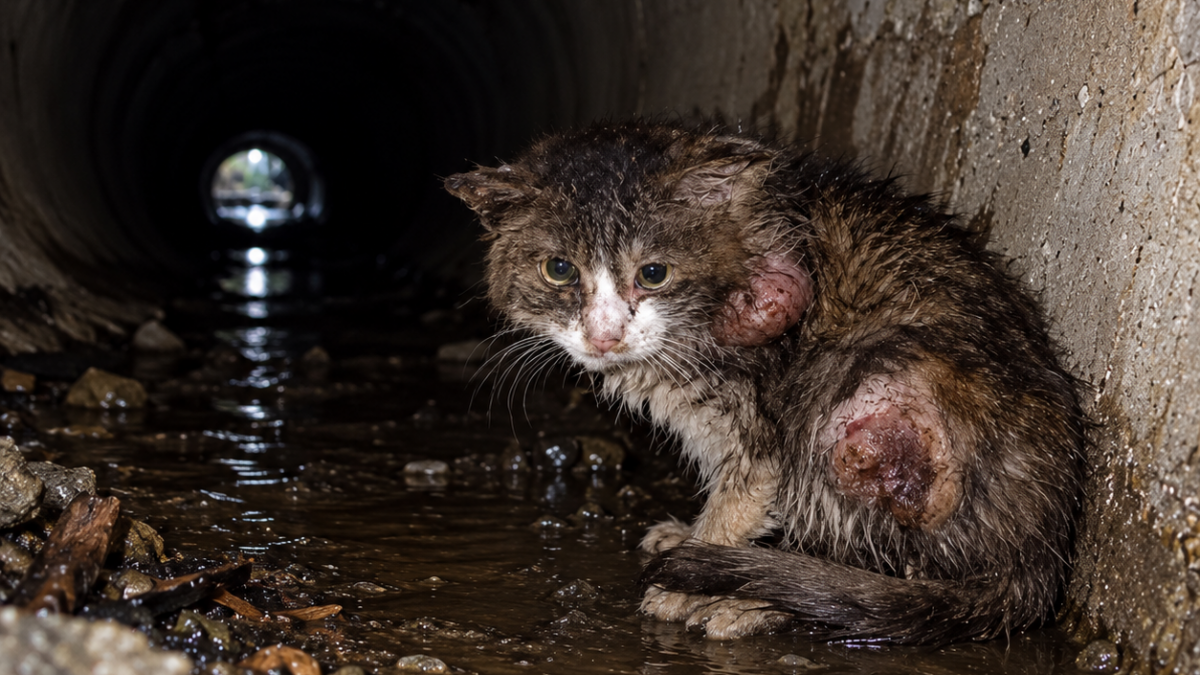
The mass near his neck was nearly the size of a small plum. Matted hair concealed damaged skin around it, and one area had begun to ulcerate.
The growth on his flank was larger.
Almost the size of my fist.
His coat was riddled with fleas.
Several claws had grown too long.
His gums were pale.
His teeth were badly worn, with two broken near the back.
There was an old scar running down his right front leg.
Dr. Harris moved her hands slowly over him.
“Severely dehydrated.”
She checked his abdomen.
“Very little muscle mass.”
Then his heart.
“Fast, but I don’t hear anything obvious.”
“Cancer?” I asked.
She looked at the tumors.
“Possible.”
I hated that word.
“Could they both be benign?”
“Possible.”
“Could they be removed?”
“Possible.”
I gave her a look.
“You’re going to keep saying that, aren’t you?”
“Until I have facts.”
That was another reason I trusted her.
They drew blood.
Rachel placed an IV catheter.
Milo barely reacted.
When she put him on the scale, the number made Dr. Harris frown.
“Eight pounds, two ounces.”
“What should he weigh?”
“Judging by his frame? Twelve, maybe thirteen.”
Nearly a third of him was gone.
While Rachel prepared fluids, another technician brought out a microchip scanner.
I had almost forgotten.
She passed it between Milo’s shoulders.
Beep.
All of us looked up.
She scanned again.
Beep.
“Well,” Dr. Harris said. “That changes things.”
The chip number pulled up a registration within minutes.
Milo Bennett.
Male.
Neutered.
Eleven years old.
Owner: Harold Bennett.
There was an address less than four miles from the drainage tunnel.
And the phone number matched the one on Milo’s tag.
I dialed.
A recorded voice answered.
The number had been disconnected.
I tried again anyway.
Same message.
Rachel searched the registration record.
“No secondary contact.”
“No email?”
“No.”
I copied the address.
“I’ll look into it.”
Dr. Harris shook her head.
“Not until we stabilize him.”
“I can use my phone while you work.”
“Elena.”
“I’m not going anywhere.”
She gave me the look she reserved for volunteers who forgot they were human.
“When did you last eat?”
“That is unrelated.”
“It’s three-thirty.”
“Actually almost four.”
“That does not improve your argument.”
Rachel handed me a granola bar.
I took it.
“You two are impossible.”
Milo was moved into a heated kennel.
The IV fluid line ran through the door.
He curled in the farthest corner.
They gave him pain medication.
Antibiotics followed because the damaged tissue around the neck mass was infected.
The first blood results came back an hour later.
Dr. Harris called me into her office.
“His kidney values are elevated.”
My stomach dropped.
“But,” she continued, “dehydration can do that. We’ll repeat them after fluids.”
“What else?”
“Anemia. Not catastrophic, but significant. His white count is elevated. He has inflammation or infection somewhere, which isn’t surprising.”
“Liver?”
“Not terrible.”
“Diabetes?”
“No.”
“FIV? FeLV?”
“Negative.”
One piece of good news.
I held onto it.
“Can you operate?”
“Not tonight.”
“Because of the anemia?”
“Anemia, dehydration, overall condition. If I put him under now, the anesthesia may be more dangerous than the tumors.”
“So what do we do?”
“We make tomorrow possible.”
Fluids.
Nutrition.
Pain control.
Antibiotics.
Warmth.
Rest.
That became Milo’s first treatment plan.
The glamorous truth about rescue is that it often comes down to very ordinary things.
Water.
Food.
Sleep.
Time.
I sat beside his kennel that evening.
At six, Rachel brought warmed recovery food.
Milo smelled it but turned his face away.
At seven, I tried again.
Nothing.
At eight, Dr. Harris said we might need assisted feeding if he continued refusing.
I hated that idea.
Not because it was wrong.
Because I could see how much being handled frightened him.
I placed the bowl inside his kennel and sat down on the floor several feet away.
“Milo.”
One ear moved.
“You don’t know me, and you don’t owe me anything.”
He opened his eyes.
“But if you could do one thing for me, eat.”
No response.
I waited.
After ten minutes, he shifted.
After fifteen, he lifted his head.
After twenty, he smelled the food.
I didn’t move.
He took one lick.
Then another.
I felt ridiculous for how emotional that made me.
“Good boy.”
He stopped.
I shut up immediately.
Five minutes later, he began eating again.
Only a spoonful.
But it was a beginning.
At nearly ten that night, I finally checked the address registered to his microchip.
Public property records showed the house had been sold sixteen months earlier.
The owner listed before the sale was Harold Bennett.
I searched his name.
The third result was an obituary.
I read it twice.
Harold Bennett.
Seventy-eight.
Retired school custodian.
Widower.
Longtime resident.
Died eleven months earlier.
Survived by a daughter named Claire.
There was a photograph.
Harold stood beside a porch railing wearing a dark cardigan and smiling directly at the camera.
Something gray-and-white appeared near the bottom edge.
I enlarged the picture.
A cat.
Only half visible.
But enough.
I looked through the glass toward Milo’s kennel.
“Found you,” I whispered.
Not him.
The beginning of him.
I located Claire the following morning through a public business listing.
Before I called, I checked on Milo.
He was still curled beneath his blanket.
His kidney values had improved overnight.
He had eaten twice.
And when Rachel changed his water, he had hissed at her.
She seemed delighted.
“More attitude today.”
“Good.”
“I have never had someone celebrate being hissed at this much.”
“Attitude requires energy.”
I stepped outside and called Claire.
A woman answered after four rings.
“Hello?”
“Is this Claire Bennett?”
“Yes.”
“My name is Elena. I volunteer with an animal-rescue organization. I’m sorry to call unexpectedly.”
There was a pause.
“Okay.”
“I’m trying to reach the family of Harold Bennett.”
Her voice changed.
“My father passed away.”
“I know. I’m sorry.”
Another pause.
“Why are you calling?”
“Did your father have a gray-and-white cat named Milo?”
Nothing.
For several seconds, I thought the call had disconnected.
“Claire?”
Her breathing became audible.
“What did you say?”
“We found a cat yesterday. His microchip is registered to Harold Bennett. His collar says Milo.”
I heard something hit a table.
“You found Milo?”
“Yes.”
“Oh my God.”
The words came out like air leaving her lungs.
“Oh my God. Where?”
“In an old storm drain.”
“No.”
“Claire—”
“How long?”
“We don’t know.”
“No, I mean—”
She started crying.
“How long has he been there?”
“I don’t think seventeen months.”
She went completely still on the phone.
“How do you know seventeen months?”
I had guessed from the house sale.
Her answer confirmed it.
“That’s when he disappeared?”
“Yes.”
She took several uneven breaths.
“My father was sick. His heart. He collapsed at home one morning. I called an ambulance, and there were paramedics and neighbors and people everywhere. Milo was terrified of strangers.”
I leaned against the clinic wall.
“He ran out?”
“The door was open.”
She began speaking faster.
“I saw him go. I tried to catch him, but Dad was on the floor and the paramedics were asking questions and I thought Milo would come back that night. He always stayed close to the yard.”
“He didn’t.”
“No.”
Claire’s voice cracked.
“I searched every day.”
I said nothing.
“We printed flyers. We checked shelters. I posted online. I walked the neighborhood at night shaking his food container. My father called me from the hospital asking if I’d found him.”
I closed my eyes.
“What happened to your father?”
“He never made it home.”
“I’m sorry.”
“He spent almost three months in the hospital, then rehabilitation, then hospice. He kept asking.”
Her crying became quieter.
“Even near the end, when he was confused, he asked if Milo had eaten.”
I looked through the clinic window.
Milo was sleeping under a blanket with an IV taped to his leg.
“Claire, I need to tell you about his condition.”
Silence.
“He’s alive. He’s stable this morning.”
“Stable?”
“He’s very thin and dehydrated. He has two large masses. One near his neck and another along his side.”
“Masses?”
“Tumors or growths. We don’t know what they are yet.”
“Cancer?”
“Possibly.”
She inhaled sharply.
“He’s in pain?”
“He was. We’re controlling it now.”
“Can I come?”
“Yes.”
“I’m leaving now.”
“Claire, drive safely.”
She hung up.
Forty-seven minutes later, a woman rushed through the clinic door.
I recognized her immediately.
She had Harold’s eyes.
She held an old photograph in one hand.
“Where is he?”
I introduced myself.
She barely heard me.
“Please.”
I took her toward the treatment area.
Before opening the door, I stopped.
“You need to prepare yourself.”
Her jaw tightened.
“I am.”
“He doesn’t look like the cat in that photograph.”
She looked down at it.
“I don’t care.”
“He’s scared of people.”
“I don’t care.”
“He may not recognize you.”
That stopped her.
For the first time, fear replaced urgency.
She nodded.
“I understand.”
We entered.
Milo lay in the back of his kennel.
Claire covered her mouth.
The photograph slipped slightly in her fingers.
“Oh.”
That single sound said more than anything else could have.
She took one step.
“Oh, Milo.”
His ear moved.
She crouched.
“Milo, baby?”
He lifted his head.
His eyes sharpened.
Claire moved closer but did not touch the kennel.
“It’s Claire.”
Milo stared.
“Remember me, you stubborn old man?”
His nose twitched.
Then something came out of him that I had never heard before.
A tiny chirping sound.
Questioning.
Soft.
Claire broke.
She dropped to her knees.
“That’s him.”
I looked at Rachel.
She was already wiping her eyes.
Claire reached toward the kennel.
“May I?”
“Slowly.”
She opened the door a few inches.
Her fingers slid inside.
Milo smelled them.
For several seconds, nothing happened.
Then he moved forward.
Barely.
Half an inch.
He pressed his forehead against her fingertips.
Claire started sobbing.
Not loudly.
It was the kind of crying that seemed to fold her whole body inward.
“I’m sorry,” she whispered. “I’m so sorry.”
Milo held his forehead against her hand.
I turned away.
There are parts of rescue you never become professional enough to ignore.
Claire stayed most of the day.
She showed me photographs.
Milo as a kitten climbing Harold’s curtains.
Milo lying across the newspaper while Harold tried to read.
Milo sleeping on Harold’s chest.
Milo sitting beside a birthday cake as though it belonged to him.
Milo in the same blue collar, new and bright.
“He found him behind the school where Dad worked,” Claire explained.
“How old?”
“Maybe eight weeks.”
“Your father rescued him?”
“He said Milo rescued him.”
She smiled weakly.
“My mom had died the year before. Dad was doing badly. Then this kitten started following him around the school parking lot.”
I looked toward Milo.
“Sounds familiar.”
“Dad pretended for three days he wasn’t taking him home.”
“What changed?”
“Milo climbed into his truck.”
I laughed.
“That’ll do it.”
“Dad said he had no choice.”
For eleven years they had been together.
Then one chaotic morning had separated them.
I thought about Harold asking from a hospital bed whether anyone had found his cat.
I thought about Milo hiding somewhere outside, probably only streets away.
Neither knew how close or far the other was.
The thought sat heavily with me.
That afternoon, Dr. Harris performed X-rays and an ultrasound.
We all waited.
Claire sat beside Milo’s kennel.
When Dr. Harris returned, her expression was serious but not defeated.
“I don’t see obvious metastatic disease in his lungs.”
Claire gripped my hand.
“That’s good?”
“It’s good.”
“And the tumors?”
“The flank mass looks fairly localized. The neck mass worries me more because of its position and the condition of the surrounding tissue.”
“Can you remove them?”
“I think so.”
“When?”
“Not today.”
Claire immediately stood.
“Why?”
“Because his body isn’t ready.”
“But if it’s cancer—”
“Operating too soon could kill him.”
The room went quiet.
Dr. Harris continued.
“He’s still significantly anemic. He’s dehydrated. His protein levels are low. We need him stronger before anesthesia.”
“How long?”
“Days, not weeks, if he responds.”
Claire looked at Milo.
“What if the tumor gets worse while we wait?”
“That’s the balance we’re managing.”
“Can you biopsy it first?”
“We can take needle samples.”
They did.
The samples did not give us a definitive answer.
One suggested abnormal spindle cells from the flank tumor.
That raised concern for a soft-tissue sarcoma.
The neck mass sample contained inflammatory cells and abnormal tissue but not enough to classify it.
Claire stared at the preliminary report.
“So one is probably cancer.”
“Possibly,” Dr. Harris corrected.
“But you think so.”
“I’m concerned.”
Claire placed the report on the desk.
“I want surgery.”
“So do I.”
“Then do it.”
“When it’s safe enough.”
Claire looked angry.
Not at the veterinarian.
At time.
At biology.
At everything she could not force into moving faster.
“I already lost my father waiting for doctors to tell us what his body could handle.”
Dr. Harris’s expression softened.
“I’m sorry.”
“I can’t sit here and lose Milo too.”
“You’re not sitting here doing nothing.”
“It feels like it.”
“I know.”
Dr. Harris leaned forward.
“But rushing him into surgery today because waiting hurts us emotionally would be treating our fear instead of treating him.”
Claire went silent.
The sentence landed.
After a moment, she nodded.
“All right.”
That evening, she stayed until closing.
Milo ate while she sat beside him.
The next morning, he ate breakfast without waiting for everyone to leave.
His kidney values dropped closer to normal.
His temperature stabilized.
By the third day, he could stand long enough to use the litter box without collapsing.
The first time he did it, Rachel called me as if he had won an Olympic medal.
“He stood the entire time.”
“Seriously?”
“Entire time.”
“What about afterward?”
“Walked three steps and yelled at me.”
“Perfect.”
On the fourth day, Milo surprised us.
Claire had brought one of Harold’s old sweaters.
She asked if we could place it beside him.
We made sure it was clean and safe, then folded it into his kennel.
Milo smelled the fabric.
His whole body seemed to soften.
He stepped onto it.
Circled twice.
Then lay down.
Claire watched through the glass.
“My dad wore that every winter.”
Milo buried his nose into the sleeve.
For the first time since his rescue, he slept deeply while people moved around the room.
We all pretended we were not affected.
We were terrible actors.
That afternoon, the situation changed.
Rachel was cleaning around Milo’s kennel when she shouted for Dr. Harris.
I was in the lobby and ran back.
Blood stained Harold’s sweater.
The neck mass had opened.
Not completely.
But enough.
The ulcerated surface had started bleeding.
Milo crouched in the corner, frightened and painful.
Dr. Harris applied pressure.
“He’s okay,” she said.
Claire appeared behind me.
“What happened?”
“The tissue broke open.”
“Is he bleeding badly?”
“No.”
“But now?”
Dr. Harris looked at the clock.
“I’m calling Dr. Patel.”
Dr. Amir Patel was a veterinary surgeon who worked with the clinic on complicated cases.
He arrived that evening and spent nearly an hour reviewing Milo’s imaging.
Then he examined him.
Claire, Dr. Harris, and I sat with him afterward.
Dr. Patel rested the scans on the table.
“I think the risk calculation has changed.”
Claire leaned forward.
“How?”
“The neck mass is breaking down. Leaving it in place increases the chance of repeated bleeding and infection.”
“So operate.”
“Yes.”
“When?”
“Tomorrow morning.”
Claire went very still.
“What are his chances?”
No doctor who deserved trust would have given her a number just to make her feel better.
Dr. Patel didn’t.
“He is a higher-risk anesthetic patient than a healthy cat. But he’s stronger than he was four days ago.”
“Could he die?”
“Yes.”
The answer hung between us.
“And if we don’t operate?”
“He could deteriorate from the tumor, infection, bleeding, or whatever disease is causing it.”
Claire stared at the images.
“What would you do if he were yours?”
Dr. Patel took several seconds.
“I would operate.”
She nodded.
“Then do it.”
That night, I stayed late again.
Claire sat on one side of Milo’s kennel.
I sat on the other.
“Do you think animals know when something is about to happen?” she asked.
“I don’t know.”
“My father knew.”
I looked at her.
“He knew he wasn’t coming home. Nobody had told him that yet.”
“How?”
“He asked me to bring him Milo’s photograph.”
She smiled sadly.
“I lied to him.”
“What did you say?”
“I told him Milo was probably being fed by somebody.”
“That wasn’t impossible.”
“I told him I’d seen him.”
I understood.
“He believed you?”
“I think he knew I was lying.”
Milo shifted on the sweater.
Claire touched the kennel door.
“Dad said, ‘If he comes back, don’t let him be alone.’”
Her voice broke.
“I thought I had failed both of them.”
“You found him again.”
“You found him.”
“Daniel heard him.”
She looked at me.
“Maybe that’s the part I’m struggling with.”
“What?”
“So many people had to do one small thing right.”
She counted them quietly.
“Daniel had to hear him. He had to call someone. You had to come. You had to check his collar. Somebody had to scan the chip. The chip company had to still have Dad’s name.”
She looked at Milo.
“If one person had decided it wasn’t worth the trouble…”
I finished the thought.
“He might not be here.”
Claire nodded.
The next morning, she arrived before sunrise.
She carried Harold’s photograph.
Milo was scheduled first.
Rachel prepared him while Dr. Patel reviewed the plan.
They would remove the flank mass first, then address the neck tumor.
The neck procedure was more complicated because of blood vessels and structures nearby.
Before they took him, Claire put her fingers through the carrier door.
Milo smelled them.
Then he began to purr.
It was faint.
Almost lost under the sound of the clinic.
Claire laughed through tears.
“Seriously? Now?”
Milo pushed his cheek against the metal door.
“You pick today to become friendly?”
I knelt beside her.
“He’s trying.”
“I know.”
Dr. Patel appeared.
“We’re ready.”
Claire closed her eyes.
“Bring him back.”
“We’ll do everything we can.”
Then Milo disappeared through the surgical doors.
Waiting is one of the cruelest parts of loving an animal.
There is nothing useful to do.
You cannot bargain with anesthesia.
You cannot negotiate with pathology.
You cannot sit beside the operating table.
You just wait.
Claire paced.
Then sat.
Then stood again.
She read the same text message on her phone at least twenty times.
At one point, she whispered, “Dad would be unbearable right now.”
“What would he do?”
“Ask the receptionist every six minutes whether there was news.”
“That sounds familiar.”
She almost smiled.
The first hour passed.
Then the second.
At two hours and twenty minutes, Dr. Harris came through the door.
Claire stood so quickly she nearly knocked over her chair.
“Not finished,” Dr. Harris said immediately.
Claire went pale.
“But he’s stable. Dr. Patel removed the flank mass. He’s working on the neck now.”
“Was it bad?”
“The flank mass came out cleanly.”
“Clean margins?”
“We won’t know microscopically until pathology.”
“But he removed it.”
“Yes.”
Another forty minutes passed.
Then an hour.
The clinic seemed unnaturally quiet.
Finally, the surgical doors opened.
Dr. Patel walked out.
His cap was still on.
There was a crease across his forehead from the mask.
Claire could not speak.
I stood beside her.
“He’s alive,” Dr. Patel said.
Claire’s knees gave slightly.
I caught her elbow.
“Both masses are out.”
She covered her mouth.
“The neck mass had more inflammation around it than the images showed, but I was able to separate it from the deeper structures.”
“You got it all?”
“I removed everything visibly abnormal that I could safely remove.”
“Was it cancer?”
“We still need pathology.”
“Is he awake?”
“He’s waking up.”
“Can I see him?”
“In a few minutes.”
Milo looked terrible after surgery.
His left side had been shaved.
A long incision curved along his flank.
Another line of sutures ran near his neck.
His eyes were half-open.
His tongue stuck slightly from his mouth.
He looked nothing like the confident cat in Claire’s photographs.
But he was breathing.
Claire sat beside him.
“I’m here.”
His ear twitched.
“That’s enough. Don’t do anything else today.”
I stood behind her.
She looked at the photograph of Harold she had placed beside the carrier.
Then at Milo.
“I found him too late.”
“No.”
“I should have searched longer.”
“You searched.”
“I stopped.”
“Because you thought he was dead.”
“I stopped.”
I pulled a chair beside her.
“Claire, listen to me.”
She wiped at her face.
“You can punish yourself for the next ten years if you want. It won’t give Milo those seventeen months back.”
She stared at the floor.
“But you can give him whatever comes next.”
“What if there isn’t much?”
“Then give him that.”
She looked at me.
I continued.
“He doesn’t know what you should have done. He knows what’s happening now.”
Milo shifted beneath the blanket.
Claire placed her hand beside him.
His paw touched one finger.
That was enough.
His first night after surgery was rough.
His temperature dropped.
They increased warming support.
His blood pressure was lower than Dr. Harris wanted.
For three hours, nobody relaxed.
At almost midnight, he stabilized.
The next morning, his temperature was normal.
He refused breakfast.
At lunch, he ate two bites.
By dinner, four.
The following day, he stood.
On the third day, he slapped Rachel when she tried to inspect his incision.
She came into the hallway smiling.
“He attacked me.”
“Excellent.”
“You people really are strange.”
“That’s recovery.”
By the fourth day after surgery, Milo had enough strength to complain about nearly everything.
Medication?
Growl.
Temperature check?
Hiss.
Fresh bedding?
Suspicious stare.
Food five minutes late?
A raspy, offended meow.
Claire watched the transformation with amazement.
“That’s the cat I remember.”
“He was grumpy?”
“He had standards.”
One morning, a familiar voice came from the lobby.
“Elena?”
Daniel stood near reception holding a shopping bag.
I had been texting him updates since the rescue.
He had never met Claire.
I introduced them.
“You’re the one who heard him?” she asked.
Daniel shifted awkwardly.
“One of the guys.”
“But you called.”
“Yes.”
Claire hugged him before he could react.
Daniel froze.
Then carefully hugged her back.
“Thank you,” she whispered.
“I just made a phone call.”
“No.”
She stepped away.
“You did more than that.”
Daniel looked uncomfortable with being thanked.
He lifted the shopping bag.
“My wife sent a blanket.”
Inside was a thick fleece blanket decorated with small gray cats.
Claire laughed.
“Very subtle.”
“My wife is not known for restraint.”
We brought him to Milo.
Daniel crouched by the kennel.
Milo watched.
“Hey, sewer cat.”
Claire frowned.
“Sewer cat?”
“It’s affectionate.”
“It needs work.”
Daniel placed the blanket inside.
Milo smelled it.
Then stepped onto it.
Daniel looked absurdly pleased.
“He likes it.”
“He likes soft things,” I said.
“Still counts.”
He came back three days later.
Then the following week.
By then, Milo’s sutures were healing.
He was gaining weight.
And we had received the pathology results.
Dr. Harris asked Claire and me to sit down.
Two reports lay on her desk.
She touched the first.
“Neck mass.”
Claire braced herself.
“Benign follicular tumor with extensive inflammation and ulceration.”
Claire blinked.
“Benign?”
“Yes.”
She exhaled so hard it sounded painful.
“So that one wasn’t cancer.”
“Correct.”
“And the other?”
Dr. Harris’s expression changed.
“The flank mass was a low-grade soft-tissue sarcoma.”
Cancer.
Claire’s relief disappeared.
“Did it spread?”
“We found no evidence of metastasis on his imaging.”
“Margins?”
Dr. Harris looked down.
“Clean.”
Claire stared at her.
“What does that mean?”
“It means the pathologist did not find tumor cells at the cut edges of the tissue.”
“So you got it all?”
“It means we have a good reason to believe the mass was completely excised.”
Claire began crying.
“Is he going to die from it?”
“Everybody dies from something eventually.”
Claire gave her an exhausted look.
“Please.”
Dr. Harris softened.
“His prognosis from this particular tumor is encouraging. We monitor him. We check for recurrence. We repeat imaging when appropriate. But today I am not telling you Milo has terminal cancer.”
Claire covered her face.
For several seconds, nobody spoke.
Then she laughed.
Not because anything was funny.
Because her body finally had another way to release what it had been holding.
When Milo was medically ready to leave the clinic, a new problem appeared.
Everyone assumed he would go home with Claire.
I did too.
Then Claire asked me to meet her for coffee.
She looked exhausted.
“There’s something I haven’t told you.”
I waited.
“My husband and I have a dog.”
“That’s not automatically a problem.”
“He has a strong prey drive.”
“How strong?”
She stared into her coffee.
“The shelter we adopted him from told us he had attacked cats before.”
I immediately understood.
“Have you ever had him around one?”
“No.”
“Could the house be divided safely?”
“Yes.”
“For a while?”
“Yes.”
“For Milo’s entire life?”
Claire looked at me.
“That’s the problem.”
I nodded.
“He’s spent seventeen months hiding,” she said. “I can put him in a bedroom, but then what? He hears a dog outside the door all day?”
“Maybe the dog could be trained and managed.”
“Maybe.”
Her fingers tightened around the cup.
“But if I’m wrong once…”
“You don’t get to be wrong once.”
She nodded.
Tears appeared again.
“I feel like I’m abandoning him.”
“No.”
“It feels exactly like that.”
“Then separate what feels right from what is safe.”
She looked up.
“He was my father’s cat.”
“I know.”
“My father asked me not to let him be alone.”
“That doesn’t mean Milo has to live in your house.”
She flinched.
I hated hurting her, but the animal had to come first.
“You can love him and still decide your home isn’t the safest place for him.”
“What kind of person finds her dead father’s missing cat after seventeen months and gives him away?”
“A person who is thinking about the cat instead of the story.”
That silenced her.
I continued more gently.
“You’re not giving him away today. We’re going to foster him while he recovers. You can visit. We’ll evaluate options.”
“What if he thinks I left again?”
I looked through the window.
Milo was asleep on the blanket Daniel’s wife had bought him.
“I don’t know exactly what cats understand. But I know he understands safety.”
Claire nodded slowly.
“All right.”
We moved Milo into one of our foster rooms.
I took responsibility for him first.
The room had a window, a chair, a low bookshelf, beds, scratching posts, and several covered hiding spaces.
Milo ignored all the carefully prepared options.
He went behind the bookshelf.
Of course he did.
The first night, he did not come out while I was present.
I left food.
When I returned later, half was gone.
The second day, he watched me from beneath the chair.
The third, he hissed when I changed his water.
I did not reach for him.
That was important.
People often think traumatized animals need to be shown affection.
Sometimes what they need first is control.
No hands chasing them.
No arms pulling them out.
No strangers deciding when they must be touched.
Every evening, I entered the room and sat on the floor.
Sometimes I read.
Sometimes I answered messages.
Sometimes I simply talked.
“Milo, I have to tell you, your medical bills are impressive.”
His eyes watched me.
“You owe several people a lot of money.”
Nothing.
“Fortunately, you don’t have a job.”
One ear moved.
“There are rumors you’ve been unemployed for eleven years.”
He blinked.
“I’m not judging.”
After a week, he started remaining in the open while I sat nearby.
On the eighth evening, I placed my hand palm-down on the floor.
Milo stared at it.
I kept reading.
Ten minutes passed.
Then he stood.
He had gained enough strength that his movements were smoother now.
One step.
Two.
He stopped about a foot from my fingers.
I did not look directly at him.
He smelled the air.
Then my hand.
His whiskers almost touched my skin.
He backed away.
That was it.
I smiled after he disappeared behind the chair.
“Good job.”
The next night, he came closer.
Two days later, his whiskers touched my knuckles.
Then he walked away.
On the twelfth evening, he did something different.
He approached.
Smelled my hand.
Then pressed his forehead against one finger.
I froze.
Milo froze too.
For a second, both of us seemed surprised.
Then he did it again.
I gently scratched beneath his chin.
His eyes closed.
A vibration started in his chest.
Quiet.
Rough.
A purr.
My eyes filled immediately.
“Hey.”
I swallowed.
“There you are.”
He leaned harder into my hand.
The cat who had pressed himself against a concrete wall to avoid being touched was asking for more.
Daniel arrived the next afternoon.
He had developed the habit of visiting every few days.
“How’s sewer cat?”
“Stop calling him that in front of Claire.”
“She knows I mean it respectfully.”
“I’m not sure there’s a respectful version.”
Daniel sat on the floor.
Milo stayed beneath the chair.
I gave Daniel a small container of treats.
“Don’t move toward him.”
“I know.”
“Don’t stare.”
“I know.”
“Don’t reach.”
“Elena.”
“Yes?”
“I heard the lecture last time.”
“Good.”
Daniel tossed a treat.
Milo waited until it landed.
Then ate it.
Another landed closer.
Milo ate that too.
By the sixth treat, he stood three feet from Daniel.
Daniel whispered, “He likes me.”
“He likes chicken.”
“Let me have this.”
Milo approached.
Smelled Daniel’s hand.
Then walked away.
Daniel grinned.
“See?”
“That was not affection.”
“That was clearly affection.”
His wife Sarah visited the following weekend.
Their fifteen-year-old daughter Emma came too.
They were quieter than Daniel.
Sarah sat by the window reading.
Emma did homework on the floor.
Nobody pushed Milo.
At one point, Emma asked, “Should I pet him if he comes over?”
“Let him choose.”
“What does that mean?”
“Hold your hand low. If he walks away, let him.”
“What if I really want to pet him?”
“Then you especially need to let him choose.”
She nodded.
Milo stayed under the chair that day.
The next visit, he came out.
The third, he walked past Emma close enough that his tail touched her knee.
She looked at me with enormous eyes.
I mouthed, “Don’t move.”
She didn’t.
Milo circled back.
Smelled her notebook.
Then sat beside her.
Emma’s face turned red from trying not to react.
Afterward, outside, she whispered to me, “That was the hardest thing I’ve ever done.”
“What?”
“Not petting him.”
I laughed.
“Congratulations. You passed.”
Daniel’s attachment became obvious.
He began sending pictures of cat trees.
Not buying them.
Just sending pictures.
“What about this one?”
“Milo does not live with you.”
“I’m aware.”
“This is the fourth cat tree you’ve sent.”
“I’m researching.”
“Why?”
“No reason.”
His wife texted me separately.
He has already cleared a corner of the living room.
I replied:
HE HAS NOT ADOPTED MILO.
She answered:
PLEASE EXPLAIN THAT TO HIM.
Three weeks later, I entered the foster room and found Daniel sitting against the wall.
He held one finger to his lips.
Milo was asleep with his body touching Daniel’s thigh.
Daniel whispered, “I’ve been here forty minutes.”
“You can move.”
“No.”
“You’ll lose circulation.”
“Worth it.”
Milo’s front paw rested on Daniel’s jeans.
“He came over on his own,” Daniel said.
“I know.”
“Then he lay down.”
“I can see that.”
Daniel looked at me.
“I want him.”
I had expected it.
“You need to talk to your family.”
“We have.”
“All of you?”
“Yes.”
“Claire?”
His expression changed.
“I haven’t.”
“That matters.”
“I know.”
Claire visited that weekend.
Milo’s transformation shocked her.
His coat was cleaner.
His ribs were less visible.
The shaved patches had begun filling with short fur.
He walked with confidence.
When she entered, he stared for several seconds.
“Milo?”
He went to her.
Not running.
Not dramatically.
He simply crossed the room.
Claire knelt.
He rubbed his face against her hand.
She closed her eyes.
“I thought maybe he’d forget me.”
“He didn’t.”
She stroked his head.
After several minutes, I told her.
“Daniel wants to adopt him.”
Claire stopped.
I watched a dozen emotions cross her face.
“Oh.”
“No decisions have been made.”
She looked toward the door.
“Does Milo like him?”
“Yes.”
“His family?”
“Yes.”
“Other animals?”
“None.”
“Indoor?”
“Completely.”
“Kids?”
“Just Emma. She’s fifteen and excellent with him.”
Claire looked at Milo.
“Can I meet them?”
Daniel and Sarah arrived later.
I left them together but stayed close enough to intervene if necessary.
Claire sat across from Daniel.
“You found him.”
“One of us found him.”
“You keep saying that.”
“Because three people were in the tunnel.”
“But you heard him.”
Daniel looked down.
“I almost didn’t.”
Claire waited.
He told her what he had told me.
How they assumed the sound was water.
How he had been walking away.
How Milo cried once more.
“How far away were you?”
“Maybe thirty feet.”
“If he hadn’t made that sound?”
Daniel shook his head.
Claire’s eyes filled.
“But he did.”
“Yeah.”
Daniel cleared his throat.
“Look, I want you to know something. If you want Milo back, I’m not going to get between you and your father’s cat.”
Claire stared at him.
“I can’t take him.”
He nodded.
“Elena told me about the dog.”
“I keep thinking I should find a way.”
“If you do—”
“No.”
She shook her head.
“That’s me trying to make myself feel better.”
She looked at Milo, who was sitting beside Sarah.
“He deserves not to spend the rest of his life behind a closed door because I’m guilty.”
Daniel said nothing.
Claire reached into her purse.
She removed a photograph.
Harold sat in his favorite chair.
Milo was sprawled across his chest.
“I want whoever takes him to have this.”
Daniel hesitated.
“You should keep it.”
“I have copies.”
She held it out.
“My father loved this cat more than he admitted.”
Daniel smiled faintly.
“Sounds like me already.”
Claire handed him the picture.
“Will you keep his name?”
“Of course.”
“Will you send me photos?”
“As many as you want.”
“Will you tell me if the cancer comes back?”
“Yes.”
“And if he gets sick?”
“Yes.”
She nodded.
Then she asked one final question.
“Will you let me visit?”
Daniel answered immediately.
“Any time.”
Claire began crying again.
Daniel did too, though he later denied it.
Milo went home with the Wilson family two weeks later.
I insisted we treat it like any other adoption.
Application.
Veterinary references.
Home inspection.
Adoption agreement.
Medical plan.
Cancer follow-up schedule.
Daniel complained.
“You’ve been in my house.”
“Doesn’t matter.”
“You know my wife.”
“Doesn’t matter.”
“I literally helped find him.”
“Still doesn’t matter.”
He shook his head.
“You enjoy paperwork.”
“I enjoy not regretting adoptions.”
Their house was quiet and perfect for Milo.
No other animals.
Secure windows.
A screened porch.
Multiple rooms.
Emma had placed a cat bed beside her desk.
Sarah had bought a scratching post.
Daniel had bought the enormous cat tree he had sent me three weeks earlier.
I pointed at it.
“No reason?”
He looked embarrassed.
“It was on sale.”
“Of course.”
We brought Milo inside in his carrier.
The family did exactly what I asked.
They opened the carrier in a quiet guest room and left him alone.
Within five minutes, he disappeared under the bed.
Daniel called me from the hallway.
“He’s hiding.”
“Yes.”
“Is that bad?”
“No.”
“He hasn’t explored.”
“It has been five minutes.”
“I thought maybe because he knows us—”
“Daniel.”
“Yes?”
“Leave the cat alone.”
He sighed.
“Fine.”
At 11:42 that night, he texted.
HE HAS NOT COME OUT.
I replied:
GOOD.
Seconds later:
HOW IS THAT GOOD?
HE FOUND A SAFE PLACE. LEAVE FOOD, WATER, AND LITTER. GO TO BED.
At 1:08 a.m.:
I HEARD SOMETHING.
I did not answer.
At 6:17:
HE ATE.
At 7:03:
HE USED THE LITTER BOX.
At 9:14:
HE IS UNDER THE DESK NOW.
At noon:
HE CAME OUT WHILE I WAS SITTING ON THE FLOOR.
At 4:36:
HE SNIFFED MY SOCK.
I finally replied:
THIS IS THE MOST DETAILED ADOPTION REPORT I HAVE EVER RECEIVED.
Daniel answered:
WAIT UNTIL DINNER.
That evening:
HE STOLE CHICKEN FROM MY PLATE.
I wrote:
NOW HE OWNS THE HOUSE.
Daniel replied:
THAT WAS FAST.
The adjustment took weeks, not hours.
Milo still startled at sudden footsteps.
The doorbell sent him under furniture.
Men wearing heavy boots frightened him more than anyone else.
Running water sometimes made him freeze.
The first thunderstorm was difficult.
Sarah called me.
“He’s behind the washing machine.”
“Can you reach him safely?”
“Yes.”
“Don’t pull him out.”
“I wasn’t going to.”
“Keep the room quiet. Put food nearby. Let him decide.”
The storm lasted nearly two hours.
Milo stayed hidden.
Then Daniel sat on the laundry-room floor.
He did not touch him.
Did not coax him.
He simply sat.
After forty minutes, Milo came out.
He climbed into Daniel’s lap.
That was the first time.
Daniel sent me a picture.
Milo was curled against his stomach, eyes half closed.
Daniel looked terrified to move.
I saved the photo.
One month after adoption, Milo returned to the clinic.
He had gained almost two pounds.
Dr. Harris examined his surgical sites.
“Beautiful healing.”
Milo growled.
“Thank you,” she told him.
He growled again.
“Your bedside manner is getting worse,” I said.
Daniel looked offended on Milo’s behalf.
“He’s setting boundaries.”
Dr. Harris laughed.
“Apparently.”
His bloodwork had improved dramatically.
The anemia was nearly resolved.
His kidney values were normal.
His coat was thickening.
His eyes were brighter.
Then Dr. Harris palpated the area where the sarcoma had been removed.
Nothing abnormal.
“No guarantees,” she reminded us.
“We know,” Daniel said.
“We check again in a few months.”
“We will.”
He had become intensely serious about Milo’s medical schedule.
When we reached the parking lot, he looked at me.
“Was that good?”
“Yes.”
“Good good?”
“Yes.”
“You’re sure?”
“Daniel.”
“What?”
“Breathe.”
He laughed.
“Sorry.”
I understood.
Once you rescue something from the edge, every ordinary problem can feel like the beginning of losing it again.
Two months later, Claire visited Daniel’s house for the first time.
She brought a cardboard box.
I happened to be there.
“What’s that?” Sarah asked.
“Milo’s things.”
Inside was a ceramic bowl decorated with tiny blue fish.
A worn grooming brush.
A faded stuffed mouse.
And a knitted brown blanket.
“I found them when we cleared Dad’s house,” Claire said. “I couldn’t throw them away.”
Sarah lifted the blanket.
Milo was sleeping near the window.
The moment the blanket unfolded, his head came up.
He stared.
Claire noticed.
“Does he recognize it?”
Nobody answered.
Sarah placed the blanket on the couch.
Milo approached.
Slowly.
He smelled one corner.
Then another.
His tail lowered.
He climbed onto the couch.
Turned twice.
And lay down directly in the center.
Claire covered her mouth.
“Oh.”
Daniel picked up the photograph Harold had given him—or rather, Claire had given him.
In the picture, Milo was lying across that same blanket.
“Dad kept it over his chair.”
Claire sat beside Milo.
He looked up.
She touched his head.
“He waited for you.”
Milo closed his eyes.
The room went quiet.
Claire’s hand moved slowly along his back.
“Every night when I visited the hospital, Dad asked the same thing.”
Daniel sat across from her.
“Did you find him?”
“Yes.”
“What did you say?”
“Sometimes the truth.”
“And sometimes?”
She looked at Milo.
“I lied.”
Nobody judged her.
“I told Dad neighbors had seen him.”
Her voice shook.
“I told him Milo was getting food somewhere. Near the end, I told him I had seen Milo myself.”
Sarah touched her shoulder.
Claire continued.
“He smiled and said, ‘I knew that fool could take care of himself.’”
She laughed through tears.
“I think he knew I was lying.”
Milo began purring.
Claire bent down until her forehead rested briefly against his.
“I’m sorry you didn’t get back to him.”
Daniel looked toward the floor.
Then Milo did something that broke whatever composure remained in the room.
He lifted one paw and rested it on Claire’s wrist.
She cried into the old blanket.
After that, Milo settled into an ordinary life.
And ordinary became beautiful.
He learned where the sunlight crossed the living-room floor each morning.
At 9:00, he slept beside the window.
At noon, he moved to the couch.
At four, he waited near the kitchen.
At 5:20, he usually appeared beside the front window.
Daniel insisted Milo could recognize his truck.
Sarah insisted Daniel was projecting.
Then one afternoon she recorded proof.
Milo was asleep when a faint engine sounded outside.
His head lifted.
He jumped down.
Seconds later, Daniel’s truck turned into the driveway.
The video became Daniel’s favorite thing.
He showed it to everyone.
“You see?”
Emma rolled her eyes.
“Yes, Dad.”
“He knows the truck.”
“Yes.”
“He waits for me.”
“You’ve told us.”
“He knows exactly when I get home.”
Sarah smiled at me.
“This happens daily.”
Daniel ignored her.
“That cat loves me.”
Milo walked past him toward the food cabinet.
I said, “He knows who operates the can opener.”
“Same thing.”
At six months, Milo returned for cancer screening.
No new masses.
No enlarged lymph nodes.
Imaging showed no signs of spread.
His weight was twelve pounds.
Dr. Harris pulled up his first photograph.
We all stared.
I had almost forgotten how terrible he looked.
His body was narrow.
His fur hung in dirty clumps.
The tumors distorted his shape.
His eyes were enormous.
Not because of curiosity.
Fear.
Then I looked at the cat on the examination table.
He was furious.
Healthy enough to be furious.
Daniel held him while Dr. Harris listened to his heart.
Milo complained loudly.
“Remember when he wouldn’t make a sound?” I asked.
Daniel smiled.
“Now he never shuts up.”
Milo meowed.
“See?”
Dr. Harris laughed.
“That may be the best problem he has.”
Nine months after rescue, the city began replacing part of the drainage system where Milo had been found.
Daniel still worked with the maintenance department.
One afternoon, he sent me a photograph.
The old tunnel entrance had been demolished.
Heavy machinery filled the area.
Concrete sections lay broken beside the road.
I stared at the picture for a long time.
That opening had once contained almost everything Milo’s life had been reduced to.
A dark corner.
Cold concrete.
Rising water.
Pain.
Fear.
Hunger.
The need not to be seen.
Now it was gone.
A week later, I visited Daniel’s house.
Milo slept on the screened porch.
Sunlight warmed his gray-and-white coat.
The fur over his flank had completely grown back, though a faint ridge remained beneath it.
I sat beside him.
He opened one eye.
“Hey, sewer cat.”
His tail flicked.
“I know. Daniel’s bad influence.”
I scratched beneath his chin.
Milo leaned into my hand.
No hesitation.
No flinch.
Daniel came outside with coffee.
“He still remembers you.”
“I bribed him for weeks.”
“So did I.”
Milo stood and stretched.
He paused between us.
Then walked over to Daniel and jumped onto the chair beside him.
Daniel looked smug.
“Looks like he picked.”
“He did.”
“Jealous?”
“Not even slightly.”
And I meant it.
Rescue is strange that way.
You work desperately to become important to an animal so that one day you can become unnecessary.
Daniel stroked Milo’s back.
On a shelf near the porch door sat the old blue collar.
He had framed it.
The little metal tag still showed Milo’s name.
The phone number beneath it had been disconnected for years.
“What made you keep that?” I asked.
Daniel looked at the collar.
“That thing got him home.”
“Technically, the microchip did.”
“The collar told you his name.”
“That’s true.”
He smiled.
“And it reminds me.”
“Of what?”
“That he had a life before us.”
I looked at Milo.
He was watching a bird through the screen.
“There are people who act like rescue animals start existing when they’re rescued,” Daniel continued. “They don’t.”
“No.”
“Milo loved somebody before me.”
“Very much.”
Daniel ran his hand along Milo’s back.
“I’m okay being second.”
“You’re not second.”
He looked at me.
“It’s not a ranking.”
He considered that.
“Yeah.”
A month later, Claire visited on what would have been Harold’s eightieth birthday.
She brought no gift.
No special food.
She simply wanted to sit with Milo.
The four of us gathered on the porch.
Milo walked over immediately.
Claire patted the chair beside her.
“Come on, old man.”
He jumped up.
She stroked his cheek.
“You know, Dad would be furious with you.”
Milo blinked.
“Seventeen months?”
She shook her head.
“He would’ve grounded you.”
Daniel laughed.
“Can you ground a cat?”
“My father would’ve tried.”
Claire smiled.
“He used to tell Milo he was banned from the kitchen table. Every night, Milo sat on the kitchen table.”
“Effective discipline.”
“Very.”
The smile faded.
Claire looked toward the yard.
“I wish Dad had known.”
Nobody had to ask what she meant.
That Milo survived.
That someone found him.
That he had a family again.
Daniel said quietly, “Maybe you telling him Milo was okay gave him what he needed.”
“But it wasn’t true then.”
“You didn’t know that.”
“I lied.”
“To comfort a dying man.”
Claire looked at Milo.
“I used to hate myself for it.”
“And now?”
She ran her thumb beneath Milo’s chin.
“Now I think maybe I accidentally told him the future.”
I felt my throat tighten.
Nobody spoke for several minutes.
Milo fell asleep against her leg.
His front paw stretched toward Daniel.
Claire looked down.
“Dad asked me not to let him be alone.”
“He isn’t,” I said.
“No.”
She smiled.
“He really isn’t.”
A year passed.
Then another.
Milo remained cancer-free.
Age brought new problems.
Mild arthritis.
A thyroid value we started watching.
Dental work.
The ordinary maintenance of an aging body.
But those problems felt almost like privileges.
He had lived long enough to become an old cat.
Daniel sent me photographs constantly.
Milo asleep beside Christmas presents.
Milo sitting on Emma’s college acceptance letter.
Milo occupying Daniel’s pillow.
Milo staring accusingly at an empty food bowl that had, according to Sarah, been empty for less than four minutes.
When Emma left for college, Milo spent three nights sleeping outside her bedroom.
She cried when Sarah sent her the picture.
During winter break, he slept on Emma’s bed again as though she had never left.
Claire continued visiting.
Sometimes monthly.
Sometimes every few months.
She never tried reclaiming Milo.
She became part of his larger family instead.
On the second anniversary of his rescue, Daniel asked me to meet him near the old drainage site.
The new system had been completed.
There was no tunnel entrance anymore.
Water disappeared beneath a grated channel and continued underground through new pipes.
“Why are we here?” I asked.
Daniel held something behind his back.
“You’re going to make fun of me.”
“Probably.”
He handed me a small object.
It was a metal plaque.
Nothing dramatic.
Just a simple plate engraved with:
MILO
FOUND HERE AFTER THE STORM
BECAUSE SOMEONE STOPPED TO LISTEN
I looked at him.
“You’re serious?”
“The city won’t let me attach it to anything.”
I laughed.
“I was about to ask.”
“So I’m putting it in my garage.”
“Why bring it here?”
“I wanted a picture.”
“That is unbelievably sentimental.”
“Sarah said the same thing.”
I took his phone.
He stood beside the place where the old entrance had been and held the plaque.
I took the photograph.
Then he looked toward the road.
“You know what bothers me?”
“What?”
“How many times do we not hear them?”
I knew what he meant.
“How many animals are behind something, under something, somewhere people don’t look?”
“Too many.”
He nodded.
“Sometimes I think about that day. I almost kept walking.”
“But you didn’t.”
“Because he made one more sound.”
I looked at him.
“And because you listened.”
That evening, I visited Milo.
He was waiting in the kitchen.
Daniel placed the plaque on the table.
Milo smelled it.
Then stepped directly on top of it.
“Perfect,” I said.
Daniel sighed.
“I spent money on that.”
Milo sat down.
“You know what? Never mind.”
I took a picture.
It became better than the one at the drainage site.
Milo sitting squarely over his own memorial while very much alive.
By his third year with Daniel’s family, his face had become whiter.
His movements were slower.
But his personality had grown enormous.
He had learned that humans could be trained.
A single meow at Sarah resulted in food.
Two meows at Daniel produced treats.
Sitting on Emma’s laptop during video calls guaranteed attention.
Claire claimed Harold would have been proud.
“Dad always said Milo was manipulative.”
“He was right.”
“Dad also gave him chicken from the table.”
“That explains everything.”
The fourth winter brought our first serious scare.
Daniel called me early one morning.
His voice sounded wrong.
“Milo isn’t eating.”
“How long?”
“Since yesterday.”
“Any vomiting?”
“Once.”
“Litter box?”
“Not much.”
“Clinic. Now.”
Dr. Harris examined him.
Bloodwork showed kidney values had risen.
This time it was not simple dehydration from living outdoors.
Milo was fourteen.
Early chronic kidney disease was suspected.
Daniel went pale.
“Cancer?”
“No evidence of that.”
“But kidneys?”
“Probably early-stage disease.”
“Can we treat it?”
“Manage it.”
“For how long?”
Dr. Harris looked at Milo.
“Possibly years. Possibly less. Every cat is different.”
Daniel sat beside the carrier.
I watched the same fear return that I had seen after Milo’s first surgery.
“He’s going to die.”
Dr. Harris answered quietly.
“Not today.”
Daniel looked up.
She continued.
“Today he needs fluids, medication for nausea, and a renal-friendly diet if he’ll accept it.”
Milo did.
He improved.
The crisis passed.
Daniel learned how to give subcutaneous fluids when needed.
The first attempt was a disaster.
Milo escaped halfway through and ran across the kitchen trailing the fluid line.
Sarah laughed so hard she had to sit down.
Daniel called me.
“You said this was easy.”
“I said it gets easier.”
“That is not the same sentence.”
“Correct.”
Eventually, he became excellent at it.
Milo learned that treatment came with chicken afterward.
They made an agreement.
Humans got to maintain kidney function.
Milo got snacks.
The next two years passed in that rhythm.
Checkups.
Medication.
Sunlight.
Food.
Claire visits.
Family photographs.
Ordinary life.
Then, one spring afternoon nearly six years after I had crawled into that drainage tunnel, Daniel called again.
This time I knew from the silence before he spoke.
“It’s time.”
I closed my eyes.
“Where are you?”
“Home.”
“Is Dr. Harris coming?”
“Yes.”
“Claire?”
“On her way.”
“I’m coming too.”
Milo was seventeen.
Older than we had ever reasonably expected him to become after the condition he was in when we found him.
His kidney disease had progressed.
He had stopped eating.
His body was tired.
There are rescues where victory means surgery.
There are rescues where victory means adoption.
And there are rescues where, eventually, victory means being allowed to leave the world somewhere safe instead of alone.
When I arrived, Milo was lying on Harold’s old brown blanket.
Daniel sat on the floor beside him.
Sarah was crying quietly.
Emma had driven home from college the night before.
Claire arrived ten minutes after me.
She walked into the room and stopped.
Milo lifted his head.
Barely.
“Hey, old man.”
She sat beside him.
He smelled her fingers.
Then rested his chin back on the blanket.
Daniel wiped his eyes.
“I keep thinking maybe we should wait another day.”
Dr. Harris, who had arrived with her bag, listened quietly.
“What would tomorrow give him?” she asked.
Daniel looked at Milo.
“I don’t know.”
“Would he eat?”
“No.”
“Would he be comfortable?”
“Probably not.”
“Would you be keeping tomorrow for him or for you?”
Daniel’s face crumpled.
“For me.”
Dr. Harris touched his shoulder.
“That’s the hardest part.”
Claire picked up Milo’s old blue collar.
Daniel still kept it framed, but he had removed it that morning.
She held the tag.
MILO.
The same name I had wiped clean in the dark all those years earlier.
“He made it back,” she whispered.
Daniel nodded.
“Not to Dad.”
“No.”
She looked around the room.
“But back.”
Milo was sedated first.
Within minutes, his breathing relaxed.
For the first time that day, the tension disappeared from his face.
Everyone touched him.
Not crowding.
Just hands resting gently along his body.
Claire stroked his head.
Sarah held one paw.
Emma cried against her father’s shoulder.
Daniel kept his hand over Milo’s chest.
I sat near his back.
Dr. Harris waited until everyone was ready.
There is no perfect way to say goodbye.
There is only kindness or the absence of it.
Milo had known enough absence.
We chose kindness.
When his heart stopped, Daniel kept his hand there for several minutes.
Nobody moved.
Finally, Claire leaned down and kissed Milo’s forehead.
“My dad would’ve loved you,” Daniel said to her.
Claire laughed through tears.
“He did.”
We stayed until the room became quiet in a different way.
Not empty.
Full.
Full of seventeen years.
Of one school custodian who brought home a stray kitten.
Of one daughter who searched the streets while her father waited in a hospital.
Of seventeen missing months.
Of a storm.
Of a sound inside a tunnel.
Of three workers deciding to check.
Of a collar.
A name.
A surgery.
A blanket.
A new family.
A screened porch.
Thousands of ordinary mornings.
Daniel eventually picked up the blue collar.
“What should I do with this?”
“Whatever feels right,” Claire said.
He thought for a moment.
Then he handed it to her.
“I think your dad bought it.”
Claire stared at the tag.
“Yes.”
“You should have it.”
She closed her hand around it.
“I gave you his photograph.”
“I still have it.”
She looked toward Milo.
“Then I’ll take this.”
Several weeks later, Claire called me.
“I did something.”
“What?”
“I put the collar around Dad’s photograph.”
I smiled.
“That sounds right.”
Daniel kept Milo’s old brown blanket.
Emma kept his stuffed mouse.
Sarah kept the ceramic bowl.
And the ridiculous plaque remained in the garage.
FOUND HERE AFTER THE STORM
BECAUSE SOMEONE STOPPED TO LISTEN
About a month after Milo died, I visited Daniel.
The house felt strange without him.
There was no cat waiting near the kitchen.
No gray face in the window.
No irritated meow from the hallway.
Daniel and I sat on the screened porch.
“That first night,” he said, “I kept waking up because I thought I heard him walking.”
“That happens.”
“I opened a can yesterday and waited for him to appear.”
I said nothing.
After a while, he smiled.
“You remember what you told me when he first came home?”
“I told you a lot of things.”
“When he stole the chicken.”
I laughed.
“That he owned the house?”
“Yeah.”
Daniel looked around.
“He did.”
We sat quietly.
Then he took out his phone.
The screen showed a photograph from Milo’s first month after adoption.
The cat was asleep with one paw resting across Daniel’s wrist.
“You know what I keep thinking about?”
“What?”
“That tunnel.”
I nodded.
“He spent however long hiding there because he thought the safest thing in the world was not being seen.”
Daniel looked through the porch screen toward the yard.
“And then he spent six years demanding everyone look at him.”
I smiled.
“That sounds about right.”
A few days later, I visited the place where the old tunnel had been.
Not because Milo was there.
He wasn’t.
The tunnel itself no longer existed.
Cars passed overhead.
Water moved quietly beneath the road through the rebuilt drainage system.
Nobody walking by would have known what happened there.
I stood for only a minute.
Then I remembered the first time my flashlight found him.
His body pressed against concrete.
The tumors.
The fear.
The way he tried to disappear.
I remembered saying his name.
Milo.
And the tiny movement of his ears.
That movement had seemed insignificant at the time.
It wasn’t.
It was the first thread connecting the frightened animal in front of me to a life we knew nothing about.
A father.
A daughter.
A home.
Eleven years of being loved.
Seventeen months of being lost.
And six more years nobody in that tunnel could have imagined.
People sometimes asked me whether rescuing animals was emotionally exhausting.
It was.
They asked how I kept doing it when so many stories ended painfully.
I never had a perfect answer.
But Milo came close.
Because rescue had never promised that nothing bad would happen again.
It could not promise endless life.
It could not erase the time he spent hungry.
It could not give Harold the chance to see his cat again.
It could not undo disease.
What it could do was change what happened next.
That was enough.
On the first anniversary of Milo’s death, Claire invited Daniel’s family and me to her house.
She had something she wanted us to see.
In the hallway was a framed photograph.
Harold sat in his old chair.
A younger Milo slept on his chest.
Around the corner of the frame hung the faded blue collar.
The metal tag rested against the glass.
MILO.
Beneath the photograph, Claire had placed a second picture.
Milo on Daniel’s screened porch.
Older.
Heavier.
Healthy.
Sleeping completely exposed in the afternoon sun.
Daniel stared at it.
“I’ve never seen that picture.”
“I took it during one of my visits.”
“It’s good.”
Claire nodded.
“I wanted Dad’s house and Milo’s second home together.”
Emma touched the frame.
“He looks happy.”
Claire smiled.
“He was.”
Then she looked at me.
“Do you remember the first photograph you sent me?”
I did.
The clinic photo.
Milo underweight, shaved around infected tissue, terrified.
“I almost deleted it,” she said.
“Why?”
“Because I hated seeing him like that.”
She looked at the two framed photographs.
“Then I realized that photo is part of his life too.”
I understood.
“You kept it?”
“Yes.”
She opened a small album.
The first page contained Harold with Milo.
The next showed Milo through the years.
Then came the missing period.
No photographs.
Only one copy of the flyer Claire had posted when he disappeared.
MISSING CAT — MILO
After that came the photograph from the clinic.
Then surgery.
Recovery.
Daniel sitting on the foster-room floor.
Milo on the old blanket.
Milo in his new home.
Milo with Emma.
Milo at Christmas.
Milo at the window.
Milo older.
Milo asleep.
Milo surrounded by people.
The final photograph was the one Daniel had sent me years earlier.
Milo sitting directly on top of his own metal plaque.
Claire laughed when we reached it.
“That is exactly how Dad would want the album to end.”
Daniel shook his head.
“He disrespected the plaque.”
“He was a cat,” Claire said. “Everything existed for him to sit on.”
We laughed.
It was the first time I had laughed about Milo without sadness following immediately afterward.
Later, as I prepared to leave, Claire walked me outside.
“There’s something I never told you.”
“What?”
“The night before Dad died, he asked about Milo.”
I waited.
“I told him Milo was okay.”
Her eyes filled, but she smiled.
“For years I felt guilty because I had no idea whether it was true.”
She glanced back at the house.
“Then you called.”
I understood before she finished.
“And eventually it became true.”
“Yes.”
She folded her arms against the evening air.
“I know Dad never got to see it.”
“No.”
“But somehow that lie doesn’t feel like a lie anymore.”
I thought about that.
Maybe comfort did not always need to be perfectly factual to contain love.
Maybe Harold had died holding the picture he needed.
And maybe Milo had spent his final years receiving the safety Harold would have wanted for him.
There was no way to make their separation fair.
There was only the ending we had been able to give them.
I hugged Claire goodbye.
On my drive home, rain began tapping against the windshield.
For a moment I thought about the storm that had started everything.
Then I corrected myself.
It had not started everything.
Milo’s story had begun years earlier in a school parking lot when a lonely widower found a kitten.
The storm simply exposed the part of the story nobody else could see.
A frightened old cat hidden in darkness.
Waiting.
Not necessarily for us.
Maybe not expecting anyone at all.
That was what stayed with me.
Not the tumors.
Not surgery.
Not even the remarkable coincidence of finding his family.
It was the image of him in that tunnel.
Pressed against concrete.
Trying to become invisible.
And then the image of him years later.
Stretched across a sunny porch.
Belly exposed.
Eyes closed.
Sleeping so deeply that someone could walk through the room without making him lift his head.
The distance between those two versions of Milo could not be measured in miles.
It was measured in trust.
The first time I reached toward him, he screamed.
The last time I saw him healthy, he walked across Daniel’s living room, climbed onto the couch beside me, and pushed his head under my hand because I had stopped petting him.
I scratched his cheek.
He purred.
Daniel looked over from the kitchen.
“He remembers who pulled him out.”
I shook my head.
“No.”
“What do you mean?”
“He remembers who scratches correctly.”
Daniel laughed.
Milo pushed harder against my hand.
I kept petting him.
There was no concrete wall behind him.
No rising water.
No need to hide.
And for a cat who once believed survival meant making himself invisible, being able to fall asleep in the middle of a room full of people may have been the most extraordinary ending of all.
[END OF STORY]








