PART 2: A Taxi Driver Brought Me a Cat Who Couldn’t See, Smell, or Close His Jaw—But Phoenix Wasn’t Ready to Di3
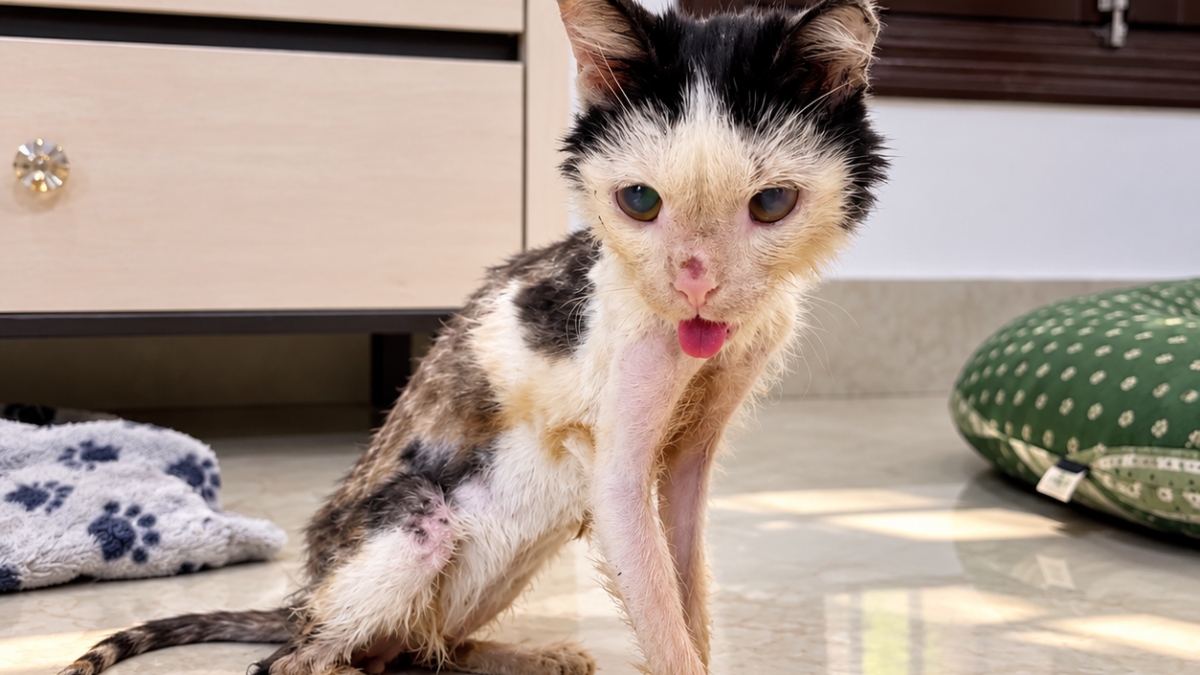
PART 2
I didn’t sit.
I should have.
The veterinarian pointed toward the images while I stood beside him, my hands resting against the edge of the counter.
“The trauma to his jaw is substantial.”
I followed his finger even though most of what I saw looked like shadows and bone.
“Can it heal?”
“Some of it may. But the problem isn’t only structural.”
He moved to another image.
“The impact appears to have caused significant nerve injury through the face.”
I looked toward Phoenix.
He was lying under a warming blanket several feet away.
“What does that mean for him?”
“It means the lack of response we’re seeing may not be temporary.”
I felt my shoulders tighten.
“He can’t feel his face?”
“Not normally.”
“And his jaw?”
“He has reduced control. That may be why he can’t close it properly.”
I tried to imagine living inside a body where your own face no longer felt like it belonged to you.
Then the veterinarian said something that made the entire situation worse.
“I also want to evaluate his sense of smell.”
“Why?”
“Because of where the nerve damage appears to be.”
I stared at him.
“Cats rely on smell for almost everything.”
“I know.”
Food.
Environment.
Recognition.
Comfort.
Danger.
To a cat, smell wasn’t just another sense.
It was part of the map of the world.
I walked back toward Phoenix.
His eyes were partly open.
I waved my fingers slowly near them.
Nothing.
My chest tightened.
“You worried about his vision too?” I asked.
“Yes.”
The answer came from behind me.
I turned.
The vet was already preparing another examination.
Over the next several hours, Phoenix moved from one test to another.
Not all at once.
His body couldn’t tolerate too much stress.
We stabilized.
Waited.
Examined.
Waited again.
He needed breathing support.
He needed his nasal passages cleaned carefully.
He needed pain management.
He needed hydration.
And through all of it, his head continued to sag whenever nobody supported it.
At one point, I placed a folded towel beneath his chin.
His face rested against it.
“There.”
One of the technicians stood beside me.
“He looks exhausted.”
“He is.”
“Do you think he knows we’re helping?”
I looked at Phoenix.
“I hope he knows we’re not hurting him on purpose.”
That was the best answer I had.
Treatment is not always gentle from the patient’s point of view.
Cleaning an infected nose hurts.
Touching an injured jaw hurts.
Handling damaged eyes can hurt.
Inserting lines hurts.
Sometimes saving an animal means asking it to endure things it doesn’t understand.
The only thing we could do was be as careful as possible.
And keep going.
By evening, Phoenix was stable enough that we could step back for a moment.
The taxi driver was still there.
I had almost forgotten about him.
He sat in the waiting area with his elbows on his knees.
“You stayed?”
He looked up.
“I wanted to know.”
I sat across from him.
“He’s alive.”
“That’s good.”
“Yes.”
He searched my face.
“But?”
I smiled faintly.
“You hear that word a lot in rescue.”
He nodded.
“What’s wrong with him?”
“We’re still finding out.”
I told him about the jaw.
The facial nerve damage.
The possibility that Phoenix had lost his sense of smell.
The concern about his eyesight.
The driver rubbed both hands together.
“Will he make it?”
“I don’t know.”
He looked toward the treatment-room doors.
“He was alone when I found him.”
I waited.
“Cars were going around him.”
His voice tightened.
“People saw him.”
That made me look at him.
“How do you know?”
“Because I saw them move around him.”
He stared at the floor.
“I did too at first.”
“You stopped.”
“Eventually.”
“You stopped.”
He nodded slowly.
“I keep thinking maybe I should have stopped faster.”
There was nothing useful in letting him punish himself.
“Phoenix doesn’t care how many seconds it took you.”
The driver looked up.
“He cares that you did.”
For the first time since he arrived, the man smiled.
Barely.
Then he stood.
“Can I come back?”
“Of course.”
He reached for the door.
Before leaving, he looked toward the back again.
“Phoenix.”
“Yes.”
“That’s a good name.”
After he left, I returned to the treatment area.
The clinic was quieter.
The emergency rush had passed.
Now came the long part.
Observation.
Monitoring.
Waiting for the next piece of bad news.
I pulled a chair beside Phoenix.
He was sleeping.
Or unconscious enough that sleep was the closest word.
His breathing sounded slightly clearer after the nasal cleaning, but it still wasn’t normal.
I put my fingers near his nose.
There was air.
Weak but steady.
“Okay.”
I whispered it to myself.
“Okay.”
The next morning, our first major concern was confirmed.
Phoenix did not appear to have a functional sense of smell.
We tried controlled tests.
Strong but safe scents.
Food.
Different environmental odors.
Nothing produced the response we expected.
At first, I refused to accept it.
“Maybe the swelling is blocking everything.”
“It might contribute,” the veterinarian said.
“But?”
“But the neurological findings suggest more.”
“How sure?”
“We’ll continue evaluating.”
That was his way of saying he didn’t want to give me false hope.
I hated it.
Phoenix’s jaw was another problem.
The accident had damaged it badly enough that he couldn’t close his mouth in a normal resting position.
That affected eating.
Drinking.
Grooming.
Comfort.
Everything.
Then came the eye examination.
A specialist was consulted.
Tests were repeated.
Responses checked.
Reflexes observed.
I stood nearby pretending I wasn’t already afraid of the answer.
The specialist finished and removed his gloves.
“Can we talk?”
Those four words rarely mean anything good in a clinic.
We moved a few feet away.
“What do you think?”
He looked at his notes.
“The trauma has caused severe damage affecting his visual system.”
I waited.
“Can he see anything?”
“We’re not finding evidence of useful vision.”
My stomach dropped.
“Temporary?”
He paused.
“That’s unlikely.”
“How unlikely?”
He looked at me directly.
“I believe the vision loss is permanent.”
I turned toward Phoenix.
The room did not change.
That was what felt strange.
Machines still beeped.
Someone opened a cabinet.
A dog barked in another part of the clinic.
A technician laughed at something near reception.
The world continued normally after somebody had just told me Phoenix’s world had gone dark.
I walked back to him.
His eyes were open.
He looked as if he should have been watching me.
But he wasn’t.
I moved my hand.
Nothing.
“You really can’t see me.”
The words slipped out.
Phoenix’s ear moved toward my voice.
I stopped.
His ear.
I spoke again.
“Phoenix.”
Another small movement.
Sound.
He still had sound.
I leaned closer.
“You can hear me.”
One ear turned toward me.
For the first time that morning, I smiled.
“Okay.”
The specialist watched from behind me.
I looked at him.
“He can learn with hearing.”
“Yes.”
“And touch.”
“Yes.”
“Even if his facial sensation is damaged?”
“His body has other sensory information. Whisker function and facial sensation may be impaired depending on the nerves involved, but he can still use his paws, hearing, body position, memory.”
I looked at Phoenix again.
“And smell?”
“That appears significantly affected too.”
Blind.
Unable to smell.
Reduced facial sensation.
Jaw trauma.
Breathing problems.
I felt anger rise in me, though there was nobody specific to be angry at.
The road?
The vehicle that hit him?
The person who might not have stopped?
Chance?
I wanted an enemy because enemies are easier than accidents.
If someone had intentionally hurt Phoenix, I could have hated them.
Instead, I had a broken cat and a thousand things I could not control.
The veterinarian touched my shoulder.
“One problem at a time.”
I nodded.
That became our rule.
One problem at a time.
We couldn’t give Phoenix the world back in a single day.
So we started with breathing.
The thick infected material inside his nose had to be addressed repeatedly.
His nasal passages were inflamed.
One side appeared especially compromised.
Every cleaning session required patience.
I spoke before touching him.
“Phoenix, I’m on your left.”
At first, I felt ridiculous.
Then I realized it helped.
A blind animal cannot prepare for hands it cannot see.
A cat with facial nerve damage may not feel those hands normally once they arrive.
My voice became a warning.
“Touching your head.”
I placed my hand lightly behind his ears.
“Cleaning your eye.”
Pause.
“Good boy.”
He rarely fought.
Sometimes I wished he would.
Resistance would have meant strength.
But little by little, resistance came.
The first time Phoenix tried to push my hand away with his paw, I nearly laughed.
“Excuse me?”
He pushed again.
A technician looked over.
“What?”
“He’s annoyed.”
She smiled.
“Good.”
Phoenix pulled his head back.
Only a little.
But he pulled.
“Look at you.”
He did not look.
I caught myself.
The phrase hurt for half a second.
Then I decided not to police every normal expression.
Phoenix was blind.
He wasn’t made of glass.
If I spent the rest of his life speaking around reality, I would only make the disability bigger.
“Fine,” I said. “Don’t look at me.”
His ear turned.
The technician laughed.
His eye care became one of the most demanding parts of the early weeks.
Because his eyes were damaged and he couldn’t protect them normally, discharge and crusting formed.
We had to soften it.
Clean carefully.
Apply medication.
Wait.
Repeat.
Some mornings looked better.
Then the next day, irritation would return.
Healing refused to move in a straight line.
I would arrive hopeful.
See fresh crust.
Feel defeated.
Clean it.
Medicate.
Come back later.
That routine became part of Phoenix’s life.
He learned the sound of the medication drawer.
The first few times, he tensed when it opened.
Eventually, he would lower his head before I even reached him.
“You know.”
His ear moved.
“Sorry.”
He probably hated the entire process.
But after each cleaning, he seemed more comfortable.
That kept us going.
Eating was harder.
Cats depend heavily on smell to stimulate appetite.
Phoenix could not rely on that.
His jaw also made chewing awkward.
Then, as if his list of problems was not long enough, he began reacting badly to certain foods.
It started with skin irritation.
Then digestive problems.
Inflammation.
At first, we blamed stress.
Phoenix had been through trauma.
Medications could affect digestion.
Hospitalization could disrupt everything.
But the pattern continued.
One of our veterinarians reviewed his symptoms.
“I’m concerned there’s an allergy component.”
I stared at her.
“Of course there is.”
She smiled despite herself.
“That’s not medically helpful.”
“I know.”
We began a more careful dietary evaluation.
Limited ingredients.
Controlled feeding.
Tracking reactions.
Working with specialists.
Phoenix’s immune system already had more work than it could handle.
The allergy complicated healing.
His skin became irritated.
Inflammation made him uncomfortable.
Certain foods made things worse.
The frustrating part was that Phoenix needed nutrition desperately.
He had to rebuild muscle.
He had to regain strength.
He needed calories.
But we couldn’t simply put anything in front of him.
Food became treatment.
Every meal mattered.
I learned to prepare it exactly.
Texture was important because of his jaw.
Composition mattered because of the allergies.
Placement mattered because he couldn’t see.
We used the same dish.
Same location.
Same approach.
I would tap lightly near the bowl.
“Food.”
At first, Phoenix searched clumsily.
His nose could not guide him.
His eyes could not guide him.
He would move his head too far left.
Then right.
His mouth would touch the edge of the dish.
He would pull back.
Try again.
Watching it was painful.
Every instinct in me wanted to pick up the food and place it directly into his mouth.
Sometimes we did assist.
But if Phoenix was ever going to function independently, he needed to learn.
So I sat.
Waited.
Tapped the bowl.
“Right here.”
He moved.
Missed.
Tried again.
Found it.
The first bite might take a full minute.
The second came faster.
Eventually, he understood the geography.
A few weeks later, I could place him near his feeding station and tap once.
Phoenix would orient toward the sound.
Step forward.
Lower his head.
Find the bowl.
I celebrated like he had performed surgery.
“You got it.”
He ate.
He didn’t care about my celebration.
That made it better.
Phoenix’s first major mobility milestone happened on a quiet afternoon.
He had become strong enough to spend controlled time outside the smaller recovery enclosure.
We created a safe room.
No high furniture.
No sharp edges.
No clutter.
Textured mats helped define areas.
His bed remained in the same corner.
Water in another.
Litter box in a predictable position.
I placed Phoenix near the bed.
He stood.
For a second, his legs trembled.
Then he moved.
One step.
Pause.
Another.
He extended a paw before committing his weight.
Touched the surface.
Continued.
His head stayed low.
He wasn’t walking confidently.
But he was gathering information.
I stayed nearby.
“Easy.”
Phoenix reached the edge of one mat.
The texture changed.
He stopped.
Paw forward.
Touch.
Then stepped.
He crossed onto the floor.
The sound of his claws changed.
He froze.
I spoke.
“You’re okay.”
One ear turned toward me.
Then he continued.
He walked the perimeter.
Not perfectly.
He bumped the wall once.
Stopped.
Adjusted.
Moved along it.
I followed several feet behind.
One of the therapists had told me something important.
“Don’t constantly rescue him from harmless mistakes. Let him build a map.”
So I fought myself.
Every time he moved toward something, I wanted to guide him.
Instead, I let Phoenix learn.
Wall.
Turn.
Mat.
Bed.
Water.
Open space.
Litter.
Door.
He repeated the route.
Over and over.
Three days later, he could cross from his bed to the water bowl without touching the wall.
I stood in the doorway watching.
One of the volunteers joined me.
“He knows where it is.”
“Yes.”
“How?”
“Memory.”
Phoenix drank.
Then turned.
He made his way back.
No eyesight.
Almost no useful smell.
Damaged facial nerves.
But memory worked.
Hearing worked.
His paws worked.
His brain was building a different world.
That became the first time I truly understood Phoenix was not waiting for us to restore his old life.
He was creating a new one.
We had been thinking in terms of losses.
No vision.
No smell.
Less facial sensation.
Damaged jaw.
Phoenix was thinking in terms of what remained.
Sound.
Texture.
Routine.
Touch through the rest of his body.
Memory.
Trust.
Food.
Warmth.
Safety.
The difference changed how I treated him.
I stopped approaching every task like compensation for tragedy.
We started training for independence.
A rehabilitation specialist joined his care.
She watched him move around the room.
Phoenix walked toward the sound of her voice.
Stopped.
Turned his head.
She snapped her fingers softly to the side.
His ear rotated.
“Good.”
She moved.
Another sound.
Phoenix reoriented.
“His auditory localization is useful.”
I folded my arms.
“In normal language?”
She smiled.
“He can tell where sound is coming from pretty well.”
“That’s good.”
“Very good.”
She introduced consistent sound cues.
Food.
Water.
Come.
Stop.
Step.
Touch.
Nothing complicated.
No circus tricks.
Functional communication.
Phoenix learned “stop” faster than I expected.
Probably because we used it when he approached something unsafe.
“Stop.”
He froze.
The first time he did it reliably, I nearly hugged the therapist.
She laughed.
“That one could save him.”
“I know.”
“Don’t overuse it.”
“I won’t.”
Phoenix learned “come” more slowly.
He would hear my voice.
Turn.
Take several steps.
Then decide something else was more interesting.
“You cannot even see what you’re ignoring me for.”
His tail moved.
By then, his personality had started appearing.
And Phoenix had opinions.
Strong ones.
He hated eye medication.
He tolerated nose cleaning but expressed his displeasure with increasingly dramatic paw movements.
He loved soft blankets.
He preferred sleeping with part of his body touching something solid.
A pillow.
The edge of his bed.
My leg.
He became fascinated with jingling toys.
That made sense.
Sound gave the object location.
The first time we rolled a bell ball near him, Phoenix’s ears snapped forward.
He crouched.
The ball stopped.
He waited.
I nudged it again.
Jingle.
Phoenix stepped toward it.
Jingle.
He reached out.
His paw hit the ball.
It rolled.
He froze.
Then chased the sound.
I covered my mouth.
The volunteer beside me whispered, “He’s playing.”
Phoenix batted the ball again.
Missed.
Listened.
Found it.
Hit it.
The bell traveled across the mat.
Phoenix followed.
He was playing.
Not undergoing treatment.
Not practicing mobility.
Playing.
For almost a minute, the room belonged to a normal cat doing something ridiculous because it made a noise.
Then Phoenix became tired and lay down.
I picked up the ball.
“That’s enough.”
He lifted his head toward the bell.
I jingled it once.
His ears rose.
I laughed.
“Tomorrow.”
The months that followed were not a smooth montage of improvement.
There were setbacks.
Real ones.
Phoenix’s nose remained a major concern.
Although cleaning helped, one nasal passage had been structurally compromised by the trauma.
Scar tissue and damage narrowed the airway.
Inflammation made it worse.
Some days he breathed more comfortably.
Other days, the congestion returned.
At night, I would sometimes sit near him and listen.
A rough inhale.
Pause.
Exhale.
Again.
I had spent the first day afraid he would stop breathing.
Months later, I still hated hearing him struggle for air.
A specialist reviewed his imaging and examinations.
“We may be able to improve the airway surgically.”
My stomach tightened.
“Surgery again?”
“Potentially.”
“What would you do?”
“The damaged passage has partially collapsed. There’s tissue obstructing airflow, and chronic inflammation isn’t helping.”
“Can you fix it?”
“I can’t promise normal anatomy.”
“Can you make him breathe better?”
“That’s the goal.”
I looked toward Phoenix.
He was sitting on an exam table facing entirely the wrong direction.
He had no idea everyone in the room was discussing another procedure.
“What are the risks?”
The specialist explained them.
Anesthesia.
Bleeding.
Swelling.
Postoperative discomfort.
Possible re-narrowing.
The possibility that improvement would be limited.
No guarantee.
Always those words.
No guarantee.
By then Phoenix was stronger than he had been after the accident.
That helped.
His nutritional status was improving.
His allergy management was more controlled.
His body had more reserves.
But I still remembered the first surgeries.
The waiting.
The uncertainty.
I rubbed the back of my neck.
“How necessary is it?”
The specialist answered carefully.
“He is functioning now. This is not the same kind of immediate emergency as before.”
That mattered.
“But?”
“But chronically compromised breathing affects quality of life. Repeated inflammation increases problems. If we can safely create better airflow, I think it’s worth considering.”
I sat beside Phoenix.
He heard the chair.
His head turned.
I touched his back.
“We keep asking you to do hard things.”
Phoenix leaned slightly into my hand.
That decided it more than I wanted to admit.
We scheduled the procedure.
The morning of surgery, Phoenix was angry because breakfast had been withheld.
For once, I appreciated the normality of the complaint.
He paced inside his carrier.
“Last time you went into surgery, you couldn’t lift your head.”
Phoenix scratched at the carrier door.
“And today you’re furious because we skipped breakfast.”
Scratch.
“I’m choosing to see that as progress.”
At the hospital, the specialist examined him once more.
The surgical plan was designed to improve airflow through the damaged nasal passage, clear obstructive material, and reduce some of the chronic irritation.
I signed forms.
I hated signing forms.
Consent documents reduce fear into boxes.
Bleeding.
Anesthesia.
Complications.
Death.
Initial here.
Sign there.
I knew why they existed.
I still hated them.
The technician took Phoenix.
He protested.
Actually protested.
He pushed backward.
Grabbed the edge of his carrier.
Made an irritated sound.
I smiled.
The technician looked at me like I was strange.
“Sorry.”
“For what?”
“I’m just happy he has enough strength to be difficult.”
She smiled.
“We understand that around here.”
The doors closed.
Waiting never got easier.
Phoenix had survived so much that part of me became superstitious.
I worried we were asking too much.
What if this was the procedure we should have skipped?
What if improving his breathing cost him everything?
That kind of thinking is dangerous because it pretends you can know the future if you worry hard enough.
I couldn’t.
We had made the best decision we could with the information we had.
Now I had to live inside the waiting.
Several hours later, the specialist came out.
“It went well.”
My shoulders dropped.
“Really?”
“Yes.”
“How much did you clear?”
“Enough that I’m encouraged.”
“Is he breathing?”
“Yes.”
“On his own?”
“Yes.”
I laughed.
The specialist smiled.
“You can ask your remaining twelve questions once he’s awake.”
“I have more than twelve.”
“I know.”
Phoenix’s postoperative recovery was slower than my anxiety wanted and faster than the doctors feared.
His face was swollen.
He sounded congested initially.
For a moment, I panicked.
“He sounds worse.”
“That’s postoperative swelling,” the veterinarian explained. “Give it time.”
Time.
Again.
Everything with Phoenix required patience.
We waited.
The swelling eased.
His breathing changed.
At first, subtly.
Then clearly.
The harsh obstruction softened.
His breaths became less labored.
I sat beside him one evening and realized I had gone several minutes without consciously listening to every inhale.
That was how I knew something had improved.
I didn’t notice his breathing.
Normal people don’t notice breathing.
You notice it when it is failing.
Phoenix was beginning to earn the luxury of being unnoticed.
Then, only days after the procedure, he terrified us again.
I was cleaning his bedding when Phoenix began coughing.
Not a normal hairball cough.
A violent, sudden series that bent his small body.
I dropped what I was holding.
“Phoenix?”
He coughed again.
I moved toward him.
Another spasm.
Something came from his mouth.
It landed on the floor.
For a second, I stared.
Then it moved.
I jumped backward.
“What the—”
One of the technicians hurried over.
“What happened?”
I pointed.
“That came out of him.”
She crouched.
Her expression changed immediately.
“Don’t touch it.”
“I had no plan to.”
She retrieved a container.
The thing was a worm.
A parasitic worm.
Phoenix sat several feet away as if nothing unusual had happened.
I stared at him.
“You were hiding that too?”
His ear moved.
At the clinic, testing confirmed parasitic infection.
I almost laughed when the veterinarian explained it.
Not because it was funny.
Because the list had become absurd.
Blindness.
Loss of smell.
Facial nerve injury.
Jaw trauma.
Severe nasal damage.
Allergies.
Immune-system stress.
And now parasites.
“What else is inside this cat?” I asked.
The vet smiled carefully.
“Let’s not challenge the universe.”
“Good point.”
Phoenix received appropriate antiparasitic treatment.
We monitored him closely.
Fortunately, the infection was treatable.
The coughing episode had looked horrifying, but in a strange way it helped reveal one more hidden problem.
Another obstacle we could actually remove.
I began thinking of Phoenix’s recovery as layers.
Every time we cleared one, another appeared underneath.
At first that had been discouraging.
Eventually, I saw it differently.
Each discovery meant we understood him better.
Each diagnosis gave us something actionable.
The danger would have been never finding the problems.
Phoenix tolerated the parasite treatment well.
His breathing continued improving after nasal surgery.
His appetite, however, remained complicated.
The allergy issue forced us to be methodical.
I worked with the veterinarians and specialists to build a diet his body could tolerate.
We didn’t treat medication as an enemy.
When Phoenix needed antibiotics, antiparasitics, pain control, anti-inflammatory treatment, or other appropriate medication, he received it.
But we also didn’t throw unnecessary drugs at every setback.
His body had been through enough.
Every decision had a reason.
Food became almost scientific.
Ingredients recorded.
Reactions tracked.
Textures adjusted.
Amounts measured.
One combination seemed promising.
Then itching returned.
We changed it.
Another upset his digestion.
Changed again.
Phoenix didn’t understand any of this.
He just understood whether the bowl appeared.
One evening, after weeks of careful adjustment, he ate an entire meal without hesitation.
Then he sat beside the bowl.
I waited.
No coughing.
No obvious discomfort.
No immediate reaction.
I looked at the clock.
Then back at Phoenix.
“You finished.”
He licked around his mouth awkwardly.
His jaw still wasn’t normal.
It never would be.
But he had adapted.
I put another small approved portion in the dish.
He found it quickly.
Ate.
The next morning, he ate again.
Then the next.
That became another milestone.
Comfortable eating.
Something so ordinary that nobody thinks about it until an animal cannot do it.
Phoenix’s weight began to stabilize.
His muscle tone improved.
The thinness around his shoulders softened.
His coat looked healthier.
His energy changed.
The most obvious sign was mischief.
One afternoon, I heard something fall in his room.
I rushed in.
Phoenix was sitting beside an overturned lightweight container.
I stared at the floor.
Then at him.
“How?”
He turned his head toward my voice.
“You’re blind.”
Tail movement.
“You can’t smell.”
Another tail movement.
“And you still figured out how to knock things over.”
Phoenix sat calmly.
I laughed.
“Congratulations. You’re officially a cat.”
His confidence expanded beyond the safe room.
We introduced him gradually to larger areas.
Never everything at once.
That would have overwhelmed the map in his head.
One hallway.
Then another room.
Markers helped.
A textured runner meant route to his bed.
A different mat near water.
Soft barriers near corners.
Consistent furniture placement.
One rule became sacred.
Do not move things unnecessarily.
Someone once shifted a chair.
Phoenix walked directly into the leg.
Not hard.
But enough that he stopped and looked confused.
I felt terrible.
The chair went back immediately.
From then on, everybody knew.
Phoenix’s world depended on consistency.
Sighted animals can see that a chair moved.
Phoenix couldn’t.
Smell might have helped another blind cat identify objects.
He didn’t have that advantage.
Memory was everything.
The world had to keep its promises.
Bed here.
Water there.
Door there.
Wall there.
Humans roughly where their voices indicated.
We could not randomly rewrite the map.
Phoenix became astonishingly good at navigating familiar spaces.
People who visited often assumed he could see shadows.
“He must see something.”
“No.”
“Are you sure?”
“Yes.”
“But he walked around that table.”
“Because the table has been there for months.”
Phoenix would cross the room.
Turn at exactly the right point.
Step onto the textured mat.
Find his bed.
No collision.
No hesitation.
It looked like sight.
It was memory.
Sometimes I thought memory had become his revenge on blindness.
The accident had taken his eyes.
Phoenix memorized the world instead.
It had taken his sense of smell.
He listened harder.
It had damaged his face.
He used the rest of his body.
Every loss forced him to build another route.
Months passed.
The taxi driver continued visiting.
Not constantly.
But enough.
The first time he returned after Phoenix was walking confidently, I didn’t warn him.
I wanted him to see.
He entered the room quietly.
Phoenix was sleeping.
The driver stopped.
“He’s bigger.”
“A little.”
“He looks like a cat now.”
I laughed.
“That helps.”
Phoenix woke at the sound of his voice.
His head lifted.
The driver crouched.
“Hey, buddy.”
Phoenix listened.
Then stood.
The driver looked at me.
“He can stand.”
“Oh, he does more than stand.”
I tapped the floor near the driver.
“Phoenix. Come.”
Phoenix oriented toward the sound.
Walked forward.
Paused.
Then continued.
The driver covered his mouth.
Phoenix reached him.
The man extended one hand slowly.
Phoenix touched it with his nose.
He couldn’t smell who it was.
Maybe he remembered the voice.
Maybe not.
It didn’t matter.
The driver ran his hand along Phoenix’s shoulder.
“He was like a rag when I carried him.”
“I remember.”
“I thought he’d die in my cab.”
Phoenix leaned into the man’s leg.
The driver looked away for a moment.
When he looked back, his eyes were wet.
“I almost didn’t stop.”
“You’ve told me.”
“I know.”
He scratched Phoenix gently beneath the chin, careful around the areas where sensation was abnormal.
“I think about it every time I see him.”
I sat beside them.
“Then think about this part too.”
He looked at me.
“Don’t only remember the road.”
Phoenix sat between us.
“Remember that you carried him through the door.”
The driver nodded.
Phoenix suddenly decided he had received enough affection and walked away.
The man laughed.
“He doesn’t care about my emotional moment.”
“No.”
“That’s healthy.”
“Very.”
By month six, Phoenix had routines.
Morning medication.
Breakfast.
Rest.
Movement exercises.
Eye care.
Play.
Another meal.
Quiet time.
More treatment when needed.
His eyes still required management.
The damaged surface could become irritated.
Crusting still formed.
Some days were worse.
He hated the cleaning as much as ever.
I would approach with supplies.
Phoenix heard the drawer.
He turned his body away.
“Don’t.”
He moved farther.
“You know I’m going to.”
Phoenix tried to walk off.
I stepped around him.
“You cannot avoid me using the strategy of walking very slowly three feet away.”
He sat.
I touched his shoulder.
“Ready?”
No response.
“Taking that as yes.”
I softened the crust carefully.
Cleaned.
Applied medication.
Phoenix pushed at my wrist.
“I know.”
Another push.
“Almost done.”
When I finished, he immediately walked away with exaggerated dignity.
The volunteer watching us laughed.
“He hates you.”
“Until dinner.”
At dinner, Phoenix came when called.
“Traitor,” I told him.
He ate.
Phoenix also discovered affection.
Not the frantic, desperate affection some rescued animals show.
His was deliberate.
He liked predictable touch.
A hand placed along his back.
Gentle scratches behind the ears.
Warmth beside another body.
Because his facial sensation was altered, we learned where touch felt comfortable and where it confused him.
He taught us.
If he moved away, we stopped.
If he leaned in, we continued.
Simple.
One night, I sat on the floor updating his treatment notes.
Phoenix walked across the room.
He reached my leg.
Stopped.
Then lowered himself until his side touched my ankle.
I didn’t move.
He stayed.
Five minutes.
Ten.
Eventually, he slept.
I looked at the notes in my lap.
BREATHING: STABLE.
APPETITE: GOOD.
EYES: CLEANED, MEDICATED.
SKIN: IMPROVED.
STOOL: NORMAL.
Words.
Clinical little words.
They couldn’t capture the cat sleeping against my ankle.
That was the part charts never show.
Trust.
At some point, Phoenix stopped being the emergency cat.
He became Phoenix.
That transition was almost invisible.
People no longer asked first, “Is he going to survive?”
They asked, “How is Phoenix?”
Volunteers knew his routines.
They knew not to move furniture.
They knew how to announce themselves.
They knew which toys made the best sounds.
They knew his preferred blanket.
The story of the road became history rather than the entire identity of the cat.
That mattered to me.
I never wanted Phoenix to spend his life as tragedy entertainment.
Yes, what happened to him was terrible.
Yes, his disabilities were real.
Yes, his medical needs remained serious.
But Phoenix himself was not tragic.
He was stubborn.
Adaptable.
Occasionally irritating.
Food-motivated.
Particular about bedding.
Suspicious of eye medication.
Interested in bell toys.
Fond of warmth.
That was a cat.
Not a list of diagnoses.
Near month seven, we had a setback.
His skin flared badly.
The allergy returned despite our careful feeding.
At first, I felt crushed.
We had been doing so well.
I found irritated areas while grooming him.
“Not again.”
Phoenix twisted slightly beneath my hand.
I called the veterinary team.
Tests.
Review.
Diet history.
Environmental possibilities.
Medication changes.
For several days, I felt as if we had been dragged backward months.
Phoenix scratched.
His skin was uncomfortable.
His appetite dipped slightly.
I sat beside him one evening.
“You’re allowed to just have one problem at a time.”
Phoenix licked one paw.
“I’m serious.”
He continued.
I called the specialist the next morning.
“What are we missing?”
She went through everything.
Nothing obvious.
Then she said, “Healing isn’t proof that there will never be another flare.”
“I know.”
“You sound like you don’t.”
I sighed.
“I’m tired.”
“So is he.”
That shut me up.
She continued.
“We adjust. We treat what’s happening. We don’t turn one setback into a prediction of the future.”
I wrote that down.
Not because it was poetic.
Because I needed it.
We adjusted.
Changed part of his dietary plan.
Modified environmental controls.
Used appropriate treatment.
Watched closely.
The flare eased.
Phoenix returned to himself.
A week later, he was batting his bell ball across the room again.
I sat on the floor watching.
The specialist had been right.
One setback had not erased seven months of progress.
Phoenix had taught us that repeatedly.
A bad day was a bad day.
Not the end.
By the time we approached ten months after rescue, I started looking through old photographs.
That was almost a mistake.
The first images were brutal.
Phoenix on the treatment table.
Head down.
Face crusted.
Mouth hanging open.
Body too weak to sit.
I stared at one photograph for several minutes.
Then Phoenix walked into the room.
Tap.
Tap.
Pause.
Step.
His gait was normal for him now.
He heard me shifting on the floor.
His ears turned.
“Come here.”
Phoenix walked toward my voice.
He stopped near my knee.
I held the phone beside him even though he couldn’t see it.
“That’s you.”
No response.
“You looked terrible.”
Phoenix sat.
“Rude, I know.”
I placed the phone down.
He leaned against my hand.
The contrast felt impossible.
Ten months.
Not a miracle in one night.
Ten months of daily care.
Ten months of setbacks.
Ten months of medications.
Ten months of meals prepared around allergies.
Ten months of eye cleaning.
Specialist visits.
Surgery.
Parasite treatment.
Rehabilitation.
Learning routes.
Learning sounds.
Learning trust.
Ten months of Phoenix teaching us that progress can be happening even when yesterday and today look almost identical.
One of the biggest milestones came with food.
For months, eating had been treatment.
Careful.
Measured.
Monitored.
Then one morning, Phoenix finished breakfast comfortably and immediately began searching for more.
I laughed.
“No.”
He moved toward the sound of the container.
“No.”
He stopped near my foot.
“You had enough.”
Phoenix waited.
I moved.
He followed.
“You cannot see me.”
Follow.
“You cannot smell where the food is.”
Follow.
“And somehow you still know.”
I opened another container for a different cat.
Phoenix turned toward the sound instantly.
I stared.
“This is witchcraft.”
A volunteer laughed from across the room.
“He hears everything.”
Phoenix sat near the counter.
He had become comfortably hungry.
That was different from starvation.
Starvation is desperation.
Comfortable hunger is expectation.
It says:
Food exists.
It will come again.
I can ask for it.
Phoenix expected meals now.
Expected clean bedding.
Expected treatment.
Expected us.
That expectation meant safety had become normal.
I loved that more than any dramatic milestone.
His final major specialist review that year was almost anticlimactic.
The veterinarian listened to his breathing.
Checked his nasal airway.
Reviewed the history.
Examined his jaw.
Eyes.
Skin.
Weight.
Bloodwork.
Everything.
I stood nearby waiting for the inevitable “but.”
The veterinarian closed the chart.
“He’s stable.”
I waited.
Nothing.
“That’s it?”
He smiled.
“That’s it.”
“No new disaster?”
“Not today.”
“No hidden worm?”
“Please stop asking the universe.”
I laughed.
Phoenix sat on the exam table.
The veterinarian scratched his back.
“He’ll always be a special-needs cat.”
“I know.”
“The blindness is permanent.”
“I know.”
“The facial nerve deficits are likely permanent.”
“I know.”
“His sense of smell may not return meaningfully.”
“I know.”
“The jaw will always require consideration.”
“I know.”
“Allergies will require management.”
I nodded.
“And?”
“And none of those things mean he can’t have a good life.”
I looked at Phoenix.
He had turned toward the sound of a drawer opening.
Probably hoping for food.
“A good life.”
“Yes.”
Not merely survival.
A good life.
That phrase stayed with me.
For months, our goal had been so much smaller.
Breathe.
Eat.
Stand.
Walk.
Heal.
Now the goal could expand.
Enjoyment.
Comfort.
Security.
Connection.
A life.
Phoenix never became independent in the sense of needing nothing from people.
He required ongoing medical attention.
His eyes needed care.
His environment needed consistency.
His food needed management.
His health needed watching.
But dependence and helplessness are not the same thing.
Phoenix was not helpless.
He knew his home.
He navigated.
He played.
He communicated.
He rejected affection when he had enough.
Requested it when he wanted more.
He knew feeding times.
He knew voices.
He knew the sound of his favorite toy.
He knew where the sunlight warmed a particular section of floor in the afternoon—not because he could see the sun, but because his body had learned where warmth lived.
That became his favorite place.
Around the same time every afternoon, Phoenix crossed the room.
Turned.
Stepped onto the mat.
Walked another few feet.
Then lowered himself into the warm patch.
The first time I realized what he was doing, I stopped.
“He knows.”
A volunteer looked up.
“What?”
“The sun.”
Phoenix stretched.
“He knows where the sun is.”
She smiled.
“He can feel it.”
I watched him settle.
The accident had taken sight.
Not warmth.
It had taken smell.
Not sound.
It had damaged his face.
Not his ability to feel sunlight across his back.
For so long, I had measured Phoenix by what the accident stole.
He measured life by what remained.
That difference became the closest thing to revenge his story ever needed.
I never found a villain to confront.
I never discovered some cruel owner to expose.
We never identified the driver who hit him.
There was no courtroom.
No confession.
No dramatic punishment.
And I eventually stopped wanting one.
Because inventing an enemy would have made Phoenix’s story easier but less true.
His enemy had been the moment itself.
Impact.
Trauma.
Time passing while he lay near the road.
The injuries that kept unfolding afterward.
And Phoenix’s answer was not violence.
It was survival so stubborn that eventually the accident became the first chapter instead of the ending.
If that was revenge, it was the only kind that mattered.
The accident said he would never see again.
Phoenix memorized the room.
The accident said he could not smell his way to food.
Phoenix learned the sound of the bowl.
The accident damaged his jaw.
Phoenix learned how to eat anyway.
It damaged the nerves in his face.
Phoenix learned to trust touch through the rest of his body.
His nasal passage collapsed.
Surgeons opened a path for air.
Parasites hid inside him.
We found them and treated them.
Allergies weakened him.
We adapted his food and care.
Every time something took one route away, Phoenix found another.
That was his payback.
He stayed.
The taxi driver visited again close to the ten-month mark.
This time, Phoenix was in his sunny place.
The man entered quietly.
He had seen Phoenix several times by then, but he still stopped whenever he saw how healthy the cat looked.
“Sleeping?”
“Mostly.”
The driver sat nearby.
Phoenix’s ear turned.
“Hey, Phoenix.”
The cat lifted his head.
The driver smiled.
“He knows me.”
“Maybe.”
“You could let me have this.”
I laughed.
“Fine. He definitely knows you.”
Phoenix stood.
Walked toward the voice.
Reached the driver.
The man touched his shoulder.
For a few seconds, he didn’t say anything.
Then he looked at me.
“You know what I remember most?”
“The paw?”
He nodded.
“That little movement.”
We both looked down at Phoenix.
“He couldn’t lift his head,” the driver said.
“No.”
“I thought I was bringing you a dying cat.”
“You were.”
His hand stopped on Phoenix’s back.
He looked at me.
I hadn’t meant it harshly.
It was simply true.
Phoenix had been dying.
The driver took a slow breath.
“And now?”
Phoenix pushed his head against the man’s hand.
I smiled.
“Now he complains about breakfast.”
The driver laughed.
Phoenix sat.
“I like this version.”
“So do I.”
The man became quiet again.
“I still feel guilty about almost driving past him.”
I thought about our conversation from the first night.
Ten months had passed and he was still carrying those few seconds.
“Can I tell you something?”
“Yeah.”
“If you had driven past, Phoenix might not be here.”
His face tightened.
“But you didn’t.”
He nodded.
“You can spend the next ten years punishing yourself for the second before you stopped, or you can remember the second you did.”
Phoenix stood and walked away.
The driver watched him navigate the room.
“He makes it look easy.”
“It isn’t.”
“I know.”
“That’s the impressive part.”
Phoenix reached his water.
Found it.
Drank.
Then returned toward the sunny mat.
No help.
No collision.
The driver shook his head.
“That cat.”
“Yes.”
“That cat.”
By then, the question of where Phoenix would live long-term had become easy.
His medical needs were complex.
His environment mattered.
He already trusted the people around him.
Changing everything simply for the sake of saying he had moved into some conventional idea of a home made no sense.
So his home became the place where his world had been rebuilt.
The people caring for him were his people.
The room and surrounding safe spaces were his territory.
His routines belonged there.
There was no dramatic adoption scene.
No ribbon.
No announcement to Phoenix.
He didn’t need paperwork to tell him where he belonged.
He already knew the map.
Months continued passing.
Phoenix became less of a patient and more of a resident.
That meant he occasionally became a nuisance.
One afternoon, a volunteer left a soft bag on the floor.
Phoenix encountered it.
He touched it with one paw.
Climbed partly onto it.
Turned.
Sat directly in the middle.
The volunteer returned.
“That’s my bag.”
Phoenix stayed.
“Phoenix.”
No reaction.
I looked over.
“He can’t see your disappointment.”
“He can hear it.”
Phoenix began grooming himself.
The volunteer laughed.
“Fine.”
Another day, he discovered that crinkling paper made an excellent noise.
He spent fifteen minutes attacking a sheet of packing paper.
Crunch.
Pause.
Crunch.
Listen.
Pounce.
He misjudged one pounce and landed beside it.
Stopped.
Listened.
Reached.
Found it.
Continued.
I watched without helping.
That would have been impossible for me months earlier.
I would have moved the paper closer.
Guided him.
Protected him from missing.
Now I understood missing was part of playing.
A life without harmless failure is not freedom.
Phoenix needed room to be wrong.
To bump softly into a familiar wall.
To reach for a toy and miss.
To choose the wrong direction.
To turn around.
To solve it.
That was independence.
His jaw never returned to normal.
Sometimes his mouth still rested slightly open.
Food occasionally needed extra preparation.
His facial expressions remained unusual because of the nerve damage.
People meeting him for the first time sometimes misunderstood.
“Is he unhappy?”
“No.”
“His face looks—”
“I know.”
Phoenix’s expression no longer communicated in the usual way.
So we learned other signs.
Ears.
Tail.
Body position.
Movement.
Whether he leaned into touch.
Whether he walked away.
Whether he played.
Whether he ate.
Whether he settled.
Humans rely heavily on faces.
Phoenix taught us to stop.
A cat could have a face that looked blank and still be content.
A cat could not smile and still feel safe.
We had to read the whole animal.
That lesson mattered beyond Phoenix.
I became more patient with every frightened animal after him.
More aware that the absence of a familiar expression didn’t mean absence of feeling.
One night, Phoenix developed congestion again.
Not severe.
But enough to bring every old fear back.
I sat beside him.
Listened.
His breathing was louder.
My stomach tightened.
I called the veterinarian.
We reviewed symptoms.
No distress.
No blue gums.
No collapse.
No major appetite change.
Monitor.
Supportive care.
Bring him in if it worsens.
I barely slept.
By morning, the congestion had improved.
Phoenix ate breakfast.
Then played.
I sat on the floor feeling foolish.
A volunteer came in.
“You look terrible.”
“Thanks.”
“Were you here all night?”
“Mostly.”
She looked at Phoenix.
“He seems okay.”
“He is.”
She understood.
“The first day comes back, doesn’t it?”
I nodded.
That was the part nobody warns you about.
An animal can recover.
The caregiver’s nervous system takes longer.
Every strange breath transported me back to the treatment table.
Every cough reminded me of the worm.
Every stumble brought back the image of his head hanging against the taxi driver’s arm.
Phoenix moved forward faster emotionally than I did.
Eventually, I had to accept that vigilance could become its own kind of cage.
I could not spend his life waiting for catastrophe.
So I learned to watch without assuming disaster.
A louder breath was a louder breath until other signs said otherwise.
A bad skin day was a flare, not the beginning of the end.
A missed meal once required attention, not panic.
A bump into furniture did not mean his navigation was failing.
Phoenix was allowed ordinary imperfections.
So was I.
Near the end of that first year, I cleaned his eyes one morning.
The crust had become much less severe compared with the early months.
I softened a small area.
Wiped carefully.
Applied the prescribed medication.
Phoenix pushed my hand away.
“Same attitude.”
He pushed again.
“Fine. Done.”
I removed my hand.
Phoenix stood.
Walked toward the sunny part of the room.
Halfway there, he stopped when he heard the bell ball move under somebody’s foot.
Jingle.
His ears lifted.
The ball rolled.
Jingle-jingle.
Phoenix changed direction.
He stalked the sound.
I smiled.
“Priorities.”
He reached.
Batted.
Missed.
Listened.
Batted again.
Contact.
The ball rolled toward the wall.
Phoenix chased it.
For a minute, I forgot every diagnosis.
Blindness.
Anosmia.
Neurological injury.
Jaw trauma.
Allergy.
Nasal collapse.
Parasites.
All those words belonged in his medical chart.
They didn’t belong in that moment.
He was a cat chasing a noisy ball.
That was enough.
The people around Phoenix began asking me what his “final outcome” was.
Rescue language loves outcomes.
Adopted.
Transferred.
Returned.
Sanctuary.
Deceased.
Medical hold.
Labels help organizations keep records.
But Phoenix resisted simple labeling.
His outcome was ongoing.
He needed care.
He was stable.
He had a home.
He had limitations.
He had joy.
All true at once.
No single word covered it.
One afternoon, nearly ten months after the taxi driver carried him through the door, I sat beside Phoenix while he ate.
The meal had been carefully prepared for his allergies and jaw.
Months earlier, finding food had been a challenge.
Eating was a challenge.
Keeping food down was a challenge.
Now Phoenix located the dish after one tap.
He ate.
Paused.
Repositioned.
Continued.
No struggle.
No panic.
No visible pain.
I found myself staring.
Phoenix finished.
Then sat beside the empty bowl.
I laughed.
“Seriously?”
He waited.
“You want more.”
Tail movement.
I added a small amount.
He ate that too.
When he finished, Phoenix walked past me without gratitude.
I smiled.
That was another sign of healing.
He didn’t live in permanent thankfulness.
Rescued animals do not owe us gratitude.
Phoenix expected care now.
As he should.
Later that evening, I found him asleep in the warm spot.
I sat nearby.
The room was quiet.
My mind returned to the day he arrived.
For once, the memory did not start with his injuries.
It started with the taxi driver’s words.
I saw his paw move.
One movement.
That was all Phoenix had needed to change the direction of his story.
A paw moved.
A man stopped.
A door opened.
We tried.
That was it.
There had been no guarantee of success.
If we had known every complication waiting ahead, maybe the whole journey would have looked impossible.
Permanent blindness.
Loss of smell.
Facial nerve damage.
Jaw dysfunction.
Nasal collapse.
Allergies.
Parasites.
Months of eye care.
Surgery.
Rehabilitation.
A lifetime of special management.
Written as a list, it sounded crushing.
Lived one day at a time, it became manageable.
Today’s eye cleaning.
Today’s meal.
Today’s medication.
Today’s walk across the room.
Today’s breath.
Phoenix had never needed to survive ten months in one afternoon.
He only had to survive the next part.
So did we.
That became the real reason he made it.
Not because he possessed some magical understanding that life would improve.
He didn’t know.
None of us knew.
He simply kept participating.
When food appeared, he tried to eat.
When his body grew strong enough, he tried to stand.
When he fell, he tried again.
When sound moved, he followed it.
When a hand felt safe, he leaned into it.
When sunlight warmed the floor, he slept there.
Survival wasn’t heroic every minute.
Most of it was boring.
Small.
Repetitive.
Medication at eight.
Cleaning at ten.
Meal.
Rest.
Check.
Repeat.
That is how lives are rebuilt.
Not through one giant act.
Through thousands of small ones.
Months later, a new volunteer arrived.
She had heard of Phoenix but had never met him.
I watched her enter his room.
Phoenix was walking from his bed toward water.
The volunteer froze.
“He’s blind?”
“Yes.”
“He really can’t see anything?”
“No useful vision.”
She watched him turn.
“And he can’t smell?”
“Not normally.”
Phoenix reached the water.
She looked at me.
“How does he know?”
“Because we don’t move it.”
Phoenix drank.
Then walked back.
The volunteer smiled.
“That’s incredible.”
I nodded.
But I had stopped thinking of it as incredible.
To Phoenix, it was Tuesday.
That was perhaps the most satisfying ending I could have hoped for.
The extraordinary became ordinary.
He did not wake every morning thinking, I am a survivor.
He woke hungry.
He wanted food.
Warmth.
Comfort.
Play.
Rest.
The things all cats want.
His disabilities shaped how he reached those things.
They did not erase the desire for them.
The accident had nearly taken his life.
It did take his sight.
It took much of his sense of smell.
It damaged the nerves in his face.
It altered his jaw permanently.
It damaged his nose badly enough to require surgical intervention.
Those losses were real.
I would never pretend they weren’t.
But the accident did not get everything.
It did not take his hearing.
It did not take his memory.
It did not take his ability to learn.
It did not take his ability to trust.
It did not take his appetite forever.
It did not take play.
It did not take warmth.
And somehow, after everything, it did not take his willingness to participate in life.
One morning, almost exactly ten months after his rescue, I arrived before most of the others.
Phoenix was awake.
The room was quiet.
I put his meal down.
Tapped the usual place.
“Breakfast.”
His head turned.
He stood.
Walked toward me.
Found the bowl.
Ate.
Afterward, I cleaned his eyes.
He complained with one paw.
“Tradition.”
He pushed me again.
“Done.”
Phoenix walked away.
The sun had begun entering through the window.
He crossed the room.
Turned at exactly the right place.
Stepped onto his mat.
Found the warm patch.
Lowered himself.
I sat several feet away.
For a long time, neither of us did anything.
No emergency.
No procedure.
No frightening discovery.
Nothing to fix at that exact moment.
Phoenix stretched.
His mouth sat slightly open because of the old jaw injury.
His eyes did not follow the light.
His nose did not lift toward some smell I couldn’t detect.
His face still carried the permanent evidence of what the accident had done.
But his body relaxed completely.
Safe enough to sleep.
I thought about the taxi driver.
The road.
The paw.
The first breath I heard fighting through his blocked nose.
The veterinarian telling me to sit down.
The blindness diagnosis.
The nerve damage.
The allergies.
The eye crusts.
The nasal surgery.
The worm that nearly made me jump out of my skin.
The diets.
The setbacks.
The little bell ball.
The first time Phoenix crossed the room from memory.
The first time he chose to sleep touching my ankle.
Every difficult moment had once felt enormous.
Now they sat behind him.
Not erased.
Just behind him.
Phoenix shifted in the sunlight.
One paw stretched forward.
Then he became still.
I realized that for the first time since he arrived, I was no longer looking at him and asking what else might go wrong.
I was simply looking at a cat sleeping in a place where he knew he belonged.
That was enough.
The accident had taken more from Phoenix than any animal should ever have to lose.
But it had failed at the one thing that mattered most.
It had failed to end his story.
And in the end, Phoenix never needed to see the sunlight to know exactly where to find it.
[END OF STORY]








