PART 2: A Puppy Cried Beside Her Dying Mother in the Rain—Everyone Filmed Until I Did the One Thing Nobody Else Would
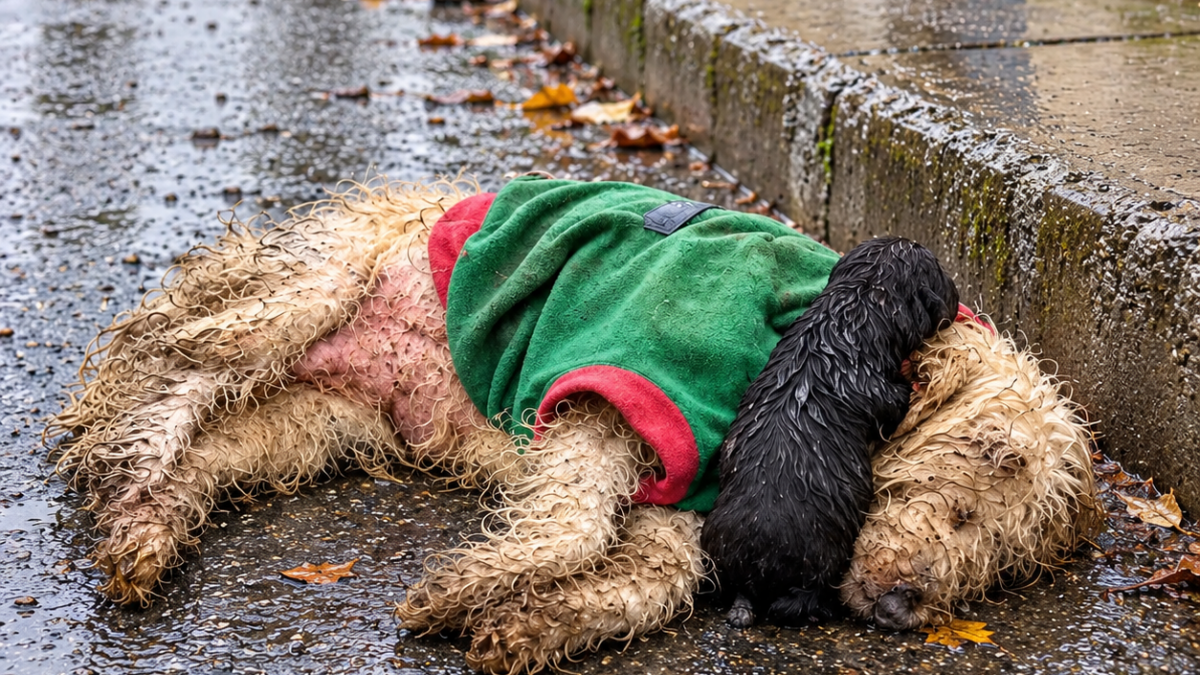
—
PART 2
I didn’t know the mother dog’s name.
I didn’t know the puppy’s name either.
At that point, I knew almost nothing about them except that one was fighting to stay alive and the other refused to leave her.
The young man carrying the puppy hurried beside me.
“My car’s parked three blocks away,” he said.
“Can we use it?”
“It’s my brother’s. I don’t have the keys.”
For one second, hope rose and collapsed.
“Okay.”
We kept moving.
Rain ran down my face.
My arms were already beginning to burn from the mother dog’s weight.
Every few steps I looked down to make sure her chest was still moving.
It was.
Barely.
“Stay with me.”
I didn’t know whether she could hear me.
“Just stay with me.”
The puppy whimpered from the box.
The young man glanced down.
“She’s freezing.”
“Cover her.”
“With what?”
I looked around.
A woman stood beneath an awning watching us.
She wore a thick scarf.
“Ma’am!”
She looked startled.
“Can we borrow your scarf for the puppy?”
She hesitated.
Then removed it.
“Take it.”
“Thank you.”
The young man wrapped the puppy.
Immediately, she burrowed into the fabric.
“Good girl,” he whispered.
We reached an intersection.
Cars passed.
I raised one hand.
“Please!”
Nobody stopped.
I moved farther into view.
A taxi slowed.
Then kept going.
Another car passed.
Then another.
I felt helpless rage building inside me.
“Someone stop!”
The mother dog’s head shifted slightly.
I froze.
“Hey.”
Her eyes opened for half a second.
Brown.
Confused.
Then closed again.
“She moved.”
The young man leaned closer.
“That’s good, right?”
“I don’t know.”
I hated saying it.
I wanted certainty.
I had none.
We kept moving.
At the next corner, I saw a small convenience store.
I rushed inside.
The cashier stared when he saw the soaked dog in my arms.
“Please,” I said. “Can you call a taxi? Anything. Emergency veterinarian.”
He grabbed his phone.
“I’ll try.”
The young man came in behind me with the puppy.
She had stopped crying.
That frightened me more.
“Cookie?”
The young man looked at me.
“What?”
“I need to call her something.”
He smiled despite everything.
“Cookie?”
“She’s tiny.”
“Cookie it is.”
I looked down at the mother.
“And you?”
No answer.
The cashier tried one company.
Then another.
“No drivers.”
“Try again.”
“I am.”
A customer entered.
He looked at us.
“What happened?”
“Hit by a car.”
“Where are you going?”
I told him the hospital.
He looked toward the rain.
Then at his keys.
“I can take you.”
I nearly cried.
“You can?”
“Yes.”
“Right now?”
“Right now.”
We ran outside.
His car was parked beside the building.
He opened the back door.
“Seats don’t matter.”
That sentence hit me.
Because twenty minutes earlier, another man had begun saying the opposite.
My seats.
This stranger saw an injured dog bleeding into his car and decided upholstery could be cleaned.
We placed the mother on the back seat.
I climbed beside her.
The young man held Cookie.
“Go!”
The driver accelerated.
Not recklessly.
But urgently.
I kept one hand against the mother dog’s chest.
“Come on.”
The driver looked at me through the mirror.
“Is she breathing?”
“Yes.”
“Good.”
I glanced at Cookie.
She was trying to climb out of the young man’s arms toward her mother.
“Let her close.”
He lowered her carefully.
Cookie crawled against her mother’s front leg.
The mother’s paw twitched.
Cookie immediately began crying again.
“She knows she’s alive,” the young man whispered.
I looked away.
I couldn’t lose control.
Not yet.
The hospital entrance appeared ahead.
“Here!”
The driver pulled in.
Before the car had fully stopped, veterinary staff were running toward us with a stretcher.
“What happened?”
“Vehicle strike.”
“How long ago?”
“Maybe thirty minutes.”
“Conscious?”
“Barely.”
“Any vomiting?”
“No.”
“Seizures?”
“No.”
They transferred her.
The second they placed her on the stretcher, Cookie started screaming.
Not barking.
Screaming.
She tried to jump from the young man’s arms.
“Keep the puppy with us,” a technician said.
“They’re together.”
The doors opened.
And then the mother disappeared behind them.
Cookie stared at the doorway.
Her whole body trembled.
I looked down at my clothes.
Mud.
Rainwater.
Blood.
I realized my hands were shaking.
The young man sat beside me.
“Is she going to die?”
“I don’t know.”
That became the worst phrase of the night.
I don’t know.
We waited.
Ten minutes.
Twenty.
Forty.
A nurse came out and asked whether I was the owner.
“No.”
“Do you know who is?”
“No.”
“Names?”
“We don’t know.”
She nodded.
“We need identifiers.”
I looked at the puppy.
“Cookie.”
The nurse wrote it down.
“And mom?”
I stared through the glass doors.
The name came from nowhere.
“Natalie.”
The young man smiled.
“Natalie?”
“Yeah.”
The nurse wrote it.
Natalie and Cookie.
For some reason, giving them names changed something.
They were no longer “the dog that got hit” and “the puppy.”
They were Natalie and Cookie.
Lives.
Individuals.
A family.
Eventually, the veterinarian came toward us.
I stood immediately.
“How is she?”
He removed his mask.
“She’s stable.”
The word almost knocked the strength out of my legs.
“Stable?”
“Yes.”
“What’s injured?”
“We’ve done preliminary imaging. I want to monitor her, but I have some good news.”
I waited.
“No obvious internal bleeding.”
I closed my eyes.
“And her head?”
“No major cranial trauma that we can identify.”
“What about her spine?”
“No fracture visible.”
I stared at him.
“So she’s going to live?”
He held up one hand.
“I’m optimistic. But she was hit hard. She has bruising, soft-tissue injuries, shock and exhaustion. We need to monitor her.”
“But she’s alive.”
“Yes.”
The young man laughed.
I started crying.
I didn’t mean to.
It just happened.
I covered my face.
The veterinarian smiled gently.
“You did the right thing bringing her quickly.”
I thought of the crowd.
All those phones.
All those eyes.
“How long can minutes matter after something like that?”
“They can matter a lot.”
That answer stayed with me.
The doctor examined Cookie too.
She had escaped the direct impact.
No fractures.
No visible injuries.
She was cold and frightened but otherwise healthy.
“Can she stay with Natalie?”
“Not tonight.”
My heart sank.
“Why?”
“Mom needs monitoring and quiet. The puppy could climb over equipment, pull lines, interfere with care.”
Cookie began whining again as if she understood.
“Can they see each other?”
“Later, if Natalie remains stable.”
The young man had to leave.
Before he did, he placed Cookie in my arms.
“You staying?”
“Yes.”
He nodded.
“Then she’s got somebody.”
I looked at him.
“So did her mom, eventually.”
He understood.
“Take care of them.”
“I will.”
The hospital staff placed Cookie in a warm carrier with blankets.
She hated it.
She kept turning toward the door Natalie had disappeared through.
Every few minutes she cried.
I sat on the floor beside her.
“Your mom’s here.”
Cookie pressed her nose between the bars.
“She didn’t leave you.”
That was important.
Because the last thing Cookie had seen before strangers carried Natalie away was her mother lying on a wet road.
She couldn’t understand medicine.
She couldn’t understand X-rays.
She understood absence.
So I stayed.
Around midnight, a technician brought me coffee.
“You don’t have to stay all night.”
“I know.”
“You’re not family?”
I looked at Cookie.
“I guess I am tonight.”
She smiled.
At one in the morning, I was allowed to see Natalie.
She lay beneath warm blankets.
IV fluids ran into one leg.
Her eyes were closed.
Her breathing was much stronger.
I walked slowly.
“Hey, Natalie.”
One ear moved.
I sat beside her.
“You caused a lot of trouble tonight.”
Nothing.
“You know that?”
Her eyes opened.
This time they stayed open longer.
She looked at me.
Then toward the doorway.
I knew what she was searching for.
“Cookie’s okay.”
Her head lifted an inch.
“Your baby.”
Her breathing changed.
“Cookie’s safe.”
Natalie tried to move.
The nurse stopped her gently.
“Easy.”
I looked at the doctor.
“Can she see her?”
He hesitated.
Then nodded.
“A minute.”
Cookie was brought in wrapped in a towel.
The moment she smelled her mother, she exploded into movement.
She scratched at the nurse’s arms.
Natalie lifted her head higher.
Cookie was placed near her face.
The puppy rushed forward.
Natalie licked her.
Once.
Then again.
Cookie crawled beneath her chin.
Everyone in the room went quiet.
I heard a nurse sniff.
“You crying?” another nurse whispered.
“No.”
“Sure.”
I smiled through my own tears.
The reunion lasted less than two minutes.
Then Cookie had to leave.
But something had changed.
Natalie settled more easily afterward.
Cookie stopped crying constantly.
Maybe scent was enough.
Maybe they both understood.
The other one was alive.
Morning came slowly.
Rain still tapped against the windows.
I finally checked my phone.
Thirty-seven missed messages.
Someone had uploaded the video.
The scene from the street was spreading through local social media.
I watched only ten seconds.
Cookie crying.
Natalie lying in the rain.
People filming.
Then me pushing through them.
I stopped the video.
My stomach turned.
The comments were furious.
Why is nobody helping?
Who hit the dog?
Who is filming this instead of calling a vet?
Did the mother survive?
Where is the puppy?
Then another video appeared.
This one showed the impact.
Not clearly.
But clearly enough.
The car.
The speed.
Natalie stepping into the road with Cookie in her mouth.
The collision.
My hand went cold.
I nearly dropped the phone.
I watched once.
Only once.
The driver braked.
Got out.
Looked at Natalie.
Then dragged her toward the curb by her body.
Cookie stumbled after them.
The driver returned to his car.
And left.
I stared at the screen.
A license plate was partially visible.
The anger I had been pushing down all night finally came up.
He knew she was alive.
He had touched her.
He had moved her.
Then he left a mother and puppy in the rain.
A nurse saw my expression.
“What?”
I showed her.
Her face hardened.
“That needs to go to authorities.”
“I know.”
The video became the beginning of the second half of Natalie’s story.
Not revenge.
Accountability.
There is a difference.
I sent the footage to local animal welfare authorities and traffic investigators.
Several people who had been at the scene also came forward.
One person had a clearer recording.
Another had photographed the car.
A nearby shop had surveillance footage.
Suddenly the same phones that had infuriated me became evidence.
I still wished someone had helped sooner.
But at least the footage might prevent the driver from pretending nothing happened.
By afternoon, Natalie was stronger.
She drank water.
Then ate a small amount.
Cookie was brought in for another controlled visit.
This time Natalie’s tail moved.
Weakly.
But unmistakably.
Cookie crawled against her chest.
She searched instinctively for milk.
The veterinarian laughed.
“That puppy has priorities.”
Natalie lay still and allowed her to nurse.
I stood watching.
Twenty-four hours earlier, Cookie had been crying over what looked like her mother’s dead body.
Now she was drinking warm milk while Natalie rested beneath clean blankets.
The contrast was almost impossible to process.
“You did it,” I whispered.
Natalie looked at me.
“No. Both of you did.”
Three days passed.
Natalie improved quickly.
The swelling decreased.
She stood.
Only for a few seconds at first.
Her legs shook.
Cookie watched from behind a barrier.
The moment Natalie rose, Cookie’s whole body began wagging.
“Look at your mom.”
Natalie took one step.
Then another.
The staff applauded.
Natalie looked confused.
Cookie barked.
That made everyone laugh.
By the fifth day, mother and puppy were allowed to spend longer periods together.
The first full reunion happened in a quiet recovery room.
We placed a large soft blanket on the floor.
Cookie entered first.
Then Natalie was led in.
For half a second, both froze.
Then Cookie ran.
She collided with Natalie’s chest.
Natalie nearly lost her balance.
“Cookie!”
The puppy didn’t care.
She climbed over her mother’s front paws.
Licked her face.
Crawled beneath her belly.
Natalie began grooming her.
Lick after lick.
Cookie rolled onto her back.
Her tiny paws kicked in the air.
I sat against the wall.
The veterinarian stood near the doorway.
Nobody spoke.
There are moments when words make things smaller.
That was one of them.
Eventually, Cookie curled against her mother’s stomach.
Natalie lowered her head beside her.
Within minutes, both were asleep.
Warm.
Dry.
Together.
I took one photograph.
Not for social media.
For myself.
Because I wanted to remember what happened when people finally helped.
The investigation into the driver continued.
A week after the accident, authorities identified him.
I learned that through an animal welfare officer.
“We found the vehicle.”
My jaw tightened.
“And him?”
“Yes.”
“What happens?”
She explained that the exact legal consequences would depend on applicable traffic and animal welfare laws, the evidence, and whether prosecutors believed the conduct after the collision met the relevant standards.
I didn’t want exaggerated promises.
I wanted the truth.
“Will he at least have to answer for leaving?”
“He will have to answer questions.”
That was enough for the moment.
Then she told me something else.
“He says he thought the dog was dead.”
I stared at her.
“He dragged her while she was breathing.”
“I know.”
“And the puppy was crying beside her.”
“I know.”
“He thought she was dead?”
“That’s what he says.”
I laughed once.
There was no humor in it.
“You know what bothers me?”
“What?”
“If he had stayed and helped, I wouldn’t hate him.”
She nodded.
“Accidents happen.”
“Exactly.”
Natalie had crossed a road.
The driver may have been speeding.
Maybe distracted.
Maybe careless.
The investigation would determine that.
But what I could never understand was the second decision.
The decision after impact.
When he got out.
When he saw what he had done.
When he saw Cookie.
He had a choice then.
Help.
Or leave.
He chose leave.
That was the part that defined him to me.
People make mistakes.
Character often reveals itself in what they do next.
The strangest part was that the driver’s identity became public before Natalie even left the hospital.
I didn’t release it.
Authorities didn’t need me to.
The internet did what it does.
People found the car.
Matched images.
Shared names.
I refused to participate.
I didn’t want harassment.
I didn’t want threats.
I didn’t want the story turning into a mob.
Natalie didn’t need vengeance.
She needed recovery.
Cookie needed her mother.
That was where I kept my attention.
Still, the driver eventually contacted the rescue organization assisting us.
He wanted to apologize.
I almost refused.
Then I changed my mind.
Not for him.
For me.
We met at the rescue facility after Natalie had recovered enough to leave the hospital.
He was younger than I expected.
Maybe early thirties.
He sat across from me.
Hands clasped.
Couldn’t look directly at me.
“You were the woman who carried her?”
“Yes.”
He nodded.
“I saw the video.”
“So did I.”
Silence.
Then he said, “I panicked.”
I waited.
“I hit her. I got out. She wasn’t moving.”
“She was breathing.”
“I didn’t know.”
“You touched her.”
“I know.”
“And you saw the puppy.”
He closed his eyes.
“Yes.”
“Then why did you leave?”
He rubbed his hands together.
“I was scared.”
“Of what?”
“Police. Trouble. I don’t know.”
I stared at him.
“That dog was scared too.”
He looked up.
I continued.
“The difference is she couldn’t get into a car and drive away.”
He swallowed.
“I know.”
“No. You know now.”
He flinched.
“At the time, you knew enough to move her out of traffic. You knew enough to see there was a puppy. You knew enough to understand something terrible had happened.”
He nodded.
“Then you decided the problem was no longer yours.”
His eyes filled.
“I’m sorry.”
I believed he was sorry.
But apologies don’t erase choices.
“Have you seen Natalie?”
“No.”
“Do you want to?”
He hesitated.
“Yes.”
I stood.
“Come with me.”
We entered the recovery room.
Natalie was lying on a blanket.
Cookie slept against her.
The driver stopped in the doorway.
His face changed.
“She lived.”
“Yes.”
He stared.
Cookie woke.
She stretched.
Natalie lifted her head.
“That’s the puppy?”
“Cookie.”
He whispered the name.
“Cookie.”
Then Natalie tried to stand.
The driver backed up.
“She can walk?”
“She can.”
His mouth opened.
Closed.
I watched guilt settle into his face.
Not internet outrage.
Not punishment.
Something more personal.
He was looking at the life he had left behind.
Natalie limped toward me.
I crouched.
She pressed her head against my hand.
The driver began crying.
“I thought she was dead.”
I looked at him.
“But she wasn’t.”
“I know.”
“And somebody had to find that out.”
He nodded.
“I should’ve stayed.”
“Yes.”
There it was.
The sentence I needed to hear.
Not an excuse.
Not panic.
Not fear.
I should’ve stayed.
Cookie toddled toward us.
The driver crouched instinctively.
Then stopped himself.
“Can I touch her?”
I looked at Cookie.
She sniffed his shoe.
Then wandered away.
“No.”
He nodded.
He understood.
“You don’t get everything back because you apologized.”
“I know.”
Before he left, he made a donation toward Natalie’s veterinary expenses.
I accepted it.
Not as forgiveness.
As responsibility.
He also agreed, as part of the process surrounding the case, to cooperate fully with investigators.
I never asked for the exact final penalty.
Later I learned there had been formal consequences related to the incident, and that he was required to satisfy obligations imposed on him.
That mattered.
But it wasn’t the ending I cared most about.
Natalie’s recovery was.
Cookie’s future was.
Two weeks after the accident, Natalie walked outside without assistance.
The day was clear.
No rain.
Cookie bounced beside her.
Natalie moved cautiously at first.
Then more confidently.
Her body was still healing, but the fear had begun to leave her eyes.
She sniffed grass.
Raised her face toward the sunlight.
Cookie attacked a leaf.
Natalie watched.
Then, for the first time, I saw her tail rise fully.
I laughed.
“Look at you.”
Cookie pounced on another leaf.
Natalie trotted after her.
The veterinarian shouted from behind me.
“No running!”
Natalie ignored him.
“So now she feels good enough to break rules,” I said.
“That’s usually how we know they’re recovering.”
Life after the hospital created a new question.
Where would mother and puppy go?
I had assumed a rescue group would take over.
Instead, somewhere between the rain and the recovery room, I had become attached.
Very attached.
I told myself I was fostering them.
The veterinarian gave me the same look I had seen rescuers give people countless times.
“What?”
“Nothing.”
“I’m fostering.”
“Of course.”
“I mean it.”
“Sure.”
“Natalie needs somewhere quiet while she finishes recovering.”
“Absolutely.”
“And Cookie is too young to separate.”
“Definitely.”
“This isn’t permanent.”
The doctor smiled.
“I didn’t say anything.”
“You’re thinking it.”
“I’m a medical professional. I don’t speculate.”
I took them home.
The first evening was chaos.
Cookie discovered my slippers.
Natalie discovered my couch.
I discovered puppies have no respect for sleep.
At two in the morning, Cookie cried.
Natalie woke.
I woke.
Cookie needed to go outside.
At four, the process repeated.
At six, Cookie decided morning had begun.
I sat in the kitchen holding coffee.
“You almost died for this child.”
Natalie looked at me.
Cookie attacked her tail.
“You sure you don’t regret it?”
Natalie turned and licked Cookie’s face.
“Yeah. I figured.”
Their bond was extraordinary.
Cookie followed Natalie everywhere.
Kitchen.
Yard.
Hallway.
If Natalie stopped, Cookie ran into her.
If Natalie slept, Cookie slept against her.
If I separated them briefly for Natalie’s checkups, Cookie protested as though civilization had collapsed.
But Natalie changed too.
At first, every car sound made her tense.
When vehicles passed outside, her ears snapped forward.
One day, a motorcycle accelerated nearby.
Natalie dropped to the floor.
Cookie ran to her.
I sat beside them.
“You’re safe.”
Natalie trembled.
Her body remembered the road.
Her mind remembered impact.
Healing bones is often easier than healing fear.
So we took our time.
The first walks were short.
Quiet streets.
Low traffic.
When a car approached, I stopped.
Natalie stood close to my leg.
Cookie watched her mother.
Then the car passed.
Nothing happened.
Again.
Again.
Again.
Eventually Natalie stopped freezing every time she heard an engine.
Cookie, being a puppy, developed the opposite problem.
She wanted to investigate everything.
Birds.
Leaves.
Trash bags.
Shoelaces.
My neighbor’s cat.
Natalie became the exhausted mother of a toddler.
I sympathized.
One afternoon, Cookie grabbed a roll of toilet paper and ran through the house.
Natalie watched from the hallway.
I chased Cookie.
“Drop it!”
Cookie accelerated.
“Toilet paper is not prey!”
She ran around the table.
Natalie’s tail started wagging.
“You’re encouraging her.”
Natalie looked innocent.
Cookie tore the roll.
White paper exploded across the floor.
I stopped.
Cookie stopped.
Natalie stared.
Then Natalie grabbed one end.
“Oh, no.”
Five seconds later, mother and daughter were both running through the house trailing toilet paper.
I sat down.
“I rescued criminals.”
That was the first day Natalie played.
Really played.
No hesitation.
No stiffness.
No remembering the road.
Just joy.
I laughed until my face hurt.
Then I realized I was crying.
Because three weeks earlier, I had carried that same dog through the rain wondering whether she would die in my arms.
Now she was destroying my bathroom supplies.
It was beautiful.
Months passed.
Natalie became strong.
Cookie grew.
The tiny puppy who once fit inside a cardboard box became long-legged and mischievous.
Natalie’s coat improved.
Her muscles returned.
The veterinarian cleared her completely.
“Normal activity.”
I looked at Natalie.
“Did you hear that?”
Tail wag.
“No medical excuse for laziness anymore.”
Natalie yawned.
Cookie jumped on her.
Normal life settled around us.
Then came something I hadn’t expected.
A local school asked whether I would speak about Natalie’s rescue.
At first I refused.
I didn’t want attention.
They explained the topic.
Not rescue heroics.
Responsibility.
What to do when you witness an injured animal.
Who to call.
How to stay safe.
Why recording should never replace action.
That changed my mind.
I brought Natalie.
Cookie came too.
The children sat on the floor.
I showed them a photo from after Natalie was stabilized.
Not the graphic accident footage.
Just Natalie in a hospital blanket with Cookie beside her.
A little girl raised her hand.
“Why didn’t the people help?”
I looked at her.
That question had bothered me for months.
“I think some were scared.”
“Of the dog?”
“Maybe.”
“Then why did they stay?”
Good question.
“Sometimes people think if many people are around, someone else will act.”
She frowned.
“But everybody thinks that?”
“Sometimes.”
“That’s dumb.”
The teacher coughed to hide a laugh.
“Sometimes it is.”
Another child raised his hand.
“What should we do?”
“Get an adult. Call animal rescue or emergency veterinary help. Don’t run into traffic. Don’t move a badly injured animal unless there’s immediate danger or someone knowledgeable tells you how.”
“And don’t film?”
“You can document if it helps identify what happened. But helping comes first.”
The little girl looked at Natalie.
“Did she know you saved her?”
I looked down.
Natalie was lying beside my chair.
Cookie slept across her paws.
“I don’t know.”
Then Natalie rested her head on my shoe.
“Maybe.”
The story spread.
Not because I wanted it to.
Because Natalie and Cookie represented something people understood instantly.
A mother trying to protect her child.
A puppy refusing to abandon her mother.
A crowd watching.
One person acting.
The rescue organization began using their story in first-aid education.
Businesses near the accident site posted emergency veterinary numbers.
A transport volunteer network formed after people learned how hard it had been for me to find a ride.
That part amazed me.
On the worst night of Natalie’s life, cars had passed while I begged someone to stop.
Months later, more than forty local drivers had registered to transport injured animals when rescue groups needed help.
Forty.
One of them was the man whose scarf had wrapped Cookie.
Another was the young man who carried the box.
And one day, I saw a familiar name on the list.
The driver who had hit Natalie.
I stared at it.
I called the rescue coordinator.
“Is that who I think it is?”
“Yes.”
“You approved him?”
“After review.”
I sat silently.
“He asked to volunteer,” she said. “Said he wanted to do something useful.”
“How long?”
“Several months.”
“Has he actually helped?”
“Three transports.”
I didn’t know how to feel.
Part of me remained angry.
Maybe part of me always would.
But another part understood something.
Accountability without change is incomplete.
Punishment can tell someone they were wrong.
Change tells you they finally understood why.
I never became his friend.
I didn’t need to.
But when I heard he had driven an injured stray to the same hospital where Natalie had been treated, I sat for a long time thinking.
The dog survived.
That mattered.
One day, the coordinator sent me a photo.
The driver stood beside his car while a rescued shepherd rested in a crate behind him.
The caption read:
“Emergency transport completed.”
I looked at Natalie.
She was asleep on my sofa.
Cookie was sprawled upside down beside her.
“Well,” I said.
Natalie opened one eye.
“I guess you changed him too.”
She went back to sleep.
That became the revenge I never knew I wanted.
Not ruining him.
Making sure the next injured animal he saw didn’t get left behind.
A year after the accident, I returned to the road with Natalie and Cookie.
I almost didn’t.
I worried Natalie might panic.
But our trainer suggested a calm visit could help if done carefully.
The weather was completely different.
Warm.
Dry.
Sunny.
Traffic moved steadily.
I stopped several yards from the place where she had been hit.
Natalie froze.
Cookie sniffed a bush.
Natalie stared at the road.
I crouched.
“We can leave.”
Her ears moved.
A car passed.
She flinched.
I waited.
Another passed.
Then another.
Natalie stepped forward.
One step.
Cookie returned and stood beside her.
Another car passed.
Natalie remained standing.
I could feel the leash loose in my hand.
“Good girl.”
She looked at me.
Then Cookie pulled toward the grass.
Natalie followed.
Just like that.
No grand moment.
No music.
No dramatic victory.
She chose grass over fear.
We walked to the sidewalk.
I sat on the curb.
Natalie leaned against me.
Cookie climbed into my lap despite no longer fitting.
“You’re both ridiculous.”
Cookie licked my chin.
Natalie watched traffic.
Her body was relaxed.
That was enough.
A man approached.
I recognized him after a few seconds.
One of the people from the crowd.
He had been filming.
He stopped when he saw Natalie.
“That’s her?”
“Yes.”
He stared.
“She looks good.”
“She is.”
“I was there.”
“I remember.”
His face tightened.
“I’ve thought about that night.”
I said nothing.
“I should’ve helped.”
“Yes.”
He nodded.
“I didn’t know what to do.”
“Neither did I.”
That surprised him.
“What?”
“I didn’t know how badly she was hurt. I didn’t know how to transport her properly. I didn’t know whether anyone would stop.”
“Then why did you?”
I looked at Natalie.
“Because doing something imperfectly was better than watching her die perfectly.”
He stared at the ground.
“I deleted the video.”
“That’s your choice.”
“I felt ashamed.”
I looked at him.
“Use that.”
“For what?”
“The next time somebody needs help.”
He nodded.
Months later, I found out he had taken a pet first-aid course.
Another person from the crowd volunteered at a shelter.
A woman who had filmed Cookie crying donated blankets every winter.
I don’t know whether guilt motivated them.
Maybe.
But guilt that becomes action can still save lives.
The road changed too.
After residents complained about speeding, authorities reviewed the area.
Additional safety measures were introduced.
Signs.
Enforcement.
Better visibility.
I was careful not to pretend Natalie alone caused every change.
Communities are complicated.
But her accident became part of the conversation.
People remembered.
That mattered.
On the second anniversary, the rescue organization organized an animal safety day.
Natalie and Cookie attended.
Cookie was fully grown.
She looked nothing like the tiny puppy from the cardboard box.
But whenever Natalie lay down, Cookie still found a way to press against her.
Some things never changed.
Children came to pet them.
Natalie loved the attention.
Cookie believed every person carried snacks.
A reporter asked me what I remembered most from the accident.
I expected to say the rain.
Or Cookie crying.
Instead I said:
“The phones.”
She looked surprised.
“The people recording?”
“Yes.”
“Why?”
“Because it taught me something.”
“What?”
“Witnessing suffering isn’t the same as responding to it.”
She wrote that down.
I continued.
“A camera can document. That can be useful. But at some point somebody still has to call. Somebody has to carry. Somebody has to drive. Somebody has to open the hospital door.”
Natalie leaned against my knee.
The reporter smiled.
“And that was you.”
“No.”
She frowned.
“It started with me. Then a young man carried Cookie. A woman gave us a scarf. A stranger drove us. Doctors treated Natalie. Nurses stayed overnight. Rescue volunteers helped afterward.”
I looked around.
“No rescue belongs to one person.”
That was important to me.
Heroes make good headlines.
Networks save more lives.
Life with Natalie and Cookie became wonderfully ordinary.
Cookie developed a talent for opening cabinet doors.
Natalie became obsessed with sunbathing.
Both dogs learned exactly where treats were stored.
If I entered the kitchen at 8:01 instead of 8:00, Cookie behaved as though I had violated international law.
Natalie simply stared.
Her stare was worse.
“You’re both fed.”
Silence.
“You ate twelve hours ago.”
More staring.
“You have no concept of hardship anymore.”
Cookie barked.
I smiled.
Good.
That was exactly what I wanted.
I wanted them spoiled enough to forget scarcity.
Safe enough to complain.
Secure enough to misbehave.
At night they slept together.
Cookie often curled against Natalie’s stomach the way she had in the hospital.
Years passed.
Cookie eventually became larger than her mother.
She still acted like a puppy.
Natalie developed white hairs around her muzzle.
Every annual checkup made me nervous because of the accident history.
Every year, the veterinarian smiled.
“Still healthy.”
I always exhaled like I had been holding my breath since the road.
One winter evening, heavy rain returned.
The sound on the windows was almost identical to the night I found them.
I was sitting on the couch.
Natalie was asleep.
Cookie stood by the window.
Thunder rolled.
Natalie woke.
For a moment, she looked disoriented.
Then she stood.
I watched carefully.
Years earlier, storms had made her uneasy because rain was tied to the accident.
This time she walked across the room.
Climbed onto the couch.
Pressed herself against me.
Cookie jumped up too.
The three of us barely fit.
“You know you have beds.”
No response.
“You have four beds.”
Cookie placed her head on Natalie.
Natalie rested against my leg.
Outside, rain hammered the street.
Inside, nobody was cold.
Nobody was bleeding.
Nobody was crying for someone to stop.
I ran my hand down Natalie’s back.
“You won.”
Her ear moved.
I smiled.
That word had changed meaning for me.
Winning wasn’t the driver being punished.
It wasn’t people online becoming angry.
It wasn’t embarrassing the crowd.
Winning was this.
Natalie asleep during rain.
Cookie beside her.
A locked front door.
Warm blankets.
Tomorrow already expected.
There is something profound about an animal reaching the point where tomorrow feels guaranteed.
Street animals don’t have that luxury.
Injured animals certainly don’t.
That night on the road, Natalie had no guarantee of the next ten minutes.
Now she expected breakfast.
Expected walks.
Expected me to return if I went outside.
Expected Cookie to be beside her when she woke.
Security is built from expectations that keep coming true.
Years after the accident, I received a message from the driver.
We had barely spoken since his apology.
It was short.
“An injured dog was hit near my house tonight. I took him to emergency care. He survived. I thought you should know.”
I read it twice.
Then I showed no one.
I simply walked into the living room.
Natalie was there.
Cookie beside her.
I sat down.
“You started something.”
Cookie looked up.
Natalie kept sleeping.
The message did not erase what he had done.
Nothing could.
But another dog had been hit.
And this time he stayed.
This time he lifted.
This time he drove.
This time an animal reached a hospital because a man who once ran away had learned not to.
That was justice with a future attached to it.
And I preferred it to revenge.
Still, there was one person who had never received credit.
Cookie.
Everyone talked about the woman who rescued them.
The driver who left.
The crowd filming.
The doctors.
But Cookie had done the first important thing.
She stayed.
A tiny puppy watched her mother collapse and refused to abandon her.
She cried.
She nudged.
She waited.
Maybe those cries were what gathered the crowd.
Maybe they were what reached me through the rain.
Maybe Cookie, without knowing it, had called for help more effectively than any human standing there.
Whenever people called me Natalie’s rescuer, I sometimes corrected them.
“Cookie found me first.”
They laughed.
I wasn’t joking.
The bond between them remained extraordinary throughout Natalie’s life.
Cookie became independent.
She could stay home without Natalie.
She could visit the veterinarian alone.
She had friends.
She played.
But whenever Natalie seemed tired, Cookie noticed.
If Natalie coughed, Cookie looked up.
If Natalie walked slowly, Cookie slowed too.
The puppy who once stood guard beside her mother in the rain never completely stopped watching over her.
Then came a day years later that frightened me.
Natalie didn’t finish breakfast.
For most dogs, that might not mean much.
For Natalie?
Impossible.
I called the veterinarian.
Cookie followed us.
The examination showed nothing catastrophic.
Age.
Mild stomach upset.
Some joint stiffness.
Medication.
Rest.
I was relieved.
At home, Natalie lay in her bed.
Cookie brought a toy.
Natalie ignored it.
Cookie brought another.
Ignored.
Finally, Cookie climbed into the bed and lay beside her.
No playing.
No bothering.
Just there.
I sat on the floor watching.
The image pulled me backward in time.
Rain.
Pavement.
Natalie motionless.
Cookie pressed beside her.
Years had passed.
The setting changed.
The puppy became an adult.
But the message was the same.
I’m here.
Natalie recovered within days.
Cookie immediately resumed being annoying.
I considered that another medical success.
As Natalie aged, our walks became shorter.
Cookie adjusted.
She could have run farther.
Instead, she often matched her mother’s pace.
We visited the park more.
Natalie liked sitting in the grass.
People occasionally recognized her.
“Is that the dog from the video?”
“Yes.”
“The one who got hit?”
“Yes.”
“She’s still alive?”
I always smiled at the surprise.
“Very much.”
Natalie would usually reinforce this by demanding food.
One afternoon a teenage girl recognized us.
She sat several feet away.
“I watched that video when I was a kid.”
I looked at her.
“That makes me feel old.”
She laughed.
“My mom showed it to me.”
“Why?”
“She wanted me to understand what to do if I saw an injured animal.”
That caught my attention.
“What would you do?”
“Call for help. Get an adult. Keep traffic away if it’s safe. Don’t crowd the animal.”
I smiled.
“Good.”
She looked at Natalie.
“I always wondered if she lived.”
Natalie rolled onto her side.
The girl laughed.
“I guess she did.”
“Yeah.”
Then the girl said something I never forgot.
“I think seeing her made me want to become a vet.”
I stared.
“Are you serious?”
“I start veterinary school next year.”
Natalie had been hit by a car.
A puppy cried.
A woman stopped.
A stranger drove.
Doctors saved a mother.
A video spread.
A child watched.
And years later, that child chose a profession where she might save animals too.
Cause and effect rarely moves in a straight line.
Sometimes tragedy sends out circles.
If people are careful, those circles can become something good.
Natalie eventually became elderly.
Cookie did too, though younger.
Their faces changed.
Their routines slowed.
The reckless toilet-paper criminals became professional nappers.
I kept the first hospital photograph framed in my office.
Natalie under a blanket.
Cookie against her.
Beside it was another photograph taken years later.
Same position.
Different blanket.
Natalie older.
Cookie larger.
Both asleep.
When I placed the two photos together, I understood the entire story without words.
They got more time.
That was all rescue had ever been trying to create.
More time.
Time for Cookie to grow.
Time for Natalie to heal.
Time for them to play.
Time for ordinary mornings.
Time for storms that ended safely.
Time for mistakes to become lessons.
Time for people to change.
One spring afternoon, we attended the animal safety event again.
The rescue transport network had grown dramatically.
A board displayed photos of animals volunteers had carried to emergency care.
Dogs.
Cats.
Birds.
Wildlife.
Each photo represented somebody who had stopped.
I found one shepherd I recognized.
The dog the former driver had transported.
Healthy now.
Adopted.
I stood in front of the picture.
The driver happened to be volunteering that day.
He walked over.
We hadn’t seen each other in a long time.
“Elena.”
“Hi.”
He looked older.
So did I.
He glanced down at Natalie.
“She looks good.”
“She’s old.”
“Aren’t we all?”
I smiled slightly.
Cookie sniffed his shoes.
He didn’t attempt to touch her.
Even after all those years, he remembered.
“Can I ask you something?” he said.
“Okay.”
“Do you still hate me?”
I considered lying.
Then didn’t.
“I hated what you did.”
He nodded.
“That isn’t what I asked.”
“No.”
He waited.
“I don’t hate you.”
His eyes dropped.
“That’s more generous than I deserve.”
“Maybe.”
He gave a small laugh.
“I was a coward.”
“Yes.”
“I still think about her in the road.”
“So do I.”
“I wish I had stayed.”
“I know.”
He looked toward the board of rescued animals.
“I can’t change that.”
“No.”
“But I can change what I do the next time.”
“That’s all anybody can do with the past.”
He nodded.
Then he crouched several feet from Natalie.
Natalie looked at him.
He didn’t reach.
After a moment, Natalie stood.
Walked toward him.
Sniffed.
Then turned around and came back to me.
He laughed quietly.
“Fair.”
I smiled.
“Very fair.”
That was the last serious conversation we ever had.
I never needed another.
Years earlier, I wanted him to understand what he had done.
Now he did.
Punishment had not taught me that.
His changed behavior did.
Natalie’s greatest revenge was that the man who once left her in the rain later became the person willing to drive injured animals to hospitals.
Not because she forgave him.
Dogs don’t operate in those moral categories.
But because what happened to her forced a human being to become better.
Cookie’s greatest victory was simpler.
She got to keep her mother.
That mattered more.
One evening near the end of Natalie’s later years, I sat in the backyard with both dogs.
The sun was low.
Cookie lay in the grass.
Natalie rested near my chair.
A car passed on the street.
Natalie didn’t react.
I noticed because there had been a time when every engine changed her body.
Now she just slept.
I looked at the road beyond the fence.
Then at her.
“I wish you knew how far you came.”
Natalie opened her eyes.
Maybe she did.
Maybe animals don’t need to compare past and present.
Maybe safety is enough.
Cookie got up.
Walked over.
Curled beside her mother.
Natalie rested her chin across Cookie’s back.
They had reversed roles over the years.
Once Cookie had been tiny enough to disappear beneath Natalie’s chest.
Now Cookie was the larger one.
But she still positioned herself the same way.
Close enough to feel her mother breathing.
I took another photograph.
No rain.
No blood.
No crowd.
No phones.
Just two dogs in warm evening light.
That became my favorite.
People sometimes asked why I eventually adopted both instead of finding them another home.
I always answered the same way.
“Because by the time Natalie recovered, they were already home.”
I had stopped pretending otherwise.
Their bowls had names.
Their collars hung by my door.
Cookie knew where I kept snacks.
Natalie slept on my side of the couch.
There was nothing temporary left.
The official adoption paperwork felt almost silly.
I signed.
The rescue volunteer smiled.
“Congratulations.”
“Thanks.”
Cookie tried to eat the pen.
Natalie slept.
Family paperwork completed.
Years later, when I think back to the first three seconds after I heard Cookie crying, I still wonder what would have happened if I had kept walking.
I don’t enjoy that thought.
Maybe someone else would have helped.
Maybe.
But I learned something that night.
“Someone else” is a dangerous person to rely on.
Someone else will call.
Someone else will stop.
Someone else knows what to do.
Someone else has a car.
Someone else has more time.
Sometimes everyone in a crowd is waiting for that same imaginary person.
And an injured animal lies there while they wait.
Natalie didn’t need a hero.
She needed the first person to begin.
Once I began, others joined.
The young man.
The woman with the scarf.
The driver who stopped.
The veterinarians.
The rescue team.
Even some people from the crowd eventually changed.
Action is contagious too.
That is the part I wish people remembered more often.
Not shame.
Not blame.
The moment one person moves can give everyone else permission to move too.
I saw it again years later.
I was driving home when traffic slowed near a different road.
A dog stood beside the curb.
Another dog had been hit.
My stomach dropped.
Before I could pull over, three people were already moving.
One called a veterinary clinic.
Another directed cars around the animal.
A third brought a blanket.
A vehicle stopped.
The injured dog was loaded carefully.
I remained in my car.
No one needed me.
And I have never been happier to be unnecessary.
That was the world I wanted after Natalie.
Not one where I was always the rescuer.
One where somebody always stopped.
I drove home.
Natalie was waiting near the door.
Cookie behind her.
“You wouldn’t believe what I saw.”
Cookie wagged.
“A whole group of people helping.”
Natalie walked toward the kitchen.
“Yeah, okay. Dinner first.”
Life had become ordinary.
Wonderfully ordinary.
Then came one rainy night that completed the circle.
I woke around two in the morning.
Rain hit the roof.
Cookie was asleep at the foot of my bed.
Natalie wasn’t there.
I found her in the living room.
Standing at the window.
I worried for a moment.
Then she turned.
Walked toward me.
No trembling.
No fear.
She nudged my hand.
I sat on the couch.
She climbed beside me.
Cookie followed a minute later.
I looked outside.
The street shimmered with rain.
Years earlier, Natalie had lain in weather like that unable to stand.
Cookie had cried beside her.
People had filmed.
A driver had left.
And one terrified question had hung over everything:
Will she survive?
Now the answer was asleep against my hip.
Yes.
She survived.
But survival was only the beginning.
She became healthy.
Loved.
Spoiled.
A mother long enough to watch Cookie grow.
A teacher without knowing it.
The reason people learned to stop.
The reason a volunteer transport network existed.
The reason one frightened driver eventually changed his behavior.
The reason a young girl wanted to become a veterinarian.
All because Natalie kept breathing.
And because Cookie kept crying.
I stroked Natalie’s head.
“You know the best part?”
Her eyes remained closed.
“The person who left you doesn’t get to be the ending.”
Cookie shifted beside her.
“That crowd doesn’t get to be the ending either.”
Rain rolled down the glass.
“This is.”
Warm room.
Mother.
Daughter.
Home.
That was the ending.
Or at least the only one that mattered.
Natalie had been struck while carrying Cookie across the road.
Even in danger, she had been trying to protect her baby.
Cookie had responded with the only loyalty she understood.
She stayed.
That tiny puppy could not lift her mother.
Could not call an ambulance.
Could not stop traffic.
Could not argue with people filming.
So she did what she could.
She cried.
She refused to leave.
And eventually, someone heard her.
I did.
Years later, I still hear that sound sometimes in my memory.
But it no longer ends with a dog in the rain.
My memory continues now.
Hospital lights.
A warm blanket.
Cookie nursing.
Natalie opening her eyes.
The first tail wag.
The first walk.
The toilet paper destroyed across my floor.
Sunlight.
Birthdays.
Gray fur.
Beds.
Home.
That is how trauma should be remembered when we are lucky.
Not erased.
Extended.
Followed by so many better chapters that the worst page is no longer the last one.
And if I could return to that night for only a few seconds, I wouldn’t speak to the crowd.
I wouldn’t speak to the driver.
I would crouch beside Cookie.
I would tell that tiny soaked puppy:
Keep crying.
Your mother can still hear you.
Help is closer than you think.
You are not going to lose her tonight.
Soon she will be warm.
Soon you will be beside her again.
Soon you will drink milk while she sleeps instead of standing over her body in the rain.
And one day, you will be bigger than she is.
You will run through a house together.
You will steal food.
Destroy toys.
Take over couches.
You will sleep through storms.
The woman running toward you right now doesn’t know any of this yet.
She’s scared too.
But she is coming.
And this time, someone is not going to walk past.
This time, somebody is going to stop.
Natalie once lay motionless beside a road while people wondered whether she would survive.
Cookie once cried because she thought her mother might never get up again.
Years later, they fell asleep every night pressed against each other beneath my roof.
The car accident became a scar.
Not a destiny.
The driver’s abandonment became a lesson.
Not the final word.
The crowd’s silence became a reason for other people to learn how to act.
And the puppy’s desperate cries became the beginning of a life neither of them should have had the chance to live.
That is the part of Natalie and Cookie’s story I carry with me.
Not that people failed them.
People did.
Not that a stranger saved them.
Many strangers eventually did.
The part I remember is this:
A mother risked everything for her baby.
A baby refused to abandon her mother.
And when the world finally responded, love had kept both of them alive long enough to make rescue possible.
Natalie’s life did not end beside that road.
Cookie’s childhood did not end in the rain.
They went home together.
And every night afterward, when Cookie curled against the mother she had once cried over on cold pavement, Natalie’s steady breathing gave her the answer she had begged the world for that night.
Mom was still here.
They were safe.
And nobody was leaving them behind again.








