PART 2: A Pit Bull Walked Into Juvenile Court and Chose the Teen Accused of Stealing Her—Then the Judge Asked One Question
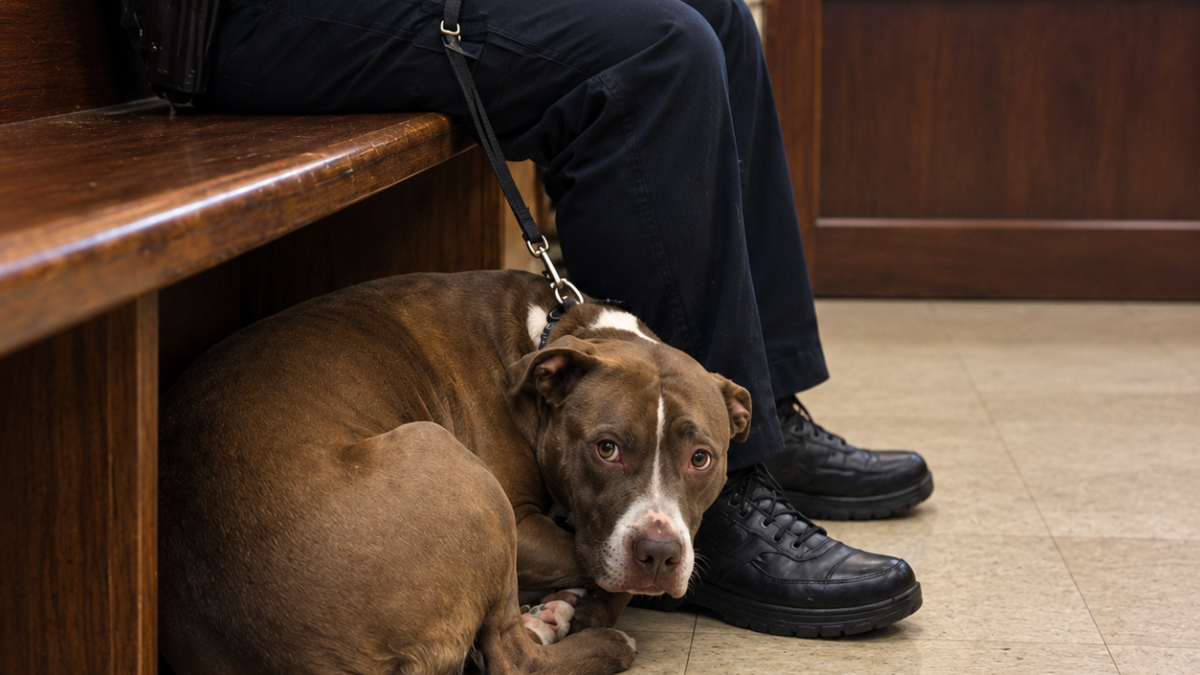
The pit bull had barely crossed the threshold of the Nashville juvenile courtroom when she passed the forty-seven-year-old man claiming to be her owner, tucked her tail so tightly beneath her body that her entire back curved, and urinated on the polished floor without making a sound. Seconds later, she saw the seventeen-year-old boy accused of kicking in that man’s back door to steal her, pulled toward him with such urgency that the deputy loosened the leash, and climbed directly into his lap while half the courtroom forgot how to breathe. I had walked into court expecting another routine burglary hearing, but before Judge Annette Caldwell said another word, I knew the frightened dog pressed against Elijah Vance was about to force everyone in that room to reconsider what the word “crime” meant that morning.
I was sitting in the third row with a notebook balanced on my knee and a press credential clipped to my jacket.
For two years, I had covered juvenile court in Davidson County for the Nashville Scene.
Most mornings followed a depressing rhythm.
Shoplifting.
Car theft.
Probation violations.
Fights.
Teenagers with exhausted parents or no parents sitting behind them at all.
By then, I had learned not to decide who someone was from the charge printed beside their name.
Elijah Vance made that lesson harder.
He was seventeen, thin, quiet, and wearing a borrowed white dress shirt that was too large around his neck. His public defender, Sarah Nolan, sat beside him.
Across the aisle was Gerald Faust.
Forty-seven.
Diesel mechanic.
Homeowner.
The alleged victim.
According to the police report, Gerald returned to his house off Dickerson Pike one October night and found his back door damaged.
Inside was Elijah.
And in Elijah’s arms was Gerald’s pit bull.
Nothing else had been taken.
Television untouched.
Laptop still on the table.
Cash still in a kitchen drawer Gerald told police had been partly open.
Elijah had one thing.
The dog.
The state charged him with burglary because he had entered a residence without permission.
Legally, that mattered.
Sarah’s defense was strange enough that I underlined it twice in my notes.
Entered to rescue dog. No intent to steal property.
Gerald called that ridiculous.
“He broke into my house,” he told the prosecutor loudly enough for me to hear before court began. “He doesn’t get to make himself some hero because he likes my dog.”
Elijah stared at the table.
Judge Caldwell entered.
Everyone stood.
The first twenty minutes were procedural.
Then Sarah made an unusual request.
“Your Honor, the defense asks that the animal be permitted inside.”
The prosecutor frowned.
Gerald sat forward.
Judge Caldwell looked over her glasses.
“The dog?”
“Yes, Your Honor.”
“For what evidentiary purpose?”
Sarah hesitated.
“I believe the court should observe her.”
Gerald shook his head.
“This is crazy.”
The judge heard him.
“Mr. Faust, if I need your commentary, I’ll ask for it.”
Silence.
Then she looked back at Sarah.
“This animal is not a witness.”
“No, Your Honor.”
“And behavior is open to interpretation.”
“I understand.”
Judge Caldwell studied the file.
Then she said, “Bring her in.”
The side door opened several minutes later.
An animal-control officer entered with a blue-gray pit bull on a leash.
She was smaller than I expected.
Her ribs were no longer sharply visible, but she was still thin. A pink healing mark circled part of her neck.
She walked cautiously.
Then she passed Gerald.
Her body collapsed inward.
Tail tucked.
Ears flattened.
Urine spread beneath her.
Gerald’s attorney shifted in his chair.
The officer stopped.
Judge Caldwell said nothing.
Then the dog saw Elijah.
Her head lifted.
She pulled once.
The officer looked toward the judge.
Judge Caldwell gave the smallest nod.
The leash loosened.
The dog crossed the courtroom.
Elijah’s face broke before she even reached him.
He dropped one hand toward the floor.
“Hey, girl.”
She climbed onto him.
Not beside him.
Onto him.
All fifty-something pounds.
Her front legs wrapped awkwardly across his waist, head buried beneath his chin.
Elijah closed both arms around her.
His shoulders began shaking.
And that was when Judge Caldwell leaned forward, looked first at the dog, then at Gerald Faust, and asked the question that changed the entire hearing.
“Mr. Faust,” she said, “when was the last time this dog had been examined by a veterinarian before the boy entered your home?”
PART 2
Gerald did not answer immediately.
That mattered.
Courtrooms train you to notice silence.
Not ordinary silence.
The kind that arrives after someone has been asked a question they should be able to answer easily.
Gerald looked toward his lawyer.
His lawyer leaned close and whispered something.
Judge Caldwell waited.
The dog remained pressed against Elijah.
Finally Gerald said, “I don’t remember.”
The judge’s expression did not change.
“Approximately.”
“I don’t know. A while.”
“A month?”
“No.”
“Six months?”
“Maybe.”
His lawyer touched his arm.
Gerald corrected himself.
“Longer, probably.”
“How much longer?”
“I’m not good with dates.”
Sarah stood.
“Your Honor, may I?”
Judge Caldwell nodded.
Sarah picked up a folder.
“Animal control records indicate the dog, then identified as Lady, had not received documented veterinary care in approximately twenty-two months.”
Gerald’s attorney rose.
“Objection. There may be private veterinary records not included in animal control’s file.”
Sarah looked at him.
“If there are, we requested them.”
The attorney’s mouth tightened.
Judge Caldwell looked toward Gerald.
“Are there?”
Gerald glanced down.
“No.”
The judge leaned back.
That did not decide Elijah’s case.
It couldn’t.
A dog being neglected does not automatically give a teenager legal authority to break into a home.
Judge Caldwell made that clear almost immediately.
She looked at Elijah.
“Mr. Vance, you understand that even if you believed the animal was in danger, entering a residence by force is not generally a lawful response.”
Elijah nodded.
“Yes, ma’am.”
His voice was almost too quiet to hear.
“What should you have done?”
“Called somebody.”
“Did you?”
A pause.
“Yes, ma’am.”
That got my attention.
So did the prosecutor’s.
Judge Caldwell looked at Sarah.
“Counsel?”
Sarah handed a document to the court clerk.
“Your Honor, that’s part of what the defense needs to present.”
I turned to a clean page in my notebook.
Until that moment, the case had looked emotionally complicated but legally straightforward.
A teenager sees a neglected dog.
Teenager makes a bad decision.
Teenager breaks into house.
Burglary charge follows.
But Sarah was about to show that Elijah had not started with the break-in.
He had started with phone calls.
The first was three days earlier.
A call to the county animal-control line from a prepaid cellphone registered to nobody.
The recording was available because the number had been logged automatically.
Sarah asked permission to play it.
The prosecutor did not object.
A young male voice filled the courtroom.
Elijah’s.
Younger somehow without his face attached to it.
“There’s a dog behind this house and she’s been tied up all day.”
The dispatcher asked for an address.
Elijah gave it.
“Is the animal injured?”
“I don’t know. She’s skinny.”
“Does she have access to water?”
“There’s a bowl.”
“Is there water in it?”
“I can’t see any.”
The dispatcher asked whether Elijah lived nearby.
There was a pause.
“Sort of.”
I looked at him.
He kept his eyes on the dog.
The recording continued.
The dispatcher explained that a complaint would be forwarded.
Elijah asked, “Will somebody come today?”
“I can’t guarantee response time.”
“She looks bad.”
“We’ve documented the complaint.”
The call ended.
Sarah stopped the recording.
Judge Caldwell looked toward the animal-control officer standing near the courtroom wall.
“Was there a response?”
The prosecutor stood.
“Your Honor, Officer Lewis can testify.”
Officer Dana Lewis was sworn in.
She had been the person holding the dog’s leash when Hope entered the courtroom.
She was in her thirties, hair pulled into a tight bun, uniform sleeves pushed to her elbows.
The prosecutor began.
“Officer Lewis, did your department receive a welfare complaint concerning Gerald Faust’s dog?”
“Yes.”
“When?”
“October sixth at approximately 4:20 p.m.”
“Did an officer respond?”
“Yes. I did.”
“What did you observe?”
Dana chose her words carefully.
“The property had a six-foot privacy fence. I could hear a dog but could not see into the rear yard from public property.”
“Did you contact the homeowner?”
“I knocked twice. No response.”
“Could you enter the yard?”
“Not without consent, a warrant, or circumstances establishing an immediate emergency I could independently verify.”
That was the kind of detail people leave out when they say somebody should have simply “done something.”
Government authority has limits.
Sometimes necessary limits.
Sometimes painfully inconvenient ones.
Dana continued.
“I left a notice requesting contact.”
“Did Mr. Faust contact animal control?”
“Yes.”
Gerald shifted.
“When?”
“The following morning.”
“And what did he tell you?”
“That the dog had food, water, and shelter and that the complaint was probably from a neighbor who had issues with him.”
Sarah rose.
“Did you return?”
“Yes.”
“When?”
“October seventh.”
“Were you permitted into the backyard?”
“No.”
“Why not?”
“Mr. Faust spoke to me from the front porch. He said the dog was inside at that moment.”
Sarah looked toward the pit bull in Elijah’s lap.
“Did you see the dog?”
“No.”
“So you could not assess body condition.”
“No.”
“Could not verify access to food.”
“No.”
“Water?”
“No.”
“Shelter?”
“No.”
“Any visible injuries?”
“No.”
“Because you never saw her.”
“That’s correct.”
Sarah returned to her table.
Then she produced the second call.
October eighth.
Same prepaid number.
Same voice.
Elijah.
This time more urgent.
“She’s still outside.”
“How long has she been out there?”
“I don’t know. Every time I come by.”
“Do you live at the property?”
“No.”
“Sir, you need to remain off private property.”
“I am. I’m in the alley.”
“Can you see water?”
“The bowl’s flipped over.”
“Shelter?”
“No.”
“There’s no doghouse?”
“No.”
“Shade?”
“Not really.”
A dispatcher again logged the complaint.
The courtroom listened to seventeen-year-old Elijah asking exactly the questions Judge Caldwell had just asked him.
Why hadn’t he called someone?
He had.
Twice.
Sarah stopped the recording.
Gerald leaned toward his attorney and whispered sharply.
Judge Caldwell noticed.
“So animal control had two complaints before the alleged burglary.”
“Yes, Your Honor,” Sarah said.
“When was the entry into the home?”
“October ninth, shortly after nine p.m.”
Judge Caldwell looked toward Elijah.
“And between the second complaint and October ninth?”
Sarah lifted another set of documents.
“That’s where the photographs come in.”
Elijah had taken nine pictures on his phone.
I saw copies later when portions of the juvenile record were made available for my reporting with identifying restrictions that were subsequently lifted after Elijah turned eighteen and consented to publication.
At the hearing, Sarah displayed them one by one.
The first showed the dog tied behind Gerald’s house.
Blue-gray coat.
Thin waist.
A rope running from her collar to a metal post.
No visible shelter.
The timestamp was October sixth, 3:48 p.m.
The second was after sunset.
Same position.
The third, next morning.
The fourth showed Elijah’s hand pushing a plastic container beneath the fence.
Water.
The fifth showed the dog drinking.
The sixth showed her neck.
The rope had rubbed a raw line through the fur.
The seventh was taken on October eighth during a light rain.
The dog was curled near the foundation of the house.
The eighth showed an empty food bowl.
And the ninth was the photograph that made Gerald stop looking at the screen.
A close image of the dog’s face through a gap in the fence.
Her eyes were open.
But there was no alertness in them.
She looked done.
I had seen that expression in human defendants.
Not sadness exactly.
Exhaustion beyond protest.
Sarah let the image remain.
“Mr. Vance,” Judge Caldwell said, “did you take these photographs?”
“Yes, ma’am.”
“Why?”
Elijah swallowed.
“So people would believe me.”
That sentence went through the room harder than anything dramatic could have.
So people would believe me.
Judge Caldwell asked, “Did you send them to animal control?”
Elijah’s face tightened.
“I tried.”
Dana Lewis looked toward him.
Sarah said, “He had limited data service. The online submission did not complete.”
“Did you know that?”
“No.”
“Why didn’t you go in person?”
Elijah looked embarrassed.
“I didn’t have a ride.”
“Public transportation?”
“I didn’t have money.”
The judge studied him.
That was when his own circumstances entered the case more fully.
Until then, Elijah had been legally defined by what he had done at 9:12 p.m. on October ninth.
A broken back door.
Unauthorized entry.
Dog in arms.
But the defense began showing the days around that moment.
Elijah’s mother had died two years earlier from complications related to diabetes.
His father had never been consistently involved.
He stayed with an aunt for several months.
Then with friends.
Then, after an argument in September, essentially wherever someone allowed him to sleep.
Couches.
A motel room shared by three people.
Occasionally a twenty-four-hour laundromat until someone asked him to leave.
At the time he encountered the dog, he was spending nights in an unfinished room above a friend’s uncle’s garage without formal permission.
He was not enrolled consistently in school.
No car.
No stable phone plan.
No adult sitting behind him in court.
The prosecutor did not dispute any of that.
He did, however, stand and make the point the law required him to make.
“Your Honor, sympathy cannot eliminate the elements of an offense.”
Judge Caldwell nodded.
“I’m aware.”
“The respondent admits he forced entry into an occupied residence.”
“Unoccupied at that moment,” Sarah corrected.
“Residence,” the prosecutor said. “The statute does not make private homes available for entry because someone believes property inside is being mistreated.”
Sarah stood.
“An animal is not merely a television.”
The prosecutor turned.
“I did not say that.”
“You called her property.”
“Legally, animals are treated as property in several relevant contexts.”
“And animal cruelty laws exist because they are not equivalent to a chair.”
Judge Caldwell raised a hand.
“Counsel.”
Both sat.
The dog—still called Lady in the official paperwork—lifted her head.
Elijah stroked the side of her neck.
The movement was careful.
No gripping.
No pulling her face toward him.
Nothing performative.
He barely seemed aware anyone else was watching.
Gerald was.
He was watching constantly.
And his face had changed.
The anger remained.
But underneath it I began seeing something else.
Embarrassment.
Maybe fear.
Maybe the realization that the case had stopped being only about his damaged door.
His lawyer asked to cross-examine Elijah.
Sarah leaned close to him.
They spoke briefly.
Then Elijah took the stand.
He looked even younger there.
Gerald’s attorney approached slowly.
“You knew the house did not belong to you.”
“Yes.”
“You knew you did not have permission to enter.”
“Yes.”
“You kicked the rear door.”
Elijah hesitated.
“Yes.”
“So you intentionally damaged Mr. Faust’s property.”
“I was trying to get inside.”
“That’s a yes.”
“Yes.”
“And then you removed his dog.”
“I picked her up.”
“Did she belong to you?”
“No.”
“Did Mr. Faust give her to you?”
“No.”
“So when police arrived, you were inside someone else’s house, without permission, holding property that did not belong to you.”
Sarah rose.
“Objection to characterization.”
“Sustained. Ask questions.”
The attorney nodded.
“Elijah, did you intend to leave with the dog?”
“Yes.”
That answer hurt the defense.
I saw Sarah’s jaw tighten.
Gerald’s attorney did too.
“So you intended to take her.”
“Yes.”
“Permanently?”
Elijah looked at the dog.
“I wanted to get her somewhere safe.”
“That was not my question.”
“I don’t know.”
“You entered the house because you wanted that dog.”
“I entered because she wasn’t outside anymore.”
This was new.
Judge Caldwell leaned forward.
“Explain that.”
Elijah looked at Sarah.
She nodded.
“I went by after dark.”
“What time?”
“Maybe eight-thirty.”
“The dog was not in the yard?”
“No, ma’am.”
“So why did you believe she was in danger?”
“I heard her.”
Gerald moved in his seat.
Elijah continued.
“From inside.”
“Heard what?”
“Crying.”
Gerald muttered something.
Judge Caldwell said, “Mr. Faust.”
He stopped.
The judge looked back at Elijah.
“You heard the dog vocalizing inside the house.”
“Yes.”
“What did it sound like?”
Elijah’s face changed.
“Like when she used to pull the rope.”
I wrote that sentence down.
The attorney resumed.
“You didn’t know she was injured.”
“No.”
“You didn’t know whether Mr. Faust had brought her inside to care for her.”
“No.”
“You didn’t call 911.”
Elijah said nothing.
“Did you?”
“No.”
“Instead, you kicked the door.”
“Yes.”
“So there were other legal options you did not use.”
Elijah looked down.
“Yes.”
That was the case in one answer.
He was not innocent of every bad choice.
The defense never claimed he was.
What they argued was that intent mattered.
Context mattered.
And what he believed he was preventing mattered when deciding how severely to punish him.
Sarah stood for redirect.
“Elijah, why didn’t you call 911?”
He looked embarrassed again.
“I thought they’d arrest me.”
“For what?”
He was silent.
Sarah waited.
“Why did you think police would arrest you?”
“I had a warrant.”
The room changed.
Judge Caldwell looked toward the prosecutor.
The prosecutor checked a file.
Sarah clarified.
“A failure-to-appear warrant on an earlier misdemeanor juvenile petition.”
“Yes.”
“What petition?”
“Shoplifting.”
“What did you allegedly steal?”
Elijah swallowed.
“Food.”
No one in the room needed Sarah to make a speech after that.
She didn’t.
“When you kicked in the door, did you know you could be arrested?”
“Yes.”
“Why do it?”
Elijah looked toward Hope.
Because by then, at least in my notes, I had stopped thinking of her as Lady.
“I thought she was going to die.”
Fourteen words in the source material would later become the quote everyone remembered.
In the courtroom, it was six.
“I thought she was gonna die.”
He said it without drama.
Like a fact.
Sarah sat.
The prosecutor called Gerald.
He was sworn in.
At first, his testimony helped him.
He had owned the dog for about three years.
He said he had adopted her from an acquaintance who could no longer keep her.
He worked long shifts at a diesel repair facility.
He said Lady usually stayed inside.
He admitted she had sometimes been tethered in the backyard.
“Sometimes?”
Sarah asked on cross-examination.
“Yes.”
“For how long?”
“Couple hours.”
“Every day?”
“No.”
Sarah held up Elijah’s time-stamped photographs.
“October sixth. Afternoon.”
Gerald looked.
“Okay.”
“October sixth after dark.”
No answer.
“October seventh.”
Gerald shifted.
“I worked overtime.”
“October eighth in rain.”
“I told you, I worked.”
“And while you worked, where was your dog?”
“Outside.”
“With shelter?”
“She could get under the overhang.”
Sarah enlarged one photograph.
The overhang extended maybe eighteen inches from the back wall.
“Under this?”
“Yes.”
“Did she have a doghouse?”
“No.”
“Covered kennel?”
“No.”
“Porch?”
“No.”
“Why not leave her inside?”
“She tore things up.”
The courtroom became still.
Sarah lowered the photograph.
“What did she destroy?”
Gerald seemed surprised by the question.
“What?”
“You said she destroyed things. What?”
“Stuff.”
“Furniture?”
“Yes.”
“What furniture?”
“My couch.”
“When?”
“I don’t remember.”
“Did you take photographs for insurance?”
“No.”
“Replace it?”
“No.”
Sarah looked toward the dog.
“How much did she damage the couch?”
Gerald’s attorney stood.
“Objection. This is becoming collateral.”
Judge Caldwell considered.
“Overruled for now.”
Gerald exhaled.
“She scratched it.”
“So you began tethering her outside for extended periods because she scratched your couch.”
“I didn’t say that.”
“What are you saying?”
“I’m saying I had problems.”
There it was.
Not villainy.
Not yet.
A tired man saying he had problems.
Sarah changed direction.
“Did you give Lady food on October sixth?”
“Yes.”
“Water?”
“Yes.”
“October seventh?”
“Yes.”
“October eighth?”
“Yes.”
Elijah’s photographs showed empty bowls.
Gerald blamed the dog.
“She knocked them over.”
Sarah asked, “Did you replace the water after she knocked it over?”
“When I got home.”
“What time?”
“Late.”
“How late?”
“Ten. Eleven.”
“So on an eighty-five-degree day, she may have had no water for several hours.”
“I don’t know when she knocked it over.”
“No.”
Sarah walked toward counsel table and picked up another folder.
“Do you recognize this?”
Gerald’s shoulders stiffened.
“What is it?”
“Veterinary report from the examination performed after Elijah’s arrest.”
Gerald’s attorney objected.
The report had already been admitted through stipulation.
Judge Caldwell allowed questioning.
Sarah read only the relevant findings.
Moderate dehydration.
Low body-condition score.
Pressure sores on both elbows.
Dermatitis.
Healing abrasion around the neck consistent with prolonged tether friction.
Overgrown nails.
Ear infection.
Weight below expected range.
Gerald said, “She was always skinny.”
Sarah looked at him.
“Always dehydrated too?”
His attorney stood.
“Argumentative.”
“Sustained.”
Sarah tried again.
“When was the last time you treated the ear infection?”
“I didn’t know she had one.”
“When did you first notice the wound around her neck?”
“I didn’t.”
“It was visible in a photograph taken three days before the break-in.”
“I don’t stare at my dog’s neck all day.”
The words left his mouth.
He seemed to realize too late how they sounded.
Sarah waited.
Sometimes the best cross-examination question is the one you don’t ask.
Gerald became angrier.
“I worked ten, twelve hours a day. I’m one person. Everybody in here acts like I woke up thinking about how to hurt a dog.”
Sarah said, “Did you?”
“No.”
“Did you want her to suffer?”
“No.”
“Then why didn’t you surrender her?”
Gerald stared.
That question seemed to hit somewhere different.
“I was going to figure it out.”
“When?”
“I don’t know.”
“Before or after she died?”
His lawyer shot up.
“Objection!”
“Sustained.”
Judge Caldwell looked sharply at Sarah.
“Counsel.”
Sarah nodded.
“I apologize.”
She stepped back.
Gerald was breathing heavily now.
I watched him and, against my own instincts, tried not to flatten him into a monster.
He worked.
He was apparently behind on bills.
Records later showed he had gone through a divorce the previous year and had missed several mortgage payments.
None of that excused the dog’s condition.
But cruelty is often easier to understand if we imagine sadists.
Neglect is frequently more ordinary and therefore more frightening.
Someone gets overwhelmed.
Something becomes inconvenient.
Care gets delayed.
Then normalized.
Then delayed again.
A living creature adapts until adaptation looks like permission.
Gerald testified that he had planned to give Lady away.
“Who to?” Sarah asked.
“A guy from work.”
“Name?”
He gave one.
The prosecutor checked with an investigator.
The coworker had not been listed earlier.
Judge Caldwell allowed a short recess.
During that break, I watched Elijah sit with the dog in a conference area visible through the open courtroom door.
He was not allowed to leave.
Hope lay with her chin on his shoe.
Gerald stood at the other end of the hallway.
He looked at her.
Once, I saw his face soften.
He took half a step forward.
Hope saw him.
She stood immediately.
Moved behind Elijah.
Gerald stopped.
That moment was not in the formal record.
I wrote it down anyway.
When court resumed, Gerald’s coworker joined by phone.
His name was Raymond Burke.
The prosecutor asked whether Gerald had offered him the dog.
Raymond hesitated.
“Kind of.”
“When?”
“A couple weeks before all this.”
“What did he say?”
“That he was tired of dealing with her.”
Gerald looked furious.
Raymond continued.
“He asked if I wanted her.”
“What did you say?”
“I said maybe, but my landlord doesn’t allow dogs.”
“Did Mr. Faust say anything about what he would do if you didn’t take her?”
Another pause.
Gerald’s lawyer objected to hearsay.
The court heard argument.
Judge Caldwell allowed the statement for a limited purpose because Gerald had opened the issue by testifying about his plan.
Raymond said, “He said he might just turn her loose.”
Gerald shook his head.
“That was a joke.”
Judge Caldwell said, “Mr. Faust.”
Raymond added, “I told him not to.”
The phone line went quiet.
That was the first time I saw the prosecutor look directly at Gerald rather than at the juvenile file.
The case had shifted again.
Elijah had broken the law.
But Gerald’s credibility was deteriorating.
Then came the neighbor.
Her name was Evelyn Price.
Sixty-eight years old.
Retired respiratory therapist.
She lived two houses away.
Evelyn had not initially wanted involvement.
According to Sarah, she changed her mind after seeing police take Elijah away.
She testified that she had noticed the dog tethered repeatedly for at least a month.
“Every day?” Sarah asked.
“No. I wasn’t watching every day.”
“When you did see her?”
“Usually tied.”
“Did you ever see Elijah?”
“Yes.”
Gerald looked at her sharply.
“When?”
“Two days before he got arrested.”
“What was he doing?”
“Giving the dog water.”
I looked at Elijah.
He stared at his hands.
Evelyn had taken a short cellphone video because she originally thought Elijah might be trespassing.
The video was admitted.
It showed him in the alley.
Not entering the yard.
Not climbing the fence.
He had a large bottle of water.
He poured some through a gap into a plastic container he had pushed beneath the fence.
The pit bull drank immediately.
Elijah whispered to her.
The phone’s microphone barely caught it.
“Slow down, girl.”
Then:
“I called. They’re gonna come.”
Hope’s head lifted at the recording.
The courtroom noticed.
She heard his voice.
The recorded Elijah said:
“You just gotta hold on.”
Seated Elijah lowered his head.
Sarah stopped the video.
Evelyn said something that stayed with me longer than the dramatic courtroom moment.
“I should have been the adult.”
Sarah looked at her.
“What do you mean?”
“I knew that dog didn’t look right.”
“You made a complaint?”
“No.”
“Why?”
“I thought somebody else probably had.”
The phrase again.
Somebody else.
I had heard it in neglected-building stories.
Homelessness reporting.
Abuse investigations.
Now here.
Somebody else knows.
Somebody else called.
Somebody else will fix it.
Evelyn wiped her eyes.
“That boy was seventeen years old and living God knows where, and he was the one bringing water.”
Gerald’s lawyer did not cross-examine her for long.
The prosecution requested another recess.
I went to the hallway and called my editor.
“You need more space.”
“How much?”
“A lot.”
“Is the dog really in court?”
“Yes.”
“And?”
I looked through the glass.
Hope was asleep with her head in Elijah’s lap.
“And I don’t know what the story is yet.”
My editor said, “That’s usually when it’s a good one.”
When I returned, Sarah was speaking quietly with the prosecutor.
Gerald and his attorney were doing the same.
Judge Caldwell had not come back to the bench.
Then something happened I had not expected.
Gerald walked toward Elijah.
A deputy immediately stepped closer.
Gerald stopped several feet away.
Hope woke.
Her body stiffened.
Elijah put one hand on her side.
Gerald looked at the dog.
“Lady.”
Hope backed against Elijah.
Gerald swallowed.
For the first time all morning, he did not look angry.
He looked tired.
“Come here.”
She didn’t.
Elijah did not restrain her.
Did not coax her.
Did nothing.
Hope chose stillness.
Gerald’s face reddened.
Then he looked at Elijah.
“You think you know her?”
Elijah said nothing.
“I had her three years.”
Still nothing.
Gerald’s voice dropped.
“You had her three days.”
Elijah finally looked up.
“She was thirsty.”
That was all.
Gerald opened his mouth.
Closed it.
The deputy said, “Sir, return to counsel.”
Gerald did.
Judge Caldwell returned ten minutes later.
She had reviewed a proposed agreement.
The burglary petition would not simply disappear.
Elijah had admitted damaging the door and entering without permission.
The state was willing, however, to amend the charge to criminal trespass with property damage addressed through restitution that accounted for Elijah’s limited circumstances.
No secure detention.
No commitment.
Supervised probation.
Attendance in a youth-support program.
Mental-health screening.
Educational placement.
Housing assistance referral.
The outstanding shoplifting matter would be incorporated into the disposition rather than used to hold him.
Judge Caldwell looked at Elijah.
“Do you understand this is not an acquittal?”
“Yes, ma’am.”
“You broke a door.”
“Yes.”
“You entered someone’s residence without legal authority.”
“Yes.”
“You had alternatives.”
Elijah’s jaw tightened.
“I tried them.”
The judge nodded.
“You tried some of them.”
That distinction was fair.
She continued.
“The court is not going to teach you that good motives give you unlimited permission to break laws.”
Elijah looked down.
“But the court is also not blind to motive.”
Hope moved closer.
Judge Caldwell looked toward Gerald.
“Nor is the court blind to why this animal was in the condition documented after the incident.”
Gerald’s attorney stood.
“Your Honor, the animal-welfare issue is separate.”
“It is.”
The judge’s tone sharpened.
“And it will remain separate.”
She looked at Officer Lewis.
“Has a cruelty investigation been opened?”
“Yes, Your Honor.”
Gerald turned toward his lawyer.
Judge Caldwell added, “I am not making findings in that matter today.”
Then she looked at the dog.
“This animal’s behavior is not proof by itself. I want that understood.”
I underlined that sentence.
She wasn’t ruling because a dog picked someone.
She was ruling on the evidence.
Calls.
Photographs.
Veterinary records.
Testimony.
The condition of the animal.
Elijah’s intent.
His circumstances.
The dog’s behavior had made the truth emotionally visible.
The rest of the case made it legally usable.
Then Gerald’s lawyer stood again.
“My client wishes to address ownership.”
Sarah looked surprised.
So did Elijah.
Gerald stared at the table.
His attorney said, “Mr. Faust is willing to execute a voluntary surrender of the animal to Metro Animal Care and Control.”
Elijah looked up.
Hope’s ears moved.
Judge Caldwell asked, “Voluntarily?”
Gerald’s jaw flexed.
“Yes.”
His lawyer whispered.
Gerald repeated it louder.
“Yes.”
Judge Caldwell turned to Officer Lewis.
“Can that be accomplished today?”
“Yes.”
Sarah rose.
“Your Honor, the defense would ask that Elijah be considered for placement with the dog once his housing is stable.”
The prosecutor almost smiled.
“Counsel, your client currently lacks housing.”
“I am painfully aware.”
Elijah looked alarmed.
Not because he didn’t want Hope.
Because for the first time, keeping her had become a possibility.
Judge Caldwell said, “Mr. Vance.”
“Yes, ma’am.”
“Do you want responsibility for this dog?”
He looked at Hope.
“Yes.”
“Wanting a dog and being capable of caring for one are different questions.”
“I know.”
“Food costs money.”
“I know.”
“Veterinary care costs money.”
“Yes.”
“Housing that permits animals is harder to find.”
“Yes.”
“Are you prepared for someone to tell you no?”
Elijah swallowed.
“Yes.”
Judge Caldwell watched him.
“Are you prepared to earn a yes?”
His answer came faster.
“Yes, ma’am.”
That was the moment Elijah started crying.
Quietly.
He turned his face away.
Hope lifted herself and pushed against his chest.
The bailiff stared at the wall.
Officer Lewis wiped beneath one eye.
Even Gerald looked away.
The surrender paperwork was brought in.
Gerald signed.
His hand shook once.
Then he pushed the paper away.
I expected satisfaction.
I felt none.
Watching someone lose ownership of an animal because he had failed to care for her was not triumphant.
It was sad.
Necessary can still be sad.
Gerald stood.
Before leaving, he looked toward Hope.
“Lady.”
Her head turned.
That was the first response she had given him.
He swallowed.
“I’m sorry.”
Whether he meant it, I couldn’t know.
Whether Hope understood, impossible.
She watched him for a second.
Then put her head back in Elijah’s lap.
Gerald left.
The hearing resumed.
Elijah accepted the amended disposition.
The judge ordered restitution of $620 for the damaged door, but structured it through a payment plan and permitted verified community-service credit depending on program rules.
He was assigned a case manager.
A youth advocate named Marcus Bell met him before he left the courthouse.
Marcus was not soft-spoken.
“First problem,” he said, looking at Elijah’s paperwork. “Where are you sleeping tonight?”
Elijah shrugged.
“That’s not an address.”
Elijah looked embarrassed.
Marcus waited.
“Friend’s garage.”
“Legal?”
Silence.
Marcus nodded.
“So no.”
He pulled out his phone.
“We fix that before anything else.”
Elijah looked toward Hope, who was now back on Officer Lewis’s leash.
“Where’s she going?”
Officer Lewis answered.
“Temporary foster.”
“For how long?”
“Until we know what permanent placement is appropriate.”
Elijah’s face fell.
“You said—”
Sarah interrupted gently.
“Nobody said you could take her today.”
Hope pulled toward him.
Elijah looked close to panic.
Officer Lewis crouched.
“Elijah.”
He looked at her.
“She is not going back to Gerald.”
That mattered.
I saw it land.
“She is safe tonight.”
He nodded.
“Okay.”
“And if you want to be considered for adoption, you stay in touch with me. You stay in your program. You get housing that allows her. You show us you can care for her.”
Elijah wiped his face with his sleeve.
“Okay.”
Officer Lewis smiled slightly.
“Good.”
Elijah crouched.
Hope immediately came into his arms.
“I’m gonna come get you.”
Sarah looked at him.
“Elijah.”
He corrected himself.
“I’m gonna try.”
Better.
The courthouse slowly emptied.
I remained.
Journalists are often the last unwanted people in a room.
Elijah eventually noticed me.
“You writing about this?”
“Maybe.”
His expression closed.
“Why?”
“Because it matters.”
“To who?”
Fair question.
“To people who think court cases are always as simple as the charge.”
He scratched Hope’s ear.
“Don’t make me sound stupid.”
“I won’t.”
“Or homeless.”
I hesitated.
“I can’t promise not to mention housing. It mattered today.”
He looked away.
“I hate that word.”
“What word?”
“Homeless.”
“Why?”
“Makes it sound like that’s what I am.”
I closed my notebook.
“What would you call it?”
He thought.
“Between places.”
I wrote that down later.
Not then.
Then I said, “Okay.”
He looked skeptical.
“You really work for a newspaper?”
“Yes.”
“You get paid?”
“Technically.”
That got the smallest smile.
Then Officer Lewis had to take Hope.
The separation was difficult.
Hope planted her feet.
Elijah whispered to her.
She resisted the leash.
Officer Lewis did not drag her.
They waited.
Finally Elijah walked with them to the side entrance.
He helped Hope into the transport vehicle.
Before the door closed, she pushed her nose through the opening toward him.
He put two fingers against it.
“I’ll see you.”
The door shut.
Elijah stood there after the vehicle left.
No dog.
No family.
No place he was sure he could sleep.
Only a court order and the first real possibility I had seen all day that someone might help him before he got worse.
Marcus, the youth advocate, walked up.
“You hungry?”
Elijah shrugged.
Marcus said, “That means yes.”
They left for lunch.
I filed my story that night.
It was longer than my editor wanted.
He cut three hundred words.
I accused him of vandalism.
He restored one hundred.
Journalistic compromise.
The piece ran the following morning.
The reaction was immediate.
Some readers called Elijah a hero.
Others called him a burglar.
Some said Gerald deserved jail.
Others argued a teenager cannot break into houses whenever he disapproves of pet care.
The judge had been wiser than the comments.
Two things could be true.
Elijah had broken the law.
And Elijah had prevented a neglected animal from remaining in a dangerous situation.
The harder question was what society should do with a seventeen-year-old who made an illegal choice after legal systems failed to move fast enough.
The court chose not to pretend the break-in was acceptable.
It also chose not to destroy him for it.
I followed the case.
Partly professionally.
Partly because I couldn’t stop thinking about the dog.
Hope went into foster care with a couple named Denise and Carla Morgan.
They lived twenty minutes outside downtown and had fostered bully breeds for years.
Officer Lewis gave me their contact information only after they agreed to speak.
Denise met me at the door.
Hope barked once.
Then retreated behind Carla.
Different dog from the courtroom.
Not because she had become aggressive.
Because I was a stranger.
Carla tossed a treat near her.
Hope ate it.
Another closer.
Eventually Hope approached enough to smell my shoe.
“That’s progress,” Carla said.
“How was the first night?”
“She slept standing up.”
I thought I’d misheard.
“What?”
“Not literally all night. But every time she started to lie down, she’d pop back up.”
“Why?”
Denise said, “Hypervigilance.”
Hope looked toward the kitchen.
“She didn’t believe she could relax.”
That first week, she hoarded food.
Not aggressively.
She carried pieces of kibble away and hid them beneath blankets.
She startled when Carla picked up a broom.
She was afraid of the back door.
Not doors generally.
That door.
Nobody knew why.
She liked couches.
She adored warm laundry.
And the first time the Morgans left a water bowl outside and came back ten minutes later, Hope drank almost the entire thing.
Then stood over the empty bowl.
Carla refilled it.
Hope drank again.
She repeated this until they had to slow her down.
“She didn’t trust water to stay,” Denise told me.
That sentence became the title of my follow-up notes.
Meanwhile Elijah entered a transitional youth program.
The first placement lasted eleven days.
Then another resident accused him of stealing headphones.
Elijah denied it.
A staff search found the headphones beneath someone else’s mattress.
No consequence for Elijah.
But by then he had packed his backpack.
Marcus stopped him at the door.
“You leaving?”
“They think I stole.”
“They found them.”
“Doesn’t matter.”
“It matters to me.”
Elijah told me this months later.
At the time, I only knew the placement nearly failed.
Marcus persuaded him to stay one more night.
Then another.
Trust, I learned, was not only Hope’s problem.
Elijah expected institutions to eject him.
So he left first.
Expected adults to stop answering.
So he stopped calling.
Expected help to become punishment.
So he hid what he needed.
Marcus refused to play along.
When Elijah missed a meeting, Marcus showed up.
When Elijah ignored two calls, Marcus sent:
I’m annoying by profession. Call me.
Elijah eventually did.
A month after court, he had a room in a supervised transitional house.
Tiny.
Bed.
Desk.
Closet.
Shared kitchen.
But legal.
Stable.
His own key.
He showed it to me during an interview.
“I’ve never had a key that was just mine.”
He immediately looked annoyed with himself for saying something personal.
I pretended to be interested in my coffee.
“What about work?”
“Marcus got me an interview.”
“Where?”
“Bike shop.”
“You know bicycles?”
“No.”
“How’d the interview go?”
“They said that might be a problem.”
I laughed.
“So?”
“They hired me to clean and stock.”
The owner, Peter Grayson, had read about the case.
That made me nervous.
Charity can become a cage of its own when people hire someone only because they like a story.
I asked Peter directly.
“Did you hire him because of the article?”
“Got him in the door.”
“And after that?”
“He showed up early.”
“That’s the standard?”
“You’d be surprised.”
Peter later taught Elijah basic repair.
Tires.
Chains.
Brake pads.
Then more.
Elijah liked mechanical work.
It required rules.
If this part is loose, tighten it.
If the chain skips, find why.
Machines were easier than people because broken things did not pretend otherwise.
The biggest obstacle remained Hope.
The transitional residence did not ordinarily allow pets.
Elijah asked anyway.
The answer was no.
He asked again.
No.
Marcus helped him apply for a different youth housing program with limited pet accommodations.
Waiting list.
Six weeks.
Elijah nearly gave up.
“I told you,” he said when I met him outside the bike shop. “They’re gonna give her to somebody.”
“Has animal control told you that?”
“No.”
“Then why assume it?”
“Because that’s what happens.”
He sounded angry.
I later realized anger was often what Elijah used when he was afraid.
“Have you visited Hope?”
“Every Saturday.”
“How’s she doing?”
“Better.”
“Does she remember you?”
He looked at me like I was stupid.
“Yes.”
I deserved that.
The Morgans documented the visits.
The first time Elijah arrived, Hope heard his voice before she saw him.
Carla told me she ran through the house so fast she crashed into a laundry basket.
When Elijah came through the door, she jumped against him.
Same courtroom behavior.
No hesitation.
After visits, she sat at the window.
Once for almost an hour.
Denise started crying while telling me.
“We foster dogs to let them go.”
I knew that sentence.
“You want him to get her.”
“I want what’s safe for the dog.”
“And?”
Denise smiled.
“I think she already decided what’s safe.”
Animal control still required more.
Emotion wasn’t enough.
Elijah needed housing.
Income.
A plan for veterinary care.
Food.
Supervision because he was a minor.
The rescue community helped with supplies, but officials were careful not to create a situation where a struggling teenager received a high-needs dog and then failed because everyone liked the symbolism.
Elijah hated the process.
“I already saved her.”
Officer Lewis told him, “That does not automatically mean you can support her for the next ten years.”
“I can work.”
“You are working.”
“I’ll buy food.”
“And veterinary emergencies?”
Silence.
“Annual vaccines?”
“I don’t know how much.”
“Flea prevention?”
He looked annoyed.
“Okay.”
“Licensing?”
“Okay.”
“Training?”
“She doesn’t need training.”
Hope chose that moment to pull toward another dog.
Dana raised an eyebrow.
“Everybody needs training.”
Elijah sighed.
“What do you want me to do?”
“Learn.”
So he did.
The Morgans made him participate in Hope’s care during visits.
Nail trimming.
Medication.
Food portions.
Leash handling.
Reading stress signals.
Hope was fearful around some men.
Particularly older men with heavy work boots.
Nobody needed to guess why.
She froze around chain noises.
She hated being tethered even briefly.
When a trainer clipped a long line to a post for a controlled exercise, Hope panicked so badly they stopped immediately.
Elijah knelt beside her.
“No more.”
The trainer said, “Correct.”
Elijah looked surprised.
“I thought training means she has to get over it.”
“Training means we help her function. It doesn’t mean forcing her to relive something because humans like dramatic progress.”
I wrote that sentence down too.
By January, Elijah had passed his GED practice tests.
The first actual test he missed because the bus broke down.
The old Elijah might have vanished.
Instead, he called Marcus.
“I’m gonna be late.”
Marcus drove him.
He passed three sections.
Missed math by four points.
He was furious.
Peter at the bike shop gave him a used workbook.
“Do it again.”
Elijah did.
Passed.
The housing approval came two days later.
A studio apartment in a youth-supported complex.
Pets allowed with case-management approval.
The room was barely larger than Gerald’s living room.
It had a kitchenette, a small bathroom, one window, and absolutely no furniture besides a bed frame and donated mattress.
Elijah walked through it slowly.
Marcus handed him the key.
“Don’t lose it.”
Elijah grinned.
“I won’t.”
Then his expression changed.
“Can Hope come?”
Marcus smiled.
“That’s why Dana is downstairs.”
Officer Lewis came up with paperwork.
There would be a thirty-day trial placement.
Hope remained legally under rescue oversight during that period.
Home visits.
Training compliance.
Veterinary check.
No tethering.
Elijah looked insulted at the last one.
Dana said, “It’s standard.”
“I’m never tying her outside.”
“I know.”
“Ever.”
“I believe you.”
Hope arrived twenty minutes later.
The Morgans brought her.
Along with:
Bed.
Crate.
Food.
Toys.
Bowls.
Blankets.
Harness.
Medication.
A bag large enough for an expedition.
Elijah stared.
“Does she own more stuff than me?”
Carla looked around the empty apartment.
“By a lot.”
Hope entered cautiously.
She smelled the bed.
Kitchen.
Bathroom.
Window.
Then she looked at Elijah.
He sat on the floor.
“It’s not much.”
Hope walked to him.
Circled once.
Lay across his legs.
Denise cried.
Marcus pretended to inspect a cabinet.
Officer Lewis smiled.
I stood near the door with my notebook closed.
Some scenes become smaller when you immediately turn them into words.
Thirty days later, the adoption was finalized.
Elijah changed her name officially.
Not Lady.
Hope.
I asked why.
He shrugged.
“Carla called her that once.”
Carla corrected him.
“You started calling her that.”
“No.”
“Yes.”
“When?”
“In court.”
I checked my notebook later.
Carla was right.
During a break, Elijah had whispered:
“Hope, look at me.”
I had assumed it was just a word.
Apparently a name had started before anyone noticed.
Gerald’s separate animal-cruelty matter took longer.
Because this was not Elijah’s proceeding, my reporting had to be more careful.
Gerald eventually entered a plea on a misdemeanor animal-cruelty charge related to failure to provide adequate care.
He received probation, a fine, court costs, and restrictions on animal ownership during the probation period.
Some readers thought that was absurdly light.
Others thought the public humiliation had already exceeded the offense.
Gerald did not respond to my later interview requests.
Nearly a year after the juvenile hearing, he called me unexpectedly.
I almost didn’t answer because I didn’t recognize the number.
“This the reporter?”
“Yes.”
“This is Gerald Faust.”
I sat up.
“Mr. Faust.”
“You still writing about me?”
“Not currently.”
Silence.
Then:
“You made me sound like I hated that dog.”
I chose my words carefully.
“I wrote what was presented in court and what you said.”
“I didn’t hate her.”
“I never wrote that you did.”
Another silence.
“I was in a bad place.”
I waited.
“My wife left. I was working all the time. House was behind. Lady kept tearing stuff up.”
“Hope.”
“What?”
“Her name is Hope now.”
He exhaled sharply.
“Fine. Hope.”
I didn’t correct him again.
“I should’ve given her up.”
“Yes.”
No journalistic neutrality required pretending the obvious was uncertain.
Gerald continued.
“I know that now.”
“Why are you calling me?”
He was quiet long enough that I checked whether the call had dropped.
Then he said, “Is the kid okay?”
That surprised me.
“Elijah?”
“Yes.”
“He’s eighteen now.”
“Is he okay?”
“As far as I know.”
“And the dog?”
“Healthy.”
Gerald said nothing.
I heard machinery behind him.
Probably the shop.
Then:
“Good.”
That could have been the end.
Instead he said, “I saw the picture.”
“What picture?”
“The one in your follow-up.”
Elijah sitting outside the bike shop.
Hope leaning against him.
“She looks bigger.”
“She gained weight.”
“Yeah.”
Another pause.
“She used to sleep on my bed.”
I didn’t know what to do with that.
The story people wanted had clean edges.
Bad owner.
Good teenager.
Wise judge.
Saved dog.
Reality kept refusing simplicity.
“Before?”
I asked.
“Before what?”
“Before you started keeping her outside.”
Gerald’s voice tightened.
“Yeah.”
“What changed?”
“I told you. Everything.”
His wife left.
Money.
Work.
Anger.
The dog became another thing demanding something from him.
He began putting her outside during long shifts.
Then overnight.
Then tethering became normal.
Food became irregular.
Vet appointments became expenses he postponed.
He did not wake up one morning and decide to torture her.
He let care erode.
That was worse in a different way.
Because millions of failures begin exactly like that.
Not hatred.
Neglect dressed as temporary compromise.
“I kept thinking I’d fix things next week,” Gerald said.
I looked at my notes without seeing them.
“And then?”
“There was always another week.”
The line stayed with me.
I asked if I could quote him.
“No.”
“Then this stays off record?”
“Yes.”
I kept it off record until years later, when Gerald gave written permission after I reached out again for a retrospective piece.
Before hanging up that first time, he asked:
“Does she still do that thing?”
“What thing?”
“Put her whole body on somebody like she weighs ten pounds.”
I smiled.
“Yes.”
Gerald laughed once.
Very quietly.
“She always did that.”
Then:
“Tell the kid…”
He stopped.
“What?”
“Nothing.”
The call ended.
I never told Elijah about it then.
It wasn’t mine to deliver.
By spring, Elijah had been at the bike shop six months.
He could rebuild a basic commuter bike almost entirely by himself.
Peter increased his hours.
Elijah began saving.
The first major thing he bought wasn’t furniture.
It was a veterinary wellness plan for Hope.
Marcus teased him.
“You have no table.”
“I got a chair.”
“You found a chair in the alley.”
“Still a chair.”
“You have one plate.”
“I wash it.”
Hope had:
Three beds.
Two harnesses.
Five toys.
A veterinary plan.
Premium dog food.
Elijah had:
One folding chair.
One plate.
A mattress.
Priorities.
His probation reviews improved.
No new charges.
Restitution payments small but consistent.
GED completed.
Housing stable.
The judge noticed.
At the six-month review, Hope was not allowed into the courtroom.
Judge Caldwell asked anyway.
“How is the dog?”
Elijah smiled.
“Good.”
“Still running your household?”
“Yes, ma’am.”
“Employment?”
“Still at the shop.”
“Education?”
“GED finished.”
“Restitution?”
The clerk gave the amount.
Judge Caldwell nodded.
Then she said something that sounded ordinary but meant more than it appeared.
“Mr. Vance, this is what progress looks like.”
Elijah looked down.
“Thank you.”
Afterward, I asked him how that felt.
“What?”
“The judge saying you’re doing well.”
He shrugged.
“You hate praise.”
“It’s weird.”
“Why?”
“Usually adults tell me what I did wrong.”
That line became the center of my second feature.
Not the dog.
Elijah.
Because by then I had realized the courtroom had not really been a story about an animal choosing a teenager.
It was about what happened after somebody chose him too.
Judge Caldwell did not excuse his conduct.
Sarah did not magically solve his life.
Marcus did not adopt him.
Peter did not rescue him.
They did something less dramatic and harder to photograph.
They gave him structure without deciding he was hopeless.
A chance with conditions.
Expectations with help.
Consequences without abandonment.
Hope’s recovery happened in parallel.
At first, she followed Elijah everywhere.
Bathroom.
Kitchenette.
Hallway.
Laundry room.
If he closed a door, she waited outside.
If he left for work, Denise initially came by to help.
Hope paced.
Stared at the door.
Whined.
The trainer called it separation distress.
Elijah took it personally.
“She thinks I’m leaving.”
“She thinks people leave,” the trainer corrected.
“That’s different.”
It was.
He practiced departures.
Thirty seconds.
Return.
Two minutes.
Return.
Five.
No dramatic goodbye.
No frantic reunion.
Hope learned something Elijah was learning too.
Someone leaving did not always mean they were gone forever.
One Saturday, I interviewed him at the apartment.
Hope slept across the doorway.
“Why there?” I asked.
“She likes watching both rooms.”
“There are only two rooms.”
“Exactly.”
I sat on his single folding chair.
He sat on the floor.
“Are you planning to buy furniture?”
“Eventually.”
“You’ve said that for four months.”
“Hope likes floor space.”
“Hope owns the apartment.”
“Basically.”
She opened one eye.
I asked something I had avoided.
“Do you regret breaking in?”
Elijah was silent.
I expected an easy no.
He surprised me.
“Sometimes.”
“Why?”
“I could’ve messed everything up.”
“For yourself?”
“For her.”
He scratched Hope’s chest.
“What if Gerald had pressed harder?”
“He did press charges.”
“What if the judge locked me up?”
“Juvenile detention.”
“Same difference to Hope.”
Fair.
“She could’ve ended up somewhere else.”
“Yes.”
“So would you do it again?”
He looked at me.
“I’d call more people first.”
I laughed.
“That sounds like Marcus.”
“He says if I tell anyone I’d kick the door again, he’ll personally arrest me.”
“Marcus cannot arrest people.”
“He thinks he can do anything.”
Hope rolled over.
Elijah rubbed her belly.
Then he said:
“But if I knew she was dying and nobody was coming?”
I waited.
He didn’t finish.
He didn’t need to.
Hope became a familiar sight around the bike shop.
Peter initially said no dogs during work hours.
Then Hope spent one afternoon behind the counter because Elijah had a scheduling problem.
Then another.
Within months there was a water bowl with her name painted on it.
Peter denied responsibility.
Customers brought treats.
A little boy afraid of dogs eventually learned to offer Hope one with an open palm.
A woman who came in for tire repairs knelt beside her for ten minutes because she had recently lost her own pit bull.
Hope had once been invisible behind a privacy fence.
Now people knew her by name.
Not everyone approved.
The original story still circulated.
Every few months someone online accused Elijah of being rewarded for burglary.
Others called for Gerald to receive harsher punishment.
Elijah stopped reading comments.
Best decision he made.
“I read one where somebody said I planned the whole thing for attention.”
“You had twelve followers.”
“Eleven.”
“Exactly.”
“Marcus followed me after court.”
“So twelve.”
He smiled.
A year after the hearing, Sarah invited Elijah to speak privately to a small group of law students working in juvenile defense.
He nearly refused.
“I don’t talk in front of people.”
“You talked to a judge.”
“She made me.”
“Good practice.”
Hope came with him.
Of course.
One student asked, “What should your lawyer have done differently?”
Sarah glared jokingly.
Elijah thought.
“Nothing.”
Sarah relaxed.
Then Elijah added:
“Maybe explained stuff slower.”
Everyone laughed.
Sarah did not.
She wrote it down.
Another student asked, “What helped you most?”
Elijah looked toward Marcus, sitting in the back.
“The annoying guy.”
Marcus raised a hand.
“Professional designation.”
Then Elijah became serious.
“He kept showing up.”
That was it.
He kept showing up.
The phrase connected everything.
Elijah showing up at Gerald’s fence.
Again.
Again.
Calling animal control.
Returning with water.
The Morgans showing up for Hope.
Marcus showing up when Elijah missed meetings.
Peter showing up with work.
Elijah showing up for probation.
For his GED.
For the dog.
None of the changes were one dramatic rescue.
They were repetition.
The right kind.
Two years passed.
I left the juvenile-court beat.
Not because of this case.
Burnout.
There are only so many mornings you can watch children arrive in handcuffs before the stories follow you home.
I moved to longer features.
Housing.
Labor.
Criminal justice.
Occasionally animals.
Elijah and I stayed loosely in contact.
Mostly because he would send me photographs of Hope doing absurd things.
Hope wearing a bicycle-shop apron.
Hope asleep on a stack of towels.
Hope refusing to walk in rain.
Hope occupying Elijah’s entire mattress while he slept against the wall.
My favorite arrived without caption.
Elijah had bought a small couch.
A real one.
Secondhand.
Hope sat in the center.
Elijah was squeezed into the corner.
I replied:
Glad the furniture helped.
He wrote:
She likes it.
At twenty, Elijah became a full-time bicycle mechanic.
At twenty-one, he moved out of youth housing into a small duplex.
Fenced backyard.
Hope stepped onto the grass and froze.
Not from fear.
Elijah sent me a video.
She smelled the air.
Walked to the center.
Rolled.
Back and forth.
Legs in the air.
Elijah laughed behind the camera.
“Girl, you have a whole yard.”
Hope sneezed.
Rolled again.
For a dog once tied in a yard she could not escape, ownership of open space seemed almost obscene in its beauty.
I visited them a month later.
The duplex was modest.
Used furniture.
Bike parts in the kitchen.
Hope’s bed by the window.
Elijah had framed one thing from the case.
Not my newspaper article.
Not a courtroom photograph.
The first animal-control welfare report.
I stared at it.
“Why keep this?”
He looked embarrassed.
“Read the bottom.”
The report showed the initial complaint.
Caller unidentified.
Concern: dog tethered without visible water.
Status: attempted contact.
Elijah tapped the page.
“That’s the first time anybody wrote down she was there.”
I understood.
Before Hope became a courtroom story, she had been one line in a system.
A complaint number.
Elijah had been the anonymous voice attached to it.
“You know Gerald called me once.”
The words came out before I planned them.
Elijah stopped.
“When?”
“Long time ago.”
“What did he want?”
I hesitated.
By then Gerald had allowed portions of our off-record conversation to be used in later reporting, but this was different.
“Wanted to know if you were okay.”
Elijah stared.
“Why?”
“I don’t know.”
Hope entered from the hallway.
Elijah looked down at her.
“Did he ask about her?”
“Yes.”
“What’d you say?”
“She was healthy.”
Elijah’s face became unreadable.
Then:
“Good.”
Same word Gerald had used.
I almost mentioned that.
Didn’t.
Some parallels don’t need pointing out.
Elijah sat.
“Do you think he was sorry?”
“I think people can regret something and still be responsible for it.”
“That’s reporter talk.”
“It’s accurate.”
He rubbed Hope’s shoulder.
“I used to hate him.”
“And now?”
“I don’t know him.”
That might have been healthier.
A year later, Gerald contacted Elijah directly.
I only learned because Elijah called me afterward.
“How’d he get my number?”
“I don’t know.”
“What did he want?”
“To see Hope.”
That surprised me.
“What did you say?”
“No.”
“Immediately?”
“Yes.”
“How do you feel about it?”
“Mad.”
“Anything else?”
Elijah went quiet.
“Bad.”
“For Gerald?”
“No.”
He sighed.
“Maybe.”
Hope was older by then.
Healthy.
Confident.
But still frightened by certain noises.
Still hated chains.
Still reacted to older men wearing heavy boots sometimes.
Elijah did not owe Gerald access.
Hope certainly didn’t.
Two months later, Gerald wrote him a letter.
No request to visit.
No defense.
Elijah showed me a copy years afterward.
It was short.
Gerald wrote that he had not treated Hope the way she deserved.
That Elijah had been right about her condition.
That breaking into his house had still been wrong.
Elijah laughed when he read that line.
“Had to get that in there.”
But the letter continued.
Gerald wrote:
You were seventeen and saw what I had stopped seeing.
Then:
I kept thinking I had more time to get my life straight and take better care of her. I didn’t understand that she was living every bad day while I waited for a better one.
Elijah kept the letter.
He never replied.
I asked why.
“What would I say?”
“I don’t know.”
“Neither do I.”
Hope developed arthritis around age nine or ten.
No one knew her exact age.
Her muzzle whitened.
Elijah started lifting her into the car.
The dog who once climbed into his lap in court became an older dog who required help with stairs.
Their roles shifted.
He monitored medications.
Bought orthopedic beds.
Learned what a heart murmur meant.
Called the veterinarian too often.
I teased him.
“You’ve become somebody’s worried parent.”
“Shut up.”
Hope had also become more relaxed with strangers.
Not everyone.
She remained selective.
But the full-body fear around adult men diminished.
One afternoon I visited while a plumber worked in the kitchen.
Older man.
Heavy boots.
Ten years earlier, that combination would have terrified her.
Hope watched from the hallway.
The plumber crouched.
“Hey, girl.”
She stayed.
He went back to work.
Twenty minutes later, Hope walked over and smelled his toolbox.
Then his hand.
Elijah saw.
He looked at me.
Neither of us said anything.
Healing rarely announced itself.
Sometimes a dog simply walks toward a pair of boots.
Judge Caldwell retired several years after Elijah’s case.
Her staff organized a small reception.
Former attorneys.
Court workers.
Community groups.
Marcus invited Elijah.
He refused at first.
Then changed his mind.
Hope came.
Older.
Gray around the face.
Judge Caldwell saw them across the room.
She smiled.
“Well.”
Elijah approached.
“Hi, Judge.”
“I’m retired. Annette works.”
Elijah looked uncomfortable.
“Judge is fine.”
She laughed.
Hope smelled her hand.
The judge scratched gently beneath her chin.
“You caused a lot of paperwork.”
Elijah said, “She didn’t kick the door.”
“No. That was you.”
He smiled.
The judge looked at him.
“I heard you became a mechanic.”
“Bikes.”
“Still working?”
“Yes.”
“Good.”
Elijah hesitated.
“Can I ask you something?”
“Of course.”
“Were you gonna lock me up before she came in?”
I expected the judge to dodge.
She didn’t.
“I hadn’t decided.”
Elijah looked at Hope.
“Did she change your mind?”
Judge Caldwell considered.
“She changed the temperature in the room.”
“What does that mean?”
“It means everyone suddenly understood emotionally what the documents had been saying.”
“But?”
“But judges should not decide cases based on emotion alone.”
Elijah nodded.
“What changed my mind,” she continued, “was the evidence and what disposition gave you the best chance not to come back to my courtroom.”
Elijah smiled.
“I didn’t.”
“I noticed.”
That mattered to him more than he admitted.
Before leaving, Judge Caldwell said:
“You know the part people misunderstand?”
“What?”
“They think I gave you a break.”
Elijah looked uncertain.
“Didn’t you?”
“I gave you work.”
He laughed.
She pointed gently toward him.
“Supervision. Program participation. Restitution. School. Housing rules.”
“Yeah.”
“You did it.”
Elijah became quiet.
Judge Caldwell added:
“The opportunity mattered. So did what you did with it.”
Hope leaned against his leg.
There it was again.
The dog as punctuation.
Years kept moving.
Hope turned slower.
Slept more.
Her fear of water bowls disappearing had vanished completely.
Elijah kept two anyway.
One in the kitchen.
One by the bedroom.
“Why two?”
I asked.
“She likes options.”
“You’re traumatized.”
“Probably.”
Hope developed kidney disease in old age.
Then a mass near her shoulder.
Benign.
Then another near her ribs.
Also benign.
Elijah called me after each biopsy as though I had medical qualifications.
“I write sentences.”
“You know people.”
“That does not make me a veterinarian.”
“You covered her case.”
“Thirteen years ago.”
“Still.”
By then Elijah was thirty.
Thirty.
The teenager from the courtroom had lines beginning around his eyes.
The dog in his lap had a white face.
Marcus had retired from youth services.
Peter sold the bike shop to two employees, one of whom was Elijah.
Not given.
Bought.
Small business loan.
Savings.
Years of work.
The first day his name appeared on the shop paperwork, Elijah sent me a photograph.
VANCE & RIVERA CYCLES
Hope sat beneath the sign.
I called him.
“You own a business.”
“Part of one.”
“You had one folding chair.”
“I have four chairs now.”
“Corporate success.”
“Hope has two couches.”
“Of course.”
Hope died the following winter.
I wish there were a surprising way to write that.
There isn’t.
Old dogs die.
That fact is simple.
The experience isn’t.
Elijah called me early on a Sunday.
I knew from his silence.
“Hope?”
“Yeah.”
“Do you want me to come?”
Long pause.
“Can you?”
I drove over.
Marcus was already there.
So were Carla and Denise.
Officer Lewis had retired but came anyway.
The room contained almost everyone connected to the day Hope walked into court.
Sarah arrived last.
No judge.
No Gerald.
That felt right.
Hope lay on an orthopedic bed near the window.
Her breathing was shallow.
Kidneys failing.
She had stopped eating two days earlier.
The veterinarian had discussed hospitalization.
Elijah chose home comfort.
That morning Hope could no longer stand.
He sat beside her.
Same position, almost, as the courtroom.
Except he was not seventeen.
And Hope could no longer climb into his lap.
So he lowered himself to her.
I sat against the wall.
Nobody talked much.
Denise brought an old photograph.
Hope’s first day in foster care.
Thin.
Nervous.
Elijah looked.
“Man.”
Carla said, “She was a disaster.”
“She still is.”
Hope’s ear moved.
We laughed.
The sound felt wrong for half a second.
Then right.
Sarah told the story about Elijah accidentally calling the prosecutor “man” instead of “sir” during a hallway argument.
Marcus told the story of the single plate.
Dana reminded everyone that Hope once stole half a sandwich from the animal-control office.
Elijah looked offended.
“You never told me that.”
“Professional confidentiality.”
Hope’s tail moved weakly.
The veterinarian arrived around noon.
A woman named Dr. Patel.
She examined Hope.
Spoke softly with Elijah.
He asked the questions everyone asks even when they already know.
“Could fluids give her more time?”
“Maybe.”
“How much?”
“Probably not meaningful time.”
“Pain?”
“We can manage some of it.”
“Can she get better?”
Dr. Patel did not lie.
“No.”
Elijah nodded.
Then asked:
“Can we do it here?”
“Yes.”
The first injection relaxed Hope.
Her breathing eased.
Elijah slid one arm beneath her neck.
She moved her head.
Slowly.
Then placed it across his thigh.
The room went silent.
I saw Sarah realize it first.
Then Dana.
Thirteen years earlier, the dog had entered a courtroom, crossed the space between Gerald and Elijah, and climbed into his lap.
Now, with almost no strength left, she had chosen the same place.
Elijah bent over her.
“Hey, girl.”
His voice broke.
Hope looked up.
He rubbed the white fur between her eyes.
“You did good.”
I turned away.
Reporters are supposed to observe.
There are moments when observation becomes intrusion.
I closed my notebook.
I had brought one out of habit.
I never opened it again that day.
Elijah whispered something into Hope’s ear.
I didn’t hear it.
I never asked.
Dr. Patel waited until he nodded.
Then Hope died with her head in his lap.
No courtroom.
No cameras.
No argument.
Just the people who had kept showing up.
Afterward, Elijah remained on the floor.
Marcus put one hand on his shoulder.
Nobody tried to move him.
Finally Elijah said:
“She peed in court.”
The room broke.
Laughter through tears.
Dana said, “All over my shoe.”
“I forgot that.”
“I didn’t.”
“She hated Gerald.”
Sarah corrected gently.
“She was afraid.”
Elijah nodded.
“Yeah.”
That difference mattered even after all those years.
Fear had started the story.
Safety had finished it.
Elijah had Hope cremated.
He kept the ashes at home for months.
Then he called me.
“Remember the courthouse?”
“Unfortunately.”
“There’s a little park near it.”
“I know.”
“Can dogs be buried there?”
“No.”
“Thought so.”
“What are you planning?”
“Nothing.”
I distrusted that answer.
He eventually decided not to scatter her ashes publicly.
Instead, he kept most of them in a plain wooden box.
The rest went beneath a tree in the yard of the duplex he had bought a few years earlier.
His house.
Not youth housing.
Not somebody’s garage.
Not a couch.
His name on the deed.
He planted a dogwood tree.
I visited in spring.
Small white flowers.
A metal tag hung loosely from one low branch.
HOPE
Nothing else.
No courtroom quote.
No newspaper headline.
No mention of rescue.
Just her name.
We sat on the back steps.
“You okay?” I asked.
“No.”
“Good answer.”
He smiled.
“I keep waking up because I think I hear her water bowl.”
“That happen often?”
“Every night.”
“It’ll change.”
“How do you know?”
“I’ve reported on enough grief.”
“That’s depressing.”
“Occupational hazard.”
He looked toward the tree.
“People still message me sometimes.”
“About the case?”
“Yeah.”
“What do they say?”
“That I saved her.”
He picked at the edge of the step.
“I hate that.”
“Why?”
“Because it makes it sound like one thing.”
I knew what he meant.
The break-in.
The courtroom.
The dog choosing him.
Clean story.
Viral story.
Wrong in its simplicity.
“You gave her water before you broke the door.”
“Yeah.”
“Animal control helped after.”
“Yeah.”
“The Morgans fostered.”
“Yeah.”
“Marcus helped you keep housing.”
“Yeah.”
“You worked.”
“Yeah.”
“She lived thirteen more years.”
Elijah smiled.
“Exactly.”
He looked at the tree.
“It wasn’t one rescue.”
No.
It never had been.
Two summers later, I was walking near Five Points after an interview when I saw Elijah outside the bike shop.
Older, obviously.
So was I.
He was talking to a teenager.
Maybe sixteen.
Backpack.
Dirty clothes.
Thin.
A small dog sat beside the kid.
I slowed.
Didn’t approach.
Elijah handed him a bicycle pump.
Showed him something near the rear wheel.
The teenager tried.
Failed.
Elijah adjusted his grip.
He tried again.
The tire inflated.
The kid smiled.
They talked.
I could not hear the words.
Then Elijah went inside and returned with a paper bag.
Food, probably.
The kid took it.
I stood across the street longer than necessary.
Elijah finally noticed me.
He raised one hand.
I crossed.
“New employee?”
“No.”
The teenager had already ridden away.
“Who was he?”
“Kid comes around.”
“Needs help?”
Elijah shrugged.
“Sometimes.”
I smiled.
“What?”
“Nothing.”
“You’re doing reporter face.”
“I don’t have a reporter face.”
“You definitely do.”
We went inside.
Near the register sat a photograph.
Not the courtroom.
Hope on the shop floor, gray muzzle on Elijah’s boot.
I pointed.
“Good picture.”
“Yeah.”
He glanced at it.
Then went back to repairing a bike.
No speech.
No grand reflection.
That was how life usually works after the story supposedly ends.
People keep going to work.
Dogs die.
Trees grow.
Teenagers become adults.
Adults who were once helped sometimes notice the next kid standing outside.
Years after that courtroom hearing, I went back through my old notebooks while cleaning my office.
I found the original.
October.
Davidson County Juvenile Court.
My handwriting was hurried.
Names.
Times.
Quotes.
Then one sentence circled twice:
Dog chooses boy.
I stared at it.
That was what I thought the story was.
A frightened pit bull entering court and revealing something people couldn’t say.
But I had been wrong.
Hope’s choice mattered.
It exposed fear.
Trust.
History written into an animal’s body.
But the larger choice came afterward.
The court chose not to reduce Elijah to the worst thing he had done.
Marcus chose to keep calling.
Peter chose to hire him.
The Morgans chose to prepare Hope for a life beyond fear.
Elijah chose, day after day, to meet the conditions attached to the second chance he had been given.
And Hope kept choosing him long after the courtroom stopped watching.
I turned the page.
Near the bottom was another note.
Something Judge Caldwell said after the formal disposition while paperwork was being collected.
I had not used it in the original article.
Maybe it sounded too sentimental then.
Maybe I had been younger and suspicious of anything that wrapped a story too neatly.
Her words were:
“The difficult part begins after everyone leaves this room.”
She had been right.
Court rulings take minutes.
Lives take years.
I closed the notebook.
A few months later, I drove past Elijah’s house on my way to another assignment.
I hadn’t planned to stop.
Then I saw him in the yard.
He was kneeling beneath the dogwood tree.
A new dog stood beside him.
Small.
Brown.
Older.
One ear missing a piece.
I pulled over.
Elijah saw me.
“Don’t start.”
“What?”
“It’s a foster.”
I laughed.
“Of course.”
“Temporary.”
“Sure.”
The dog approached slowly.
I held out my hand.
She smelled it.
Elijah scratched her neck.
“Shelter had no space.”
“How long?”
“Couple weeks.”
I looked at him.
He looked back.
Then both of us looked toward Hope’s tree.
The little dog walked beneath it and lay down in the shade.
Elijah sighed.
“Don’t say anything.”
“I wasn’t going to.”
“You were.”
“Maybe.”
The wind moved through the branches.
Hope’s metal tag tapped softly against the bark.
Not loud.
Just enough for us to hear.
Elijah looked up.
For one second, he was seventeen again in my mind.
Borrowed shirt.
No address.
Dog in his arms.
Terrified of what would happen when the hearing ended.
Then the image disappeared.
He was a grown man standing in his own yard.
Keys in his pocket.
Work waiting the next morning.
A frightened foster dog sleeping safely beneath a tree.
He crouched and called softly.
“Come on, girl.”
The dog stood.
Walked toward him.
And together they went inside.
[END OF STORY]








