PART 2: A Moose Kept Ramming Cars on a Washington Highway—Then We Saw What She Was Guarding
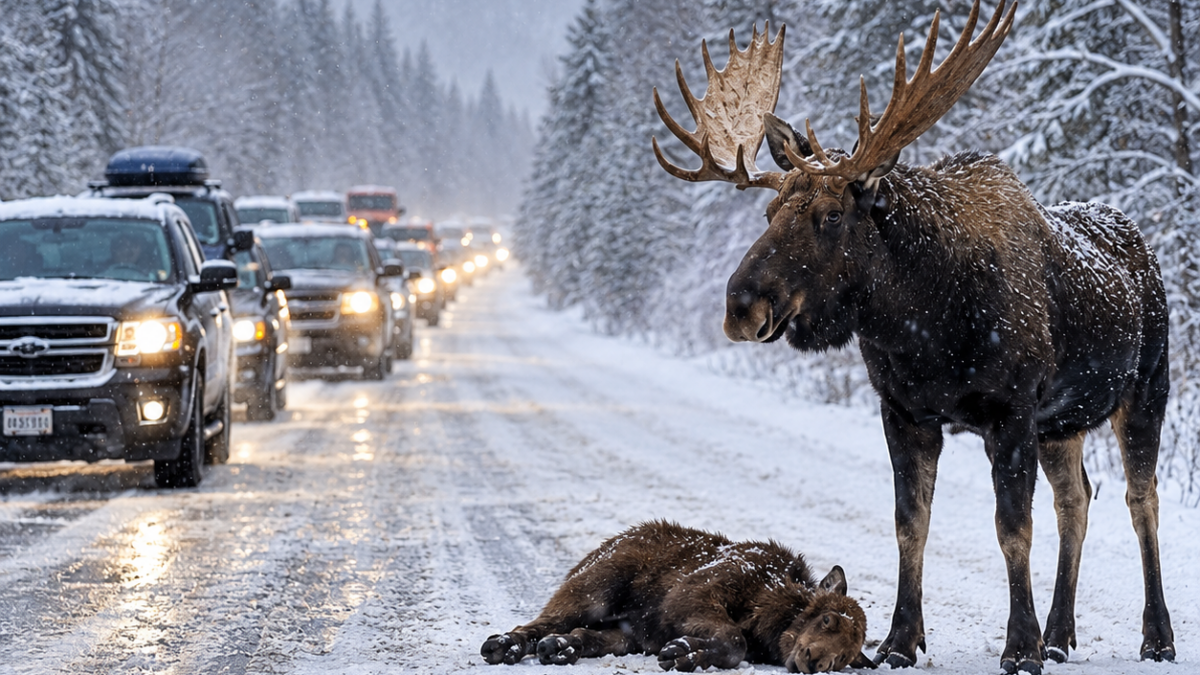
The first thing I saw when I stepped out of my truck was a full-grown cow moose standing broadside across two lanes of Washington traffic, slamming her shoulder into the door of a pickup every time its driver tried to inch forward.
At first I thought we were dealing with a frightened animal trapped on asphalt, but the longer I watched her charge at bumpers, retreat three steps, and then plant herself in the exact same patch of roadway, the more obvious it became that she was not trying to escape.
Then one of the stranded drivers pointed behind her and said, “There’s something on the road,” and when I raised my binoculars I saw a small dark body lying motionless on the pavement where the moose had been refusing to let anyone near it.
I work wildlife calls across a large section of Washington, so unusual roadside scenes are part of the job. Deer tangled in fencing. Eagles struck by vehicles. Bears in backyards. The occasional moose wandering someplace a moose absolutely should not be.
But that morning was different.
Dispatch had described it as “an aggressive moose blocking traffic.” By the time I arrived, both directions were stopped. Cars stretched back around the curve, engines idling while people leaned out windows with phones raised.
“Stay in your vehicles!” I shouted.
A man in a gray SUV pointed at the moose.
“She hit my door!”
“Anybody hurt?”
“No, but she came right at me.”
The moose swung her head toward us.
I stopped moving.
An adult moose does not need to look angry to be dangerous. Size alone changes the rules. One kick can cause catastrophic injury, and an animal frightened by traffic can move much faster than most people realize.
I motioned for the driver to close his window.
“Back up if you can. Slowly.”
Another wildlife officer, Ben, pulled in behind me.
“What do we have?”
“Cow moose. Defensive behavior. Something behind her.”
“Calf?”
“That was my first thought.”
He raised his binoculars.
The small body lay perhaps twenty yards beyond the moose, partly between the faded center line and the shoulder.
Ben stared for several seconds.
“That doesn’t look like a calf.”
I adjusted my focus.
The body was dark brown.
Too compact.
Wrong shape.
Then I saw a rounded ear.
My stomach tightened.
“That’s a bear.”
Ben lowered the binoculars.
“A cub?”
“Looks like it.”
Neither of us spoke for a moment.
A moose standing over a bear cub made no sense.
Not the kind of sense you want during a traffic emergency, anyway.
Someone shouted from a truck farther back.
“She’s been guarding it the whole time!”
A woman added, “We thought it was her baby.”
I walked toward the first row of vehicles, staying well outside the moose’s immediate space.
“Did anyone see what happened?”
The woman shook her head.
“When I got here, she was already in the road.”
“Was the cub moving?”
“I thought it was sleeping.”
Another driver called out, “It moved earlier. I think.”
That changed everything.
I looked at Ben.
“If it’s alive, we need to get to it.”
“If she lets us.”
The moose turned and stepped closer to the cub.
Not toward the forest.
Toward the cub.
Her body blocked our line.
Ben exhaled.
“She’s definitely guarding it.”
We tried the simplest option first.
Distance.
No sirens. No horns. No shouting.
State patrol began moving vehicles farther back while we opened a clear path toward the tree line.
If the moose felt trapped, we wanted her to see an escape route.
For nearly five minutes, we waited.
She did not take it.
Instead, whenever we shifted position, she repositioned herself between us and the cub.
I had seen mothers defend calves.
I had seen territorial animals defend space.
I had never seen anything like this.
Then the cub’s paw moved.
Barely.
But it moved.
“Ben.”
“I saw it.”
The moose saw it too.
She stepped over the little bear, lowered her head, and touched her muzzle near its shoulder.
The cub did not rise.
That was the moment the whole scene stopped being strange and started feeling urgent.
Ben looked through the binoculars again.
“There’s blood near the rear leg.”
I raised mine.
This time I saw it.
A dark smear on the pavement.
Not sleep.
Not rest.
Impact.
Behind us, one of the drivers whispered, “Oh my God.”
I reached for the radio.
“We’ve got an injured bear cub in the roadway and a cow moose actively defending it. I need traffic held completely and wildlife medical support moving now.”
Dispatch answered.
Then Ben touched my arm.
The moose had turned toward us again.
She lowered her head.
And instead of retreating toward the open forest, she began walking straight at us.
PART 2
“Back.”
Ben didn’t shout it.
He didn’t have to.
We moved at the same time.
Neither of us turned our backs on her.
Running from a moose is generally a terrible strategy when you have a better option, and at that moment our better option was a state-patrol SUV parked about fifteen feet behind us.
The cow came faster.
Her long legs made the distance disappear in a way that always looks impossible until you have watched a moose move in person.
“Behind the truck.”
Ben reached the passenger side first.
I came around the front bumper just as the moose closed the last few yards.
Her shoulder struck the corner of the vehicle.
The SUV rocked.
Somebody farther down the road screamed.
The moose backed away immediately.
She had not followed us around the truck.
She had not continued attacking.
Instead, she turned and walked straight back toward the bear.
Ben leaned against the vehicle.
“That answer your question?”
“What question?”
“Whether she’s serious.”
I looked at the fresh scrape along the patrol SUV.
“I wasn’t really wondering.”
The trooper whose vehicle she had struck stared at the damage.
“I’m putting ‘moose’ on the report.”
“That would be accurate.”
He looked at me.
“Can we move her?”
“Eventually.”
“That sounded optimistic.”
“It was.”
The moose returned to the bear cub and stood over it again.
That behavior was what kept bothering me.
She had every opportunity to leave.
The forest was close.
There was no fence blocking her.
We had moved people back.
Traffic noise had fallen dramatically.
If she had simply been trapped by vehicles, the obvious escape route should have solved most of the problem.
Instead, she had charged only far enough to push us away, then immediately returned.
“This isn’t random,” I said.
Ben nodded.
“She’s defending the cub.”
“That sentence should not make sense.”
“No.”
“But here we are.”
Another officer joined us.
“What’s the plan?”
Before I could answer, a man climbed out of a sedan thirty yards back.
I pointed at him.
“Get back in your car!”
“I have video!”
“I don’t care. Get back inside.”
“I saw what happened!”
That changed the conversation.
“Stay there.”
The moose turned toward his voice.
I held up one hand.
“Don’t move.”
The man froze.
Ben positioned himself behind the patrol vehicle while I approached the witness from the protected side of the line of cars.
The man held his phone tightly.
“I was coming the other direction,” he said. “I didn’t hit it.”
“Okay.”
“I swear.”
“I’m not accusing you. What did you see?”
He swallowed.
“A little bear ran out.”
“From which side?”
He pointed toward the woods opposite the direction the moose had been facing.
“Over there.”
“Was there an adult bear?”
“I didn’t see one.”
“And the cub?”
“A car ahead of me clipped it.”
My jaw tightened.
“Did the car stop?”
“For a second.”
“And?”
“It kept going.”
“What kind of car?”
“I don’t know. Dark SUV maybe.”
“Do you have that on video?”
“Not the impact. My dash camera started recording after I hit the button.”
“Show me.”
His hands shook as he opened the clip.
The video began with his windshield framing a chaotic road.
The bear cub was already down.
Cars had stopped unevenly across both lanes.
Then something large emerged from the trees.
The moose.
I leaned closer.
She came onto the pavement cautiously at first.
Not charging.
Not panicking.
She moved toward the injured cub.
The cub lifted its head.
The moose stopped.
For perhaps two seconds they faced each other.
Then she stepped between the cub and the nearest car.
A driver tried to maneuver around.
The moose lunged.
The recording shook as people began shouting.
I watched it again.
Ben had come over.
“Did you see that?”
“The cub moved.”
“No. Before that.”
I replayed the clip.
The moose had not come from the same side of the road as the cub.
She had not been walking with it.
She was not confusing the animal with her own calf after traveling beside it.
She had encountered an injured animal in the roadway.
And then stayed.
The witness looked between us.
“Why would she do that?”
I didn’t have an answer.
Wild animals do not owe us explanations that fit human ideas about friendship, grief, courage, or compassion.
I am careful with that.
I have seen people assign elaborate emotions to ordinary animal behavior because they desperately want nature to resemble a children’s movie.
Sometimes a bear is not “waving.” It is standing.
Sometimes a deer is not “asking for help.” It is frozen by fear.
Sometimes proximity is coincidence.
But behavior is still behavior.
Whatever motive existed inside that moose’s head, one fact was undeniable.
She was repeatedly placing her own body between an injured bear cub and approaching vehicles.
And she was willing to charge us to maintain that position.
The cub moved again.
Its head lifted perhaps an inch from the pavement.
Then dropped.
“We’re running out of time,” I said.
Ben looked toward the road behind us.
“How far is the wildlife vet?”
I checked the radio.
“Twenty minutes.”
“Cub may not have twenty.”
I knew.
But reaching it was another problem.
Even if we managed to get past the moose, injured bears are not harmless because they are young.
Pain changes behavior.
Fear changes behavior.
And if the cub’s mother was somewhere nearby, our problems could multiply instantly.
“Any sign of an adult bear?” I asked.
The officers scanning the tree line shook their heads.
“No.”
That did not mean there wasn’t one.
The surrounding woods were thick enough to hide several animals.
We had three separate risks now.
The moose.
The cub.
The possibility of a sow watching from cover.
Ben said what I was thinking.
“We need more eyes on the woods.”
I assigned two officers to observation positions.
Nobody was to wander into the tree line.
Nobody was to approach the cub without coordination.
The traffic backup had grown farther than we could see.
Dispatch began routing vehicles around the area where possible.
People were frustrated.
Most changed their attitude once officers told them an injured animal was in the road.
A few did not.
One man walked toward us demanding to know how long it would take.
“I have somewhere I need to be.”
“So does the bear,” Ben muttered.
I shot him a look.
The driver didn’t hear.
I explained the situation.
He stared past me at the moose.
“You’re shutting the whole highway down for that?”
“For a dangerous wildlife incident, yes.”
“Can’t you just scare it away?”
“That’s what we’re working on.”
“Use your siren.”
“We’re not escalating a thousand-pound animal beside an injured cub just because you’re late.”
His mouth tightened.
A trooper stepped between us.
“Back to your vehicle, sir.”
The driver turned away, muttering.
I watched him leave.
Ben said, “Very empathetic.”
“Traffic brings out everyone’s best.”
The situation looked absurd from a distance.
A moose guarding a bear.
A highway full of motion stopped by two animals.
People standing around with radios and binoculars.
But nothing about it felt amusing once you watched the cub breathe.
Its sides moved quickly.
Too quickly.
I raised the binoculars again.
The moose lowered her head.
For one moment, her muzzle touched the cub’s neck.
The cub’s front paw twitched.
Then the cow stepped sideways as a patrol officer moved near the shoulder.
She immediately placed herself between him and the bear.
“Stop,” I called.
The officer froze.
The moose stared.
After several seconds, she relaxed slightly.
“She’s tracking every person,” Ben said.
“Every vehicle too.”
“She knows what hurt it.”
Maybe.
I would not claim that as fact.
But the pattern was hard to ignore.
When people moved, she watched.
When vehicles moved, she reacted more strongly.
The cub had been struck by a vehicle.
Now the moose treated vehicles as the greatest threat.
Whether that came from understanding, association, or simple response to size and motion, I couldn’t say.
The result was the same.
Nobody was driving near that cub again while she stood there.
The wildlife medical team arrived seventeen minutes later.
Dr. Maren Cole stepped out of the truck carrying a trauma bag.
She stopped when she saw the scene.
“You weren’t exaggerating.”
“I try not to.”
“You said moose and bear cub. I assumed dispatch had confused something.”
“So did I.”
She studied the cow.
“How close can we get?”
“Not very.”
“She charged?”
“Twice that we know of. Hit at least two vehicles.”
Maren looked toward the cub.
“Movement?”
“Small. Breathing. Witness confirms vehicle strike.”
“Adult bear?”
“None seen.”
She exhaled.
“All right.”
We moved behind the patrol vehicles and built the closest thing we could to a mobile barrier.
The idea was not to trap the moose.
That would be dangerous and counterproductive.
We wanted to create pressure from one direction while leaving the forest side completely open.
Patrol vehicles would move slowly, never fast enough to make her panic, narrowing the comfortable space on the roadway.
At the same time, wildlife officers would remain visible but protected.
If she chose the woods, we would immediately stop advancing.
Then we would need several precious seconds to reach the cub before the moose returned.
Maren listened.
“What if she circles?”
“We expect she might.”
“What if she charges the medical team?”
“You won’t be exposed until we have distance.”
She looked at me.
“And if she won’t leave?”
I didn’t answer immediately.
Sedation was theoretically possible but introduced another set of dangers.
A darted moose could run into traffic, woods, people, or fall badly.
Drug onset was not instantaneous.
Dosing a stressed free-ranging animal under these conditions was not something we casually used as a first choice.
“We keep working the problem.”
Maren nodded.
“Fair.”
We began.
Two vehicles crept forward side by side.
The moose’s ears shifted.
She moved closer to the cub.
The vehicles stopped.
We waited.
A minute.
Two.
Then another foot.
The moose lowered her head.
Stop.
Wait.
Advance.
It was painfully slow.
People watching from far back probably wondered what we were doing.
We were negotiating space with an animal that could overturn the plan in one second.
After several minutes, the moose moved off the center line.
Good.
Another step.
She moved again.
Closer to the shoulder.
“Keep the woods open,” I said over the radio.
No one blocked her path.
The bear cub remained exposed behind her now.
Maren crouched behind a vehicle, watching.
“Can you see respiration?”
“Yes.”
“Still fast?”
“Yes.”
“Any attempt to stand?”
“No.”
The moose looked toward the trees.
For one second, I thought she would go.
Then the cub made a sound.
It was faint.
A short, rough cry.
The moose spun around.
Everything we had gained disappeared.
She walked straight back.
Ben swore under his breath.
The cow stood over the cub again.
Maren’s face changed.
“That cub’s hurting.”
“I know.”
“We need in.”
“I know.”
“Soon.”
“I know.”
She looked at me.
“I’m aware that saying it repeatedly is not helping.”
“No.”
“Good.”
We reset.
This time, we changed the angle.
Instead of pushing directly from the road, one vehicle moved gradually toward the area from which the moose had been charging.
Another remained stationary, becoming less of a perceived threat.
The moose watched the moving vehicle.
Then glanced at the cub.
She took two steps toward the woods.
Stopped.
Another two.
The distance between her and the cub widened.
Five yards.
Seven.
Ten.
“Not yet,” I said.
Maren was ready.
Ben held the transport board.
A rehabilitation technician named Jules waited with a heavy blanket and crate.
Fifteen yards.
The moose stepped off the pavement.
Her front legs entered the grass.
She turned.
Still watching.
“Hold.”
Nobody moved.
If we exploded into action too soon, she would return.
She stepped farther.
Half her body disappeared into brush.
Then the entire cow moved into the tree line.
“Go.”
Maren, Ben, Jules, and I moved at once.
We ran the last distance.
The cub lifted its head when we approached.
Its mouth opened.
A frightened sound came out.
“Easy,” Maren said.
She knelt.
“Don’t let it bite.”
“I know.”
The cub tried to pull forward with its front legs.
Its rear half barely responded.
Maren’s expression tightened.
“Trauma to the hind end.”
“Spine?”
“Could be pelvis. Could be leg. Don’t guess yet.”
The cub snapped weakly when Ben positioned the board.
“Still has fight.”
“Good.”
We slid the board carefully beside it.
Jules unfolded the blanket.
Then Ben shouted.
“Moose!”
I looked up.
The cow had reappeared at the edge of the woods.
Head high.
Watching.
“Keep working,” I said.
“She’s coming.”
She was.
Slowly at first.
Then faster.
“Move!”
We could not abandon the cub halfway onto the board.
Maren kept one hand near its shoulders.
“Ten seconds.”
“You have five.”
Ben and I lifted together.
The cub cried.
The sound changed the moose instantly.
She broke into a charge.
“Now!”
We got the cub onto the board.
Jules pulled the blanket around it.
The transport crate sat behind the protective vehicle.
Too far.
The moose was closing.
Ben grabbed one end.
I took the other.
Maren steadied the cub.
“Go!”
We moved.
The board felt awkward rather than heavy.
Behind us came the sound of hooves striking pavement.
A trooper drove the barrier vehicle forward several feet, putting steel between us and the moose.
She hit the brakes of her own body almost impossibly fast.
Her shoulder turned.
She struck the side of the vehicle.
The entire SUV shook.
Inside, the trooper kept his hands on the wheel.
We reached the crate.
“Lower.”
The cub snapped again.
Maren guided its head.
“Easy. Easy.”
We slid it inside.
Door closed.
Latch.
Second latch.
“Secure.”
I turned.
The moose had moved around the rear of the patrol vehicle.
Ben stepped beside me.
“Oh, come on.”
She looked toward the crate.
Then toward us.
Her chest moved heavily.
For a terrible second, I thought she might charge directly into the group.
Instead, she walked three steps closer and stopped.
Nobody moved.
Maren whispered, “Does she know the cub’s in there?”
“She heard it.”
The cub shifted inside the crate.
A small thump.
The moose’s ears turned toward the sound.
She moved closer.
“Back away,” I said.
We slowly stepped away from the crate.
The cow approached.
Not touching.
Not charging.
Just approaching.
She stood perhaps ten feet from the transport crate.
The cub made another weak sound.
The moose lowered her head.
I had never felt so torn during a rescue.
We had what we needed.
The cub was contained.
Medical treatment could begin.
But the moose had spent perhaps an hour protecting an animal that was not hers, and now we were taking it away.
We could not explain that.
We could not tell her the box was safer than the road.
We could not tell her the humans she had been charging were now trying to undo what another vehicle had done.
To her, perhaps, we were simply another threat removing the injured animal she had refused to abandon.
“She won’t let us load it,” Jules whispered.
“She will.”
“How?”
“We give her somewhere to go.”
We moved the crate behind the medical truck but did not load it yet.
The moose followed several yards.
Traffic remained completely stopped.
We positioned vehicles again, this time not around the cub but around the cow.
The forest remained open.
She looked toward the trees.
Then back toward the truck.
“Come on,” Ben whispered. “You did enough.”
The moose stepped sideways.
Stopped.
Another step.
The distance grew.
We did not rush.
Eventually she moved toward the shoulder.
Then onto the grass.
The cub was quiet now.
Perhaps that helped.
The moose walked into the brush.
Ten feet.
Twenty.
She turned once.
I could still see her head between the branches.
We loaded the crate.
The truck door shut.
The moose took one step forward.
I froze.
She did not emerge.
Maren climbed into the medical vehicle.
“We need to go.”
I nodded.
The truck pulled away slowly in the opposite direction from the open forest.
The moose watched.
Then she disappeared among the trees.
For several seconds nobody spoke.
Ben finally exhaled.
“I don’t think I’ve breathed since seven this morning.”
“You’re exaggerating.”
“Barely.”
The trooper stepped out of his battered SUV and inspected the second dent.
“She really hates this vehicle.”
“You were between her and the cub.”
He looked toward the woods.
“I can’t even be mad.”
Traffic could not reopen immediately.
We needed to make sure the moose had truly moved away and was not waiting near the shoulder.
Officers checked from vehicles.
No sign.
We collected equipment.
Photographed the roadway.
Documented the blood marks and approximate impact location.
The witness provided his video.
Then, slowly, we began releasing traffic.
Drivers moved past the scene at reduced speed.
Many stared toward the woods.
Some stared at us.
A few held their phones up.
The gray SUV with the dented door passed.
The driver rolled down his window.
“Is the little bear alive?”
“Yes.”
He nodded.
“And the moose?”
“Back in the woods.”
He smiled.
“Good.”
Then he drove on.
The man who had complained about the delay passed later.
He did not make eye contact.
I didn’t care.
The road gradually returned to what roads do.
Movement.
Noise.
People going somewhere.
Within thirty minutes, the place that had held everyone’s attention looked almost ordinary again.
That always surprises me after wildlife emergencies.
The physical world moves on quickly.
A smear is washed away.
Vehicles leave.
Animals disappear into cover.
Unless you witnessed it, you could drive through the same place an hour later and have no idea anything extraordinary happened.
I remained behind with Ben.
He was staring at the tree line.
“You ever seen a moose do that?”
“No.”
“Anything close?”
“No.”
“You think she thought it was her calf?”
I considered it.
“The cub didn’t look like a moose calf.”
“Animals don’t always work visually the way we do.”
“True.”
“Could have been maternal instinct.”
“Maybe.”
“Could have been curiosity.”
“Maybe.”
“Could’ve just hated cars.”
I laughed.
“That part I’m willing to believe.”
He looked at the blood mark in the road.
“But she kept covering the cub.”
“Yes.”
“That wasn’t random.”
“No.”
We stood there.
One of the hardest parts of wildlife work is resisting the urge to turn every unexplained behavior into a story.
Stories are comforting.
Science usually asks us to tolerate uncertainty.
We knew what the moose did.
We did not know why.
Those are different kinds of knowledge.
What she did was enough.
She had approached an injured bear cub.
She had remained beside it.
She had blocked traffic around it.
She had struck vehicles that came too close.
She had refused repeated chances to return to the woods.
And when we approached the cub, she had charged back.
Those were observations.
Whatever name people later gave them—protection, maternal instinct, guarding, compassion—the behavior itself did not change.
My radio crackled.
Maren.
“You still on scene?”
“Yes.”
“We’re ten minutes out from the wildlife hospital.”
“How is it?”
“Alive.”
I closed my eyes briefly.
“Good.”
“Shocky. Significant trauma. I’ll know more after imaging.”
“Any obvious fatal injury?”
“Not yet.”
Not yet.
Wildlife medicine rarely gives you the clean answer you want in the first hour.
“Call me.”
“I will.”
The sun had shifted by the time we finished paperwork.
I drove back toward the office with dried mud on my boots and one image repeating in my head.
The cow lowering her muzzle toward the cub.
At the time, everyone on scene had become quiet.
No one had instructed them to.
Even the people filming seemed to understand they were watching something they could not easily explain.
At the office, the videos had already begun circulating.
That was inevitable.
Someone had posted a clip of the moose striking the pickup.
Another showed the dark shape behind her.
The first captions were exactly what I expected.
“Crazy moose attacks cars.”
“Angry moose stops Washington traffic.”
Then someone zoomed in.
“What is she guarding?”
Another video appeared.
“That’s not a calf.”
Within hours, the story changed.
People began calling our office.
“Is it true she was protecting a bear?”
“Did the cub survive?”
“Was the moose injured?”
“Are they friends?”
That last question appeared repeatedly.
No.
At least, not in any sense we could responsibly claim.
We had no evidence they knew each other before the collision.
No evidence of some long-standing relationship.
We had evidence of one remarkable event.
That should have been enough.
But the human mind hates an incomplete story.
People wanted a reason.
A friendship.
A lost calf.
A moose grieving and transferring maternal instincts.
A bear cub adopted by another species.
Every theory appeared.
I refused to endorse any of them.
A reporter called.
“What do you think motivated the moose?”
“I don’t know.”
“Was she treating the bear like her baby?”
“I can’t tell you that.”
“But she was protecting it?”
“She repeatedly placed herself between the injured cub and perceived threats.”
“So yes.”
I sighed.
“If you want the plain-language version, yes, her behavior functioned as protection.”
“Why?”
“I don’t know.”
There was a pause.
“That’s not a very satisfying answer.”
“It’s an accurate one.”
I could almost hear the reporter smile.
“Fair.”
Maren called late that afternoon.
I answered before the second ring.
“How’s the cub?”
“Stable right now.”
I sat down.
“What did imaging show?”
“Trauma consistent with a vehicle strike. We’re treating for shock and injuries. I’m not going to promise outcome yet.”
“Can it move the rear legs?”
“Some response.”
“That’s good?”
“It’s better than none.”
I leaned back.
“Eating?”
“Not yet.”
“Expected?”
“Yes.”
I looked toward the window.
Outside, a pair of ravens were arguing over something in the parking lot.
“Any sign we need to look for the mother?”
“We still need to consider that possibility.”
We had already done a limited observation of the area from a safe distance.
No sow had appeared.
That concerned me.
Bear cubs do not usually wander through the world as independent little adventurers.
Depending on age, a young bear should be near its mother.
But wildlife does not always present a complete family history at the scene.
The mother could have been separated.
Dead.
Nearby but hidden.
The cub could have moved farther than expected.
We simply did not know.
“Keep me posted.”
“I will.”
Before hanging up, Maren said, “That moose bought us time.”
I paused.
“What do you mean?”
“If traffic had kept flowing around that cub…”
She didn’t finish.
She didn’t need to.
Another vehicle strike could have ended everything.
Instead, traffic had stopped.
Because nobody was willing to test a thousand-pound animal standing in the middle of the lane.
“Yeah,” I said.
“She did.”
That night I went home later than usual.
I should have been exhausted.
Instead, I couldn’t settle.
I opened the witness video again.
Not the dramatic part.
Not the charges.
The beginning.
The moose emerging from the woods.
The cub already down.
The cow approaching.
Stopping.
Then moving between the cub and traffic.
I watched it four times.
My wife walked behind me.
“You’re still working?”
“Technically.”
“That means no.”
I turned the laptop so she could see.
She watched the clip.
“Is that the bear?”
“Yes.”
“And she’s the moose?”
“That’s generally how those species work.”
She ignored me.
“She just walked up to it?”
“Yes.”
“Why?”
“There’s the million-dollar question.”
She watched again.
Then said, “Does it matter?”
I looked at her.
“What?”
“Why.”
“Scientifically? Yes.”
“No. I mean tonight.”
She pointed at the screen.
“She stayed. The bear got help. Maybe you don’t need to know what she was thinking.”
I hated when she made a better point than I had.
I closed the laptop.
The next morning, the cub was still alive.
That became our first milestone.
Twenty-four hours.
Maren reported it had taken fluids, pain medication, and supportive treatment.
The team was watching neurological function closely.
The cub remained frightened and defensive.
Good.
People sometimes interpret calmness in injured wildlife as trust.
Often, calmness means severe weakness.
A young bear objecting to human presence was not a bad sign.
“He tried to bite Jules,” Maren told me.
“Excellent.”
“That is a strange response.”
“You know what I mean.”
“I do.”
“Any eating?”
“Very little.”
“Still early.”
“Exactly.”
The road site remained quiet.
No moose in traffic.
No bear.
We found tracks near the woods but nothing that allowed us to determine where the cow had gone.
That was fine.
The goal was not to find her.
The goal was for her to return to being a wild moose doing wild moose things somewhere that did not include vehicle doors.
By the third day, the story had gone far beyond our region.
Messages came from people who had never been to Washington.
Some called the moose a hero.
Others insisted the whole event must be staged.
One person emailed six paragraphs explaining that bears and moose were “natural enemies” and therefore what we witnessed was impossible.
I read it twice.
Then forwarded it to Ben.
His reply:
“Tell the moose.”
I laughed harder than I should have.
The problem with saying something is impossible after it has happened in front of thirty witnesses is that reality has already won the argument.
The behavior was unusual.
That did not make it imaginary.
I spent more time than expected answering questions.
“No, we did not put the bear next to the moose.”
“No, the moose was not domesticated.”
“No, we did not know whether the moose had lost a calf.”
“No, the bear was not secretly a baby moose.”
That last one came from a surprising number of people.
Ben called me.
“I think the internet has broken everyone.”
“That happened years ago.”
“Someone asked me if we’re letting the moose adopt the bear.”
“Please tell me you did not answer.”
“I said the paperwork was complicated.”
“Ben.”
“What?”
“You’re the reason I get emails.”
He laughed.
Then his voice became more serious.
“Any update?”
“Cub ate a little.”
“Good.”
“Very good.”
That was the second milestone.
Eating.
The wildlife hospital minimized human contact as much as possible.
An injured wild bear did not need to become comfortable with people.
The goal was recovery, not taming.
Cameras allowed staff to observe without constantly entering the enclosure.
At first, the cub spent most of its time curled tightly.
Then it began shifting position more often.
Standing briefly.
Putting more weight on the injured side.
Every small improvement mattered.
I visited once, mainly because I needed to deliver documentation and discuss the scene.
Maren allowed me to see the cub from the observation area.
It looked smaller indoors than it had on the road.
That surprised me.
On asphalt, surrounded by vehicles and guarded by a moose, the cub had seemed like the center of the entire world.
Here it was just a young animal in a recovery enclosure.
Bandaged.
Alert.
Angry at everyone.
Perfect.
“That’s the same bear?” I asked.
Maren gave me a look.
“No, we swapped it for another injured bear for dramatic effect.”
“I’ve spent three days answering internet questions. My standards are low.”
The cub stood.
Its movement was awkward.
But it stood.
I felt my throat tighten.
Maren noticed.
“Don’t get emotional yet.”
“Not emotional.”
“You wildlife guys are all the same.”
“Cold professionals.”
“Right.”
The cub took several steps.
Then sat.
I smiled.
“Look at that.”
Maren folded her arms.
“If progress continues, we keep going.”
“If?”
“There’s always an if.”
I knew.
Wild animals can worsen unexpectedly.
Injuries declare themselves over time.
Stress creates complications.
We had won the first battle.
That was not the same as winning the entire recovery.
“Does it have a chance?”
“Yes.”
That was enough.
On my way out, Jules caught me near the door.
“You know the weird part?”
“There are several.”
“When we moved the cub into the crate, I thought the moose was going to kill us.”
“That wasn’t weird. That was reasonable.”
“No. I mean after.”
She leaned against the wall.
“When the truck started moving, I looked through the back window.”
“And?”
“The moose was still at the tree line.”
“I saw.”
“She followed the truck with her head until we turned.”
I remembered.
“You think she understood?”
“No idea.”
Jules nodded.
“Me neither.”
We stood there for a moment.
Then she said, “I hope she thought we were helping.”
“I hope so too.”
It was probably the most sentimental thing I allowed myself to say about the incident.
A week passed.
The cub improved.
Not perfectly.
But enough.
It was eating consistently.
Moving better.
Responding the way a frightened wild bear should respond to humans.
Maren sent me a short video.
The cub stood at the back of the enclosure as a staff member entered.
It gave a defensive huff and moved away.
Text underneath:
“Your patient hates us.”
I replied:
“Excellent prognosis for customer satisfaction.”
She sent back:
“Idiot.”
I saved the video anyway.
The highway incident began to fade from daily news.
That was healthy.
Wildlife rescue should not become a circus.
People had seen the remarkable moment.
Now the animals needed distance from us.
Especially the cub.
The moose was already gone.
Exactly where she should be.
One morning, Ben and I returned to the road for another unrelated call nearby.
We passed the exact stretch.
He slowed.
“Think she’s around?”
“Probably somewhere.”
“Think she remembers?”
“No idea.”
He looked at me.
“You’ve said ‘no idea’ more this month than in the previous five years.”
“It’s an accurate phrase.”
We pulled onto the shoulder.
The blood was gone.
Rain had washed the pavement clean.
Vehicles passed normally.
No skid marks obvious anymore.
No crowd.
No phones.
Only the forest.
Ben stepped out.
We stood beside the road.
“She stopped all this.”
I knew what he meant.
One animal had stopped dozens of cars.
Not by asking.
By refusing to move.
“Imagine being the first driver,” he said.
“You’re late for work and a moose attacks your truck because she’s guarding a bear.”
“Try explaining that to insurance.”
He smiled.
Then his expression softened.
“Still weird.”
“Yes.”
We went back to work.
Several weeks later, I received the update I had been hoping for.
The cub was progressing well enough to move into the next stage of rehabilitation.
Not release.
Not yet.
But farther from emergency medicine.
More space.
Less intervention.
A chance to regain strength while remaining wild.
Maren called.
“Walking much better.”
“How much better?”
“Enough that Jules now complains it makes her job difficult.”
“That’s excellent.”
“It is.”
“Any concerns?”
“Always.”
“Of course.”
She paused.
“You sound disappointed that I won’t give you a Disney ending.”
“I’ve learned not to ask.”
“Good.”
The long-term goal remained simple.
If the cub recovered sufficiently and met the necessary criteria, it could eventually return to appropriate habitat.
No guarantees.
No ceremony promised.
Wildlife rehabilitation is full of animals that never understand how many people worried about them.
That is exactly as it should be.
A bear does not owe us gratitude.
Neither did the moose.
The road event also changed something in me.
Not my understanding of moose safety.
If anything, it reinforced every warning.
A protective moose is extraordinarily dangerous.
The people who stayed inside their cars did the right thing.
The ones who stepped out for photographs did not.
But emotionally, the incident made me a little slower to assume I understood unusual behavior after the first thirty seconds.
When dispatch says “aggressive animal,” that may be accurate.
It may also be incomplete.
The moose was aggressive.
She struck vehicles.
She charged officers.
Nobody imagined those actions.
But “aggressive” alone failed to explain the scene.
She was aggressive in relation to something.
Remove that context and she looked like a dangerous animal randomly attacking traffic.
Add the injured cub and the pattern appeared.
That lesson came back months later when we responded to a deer repeatedly approaching a backyard.
The homeowner wanted it removed.
“She keeps coming right up to the porch.”
We searched.
A fawn had become trapped behind a decorative fence on the neighboring property.
Different animal.
Different circumstance.
Same reminder.
Behavior has context.
Find it before deciding what the behavior means.
The Washington moose remained the strangest example.
One afternoon, nearly two months after the incident, Maren called again.
“You sitting?”
“That usually means bad news.”
“No.”
I sat anyway.
“The cub’s doing well.”
“How well?”
“Well enough that we’re starting to talk seriously about eventual release planning if progress holds.”
I didn’t say anything immediately.
“You there?”
“Yeah.”
“I thought you’d be louder.”
“I don’t want to jinx it.”
“You do know biology is not controlled by your superstition.”
“Obviously.”
“Good.”
She laughed.
Then added, “Still has a long way to go.”
“I know.”
That became our third milestone.
The possibility of return.
Not certainty.
Possibility.
I drove past the original site that evening.
I don’t know why.
Maybe because I wanted to put the update somewhere physical.
The forest looked exactly as it had before.
Trees.
Brush.
Shadow.
I pulled onto a safe turnout well away from traffic and stood for a few minutes.
No moose appeared.
I was glad.
If she had, that probably would have meant another problem.
I looked toward the place where she had first emerged in the witness video.
Somewhere beyond those trees, she had continued her life.
She had no idea people across the country had watched her on phones.
No idea strangers called her heroic.
No idea scientists, hunters, wildlife enthusiasts, and internet experts had argued about why she acted that way.
She had walked back into the woods and become anonymous again.
That felt right.
The cub’s story belonged to the same world.
If we did our job correctly, eventually nobody would be feeding it by hand.
Nobody photographing it.
Nobody calling it brave.
It would simply become a bear.
There is a kind of success in being forgotten by wildlife.
Months after the rescue, one of the original witnesses visited our office.
It was the woman who had said she thought the cub was sleeping.
She carried printed photographs.
“I took these that morning.”
I recognized the road.
The moose.
The traffic.
One image showed the cow standing over the cub, her body angled toward an SUV.
Another showed her muzzle lowered close to the bear.
“I thought you might want copies.”
“Thank you.”
She hesitated.
“Can I ask something?”
“Sure.”
“Did the cub make it?”
I understood what she meant.
Not necessarily all the way to release.
She wanted to know whether our efforts had mattered.
“It survived the initial injuries and has been progressing in rehabilitation.”
Her face relaxed.
“Oh, thank God.”
She looked at the photograph.
“I’ve thought about that moose every day.”
“So have a lot of people.”
“My husband says I’m making too much of it.”
“What do you think?”
She ran one finger along the edge of the picture.
“I watched her get hit by cars because she wouldn’t leave that baby.”
“Cub.”
“You know what I mean.”
“I do.”
She looked at me.
“Do animals do things like that often?”
“Animals do surprising things more often than people think.”
“That wasn’t my question.”
I smiled.
“No. I’ve never seen that exact thing before.”
She nodded.
“Me neither.”
I almost said, I should hope not.
Most people do not accumulate multiple moose-protecting-bear-cub events.
Instead I thanked her again.
After she left, I pinned one photograph above my desk.
Not the most dramatic one.
The quiet one.
The moose standing beside the cub.
No charging.
No vehicles close enough to threaten her.
Just the cow and the small dark animal on the road.
Ben saw it the next morning.
“You becoming sentimental?”
“No.”
“You put up a photograph.”
“For documentation.”
“On a corkboard next to your family picture?”
“Very official documentation.”
He laughed.
I left it there.
Eventually the day came when the rehabilitation team stopped needing daily medical intervention.
The cub was moving strongly.
Avoiding people.
Eating appropriately.
Displaying normal wild behavior.
That was what everyone wanted.
Not a cuddly bear.
Not a social-media mascot.
A difficult, suspicious, self-sufficient young animal with no interest in humans.
Maren called it “professionally rude.”
I called it perfect.
The release process required planning I was only partly involved in, and I will not pretend every decision was mine.
Suitable habitat had to be considered.
Human conflict risk.
Food availability.
The bear’s condition.
Its ability to function without support.
Nothing was done because the story would look nice.
If the cub was not ready, it would not be released merely to provide a satisfying ending.
That mattered.
When Maren finally said, “We’re comfortable moving forward,” I stared at her.
“You mean it?”
“I rarely speak recreationally.”
“That is absolutely false.”
She ignored me.
“The bear has met what we need to see.”
I felt something loosen in my chest that had apparently been tight since the road.
“When?”
“Soon.”
I was invited to observe from a distance because I had been on the original response.
I almost declined.
Wildlife releases are not usually about the rescuers.
But I wanted to see one thing.
The cub take a step without asphalt beneath it.
So I went.
There was no crowd.
No reporters.
No applause.
Just the rehabilitation team, wildlife staff, transport equipment, and forest.
The bear had grown.
That was the first thing I noticed.
The little body I remembered lying behind the moose was gone.
In its place was a stronger young bear, alert inside the transport enclosure.
It wanted nothing to do with us.
Excellent.
Maren stood beside me.
“Nervous?”
“For the bear?”
“For you.”
“I’m never nervous.”
She laughed.
“You hid behind a patrol SUV from a moose.”
“That was tactical.”
“Of course.”
The release was arranged to minimize human proximity.
The transport door opened.
For one second, nothing happened.
The bear remained inside.
I almost laughed.
Months of work and the patient had decided not to participate.
Then its nose appeared.
Head.
Shoulders.
It stepped out.
Stopped.
Looked toward us.
I held still.
The bear turned toward the trees.
Then ran.
No limp I could see.
No hesitation after the first few seconds.
It moved through brush and disappeared.
That was it.
No backward glance.
No dramatic pause.
No gratitude.
Nothing.
Maren smiled.
“Perfect.”
I couldn’t answer immediately.
The last time I had watched that animal try to move, it dragged itself on the roadway while a moose stood over it.
Now it was gone into the forest before I could process the moment.
“That fast?” I finally said.
“What did you want? A speech?”
“No.”
“Yes, you did.”
“Maybe a wave.”
“Wrong profession.”
We packed equipment.
The forest became quiet again.
On the drive home, I thought about the moose.
She would never know this part.
At least, not in any way we could understand.
She would never know the cub had been treated.
Never know it had survived rehabilitation.
Never know it had eventually disappeared back into wild country on strong legs.
The last thing she had seen, as far as I knew, was humans placing the injured animal into a crate and driving away.
That bothered me more than I expected.
I mentioned it to my wife that night.
She listened.
Then said, “You’re doing it again.”
“What?”
“Trying to finish the story for the moose.”
I frowned.
“She stayed with the cub.”
“Yes.”
“And then we took it.”
“Yes.”
“What if she thought—”
“You don’t know what she thought.”
There it was again.
Accurate and annoying.
She sat beside me.
“What you know is what she did.”
I looked at the photograph above my temporary home-office desk—the copy the witness had given me.
The cow standing over the bear.
“She stopped traffic.”
“Yes.”
“She kept cars away.”
“Yes.”
“She charged us.”
“Also yes.”
“She made the entire rescue harder.”
My wife smiled.
“And possible.”
That was true.
Without the moose, somebody might have tried to drive around the cub.
Then another person.
Then another.
Someone might not have seen the dark body against the pavement.
The first collision had badly injured it.
A second could have been fatal.
The moose had turned a dangerous roadway into an unavoidable emergency.
Nobody could ignore the bear because nobody could get past her.
Her presence bought time.
Time for witnesses to call.
Time for traffic to stop.
Time for officers to arrive.
Time for us to discover the cub was alive.
Time for medical help.
Whatever her reason, those were the consequences.
Weeks later, I removed the photograph from my office wall.
Not because I was tired of it.
Because I had found a better place.
We had a training room where new wildlife officers and volunteers sat through safety orientations.
I put it near the section on roadside response.
Ben saw it.
“Documentation?”
“Educational.”
“What does it teach?”
I considered several answers.
Moose safety.
Scene control.
Wildlife triage.
Cross-species behavior.
Instead I said:
“Look twice.”
He nodded.
That was enough.
The call that morning had been labeled an aggressive moose.
Accurate.
Incomplete.
Drivers thought the animal behind her was a calf.
Understandable.
Wrong.
People thought the cub was sleeping.
Hopeful.
Wrong again.
Every new look changed the story.
Aggression became guarding.
A calf became a bear.
Sleep became injury.
A traffic nuisance became a rescue.
And the animal everyone initially feared turned out to be the reason the smallest animal on the road had not been struck again.
I still refuse to tell people exactly why the moose did it.
Maybe maternal behavior played a role.
Maybe the cub’s distress triggered something.
Maybe she reacted to an injured young animal in a way we rarely witness.
Maybe there is some other explanation we did not recognize.
Uncertainty does not weaken what happened.
If anything, it makes it more remarkable.
We did not train her.
We did not lure her there.
She had nothing to gain that we could identify.
She simply stayed.
That is the fact I keep.
Years of wildlife work have shown me every side of animals.
Fear.
Competition.
Hunger.
Predation.
Territoriality.
Parental devotion.
Curiosity.
Behavior that appears cruel to human eyes.
Behavior that appears tender.
Nature is not obligated to be gentle.
That may be why the rare moments that look like mercy hit us so hard.
On that Washington road, an injured bear cub lay almost helpless after being struck by a vehicle.
Cars approached.
A moose placed herself between them.
Again.
And again.
And again.
When drivers pushed closer, she pushed back.
When we created a path to the woods, she refused it.
When the cub cried, she returned.
When we lifted the bear, she charged.
And only after the cub was safely contained did we finally convince her to move toward the forest.
The motorists who witnessed it still remembered.
So did the officers.
So did I.
Months later, the bear returned to wild country.
The moose had returned long before.
Neither animal knew the story humans built around them.
That was probably for the best.
One evening, long after the case was closed, I drove that highway on my way home from another call.
Traffic was light.
The sun was dropping behind the trees.
As I approached the familiar stretch, I automatically slowed.
There was no reason to.
The road was clear.
No patrol cars.
No stopped traffic.
No injured animal.
Then movement at the edge of the forest caught my eye.
Large.
Brown.
For half a second, my heart jumped.
A moose stood between the trees.
I could not say whether it was the same cow.
I would never pretend I could identify her from one brief roadside glimpse months later.
She looked toward the road.
I slowed farther.
She remained in the woods.
Good.
Exactly where I wanted her.
Another vehicle approached behind me, so I continued.
In the mirror, I saw the moose turn away from the highway and disappear deeper among the trees.
I smiled.
Not because I believed she had come back to the scene.
Not because I thought she remembered the cub.
And not because I needed the coincidence to mean anything.
It was simply a moose in the forest.
A bear somewhere else in the wild.
Two animals continuing lives that had crossed for one extraordinary hour on a piece of Washington pavement.
That was enough.
The road opened ahead of me.
I thought about the cub running from the release crate.
I thought about the cow standing over it months earlier.
Then I thought about the first words dispatch had given me that morning.
Aggressive moose blocking traffic.
Technically, they had never been wrong.
We had just been missing the most important part.
She was not standing in the highway because she had nowhere else to go.
She was standing there because something smaller could not get up and leave.
And until help finally reached it, neither did she.
[END OF STORY]








