PART 2: A Drunk Man Broke Into Our Animal Shelter After Midnight—Then We Saw What He Was Doing Between the Kennels
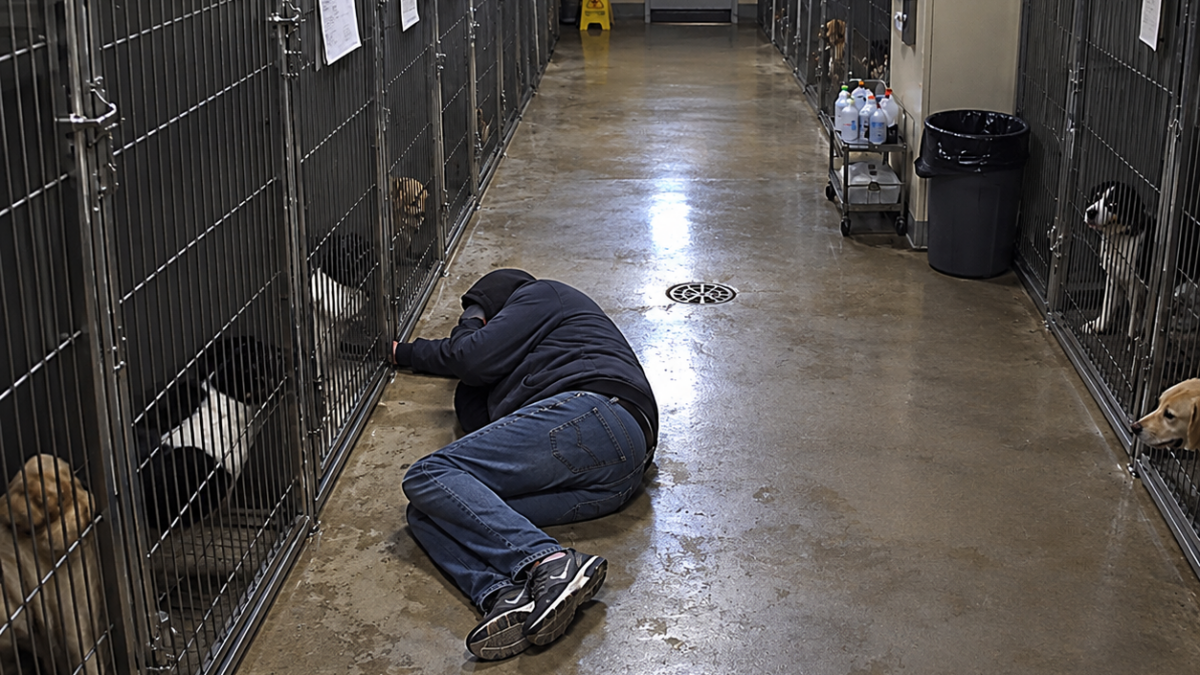
At 12:47 a.m., my phone lit up with the shelter’s security alert, and the first camera I opened showed a drunk stranger walking alone between thirty occupied kennels while every dog in the building watched him through the bars.
For several terrifying minutes, we had no idea whether he had come to steal an animal, hurt one, or open the kennel doors, and by the time I pulled on my shoes and called the police, I was already imagining every possible way the night could end badly.
Then a second camera caught him doing something so strange that I stopped speaking in the middle of the emergency call, because whatever had brought that man into our shelter after midnight suddenly looked nothing like the burglary I thought I was watching.
I had managed the shelter long enough to know that alarms rarely go off for harmless reasons. We kept medication inside, donation money in a locked office, and dozens of animals that depended on us to keep strangers out when the building was closed.
“Police are on the way,” the dispatcher told me.
“I’m ten minutes out.”
“Do not enter if the suspect is still inside.”
“I won’t.”
That was easy to promise from my kitchen. It became harder when the live feed refreshed and I saw the man stop in front of one of our older dogs.
He stood there swaying slightly.
The dog backed away.
My stomach tightened.
“Come on,” I whispered at the screen. “Keep moving.”
Instead, the man lowered himself onto his knees.
He put one hand against the kennel gate.
The dog approached cautiously.
Nothing happened.
No door opened.
No hand reached for the latch.
The man simply stayed there.
I switched cameras.
The next angle showed something on the floor near the office entrance. For one sick second I thought it was a tool. Then I realized it was a bottle.
“That explains part of it,” I muttered.
My coworker Rachel answered on the third ring.
“What’s wrong?”
“Someone’s inside.”
“What?”
“Male. Adult. Looks intoxicated.”
“Is he taking dogs?”
“Not yet.”
“Not yet?”
“I don’t know what he’s doing.”
By the time I pulled into the parking lot, two patrol cars were already angled across the front entrance with their lights flashing silently against the glass.
An officer met me before I reached the door.
“You the manager?”
“Yes.”
“Any staff inside?”
“No.”
“Any weapons stored in the building?”
“No.”
“Any reason somebody would break in besides the animals or cash?”
“Not that I can think of.”
He nodded toward the shelter.
“Stay here.”
Two officers entered.
I stood under the awning with rain blowing against my jeans and watched the security feed on my phone.
The man had moved deeper into the kennel wing.
Then he disappeared from one camera.
I switched to another.
Empty hallway.
Another.
Nothing.
My pulse climbed.
“Where did he go?”
Rachel had arrived and was standing beside me now.
I opened the last camera over the rear kennel corridor.
There he was.
But he wasn’t standing.
He was lying on the floor.
For a second I thought he had collapsed.
Then I zoomed in.
He was curled on his side between two kennel runs, one arm folded beneath his head. A black dog stood at the gate inches from his shoulder. On the opposite side, another dog had lowered itself to the concrete, facing him.
Rachel stared at the screen.
“What is he doing?”
“I have no idea.”
The officers reached him a minute later.
One nudged his shoe and spoke to him. The man sat up slowly, blinking as if he had forgotten where he was. He did not run. He did not fight. He did not reach for a kennel latch.
They handcuffed him and walked him outside.
Up close, he looked less frightening than broken.
His shirt was wrinkled. His eyes were red. He smelled strongly of alcohol even from several feet away.
An officer asked, “Did you take anything?”
The man shook his head.
“Did you hurt any animals?”
Another shake.
“Why are you here?”
His mouth moved, but I couldn’t hear the answer.
Then, while another officer checked his pockets, a folded paper slipped from his wallet and landed on the wet pavement.
The officer picked it up, unfolded it under the parking-lot light, and his entire expression changed.
He looked at the man, then at me.
On the top of the paper was the name of a veterinary clinic.
Under it was a date from the previous week.
PART 2
I took one step closer.
The officer folded the paper before I could see anything else.
“What is it?”
He didn’t answer immediately.
Instead, he walked back to the man.
The stranger was sitting on the curb now, his cuffed hands in front of him because the officers had decided he wasn’t actively combative. Rain dotted his shoulders.
One officer crouched.
“This yours?”
The man looked at the paper.
His face changed.
Until then, he had seemed confused more than emotional.
Now his lower lip tightened.
He looked away.
“Yeah.”
“What is it?”
The man said something so quietly the officer leaned closer.
I couldn’t hear.
Rachel stood beside me with both arms wrapped around herself.
“He’s crying,” she whispered.
He was.
Not loudly.
There was no dramatic collapse.
His head simply dropped.
His shoulders began shaking.
The officer who had found the paper glanced toward us.
Then he walked over.
“You said nothing appears missing?”
“We haven’t checked everything.”
“Do that once we clear the building.”
“Did he tell you why he came in?”
The officer looked back at him.
“His dog died last week.”
The sentence was so simple that for a second I didn’t understand why it mattered.
Then I looked at the veterinary paper.
Rachel whispered, “Oh.”
The officer continued.
“Cancer.”
I stared at the man on the curb.
“He broke into an animal shelter because his dog died?”
“That’s what he’s telling us.”
“Is he making sense?”
“Not much. He’s very intoxicated.”
The man wiped his face against his shoulder.
The officer lowered his voice.
“He says he’s been drinking since it happened.”
Rain tapped against the awning.
Behind the glass doors, one of the dogs barked.
The man’s head lifted instantly.
That movement answered something before any police report did.
He wasn’t looking toward the office.
He wasn’t looking toward our donation cabinet.
He wasn’t looking at the patrol cars.
He was listening to the dog.
The officer said, “We still have to deal with the unlawful entry.”
“Of course.”
“Grief doesn’t make breaking into a building legal.”
“I know.”
“But so far, this doesn’t look like theft.”
I nodded.
My brain was trying to hold two completely different truths at once.
A stranger had entered a locked animal shelter after midnight.
That terrified me.
He had also apparently come because his dog had died.
That broke my heart.
Neither truth erased the other.
The police finished checking him.
No shelter property.
No medication.
No cash.
No tools used to harm animals.
Nothing.
He had his wallet, phone, keys, the veterinary paper, and very little else.
One officer helped him stand.
The man looked toward me.
For the first time, we made direct eye contact.
His eyes were swollen.
“I’m sorry,” he said.
The words slurred.
I didn’t know what to say.
He looked at the building.
Then at me again.
“I wasn’t taking them.”
“I know.”
“I wouldn’t.”
The officer touched his arm.
“Come on.”
The man resisted only long enough to say one more thing.
“I just wanted…”
His voice broke.
He stopped.
The officer waited.
The man shook his head.
Then they put him into the patrol car.
I watched the car pull out of the parking lot.
Rachel stood beside me.
“What was he going to say?”
“I don’t know.”
At that point, I genuinely didn’t.
We still had work to do.
Compassion could wait fifteen minutes.
Animal safety could not.
The officers cleared the shelter, then allowed us inside.
The kennel wing was loud.
Most of the dogs had been awakened by lights, strangers, radios, and commotion.
I went enclosure by enclosure.
Everyone present.
Every latch closed.
No visible injuries.
No open kennel doors.
No missing food or equipment.
Rachel checked the office.
Nothing taken.
The medication cabinet remained locked.
The donation drawer was untouched.
The only unusual thing inside was the bottle we had seen on camera.
One of the officers bagged it.
“He brought that in?”
“Looks like it.”
We checked again.
Then again.
Thirty dogs.
Safe.
By almost three in the morning, the police left.
Rachel and I stayed.
Neither of us wanted to go home immediately.
Adrenaline has a way of making sleep impossible even when your body is exhausted.
We sat in the office with terrible vending-machine coffee.
Rachel stared through the window into the kennel wing.
“I thought he was going to steal one.”
“So did I.”
“Or let them out.”
“Me too.”
She wrapped both hands around her cup.
“And instead he lay down.”
I looked at the monitor.
The recordings were still queued.
We had only watched pieces live.
Now we had to review everything.
Partly for our own documentation.
Partly for police.
Mostly because I needed to understand what had happened inside my building.
I clicked the first recording.
12:42 a.m.
The man entered.
The camera had no useful audio, so the footage felt strangely detached.
He stopped just inside the shelter.
Looked around.
Nearly lost his balance.
Then steadied himself against a wall.
He passed the office without touching the door.
That mattered.
He passed the supply closet.
He passed the room where donated food was stored.
He walked directly toward the kennel corridor.
Rachel leaned closer.
“He knew where the dogs were.”
“Maybe he’d been here before.”
“Or heard them.”
The first dog barked.
The man stopped.
He crouched.
Then sat down.
Not opening the kennel.
Not reaching inside.
Just sitting.
After a minute, he moved to the next enclosure.
Then another.
At one kennel, he pressed his forehead against the gate.
Rachel looked away.
I kept watching.
The dog inside was a nervous shepherd mix named Penny who usually retreated when unfamiliar men approached.
On the video, Penny initially backed toward the rear of the kennel.
The man didn’t follow.
He sat on the floor.
Eventually Penny came closer.
She lay down near the gate.
The man stayed there almost four minutes.
Then he moved on.
“What is he saying to them?” Rachel asked.
“No audio.”
“I wish there was.”
I wasn’t sure I did.
The footage became harder to watch the longer it continued.
At first, I had expected some hidden criminal intention to reveal itself.
Maybe he was studying locks.
Maybe choosing a dog.
Maybe waiting until no one came.
But he never touched a latch.
Never checked an office drawer.
Never searched for valuables.
Instead, he moved from dog to dog.
Sometimes he knelt.
Sometimes he sat.
Once he put both hands over his face.
Then came the rear corridor.
He stopped between two kennels.
A black dog named Duke barked at him.
The dog across the aisle, Rosie, paced.
The man sat.
He leaned against the wall.
Duke stopped barking.
The man slowly lowered himself onto the floor.
Rachel whispered, “There.”
That was the moment we had seen live.
On the recording, it lasted longer.
Much longer.
He curled onto his side.
Duke approached the gate.
Rosie lay down across from him.
For nearly twenty minutes, the three of them barely moved.
A drunk stranger.
Two shelter dogs.
A strip of concrete under fluorescent lights.
That was all.
Nothing was stolen.
Nothing damaged in that corridor.
No kennel opened.
No animal harmed.
The man appeared to fall asleep.
Rachel wiped her cheek.
“Damn it.”
I paused the video.
“What?”
“I wanted to be angry.”
“You can still be angry.”
“At what?”
“He entered the building illegally.”
“I know.”
“He scared us.”
“I know.”
“He could have caused a disaster.”
“I know.”
She looked at the frozen image.
“But look at him.”
I did.
The man looked like someone who had run out of places to put his grief.
That interpretation came later.
At the time, I only knew the footage no longer looked threatening.
It looked unbearably lonely.
The next morning, every member of staff had heard some version of the story before I even arrived.
Shelters are terrible places for secrets.
“What happened?”
“Was he stealing dogs?”
“Is everyone okay?”
“Did he break anything?”
“Who was he?”
I gathered everyone before opening.
“All animals are safe.”
Visible relief.
“Nothing appears to have been stolen.”
More relief.
“He was arrested for entering after hours.”
One employee raised her hand as if we were in school.
“Why did he do it?”
I hesitated.
“Police say his dog died from cancer last week.”
Silence.
Someone at the back said, “Oh, no.”
Another person whispered, “That’s horrible.”
Then Mark, one of our maintenance volunteers, crossed his arms.
“Still doesn’t mean he gets to break in.”
“No,” I said. “It doesn’t.”
I wanted that clear.
Sad stories can tempt people to erase boundaries.
That is not compassion.
If an intoxicated stranger can enter a building full of vulnerable animals after midnight, something has gone wrong.
His motive might change how we understood the event.
It did not make the event safe.
“We’re reviewing security,” I said. “We’ll cooperate with police. And nobody is to post his name, photographs, or theories online.”
Mark frowned.
“Why protect him?”
“I’m protecting us from turning half a story into a public execution.”
Nobody argued after that.
But emotions remained divided.
Some staff were frightened.
Some angry.
Some devastated for him.
A few felt all three.
So did I.
Around noon, an officer called.
He needed a statement.
I went to the station later that afternoon.
The same officer from the parking lot met me.
He looked less tired than I felt.
“Everyone okay?”
“Yes.”
“Animals?”
“All fine.”
“Anything missing?”
“Nothing.”
“Damage?”
“Nothing significant that we’ve found.”
He nodded and wrote.
Then I asked, “Was he telling the truth?”
“About his dog?”
“Yes.”
“As far as we can establish.”
The officer closed his notebook slightly.
“He lost the dog six days ago.”
“Cancer?”
“Yes.”
“He had paperwork from the veterinary clinic.”
I remembered the folded sheet.
The officer said, “Family member confirmed it too.”
“Family?”
“We contacted someone to let them know where he was.”
“Has he been drinking the whole week?”
“I can’t tell you every personal detail, but he told us he’s been drinking heavily since the dog died.”
I looked down at my hands.
“Did he explain why our shelter?”
The officer leaned back.
“Not very clearly.”
“What did he say?”
“He said he was walking.”
“Walking where?”
“Apparently nowhere in particular.”
I waited.
“He heard dogs.”
I felt something tighten in my chest.
“That’s it?”
“He said he heard barking from your building.”
The officer paused.
“Then he said he wanted to be somewhere dogs were alive.”
I looked away.
There are sentences you wish you had not heard because once they enter your mind they stay there.
That was one.
Somewhere dogs were alive.
The officer gave me a moment.
Then he continued.
“He also understands, at least sober enough this morning, that what he did was wrong.”
“He remembers it?”
“Parts.”
“Does he remember lying on the floor?”
“Not clearly.”
I thought of Duke and Rosie lying opposite him.
“What happens now?”
“He’s been charged in relation to entering the property unlawfully. The rest goes through the normal process.”
“Even though nothing was stolen?”
“Nothing being stolen matters. It doesn’t make the entry legal.”
“I understand.”
The officer studied me.
“You feel sorry for him.”
“Yes.”
“So do some of us.”
That surprised me.
He continued.
“Feeling sorry for somebody doesn’t mean pretending they didn’t cross a line.”
“No.”
“It just means you understand why they crossed it.”
I nodded.
That was probably the most balanced thing anyone said about the incident.
When I returned to the shelter, the footage was still in my mind.
Especially the twenty minutes on the floor.
Duke had been with us almost four months.
He was large, black, and regularly passed over because people interpreted his barking as aggression.
In reality, Duke barked when he was uncertain.
Once he trusted you, he leaned his entire body against your legs as if trying to merge with you.
That afternoon, I entered his kennel.
He smelled my clothes.
Then pressed his head against my thigh.
“You had a strange night.”
Duke wagged.
I sat on his bed.
“What did he say to you?”
Duke stared at me.
“Nothing?”
Tail wag.
“Helpful.”
He lowered himself beside me.
I thought again about the stranger lying outside the gate.
Dogs don’t understand arrest records.
They don’t care whether grief is socially acceptable.
They don’t need you to explain why you’re crying before sitting beside you.
They respond to what is in front of them.
Maybe that was exactly what the man had wanted.
Not advice.
Not another drink.
Not someone telling him it was “only a dog.”
Just something warm and alive breathing nearby.
The next complication arrived that evening.
A local reporter called.
“Can you confirm there was a break-in at the shelter?”
“How did you hear about it?”
“Police activity was logged publicly.”
I sighed.
“Yes, there was an unlawful entry.”
“Were animals stolen?”
“No.”
“Harmed?”
“No.”
“Was the suspect trying to steal dogs?”
“Not based on anything we observed.”
“What was he doing?”
I looked through the office window at Duke.
“That’s more complicated.”
Within a day, the basic incident was public.
The first headline I saw used the word BURGLAR.
I hated it immediately.
Technically, depending on the language people used, someone entering illegally might be described that way.
But the word made readers imagine masks, tools, stolen property, terrified animals.
Then another post appeared.
DRUNK MAN BREAKS INTO DOG SHELTER.
Closer.
Still incomplete.
Comments multiplied.
“Throw away the key.”
“What kind of psycho breaks into an animal shelter?”
“Probably wanted fighting dogs.”
“He should never be allowed near an animal.”
I stopped reading.
Then someone who knew part of the police account posted that his dog had died.
The reaction flipped so fast it made me uncomfortable.
“He did nothing wrong.”
“Charges should be dropped.”
“Give him a dog!”
“Let him adopt one for free.”
That disturbed me almost as much.
Grief explained his behavior.
It did not mean he was ready for another animal.
And handing a grieving, recently intoxicated person a dog as an emotional bandage would have been irresponsible.
We published a short statement.
All animals were safe.
No property had been taken.
Police were handling the unlawful entry.
We asked people not to harass anyone connected to the incident.
Then I added one sentence after debating it for almost an hour:
“The complete security footage was difficult for our staff to watch, not because it showed cruelty, but because it showed a person in obvious distress seeking comfort near the dogs.”
Rachel read it before we posted.
“Too much?”
“Maybe.”
“It’s true.”
“Yes.”
“Then use it.”
We did.
The tone changed.
Not completely.
The internet is rarely capable of complete nuance.
But enough people began understanding that this was neither a heroic act nor a sinister one.
It was a bad decision made inside profound grief.
Three days later, I received a message through the police liaison.
The man wanted to apologize to shelter staff.
I stared at the email.
Rachel was beside me.
“What does it say?”
“He wants to meet.”
“Here?”
“He asked if he could.”
Her eyebrows lifted.
“What do you think?”
“I don’t know.”
I was not afraid of him exactly.
The footage made that difficult.
But I also had staff to consider.
Some had felt genuinely unsafe.
The shelter was not a therapy room.
And we did not owe access to someone simply because his motive turned out to be sad.
I asked the team.
“No,” Mark said immediately.
One employee said, “I’d like to hear him.”
Another shrugged.
“If police say he isn’t dangerous.”
Rachel remained quiet.
“What do you think?” I asked her.
She looked toward the kennel hall.
“I think he should apologize.”
“In person?”
“I think if he wants to take responsibility sober, that matters.”
We set conditions.
Daytime.
No alcohol.
Short meeting.
Police were aware.
He would not wander through the shelter alone.
Anyone on staff who didn’t want to participate could stay elsewhere.
A week later, he came through the front door.
That detail mattered to me.
Front door.
Business hours.
Sober.
He looked different.
Not happier.
Just clearer.
His hair was combed.
His clothes were clean.
He held no flowers, no grand gift, no dramatic gesture.
Only an envelope.
He stopped near reception.
“I’m not sure where you want me.”
“Conference room.”
He nodded.
His eyes moved briefly toward the kennel wing when a dog barked.
Then he followed me.
Rachel joined us.
Mark chose not to.
I respected that.
The man sat across from us.
For several seconds, nobody spoke.
Finally he placed the envelope on the table.
“This is for anything I damaged.”
“You didn’t take anything,” I said.
“I know.”
“We didn’t find major damage.”
“Then use it for the dogs.”
I pushed the envelope back.
“We’ll deal with donations separately. You came to talk.”
He swallowed.
“Right.”
His hands trembled slightly.
Not intoxication, I thought.
Nerves.
“I’m sorry.”
He looked at Rachel.
Then me.
“I scared you.”
“Yes.”
“I didn’t think about that.”
“I know.”
“I wasn’t thinking about much.”
Rachel asked gently, “Do you remember coming in?”
“Pieces.”
“The dogs?”
His face tightened.
“Yes.”
He looked down.
“My dog died.”
We already knew, but hearing him say it himself changed the room.
“I had my dog a long time.”
He stopped.
Pressed his lips together.
“I’m sorry.”
“You don’t have to apologize for being upset,” I said.
He nodded.
“No, I do if being upset becomes everybody else’s problem.”
That answer stayed with me.
He continued.
“The cancer came fast. Or maybe I didn’t see it fast enough.”
I didn’t interrupt.
“One week everything seemed manageable. Then the tests came back and suddenly every conversation was about pain and time.”
He rubbed his palms together.
“I kept thinking if I asked one more question somebody would tell me there was another option.”
Rachel lowered her eyes.
“There wasn’t?”
He shook his head.
“I lost my dog.”
No dramatic details.
He didn’t need them.
Anyone who has sat in a veterinary exam room while hope narrows understands the rest.
“The first night after,” he said, “I didn’t sleep.”
He gave a tired laugh with no humor.
“The second night either.”
“You started drinking?”
“Yes.”
“How much?”
“Too much.”
“At home?”
“Mostly.”
He stared at the tabletop.
“People kept calling me.”
“Family?”
“Family. Friends.”
“And?”
“I stopped answering.”
I understood that less than the dog part, but I understood enough.
Grief can make concern feel like noise.
Rachel asked, “What happened the night you came here?”
He took a long breath.
“I’d been drinking.”
“We know.”
“I went walking.”
“At midnight?”
He shrugged.
“I didn’t want to be in the house.”
“Why not?”
His answer came immediately.
“Too quiet.”
Nobody spoke.
He continued.
“My dog used to follow me everywhere. Kitchen. Bathroom. Garage. If I stood up, I’d hear nails on the floor behind me.”
His eyes filled.
“After… there was nothing.”
He wiped his cheek.
“I kept thinking I heard it anyway.”
Rachel shifted in her chair.
The man looked embarrassed.
“I know that sounds stupid.”
“It doesn’t,” she said.
He nodded.
“That night I walked past here. I heard barking.”
He looked toward the wall as if he could see the kennel corridor through it.
“I don’t remember deciding to come inside.”
“But you did.”
“Yes.”
“Why?”
“I wanted to hear dogs.”
The room became silent.
He shook his head.
“I know how insane that sounds.”
“It sounds like you were drunk and grieving.”
“I was.”
“That doesn’t make the entry okay.”
“I know.”
He met my eyes.
“I’m not asking you to say it was okay.”
That mattered.
A lot.
People often become defensive when shame catches up with them.
They rewrite their behavior.
Minimize.
Blame circumstances.
The man did not.
He said, “I scared your staff. I could’ve scared the animals. Police had to come. You had to leave your homes in the middle of the night.”
“Yes.”
“I’m responsible for that.”
Rachel asked, “Do you remember lying next to Duke?”
“Which one is Duke?”
“The big black dog.”
His expression changed.
“I remember him.”
“What do you remember?”
The man stared at his hands.
“He barked at me.”
Rachel smiled slightly.
“That sounds like Duke.”
“I sat down.”
“And?”
“He stopped.”
A tear ran down his cheek.
“He just looked at me.”
He took a shaky breath.
“My dog used to do that.”
I looked away.
He continued.
“I think I told him I was sorry.”
“Sorry for what?”
“I don’t know.”
He wiped his face.
“Everything.”
That was when I understood why the footage had looked so intimate despite the bars between them.
He had not gone kennel to kennel looking for another dog to take home.
He was looking for the shape of something he had lost.
A head near his hand.
A body breathing beside him.
Eyes that did not demand he explain himself.
He said, “I remember lying down.”
“Why?”
“I was tired.”
A pause.
“And I didn’t want to leave yet.”
Rachel asked, “Did you think about opening any cages?”
“No.”
“Taking a dog?”
“No.”
“Did you want another dog?”
His response was immediate.
“No.”
Then quieter:
“I still don’t.”
That answer reassured me more than anything else he had said.
He was not trying to replace his dog.
He knew replacement was impossible.
We talked for another half hour.
I told him what frightened us.
The possibility of loose animals.
A dog biting out of fear.
Medication access.
Police entering a kennel building while animals were already agitated.
The risk to him if an officer misunderstood a sudden movement.
He listened.
At one point he covered his face.
“I didn’t think of any of that.”
“No.”
“I just heard them.”
“I know.”
When he stood to leave, he pushed the envelope toward me again.
“Please.”
I opened it after he left.
There was enough money inside to cover far more than any minor cleanup.
I called him later.
“This is too much.”
“Keep it.”
“We don’t want guilt money.”
“It isn’t.”
“What is it?”
There was a pause.
“My dog had food left. Medication. A bed. Toys.”
His voice became quiet.
“I haven’t been able to touch any of it.”
“You don’t have to donate it.”
“I know.”
Another pause.
“I just need something good to happen to a dog.”
We accepted part of the money as a formal donation after making sure he understood it had no effect on his legal case.
The rest I returned.
That distinction mattered.
The shelter was not going to sell forgiveness.
The police charge remained separate.
He still had to answer for entering the property.
I told him directly.
“This does not change what happened legally.”
“I know.”
“Donating does not buy access.”
“I know.”
“And it doesn’t mean you owe us forever.”
He gave the smallest smile.
“I know.”
For the next few weeks, life returned to normal.
Or as normal as shelter life ever becomes.
Dogs arrived.
Dogs were adopted.
Someone abandoned three puppies near our gate.
A senior beagle needed dental surgery.
Duke continued barking at everyone he secretly wanted to befriend.
Rosie was adopted by a retired couple.
The night of the break-in slowly became another story staff told.
But I noticed something had changed in how we spoke about grief.
Animal shelters see it constantly.
People surrender pets when owners die.
Families bring us unopened food after euthanasia.
Someone stands at the donation desk holding a leash and suddenly cannot speak.
People apologize for crying over animals as though love becomes embarrassing when the loved one has four legs.
Before that night, I had understood pet grief intellectually.
After watching a grown man risk arrest simply because he could not tolerate a house without the sound of a dog breathing, I understood how physically disorienting it could become.
That did not make drinking a solution.
It certainly did not make unlawful entry a solution.
But the grief itself stopped looking small.
One Saturday, an elderly woman brought us two sealed bags of prescription food.
“My dog died yesterday,” she said.
Normally I would have thanked her, taken the bags, and offered condolences.
This time I noticed how tightly she was holding them.
“You don’t have to leave these today,” I said.
She looked surprised.
“I can’t take them home.”
“Okay.”
Her eyes filled.
I invited her to sit.
She talked for twenty minutes.
Her dog had been sixteen.
Slept near the kitchen.
Hated thunderstorms.
Loved carrots.
Nothing remarkable.
Everything important.
When she left, Rachel looked at me.
“You’re doing that because of him.”
“Maybe.”
“Good.”
The public attention around the break-in eventually faded.
That was a relief.
But one headline continued circulating occasionally, stripped of all nuance.
MAN ARRESTED AFTER BREAKING INTO ANIMAL SHELTER.
Technically true.
Emotionally incomplete.
Then another version appeared:
GRIEVING DOG OWNER BROKE INTO SHELTER JUST TO CUDDLE ANIMALS.
Also incomplete.
He had not “just” done anything.
He had committed an offense while severely intoxicated.
He had frightened workers.
He had placed himself and animals at risk.
Turning his behavior into a cute grief story would have been dishonest.
But calling him a dangerous animal thief was equally dishonest.
The truth sat uncomfortably between those narratives.
A man had made a reckless decision because grief and alcohol had dismantled his judgment.
Nobody was harmed.
Nothing was stolen.
And the camera captured a moment more tragic than criminal in spirit.
That was all.
Months passed.
His case moved through the system.
I deliberately stayed out of the parts that did not involve us.
I provided the necessary statement.
Confirmed there had been no theft.
Confirmed no animal had been injured.
Confirmed the security footage accurately represented his movements inside.
After that, the consequences were his to face.
He accepted responsibility.
He did not ask me to request special treatment.
That mattered.
One afternoon, long after the immediate case had stopped consuming our staff, I received another email from him.
Subject: Duke.
I opened it.
“I know I don’t have any right to ask, but is the black dog from that night still there?”
I looked through the office window.
Duke was asleep upside down on his bed.
I replied:
“Yes.”
A minute later:
“Has anyone applied for him?”
“No serious applications yet.”
Then nothing.
Two days passed.
He wrote again.
“I’m not asking to adopt him.”
I smiled despite myself.
“Okay.”
“I just wanted to know he was alright.”
“He is.”
Another pause in the email thread.
Then:
“Thank you.”
I expected that to be the end.
It wasn’t.
Several weeks later, after the legal issues around his entry had progressed enough that there was no longer any concern about inappropriate contact, he asked if he could visit during normal opening hours.
Not alone.
Not after midnight.
Not drunk.
Just visit.
I discussed it with the team.
Mark still disliked the idea.
“He broke into this building.”
“Yes.”
“So now we invite him back?”
“Not as a reward.”
“Then why?”
I thought about it.
“Because people can be responsible for a bad decision without being permanently reduced to that decision.”
Mark looked unconvinced.
I continued.
“He apologized. He cooperated. He accepted the consequences. He isn’t asking us to erase anything.”
“What if it goes wrong?”
“Then we end the visit.”
Rachel said, “I’ll be there.”
Mark sighed.
“Fine. But I’m not hugging him.”
“Nobody asked you to.”
The man arrived at two in the afternoon on a Wednesday.
Sober.
Early.
He waited outside until his appointment time.
That detail told me more than he probably realized.
When I opened the door, he said, “Hi.”
“Hi.”
He looked nervous.
“Still okay?”
“Yes.”
“I can leave if staff are uncomfortable.”
“Come in.”
The shelter sounded different in daylight.
Phones.
People talking.
Kennels being cleaned.
Dogs barking because lunch carts moved through the hall.
The man stood near reception.
For a moment he looked overwhelmed.
“You okay?”
He nodded.
“Just weird.”
“Remembering?”
“Some.”
We walked toward the kennels.
Duke heard us before he saw us.
Bark.
Bark.
Bark.
The man stopped.
A smile appeared for the first time since I had met him.
“That’s him.”
“That’s Duke.”
Duke came to the gate.
The man remained several feet away.
“Can I?”
“Sit outside?”
He nodded.
“Yes.”
He lowered himself onto the floor.
Daylight came through the high windows.
No police.
No alcohol.
No handcuffs.
No alarm.
Duke barked once more.
Then stopped.
The man put his fingers near the bars but did not push them through.
Duke smelled them.
His tail moved.
The man swallowed.
“Hey.”
Duke leaned against the gate.
I stepped back.
Rachel stood near the doorway.
Neither of us spoke.
After a minute, the man asked, “Could I pet him?”
I opened the kennel and brought Duke out on leash.
That dog had nearly eighty pounds of body and no concept of dignified greetings.
He walked straight to the man and shoved his enormous head against his chest.
The man laughed.
Then immediately began crying.
Both sounds came out at once.
He wrapped his arms around Duke’s neck.
Duke leaned harder.
“Okay,” the man whispered. “Okay.”
I looked away to give him a little privacy.
Rachel didn’t.
She was crying too.
Duke, utterly unconcerned with human emotional complexity, tried to climb partially into the man’s lap.
The man laughed again.
“You’re huge.”
Duke wagged.
They sat together for nearly twenty minutes.
The man did not tell us long stories.
He didn’t make the visit about redemption.
He mostly scratched Duke’s neck.
Before leaving, he said, “I’m still not ready for another dog.”
“That’s okay.”
“I thought maybe seeing him would make me want one.”
“And?”
He looked at Duke.
“No.”
I respected the answer.
He continued.
“But it didn’t hurt as much as I thought.”
“That’s something.”
He nodded.
At the front door, he stopped.
“The night I came here…”
“Yes?”
“I thought I was looking for my dog.”
He glanced toward the kennel wing.
“I wasn’t.”
“What were you looking for?”
He thought for a moment.
“Proof that losing one didn’t mean dogs were gone from the world.”
I didn’t answer.
There was nothing to improve in that sentence.
He left through the front door.
This time we watched him walk to his car in daylight.
He drove away sober.
Duke was adopted two months later.
A family with a teenage son came to meet him.
Duke barked at them so loudly during the first introduction that the father laughed.
“Well, nobody’s sneaking into our house.”
“Give him a minute,” I said.
They did.
Duke stopped barking.
The boy sat on the floor.
Duke leaned against him.
That was that.
When the adoption became official, I debated whether to tell the man.
I finally sent one email.
“Duke went home today.”
His reply came several hours later.
“That makes me happier than I expected. Please tell his family they got a good one.”
I did not tell them the entire midnight story.
It belonged partly to someone else.
But I did tell them Duke had once comforted a person on one of the worst nights of his life.
The boy scratched Duke’s ears.
“That sounds like him.”
Yes.
It did.
The grieving man did not become a regular volunteer.
He did not immediately adopt another dog.
There was no miraculous transformation where grief vanished because he spent twenty minutes with Duke.
Real grief is less cooperative than that.
He told me once by email that he had stopped drinking the way he had during that first week.
He had finally gone through some of his dog’s belongings.
Kept the collar.
Kept one favorite toy.
Donated unopened food.
Put the bed away.
Small things.
Enormous things.
I never asked for more detail than he offered.
His grief was not shelter property.
Almost a year after the break-in, he came to one of our public fundraising events.
I saw him near the edge of the crowd.
For a second, I almost didn’t recognize him.
He looked healthier.
Still quiet.
But present.
He approached the table.
“Hi.”
“Hi.”
“No handcuffs today.”
I stared at him.
Then laughed.
“That joke took you a year?”
“I’ve been working on it.”
“Needs work.”
He smiled.
A volunteer walked past with a young dog.
The dog immediately pulled toward him.
He crouched and let her sniff his hand.
“She available?”
the volunteer asked.
He shook his head quickly.
“I’m not looking.”
“Just asking.”
He looked at the dog.
Then at me.
“Maybe someday.”
That was enough.
He stayed for about an hour.
Bought a coffee.
Talked briefly with Rachel.
Avoided Mark, which was probably wise.
Before leaving, he walked past the kennel wing.
He didn’t enter.
Didn’t need to.
I watched him from reception.
A year earlier, that hallway had represented desperation.
Now he could walk past it.
That felt like progress.
People sometimes asked me afterward whether I thought he should have been arrested.
My answer disappointed anyone who wanted a simple moral.
The police did their job.
A man had entered private property unlawfully after midnight while intoxicated.
We didn’t know his motive when officers arrived.
They could not assume it was harmless.
Neither could we.
He was charged.
That consequence was not cruelty.
It was accountability.
But accountability and compassion are not opposites.
I can believe he should never have entered the shelter that night and still feel heartbroken about why he did.
I can be grateful no animals were hurt while acknowledging how easily things might have gone differently.
I can understand why staff were frightened and why the footage made some of them cry.
All those things can be true at once.
That night also changed one practical part of our shelter.
We improved the building’s security.
Better alerts.
Better checks.
Clearer overnight response procedures.
We had been lucky.
A grieving man with no intent to hurt animals exposed a weakness someone with worse intentions could have used later.
In an odd way, even that became useful.
But the biggest change was quieter.
A small box appeared at reception several months later.
A volunteer had suggested it.
Inside were cards with information about pet-loss support services.
Grief counseling.
Hotlines.
Local groups.
Resources for people whose animals had died.
The first week, nobody took one.
Then a man came in carrying an unopened bag of senior-dog food.
His Labrador had died.
While I filled out the donation receipt, he saw the cards.
He took one.
A month later, an older woman took two.
Then another person.
Soon I had to refill the box.
I thought often about the man from the security footage.
Maybe if someone had handed him one of those cards six days earlier, nothing would have changed.
Maybe he still would have drunk too much.
Maybe he still would have walked.
Maybe grief would still have pulled him through our door after midnight.
There is no clean way to rewrite the past.
But we could make the next person slightly less alone.
That mattered to me.
The strangest thing is that when I remember the incident now, I no longer picture the police lights first.
I picture the security footage.
The grainy rear camera.
A row of metal kennel gates.
A man curled on cold concrete.
Duke on one side.
Rosie on the other.
Three living creatures separated by bars but somehow keeping one another company.
At the time, I had stared at that screen trying to identify a threat.
I thought I was watching a crime unfold.
Technically, I was.
But that was not all I was watching.
I was watching grief become physical.
A person who could not stand the silence of his own home had walked until he heard barking.
He crossed a line he had no right to cross.
Entered a place he had no right to enter.
And then, surrounded by dogs he had no right to be near at that hour, he finally stopped moving.
He lay down.
The dogs stopped barking.
For a few minutes, nothing demanded anything from him.
Nobody told him to get over it.
Nobody reminded him that it was “just a dog.”
Nobody offered another drink.
Nobody tried to replace what he had lost.
There was only breathing.
His.
The dogs’.
Alive.
That was what he had been looking for.
Not a dog to steal.
Not a dog to own.
Not even a dog to take home.
Just proof that the world still contained the sound he missed.
The last time I saw him was much later.
He came by during normal hours to drop off a small bag of dog treats.
Nothing dramatic.
He stood at reception while I logged the donation.
“You still don’t have another dog?” I asked.
“No.”
“Want one?”
He smiled.
“Is that professional sales pressure?”
“Absolutely.”
He looked through the glass toward the kennels.
“Maybe later.”
“Fair.”
Then he reached into his wallet.
For one second, the movement transported me back to the rain and the police lights and the folded veterinary paper falling onto the pavement.
But this time he pulled out a photograph.
His dog.
I had never seen the picture before.
A happy animal lying on a couch with one paw across the man’s leg.
“That was my favorite picture,” he said.
I looked closely.
“Beautiful dog.”
“Yeah.”
He smiled, and for once the smile didn’t collapse afterward.
“I can look at it now.”
I handed the photograph back.
“That’s good.”
He tucked it carefully into his wallet.
A dog barked from the kennel wing.
He looked toward the sound.
Then back at me.
No panic.
No tears.
Just recognition.
“I should go.”
“Take care of yourself.”
“I’m trying.”
He walked to the entrance.
Opened the door.
Then paused.
“You know what I remember most from that night?”
“What?”
“Not the police.”
I waited.
“Not being arrested.”
His hand rested on the door.
“The dogs getting quiet.”
He nodded to himself.
“That’s the part I remember.”
Then he stepped outside.
The door closed behind him.
I stood there for a while.
A year earlier, that same man had entered our building after midnight because grief and alcohol had convinced him there was nowhere else to go.
He had left in handcuffs.
This time he came while we were open.
He asked permission.
He made a donation.
He showed me the dog he had loved.
And when he was ready, he walked away on his own.
The barking continued behind me.
Phones rang.
Someone needed an adoption application.
A volunteer called for help with laundry.
Ordinary shelter noise.
Life.
I looked through the front window and saw him reach his car.
He stopped before opening the door and glanced back at the building.
Then he smiled faintly.
Not at me.
At the sound coming through the walls.
Dogs.
Still alive.
Still barking.
Still here.
He got into his car and drove away.
And this time, he didn’t need to come inside to know it.
The months after that night passed quietly enough that, from the outside, it would have been easy to believe the whole incident had faded into one more strange shelter story.
For me, it never completely did.
Every time I walked past the rear kennel corridor after closing, I still saw the grainy security image in my head: a grown man curled on the concrete floor while Duke watched him through one gate and Rosie lay facing him through another.
Nothing about that image fit neatly into the word burglary.
Nothing about it fit neatly into the word grief, either.
It was both simpler and more complicated than that.
A man had made a reckless decision.
A man had been hurting badly.
Both things were true.
For several weeks after his visit, I heard almost nothing from him.
That was probably a good thing.
He needed to deal with his legal situation. More importantly, he needed to deal with the part of his life that no police report could fix.
The drinking.
The empty house.
The silence.
The fact that every normal movement still reminded him of an animal that was no longer there.
Then one afternoon I received a short email.
There was no dramatic subject line.
Just:
“Thank you.”
I opened it between two adoption appointments.
He wrote that he had started seeing someone to talk about the grief and the drinking. He did not give details, and I did not need them. He said he was trying to stay away from alcohol because he had realized how quickly it had turned sadness into something dangerous.
At the bottom, he added:
“I still hear my dog’s tags sometimes when I walk into the kitchen, even though I know they aren’t there.”
I stared at that sentence for a long time.
Then I closed the email.
There wasn’t a perfect response to something like that.
So I wrote back:
“I’m glad you’re getting help. Take care of yourself.”
That was all.
I did not want to become his counselor.
I was not qualified for that.
I also did not want to treat him like a criminal every time he contacted us.
He had crossed a line.
He knew it.
He was facing consequences for it.
My job was not to punish him emotionally forever.
Around the same time, Duke finally started attracting serious adoption interest.
It surprised me how protective I had become of him.
Duke was one of those dogs people often judged before they understood.
He barked hard at the kennel gate, especially around unfamiliar men.
People would pause for two seconds, hear that deep voice, and move on to a quieter dog.
But the moment you sat with him long enough, the performance disappeared.
He was needy.
Clumsy.
Affectionate.
He leaned against people so hard they had to brace their feet.
One Saturday, a family came in with a teenage son named Evan.
Duke barked the instant they approached.
The mother flinched.
Evan didn’t.
He looked at me.
“Is he mean?”
“No.”
“Then why’s he barking?”
“He’s unsure.”
Duke barked again.
Evan crouched several feet from the kennel.
His father said, “Don’t put your fingers through.”
“I’m not.”
Duke kept barking for perhaps thirty seconds.
Then something changed.
Evan stopped looking directly at him.
He sat down on the floor.
Duke fell silent.
I smiled.
“Give him a minute.”
The boy did.
Duke moved closer.
Sniffed through the gate.
Then wagged once.
Evan looked at me.
“That’s good?”
“That’s very good.”
We brought Duke into a meeting room.
Within ten minutes, all eighty pounds of him were leaning against Evan’s legs.
The boy laughed.
“He thinks he’s tiny.”
“He has no sense of scale.”
The family stayed for almost two hours.
They asked good questions.
They did not romanticize him.
They wanted to know about his barking.
His exercise needs.
His vet history.
His behavior around visitors.
By the time they left, I already suspected where the application was going.
A week later, Duke went home.
I almost didn’t tell the man from that night.
Part of me thought the connection was too strange.
Duke had been part of a moment the man barely remembered sober. Maybe hearing he was gone would feel like another loss.
But eventually I sent a simple message.
“Duke was adopted today.”
The reply came hours later.
“I’m really glad.”
Then another message.
“I know this is strange, but please tell whoever took him that he helped somebody once.”
I read that sentence twice.
I didn’t tell the family everything.
That story was not entirely mine to share.
But when they came to pick Duke up, I said, “He has a way of sitting with people when they need it.”
Evan rubbed Duke’s head.
“He already does that with me.”
Perfect.
That was enough.
After Duke left, something in the shelter seemed to close a little.
Not disappear.
Just settle.
The night of the break-in stopped being tied to one specific dog still living behind our walls.
And the man seemed to understand that too.
He did not ask about Duke again.
Months passed.
The donation box at reception grew into something more useful.
We added printed information about pet-loss support groups and local counseling resources.
At first I worried people would think it was excessive.
Then I watched how many cards disappeared.
A woman whose cat died after eighteen years took one without saying anything.
A father whose daughter’s dog had been euthanized asked if he could take an extra card home for her.
A man stood at the desk one morning holding a collar in his fist and whispered, “Do people really go to support groups for this?”
“Yes.”
He looked embarrassed.
“I feel stupid.”
“You don’t need to.”
He took a card.
I thought about the man who had entered our shelter drunk because his house felt too quiet.
Maybe grief would always find some way out.
The question was whether it found a safe one.
One afternoon, Rachel walked into my office holding a printed email.
“You’ve got another message from him.”
“Bad?”
“No.”
She handed it to me.
The man wanted to donate his dog’s remaining supplies.
Not everything.
He was not ready to let go of everything.
But the unopened food, medication we could not legally redistribute without veterinary review, several blankets, and a crate were still sitting in his garage.
He asked whether we could use any of it.
We told him what we could accept and what we could not.
He arrived two days later during regular hours.
No appointment this time beyond a simple drop-off time.
He parked near the front.
When he opened his trunk, I saw the crate first.
Then two bags of food.
A plastic bin.
Several folded blankets.
He stood looking at them for a moment.
“You okay?” I asked.
“Yeah.”
He didn’t sound convincing.
I lifted one bag.
He picked up the bin.
We carried everything inside.
When we reached the donation area, he stopped before setting the blankets down.
One was blue.
Old.
Covered with hair.
He touched it.
“That one was his.”
“You don’t have to leave it.”
“I know.”
He stood there for nearly a minute.
Then he pulled the blue blanket out of the stack.
“I’m keeping this one.”
“Good.”
He looked relieved that I had not tried to encourage him to donate more.
People often think healing requires getting rid of everything.
Sometimes keeping one thing is what allows you to release another.
He put the blanket back into his car.
The rest stayed.
Before leaving, he stood near the lobby window and watched two dogs in the exercise yard.
Neither was Duke.
Neither resembled his dog.
That seemed important.
“You ever think about adopting again?” I asked.
He shook his head.
“Not yet.”
“No pressure.”
“I know.”
He watched one of the dogs chase a ball.
Then miss it completely.
A small smile crossed his face.
“My dog was terrible at fetch.”
“Most dogs are terrible at fetch. We just pretend it’s instinct.”
He laughed.
A real laugh.
Short, but real.
That was the first time I heard it.
When he left, he took the blue blanket home.
I was glad.
Several more months passed before I saw him again.
This time it was at our annual fundraiser.
He came alone.
Not through a back door.
Not after midnight.
Not stumbling.
He walked through the front entrance with a ticket like everyone else.
When I noticed him, he was standing near the silent-auction tables reading a description for a donated pet-food package.
I approached.
“You made it.”
He turned.
“Looks like it.”
“You okay with the crowd?”
“Yeah.”
He looked around.
“Different seeing this place full of people.”
“Better or worse?”
“Better.”
Rachel joined us.
She greeted him warmly enough.
Mark saw him from across the room.
He gave a small nod.
Nothing more.
That was probably the most Mark was ever going to offer.
I considered it progress.
The man stayed near the edges of the event.
He did not make himself the center of the story.
That mattered to me.
He bought coffee.
Dropped twenty dollars into a donation jar.
Watched a volunteer introduce an adoptable dog.
At one point, a young shepherd mix pulled toward him.
The volunteer laughed.
“Looks like you’ve been chosen.”
The man crouched.
The dog smelled his hand.
Then licked his wrist.
For one second, his expression cracked.
I thought he might start crying.
Instead, he smiled.
“You’re trouble.”
The volunteer said, “She’s available.”
He shook his head immediately.
“I’m not ready.”
The dog leaned against his knee anyway.
He scratched behind her ears.
“Maybe someday.”
I heard it from several feet away.
Maybe someday.
Not “never.”
That felt like something.
The legal case eventually reached its conclusion.
I will not pretend the details were dramatic.
There was no courtroom speech.
No judge delivering a grand lesson.
He faced consequences appropriate to what he had done.
He accepted them.
There were requirements tied to the case.
He complied.
That was all I needed to know.
People later asked whether I had tried to get the charges dismissed.
I had not.
That surprised some of them.
“He was grieving,” one person said.
“Yes.”
“He didn’t steal anything.”
“I know.”
“So why should he be punished?”
Because compassion does not require pretending actions do not matter.
He entered a locked building while intoxicated.
Animals were inside.
Staff were frightened.
Police responded.
A different dog might have bitten him through a gate.
He might have opened a door without understanding what he was doing.
An officer could have entered and misread a movement.
A hundred bad outcomes had been possible.
The fact that none happened was fortunate.
It did not make the decision safe.
What mattered to me was that he understood that.
He never once said, “I shouldn’t have been arrested.”
He never blamed us for calling police.
He never said grief gave him a right to enter.
He said the opposite.
“I made everybody else deal with what I was feeling.”
That was the sentence that convinced me he was moving forward.
A year after the incident, he came to the shelter one afternoon carrying a small grocery bag.
“Donation,” he said.
I looked inside.
Dog treats.
“Very dangerous contraband.”
He smiled.
“Do I need paperwork?”
“Probably seventeen forms.”
“I’ll risk it.”
There was a lightness in him that had not existed before.
Not happiness exactly.
But space.
Grief was no longer occupying every visible part of him.
I logged the donation.
While I wrote, he stood looking at a bulletin board filled with adoption photographs.
Duke’s family had sent one.
Duke sat beside Evan on a couch, both looking half asleep.
The man noticed it.
“That him?”
“Yes.”
“He looks good.”
“He is.”
He studied the photograph.
“I’m glad.”
No pain in the words this time.
Or at least not pain strong enough to take over.
I finished the receipt.
When I handed it to him, he reached for his wallet.
My stomach reacted before my brain did.
The movement took me directly back to that night.
Rain.
Police lights.
The veterinary paper falling onto wet pavement.
He noticed my expression.
“What?”
“Nothing.”
He pulled out a photograph.
Not money.
A photograph.
“This was my dog.”
I took it carefully.
The dog was lying on a couch with one paw draped across the man’s leg.
Large brown eyes.
Gray beginning around the muzzle.
The man in the photograph looked younger than the one standing in front of me, though it could only have been a few years old.
“What was his name?”
“Charlie.”
It was the first time I had asked.
Or maybe the first time he had been ready for me to.
“Charlie,” I repeated.
He smiled.
“Yeah.”
“How long did you have him?”
“Eleven years.”
I looked back at the photograph.
“That explains a lot.”
He nodded.
“He was there through everything.”
“What kind of everything?”
The man leaned one hip against the desk.
“Divorce. Moving twice. Losing my dad.”
He gave a small shrug.
“Bad jobs. Good jobs. My sister having kids. Basically all the boring stuff that becomes your life.”
“And Charlie?”
“Always there.”
He looked down.
“When he got sick, I kept thinking I could fix it because that’s what I’d always done. Vet appointment. Medication. New food. Another appointment.”
His fingers moved along the edge of the counter.
“But eventually there was nothing left to fix.”
I handed the picture back.
He looked at it.
“The first few months, I couldn’t look at this.”
“Why?”
“Because it didn’t look like the dog at the end.”
I understood.
Illness can overwrite memory.
People sometimes remember the final days so vividly that they temporarily lose the years before them.
He continued.
“Now I can see him before he was sick again.”
“That’s good.”
“Yeah.”
He placed the photograph back inside his wallet.
A dog barked in the kennel hall.
His eyes shifted toward the sound.
I watched him.
No flinch.
No panic.
No desperate need to follow it.
Just awareness.
“I should probably go.”
“Before you accidentally adopt six dogs?”
“That seems financially irresponsible.”
“Coward.”
He smiled.
Then started toward the door.
Halfway there, he stopped.
“You know what I remember most from that night?”
I leaned against the counter.
“What?”
“Not the police.”
I waited.
“Not the cuffs.”
He looked past me toward the corridor.
“The dogs getting quiet.”
I knew exactly what he meant.
Duke stopping his bark.
Rosie lying down.
The concrete floor.
The strange stillness.
He rubbed the back of his neck.
“I barely remember walking in. I barely remember most of what I said.”
“But that?”
“That I remember.”
“Why?”
He thought about it.
“I think because my house hadn’t been quiet in the right way after Charlie died.”
I frowned slightly.
“What does that mean?”
He looked embarrassed.
“I don’t know.”
Then he tried again.
“My house was empty quiet.”
I understood immediately.
“And the kennel?”
“Wasn’t empty.”
He glanced toward the dogs.
“There were animals breathing. Moving. Scratching around. Even when they stopped barking, it wasn’t empty.”
He looked at me.
“That probably makes no sense.”
“It does.”
He nodded.
“Good.”
He reached for the door.
“Take care of yourself.”
“I’m trying.”
“Still?”
“Still.”
The door opened.
He stepped outside.
I watched through the glass as he crossed the parking lot.
There was something different in his walk.
That first night, the security camera had shown a man moving without direction.
Stumbling from one kennel to another because he had nowhere else to put himself.
Now he walked straight to his car.
He did not look lost.
Before getting in, he turned toward the shelter.
A dog barked loudly from inside.
Then another answered.
He smiled.
Not a big smile.
Just enough.
Then he drove away.
For several minutes, I stood at reception doing nothing.
Rachel walked past carrying a laundry basket.
“You okay?”
“Yeah.”
“That him?”
“Yes.”
“How’s he doing?”
“Better.”
She smiled.
“Good.”
Then she kept walking.
The shelter returned to itself.
Phones.
Laundry.
Food bowls.
Someone asking whether a beagle was good with cats.
A volunteer looking for a missing leash.
Ordinary noise.
Life continuing.
Later that evening, after everyone had gone home, I walked through the kennel corridor before locking up.
The dogs were settling.
Some curled into blankets.
Others watched me pass.
A young mixed-breed dog barked once and then yawned.
I reached the place where the man had lain that night.
There was nothing special about it.
Bare concrete outside two kennel runs.
Duke was long gone to his family.
Rosie too.
Different dogs occupied the spaces now.
I stood there anyway.
For a while.
That security recording had changed meaning so many times.
At first, I had seen danger.
Then sadness.
Then recklessness.
Then loneliness.
Now, more than anything, I saw a moment when somebody had reached the bottom of his grief and happened to land in a building full of animals.
He should never have entered.
That truth had not changed.
But I was grateful the dogs he found that night had been dogs like Duke.
Dogs that barked first and judged later.
Dogs that could lie quietly beside someone without understanding the story.
The man had come into our shelter looking for something he could not name.
He did not find Charlie.
Nobody could give him Charlie back.
That was the part grief eventually forces people to accept.
Love does not make us powerful enough to reverse death.
What he found instead was smaller.
Breathing.
Warmth behind kennel bars.
The sound of nails shifting against concrete.
A dog choosing not to bark anymore.
Enough life around him to survive one terrible night.
Maybe that was all he needed then.
Not healing.
Not closure.
Just enough.
I turned off the kennel lights.
One by one, the hall dimmed.
The dogs moved in their beds.
No panic.
No emergency.
No police outside.
Just the ordinary end of another shelter day.
I walked toward the front office.
Before locking the door, I looked at the small box of pet-loss support cards near reception.
We had refilled it three times that month.
One card remained on top.
I straightened it.
Then turned off the final light.
Outside, the parking lot was empty.
I locked the door.
For a second, I listened.
Even through the walls, I could hear a dog bark.
Another answered farther down the kennel wing.
Then the building slowly settled.
Not empty quiet.
Never empty.
I smiled to myself.
Somewhere, the man who had once crossed that door after midnight was learning how to live in his own house again.
Charlie was still gone.
That would always be true.
But now he could carry a photograph in his wallet.
Say his name.
Hear a dog bark without breaking apart.
And walk away knowing that love for one animal did not end simply because that animal’s life did.
The world still had dogs in it.
Still breathing.
Still barking.
Still here.
And now, finally, he did not need to break into a shelter to remind himself of that.
[END OF STORY]








