HOA VP Kept Stealing Power From My EV Charger—So I Let Her Do It One Last Time on Camera
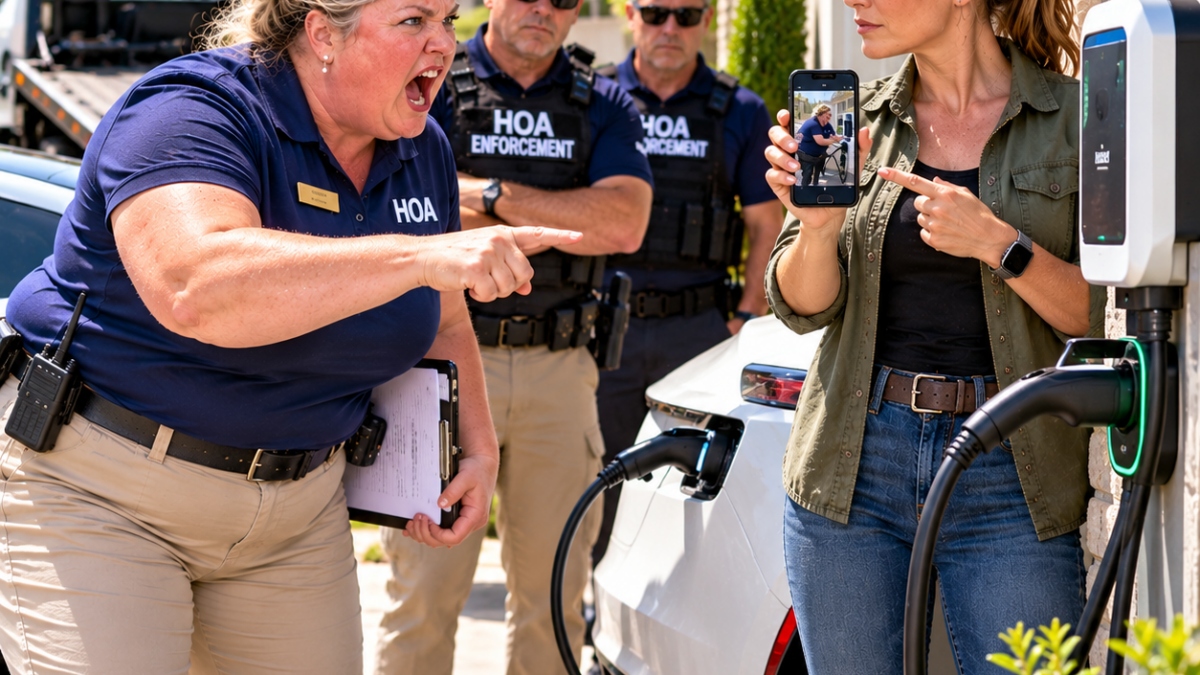
The HOA vice president unplugged my car in the middle of the night, dragged my charging cable across three lawns, and used the electricity I paid for—then showed up at my door demanding that I warn her before I disconnected her car again.
By the time she realized I had stopped arguing and started documenting, she had already walked straight into the one trap she could never talk her way out of: the truth, timestamped in high definition.
The first thing I noticed that Monday morning was the silence.
Electric vehicles teach you a strange kind of routine.
You plug in.
The connector clicks.
A light flashes.
Your phone confirms the charging session.
Then you stop thinking about it.
At least that was how my mornings worked until I walked into my garage at 6:10 a.m. and saw my car sitting there with fifteen percent battery.
I stared at the dashboard.
15%.
I had plugged it in the night before.
I knew I had.
Routine was one of the few things in my life that rarely failed me.
I was a software engineer. My entire job involved building systems that behaved predictably because unpredictable systems eventually became expensive systems.
Wake up.
Coffee.
Shower.
Check messages.
Unplug car.
Drive.
That morning, step five had vanished.
I walked toward the charger.
Empty.
The cable wasn’t connected to my car.
At first I assumed I had somehow forgotten.
Then I noticed the black cable stretched across the garage floor.
It disappeared under the partially open garage door.
I followed it outside.
Across my driveway.
Over the sidewalk.
Across a strip of grass.
Then along the side of the house three doors down.
My coffee cooled in my hand as I followed the cable.
At the other end sat a white Tesla Model Y.
Charging.
Green light blinking.
Using my equipment.
My electricity.
My cable.
I stood there longer than I care to admit.
Not because the situation was difficult to understand.
Because it was so ridiculous that my brain kept looking for a version that made sense.
Maybe someone thought the charger was public.
Maybe a neighbor had some emergency.
Maybe there had been a misunderstanding.
I unplugged the Tesla.
Coiled my cable.
Carried it back home.
No shouting.
No note.
No confrontation.
I had a client meeting in Phoenix in ninety minutes and far more immediate problems than teaching someone basic property boundaries.
I drove to a public fast charger.
Paid more than I should have.
Arrived eight minutes late.
My client didn’t care.
I did.
By lunchtime, the incident had settled into the category of irritating but probably fixable.
Then my doorbell camera sent an alert.
A woman stood on my porch.
Mid-forties.
Tennis clothes.
Sunglasses pushed onto her head.
Perfectly straight posture.
And an expression that suggested she had come to correct something I had done.
I ended my video call early.
Opened the door.
She didn’t introduce herself.
“Are you the one who unplugged my car this morning?”
That was her first sentence.
No hello.
No apology.
Not:
Did I accidentally use your charger?
Not:
I’m sorry, I thought it was shared.
She sounded offended.
I stared at her.
“That was my charging cable.”
She tilted her head.
“Yes. I know.”
“It runs from my charger.”
“I know.”
“Inside my garage.”
Another pause.
Then she gave me a faintly impatient smile.
“Oh, I assumed it was a community amenity.”
“A community amenity?”
“You know. Something residents can use.”
“No.”
I kept my voice level.
“I paid for it.”
Her smile faded slightly.
“It’s an EV charger.”
“Yes.”
“In a community.”
“It’s mounted inside my garage and connected to my meter.”
She waved one hand.
“Fine. Fine.”
Then she actually turned to leave.
I thought the conversation was over.
It wasn’t.
She looked back.
“Just give me a heads-up next time before you disconnect me, okay?”
I almost laughed.
“Excuse me?”
“If I’m charging.”
“You’re asking me to notify you before I stop you from using my private charger?”
She looked irritated now.
“You don’t have to make everything adversarial.”
I hadn’t lived in Ridgewood Heights long enough to know how much weight that sentence would eventually carry.
At the time, I just stared at her.
She walked away.
Three doors down.
Back toward the white Tesla.
Later that afternoon, my next-door neighbor told me her name.
Evelyn Rogers.
Vice president of the Ridgewood Heights Homeowners Association.
Eight-year resident.
Six years on the board.
Responsible for “community standards.”
That last part became relevant very quickly.
That evening, I opened the ChargePoint app.
I wasn’t even angry yet.
Mostly curious.
The app stored charging history.
Start time.
End time.
Kilowatt-hours.
Session duration.
I scrolled backward.
There was the previous night.
Then another session I didn’t recognize.
Then another.
Then another.
Four unauthorized sessions in less than two weeks.
All between roughly eleven at night and six in the morning.
All on nights when I had gone to bed believing my car was charging.
Total energy consumption:
About 180 kilowatt-hours.
The dollar amount wasn’t enormous.
Twenty-five or thirty dollars at my electricity rate.
That almost made the behavior worse.
She wasn’t stealing because she couldn’t afford electricity.
She owned a Tesla.
She lived in a house in Ridgewood Heights.
This was not desperation.
It was entitlement.
Four times, someone had walked onto my property at night.
Entered my garage area far enough to access my charging cable.
Disconnected my vehicle.
Dragged my cable toward another property.
Used electricity from my meter.
Then returned it before morning—or, on the fourth occasion, failed to do even that.
Once might be confusion.
Four times was a system.
I took screenshots.
Every session.
Every date.
Every start time.
Every amount of electricity consumed.
I created a folder.
RIDGEWOOD — EV CHARGER.
I had no grand plan.
No revenge fantasy.
I just understood one thing from years of engineering:
If something happens once, note it.
If it happens twice, investigate it.
If it happens four times, stop calling it an accident.
The next evening I wrote Evelyn an email.
I kept it painfully polite.
Evelyn,
I’m following up regarding the EV charging issue we discussed yesterday. The Level 2 charger at my residence is privately owned, installed at my expense, and connected directly to my household electrical meter.
My charging history indicates several sessions I did not initiate. Please do not use the charger or charging cable without my permission going forward.
If you need information about local public charging stations or residential installation options, I’m happy to send some resources.
Thank you,
Alan Reyes
I read it three times.
Removed the word unauthorized from the first draft because it sounded accusatory.
Removed a sentence about trespassing.
PART 2
Removed another sentence pointing out that she had already acknowledged knowing the charger came from my house.
Facts.
Boundary.
Solution.
No drama.
Sent at 7:43 p.m.
No response.
Not that night.
Not the next morning.
Not the following evening.
On the third day, I stopped checking.
Then my phone buzzed with a Ridgewood Heights community-app notification.
Evelyn Rogers had posted in the general discussion channel.
Over two hundred households could see it.
Her message read like something from a greeting card written by someone holding a knife behind their back.
Good morning, neighbors!
Just a friendly reminder that community spirit is what makes Ridgewood Heights special. We have always been a neighborhood where people share, support one another, and look out for their neighbors.
Unfortunately, some newer residents may not yet understand our culture of generosity.
Let’s all do our part to educate them on what it means to be a good neighbor.
No name.
No address.
No charger.
She didn’t need them.
I was the newest homeowner in Ridgewood Heights.
Everyone knew.
Fourteen people liked the post within an hour.
One comment:
Exactly! We’re a COMMUNITY, not a collection of islands.
Another:
Some people move in and immediately think everything is about “mine, mine, mine.”
A third:
Hopefully the new folks learn how things work around here.
I stared at the screen.
That was the moment the situation stopped being funny.
My private property had become evidence, in Evelyn’s version of events, that I lacked community spirit.
My request that she stop taking electricity I paid for had been transformed into selfishness.
I almost replied.
I wrote a response.
Deleted it.
Wrote another.
Deleted that too.
Anything I posted while angry would become a screenshot.
And screenshots survive longer than explanations.
So I put the phone down.
The consequences of Evelyn’s post started quietly.
A woman four houses away used to wave when she walked her golden retriever.
She stopped.
A man who washed his Corvette every Saturday crossed the street when I approached on an evening walk.
At the mailbox cluster, two neighbors ended their conversation the second I arrived.
One of them looked directly at me.
Then away.
Ridiculous?
Yes.
But social exclusion rarely arrives with a formal notice.
It comes in tiny movements.
Eyes.
Silences.
A conversation paused at the wrong moment.
I had lived in Ridgewood Heights for two months.
I barely knew these people.
Evelyn had lived there eight years.
She had six years of board meetings, neighborhood events, holiday parties, favors, relationships, and credibility.
I had a charging cable.
A stranger rarely wins a reputation battle against someone who has already defined the stranger.
That weekend, Mark Henderson knocked on my door.
Mark lived next to me.
Construction supervisor.
Mid-forties.
Quiet guy.
We had exchanged maybe ten sentences since I moved in.
“Hey.”
“Hey.”
“Hot today.”
“Yep.”
That level of intimacy.
When I opened the door, he looked down the street before speaking.
“I saw Evelyn’s post.”
“Most people did.”
“She was talking about you.”
“I assumed.”
Mark shoved his hands into his pockets.
“Can I come in?”
I stepped aside.
He accepted a beer and sat at my kitchen island.
For a while he didn’t speak.
Then:
“You need to understand how she operates.”
That got my attention.
“What does that mean?”
“She’s been vice president about six years.”
“I heard.”
“Anyone who crosses her starts getting violations.”
“For real violations?”
Mark laughed once.
“Sometimes.”
“And other times?”
“Trash can left out too long.”
“Grass half an inch over.”
“Christmas lights January second instead of January first.”
He drank.
“Fence stain supposedly wrong shade.”
“Mailbox not approved.”
“Basketball hoop visible.”
He looked toward my front window.
“She finds something.”
“Why?”
“Because once you’re officially a problem homeowner, everything becomes easier.”
“Easier how?”
“Other people stop defending you.”
That sounded familiar already.
Mark told me about the Henderson family.
Not related to him.
Same last name.
They had lived around the corner.
Two kids.
Normal people.
Their dispute started over a backyard fence.
They challenged Evelyn.
Won the first appeal.
Then came another violation.
Then another.
Landscaping.
Holiday decorations.
Parking.
Exterior storage.
A year later they sold.
“Did Evelyn make them sell?”
“Not legally.”
Mark’s answer was careful.
“She wore them down.”
“Why didn’t people stop it?”
He looked at me.
“Would you like to be her next project?”
That was an uncomfortable question.
Mark finished his beer.
“I’m not telling you to give in.”
“What are you telling me?”
“Don’t fight her emotionally.”
He stood.
“She’s better at that game than you.”
“I’m a software engineer.”
He smiled.
“Exactly.”
After he left, I sat alone.
I could respond publicly.
Post the charging logs.
Name Evelyn.
Force the neighborhood to pick sides.
It might feel great.
For five minutes.
Then she would say I was attacking a volunteer board member over a misunderstanding.
And half the neighborhood would believe her.
Instead, I opened my laptop.
New email.
This one went to the entire HOA board.
President Robert Hendricks.
Vice President Evelyn Rogers.
Secretary Linda Carter.
Two at-large members.
I attached a simple table.
Dates.
Times.
Energy usage.
No accusations.
I wrote:
I am requesting written clarification as to whether privately installed residential EV charging equipment connected to a homeowner’s personal electrical meter is considered a shared community amenity under Ridgewood Heights governing documents.
I also want to document that I previously asked Mrs. Rogers not to use my charging equipment without permission.
Please confirm the board’s position.
Sent.
Monday, 8:15 a.m.
Nothing.
Tuesday.
Nothing.
Wednesday.
Nothing.
Thursday night at 11:22, my phone recorded another charging session.
I discovered it Friday morning.
47 kilowatt-hours.
After the email.
After she knew.
After the entire board had been copied.
That removed any possibility of misunderstanding.
I sat in my car before work staring at the charging log.
The amount stolen still wasn’t huge.
That almost didn’t matter anymore.
It wasn’t about electricity.
It was about the belief underneath it.
Your boundary exists only if I respect it.
Your property is private only until I decide the community deserves it.
Your objection becomes selfishness because I say so.
That belief bothered me more than the money ever could.
The violation notice arrived the following Tuesday.
White envelope.
Official HOA logo.
Red stamp.
ACTION REQUIRED.
Inside:
NOTICE OF VIOLATION
CASE 2024-0147
UNAUTHORIZED EXTERIOR EQUIPMENT INSTALLATION
The address was mine.
The alleged violation was my EV charger.
According to the notice, I had installed exterior equipment visible from the street without architectural approval.
Required remedy:
Remove charger within thirty days.
Failure:
$100 daily fines.
Administrative costs.
Potential remediation by the association.
Signed:
Evelyn Rogers
Vice President
Ridgewood Heights HOA
I read it three times.
Then walked into my garage.
The charger was mounted on the inside wall.
Inside.
Behind the garage door.
You could not see it from the street.
You could barely see it from my driveway unless the garage was fully open.
Evelyn had personally walked into my garage area often enough at night to know exactly where it was.
That was what made the notice feel different.
It wasn’t a misinterpretation.
It was retaliation dressed in formatting.
I pulled the Ridgewood covenants.
Article 7.4.
Exterior equipment visible from public areas must follow architectural standards.
The charger wasn’t exterior.
Then I checked Arizona’s rules regarding residential EV charging equipment.
State law limited the ability of homeowner associations to prohibit or unreasonably restrict private EV charging installations.
I wasn’t trying to become a lawyer.
I needed to know whether Evelyn’s threat had any foundation.
So I called the HOA management company.
Desert Community Services.
After ten minutes of hold music that sounded designed to make callers surrender voluntarily, Jennifer answered.
I explained the notice.
She pulled my file.
“Your charger is inside the garage?”
“Yes.”
“Not mounted outside?”
“No.”
“Visible from the street?”
“No.”
She paused.
“I’m looking at the violation language.”
Another pause.
“Article 7.4 appears to concern exterior installations.”
“That was my reading.”
“Yes.”
“And state law?”
She became more careful.
“I’m not authorized to give legal advice.”
“Understood.”
“But Arizona law does limit an HOA’s ability to prohibit residential EV charging equipment.”
“So should this notice have been issued?”
“I can’t formally answer that.”
“Can the board rescind it?”
“Yes.”
“How?”
“Appeal at the next meeting.”
“When?”
“Three weeks.”
I wrote everything down.
“Thank you.”
After we hung up, I saved the call details.
Then called Mark.
He came over.
Read the notice.
Shook his head.
“Article 7.4.”
“You know it?”
“She used it against the Hendersons.”
“For what?”
“Their fence.”
“A fence is exterior.”
“Sure.”
“But?”
“She claimed it was visible from common property.”
“Was it?”
“If you stood on a ladder behind a hedge.”
I stared at him.
Mark handed back the paper.
“This is what I meant.”
“She finds something.”
“Exactly.”
“Why is the board letting her?”
“Because most board members don’t read everything she signs.”
“That’s insane.”
“It’s volunteer government.”
Mark leaned against the counter.
“People show up thinking they’re approving landscaping budgets.”
“Then one person who really enjoys authority becomes the person who actually runs everything.”
That night I created a second folder.
Not digital.
Paper.
Charging logs.
Emails.
Community-app screenshots.
Violation notice.
Photographs showing the charger location.
Relevant covenant language.
Applicable state-law materials.
Nothing dramatic.
Just a file.
Then I ordered a security camera.
Weatherproof.
Night vision.
Cloud backup.
Wide field of view.
The camera arrived Saturday.
I mounted it under the garage eave.
From the street, it looked like part of the existing security system.
From my phone, it showed everything.
Driveway.
Garage entrance.
Sidewalk.
Charger cable.
I tested it repeatedly.
Daylight.
Night.
Headlights.
Motion.
Then I installed a smart lock on the cable system.
Not a physical trap.
Nothing that could hurt anyone.
Just control.
I could authorize or deny access remotely.
The charger already logged every session.
Now I had the missing piece.
Video.
If Evelyn stopped, good.
I would be happy.
If she didn’t, I would stop arguing about what happened.
I would show it.
Two weeks remained before the board meeting.
Evelyn used the charger three more times.
Three.
All after written notice.
All after my board email.
All late at night.
Meanwhile, she posted again.
A quick note about neighborhood values…
Ridgewood Heights is a community where people support each other. We share. We help. We don’t hoard resources while our neighbors go without.
Some homeowners seem to have forgotten what community means.
Let’s hope they remember.
Eighteen likes.
Six comments.
One:
Some people really don’t belong in places like Ridgewood.
I screenshot it.
Saved it.
Closed the app.
The management company sent me a reminder that the thirty-day removal deadline was approaching.
Daily fines would begin afterward.
I calculated what a lawyer might cost.
Two thousand.
Five thousand.
More if litigation expanded.
I could afford it.
That wasn’t the point.
Evelyn could issue another violation afterward.
Then another.
If the board never examined what she was doing, winning one legal argument wouldn’t solve anything.
The real issue wasn’t the charger notice.
It was credibility.
Her credibility.
Mine.
And the board’s willingness to see evidence.
Four nights passed without another charging session.
I started wondering if she had finally stopped.
Fifth night.
11:47 p.m.
My phone vibrated.
CHARGING SESSION STARTED.
I was already in bed.
I opened the camera feed.
There she was.
Evelyn Rogers.
Pajama pants.
Light jacket.
Hair tied back.
She entered my driveway.
Stopped.
Looked left.
Then right.
That detail mattered.
People doing something they believe is innocent rarely scan the street first.
She walked into my garage approach.
Disconnected my car.
Then pulled an extension cable from beside the landscaping.
Already prepared.
She connected my charger to the extension.
The extension disappeared across the lawns toward her property.
Thirty seconds.
Efficient.
Practiced.
Then she walked away.
I watched the clip again.
And again.
Not because I enjoyed it.
Because I wanted to make sure I wasn’t seeing what I expected to see.
11:47.
Clear face.
Clear cable.
Clear charger.
Clear movement toward her house.
I saved the recording.
Phone.
Laptop.
Cloud.
External drive.
Then I did something that surprised even me.
Nothing.
I didn’t disconnect her.
Didn’t confront her.
Didn’t call the police.
I let the charging session continue until morning.
At six, I ended it.
52 kilowatt-hours.
Then opened a spreadsheet.
Seven documented unauthorized sessions.
312 kilowatt-hours.
Around forty-five dollars at my rate.
Forty-five dollars.
That was all.
A board vice president had risked her reputation over less than the price of a nice dinner.
But again, this was never about forty-five dollars.
It was about someone believing nobody would ever force her to explain herself.
I scheduled a consultation with an HOA attorney named Olivia Murphy.
Video call.
One hundred fifty dollars an hour.
Worth it.
I gave her the file.
She read silently.
Then watched the camera footage.
Twice.
When she finished, she leaned back.
“Alan.”
“Yes.”
“This is unusually clean.”
“Good clean or bad clean?”
“Good for you.”
She pointed toward the documents.
“The violation notice appears unsupported by the covenant section cited.”
I nodded.
“The charger is inside your garage.”
“Yes.”
“And Arizona law provides significant protection against unreasonable HOA restrictions on residential EV charging.”
“Yes.”
Then she pointed at the video.
“And Evelyn continued using your charger after written notice.”
“Yes.”
“Multiple times?”
“Seven total. Several after notice.”
Olivia was quiet.
“What do you want?”
I had considered everything.
Police complaint.
Small claims.
Demand letter.
Formal board complaint.
Management-company complaint.
I could pursue any combination.
“I want the board meeting.”
Olivia raised an eyebrow.
“Why?”
“I want to appeal the violation publicly.”
“Okay.”
“And then show the footage.”
“Also okay.”
“In front of homeowners.”
She studied me.
“This isn’t the lowest-conflict strategy.”
“No.”
“If the board protects her, you’ll escalate the hostility.”
“I know.”
“If she resigns or the board removes her, you win publicly.”
“That isn’t exactly what I’m after.”
“What are you after?”
I thought.
“I want the story to stop being hers.”
Olivia nodded slowly.
That she understood.
“Then facts only.”
“I know.”
“No insults.”
“Yes.”
“No ‘Karen.’”
“Definitely not.”
“No dramatic accusations about theft unless you’re prepared for the legal implications.”
“I’ll say unauthorized charging.”
“Good.”
“Let the video make the moral point.”
“Exactly.”
We designed the presentation.
Slide one:
Violation notice.
Slide two:
Actual covenant language.
Slide three:
Photos showing charger location.
Slide four:
State-law summary.
Then stop.
Let the board respond.
Only after Evelyn inevitably attacked my motives would I introduce the charging issue.
Olivia didn’t say inevitably.
I did.
She smiled.
“Don’t get overconfident.”
“Sorry.”
Then:
Charging logs.
Emails.
Video.
No commentary necessary.
The night before the meeting, Evelyn posted again.
Looking forward to seeing everyone tomorrow evening! We have important community matters to address.
I stared at the words.
She had no idea.
That was the strangest part.
She genuinely believed I was coming to defend myself against her notice.
She thought she still controlled the frame.
The Ridgewood Heights Community Center was already half full when I arrived Thursday at 6:45.
Beige stucco.
Fluorescent lights.
Folding chairs.
Projector screen.
About forty residents.
More arrived before seven.
I chose a chair in the middle.
Not front row.
Not back.
Laptop bag beside me.
Mark entered.
Saw me.
Sat two rows behind.
He didn’t wave.
Smart.
This wasn’t a team performance.
Board members entered at 6:55.
President Robert Hendricks sat center.
Early sixties.
Gray hair.
Permanent expression of a man who regretted volunteering.
Linda Carter sat left.
Evelyn sat right.
Cream blouse.
Perfect posture.
Confident smile.
She looked at me once.
Then away.
Meeting began.
Pool resurfacing.
Landscaping contract.
Garage-sale weekend.
Budget adjustments.
I heard almost none of it.
My stomach tightened as agenda item seven approached.
Forty-five minutes later:
“Violations and appeals.”
Robert adjusted his glasses.
“We have one homeowner appeal tonight.”
He read the case number.
“Mr. Alan Reyes.”
I stood.
Carried the laptop forward.
Connected it.
First slide.
Violation notice.
“Thank you.”
My voice sounded calmer than I felt.
“I received this notice alleging that my EV charger violates Article 7.4 concerning exterior equipment visible from public areas.”
Next slide.
Photos.
Front of house.
Driveway.
Closed garage.
Open garage showing charger on interior wall.
“My charger is installed entirely inside my garage.”
Linda leaned forward.
Robert wrote something.
“You cannot see it from the street.”
Next slide.
Covenant language.
“Article 7.4 applies to exterior equipment.”
Pause.
“My charger is not exterior.”
Next.
State-law summary.
“Arizona law also limits an HOA’s ability to prohibit or unreasonably restrict residential EV charging equipment.”
I looked at the board.
“For those reasons, I’m asking that notice 2024-0147 be rescinded.”
Robert nodded.
“That appears straightforward.”
Linda whispered something to him.
Then Evelyn interrupted.
“May I?”
Robert looked tired already.
“Go ahead.”
Evelyn leaned toward her microphone.
“This is exactly the kind of technical rules-lawyering that undermines community standards.”
There it was.
Her eyes moved to me.
“Mr. Reyes has lived here for approximately two months.”
“Correct.”
“He has repeatedly resisted reasonable efforts to cooperate.”
I remained standing.
Evelyn continued.
“The spirit of Article 7.4 is clear.”
I said:
“Before we debate the spirit of the rules, I have another matter for the board.”
Robert looked at me.
“Related?”
“Yes.”
I clicked.
Spreadsheet.
Dates.
Times.
Kilowatt-hours.
Seven sessions.
The room quieted.
“This is my residential charging log.”
I pointed.
“Each line represents a charging session.”
“These seven were not initiated by me.”
11:32 p.m.
12:18 a.m.
1:07 a.m.
11:22 p.m.
2:14 a.m.
12:41 a.m.
11:47 p.m.
“All occurred overnight.”
I clicked again.
Email to Evelyn.
“On May fifteenth, I notified Mrs. Rogers in writing that the charger was private property and asked her not to use it.”
Next.
Email to board.
“On May twenty-second, I asked the board to clarify whether a privately installed charger connected to a homeowner’s electrical meter is considered a community amenity.”
Robert’s expression changed.
“I remember this email.”
“Did the board respond?”
He looked at Evelyn.
Then at Linda.
“No.”
Evelyn spoke quickly.
“There are hundreds of emails—”
I raised one hand slightly.
“I’m not asking why.”
She stopped.
I turned back to the screen.
“Several unauthorized sessions occurred after both emails.”
Then I clicked the final file.
Video.
Night vision.
Timestamp:
11:47 p.m.
The entire room watched Evelyn Rogers walk into my driveway.
Her face clear beneath the streetlight.
She looked left.
Right.
Disconnected my car.
Attached the extension cable.
Walked away.
The video was thirty-eight seconds long.
It felt like ten minutes.
Evelyn stood so quickly her chair scraped backward.
The video froze on a frame showing her hand on my charging connector.
Nobody said anything.
Her face turned red.
Not instantly.
It started along her neck.
Moved upward.
“This…”
She looked around.
“This is an invasion of privacy.”
I kept my voice flat.
“The camera records my driveway and my garage entrance.”
“You recorded me without consent.”
“You were on my property interacting with my equipment.”
“That does not give you the right to spy on neighbors.”
“I installed the camera after repeated unauthorized use of my charger.”
Her voice rose.
“You intentionally set me up.”
“No.”
I looked directly at her.
“I asked you to stop.”
The room became even quieter.
“I asked twice.”
I pointed at the email.
“You continued.”
I pointed at the logs.
“You came back repeatedly.”
Then the video.
“I documented it.”
Evelyn looked at Robert.
“This is completely inappropriate.”
Robert stared at the frozen image.
“Evelyn.”
“What?”
“Did you use his charger?”
She hesitated.
That hesitation ended the argument.
“Everyone shares resources in Ridgewood.”
Robert’s expression hardened.
“That isn’t what I asked.”
“I thought the charger was available.”
I said:
“After my email?”
She turned toward me.
“You didn’t need to be so hostile about it.”
Mark made a sound behind me.
Almost a laugh.
Evelyn heard.
“See?”
She looked around.
“This is what he has done since moving here.”
“He refuses to participate.”
“He treats everything like a transaction.”
“He called something community residents have always shared ‘private property.’”
A man near the front asked:
“Have we always shared private electricity?”
Evelyn ignored him.
Robert raised his hand.
“Let’s stop.”
He looked at me.
“Mr. Reyes, do you have anything further?”
“No.”
That was important.
I had everything.
Adding anger would weaken it.
Robert looked at the other board members.
“I’m calling a fifteen-minute recess.”
The board disappeared into a back room.
Evelyn followed.
The door closed.
Then the room exploded.
Not shouting.
Whispers.
“Was that really Evelyn?”
“She unplugged his car?”
“She went onto his driveway at midnight.”
“How many times?”
“Seven.”
“Why?”
Mark moved beside me.
“Well.”
“Don’t.”
“I didn’t say anything.”
“You’re smiling.”
“I’m trying not to.”
An older man approached.
“You’re Alan?”
“Yes.”
“Peterson.”
We shook hands.
“I believe you.”
“Thank you.”
He looked toward the closed board-room door.
“She used my garden hose.”
I blinked.
“What?”
“Six years ago.”
“For what?”
“Filled her pool.”
I thought he was joking.
He wasn’t.
“I kept seeing my water bill spike.”
“Did you catch her?”
“Once.”
“What happened?”
“She said community resources should be shared.”
Same phrase.
Same logic.
“Why didn’t you report her?”
“I did.”
“To who?”
“The HOA.”
I looked at the board-room door.
Peterson smiled without humor.
“Exactly.”
A woman joined us.
“She fined me three years straight for Christmas lights.”
Another man:
“She cited my mailbox.”
Then another:
“She tried to make us remove a play structure.”
Stories started accumulating.
Not huge crimes.
Not dramatic.
Just six years of selective enforcement, petty pressure, and power used personally.
Robert returned after twenty-two minutes.
The board sat.
Evelyn did not.
For several seconds, I thought she might have left.
Then she entered.
Slowly.
No smile.
She sat.
Robert adjusted his microphone.
“We’ve reviewed the materials presented tonight.”
He looked at me.
“Violation notice 2024-0147 is rescinded effective immediately.”
Applause started.
Robert raised a hand.
“Please.”
It stopped.
“The association will also remove all related administrative charges from Mr. Reyes’s account.”
He continued.
“The board has determined that privately owned EV charging equipment connected to an individual homeowner’s electrical service is not a shared community amenity.”
Someone behind me muttered:
“Obviously.”
A few people laughed.
Evelyn stared at the table.
Robert continued.
“The board further finds that the conduct shown in the video is inconsistent with the responsibilities expected of an HOA officer.”
Pause.
“Mrs. Rogers has agreed to resign as vice president effective immediately.”
A low whistle came from the back.
Evelyn’s jaw tightened.
Robert looked uncomfortable.
“The board will issue a written apology to Mr. Reyes.”
“And a community-wide clarification regarding private EV charging equipment.”
He turned toward me.
“Mr. Reyes, is there anything you would like to add?”
I stood.
Every person looked at me.
“I appreciate the board correcting the violation.”
I glanced at Evelyn.
Then back at Robert.
“I am not asking the HOA to punish Mrs. Rogers beyond whatever governance decisions the board believes are appropriate.”
Evelyn looked up.
I continued.
“I will pursue reimbursement for the electricity used without permission and any applicable costs separately.”
Peterson suddenly spoke.
“Good.”
Everyone looked at him.
He stood.
“I should’ve done that six years ago.”
Robert sighed.
“Mr. Peterson—”
“No.”
Peterson faced the room.
“She used my hose for weeks.”
A few surprised laughs.
“I complained.”
“Nothing happened.”
“So I gave up.”
A woman raised her hand.
“She targeted my holiday decorations.”
Another:
“She threatened fines over my mailbox.”
Another:
“She reported my son’s basketball hoop three times.”
The room changed.
This wasn’t my meeting anymore.
It belonged to years of accumulated frustration.
Evelyn stood.
“This is ridiculous.”
Nobody stopped talking.
She raised her voice.
“This is a witch hunt.”
That quieted everyone.
She looked around.
Face flushed.
Hands shaking.
“I have given six years to this community.”
No one answered.
“Six years.”
She pointed toward me.
“And now some outsider who has lived here for two months brings in a video and suddenly I’m the enemy?”
I stayed silent.
She continued.
“He refused to cooperate from day one.”
“He refused to share.”
“He set up cameras.”
“He has treated this neighborhood like a hotel.”
Mark finally spoke.
“He paid for the charger.”
Evelyn snapped toward him.
“That isn’t the point.”
Mark crossed his arms.
“That seems exactly like the point.”
A few residents laughed.
Evelyn looked at Robert.
“Are you going to let this happen?”
Robert’s voice was tired.
“Evelyn, sit down.”
Her face changed.
“Excuse me?”
“Please sit down.”
She looked from Robert to Linda.
Linda would not meet her eyes.
That was when Evelyn understood.
Not when the video played.
Not when the violation was rescinded.
Then.
Her power had depended on people beside her continuing to validate it.
They were done.
Evelyn grabbed her purse.
“You’ll regret this.”
Robert closed his eyes briefly.
“Please don’t.”
She walked toward the exit.
Stopped beside me.
For a second I thought she might say something.
She didn’t.
The door closed behind her.
Nobody followed.
The meeting ended ten minutes later.
People approached as I packed my laptop.
A woman shook my hand.
“Thank you.”
“You don’t need to thank me.”
“We were scared of her.”
That surprised me.
“Scared?”
“Not physically.”
She looked embarrassed.
“Of becoming the next person she targeted.”
That was more honest.
Mark waited until most people left.
Then clapped me on the shoulder.
“Told you she plays the long game.”
I zipped the laptop bag.
“What?”
“Nothing.”
“What?”
He smiled.
“She finally met someone who played longer.”
“I didn’t play anything.”
“Sure.”
Outside, the desert air had cooled.
I stood in the parking lot.
For weeks, I imagined I would feel triumphant.
Instead, I felt tired.
The trap hadn’t been clever.
No booby trap.
No public humiliation engineered for entertainment.
A camera.
A charging log.
Emails.
A law.
A board meeting.
Truth preserved long enough that someone had to confront it.
That was all.
Three days later, Robert emailed.
Formal apology.
Signed by the board.
The violation was gone.
The management company removed the case from my property account.
The HOA also circulated a community notice:
Privately owned residential charging equipment connected to individual electrical service is not available for public or community use without owner permission.
Obvious.
Now officially obvious.
Olivia helped me file a small civil claim.
Not because forty-five dollars mattered.
Because I wanted the record to end cleanly.
Electricity.
Court fee.
Related costs.
Evelyn did not contest it.
The court awarded $387 total.
The check arrived weeks later.
No note.
No apology.
Just money.
I deposited it.
Done.
Or I thought it was done.
Two weeks after the board meeting, Linda knocked on my door.
New vice president.
She looked nervous.
“I wanted to apologize personally.”
“You don’t have to.”
“Yes, I do.”
She shifted.
“We should have responded to your email.”
I said nothing.
“We should have reviewed the notice before it went out.”
“Yes.”
She nodded.
“I know.”
That was the first time someone from the HOA simply admitted the mistake without explaining it away.
It mattered.
“We’re reviewing enforcement procedures.”
“Good.”
“And no single board officer will be able to issue a formal violation without documentation.”
“Better.”
She hesitated.
“Would you consider joining the committee?”
“No.”
She laughed.
“That fast?”
“I moved here to live here.”
“Fair.”
A month later, Evelyn’s house went on the market.
Mark told me.
“Priced low.”
“Okay.”
“You don’t care?”
“I care enough to hope the sale goes smoothly.”
He stared.
“That’s disturbingly mature.”
“Therapy.”
“You go to therapy?”
“No.”
“Then you’re lying.”
“Probably.”
The house sold in ten days.
Moving truck arrived six weeks after the meeting.
I didn’t watch intentionally.
But I was outside checking my mail when Evelyn walked from her house carrying a box.
She saw me.
We looked at each other across three properties.
No board table.
No app posts.
No charger cable between us.
She looked away first.
I didn’t feel victorious.
That surprised me too.
She got into her car.
Drove away.
That was the last time I saw Evelyn Rogers.
A young couple bought the house.
Jason and Maria.
Toddler named Sophia.
Golden retriever with absolutely no respect for property lines.
I brought them wine.
Jason drove a Toyota hybrid.
While we stood in their driveway he asked:
“We might get an EV next year.”
“Nice.”
“Any trouble installing chargers?”
I almost laughed.
“No.”
“HOA?”
“Not anymore.”
A week later, somebody posted on the community app:
Welcome Jason, Maria, Sophia, and Bailey!
Please make them feel at home.
And remember: don’t borrow their garden hose without asking.
Twelve laughing reactions.
Peterson tagged me.
Mark tagged me.
I stared at the post.
Then, for the first time since moving into Ridgewood Heights, I laughed at something in the community app instead of closing it angry.
Things changed slowly.
Robert hired an attorney to review the governing documents.
The EV-charger language was clarified.
So were rules concerning solar panels and battery storage.
Board officers had to disclose conflicts when filing complaints.
Violation notices required actual photographic or documentary support.
Homeowners received a clearer appeal process.
No revolution.
Just guardrails.
Three more families installed EV chargers that year.
No violations.
Nobody called them selfish.
Nobody stretched cables across lawns at midnight.
Mark came over one Saturday with beer.
We sat on my patio.
The Arizona sky turned orange.
He stared toward Evelyn’s old house.
“You know what’s weird?”
“What?”
“I’ve lived here seven years.”
“Sorry.”
“Thank you.”
He opened another beer.
“This is the first time the HOA feels boring.”
“That’s good.”
“Very.”
We sat quietly.
Then he said:
“Do you think you fixed Ridgewood?”
“No.”
“Seriously?”
“I exposed one person doing one thing.”
Mark shook his head.
“You gave everyone else permission to admit what they already knew.”
That stayed with me.
Because he was right.
The video didn’t create Evelyn’s behavior.
It made denial harder.
Peterson already knew.
The Christmas-light woman knew.
Mark knew.
The Hendersons knew.
Probably Robert knew more than he admitted.
What changed was evidence.
Once people saw the same pattern at the same time, they stopped thinking their experience was isolated.
That may have been Evelyn’s real power.
Isolation.
Make every homeowner think:
This only happens to you.
Maybe you’re difficult.
Maybe the board is right.
Maybe fighting is embarrassing.
Maybe paying the fine is easier.
Then somebody else thinks the same thing.
And another.
And another.
Until one security-camera clip puts everyone’s private suspicion in the same room.
A few days later, I found a bottle of wine on my porch.
No name.
Card attached.
Thank you for doing what the rest of us were too afraid to do.
From everyone who ever received one of her ridiculous violation notices.
I recognized Peterson’s handwriting from the sign-in sheet at a community event.
I brought the wine inside.
That evening, I poured one glass.
Sat on the patio.
Stars appeared above the rooftops.
My phone vibrated.
CHARGING COMPLETE — 100%.
I stared at the notification.
Months earlier, the story began with fifteen percent.
Silence in the garage.
Cable gone.
Client meeting.
Confusion.
Now the charging session belonged to me.
Exactly as boring as it should have been.
I thought about the word trap.
People who heard the story later loved that part.
“What trap did you set?”
“Did you lock the cable on her?”
“Did you remotely shut her car down?”
“Did you leave a fake charger?”
Nothing like that.
I never needed to physically trap Evelyn.
I never baited her.
I repeatedly asked her to stop.
Then I documented what she chose to do anyway.
That was the trap.
Truth.
She walked into it seven times.
Every unauthorized session became another timestamp.
Every ignored email became another timestamp.
Every community post attacking my character became another contrast.
The violation notice became the final mistake.
She accused me of violating community standards while secretly using the same equipment she claimed should be removed.
That contradiction humiliated her far more than any insult I could have invented.
Because everyone saw it at once.
One evening several months later, Peterson joined me on a walk.
We passed the community center.
He nodded toward it.
“Never liked that building.”
“Why?”
“Too many meetings.”
“Fair.”
He laughed.
Then grew serious.
“I should have fought Evelyn over the pool water.”
“Maybe.”
“That’s all?”
“What do you want me to say?”
“That I was weak?”
“No.”
“I let it go.”
“Yes.”
“And she kept doing it.”
“Yes.”
Peterson stopped walking.
“Then maybe I was part of the problem.”
I thought before answering.
“You weren’t responsible for what she did.”
“But silence helped.”
“Sometimes.”
He nodded.
“That’s what I mean.”
We resumed walking.
After a moment I said:
“You also spoke at the meeting.”
“Six years late.”
“Still spoke.”
He smiled slightly.
“I guess.”
That conversation changed how I saw the whole thing.
I had spent weeks thinking justice meant Evelyn losing her board position.
Then her moving.
Then the civil judgment.
But justice wasn’t a single event.
It was a neighborhood relearning how to say:
No.
Show me the rule.
Where is that written?
Who approved this?
Why was I fined?
Why wasn’t the other property fined?
What authority allows this?
Those are ordinary questions.
But ordinary questions are poison to people whose power depends on nobody asking them.
The board became noticeably more cautious.
At the next annual budget meeting, Robert proposed a landscaping contract.
A woman in the second row asked for bids.
Old Ridgewood might have accepted the recommendation.
New Ridgewood asked:
“How many companies bid?”
Robert answered.
“Three.”
“Can we see them?”
He hesitated.
Then:
“Yes.”
They posted them.
Nothing sinister.
The lowest bidder wasn’t selected because another company offered better maintenance coverage.
Residents read it.
Discussed it.
Approved it.
No scandal.
No conspiracy.
Just transparency working before distrust had a chance to grow.
Linda later told me:
“Every question feels hostile now.”
I said:
“That’s probably temporary.”
“Why?”
“People haven’t been allowed to ask them for a long time.”
She nodded.
“How do we earn trust back?”
“Answer boring questions.”
She laughed.
“That’s it?”
“Mostly.”
“What about community events?”
“Answer boring questions.”
“Newsletters?”
“Boring questions.”
“Transparency portal?”
“Now you’re learning.”
We became friends in the strange way people do after surviving a shared administrative disaster.
Not close friends.
But friendly.
She once asked what I would have done if Evelyn had apologized at my door the first day.
“I would’ve forgotten the whole thing.”
“Really?”
“Yes.”
“No board meeting?”
“No.”
“No camera?”
“Probably not.”
“No small claims?”
“No.”
Linda shook her head.
“All this because she couldn’t say sorry.”
“Not exactly.”
“What then?”
“Because she couldn’t accept no.”
That was more accurate.
The charger wasn’t special.
My electricity wasn’t special.
I wasn’t special.
The conflict grew because Evelyn believed a boundary was a challenge.
When I said:
This is private.
She heard:
Prove you’re powerful.
When I said:
Please stop.
She heard:
Make me.
When I asked the board for clarification, she responded with a violation.
The charger became symbolic.
Not of electricity.
Of authority.
She needed to win because losing would mean admitting my garage was outside her control.
That was why the $45 figure never made sense if you treated this as theft alone.
No rational person risks six years of community leadership for $45.
But people risk everything over power constantly.
A year after Evelyn left, Ridgewood held its annual summer gathering.
Mark convinced me to attend.
“Free food.”
“That’s your argument?”
“Yes.”
“It’s strong.”
We stood near a grill.
Jason from Evelyn’s old house walked over.
“You’ll appreciate this.”
“What?”
He showed me his phone.
Order confirmation.
New EV.
“Charger next month.”
I nodded.
“Congratulations.”
“Anything I need to know?”
“Use a licensed electrician.”
“I mean HOA.”
I pretended to think.
“Yes.”
His expression tightened.
“Really?”
“Never run an extension cord three houses down.”
Mark nearly dropped his drink laughing.
Jason stared.
Then realized.
“You’re that guy.”
“What guy?”
“The charger story.”
Mark pointed at me.
“He’s absolutely that guy.”
I closed my eyes.
Fantastic.
The story had become neighborhood folklore.
According to one version, I caught Evelyn using a drone.
Another version said the charger automatically locked onto her Tesla.
Someone claimed I remotely immobilized her car until police arrived.
None of that happened.
Reality was less cinematic.
Which was exactly why I trusted it more.
A camera.
A spreadsheet.
A meeting.
The truth does not need special effects.
Jason installed his charger.
Perfect installation.
No issue.
A few months later, another homeowner installed solar panels.
The board reviewed the plan.
Approved it.
No drama.
Then battery storage systems began appearing.
Ridgewood changed with technology.
The HOA adapted instead of pretending every new device threatened property values.
That felt like progress.
My own charger became obsolete eventually.
Two years later, a newer model offered better power management.
I replaced it.
When the electrician removed the old unit, he pointed at scratches near the cable mount.
“What happened here?”
I looked.
Small marks.
Probably from nights Evelyn pulled the cable out.
“Long story.”
“Should I fix the wall?”
I considered.
“No.”
He shrugged.
Installed the new unit.
The scratches remained.
I didn’t keep them as some dramatic monument.
I simply stopped caring enough to patch them.
That was another sign the story was over.
Real closure isn’t remembering without anger.
Sometimes it is forgetting long enough that the memory stops organizing your behavior.
For months after Evelyn left, I checked the camera feed every morning.
Eventually, I stopped.
Then one day I realized I had not opened the camera app in three weeks.
I smiled.
Deleted several old clips.
Kept the important evidence file archived.
Not because I expected trouble.
Because I am still a software engineer.
We archive everything.
Mark said that sounded unhealthy.
I reminded him he owned seven different power drills.
We agreed not to discuss hobbies.
One Saturday, Maria knocked on my door.
Evelyn’s former house.
“Do you have a minute?”
“Sure.”
She looked nervous.
“My daughter’s playhouse.”
“What about it?”
“The HOA sent a notice.”
For one second, something old tightened in my chest.
“What kind?”
“Architectural review.”
I read it.
This one was legitimate.
The playhouse exceeded a height threshold and needed formal approval.
No fine.
No threat.
Just an application request.
I explained.
Maria looked embarrassed.
“Oh.”
“That’s it.”
“So they’re right?”
“Yes.”
She laughed.
“I came to the anti-HOA guy and he sided with the HOA.”
“I’m not anti-HOA.”
“You kind of have a reputation.”
“I’m pro-reading.”
She filled out the form.
Board approved the playhouse.
That little incident mattered to me.
Because after Evelyn, it would have been easy to assume every enforcement action was abuse.
It wasn’t.
Communities need rules.
Shared standards can be reasonable.
Parking rules can matter.
Noise limits can matter.
Building requirements can matter.
The problem was never that Evelyn enforced rules.
It was that she treated rules as tools for personal power.
A legitimate HOA can say:
Here is the rule.
Here is why it applies.
Here is the evidence.
Here is your appeal.
Here is the same standard applied to everyone.
An abusive one says:
Because I said so.
That difference became clearer with time.
Robert eventually stepped down.
Not scandalously.
He had served enough years.
Linda became president.
Her first email to residents made me laugh.
SUBJECT: I PROMISE YOUR PRIVATE CHARGERS ARE SAFE.
She included a laughing emoji.
Then apologized for using an emoji in an official HOA email.
Mark replied-all:
THIS IS THE REAL SCANDAL.
The entire thread became chaos.
Nobody got fined.
Ridgewood survived.
Peterson eventually sold his house.
Not because of conflict.
He wanted to be closer to his grandchildren.
At his goodbye gathering, he handed me a garden hose nozzle.
I stared.
“What is this?”
“Symbolic.”
“Of what?”
“Property rights.”
I laughed.
“Please take it.”
“No.”
“Peterson.”
“Frame it.”
“I hate you.”
“You’ll miss me.”
He was right.
I did.
After he moved, the neighborhood felt different.
But not emptier.
Just changed.
People come.
People leave.
Communities aren’t preserved by controlling every change.
That was another thing Evelyn never understood.
She believed maintaining Ridgewood meant freezing it.
Same aesthetics.
Same hierarchy.
Same habits.
Same people agreeing with her.
But healthy communities change.
New homeowners.
New technology.
New expectations.
New questions.
Sometimes even EV chargers.
The first morning with my new charging unit, I woke early.
Walked into the garage.
100%.
Cable where I left it.
No extension cord.
No mystery session.
No drama.
I laughed.
Mark was outside walking past.
“What?”
“Nothing.”
“You’re laughing at your charger?”
“No.”
“You’ve finally lost it.”
“Possible.”
He continued down the sidewalk.
I unplugged the car.
The small click sounded strangely satisfying.
Not because it meant victory.
Because it meant normal.
That was all I ever wanted.
Normal.
To charge my car.
Go to work.
Wave at neighbors.
Attend the occasional barbecue.
Ignore most HOA emails.
The ordinary privileges people rarely appreciate until somebody makes them difficult.
Years later, when someone new heard the story, they usually asked:
“Why didn’t you call police immediately?”
Fair question.
I could have.
Unauthorized use of electricity can be reported.
Trespass can be documented.
But I had been new.
The value involved was small.
And I hoped a direct request would solve it.
Then:
“Why let her keep charging after you installed the camera?”
Another fair question.
I did not encourage her.
I repeatedly told her to stop.
The camera did not create her decision.
It preserved it.
I wanted evidence strong enough that the board could not turn the dispute into:
Alan says.
Evelyn says.
That was the whole strategy.
Remove ambiguity.
Engineers love removing ambiguity.
Was the charger private?
Yes.
Was it connected to my meter?
Yes.
Did I notify her?
Yes.
Did she know I objected?
Yes.
Did she continue?
Yes.
Was she visible on camera?
Yes.
Did the HOA rule apply?
No.
Could she explain all of that away?
Apparently not.
That is why the board meeting worked.
Not because I embarrassed her skillfully.
Because every escape route had been closed by facts.
She could not say:
I thought it was shared.
Email.
She could not say:
I didn’t use it.
Video.
She could not say:
I stopped when he asked.
Charging logs.
She could not say:
His charger violated the rules.
Covenants and state law.
She could not say:
He attacked me publicly first.
Her own community posts existed before my presentation.
All I did was put the timeline in the right order.
Truth becomes powerful when sequence makes motive visible.
That idea changed how I handled conflict afterward.
At work too.
When a client blamed software for something, I stopped arguing.
Logs.
Timeline.
Screenshots.
Data.
Mark once said:
“You turned Evelyn into a professional development course.”
“Everything is data.”
“That is the most engineer thing you’ve ever said.”
He wasn’t wrong.
Another year passed.
Ridgewood installed two shared EV chargers near the community center.
That was the funniest ending possible.
Actual community chargers.
Paid from approved common funds.
Metered separately.
Available by resident account.
The board asked homeowners to vote.
Seventy-eight percent supported the proposal.
At the ribbon cutting, Linda looked directly at me.
“Would you like to say a few words?”
“No.”
“Please?”
“No.”
Mark started chanting:
Speech.
Three other people joined.
I hated all of them.
Finally, I stood beside the chargers.
“This one is public.”
Everyone laughed.
“That’s my entire speech.”
I walked away.
Linda grabbed the microphone.
“He practiced all week.”
“I absolutely did not.”
People laughed again.
The chargers became popular.
And because they were actually shared, nobody had to drag cables across private lawns.
The board even installed signage:
RIDGEWOOD HEIGHTS COMMUNITY EV CHARGING
FOR RESIDENT USE.
Sometimes clarity really is that easy.
One night, I returned late from work.
Community charger occupied.
My own garage waiting.
I plugged in.
The app flashed:
SESSION STARTED.
I stood there for a moment.
Remembered the first morning.
Fifteen percent.
The cable disappearing across grass.
Evelyn on my doorstep.
“Give me a heads-up next time.”
It felt almost fictional.
Then I remembered the fear under the anger.
Not fear of losing electricity.
Fear that I had bought a house in a place where one influential person could define me before anyone knew me.
That was the hardest part.
Being new.
Walking to the mailbox and feeling conversations stop.
Wondering whether every neighbor thought I was selfish.
Thinking about selling after only two months.
I never told Mark that part until much later.
We were sitting on my patio.
He asked:
“Did you ever actually consider leaving?”
“Yes.”
He looked surprised.
“When?”
“After her second community post.”
“Seriously?”
“I’d been here two months.”
He nodded.
“I didn’t know anyone.”
“I knew you.”
“Ten words.”
“Quality words.”
I laughed.
“I looked at houses online.”
Mark sat back.
“That close?”
“Pretty close.”
“What stopped you?”
I thought about Evelyn’s smile.
“Probably spite.”
He laughed.
“Now that I believe.”
Then I became serious.
“I didn’t want to sell because someone decided I didn’t belong.”
Mark nodded.
“Good.”
I looked toward the street.
“Leaving would have been easier.”
“Sometimes easier is right.”
“I know.”
“But not that time?”
“No.”
Not that time.
Because staying gave me something I didn’t expect.
Neighbors.
Not all friends.
Not some sentimental family.
Just people.
Mark.
Peterson.
Linda.
Robert.
Jason and Maria.
Even Patricia from four houses down who eventually started waving again.
Belonging didn’t arrive because everybody liked me.
It arrived because I stopped letting one person define whether I deserved to be there.
That may have been the most important part.
Evelyn believed community meant conformity.
I learned community meant boundaries plus connection.
You can help your neighbors without giving them unlimited access to your property.
You can share without being forced.
You can say no and still be kind.
You can own something privately and still care about the people around you.
Generosity requires choice.
Without choice, it isn’t generosity.
It is entitlement wearing a friendly word.
That was Evelyn’s mistake from the beginning.
She called her behavior sharing.
But sharing requires the owner to say yes.
She never asked.
Years later, I still occasionally received questions from homeowners after someone retold the story online.
“What camera did you use?”
“What smart lock?”
“How do I trap my HOA president?”
That last question bothered me.
I always answered the same way.
Don’t trap anybody.
Protect your property.
Read your governing documents.
Keep communications professional.
Save records.
Use lawful cameras.
Talk to qualified counsel if necessary.
Give people every opportunity to stop.
Then, if they continue, let their own behavior speak.
The goal should be stopping the problem.
Not manufacturing a spectacular downfall.
I was lucky.
The board responded reasonably once confronted.
Robert listened.
Linda admitted mistakes.
They corrected the notice.
Another board might behave differently.
Every dispute is different.
What worked in Ridgewood worked because the evidence was undeniable and the people in the room were finally ready to look at it.
That last part matters.
Truth can exist for years without changing anything if everyone benefits from ignoring it.
Peterson knew.
Mark knew.
The Hendersons knew.
But the camera gave people a common fact around which courage could organize itself.
That is what changed the room.
One person spoke.
Then another.
Then another.
The dam didn’t break because I was stronger than Evelyn.
It broke because everyone discovered they weren’t alone.
I eventually replaced the laptop that contained my original evidence folder.
Before wiping the old drive, I opened RIDGEWOOD — EV CHARGER one final time.
Seven charging-log screenshots.
Two emails.
Three community-app posts.
Violation notice.
Legal research.
Video.
Board apology.
Court judgment.
Then a photograph from the summer barbecue.
Mark had taken it.
Me.
Linda.
Peterson.
Jason.
Maria.
A bunch of neighbors.
Community center in the background.
Shared EV chargers visible near the parking lot.
I stared at it.
Then copied the folder to archive storage.
Not because I needed the evidence.
Because the last photo belonged with the first screenshot.
15%.
100%.
Isolation.
Belonging.
The entire story existed between those two states.
That evening, I drove home.
Pulled into the garage.
Connected the car.
Click.
Green light.
Phone notification.
Charging started.
I walked outside with coffee.
Yes, evening coffee.
Software engineer.
Don’t judge me.
Mark stood in his driveway.
“Community charger broken?”
“No.”
“Then why are you using your private one?”
“Selfishness.”
He laughed.
“You never learned.”
“Nope.”
Jason drove past in his EV.
Window down.
“Hey, Alan!”
“Hey.”
“Community charger open?”
“Second station.”
“Thanks.”
He drove on.
That was sharing.
He asked.
I answered.
Nobody trespassed.
Nobody lectured anybody about generosity.
Nobody filed a violation.
Ridiculously simple.
The sun dropped behind the Arizona roofs.
Streetlights came on.
I thought about Evelyn one last time.
Not where she moved.
Not whether she changed.
I genuinely didn’t know.
Maybe she told herself she had been wronged.
Maybe she eventually understood.
Maybe she didn’t.
That part wasn’t mine to control.
And that was another lesson.
Accountability doesn’t guarantee self-awareness.
You can prove what someone did.
You cannot force them to become the kind of person who understands why it was wrong.
All you can do is make the boundary real.
Mine became real the night the entire room watched the video.
Not because I shouted louder.
Because I didn’t need to shout at all.
Her own footsteps were there.
Her own hands.
Her own face.
Her own choice.
11:47 p.m.
Timestamped.
Preserved.
Undeniable.
People still call it my trap.
They’re wrong.
The camera wasn’t the trap.
The charger wasn’t the trap.
The smart lock wasn’t the trap.
I never trapped Evelyn Rogers.
I told her no.
Politely.
In writing.
More than once.
She simply believed my no didn’t matter.
That belief carried her into my driveway night after night until one evening I placed the truth on a projector and let forty-five neighbors see exactly what she had been doing while lecturing everyone else about community values.
In the end, I didn’t have to ruin her reputation.
I didn’t have to insult her.
I didn’t have to invent revenge.
I didn’t even have to raise my voice.
She had already done all the difficult work herself.
I just kept the receipts.





