PART 2: HOA Turned My Quarry Into Their Landfill — I Took $7 Million and Forced the Board to Resign
PART 2
The bridge project finished five days early.
I could have stayed at the hotel until the company booked my original flight home, but after nearly three weeks of instant coffee and highway food, I wanted my own bed.
So I rented a truck and drove through the night.
It was 1:47 in the morning when I turned off the county road toward the quarry.
I wasn’t even planning to stop.
I just wanted to check the gate before going home.
My headlights swept across the gravel.
Fresh tire tracks appeared immediately.
I slowed.
They were deep.
Much deeper than pickup tracks.
Dual rear tires.
Heavy equipment.
I pulled closer to the gate.
The chain was hanging loose.
For several seconds, I simply stared at it.
Then I got out.
The padlock was gone.
Not cut.
Gone.
Someone had removed it and replaced part of the chain in a way that looked secure from the road.
My stomach tightened.
I shut off my truck.
That was when I heard the engines.
Low diesel rumbles echoed from somewhere beyond the trees.
I stepped off the gravel and moved along the brush line.
The quarry road curved about a quarter mile before reaching the upper rim.
I walked slowly, keeping myself behind cedar and sumac.
Then I saw red taillights.
Three dump trucks.
They were positioned one behind another near the eastern edge of the pit.
Their running lights were off.
Only the reverse lights on the first truck glowed.
A man wearing a red baseball cap stood beside it, waving the driver backward.
My first instinct was to walk out and demand an explanation.
Then something stopped me.
Maybe it was the hour.
Maybe it was the missing lock.
Maybe it was the fact that people doing legitimate work usually didn’t do it at two in the morning with their lights turned off.
I stayed hidden.
The truck reached the edge.
Its hydraulic bed began rising.
Something heavy shifted inside.
Then the entire load slid backward.
The sound that came from the quarry was enormous.
Metal.
Wood.
Glass.
Something shattered far below.
The truck lowered its bed.
The second backed into position.
I pulled my phone out and started recording.
For the next twenty minutes, I watched all three trucks empty their loads.
Nobody inspected anything.
Nobody signed anything.
They dumped and left.
I waited until I could no longer hear their engines.
Then I walked toward the rim.
It was too dark to see much.
The smell reached me first.
Rotting food.
Chemical fumes.
Wet cardboard.
Something sharp that reminded me of fresh paint.
I backed away.
At sunrise, I returned.
The view almost made me physically sick.
What had once been a clean limestone basin now looked like an illegal city landfill.
Broken furniture had been tossed over the rim.
Mattresses lay folded against boulders.
Construction debris covered a lower bench.
There were televisions, refrigerators, broken toilets, tires, black plastic bags, insulation, roofing material, buckets of hardened chemicals, and piles of household garbage.
Some of it looked recent.
Some didn’t.
That was the part that scared me.
Near the bottom of the pit, weeds were already growing through older trash.
This hadn’t started while I was gone.
They had been dumping here before.
They had simply become bolder.
I climbed down the old service trail.
The farther I went, the worse the smell became.
Then I saw the barrels.
At first I thought they were just more trash.
Then sunlight caught the rusted steel.
Dozens of industrial drums were stacked behind a mound of broken drywall.
Some were blue.
Some black.
Several were badly corroded.
Faded warning diamonds were still visible on their sides.
One drum had split open.
Dark liquid stained the limestone beneath it.
A thin rainbow film floated across the water.
I stopped walking.
I had inspected enough industrial sites during bridge work to recognize what I was looking at.
Those drums did not belong anywhere near groundwater.
I climbed out and called the sheriff’s department.
Deputy Mike Sorrell arrived twenty minutes later.
I knew Mike by sight.
Small county.
Everybody eventually knew everybody.
He pulled his cruiser beside my truck.
Before he could open his door, tires screamed behind us.
A beige Chevrolet Blazer came charging down the quarry road.
It stopped hard enough to throw dust over the cruiser.
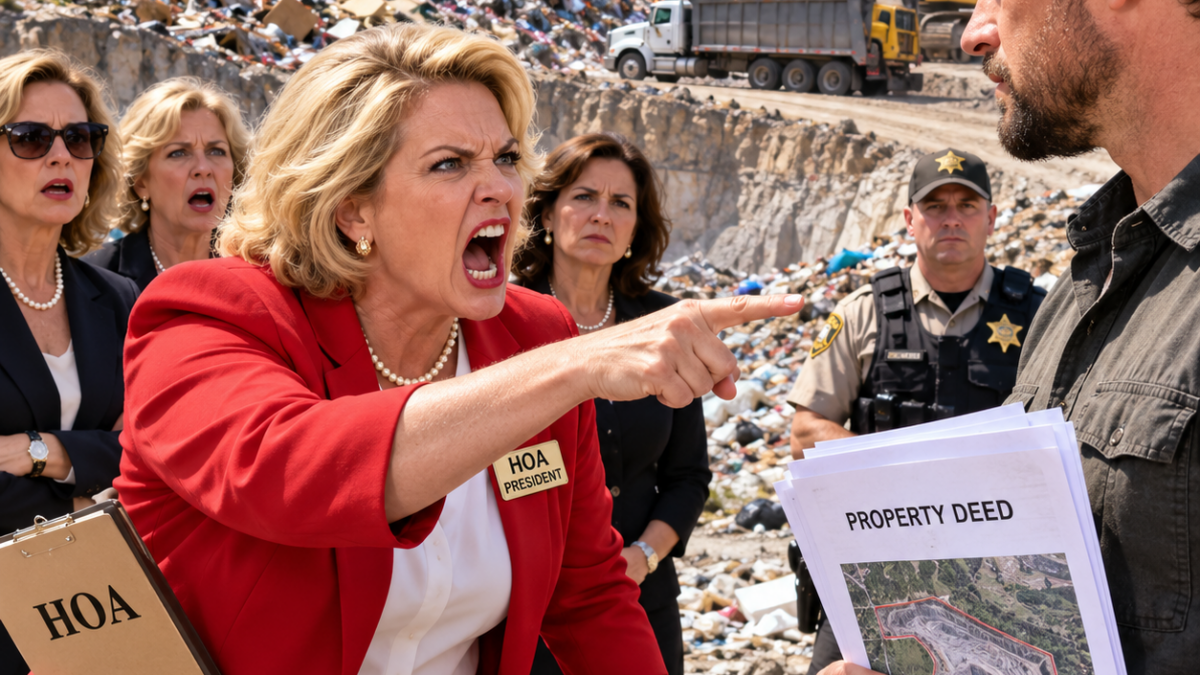
Judith Crane stepped out.
She wasn’t surprised to see the trash.
That was the first thing I noticed.
She was furious to see me.
“That man has no authority to be here,” she said.
Mike looked from her to me.
“Morning, Judith.”
“He’s trespassing on HOA reserve property and interfering with an authorized disposal project.”
I stared at her.
“Authorized disposal project?”
She ignored me.
“Deputy, I want him removed.”
Mike glanced toward the quarry.
Even from where we stood, he could see the garbage.
“What exactly are you disposing of?”
“Community waste.”
“Community waste?”
“We contracted a licensed service.”
I pointed toward the pit.
“Ask her about the chemical drums.”
For the first time, Judith looked toward the quarry.
Her eyes moved for maybe half a second.
Then back to Mike.
“There is no reason for Mr. Holloway to be wandering around an active project site.”
I laughed once.
I couldn’t help it.
“You dumped this on my property.”
Her head snapped toward me.
“This property is not yours.”
“My father owned it for thirty-eight years.”
“Your understanding of the boundary is incorrect.”
“My name is on the tax bill.”
“That doesn’t settle the reserve issue.”
Mike raised both hands.
“All right. Everybody stop.”
He turned to me.
“Dean, do you have a deed with you?”
“At home.”
“How far?”
“Three hours round trip.”
Judith smiled.
Barely.
But I saw it.
She had expected this question.
Mike looked uncomfortable.
“Any survey paperwork?”
“Same place.”
Judith folded her arms.
“The HOA has records on file.”
“With you?” I asked.
“Our attorney has them.”
“So neither of us has paperwork.”
“I represent Richmond Estates.”
“And I represent myself.”
Mike rubbed his jaw.
He looked toward the garbage again.
I could tell he knew something was wrong.
But he also knew property disputes could get ugly fast when nobody had documents in hand.
“Dean,” he said quietly, “I’m not arresting anybody. But until ownership gets confirmed, I need everybody away from the active area.”
Judith jumped in.
“Give him ten minutes to leave.”
Mike looked at her.
“I didn’t ask for your help.”
Her lips tightened.
I could have argued.
I wanted to.
Instead I nodded.
“Fine.”
Judith’s smile returned.
She thought I had surrendered.
I walked to my truck.
Then I looked at Mike.
“Before I go, you should photograph those barrels.”
His expression changed.
“Already planning to.”
Judith didn’t like that.
I got in my truck and drove away.
But I didn’t go home.
I went to Clyde Baxter’s farm.
Clyde was seventy-two years old, built like an old fence post, and had known my father since they were teenagers.
His farmhouse sat downhill from the quarry.
When he opened the door, he looked terrible.
His skin was pale.
His eyes were red.
“You look like hell,” I said.
He stepped aside.
“So do you.”
We sat at his kitchen table.
I told him what I had found.
He didn’t interrupt.
When I mentioned the barrels, he slowly looked toward the sink.
Then he said something that changed the entire situation.
“You saw them.”
It wasn’t a question.
My heart started beating harder.
“What do you mean?”
He stood and walked to the faucet.
“Smell this.”
He filled a glass.
I leaned over it.
The odor hit me immediately.
Sweet.
Chemical.
Like paint thinner mixed with gasoline.
“How long?”
“About a month.”
“Clyde.”
“I know.”
“You’ve been drinking this?”
“Not since it started smelling strange.”
“You call the county?”
“They tested for bacteria. Said it was clean.”
“Did you tell them it smelled like solvent?”
“Three times.”
He lowered himself into a chair.
“My doctor thinks that’s why I’ve been dizzy. Maybe why my liver numbers went strange.”
I felt cold despite the August heat.
Groundwater flowed downhill from the quarry.
Everybody around there knew it.
If those drums had leaked into the limestone aquifer, Clyde’s well would have been one of the first affected.
“Anybody else having problems?”
Clyde nodded.
“The Wilsons said their water tastes metallic.”
“How far away?”
“Half mile.”
My anger changed then.
Until that moment, I had been furious because someone had violated my land.
Now someone might have poisoned my neighbor.
My father’s best friend.
Possibly an entire line of homes.
I took two unopened mason jars from Clyde’s cabinet.
We let the faucet run.
Then I filled both.
I sealed them.
Clyde watched me.
“What are you doing?”
“Finding somebody who knows what’s in this.”
I drove directly to the regional environmental office.
It was nearly closing time when I walked in carrying the jars.
A receptionist tried to explain that private well complaints normally went through county health.
I put one jar on the counter.
“You need to smell this.”
A woman passing through the lobby stopped.
She had dark hair pulled into a low ponytail and an ID badge that read:
LENA ORTIZ
ENVIRONMENTAL COMPLIANCE INVESTIGATOR.
She picked up the jar without opening it.
“What’s the source?”
“Private well downhill from an abandoned quarry.”
“Industrial activity nearby?”
“Not supposed to be.”
“What does that mean?”
“Someone filled the quarry with garbage.”
Her expression sharpened.
“What kind?”
“I found hazardous-material drums this morning.”
That got everybody’s attention.
Lena took me into a conference room.
For the next forty minutes, I described everything.
She asked precise questions.
How many drums?
Any labels?
Any liquid visible?
Distance to groundwater?
Nearby wells?
I showed her the video from the night before.
She watched it twice.
“Do not touch the drums,” she said.
“I wasn’t planning to.”
“Do not confront the hauler.”
“Wasn’t planning that either.”
She looked at me.
“You look exactly like someone who is planning both.”
For the first time that day, I almost smiled.
“I want proof.”
“You already have enough for us to open a preliminary investigation.”
“I want proof of who ordered it.”
“That’s different.”
“I know.”
That evening, I bought two cellular trail cameras and returned to the quarry.
I stayed outside the fence until dark.
Then I placed one camera high in a cedar overlooking the dump area and another near the entrance.
Afterward, I parked my truck behind an abandoned equipment shed on the western side.
I waited.
Eleven o’clock.
Nothing.
Midnight.
Nothing.
At 12:37, headlights appeared.
A dump truck entered.
Then another.
Then a third.
I started recording from inside my truck.
The red-cap man was there again.
This time, another vehicle followed him.
A beige Blazer.
My mouth went dry.
Judith stepped out.
She wore jeans and a dark jacket instead of her usual business clothes.
She walked straight to the red-cap man.
They spoke for a few minutes.
I couldn’t hear them.
Then he opened the door of his pickup and pulled out a thick envelope.
Judith took it.
She counted the cash.
Right there.
Under the security light of his truck.
I recorded the entire exchange.
When they left, I stayed hidden for another hour.
Then I drove out.
The next morning, I followed the red-cap man.
His truck led me fourteen miles outside town to a fenced industrial yard.
A weather-beaten sign read:
KESSLER HAULING & RECOVERY.
That gave me a name.
Bud Kessler.
I parked across the road beside an abandoned gas station and watched.
Three of the dump trucks I had seen in the quarry were inside.
At noon, Kessler left.
I waited another half hour.
Then I drove closer.
I didn’t enter the property.
I stayed on public ground.
Through the front office window, I could see shelves stacked with paper.
One pile sat directly against the glass.
The top pages were invoices.
RIDGEMONT RESERVE DISPOSAL.
That phrase made no sense.
Ridgemont Reserve.
Not Richmond.
I zoomed in with my phone.
The invoices listed disposal charges in amounts ranging from $18,000 to $47,000.
There were dozens.
I photographed what I could see.
That night, I went home for the first time since finding the dump.
An envelope lay beneath my front door.
No stamp.
No return address.
Inside was a photocopy of what looked like a financial ledger.
Twenty-seven payments were highlighted.
KESSLER ENVIRONMENTAL.
KESSLER RECOVERY.
RESERVE MAINTENANCE.
EMERGENCY REMEDIATION.
The total exceeded $1.8 million.
At the bottom was one handwritten sentence.
Check the reserve fund.
I can’t live with this anymore.
I sat at my kitchen table for almost an hour.
Someone inside the HOA was scared.
And guilty.
The next morning, I called every Richmond Estates board member whose phone number I could find.
Nobody returned my calls.
Then one did.
“Mr. Holloway?”
The voice was barely above a whisper.
“Yes.”
“This is Frank Mulder.”
The HOA treasurer.
“I think you left something at my house.”
Silence.
Then:
“Not on the phone.”
We met at a diner thirty miles away.
Frank was already in a back booth when I arrived.
He was sixty-three, thin, nervous, wearing a button-down shirt despite the heat.
His coffee shook slightly in his hand.
I sat across from him.
“You gave me the ledger?”
He stared at his cup.
“Yes.”
“What is the reserve fund?”
“A restricted account.”
“For what?”
“Road repairs. Drainage. Emergency expenses. Common property.”
“And Judith used it to pay Kessler?”
Frank swallowed.
“She told us we were disposing of contaminated fill from HOA drainage projects.”
“Did you ever see the fill?”
“No.”
“Did anybody?”
“I don’t know.”
“You’re the treasurer.”
His eyes closed.
“I know what I am.”
I let the silence sit.
Then he said, “Nearly two million dollars.”
“Paid to Kessler?”
“Mostly.”
“For dumping on my land?”
“I didn’t know where it was going.”
“But you signed the checks.”
His eyes filled with shame.
“Yes.”
“Why?”
“Because Judith had board authorization.”
“That’s not an answer.”
His jaw tightened.
“She controlled everything.”
“No. She didn’t.”
He looked at me.
“You signed.”
The words hurt him.
I wanted them to.
Then I remembered the shaking hand.
The frightened glance toward the diner door.
This man wasn’t innocent.
But he wasn’t Judith either.
“What changed?” I asked.
Frank rubbed his forehead.
“I saw the trucks.”
“When?”
“Six weeks ago.”
“Where?”
“Coming out of your quarry.”
“And you said nothing.”
“I confronted her.”
“What did she say?”
“She said the quarry belonged to the HOA.”
“It doesn’t.”
“I know that now.”
“How?”
Frank reached into his briefcase.
He pulled out a folded county map.
“Because I checked the archived assessments.”
My pulse quickened.
“And?”
“The map we’ve been using is wrong.”
“Wrong how?”
“The reserve boundary overlaps your parcel.”
“Why?”
“Some kind of transfer error when Richmond Estates was developed.”
“So Judith knows?”
Frank’s face told me before he answered.
“Yes.”
“How long?”
“At least a year.”
I leaned back.
That changed everything.
This wasn’t confusion.
It wasn’t a boundary dispute.
She knew.
“She deliberately dumped on land she knew she didn’t own.”
Frank nodded.
“And there’s more.”
Of course there was.
“There’s always more.”
“Kessler has been giving money back.”
“To Judith?”
“I think so.”
“I recorded him handing her cash.”
Frank’s face went white.
“You what?”
“I recorded it.”
He looked toward the window.
“You need to understand something.”
“I understand plenty.”
“No, Dean. You don’t.”
His voice dropped.
“Judith is dangerous when she thinks she’s losing.”
I almost laughed.
“She runs an HOA.”
“She controls people through debt, liens, lawsuits, permits, contractors. She destroys them on paper.”
As if she had heard him, Judith struck the next morning.
A process server arrived at my door at 8:15.
He handed me a certified packet.
NOTICE OF HOA LIEN.
Amount claimed:
$250,000.
Violations listed included unauthorized land use, environmental damage, interference with community property, obstruction of a contracted waste-removal project, and unpaid reserve assessments.
I actually laughed.
The process server looked concerned.
“You okay?”
“Yeah.”
“This is serious.”
“I know.”
“That’s why I’m laughing.”
I called an attorney named Samuel Wickham.
Sam had handled my father’s estate.
He was sixty-eight years old and had the temperament of a man who had spent four decades being paid to find the sentence everybody else missed.
I dropped the lien packet on his desk.
He read it silently.
Then he removed his glasses.
“Interesting.”
“That’s not the word I used.”
“They’re claiming your quarry is common reserve.”
“They know it isn’t.”
“Can you prove that?”
“Yes.”
“How?”
I stopped.
My father’s voice returned to me.
Keep the paper.
I left Sam sitting at his desk and drove home.
The safe was bolted inside a closet.
I opened it.
The envelope lay exactly where I had put it after Dad died.
Brown paper.
His handwriting on the front.
DEAN — QUARRY.
My hands trembled when I carried it back to Sam’s office.
He opened it carefully.
Inside was a deed recorded in 1987.
A survey.
Several notarized statements.
And a letter from the county planning department dated nearly forty years earlier.
Sam read the deed first.
Then the survey.
Then the planning letter.
He stood and walked to a wall map.
“Dean.”
“What?”
“Come here.”
He laid my father’s survey against the current Richmond Estates plat.
The boundaries did not match.
Not even close.
A drafting error in an early subdivision map had extended the HOA reserve line over a portion of my father’s quarry.
But the original deed controlled.
The later plat never transferred ownership.
Sam tapped the signature page.
“Your father noticed this in 1987.”
“He knew?”
“He did more than know.”
Sam pointed to a recorded affidavit.
“He formally challenged the incorrect mapping.”
“So the county has had proof for decades.”
“Yes.”
“And the HOA?”
“If their attorney performed a proper title review, they would have found it.”
I thought about Frank.
“Judith did.”
Sam looked up.
“You’re sure?”
“Her treasurer says she knew.”
“Will he testify?”
“I don’t know.”
“Then we make sure he understands his choices.”
The environmental results came back the following afternoon.
Lena Ortiz called me personally.
“Dean, are you somewhere you can sit down?”
My stomach tightened.
“I’m sitting.”
“The Baxter well sample tested positive for arsenic, chlorinated solvents, lead, and elevated chromium.”
I didn’t speak.
“The concentrations are significantly above drinking-water limits.”
“How bad?”
“Bad enough that nobody should consume that water.”
“What about the quarry?”
“Our preliminary field samples indicate similar contaminants.”
My hand tightened around the phone.
“So the barrels caused it.”
“We need formal source attribution before I can say that legally.”
“But?”
“The chemical fingerprint is consistent.”
I looked through my kitchen window toward the distant tree line.
Clyde had trusted that well for forty years.
His wife had cooked with that water.
His grandchildren drank lemonade made from it.
“How many wells?”
“We’re expanding testing.”
“How many, Lena?”
“Potentially dozens.”
I closed my eyes.
“This isn’t just an illegal dumping case anymore,” she said.
“What is it?”
“A groundwater contamination event.”
“Criminal?”
“There are multiple potential violations.”
“State?”
“And possibly federal.”
That evening, I drove to Clyde’s.
He was sitting on his porch.
I sat beside him.
For a minute, neither of us spoke.
Then I handed him a case of bottled water.
He stared at it.
“So it’s bad.”
“Yeah.”
“How bad?”
I told him.
He looked across his field.
The sun was setting behind the silo.
“Your dad and I dug that well together,” he said.
I had never known that.
“When?”
“1982.”
He smiled faintly.
“Ray complained the whole time. Said limestone was God’s revenge on men who owned shovels.”
I laughed despite myself.
Then Clyde wiped his eyes.
“Think this is why I’ve been sick?”
“I don’t know.”
“But maybe.”
“Maybe.”
He nodded.
“What are you going to do?”
I looked toward the quarry.
“Everything I can.”
“No.”
His voice became firmer.
“What are you going to do to them?”
I understood the question.
“Make sure they can’t do this to anyone again.”
Two days later, state environmental vehicles rolled through my gate.
Lena came first.
Behind her were hydrogeologists, hazardous-material technicians, inspectors, and contractors carrying sample kits.
Deputy Mike Sorrell arrived shortly afterward.
This time, I had the 1987 deed in my truck.
At 9:22, we heard diesel engines.
Three Kessler trucks appeared on the quarry road.
Behind them came Judith’s beige Blazer.
I almost admired the confidence.
She stepped out wearing a cream blazer and sunglasses.
Then she saw the state vehicles.
Her pace slowed.
Lena walked toward her.
“Judith Crane?”
“Yes.”
“Lena Ortiz. State environmental compliance.”
Judith recovered quickly.
“This is HOA reserve property. I need to know who authorized this inspection.”
“I did,” Lena said.
Judith blinked.
“I’m the HOA president.”
“I heard you.”
“These people cannot enter without board approval.”
“They don’t need it.”
Judith looked at me.
Her expression changed instantly.
“Arrest him.”
Mike was walking toward us.
She pointed at me.
“This man has repeatedly trespassed, interfered with contractors, and threatened HOA operations.”
Mike stopped beside me.
I handed him the deed.
He unfolded it.
Judith’s face changed.
Just slightly.
But enough.
Mike read.
Then he looked toward Lena.
Then back at Judith.
“Ma’am.”
“What?”
“This deed says Mr. Holloway owns the quarry.”
“The HOA has conflicting records.”
Sam Wickham stepped out of his car.
He had arrived ten minutes earlier and had been waiting.
“No, Mrs. Crane,” he said. “Your HOA has an incorrect plat map. There are no conflicting ownership records.”
Judith stared at him.
“And you are?”
“Counsel for Mr. Holloway.”
Her jaw clenched.
Sam handed her a copy of my father’s recorded affidavit.
“This boundary error was corrected and preserved in the county record in 1987.”
Judith barely looked at it.
“Our attorneys will review this.”
“I recommend they do.”
Behind us, one of the Kessler drivers started reversing his truck.
Lena lifted a hand.
“Stop the vehicle.”
The driver stopped.
Bud Kessler climbed out of the lead truck.
Red cap.
Same man.
He looked at Judith.
She looked away.
That told Lena everything she needed to know.
“What are you carrying?” Lena asked him.
“Construction debris.”
“Manifest?”
He hesitated.
“What?”
“Waste manifest.”
“Office has it.”
“What facility were you delivering to?”
He pointed vaguely toward the quarry.
“This site.”
“This is not a licensed waste facility.”
Kessler looked at Judith again.
She snapped, “Stop looking at me.”
Everyone went silent.
Lena turned toward her.
“Why would he be looking at you?”
Judith realized her mistake.
“I don’t know.”
Bud took off his cap and rubbed his forehead.
“We were told the HOA owned the site.”
“By whom?” Lena asked.
“Nobody specific.”
Judith exploded.
“Do not answer questions without your attorney.”
Lena’s eyebrows rose.
“You’re advising Mr. Kessler?”
“I’m advising everyone to stop this circus.”
Mike stepped closer to Judith.
“Ma’am, you need to lower your voice.”
“I need you to do your job.”
“I am.”
“No, you’re standing beside a trespasser.”
“He owns the land.”
“You don’t know that.”
Mike held up the deed.
“I know enough not to arrest him.”
For the first time since I had met Judith Crane, she looked unsure.
Not afraid.
Not yet.
But unsure.
Then one of Lena’s technicians shouted from below.
“Lena!”
We all turned.
The technician stood near the barrels.
He was holding a handheld meter.
Even from the rim, I could see Lena’s posture change.
She ran down the access path.
Two other technicians followed.
Judith took one step toward her vehicle.
Mike noticed.
“Mrs. Crane.”
She stopped.
“Don’t leave.”
“I have a meeting.”
“Not anymore.”
The next hour became a blur.
The environmental team established an exclusion zone.
Kessler’s trucks were detained for inspection.
Samples were collected from the loads.
Photographs were taken.
Serial numbers were documented from the drums.
One barrel still had a partial shipping label.
Another had a manufacturing lot code.
Those numbers could identify where the waste originated.
Bud Kessler stopped talking completely.
Judith called three different people.
The last conversation ended with her screaming into the phone.
Then she walked toward me.
“You think you won something?”
I looked at her.
“My neighbor may have been poisoned.”
“This contamination could have existed for decades.”
“Then why were your trucks dumping barrels last night?”
“You have no idea what you saw.”
“I have video.”
Her expression froze.
I continued.
“Two nights of it.”
Her face drained of color.
“You recorded private activities?”
“On my property.”
She leaned closer.
“You don’t understand what you’ve gotten yourself into.”
“No, Judith.”
I looked toward the state investigators.
“I think you don’t.”
That night, Richmond Estates held an emergency board meeting.
I wasn’t invited.
Frank Mulder was.
He called me twenty minutes before it began.
“I’m going to tell them.”
“Everything?”
“Yes.”
“You sure?”
“No.”
“Good answer.”
“Dean?”
“Yeah?”
“If they turn on me—”
“They probably will.”
“Thanks.”
“You want me to lie?”
“No.”
“Then bring documents.”
He brought a box.
Inside were seven years of reserve-fund ledgers, payment authorizations, canceled checks, meeting notes, contractor invoices, and email printouts.
Frank later told me exactly what happened.
There were nine board members sitting around a polished conference table.
Judith sat at the head.
The association attorney had joined by speakerphone.
Frank placed the box in the center.
Judith asked what it was.
“Records.”
“We already have records.”
“Not these.”
She stared at him.
Frank pulled out the ledger.
“I’m providing copies to state investigators tomorrow.”
Nobody spoke.
Judith stood.
“You are breaching fiduciary confidentiality.”
Frank’s hands were shaking.
But he stayed seated.
“No.”
“You are exposing the association to liability.”
“No.”
“You signed those checks too.”
Frank nodded.
“Yes.”
Then he said the sentence that finally broke her control over that room.
“That’s why I’m cooperating.”
One of the board members, a retired dentist named Harold Price, leaned forward.
“Cooperating with whom?”
“Environmental investigators.”
Another asked, “What exactly have you given them?”
“Nothing yet.”
Judith slammed both palms onto the table.
“You will give them nothing.”
Frank looked at her.
“I already gave Dean the ledger.”
The room erupted.
Judith screamed.
Two board members stood.
Someone demanded an attorney.
Someone else asked how much money was missing.
Frank answered.
“Potentially just under two million.”
The room became silent again.
Every face turned toward Judith.
She said the charges were legitimate.
Frank showed them the invoices.
Then he showed them canceled checks.
Then cash withdrawal records linked to a contractor.
One member whispered, “My God.”
Judith pointed at Frank.
“He is responsible for treasury records.”
Frank nodded.
“Yes.”
Then he slid one document across the table.
It was an email.
From Judith to Frank.
AUTHORIZE KESSLER PAYMENT UNDER EMERGENCY RESERVE REMEDIATION. DO NOT INCLUDE SITE ADDRESS IN BOARD PACKET.
Nobody defended her after that.
Three board members resigned before midnight.
Two more submitted letters the next morning.
Judith refused.
Instead, she doubled down.
At 7:30 the following day, a legal courier delivered another threat to my house.
The HOA intended to seek an injunction preventing me from interfering with “community remediation operations.”
Sam read it.
Then he smiled.
“What?”
“Nothing.”
“You’re smiling.”
“This is becoming educational.”
“For who?”
“Their insurance carrier.”
That afternoon, Sam notified Richmond Estates’ insurer of a potential eight-figure environmental liability claim.
He also notified Kessler Hauling’s insurer.
Then he sent preservation letters ordering both organizations to retain all emails, invoices, texts, contracts, meeting minutes, location records, photographs, and financial documents related to the quarry.
The legal tone changed almost immediately.
The threatening letters stopped.
Then the phone calls started.
First from a junior attorney.
Then senior counsel.
Then a specialist from the insurance company.
Everybody wanted a meeting.
I refused until Clyde’s medical expenses were documented and every nearby well had been tested.
Over the next week, the contamination map grew.
Clyde’s property was the worst.
Three neighboring wells showed elevated contaminants.
Two more showed low-level traces.
Families were told not to drink their water.
The HOA arranged bottled-water deliveries only after Sam threatened emergency court action.
Residents became furious.
For years, Judith had built her authority around tiny rules.
Mailboxes.
Fence colors.
Trash cans.
Holiday decorations.
Shed placement.
Now people learned that while she was threatening them over landscaping, trucks connected to the association had been dumping hazardous waste behind their neighborhood.
Richmond Estates turned against its own board almost overnight.
I received dozens of calls.
Some people apologized for believing Judith’s claims that I was an irresponsible landowner.
Others gave information.
A woman named Theresa told me she had seen Kessler trucks entering the quarry at night months earlier.
A retired police officer had security-camera footage from his driveway showing the trucks.
A teenager who lived near the service road had recorded one because he thought the driver was illegally hunting.
Every piece mattered.
Then came the document that changed the money trail.
One afternoon Frank arrived at Sam’s office carrying a laptop.
“I found a folder.”
“What kind?” Sam asked.
“Judith’s.”
“How did you access it?”
“Shared board drive. She thought she deleted it.”
Sam immediately raised his hand.
“Don’t open anything else.”
Frank froze.
“Why?”
“Because I want the forensic process clean.”
A specialist imaged the drive.
The recovered files showed that Kessler’s invoices had been intentionally inflated.
The HOA would approve a large “disposal” payment.
Kessler kept part.
The rest moved through consulting fees and cash transactions.
Judith had received substantial kickbacks.
But there was something worse.
Some of the hazardous material had come from commercial clients who had paid Kessler to dispose of it legally.
Legal hazardous-waste disposal was expensive.
Dumping it into an abandoned quarry cost almost nothing.
Kessler increased his profit.
Judith received money.
The HOA reserve fund helped disguise transactions.
And my father’s land became the hole where everybody thought the evidence would disappear.
They had assumed the quarry was worthless.
That mistake was about to cost them everything.
State investigators referred portions of the case to federal authorities.
I was interviewed three times.
So was Clyde.
So was Frank.
Mike Sorrell provided the photographs he had taken the first morning.
His pictures turned out to be crucial because they documented the condition of the site before anyone knew an environmental investigation had begun.
One afternoon Mike came to see me.
We stood by the gate.
“I owe you an apology.”
“For what?”
“That first morning.”
“You didn’t arrest me.”
“Came close to making you leave your own land.”
“You had two people claiming ownership and no paperwork.”
“Still.”
I looked at him.
“You photographed the drums.”
He nodded.
“That mattered more.”
He kicked at the gravel.
“Judith filed a complaint against me.”
I laughed.
“For what?”
“Bias.”
“Against HOA presidents?”
He smiled.
“Apparently.”
By the end of the second week, Richmond Estates’ insurer requested mediation.
The meeting took place in a corporate law office two counties away.
Sam sat beside me.
Across from us were four attorneys, an insurance representative, a Richmond Estates representative, and outside counsel for the HOA.
Judith was there too.
She sat behind a glass partition in an adjoining conference room.
I didn’t know whether that was intentional.
But I could see her.
And she could see me.
The first offer came after three hours.
$1.2 million.
Confidential settlement.
Mutual release.
No admission of liability.
I read the number.
Then pushed the paper back.
The insurance attorney looked surprised.
“Mr. Holloway, perhaps you’d like a moment with counsel.”
“No.”
“It’s a substantial offer.”
“My neighbor’s drinking water was poisoned.”
“The proposal includes compensation for property damages.”
“Whose property?”
“Yours.”
“What about Clyde?”
“Individual residents may pursue separate claims.”
I shook my head.
“No.”
The attorney leaned back.
“What exactly are you seeking?”
“Cleanup.”
“The state will determine remediation requirements.”
“Paid by who?”
“That remains subject to allocation.”
“No.”
Sam touched my arm lightly.
Not to stop me.
Just to remind me he was there.
I continued.
“You dumped on my land. Whether you want to argue about which defendant ultimately pays which percentage is your problem. It won’t become mine.”
The insurer’s representative spoke.
“You understand the association has limited assets?”
“I understand Richmond Estates paid almost two million dollars in questionable disposal expenses.”
Nobody answered.
I pointed toward the window.
“People are drinking bottled water because your board president helped turn a private quarry into an illegal hazardous-waste dump. My father’s best friend is sick. Families are afraid to bathe their children. You want to pay me personally and make me disappear.”
“That is not an accurate characterization.”
“Then remove confidentiality.”
Silence.
“Fund cleanup.”
Silence.
“Fund replacement wells.”
Silence.
“Cover environmental monitoring.”
Silence.
“Withdraw every lien and claim.”
The HOA attorney shifted in his chair.
I looked directly at him.
“And your board resigns.”
“That is not a monetary term.”
“It’s a settlement term.”
“The insurer cannot force elected board members to resign.”
“Then there’s no deal.”
Judith stood behind the glass.
I could see her speaking to someone.
Then she slapped a folder onto the table.
The mediator entered.
“We may need a recess.”
“Take one,” I said.
They disappeared for forty minutes.
Sam and I sat alone.
“You realize seven figures is already life-changing money,” he said.
“I know.”
“You also realize this could take years if you reject settlement.”
“I know.”
He studied me.
“So why are you calm?”
I looked through the glass at the empty room where Judith had been sitting.
“Because this stopped being about money the day I smelled Clyde’s water.”
Sam nodded once.
When the lawyers returned, nobody looked comfortable.
The insurer’s representative placed a new term sheet in front of me.
I read it slowly.
Total settlement and funded remediation package:
$7 million payable to me and associated property claims.
Full financing of approved quarry remediation.
Full financing of groundwater investigation and affected-well replacement.
Reimbursement of documented emergency water costs.
Withdrawal and release of the HOA lien.
Permanent acknowledgment of the 1987 property boundary.
Legal fees.
Environmental monitoring fund.
And one additional term.
Resignation of the remaining Richmond Estates board members whose approval or oversight related to the dumping program.
Including Judith Crane.
I stopped reading.
“Is this real?”
Sam leaned over the document.
“Yes.”
“Cleanup separate from the seven million?”
“Yes.”
I looked at the insurer.
“And Clyde’s well?”
“Replacement or equivalent permanent remedy, subject to environmental engineering.”
“Medical monitoring?”
“Separate resident claims remain preserved.”
I looked at Sam.
“What am I missing?”
“Confidentiality is limited to insurance allocation and privileged mediation statements. You may discuss the environmental facts and public regulatory record.”
Judith appeared behind the glass.
She stared at me.
I picked up the pen.
But before I signed, I stood.
Everyone looked up.
I walked toward the glass partition.
Judith walked to the other side.
For several seconds, we faced each other.
She looked exhausted.
Not defeated exactly.
People like Judith rarely recognized defeat until somebody else closed the door.
Her voice came faintly through the gap.
“You destroyed this community.”
I almost couldn’t believe it.
“You poisoned it.”
“I protected property values.”
“By dumping toxic waste beside people’s wells?”
“You have no idea what it takes to manage a place like Richmond Estates.”
“No.”
I looked at her.
“But I know what it takes to own something.”
She laughed bitterly.
“You’re going to become rich because of an administrative mistake.”
“My father bought that quarry before your neighborhood existed.”
“You could have sold it years ago.”
“He didn’t want it sold.”
“So this is about your father?”
Her tone was mocking.
That was her final mistake with me.
“Yes.”
I stepped closer.
“It is.”
Her smile disappeared.
“My father spent his life protecting that land. He kept documents for forty years because he knew people like you would eventually decide history didn’t matter. You looked at an old quarry and saw empty space. You thought nobody cared what happened there.”
I pointed toward the floor.
“You were wrong.”
She folded her arms.
“Enjoy your money.”
“I’ll enjoy the clean water more.”
I returned to the table and signed.
The next morning, Richmond Estates posted a notice.
Effective immediately, the remaining board members were resigning.
One by one.
Harold Price.
Elaine Moore.
Steven Braddock.
Janice Holt.
Frank Mulder.
And finally:
Judith Crane.
Her letter was three sentences long.
No apology.
No explanation.
Just resignation.
That afternoon, I drove past the Richmond Estates clubhouse.
Judith was walking out carrying a cardboard box.
For months, I had pictured that moment differently.
I thought I would feel triumphant.
Maybe I would roll down my window.
Maybe say something.
Maybe smile.
Instead, I felt tired.
Two unmarked state vehicles were parked near the entrance.
Investigators were waiting.
Judith saw them.
Then she saw me.
I drove on.
The criminal process moved separately from the settlement.
Frank gave a full statement.
He admitted signing the checks.
He provided emails.
He identified meetings.
He turned over notes he had kept because, as he later told me, “some part of me knew this was going to end badly.”
Bud Kessler eventually started cooperating too.
His attorney understood the evidence.
Truck GPS records placed his vehicles at my quarry repeatedly.
Financial records connected him to Judith.
Waste manifests showed discrepancies between material accepted from clients and material delivered to licensed disposal facilities.
Investigators reconstructed years of activity.
The quarry wasn’t their first shortcut.
But it was the largest.
Judith’s attorney released a statement saying she denied knowingly authorizing hazardous dumping.
That statement didn’t last long.
A recovered email did.
BUD — USE THE HOLLOWAY SITE AFTER 11. NO LIGHTS NEAR THE RESERVE ROAD. DEAN IS OUT OF STATE UNTIL THE 23RD.
I read that line three times.
She knew my name.
She knew my travel schedule.
She knew the property was mine.
And she had waited until I left.
That email bothered me more than the money.
More than the lien.
More than her screaming at Mike to arrest me.
Because it meant she had watched.
Planned.
Timed it.
Someone inside Richmond Estates had apparently mentioned that I would be away.
Judith used the information.
She believed three weeks was enough.
Enough time to dump.
Enough time to cover the newest material.
Enough time to create paperwork making everything appear authorized.
She was wrong because my job finished early.
Five days.
That was the difference.
Five days between an illegal operation continuing and the entire thing beginning to collapse.
The cleanup started in October.
The first excavator rolled into the quarry shortly after sunrise.
I stood beside Clyde on the western rim.
The crews wore protective equipment.
Waste specialists mapped each section.
Everything had to be separated.
Household debris.
Construction waste.
Scrap metal.
Contaminated soil.
Hazardous containers.
The mattresses came first.
Then furniture.
Then appliances.
Then mountains of trash.
The deeper they dug, the worse it became.
Some of the barrels had been buried beneath layers of ordinary garbage.
Clyde stared down at the excavation.
“How much you think they put in there?”
“Too much.”
“Ray would’ve killed somebody.”
I laughed.
“He would’ve tried.”
“He’d have chased them with that old twelve-gauge.”
“He never loaded it.”
Clyde looked at me.
“You believed that?”
I turned.
He smiled.
For the first time in months, we both laughed.
Then the excavator uncovered another row of drums.
Clyde stopped laughing.
I watched workers place each one into containment.
One.
Two.
Five.
Ten.
Twenty-seven.
By the end of the week, more than sixty industrial containers had been removed.
Some were empty.
Some were partially full.
Several had leaked.
The contaminated soil around them had to be excavated too.
Truck after truck left the quarry for licensed facilities.
This time, every load had a manifest.
Every pound was tracked.
Every destination documented.
Lena visited almost daily.
One afternoon she found me standing at the pond.
The water level had been partially lowered for cleanup.
“You okay?” she asked.
“Ask me next year.”
She nodded.
“Fair.”
“How bad is the rock?”
“Fractured limestone complicates things.”
“Meaning?”
“Contaminants can move through fissures faster than through ordinary soil.”
“I knew I hated geology.”
She smiled.
“Your father picked an inconvenient place for an environmental crime.”
“He picked it thirty years before anybody committed one.”
“Good point.”
I looked toward Clyde’s property.
“Will his well ever be safe?”
“Maybe.”
“That’s not very reassuring.”
“You want the honest answer?”
“Always.”
“Even if the aquifer recovers, I wouldn’t recommend relying on that well again.”
I nodded.
“Then replace it.”
“That’s the plan.”
Engineers eventually determined that Clyde could be connected to a deeper protected water source.
The settlement fund covered everything.
Drilling.
Testing.
Filtration.
Plumbing.
Monitoring.
The day they finished, Clyde refused to turn on the faucet.
He stood in his kitchen staring at it.
I was there.
So was Lena.
“Go ahead,” I said.
He shook his head.
“You do it.”
“Your house.”
“Your mess.”
I looked at him.
He grinned.
“Bad joke.”
“Terrible joke.”
I turned the tap.
Clear water ran into the sink.
No chemical smell.
Nothing metallic.
Just water.
Clyde filled a glass.
Lena stopped him.
“Hold on. We still need the final clearance.”
He sighed.
“Woman, I’m seventy-two.”
“And I’m the person keeping you from drinking unverified groundwater.”
“You environmental people take all the fun out of life.”
Three days later, the final laboratory test came back.
Clear.
I brought the report to Clyde.
He read the first page.
Then the second.
His hands started trembling.
“Safe?”
“Safe.”
“You sure?”
“Lena says safe.”
He turned toward the faucet.
Then he covered his face.
For a second I thought he was laughing.
He wasn’t.
I put my arms around him.
He cried against my shoulder.
Not because of the money.
Not because Judith had resigned.
Not because investigators had opened a criminal case.
Because he could drink water from his kitchen again.
That moment mattered more than the mediation.
More than the settlement.
More than seeing Judith carry her box out of the clubhouse.
My father had spent half his life teasing Clyde.
The two of them argued over tractors, baseball, fishing, politics, weather, and whose chili was better.
If Dad had been there, he would have pretended Clyde’s crying made him uncomfortable.
Then he would have hugged him anyway.
I felt that absence deeply.
“You think Ray knows?” Clyde whispered.
I looked toward the quarry through the kitchen window.
“Yeah.”
“You believe that?”
“I do now.”
Clyde nodded.
“Me too.”
The money arrived in stages.
I paid the taxes.
Set aside funds for the property.
I paid off my mortgage.
I created a trust for long-term environmental monitoring at the quarry beyond what the settlement required.
Then I did something my financial adviser thought was unnecessary.
I established a private emergency fund for nearby residents whose wells might develop delayed contamination.
“You have no legal obligation,” he told me.
“I know.”
“Then why assume future costs that could belong to the responsible parties?”
“Because legal responsibility and being able to sleep are different things.”
He stopped arguing.
I didn’t quit my job immediately either.
People assumed seven million dollars meant I would buy a mansion, a sports car, maybe disappear somewhere tropical.
Instead, I reported to a bridge inspection the following Monday.
My supervisor stared at me.
“What are you doing here?”
“Working.”
“Dean.”
“What?”
“You’re a millionaire.”
“I was a millionaire yesterday too.”
“You’re inspecting expansion joints.”
“They still need inspecting.”
He shook his head.
“You are the strangest rich person I know.”
“You know a lot of rich people?”
“No.”
“Then statistically that means nothing.”
I stayed another eight months.
Then I moved into consulting work.
Fewer hours.
More control.
More time at the quarry.
Richmond Estates changed too.
The residents elected a temporary board.
Then adopted new financial controls.
No single officer could authorize major contracts.
Reserve spending required independent review.
Environmental contractors had to provide verified licenses.
Meeting minutes became publicly accessible to homeowners.
Frank helped write some of those reforms before moving away.
One afternoon he came to the quarry.
I almost didn’t recognize him.
He looked healthier.
Less frightened.
We walked along the rim.
“I bought a place near my daughter,” he said.
“Good.”
“Four hours north.”
“Cold up there.”
“I’m told retirement is supposed to involve sweaters.”
I smiled.
He stopped near the old cedar where I had placed one of the trail cameras.
“I should’ve stopped her sooner.”
I didn’t answer.
“I signed the checks.”
“Yes.”
“I told myself I was following board authorization.”
“Yes.”
“I told myself I wasn’t responsible for what contractors did after we paid them.”
“Yes.”
He looked at me.
“You’re not going to make this easier, are you?”
“No.”
He laughed quietly.
“Fair.”
We stood in silence.
Then I said, “You also brought the ledger.”
“Eventually.”
“You testified.”
“Eventually.”
“You helped stop it.”
“After helping it happen.”
“Both things can be true.”
He looked toward the quarry.
“I think that’s the hardest part.”
“It usually is.”
He nodded.
Before leaving, he handed me a small object.
A brass key.
“What’s this?”
“The old Richmond Estates records room.”
“I don’t want it.”
“I know.”
“Then why give it to me?”
“Because Judith gave it to me when I became treasurer.”
“So?”
Frank smiled.
“I thought you might enjoy throwing it into the quarry.”
I looked at the clean water below.
“No more dumping.”
He laughed so hard he had to wipe his eyes.
I gave the key back.
“Frame it.”
“Why?”
“Reminder.”
“Of what?”
“That small things can unlock expensive problems.”
He actually did.
Months later he sent me a photograph of the key framed beneath a label:
ASK QUESTIONS BEFORE SIGNING CHECKS.
The case against Judith and Kessler moved slowly.
Criminal investigations always do.
There were hearings.
Motions.
Subpoenas.
Negotiations.
I stopped following every development.
At first that surprised me.
For months, bringing Judith down had consumed almost every waking thought.
Then one day I realized I had gone forty-eight hours without thinking about her.
It felt like freedom.
Eventually, public court records showed that charges had been filed relating to illegal waste disposal, conspiracy, financial misconduct, and environmental violations.
The precise outcomes belonged to the court system.
I wasn’t interested in becoming Judith’s lifelong audience.
The punishment I cared about had already happened.
She lost control.
She lost the boardroom.
She lost the ability to weaponize the HOA against people who questioned her.
Most importantly, the dumping stopped.
The land survived.
The water began recovering.
About a year after the cleanup started, I found myself standing at the western ledge just before sunrise.
It was the same place Dad and I used to sit.
The quarry looked different.
Some trees had been removed during remediation.
Fresh stone lined part of the slope.
Monitoring wells stood in places where wild grass had once grown.
It wasn’t exactly the quarry I remembered.
But it was clean.
That mattered.
Clyde drove up in his pickup carrying two coffees.
He handed me one.
“You planning to stand here all morning?”
“Maybe.”
“Rich people have no work ethic.”
“You’re drinking coffee I paid for.”
“Exactly.”
We sat.
The sun rose over Richmond Estates.
Light crossed the rooftops.
Then it reached the quarry.
The limestone turned gold.
For a long time, neither of us said anything.
Finally Clyde asked, “You ever think about selling now?”
“No.”
“Not even for seven million?”
“I already got seven million.”
“Eight?”
“No.”
“Ten?”
“No.”
“Twenty?”
I looked at him.
“Whose side are you on?”
He laughed.
“Just checking how serious you are.”
I pulled my wallet out.
Inside was a copy of my father’s note.
Not the deed.
Not the survey.
Just one scrap of paper I had found inside the old envelope after everything was over.
I hadn’t noticed it the first day in Sam’s office.
On it, Dad had written:
Dean—
Land only belongs to us for a little while.
Take care of it anyway.
—Dad
I had spent months thinking his final warning was about ownership.
Keep the paper.
Never sell the pit.
For a long time, I believed he had been protecting the quarry from developers.
Maybe that was part of it.
But sitting there beside Clyde, I finally understood something else.
My father hadn’t preserved that deed because paper mattered more than people.
He preserved it because memory does.
History does.
Responsibility does.
Judith looked at forty acres of abandoned quarry and saw something nobody would defend.
Kessler looked at the same hole and saw cheap disposal.
The HOA looked at an old plat error and saw an opportunity to claim something that wasn’t theirs.
They were all wrong for the same reason.
They believed value only existed where somebody had bothered to put a price tag.
My father knew better.
That quarry held Sunday mornings.
Fishing poles.
Arguments.
Coffee.
A rusted loader he refused to sell.
The place where he taught me to drive.
The ledge where he told me about meeting my mother.
The pond where Clyde once lost an entire tackle box because Dad convinced him a twenty-pound catfish was hiding under a ledge.
It held a lifetime.
And when people poisoned it, they poisoned more than rock and water.
That was why I fought.
The seven million dollars became the headline.
People loved that part.
They loved hearing that an HOA president tried to claim my land and ended up resigning.
They loved the settlement.
They loved the image of Judith carrying her cardboard box past investigators.
But the money was never the ending.
The ending came one spring morning almost two years later.
I had planted native grasses along the restored slope.
The environmental team had approved a long-term conservation plan.
Birds had returned.
Frogs were appearing near the pond again.
The latest groundwater samples were better than the year before.
Not perfect.
Better.
Clyde and I were installing a bench near the western overlook.
He complained that I had bought cheap bolts.
I told him he was using the wrench backward.
He told me he had been using tools before I existed.
Then we heard a vehicle.
A pickup stopped by the gate.
A young couple got out with two children.
I walked down.
The father looked nervous.
“Mr. Holloway?”
“That’s me.”
“We live in Richmond Estates.”
I waited.
His daughter was holding a school notebook.
“She has a project on local geology,” he said. “Someone told us the quarry has exposed limestone formations.”
The girl looked up.
“Can I see them?”
Two years earlier, my first instinct would have been to tell anyone from Richmond Estates to stay outside the gate.
Instead, I looked at Clyde.
He shrugged.
“Make them sign something so they don’t sue you when they trip.”
The father laughed awkwardly.
I opened the gate.
“Stay on the marked trail.”
The girl grinned.
We walked toward the overlook.
I showed them the limestone layers.
I explained how water moved through cracks in the rock.
I showed them the monitoring wells without going into every painful detail.
Then her younger brother pointed toward the pond.
“Can fish live there?”
“Eventually.”
“There aren’t fish now?”
“A few.”
“Why only a few?”
His father looked uncomfortable.
I could have lied.
Instead I crouched beside him.
“Because some adults made a very bad decision and put things here that didn’t belong.”
“Did you make them clean it?”
“Yeah.”
He thought about that.
“Were they mad?”
I smiled.
“Very.”
That seemed to satisfy him.
His sister stood beside the overlook writing notes.
Then she asked, “Why didn’t you sell it after everything happened?”
I looked around.
Wind moved through the young grass.
Clyde stood near the bench pretending not to listen.
“My dad gave it to me.”
“That’s all?”
“No.”
I smiled.
“He also taught me that taking care of something doesn’t stop just because taking care of it gets expensive.”
She wrote that down.
I almost told her not to.
Then I imagined my father laughing.
Let her write it.
When the family left, Clyde walked beside me toward the gate.
“You know what Ray would say about you letting HOA people in here.”
“What?”
“He’d say you finally got soft.”
“He was softer than me.”
“True.”
We shut the gate.
I wrapped the chain around it.
The old lock had never been recovered.
Investigators thought Kessler’s crew had thrown it away.
So I bought a new one.
Heavy steel.
Weatherproof.
I snapped it closed.
Clyde watched me.
“Still worried?”
“No.”
“Then why lock it?”
I looked through the gate toward the quarry.
“Because forgiving people doesn’t mean removing the fence.”
He nodded.
“That sounds like something your dad would say.”
“No.”
I started walking toward the truck.
“He would’ve said, ‘Lock the damn gate, Dean.’”
Clyde laughed behind me.
And for just a second, I could almost hear my father laughing with him.
That evening, I returned alone.
The sun had dropped low enough to turn the quarry walls orange.
I walked to the western ledge.
The same place where everything seemed to begin.
The same place where my father and I had spent so many quiet evenings.
I took his note from my wallet.
The paper had softened at the folds.
Land only belongs to us for a little while.
Take care of it anyway.
I looked down at the water.
Clear enough now to reflect the sky.
There was still monitoring equipment below.
There would be sampling for years.
Some damage doesn’t disappear simply because the people responsible finally face consequences.
That was another thing I learned.
Justice isn’t a rewind button.
It doesn’t erase contaminated water.
It doesn’t erase fear.
It doesn’t give Clyde back the months when he wondered whether every headache meant something worse.
It didn’t give me back the morning I first looked into my father’s quarry and saw garbage stacked twenty feet high.
Justice could only do what it could do.
Stop the harm.
Make the guilty answer for it.
Repair what could be repaired.
And leave the people who survived it responsible for the rest.
I folded Dad’s note.
Then I heard something splash.
I looked toward the pond.
A fish broke the surface.
Small.
Probably one of the bluegill environmental crews had documented several weeks earlier.
It vanished beneath the water.
I laughed.
“Okay, Dad.”
Wind moved through the trees.
For once, there were no dump trucks.
No lawyers.
No shouting.
No letters from the HOA.
No beige Blazer racing down the road.
Just limestone.
Water.
Evening light.
And forty acres that were still mine.
Not because Judith Crane finally admitted it.
Not because an insurance company wrote a seven-million-dollar settlement.
Not because the county corrected a map.
They were mine because my father had protected the truth long enough for me to find it.
Judith had believed an abandoned quarry was nothing more than a hole in the ground.
A convenient place to bury garbage.
A place where evidence could disappear.
A piece of land nobody would defend.
She was wrong.
Some things become more valuable precisely because people tried to destroy them.
Some promises become stronger because somebody tried to force you to break them.
And sometimes the document everybody forgets in an old envelope becomes the one thing powerful enough to expose an entire lie.
I put Dad’s note back in my wallet.
Then I walked toward the gate.
Before leaving, I turned around one final time.
The last sunlight touched the limestone walls.
They glowed gold.
Exactly the way they had when I was a kid.
Exactly the way they had when my father was still alive.
I finally understood why he had refused every offer to sell.
Why he had saved that old deed.
Why his last clear words to me had not been about money.
Keep the paper, Dean.
Never sell the pit.
I kept the paper.
I kept the pit.
And when people tried to bury their crimes in the land my father trusted me to protect, I made sure they were the ones who had to dig them back out.
Every last barrel.
Every last lie.
And every last dollar it took to make the water clean again.








