HOA President Called My Ranch “White Trash”—So I Gave Her Neighborhood a View They Couldn’t Ignore
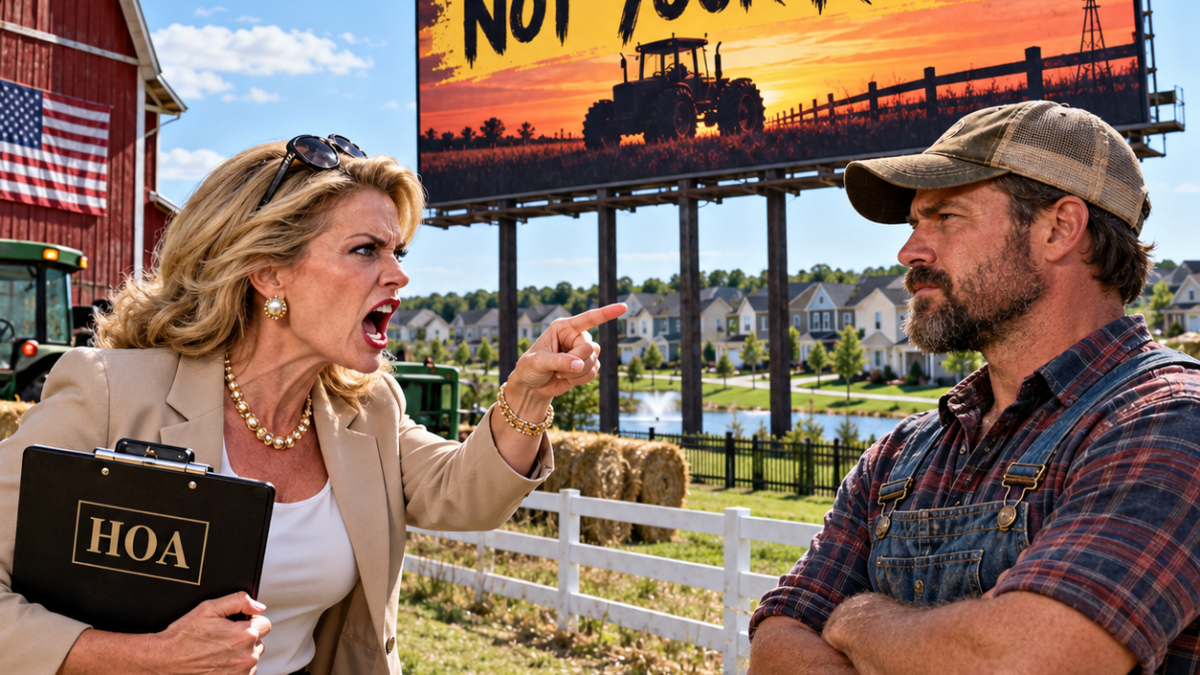
The president of the luxury HOA next to my ranch stood on the other side of my timber fence, looked over thirty years of family work, cattle pasture, dusty equipment, and weathered barns, and called the whole place “white-trash acreage” that was dragging down the view from homes worth more than most people earned in a lifetime.
When I refused her offer to buy the only flat corridor through my property—the strip a developer desperately needed to reach a hidden valley behind me—her complaints stopped being about appearances and turned into survey stakes moved in the night, fake violation notices, security trucks idling at my gates, and men with cameras trying to convince me that my own land somehow belonged to her community.
I let her believe the silence meant she was wearing me down, because by the time she finally sent armed private security through my gate one morning, the thing she should have been most afraid of was no longer me.
My name is Daniel Mercer.
The ranch sits in a dry western valley where subdivisions arrived long after cattle, irrigation ditches, and fence posts had already decided where the world belonged.
My grandfather bought the first acreage.
My father expanded it.
I inherited the property after he died and added several adjoining parcels until the ranch wrapped around one side of a gated development called Silver Ridge Estates.
The contrast was almost funny.
On my side: weathered red barn, tractors, feed shed, working dogs, timber fencing, pickup trucks, men who came home wearing dust.
On their side: stone entrance towers, artificial waterfalls, clipped hedges, imported tile roofs, and balconies positioned specifically to admire the valley.
Karen Whitmore ran Silver Ridge like she owned the horizon.
Our first serious conversation happened at my south fence.
She wore a cream blazer despite the heat and carried architectural renderings under one arm.
“Mr. Mercer, you’re sitting on a very valuable opportunity.”
She spread the drawings across the hood of her SUV.
Behind my ranch was an undeveloped valley where a national real-estate company wanted to build another high-end community.
There was one problem.
Mountains blocked access from the west.
Wetlands complicated the eastern approach.
The cheapest viable construction corridor crossed my land.
Karen tapped a highlighted strip.
“Twenty-eight acres.”
“Not for sale.”
“You haven’t heard the number.”
“Doesn’t matter.”
“It’s considerably above agricultural value.”
“I’m not selling.”
Her smile tightened.
“You could retire.”
“I like working.”
“The corridor would barely affect your operation.”
“It cuts the ranch in half.”
“They’d construct crossings.”
“No.”
She folded the plans.
“You understand development is coming whether you like it or not.”
“Probably.”
“Then why make this difficult?”
“I’m not.”
I looked at her.
“I said no.”
That should have ended it.
Instead, Karen stared past me toward the barn.
“You know what residents call this place?”
I didn’t answer.
“White-trash acreage.”
The words came casually.
Almost professionally.
Like an appraisal.
“Rusting equipment. Dirt roads. livestock. That fence looks like something from a Depression-era photograph.”
I felt anger rise.
But anger is information, not instruction.
I said, “Then tell them to face their chairs the other direction.”
For the first time, her smile disappeared.
After that, the campaign began.
Silver Ridge security vehicles parked beside my boundary at night with spotlights aimed toward the barns.
Anonymous dust complaints reached the county.
Then noise complaints.
Then environmental complaints.
Every agency inspected.
Every inspection cleared me.
Next came certified envelopes demanding fines for violations of Silver Ridge covenants.
My ranch had existed decades before the HOA.
It was not part of Silver Ridge.
I filed the letters instead of answering them.
Then survey stakes started moving.
Only inches at first.
Then nearly three feet.
I reset nothing myself.
I photographed everything.
Installed cameras.
Logged dates.
Saved envelopes.
The ranch manager, Tom Alvarez, finally asked me one night, “How long are you going to let her do this?”
“As long as she keeps giving me evidence.”
“For what?”
I looked toward the lights of Silver Ridge glowing above the pasture.
“For the moment she stops pretending this is an HOA dispute.”
Three weeks later, nine black SUVs came through my ranch gate just after sunrise.
Men in tactical clothing poured out.
My fence crew froze.
Tom stepped from the barn.
And Karen Whitmore climbed from the lead SUV carrying a leather folder and the smile of someone convinced she had finally won.
PART 2
I was not at the ranch when the SUVs arrived.
That point matters.
Karen later tried to claim I had engineered the confrontation.
I hadn’t.
I was twenty-two miles away sitting in a conference room with two federal investigators, a prosecutor, and a financial analyst when my phone vibrated on the table.
One message.
From Tom.
**SHE’S HERE. NINE VEHICLES. SECURITY. THEY CUT THE GATE.**
The prosecutor across from me saw my expression.
“What?”
I turned the phone toward him.
He read it.
Then looked at the lead investigator.
No one panicked.
That was the moment I knew the previous fourteen months of patience had been worth it.
“Cameras?” Agent Laura Bennett asked.
“Running.”
“Audio?”
“Main yard and office exterior.”
“Your people know what to do?”
“Tom does.”
The ranch had standing instructions.
Do not resist.
Do not threaten.
Do not touch an armed trespasser unless necessary to protect life.
Ask for identification.
Ask for a warrant.
Document.
Call 911.
Nothing heroic.
Heroics destroy clean cases.
Bennett stood.
“We’re moving.”
The federal operation already planned for that morning changed shape in less than thirty seconds.
Not because Karen had chosen some magical date.
Because warrants had been approved the previous afternoon after months of independent investigation.
Search warrants.
Arrest warrants for several principal targets.
Financial seizure orders.
The plan had been to execute them simultaneously at offices and residences after sunrise.
Karen simply added a live crime scene.
I stayed behind.
That irritated me.
“I’m going.”
Bennett shook her head.
“No.”
“That’s my ranch.”
“That is exactly why you are not leading this.”
“I didn’t say leading.”
“You are also a sworn federal officer with a direct property interest.”
“I know.”
“Then act like one.”
That landed.
My name is Daniel Mercer.
The piece Karen never bothered learning about me was that cattle ranching was not my primary career.
I was a supervisory deputy United States Marshal.
Twenty-three years.
Most of my professional life had involved fugitives, protective operations, complex warrant service, threat assessment, and interagency task-force work.
The ranch was the place I went to stop feeling like the world was always running from something.
When Karen’s harassment started, I had exactly the training needed to make the worst possible mistake.
I could have flashed credentials.
Threatened federal consequences.
Called friends.
Used professional authority in a private land fight.
So I did none of that.
I treated myself like any other landowner.
County complaints went through county channels.
Survey issues went through licensed surveyors.
Trespass reports went through the sheriff.
Civil issues went through my private attorney.
And once financial evidence suggested something larger than a neighborhood dispute, I reported it through official channels and formally removed myself from investigative decision-making.
That separation later saved the case.
At first, there was no federal case.
There was only Karen being Karen.
The first offer for my land came from Silver Ridge Development Advisory LLC.
That company sounded independent.
It wasn’t.
My attorney, Rachel Sloan, found that its registered address shared office space with Bellweather Communities, a national developer.
Bellweather wanted the valley behind my ranch.
I still didn’t care.
Companies buy land.
People say no.
That is not a crime.
Then Karen’s behavior changed.
She began sending letters asserting that Silver Ridge had “historic access rights” across my southern pasture.
False.
My title showed none.
Next, one letter included a notarized declaration from a supposed former owner stating a roadway had existed there for decades.
I knew the name.
The man had died years before the date on the notarization.
That was when Rachel stopped smiling.
She placed the paper on her desk.
“Daniel.”
“I know.”
“Do not touch this more than necessary.”
“It came certified.”
“Keep envelope.”
“Already bagged.”
“You’re doing the cop thing.”
“I’m doing the not-idiot thing.”
Rachel arranged a forensic document review.
The notary stamp belonged to a real notary whose commission had expired before the document’s date.
Signature inconsistent.
Record number did not match county indexing.
Someone had created evidence.
That moved the situation from harassment toward fraud.
I notified my chain of command.
They told me what I already expected.
Formal recusal.
No investigative role.
No database searches.
No subpoenas.
No approaching suspects under color of office.
I remained the victim and evidence source.
Agent Bennett’s financial-crimes team took over.
Then another person came forward.
His name was Jonathan Price.
General counsel for Silver Ridge’s property association.
I had never met him.
According to investigators, Jonathan had begun questioning invoices connected to Karen’s “special development liaison” work.
There were consulting payments.
Land-acquisition reimbursements.
Security expenses.
Payments to recently formed companies.
At first, he thought they were sloppy governance.
Then he found digital copies of altered plats.
My ranch plats.
Property lines moved.
Old access routes drawn where none legally existed.
Draft deeds.
Notary templates.
Jonathan did something risky.
He preserved copies according to counsel from his own outside ethics attorney and eventually went to federal authorities.
His evidence overlapped mine.
That was the first real indication Karen was not acting alone.
Money from Bellweather-related entities had passed through consulting structures tied to Karen.
Not millions in grocery bags.
More sophisticated than that.
Future consulting agreements.
Success bonuses.
Association “infrastructure grants.”
Reimbursement promises if the access corridor was secured.
The apparent bargain was simple.
If Karen pressured me into selling, Silver Ridge would benefit from upgraded roads and amenities.
Karen personally stood to receive substantial consulting income.
Bellweather obtained its route without approaching me publicly and alerting neighboring landowners to the development value.
Still potentially civil.
Potentially unethical.
Then the forged instruments appeared.
Then interstate emails discussing pressure tactics.
Then private-security invoices.
Then recorded conversations from cooperating witnesses.
The case grew.
I hated every day of it.
Tom asked me once:
“You knew this was getting big?”
“I knew someone was lying.”
“That’s not what I asked.”
“No.”
I looked across the pasture.
“I didn’t know how big.”
He leaned on the fence.
“Why didn’t you tell us what you do for a living when she started?”
“Because what I do for a living shouldn’t decide whether she respects our property line.”
Tom smiled.
“That’s a very federal answer.”
“It’s a very tired answer.”
Karen still thought I was simply Daniel Mercer, quiet ranch owner.
I preferred it that way.
She grew bolder.
Her security contractor started driving the perimeter.
The company was called Sentinel Property Solutions.
They held state licenses for private security.
Some employees were former military.
Most were ordinary professionals doing legitimate work.
Their director, Nolan Pierce, was different.
Pierce liked intimidation.
On camera he had been recorded telling one of my hands:
“This entire ranch is going to change owners eventually.”
Another time:
“You boys ought to start looking for work before the bulldozers arrive.”
I documented.
Reported trespass when appropriate.
Did not engage.
The workers began asking why I tolerated it.
That hurt.
Because patience looks a lot like weakness to people who do not know what is happening behind the curtain.
Then came the morning Karen crossed the line herself.
Tom later told me the entire sequence.
He had been inside the equipment barn when engines rolled through the gate.
The gate was chained.
Sentinel cut the chain after Karen claimed she held an emergency authorization.
Workers named Luis, Mateo, Ben, Curtis, and Ray were repairing fence along the interior lane.
Sentinel personnel surrounded them.
Some carried sidearms.
Others carried less-lethal launchers.
The workers were ordered to set tools down.
When Curtis reached for his phone, a guard knocked it from his hand.
Tom walked out.
“What the hell are you doing?”
Pierce raised one hand.
“Stay where you are.”
Tom kept walking until two guards blocked him.
Then he looked at Karen.
She stood beside the lead SUV.
Cream jacket again.
Same style she had worn when offering to buy my land.
“What authority are you operating under?”
Karen lifted a folder.
“Emergency community protection order.”
Tom almost laughed.
“Signed by who?”
“The Silver Ridge executive board.”
“That’s not a court.”
“Our covenants authorize immediate abatement of hazards threatening residents.”
“This ranch is not in Silver Ridge.”
“The fence encroaches.”
“Show me a survey.”
“Move back.”
“Show me a warrant.”
“You don’t understand the situation.”
Tom glanced at the men surrounding our workers.
“I understand armed private security entered private property, detained ranch employees, and seized phones.”
Pierce stepped closer.
“You need to calm down.”
“I’m calm.”
That was true.
Tom spent twelve years managing large agricultural operations.
Before that, six years Army logistics.
He did not scare easily.
Karen thrust the paper toward him.
“Your operation is under administrative receivership until the boundary hazard is corrected and outstanding assessments are satisfied.”
Tom finally laughed.
“What does that even mean?”
Her face reddened.
“Detain him.”
Pierce hesitated.
Important detail.
He knew.
Later, his cooperation would establish that he knew Karen’s “order” was not judicial.
But he followed her direction.
Tom’s wrists were zip-tied.
So were the workers’.
Phones were taken.
Keys.
Radios.
No one was beaten badly.
One worker suffered wrist abrasions.
Another had a bruised shoulder when forced against the fence.
Serious enough.
Not cinematic carnage.
Karen ordered the office opened.
The door was locked.
Sentinel drilled the cylinder.
That destroyed any remaining argument that this was a boundary misunderstanding.
My ranch cameras recorded everything.
Karen entered.
She searched filing cabinets.
Opened drawers.
Pulled folders.
At the center desk was a manila file.
It bore Bellweather Communities’ name.
That file was there because investigators had prepared for a different purpose.
Not a ridiculous honeypot designed for Karen to steal.
It was a monitored evidentiary control file containing copies and marked material related to prior suspicious documents, kept there during coordinated evidence-transfer preparation.
Karen had no legal right to touch it.
She opened it.
Read.
Then put it in her bag.
That act became important.
But not because it contained classified material.
I would never have left classified material sitting in a ranch office.
The folder contained marked copies tied to the ongoing investigation.
Its removal created another documented act of unlawful seizure and potential obstruction.
By then, Agent Bennett’s convoy was approaching.
The sheriff’s office arrived first.
Two units.
They stopped outside because Sentinel personnel were armed.
The deputy requested identification and authority.
Pierce produced his state security license.
Karen produced her HOA paper.
The deputy read it.
“This is not a warrant.”
Karen said:
“It authorizes abatement.”
“Not detention.”
“These individuals were interfering.”
The deputy looked at Tom kneeling in dirt with his wrists tied.
Then radioed for additional units.
Federal vehicles arrived moments later because the preplanned operation was already in motion and agents had been redirected to the ranch.
No black-armored fantasy army.
Marked and unmarked vehicles.
FBI.
U.S. Marshals task-force personnel.
County deputies.
A federal prosecutor stayed off-site.
The agents announced themselves.
Sentinel guards froze.
Pierce immediately ordered his men to holster or ground weapons.
Whatever else he was, he was not suicidal.
Agents separated everyone.
Cut workers free.
Secured the office.
Placed Karen apart from others.
Then I arrived.
Only after Bennett told me the scene was controlled and I was coming as the property owner and victim, not operational commander.
I wore jeans.
Work boots.
No tactical vest.
No dramatic badge reveal.
Karen saw me step from my truck.
Her face twisted into relief.
That still surprises me.
She apparently thought the federal presence concerned some separate matter.
She pointed toward me.
“There he is. He can explain.”
Bennett looked at me.
I said nothing.
Karen walked toward me before an agent stopped her.
“Daniel, tell them this is a property issue.”
I met her eyes.
“It was.”
Her expression shifted.
“What does that mean?”
Agent Bennett stepped in.
“Ms. Whitmore, I need you to listen carefully.”
Karen looked from Bennett to me.
Then noticed one task-force deputy speaking quietly to me.
Recognition began.
Not of rank.
Of familiarity.
“You know these people?”
I answered truthfully.
“Yes.”
“How?”
Bennett interrupted.
“That isn’t relevant right now.”
Karen looked at me again.
“What are you?”
A strange question.
I almost said rancher.
Because that was what she had always refused to see.
Instead I said:
“I work for the United States Marshals Service.”
The color left her face.
Not all at once.
Slowly.
“You’re—”
“Yes.”
She looked toward Tom.
Then at the cameras on the barn.
Then the federal vehicles.
“No.”
Nobody answered.
“This is entrapment.”
Bennett remained calm.
“No one instructed you to enter this property today.”
“You set me up.”
“You were told repeatedly to stay off Mr. Mercer’s ranch.”
“This is an HOA enforcement matter.”
“The ranch is not part of your HOA.”
“Our attorney—”
Jonathan Price stepped from a federal vehicle.
That broke her.
Her own association lawyer.
The man she thought she controlled.
“Jonathan?”
He looked exhausted.
Not triumphant.
“Karen.”
“You did this?”
He said nothing.
Her voice rose.
“You stole privileged files.”
Bennett stepped between them.
“Stop.”
Jonathan looked away.
Later, lawyers would fight over privilege boundaries.
Some materials were protected.
Others fell outside privilege or came from independent business records.
Those issues were handled by filters and courts.
Not by Karen shouting in the dirt.
Agent Bennett asked:
“Ms. Whitmore, do you have property belonging to this ranch in your bag?”
“No.”
That was a mistake.
The search warrant authorized seizure of specified devices and records connected to the investigation.
The scene also contained obvious evidence of the fresh trespass and office burglary.
A female agent secured Karen’s bag.
Inside was the marked Bellweather folder.
Also several ranch documents removed from cabinets.
Survey copies.
Vendor list.
A title report.
Karen watched each item placed into evidence sleeves.
“I was preserving them.”
No one responded.
“I thought Daniel was destroying records.”
Still nothing.
Then agents showed Pierce the warrant bearing a federal judge’s signature.
He sat on the ground.
Literally.
Back against one of the SUVs.
Hands over his face.
Karen was taken into custody on the warrants already issued before her ranch incursion.
So was Pierce.
Other suspects were arrested elsewhere that morning.
Bellweather offices were searched under warrant.
Silver Ridge’s management office was searched too.
No agents smashed walls searching for secret vaults.
They did what real searches usually involve.
Servers imaged.
Paper records boxed.
Phones seized.
Accounting systems preserved.
Cloud credentials obtained according to process.
Slow.
Methodical.
Devastating in a different way.
I walked to Tom first.
“You okay?”
He held up his wrists.
Red marks.
“I’ve had better mornings.”
Luis was shaking.
I had never seen him shake.
“You hurt?”
“No.”
“Sit down.”
He looked at me.
“You knew?”
“Not today.”
“You knew they were investigating her?”
“Yes.”
“Why didn’t you tell us?”
That question hit.
I had reasons.
Operational secrecy.
Safety.
Recusal.
But Luis had spent twenty minutes believing armed men might take him away because he repaired a fence.
“I couldn’t.”
He looked angry.
He had that right.
“I’m sorry.”
For the next week, that mattered more to me than Karen’s arrest.
Every worker received paid leave.
Medical evaluation.
Counseling access.
Replacement phones where property had been damaged.
The ranch covered everything immediately.
Tom returned after two days.
Luis needed a week.
Curtis almost quit.
I asked him to sit with me.
“You should’ve told us enough to know something was happening.”
“I know.”
“You let us think she was just some crazy HOA lady.”
“I believed security risk increased if word spread.”
“Maybe.”
He looked toward the gate.
“But we’re the ones standing here every day.”
I could not argue.
“I failed you on that.”
Curtis stared.
Most employers defend themselves.
I had learned in the Marshals Service that sometimes the fastest way through failure is to name it.
“I should have prepared you better without compromising the case.”
He nodded.
“Yeah.”
“Will you stay?”
“I don’t know.”
He stayed.
Years later, he would be the one who helped me raise the billboard.
But I did not know that then.
The criminal case expanded dramatically after the searches.
Bellweather executive Thomas Vale had approved covert acquisition incentives.
Emails discussed using “community pressure” to reduce my bargaining position.
One message described the ranch as:
**Aesthetic and political leverage point. Owner likely to fold if isolated.**
Karen had replied:
**He will. Everyone does eventually.**
I read that line during discovery as a victim much later.
Everyone does eventually.
That was how she understood people.
Pressure them long enough.
Make resistance expensive.
Embarrassing.
Lonely.
Then they fold.
The same philosophy appeared in Silver Ridge resident complaints.
That surprised me.
Karen had not only targeted the ranch.
She had used similar tactics internally.
Not armed raids.
Administrative pressure.
Fines.
Selective enforcement.
Legal threats.
One family had challenged a landscaping contractor she favored and suddenly received four violations.
Another resident questioned association expenditures and found himself accused of unauthorized structural modifications.
Residents began calling investigators.
The case became about more than my land.
Still, prosecutors narrowed criminal charges to conduct they could prove.
Wire fraud.
Conspiracy.
Extortion-related counts tied to property acquisition.
Forgery-related state charges referred separately.
Obstruction issues.
Financial crimes.
The armed ranch entry created state and federal exposure for multiple participants.
No one charged Karen with being rude.
No one charged her with calling my ranch white trash.
But that insult became part of the civil case.
Because it had not been private.
Months earlier, during a Silver Ridge board meeting, Karen had apparently described my property as:
“that white-trash ranch destroying our eastern view.”
It was in meeting audio.
She then told residents the association was taking “aggressive action” to remedy the situation.
My attorney Rachel played the clip for me.
I stared at the speaker.
“That’s real?”
“Yes.”
“You’re sure?”
“Association produced the audio under subpoena.”
I listened again.
White-trash ranch.
Something about hearing it in a room full of her residents hurt more than hearing it over my fence.
At the fence I had been one man she wanted to provoke.
At the meeting, I was a category.
Something lesser.
Something people like her could fix.
Rachel watched me.
“Daniel?”
“I’m fine.”
“No, you’re angry.”
“I’m allowed.”
“Yes.”
I stood.
Walked to the window.
“My father built that barn.”
“I know.”
“He repaired the roof after a windstorm when we couldn’t afford contractors.”
Rachel said nothing.
“My mother painted the office herself.”
Still nothing.
“I buried my father on the north ridge.”
Rachel’s expression softened.
“And she called it trash because the fence wasn’t decorative enough.”
“She said it because dehumanizing you made the rest easier.”
That stayed with me.
The criminal case took almost two years.
No spectacular trial.
Cooperation agreements.
Plea negotiations.
Pretrial motions.
Asset disputes.
Bellweather’s board turned on executives once evidence became impossible to ignore.
Thomas Vale pleaded guilty to conspiracy and wire-fraud-related charges.
He agreed to substantial forfeiture and cooperation.
Nolan Pierce cooperated early.
He admitted Karen had repeatedly asked Sentinel to act beyond normal private-security authority.
His company lost contracts and eventually dissolved.
Several guards were never criminally charged because investigators concluded they had been misled about the scope of the operation and complied with authorities once the illegality became clear.
That distinction mattered to me.
I did not want every man in a black shirt destroyed because Karen lied.
Pierce, however, had known enough.
Jonathan Price became a key witness.
His role was complicated.
He had once facilitated aggressive association legal strategy.
He admitted that.
“I should have pushed back sooner,” he told me outside court one morning.
I looked at him.
“Why didn’t you?”
He rubbed his forehead.
“Same reason everyone else didn’t.”
“Which is?”
“She won a lot.”
That answer was more honest than I expected.
Karen held out longest.
Her lawyers argued federal overreach.
Conflict of interest.
Selective prosecution.
They claimed I had weaponized my position.
The recusal record destroyed most of that.
I had formally stepped away months before subpoenas were issued.
Independent investigators handled evidence.
Independent prosecutors presented warrant applications.
Judges reviewed probable cause.
I had not participated in tactical planning.
The morning at my ranch did not create the case.
It strengthened it.
Karen eventually took a plea.
Several felony counts.
Restitution.
Forfeiture connected to illicit proceeds.
A custodial sentence followed by supervised release.
Not life.
Not some fantasy century in prison.
Enough years that Silver Ridge would have several presidents before she returned to ordinary life.
At sentencing, the judge allowed victims to speak.
Silver Ridge residents went first.
A widow who had spent retirement savings fighting assessments.
A young family.
Jonathan.
Tom.
Then me.
I stood at the lectern.
Karen sat at defense table.
For the first time since I met her, she did not look at me with contempt.
She looked tired.
I had written six pages.
I read less than one.
“Your Honor, I could talk about money or property.”
I paused.
“But those things can be repaired.”
Karen looked up.
“What was harder to repair was trust.”
I glanced back at Tom and Luis.
“My employees went to work one morning believing the worst thing they might face was heat and fence wire. Instead, armed private guards put them in restraints because one person decided her goals mattered more than their rights.”
I looked at Karen.
“For fourteen months, Ms. Whitmore treated silence as weakness. She was wrong.”
I stopped.
Then added:
“But I also learned that secrecy has a price. Even when justified, people close to you can end up carrying fear they didn’t choose.”
Luis lowered his eyes.
“I ask only that the court consider the full harm.”
Then I sat.
No speech about victory.
I did not feel victorious.
Justice is heavier than revenge when real people have been hurt.
The civil case continued after sentencing.
My claims included trespass.
Interference with property rights.
Defamation.
Damage associated with boundary tampering.
Business disruption.
The ranch workers had separate claims arising from detention and emotional harm.
Silver Ridge itself sued former officers and sought insurance recovery.
Bellweather entered settlement negotiations.
Karen’s assets became part of restitution and civil proceedings.
It took another year.
Eventually, settlements were reached.
My workers received compensation.
That mattered first.
Luis used part of his settlement to put a down payment on a house.
Curtis paid off debt.
Tom put his money into a college account for his granddaughter and then pretended he had not.
“What?”
“You told me you bought a fishing boat.”
“I considered it.”
“You bought a 529 plan.”
“Stop investigating me.”
The ranch received compensation too.
Property damage.
Legal expense.
Business interruption.
Defamation component.
Settlement language acknowledging the ranch was separate from Silver Ridge and that prior assertions of HOA jurisdiction were false.
The association issued a public corrective statement.
Not because I demanded humiliation.
Because false statements had been distributed publicly.
Rachel asked me:
“What do you want the correction to say?”
“The truth.”
“That is annoyingly broad.”
“Start with the ranch is not subject to Silver Ridge covenants.”
She typed.
“And?”
“No legal encroachment existed.”
“Good.”
“And their prior public statements about unlawful operations were withdrawn.”
“Anything about ‘white trash’?”
I looked at her.
“No.”
She raised an eyebrow.
“You’re sure?”
“I don’t need a court order saying Karen was rude.”
That would come later in another form.
Silver Ridge elected an entirely new board.
The first meeting with them happened in my barn.
Their idea.
I almost refused.
Tom said:
“You should make them sit next to the tractor.”
So I did.
The new president, Elaine Porter, was a retired hospital administrator.
Practical.
Direct.
She looked around the barn.
“This is the structure we were told was an eyesore?”
“Yes.”
“It looks like a barn.”
“Sharp eye.”
She smiled.
“I owe you an apology.”
“You personally?”
“No.”
“Then don’t carry hers.”
“I’m president now. I carry the association’s obligations.”
Fair.
We reviewed boundaries.
Survey coordinates.
Fence maintenance.
Emergency contacts.
Dust-control practices during unusually dry months.
Nothing dramatic.
When the meeting ended, Elaine looked toward the east fence.
“The residents are asking whether you plan to replace that.”
“Why?”
“Part of it is damaged from repeated interference.”
“Probably.”
She looked uncomfortable.
I noticed.
“What?”
“Some residents would prefer something more visually screened.”
I laughed.
Not at her.
At history.
She raised both hands.
“I am not telling you what to build.”
“Good.”
“I said I would ask.”
“Also good.”
I walked her to the gate.
Then looked uphill toward Silver Ridge.
The homes sat in staggered tiers.
Glass.
Stone.
Wide balconies.
Every one of them faced my ranch because the valley view had been their selling point.
Karen had spent years furious that the foreground included actual agriculture.
Suddenly I had an idea.
Not illegal.
Not threatening.
Not destructive.
Maybe petty.
Definitely petty.
I called Rachel.
“How difficult is it to put up a billboard on agricultural land?”
Her first response was:
“No.”
“You don’t know what I’m asking.”
“You used the word billboard.”
“Legal billboard.”
“No.”
“Rachel.”
She sighed.
“What size?”
“I don’t know yet.”
“What message?”
“Truth.”
“That word again.”
I explained.
Silence.
Then:
“This is childish.”
“Potentially.”
“I respect it.”
“So we can?”
“Maybe. Zoning, sign ordinance, highway visibility, lighting, setback, structural permit. You are not putting up anything until we check every one.”
“Agreed.”
“What exactly do you want it to say?”
That took weeks.
At first I wanted the public correction enlarged.
Too many words.
Then I considered Karen’s insult.
**WHITE TRASH RANCH — STILL NOT FOR SALE**
Tom loved that.
Rachel hated it.
“You will make yourself the story.”
“Probably.”
“Don’t.”
She was right.
The billboard should not be about Karen.
Not really.
It should be about what happened when people decided they could overwrite a boundary through money and intimidation.
Then Silver Ridge’s lawyers reminded us of a settlement provision.
The association had agreed to publish a corrective notice for ninety days on its website and distribute it to members.
Rachel asked whether they would also consent to display of the same approved language on my property.
Elaine laughed when asked.
“You seriously want to face our houses with our own correction?”
“Yes.”
She rubbed her forehead.
“This is why Karen hated you.”
“Probably.”
The new board debated.
Residents debated harder.
Some were furious.
“We weren’t involved.”
True.
Others supported it.
“We should remember what happened.”
Also true.
Finally, Elaine called.
“Board won’t oppose a sign if it complies with county law and uses settlement-approved language.”
“Good.”
“For a defined period?”
“How defined?”
“One year.”
I considered.
“Two.”
“One.”
“Eighteen months.”
She sighed.
“Fine.”
That was enough.
County zoning allowed an agricultural identification and informational sign of substantial size under conditions, but not the giant highway commercial billboard I initially imagined.
So we designed within the rules.
Steel posts.
Engineering drawings.
Wind-load calculations.
Setbacks.
Shielded solar lighting.
No flashing lights.
No traffic hazard.
Permit approved.
Thirty-six feet wide.
Fourteen feet high.
From the Silver Ridge balconies, enormous.
From the public highway, barely visible because of orientation.
Perfect.
Curtis helped weld the structure.
The same man who had once considered quitting after Karen’s raid.
He looked up at the frame.
“This is ridiculous.”
“Yes.”
“I love it.”
The sign face arrived on a flatbed.
White background.
Black lettering.
Simple.
At the top:
**MERCER FAMILY RANCH — EST. 1958**
Below that, smaller:
**THIS RANCH IS PRIVATE AGRICULTURAL PROPERTY AND IS NOT SUBJECT TO SILVER RIDGE ESTATES HOA CONTROL.**
Then:
**SILVER RIDGE ESTATES HAS FORMALLY WITHDRAWN PRIOR CLAIMS OF ENCROACHMENT, UNAUTHORIZED ACCESS RIGHTS, AND HOA JURISDICTION OVER THIS LAND.**
At the bottom was the line I added myself.
Not insulting.
Not legally necessary.
Approved anyway.
**GOOD NEIGHBORS RESPECT FENCES.**
Tom read it.
“That’s it?”
“What did you expect?”
“WHITE TRASH AND PROUD.”
“I considered it.”
“You got old.”
“Rachel got involved.”
He nodded.
“Same thing.”
We raised the sign on a Saturday morning.
No news cameras.
No crowd.
Me.
Tom.
Curtis.
Luis.
A crane operator.
Rachel stood near the barn pretending she was only there to inspect permit compliance.
The frame tilted upright.
Bolts seated.
Crew tightened everything.
Then protective covering came down.
Across the valley, balconies faced it.
I imagined dozens of coffee cups stopping halfway to mouths.
Luis started laughing.
Not a chuckle.
Full-body laughter.
He leaned against the truck.
“That’s what they get to look at?”
“For eighteen months.”
“Every morning?”
“Yes.”
“Night?”
“Shielded lighting until ten.”
He laughed harder.
Rachel shook her head.
“This may be the dumbest legally compliant thing I have ever helped create.”
“That should go on your website.”
“No.”
By noon, my phone started ringing.
Silver Ridge residents.
Some angry.
Some amused.
One woman said:
“I voted for the new board, and I still think this is obnoxious.”
“That’s fair.”
“You’re leaving it?”
“Yes.”
She sighed.
“At least it’s factual.”
“Thank you.”
“That was not a compliment.”
“Still taking it.”
Another resident called just to say:
“My husband nearly dropped his coffee.”
Tom wanted that printed on shirts.
I refused.
Elaine visited three days later.
We stood beneath the sign.
She looked up.
“Bigger from here.”
“Smaller from your house?”
“No.”
We both laughed.
She turned serious.
“Some residents want us to sue.”
“On what basis?”
“I asked the same question.”
“Good president.”
“I hate this job.”
“Another sign of a good president.”
She looked at the ranch.
Then at the hillside homes.
“You know, Karen’s original argument was always property values.”
“I know.”
“Our latest sales haven’t moved.”
“Imagine that.”
“The ranch existing didn’t destroy Silver Ridge.”
“No.”
“Your sign might.”
“Elaine.”
“Kidding.”
Mostly.
Life quieted.
That was what I wanted.
The developer abandoned the valley project after the criminal case made the acquisition strategy toxic and access economics collapsed.
Another company eventually purchased some distant acreage but pursued a completely different route years later.
My corridor remained part of the ranch.
We improved the fence.
Not because Silver Ridge requested it.
Because cattle had begun testing the old posts.
Curtis and Luis built a new three-rail timber fence.
Straight.
Strong.
Beautiful in the way working things are beautiful.
I left a portion of the old fence near the billboard.
Weathered gray rails.
Bullet-free.
Simple.
The piece Karen had once called trash.
My mother would have recognized it.
That mattered.
The first anniversary of the raid was difficult.
I did not expect that.
I woke before dawn.
Walked toward the barn.
For a moment, engine noise on the county road made my shoulders tighten.
Memory is physical before it becomes intellectual.
Tom found me near the gate.
“You good?”
“Yeah.”
“Liar.”
We stood quietly.
Luis joined us later.
Then Curtis.
Nobody planned it.
We drank coffee.
At 6:47—the approximate time Sentinel entered the year before—Luis looked at his watch.
“One year.”
“Yep.”
He looked toward the billboard.
“You know what I remember?”
“What?”
“Dirt.”
“The ranch has a lot.”
“No. When they pushed my face toward the fence.”
His hand tightened around his cup.
“I could smell dirt.”
I did not speak.
“For months after, if I smelled dry dust, I got angry.”
“Still?”
“Sometimes.”
I nodded.
He looked at me.
“But I stayed.”
“I know.”
“You apologized.”
“I owed you.”
“Most bosses don’t.”
“I’m not most bosses.”
Tom snorted.
“Federal ego.”
“Shut up.”
Luis smiled.
The tension broke.
We went to work.
Eighteen months after installation, the billboard agreement expired.
I had the legal right to replace it with another permitted sign.
Tom wanted:
**STILL NOT FOR SALE.**
Curtis wanted:
**NO HOA BEYOND THIS POINT.**
Rachel recommended taking the structure down completely.
“What do you want?” she asked.
I looked toward Silver Ridge.
The new board had been decent.
Residents volunteered with local charities.
Elaine had invited our crew to their community barbecue.
The first time, Luis refused.
The second, he went.
Things change.
“I don’t need it anymore.”
Rachel smiled.
“Growth.”
“Don’t start.”
We removed the printed panel.
But I kept the steel frame.
For months it stood empty.
Just structure against sky.
Then my niece Emily had an idea.
She taught agricultural science at the county high school.
“Use it for something useful.”
“Such as?”
“Scholarships.”
She proposed a program connecting students with local farms and ranches.
Summer internships.
FFA support.
Welding.
Veterinary science.
Water management.
Land surveying.
Skills that built the valley before luxury gates arrived.
I liked that.
So the next panel read:
**MERCER VALLEY AGRICULTURAL SCHOLARSHIP**
**SUPPORTED BY LOCAL FARMERS, RANCHERS, AND NEIGHBORS**
Applications listed below.
Silver Ridge residents donated the first year.
Elaine personally wrote a check.
When she handed it to me, she said:
“Please tell me this means we don’t have to stare at legal language again.”
“No promises.”
She glared.
I laughed.
The scholarship became permanent.
The first recipient was a girl named Sofia Ramirez.
Her father repaired irrigation pumps.
She wanted to study agricultural engineering.
At the award dinner, she shook my hand.
“Mr. Mercer, why did you start this?”
I looked toward Emily.
“You can blame my niece.”
Emily said:
“He had a giant revenge billboard and eventually grew up.”
Sofia stared.
“What?”
Long story.
I told her the short version.
“People forgot agriculture was part of this valley too.”
“So you put up a sign?”
“Basically.”
“Did it work?”
I looked through the community hall windows toward distant lights on the hillside.
“Yes.”
“Because they respected the farm?”
“Some did.”
“And the rest?”
“They respected the property line.”
Sometimes that is enough.
Tom retired eventually.
He lasted longer than me on the ranch day to day.
At his retirement dinner, I gave him a framed copy of Karen’s fake “emergency protection order.”
He stared.
“You kept this?”
“Of course.”
“This is garbage.”
“Historical garbage.”
He laughed.
Then grew quiet.
“Burn it.”
“What?”
“Burn it.”
So we did.
After dinner, we carried a metal fire pit behind the barn.
Tom dropped the fake order in.
Paper curled.
Embossed association seal blackened.
Pseudo-legal language disappeared.
Luis tossed in one of the old violation notices.
Curtis added a photocopy of the demand that our tractor dust be “remediated.”
Rachel arrived late.
“What are you people doing?”
“Evidence destruction,” Tom said.
She almost had a heart attack.
“Copies,” I said quickly.
She glared.
“Idiots.”
The originals remained archived as required.
The copies became ash.
We watched sparks disappear into dark.
No speeches.
Didn’t need any.
Years after Karen’s conviction, I received a letter.
Plain envelope.
Prison return address.
I recognized her name.
I almost threw it away.
Then opened it.
One page.
No dramatic confession.
No request for forgiveness.
She wrote that she had spent years believing people respected her when they were actually afraid of conflict.
She said I had humiliated her.
Then crossed out humiliated and wrote:
**exposed**
She admitted the word felt more accurate.
She wrote:
**I still think your ranch looked terrible from our balconies.**
I laughed out loud.
At least she had not become dishonest in prison.
Then:
**But it was never mine to fix.**
I read that line twice.
That was the closest she came to understanding.
Near the bottom:
**I do not expect a response.**
I gave the letter to Rachel.
“Any reason I need to preserve this?”
She read.
“No.”
“What should I do?”
“Whatever lets you sleep.”
I put it in the same fireproof box as old family papers.
Not forgiveness.
Not vengeance.
History.
A few years later, my mother’s old barn needed a new roof.
The original metal sheets had patched areas older than some of my employees.
We stripped them.
Beneath one panel, scratched into a wooden rafter, I found my father’s initials.
**R.M. 1987**
I stood on the ladder staring.
Curtis called:
“You falling asleep?”
“Come here.”
He climbed.
Saw it.
“Your dad?”
“Yeah.”
We left the rafter exposed inside.
That evening, I sat on the tailgate and looked at the ranch.
New roof.
Old fence section.
Scholarship sign.
Cattle moving toward water.
Silver Ridge lights above.
Karen once saw all of that and thought poor.
Ugly.
Trash.
She saw weathering and assumed neglect.
Saw labor and assumed failure.
Saw people who worked with their hands and assumed they were easier to push.
That miscalculation cost her almost everything.
But the part that stayed with me was not her downfall.
It was how close I came to letting her define the fight.
For months I wanted to prove my ranch had value.
Eventually I understood I never needed to.
Its value was already visible to anyone who knew what to look for.
Tom’s thirty years keeping operations alive.
Luis raising three kids on honest work.
Curtis teaching younger hands how to weld.
My father’s initials in a rafter.
My mother’s paint beneath newer layers in the office.
Students receiving scholarships funded by land Karen called an eyesore.
No appraisal could measure all of that.
Silver Ridge changed too.
Some residents moved.
Most stayed.
The association reduced private-security authority.
Outside counsel reviewed enforcement.
Financial statements became transparent.
Related-party contracts required disclosure.
Boundary disputes required independent surveys.
No armed private security could conduct property enforcement beyond ordinary licensed functions.
That rule should never have needed writing.
Sometimes the obvious becomes policy only after someone violates it spectacularly.
Elaine served four years, then quit.
I asked why.
“Mailbox arguments.”
“Really?”
“Do you know how emotional adults become over mailbox posts?”
“Yes.”
She stared.
“Of course you do.”
Her successor was an accountant named Marcus Lee.
Quiet.
Boring.
Excellent.
Silver Ridge eventually asked whether the ranch would participate in a joint wildfire-prevention program.
I agreed.
We cleared brush along the shared boundary.
Created emergency gate coordination.
Established water-tender access points.
Fire crews mapped both properties.
The same boundary that had once been a battlefield became part of a safety plan.
That felt better than revenge.
During one wildfire season, lightning started a grass fire several miles west.
Wind pushed smoke toward us.
No structures burned.
But crews staged on my ranch and Silver Ridge’s lower road.
For twelve hours, wealthy homeowners and ranch hands filled sandbags, moved livestock, delivered water, and watched the same orange sky.
Nobody cared about fences except where gates needed opening.
Afterward Marcus walked over.
“Funny.”
“What?”
“Karen wanted your ranch gone because she thought it threatened our property values.”
I looked at the fire engine filling from my stock tank.
“And?”
“Today it helped protect the subdivision.”
I shrugged.
“It’s land.”
“No.”
He smiled.
“It’s infrastructure.”
I liked that description.
Years passed faster.
My supervisory badge went into a retirement case.
That was harder than expected.
The ranch became full-time life.
I thought I would miss operational work.
Sometimes I did.
Mostly I discovered cattle can create emergencies with less paperwork.
Emily expanded the scholarship.
Sofia Ramirez graduated and returned as a civil engineer specializing in rural water systems.
At a scholarship dinner ten years after the original sign went up, she approached me.
“You know that thing changed my life.”
“The scholarship?”
“The billboard.”
I frowned.
“You were a kid.”
“My school bus passed the ranch road.”
“You couldn’t see the first sign from the highway.”
“Not well.”
“My dad told me the story.”
“Oh.”
She smiled.
“He said somebody rich called farmers trash and the farmer put the truth on a billboard.”
“That is an aggressively simplified version.”
“Still worked.”
She looked at the current scholarship panel.
“It made me think somebody believed farming was worth defending.”
That hit harder than any settlement check.
I cleared my throat.
“Your dad exaggerated.”
“Probably.”
She walked away.
Tom, sitting nearby, had heard everything.
He leaned toward me.
“You crying?”
“No.”
“Federal allergies?”
“Exactly.”
The old steel sign frame eventually rusted at the base.
Curtis inspected it.
“We should replace the posts.”
“How bad?”
“Another few years maybe.”
I thought about it.
Then:
“Take it down.”
He stared.
“The whole thing?”
“Yeah.”
“What about the scholarship sign?”
“Put something smaller near the entrance.”
“You sure?”
I looked toward Silver Ridge.
The huge structure had once been necessary because anger wanted an audience.
The scholarship no longer did.
“Sure.”
We dismantled it piece by piece.
The steel went to a local fabricator.
Some became benches for the county agricultural education center.
One beam became part of a gate arch over our ranch entrance.
Curtis welded a small plate into it.
**GOOD NEIGHBORS RESPECT FENCES.**
That line survived.
Not the accusation.
Not Karen’s name.
Not the correction.
Just the boundary.
My grandson asked about it years later.
“Why does the gate say that?”
He was seven.
My daughter had brought him for the summer.
I looked at the old fence.
“Because fences are useful.”
“For cows?”
“Mostly.”
“Neighbors too?”
I laughed.
“Sometimes.”
He pointed uphill.
“Those houses your neighbors?”
“Yes.”
“Do you like them?”
“Most.”
“What about the ones you don’t?”
“You still respect the fence.”
He thought about that.
Then wandered away to bother a calf.
Simple.
Better than the original story.
The last physical reminder of Karen’s campaign was an old security camera mounted on a cottonwood near the southern boundary.
Technology moved on.
The camera had stopped working years before.
I kept forgetting to remove it.
One afternoon, I climbed a ladder.
Unscrewed the mount.
The bark had grown around part of the bracket.
I had to work it loose carefully.
The camera that once watched men move survey stakes came free into my hand.
Small.
Sun-faded.
Obsolete.
For fourteen months, I had depended on devices like it because I could not trust people on the other side of the fence.
Now Marcus from Silver Ridge texted me directly if contractors needed boundary access.
No camera required.
I took it to the barn.
Placed it on a shelf.
Then changed my mind.
Electronic recycling.
Gone.
That evening, I sat outside the office.
The same office Karen had illegally entered.
Door replaced.
Lock replaced.
Desk still there.
My father’s old coffee mug sat beside a newer computer.
Sunset turned the Silver Ridge windows orange.
They reflected the ranch.
Barn.
Pasture.
Fence.
Dust.
Everything Karen hated.
Without the giant billboard, there was nothing blocking their view anymore.
Just the ranch itself.
That felt right.
Tom had once asked me what my answer would be if Karen ever called the place white trash again.
Back then I probably would have said something angry.
Now I knew.
Nothing.
I did not need to answer.
The barn still stood.
The cattle were fed.
The land was still ours.
The road through the ranch had never become Bellweather’s construction corridor.
Workers who had been humiliated in the dirt now owned homes, raised families, retired, or trained younger crews.
The association that once tried to erase us eventually helped fund agricultural scholarships.
And the massive steel billboard built to force a luxury neighborhood to stare at the truth had eventually become benches where farm kids sat during classes.
That was enough of an answer.
The sun dropped behind the ridge.
Lights came on in Silver Ridge.
From somewhere near the barn, I heard Curtis’s successor shutting a gate.
Metal struck metal.
Secure.
A little later, my grandson came running toward the house with mud on both knees.
“Grandpa!”
“What?”
“The calf got through the fence!”
I stood.
“Which fence?”
He pointed south.
For one ridiculous second, I thought of Karen.
Then laughed.
“Come on.”
We walked together toward the pasture.
No security SUVs.
No forged notices.
No developer renderings.
No cameras recording evidence.
Just a broken rail and one confused calf chewing grass on the wrong side.
I picked up a hammer.
My grandson carried nails.
Across the valley, million-dollar balconies still faced the ranch.
If anybody thought the view looked cheap, they were entitled to their opinion.
The fence, however, was ours.
And we fixed it before dark.
[END OF STORY]








