PART 2: HOA Karen Paid Bikers to Terrify My Pregnant Wife—Three Minutes of Phone Calls Later, They Were Begging at My Door
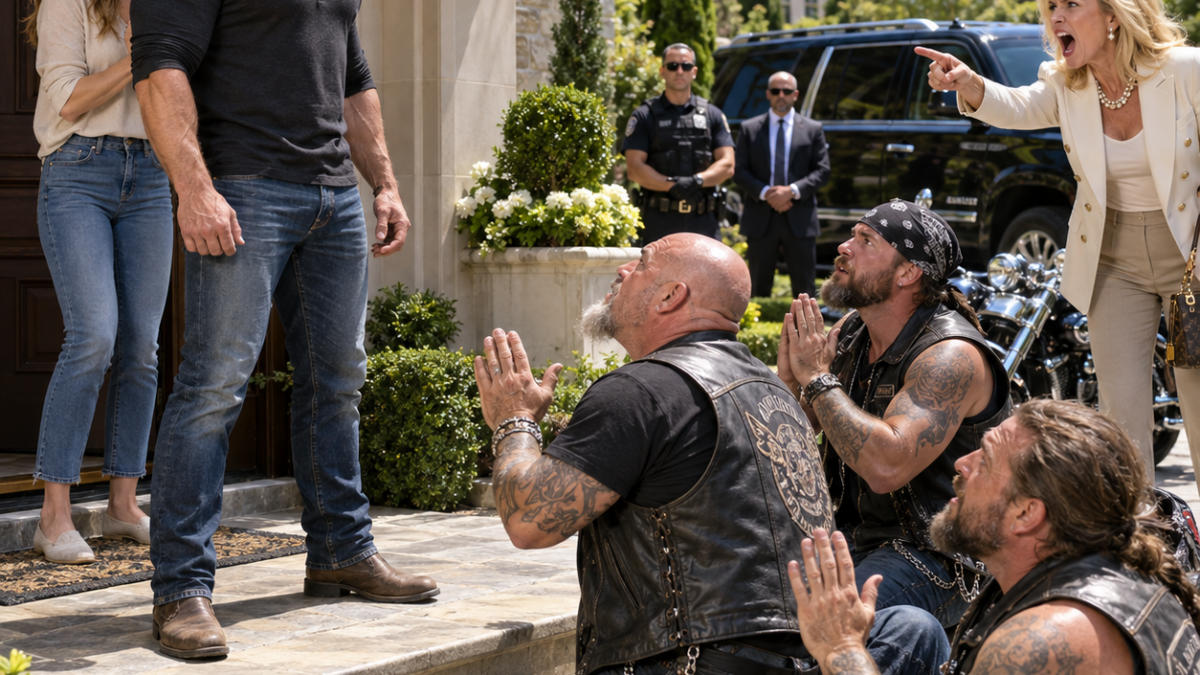
PART 2
I didn’t remember leaving the physical therapy clinic.
One second I was sitting on a padded table while a therapist complained that I was still compensating for the shoulder injury I’d picked up overseas, and the next I was crossing the parking lot with my phone pressed against my ear.
“Elena, lock the front door.”
“It’s locked.”
“Back door?”
“Locked.”
“Are they still there?”
She moved toward a window.
“Wait.”
I heard her breathing.
“They’re leaving.”
“Don’t go outside.”
“I’m not.”
“Any injuries?”
“No.”
“Did anybody touch you?”
“No.”
Her voice changed.
“But one of them got close.”
“How close?”
“Too close.”
My hand tightened around the truck key.
“Elena.”
“I’m okay.”
She wasn’t.
I knew my wife.
She was a pediatric nurse who could hold a screaming six-year-old still while a doctor reset a broken arm and somehow make the child feel safe.
She was strong.
Controlled.
Practical.
But I could hear fear underneath every word.
“They knocked the groceries out of my hands,” she said.
“Accidentally?”
A pause.
“No.”
I closed my eyes.
“Stay inside. I’m coming home.”
“Marcus.”
“Yeah?”
“Don’t do anything stupid.”
Despite everything, I almost smiled.
“You know me.”
“Exactly.”
***
It took me fourteen minutes to reach Willowbrook.
The motorcycles were gone.
Elena stood just inside the front door.
I walked in.
Then stopped.
She was holding a carton of eggs against her chest like she’d forgotten what it was.
Her other hand rested protectively over her belly.
I closed the door behind me.
“Come here.”
She stepped into my arms.
The moment I felt her body shaking, all the anger I’d held under control on the drive home changed into something sharper.
Not rage.
Purpose.
I held her until the trembling slowed.
Then I asked:
“Tell me everything.”
She sat at the kitchen table.
I poured water.
She described the motorcycles pulling in behind her.
Three men.
Randy Hartwell—Delilah’s nephew.
The other two she didn’t know.
All wearing leather vests.
No visible club insignia that meant anything to her.
Randy blocked the path between the car and our front door.
One man stood near the garage.
The third remained beside the motorcycles.
“Did they threaten you directly?”
Elena thought.
“Randy said your noncompliance was going to have consequences.”
“What kind?”
“He said serious consequences.”
“Anything about the baby?”
Her eyes lifted.
“No.”
“Anything about harming me?”
“No.”
I nodded.
Facts.
Precise.
Then:
“Did they identify themselves?”
“No.”
“Ask for money?”
“No.”
“Touch you?”
“No.”
“Touch the car?”
“Not that I saw.”
I reached for her hand.
“Good.”
She looked offended.
“Good?”
“Good for the evidence.”
Her shoulders dropped.
“Marcus.”
“I mean you’re safe.”
I squeezed her fingers.
“And we’re going to keep it that way.”
Then I opened the security system.
Four cameras covered the front yard.
Two had captured the entire encounter.
We watched in silence.
Elena carrying groceries.
Motorcycles turning into the drive.
Randy stepping in front of her.
Another biker moving to the side.
One bag falling.
Oranges rolling across the driveway.
A jar shattering.
Randy leaning toward her.
The audio wasn’t perfect.
But it caught enough.
**Your husband’s causing problems.**
Then:
**There are consequences.**
Across the street, Delilah’s white SUV sat at the curb.
Engine running.
Window down.
Watching.
Three minutes into the recording, the bikers left.
Delilah remained another thirty seconds.
Then drove away.
I paused the video.
Elena stared at the screen.
“She paid them.”
“We have another recording that suggests that.”
I pulled up the footage from behind the community center.
Delilah handing Randy an envelope.
**Whatever it takes to get them out.**
Elena’s face changed.
She looked toward me.
“Marcus.”
“I know.”
“No.”
She pointed at the screen.
“You’ve been treating this like an HOA fight.”
“Not anymore.”
***
I spent the next three minutes making calls.
Not to buddies who could magically make people disappear.
Not to anyone who could illegally pull private records.
That wasn’t how this was going to work.
Call one went to Phyllis Brennan.
Seventy-two.
Retired attorney.
Member of our growing homeowner coalition.
She answered immediately.
“Marcus?”
“Delilah escalated.”
I told her what happened.
Phyllis didn’t react emotionally.
That’s why I called her first.
“Preserve the footage in original format.”
“Already doing it.”
“Back it up somewhere off-site.”
“Done.”
“Do not edit anything.”
“I know.”
“Call law enforcement.”
“Next.”
Then she said:
“Marcus.”
“Yeah?”
“Your wife is seven months pregnant.”
“I know.”
“Then tonight is not about winning.”
I looked toward Elena.
“I know.”
My second call went to the district attorney’s victim-intimidation intake line because one of our earlier complaints had already produced a contact there.
I gave them no theories.
Only facts.
Recorded prior payment.
Recorded threat.
Pregnant resident targeted while husband absent.
Names.
Vehicle descriptions.
Times.
The person on the line told me to contact local police immediately and preserve everything.
My third call went to a licensed private investigator already working with our attorney to verify the security company’s ownership and licensing.
I gave him Randy’s name and motorcycle description.
“Public records only,” I said.
“Obviously.”
“Find out whether those other two men are associated with the security company.”
“I’ll start.”
Three minutes.
That’s all.
No threats.
No revenge.
Just three lawful calls.
Then I called the police.
***
What I didn’t know was that Randy had created his own problems long before he pulled into our driveway.
By the time officers started identifying the three men through the footage and public vehicle information, Randy was already wanted on an outstanding court matter related to unpaid support obligations.
One of his friends, Jake Pruitt, was on supervised release with restrictions that made the morning’s conduct potentially serious.
The third, Tommy Vance, had missed court-ordered counseling obligations.
None of that was my doing.
I didn’t create their histories.
I simply gave law enforcement evidence showing where Randy had been and what he had been doing.
Within hours, Randy was taken into custody on the outstanding matter while investigators began reviewing the intimidation complaint separately.
The speed shocked even me.
Then came the knock.
Elena and I looked at each other.
Three knocks.
Soft.
Nothing like Delilah’s pounding visits.
I checked the camera.
Jake and Tommy.
No motorcycles.
No swagger.
Hands visible.
I did not open the door immediately.
“What do they want?” Elena whispered.
“I’ll ask.”
I activated the speaker.
“What?”
Jake looked directly toward the camera.
“Mr. Donovan, we need to talk.”
“About?”
“This morning.”
“Police are already handling it.”
“I know.”
Tommy rubbed both hands over his face.
“Randy’s been picked up.”
“That’s between Randy and law enforcement.”
Jake stepped closer.
“His girlfriend said you called somebody.”
“I reported what happened.”
He looked over his shoulder.
“Look, man, whatever you started—”
I cut him off.
“I started nothing.”
Silence.
I continued.
“You came onto my property and surrounded my pregnant wife.”
Jake’s face changed.
“That wasn’t supposed to—”
“Wasn’t supposed to what?”
He swallowed.
“Go that far.”
Behind me, Elena said quietly:
“Ask who paid them.”
I did.
Jake looked at Tommy.
Tommy looked at Jake.
Then Jake said:
“Delilah.”
I opened the door only after confirming Elena was comfortable and the conversation would remain recorded.
They stayed outside.
I stayed inside the threshold.
Nobody needed theatrics.
Jake spoke first.
“She paid us five hundred dollars.”
“For what?”
“To deliver a message.”
“What message?”
“That you needed to stop causing trouble for the HOA.”
“Why approach Elena instead of me?”
Neither answered.
I waited.
Tommy finally whispered:
“She said you’d be gone.”
My jaw tightened.
Jake continued quickly.
“She said scaring your wife would get through to you.”
The silence that followed was heavy enough to feel physical.
Behind me, Elena inhaled sharply.
Jake looked past me.
“Ma’am, I’m sorry.”
Elena stepped where they could see her.
“Did you know I was pregnant before you came?”
Jake lowered his eyes.
“Yes.”
Tommy nodded.
Something in Elena’s expression changed.
Not fear anymore.
Disgust.
“Then don’t tell me it got out of hand.”
Neither man answered.
She continued.
“You came because you thought a pregnant woman alone would be easy to frighten.”
Jake looked ashamed.
“Yes.”
That was the first honest answer either man had given.
***
They agreed to provide statements through proper channels.
Not because I promised to erase their legal problems.
I couldn’t.
I made that clear.
“If you cooperate, your attorney can tell prosecutors you cooperated.”
Jake nodded.
“But I cannot make charges disappear.”
“We understand.”
Tommy looked toward the house.
“Can you tell them we came back?”
“The recording will.”
He swallowed.
“Okay.”
Before leaving, Jake said:
“Randy said his aunt had done stuff like this before.”
“What stuff?”
“Sending people around.”
“Who?”
“Residents.”
“Names?”
“I don’t know.”
“Then tell investigators what you actually know.”
He nodded.
No exaggeration.
No embellishment.
Evidence.
That rule mattered.
Because if Delilah was going down, she was going down under the weight of what she actually did.
Not what angry people imagined she’d done.
***
By sunset, the neighborhood knew Randy had been taken into custody.
That part spread faster than anything I could have controlled.
People started appearing outside.
Small groups near driveways.
Conversations at mailboxes.
Neighbors who’d spent months avoiding one another suddenly compared experiences.
Martha came to our house carrying soup.
She ignored me completely and went straight to Elena.
“Sit.”
Elena laughed.
“I’m already sitting.”
“Sit more.”
Apparently pregnancy makes elderly women instantly outrank husbands.
I didn’t interfere.
Trevor and Sage arrived next.
Then Diego Ramirez.
Former city councilman.
He walked into my dining room holding a folder.
“I heard what happened.”
I nodded.
“You okay?”
I looked toward Elena.
“Ask her.”
Diego did.
Elena said:
“I’m angry.”
“Good.”
She looked at him.
“Good?”
“Fear isolates people.”
He sat down.
“Anger sometimes organizes them.”
That sentence became prophetic.
***
Our coalition had begun weeks earlier over illegal fines.
Seven people at Murphy’s Diner.
Then eighteen.
Then forty-seven.
After the biker incident, attendance doubled.
Families who had previously whispered suddenly wanted their names on formal complaints.
A retired teacher named Dorothy brought eighteen months of notices.
Trevor and Sage produced footage of private security following them.
Martha opened a binder containing every violation she’d received.
Eight thousand dollars over a garden ornament and landscaping.
“You kept all this?” I asked.
“Marcus.”
She adjusted her glasses.
“I kept tax returns from 1979.”
Fair.
Phyllis organized the evidence.
“Separate facts from conclusions.”
She tapped the table.
“Dates here. Documents here. Witnesses here. Financial questions separate. No one writes ‘corrupt’ until we can prove money.”
Martha raised her hand.
“I can prove money.”
Everyone looked at her.
She smiled.
That was when the second half of Delilah’s nightmare began.
***
Martha had volunteered with HOA bookkeeping years earlier.
She still had copies of budgets and annual reports.
At first glance, nothing dramatic.
Landscaping.
Security.
Management.
Insurance.
Repairs.
But she had noticed administrative costs growing every year.
The HOA budget allocated around fifty thousand dollars annually for management.
Actual payments were closer to sixty thousand.
Sometimes more.
Recipient:
**Hartwell Property Solutions.**
I looked at Martha.
“Delilah?”
“Registered owner.”
Phyllis leaned forward.
“Conflict disclosed?”
“No.”
“Board vote?”
“Not in records I have.”
We started tracing.
Not secretly accessing accounts.
Homeowners had rights to request association financial records, and our attorney used the proper process.
What came back was ugly.
Emergency tree removal.
Four thousand five hundred dollars.
No tree removed.
Consulting.
Seven thousand.
No work product.
Security.
Paid to a company owned by Delilah’s brother-in-law.
Invoices with vague descriptions.
Landscaping jobs nobody remembered.
Country-club-related charges coded under community relations.
A conference in Hawaii that appeared suspiciously close to a personal vacation.
Phyllis refused to call it theft.
Not yet.
“Financial irregularities,” she said.
Martha rolled her eyes.
“Money missing.”
“Financial irregularities.”
“Fine.”
But the estimate grew.
Three hundred forty thousand.
Then four hundred.
Finally, the forensic accountant we hired put the questionable total near four hundred eighty thousand dollars over six years.
The room went silent.
Elena sat beside me rubbing her belly.
“That’s how much?”
“Roughly six thousand dollars per household,” Martha said.
Elena looked around.
“While she’s fining people over mailboxes?”
No one answered.
Because everybody was thinking the same thing.
***
Then Diego found the development agreement.
Willowbrook Estates had been approved in 2018 with a requirement that fifteen percent of the homes be reserved for moderate-income purchasers or that the developer pay negotiated fees in lieu of those units.
Teachers.
Firefighters.
Nurses.
People like Elena.
No affordable units had been built.
City correspondence referenced unpaid obligations.
Hundreds of thousands.
Delilah’s real-estate interests were intertwined with the development.
Suddenly her obsession with property values had another dimension.
It wasn’t simply personality.
Her livelihood depended on controlling the story Willowbrook told buyers.
Perfect lawns.
Uniform houses.
No visible conflict.
No residents challenging money.
No public scandal.
Then I arrived with native plants and the unforgivable habit of reading bylaws.
***
Delilah panicked.
Her next move was a special assessment.
Five thousand dollars from every household.
Supposed purpose:
**Urgent legal defense against coordinated litigation threatening community assets and property values.**
Translation:
Residents were being asked to fund the defense of leadership they were accusing of misconduct.
Monday’s meeting drew eighty-nine residents in person, plus proxies from others.
Delilah stood at the front.
She looked tired.
Still polished.
But the confidence had started cracking.
“We are under attack.”
She pointed toward me.
“Outside agitators are attempting to destabilize this association.”
I looked at Elena.
She whispered:
“We live here.”
“Apparently we’re very committed agitators.”
She almost laughed.
Delilah continued.
“These individuals moved here six months ago and immediately began challenging established standards.”
Then Martha stood.
No microphone.
No drama.
“Before we vote, I request a complete independent audit.”
Silence.
Delilah blinked.
“That’s unnecessary.”
Martha smiled.
“I’m seventy years old. I have time.”
Several people laughed.
She continued.
“I want every administrative payment, every related-party vendor, every emergency expense, every contract connected to a board member, and every transfer exceeding the approved budget.”
Delilah’s face drained.
People noticed.
That’s the problem with fear.
Once enough people stop feeling it simultaneously, bullies look ordinary very quickly.
The assessment failed.
Overwhelmingly.
Delilah walked out before residents finished counting.
***
Her retaliation became chaotic.
Code complaints.
Zoning complaints about my consulting business.
Playground safety reports.
Rumors I was under federal investigation.
Then she hired a private investigator.
A real one this time.
Licensed.
Professional.
She wanted dirt on me.
He found none worth using.
What he did find were public business relationships connected to Delilah.
He withdrew.
Then, through counsel, alerted the appropriate authorities about financial information suggesting broader irregularities.
The irony was almost unfair.
Delilah paid someone to investigate me.
He pointed investigators toward her.
***
The state HOA oversight complaint expanded.
The attorney general’s office requested information.
Tax authorities reviewed nonprofit filings.
City attorneys revisited the development agreement.
No one kicked down doors.
No sirens.
Just letters.
Subpoenas.
Requests.
Deadlines.
The quiet machinery of institutions finally paying attention.
Delilah hated quiet machinery.
She understood intimidation.
She did not understand patience.
So she filed for a restraining order.
Against me.
She claimed I had used military tactics to stalk and threaten her.
That I was dangerous.
That our coalition was harassing her.
The filing included audio clips.
My attorney listened.
Then listened again.
“Edited.”
We hired a forensic audio examiner.
Digital cuts.
Missing segments.
Splices.
Phyllis smiled in a way that made me uncomfortable.
“She filed these in court?”
“Yes.”
“Good.”
“Why do lawyers keep saying good when people do terrible things?”
“Because terrible evidence against the other side saves time.”
The petition was withdrawn after her counsel reviewed our response.
The judge warned both sides to preserve evidence and suggested false submissions could carry consequences.
Delilah left furious.
Her lawyer left separately.
Never a great sign.
***
Then she called Channel 7.
Her story:
Pregnant community leader terrorized by militarized homeowner.
Except Delilah wasn’t pregnant.
Elena was.
The reporter started asking questions.
Then we sent documents.
By the following afternoon, the story changed.
Channel 7 wasn’t investigating me.
They were investigating HOA finances.
The phrase **$480,000 in questioned expenditures** appeared in a teaser.
Willowbrook exploded.
People who had ignored meetings for years suddenly wanted statements.
Documents.
Answers.
Delilah stopped answering her door.
***
Bryce came to mine instead.
Retired bank executive.
Longtime Delilah supporter.
He looked twenty years older than the man I’d seen at the first emergency board meeting.
He held a manila envelope.
“Marcus.”
“Bryce.”
“I need to talk.”
We sat on the porch.
He wouldn’t come inside.
His hands shook.
“She threatened my grandchildren.”
I stared at him.
“What?”
“Not physically.”
He swallowed.
“She said she’d destroy our family’s reputation if I talked.”
“About what?”
“The finances.”
He handed me the envelope.
Bank statements.
Emails.
Internal reports.
Records showing transfers.
Instructions to categorize personal or related-party costs.
Discussions about concealing overruns.
Then a signed statement.
Three pages.
Bryce admitted approving transactions he should have questioned.
He described Delilah intimidating board members who raised concerns.
He acknowledged remaining silent.
“I should’ve stopped her.”
I looked at him.
“Yes.”
He flinched.
I didn’t soften it.
Accountability isn’t cruelty.
“I’m sorry.”
“Then testify.”
He looked up.
“Publicly?”
“Yes.”
His face went pale.
“You don’t understand.”
“I understand exactly.”
I leaned forward.
“Everybody who stayed quiet had a reason.”
His grandchildren.
Martha’s fixed income.
Trevor’s job.
Elena’s pregnancy.
My desire for peace.
“At some point, the reason stops mattering if silence keeps hurting other people.”
Bryce nodded slowly.
“I’ll testify.”
That was the moment Delilah lost the last piece of protection she still had.
***
The community presentation moved to Sacred Heart Church because Delilah tried to interfere with our original venue reservation.
The church had space for three hundred.
We filled it.
Three hundred twelve people.
City council representatives.
Media.
Attorneys.
Residents.
Former residents.
Law enforcement observers.
Elena sat beside me on the stage.
Eight months pregnant now.
I tried convincing her to stay home.
She looked at me.
“Did staying home work the last time?”
Argument over.
Hospital bag under her chair.
Just in case.
Martha sat in the first row.
Trevor and Sage handled the presentation.
Phyllis kept the evidence files.
Diego managed media.
A detective from the financial-crimes unit stood near the back.
Delilah entered alone.
That mattered.
Six years in power.
And when consequences arrived, the people who’d smiled beside her suddenly had other appointments.
***
I stepped to the microphone.
No dramatic military speech.
No threats.
Just:
“Tonight we’re going to talk about where the money went.”
First slide.
Budgeted administration versus actual expenditures.
Second.
Payments to Hartwell Property Solutions.
Third.
Contracts tied to relatives.
Fourth.
Vendor invoices with no corresponding work.
Fifth.
Luxury expenses.
Then the total.
**$480,000 in questioned HOA expenditures.**
The room inhaled as one.
I continued.
“This isn’t my conclusion.”
I pointed toward the accountant.
“An independent forensic review produced these findings.”
Then Phyllis spoke.
She explained what was allegation, what was documented, and what remained subject to investigation.
That distinction mattered.
We weren’t conducting a public trial.
We were showing homeowners their own records.
Then Trevor played the audio.
Delilah’s voice behind the community center.
**Whatever it takes to get them out.**
Then:
**That family needs to understand they’re not welcome here.**
People turned toward her.
Delilah rose.
“This is edited!”
Phyllis shook her head.
“Original file and expert authentication have been provided to investigators.”
Someone shouted:
“You sent those men after a pregnant woman?”
Delilah pointed toward me.
“He manipulated everything!”
Then she made the mistake that ended whatever sympathy remained.
“You people don’t understand complex financial management!”
The hall went quiet.
Martha stood.
“Delilah, dear.”
Her voice was gentle.
Which somehow made it worse.
“I’ve balanced community and church books since before you were old enough to drive.”
She adjusted her glasses.
“This isn’t complicated.”
Pause.
“This is money that doesn’t belong where it went.”
Applause broke out.
Delilah shouted over it.
“You don’t know anything!”
Martha smiled.
“Then explain the Hawaii conference.”
The room erupted.
***
Witnesses came next.
Residents described selective fines.
Security harassment.
Surveillance.
Bogus meetings.
Bryce testified.
His hands shook.
But he spoke.
He explained how Delilah pressured the board.
How questions were discouraged.
How expenses were disguised.
Then the screen showed Jake and Tommy’s recorded statements.
They admitted receiving five hundred dollars to frighten Elena.
They admitted being told to approach when I wasn’t home.
Elena sat beside me.
I felt her fingers close around mine.
The room became silent.
She whispered:
“I hate hearing it again.”
“We can leave.”
“No.”
Her voice was steady.
“I’m staying.”
Then Delilah stood.
“You wanted this!”
She pointed toward Elena.
“You and your husband came here looking for a fight!”
Elena rose slowly.
Eight months pregnant.
No microphone at first.
Then I handed her mine.
She looked at Delilah.
“I wanted a nursery.”
That shut everyone up.
Elena continued.
“I wanted a safe street where our daughter could learn to ride a bicycle.”
Her hand moved to her belly.
“I wanted neighbors.”
She swallowed.
“I didn’t know HOA bylaws. I didn’t care about elections. I didn’t know who controlled the landscaping budget.”
Her voice shook.
“I asked Marcus more than once to replace the native plants with grass because I wanted this to stop.”
I looked down.
She had.
“And then you paid men to come to my driveway when you knew my husband wasn’t home.”
Delilah looked away.
Elena continued.
“You didn’t target Marcus that morning.”
Her voice cracked.
“You targeted me because you thought pregnancy made me easier to frighten.”
No one moved.
Then:
“You were right.”
Delilah looked toward her.
“I was terrified.”
Elena wiped one tear.
“But I went inside.”
She looked around the room.
“I locked the door.”
“And then I told the truth.”
A few people began clapping.
Elena held up one hand.
“Please.”
Silence returned.
“I don’t want revenge.”
She looked directly at Delilah.
“I want my daughter born into a neighborhood where nobody sends strangers to scare a woman because her husband asked to see financial records.”
Then Elena sat.
I couldn’t speak for several seconds.
Neither could most of the room.
***
Detective Martinez stood.
He wasn’t there to perform.
His statement was short.
“Ms. Hartwell, based on evidence gathered independently during an ongoing investigation, we need to speak with you regarding suspected fraud, misuse of association funds, and conspiracy related to harassment.”
Delilah’s face collapsed.
“What does that mean?”
“It means please remain where you are.”
Two investigators approached.
No dramatic tackle.
No shouting at first.
Then Delilah realized she was being taken into custody.
“This is a witch hunt!”
Nobody applauded immediately.
People watched.
Some cried.
Some looked stunned.
Then Martha exhaled.
A sound like she’d been holding her breath for six years.
That was when applause started.
Not celebration of suffering.
Relief.
There is a difference.
***
The emergency homeowner vote happened afterward.
The existing board was removed.
Interim leadership appointed.
Independent audit mandated.
New elections scheduled.
Financial controls adopted.
No related-party contracts without disclosure and competitive review.
No emergency fine increases without membership approval where governing documents required it.
No private-security intimidation.
Formal appeals process.
Meeting notice requirements enforced exactly as written.
Simple stuff.
Rules applied to the people enforcing rules.
Revolutionary, apparently.
***
Elena went into labor twelve days later.
Two weeks early.
At 2:13 in the morning she shook me awake.
“Marcus.”
I opened my eyes.
She stood beside the bed.
“Either I just peed myself in a very humiliating way or we’re having a baby.”
I was out of bed before she finished.
She laughed.
“You moved faster than when the bikers came.”
“This seems more urgent.”
“Good answer.”
At the hospital, all the HOA documents disappeared from my head.
Delilah.
Fines.
Audits.
Investigations.
None of it mattered.
For eleven hours, the entire world became Elena’s hand crushing mine.
Her breathing.
The monitor.
The nurse.
The doctor.
Then a cry.
Our daughter.
Hope.
Six pounds, eleven ounces.
Healthy.
Furious.
Perfect.
The nurse placed her on Elena’s chest.
My wife looked at me.
Exhausted.
Hair stuck to her forehead.
Tears everywhere.
“Marcus.”
I couldn’t answer.
She smiled.
“You’re crying.”
“No.”
“You’re absolutely crying.”
I touched Hope’s tiny hand.
Her fingers closed around mine.
And suddenly the last months made sense differently.
I thought I’d been fighting Delilah.
I hadn’t.
I’d been fighting for this.
For a child who didn’t know what an HOA was.
Who didn’t care about landscaping.
Who only needed the adults around her to build something decent before she was old enough to notice whether they had.
***
The criminal investigation moved forward while we learned how little newborns respect sleep.
Auditors confirmed substantial improper expenditures.
Not every suspicious transaction became a criminal charge.
Some were poor governance.
Some violated internal procedures.
Some involved undisclosed conflicts.
Others supported prosecutors’ allegations of fraud and embezzlement.
The final established losses and restitution claims approached hundreds of thousands of dollars.
The city pursued unpaid development obligations separately.
Tax authorities reviewed income and reporting issues.
Delilah eventually entered a plea resolving multiple charges involving financial misconduct and the intimidation scheme.
Her final sentence was eight years.
Randy received a shorter custodial sentence and supervision based on his own conduct and prior issues.
Jake and Tommy received consideration for cooperation but still faced consequences.
I never asked prosecutors to “go easy.”
Didn’t ask them to “go hard.”
That wasn’t my job.
Their job was justice.
Mine was protecting my family and telling the truth.
***
The civil recovery took longer.
Insurance disputes.
Asset tracing.
Restitution.
Sale of property.
Negotiated repayment.
Residents eventually recovered a meaningful portion of the funds taken or misused.
Martha insisted on calculating every allocation twice.
Then a third time.
“Why three?”
“Because once you’ve been robbed by an HOA president, two calculations don’t feel sufficient.”
Fair.
Delilah’s large house was eventually sold.
The community had an opportunity to acquire the property through a structured transaction after legal issues were resolved.
At first, I hated the idea.
“Why would we want her house?”
Elena looked at me.
“Because buildings don’t commit crimes.”
Sometimes my wife is annoyingly wise.
The community purchased it with a mix of recovered funds, grants, and approved financing.
The property became the Willowbrook Community Center.
Meeting rooms.
Legal-aid clinics.
After-school tutoring.
A community kitchen.
And behind the house, where Delilah had once held private gatherings with her inner circle, residents planted native flowers.
The same drought-resistant species she had tried to force me to remove.
That part made me smile.
***
Martha called it the Hope Garden.
I objected.
“That’s our daughter’s name.”
“Correct.”
“She isn’t even one.”
“Exactly.”
“Why exactly?”
“Because she’ll never remember the old Willowbrook.”
That silenced me.
Martha continued.
“She’ll think neighborhoods are supposed to work like this.”
I looked around.
Volunteers spreading mulch.
Trevor installing solar lights.
Sage labeling native plants.
Elena sitting beneath a tree with Hope asleep against her chest.
Maybe Martha was right.
Sometimes the best measure of reform is that children born afterward can’t understand why the old behavior was ever considered normal.
***
Willowbrook’s property values didn’t collapse.
Delilah had spent years convincing residents that strict control protected value.
Instead, after the scandal ended and transparent governance replaced her system, the neighborhood became more desirable.
Families liked knowing finances were independently reviewed.
They liked written appeal procedures.
They liked open meetings.
They liked not being fined because one president disliked their paint.
Property values eventually rose.
Not because everybody had identical lawns.
Because people trusted the place.
Trust turned out to be more valuable than uniform mulch.
***
The native landscaping survived too.
Better than survived.
Neighbors copied it.
Trevor replaced half his lawn.
Martha planted native flowers around the infamous garden gnome.
Even Bryce converted one section of his front yard after apologizing to the community and stepping away from leadership.
One afternoon, Elena stood beside our original garden holding Hope.
“Remember when I asked you to rip this out?”
“Frequently.”
“You enjoyed saying that.”
“Very much.”
She smiled.
“I was scared.”
“I know.”
“I thought surrendering one thing would buy peace.”
I looked toward the plants.
“It usually buys the next demand.”
She leaned against me.
“Still.”
“What?”
“I understand why people give in.”
That mattered.
Because before Willowbrook, I probably would’ve judged them.
After years working military logistics, I believed preparation solved almost anything.
Then I watched ordinary families make decisions under fear.
A seventy-year-old widow paying a fine because she didn’t know whether she could afford court.
A couple removing solar equipment because legal letters terrified them.
A pregnant nurse begging her husband to plant grass so conflict would stop.
Fear changes math.
It makes unfair settlements look rational.
That’s why systems matter.
People shouldn’t need my background to defend their homes.
***
We created the Willowbrook Community Defense Fund.
I hated that name too.
Apparently I had no naming authority in my own neighborhood.
The fund paid for initial legal consultations when homeowners received questionable notices.
It also funded financial audits and education.
Residents learned how to read their governing documents.
How to request records.
How elections worked.
How to distinguish a legitimate rule from an improvised threat.
No anti-HOA crusade.
No assumption every board was corrupt.
Just literacy.
Phyllis taught the first class.
Her opening line:
“If you can survive assembling furniture from Swedish instructions, you can survive HOA bylaws.”
Thirty people signed up immediately.
***
Channel 7 returned for a follow-up story.
The reporter wanted the biker angle.
Of course.
“Marcus, what did you do in those three minutes after your wife called?”
I looked at Elena.
She smiled.
“Tell her.”
I faced the camera.
“I made three phone calls.”
“To who?”
“People whose jobs involved law, evidence, and investigation.”
The reporter leaned closer.
“Did you use military contacts to get the bikers arrested?”
“No.”
“Then how did Randy end up in custody so quickly?”
“He already had an outstanding legal problem.”
I shrugged.
“I didn’t create it.”
“So the title everybody keeps repeating—three minutes later they were begging at your door—isn’t exactly literal.”
I smiled.
“Three minutes changed the direction of the situation.”
“What did you say to the bikers when they came back?”
“That cooperation was their decision.”
“Did you threaten them?”
“No.”
“Were you tempted?”
I looked toward Elena.
“Yes.”
She raised an eyebrow.
The reporter laughed.
“What stopped you?”
“My wife had already been frightened enough for one day.”
That was the truth.
If I’d turned our front porch into another confrontation, what would I have accomplished?
Proved I was tougher?
They already knew I wasn’t afraid.
Elena needed safety.
Not a performance.
***
A state senator later introduced HOA financial-transparency reforms partly inspired by complaints from Willowbrook and several other communities.
I didn’t pretend our neighborhood single-handedly changed state law.
Legislation doesn’t happen that way.
But residents testified.
Martha testified.
Phyllis provided analysis.
Other communities told similar stories.
The resulting reforms strengthened auditing and disclosure requirements.
That mattered.
Because corruption rarely survives mandatory sunlight comfortably.
***
My consulting business changed too.
People started calling me for community-association problems.
I told them the same thing:
“I’m not an attorney.”
Then connected them with people who were.
Eventually I built a consulting practice focused on records organization, governance workflows, and community risk.
Elena called me the HOA whisperer.
I hated that almost as much as the Defense Fund name.
Hope found it funny when she was old enough to repeat it.
***
Randy’s story took an unexpected turn.
After serving his sentence and completing supervision requirements, he contacted our attorney.
He wanted to apologize.
I wasn’t interested.
Elena was.
“Why?”
“Because I was the person he threatened.”
Fair.
We met in a public office with counsel present.
Randy looked different.
No leather vest.
No skull bandana.
Short hair.
Work clothes.
He sat across from Elena and couldn’t look at her.
“I’m sorry.”
She waited.
He continued.
“My aunt paid me.”
“We know.”
“I thought it was just scare tactics.”
“You surrounded a pregnant woman.”
His eyes closed.
“I know.”
“Why me?”
“Because she said Marcus would fight us.”
“And I wouldn’t?”
He looked ashamed.
“Yeah.”
Elena sat back.
“That’s the part I needed to hear.”
Randy looked confused.
She continued.
“You didn’t accidentally scare me.”
“No.”
“You picked me because you believed I was weaker.”
He nodded.
“Yes.”
She took a breath.
“Then understand something.”
Her voice remained calm.
“You didn’t make me stronger.”
Randy looked up.
“I was already strong.”
Silence.
“You just gave me a reason to stop being quiet.”
I watched his face.
That landed harder than anger could have.
He nodded.
“I understand.”
I wasn’t sure he did.
But maybe someday.
***
Randy later became involved in a court-approved motorcycle safety and youth mentorship program as part of rebuilding his life.
I didn’t sponsor it.
Didn’t praise it publicly.
People deserve room to become better without the people they hurt being required to participate.
That distinction matters.
Redemption is something a person proves forward.
It does not rewrite backward.
***
Bryce spent years trying to repair his own reputation.
Some neighbors never forgave him.
Others did.
He accepted that.
At one board meeting, a resident asked why he still attended if nobody trusted him.
Bryce answered:
“Because leaving would make my shame easier for me and harder for everyone else.”
I respected that.
He never held office again.
But he volunteered.
Set up chairs.
Cleaned after events.
Worked the scholarship fundraiser.
Quiet work.
Sometimes that’s what accountability looks like after public failure.
***
Martha became treasurer of the new association.
Everyone joked that it was the safest money in America.
She created monthly reports simple enough for anyone to understand.
Revenue.
Expenses.
Reserves.
Contracts.
Every related-party relationship disclosed.
Every major vendor bid documented.
She posted everything online.
When someone complained the reports were too long, she said:
“Wonderful. Then you’ll have something to read before complaining.”
No one challenged her after that.
***
Diego helped rewrite our governance procedures.
Phyllis insisted on due process.
Notice.
Hearing.
Appeal.
Mediation.
Caps on penalties unless homeowners approved changes.
No weaponized emergency meetings.
No unexplained surveillance.
No intimidation.
The first time someone violated a fence rule under the new system, the homeowner received a normal letter.
They attended a hearing.
Explained a contractor mistake.
Got thirty days to fix it.
Problem solved.
No motorcycles.
No threats.
No five-thousand-dollar assessment.
Boring.
Beautifully boring.
***
Hope’s first birthday took place at the community center.
The same property that once symbolized Delilah’s power.
Kids ran through the native garden.
Martha baked a cake too large for the refrigerator.
Trevor brought speakers.
Sage organized games.
Phyllis arrived with a legal pad because she apparently didn’t understand birthdays.
Elena held Hope while everyone sang.
I stood behind them.
At one point my daughter reached toward the flowers.
Tiny fingers closing around a coneflower petal.
Elena smiled.
“Don’t eat that.”
Hope immediately tried.
My daughter inherited my respect for authority.
The community laughed.
I looked around.
This was the victory.
Not prison.
Not headlines.
Not seeing Delilah handcuffed.
A child surrounded by neighbors who knew her name.
A mother who could unload groceries without looking over her shoulder.
A community that no longer confused control with safety.
***
After guests left, Elena and I walked home pushing Hope in the stroller.
The night was warm.
Native grasses moved beside our driveway.
No motorcycles.
No security SUV.
No one photographing our house.
Elena stopped near the exact spot where the groceries had fallen.
I knew because she looked down.
“You thinking about it?”
She nodded.
“Sometimes.”
“Me too.”
She was quiet.
Then:
“I hated myself afterward.”
I stopped.
“What?”
“For being scared.”
I stared at her.
“Elena.”
“I know.”
She looked at me.
“I know now.”
Her voice softened.
“But that first night, I kept replaying it. Thinking I should’ve said something. Should’ve yelled. Should’ve stood there.”
“You were seven months pregnant.”
“I walked away.”
“Exactly.”
She frowned.
I continued.
“You got inside.”
“You think that was brave?”
“I think getting yourself and our daughter away from three men trying to provoke you was the smartest thing anybody did that day.”
Her eyes filled.
I touched her face.
“They wanted a confrontation.”
She nodded.
“You denied them one.”
Hope made a tiny sound in the stroller.
Elena looked down.
Then smiled.
“She kicked through the whole thing.”
“Strong opinions early.”
“Your daughter.”
“Ours.”
We kept walking.
***
People online eventually reduced the story to one sentence:
**HOA Karen sent bikers after a military contractor’s pregnant wife, and three minutes later they were begging him to stop.**
I understand why.
It’s clean.
Satisfying.
But real life was messier.
The bikers didn’t magically teleport back because I made a scary call.
Law enforcement discovered existing legal issues.
Two men realized they’d been dragged into something more serious than they’d expected.
They came back because consequences suddenly felt real.
And I didn’t “make it stop.”
Courts did.
Investigators did.
Auditors did.
Residents did.
Delilah’s own records did.
Three minutes mattered.
But only because we had spent weeks preparing before those three minutes arrived.
That’s something my old logistics instructors used to say.
People notice the emergency response.
They don’t notice the supply chain that made it possible.
***
Delilah wrote Elena from prison once.
Not me.
Elena opened the letter at the kitchen table.
Read it.
Then folded it.
I asked:
“What’d she say?”
“She’s sorry.”
“Do you believe her?”
Elena thought.
“Parts.”
“What parts?”
“That she regrets losing everything.”
I smiled sadly.
“Not the same as regretting what she did.”
“No.”
She placed the letter down.
“She says she was terrified of losing control.”
That made sense.
Elena continued.
“She said every time residents challenged her, she felt like the whole neighborhood was turning against her.”
I looked toward our garden.
“And so she made it happen.”
“Pretty much.”
“Are you answering?”
“No.”
I nodded.
“Okay.”
Then Elena looked at Hope asleep in the baby monitor.
“I don’t need her apology.”
“What do you need?”
She smiled.
“This.”
Home.
Safety.
Our daughter.
Enough.
***
Years later, when Hope was old enough to ask why the community garden carried her name, Elena told her a version suitable for a child.
“A long time ago, some neighbors forgot how to be kind.”
Hope frowned.
“All of them?”
“No.”
“Then what happened?”
“Other neighbors reminded them.”
Hope looked toward me.
“Daddy?”
I laughed.
“Lots of people.”
“Did you fight?”
Elena looked at me.
I answered carefully.
“With paperwork.”
Hope stared.
“That’s boring.”
“Extremely.”
She ran toward the flowers.
I looked at Elena.
“She’s not impressed.”
“Good.”
“Good?”
“I don’t want her growing up thinking justice is supposed to look exciting.”
That stayed with me.
***
The older I get, the more I think Elena was right.
Real justice is often boring.
Meetings.
Audit trails.
Testimony.
Proper notice.
Evidence preservation.
People returning money.
Policies rewritten.
Victims sleeping better.
Children growing up without knowing why their parents once checked the driveway before stepping outside.
That doesn’t make a great action movie.
It makes a decent life.
I’ll take the decent life.
***
Every Thursday morning now, I walk through Willowbrook before work.
Martha’s garden gnome still stands.
She named him Due Process.
Trevor’s solar panels cover half his roof.
Sage added a battery system.
Dorothy repainted her door the exact shade of blue Delilah once fined.
She calls it “Vindication Blue.”
Bryce waves from his driveway.
The community center opens at eight.
Financial reports are posted on the first Monday of every month.
And our native landscaping?
It became one of Willowbrook’s most copied designs.
The county even used it in a conservation brochure.
Elena framed that page.
She hung it where Delilah’s first violation notice used to sit.
Petty?
Maybe.
I love my wife.
***
Sometimes motorcycles still come through Willowbrook.
Real riders.
Weekend riders.
Veterans.
People heading toward the highway.
For months, Elena tensed every time she heard loud pipes.
I noticed.
She noticed me noticing.
Then one Saturday, a veterans motorcycle group volunteered at the community center.
Twenty bikes rolled in.
Hope ran toward the sound.
Elena froze.
I reached for her hand.
She breathed.
Then one rider climbed off.
Sixty-something.
Gray beard.
Army patch.
He knelt and handed Hope a tiny pair of foam ear protectors because the engines were loud.
She grinned.
Elena laughed.
Something shifted.
Not erased.
Healed a little.
That’s how fear leaves.
Not all at once.
Through new memories.
***
I never forgot the morning Elena called me.
Her whisper.
The tremor.
The sentence:
“They knew exactly when you wouldn’t be home.”
That was the moment Delilah crossed from petty authoritarian into something more dangerous.
She believed fear was a management tool.
That was the flaw underneath everything.
Fines.
Security patrols.
Rumors.
Bikers.
Financial secrecy.
She thought leadership meant making resistance expensive enough that people surrendered.
Then one family resisted.
Then twenty-three.
Then forty-seven.
Then nearly the whole neighborhood.
Bullies often look powerful because everyone meets them alone.
They become much smaller when everyone walks into the same room carrying receipts.
***
The three bikers were never the story.
Not really.
They were a symptom.
The story was a woman who thought she could spend other people’s money without questions.
A board that forgot its duty to supervise her.
Neighbors who stayed quiet because each believed they were the only one being targeted.
A pregnant nurse who walked away from intimidation instead of giving men the confrontation they wanted.
A seventy-year-old widow who asked one financial question at exactly the right meeting.
A retired attorney who turned anger into procedure.
An old banker who finally chose truth over embarrassment.
A neighborhood that learned transparency isn’t paperwork for paperwork’s sake.
It’s protection.
***
One summer evening, I found Elena sitting in the Hope Garden after a community festival.
Our daughter was asleep against her.
Music from the pavilion had stopped.
Volunteers were folding tables.
The flowers moved in the warm breeze.
I sat beside her.
“Tired?”
“Very.”
“Want me to take Hope?”
“No.”
I smiled.
“You never let me hold my own child.”
“You hold her constantly.”
“Not according to my statistics.”
“Your statistics are fraudulent.”
“Should I request an audit?”
She laughed.
Then became quiet.
“Marcus.”
“Yeah?”
“Do you remember what I said before all this started?”
“About grass?”
She nodded.
“I asked you to give in.”
“I remember.”
“You were right.”
I looked at her.
“About what?”
“Backing down wouldn’t have stopped her.”
I shook my head.
“Maybe.”
“No.”
She touched Hope’s hair.
“But I wasn’t wrong either.”
I waited.
“I needed peace.”
That was true.
She continued.
“You kept thinking the choice was fight or surrender.”
I looked toward her.
“What was it?”
“Fight carefully enough that the people you love don’t become casualties of your fight.”
That one landed.
Hard.
I nodded.
“You’re right.”
She smiled.
“I know.”
“Very humble.”
“Married you, didn’t I?”
I laughed.
***
That sentence became the real lesson for me.
For years, my work had taught me to solve logistical problems aggressively.
Identify failure.
Build redundancy.
Control variables.
Push until the mission succeeds.
But families aren’t missions.
Communities aren’t battlefields.
People you love shouldn’t have to absorb endless stress because you’re determined to prove a point.
Elena needed me to fight.
But she also needed me to remember why.
That’s why I didn’t confront Randy in anger.
Why I didn’t threaten Jake or Tommy.
Why I didn’t turn Delilah’s downfall into entertainment.
Why we built rules after removing her.
The goal was never domination.
The goal was safety.
***
The old footage still exists.
Archived with the case documents.
I rarely watch it.
Elena never does.
Three motorcycles.
Groceries falling.
Randy stepping forward.
Delilah watching from across the street.
Then Elena walking inside.
The internet loves the next part.
The phone calls.
The arrests.
The begging.
The reversal.
But if I had to choose the most important three seconds in that video, it would be Elena closing the front door.
She refused to give them what they’d come for.
A scene.
Fear they could enjoy.
A mistake they could use.
She protected herself and our daughter.
Everything else came afterward.
***
This morning Hope helped me water the native plants.
She’s old enough now to ask approximately eight thousand questions before breakfast.
“Daddy, why don’t we have grass everywhere?”
“These plants use less water.”
“Why?”
“They belong here.”
She thought.
“Like us?”
I stopped.
Kids do that.
Ask simple questions that carry more weight than they understand.
“Yeah.”
I smiled.
“Like us.”
She poured half the watering can onto her shoes.
Then laughed.
Behind us, Martha shouted from her yard:
“Marcus, HOA meeting tonight!”
I shouted back:
“I’m busy!”
“You live here!”
“Unfortunately!”
Hope giggled.
The neighborhood felt alive.
Not perfect.
Never perfect.
But ours.
***
Delilah Hartwell believed sending bikers to intimidate my pregnant wife would end our resistance.
Instead, it became the moment people stopped pretending her behavior was normal.
She believed fear would isolate us.
Instead, it connected us.
She believed money could buy silence.
Instead, every payment became another transaction investigators could examine.
She believed leadership meant nobody questioned her.
In the end, the questions were what brought her down.
And the three men she hired to frighten Elena?
Two came back asking how to cooperate before the day was over.
Not because I threatened them.
Not because I was more dangerous.
Because for the first time, they realized Delilah’s money couldn’t protect them from the consequences of their own choices.
That’s the part I still find satisfying.
Not fear.
Clarity.
***
I spent twelve years learning how quickly a bad plan falls apart once logistics fail.
Delilah’s entire system depended on four things:
Residents staying isolated.
Board members staying silent.
Financial records staying unread.
And frightened people believing resistance was more dangerous than surrender.
We removed those four supports.
The rest collapsed on its own.
No secret weapon.
No heroic violence.
No miracle.
Just people.
Documents.
Courage.
And a pregnant woman who walked through her own front door, locked it behind three men sent to frighten her, and decided she was done being quiet.
That woman is still my favorite person in Willowbrook.
Hope is a very close second.
Don’t tell her.
***
At sunset, I sometimes stand in our driveway where Elena’s groceries once scattered across the concrete.
There is no stain.
No mark.
Nothing proving it happened.
But the native garden beside the drive is taller now.
Coneflowers.
Sage.
Little bluestem.
Milkweed.
Plants Delilah called noncompliant.
Plants dozens of neighbors now grow.
Hope chases butterflies through them.
Elena watches from the porch.
The community center lights come on down the street.
Martha’s ridiculous garden gnome watches over her flowers.
And I think about the strange path from fear to something better.
Delilah wanted us gone.
Instead, our daughter will grow up here.
She wanted identical lawns.
Instead, the whole neighborhood learned to appreciate something different.
She wanted people scared of authority.
Instead, Willowbrook learned authority should be questioned when it stops serving the people who granted it.
She sent bikers.
We built neighbors.
There isn’t much more satisfying than that.
***
People still ask what revenge felt best.
Randy getting arrested?
Delilah losing office?
The audit?
The conviction?
Her house becoming the community center?
None.
The best moment came years later.
Hope was running through the garden with a little girl whose grandmother Delilah had once fined.
Elena stood beside me.
The girls were laughing so hard neither could breathe.
No one was scared.
No one was checking cameras.
No one was waiting for another notice.
Elena slipped her hand into mine.
“You hear that?”
“What?”
“The silence.”
I listened.
Children laughing.
Birds.
A lawn mower somewhere.
Wind through grass.
“That’s not silence.”
She smiled.
“Exactly.”
I understood.
Fear has a sound.
Engines idling outside.
Boots on gravel.
A knock you don’t want.
A phone ringing when you’re afraid to answer.
Peace has sound too.
Children.
Neighbors.
Music.
Ordinary life.
That was what we had been fighting for all along.
And when I finally understood that, the whole story stopped being about what Delilah lost.
It became about what Willowbrook got back.
**THE END.**








