PART 2: HOA Karen Called 911 When I Shut Off My Own Ranch Water—Then the Sheriff Asked for One Document She Couldn’t Produce
PART 2
The county sent a man named Ethan Cole two days later.
He was in his forties, sunburned across the back of his neck, with the permanently tired expression of somebody who had spent too many years explaining regulations to people who didn’t want to hear them.
He parked beside my barn just after eight in the morning.
“You Caleb Morgan?”
“That depends. You here to fine me?”
He looked at the cattle.
“Not yet.”
I liked him immediately.
I showed him the pipeline.
We started at the ranch’s main control point, then followed the line through the pasture. Ethan checked the valve assembly, photographed the meter numbers, and compared each component with the inspection sheet on his clipboard.
When we reached the unauthorized branch, he stopped.
He looked at the meter.
Then his paperwork.
Then the meter again.
“You install this?”
“No.”
“Previous owner?”
“I am the previous owner. And the current one.”
He smiled faintly.
“Family property?”
“Three generations.”
“Anybody in your family authorize the subdivision to tap the line?”
“Not that I can find.”
He crouched and wiped dirt from a small metal identification tag attached to the junction.
The expression on his face changed.
“What?”
He read the number again.
“Interesting.”
“That usually means expensive.”
“Sometimes.”
He took three photographs.
Then he stood and looked across the fence.
The roofs of Calder Creek Estates rose beyond a line of landscaped trees.
“That tag is tied to an old county project format.”
“What kind of project?”
“Could be temporary construction infrastructure. Could be something else.”
“Can you tell whether this connection is legal?”
“Not standing in a pasture.”
“So what can you tell me?”
“I can tell you this meter isn’t on the current inspection sheet.”
He pointed toward the branch.
“And neither is that.”
That was the first sentence anyone had spoken that made the hair rise on my arms.
“Meaning?”
“Meaning somebody made changes to this system without those changes appearing where I would expect them to appear.”
“Is that illegal?”
He held up one hand.
“I didn’t say that.”
“Could it be?”
“Anything could be until I see the file.”
I nodded toward the neighborhood.
“They’ve been feeding their lake from my ranch.”
“Looks that way.”
“They say they have a right.”
“Rights usually leave paperwork.”
I looked at him.
“That’s what I thought.”
Ethan spent another hour documenting the junction.
Before leaving, he said, “Don’t tear anything out.”
“I wasn’t planning to.”
“Don’t threaten anyone.”
“Wasn’t planning that either.”
He looked at me over his sunglasses.
“You’re saying the words correctly, but your face concerns me.”
I laughed.
“I want my water back.”
“Then let me figure out what this is first.”
I agreed.
I had every intention of keeping things calm.
Victoria made that difficult.
By lunchtime she knew Ethan had been there.
I still don’t know who called her.
Maybe one of the homeowners saw the county truck.
Maybe she had somebody watching the fence.
Whatever the reason, her white SUV came down my ranch road at 1:16 that afternoon.
She stopped outside the gate.
I walked over.
She never got out.
She lowered the window.
“You called the county.”
Not hello.
Not good afternoon.
Just accusation.
“I did.”
“Without notifying the HOA.”
I stared at her.
“Why would I need to notify the HOA before calling the county about my own water line?”
“This system serves our community.”
“That’s exactly what I’m trying to understand.”
“We already explained this.”
“No. You told me you’ve been using it for years.”
“Maintaining it.”
“That isn’t the same thing.”
Her jaw tightened.
“Caleb, there are proper channels.”
“County inspection sounds pretty proper.”
“You’re deliberately escalating a minor administrative issue.”
“My pond is losing water.”
“You have plenty of water.”
I stepped closer to the gate.
“You don’t get to decide how much of my water is enough for me.”
“That isn’t what I meant.”
“It’s exactly what you meant.”
Her fingers tightened around the steering wheel.
“For your own sake, I suggest you stop interfering until our counsel reviews the matter.”
“Your counsel can review whatever he wants.”
“Then leave the connection alone.”
“Why?”
“Because hundreds of residents depend on stable community infrastructure.”
I looked past her toward the neighborhood.
“Does their drinking water come from this line?”
She hesitated.
Barely.
But I saw it.
“No.”
“Fire protection?”
“Our systems are interconnected.”
“That wasn’t my question.”
“The lake supports storm-water management and community assets.”
“So nobody’s faucet goes dry if that branch closes?”
She gave me a cold look.
“You’re simplifying a complex system.”
“No, Victoria. I’m asking a simple question.”
She lifted her phone from the passenger seat.
“You’ll regret turning this into a county matter.”
Then she drove away.
I stood at the gate watching dust settle behind her SUV.
That sentence stayed with me.
Not because it sounded threatening.
Because it sounded frightened.
The county called the next morning.
Ethan had found the original work-order number connected to the metal tag.
He still didn’t have the whole file.
“It’s old,” he told me. “Some of the material was archived on paper.”
“What do you know?”
“The project appears to have been tied to construction of the subdivision’s storm-water facilities.”
“Temporary?”
“That’s what the initial description says.”
“And the permanent connection?”
“I haven’t found an approval yet.”
I walked to my office window.
My cattle were clustered near the south pasture.
“What do I do while you investigate?”
“I can’t give you legal advice.”
“Can I isolate a branch on my private system if it’s reducing my ranch supply?”
A long pause.
“Your system has separate controls?”
“Yes.”
“You can keep your ranch line operating without affecting residential drinking water?”
“Yes.”
“Any fire-suppression system dependent on it?”
“Victoria wouldn’t answer clearly.”
“I’ll check.”
He called back forty minutes later.
“The branch appears to feed the lake system, not residential potable water.”
“Then I’m closing it.”
“Caleb.”
“I’m not destroying it. I’m isolating the disputed branch until ownership is clarified.”
“I’m documenting that you said that.”
“Please do.”
I called my attorney before touching anything.
I explained the situation.
He told me essentially the same thing.
Do not damage the system.
Do not enter HOA property.
Do not interfere with any confirmed emergency service.
Photograph everything.
I did.
I took pictures of the valve open.
Pictures of the meter.
Pictures of the county tag.
Pictures of the pasture.
Then I put a wrench on the valve wheel.
For one second, I hesitated.
Not because I thought I was wrong.
Because I knew Victoria would explode.
Then I turned.
Slowly.
The wheel groaned.
Water hissed inside the pipe.
I kept turning until the disputed branch was closed.
The pipe became quiet.
My ranch line stayed active.
I checked the cattle troughs.
Water flowed normally.
I sent Ethan a photograph showing the valve position.
Then I went back to repairing a gate.
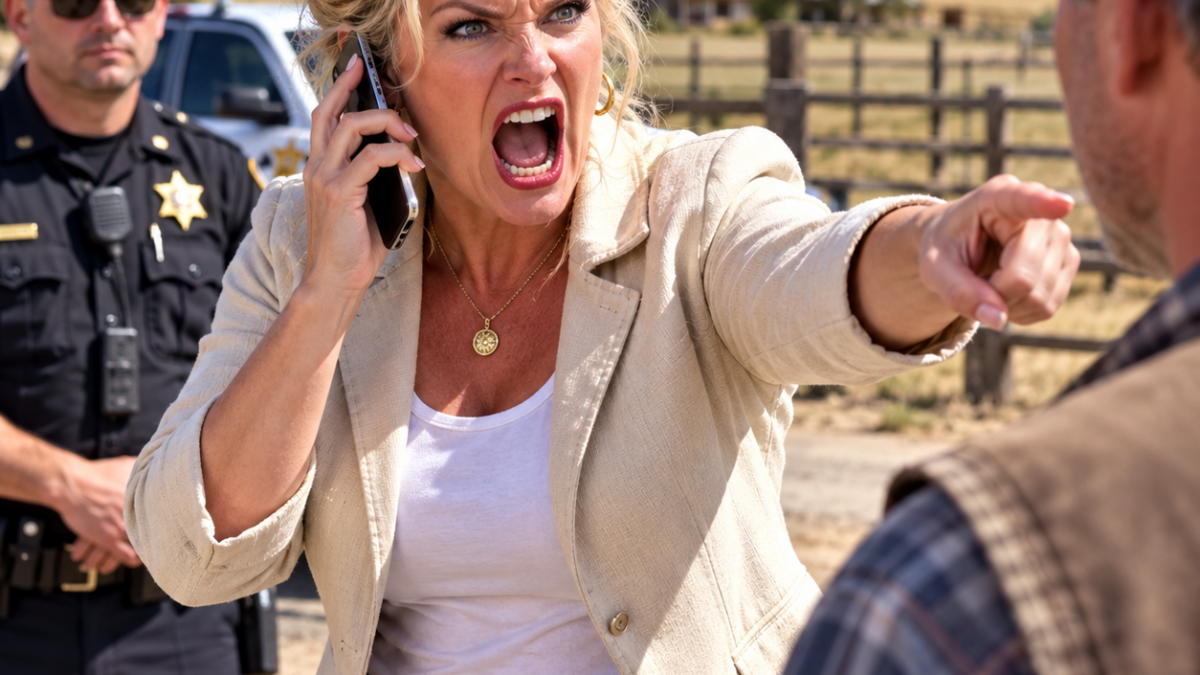
Twenty minutes later, I heard tires coming down the road.
Victoria.
She didn’t stop outside the main entrance.
She pulled directly onto the gravel shoulder beside my fence.
Her driver’s door flew open.
Phone pressed to her ear.
She was already talking.
“Yes, he’s here right now.”
I rested my hands on the fence.
She pointed at me.
“Yes. Him.”
I frowned.
“Who are you calling?”
She ignored me.
“He deliberately shut off the community water supply after being told not to.”
My stomach dropped.
Not because I was afraid.
Because I realized who she was talking to.
“Victoria.”
She turned away from me.
“No, this is absolutely an emergency. I want an officer sent immediately.”
“You called 911?”
She held up a finger like I was interrupting a meeting.
“Yes, the man is refusing to restore service.”
I laughed once in disbelief.
“You called emergency dispatch because your lake stopped filling?”
Her eyes flashed.
“This serves hundreds of homes.”
“It does not supply their houses.”
“That is not for you to decide.”
“It’s my pipe.”
“You are interfering with HOA infrastructure.”
“On my ranch.”
“Stop saying that as though it settles everything.”
I stared at her.
“It settles quite a lot.”
She paced beside the fence.
The dispatcher was clearly asking questions.
I could hear only her answers.
“No, there’s no medical emergency.”
Pause.
“No, I’m not saying the houses currently have no drinking water.”
Another pause.
Her voice became tighter.
“The system is interconnected.”
Pause.
“Yes, the disputed valve is physically located on his parcel, but—”
She stopped.
Her face changed.
I almost smiled.
The dispatcher had reached the obvious question.
If the valve was on my land, and nobody had lost drinking water, what exactly was the emergency?
Victoria turned her back to me.
“We have legal rights.”
Pause.
“Yes, I can provide documentation.”
That turned out to be the most important promise she made all day.
Two sheriff’s vehicles arrived eleven minutes later.
The first deputy was a younger man I didn’t know.
The second was Sheriff Daniel Brooks.
Daniel had been sheriff for about six years. Before that, he had been a deputy when my father was still alive.
He stepped from his SUV, looked at me, looked at Victoria, then looked toward the pasture.
“Morning, Caleb.”
“Daniel.”
Victoria marched toward him.
“Sheriff, thank God. This man has intentionally shut down a community water system.”
Daniel glanced at me.
“You shut something off?”
“Yes.”
Victoria threw both hands up.
“There. He admits it.”
Daniel didn’t even look at her.
“What did you shut off?”
“A branch of my ranch pipeline feeding their decorative lake.”
“It’s not his pipeline,” Victoria snapped.
Daniel turned toward her.
“Okay. That sounds like the part we need to figure out.”
“There is nothing to figure out.”
“Good. Then this should be quick.”
That confidence pleased her.
She opened the leather folder she had brought.
Daniel turned to me.
“Anybody without household water?”
“No.”
“Fire system affected?”
“Not according to the county inspection.”
“Livestock water?”
“My cattle are fine.”
“Any flooding?”
“No.”
“Threats?”
“No.”
“Physical confrontation?”
“No.”
He looked at Victoria.
She looked irritated.
“This is theft of service and sabotage.”
Daniel frowned.
“Who owns the pipeline?”
“The HOA maintains it.”
“That wasn’t what I asked.”
For the first time all morning, Victoria’s answer did not arrive immediately.
“The HOA has established rights.”
“Who owns the pipe?”
“It serves Calder Creek Estates.”
Daniel looked at me.
“Caleb?”
“As far as my records show, I do.”
“Survey?”
“In the truck.”
I retrieved the folder.
Daniel unfolded my property survey across the hood of his SUV.
The younger deputy stood beside him.
Victoria moved closer.
Daniel traced the property line.
Then the marked route of the private water system.
“The junction is here?”
I pointed.
“Inside the fence, about sixty yards.”
“You have a county permit for your ranch system?”
“Yes.”
“Show him the HOA documents,” Victoria said.
Daniel looked up.
“I will.”
Her folder contained maintenance invoices.
Lake renovation estimates.
Annual infrastructure reports.
Several pages from HOA meeting packets.
Then she produced a photocopy.
“This is the agreement.”
Daniel took it.
I recognized the first page.
Same language as my old copy.
Temporary water access.
Different attachment.
No original signature page.
Daniel read carefully.
“Where’s the recorded easement?”
Victoria crossed her arms.
“This is the water agreement.”
“I see that.”
“It establishes the right.”
“Where is it recorded?”
“Our association has relied on this arrangement for years.”
“Where is the recorded easement?”
“The county has records.”
“So you don’t have one here.”
“I have the agreement.”
Daniel tapped the paper.
“This appears to reference construction access.”
“The language was later amended.”
“Where’s the amendment?”
“It’s in county records.”
Daniel looked at me.
“County inspector been out?”
“Yesterday.”
Victoria interrupted.
“Without HOA authorization.”
Daniel stared at her for a second.
“County inspectors don’t need HOA permission to inspect Mr. Morgan’s private property at his invitation.”
Her face hardened.
“That is not the point.”
“It’s definitely one of them.”
The younger deputy looked down to hide a smile.
Daniel continued.
“Victoria, do you have a court order requiring Caleb to keep this valve open?”
“No.”
“Recorded utility easement?”
“The original documentation is being retrieved.”
“Emergency-services order?”
“No.”
“Anything showing residents currently depend on this branch for potable water?”
“It maintains the lake.”
“That’s not what I asked.”
She exhaled loudly.
“The lake is part of our storm-water management and property-value system.”
“Property value isn’t a 911 emergency.”
The words hung there.
Victoria’s face flushed.
“You don’t understand the liability here.”
“Maybe not. That’s why I’m asking questions.”
She looked at me.
“This is exactly what he wanted. He’s trying to humiliate the board.”
I laughed.
“I didn’t make you call 911.”
“You shut off community infrastructure.”
“I isolated a disputed connection on my own ranch while the county checks the records.”
“There is no dispute.”
Daniel held up her photocopy.
“There seems to be one.”
Then my phone rang.
Ethan.
I answered and put him on speaker after telling him the sheriff was standing beside me.
“Perfect,” Ethan said. “I’ve got the archive update.”
Daniel leaned toward the phone.
“This is Sheriff Brooks.”
“Ethan Cole, county water compliance.”
“What’d you find?”
Paper rustled on Ethan’s end.
“The original work order was issued during subdivision construction. It authorized temporary water service connected to storm-water facility construction.”
I watched Victoria.
She became absolutely still.
Daniel asked, “Temporary how?”
“The work order required a shutoff after completion and a final inspection.”
“Was that done?”
“That’s the problem. I have a completion report, but the final signoff is missing.”
Victoria spoke loudly enough for the phone.
“There was a later agreement.”
Ethan paused.
“Ms. Sterling?”
“Yes.”
“I did find a later attachment.”
Her shoulders relaxed.
For about three seconds.
Then Ethan continued.
“The attachment describes permanent water access, but it does not include the normal approval reference, and I have not located a recorded permanent easement.”
Daniel slowly looked at Victoria.
“Who filed the attachment?”
“We’re checking.”
“When?”
“Added later than the original project file.”
Victoria stepped forward.
“See? There is a permanent agreement.”
Ethan answered before Daniel could.
“I did not say that.”
She frowned.
“You said the county has the attachment.”
“Yes. I also said the supporting approval has not been located.”
“It was approved.”
“Then we need the approval.”
“I’m sure it exists.”
Daniel wrote something in his notebook.
That tiny motion made Victoria suddenly nervous.
“What are you writing?”
“My notes.”
“About me?”
“About everybody.”
She looked at his page as though she wanted to reach for it.
Instead she stepped back.
Daniel asked Ethan, “As of right now, can you confirm the HOA has a recorded permanent easement across Caleb’s parcel for this water branch?”
“No.”
“Can you confirm Caleb violated a county order by isolating it?”
“No.”
“Can you confirm the branch is required for potable residential supply?”
“No.”
Victoria opened her mouth.
Daniel raised one hand.
“I’m talking to him.”
Ethan continued.
“I’m not declaring ownership over the phone. The records need formal review. But there are enough discrepancies that I would advise both sides not to alter the physical system beyond maintaining safe independent service.”
“My ranch supply is independent,” I said.
“Document it.”
“Already did.”
Daniel ended the call.
Then he looked at Victoria.
“I don’t have grounds to order Caleb to reopen that valve.”
“You absolutely do.”
“No.”
“He’s disrupting an HOA asset.”
“You haven’t shown me that it belongs to the HOA.”
“We maintain it.”
“Paying to maintain something doesn’t automatically mean you own it.”
She stared at him.
Then she made the mistake that changed the entire character of the conversation.
“We have been charging residents for this infrastructure for years. We have obligations to provide the service.”
Daniel’s pen stopped.
“What did you say?”
Victoria blinked.
“The HOA maintains the system through infrastructure assessments.”
“You charge residents specifically for this pipeline?”
“For water infrastructure.”
“How much?”
“That’s irrelevant.”
Daniel resumed writing.
“I’m not sure it is.”
Something in her face collapsed for just a fraction of a second.
Then she recovered.
“This is a civil matter.”
“It may be.”
“Then why are you questioning our billing?”
“Because you called law enforcement and claimed this was an emergency community system. Now I’m trying to understand what system you’re talking about.”
She looked at me as if I had somehow tricked her into saying it.
I hadn’t spoken.
Daniel closed his notebook.
“Nobody is getting arrested today.”
Victoria’s mouth fell open.
“Sheriff—”
“No.”
“At minimum, he needs to restore service pending legal review.”
“That’s not an order I can give you.”
“This is unbelievable.”
Daniel pointed toward her SUV.
“What I suggest is that you gather whatever documents you believe establish the HOA’s legal right, provide them to the county, and stop treating a property-record dispute like an active criminal emergency.”
She went pale.
“I had every right to call.”
“I didn’t say you didn’t.”
“You’re taking his side.”
“I’m taking the paperwork’s side.”
That sentence traveled through Calder Creek Estates faster than wildfire.
By four that afternoon, residents were standing along the walking path beside the lake.
The water level had barely changed.
Most people probably would never have noticed if Victoria hadn’t announced an emergency.
But she had.
Now everybody was staring.
A woman approached me at the fence.
“Are you Caleb?”
“Yes.”
“I’m Laura Bennett. I live on Hawthorne Court.”
She pointed toward the lake.
“Did you really shut off our water?”
“Your drinking water?”
“Yes.”
“No.”
She blinked.
“Victoria said the neighborhood water supply had been shut down.”
“I isolated one branch feeding the lake.”
“You mean our houses still have normal water?”
“As far as I know.”
Laura turned toward her husband.
He looked irritated.
“So why did she say it was an emergency?”
I shrugged.
“You’ll have to ask her.”
By sunset, they were asking.
Dozens of them.
The HOA sent an email at 6:03 p.m.
URGENT COMMUNITY INFRASTRUCTURE INTERRUPTION.
It claimed an “adjacent landowner” had interfered with “longstanding community water operations.”
It did not say that household water was unaffected.
It did not say the county had failed to locate a permanent easement.
And it definitely did not say that Victoria’s attempt to have me removed had failed.
I printed the email.
Then I remembered the voicemail.
Two months earlier, when I first began asking questions about the pond, Victoria had called while I was working cattle.
I had saved the message because her tone had irritated me.
Now I played it again.
“Caleb, this is Victoria Sterling. We need the water arrangement to remain unchanged until the next HOA audit. Any unilateral alteration before that review could create serious complications for everyone involved. Call me before you do anything.”
At the time I had heard control.
Now I heard fear.
Why did the water arrangement have to remain unchanged until an audit?
Why mention the audit at all?
I called Daniel.
He came by the next morning.
I played the voicemail.
He listened twice.
“Send me the original.”
“Think it matters?”
“I think words matter more after people start changing their explanations.”
“Am I filing a complaint?”
“Not yet.”
“Against her?”
“Caleb.”
“I’m asking.”
“You’ve got a property dispute, a county records discrepancy, and now questions about fees. Don’t get ahead of the evidence.”
That frustrated me.
He noticed.
“You want me to tell you she committed a crime because you don’t like her.”
“I want somebody to tell me how long they’ve been taking my water.”
“That’s a different question.”
“It doesn’t feel different.”
“It will if this ends up in court.”
I sat back.
Daniel was right.
Anger wanted a villain immediately.
Evidence wanted patience.
I hated patience.
By noon, three Calder Creek homeowners had called me.
All three had copies of HOA financial summaries.
One showed an annual line item:
WATER INFRASTRUCTURE MAINTENANCE — $86,400.
Another showed:
LAKE WATER SYSTEM SERVICE — $41,750.
Another showed a monthly “community water infrastructure fee” attached to every household’s dues.
I spread the papers across my kitchen table.
I wasn’t an accountant.
But I knew enough to recognize a question.
If the HOA did not own my pipeline and did not have a verified permanent right to use it, what exactly had residents been paying to maintain?
That afternoon, a woman named Melissa Grant knocked on my door.
She was around sixty, with short gray hair and the brisk energy of someone who had arrived because she had finally decided being polite was no longer useful.
“You’re Caleb Morgan?”
“I’m starting to think I should put up a sign.”
She didn’t smile.
“I was on the landscaping committee eight years ago.”
“Okay.”
“I think I have something you should see.”
That got my attention.
She handed me a folder.
Printed emails.
Old ones.
Some from before Victoria became HOA president.
The first referenced temporary construction water.
The second discussed the need for a separate legal agreement before any long-term use of the ranch connection.
The third contained a sentence that made me sit down.
RESIDENT BILLING SHOULD NOT INCLUDE THIS SYSTEM UNTIL COUNTY REVIEW AND PERMANENT ACCESS DOCUMENTATION ARE COMPLETE.
I read it twice.
“Who wrote this?”
“Former management company.”
“What happened after that?”
“That’s what I’m trying to remember.”
“Did the county ever approve permanent access?”
“Not that I knew.”
“But residents got billed.”
She nodded.
“When?”
“Within a year.”
“Why didn’t anyone question it?”
Melissa gave me a tired smile.
“Because most people don’t spend Saturday nights reading infrastructure appendices.”
“Fair.”
“And because we were told the matter had been resolved.”
“By Victoria?”
“Eventually, yes. But this started before she became president.”
That mattered.
It meant I couldn’t simply blame every bad decision on her.
The problem might have begun as neglect.
Maybe a temporary pipe never got shut off.
Maybe somebody forgot a final inspection.
Maybe the HOA started paying for maintenance because the system existed and nobody wanted to ask whether it should.
Then years passed.
Temporary became normal.
Normal became assumed.
And assumed became something Victoria defended as ownership.
That was how people lost rights sometimes.
Not through one dramatic theft.
Through repetition.
Use something long enough.
Call it yours long enough.
Make people afraid to question it.
Eventually everyone forgets to ask where it came from.
Except my pond was shrinking.
And I had asked.
Melissa tapped one email.
“This is why Victoria hates you.”
“I thought it was my charming personality.”
“She can manage complaints.”
“What can’t she manage?”
“Questions she can’t answer.”
The emergency HOA meeting happened that night.
I attended.
Not because I was invited.
Because enough residents demanded that I be allowed to speak.
The Calder Creek clubhouse was packed.
People stood along the walls.
Victoria sat at the front behind a polished table with six board members.
She looked perfectly composed.
That worried me more than if she had been angry.
She had spent all day preparing.
“Before we begin,” she said, “I want everyone to understand that this association is currently responding to a deliberate interruption of established community infrastructure.”
Murmurs moved through the room.
I remained in the back.
Victoria continued.
“We are working with counsel and local authorities to restore service.”
Someone called out, “Restore what service?”
Victoria’s eyes narrowed.
Laura Bennett stood.
“Our house never lost water.”
“That does not mean community infrastructure was not compromised.”
“Then what exactly did Caleb shut off?”
“The primary supply to the community lake system.”
Another homeowner raised his hand.
“Do we own that pipe?”
Victoria’s mouth tightened.
“The association has established access rights.”
“Can we see the easement?”
“Our counsel is retrieving the original documentation.”
“How long will that take?”
“I’m not going to speculate.”
A man near the aisle said, “Sheriff Brooks said there wasn’t one.”
Victoria leaned toward the microphone.
“Sheriff Brooks is not a title attorney.”
That was true.
Which was why it almost worked.
Several people quieted.
Then Melissa stood.
“I have an email from the old management company.”
Victoria looked at her.
“Melissa, please wait your turn.”
“I’ve been waiting eight years.”
That line changed the room.
Melissa walked to the front.
She handed copies to the board.
Victoria did not take hers.
“What is this?”
“An email saying the ranch connection was temporary and residents shouldn’t be billed until permanent access was approved.”
Victoria’s face stayed still.
But one of the board members, Paul Kramer, started reading immediately.
He looked up.
“Where did you get this?”
“My files.”
Victoria spoke sharply.
“An old committee email does not override subsequent approvals.”
Melissa nodded.
“Then show us the subsequent approval.”
Applause broke out.
Not loud.
But enough.
Victoria struck the table with her palm.
“This is not a courtroom.”
“No,” a homeowner shouted. “In a courtroom you’d have to answer.”
The room erupted.
Victoria stood.
“If this continues, I will adjourn the meeting.”
I finally walked toward the front.
She saw me.
Her expression hardened.
“You are not recognized.”
“I didn’t come to argue.”
“Then sit down.”
“I came to give the board my survey.”
“I said sit down.”
Paul Kramer looked at Victoria.
“Let him speak.”
She turned on him.
“This is an HOA meeting.”
“And I’m an HOA board member.”
Silence.
That was the first visible crack.
Victoria sat slowly.
I placed copies of my survey on the table.
“My family’s pipeline is shown inside Calder Creek Ranch. I’m not asking anyone here to believe me because I’m angry. I’m asking you to look at the county record.”
Victoria laughed.
“Your survey does not establish water rights.”
“No. But it establishes where the pipe is.”
“You are trying to turn residents against this board.”
“No.”
I looked at the homeowners.
“I didn’t know most of your names three days ago.”
A few people laughed nervously.
“I don’t want your lake.”
I pointed toward the windows.
“I don’t want your clubhouse. I don’t want control over your HOA. I want the county to tell us whether your association has a legal right to take water from my ranch.”
Victoria folded her arms.
“You know very well that arrangement has existed for years.”
“Yes.”
“And your family never objected.”
“I don’t know what my father knew.”
“Convenient.”
My anger surged.
I almost snapped.
Then I remembered Daniel’s warning.
Evidence wanted patience.
So I kept my voice calm.
“What I know is this: the county file begins with a temporary construction connection. The final signoff is missing. Ethan Cole has not found a recorded permanent easement. And residents here apparently received bills related to a system whose legal status was never clearly documented.”
The room became quiet.
Victoria stared at me.
Then she said, “You’re accusing this association of fraud.”
“No.”
That answer surprised her.
“I’m saying I don’t know what happened.”
I looked directly at her.
“But I want to.”
The applause this time was louder.
Victoria ended the meeting twelve minutes later.
Outside, residents gathered around me.
Questions came from every direction.
How much water?
How long?
Was I suing?
Would the lake dry up?
Were their fees illegal?
I answered the same way every time.
“I don’t know yet.”
That was the truth.
It also drove Victoria crazy.
Because she needed me to be the angry rancher.
If I screamed, threatened, or exaggerated, she could make the story about me.
So I refused.
The next morning she called the sheriff again.
Not 911 this time.
She demanded enforcement action.
Daniel later told me the conversation lasted nearly fifteen minutes.
Victoria claimed I was intentionally destabilizing neighborhood infrastructure.
Daniel asked whether she had found the permanent easement.
She said the documentation was under review.
He asked who authorized the monthly infrastructure charges while the documentation remained unresolved.
That was when she said something she should never have said.
According to Daniel’s written summary, she answered:
“We continued collecting the fees because residents had been promised uninterrupted service.”
Daniel asked, “Who made that promise?”
Victoria ended the call.
That afternoon, the county formally opened a records review.
Ethan returned to the ranch with another inspector.
They photographed the junction again.
They inspected the old meter.
They confirmed my livestock line remained active and separate.
They documented the closed branch.
Then Ethan sat on the tailgate of his county truck and handed me a copy of the original work order.
I read the first page.
TEMPORARY CONSTRUCTION WATER CONNECTION.
There it was.
Black ink.
No ambiguity.
“How long was this supposed to last?”
“Until the storm-water construction was complete.”
“When was that?”
“Twelve years ago.”
I looked toward the subdivision.
“So they’ve been using a temporary construction connection for twelve years?”
“Potentially.”
“Potentially?”
“I know you hate that word.”
“I’m starting to.”
“We still need to establish what happened after the original project.”
He flipped to another page.
“Here’s the required shutdown.”
A checkbox.
Blank.
“Here’s final inspection.”
Another blank.
“Here’s project completion.”
Signed.
I frowned.
“How can the project be completed without final shutdown inspection?”
“That’s one of the questions.”
Then he showed me the later attachment.
The page Victoria had apparently relied on.
PERMANENT WATER ACCESS ARRANGEMENT.
Typed.
Dated.
Referencing my parcel.
But below the body there was no recorded instrument number.
No county approval stamp.
No supporting legal description.
No ranch-owner signature.
I looked at Ethan.
“Does this look normal to you?”
“No.”
“Does it look fake?”
“I’m not saying that.”
“Why not?”
“Because my job is to identify record deficiencies, not declare document fraud.”
I tossed the copy onto the tailgate.
“You government people have a special talent for making obvious things sound mysterious.”
He grinned.
“And ranchers have a special talent for wanting an arrest before lunch.”
“I don’t want an arrest.”
He raised one eyebrow.
“Fine. I want answers before lunch.”
“Better.”
The financial side grew uglier.
Residents created an informal committee.
Melissa joined it.
So did Laura.
Paul Kramer, the board member who had challenged Victoria, demanded an independent audit.
Two other board members supported him.
Victoria opposed it.
That alone made residents more suspicious.
At the next board session, Paul read the motion.
“Independent review of all water infrastructure assessments, contractor invoices, maintenance charges, and representations concerning ownership or access rights.”
Victoria stared at him.
“This is unnecessary and expensive.”
Paul replied, “So is litigation.”
“You’re feeding hysteria.”
“I’m responding to residents.”
“You’re undermining governance.”
“No, Victoria. I’m doing it.”
The motion passed four votes to three.
I heard about it twenty minutes later.
The next morning someone cut the chain on one of my pasture gates.
Nothing was stolen.
No cattle got out because I had installed a secondary latch years earlier.
I called Daniel.
He photographed the cut.
“You think Victoria did it?” he asked.
“I think accusing her without evidence would make you give me that disappointed sheriff look.”
He nodded.
“Growth.”
“I hate you.”
“Get cameras.”
I did.
Four trail cameras.
Two gate cameras.
One camera aimed toward the pipeline junction.
I also installed a locking cover over the shutoff valve.
Perfectly legal.
Perfectly visible.
Three nights later, headlights appeared at 1:07 a.m.
My phone alerted me.
I opened the camera feed.
A pickup had stopped outside the fence.
A man got out.
Not Victoria.
I recognized him vaguely.
One of the HOA maintenance contractors.
He walked along the fence using a flashlight.
Then he stopped opposite the valve.
He did not cross.
He photographed it.
Then made a phone call.
The next morning, Victoria sent a certified letter accusing me of “physically obstructing access to shared infrastructure.”
I forwarded it to my attorney.
He responded with two sentences.
Please identify the recorded instrument granting the HOA physical access to the valve.
Until then, your client is instructed not to enter Calder Creek Ranch.
We heard nothing for three days.
Then the audit team requested records from the HOA.
That was when Victoria’s control began collapsing in earnest.
Residents had been charged infrastructure fees for years.
Some of those charges clearly paid real expenses.
Pipe repairs.
Meter service.
Lake pumps.
Contractor labor.
No one disputed that.
But the auditors discovered something more uncomfortable.
The HOA had repeatedly described the ranch connection in budgets as a “community-owned water asset.”
No title record supported that language.
In other years, it had been described as “permanent easement infrastructure.”
Again, nobody could produce the easement.
Then there were legal expenses.
Three years earlier, the HOA had paid a law firm to review “utility access concerns.”
That caught my attorney’s attention.
We requested the nonprivileged billing descriptions through the proper process.
One entry read:
REVIEW OF TEMPORARY WATER AGREEMENT AND OPTIONS FOR PERMANENT EASEMENT ACQUISITION.
I stared at it.
“If they already had a permanent easement,” I said, “why were they paying a lawyer to discuss acquiring one?”
My attorney leaned back.
“That is an excellent question.”
“Does Victoria know about this?”
“The invoice predates her presidency by several months.”
That surprised me.
“So she inherited the mess.”
“Possibly.”
“And then?”
“And then we need records before deciding what she knew.”
I hated that answer.
But once again, he was right.
The investigation wasn’t a movie.
There wasn’t one evil folder containing everything.
There were fragments.
Old emails.
Invoices.
Meeting notes.
Incomplete county records.
Changes in terminology.
People remembering different versions.
But every fragment pointed in the same direction.
The HOA had never clearly secured the permanent right it claimed.
Then Melissa found the email that put Victoria directly in the middle.
It had been sent two weeks after Victoria became president.
From the association’s former attorney.
The subject line:
CALDER CREEK RANCH WATER CONNECTION.
The message was short.
President Sterling,
As discussed, the existing ranch connection appears to derive from the original temporary construction work order. I have not located evidence of a recorded permanent easement. Continued use should be addressed through a negotiated agreement with the Morgan property owner or alternate water source.
Please avoid representing the connection as association-owned until title and access are resolved.
I read the email three times.
The date was four years earlier.
Victoria knew.
Not every detail.
Maybe not the entire history.
But she knew there was no confirmed permanent easement.
And for four years she had told residents the opposite.
That evening, Calder Creek Estates held the ugliest meeting I ever attended.
The clubhouse was beyond capacity.
Residents stood outside the doors.
Someone had printed the attorney email and passed copies through the room.
Victoria arrived ten minutes late.
For once, she looked tired.
She sat down.
Paul Kramer opened the meeting.
Victoria immediately objected.
“As president, I call this meeting to order.”
Paul looked at her.
“The board voted before you arrived to appoint me chair for this special session.”
Her head snapped toward the other members.
“You did what?”
“Four to two.”
“You cannot suspend the president’s authority without notice.”
“This is not a removal vote.”
“Then what is it?”
“A records review.”
She laughed.
“This is a coup.”
A homeowner shouted, “Show us the easement!”
Another yelled, “Where did our fees go?”
Paul struck the gavel.
“Enough.”
It took almost a minute for the room to settle.
Then Melissa walked forward.
She carried the old attorney email.
Victoria’s face changed as soon as she saw it.
Melissa placed it on the table.
“Did you receive this?”
Victoria looked down.
“I receive hundreds of emails.”
“That’s not an answer.”
“This communication may be privileged.”
Paul spoke.
“The association’s counsel has already reviewed the disclosure issue.”
Victoria turned toward him.
“You contacted counsel without me?”
“Yes.”
She stared.
The room was silent.
Paul continued.
“Victoria, did you know four years ago that no recorded permanent easement had been located?”
Her mouth opened.
Closed.
Then she said, “The legal status was being reviewed.”
“You told residents the system was HOA-owned.”
“It was operated as an HOA system.”
“You told the sheriff it was HOA infrastructure.”
“It is.”
“You called 911 and accused Caleb Morgan of interfering with a community utility.”
“Because he did.”
I stood in the back.
I hadn’t planned to speak.
Then Victoria pointed directly at me.
“This man engineered this entire spectacle because he resents the existence of our neighborhood.”
There it was.
The story she needed.
The hostile rancher.
The outsider.
The enemy.
I stepped forward.
“No, Victoria.”
“You have harassed this board for months.”
“I asked why my pond was dropping.”
“You cut off infrastructure.”
“I closed a disputed branch on my ranch.”
“You knew it would create panic.”
“I didn’t send the emergency email.”
Her cheeks reddened.
“You knew exactly what you were doing.”
I nodded.
“Yes.”
The room quieted.
That answer surprised everyone.
“I knew I was stopping water from leaving my property until the county determined whether you had a legal right to it.”
I looked around.
“I expected Victoria to complain.”
Then back at her.
“I did not expect her to call 911 and tell law enforcement she could prove the HOA owned rights she already knew had been questioned years earlier.”
Her expression hardened.
“You are twisting facts.”
“Then untwist them.”
I spread my hands.
“Show us the easement.”
Nothing.
Not one word.
“Show us the ranch-owner agreement.”
Silence.
“Show us the county approval.”
Silence.
A man in the front row said quietly, “There isn’t one, is there?”
Victoria looked at Paul.
“This meeting is over.”
She stood.
Paul remained seated.
“No, it isn’t.”
Her head turned slowly.
“I said it is over.”
“And the board voted otherwise.”
“You have no authority to embarrass me like this.”
Paul’s face changed.
“This stopped being about you two weeks ago.”
That line landed harder than any shouting could have.
Victoria stood alone at the front of the room.
For years, according to residents, people had backed down when she raised her voice.
She had learned the rules.
Learned the bylaws.
Learned how to send violation notices, impose fines, control meeting agendas, and make ordinary homeowners feel as though resistance cost more than obedience.
But none of those tools worked when the entire room stopped being afraid.
Laura Bennett stood.
“How much did we pay?”
Victoria looked at her.
“The audit isn’t complete.”
“How much did we pay for this water system?”
“I don’t have that figure.”
“You approved the budgets.”
“That doesn’t mean I memorize every line.”
Melissa spoke.
“Why did you keep calling it HOA-owned after your attorney told you not to?”
Victoria grabbed her folder.
“I will not participate in a mob.”
She walked out.
Nobody followed.
The next morning she sent every homeowner a six-page letter accusing “outside agitators” of manipulating incomplete information.
That letter may have done more damage to her than silence would have.
Residents started comparing her statements line by line against the documents.
She said the county had recognized permanent access.
Ethan’s written preliminary review said no permanent recorded easement had been located.
She said my family had historically consented.
No signed permanent agreement had been produced.
She said I had deprived residents of water.
Their household water had never stopped.
She said the infrastructure charges proved the HOA had rights.
The auditors said expenses proved maintenance, not ownership.
Every defense created another contradiction.
Then Daniel called me.
“Got time?”
“For what?”
“Records office.”
“What happened?”
“You’re going to enjoy this too much.”
“I promise to look serious.”
“You won’t.”
He was right.
At the county building, Ethan laid three documents on a conference table.
The original temporary work order.
The later permanent-access attachment.
And a scanning record.
“What’s this?” I asked.
“Document imaging metadata.”
I stared at him.
“In English.”
“The permanent-access attachment was not scanned into the county file when the project was originally archived.”
“When was it added?”
“Eight years later.”
My attorney leaned forward.
“By whom?”
Ethan pointed to a transaction number.
“That’s what the formal review is trying to determine.”
“Could someone from the HOA have inserted it?”
“Could have been submitted by a contractor, management company, county employee, attorney, property representative. We don’t know yet.”
Daniel nodded.
“And until we do, nobody uses the word forged.”
I looked at him.
“You knew I was about to.”
“I saw your face.”
My attorney picked up the attachment.
“Does the document have a corresponding recorded easement number?”
“No.”
“Board-of-commissioners approval?”
“Not located.”
“Landowner signature?”
“No.”
“County legal approval?”
“Not located.”
“Survey exhibit?”
“No.”
He placed it down.
“Then even if the paper is authentic as a piece of paper, it doesn’t establish the property right Victoria claimed.”
“That,” Ethan said, “is closer to what we can safely say.”
I sat back.
For months I had imagined the moment someone would simply declare:
You were right.
They were wrong.
But reality was slower.
More careful.
And somehow more satisfying.
Because every conclusion came from documents Victoria couldn’t shout over.
The audit continued for another month.
The disputed water branch remained closed.
My pond recovered gradually.
Not overnight.
But week by week the level stabilized.
My cattle had dependable supply again.
The HOA lake did not dry up.
That was another surprise.
Without my water, its level dropped several inches and then settled.
Engineers discovered the lake could be maintained through a combination of storm runoff, existing pumps, conservation, and—if residents wanted the decorative level restored—a lawful supplemental source.
In other words, the crisis Victoria had described was never a crisis.
It was an inconvenience.
An expensive inconvenience.
But not an emergency.
That made her 911 call look worse every time it was mentioned.
One Saturday morning I was repairing a section of fence when Laura Bennett came walking down the public side.
“You busy?”
“Always.”
She held up two coffee cups.
“I brought bribery.”
I opened the gate enough to take one.
“What do you need?”
“Nothing.”
“That makes me suspicious.”
She laughed.
Then she looked toward the cattle.
“I wanted to apologize.”
“For what?”
“For believing her.”
“You didn’t know me.”
“That doesn’t make it better.”
“Actually, it kind of does.”
She shook her head.
“When Victoria emailed everyone that first day, I pictured some angry rancher cutting off water because he hated the subdivision.”
“I was angry.”
“You know what I mean.”
“I do.”
She looked toward the lake.
“We bought our house because of that view.”
“It’s a nice lake.”
“I thought you’d hate it.”
“I don’t hate lakes.”
“I thought you hated us.”
“Laura, I barely knew you existed.”
She laughed.
“That might be more insulting.”
“Sorry.”
She became serious.
“My daughter asked why grown-ups would tell everyone they owned something if they didn’t know.”
“What’d you tell her?”
“That sometimes people say something so many times they start treating questions like insults.”
I looked at her.
“That’s pretty good.”
“She’s eleven. She said that.”
“Oh.”
“Yeah. We’re both being outthought by a sixth grader.”
After she left, I kept thinking about it.
Victoria had not built her authority on one gigantic lie.
She had built it on certainty.
Certainty that nobody would demand old files.
Certainty that residents would trust labels in budgets.
Certainty that maintenance meant ownership.
Certainty that a rancher would rather avoid legal trouble than fight.
Certainty that a sheriff would hear “community water system” and make me obey.
The 911 call had been the purest expression of that certainty.
And it had been her undoing.
Because emergency dispatch created a record.
Deputies created reports.
Daniel asked for documents.
Residents heard her claims.
The county had to answer questions.
Once everyone was looking at the same timeline, she could no longer control which piece of the story each person saw.
The auditors released their preliminary report six weeks after I closed the valve.
They did not call every water-related charge improper.
That mattered.
I had promised myself I wouldn’t become what I hated—someone who ignored inconvenient facts.
A portion of the fees had paid for legitimate maintenance work.
Pumps had been repaired.
Lake equipment had been serviced.
Meters had been checked.
Contractors had actually performed work.
But the report found serious governance problems.
The HOA had described the ranch connection as an owned or permanent community asset without adequate documentation.
Residents had been assessed recurring infrastructure charges based partly on those representations.
Internal legal warnings about the unresolved easement had not been clearly disclosed.
And recordkeeping was inconsistent enough that the auditors recommended a deeper review.
The clubhouse filled again.
This time Victoria was not at the center table.
Paul Kramer chaired.
The audit firm presented its findings.
I sat near the back beside Melissa.
When the auditor reached the section about the ranch pipeline, nobody made a sound.
“Based on the records reviewed,” he said, “we cannot substantiate the association’s historical characterization of the Morgan Ranch connection as an HOA-owned asset.”
A woman behind me whispered, “Jesus.”
The auditor continued.
“We also have not been provided a recorded permanent easement establishing long-term access.”
Victoria sat in the first row.
She turned around and looked directly at me.
Her eyes carried a hatred so sharp I almost felt sorry for her.
Almost.
Then came the fees.
The auditor explained that the HOA could legitimately assess residents for certain lake-maintenance expenses.
But representations tying those fees to ownership or permanent water rights needed correction.
Further review would determine whether any charges had been improperly characterized or should be refunded or credited.
Victoria stood.
“I need to respond.”
Paul looked at the auditor.
Then at her.
“You’ll have time during member comment.”
“I was president when most of these decisions were made.”
“That’s exactly why you’ll have time during member comment.”
A ripple went through the room.
Victoria sat.
Her hands shook.
That was the first time I saw fear replace anger.
Not fear of arrest.
Not fear of me.
Fear of irrelevance.
For someone like Victoria, losing control of the room was worse than losing an argument.
When public comment opened, she walked to the microphone.
She had notes.
Six pages, maybe more.
She began calmly.
“For years, I served this community in good faith.”
Nobody interrupted.
“I inherited an infrastructure system that previous boards, contractors, managers, and county personnel had treated as established.”
Still quiet.
“I did not create the original arrangement.”
That was true.
“I relied on institutional records.”
Also partly true.
“I relied on professional advice.”
That was where Melissa shifted beside me.
Victoria continued.
“And when Mr. Morgan abruptly interrupted that system, my priority was protecting this community.”
A homeowner raised his hand.
Paul said, “Let her finish.”
Victoria looked grateful.
She continued.
“Could communication have been better? Perhaps. Could our documentation have been clearer? Certainly. But I reject the narrative that I knowingly deceived residents.”
When she finished, the room remained silent.
Then Melissa stood.
She carried the four-year-old attorney email.
“Victoria.”
Victoria’s shoulders stiffened.
Melissa walked to the microphone.
“You said you relied on professional advice.”
“Yes.”
“Your attorney told you no permanent easement had been found.”
“He said additional review was needed.”
“He also said not to represent the connection as association-owned.”
“That was preliminary advice.”
“Did you tell residents?”
Victoria hesitated.
“Legal discussions are privileged.”
“That wasn’t my question.”
Paul leaned forward.
“Answer if you can.”
Victoria stared at him.
“I followed what I believed was the best course for the community.”
Melissa nodded slowly.
“That is an answer.”
She sat down.
Then Laura stood.
“My question is simpler.”
Victoria looked exhausted.
Laura asked, “Why did you call 911?”
Murmurs moved through the room.
Victoria lifted her chin.
“Because Mr. Morgan had deliberately disrupted community infrastructure.”
“Our homes had water.”
“The lake system—”
“Our homes had water.”
“Yes.”
“No one was in danger.”
“The full consequences were unknown.”
“You told dispatch it was an emergency.”
“I believed immediate intervention was necessary.”
Laura looked toward Daniel, who had attended at the board’s request because emotions had been running high.
“Sheriff, was there an emergency?”
Daniel shifted uncomfortably.
“I’m not here to characterize Ms. Sterling’s state of mind.”
Laura nodded.
“Were residents without drinking water?”
“No.”
“Was there a fire-safety outage?”
“Not documented.”
“Was anyone injured?”
“No.”
“Did Caleb threaten anyone?”
“No.”
“Did you order him to reopen the valve?”
“No.”
She turned back to Victoria.
“Then the only person who turned this into a community emergency was you.”
The room erupted in applause.
Victoria stepped away from the microphone.
Her face was white.
The board called a ten-minute recess.
I walked outside.
The evening air was cool.
I leaned against the stone wall of the clubhouse.
A minute later, the door opened behind me.
Victoria.
Of all the people I expected, she was last.
She stopped ten feet away.
For several seconds, neither of us spoke.
Then she said, “Enjoying yourself?”
“No.”
“You expect me to believe that?”
“I expected to be fixing fences tonight.”
“You wanted this.”
“I wanted my water.”
“You wanted to humiliate me.”
“Victoria, you called 911.”
Her jaw tightened.
“You knew what closing that valve would do.”
“I knew the lake would stop receiving my water.”
“You knew residents would panic.”
“I didn’t tell them their community water supply had been shut down.”
She looked away.
Cars filled the clubhouse parking lot.
Through the windows we could see homeowners still talking.
“You have no idea what it takes to run an association,” she said.
“You’re right.”
“Every homeowner wants something different. Every contractor has an excuse. Every budget is too high. Every fee is unfair. Every rule is tyranny until their neighbor breaks one.”
“I believe you.”
She looked surprised.
“I do,” I said. “I think the job is awful.”
“Then maybe you understand why sometimes you have to make decisions.”
“Decisions, yes.”
I stepped closer.
“Pretending uncertainty doesn’t exist? No.”
“I was trying to preserve a system people depended on.”
“You had four years to negotiate with me.”
“You would have demanded money.”
“You never asked.”
“The ranch has always been hostile to development.”
“My father disliked the subdivision.”
“There.”
“That doesn’t give you my water.”
She folded her arms.
“We maintained that line for years.”
“And if I pay to repair your driveway for ten years, do I own your garage?”
“That is ridiculous.”
“Exactly.”
She looked toward the parking lot.
Then she said something I didn’t expect.
“I thought the paperwork would eventually be resolved.”
I stared at her.
There it was.
Not a confession of some grand conspiracy.
Something more ordinary.
“I thought if we kept everything functioning, the attorneys would clean it up later.”
“How long did you think ‘later’ was?”
She didn’t answer.
“You knew there was a problem.”
“I knew there was a documentation issue.”
“You told the sheriff there wasn’t.”
“I was under pressure.”
“You put yourself under pressure.”
Her eyes flashed.
“You shut off the valve.”
“Yes.”
“Knowing what would happen.”
“No.”
I shook my head.
“I knew what would happen to the pipe. I had no idea what would happen to you.”
She stared at me.
That sentence hurt her more than I meant it to.
I almost apologized.
Then I remembered my pond.
The warning letters.
The threat that I would regret involving the county.
The 911 call.
The accusation that I had endangered hundreds of residents.
I stayed quiet.
Victoria went back inside.
The board reconvened fifteen minutes later.
Paul read a resolution.
Temporary suspension of Victoria Sterling from board-president duties pending completion of the audit and governance review.
The vote was five to one.
Victoria was allowed to vote.
She voted against.
She did not speak afterward.
Two weeks later, the county issued its initial determination.
The original branch had been created as part of a temporary construction arrangement.
No properly recorded permanent easement had been located.
The later attachment did not, by itself, establish permanent property rights.
The HOA would need either a negotiated agreement with me or an independent lawful water solution.
My attorney called me the second the letter arrived.
“You won.”
I looked at the page.
“Is this winning?”
“Legally? On the immediate issue, yes.”
“No fireworks?”
“I can invoice you for fireworks.”
“I’ll pass.”
“What do you want to do?”
That question mattered.
For weeks, everyone assumed I wanted revenge.
Some residents expected me to demand the pipeline be dug out.
Others thought I would sue the HOA for millions.
Victoria probably imagined I would use the ruling to punish the neighborhood.
I could have demanded compensation for past water use.
My attorney believed we had a credible claim.
Not a guaranteed claim.
But credible.
I thought about it for three days.
Then I drove to Clyde—no, there was no Clyde in this story; there was only my own father’s old workbench and the memory of how he handled disputes.
Dad had believed in property lines.
Firmly.
But he also believed there was a difference between protecting what was yours and enjoying someone else’s pain.
I found an old crescent wrench in the drawer.
His initials were scratched into the handle.
I stood there holding it, remembering something he once told me after a neighboring farmer accidentally ran cattle across our south field.
“A fence tells a man where to stop,” Dad had said. “It doesn’t tell you what kind of man to be after he does.”
I knew what I wanted.
The HOA could not continue using my branch under the old arrangement.
That ended.
If Calder Creek Estates wanted a lawful future connection, it would require a new agreement negotiated openly, approved properly, metered transparently, and priced fairly.
No secret assumptions.
No “community rights” invented by repetition.
No access to my property without written permission.
Until then, the valve stayed closed.
I also agreed not to pursue an aggressive claim against individual homeowners for historical use as long as the HOA resolved the matter, corrected its records, and handled any fee adjustments identified by the audit.
My attorney stared at me.
“You’re giving up leverage.”
“I’m using leverage.”
“For what?”
“Clean records.”
He frowned.
“That’s not usually what clients say.”
“I want this finished.”
“What about Victoria?”
“What about her?”
“You could make her deposition very unpleasant.”
“I don’t want her deposition.”
That surprised even me.
For weeks, I had imagined making Victoria sit under oath and answer every question she had dodged.
But the longer the process continued, the less I wanted her attention.
Winning was starting to look less like defeating her and more like no longer caring whether she approved.
The homeowners voted on governance reforms the following month.
Major infrastructure claims now required supporting ownership or easement documentation.
Special assessments had to show the underlying authority.
Contracts above a threshold required multiple board approvals.
Key legal warnings could no longer disappear into one officer’s inbox.
The audit recommended credits to residents for a portion of charges that had been inaccurately categorized.
Not every dollar came back.
It shouldn’t have.
Real maintenance had occurred.
But the books were corrected.
The descriptions changed.
Residents could finally see what they were paying for.
Victoria remained suspended through the final audit.
Then she resigned before the recall vote.
Her letter was short.
She said the community needed “new leadership free from the hostility surrounding the water dispute.”
She never apologized to me.
She never admitted she had been wrong.
For a few minutes after I heard, I felt disappointed.
I had imagined some dramatic final confrontation.
Victoria at my gate.
Victoria admitting she knew.
Victoria watching while I reopened or permanently capped the line.
Something cinematic.
Instead, she sent a letter.
And disappeared from the board.
That was real life.
Sometimes the person who spends years demanding the final word leaves without one.
Several months later, I saw her at the grocery store.
I was loading feed supplements into my truck.
She was putting bags into the back of her SUV.
Our eyes met.
For a second, I considered looking away.
She walked toward me.
“Caleb.”
“Victoria.”
She seemed smaller without the folders, the board table, the title.
Not physically.
Just ordinary.
“I heard the association selected the alternate lake-water project.”
“They did.”
“The reclaimed-water system?”
“Partly. Storm-water capture too.”
“It will cost them more.”
“Probably.”
“You could have let the original arrangement continue.”
“We could have negotiated.”
“You would have charged us.”
“Yes.”
She laughed bitterly.
“At least you admit it.”
“My cattle feed isn’t free either.”
For a second, something almost like a smile crossed her face.
Then it vanished.
“You damaged my reputation.”
I looked at her.
“No.”
Her eyes hardened.
“You think you had nothing to do with this?”
“I shut my valve.”
“You exposed private association matters.”
“Your residents exposed those.”
“You gave documents to the sheriff.”
“After you called him.”
She looked away.
Cars moved through the parking lot behind us.
Finally she said, “I should not have called 911.”
I said nothing.
She looked back at me.
“That what you wanted to hear?”
“Not really.”
That surprised her.
“What did you want?”
“For you to have knocked on my door six months earlier and said, ‘Caleb, we’ve got a problem with an old water connection. Can we figure it out?’”
Her expression softened for the first time since I had known her.
“I didn’t think you’d cooperate.”
“You never gave me the chance.”
“No.”
She swallowed.
“I didn’t.”
That was as close to an apology as I ever received.
It was enough.
Not because Victoria deserved forgiveness.
Because I was tired of carrying the argument.
I nodded once.
Then returned to loading my truck.
She walked away.
The alternative water project took almost a year.
The HOA redesigned the lake system to use storm-water capture, a reclaimed-water source, and seasonal conservation.
The decorative lake remained.
The houses did not collapse in value.
Nobody’s children went thirsty.
Nobody’s lawn turned to dust.
The disaster Victoria had predicted never happened.
Meanwhile, my ranch pond filled back to its old seasonal line.
That spring, after heavy rain, it overflowed through the lower spillway for the first time in years.
I stood there watching water run through native grass.
My oldest cow, Molly, walked past me without the slightest appreciation for the historical significance.
“Glad somebody’s impressed,” I told her.
She ignored me.
I laughed.
Then I noticed a pickup parked outside the gate.
Laura Bennett and her daughter had stopped.
I walked over.
Her daughter held a school project board.
“What’s that?”
“Water rights.”
I looked at Laura.
“You’ve created a monster.”
“She got an A.”
The girl held up the board.
There were diagrams of watersheds, easements, private property, and community infrastructure.
One section was titled:
TEMPORARY DOESN’T MEAN FOREVER.
I laughed so hard I had to lean against the gate.
“Your teacher let you use that?”
“She liked it.”
Laura smiled.
“She wants to know if she can interview you.”
“About ranch water?”
“About what happened.”
I looked at the girl.
“What do you want to know?”
She glanced at her notes.
“Were you scared when the police came?”
The question caught me off guard.
I thought about that morning.
Victoria pacing beside the fence.
The sirens.
Daniel opening my survey across his hood.
The strange possibility that an argument about my own pipe might somehow end with me treated like the criminal.
“A little,” I admitted.
“But you owned the land.”
“Yes.”
“Then why were you scared?”
Because adults know something children haven’t learned yet.
Being right and being safe are not always the same thing.
Having a document and having someone believe it are not always the same thing.
Owning property and defending it are not always the same thing.
I crouched beside her.
“Because when people are angry and nobody has all the facts yet, being right doesn’t automatically make things simple.”
She wrote that down.
Then she asked, “What made it simple?”
I thought about it.
“The paperwork.”
She frowned.
“That’s boring.”
I laughed.
“Very.”
“There wasn’t one big secret?”
“No.”
“One evil plan?”
“Not that anyone proved.”
“One hidden confession?”
“No.”
She looked disappointed.
I pointed toward the ranch.
“You want to know what actually happened?”
She nodded.
“People stopped checking.”
She waited.
“A temporary pipe stayed in place. Years passed. Somebody treated it like it was permanent. Somebody else paid to maintain it. Budgets started calling it an asset. New board members inherited the old language. Residents paid fees. Lawyers raised questions. Those questions weren’t resolved. Then eventually one person became so certain the HOA had authority that she called 911 when the landowner closed his own valve.”
The girl stared at me.
“That’s kind of crazy.”
“Exactly.”
She wrote that down too.
After they left, I walked to the pipeline.
The old branch still existed physically.
But the valve remained locked closed.
The HOA had no reason to use it anymore.
My attorney had suggested removing the line entirely.
I hadn’t.
Not yet.
Part of me liked having it there.
A reminder.
I touched the metal cover.
The same piece of pipe had looked insignificant six months earlier.
A rusty junction in tall grass.
It had led to county archives, board meetings, audits, angry residents, sheriff’s reports, and the end of Victoria Sterling’s presidency.
Not because the pipe was powerful.
Because questions were.
That was the lesson I carried forward.
Authority sounds strongest when nobody asks where it came from.
Victoria loved phrases like established rights, community infrastructure, longstanding arrangement, board authority.
They sounded official.
They sounded permanent.
But when Daniel asked one ordinary question—
“Where is the recorded easement?”
—everything changed.
Not immediately.
There was no dramatic arrest.
No handcuffs.
No judge pounding a gavel.
Instead there were weeks of uncomfortable questions.
Old emails.
Archive searches.
Invoices.
Meetings.
Contradictory explanations.
Residents who had been silent started asking what they had paid for.
Board members who had always nodded started demanding records.
A county attachment that everyone treated like proof had to be examined.
And every time someone asked for the foundation beneath Victoria’s certainty, they found another layer that needed explanation.
That was how she exposed herself.
Not by confessing.
By demanding enforcement before she had proved the authority she wanted enforced.
Months after the alternative water system came online, Paul Kramer invited me to the Calder Creek summer picnic.
I laughed when he called.
“You understand I’m not in your HOA.”
“We checked.”
“Very funny.”
“Laura says if you don’t come, she’ll send her daughter to interview you again.”
“That is a threat.”
“So you’ll be there?”
“I’ll stop by.”
I went for an hour.
Stayed four.
The lake looked good.
Lower than it had been when my ranch supplied it, but healthier somehow.
Native plants had been added along one edge.
A sign explained the new storm-water system.
Kids were fishing from a small dock.
Nobody looked terrified by the reduced water level.
Paul handed me a beer.
“Careful,” I said. “Somebody might fine you for public alcohol.”
“We revised that rule.”
“You people are getting reckless.”
He laughed.
Then became serious.
“You know, a lot of residents blamed you at first.”
“I noticed.”
“I did too.”
“I noticed that too.”
“I thought you were using the pipeline issue to force us to pay you.”
“That would have been easier.”
“Probably.”
He looked across the lake.
“I owe you an apology.”
“You don’t owe me anything.”
“I voted for two budgets that described the line as an association asset.”
“Did you know it wasn’t?”
“No.”
“Then learn from it.”
“I have.”
He lifted his bottle toward the lake.
“We ask for attachments now.”
“Attachments?”
“If a report says we own something, someone has to attach the deed, easement, lease, contract—whatever proves it.”
I smiled.
“Very exciting reform.”
“You laugh. Our meetings are now forty minutes longer.”
“My deepest condolences.”
A few minutes later, Melissa joined us.
She carried a plate loaded with barbecue.
“I hear you’re responsible for our boring new document policy.”
I pointed at Paul.
“He confessed.”
“You should see Victoria’s old meeting minutes.”
“No, thank you.”
“You sure? I printed highlights.”
“Melissa.”
She laughed.
“I’m joking.”
Then she lowered her voice.
“Mostly.”
We stood there watching children run beside the lake.
It hit me that this was the first time I had ever actually been inside Calder Creek Estates without feeling like I had crossed enemy territory.
For years, I had thought of the subdivision as one thing.
The HOA.
Victoria.
Letters.
Rules.
Stone entrance signs.
But the residents weren’t Victoria.
They were teachers, retirees, mechanics, nurses, parents, accountants, kids.
Some had trusted her.
Some had disliked her.
Most had simply assumed someone else had checked the documents.
That was probably the most dangerous thing in the entire story.
Not corruption.
Not even arrogance.
Assumption.
The belief that because a system had operated yesterday, somebody must have established its right to operate tomorrow.
As the sun dropped lower, Laura’s daughter came running toward me.
“Mr. Morgan!”
“What?”
“We caught a fish.”
“You did?”
“It’s huge.”
The fish was maybe seven inches long.
I studied it seriously.
“Monster.”
“I know.”
“Careful. It could pull you in.”
She rolled her eyes.
“You’re joking.”
“Maybe.”
She ran back toward the dock.
Laura walked over.
“She still talks about your ranch.”
“She needs better hobbies.”
“She says she wants to become a lawyer.”
I groaned.
“This is all my fault.”
“Probably.”
We laughed.
On the drive home, I stopped at the crest overlooking my property.
The ranch stretched west beneath the evening light.
Pasture.
Barn.
Cottonwoods.
The pond reflecting orange sky.
My grandfather had seen almost none of what surrounded it now.
No subdivision.
No clubhouse.
No decorative lake.
No HOA.
Dad had lived long enough to see the first houses built.
He hated them.
Not the people.
The change.
I understood him better now.
Change feels like theft when you think the past belonged to you.
But land doesn’t stay frozen because we love it.
People build.
Roads expand.
Neighborhoods arrive.
Water systems change.
The answer wasn’t to fight every new thing.
It was to make sure new things didn’t erase old rights simply because nobody bothered to defend them.
I drove down to the pond.
Molly and the other cattle were standing near the bank.
Water covered the stones that had been exposed when the level dropped.
I knelt and touched the surface.
Cold.
Clear.
Ours.
Not because I hated Calder Creek Estates.
Not because I defeated Victoria.
Because the county finally forced everyone to answer a question that should have been answered twelve years earlier.
Who had the right to this water?
For most of my life, property rights had seemed abstract.
Lines on surveys.
Deeds in drawers.
Things attorneys worried about.
After Victoria called 911, I understood them differently.
A property line is not just a line saying where someone else must stop.
It is also a responsibility telling you what you must protect.
My grandfather protected this ranch.
My father protected it.
Someday I would leave it to someone else.
I wanted the paperwork clear when I did.
So I spent that winter organizing everything.
Every survey.
Every water permit.
Every inspection.
Every county determination.
Every letter from the HOA.
I made digital copies.
Paper copies.
Backup copies.
My attorney laughed.
“Traumatized?”
“Educated.”
“Same thing, sometimes.”
I also wrote a letter for whoever owns the ranch after me.
Not legal language.
Just the story.
I began:
If you’re reading this because somebody says they have always had the right to use something on this ranch, don’t get angry first.
Get the documents.
Then I explained the pipe.
The temporary work order.
The missing final inspection.
The disputed attachment.
The unauthorized assumptions.
The closed valve.
And the 911 call.
At the end, I wrote:
People will sometimes mistake history for permission.
They are not the same thing.
I sealed the letter and placed it with the property records.
A year passed.
Then another.
The Calder Creek dispute gradually became one of those local stories people told in simplified form.
“Rancher shuts off HOA water.”
“HOA president calls cops on property owner.”
“Hidden pipeline scandal.”
Every version became more dramatic.
One man at a feed store told me he heard Victoria had been arrested at the scene.
I laughed.
“I was there. She wasn’t.”
He squinted at me.
“You sure?”
“Pretty sure.”
Another person said I had won a $10 million lawsuit.
“I wish.”
Someone else said the entire lake had dried up and exposed stolen cars.
That one was creative.
The truth was less sensational.
And in my opinion, better.
I had shut one valve.
Victoria had called 911 believing law enforcement would force me to comply.
Instead, the deputies asked her to prove the right she wanted enforced.
She couldn’t.
That question reached the county.
Then the board.
Then the residents.
Then the auditors.
And once people began checking, her authority over the story disappeared.
She lost the presidency.
The HOA lost the disputed connection.
Residents gained clearer records.
My ranch regained its water.
Nobody went thirsty.
Nobody lost a home.
Nobody needed a dramatic courtroom victory.
It was the rare fight where the ending actually fixed something.
One autumn morning, Sheriff Daniel Brooks pulled into my yard.
I was replacing hydraulic hoses on the loader.
“What’d I do now?”
He climbed out.
“Nothing yet.”
“That sounds ominous.”
He held up a folded paper.
“What’s that?”
“My retirement announcement.”
I stared at him.
“You came all the way out here to make me feel old?”
“Partly.”
We sat on the loader bucket.
He looked toward the eastern fence.
“Remember that 911 call?”
“I’ve tried therapy.”
He laughed.
“You know what always bothered me about it?”
“That you had to leave breakfast?”
“That too.”
He became serious.
“She genuinely thought I would order you to open the valve.”
“I know.”
“She wasn’t pretending.”
“No.”
“She believed her title gave her authority outside the HOA.”
I nodded.
“That’s what scared me.”
Daniel looked at me.
“You were scared?”
“Don’t ruin my reputation.”
He smiled.
“Your secret’s safe.”
I picked up the retirement paper.
“What are you going to do?”
“Fish.”
“You fish now.”
“I’m going to fish without a radio.”
“That does sound better.”
He stood.
Before leaving, he said, “For what it’s worth, you handled it better than most people would have.”
“I wanted to yell.”
“I know.”
“I wanted you to arrest her.”
“I know.”
“I wanted to rip that pipe out with the loader.”
He laughed.
“That would’ve made my morning much worse.”
“Ethan told me not to.”
“Smart man.”
I watched him walk toward his SUV.
“Daniel.”
He turned.
“Thanks for asking the question.”
“What question?”
I smiled.
“Who owns the pipe?”
He thought for a moment.
Then nodded.
“Funny how useful simple questions are.”
After he left, I went back to work.
The loader started on the third try.
Dad would have complained it should start on the first.
I could almost hear him.
That afternoon, I drove along the fence and stopped near the old junction.
Grass had grown around the locked valve.
Rust had begun forming on the wheel.
I considered finally removing the branch.
Instead, I left it.
Not because the HOA might someday use it.
They wouldn’t without a new agreement.
I left it because sometimes a scar is useful.
It reminds you where the wound was.
The sun was setting behind the barn when I walked back toward the truck.
From the hill, I could see both worlds.
My ranch on one side.
Calder Creek Estates on the other.
Cattle in one field.
Rooftops beyond the trees.
My pond.
Their lake.
Neither had to destroy the other.
That was something Victoria never understood.
She had treated every disagreement like a contest over control.
If I owned the water, she lost.
If she admitted uncertainty, she looked weak.
If residents asked questions, they were disloyal.
If the sheriff didn’t obey her, he was biased.
But land and communities don’t survive on control.
They survive on boundaries people respect and agreements people can actually prove.
I climbed into my truck.
Before starting the engine, I looked once more toward the pipe.
One valve.
That was all I had closed.
A valve on my own ranch.
Victoria wanted that act to become evidence that I was dangerous.
Instead, her 911 call turned it into evidence that her certainty had outrun her paperwork.
She wanted deputies to make me obey.
Instead, the sheriff asked for the easement.
She wanted residents to believe I had threatened their water.
Instead, they discovered their homes had never lost it.
She wanted the county to confirm the HOA’s authority.
Instead, the archive showed a temporary project that had never been properly transformed into the permanent right she claimed.
She wanted me to become the villain.
Instead, people started reading.
And once they read, she could no longer tell them what the documents said.
That was the closest thing to revenge I ever needed.
I didn’t take Victoria’s house.
I didn’t bankrupt her.
I didn’t have her dragged away in handcuffs.
I didn’t need to.
She built her power on the idea that no one would challenge her version of reality.
Then she called 911 and invited outsiders to examine it.
The investigation she wanted aimed at me turned toward the records she had spent years insisting nobody needed to question.
And by the time it was over, my cattle had their water, my ranch boundary was formally respected, the HOA had a lawful alternative system, residents had transparent accounts, and Victoria Sterling no longer had a boardroom from which to order anyone around.
Sometimes revenge is loud.
Sometimes it is a courtroom verdict.
Sometimes it is money.
Sometimes it is watching the person who tried to silence you lose the authority they were abusing.
But sometimes the most satisfying revenge is much simpler.
You close one valve.
You tell the truth.
You keep your documents.
And when the person trying to bully you calls the police, you stand beside your own fence and let them explain—out loud, on the record—why they believe your property belongs to them.
Then you wait for someone to ask the question they were hoping nobody would ever ask.
“Where is the proof?”
Victoria never had a good answer.
I did.
And my cattle are still drinking from my water today.








