HOA Guards Locked Me in Their Private Cell Overnight—By Sunrise, the Sheriff Had Every One of Them in Handcuffs
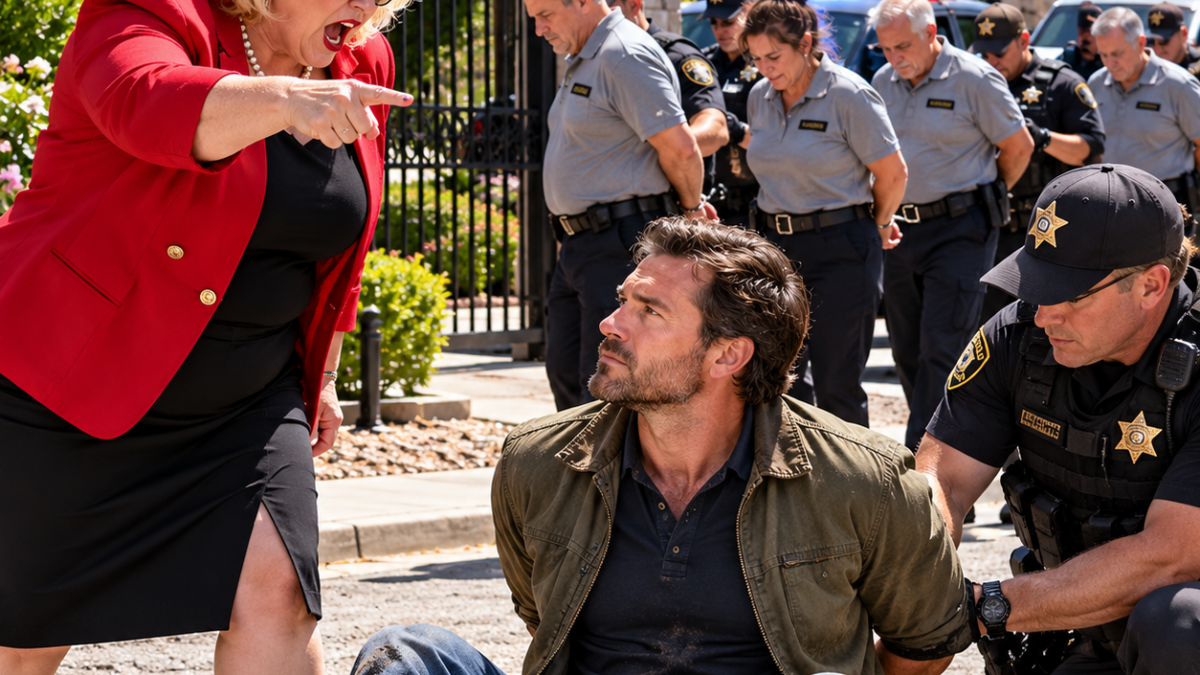
PART 2
I opened the folder without getting out of my truck.
The first page had my name already typed in bold letters near the top.
GIDEON PRICE.
Under it was a title long enough to make a tired person stop reading.
PERMANENT ACCESS, MAINTENANCE, AND ROADWAY ADMINISTRATION AGREEMENT.
That was the kind of title people used when they wanted to hide a surrender document inside harmless words.
I turned the first page.
Vanessa watched me closely.
Brock stood near my door with his hands on his belt.
The younger guard hovered near the rear of my truck, pretending not to be uncomfortable.
I read slowly.
The agreement said Blackridge Estates HOA would “administer and regulate” all access along Hawthorne Access Road.
It gave the association the authority to establish future access rules, maintenance charges, inspection procedures, security requirements, and penalties.
It granted Blackridge a right of first refusal if I ever sold any portion of my property.
It required me to waive any future objection to HOA resolutions affecting the road.
And buried deep in the fine print was the real poison.
If I signed, I acknowledged that Blackridge had lawful control over the road.
I closed the folder.
Vanessa lifted her chin.
“Well?”
“This is not an agreement.”
“It is a reasonable settlement.”
“No. It’s a permanent surrender disguised as paperwork.”
Her mouth tightened.
“Mr. Price, you currently owe Blackridge forty-six thousand eight hundred dollars in road-use penalties.”
I stared at her.
“For driving to my own house?”
“For unauthorized use of controlled access.”
“You invented those fines.”
“They are documented.”
“By whom?”
“The compliance office.”
“You mean your office.”
Her face went still.
That was the second time I saw the truth flicker under her polish.
“You are in a very difficult position,” she said.
“No, Vanessa. I’m sitting in my truck.”
“For now.”
Brock smiled.
The younger guard looked at the ground.
I tapped the folder.
“How many other people have you done this to?”
Vanessa’s eyes sharpened.
“What did you say?”
“You said penalties. You said settlement. You said access restructuring. That sounds practiced.”
Her voice cooled.
“You don’t know what you’re talking about.”
“I asked how many.”
She glanced at Brock.
Just for half a second.
But I saw it.
And the recorder in my pocket captured the pause.
Brock reached for my door handle.
“Step out.”
I looked at him.
“Do not touch me.”
Vanessa sighed as though I was testing her patience.
“Mr. Price, you have been offered every opportunity to handle this like a reasonable adult.”
“By signing away a road right you don’t own.”
“You can either cooperate now or explain your refusal later.”
“To whom?”
“To people with more authority than you.”
That sentence told me everything I needed to know about Vanessa Whitmore.
She did not understand authority.
She understood intimidation.
Those are different things.
I kept my hands visible.
“I am stating clearly that I do not consent to being touched, detained, searched, blocked, or deprived of my property.”
Brock opened my truck door.
The younger guard stepped closer.
I stayed seated.
Brock grabbed my left arm.
I did not resist.
That was hard.
Instinct tells you to pull back when someone grabs you.
But I knew what they wanted.
They wanted a struggle.
They wanted me angry.
They wanted a reason to say I had become threatening.
So I let my boots hit the pavement and kept talking.
“My name is Gideon Price. I am being physically removed from my vehicle by private security. My truck is trapped between two HOA-controlled gates on Hawthorne Access Road. I do not consent.”
“Stop narrating,” Vanessa snapped.
Brock ripped my phone from my hand.
“That is my property,” I said.
He handed it to Vanessa.
She glanced at the screen, saw the photos, and turned it off.
The younger guard reached into my truck and took my keys.
I looked directly at him.
“What’s your name?”
He froze.
Brock barked, “Don’t answer him.”
I read the patch on his shirt.
“T. Wallace.”
His eyes met mine for one nervous second.
Then he looked away.
Vanessa held up the folder again.
“You can still end this right here.”
“No.”
“You haven’t heard the consequences.”
“I have.”
“Then you understand you won’t leave until this is resolved.”
There it was.
I turned toward her slowly.
“Am I free to leave?”
She said nothing.
The silence stretched.
Brock shifted his weight.
Wallace swallowed.
I asked again.
“Am I free to leave?”
Vanessa removed her sunglasses.
Her eyes were cold.
“You will leave when I decide you can leave.”
The recorder caught every word.
A person can cross a line without realizing how permanent it is.
Vanessa crossed hers with perfect confidence.
She believed she was still inside the safe world of HOA language—violations, hearings, compliance, access control, board resolutions.
But the moment she admitted I could not leave unless she allowed it, this stopped being a property dispute.
It became detention.
And then she made it worse.
“Take him inside,” she told Brock.
He grabbed my arm again.
I let him lead me toward the guardhouse.
The younger guard walked behind us with my keys in his hand.
Vanessa followed with the folder.
The guardhouse was larger than it looked from the road. The front section had a desk, monitors, access panels, and a small coffee station. But off to one side was a steel door with no window.
A keypad glowed beside it.
Brock punched in a code.
The lock clicked.
He opened the door.
I looked inside.
A metal chair bolted to the floor.
Concrete walls.
One overhead light.
No window.
A camera mounted in the upper corner.
A clipboard hanging from a nail.
A small wall cabinet.
A drain in the floor.
I stopped.
Vanessa’s voice was quiet behind me.
“Go in.”
“What is this room?”
“Temporary compliance holding.”
I repeated it, slow enough for the recorder.
“Temporary compliance holding.”
Her jaw tightened.
“You’re very fond of repeating things.”
“Only the important parts.”
Brock shoved me forward.
I caught myself before I stumbled.
The door closed behind me.
The lock turned from the outside.
That sound is hard to explain unless you have heard it from the wrong side.
A lock from the outside does something to the air.
It changes the size of the room.
It changes the meaning of your body.
One second, you are a man standing in a building.
The next, you are a man being kept.
I stood still until their footsteps moved away.
Then I breathed.
Slow in.
Slow out.
I checked the recorder through my jacket.
Still running.
Battery good.
Then I studied the room.
Years of work had trained me to do that before panic could take over.
Three steps wide. Seven steps long.
Camera in the upper left corner.
Vent above the door.
Chair bolted down.
Scratches near the base of the wall.
Not one scratch. Many.
Some shallow. Some deep.
The kind made by shoes, metal, fingernails, maybe a belt buckle, maybe something dragged.
I moved to the clipboard.
At the top, written in black marker, were the words:
TEMPORARY COMPLIANCE HOLDING LOG.
Below that were dates.
Initials.
Times in.
Times out.
Seven entries.
Seven different sets of initials.
J.T.
M.P.
W.R.
D.L.
C.A.
H.N.
R.P.
One entry showed four hours and ten minutes.
Another showed five hours and forty-five.
One showed six and a half.
My chest tightened.
This room had not been built for me.
That was the first moment anger really reached me.
Until then, I had been controlled.
Observing.
Recording.
Thinking two steps ahead.
But looking at those initials, I felt the cold part of my anger break open.
Someone else had sat in that chair.
Someone else had heard that lock.
Someone else had been told signing was easier than waiting.
I moved to the wall cabinet and opened it.
Plastic zip ties.
A stack of blank forms.
A cheap first-aid kit.
A roll of evidence-style property bags, except there was no evidence here.
Only people’s phones.
Keys.
Leverage.
I closed the cabinet exactly as I found it.
Then I sat in the metal chair.
I did not bang on the door.
I did not yell.
Yelling wastes oxygen and gives cruel people proof that you are emotional.
Instead, I listened.
Brock’s voice moved outside the room.
Vanessa’s voice answered.
I heard pieces.
“…he’ll sign…”
“…no phone…”
“…morning at the latest…”
“…others folded faster…”
Others.
That word landed with the clipboard.
For anyone else, this might have been terrifying because it felt impossible to understand.
For me, it was terrifying because I understood it too well.
My day job was the one thing I had not told Vanessa.
Most people in the county knew me as a private man who owned a little land past Blackridge.
That was intentional.
I did not announce my work at cookouts or hardware stores.
I did not advertise it at the feed store.
I did not put it on my truck.
But I was a senior investigator with the state civil rights enforcement unit.
My cases often involved private security overreach, unlawful confinement, coercion, retaliation, and organizations that discovered just enough legal language to become dangerous.
That did not make my rights more valuable than anyone else’s.
It simply meant I knew what Vanessa was building before she realized she had shown it to me.
At 6:18 p.m., the door opened.
Brock stood there with a bottle of water.
He tossed it onto the floor.
It rolled near my boot.
“Vanessa says you get water if you behave.”
I looked at the bottle.
Then at him.
“Is food also conditional?”
He smirked.
“You’re not at a hotel.”
“No. Hotels have legal exits.”
His face hardened.
“You think you’re clever?”
“I think you should call the sheriff.”
He laughed.
“Sheriff Bell doesn’t come running because some trespasser doesn’t like our access policy.”
“I’m not trespassing.”
“You’re in our facility.”
“That may be the biggest problem you have.”
He took one step into the room.
“You want my advice? Sign the paper. Nobody cares about your little driveway.”
“It isn’t a driveway.”
“Road, driveway, trail, whatever.”
“It’s legal access.”
“It’s a problem for Blackridge.”
There it was again.
Expansion without saying expansion.
Control without saying taking.
I leaned back.
“Brock, did Vanessa tell you why this road matters so much?”
He didn’t answer.
His eyes shifted.
“She didn’t, did she?”
“Enjoy the water.”
He stepped out and locked the door again.
At 7:42 p.m., Vanessa came in.
She had removed her sunglasses and changed from polished public authority to controlled private anger.
The folder was under her arm.
Brock stood behind her.
The younger guard, Wallace, lingered near the hallway.
Vanessa placed the folder on my lap.
“Let’s stop wasting time.”
I did not touch it.
“You’re holding me in a locked room.”
“I’m giving you a chance to calm down.”
“I was calm when your guards pulled me out of my truck.”
“You were obstructive.”
“I asked to go home.”
“And you can. As soon as this is settled.”
“Meaning as soon as I sign.”
She stared at me.
“Meaning as soon as you make the responsible choice.”
I looked at the camera in the corner.
“Is this being recorded?”
Vanessa followed my eyes.
“For safety.”
“Good. Then the footage will show you brought a property agreement into a locked room where I’m being detained and told me I can leave if I sign.”
The silence was immediate.
Brock looked at the camera.
Vanessa’s lips thinned.
“Turn it off,” she said.
Brock hesitated.
“Now.”
He stepped into the hall.
A moment later, the little indicator light on the camera went dark.
Vanessa turned back to me.
“Better?”
I almost smiled.
Not because anything about it was funny.
Because she had just made the mistake every arrogant person makes.
She confused the evidence she controlled with all evidence that existed.
The recorder in my jacket kept running.
The dash camera in my truck outside had been running since the gate lowered behind me.
And because the guardhouse Wi-Fi reached the parking area, the footage had already begun syncing automatically to a secure cloud account.
Vanessa had taken my phone.
She had not taken the system I built for exactly this kind of risk.
“You understand,” I said, “that turning off your camera does not make this legal.”
She leaned closer.
“Let me explain something to you, Mr. Price. Blackridge is moving forward. This community is expanding. That road is necessary to the future safety, value, and development of hundreds of families.”
“There it is.”
“What?”
“The reason.”
Her expression sharpened.
“You are one property owner.”
“I am the property owner whose road you need.”
“That road should have been incorporated into the Blackridge access plan years ago.”
“But it wasn’t.”
“It will be.”
“Not by locking me in a room.”
She smiled slightly.
“You’re assuming anyone will describe it that way.”
I held her eyes.
“You just did.”
For the first time, she looked uneasy.
Only briefly.
Then she recovered.
“You are not a victim here.”
“No?”
“You are a man using an old technicality to block progress.”
“My deed is not a technicality.”
“Your stubbornness is costing this community.”
“Your greed built a gate across my access road.”
Brock stepped forward.
Vanessa raised her hand.
“No. Let him talk. He needs to feel brave for a little longer.”
She picked up the folder and placed it on the chair beside me.
“Here is what happens now. You can sign tonight and leave with the penalties waived. Or you can refuse, spend the night considering your position, and face the full enforcement power of this association in the morning.”
I asked quietly, “Are you saying I stay in this room overnight if I don’t sign?”
She said, “If necessary.”
“Say it clearly.”
Her eyes narrowed.
“You will stay here until you understand what your signature is worth.”
That was enough.
The recorder had it.
Intent.
Condition.
Signature for freedom.
I nodded.
“Thank you.”
She blinked.
“Thank you?”
“For being clear.”
Her face flushed.
“Leave him,” she snapped.
Brock shut the door harder than necessary.
The lock turned again.
After they left, I let my head rest briefly against the concrete wall.
That was the first time fear hit me fully.
Not panic.
Not helplessness.
But fear with edges.
What if the recorder failed?
What if the dash upload failed?
What if Vanessa had more loyal guards than nervous ones?
What if this went from coercive detention to something uglier before anyone outside noticed?
A person can understand evidence and still feel the small animal part of his mind measuring the room.
No windows.
One door.
No handle.
No phone.
No weapon.
No way to know what lies someone outside is telling.
I forced myself to breathe.
Then I returned to the checklist.
Names.
Times.
Statements.
Room details.
Objects.
Sequence.
At 8:56 p.m., footsteps stopped outside.
Wallace opened the door with a paper cup of water.
He looked paler than before.
“You need anything?” he asked quietly.
“My phone.”
“I can’t.”
“My keys.”
“I can’t.”
“To leave.”
He looked down.
“I can’t.”
I stepped closer.
“Wallace, you understand that ‘I can’t’ is not a defense if you’re helping them keep me in here.”
His throat moved.
“I didn’t touch you.”
“You know I’m locked inside.”
“I just started here.”
“Then start thinking for yourself.”
He looked toward the hallway.
“Brock said legal cleared it.”
“Did you see that clearance?”
“No.”
“Did Vanessa show you a court order?”
“No.”
“Did the sheriff deputize you?”
His face tightened.
“No.”
“Then you are a private guard standing outside a locked room where a man is being held because he won’t sign a property document.”
His eyes filled with panic.
“Brock will fire me.”
“That may become the least of your problems.”
Before he could answer, Brock shouted from down the hall.
“Wallace!”
The young guard flinched.
He shut the door.
The lock clicked.
At 10:58 p.m., the system on my truck sent the alert.
I did not see it happen.
But I knew the time because I had set the threshold myself.
If my vehicle remained stationary in an unexpected location for more than six hours after an activated field recording, my designated emergency contact received a location notice.
That contact was Elise Marlow.
Assistant prosecutor.
Colleague.
Friend.
The kind of person who could read a fact pattern at midnight and know whether a judge needed to be woken up.
Later, Elise told me exactly what happened.
She was at her kitchen table reviewing warrant language for another case when the alert hit her phone.
My truck.
Stationary.
Blackridge guardhouse.
Six hours.
No check-in.
She called me.
Straight to voicemail.
She called again.
Nothing.
Then she opened the secure field video link.
The dash footage loaded.
She saw the gate come down behind my truck.
She saw Brock at my window.
She saw Vanessa arrive.
She saw me hold up my hands and state that I did not consent.
She saw my phone taken.
She saw my keys removed.
She saw two guards escort me into the side of the guardhouse.
And then she saw nothing showing me leave.
Elise did not panic.
She called Sheriff Conrad Bell.
Conrad was fifty-three, broad-shouldered, gray at the temples, and so steady that even emergencies seemed to slow down around him.
He watched the footage once.
Then a second time.
Then he said, “That’s not an HOA issue. That’s a detention.”
Within twenty minutes, they were checking land records.
Hawthorne Access Road was not Blackridge property.
Blackridge had no recorded ownership interest in it.
No lawful authority to block it.
No court order.
No easement control.
No right to seize my keys.
No right to hold me in a guardhouse.
The permit file for the structure made it worse.
Blackridge had described the guardhouse as a decorative access and monitoring station.
Nothing in the permit mentioned a detention room.
Nothing mentioned holding cells.
Nothing mentioned confinement.
Conrad also pulled the security company’s license information.
Brock and his team were licensed for private property monitoring and access support.
They were not law enforcement.
They had no authority to detain a person over a civil property dispute.
Then Elise froze a frame from my dash camera.
Behind Vanessa, through the open guardhouse door, was a whiteboard.
The image was blurry, but the heading was readable.
DETENTION LIST.
Under it were names.
Not just initials.
Names.
Elise later said that was the moment she stopped thinking only about me.
Because if there was a detention list, then I was not the first.
Conrad chose not to drive in with lights blazing right away.
He knew Vanessa might destroy evidence.
Instead, he sent a plainclothes deputy near the gate.
The deputy walked up pretending to be lost and asked whether the road connected to the county route beyond Blackridge.
The guard on duty told him the road was closed until morning due to an internal security matter.
From where he stood, the deputy saw my truck trapped behind the barrier.
He got the plate number.
He backed away calmly.
That confirmation went to the judge.
While Elise prepared the emergency warrant request, she found the financial line item that made everyone in the room go silent.
RESIDENT COMPLIANCE DETENTION.
Tens of thousands of dollars.
Budgeted.
Approved.
Hidden inside vague security spending.
Vanessa had not lost her temper and improvised a bad decision.
She had built a system.
At 3:17 a.m., the judge signed.
Search warrant.
Evidence seizure authorization.
Emergency entry authority.
Arrest warrants for those directly involved.
Inside the locked room, I knew none of that.
I only knew the room had grown colder and my back ached from the metal chair.
At 3:48 a.m., Brock returned.
The door opened so hard it struck the wall.
He came in with the folder and slammed it on the chair.
“Sign.”
His eyes were red.
His confidence had begun to rot around the edges.
I looked at the clock.
Almost four in the morning.
“No.”
“You’ve been in here all night for nothing.”
“No. I’ve been in here all night because you locked the door.”
He stepped close.
“Nobody knows where you are.”
I looked at him for a long moment.
“Brock, for your sake, I hope that’s true.”
That unsettled him.
Good.
Wallace stood outside the door, pale and silent.
Brock jabbed a finger toward the paper.
“Vanessa is done playing.”
“So am I.”
“You think you can walk out of here and sue us?”
“I think you should stop talking.”
His face twisted.
“You don’t get to question me.”
“Who ordered the door locked?”
He blinked.
“What?”
“Who ordered it?”
“You’re not interviewing me.”
“Who took my keys?”
His breathing got heavier.
“Shut up.”
“Who decided I wasn’t allowed to leave?”
He stepped so close I could smell coffee on his breath.
“I did.”
The recorder caught it.
“You did?”
“Yes. I did. Because Blackridge has the right to detain anyone found violating association-controlled property.”
I nodded slowly.
“There’s your problem.”
“My problem?”
“This is not association-controlled property.”
He laughed.
“You’re sitting in our guardhouse.”
“No. I’m sitting in a room Blackridge built partly inside my property line.”
The laugh died.
“What?”
“You didn’t know?”
His eyes shifted toward Wallace.
I continued.
“The road is my legal access. The boundary runs closer than Vanessa told you. Your gate blocks my easement. And according to the survey I reviewed last month, this room sits just over the line.”
Brock’s face changed in stages.
Disbelief.
Anger.
Then fear.
Not because he believed me completely.
Because some part of him suspected Vanessa had not told him everything.
Before he could respond, a guard shouted from the hallway.
“Brock!”
“What?”
“There are vehicles outside.”
He turned.
“What kind of vehicles?”
No answer.
Then another voice said, “A lot of them.”
Brock left fast.
The door closed again.
This time, the lock sounded less like power and more like desperation.
The building began to move around me.
Footsteps.
Radios.
Drawers opening.
Vanessa’s voice.
“Get him out of there.”
Brock answered, “Now?”
“Yes, now!”
Another voice: “The road is blocked.”
“Then delete the video.”
That sentence came clear through the vent.
“Pull the drives. Get the logs. Anything with names goes away.”
I stood.
Outside, dawn was beginning.
A faint gray strip appeared under the door.
For the first time all night, I smiled.
Because Vanessa did not understand that the evidence she wanted destroyed had already multiplied beyond her reach.
The dash footage was in the cloud.
The recorder was still running.
Deputies were outside.
The judge had signed.
And every order she gave now added another layer.
At 5:06 a.m., the guardhouse phone rang.
Brock answered first.
His voice was tight.
“This is Blackridge security.”
A pause.
“This is private property.”
Another pause.
“I said this is private property.”
Silence.
Then Vanessa grabbed the phone.
“Sheriff Bell, you have no authority to enter this facility without proper documentation.”
A long pause.
“You can present the warrant at the gate.”
Another pause.
“No one enters until I verify it with counsel.”
She slammed the phone down.
“Block the barrier,” she ordered. “Nobody opens anything.”
Outside, Conrad Bell’s voice came over a loudspeaker.
“Blackridge security personnel. This is Sheriff Conrad Bell. Step away from the gate and put your hands where deputies can see them.”
Nobody moved.
I could feel it through the walls.
That last stubborn second when people who have pretended to hold power decide whether to surrender to real authority.
Vanessa chose wrong.
“Do not move!” she shouted.
Conrad’s voice returned.
“This is your final instruction. Step away from the gate.”
Silence.
Then one clean command.
“Cut it.”
Metal screamed.
A chain dropped.
Something heavy snapped loose.
Boots hit pavement.
Deputies moved in fast, controlled, and loud.
“Hands visible!”
“Step back!”
“Down on the ground!”
“Do not reach!”
Brock shouted, “You can’t do this!”
A deputy answered, “Face down. Now.”
Then I heard the sound of Brock hitting the pavement.
A radio clattered.
Another guard yelled that he was complying.
Wallace’s voice cracked.
“I’m not resisting! I’m not resisting!”
One by one, the men who had stood behind that gate all night were taken down, cuffed, searched, and moved into a line.
The door to the guardhouse opened.
Heavy boots entered the hall.
Vanessa shouted something about association counsel.
A deputy told her to step aside.
Then footsteps stopped outside my door.
Someone tried the handle.
Locked.
Sheriff Bell’s voice came through the steel.
“Gideon?”
“I’m here.”
“You hurt?”
“No.”
“Step back.”
I moved to the far wall.
A metal tool slid into the lock mechanism.
There was a sharp crack.
The door swung open.
Fresh air came in.
Not much.
Just enough.
But after almost twelve hours in that room, it felt like the entire world had opened.
Sheriff Conrad Bell stood in the doorway.
Behind him were two deputies, Elise Marlow, and a crime-scene technician holding a camera.
Conrad looked me over once.
His face did not show much.
His eyes did.
“You okay?”
“I will be.”
“How long?”
I looked at the clock.
“Eleven hours and forty-six minutes since the door locked.”
Elise stepped forward.
“You still have the recorder?”
I touched my jacket.
“Yes.”
“Keep it running until we secure the room.”
I nodded.
Then I pointed to the wall cabinet.
“Zip ties inside. My phone. My keys. Maybe others. Clipboard has seven prior entries. Camera was turned off after Vanessa realized what she’d said.”
Conrad looked past me into the room.
His jaw flexed.
“Photograph everything.”
As the technician entered, I stepped into the hallway.
Brock was outside, cuffed on his knees.
When he saw me, he looked away.
Vanessa stood near the front desk, surrounded by deputies but not yet cuffed. She was talking quickly, hands raised, trying to turn disaster into misunderstanding.
“This is a civil access matter,” she said. “Mr. Price was not harmed. He was being held temporarily while we resolved a compliance dispute.”
Conrad stepped toward her.
“Mrs. Whitmore, you need to stop talking.”
“I will not be treated like a criminal for protecting my community.”
Elise emerged from the back office with a thick folder sealed in an evidence bag.
The label faced outward.
COMPLIANCE ACQUISITIONS — ROADWAY AND LAND ACCESS
Vanessa saw it.
All the color left her face.
That was the moment I knew the folder mattered even before I knew what was inside.
The search uncovered the rest.
Forced easement drafts.
Penalty schedules.
Lists of nearby landowners.
Notes describing who was “pressure-sensitive,” who was “financially vulnerable,” who was “likely to settle,” and who had “family medical concerns.”
My name appeared with one word beside it.
CRITICAL.
Hawthorne Access Road was the key route for a planned luxury expansion Blackridge wanted to build beyond its current boundary.
My land stood in the way.
My road rights stood in the way.
That was why Vanessa needed the signature.
Not safety.
Not community order.
Money.
Expansion.
Control.
Then Elise found the email.
Vanessa had sent it to Brock one week earlier.
PRICE LEAVES AFTER WE HAVE THE EASEMENT.
Seven words.
Enough to destroy every excuse.
Conrad walked to Vanessa.
“Vanessa Whitmore.”
She stared at the email in Elise’s hand.
“Sheriff, this is being taken out of context.”
“Turn around.”
“You don’t understand the legal background.”
“Turn around.”
“This is not what it looks like.”
Conrad’s voice did not rise.
“It looks like you locked a man in a room overnight to force a property signature.”
She swallowed.
“I want my attorney.”
“You’ll get that.”
He nodded to a deputy.
Vanessa turned slowly.
The cuffs clicked around her wrists inside the same guardhouse she had built to frighten others.
No one cheered.
No one clapped.
The moment was too heavy for that.
Only hours earlier, Vanessa had stood outside my locked door deciding when I would be allowed to leave.
Now she was the one being escorted through that same building under custody.
She looked at me once as they walked her past.
Her eyes were wet, but not with remorse.
With disbelief.
“You should have told me who you were,” she whispered.
That sentence chilled me more than the room had.
Because she still thought the mistake was choosing the wrong victim.
I stepped closer.
“Vanessa, this was wrong before you knew my job.”
She said nothing.
“If I sold lawn mowers, fixed roofs, delivered packages, or lived on disability checks, you still had no right to lock me in that room.”
Her face hardened.
I continued.
“The law protecting people from being held against their will does not change based on who they work for.”
For once, Vanessa Whitmore had no answer.
A deputy guided her outside.
The morning sun was fully up now.
Every guard who had blocked that gate was cuffed, questioned, or sitting on the asphalt with deputies standing over them.
Wallace was crying quietly while giving a statement.
Brock kept his head down.
The guardhouse door stood open behind them.
The steel gate that had trapped my truck hung broken at one side.
Residents had begun gathering in bathrobes, sweatpants, slippers, and shocked silence along the sidewalks inside Blackridge.
Some held phones.
Some whispered.
Some stared at me like they could not decide whether I was the victim, the villain, or the man who had exposed what they should have noticed long ago.
One older man approached while I stood beside my truck.
His name was Daniel Kerr.
I knew him only by sight.
He lived near the entrance.
“Mr. Price,” he said softly.
I turned.
“My wife and I saw them take you inside yesterday.”
I looked at him.
The sentence hit harder than I expected.
“You saw?”
He nodded, shame already rising in his face.
“We thought… we thought security must have had a reason.”
“For taking my phone?”
His eyes dropped.
“For all of it.”
“And you didn’t call anyone.”
“No.”
The quiet after that was painful.
He twisted a baseball cap in his hands.
“Vanessa told us outsiders had been threatening the community. She said the new guardhouse was for protection. She said if security brought someone inside, it meant the situation was serious.”
I looked toward the building.
“And you believed her.”
“Yes.”
He swallowed.
“I’m sorry.”
Part of me wanted to say sorry was late.
Part of me wanted to ask how many screams people could ignore if the person screaming was outside their HOA fence.
But another part of me saw that he was not making excuses.
He was finally seeing the room behind the language.
So I said, “Next time, don’t assume a locked door is justified because the person holding the key sounds official.”
His eyes reddened.
“No, sir.”
By afternoon, the story had spread beyond Blackridge.
News vans arrived.
County officials came.
The guardhouse was sealed.
The security company’s contract was suspended.
Blackridge board members, who had spent months approving Vanessa’s “safety upgrades” without asking enough questions, suddenly could not distance themselves fast enough.
But distance would not be easy.
The financial records showed a budget line labeled RESIDENT COMPLIANCE DETENTION.
The permit records showed the room had never been disclosed as a holding area.
The security logs showed seven prior detentions.
The seized files showed forced agreements and fabricated penalties.
And the recovered communications showed Vanessa’s intent.
Over the next week, investigators contacted every person connected to the initials on the clipboard.
Some were residents.
Some were contractors.
Some were neighboring landowners.
One was Margaret Pell, a widow in her late sixties who lived outside Blackridge and had disputed a drainage access fee.
She had been brought into the same room, denied her phone, and kept there nearly three hours until she signed a payment agreement she did not understand.
When she gave her statement, she cried—not only because of what happened, but because she had spent two years wondering if she had exaggerated it in her own mind.
That is what people like Vanessa do.
They do not only take money or signatures.
They take certainty.
They make you wonder whether you are weak, dramatic, confused, or foolish for objecting.
Another name was Wade Prater, a retired survey engineer.
He had fought Blackridge for years over a boundary line the HOA wanted to shift to support future development plans.
His complaints had disappeared into Vanessa’s compliance office.
When investigators called him, Wade showed up with boxes of survey records, old plats, correspondence, photographs, and notes.
He had been right all along.
Blackridge had been manipulating boundary language, access claims, and internal maps to pressure property owners beyond its legal reach.
My case did not create the pattern.
It exposed it.
At an emergency community meeting, Blackridge residents packed the clubhouse until people were standing against the walls.
Some were angry.
Some defensive.
Some embarrassed.
Some still wanted to believe Vanessa had gone too far for good reasons.
That changed when Margaret Pell stood up.
She was small, gray-haired, and shaking so badly she had to hold the podium with both hands.
“I signed because I was afraid,” she said.
The room went silent.
“I paid money I did not owe because I thought nobody would believe me.”
No one interrupted.
She looked at the board.
“You let her become bigger than the rules.”
That sentence stayed in the room after she sat down.
Wade Prater spoke next.
Then a contractor.
Then a former resident.
Then Wallace, the young guard, appeared through counsel and confirmed the informal instructions Brock had given new security hires.
Keep disputes inside the gate.
Do not involve outside authorities unless Vanessa approves.
Bring resistant people into compliance holding.
Let the paperwork team handle signatures.
By the end of the meeting, the board voted unanimously to remove Vanessa Whitmore from every remaining position of authority.
But removing her did not erase what had happened.
Blackridge still had to audit years of agreements.
Refunds had to be considered.
Prior settlements were reopened.
The county reviewed every barrier, camera, road restriction, and access claim the HOA had installed.
The security company faced its own investigation.
Brock tried to blame Vanessa.
Vanessa tried to blame Brock.
The documents blamed them both.
As for Hawthorne Access Road, the county records were formally reaffirmed.
My access was uninterrupted and valid.
Blackridge had no ownership over the road.
The gate was unlawful.
The guardhouse had been built without proper disclosure.
The barrier came down within days.
I stood there when they removed it.
I needed to see it gone.
A crew unbolted the steel frame. A machine lifted the barrier arm that had dropped behind my truck. The sign that said BLACKRIDGE ESTATES HOA PRIVATE ACCESS was lowered onto a flatbed.
The road looked strange without it.
Open.
Ordinary.
Almost innocent.
Sheriff Bell stood beside me.
“You sure you’re all right?” he asked.
“I’m all right.”
“You were in there a long time.”
“Long enough.”
He looked down the road.
“Was it worth all this? The fight over the road?”
I thought about the room.
The scratches.
The clipboard.
Margaret Pell.
Wade Prater.
The folder with my name marked critical.
Then I looked at Hawthorne Access Road stretching toward my land.
Before that night, it had been my way home.
After that night, it became proof that rights are only as strong as people are willing to defend them.
“Yes,” I said. “It matters more now than it did before.”
A week later, I had a small sign installed where the gate once stood.
Nothing dramatic.
No mention of Vanessa.
No mention of arrests.
Just plain words.
PRIVATE ROAD
NO HOA AUTHORITY
LEGAL ACCESS PROTECTED
Some people thought I should have written more.
I didn’t need to.
The truth does not always have to shout.
Months passed.
The criminal cases moved slowly, the way real cases do.
Hearings were scheduled.
Attorneys argued.
Evidence was reviewed.
Vanessa’s public image collapsed faster than the legal process moved.
The woman who once posed in HOA newsletters beside flower beds and fountain dedications was now known across the county for the illegal room hidden inside the guardhouse.
The Blackridge board replaced its leadership.
Residents demanded outside audits.
Every HOA in the county suddenly wanted to know whether its security policies could survive legal review.
And Hawthorne Access Road stayed open.
One evening near sunset, I drove home along that same stretch.
The sky was orange behind the pines.
My truck rolled over the exact pavement where I had been trapped between two gates.
No guard stepped out.
No camera followed me.
No one asked for my ID.
No one demanded my signature.
The concrete pad where the guardhouse had stood was still there, though grass had begun growing through cracks near the edge.
I slowed down beside it.
For a second, I could still hear the lock.
Then I heard another sound in my memory.
The gate being cut open at dawn.
That was the sound I chose to keep.
Because that was the sound of fear losing authority.
I drove forward.
At the curve, I looked once in the rearview mirror.
The road behind me was clear.
Vanessa Whitmore had believed power was something she could build out of steel, cameras, uniforms, and fear.
She believed a private association could create its own prison and call it compliance.
She believed an old deed, a quiet landowner, and a lonely access road would fold under enough pressure.
She was wrong.
By sunrise, every guard who helped keep me there was in handcuffs.
The president who ordered it was under arrest.
The files were seized.
The older victims were finally being heard.
The road was reopened.
And I drove home without asking anyone for permission.
Because Blackridge never owned that road.
Vanessa never owned my rights.
And no HOA in America gets to lock a man in a room overnight and call it community rules.
[EXPANDED ENDING — 3000 WORDS]
For a long time after Sheriff Bell opened that steel door, I kept hearing the lock in my head.
Not the deputies cutting the gate.
Not Brock shouting outside.
Not Vanessa arguing about association authority while her voice shook for the first time all night.
The sound that stayed with me was smaller than all of that.
Click.
A lock turning from the outside.
A sound that lasted less than one second but changed the meaning of the entire night.
When the deputies stepped into the room, the first thing I noticed was not the fresh air or the light from the hallway. It was how small that room looked with other people standing in it. All night, it had felt like the whole world had shrunk to those concrete walls, that bolted chair, that dark camera, that clipboard of initials, and the steel door Vanessa believed would break me.
But when Sheriff Bell walked in with two deputies behind him, the room looked exactly like what it was.
A private cell.
Illegal.
Ugly.
Unforgivable.
“Elise,” Sheriff Bell said without taking his eyes off the wall cabinet, “photograph everything before it moves.”
Elise Marlow stepped in carefully, wearing gloves, her face pale but focused. She had seen terrible things in her work, but I could tell this one landed differently. Maybe because she knew me. Maybe because the room looked so ordinary from the outside. Maybe because people always imagine abuse arriving with monsters, not laminated HOA badges and a fresh coat of paint.
She photographed the chair.
The lock.
The camera.
The scratches at the bottom of the wall.
Then she took the clipboard from its nail and stared at it for a long second.
Seven entries.
Seven initials.
Seven times someone had likely sat where I sat.
“That’s not just you,” she said quietly.
“No,” I answered. “It never was.”
Sheriff Bell opened the cabinet.
Inside were the zip ties, the property bags, my phone, my keys, and two phones that did not belong to me.
The sheriff’s expression changed when he saw those phones.
He did not curse. He did not yell.
But his jaw set in a way I had seen before on men who had just realized a case was worse than they expected.
“Bag all of it,” he said.
A deputy lifted the zip ties with gloved hands and placed them into an evidence bag.
Another deputy found my keys and held them up.
“Mr. Price?”
I nodded.
“Those are mine.”
He bagged them too.
Vanessa was still in the front lobby trying to talk her way out of what everyone could now see.
“It was a controlled compliance measure,” she said.
Her voice carried through the hallway.
“Nobody was harmed. Mr. Price was agitated. We were preventing escalation.”
I stepped into the hall and saw her standing between two deputies, her white blazer wrinkled, her hair no longer perfect, her hands moving as if she could still conduct the room.
Sheriff Bell turned toward her.
“Mrs. Whitmore, stop talking.”
She looked offended.
That almost made me laugh.
After everything she had done, she still believed the worst thing happening to her was being spoken to without deference.
“This is an HOA matter,” she snapped.
“No,” Sheriff Bell said. “This is a locked-room matter. This is a seized-property matter. This is a man-held-overnight-against-his-will matter.”
Her mouth opened, but no words came out.
Then Elise emerged from the back office holding a thick folder sealed in an evidence sleeve.
On the front, in block letters, was written:
COMPLIANCE ACQUISITIONS — ROADWAY AND LAND ACCESS.
Vanessa saw it.
For the first time all morning, she stopped trying to explain.
That folder did what no argument could.
It exposed the reason.
The deputies spread the contents across the guardhouse desk after photographing everything in place. I stood several feet away, wrapped in a sheriff’s department blanket I did not remember accepting, watching my own name appear on documents I had never seen.
PRICE — HAWTHORNE ACCESS CRITICAL.
Critical.
Not neighbor.
Not owner.
Not citizen.
Critical.
In Vanessa’s files, I was not a person. I was an obstacle.
There were maps of Blackridge Estates and the land beyond it. There were colored routes showing proposed future roads. There were notes about expansion phases, luxury lots, estimated home values, projected access costs, and “external landowner resistance.”
External landowner.
That was me.
That was Wade Prater.
That was Margaret Pell.
That was anyone outside Vanessa’s authority who happened to own something she wanted.
The planned expansion was worth tens of millions of dollars if Blackridge could secure control over Hawthorne Access Road and the surrounding access points. Without my easement rights, the project became expensive, slow, and vulnerable to challenge.
With my signature, Vanessa could present the whole thing as settled.
That was why she had blocked me.
That was why she invented fines.
That was why she tried to force an agreement in a locked room.
Not safety.
Not order.
Not community protection.
Money.
Land.
Control.
Then Elise found the email.
It had been printed and filed like Vanessa had been proud of it.
PRICE LEAVES AFTER WE HAVE THE EASEMENT.
Seven words.
Seven words that stripped away every polished excuse she had tried to build.
Sheriff Bell read it once.
Then he looked at Vanessa.
“Turn around.”
Her face went blank.
“What?”
“Vanessa Whitmore, turn around.”
“You do not understand the legal context.”
“I understand enough.”
“This was a civil negotiation.”
“You locked him in a room overnight.”
“He refused to cooperate.”
“You took his phone.”
“For security reasons.”
“You took his keys.”
“To prevent escalation.”
“You told your staff he leaves after you get the easement.”
She stared at the email in Elise’s hand.
That was when I knew she finally understood.
Not that what she had done was wrong.
I still do not believe Vanessa truly understood wrong the way ordinary people understand it.
She understood exposure.
She understood evidence.
She understood that her language had failed her.
A deputy guided her hands behind her back.
The cuffs clicked.
That sound should have felt satisfying.
Part of me expected it to.
Instead, it felt heavy.
Because once the cuffs went on Vanessa, the night did not become smaller. It became larger.
It was no longer just about me sitting in that room.
It was about every person who had sat there before me.
It was about the homeowners who paid dues without knowing they were funding something called compliance detention.
It was about the people who had signed documents because they were tired, scared, embarrassed, or alone.
It was about how easily a private association had built a shadow system of punishment while everyone around it assumed official-looking people must be acting officially.
Vanessa looked at me as the deputy led her past.
Her eyes were wet, but not soft.
“You should have told me who you were,” she whispered.
That sentence cut deeper than any threat she had made.
I stepped closer.
“No, Vanessa. You should have known you couldn’t do this to anybody.”
She blinked.
I continued.
“If I sold lawn mowers, delivered groceries, cleaned gutters, or lived on Social Security, you still wouldn’t have had the right to lock me in that room.”
For the first time since I met her, she had nothing to say.
Outside, dawn had fully broken over Blackridge Estates.
The guards who had stood behind that gate all night were now sitting or kneeling on the pavement, wrists cuffed behind them. Brock Hansley sat near the broken barrier arm, his tactical vest removed, his face turned toward the asphalt.
He had spent the night telling me nobody knew where I was.
Now everyone knew exactly where he was.
Wallace, the young guard, sat apart from the others. He was crying quietly while giving his statement. I did not feel sorry for him exactly, but I understood the look on his face. It was the look of someone who had followed orders until the orders became evidence.
He told deputies about the informal training.
Do not call outside law enforcement unless Vanessa approves it.
Keep access disputes inside the gate.
Use compliance holding for resistant owners.
Let the office handle the paperwork.
Never put the word detention in reports.
Except they had put it everywhere.
On clipboards.
In budgets.
In files.
That was the arrogance of people who believe no one will ever look closely enough.
By noon, residents had gathered near the entrance.
Some stood in bathrobes and slippers. Some held phones. Some whispered. Some looked ashamed. Some looked angry for the first time, though I was not sure whether they were angry at Vanessa or angry that the truth had become public.
A man named Daniel Kerr approached me beside my truck.
I had seen him before. He lived near the entrance and waved sometimes when I drove past.
That morning, he could barely look at me.
“Mr. Price,” he said, twisting a baseball cap in his hands. “My wife and I saw them take you inside yesterday.”
I looked at him.
“You saw it?”
He nodded.
“We were on the porch.”
“And you didn’t call anyone?”
His face reddened.
“No.”
I waited.
He swallowed hard.
“Vanessa told us there had been threats from outside owners. She said the guardhouse was for community protection. She said if security brought someone inside, there was a serious reason.”
“You believed her.”
“Yes.”
His voice broke.
“I’m sorry.”
Sorry did not unlock the door.
Sorry did not give me back those hours.
Sorry did not help the seven people on that clipboard.
But I looked at Daniel’s face and saw something more useful than guilt.
I saw recognition.
“Next time,” I said, “don’t assume a locked door is justified because the person holding the key sounds official.”
He nodded slowly.
“I won’t.”
That afternoon, investigators sealed the guardhouse.
Blackridge’s security contract was suspended.
The county began reviewing every access control structure, internal compliance policy, gate restriction, easement demand, and road-use penalty connected to Vanessa’s presidency.
At first, the Blackridge board tried to distance itself.
They released a statement saying they were shocked.
That word appeared three times.
Shocked by the allegations.
Shocked by the evidence.
Shocked by the conduct of individuals acting outside board values.
But the financial records made shock a difficult position to maintain.
Resident Compliance Detention was not hidden in Vanessa’s diary.
It was in the budget.
The guardhouse was not built overnight.
It had plans, invoices, contractors, electrical work, security installation, access panels, and board-approved funding.
Maybe not every board member knew the room’s purpose.
Maybe some had avoided asking.
But avoiding a question is sometimes just another way of protecting the answer.
Within days, reporters were calling it the Blackridge Guardhouse Scandal.
I hated that phrase.
Scandal sounded like gossip, like a secret romance or a stolen campaign fund.
This was not gossip.
This was confinement.
Coercion.
A private organization using fear to acquire property rights.
The criminal charges began with Vanessa, Brock, and the guards directly involved in my detention. False imprisonment. Coercion. Conspiracy. Tampering with evidence. Unlawful restraint. Additional allegations tied to attempted destruction of records and the broader property scheme.
The final charges would be shaped by prosecutors, judges, and evidence.
But the moral shape of the case was obvious from the first morning.
They had built a room.
They had put people in it.
They had used locked doors to make signatures happen.
One week after the arrest, Blackridge held an emergency community meeting.
I did not want to go.
I was tired of the place. Tired of the sign. Tired of the road. Tired of seeing my name in documents written by people who had reduced me to a problem.
But Elise told me something before the meeting.
“The others may speak,” she said. “If they do, you should be there.”
So I went.
The clubhouse was packed.
People stood along the walls. Some were residents. Some were neighboring landowners. Some were reporters waiting outside because they were not allowed in.
The board looked smaller than usual at the front table.
Vanessa’s chair was empty.
For years, I had heard people describe her as commanding. That night, the room felt like everyone was noticing how much space her absence left.
The acting board president began with apologies.
Careful apologies.
Legal apologies.
The kind that sound sincere while trying not to admit liability.
Then Margaret Pell stood.
She was small, gray-haired, and shaking so badly the woman beside her touched her elbow.
“I was in that room,” Margaret said.
The clubhouse went silent.
She unfolded a paper but barely looked at it.
“I live outside Blackridge. My husband had just died. I disputed a drainage access fee because I did not owe it. Two guards brought me into the guardhouse. They said it would be quicker if I discussed it privately.”
Her voice trembled.
“They took my phone. They told me the fee would double if I kept arguing. They left me in that room until I signed a payment agreement.”
No one moved.
“I told myself it wasn’t that bad. I told myself maybe I misunderstood. I told myself no one would believe an old widow over an HOA president.”
Tears ran down her face.
“Then I saw the news, and I realized I had not imagined it.”
That sentence broke the room.
Not loudly.
Not dramatically.
But you could feel the shame move through people.
Because Margaret was not a headline.
She was someone’s neighbor.
Someone they had seen at the grocery store.
Someone they might have waved to while she carried the memory of that locked room alone.
Then Wade Prater spoke.
He was a retired survey engineer with a voice like gravel and a stack of documents under one arm.
He had fought Blackridge for years over a boundary line Vanessa wanted shifted for the expansion. His complaints had gone nowhere because every complaint had been routed back through Vanessa’s compliance office.
“They treated me like a crank,” Wade said. “Old man yelling about survey pins.”
He placed his records on the table.
“The pins were right.”
Others followed.
A contractor.
A delivery company owner.
A former resident.
Even Wallace’s written statement was read through counsel. He admitted new guards were told to keep certain disputes inside the gate and avoid outside authorities.
By the end of the meeting, the board voted unanimously to remove Vanessa from every remaining role and begin a full audit of past compliance agreements.
But the vote did not feel like the end.
It felt like the first honest beginning.
When they asked if I wanted to speak, I almost declined.
Then I saw Margaret sitting in the third row, hands folded, eyes lowered.
So I stood.
“I’m not here to punish residents for what Vanessa did,” I said. “I’m not here to take your homes. I’m not here to block your streets. I’m not here because I enjoy conflict.”
The room stayed quiet.
“But every person here needs to understand what happened. An HOA is not a government. A private security guard is not a sheriff. A board resolution is not a deed. And a locked room does not become legal because somebody calls it compliance.”
Several people looked down.
“Hawthorne Access Road is my legal access. It always was. It remains so now. Blackridge had no right to block it, no right to take my keys, no right to demand my signature, and no right to put me or anyone else in that room.”
I paused.
“This is bigger than me because I had systems in place. I had a recorder. I had a dash camera. I had an emergency contact who knew what to do. But rights should not depend on whether the victim knows how to build a case while being abused.”
Margaret looked up then.
“That is why this matters,” I said. “Because the next person locked in that room might not have had any of those things.”
No one clapped.
I was glad.
Clapping would have made it feel too easy.
The gate came down three days later.
I stood near the shoulder while a crew unbolted the steel frame.
The barrier arm that had trapped my truck was lifted by a machine and lowered onto a flatbed trailer. The Blackridge sign was removed. The electronic card reader was disconnected. The cameras were taken down and bagged.
Sheriff Bell stood beside me, hands in his jacket pockets.
“Road looks different,” he said.
“Looks like a road again.”
He nodded.
“Was it worth it?”
I looked down Hawthorne Access Road.
Past the curve were my trees, my fence line, my house, my quiet acres waiting beyond the pines.
Before that night, the road had simply been my way home.
After that night, it had become something else.
A line.
A test.
Proof that rights ignored become rights weakened.
“Yes,” I said. “It matters more now than it did before.”
A week later, I put up a small sign at the spot where the barrier had dropped behind me.
PRIVATE ROAD
NO HOA AUTHORITY
LEGAL ACCESS PROTECTED
No threats.
No names.
No victory speech.
Just the truth.
Months passed.
The criminal cases moved slowly.
Real justice often does.
Vanessa’s lawyers argued context. Brock’s lawyers argued orders. The board argued ignorance. The records argued back.
Margaret’s payment agreement was voided.
Wade’s boundary records were accepted into the county review.
Other property agreements were reopened.
Blackridge hired outside counsel, outside auditors, outside security consultants, and outside anyone else they could find to prove they were no longer the organization Vanessa had shaped.
Maybe they changed.
Maybe they only learned fear from the other side.
I do not pretend to know.
What I know is that Hawthorne Access Road stayed open.
One evening near sunset, I drove home along that same road.
No gate.
No guard.
No cameras.
No one asking where I was going.
I slowed beside the concrete scar where the guardhouse had stood. Most of it was gone now, dismantled piece by piece, but the foundation remained.
Grass had started growing through the cracks.
For a moment, I could still see the room.
The chair.
The scratches.
The clipboard.
The dark camera.
Then I heard another sound in my memory.
Not the lock closing.
The gate being cut open at dawn.
That was the sound I chose to keep.
Because that was the sound of fear losing its authority.
I drove forward.
At the bend, I looked once in the rearview mirror.
The road behind me was clear.
Vanessa Whitmore had believed power was something she could build from steel, cameras, uniforms, and fear.
She believed a private association could create its own prison and call it community safety.
She believed a signature taken under pressure would become truth if nobody questioned how it was obtained.
She was wrong.
By sunrise, every guard who helped keep me there was in handcuffs.
The woman who ordered it was under arrest.
The files were seized.
The old victims were finally heard.
The gate was gone.
And I drove home without asking anyone for permission.
Because Blackridge never owned that road.
Vanessa never owned my rights.
And no HOA in America gets to lock a man in a room overnight and call it community rules.
[END]








