HOA “Cops” Raided My Garage and Wrecked My Dad’s 1969 Mustang—Then Froze When I Opened My FBI Badge
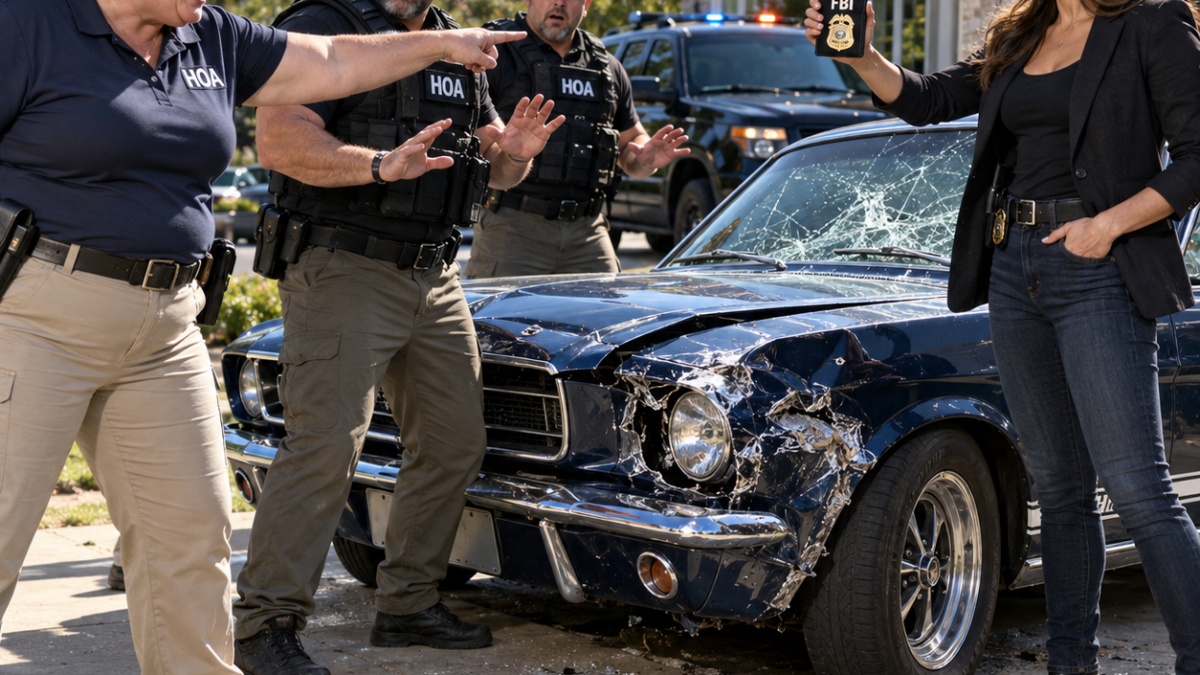
PART 2
Jacob Torres came to my house two days later.
He arrived in a silver Mercedes wearing golf clothes and the relaxed confidence of a man who assumed the neighborhood belonged to him.
I was in the garage checking the Mustang’s tire pressure.
He walked up my driveway without invitation.
“Mr. Evans.”
“Mr. Torres.”
He held out his hand.
I shook it once.
“I wanted to resolve this little misunderstanding personally.”
“What misunderstanding?”
Torres glanced at the Mustang.
His expression changed in a way I recognized immediately.
Not admiration.
Calculation.
“Beautiful automobile.”
“Thank you.”
“Boss 302?”
“Yes.”
“Original?”
“Mostly.”
“These are worth serious money.”
“It isn’t for sale.”
He laughed lightly.
“Of course not.”
Then came the sympathetic expression.
Practiced.
Polished.
The expression of someone about to explain why taking your money was actually a favor.
“The problem,” he said, “is that Oakwood has strict aesthetic standards.”
“I’ve read the covenants.”
“Then you understand.”
“I understand there’s no rule banning classic vehicles.”
Torres’s smile tightened.
“The board has discretionary authority.”
“For what?”
“To protect property values.”
“My car is stored inside my garage.”
“It has been visible.”
“Because I washed it.”
“Some residents complained.”
“Names?”
“I can’t disclose confidential complaints.”
Convenient.
Torres walked closer to the Mustang.
He didn’t touch it.
But he looked at every panel.
Every piece of chrome.
The wheels.
The hood.
“How attached are you to keeping it here?”
I stared at him.
“What exactly are you proposing?”
He lowered his voice.
“For certain unique circumstances, the board can approve an exemption.”
“How much?”
That surprised him.
Only for a second.
Then the smile came back.
“Five hundred dollars per month.”
I actually thought I had misheard.
“Five hundred.”
“Yes.”
“Six thousand dollars a year.”
“For a preservation exemption.”
“To keep my own legally registered car inside my own garage.”
“To maintain community harmony.”
I almost laughed.
Instead I said:
“And if I don’t pay?”
His expression stayed pleasant.
“The normal enforcement process continues.”
“Which means?”
“Violations.”
“Fines.”
“Potential removal if the vehicle becomes seriously noncompliant.”
There it was.
He didn’t say:
Pay us or we take your car.
He didn’t need to.
“I’ll think about it.”
Torres relaxed.
“Good.”
He took a business card from his pocket.
Placed it on my workbench.
“You seem like a reasonable man, Aaron.”
That was the first time he used my first name.
“Reasonable people do well in Oakwood.”
“And unreasonable people?”
His eyes hardened slightly.
“They usually decide this isn’t the right community for them.”
He left.
I stood beside the Mustang for several minutes after the Mercedes disappeared.
Then I picked up his card.
JACOB TORRES
PRESIDENT
OAKWOOD ESTATES HOA
On the back, he had written a phone number.
Under it:
Classic exemption — $500/month.
I photographed the card.
Scanned it.
Stored the original in an evidence sleeve.
Old habits.
The next day I started asking questions.
Quietly.
Gerald introduced me to Emma Lopez.
Emma was sixty-eight and had worked as a nurse for more than thirty years.
She lived alone.
On her living-room wall were photographs from national parks.
Yellowstone.
Grand Canyon.
Glacier.
Yosemite.
A large empty frame hung among them.
“What goes there?” I asked.
“My trip.”
“Which trip?”
“The one I never took.”
She brought me a folder.
Inside were photographs of a small RV.
White.
Blue stripe.
Nothing fancy.
“My husband and I bought it before he died.”
Her voice softened.
“We planned to drive across the country after I retired.”
“Did you?”
“He got sick.”
I understood.
“We never made it.”
Emma parked the RV at home while preparing to take the trip alone.
Oakwood security issued an oversized-vehicle violation.
Then another.
Then an assessment.
Then a deadline.
She appealed.
The HOA denied the appeal.
When she couldn’t pay several thousand dollars immediately, the RV was removed.
“Where did it go?”
“Oakwood Towing.”
“Did you get it back?”
She looked at the photographs.
“No.”
“Why?”
“The fees kept increasing.”
Storage.
Administrative costs.
Compliance charges.
Environmental inspection.
Processing fee.
By the time Emma gathered enough money, the RV had already been auctioned.
“Who bought it?”
“I don’t know.”
“How much?”
“I don’t know.”
“Did you receive any proceeds?”
She laughed once.
No humor.
“No.”
I photographed the documents with her permission.
Then met the Rodriguez family.
Their son, Mateo, had an older Honda.
Nothing special.
But he needed it to commute to work.
The HOA claimed one registration sticker had expired.
Security tagged the car.
The family corrected the paperwork.
Then the HOA claimed there were “roadworthiness concerns.”
The car disappeared from their driveway three days later.
Tow fee.
Storage.
Compliance penalties.
$2,500.
They paid because Mateo would lose his job without transportation.
His mother still kept the receipt.
“They said we should be grateful,” she told me.
“For what?”
“That they didn’t fine us more.”
By the time I returned home, I had spoken with seven residents.
Three had lost vehicles.
Two had paid thousands to avoid losing them.
One had sold her house after months of escalating violations.
And every story contained the same three names.
Jacob Torres.
Derek Simmons.
Oakwood Towing and Storage.
I went online.
Corporate records.
Business registrations.
County filings.
No FBI database.
Nothing restricted.
Everything available to any citizen willing to spend a night reading boring documents.
Torres owned forty percent of Oakwood Towing.
Another forty percent belonged to a company registered to his brother-in-law.
The remaining twenty percent belonged to an LLC whose address matched a used-car dealership two counties away.
I searched that too.
Same lawyer.
Same accountant.
Same mailing address used on several Oakwood towing invoices.
I sat back.
The pattern wasn’t proof yet.
But it smelled wrong.
HOA issues a violation.
HOA security removes vehicle.
Torres’s towing company collects fees.
If owner fails to recover the vehicle, another connected business handles auction or resale.
The same person influencing enforcement also profits from enforcement.
At minimum, it was an undisclosed conflict.
At worst, something much larger.
The surveillance started the following morning.
White security SUV.
Parked across from my house.
Twenty minutes.
Then gone.
Returned at lunch.
Again that evening.
Day after day.
Simmons sometimes drove.
Sometimes one of his men.
They photographed my garage.
Photographed my driveway.
Photographed me carrying groceries.
I documented every pass.
Then the drones appeared.
Small consumer models.
First one hovered over my backyard for nearly four minutes.
Camera pointed toward the garage windows.
Second appeared three hours later.
Same flight pattern.
I recorded both.
No confrontation.
No shouting.
No dramatic gesture.
Just evidence.
The first anonymous note arrived on day fourteen.
TROUBLEMAKERS DON’T BELONG IN OAKWOOD.
LEAVE WHILE YOU CAN.
I photographed it.
Placed it inside a protective sleeve.
Then laughed at myself because some habits never turn off.
Undercover work had taught me that emotional reaction is often exactly what someone wants.
Simmons wanted anger.
Torres wanted fear.
I gave them paperwork.
At 3:04 the next morning, a motion alert woke me.
A figure entered my front yard carrying a real-estate sign.
FOR SALE.
They planted it beside my walkway.
Face hidden.
Dark jacket.
The camera captured height, build, and partial features.
One of Simmons’s guards.
Not enough to identify beyond argument.
Enough to document.
At sunrise I pulled out the sign.
Placed it in my garage.
Added the video to the file.
Then I made a call.
Special Agent Diana Walsh answered on the second ring.
“Aaron?”
“Morning.”
“If this is about you wanting to come back early, the answer is no.”
“It isn’t.”
“Then why are you calling at seven?”
“I found something.”
Silence.
Diana knew those words.
She had supervised me before my undercover assignment.
She also knew I had a dangerous habit of turning vacations into investigations.
“You’re on leave.”
“I know.”
“You’re supposed to be resting.”
“I know.”
“You said that like someone who isn’t resting.”
I explained Oakwood.
The fabricated violations.
Vehicle seizures.
Torres’s ownership in the towing company.
The intimidation.
The anonymous note.
The drone surveillance.
She didn’t interrupt.
When I finished, she asked:
“Have you used federal systems?”
“No.”
“Identified yourself as an agent?”
“No.”
“Conducted interviews under color of your position?”
“No.”
“Good.”
“I’m acting as a homeowner.”
“Keep it that way.”
“What if it escalates?”
“Call local police.”
“I don’t know who Torres knows.”
“That’s not an answer.”
“It’s a concern.”
Diana sighed.
“Aaron, you are on mandatory leave because you spent eighteen months pretending to be someone else while organized criminals discussed murder in front of you.”
“I remember.”
“Do you?”
That stopped me.
She continued more softly.
“You are not required to fix every bad system you encounter.”
“I know.”
“Do you?”
I looked through the garage window at Dad’s Mustang.
“No.”
Diana breathed out.
“Document. Do not provoke. Do not physically engage anybody. If you believe there’s a genuine federal nexus, call me before doing anything else.”
“Understood.”
“I mean it.”
“So do I.”
“You always mean it right before doing something complicated.”
“Goodbye, Diana.”
“Aaron.”
“Yes?”
“Be careful.”
I ended the call.
That evening Simmons came to my door.
10:15.
Alone.
The porch camera caught him before he knocked.
I opened the door.
Did not step outside.
He held a paper.
“Final notice.”
I took it.
FORTY-EIGHT-HOUR VEHICLE REMOVAL ORDER.
My Mustang was allegedly a continuing safety and aesthetic violation.
Simmons folded his arms.
“You have forty-eight hours.”
“For what?”
“Remove the vehicle.”
“It’s in my garage.”
“Doesn’t matter.”
“It matters to property law.”
His expression hardened.
“This isn’t a negotiation.”
“Then why are you here?”
“To make sure you understand.”
“I understand perfectly.”
“You think you’re smart.”
“I didn’t say that.”
“You think reading rules means you can play games.”
“I’m not playing anything.”
Simmons leaned closer.
“Forty-eight hours, Evans.”
“Leave my property.”
His mouth curved.
“We’ll be back.”
“Goodnight, Derek.”
I closed the door.
My hands were steady.
My breathing wasn’t.
The Mustang was more than a car.
And Simmons knew that.
Torres knew that.
They had seen the way I maintained it.
The way I responded to their notices.
They had identified leverage.
That made me angry.
Not the loud kind.
The kind I had spent years learning to control.
I went to the garage.
Pulled the cover back.
Highland Red paint reflected the overhead lights.
Dad’s Mustang.
Our Mustang.
I sat in the driver’s seat.
The smell inside hadn’t changed much since childhood.
Old vinyl.
Leather.
A faint trace of gasoline and oil.
When I was nine, Dad used to let me sit behind the steering wheel while the car stayed parked.
“Don’t touch anything,” he would say.
I touched everything.
He knew I would.
When I was sixteen, he taught me to drive stick in a deserted industrial lot.
I stalled thirteen times.
Dad counted every one.
“Fourteen will be better.”
It wasn’t.
“Fifteen?”
Worse.
By twenty, I could shift it so smoothly Dad pretended not to be impressed.
The framed photograph above my workbench showed us in 1996.
His hand on my shoulder.
Mustang behind us.
The day he signed the title to me.
“Take care of her.”
“I will.”
I had kept that promise almost thirty years.
I closed the garage.
Checked every camera.
Then went to bed.
Tuesday morning, I went running.
Habit.
Five miles when my head was clear.
Seven when it wasn’t.
I was two miles away when my phone vibrated.
MOTION DETECTED — DRIVEWAY.
Then:
MOTION DETECTED — GARAGE.
I stopped.
Opened the feed.
A flatbed tow truck backed into my driveway.
Two Oakwood security SUVs blocked the street.
Simmons stood at my garage.
Three guards with him.
Another man carried bolt cutters.
My body went cold.
Then strangely calm.
I started running home.
Not sprinting.
Not yet.
I kept the video open.
The bolt cutters closed around my garage padlock.
Snap.
Door lifted.
Simmons stepped inside.
The Mustang sat under its cover.
One guard removed it.
“There she is.”
Simmons’s voice came through the dashcam.
Another man whistled.
“Damn.”
Simmons walked around the car.
“Get it out.”
The tow operator said:
“Parking brake’s set.”
“Release it.”
“Door’s locked.”
Simmons tried the handle.
Locked.
“Break in.”
The tow operator hesitated.
“I’m not breaking a collector car.”
Simmons’s voice sharpened.
“You’re getting paid to tow.”
“I’m getting paid to transport.”
“Hook it.”
“It’s in gear.”
“I don’t care.”
My pace increased.
My lungs burned.
I watched the screen.
Simmons pointed.
“Hook the rear frame and pull.”
The tow operator resisted again.
“You’ll damage the transmission.”
“Then damage it.”
Something inside me tightened.
“Get it out.”
A chain went beneath the Mustang.
Metal clinked.
Engine on the flatbed revved.
Then came the sound.
I had heard gunshots.
Crashes.
Screaming tires.
Doors kicked open during raids.
Nothing sounded like that.
Metal dragged against concrete.
The Mustang lurched backward.
Rear tires resisted.
Chain tightened.
The car shifted sideways.
One taillight struck the garage frame.
Shattered.
I ran faster.
The bumper scraped.
Paint came off.
The car slammed against the frame.
Simmons yelled:
“Keep pulling!”
The tow operator shouted something I couldn’t hear.
The Mustang moved again.
Something beneath the car snapped.
The sound came through the microphone.
I knew what it probably was.
Drivetrain.
Transmission.
Maybe worse.
The live feed shook as the dashcam changed angle.
The Mustang disappeared from the garage.
I turned onto my street fifteen minutes later.
The tow truck was gone.
Security SUVs gone.
Garage open.
Gerald Lewis stood near my driveway.
He looked sick.
“Aaron.”
I slowed to a walk.
“I tried.”
His voice trembled.
“I told them it wasn’t abandoned.”
I didn’t answer immediately.
“They said they had authority.”
Gerald looked toward the garage.
“I called the HOA office. They laughed.”
I put a hand on his shoulder.
“This isn’t your fault.”
“I should have called police.”
“You couldn’t have stopped them.”
“I could’ve tried harder.”
“No.”
I meant it.
I walked into the garage.
Deep gouges crossed the floor.
Broken red plastic from the taillight lay near the door.
A streak of Highland Red paint marked the wooden frame.
On my workbench, the photograph of Dad and me remained untouched.
I stared at it.
Take care of her.
For nearly a minute, I didn’t move.
Then I sat on the stool.
Closed my eyes.
Breathed.
Control the body.
Control the mind.
Then act.
One breath.
Two.
Three.
I called Diana.
She answered immediately.
“What happened?”
“They took the Mustang.”
Her voice sharpened.
“Who?”
“HOA security.”
“From where?”
“My locked garage.”
Pause.
“Say that again.”
“They cut the lock, entered my garage, dragged out a vehicle valued over one hundred thousand dollars, damaged it, and transported it to a towing company financially connected to the HOA president.”
“You have video?”
“Multiple cameras. Audio.”
“How much damage?”
“I don’t know yet.”
“Are you safe?”
“Yes.”
“Anyone still there?”
“No.”
“Do not go confront them.”
“I’m going to the tow lot.”
“Aaron.”
“To photograph the vehicle. Nothing else.”
Silence.
“Take another person.”
“No.”
“Aaron.”
“I will stay outside the fence if necessary.”
“You call me the second anything changes.”
“I will.”
I drove to Oakwood Towing.
Chain-link fence.
Barbed wire.
Rows of cars.
Some old.
Some expensive.
Some barely damaged.
The attendant barely looked up.
“Help you?”
“1969 Mustang towed this morning.”
He typed.
“Eight hundred fifty.”
“For what?”
“Tow, processing, storage.”
“I want to inspect it.”
“Pay first.”
“I want to confirm condition.”
He shrugged.
Then buzzed the gate.
I found the Mustang near the rear fence.
For several seconds, I couldn’t breathe properly.
Highland Red paint scarred along the quarter panel.
Rear bumper bent.
Both taillights broken.
Scrapes across the side.
One rear wheel sat slightly wrong.
The transmission had clearly taken damage from being dragged while engaged.
I walked around it slowly.
Photograph after photograph.
Thirty-seven images.
Close-ups.
Wide angles.
VIN.
Tow markings.
Damage.
Chain contact points.
Then I placed my hand on the roof.
Cold metal.
“You’re coming home.”
The attendant repeated the fee when I returned.
“Eight-fifty.”
I looked at him.
“Who authorized the tow?”
“Oakwood.”
“Name?”
“Security.”
“Name?”
He became defensive.
“You paying or not?”
“Not today.”
He leaned back.
“Storage goes up every day.”
“I’m aware.”
I turned.
“I’d advise you not to alter, sell, dismantle, or transfer that vehicle.”
He laughed.
“Why?”
“You’ll understand soon.”
I left.
Two black sedans were parked outside my house when I returned.
Agents Morrison and Keller.
Diana moved quickly.
Morrison met me at the driveway.
“Aaron Evans?”
“You know who I am.”
“Today you’re a complainant.”
That was deliberate.
I nodded.
“Understood.”
“Good.”
For the next three hours, I became the witness.
Not the agent.
I showed everything.
Violation letters.
Security video.
Anonymous note.
Surveillance.
Corporate filings.
Gerald’s records.
Torres’s exemption offer.
Then the garage video.
Morrison watched Simmons enter.
Watched them hook the Mustang.
Heard:
“I don’t care if you have to rip the transmission out.”
Keller stopped the video.
“Play that again.”
I did.
Simmons’s voice filled the room.
“Then drag it.”
Keller looked at Morrison.
Morrison closed his notebook.
“This is not an HOA dispute.”
“No.”
“Potential coordinated fraud.”
“Yes.”
“Maybe extortion.”
“Yes.”
“Possible interstate financial activity?”
“I haven’t checked.”
“Don’t.”
He pointed at me.
“You’re a victim.”
I almost smiled.
“Diana told you to say that.”
“She told me three times.”
“Sounds like her.”
Morrison stood.
“We’re recommending a formal preliminary inquiry.”
“How fast?”
“If the financial links hold, very.”
“Torres may destroy records.”
“Which is why you’re not calling him.”
“I wasn’t planning to.”
Morrison gave me a look.
“I know your reputation.”
“What reputation?”
“Exactly.”
Forty-eight hours later, Diana called.
“Federal case is open.”
I sat at the kitchen table.
“Approved?”
“Financial fraud, extortion-related conduct, conspiracy, asset conversion. The prosecutors want it tight before anyone moves.”
“And me?”
“Victim.”
“I know.”
“Witness.”
“I know.”
“You are not investigating your own case.”
“I know.”
“Aaron.”
“Yes.”
“If you say ‘I know’ one more time, I’m extending your leave.”
I smiled.
“Understood.”
The FBI brought in a forensic accountant.
Sandra Chen.
Forty-two.
Quiet.
Brutal with numbers.
She spent four hours examining public filings and subpoena-return previews once legal process started.
Then she called me.
“This is bigger than your car.”
“I assumed.”
“Three connected businesses.”
Oakwood Towing.
Front Range Vehicle Auctions.
Torres Auto Group.
Money flowed between them.
Towing fees.
Storage.
Auction proceeds.
Resale.
Torres or relatives had ownership interests in each.
The HOA security operation identified “violations.”
Vehicles moved to towing.
Owners faced inflated fees.
If they couldn’t pay, vehicles transferred to auction.
Some were later resold through the dealership.
Over five years, more than two hundred vehicles had passed through the network.
Not all illegal.
That was important.
Some were legitimate tows.
Some abandoned.
Some properly authorized.
But enough had questionable paperwork to justify serious scrutiny.
Estimated questionable revenue:
Around $1.8 million at the preliminary stage.
I stared at Sandra’s spreadsheet.
“How many Oakwood residents?”
“Dozens.”
“How many outside communities?”
“Several associations contracted with Simmons’s company.”
That surprised me.
Oakwood wasn’t the whole operation.
It was the testing ground.
Simmons’s security company worked in other developments.
Same methods.
Same towing vendor.
Same escalation.
Then Gerald’s five years of records became invaluable.
Not because he had legal expertise.
Because he had dates.
Names.
Receipts.
Photos.
Every time somebody complained, Gerald wrote it down.
His handwriting was terrible.
His discipline was perfect.
Agent Keller interviewed him.
Gerald cried afterward.
Not from fear.
Relief.
“Five years,” he told me on my porch.
“I thought I was crazy.”
“You weren’t.”
“Everyone kept saying let it go.”
He looked toward my empty garage.
“I kept thinking if I collected enough, somebody would eventually listen.”
“They are.”
Gerald nodded.
Then looked at me.
“You’re really FBI?”
“Yes.”
He laughed.
“I knew there was something wrong with you.”
“Thank you.”
“No normal person keeps documentation like that.”
“Neither do normal machinists.”
He smiled.
“Fair.”
Emma Lopez gave her records.
Rodriguez family too.
William Park came forward next.
Seventy-four.
Retired teacher.
He had lost a 1967 Chevrolet Camaro.
Cherry red.
His late wife gave it to him on their thirtieth anniversary.
He brought a photograph.
Her leaning against the hood.
Smiling.
He had been recovering from heart surgery when Oakwood security claimed the Camaro violated storage rules.
The car was removed.
He couldn’t manage the fees.
Auctioned.
Eleven thousand dollars.
He received nothing.
“That car wasn’t worth a fortune,” William said.
“That isn’t the point.”
“No.”
He touched the photograph.
“It was hers.”
I understood too well.
William looked at me.
“They got your father’s car too?”
“Yes.”
“Can you fix it?”
“I hope.”
He nodded.
“I hope you can.”
By the end of the first week, fifteen victims had provided records.
Documented losses approached three hundred thousand dollars.
Prosecutors believed the real amount was much higher.
Then Diana called.
“We need Torres talking.”
I knew what she meant.
“You want me to call him.”
“Only if you’re comfortable.”
“I am.”
“This is recorded under applicable law. Follow counsel’s instructions exactly.”
“Understood.”
“No improvising.”
“That hurts.”
“I’m serious.”
“So am I.”
I called Torres.
He answered quickly.
“Aaron.”
First name again.
I made my voice tired.
Defeated.
“I’ve been thinking.”
“I’m glad.”
“I want the car back.”
“Of course.”
“I don’t want more trouble.”
His tone warmed.
“That’s sensible.”
“What do I owe?”
Pause.
I could almost hear him smiling.
“Well, there are towing costs.”
“Okay.”
“Storage.”
“Okay.”
“Administrative fees.”
“Okay.”
“Damage assessment.”
I almost laughed at that.
They damaged it.
Then wanted me to pay for the assessment.
“How much total?”
“Five thousand.”
I let silence sit.
“Five?”
“I can personally authorize release.”
“And the HOA violations?”
“I’ll clear them.”
“All of them?”
“Yes.”
“If I pay?”
“Yes.”
“Can we meet?”
“Saturday.”
“Where?”
“Community center.”
“After the annual meeting.”
“Bring a cashier’s check.”
“I just want this over.”
Torres chuckled.
“That’s usually the best choice.”
I ended the call.
For several seconds, I sat completely still.
Diana called two minutes later.
“We got it.”
“Yes.”
“Aaron?”
“What?”
“You okay?”
I looked toward the empty garage.
“No.”
Silence.
Then:
“But I will be.”
Saturday arrived.
Oakwood’s annual meeting usually drew fifty residents.
That night, nearly two hundred appeared.
Word had spread.
The Mustang.
The tow.
Rumors of an investigation.
Torres stood at the podium wearing a tailored blazer.
Simmons stood near the front wall.
Same black uniform.
Same fake authority.
I entered through the rear door after the meeting started.
Four FBI agents were positioned outside.
Two county deputies stood by.
Warrants had been signed that morning.
The case did not depend on theatrics.
That mattered.
The arrests were already authorized.
The meeting was simply where Oakwood would finally see who had been running it.
Torres clicked to a slide.
COMMUNITY SECURITY RESULTS.
“Forty-seven noncompliant vehicles processed this year.”
He smiled.
“Property values increased twelve percent.”
A few people clapped.
Most didn’t.
“I want to thank Derek Simmons.”
Simmons nodded.
“For his tireless commitment to Oakwood.”
I stood.
Torres stopped.
His expression changed.
“Mr. Evans.”
I walked down the center aisle.
“You’ll have an opportunity during resident comments.”
“I don’t need one.”
Simmons stepped toward me.
“Return to your seat.”
I stopped six feet away.
“I have something more important.”
His hand moved toward the pepper spray on his belt.
I reached inside my jacket.
Simmons tensed.
Then I pulled out my credentials.
Opened the case.
Held it up.
Gold shield.
Federal Bureau of Investigation.
“My name is Special Agent Aaron Evans.”
The room became absolutely silent.
Simmons’s hand dropped.
Torres went pale.
Not movie pale.
Real pale.
Color draining slowly as understanding reached him.
I lowered the badge.
“I have been on authorized leave since moving into Oakwood.”
I turned toward the residents.
“For the past several weeks, I have also been the victim of a coordinated campaign involving false vehicle violations, intimidation, and ultimately the unauthorized removal of personal property from my locked garage.”
Torres found his voice.
“This is inappropriate.”
I connected my phone to the projector.
His property-value slide disappeared.
Video appeared.
My driveway.
6:30 a.m.
Tow truck.
Security SUVs.
The room watched.
Bolt cutters.
Garage opened.
Mustang revealed.
Someone gasped.
Then Simmons’s voice:
“There she is.”
Tow chain.
Pull.
Crash.
Broken taillight.
The sound of metal scraping concrete filled the community hall.
People stopped moving.
Then:
“I don’t care if you have to rip the transmission out.”
Emma Lopez covered her mouth.
William Park lowered his head.
Gerald stared at Simmons.
I stopped the video.
Nobody spoke.
Torres stepped away from the podium.
“This is edited.”
“No.”
“You can’t prove context.”
“Federal forensic analysts have the original files.”
That shut him up.
I changed the slide.
Not every investigative detail.
Only information already authorized for disclosure.
Connected companies.
Towing.
Storage.
Auctions.
Ownership relationships.
Victim counts under review.
“The federal investigation is ongoing.”
Torres shouted:
“This is entrapment!”
“No.”
My voice stayed level.
“You chose the rules.”
“You sent the notices.”
“You ordered enforcement.”
“Simmons entered my garage.”
“Your connected towing company took the vehicle.”
“And you personally offered to return it to me for five thousand dollars.”
His mouth opened.
I played the recording.
Torres’s own voice:
“Bring a cashier’s check and this whole unpleasant business will be behind us.”
Nobody needed legal training to understand how bad that sounded.
The side doors opened.
Agents Morrison and Keller entered first.
FBI windbreakers.
Two additional agents behind them.
County deputies followed.
Torres stepped backward.
Simmons froze.
Morrison approached the podium.
“Jacob Torres?”
Torres stared at him.
“You are being taken into federal custody pursuant to an arrest warrant.”
Torres looked around.
At residents.
At Simmons.
At me.
“I want my lawyer.”
“You’ll have that opportunity.”
Morrison turned toward Simmons.
“Derek Simmons?”
Simmons did not argue.
The performance disappeared.
No threats.
No hand on the belt.
No:
In this community, we are the law.
Just a man standing beneath fluorescent lights while real authority handed him a warrant.
Emma began crying.
Not loudly.
Shoulders shaking.
Gerald moved beside her.
William Park stood.
He held up the photograph of his wife beside the Camaro.
“That was mine.”
His voice barely carried.
“They sold it.”
Torres looked away.
William continued.
“My wife gave me that car.”
Still nothing.
“She died before they took it.”
Torres’s face tightened.
No answer.
Morrison guided him toward the door.
Someone in the crowd shouted:
“Where’s our money?”
Another:
“How many cars?”
Another:
“You knew!”
The room started erupting.
I raised one hand.
“Please.”
Surprisingly, they quieted.
“This investigation is not finished.”
I looked around.
“If you believe you were affected, preserve every record you have.”
“Receipts.”
“Emails.”
“Photographs.”
“Notices.”
“Do not alter anything.”
I stopped.
“I know many of you are angry.”
Emma looked at me through tears.
“But let the evidence do its work.”
That was the lesson my father taught me about engines.
And the Bureau taught me about cases.
Do not force what needs precision.
Outside, agents placed Torres and Simmons into separate vehicles.
I didn’t watch.
I walked behind the community center.
Cold evening.
Quiet parking lot.
For the first time since the Mustang disappeared, I let myself breathe.
The case was moving.
The men were in custody.
Residents finally knew.
And I still felt terrible.
Winning does not restore what was broken.
Diana found me outside.
“You disappeared.”
“Needed air.”
“You did fine.”
“I almost lost my temper during the video.”
“You didn’t.”
“I wanted to.”
“That’s allowed.”
I looked at her.
“Is it?”
“You’re human.”
“Questionable.”
She smiled faintly.
“How’s the car?”
“Bad.”
“Repairable?”
“I don’t know.”
She put a hand on my shoulder.
“You did right by him.”
I knew who she meant.
Dad.
“I let them take it.”
“No.”
“You documented a crime.”
“I was two miles away.”
“Aaron.”
I looked at her.
“You didn’t damage that car.”
I knew.
Logically.
Grief doesn’t care about logic.
The next seventy-two hours brought search warrants.
Oakwood HOA office.
Torres’s house.
Towing company.
Auction facility.
Used-car dealership.
I did not participate.
That line mattered.
I was the victim.
Diana kept me informed only where appropriate.
What agents found was worse than expected.
Torres kept detailed records.
Not because he was careless.
Because he thought nobody could touch him.
A ledger listed residents.
Vehicles.
Estimated values.
Personal circumstances.
Recently widowed.
Medical debt.
Divorce.
Fixed income.
Likely to sell.
Difficult family situation.
The language made my stomach turn.
Victims weren’t random.
Some had been selected because they were less able to fight.
Emails showed Torres and Simmons discussing timing.
Which notices to issue first.
How long to wait.
When to tow.
How fees accumulated.
Financial records showed millions moving through the connected businesses over several years.
Not all illegal.
But enough suspicious transactions and seized vehicles justified an extensive fraud case.
Agents recovered records of payments to HOA employees.
Discounted vehicle sales to associates.
Questionable auction transfers.
There was even an overseas account holding money prosecutors believed was linked to the operation.
The case expanded.
Seven people eventually faced significant charges or cooperation agreements depending on involvement.
The tow-yard manager claimed ignorance.
The records disagreed with parts of his story.
Several security employees insisted they were only following Simmons.
Texts showed some actively participated.
Tyler Morgan—one of the younger guards—cooperated early.
He told investigators:
“Derek said nobody would question us because residents thought we were police.”
That sentence stayed with me.
Because that was the entire scheme in miniature.
Not law.
Appearance.
Residents didn’t obey because Oakwood security had real police authority.
They obeyed because the uniforms were close enough.
The vehicles were close enough.
The language was close enough.
The confidence was close enough.
People filled in the gap.
The federal grand jury heard testimony.
Gerald.
Emma.
Rodriguez family.
William.
Others.
I testified too.
Three hours.
No speech.
No dramatic storytelling.
Dates.
Documents.
Video.
Business relationships.
Phone call.
The grand jury returned indictments on multiple fraud, conspiracy, extortion-related, and property offenses.
The precise charges varied by defendant.
I intentionally stopped memorizing the maximum possible sentences.
People obsess over those numbers.
Twenty years.
Ten years.
Thirty years.
Real justice is not a scoreboard.
Proof matters.
Convictions matter.
Restitution matters.
Prevention matters.
Torres pleaded not guilty initially.
Simmons too.
At arraignment, I sat in the gallery.
Torres looked smaller.
No blazer.
No HOA podium.
No Mercedes.
Just defendant and lawyer.
He glanced toward me once.
Then away.
I felt nothing.
That surprised me.
I had imagined anger.
Satisfaction.
Vindication.
Mostly I felt tired.
The victims filled several rows.
Sixty-three families eventually came forward with some kind of claim.
Not every claim became part of the criminal case.
Some lacked records.
Some were outside limitations periods.
Some reflected aggressive but technically lawful enforcement.
Others were clearly tied to the fraudulent towing system.
Documented losses exceeded two million dollars.
The trial lasted approximately two weeks.
Torres’s defense argued the HOA bylaws gave broad discretion.
That defense failed against emails showing profit motives and vehicle targeting.
The government played our phone call.
Five thousand dollars.
Release of my own property.
Violations disappear.
The jury heard it more than once.
Simmons argued he followed orders.
Then prosecutors introduced messages where he personally suggested targets and discussed incentives.
Following orders became less persuasive.
Gerald testified.
I watched from the gallery after my own testimony finished.
He brought his five-year folder.
The defense attorney looked almost offended by its thickness.
“Mr. Lewis, you documented every interaction?”
“Most.”
“Why?”
Gerald shrugged.
“Because nobody listened.”
“Were you trying to build a case?”
“No.”
“What were you trying to do?”
“Remember.”
That answer silenced the room.
Emma testified.
She described her RV.
Her husband.
The trip they never took.
The attorney asked:
“Mrs. Lopez, was the RV properly parked?”
“Yes.”
“Did you receive notices?”
“Yes.”
“Did you understand you could appeal?”
“I did appeal.”
“What happened?”
“They denied it.”
“Why didn’t you pay the fees sooner?”
Emma’s face changed.
“I’m a retired nurse.”
She looked at the jury.
“I had six thousand dollars in savings.”
“That was supposed to be for the trip my husband and I never got to take.”
She paused.
“I had to choose between paying people I believed were wrong and keeping enough money to live.”
No further question.
William Park testified about his Camaro.
His wife’s gift.
Heart surgery.
The auction.
He held the same photograph.
A prosecutor asked:
“What did losing that car mean?”
William looked toward Torres.
Then back.
“It meant someone decided grief had a resale value.”
Even I had trouble keeping my face neutral.
The jury returned guilty verdicts on the principal charges against Torres and Simmons.
Several cooperating defendants resolved their cases separately.
Sentencing came later.
Torres received a lengthy federal prison term.
Simmons received a shorter but still substantial sentence.
Restitution.
Supervised release.
Financial forfeitures.
Other employees received outcomes based on their roles.
The tow-yard manager received a lesser sentence.
Tyler’s early cooperation reduced his punishment significantly.
Diana called me after Torres was sentenced.
“You coming?”
“No.”
“Sure?”
“Yes.”
“You testified.”
“I’m done.”
She was quiet.
“Fourteen years.”
I stared at the garage floor.
“Okay.”
“Restitution order is substantial.”
“Good.”
“Doesn’t sound like you.”
“What should I sound like?”
“I don’t know.”
“Celebratory?”
“No.”
I looked at the photograph of Dad.
“It doesn’t fix the Mustang.”
“No.”
“It doesn’t bring William’s wife back.”
“No.”
“It doesn’t give Emma three lost years.”
“No.”
Diana sighed.
“Justice isn’t restoration.”
“Sometimes it starts it.”
That was as close as I came to satisfaction.
The Mustang returned to me under evidence-release procedures.
Technically, what returned was a damaged shell of the car I had brought to Oakwood.
I found a restoration specialist named Vincent Hale.
Sixty.
Former racing mechanic.
Hands permanently stained with engine grease.
He examined the Mustang for two hours.
Frame.
Engine.
Transmission.
Body.
Suspension.
Then he stood.
“Well?”
He scratched his chin.
“Whoever moved this car had no idea what they were doing.”
“I know.”
“Transmission is destroyed.”
“I assumed.”
“Rear suspension needs work.”
“Body?”
“Ugly.”
I nodded.
“Fatal?”
Vincent looked offended.
“To a Mustang?”
He ran his hand along the fender.
“No.”
I almost laughed.
“How long?”
“Four months.”
“Cost?”
He gave me a number.
Painful.
Restitution would eventually cover much of it.
I didn’t care.
“Do it.”
Vincent looked inside.
“Family car?”
“Dad.”
“Still alive?”
“No.”
He nodded.
That was enough explanation.
“Give me four months.”
Before leaving, I touched the roof.
“You’re coming home.”
Vincent heard me.
He pretended not to.
Good man.
Oakwood changed while the Mustang was gone.
The HOA board collapsed.
Two members cooperated.
One resigned.
Others were removed.
The security contract ended immediately.
White SUVs disappeared.
Fake police-style uniforms vanished.
No more patrols slowing outside houses.
No more surprise vehicle inspections.
Residents elected temporary leadership.
Financial oversight came first.
Independent audits.
Vendor disclosure.
Conflict-of-interest rules.
Any company linked to a board member required full disclosure and competitive bidding.
Vehicle enforcement was rewritten almost completely.
Actual dangerous or abandoned vehicles went through lawful municipal processes.
Private security could document concerns.
That was it.
No seizure.
No lockout tools.
No confiscation.
No private auctions.
Gerald Lewis was nominated for HOA president.
He refused.
Residents nominated him again.
He refused again.
Emma stood.
“You kept records for five years.”
Gerald sighed.
“That doesn’t mean I want meetings.”
“You’re retired.”
“That means I definitely don’t want meetings.”
People laughed.
Emma continued.
“You don’t need power.”
“You already proved that.”
“You just need to make sure nobody else gets too much.”
Gerald looked at me.
“Help.”
I shook my head.
“This is your nightmare.”
He glared.
Eventually he agreed under conditions.
Two-year term.
Rotating oversight committee.
Published finances.
No unilateral spending above a defined threshold.
He deliberately weakened his own position before accepting it.
That impressed me.
The first meeting Gerald chaired lasted three hours because he had no idea how parliamentary procedure worked.
I stayed twenty minutes.
He caught me leaving.
“Coward.”
“I’m FBI.”
“Same thing.”
I laughed.
The victim fund started distributing restitution.
Emma received enough to replace much of what she lost.
She bought a smaller camper.
Two months later, she sent me a postcard from Utah.
On the back:
FINALLY TOOK THE TRIP.
I put it on my refrigerator.
Rodriguez family received their payments.
Mateo bought a reliable used car.
William received compensation for the Camaro.
Not enough.
Never enough.
He used some of it to create a scholarship in his wife’s name for local teachers.
Gerald was offered restitution too.
He redirected part of it toward residents who had lost more.
“Why?” I asked.
“I got my truck back.”
“You still lost money.”
“I’ll survive.”
He shrugged.
“Emma lost time.”
Hard to argue.
My mandatory leave eventually ended.
Diana called.
“You ready?”
“I think.”
“That’s not confidence.”
“It’s honesty.”
“Better.”
I returned to a financial-crimes assignment.
No deep cover.
No eighteen-month identity.
No pretending to be somebody else until mirrors became uncomfortable.
The first week back, I went home every night.
Slept in my own bed.
Walked Oakwood in the morning.
Talked to Gerald.
Sometimes sat in the empty garage.
Therapy continued.
That part surprised colleagues who thought an FBI badge somehow cancelled mental health needs.
It doesn’t.
My therapist once asked:
“Why did the Mustang case affect you so strongly?”
“They destroyed Dad’s car.”
“That’s the event.”
“What’s the meaning?”
I hated therapist questions.
“It was Dad.”
“The car?”
“No.”
“Then?”
I stared at the floor.
“When Dad died, I was working.”
“Where?”
“Another state.”
“Did you make it home?”
“Not before.”
There it was.
The part I had avoided.
Dad’s last weeks happened while I was on an investigation.
He told me not to leave the case.
Said he was fine.
He wasn’t.
I arrived after.
The Mustang became the thing I could still protect.
Take care of her.
So when Simmons damaged it, the old guilt came roaring back.
“You believe you failed your father twice,” my therapist said.
I looked at her.
“I didn’t say that.”
“You didn’t have to.”
I hated her professionally.
“You were doing the work he was proud of.”
“I know.”
“Did he tell you to abandon the case?”
“No.”
“Did he blame you?”
“No.”
“Then whose judgment are you obeying?”
Mine.
That was harder.
The Mustang’s restoration became therapy in its own strange way.
Vincent sent photographs.
Transmission removed.
Body panels stripped.
Paint sanded.
Metal straightened.
Replacement taillights located.
Chrome refinished.
Every image looked worse before it looked better.
That was restoration.
Strip damage down.
Reveal it.
Repair what can be repaired.
Replace what cannot.
Prime.
Paint.
Rebuild.
Maybe Dad had taught me more with that car than I realized.
Four months later, Vincent called.
“She’s ready.”
I drove to his shop that evening.
The garage door opened.
Highland Red.
White stripes.
Perfect.
The Mustang sat beneath fluorescent lights as though time had reversed.
I stopped walking.
Vincent stood beside it.
“You breathing?”
“Working on it.”
“Come closer.”
I approached.
The repaired body reflected my face.
Bumper straight.
Taillights restored.
Transmission rebuilt.
Wheels aligned.
Interior cleaned.
I ran my fingers across the rear quarter panel.
Nothing.
No scar.
Vincent handed me the keys.
“Start her.”
I opened the driver’s door.
Sat.
The seat felt like childhood.
I inserted the key.
Turned it.
The Boss 302 came alive.
Deep V8 rumble.
The whole car vibrated.
I closed my eyes.
Dad’s garage.
Sunday morning.
Radio playing baseball.
Coffee.
Grease.
His voice:
Listen first.
I opened my eyes.
Vincent stood outside the window.
“Well?”
I couldn’t speak immediately.
Finally:
“You got it right.”
He smiled.
“No.”
“What?”
“You did.”
I looked at him.
“You kept the car long enough for me to fix it.”
That sounded like something Dad would say.
I drove home slowly.
No highway.
Back roads.
Engine warming beneath me.
Sunset across the fields.
Every shift smooth.
When I entered Oakwood, people noticed.
Emma was walking her dog.
She stopped.
Covered her mouth.
Then clapped.
I laughed.
A teenager on a bicycle shouted:
“Nice Mustang!”
“Thanks.”
Gerald appeared before I even reached my driveway.
I parked.
Got out.
He walked around the car.
“Looks better than before.”
“Careful.”
He grinned.
“Your father would be proud.”
That sentence nearly broke me.
“Thanks, Gerald.”
He touched the roof lightly.
Then looked toward the garage.
The concrete still contained tow-chain gouges.
“Fixing those?”
I stared at them.
“Maybe not.”
“Why?”
“Reminder.”
Gerald nodded.
“Good ones and bad ones?”
“Both.”
We stood together as the sun disappeared.
No security SUV.
No drone.
No violation notice.
Just a quiet neighborhood.
The quiet I had originally moved there to find.
That night, I parked the Mustang inside.
But didn’t close the garage door immediately.
I sat behind the wheel.
Engine off.
Dad’s photograph on the workbench.
His hand on my shoulder.
His smile.
Take care of her.
“I did.”
My own voice sounded strange in the empty garage.
“Eventually.”
The photograph did not answer.
It didn’t need to.
I got out.
Picked it up.
Set it on the Mustang’s hood.
For a while, I let myself remember Dad without turning memory into guilt.
His terrible jokes.
The way he overcooked burgers.
The fact he refused to ask for directions.
How he could rebuild a carburetor but somehow never figured out our microwave.
The Bronze Star stayed in a drawer most of his life.
The Mustang sat where everyone could see it.
That told you everything about him.
The neighborhood’s first summer under Gerald’s board was imperfect.
That was good.
Residents argued.
Budgets took too long.
Someone complained about the pool hours.
Another person wanted different landscaping rules.
Gerald forgot to publish one meeting agenda and had to reschedule.
Nobody was dragged from a garage.
Nobody’s car disappeared.
Nobody received a secret bill because they questioned leadership.
Perfection had always been Torres’s sales pitch.
Perfect lawns.
Perfect vehicles.
Perfect compliance.
The new Oakwood was messier.
Healthier.
Emma parked her camper outside for two days while loading for another trip.
No citation.
Gerald’s truck tires were slightly underinflated once.
Nobody towed it.
William Park occasionally came to meetings even though he lived outside Oakwood.
Residents welcomed him.
He eventually bought another Camaro.
Not a replacement.
He was careful about that word.
A different car.
Blue.
He took me for a drive.
“You like it?”
“Beautiful.”
“My wife would’ve hated the color.”
I laughed.
“Then why blue?”
“Because I’m not replacing hers.”
That hit me.
He looked over.
“You understand.”
“Yes.”
I did.
Restoration is not replacement.
My Mustang looked like the old car.
It was the old car.
But certain parts were new.
Transmission components.
Body pieces.
Paint.
Still Dad’s.
Still mine.
Changed.
Not erased.
Like grief.
One afternoon, Emma stopped by with a postcard from Yellowstone.
“You were supposed to mail this.”
“I wanted to hand it to you.”
“Why?”
She smiled.
“Because I wanted you to know I actually made it.”
She had driven through five states.
Camped alone.
Made friends with two widows traveling in another RV.
“I think I’m becoming dangerous.”
“How?”
“I like being away.”
“That sounds healthy.”
“Gerald says I’m abandoning my presidential oversight responsibilities.”
“Gerald says everything is his responsibility now.”
“He loves it.”
“He hates it.”
“Same thing at his age.”
I put the postcard beside the first one.
The case continued influencing my work.
Diana noticed.
“You’re less patient with financial conflicts.”
“Was I too patient before?”
“No.”
“You just stare at vendor disclosures longer.”
“Trauma.”
She rolled her eyes.
“You also volunteer for HOA-fraud complaints.”
“That’s coincidence.”
“You’ve taken four.”
“Five.”
She stared.
I smiled.
“Fine.”
Not every HOA complaint became a federal case.
Most didn’t.
Some were civil disputes.
Some were misunderstandings.
Some involved boards acting within rules residents disliked.
The Oakwood case made me careful not to see Torres everywhere.
That was important.
Experience can sharpen judgment.
It can also distort it.
Every controlling board president was not a racketeer.
Every towing dispute wasn’t fraud.
Every private security officer wasn’t Simmons.
Evidence first.
Always.
One year after the arrests, Oakwood held a memorial-style community event.
Not for the FBI.
Not for me.
For residents who had been harmed.
Gerald hated ceremonies.
Emma loved them.
Emma won.
They created a small plaque inside the community center.
NOTHING ABOUT US WITHOUT US.
Beneath it:
Transparency. Consent. Accountability.
No names.
I liked that.
Torres didn’t deserve permanent ownership of Oakwood’s identity.
Neither did I.
A community should not become the story of the man who abused it or the man who happened to expose him.
It belonged to residents.
At the event, William brought the photograph of his wife and Camaro.
Emma brought a picture of her RV.
Rodriguez family brought a photograph of Mateo’s old Honda.
Gerald brought nothing.
“What?”
“I don’t keep sentimental truck photos.”
“You kept five years of receipts.”
“That’s different.”
“How?”
“It’s useful.”
I laughed.
Emily—Diana’s assistant? No, there was no Emily here. I caught myself one evening thinking of the neighbors from other cases I’d worked and realized how much Oakwood had become intertwined with my memory of victims everywhere.
Ordinary people.
That was the real lesson.
Fraud rarely starts with dramatic theft.
It starts with a small abuse nobody wants to challenge.
A fee.
A rule.
A conflict.
An officer-like uniform.
A person saying:
This is how we do things.
Then everyone deciding resistance costs too much.
Torres’s genius, if you want to call it that, wasn’t complicated financial engineering.
It was understanding exhaustion.
A resident gets a $150 fine.
They pay.
Next person gets a $400 tow charge.
They pay.
Another loses an old vehicle worth $3,000 rather than spend $5,000 fighting.
Nobody sees the whole pattern.
Torres did.
He saw isolated surrender as a business model.
That ended only when people compared stories.
Gerald’s receipts.
Emma’s RV.
William’s Camaro.
Rodriguez family’s bank records.
My Mustang.
One victim can be dismissed.
Sixty-three becomes a pattern.
That is why I eventually told new agents:
“Never underestimate boring evidence.”
They expected dramatic advice.
Wiretaps.
Surveillance vans.
Undercover identities.
I told them:
Receipts.
Emails.
Property records.
Calendars.
Photos.
People laughed.
Then they learned.
Torres’s empire collapsed under boring evidence.
Not my badge.
People still focused on the badge.
Residents loved retelling the annual meeting.
“Simmons reached for his spray.”
“He froze.”
“Torres nearly fell over.”
The details grew more dramatic every year.
According to one teenager, twelve FBI agents rappelled through the roof.
I corrected him.
He looked disappointed.
“Four agents?”
“Yes.”
“No helicopter?”
“No.”
“That’s boring.”
“Justice usually is.”
“What about the badge?”
“That part happened.”
“Did they really freeze?”
I considered.
“Yes.”
He smiled.
“Cool.”
I let him have it.
The badge reveal mattered symbolically.
For weeks, Simmons had relied on a costume resembling authority.
Then real credentials appeared.
The contrast was undeniable.
But eventually I grew uncomfortable with the story’s simplest version.
Fake cops mess with wrong guy.
Wrong guy is FBI.
They get destroyed.
Because the implication bothered me.
What if I hadn’t been FBI?
Would Emma’s RV matter less?
Would William’s Camaro deserve less protection?
Would Gerald’s truck be less wrongfully seized?
Would the scheme be acceptable if every victim were powerless?
Of course not.
My badge should never have been necessary.
That became my answer whenever someone said:
“They picked the wrong guy.”
“No.”
They picked people.
That was enough.
They were wrong before they knew what I did for a living.
Years passed.
Oakwood settled.
Gerald eventually stepped down.
True to his promise.
Two terms.
No more.
Emma nominated him for a third just to annoy him.
He threatened to sell his house.
She withdrew the nomination.
The new president was a younger woman named Rachel Kim.
CPA.
Two children.
Zero interest in becoming famous.
Her first act was to publish every association contract online.
Her second was to shorten meetings.
Gerald called her a visionary.
I agreed.
My Mustang became a regular sight on Sunday mornings.
I drove it.
Dad would have hated the idea of keeping it hidden forever.
“You own cars to drive them,” he used to say.
So I did.
Mountain roads.
Back roads.
Occasional shows.
No trailer.
No museum.
One Sunday, William drove his blue Camaro beside me.
Two old muscle cars moving through Colorado sunshine.
At a gas station, a teenager asked:
“Which is faster?”
William answered:
“Mine.”
I said:
“He’s senile.”
William laughed.
“Federal agent making false statements.”
“Retired teacher obstructing justice.”
The kid looked terrified.
We explained we were joking.
Mostly.
At home that night, I parked the Mustang over the old gouges.
I had never repaired the concrete.
Not because I wanted anger.
Because scars can become context.
The car sat restored above damage left by the moment it nearly disappeared.
That seemed appropriate.
I took Dad’s photograph from the workbench.
The frame had started fading.
I replaced it.
Kept the original photo.
In it, I was young.
Dad still alive.
Neither of us knew what was coming.
That is the mercy of photographs.
They preserve people before loss teaches them what the moment meant.
I sat beside the Mustang.
No engine.
No music.
Just silence.
The kind I once thought I wanted when I moved to Oakwood.
It turned out silence alone isn’t peace.
For eighteen months undercover, silence had meant danger.
You listen because someone might expose you.
After Dad died, silence meant absence.
Oakwood’s old silence meant fear.
Residents didn’t complain because they were afraid.
Real peace sounded different.
A neighbor mowing.
Children yelling.
Gerald arguing about trash pickup.
Emma starting her camper.
William’s Camaro turning the corner.
Ordinary noise.
That was what Torres had stolen long before he took anyone’s vehicle.
The feeling that ordinary life belonged to residents.
The arrests restored more than cars and money.
They restored permission to live without watching the street.
My leave had started because I was tired.
Oakwood did not give me the rest I expected.
It gave me something else.
Perspective.
For years, I thought being an agent meant carrying responsibility toward large threats.
Organized crime.
Financial networks.
Public corruption.
Oakwood reminded me that systems become dangerous at every scale when nobody asks who benefits.
A neighborhood.
A company.
A federal agency.
Power always needs scrutiny.
Even mine.
Especially mine.
Diana asked me once:
“If you could go back to your first Saturday in Oakwood, would you show Simmons your badge immediately?”
I thought for a long time.
“No.”
“Why?”
“Because he would have left me alone.”
“That sounds good.”
“For me.”
She nodded.
“And continued with everyone else.”
“Probably.”
Diana looked at me.
“You realize you were lucky.”
“Yes.”
“They could’ve hurt you.”
“Yes.”
“Or damaged the car beyond repair.”
I looked away.
“Yes.”
“So?”
“So I wouldn’t advise another person to do what I did.”
That surprised her.
“No?”
“No.”
“I had training.”
“Cameras.”
“Legal support.”
“Resources.”
“Most residents don’t.”
I paused.
“Gerald shouldn’t have needed an FBI neighbor.”
Diana smiled faintly.
“That might be the healthiest thing you’ve said about this case.”
“Therapy.”
“Miracles happen.”
Eventually, I wrote something for Oakwood’s newsletter.
Not as an agent.
As Aaron Evans.
I titled it:
WHAT AUTHORITY LOOKS LIKE.
It was short.
I wrote:
Authority is not a uniform.
It is not a title.
It is not confidence.
Legitimate authority has limits.
It can explain where it comes from.
It can be challenged.
It leaves records.
It tolerates oversight.
It does not need fear to survive.
Gerald printed it.
Emma complained it was too serious.
William said it needed a joke.
I ignored both.
Residents kept copies.
Years later, Rachel told me new board members received it with orientation materials.
That embarrassed me.
But maybe embarrassment is the price of leaving something useful behind.
The Mustang turned fifty-seven.
Then fifty-eight.
The Highland Red needed minor paint correction.
Vincent retired.
His daughter took over the shop.
She knew the car.
“Dad talked about this one.”
“What did he say?”
“That somebody tried to destroy it.”
“Exaggeration.”
“He said you cried when you picked it up.”
I stared.
“He lied.”
She smiled.
“Sure.”
I let her service the engine.
When she returned the keys, she said:
“Drive it more.”
“I do.”
“More.”
That sounded like Dad.
So I drove.
One summer evening, I passed Oakwood’s old towing lot.
The company was gone.
New ownership.
Different name.
The barbed-wire fence remained.
I slowed.
Then kept going.
I did not stop.
There was nothing there for me anymore.
The old yard had held the Mustang for days.
For a while, I imagined it as a place I needed to conquer emotionally.
I didn’t.
Healing doesn’t require revisiting every room where you were hurt.
Sometimes you simply keep driving.
I drove toward the mountains.
The V8 steady.
Windows down.
Dad’s old sunglasses in the glove box.
I wore them occasionally even though they looked ridiculous.
At sunset, I pulled into an overlook.
Turned off the engine.
The world went quiet.
That quiet was different.
Not fear.
Not grief.
Rest.
The thing I had been looking for all along.
I thought about Torres.
Simmons.
I rarely did anymore.
Their sentences were not the ending.
Their downfall wasn’t the ending.
The ending was Emma sending postcards.
William driving another Camaro.
Gerald complaining about meeting agendas.
Residents reading financial statements.
My Mustang running.
Me breathing normally when a security vehicle drove past.
That is what satisfying justice actually looked like.
Not destruction.
Restoration.
The story began with people who believed power gave them permission to take.
Cars.
Money.
Peace.
Dignity.
The response that finally stopped them was not becoming more destructive.
It was evidence.
Accountability.
Restitution.
Rules that applied to leadership too.
I returned home after dark.
The Mustang entered the garage.
Its tires crossed the old gouges in the concrete.
I shut off the engine.
Sat for another minute.
Then looked at Dad’s photograph.
“Still taking care of her.”
I smiled.
He would probably tell me to change the oil.
I closed the garage door.
Oakwood was quiet outside.
No patrol vehicles.
No drones.
No threatening letters.
No men wearing costumes and pretending those costumes gave them the right to enter somebody else’s home.
Just neighbors.
Ordinary cars.
Ordinary houses.
And a restored 1969 Mustang sleeping in the garage where it belonged.
The men who damaged it had once believed they could take whatever they wanted because everyone around them had learned to be afraid.
They were wrong.
They were wrong before they saw my FBI badge.
They were wrong before federal agents entered the annual meeting.
They were wrong before the first warrant was signed.
The badge only revealed something that had always been true.
Their power had never been real.
It existed only as long as nobody challenged it.
And once the people of Oakwood finally stopped being afraid, the entire thing collapsed.
My father’s Mustang came home.
The residents got their neighborhood back.
And I finally found the peace I had moved there looking for.
Not because Oakwood became silent.
Because nobody had to be silent anymore.




