HOA Built a $900,000 Pavilion on My Pasture—Then Their Own Invoice Showed Who Had Been Getting Paid
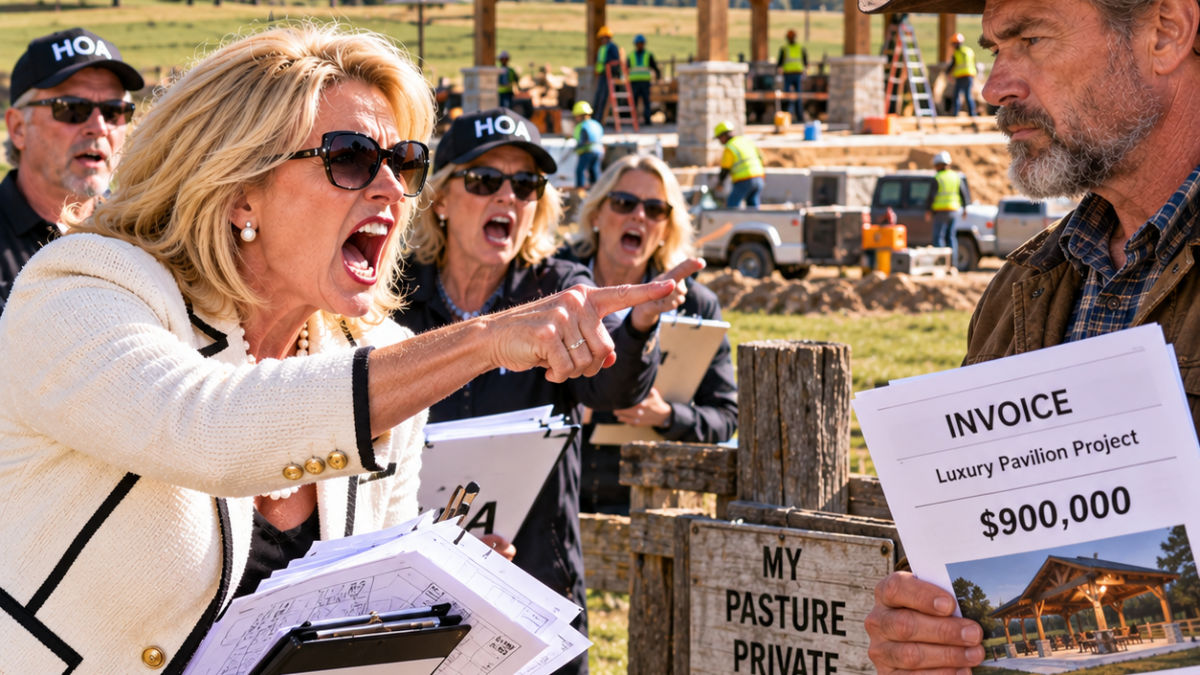
PART 2
I photographed every page.
Front.
Back.
Attachments.
The small project codes in the corners.
Even the staple holes.
Mara had trained me out of the habit of deciding which detail mattered before the evidence had a chance to answer.
Lydia mistook my silence for hesitation.
“You finally understand the exposure,” she said.
I slid the packet into a plastic document sleeve.
“I understand I want the backup records.”
Graham stepped forward.
“Those numbers reflect the association’s total project investment.”
“That’s not what I asked.”
Lydia’s mouth tightened.
“Reed, the time for games is over.”
I looked past her toward the pavilion.
“The time for games ended about ten months ago.”
The deputy approached.
“Mr. Callaway, the work can proceed within the order. Mrs. Fenwick, your vehicle needs to be moved out of the authorized work area.”
Lydia turned toward him.
“We object.”
“I understand.”
“This is nine hundred thousand dollars of community property.”
“I’m not deciding ownership or damages. I’m confirming the order and that there’s no stay.”
Graham put a hand lightly on Lydia’s elbow.
She pulled away.
Then she looked at me.
“If you do this, ninety families will know exactly who destroyed what they paid for.”
That sentence landed harder than I wanted it to.
Not because I believed the pavilion belonged on my pasture.
Because by then I knew some of the people who had paid for it.
Ruth Bell had taken $9,600 out of money she had set aside for a new roof.
Other homeowners had probably done similar things.
They were not all Lydia.
They were people who trusted a board to verify land rights before collecting nearly ten thousand dollars from each household.
I climbed back into the bulldozer.
The removal foreman, Neil Bowers, raised one hand before I started the engine.
“Remember what we discussed.”
“I remember.”
“You do not get to save money by making this exciting.”
I nodded.
That may have been the best instruction anyone gave me during the entire dispute.
The pavilion did not collapse in one satisfying push.
Fixtures came out first.
Appliances were disconnected, labeled, photographed, and stored.
Roof panels were lowered by the crew.
Recoverable cedar beams were stacked on cribbing.
Electrical service had already been professionally disconnected.
Plumbing had been isolated.
An independent observer photographed the sequence because Mara had insisted that if the HOA later claimed I destroyed salvageable property, we would have more than my memory against theirs.
Only after the unstable framing was cleared did Neil wave me forward.
I pushed the first remaining post.
It snapped with a sound like a rifle crack.
Lydia flinched.
So did I.
I had imagined that moment during some of the worst nights of the previous year.
In my imagination, tearing down the pavilion felt like revenge.
In reality, it felt like waste.
Perfectly usable material.
Money.
Labor.
Time.
All being undone because somebody had decided the answer to a disputed boundary was to keep building until the structure became too expensive to challenge.
My relief did not come from hearing timber break.
It came when I could see my equipment lane again.
The lane my father and I had built.
The lane somebody had apparently charged Brier Glenn sixty-eight thousand dollars to “prepare.”
By noon, a ten-second phone video appeared online.
It showed my bulldozer beside one fallen wall.
The caption read:
**LOCAL CONTRACTOR DESTROYS $900,000 HOA PAVILION.**
No court order.
No removal crew.
No inventory.
No months of litigation.
Just ten seconds of machinery and a sentence designed to tell viewers who the villain was.
My equipment driver, Owen, showed me the post.
“Want me to put the survey on there?”
“No.”
“The court order?”
“No.”
“The fake consent?”
“Mara will kill both of us.”
He smiled.
“Mostly you.”
Mara prepared three sentences for the public record.
The pavilion was being removed pursuant to a signed court order.
The work was following the approved removal plan.
Financial claims remained disputed.
That was all.
Then I went to my shop and opened the old steel filing cabinet beside the parts shelves.
The road folder was exactly where I remembered.
My father labeled everything in black marker.
**WEST LANE — 11 YEARS AGO.**
Inside were aggregate receipts.
Fuel logs.
Equipment hours.
A hand-drawn drainage profile.
And photographs.
One showed me operating the grader.
Another showed Dad standing beside the crooked oak, his canvas coat open, one boot on the newly spread gravel.
He looked thin.
He was already slowing down then.
But his hand was raised toward the ditch because he was telling me the crown of the road was wrong.
I laughed despite everything.
Even in a photograph, he looked like he was correcting me.
At the bottom of the folder was our bookkeeper’s final summary.
Materials.
Machine hours.
Labor.
Completion date.
Eleven years before Brier Glenn approved its pavilion.
I scanned everything and sent it to Mara.
Then Nolan Pierce, my surveyor, confirmed that the photograph attached to Lydia’s demand showed the same west equipment lane.
Mara called me that evening.
“We have enough to ask for the underlying charge.”
“Finally.”
“Don’t get ahead of yourself.”
“I know.”
“Say it.”
“The sixty-eight thousand dollars could have a legitimate explanation.”
“Good.”
“I hate you.”
“You pay me by the hour. Hate efficiently.”
I smiled.
Then she became serious.
“The road item matters because it’s testable against records completely outside their accounting. If that line doesn’t hold up, we start asking how the rest of the nine hundred thousand was calculated.”
That was exactly what we did.
But to understand why one road charge mattered so much, you have to understand how the pavilion reached my pasture in the first place.
—
Ten months earlier, I knew none of this.
I thought I had found a contractor’s mistake.
That was all.
I was driving along the west fence when I saw a brass survey cap sticking out of a bucket in the bed of a pickup.
The number stamped into it looked familiar.
Nolan had shown me that marker when we settled my father’s estate.
A young laborer was carrying orange stakes through my gate.
I stopped.
“Where did you get that cap?”
He looked confused.
“The boss said it was obsolete.”
“Who’s your boss?”
He pointed toward Brier Glenn.
“The lady running the pavilion project.”
I photographed the cap.
The bucket.
The truck license plate.
The stakes.
Then I told him not to move anything else until the location was checked.
He was maybe twenty-three.
He looked terrified.
“I’m just doing what they told me.”
“I know.”
I learned early in the dispute that shouting at workers usually punished the people who knew the least.
So I drove to Brier Glenn’s management office.
Lydia Fenwick met me in the lobby.
Red jacket.
White blouse.
Reading glasses hanging from a chain.
She knew my name.
“Mr. Callaway.”
“Were you planning to call me?”
“We were.”
“Before or after your contractor removed my survey marker?”
She gave me an irritated look.
Not guilty.
Not nervous.
Annoyed.
“The contractor is correcting an old layout.”
“Based on what?”
“Your fence does not match the recreation plan.”
“A recreation plan is not a boundary survey.”
She pulled out a colored drawing.
A blue strip crossed the western part of my pasture.
Inside it was a pavilion.
Patio.
Outdoor kitchen.
An arrow labeled **COMMUNITY ACCESS** followed my equipment lane.
“There is a recreational easement,” Lydia said.
“Where?”
“Dating to 1998.”
“Recorded?”
“Yes.”
“Send me the instrument.”
“Our attorney has it.”
“Good. Send the recording number, complete legal description, and exhibit.”
She tapped the pavilion location.
“Ninety households have already contributed to this project.”
I remember that sentence because it was the first time Lydia used other people’s spending as a substitute for my consent.
“Ninety households paying for something does not move my boundary.”
“Your property has always benefited from Brier Glenn’s improvements.”
“My pasture doesn’t become yours because your landscaping is nice.”
She exhaled slowly.
“You’re making this adversarial.”
“I found my survey cap in your contractor’s truck.”
She rolled up the map.
“Our attorney will contact you.”
I gave her my email.
Then, before leaving the parking lot, I sent her a written summary.
I disputed the work.
Requested the claimed easement.
Stated that I had authorized no construction.
No insults.
No accusations.
No threats.
I wanted a time-stamped record before anyone could later describe the conversation differently.
At 5:17 the next morning, Owen called.
“Reed, we have a problem.”
“What?”
“There’s a chain across the west lane.”
I sat upright.
“What chain?”
“And a concrete truck waiting behind me.”
By the time I arrived, part of my fence was down.
Two new posts had been installed on my side of the line.
A chain stretched between them.
A plastic sign read:
**CONSTRUCTION ACCESS ONLY**
Owen’s trailer was loaded with one of my compact loaders.
A customer expected it before sunrise.
Backing out meant nearly an hour around the south entrance.
The concrete driver handed me a site-contact sheet.
Near the bottom was a field:
**LANDOWNER APPROVAL**
Beside it:
**REED CALLAWAY**
Typed.
Not signed.
Just my name.
I called the general contractor listed on the sheet.
Curtis Vale answered.
“I’m looking at your trucks entering my property.”
“Who is this?”
“Reed Callaway.”
A pause.
“The adjacent owner?”
“The owner of the land your truck is sitting on.”
“We have consent.”
“Send it.”
Another pause.
“I’ll need project management.”
“Do that while your concrete waits outside my gate.”
Curtis surprised me.
He stopped the delivery.
That decision cost him a cancellation fee.
He later reminded me of it.
But compared with everyone else connected to the project, it was the first sign somebody understood that an unanswered land question should stop heavy equipment.
That afternoon, I hired Mara.
Then I called Nolan.
He arrived with the estate survey, original field notes, and an expression I had only seen when a developer once drove a skid steer across his GPS tripod.
He recovered the survey cap from the contractor’s office.
Then rebuilt the boundary from surviving monuments and recorded calls.
The pavilion foundation stakes sat entirely inside my parcel.
Closest corner: forty-one feet.
Farthest: sixty-three.
I stared at the measurements on his tablet.
“No possibility?”
Nolan looked at me.
“Possibility of what?”
“That my fence is wrong and somehow they’re right?”
“Your fence is close. The recorded boundary is better.”
“And?”
“Their building is on your land under either one.”
“What about the 1998 easement?”
“Could exist.”
I frowned.
“That date predates Brier Glenn.”
“That doesn’t make it invalid.”
“So we still need it.”
“We need the entire instrument.”
I wanted Nolan to tell me the easement was nonsense.
He refused.
Mara was the same.
Whenever I tried to turn suspicion into conclusion, one of them narrowed it back to what we could prove.
At first, it drove me crazy.
Later, I understood why it saved us.
—
The HOA finally produced an easement number and a scanned page.
There was also a “consent” form.
My supposed signature appeared at the bottom.
At first glance, it looked enough like mine to make my stomach tighten.
Then I looked closer.
The R in Reed leaned the wrong way.
The final y in Callaway formed a loop I never made.
I had signed thousands of equipment invoices.
Checks.
Contracts.
Permits.
My handwriting was not beautiful, but it was mine.
“That is not my signature.”
Mara sat across from me.
“I believe you.”
“Then this is over.”
“No.”
I stared at her.
“What?”
“Your denial matters. It does not make their exhibit vanish.”
“It’s fake.”
“Maybe. But we prove that.”
I hated legal caution when I was paying for it.
She sought an early court order stopping work.
The HOA opposed with the purported easement.
The consent form.
And a declaration saying I had agreed informally before later changing my mind.
At the first hearing, the court did not decide the final property rights.
The record was incomplete.
The claimed easement had not been produced in full.
The signature dispute required more evidence.
The judge set an accelerated schedule for fuller submissions but did not immediately stop every aspect of construction.
I walked out furious.
“I brought them a survey.”
Mara kept pace beside me.
“You brought strong evidence.”
“They brought a bad signature.”
“They brought something that appears facially official until tested.”
“That’s ridiculous.”
“Yes.”
I stopped.
She stopped with me.
“Reed, a convincing lie is expensive because you still have to dismantle it properly.”
The trucks returned.
Mara warned Graham in writing that construction remained disputed and that continuing would increase damages if the HOA’s claimed rights failed.
He responded that the association understood its position.
Footings appeared.
Then cedar posts.
Then the roof.
Every afternoon, I stood at the same fence corner and photographed the progress.
People later called that patience.
It wasn’t.
It felt like watching someone build a shed in my living room while professionals explained which filing deadline came next.
The blocked lane cost my company two hauling jobs.
One customer hired somebody else.
A cattle lessee moved his animals early because construction traffic kept opening the west access.
My legal bills climbed.
One evening I sat in my truck with Mara’s invoice on one knee and a repair estimate for one of my loaders on the other.
I could pay both.
It meant postponing replacement of our service pickup.
That was when Lydia came across the pasture.
“This does not need to bankrupt anyone.”
I looked up.
She held out a proposed agreement.
Fifteen thousand dollars.
In exchange, I would confirm the pavilion’s continued use.
Share access over my lane.
And grant rights for “future recreational improvements.”
I read that phrase twice.
“Why do you need expansion rights?”
“It’s standard.”
“You say you already have permission for the pavilion.”
“We do.”
“Then why are you paying me to confirm it?”
“To resolve uncertainty.”
“And future improvements?”
“Our attorney uses standard language.”
“Then he can explain it to Mara.”
She took back the paper.
“You could be a good neighbor, Reed.”
After she left, I looked at the plan she had carried.
A pale gray rectangle extended beyond the pavilion patio.
No label.
Its service arrow crossed the only level entrance to my lower pasture.
Until then, I thought I was fighting one building.
Suddenly I wondered whether the pavilion was phase one of something bigger.
The next morning, I told Mara:
“Get every earlier version of the site plan.”
That request changed the dispute.
—
Elaine Dorsey from the county permitting office called Mara two weeks later.
She had located the application history.
The original pavilion design was inside Brier Glenn.
Exactly where you would expect a neighborhood recreation building to go.
But the proposed location overlapped a subdivision stormwater-management area.
Drainage review flagged it.
Building there would require additional site preparation and redesign.
Curtis’s preliminary estimate put that extra work at approximately $112,000.
Then the plan changed.
The pavilion moved west.
Onto my higher ground.
Same building.
Same roof.
Same kitchen.
Different land.
The revision note contained four words:
**OWNER APPROVED ALTERNATE CONSTRUCTION LOCATION.**
Mara placed the drawings side by side.
I stared at them.
“They knew where their boundary was.”
“The plans show a deliberate relocation.”
“They moved onto my land to save a hundred twelve thousand dollars.”
“That’s a question.”
I gave her a look.
She shrugged.
“We need who authorized it and why.”
Elaine had also preserved the digital submission history.
The consent form bearing my supposed signature had been uploaded by an email account belonging to the HOA management office.
That did not prove the office created it.
But attached to the same project package was a routing message instructing staff to use the alternate-site package while retaining the original-site budget.
I read it.
“Wait.”
Mara looked at me.
“They avoided the drainage work.”
“Possibly.”
“But kept charging the old budget.”
“Ask the question, Reed.”
I leaned back.
“Where did the money go?”
She smiled slightly.
“Now we’re getting somewhere.”
—
A few days later, Ruth Bell walked into my shop.
She was a retired school office manager from Brier Glenn.
I knew her because I had once pulled her husband’s car out of a drainage ditch after heavy rain.
I refused payment.
The next morning she delivered lemon bread and informed me the debt was settled.
This time she had no bread.
She had a newsletter.
“I voted for the pavilion.”
I wiped my hands on a rag.
“Okay.”
“I thought you sold them the land.”
“I didn’t.”
She looked at me for several seconds.
Then unfolded the paper.
The newsletter described “a permanent recreation site secured through a negotiated land arrangement.”
Under the paragraph was an artist’s rendering.
Below that was a photograph of me shaking Lydia’s hand.
I knew the photograph.
Two years earlier, my crew had helped clear storm-damaged trees near Brier Glenn.
The HOA held a breakfast thanking local contractors.
In the original picture, three other people stood with us.
They had been cropped out.
The caption under the newsletter version read:
**A PARTNERSHIP WITH OUR NEIGHBORS**
Ruth watched me.
“That picture wasn’t about the pavilion.”
“No.”
“You didn’t sell them anything?”
“No.”
She sat on a stack of unopened shop towels.
“I paid ninety-six hundred dollars.”
I knew the special assessment amount.
Hearing it from her felt different.
“I took it out of what I keep for the roof,” she said. “Mine needs replacing in another year or two.”
That was when Brier Glenn stopped being one thing in my head.
Until then, I had used “the HOA” as though it meant Lydia.
It didn’t.
It meant ninety households.
People like Ruth.
People who had been shown a photograph suggesting I supported the project.
People who were told the land rights were settled.
Someone had used my face to make them feel safe about spending their savings.
Mara told me to share only documents I was entitled to distribute.
Ruth got Nolan’s survey.
And my first written objection to Lydia.
Both predated the newsletter.
Ruth read them.
Then she folded the paper.
“I’m asking for the board minutes.”
“What minutes?”
“The meeting where we supposedly approved this land arrangement.”
That request produced another contradiction.
—
The approved pavilion budget was $900,000.
Ninety households contributed $9,600 each.
That totaled $864,000.
Another $36,000 came from reserves.
The arithmetic worked.
The project description did not.
The board minutes authorized construction of a pavilion within the association’s existing recreation area, subject to approvals.
There was no vote approving construction on the Callaway property.
No vote approving permanent use of my equipment lane.
No vote buying land.
At the bottom of the minutes was a later annotation:
**PRESIDENT COMPLETED SITE ARRANGEMENTS PURSUANT TO DELEGATED AUTHORITY.**
Ruth asked for the supporting agreement.
At the next meeting, Lydia said confidential negotiations could not be distributed to every resident.
Ruth stood up.
“You distributed his photograph to every resident.”
Lydia stared at her.
“Mrs. Bell—”
“If he signed something, why can’t we see it?”
Three more homeowners asked the same question.
Lydia referred future questions to counsel.
The next day, the announced grand opening was moved forward two weeks.
Mara noticed immediately.
“They’re trying to create completion.”
“What does that accomplish?”
“Not legal ownership.”
“Then why?”
“Because a finished building full of residents creates a different emotional argument than construction equipment behind a fence.”
She was right.
By then, the pavilion was nearly complete.
Four months after the first stakes, the HOA behaved as though finishing it would settle the dispute.
Mara returned to court.
This time, she had more.
The original and revised site plans.
The newsletter.
The board minutes.
The cropped photograph.
Nolan’s survey.
My written objection.
The court issued an order barring public use while the property claims were litigated.
The order arrived the afternoon before the grand opening.
Caterers packed up.
Rented chairs disappeared.
Red-and-white opening ribbons remained tied around the posts.
Lydia blamed me publicly for disappointing children and grandparents.
I understood why that message worked.
A locked, beautiful pavilion is visible.
Missing land consent is paperwork.
But now the HOA could not occupy the building while claiming use itself made the problem irreversible.
We still needed the complete 1998 easement.
The HOA had produced only the first page and a recording reference.
After months of requests, Mara obtained the entire recorded instrument.
Nolan entered the bearings and distances.
Checked the parcel history.
Then came to Mara’s office with an overlay.
He laid it across my survey.
The easement existed.
It was genuine.
It covered land almost two miles east of my pasture.
A former recreation parcel.
It did not touch my boundary.
It did not touch my road.
It did not touch the pavilion.
Nolan tapped the paper.
“Real document.”
Then he tapped my land.
“Wrong property.”
For months, I had expected some elaborate forged deed.
Instead, the trick was simpler.
Take a genuine first page.
Leave out the legal-description exhibit.
Let everyone assume the recorded document supports the colored map being shown today.
A real document can mislead just as effectively as a fake one when the part that proves what it means stays hidden.
Mara commissioned a title review.
No recorded right authorized the pavilion on my parcel.
At the property hearing, Graham shifted strategy.
Even if the easement did not apply, he argued, the consent form showed I had permitted construction.
Mara put the association’s own form on the screen.
The final paragraph limited the alleged permission to the attached construction site and the construction period.
It expressly stated that no permanent property right was conveyed.
Even the form I denied signing did not say what Lydia had been telling homeowners.
There was no dramatic ruling from the bench that afternoon.
More submissions followed.
Written briefs.
Waiting.
I checked my phone too often.
Finally, the decision arrived.
The court rejected the HOA’s claimed right to keep the pavilion on my parcel.
The order gave Brier Glenn thirty days to remove it under specified conditions.
If the association failed, I could arrange removal pursuant to an approved plan.
Utilities had to be disconnected.
Salvageable property protected.
Notice provided.
Monetary claims would be addressed separately.
I read the order and looked at Mara.
“So I can remove it.”
“Yes.”
“With my equipment.”
“If the plan allows.”
“If they don’t.”
“Yes.”
I smiled.
She didn’t.
“This is permission to carry out a court order.”
“I know.”
“No, Reed. Listen. It is not permission to do whatever feels fair.”
That sentence stayed with me.
Brier Glenn requested a pause.
Denied.
No stay.
Thirty days passed.
The pavilion remained.
On day twenty-six, Graham sent the $900,000 damage demand.
And four days later, Lydia parked her SUV in front of my bulldozer.
Which brought us back to the road charge.
—
The underlying records for the $68,000 line arrived weeks after demolition.
There was no construction invoice showing anybody had built my lane.
No aggregate purchase remotely close to that amount.
No heavy-equipment billing.
Instead, the road charge appeared inside something called a “consulting allocation.”
I read the phrase three times.
“What does that even mean?”
Mara slid another page across the table.
“Look at the total.”
The $900,000 project broke into three major pieces.
Curtis Vale Construction:
**$314,700**
Documented electrical work, furnishings, landscaping, appliances, and related physical expenses:
**$99,300**
Supported physical project cost:
**$414,000**
Then:
**FENWICK DEVELOPMENT CONSULTING — $486,000**
I stared at the company name.
“Fenwick.”
“Yes.”
“Lydia?”
“We need ownership records.”
Those arrived.
Fenwick Development Consulting was owned by Lydia and her brother, Martin.
The HOA bank records showed payments going to the company account.
That fact alone did not prove the services were imaginary.
Related-party companies can legally perform real work.
The question was disclosure.
Authorization.
Deliverables.
Value.
Inside the $486,000 were categories such as:
Site acquisition.
Project coordination.
Drainage avoidance planning.
Procurement services.
Risk management.
And the $68,000 road charge.
I stopped at **RISK MANAGEMENT**.
“They charged homeowners for managing the risk of building on land I kept telling them was mine.”
Mara didn’t smile.
“Let’s find the work product.”
An independent cost consultant reviewed the project.
The documented physical work broadly aligned with approximately $414,000 in supported costs.
She did not say consulting could not cost more.
She asked the question that mattered:
What services justified the remaining difference?
That question forced the next document fight.
And document fights cost money.
Weeks passed.
Another legal bill.
Then another.
The satisfying evidence people imagine appearing in a single binder had to be requested, reviewed, challenged, and sometimes requested again.
At one point, Ruth called.
“They keep saying this is complicated.”
“Some of it is.”
“I understand complicated. I ran payroll through three software conversions.”
I laughed.
“I just want the receipts,” she said.
That stopped me laughing.
Then she asked:
“If the HOA loses, do we pay you too?”
I looked out the shop window.
I wanted to say Lydia would pay everything personally.
That ninety innocent households would somehow walk away untouched.
I had no evidence for that.
“The association is responsible for what it did,” I said. “Where it gets the money and what it recovers from other people is a separate question.”
Ruth was quiet.
“I thought so.”
That changed what victory meant.
I still wanted my losses covered.
But I stopped imagining “the HOA” as Lydia with a bank account.
She had placed ninety households between her decisions and their consequences.
Whatever happened next needed to distinguish them.
—
The HOA produced a board resolution authorizing professional support for the pavilion.
One sentence said:
**The president may select affiliated service providers where appropriate to project needs.**
That sentence mattered.
It appeared to authorize Lydia to hire her own company.
Then Ruth found her copy.
She had downloaded the meeting packet the morning after the vote.
Her version did not contain that sentence.
For two days, I used the word “forged” every time I talked to Mara.
Finally she snapped.
“Stop.”
“It was added.”
“After the vote, apparently.”
“So forged.”
“We know there are different versions. We do not yet know what was formally adopted, corrected, circulated, or approved afterward.”
“You enjoy ruining perfectly good words.”
“I enjoy not making claims before the evidence.”
The management company’s email archive answered it.
After the meeting, Lydia sent a revised resolution.
Her message called the added sentence a “clarification for the permanent record.”
No later board vote approving that revision appeared in the minutes.
Several directors learned about the change during the document review.
Suddenly the board had a conflict larger than my pasture.
They had been defending payments under language they had not actually voted on in that form.
Lydia requested an emergency closed meeting.
The directors instead hired separate independent counsel to review the financial issues.
Graham continued representing the HOA in the property litigation.
Lydia hired her own lawyer.
For the first time, nobody could pretend Lydia’s interests and the association’s interests were identical.
Then Curtis Vale called Mara.
—
Curtis still had final retainage unpaid under his $314,700 contract.
That gave him an excellent reason to preserve records.
At his deposition, he brought a project journal.
Emails.
Photographs.
Daily logs.
And one message he had sent before the first concrete pour.
Attached was a photograph of the brass survey cap that started the entire dispute.
Curtis had written:
**Proposed corners appear outside subdivision boundary. Recommend confirming owner authorization before proceeding.**
Lydia’s reply attached the consent package.
Her message said:
**Owner objection concerns compensation. Counsel has confirmed association right to proceed.**
Mara placed that beside Graham’s produced correspondence.
At the time Lydia sent that email, Graham had asked management for the complete easement and original consent.
He had not written the blanket confirmation Lydia attributed to him.
Curtis stared at the two emails.
“So you resumed work because you believed the land issue was resolved?” Mara asked.
“Yes.”
“Did you independently see the original signed consent?”
“No.”
“Did you see the complete easement?”
“No.”
“Do you regret continuing?”
His attorney objected to the framing.
Curtis answered anyway.
“I should have insisted on the documents.”
Then Mara asked about the road.
“Did your company build the west access lane?”
“No.”
“What did you do there?”
“Used it.”
“Any work?”
“We spread repair gravel near the entrance after deliveries tore it up.”
“How much?”
He checked his journal.
“Receipt was eight hundred forty dollars.”
“Already included in your construction accounting?”
“Yes.”
“Did anyone ask you to invoice sixty-eight thousand dollars for road construction?”
“No.”
He leaned forward.
“I would not have signed that.”
Lydia’s attorney later described the $68,000 allocation as broader “logistical coordination.”
Mara requested time records.
Written scope.
Deliverables.
What arrived did not explain the number.
But Curtis had one more document.
An earlier email from the management office.
Subject:
**PENDING LANDOWNER APPROVAL**
The manager wrote that my approval had not been received and the alternate-site package should remain on hold.
Later that day, Lydia replied:
**Release alternate package. I will handle owner directly.**
The submission log showed the consent bearing my supposed signature was uploaded the following morning.
There was no intervening email from me.
No text.
No original wet-signed form.
No meeting.
No recorded call.
No message saying I had changed my position.
What we had was my written objection.
The management office saying approval was still pending.
Lydia ordering the package released.
And a disputed consent appearing the next morning.
That did not prove which hand physically wrote the signature.
Mara never claimed it did.
She obtained a document examiner’s opinion identifying significant inconsistencies.
Then she presented the evidence as a sequence.
A sequence is often harder to escape than a dramatic accusation.
—
Lydia’s deposition lasted most of a day.
I sat at the far end of the table.
She looked smaller without the clubhouse lectern behind her.
Not weak.
Just human.
Mara began with the consent.
“Did you personally watch Mr. Callaway sign this?”
“No.”
“Did he email it to you?”
“Not directly.”
“Who told you he approved?”
“There was an understanding through project administration.”
“Name the person.”
“I would need to review the communication chain.”
Mara placed my first email in front of her.
“Is this an approval?”
Lydia read it.
“It reflects a negotiating position.”
“Please read the sentence beginning ‘I authorize.’”
Her lawyer shifted.
“There is no sentence beginning that way.”
“Then read the sentence concerning authorization.”
Lydia’s eyes moved across the page.
**I HAVE AUTHORIZED NO CONSTRUCTION OR PROPERTY ACCESS RELATED TO THE PROPOSED PAVILION.**
Mara waited.
“Does that sentence approve construction?”
“No.”
Next came the site plans.
“Why was the pavilion moved?”
“The alternate location was more practical.”
“For whom?”
“The project.”
“For the homeowners?”
“The project as a whole.”
“For Mr. Callaway?”
“He retained ownership.”
“That was not my question.”
Lydia turned a pen slowly between two fingers.
I watched it.
The project.
That was how she spoke about everything.
Not Ruth’s savings.
Not my pasture.
Not Curtis’s warning.
The project needed to proceed.
Once you treat the project as the thing that matters most, every person becomes either useful or obstructive.
Mara asked about the $900,000 demand.
“Was that amount based on an independent appraisal of the pavilion immediately before removal?”
“It reflected the approved investment.”
“That’s not the same thing.”
“It reflected the community’s cost.”
“Was there an independent appraisal?”
“Not that I’m aware of.”
“Was the $68,000 road charge payment for new road construction?”
“It included access coordination and project logistics.”
“What new road was delivered?”
“The access corridor required significant planning.”
“The physical lane existed eleven years earlier.”
“Yes, but the project required mobilization.”
“Curtis Vale testified his company performed $840 of repair gravel there.”
“There were other services.”
“Identify them.”
“I would need to review the accounting.”
Then Mara reached the site-acquisition line paid to Fenwick Development Consulting.
“What property interest did Brier Glenn receive in exchange for the site-acquisition work?”
Lydia pointed toward the consent.
“And the recreational easement.”
Mara placed the property judgment beside them.
“What property interest did Brier Glenn receive?”
Lydia looked at the page.
Then at her attorney.
“I would need to review the accounting.”
Months earlier, I wanted an apology.
By then, I understood an apology was not the most useful thing I could get.
I wanted answers that could no longer change depending on who was listening.
—
The monetary hearing came later.
By then, Brier Glenn’s independent counsel had stopped treating my boundary claim as an attack on the neighborhood.
The association narrowed its argument.
It disputed whether the pavilion removal had gone beyond what was necessary.
It questioned whether salvageable material had been protected.
That was exactly why Mara made us behave cautiously on demolition day.
Neil testified.
The independent observer authenticated photographs.
The electrician confirmed the disconnect.
Inventory records showed appliances, fixtures, roofing, and salvageable beams had been protected.
The HOA had been offered opportunities to retrieve stored property.
The judge compared the removal sequence with the signed order.
I sat beside Mara remembering how badly I had wanted to drive the bulldozer straight through the building months earlier.
If I had done that, the case would have looked different.
Very different.
Instead, we had followed the order.
The court rejected the association’s $900,000 demolition claim.
The project budget was not automatically the value of what had been removed.
And the evidence did not establish that I had departed from the approved removal process in a way supporting the damages demanded.
I closed my eyes.
Not long.
One second.
Maybe two.
Mara touched the edge of my legal pad.
“We’re not done.”
“I know.”
The financial review produced questions beyond my property case.
Some remained with the association.
Some concerned the consent submission.
Some concerned payments to Fenwick Development Consulting.
Mara warned me repeatedly:
“Evidence can expose a new problem without finishing the case that problem creates.”
I listened by then.
For my part, the central results were clear.
The pavilion had no authorized place on my land.
Its removal complied with the court’s order.
And the HOA could not turn a disputed $900,000 project budget into a $900,000 judgment against me.
Outside the courthouse, Graham approached Mara.
“Is there room to settle Callaway’s remaining loss claims?”
She looked at me.
I nodded.
I did not want another year of hearings if the remaining issues could be documented and resolved.
The board’s independent attorney handled negotiations.
We used receipts.
Estimates.
Survey invoices.
Fence work.
Ground restoration.
Actual removal expenses.
Legal-cost contributions.
Not a dramatic round number.
The final settlement paid $68,420 toward documented removal and restoration costs, fence replacement, surveys, and an agreed portion of my legal expenses.
Not every lost hour.
Not the customer who hired somebody else.
Not the months I spent waking up angry.
But enough that I could sign the agreement without pretending either side owed imaginary damages.
The property documents made clear that Brier Glenn had no right to maintain a pavilion on my parcel, use my west lane as a permanent community access route, or expand recreational improvements onto my pasture.
Mara handled the filings preserving that result in the property records.
Then I signed.
—
Lydia lost the presidency in a member vote.
No dramatic arrest happened outside the clubhouse.
No television cameras arrived.
The board ordered an independent audit.
It pursued recovery of disputed consulting payments.
Records related to the consent were referred for appropriate review.
I never promised anyone Lydia would go to jail.
I never knew whether she would.
That was no longer mine to decide.
The homeowners had enough damage without me feeding them fantasies.
Ruth called after the board meeting.
“Are we getting our money back?”
“Some recovery efforts are still pending.”
“So that means no one knows.”
“That means no one should tell you they know.”
She sighed.
“I’m getting very tired of accurate answers.”
“Welcome to my year.”
The board eventually published supported project costs separately from the disputed amounts.
Curtis received his verified final contract balance.
The salvaged appliances, beams, fixtures, and other materials were turned over with condition records.
There was no victory parade.
There were trucks.
Checks.
Signatures.
Audit meetings.
Angry homeowners.
Embarrassed directors.
People trying to understand how a project they believed had been properly vetted ended up on somebody else’s land.
That was more honest than pretending every innocent homeowner escaped consequences.
Lydia had made decisions in the association’s name.
The association had consequences.
Then the association had to determine what it could recover from the people and companies involved.
That process belonged to them.
My job was getting my pasture back.
—
Restoration took several weeks.
The remaining slab came out under the approved plan.
We corrected compacted soil.
Rebuilt drainage.
Brought in clean topsoil.
Repaired the west fence along Nolan’s surveyed line.
The cattle lessee came back the following season.
My equipment trucks started using the lane again without detours.
One Saturday, I was hanging the new gate when Ruth arrived.
She held a loaf wrapped in foil.
“Lemon bread?”
“Obviously.”
“I didn’t pull anyone out of a ditch.”
“No.”
She set the bread on the hood of my pickup.
“I owe you an apology.”
“For what?”
“I voted for the project.”
“So did most people.”
“I believed Lydia.”
“You believed the materials your board gave you.”
“I should have asked.”
“You did ask.”
“After spending the money.”
I tightened the top hinge.
“You asked when something stopped making sense.”
She looked across the pasture.
Only flattened soil remained where the pavilion had stood.
“We thought she was saving us money by moving the site.”
I stopped turning the wrench.
“She moved the cost.”
Ruth looked at me.
“She just didn’t tell you where.”
I nodded toward the gate.
“Hold that level.”
She laughed.
“Seriously?”
“You came here to apologize. You can work.”
She held the gate while I tightened the bolts.
For ten minutes we talked about ordinary things.
Her roof.
My old service pickup.
The subdivision entrance landscaping.
That conversation meant more to me than seeing Lydia removed as president.
Because for most of the dispute, Lydia needed Brier Glenn residents to see me as the enemy.
An angry landowner.
A rich contractor.
A man destroying their $900,000 pavilion.
But boundaries do not have to create enemies.
They create clarity.
Once people could see the records, most understood the difference.
—
A week later, the first hard rain of the season came through.
I put on my father’s old canvas coat and walked the west lane.
Water moved into the ditch.
Past the crooked oak.
Around the bend.
Exactly where it was supposed to go.
Eleven years earlier, Dad and I had walked that same route after the first rain.
He was already sick, though neither of us liked using that word.
He stopped beside the oak and watched water cutting a groove toward the pasture.
“You crowned it wrong.”
“I did not.”
He pointed.
“Water says you did.”
“I followed the grade.”
“You followed what you thought the grade was.”
He handed me the shovel.
“Water doesn’t care what you meant.”
I had grumbled for an hour while fixing it.
Now I stood in the rain smiling.
The ditch still worked.
The road still worked.
And I thought about Lydia’s $68,000 invoice line.
She had meant that photograph to show what I owed Brier Glenn.
Instead, it showed us where to start asking questions.
That was the strange part.
The biggest evidence in the case was not some secret recording or anonymous whistleblower.
It was an invoice Lydia herself handed me because she believed the number would frighten me.
I never needed the pavilion to become a monument to my victory.
I did not want to look at a broken foundation every morning and remember a year of legal bills.
I wanted grass.
A working gate.
A clear lane.
A fence where the survey said the fence belonged.
Paperwork matching the dirt beneath it.
Eventually, that was what I got.
People sometimes describe disputes like mine as two stubborn sides refusing to compromise.
Sometimes that is exactly what they are.
But compromise requires each side to have something it is actually entitled to give.
My pasture was never Lydia’s contribution to make.
My equipment lane was never hers to sell twice.
And her neighbors’ savings were never hers to gamble with just because completing the project made the decision look irreversible.
I followed the water down the ditch until it passed the crooked oak.
Then I looked across the pasture where the pavilion had stood.
There was no building.
No ribbon.
No patio.
Just rain darkening the new grass.
I opened the gate, drove my truck through, and closed it behind me.
For the first time in almost a year, nothing on that pasture belonged to anyone who had not asked to put it there.
And the water kept moving exactly where my father and I had sent it.
[END OF STORY]








