Three Fake HOA “Cops” Drove Onto My Ranch to Seize 47 Cattle Over a $2,400 Fine—Then One Real Sheriff Saw Their Badges and Asked Who Sent Them.
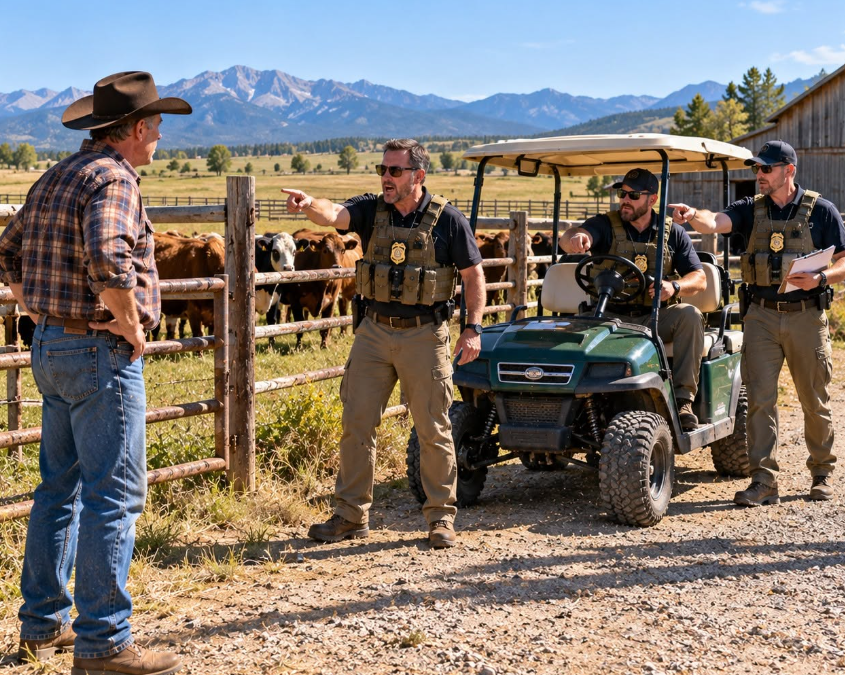
PART3:
“The homeowners association commissioned you?”
He smiled like he had been waiting for that question.
“Sage Creek is a master-planned private community with extended environmental authority over adjacent impact zones.”
“Adjacent impact zones,” I repeated.
The smallest of the three men moved to my left, not quite behind me but close enough that I noticed. He was younger, maybe twenty-five, with a patchy beard and a nervous right hand that kept touching the radio on his shoulder. The third man was older, lean, and sunburned, with mirrored sunglasses and a jaw that looked like it had been clenched since birth.
I set my tongs on the metal shelf beside the smoker.
Slowly.
“You boys crossed my cattle guard,” I said. “You’re standing on the Mitchell ranch. My land is not in Sage Creek. My cattle are not in Sage Creek. My fence was here before Sage Creek had a name.”
Harlan tapped the laminated citation.
“Your operation affects Sage Creek residents.”
“So does the sun in July. You fining that too?”
The young one snorted before he could stop himself.
Harlan shot him a look.
Then he turned back to me.
“Mr. Mitchell, we are not here to debate.”
“That’s good, because you’re not equipped for it.”
His face flushed.
“We’re giving you fifteen minutes to settle the outstanding balance and sign a compliance agreement.”
“And if I don’t?”
He looked toward the pasture.
A few of my cows had lifted their heads, ears turning toward the voices. The lead cow, Dolly, stood near the water trough, black hide shining in the late light. She was twelve years old and had more sense than all three of these men combined.
Harlan said, “Then we contact contracted livestock removal.”
“You mean rustlers with paperwork.”
The older man in sunglasses stepped forward.
“You need to watch your mouth.”
I looked at him.
“What’s your name?”
“Officer Reed.”
“First name?”
He did not answer.
“Badge number?”
His jaw tightened.
Harlan cut in. “He doesn’t have to give you that.”
“Real officers do.”
“We are private compliance officers.”
“Then stop calling yourselves officers.”
That made the air change.
There are moments on a ranch when you feel weather before it arrives. Cattle do it all the time. They lift their heads, turn into the wind, gather before clouds even darken the ridge.
That moment felt like that.
The young one shifted his weight.
Reed’s hand rested near the black pouch on his belt. Pepper spray, maybe. Maybe worse. Hard to say with men who wanted authority without understanding the responsibility that came with it.
Harlan held out his clipboard.
“Sign here.”
I did not move.
“Mr. Mitchell.”
I glanced at the smoker.
The ribs needed another twenty minutes.
That annoyed me more than it should have.
“No,” I said.
Harlan blinked.
“No?”
“No.”
“You’re refusing lawful compliance?”
“I’m refusing nonsense.”
He took one step closer.
“You understand refusal escalates this.”
“Son, you drove onto a working ranch in a golf cart with fake badges to steal cattle before supper. We’re already escalated.”
Behind him, the amber light kept spinning uselessly in the sunshine.
I had lived on that ranch sixty-two years, minus the years I spent away working oil fields and building fences for other men so I could keep this place after my father’s stroke. I knew every draw, every low spot, every patch of prickly pear, every oak that still bore lightning scars from storms before my children were born.
The Mitchell ranch was not fancy.
It was not a spread people photographed for magazines.
The house needed paint. The barn roof popped in the heat. The old windmill no longer pumped. The feed truck had a dent in the passenger door from the year my son Cody tried to back it while watching a girl on horseback instead of the mirror.
But it was ours.
My grandfather bought the first two hundred acres after coming home from Korea with a limp and a hatred of debt. My father added another hundred after twenty years of running cattle and fixing county roads. I fought like hell to keep the whole thing when the drought came, when beef prices dropped, when my wife’s cancer bills ate through our savings faster than I could earn it back.
And then Sage Creek arrived.
At first, it was just survey flags in the distance.
Then bulldozers.
Then a sales office with cold bottled water, fake reclaimed wood, and a sign that said:
SAGE CREEK ESTATES
Luxury Hill Country Living
Authentic Texas Views
Authentic.
They scraped cedar, leveled pasture, imported decorative boulders, and named the streets after the ranching life they had erased.
Longhorn Lane.
Cattleman’s Bend.
Prairie Star Court.
Then came the houses.
Stone fronts.
Black metal roofs.
Outdoor kitchens.
Three-car garages.
People moved in wearing boots that had never touched manure and hats shaped by people who had never worked in the sun. Not all of them were bad. Some were decent. Some waved when they drove past. A few bought beef from me at Christmas.
But the HOA board was different.
They wanted the view without the life that made it.
They wanted cattle in the distance like a painting, but not the smell, not the flies, not the bawling calves, not the dust from hay deliveries, not the sound of my tractor at dawn.
For two years, they sent letters.
At first polite.
Then formal.
Then threatening.
They claimed my cattle lowered property values.
They claimed my fencing was “visually inconsistent.”
They claimed my old hay trailer constituted “industrial storage visible from community-facing lots.”
They claimed my roosters disrupted “resort-style quiet enjoyment,” which was impressive since I had not owned roosters in eight years.
I ignored most of it.
Sometimes I mailed back copies of my deed.
Sometimes I wrote “No jurisdiction” across their letters in black marker and dropped them at the post office.
Once, after they accused my pond of creating “mosquito exposure risk,” I sent them a photocopy of a frog.
My daughter Emily told me that was childish.
She was probably right.
But after forty years of paying taxes, mending fences, pulling calves in sleet, burying my wife under a live oak, and surviving every kind of weather Texas could invent, I had earned a little childishness.
Harlan did not care about any of that.
Men like him never do.
They come with laminated paper and think paper is the same thing as truth.
“Last chance,” he said.
I heard the threat under it.
My old blue heeler, June, came out from under the porch and stood beside my boot. She was fourteen, mostly deaf, stiff in the hips, and still convinced she could whip the world if required. Her lip lifted at Harlan.
He looked down.
“You need to secure that animal.”
“She’s more official than you are.”
Reed moved again.
This time, he reached toward my gate latch.
That gate led from the yard into the lane that ran to the west pasture.
I said, “Touch that gate and we’ll have a different kind of conversation.”
He paused.
Harlan said, “Open it.”
Reed smiled.
That was when I realized they had not come expecting payment.
They had come expecting a show.
A staged seizure.
A frightened rancher.
A video for the HOA board proving they had “taken action.”
Maybe they thought if they loaded one cow, I would cave.
Maybe they did not understand cattle.
Maybe they understood just enough to be dangerous.
Reed put his hand on the latch.
I took one step forward.
June growled.
And then, from behind me, a woman’s voice said, “Dad?”
My chest tightened.
I turned.
Emily’s truck had rolled in without me noticing over the golf cart noise and my own rising anger. She stood by the driver’s door, still in her scrubs from the hospital, hair pulled into a tired knot, my ten-year-old grandson Mason visible in the passenger seat with wide eyes.
Behind her, my son Cody’s pickup turned through the gate.
My family had arrived early.
Of course they had.
Because trouble has a way of showing up right before the people you love.
Emily looked from the fake uniforms to me.
“What’s going on?”
Harlan straightened as if an audience improved him.
“Ma’am, this is an enforcement action. Please remain in your vehicle.”
Her eyebrows lifted.
Emily had spent twelve years as an emergency room nurse. She had been vomited on, bled on, cursed at, and once threatened by a man with a fishing spear stuck through his own foot. A sweaty man in a fake badge did not impress her.
“This is my father’s ranch,” she said.
“And this is a compliance matter.”
Cody got out of his truck.
He was thirty-six, broad-shouldered like my father, with his mother’s dark eyes and my temper when he forgot to guard it. He had a feed store cap pulled low and work gloves tucked into his back pocket.
“Who the hell are you?” he asked.
Harlan pointed at him.
“Sir, stay back.”
Cody laughed.
Wrong laugh.
The kind that meant he was already halfway over the fence in his mind.
I held up one hand.
“Cody.”
He looked at me.
I shook my head once.
Not here.
Not in front of Mason.
Not with three men hoping we would give them a reason.
Cody stopped, but his jaw worked.
Harlan mistook restraint for weakness. People often do.
He lifted the citation board.
“Mr. Mitchell has refused to comply. The association is authorized to begin livestock impound.”
Emily said, very quietly, “Impound our cattle?”
Mason opened the truck door.
Emily snapped, “Stay inside.”
“But Mom—”
“Inside.”
He obeyed, though his face stayed pressed to the window.
The sight of my grandson watching those men threaten what our family had fought to keep lit something dangerous in me.
I looked at Harlan.
“You need to leave now.”
He smiled.
“Or what?”
The question hung there.
I could have answered a lot of ways.
With the rifle in the mudroom.
With the shotgun behind the pantry door.
With the fact that Texas law had little patience for men trespassing with intent to steal livestock.
But the older I got, the more I understood that strength was not saying everything you could say.
Sometimes strength was leaving room for fools to continue incriminating themselves.
So I answered with the truth.
“Or you’re going to wish you had.”
Harlan turned toward the young one.
“Call the hauler.”
The young man pulled out his phone.
That was when the first real siren sounded.
Not loud.
Not dramatic.
Just one short whoop from the road.
The three fake officers froze.
A black sheriff’s SUV turned off the subdivision road and crossed my cattle guard.
Then another.
Then a white unmarked truck.
The golf cart’s amber light kept spinning, suddenly ridiculous.
Sheriff Raylan Cruz stepped out of the first SUV.
Now, Raylan Cruz was not a large man. Five-nine maybe. Lean. Gray at the temples. He wore a tan uniform, a real badge, and the expression of a man who had been waiting all day for someone to lie to him.
Behind him came Deputy Marisol Vega, hand resting near her belt, eyes already moving over the scene. From the unmarked truck stepped a man in jeans and a state livestock inspector’s vest.
Harlan’s face changed.
Not fear exactly.
Calculation.
“Sheriff,” he called, forcing a smile. “Good, you’re here. We’ve got a noncompliant landowner refusing—”
Raylan walked past him.
Straight to me.
“Dalton,” he said.
“Raylan.”
His eyes moved quickly over me.
“You all right?”
“For now.”
He glanced at Emily, Cody, Mason in the truck, June by my boot, the smoker still breathing mesquite smoke like nothing in the world had gone wrong.
Then he looked at Harlan.
The temperature seemed to drop.
“Who are you?”
Harlan puffed up.
“Officer Brent Harlan, Sage Creek Compliance Enforcement. We contacted your office regarding repeated violations and requested standby assistance for livestock impound.”
“No, you didn’t.”
Harlan blinked.
“I—yes, sir, we did.”
Raylan’s voice stayed calm.
“No. You called dispatch and claimed you were conducting a civil compliance inspection and needed deputies for a disturbance risk. That is not the same as livestock impound.”
Harlan swallowed.
“We have authority under association standards.”
Raylan held out his hand.
“Badge.”
Harlan hesitated.
“Sheriff, with respect—”
“Badge.”
The young man looked like he might throw up.
Reed took one slow step backward.
Deputy Vega noticed.
“Don’t move,” she said.
Reed stopped.
Harlan unpinned the badge and placed it in Raylan’s palm.
Raylan looked at it for half a second.
“Where’d you get this?”
“It was issued by our department.”
“What department?”
“Sage Creek Compliance Enforcement.”
Raylan looked toward Deputy Vega.
She took out a small evidence bag.
Raylan dropped the badge inside.
Harlan’s voice rose.
“That is association property.”
“No,” Raylan said. “That is evidence.”
The young one whispered, “Brent.”
Harlan snapped, “Shut up.”
Raylan heard it.
“Name,” he said to the young one.
The boy’s face went pale.
“Tyler Ames.”
“Tyler, are you a licensed peace officer in the state of Texas?”
“No, sir.”
“Security license?”
“I—I’m in the process.”
“Are you carrying a weapon?”
“No, sir.”
Raylan turned to Reed.
“You?”
Reed said nothing.
Deputy Vega moved closer.
“Hands where I can see them.”
Reed slowly lifted his hands.
The livestock inspector, a tall man named Glen Mercer, walked toward the pasture gate and examined the laminated citation still in Harlan’s hand.
“Sheriff,” he said, “this form claims authority under Texas livestock health code.”
Raylan’s eyes sharpened.
“Does it now?”
Glen took the form.
His face grew colder as he read.
“This references a quarantine provision.”
Harlan said quickly, “Template language.”
Glen looked at him.
“Template fraud, maybe.”
Raylan turned fully toward Harlan.
“Did you intend to remove cattle from this property?”
“We intended to enforce compliance.”
“That’s not what I asked.”
Harlan’s mouth opened.
Closed.
Raylan waited.
That was one of his talents.
He could let silence make a guilty man sweat better than shouting ever could.
Finally Harlan said, “If necessary, yes.”
“With what lawful order?”
“The HOA—”
Raylan cut him off.
“The HOA does not regulate cattle outside its subdivision.”
“It regulates community impact—”
“No.”
The word was quiet.
Final.
Harlan’s face reddened.
“Sheriff, with respect, Sage Creek has legal counsel.”
“Good. They’ll need it.”
Deputy Vega moved toward the golf cart.
On the back seat sat a plastic tub. Inside were more laminated notices, zip ties, a stack of blank compliance agreements, and three orange livestock tags with numbers printed on them.
Glen Mercer saw the tags and swore under his breath.
“Those are not state tags,” he said.
Reed suddenly bolted.
He made it six steps.
Cody moved like a gate slamming shut.
“Cody!” I barked.
He stopped himself, barely.
Deputy Vega did not need help. She caught Reed by the arm, twisted him cleanly, and had him against the golf cart before his sunglasses hit the gravel.
“Running during a friendly conversation,” she said, cuffing him. “Bold choice.”
Tyler Ames started crying.
Not sobbing.
Just tears sliding down a face too young for the hole he had dug.
Harlan stared at Reed in disbelief.
Raylan looked at me.
“You got cameras on?”
I nodded toward the barn.
“North corner. Workshop. Porch.”
“Audio?”
“Yard camera does.”
Harlan closed his eyes.
That was the first smart thing he had done all afternoon.
Raylan stepped closer to him.
“Brent Harlan, you are being detained pending investigation into impersonating a public servant, attempted livestock theft, criminal trespass, fraudulent documents, and possible organized scheme involvement.”
Harlan’s head snapped up.
“Organized scheme? This is HOA enforcement.”
Raylan said, “No, son. This is the dumbest branch of something much bigger.”
And there it was.
The sentence that told me what I had suspected since the first amber flash.
These men were not the root.
They were the weeds.
The real trouble was planted elsewhere.
They cuffed Harlan and Reed first.
Tyler Ames sat on the golf cart step with his hands shaking so badly Deputy Vega had to help him hold still. He kept saying, “I didn’t know. I didn’t know they were going to take anything.”
Maybe that was true.
Maybe it was not.
Most people involved in wrong things know less than the worst person and more than they admit.
Mason finally climbed out of Emily’s truck after Raylan nodded permission.
He ran to me and wrapped both arms around my waist.
I held him.
He was trying to be brave, but I could feel him trembling.
“They were gonna take Dolly?” he whispered.
“No,” I said. “They were going to try.”
He looked at the sheriff’s deputies.
“Are they bad guys?”
I glanced at Harlan, who was now sitting on the ground beside the golf cart, face shiny with sweat and fury.
“They did bad things.”
Mason thought about that.
“Is Dolly a victim?”
Cody coughed to hide a laugh.
Emily pressed her lips together.
I looked at Dolly, who had gone back to grazing because cattle understand priorities.
“Yes,” I said. “Dolly is a victim.”
Mason nodded solemnly.
“Can she sue?”
Raylan overheard and smiled for the first time.
“We’ll put her statement in the file.”
Emily hugged me after that.
Hard.
She smelled like hospital soap and worry.
“You should’ve called us,” she said.
“I thought you were coming after five.”
“That is not what I meant.”
“I know.”
She pulled back and looked at my face the way nurses do when they are checking for injuries people are too stubborn to report.
“You’re shaking.”
“No, I’m not.”
“Dad.”
I looked down.
My right hand was trembling.
Anger leaving the body looks a lot like fear.
“I’m fine,” I said.
“You always say that.”
“And someday I’ll be right.”
She did not smile.
That hurt.
Cody stood near the pasture gate, watching the deputies search the golf cart. He was wound tight, the way he had been since his mother died. He had come back to the ranch after the funeral and stayed six months, then left for welding work in Odessa because grief and fathers can make a house too small.
We loved each other.
We also knew exactly where to cut.
That made us careful and careless by turns.
He looked at me over his shoulder.
“How long have you known something was going on?”
I did not answer fast enough.
Emily’s expression sharpened.
“Dad.”
I sighed.
Raylan saved me from answering.
For the moment.
He walked back over with a folder in one hand.
“Dalton, I need to ask you some questions on record, but first you should know this is connected to an active investigation.”
“Into Sage Creek?”
“Into people using HOA authority to pressure rural landowners.”
Cody said, “Pressure them into what?”
Raylan looked toward the subdivision.
“Selling.”
The word moved through my yard like a cold wind.
I had known.
Deep down, I had known.
The letters had not been about odor or fencing or aesthetic harmony. They had been about making the ranch feel surrounded. Making me feel old. Difficult. Outnumbered. Making my kids worry. Making the land seem like a burden I should put down before someone took it.
Emily whispered, “Oh my God.”
Raylan nodded.
“We’ve had complaints in three counties. Fake fines. Bogus environmental notices. Threats of liens. Private security intimidation. Two elderly landowners sold last year after repeated harassment from development-adjacent groups.”
“What development groups?” Cody asked.
Raylan’s eyes stayed on Sage Creek.
“That’s what we’re proving.”
I already knew one name.
Everybody did.
Caldwell Dominion.
The developer behind Sage Creek.
A company with a patriotic logo, polished commercials, and a habit of buying land right before highways expanded.
Their local face was Preston Caldwell III, a man with soft hands, white teeth, and the kind of smile that made you check your wallet after shaking his hand. He had come to my ranch eighteen months earlier in a pearl-snap shirt so new the creases looked factory-made.
He stood near my barn and offered me seven million dollars.
Seven million.
More money than my father ever saw, more than I had ever imagined sitting in any account with my name on it.
I told him no before he finished his bottled water.
He smiled.
“Mr. Mitchell, you may want to take time to discuss this with your family.”
“My family knows what this place is.”
“Land can be legacy in many forms.”
“That sounds like something a man says when he wants to pour concrete over it.”
His smile cooled.
“Growth is coming whether you participate or not.”
“So is weather. Doesn’t mean I sell the roof.”
He left with his offer folder unopened.
Two months later, Sage Creek started sending letters.
Now Harlan sat cuffed in my yard, and Raylan was saying out loud what Caldwell had only implied.
Growth was coming.
And if I would not participate, they would make me pay for standing still.
Raylan took my statement while Deputy Vega photographed everything.
The citation.
The golf cart.
The fake badges.
The orange tags.
The compliance agreements.
The body cameras the men had worn but, foolishly, not activated.
My own yard camera had captured everything, from Harlan saying “impound procedures” to Reed touching my gate.
When Raylan asked if I had touched any of them, I said no.
Cody looked away.
Raylan noticed.
“Cody?”
Cody’s jaw tightened.
“I wanted to.”
“That’s not a crime.”
“Good.”
“Usually.”
Emily said, “Sheriff, what happens now?”
Raylan closed his notebook.
“Now we squeeze.”
Harlan, sitting ten yards away, looked up.
Raylan did not lower his voice.
“People like this don’t build the machine. They just run when someone pushes the button. We find who gave them the paperwork, who paid them, who authorized them to come here, and who planned to haul cattle.”
Harlan shouted, “I want a lawyer.”
Raylan said, “That’s the first sensible thing you’ve said.”
They loaded the three men into separate vehicles.
Before Raylan left, he turned to me.
“You’ll get calls.”
“I figured.”
“Don’t take meetings alone.”
“I’m not helpless.”
“I didn’t say you were.”
I looked toward Mason, who was now crouched by June, telling her she was a witness.
Raylan followed my gaze.
Then he said quietly, “Your dad helped my family when I was a kid.”
I looked back at him.
“I remember.”
His father had been a mechanic who lost his shop in a fire. My father gave him use of our equipment shed for six months until he got back on his feet. Raylan had been twelve then. Skinny. Angry. Always hungry but too proud to take food unless my mother made him “help” in the kitchen first.
Raylan swallowed.
“I know what this land means,” he said. “Not just to you.”
That nearly undid me.
I nodded once.
He put on his hat.
“We’ll do this right.”
After they left, the yard felt too quiet.
The smoker still held the ribs.
They were overdone.
Nobody cared.
Emily set the picnic table without asking. Cody pulled extra chairs from the barn. Mason fed June bits of rib until Emily caught him. Dolly remained a victim in good standing.
We ate as the sun dropped behind the west pasture.
Nobody talked about the fake officers at first.
We talked about ordinary things because ordinary things are how families find their footing after fear.
Mason’s baseball game.
Emily’s patient who swallowed a hearing aid battery.
Cody’s truck making a noise he described as “financially concerning.”
Then, after Mason fell asleep in a lawn chair with a rib bone still clutched in one hand, Emily looked at me across the table.
“Were you going to tell us?”
I set down my fork.
Cody leaned back.
The sky had gone purple at the edges. Crickets started up near the ditch. The cattle gathered in dark groups near the water.
“I didn’t know enough.”
“That wasn’t the question,” Emily said.
I looked at my daughter.
She had her mother’s eyes.
That made lying harder.
“No,” I said.
Her face tightened.
Cody muttered, “Of course.”
I looked at him.
He stood abruptly and walked toward the barn.
“Cody.”
He kept walking.
Emily closed her eyes.
“Dad, you can’t keep doing this.”
“Doing what?”
“Carrying everything alone until it explodes.”
“I didn’t want to worry you.”
“That is not love. That is control with better intentions.”
The words hit clean.
Nurses know where to press.
I stared at the table.
Emily’s voice softened.
“Mom used to say you treated pain like a stray dog. If you didn’t look at it, maybe it wouldn’t follow you home.”
I laughed once, but there was no humor in it.
“She said a lot of things.”
“She was usually right.”
“Yes.”
We sat there in the darkening yard.
I could still see her mother at that table. Laura Mitchell. Barefoot in the grass, laughing at something Cody said, stealing the crispy ends off ribs before anyone else got to them. She had loved that ranch with a fierceness that rivaled mine, but differently. I loved it like duty. She loved it like a living thing.
When the cancer came, she made me promise two things.
Do not sell because you are scared.
Do not keep it if it costs you the children.
At the time, I thought I understood.
I had not.
Emily reached across the table and touched my hand.
“We almost pulled in on those men taking your cattle, Dad. Mason saw badges and thought they were real. Cody wanted to fight. I wanted to call Mom and then remembered I couldn’t.”
Her voice broke.
I covered her hand with mine.
“I’m sorry.”
“I know you are.”
“I thought I was protecting you.”
“You were leaving us outside the fence.”
That one hurt because it was true.
From the barn came the sound of a metal door sliding open.
Cody had gone inside to cool off.
Or maybe to punch something.
Possibly both.
I looked toward the barn.
“I’ll talk to him.”
Emily nodded.
“Try listening too.”
I found Cody in the tack room.
He had one hand braced against the wall, head down, shoulders tight.
The tack room still smelled of leather, dust, saddle soap, and Laura’s peppermint candies. She used to keep a jar on the shelf for the kids and pretend not to notice when Cody took three at a time.
He did not turn when I entered.
“I’m not in the mood,” he said.
“Neither am I.”
“Then go back outside.”
“No.”
He laughed bitterly.
“There it is.”
I leaned against the doorframe.
“You think I don’t want your help.”
“I know you don’t.”
“That’s not true.”
He turned then.
His eyes were wet, which made him angrier.
“When Mom got sick, you made every decision before we even knew there was a decision. Treatment plans, bills, selling equipment, refinancing, all of it. Then after she died, you shut the office door and became a damn monument.”
I said nothing.
“You think keeping us out means we don’t hurt. We still hurt. We just hurt alone.”
I looked down.
In the corner sat the old roping saddle Cody used as a teenager. Laura had saved for months to buy it used from a widow in Fredericksburg. He rode it until the stirrup leather cracked.
“I didn’t know how to be your father after she died,” I said.
That stopped him.
The words surprised me too.
Cody’s anger faltered, but did not disappear.
I kept going before pride could stop me.
“She was the bridge. Between me and you. Between me and Emily. Between me and the parts of myself I didn’t want to explain. When she got sick, I thought if I could just handle everything, I could spare you. Then she was gone, and handling things was the only language I had left.”
Cody looked away.
“I needed you to be my dad, not my foreman.”
“I know.”
“Do you?”
“I’m learning late.”
He swallowed.
For a while, the only sound was crickets and the low groan of cattle beyond the barn.
Finally he said, “If they come for this place, they come for all of us.”
I nodded.
“Yes.”
“No more secret letters.”
“No more.”
“No more meetings alone.”
“No more.”
“No selling without talking to us.”
I looked at him sharply.
“I’m not selling.”
“I didn’t say you were. I said no deciding alone.”
I thought of Laura’s promise.
Do not keep it if it costs you the children.
“All right,” I said.
Cody nodded.
It was not fixed.
Families are not tractors. You do not replace one broken part and call it repaired.
But something shifted.
That night, after Emily took Mason home and Cody drove back to his place, I sat on the porch with June asleep by my chair and watched headlights disappear down the road.
Beyond the eastern fence, Sage Creek glowed.
Porch lights.
Landscape lights.
Pool lights.
A fake Texas village built on former pasture, shining like it had always belonged there.
I wondered how many people inside those houses knew what was being done in their name.
More than claimed, probably.
Fewer than deserved blame, maybe.
That was the hard part about organized cruelty. It used ordinary people as insulation.
A week passed.
Then two.
The story spread through the county faster than Johnson grass.
“Fake HOA cops try to seize cattle.”
It sounded ridiculous enough to become a joke until people understood it was real.
Then folks started talking.
A widow outside Bandera brought Raylan a stack of notices threatening to lien her well access unless she sold a back parcel to an “approved conservation buyer.”
A retired teacher near Junction admitted she had paid $6,800 in bogus view-corridor fines because men in uniforms kept coming to her gate.
A father and son near Mason reported that a private enforcement crew had cut their fence and photographed cattle on the road, then blamed them for “community endangerment.”
Every story had different letterhead.
Different names.
Different compliance officers.
But the language was the same.
Impact zone.
Environmental nuisance.
Community-facing land.
Agricultural nonconformity.
Unauthorized rural use.
Words designed to make old rights sound like new violations.
Raylan called me one Thursday morning.
“You got time to come in?”
“Depends.”
“On what?”
“Whether I’m under arrest.”
“Not today.”
“That’s comforting.”
“Bring the letters.”
I brought everything.
Two years of Sage Creek notices in a cardboard feed supplement box.
Raylan met me at the sheriff’s office and led me past the front counter into a conference room.
On the wall was a map of three counties.
Red pins.
Blue pins.
Yellow string.
I looked at it and felt my stomach sink.
There were too many pins.
Deputy Vega stood near the map with a laptop. Glen Mercer, the livestock inspector, sat at the table. Beside him was a woman in a gray suit who introduced herself as Clara Wynn from the state attorney general’s rural fraud unit.
That was when I understood the investigation had grown teeth.
Clara shook my hand firmly.
“Mr. Mitchell, your camera footage gave us our first clean attempted livestock seizure on video.”
“Glad my yard was useful.”
“It may be more than useful.”
She opened a folder.
“We believe several development entities have used private compliance contractors to intimidate landowners adjacent to planned residential expansions. The contractors rely on fake or exaggerated HOA authority, fraudulent citations, and, in some cases, fabricated livestock or environmental claims.”
“Caldwell Dominion,” I said.
She did not confirm.
She did not need to.
Raylan slid a photograph across the table.
It showed Brent Harlan standing beside Preston Caldwell III at some charity skeet shoot, both holding shotguns and smiling.
I stared at it.
“Harlan said he worked for Sage Creek.”
“He works for Lone Star Community Protection,” Raylan said. “Private company. Contracted by several HOAs.”
“Owned by?”
Deputy Vega clicked something on the laptop.
A corporate filing appeared on the screen.
“Officially, a holding company,” she said. “Behind that, another company. Behind that, a trust.”
Clara said, “But payments tell a clearer story.”
She showed me a bank record.
Sterling Consulting.
Caldwell Dominion.
Lone Star Community Protection.
Sage Creek HOA.
Different names.
Same river.
“They’ll say it was rogue contractors,” I said.
Clara smiled slightly.
“They already are.”
“Is it working?”
“Not as well as they hoped.”
Raylan leaned back.
“Harlan is talking.”
That surprised me.
“He is?”
“Not out of moral awakening. Reed tried to pin everything on him. Tyler Ames cried for six hours and gave us text messages. Harlan decided loyalty was less appealing than prison.”
Deputy Vega looked almost fond of the memory.
“Tyler really did cry for six hours,” she said.
Clara handed me another document.
“This is why we asked you here.”
It was a copy of a proposed civil injunction.
My ranch was listed as a protected property.
So were nine others.
“They’re trying to stop the harassment campaign,” Raylan said. “But we need witnesses. People willing to testify publicly.”
I looked at the map.
Then at my ranch name on the page.
I had spent most of my life avoiding rooms with microphones. Ranching teaches you to solve problems with wire, water, and weather, not statements under oath.
But I thought of Mason asking if Dolly could sue.
I thought of Emily saying I left them outside the fence.
I thought of Cody standing in the tack room, eyes wet with anger because his father had mistaken silence for strength.
“What do you need me to say?” I asked.
Clara’s expression softened.
“The truth.”
The first public meeting was held at the county courthouse annex.
It was not a trial yet, though the room felt like one. Reporters lined the back wall. Landowners sat shoulder to shoulder. Sage Creek residents came too, some defensive, some curious, some frightened that their HOA dues had funded something uglier than landscaping disputes.
Preston Caldwell arrived fifteen minutes late.
That was intentional.
Men like him believe punctuality is for people without power.
He wore a tailored sport coat, polished boots, and an expression of patient disappointment. Not guilt. Not concern. Disappointment that everyone had made such a fuss.
Beside him walked Sage Creek HOA president Marjorie Bell.
Marjorie was in her late fifties, sharp-haired and sharp-eyed, with a silver bracelet that clinked every time she adjusted her papers. She had signed most of the letters sent to my ranch. I had met her once at a county water meeting, where she introduced herself by saying, “We’re neighbors whether you like it or not.”
I had replied, “Then be better at it.”
She had not.
At the annex meeting, she avoided looking at me.
Clara Wynn presented the state’s preliminary findings. Calm. Precise. No theatrics.
Fake citations.
Unlicensed enforcement personnel.
Misrepresentation of legal authority.
Possible impersonation of public servants.
Fraudulent liens threatened but not filed.
Attempted unlawful seizure of livestock.
Pattern of development-related pressure.
Each phrase landed like a hammer.
Then she played the video from my yard.
I had seen it already.
Still, watching it on a big screen in a room full of people made my skin tighten.
There I was beside the smoker, older and thinner than I felt in my own head. Harlan stood too close. Reed moved toward the gate. The amber light spun. My daughter’s truck arrived. My grandson watched through the window.
Then Harlan’s voice filled the room.
“We begin impound procedures.”
A murmur moved through the audience.
Marjorie Bell stared at the table.
Preston Caldwell kept his face neutral, but his fingers tapped once against his knee.
The video continued until Raylan arrived and took the badge.
When it ended, Clara called me to speak.
I walked to the microphone.
My hands were steady.
That surprised me.
“My name is Dalton Mitchell,” I said. “My ranch is not inside Sage Creek. It has never been inside Sage Creek. My family has run cattle there since 1954.”
I looked at the audience.
Some faces I knew.
Some I did not.
Cody and Emily sat in the front row with Mason between them. My grandson wore a button-down shirt and looked very serious, as if he might be called as Dolly’s attorney.
I continued.
“For two years, Sage Creek sent letters claiming my land violated their rules. I ignored them because they had no authority. Then three men in fake law enforcement uniforms drove onto my property and threatened to seize my cattle unless I paid money I did not owe.”
I turned slightly toward the Sage Creek section.
“I know some of you live in that subdivision because you wanted peace. I don’t blame you for wanting a safe street, a nice home, a place for your kids or grandkids. But your board and developer used your community like a weapon. They tried to make my ranch look like the problem so nobody would ask why they wanted my land so badly.”
Marjorie’s face tightened.
Caldwell watched me carefully now.
I looked back at the commissioners.
“My cattle are not props. My fences are not decorations. My pasture is not a view corridor. It is a working ranch. It fed my children. It paid hospital bills. It buried my wife. It holds my father’s sweat and my mother’s prayers. And no fake badge turns that into someone else’s asset.”
The room stayed silent.
I had more to say, but the rest caught in my throat.
So I finished simply.
“Lines matter. Not just property lines. Moral ones.”
I stepped back.
Mason stood and clapped once.
Emily grabbed his arm, embarrassed, but then someone else clapped.
Then another.
Soon half the room was standing.
Not everyone.
Caldwell did not.
Marjorie did not.
But enough.
Afterward, in the hallway, Preston Caldwell approached me.
Raylan noticed immediately and moved closer, but I shook my head.
Caldwell smiled.
“Mr. Mitchell.”
“Mr. Caldwell.”
“Powerful remarks.”
“True ones usually are.”
His smile did not change.
“I’m sorry for what happened on your property.”
“Are you?”
“I’m sorry you experienced distress.”
“That’s not the same thing.”
His eyes cooled slightly.
“You should be careful about making broad accusations.”
“You should be careful about hiring idiots.”
For the first time, his smile vanished.
Only for a second.
Then it returned.
“I hope you understand development is not the enemy.”
“No. Greed is.”
“Progress requires vision.”
“Progress without memory is just appetite.”
His jaw tightened.
“You know, I made you a very fair offer.”
“You made me a very large offer. Fair is different.”
“Your children may not share your attachment forever.”
That was the first true threat.
Not against me.
Against time.
Against my heirs.
Against the day I would not be standing at the gate.
I stepped closer.
Caldwell smelled like cedar cologne and expensive laundry.
“My children,” I said, “know the difference between inheritance and bait.”
His eyes flicked past me.
Cody had appeared behind my shoulder.
Emily stood beside him.
Mason too.
Caldwell’s calculation shifted.
For the first time, he saw not an old rancher alone, but a fence line with people standing on it.
He nodded once.
“Good evening.”
He walked away.
Cody watched him go.
“I don’t like him.”
“He’ll survive your disapproval.”
“Will we?”
I looked at my son.
“Yes,” I said. “But not by accident.”
The arrests came before dawn three weeks later.
Raylan told me afterward that he preferred dawn because guilty people were less polished before coffee.
Search warrants hit Lone Star Community Protection, Sage Creek HOA offices, and Caldwell Dominion’s regional planning suite. Computers, phones, contracts, bank records, fake badges, blank citation templates, and binders labeled “Rural Adjacent Compliance Strategy” were seized.
Rural adjacent.
That was what we were to them.
Not ranchers.
Not families.
Not people.
Adjacent.
Near enough to profit from.
Inconvenient enough to pressure.
The news helicopters came by noon.
By evening, Preston Caldwell was on television denying knowledge of illegal tactics while walking very quickly from his office to a black SUV. Marjorie Bell resigned “to focus on her family.” Harlan, Reed, and several others were formally charged. Tyler Ames received a lesser charge in exchange for cooperation and, according to Deputy Vega, cried again while signing.
But the most satisfying moment came two days later, when Raylan drove out to my ranch with a copy of one seized document.
He found me fixing a trough float.
“You need to see this,” he said.
I dried my hands on my jeans.
The document was a strategy memo from Caldwell Dominion.
Target: Mitchell Ranch.
Objective: acquisition or neutralization of operational nuisance prior to Phase II expansion.
Operational nuisance.
There it was in corporate language.
Me.
My cattle.
My wife’s grave beneath the live oak.
My grandson feeding cubes through the fence.
My daughter learning to drive the old feed truck.
My son breaking his arm falling from the hayloft at twelve.
A whole life reduced to a nuisance standing in the way of Phase II.
Raylan watched my face.
“You okay?”
I folded the paper carefully.
“No.”
He nodded.
“Want to hit something?”
“I’m seventy-two.”
“I didn’t say hard.”
I laughed despite myself.
Then I looked toward the east pasture where my cattle moved in late sun.
“What happens to Phase II?”
Raylan smiled.
“Hard to build luxury homes when the state freezes your permits.”
That night, I called Emily and Cody to the house.
Not because there was danger.
Because there were decisions.
I laid the seized memo on the kitchen table along with my deed, tax records, water rights documents, and Laura’s old notebook where she had written down ranch expenses in neat blue ink for twenty-nine years.
Emily touched the notebook first.
“She kept everything.”
“Yes.”
Cody read the memo.
His face darkened.
“Neutralization.”
“I know.”
“They talk like we’re pests.”
“To them, we are.”
Emily looked at me.
“What do we do?”
That question mattered.
Not what will you do.
What do we do.
I looked at both my children.
“I’ve been thinking about putting part of the ranch into a conservation easement.”
Cody sat back.
Emily blinked.
“That’s permanent,” she said.
“Yes.”
“No development?”
“No subdivision. No commercial buildout. Ranching stays. Family homes possible under limits. Land protected.”
Cody was quiet.
“You serious?”
“I should’ve done it years ago.”
Emily looked toward the window, beyond which the yard lay dark and quiet.
“Would that hurt the value?”
“Yes.”
“How much?”
“A lot.”
Cody rubbed his jaw.
“That’s money you might need.”
“I need sleep more.”
Emily smiled faintly, then grew serious again.
“What about us? Mason? Future grandkids?”
I looked at Laura’s notebook.
“Your mother told me not to keep this place if it cost me my children. So I’m asking. Not telling. If both of you say no, we wait.”
Cody and Emily looked at each other.
Years of sibling language passed between them without words.
Finally Emily said, “I don’t want Mason inheriting a war.”
Cody nodded slowly.
“I don’t want him inheriting a shopping center either.”
Emily laughed softly.
“No.”
Cody looked at me.
“If we do this, we do it right. Keep enough flexibility for the family. Protect the water. Protect Mom’s oak.”
“Ruthless negotiator,” I said.
“I learned from a difficult old man.”
“That man sounds handsome.”
Emily rolled her eyes.
For the first time in a long time, the kitchen felt like a family room instead of a command post.
We spent three hours talking.
Arguing.
Remembering.
Planning.
Not once did I feel alone.
The court cases dragged on, the way court cases do.
Harlan pleaded guilty first.
Reed held out and lost.
Marjorie Bell took a deal that required testimony against Caldwell Dominion executives. She claimed she had believed the enforcement tactics were “aggressive but lawful.” The judge asked whether threatening to seize cattle with fake badges had seemed lawful to her.
She cried.
The judge did not look impressed.
Preston Caldwell fought longest.
Men like him always do. They believe consequences are for people who personally touch the gate latch, not the ones who pay for the hand.
But the documents were too much.
The payments.
The memos.
The text messages.
One from Caldwell to his regional manager became famous locally:
If Mitchell won’t sell, make ranching next to Sage Creek unbearable. Keep it deniable.
Keep it deniable.
That phrase followed him into the courtroom like a smell.
He eventually pleaded to conspiracy-related fraud and avoided the longest possible sentence, which angered many people. It angered me too, at first. Then Raylan explained the plea required restitution, cooperation, and permanent debarment from certain state-backed development programs.
“He’ll still be rich,” Cody said when we discussed it.
“Probably,” Raylan said.
“That doesn’t feel like justice.”
“No,” Raylan said. “It feels like the legal system. We aim them in the same direction when we can.”
The ranchers received restitution.
Some land deals were reopened.
The widow near Bandera got her back parcel returned after proof showed she had signed under fraudulent pressure. The retired teacher received her money back with damages. The father and son near Mason used their settlement to rebuild fencing and install cameras on every gate.
As for Sage Creek, the HOA was placed under oversight until new elections could be held.
Many residents were furious.
Some at me.
Most at Marjorie and Caldwell.
A few came to apologize in person.
One man brought a bottle of bourbon and said, “I voted for every fine they sent you. I thought you were just being stubborn.”
“I was being stubborn.”
“Yeah, but you were right.”
“Those can overlap.”
He laughed.
Then he looked toward the pasture.
“My son likes watching the cows.”
“Most sensible thing I’ve heard from Sage Creek.”
He smiled.
“Could we buy beef from you sometime?”
I studied him.
He looked embarrassed but sincere.
“Call Emily,” I said. “She handles the list now.”
“She does?”
“She said my system was ‘a coffee can full of chaos.’”
“Was it?”
“Yes.”
Slowly, awkwardly, fences became fences again instead of battle lines.
Not with everyone.
Some people preferred resentment. It requires less humility than regret.
But enough changed.
Sage Creek replaced its board. They removed the word “enforcement” from almost everything. They hired a real attorney who began every meeting, I was told, by saying, “Our authority ends at our property line.”
That line became a joke around the county.
Then a bumper sticker.
Then a sign someone anonymously hung on my gate one morning:
AUTHORITY ENDS HERE. BRISKET BEGINS AT 5.
Cody denied making it.
Emily denied ordering it.
Mason confessed after three days because guilt interfered with dessert.
I left it up for a month.
The conservation easement took nearly a year to finalize.
Surveyors came.
Lawyers came.
Biologists came.
A historian came and asked whether the old stone trough was original to the 1950s cattle operation. I said yes, though my father would have laughed himself sick hearing that a cracked trough had become historically interesting.
We walked every boundary.
Marked every water source.
Documented native grass.
Mapped the oak where Laura was buried.
Mason helped by carrying flags and asking whether conservation easements protected ghosts.
The lawyer, to her credit, said, “In a way.”
When the final signing day came, we held it at the ranch, not an office.
Raylan came.
Deputy Vega came.
Clara Wynn drove in from Austin.
Emily brought sandwiches.
Cody smoked brisket.
Mason wore a bolo tie and announced himself as “livestock victim counsel,” which made Glen Mercer laugh so hard he had to sit down.
We set a folding table beneath the live oak.
Laura’s oak.
The same tree where she was buried, where shade fell wide and cool even in August.
I signed first.
Then Emily.
Then Cody.
Not because they had to legally, but because I wanted them at the table.
When the last signature dried, nobody cheered.
It was too solemn for that.
But Mason raised his hand.
“Does this mean nobody can build houses on Grandma’s ranch?”
Emily’s eyes filled.
I put my hand on his shoulder.
“It means this land gets to stay itself.”
He thought about that.
Then he nodded.
“Good.”
After everyone ate, Raylan and I stood near the fence watching the cattle.
Dolly, now famous because the local paper had called her “the cow at the center of the fake HOA scandal,” grazed with complete indifference to her public role.
Raylan said, “You ever think about what would’ve happened if your camera wasn’t on?”
“Yes.”
“If Emily hadn’t arrived?”
“Yes.”
“If Reed got that gate open?”
I looked at him.
“Yes.”
He nodded.
“Me too.”
The wind moved through the grass.
Finally I said, “Thank you.”
“For doing my job?”
“For knowing it was your job before I had to convince you.”
Raylan looked down.
“My dad used to say your father saved him.”
“He gave him a shed.”
“Sometimes a shed is the difference between falling and standing.”
I thought of my father then.
Hard hands.
Quiet voice.
A man who believed help was something you did before people had to ask.
“He would’ve liked you as sheriff,” I said.
Raylan smiled.
“That means more than you know.”
The next spring, Sage Creek held a community meeting and invited me to speak.
I almost said no.
Then Emily said, “You don’t have to forgive them to teach them something.”
Cody said, “Also, I want to see their faces when you walk in wearing your manure boots.”
So I went.
The meeting was held in their clubhouse, a big stone building with cedar beams and framed photographs of “authentic ranch living” that did not include a single actual rancher. Someone had put out bottled water and little cookies shaped like Texas.
I wore clean jeans, a pearl-snap shirt Laura had bought me years before, and boots that had indeed seen manure, though I scraped them first because I was raised right.
The new HOA president, a soft-spoken engineer named David Lin, introduced me carefully.
“Mr. Mitchell has agreed to discuss neighbor relations, rural land boundaries, and what our community can do better.”
I stood at the front and looked at the room.
Some faces were friendly.
Some wary.
Some ashamed.
A few defensive.
I had no interest in humiliating people who had already learned expensive lessons.
So I told them about cattle.
Not laws first.
Cattle.
I told them why calves bawl after weaning. Why dust rises during hay season. Why fences are patched with whatever works until you can do better. Why a working ranch sometimes smells like manure because manure is not a moral failure. Why ranch trucks start early. Why guard dogs bark. Why vultures circling do not always mean disaster, but ranchers look anyway.
Then I told them about land.
How every acre has water, slope, memory, and consequence.
How a fence line is not an insult.
How a view is not ownership.
How moving to the edge of a ranch and complaining about ranching is like moving beside a church and complaining about bells.
People smiled at that.
A few even laughed.
Then I told them about Laura.
Not too much.
Enough.
I told them she used to say neighbors were not the people who lived closest, but the people who noticed when something was wrong.
“When your board sent letters to my ranch,” I said, “some of you knew. Some of you signed petitions. Some of you shared complaints online. Some of you looked away because it was easier. That is how bad people borrow good people’s silence.”
The room went still.
I looked around.
“I’m not saying this to shame you forever. Shame is only useful if it becomes change. I’m saying it because communities don’t become decent through rules. They become decent through courage.”
Afterward, people lined up to shake my hand.
One young mother apologized because her kids had repeated things about “smelly cows” they heard from adults.
An older man asked if Mason might show his grandson the cattle sometime.
A woman who had once complained about my hay trailer asked if I needed volunteers for fence repair after storms.
I told her nobody needs volunteers for fence repair unless they dislike their friends.
She said she was serious.
I believed her.
At the end, David Lin handed me an envelope.
Inside was a resolution passed by the new HOA board.
Sage Creek formally recognized the Mitchell Ranch as a preexisting agricultural neighbor and committed to noninterference, boundary respect, and direct communication before complaints.
At the bottom, someone had added a handwritten note:
Thank you for reminding us Texas was here before our subdivision.
I folded it and put it in my shirt pocket.
On my way out, I stopped near a framed promotional photograph in the hallway.
It showed a sunset over my pasture.
My cattle.
My fence.
My land.
A marketing caption beneath it read:
Luxury with a ranch view.
I stared at it for a long moment.
David Lin, standing beside me, cleared his throat.
“We’re taking those down.”
“Good.”
“We didn’t realize.”
I looked at him.
“Yes, you did.”
He had the decency not to argue.
Then I said, “But realizing late is better than never.”
He nodded.
The photograph was gone by the next week.
Months passed.
Life returned to ranch rhythms, which is to say something broke every other day and weather ignored forecasts.
Dolly had a calf in a thunderstorm because old cows enjoy drama.
June passed away in her sleep on the porch in late October, nose tucked under her tail, having outlived her hearing, half her teeth, and every trespasser’s confidence. Mason insisted we bury her near the cattle guard because “that’s where she worked.”
So we did.
Cody moved back closer to the ranch, taking welding jobs within driving distance. He and I still argued, but better now. Cleaner. Less old poison. He took over equipment repairs and taught Mason how to weld scrap into terrible art.
Emily reduced her hospital hours and built the ranch beef program into an actual business instead of what she called “Dad’s handshake economy.” She made labels, set up online orders, tracked inventory, and forced me to learn how to use a tablet.
I remain opposed to tablets on philosophical grounds.
But the beef sold.
Mostly to people who liked knowing where their food came from.
Including, to my private amusement, several Sage Creek families.
One Saturday afternoon, almost exactly a year after the fake officers came, we held a small ranch open house for customers and neighbors.
Nothing fancy.
Brisket.
Beans.
Lemonade.
Hay rides for kids.
A table where Mason sold hand-drawn “Dolly the Victim” stickers until Emily made him change the wording to “Dolly the Survivor.”
Raylan came in plain clothes.
Deputy Vega brought her wife.
Glen Mercer came and inspected the potato salad with more suspicion than he had shown the fake livestock tags.
Caldwell Dominion was gone from the county by then, at least under that name. Developers are like mesquite; cut one down and watch for shoots. But the permits for Phase II were dead. The land east of Sage Creek remained scrub pasture, tied up in lawsuits and then eventually sold to a conservation buyer after the fraud cases made it too toxic for luxury marketing.
At sunset, I found myself standing by the fence with Mason.
He was watching Dolly’s calf chase a grasshopper.
“Grandpa?”
“Yeah.”
“When those fake guys came, were you scared?”
I thought about lying.
Then I looked at him and remembered promising my children no more fences where truth belonged.
“Yes,” I said.
He looked surprised.
“You didn’t look scared.”
“That’s not the same thing as not being scared.”
He considered this carefully.
“Were you brave?”
“I was angry.”
“Can angry be brave?”
“Sometimes. If you make it behave.”
He nodded.
Then he looked toward the cattle guard.
“Do you think bad people will come again?”
I looked out across the ranch.
The grass moved in long waves under the evening wind. Cattle grazed. The house lights glowed warm behind us. Cody’s laugh carried from near the smoker. Emily was arguing with Glen Mercer about whether brisket counted as a vegetable if served beside beans.
“Maybe,” I said.
Mason looked up.
I put a hand on his shoulder.
“But next time, they’ll find more of us at the fence.”
He smiled.
That seemed to satisfy him.
Later, after everyone left and the ranch grew quiet, I walked alone to the cattle guard.
The sign Mason made still hung nearby, weathered now but readable.
AUTHORITY ENDS HERE.
I stood there in the dark, listening.
A year earlier, a golf cart had crossed that guard with amber lights spinning and three men pretending paper made them powerful. They thought fear would do the work. They thought age meant weakness. They thought a ranch was just land waiting to become money.
They did not understand that land remembers.
It remembers boots.
Blood.
Rain.
Ash.
Birth.
Burial.
Promises whispered under live oaks.
Children learning to ride.
Women balancing ranch books at midnight.
Men fixing fence after funerals because cattle do not pause for grief.
It remembers every hand that held it together when selling would have been easier.
And sometimes, if the right people refuse to look away, it remembers loudly enough for a whole county to hear.
I looked toward Sage Creek.
Its lights were softer now.
Less like an invasion.
More like neighbors who had learned, painfully, that fences do not only keep things out. They teach respect to anyone willing to read them.
Behind me, the smoker was cold. The cattle were bedded down. My family’s voices still seemed to hang in the yard.
I thought of Harlan’s fake badge in Raylan’s evidence bag.
Preston Caldwell’s polished smile fading under courtroom lights.
Marjorie Bell reading an apology with trembling hands.
Emily’s hand over mine at the kitchen table.
Cody in the tack room saying they come for all of us.
Mason asking if Dolly could sue.
I smiled in the dark.
They had come to seize cattle.
They had uncovered a crime.
They had tried to make one old rancher feel alone.
They had reminded my family how to stand together.
That was the part they never saw coming.
Fraud wears uniforms.
Greed prints letterhead.
Power loves a laminated notice.
But truth has older tools.
A deed.
A fence.
A camera.
A sheriff who knows the land.
A family willing to stop leaving each other outside the gate.
And one stubborn ranch that refused to become a view from somebody else’s back porch.




