The HOA Dumped 60 Truckloads of Fill Across My Meadow and Swore the County Approved It—Then I Asked the Foreman to Unfold the Original Grading Plan.
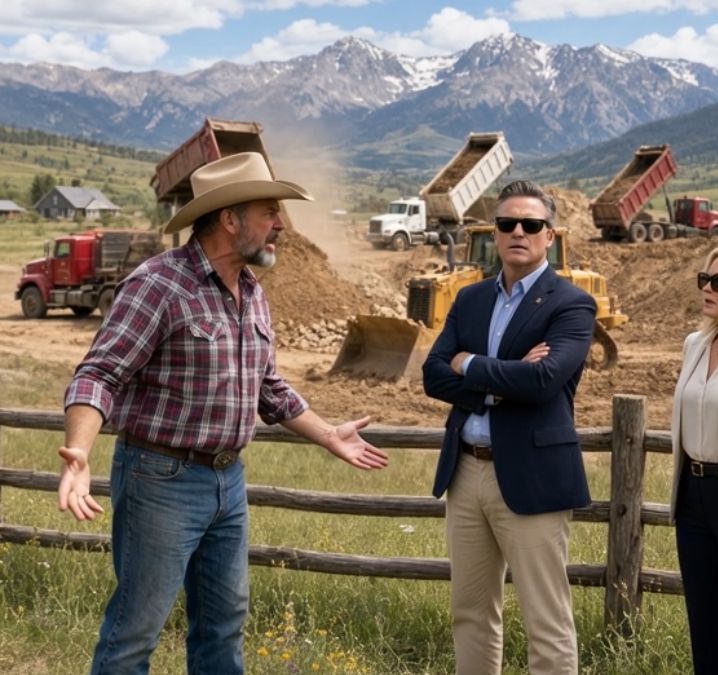
The HOA Dumped 60 Truckloads of Fill Across My Meadow and Swore the County Approved It—Then I Asked the Foreman to Unfold the Original Grading Plan.
Six dump trucks were already inside my meadow when I came over the rise.
The HOA president stood beside my gate in a crimson blazer, smiling like the brown scars across my hay ground were already settled law.
Then I asked her to show me one document, and that was the moment her entire project started sinking into the mud.
My lower meadow had been green the night before.
Not perfect.
It was working ground.
Late spring grass. A seasonal swale. Low pockets that stayed soft after rain. A fence line I had repaired more times than I could count. The kind of place you stop noticing because you know it too well.
Then one morning, it looked like a construction site.
Heavy truck tires had cut through the turf.
Fresh imported soil lay in rough strips across the low ground.
Some of the grass was still sticking out from beneath it.
The sixth truck idled near the gate, reverse alarm chirping every few seconds.
I stood there for maybe three seconds without saying anything.
That was unusual for me.
Normally, when something went wrong on the ranch, my brain immediately started sorting it.
Fence down. Find the break.
Water line leaking. Find the valve.
Equipment stuck. Get chains.
But this felt different.
Somebody had changed the ground.
Not scratched it.
Not crossed it once.
Changed it.
Dana Whitmore, president of the Cedar Hollow Homeowners Association, stepped slightly closer.
“The HOA has authorization to raise this entire low area,” she said.
I looked from her face to the meadow.
Then down at the folded sheet in her hand.
“Plan number?”
Her jaw moved.
Just once.
Tiny.
But I saw it.
So did the site foreman.
He was standing beside a white work pickup with a full-size plan set under one arm.
I stepped away from the entrance.
“I’m not stopping anybody from leaving,” I said. “I’m stopping another load from being dumped until somebody shows me why this work crossed onto my property.”
Dana’s expression hardened.
“You’re interfering with an approved drainage project.”
“Then the approved plan should make this easy.”
I pointed toward the sheet she was holding.
The bold construction boundary on her drawing appeared to stop before my fence.
Not in the meadow.
Before it.
The foreman looked at Dana.
Then at me.
Then he walked back to his truck.
PART2:
He opened the passenger-side door and pulled out the full construction set.
That was when I took out my phone.
Not to call anybody yet.
To record.
Gate.
Dump trucks.
Contractor logo.
Truck numbers.
Tire tracks.
Fresh fill.
Grass buried under the edge.
Fence posts.
Dana holding the smaller plan.
No yelling.
No grabbing keys.
No standing in front of a truck.
Just a record.
Because once dirt is moved, people start telling stories about why it was always supposed to be there.
I wanted the first story to be visual.
The foreman spread the large drawing across the hood of the pickup.
County project number.
Engineering stamp.
Revision block.
Heavy dashed line.
Dana moved beside him.
“That’s the same plan,” she said.
He compared the two sheets.
Then stopped.
“They’re related.”
Dana’s fingers tightened around the black portfolio she carried.
“Related how?”
PART3:
The foreman pointed.
“This one has additional markup.”
Dana did not answer immediately.
That silence was the first thing that made me think the problem was bigger than an operator taking a wrong turn.
The sixth dump truck was still waiting.
Engine low and steady.
Beyond it, the meadow split into two colors.
Green.
Brown.
A line on a drawing.
A line on the ground.
And suddenly the difference between the two felt more important than anything Dana had said.
I told the foreman no additional load entered until property authority was clarified.
He nodded.
Dana did not.
“You’re increasing drainage risk to Cedar Hollow,” she said.
“I’m asking where the approved work stops.”
“You’re obstructing necessary maintenance.”
“Show me the authorization.”
“The association has drainage rights.”
“That isn’t the same question.”
Her face changed again.
Only slightly.
Dana was good at sounding certain.
That became important later.
At the time, I simply knew I did not trust the confidence.
The trucks began pulling out.
I photographed each one as it passed the gate.
Not because I thought the drivers had done something criminal.
Because I wanted a count.
If this became a dispute later, “a lot of trucks” meant nothing.
Truck 14.
Truck 7.
Truck 22.
Dates and times.
Visible company markings.
Record what you can see.
That lesson saved me more than once over the next several weeks.
After they left, the meadow looked worse.
Maybe because the movement had stopped.
When machines are running, your eyes follow them.
When everything becomes quiet, you see the damage.
The imported fill sat across the lower section like somebody had dragged a dirty brush through the grass.
Fresh soil covered the seasonal swale in places.
Tire ruts were black in the damp ground.
Some deep enough that water already gathered in the bottoms.
I walked from the gate to the first mound.
Grass blades stuck through the new soil.
Flattened.
Alive underneath, maybe.
Maybe not.
I crouched and touched the fill.
Sandy loam.
Compactable material.
Clean looking.
No obvious contamination.
That was not the point.
I could have been looking at the cleanest soil in the county.
It still had no business being on my meadow unless somebody had the right to put it there.
Dana left without another conversation.
I went inside.
From my kitchen window, the contrast looked almost worse.
Green meadow.
Brown scar.
I put my closing file on the table.
Deed.
Survey.
County parcel map.
Easement.
The documents were not new.
I had looked at all of them when I bought the ranch.
But there is a difference between reviewing paperwork at closing and standing in mud asking what rights somebody actually has.
I started with the easiest question.
Who owns the meadow?
The deed answered that.
Me.
Eighty-four acres total.
The lower meadow was about eleven acres along the eastern edge.
Cedar Hollow sat uphill and beyond the fence.
The subdivision had been built long after the ranch.
Most of my place was hay and pasture.
The lower meadow sat where runoff naturally moved through a shallow seasonal swale before the land rose again.
The survey matched the fence.
County parcel viewer matched the survey.
That part was easy.
Then I opened the document that complicated everything.
Drainage maintenance easement.
That was why Dana sounded plausible.
Cedar Hollow did have a recorded drainage right touching part of my land.
When the subdivision had been created, somebody had understood that roofs, driveways, streets, and storm drainage could push water downhill toward existing agricultural property.
The easement gave the subdivision and original developer certain rights around a defined drainage corridor.
It was not fake.
That mattered.
The dispute was not: HOA has no document.
The dispute was: what exactly does the real document allow?
That is harder.
I carried the easement and survey outside.
The legal description followed a narrow strip near the seasonal swale.
I stood inside that corridor.
Then looked at the fill.
Some of it was clearly outside.
Not by inches.
Broad sections.
Still, I did not jump to the conclusion that I had already won.
Old easements can be amended.
Field conditions can change.
Legal descriptions can be confusing.
A maintenance right can authorize physical work.
Maybe there was some approved revision I had not seen.
So I measured.
Then photographed.
Then measured again.
Fence posts.
Swale.
Disturbed edge.
Truck ruts.
Depth estimates.
Location of fill relative to the known easement strip.
I flagged several points where imported soil ended and untouched grass began.
By afternoon, clouds were building.
Dana emailed.
Subject line:
Required Drainage Correction Cedar Hollow
The subject line alone annoyed me.
The body said the association possessed maintenance rights affecting the lower meadow and that I was not to interfere when the contractor returned.
She argued the HOA had a duty to correct drainage conditions affecting residents.
I printed it.
Then opened the parcel viewer again.
The meadow was still where it had always been.
My parcel.
Outside Cedar Hollow.
The easement was the only bridge between their authority and my land.
That was what made the fight dangerous.
Dana did not need to prove she owned the meadow if she could prove she had some separate legal right to enter and work there.
A person can own land subject to somebody else’s easement.
That is ordinary.
But an easement is not a blank check.
It has scope.
Location.
Purpose.
Conditions.
That became the heart of everything.
The next morning, Luis Ortega called.
He was the contractor’s project manager.
“I want to talk before anyone sends another truck,” he said.
“Good.”
“We’ve stopped deliveries.”
“For how long?”
“Until the property line issue is clarified.”
That phrase mattered.
Not drainage maintenance issue.
Property line issue.
Twenty minutes later, Luis pulled up.
Same white truck.
Clipboard.
Rolled plans.
Stack of carbon-copy tickets.
Dana was not with him.
He spread the paperwork across the tailgate.
Wind kept lifting the corners.
He pinned one with his hand.
“I checked the load count,” he said.
“How many?”
He moved his finger down the tickets.
“Fifty-eight confirmed.”
I looked at him.
He continued.
“Two more were coded to this project but don’t have placement notes. So potentially sixty.”
“Sixty loads.”
“Yes.”
I looked past him.
The meadow split green and brown.
Numbers feel different when you can see them.
Sixty truckloads sounded abstract.
Then I looked at one deep tire groove and understood the physical scale.
“What material?”
“Clean fill. Sandy loam. Compactable soil.”
“Source permitted?”
“We have paperwork.”
“Any known contamination?”
“No.”
“That’s not my main issue.”
“I understand.”
“Why did your drivers cross my fence?”
Luis pulled out two drawings.
“This is the issued set.”
Full size.
Stamped.
Heavy dashed line showing the limit of disturbance.
Then he pulled out a smaller sheet.
“This is what we got later.”
Dana’s version.
Same base drawing.
Same drainage features.
Same road labels.
But a colored extension continued past the stamped limit.
Across the fence.
Into my meadow.
Luis traced the official line.
Stopped.
Then traced Dana’s.
Kept going.
“Who sent this?” I asked.
He flipped it.
Email printout.
Dana Whitmore.
Subject:
Field Direction Lower Drainage Transition
I read the first visible line.
Proceed with feathering beyond existing fence to eliminate low pocket and create positive drainage transition.
I looked at him.
“You followed this instead of the stamped plan.”
“We treated it as an owner-directed field adjustment.”
“Owner?”
“Project owner.”
“Cedar Hollow.”
“Yes.”
“They don’t own this side of the fence.”
“I understand that now.”
That answer was honest.
And bad.
Luis brought out the foreman’s daily log.
Block letters.
Equipment hours.
Truck counts.
Crew notes.
Then one line.
Extended fill placement beyond east fence per owner representative direction. Authorization to be verified.
I tapped it.
“Who wrote this?”
“My foreman.”
“When?”
“During the work.”
“Before or after the first load crossed?”
“After the issue came up.”
“So somebody questioned the boundary.”
“Yes.”
“And Dana told you to keep going.”
“Yes.”
I stood there for a second.
This was no longer about drivers accidentally following stakes too far.
Somebody had asked.
The contractor had recognized a potential boundary problem.
Dana had answered.
The trucks continued.
I asked for copies.
Luis sent everything before noon.
Tickets.
Daily log.
Marked-up plan.
Dana email.
I saved it in two places.
Cloud.
External drive.
Then printed the most important sheets.
I carried the official grading plan outside.
Held it up with the meadow behind it.
On paper, the dashed line stopped.
In real life, brown soil kept going.
That image became the whole dispute.
A line in a permit.
A line on land.
Sixty loads on the wrong side.
That afternoon, rain came.
Not historic.
Not a flood.
Just a hard normal storm.
I stood under the porch and watched.
The grass absorbed water gradually.
The imported fill darkened fast.
Almost black.
Thin rivulets moved across the new grade.
The original meadow had been shaped by years of water following the shallow swale.
Now part of that swale was buried.
After the rain eased, I walked down.
Water had backed against one of the fill bands.
Three or four inches at the deepest point.
Nothing dramatic.
That was why it mattered.
I did not want to say flood.
There was no flood.
No barn underwater.
No cattle in danger.
No road washed out.
But the drainage pattern had changed after an ordinary storm.
That was measurable.
I put a measuring rod in the standing water.
Photo.
Then another frame showing the buried swale, ponding, and fill together.
Then video from untouched grass across the disturbed area.
No commentary.
The ground could speak for itself.
The next morning, water was still there.
I called an excavation contractor I trusted.
He walked the site.
Looked at tickets.
Looked at the fill.
“That’s a lot of imported material,” he said.
“If it has to come out?”
He shook his head.
“You’re not paying only for dirt removal.”
“What else?”
“Compaction repair. Topsoil. Reseeding. Access. Maybe drainage restoration. Depends on elevations.”
That was the first time I understood the scale of getting the meadow back.
Stopping the sixty-first truck had been easy.
Undoing sixty loads was another problem.
At 3:25 that afternoon, Dana sent another email.
Notice of Interference With Required Stormwater Work
I printed it.
Took it outside.
Read it standing near the fence.
Her argument was on clean white paper.
Her result was mud under my boots.
She wrote that Cedar Hollow had a duty to correct drainage affecting homeowners.
Then this sentence:
The association’s recorded drainage rights authorize all work reasonably necessary to correct the contributing condition.
That was her best argument.
Not ownership.
Reasonably necessary work under the easement.
I knew enough not to dismiss it casually.
Maybe the easement language really was broad.
Maybe a court would interpret it in a way I did not expect.
Maybe maintaining drainage required fill.
So I built a timeline instead of a conclusion.
Truck.
Time.
Load.
Direction.
Visible location.
Dana instruction.
Luis log.
Rainfall.
Photos.
Measurements.
Then Luis called again.
“There’s another note.”
He sent a PDF.
One line.
Property boundary concern raised. Owner representative states easement permits continuation.
I read it twice.
“Owner representative means Dana?”
“Yes.”
That was important.
The question had been asked before work continued.
Dana had asserted authority.
Now I needed to find out whether that assertion meant anything legally.
I matched truck numbers from my first morning video against delivery tickets.
Truck 18 at 7:14.
Same cab again at 8:02.
Another truck three cycles.
Time.
Load.
Physical result.
I put a board on my dining table.
Left column:
What I could see.
Right column:
What records claimed.
By midnight, the pattern was clear.
Then I sent a records request to county engineering.
Issued grading permit.
Every stamped sheet.
Every revision.
Inspection notes.
Erosion control records.
Correspondence affecting the limit of disturbance.
I did not ask:
Was Dana wrong?
I asked:
Where did the approved work stop?
Cleaner question.
If there was a legitimate revision allowing Cedar Hollow’s project onto my property, county records should show it.
If there was not, the argument would stop depending on who spoke louder.
The answer came in the project file.
Limit of disturbance.
LOD.
Heavy dashed line.
Stopped before my fence.
Revision block showed two changes.
Storm drain inlet.
Erosion control sequencing.
Nothing moving grading east.
Nothing into my meadow.
Then I found correspondence.
A county reviewer had asked the project engineer to confirm that offsite drainage patterns would be preserved.
The engineer responded that work would remain within approved construction limits and would not require grading on adjacent private property.
I underlined it.
Then carried the page outside.
Rain dotted the plastic sleeve.
Construction stakes were still visible on Cedar Hollow’s side.
I aligned the printed plan with the fence.
Approved line stopped.
Fill crossed it.
I measured from the nearest stake to the disturbed edge.
Then took one photograph.
Orange stake.
Fence.
Brown fill beyond both.
Dana’s position felt smaller.
Not gone.
Smaller.
Next, I called the engineering firm.
Maya Bennett had signed the drainage calculations.
“Did your office approve grading across my fence?”
“No.”
The answer came immediately.
Two days later, Maya came to the site.
Dana arrived too.
The visual almost made me smile.
Maya had field shoes covered in mud.
Dana had clean black heels under the same crimson blazer.
One person dressed for wet ground.
The other looked like she expected the ground to respect her.
Dana started.
“The eastern transition was necessary to complete the drainage correction.”
Maya kept looking at the stamped plan.
I put Dana’s markup beside it.
“Did your office create this?”
Maya studied it.
“No.”
Dana’s eyebrows lifted slightly.
“It’s based on your design.”
“The base drawing is ours.”
Maya tapped the colored extension.
“This is not.”
Dana folded her arms.
“The HOA has easement rights.”
Maya nodded.
“That’s a property question.”
Then she pointed at the dashed line.
“I’m telling you our approved grading stops here.”
Simple.
No accusation.
No shouting.
Dana no longer had the engineer behind her interpretation.
Rain strengthened.
Water moved over the fill.
Maya watched one rivulet curve toward the depression where I had photographed ponding.
She took out her phone.
Dana watched too.
The water stopped against the raised strip.
Maya did not say the fill caused it.
She said, “I need elevations.”
That restraint made me trust her more.
Facts first.
Conclusion later.
Back at the county file, Maya checked every revision.
No amendment moved the LOD east.
No field directive from engineering authorized placement past the fence.
No approved grading sheet included my meadow.
I asked her, “Say it without engineering shorthand.”
She turned the screen toward me.
“This permit does not show approved grading on your parcel.”
That settled one question.
Not all.
Because Dana still had the easement.
I went to the recorder.
Ordered certified copies.
Full drainage easement.
Every exhibit.
Every amendment.
Thick packet.
I reduced it to three questions.
What area?
What purpose?
What conditions?
The legal description followed a narrow drainage corridor around the swale.
The easement authorized inspection.
Clearing.
Maintenance.
Repair.
Restoration.
It included notice provisions except for defined emergencies.
It identified access.
It discussed restoring disturbed surfaces.
It did not say entire lower meadow.
It did not contain Dana’s colored extension.
One clause allowed reasonable work necessary to maintain drainage function.
Another limited granted rights to the described area.
That was where the legal fight became real.
I requested Cedar Hollow’s internal records too.
Minutes.
Approvals.
Engineering emails.
Contractor instructions.
Invoices.
Anything about work beyond LOD.
The first records arrived three days later.
I spread them across my kitchen floor.
Board.
Engineer.
Contractor.
Dana.
The board minutes showed motive.
Homeowners at the lower end of Cedar Hollow had complained about standing water.
That was legitimate.
The engineer designed improvements on the HOA side.
Those improvements stopped before my property.
An internal memo described a “low pocket” near my fence.
Dana wanted a smoother transition.
Fewer future complaints.
Easier maintenance.
Her idea was to extend fill beyond the fence.
Then I found Paul Reyes.
Board member.
In the minutes, he asked:
Do we have written authorization to grade private land east of the fence?
I stopped reading.
Next line:
Dana answered that the drainage easement provided maintenance authority.
Paul asked whether that had been confirmed against the grading permit.
Minutes ended with:
Counsel review to be confirmed.
No attached legal opinion.
No permission from me.
No county revision.
Then contractor correspondence.
Please confirm whether east side feathering is within owner-controlled property or easement rights.
Dana replied:
HOA has drainage maintenance authority. Proceed as directed.
Then Maya’s email.
Sent before dumping.
Any grading outside the stamped LOD should be held pending confirmation of property authorization and permit implications.
I placed the two emails side by side.
One said:
Hold.
One said:
Proceed.
The trucks followed the second one.
I called Luis.
“Your project manager saw Maya’s warning?”
“Yes.”
“Before the trucks crossed?”
“Yes.”
“And Dana still told you to proceed?”
“Yes.”
“Why?”
“She said the easement covered it and the HOA would take responsibility for authorization.”
Take responsibility.
Not:
We have written authority.
Different sentence.
Luis sent the full daily report.
I printed the page.
Carried it outside.
Held it against the fence with fill in the background.
The line read:
East extension questioned due to LOD. Owner rep confirms easement authority and directs continuation. Engineering revision not received.
That photograph connected paper to ground.
By then, five separate categories of evidence existed.
Property.
Permit.
Easement.
Contractor.
HOA.
My deed answered ownership.
Permit answered approved construction footprint.
Easement answered limited property rights.
Contractor logs answered who directed off-plan work.
Board records answered why.
I finally called attorney Evan Price.
I told him I did not want a theatrical lawsuit.
I wanted the lines explained.
He drew three boxes on a legal pad.
Drainage Easement.
Maintenance Authority.
Grading Authority.
Then he said, “Cedar Hollow has been talking about these like they are the same thing.”
“They aren’t?”
“Not even close.”
He tapped the first box.
“The easement is a property right.”
He opened the certified document.
“This tells us what portion of your property is burdened and for what purpose.”
He traced the narrow corridor.
Then looked at the photographs.
“Your fill extends beyond it.”
Then the second box.
“Maintenance authority.”
Inspection.
Clearing.
Repair.
Restoration.
“Those can be real rights,” he said.
“I know.”
“Maintenance can involve physical work.”
“I know.”
Then the third box.
“Grading authority.”
He laid out the stamped county plan.
“This answers a different question.”
His finger followed the LOD.
“What did this particular permitted project authorize the contractor to disturb?”
The line stopped before the fence.
I looked at the boxes.
“So the HOA can have real easement rights and still exceed them.”
“Yes.”
“And even work that might be allowed by an easement does not automatically expand a permit.”
“Exactly.”
He put Dana’s markup between us.
“That is where the issue becomes precise.”
I liked that word.
Precise.
Not HOA evil.
Not everything illegal.
Precise.
The easement described one authority.
The permit described another.
Dana’s field direction did not automatically connect them.
Evan continued.
“They will make their strongest argument here.”
Dana’s email.
Recorded drainage rights authorize all work reasonably necessary.
“She’ll say this was maintenance.”
“Yes.”
“Then we ask questions.”
He started listing them.
Was the work inside the easement area?
Was imported fill at this scale maintenance or material regrading?
Were notice provisions followed?
Was there an emergency?
Did the easement allow work outside the defined corridor?
Did the county approve a larger disturbance?
Did you consent?
Had Cedar Hollow previously notified you the swale was failing?
“No.”
“Given you a chance to perform maintenance?”
“No.”
“Declared an emergency?”
“No.”
“Requested a permit revision?”
“No.”
“Asked you for written access?”
“No.”
He nodded.
“Sequence matters.”
Then he drafted a demand letter.
No screaming.
No fraud accusation.
No criminal threats.
Stop grading.
Preserve emails.
Preserve markups.
Preserve contractor logs.
Preserve haul tickets.
Identify who authorized work beyond LOD.
State legal basis.
Provide stabilization plan.
Propose restoration.
Near the end, he wrote:
A limited easement for drainage maintenance does not, without additional authority, grant a right to materially regrade private land outside the easement area, nor does it enlarge the approved limits of a separate permitted construction project.
That sentence finally explained what I had been trying to say at the gate.
Dana kept using drainage like the word settled everything.
It did not.
Purpose is not scope.
The demand went out.
Certified mail.
Email.
Contractor received preservation notice.
Engineering firm too.
County notified.
That evening, Dana replied.
Cedar Hollow maintained that the easement allowed the work.
They would not remove fill until the issue was formally resolved.
I forwarded it to Evan.
He called.
“She’s allowed to make the argument.”
“What now?”
“Someone outside Cedar Hollow checks the line.”
Mark Ellison from county engineering came to the site.
He did not ask Dana where she thought the boundary was.
That impressed me.
He walked straight to the construction stakes.
Dana stood nearby.
Luis had contractor records.
I stayed out of the way.
Mark opened the stamped plan on his tablet.
Found the approved stakes.
Measured.
Crossed the fence.
Measured again.
The tape clicked through the grass.
For a few seconds, that sound became everything.
If Mark accepted Dana’s theory that easement rights somehow expanded the permitted footprint, Cedar Hollow might treat my entire lower meadow as future overflow space.
That was what frightened me.
Not only the existing sixty loads.
Precedent.
Mark looked at the plan.
Then tape.
Then disturbed edge.
“How far outside?” I asked.
“I need to document it before I give a number.”
Fair.
Dana stepped closer.
“The work was required for drainage.”
Mark looked at her.
“I’m reviewing the permit footprint.”
“The HOA has easement rights.”
“They may matter to the property dispute.”
He tapped his screen.
“I’m checking whether permitted grading stayed within the approved limits.”
Dana’s lips tightened.
Mark asked Luis for the field records.
Daily logs.
Marked plan.
Dana email.
He read.
Then asked, “Did the county approve this revised limit?”
Luis shook his head.
“Not that we received.”
Mark looked at Dana.
“Do you have an approved revision?”
“The easement authorized the work.”
He repeated, “Do you have a county-approved revision moving the limit of disturbance onto this parcel?”
“No.”
One word.
That was the first time I felt the pressure in my chest release.
Not because everything was solved.
But because one independent authority had finally separated the permit from Dana’s interpretation.
The written notice came the next afternoon.
Grading and fill placement occurred outside the approved limit of disturbance.
The unapproved area required corrective action or a properly reviewed revision before further work.
The contractor had to stabilize the site while a correction plan was developed.
Cedar Hollow’s attorney contacted Evan.
The insurer requested records.
Luis confirmed no work would enter my parcel without authorization from all required parties.
Then came the part that mattered more than being right.
What had the sixty loads actually done?
Rachel Kim, a civil engineer, surveyed the meadow.
Rachel did not care about Dana.
Did not care about HOA politics.
She cared about elevations.
She shot grades along the swale.
Measured filled areas.
Compared disturbed and undisturbed ground.
Studied ponding photos.
Her conclusion was practical.
Some fill could remain if reshaped correctly.
Other fill had to come out because it raised the natural low path.
The blocked low path contributed to ponding after ordinary rain.
“Can you restore it exactly?” I asked.
“No.”
I appreciated the honesty.
“No engineer should promise exactly.”
“What can you promise?”
“Drainage function restored to a defensible grade. Surface rebuilt. Swale reopened. Compaction addressed. Topsoil replaced where needed.”
That became our goal.
Not revenge.
Not hauling sixty loads out just because sixty came in.
Fix the ground.
Rachel divided the disturbed meadow into three zones.
Zone One: material could remain if regraded to support the intended drainage path.
Zone Two: partial excavation because elevation had been raised too much.
Zone Three: most imported fill removed, then topsoil, seed, and erosion control.
She also recommended restoring the widened access point where trucks had chewed into the fence opening.
By then, even Cedar Hollow’s attorney stopped saying the stamped grading plan authorized work in my meadow.
The argument shifted.
Authority.
Responsibility.
Restoration.
Then finally:
Who pays?
That was the question everybody had avoided.
The insurer wanted before photos.
I had them.
The contractor wanted evidence of who ordered the field change.
Its own log answered.
The HOA wanted to preserve its drainage easement rights.
We never asked them to surrender those rights.
We asked them to stop treating those rights as control over everything around them.
The final agreement was practical.
Cedar Hollow funded corrective grading.
The contractor removed or redistributed fill according to Rachel’s elevations.
Topsoil restored.
Swale reopened.
Disturbed sections reseeded.
Fence access rebuilt.
Engineering costs reimbursed.
Agreed portion of legal fees reimbursed.
No fantasy payout.
No emotional number.
Invoices.
Survey work.
Professional costs.
Actual restoration.
The agreement also changed procedure.
Any future Cedar Hollow project crossing land it did not own required written confirmation of property authority.
Permitted work had to match approved limits.
Contractors could not follow a field directive beyond stamped LOD without engineering review and documented authorization.
That was the part I cared about most.
I did not want to fight this again five years later.
Dana remained on the board through the rest of her term.
Some people expected me to demand she resign.
I did not.
By the next election cycle, somebody else chaired meetings.
Dana did not return as president.
That was enough.
I did not need her embarrassed.
I needed trucks to stop crossing my fence because one person had decided a drainage easement meant whatever she needed it to mean.
Restoration started on a gray morning.
The excavator bucket entered one of the deeper fill sections.
Lifted.
Brown imported soil peeled away.
Underneath, dark original topsoil appeared.
Green black.
Compacted.
Damaged.
Still there.
That was the first moment I believed the meadow might come back.
Luis stood beside me.
“I should’ve stopped it.”
“When?”
“When my foreman flagged the boundary.”
I said nothing.
He continued.
“I should’ve asked for the county revision instead of trusting a colored markup.”
“Yes.”
He looked at the fence.
“Next time I will.”
I believed him.
Contractors work under pressure too.
Schedule.
Owner direction.
Equipment already mobilized.
Trucks waiting.
A person with apparent authority says proceed.
It is easy to let momentum substitute for verification.
That is exactly what happened.
Dana’s confidence became operational authority because nobody forced the paperwork to catch up before the next truck moved.
The restoration crew worked differently.
Slow.
Survey stakes.
Elevation checks.
No improvising past lines.
Material removed where Rachel required.
Redistributed elsewhere where acceptable.
Topsoil imported only after existing grade matched design.
Swale reopened.
Fence repaired.
Seed.
Erosion blanket.
Then rain.
Everyone watched the first real storm after restoration.
I stood under the porch again.
Water moved.
Not perfectly.
No land works perfectly.
But it followed the shallow channel instead of pooling behind a raised fill strip.
That felt better than any meeting result.
Months passed.
Fresh seed took.
Brown scars faded.
Tire ruts disappeared.
The meadow became ordinary.
That was what I wanted.
Ordinary is underrated.
After weeks of emails, plans, lawyers, measurements, engineers, and mud, boring grass felt like victory.
One evening after a light storm, I walked the lower section.
Water ran through the swale.
Beyond the fence, Cedar Hollow was still there.
So was the drainage easement.
Important point.
The HOA still had legitimate rights.
The dispute did not erase them.
If the defined drainage feature needed inspection, repair, or maintenance under the actual easement terms, Cedar Hollow could exercise those rights.
I still owned the rest of the meadow.
Nothing about that was contradictory.
Property law is full of overlapping rights.
Ownership does not always mean absolute control over every square foot.
An easement does not mean ownership.
The entire conflict happened because Dana collapsed those distinctions.
Drainage problem.
Therefore drainage rights.
Therefore maintenance.
Therefore grading.
Therefore fill anywhere necessary.
Therefore county limits do not matter.
Every step sounded related.
Related is not the same as authorized.
That became the lesson.
I kept Dana’s marked-up plan.
Not as a trophy.
As a reminder.
Same base drawing.
Same roads.
Same labels.
One colored extension.
That one extension moved sixty loads.
It is amazing how much physical damage can start as a line on paper.
I also kept the stamped plan.
I sometimes put them side by side.
Official dashed limit.
Dana’s colored area.
One stopped at my fence.
One did not.
Nothing about the difference looked dramatic.
No giant warning.
No skull.
No red X.
Just a line.
Yet that line separated approved work from unapproved disturbance.
People think property disputes are about shouting over fences.
Often they are about tiny marks nobody reads until after machines arrive.
That is why I tell people:
Never look only at the title of a plan.
Look at boundaries.
Revision block.
Notes.
Stamps.
Dates.
Who issued it.
What changed.
Dana’s sheet looked real because most of it was real.
That was what made it dangerous.
It used the engineer’s base drawing.
Real project.
Real drainage issue.
Real labels.
Then somebody added something that had not been approved.
Half-true documents can be more persuasive than obvious fakes.
Everyone recognizes a ridiculous forgery.
A legitimate plan with one unauthorized addition can move a crew.
That morning proved it.
The foreman had a project.
Dana had authority inside the HOA.
The crew had trucks.
Schedule.
Material.
Nobody wanted to stop six dump trucks because of a line unless somebody forced the question.
My question was simple.
Show me the approved plan.
Everything followed.
Had I arrived one hour later, maybe twelve more loads.
Half a day later?
Who knows.
The entire low pocket might have been raised.
The more work completed, the harder restoration becomes.
Momentum matters.
That is why stopping early matters.
Not by physically blocking equipment if that creates danger.
By making the authority question visible.
I never trapped a truck.
Never took keys.
Never threatened drivers.
I stepped aside.
Let them leave.
Documented.
That helped later.
Nobody could honestly claim I escalated the scene.
I was not anti-drainage.
That mattered too.
Cedar Hollow homeowners had legitimate concerns.
Their subdivision created runoff.
Standing water near homes can cause problems.
Correcting drainage was reasonable.
The argument was never: do nothing.
It was: do not solve your drainage problem by treating my meadow like unowned space.
That distinction became important when residents began contacting me.
Some were angry initially.
They had been told I stopped a safety project.
One man called and said, “My backyard floods because of you.”
“I’m sorry you have standing water.”
“You blocked the fix.”
“I stopped work outside the permit.”
“The HOA says they have an easement.”
“They do.”
He paused.
“You admit that?”
“Yes.”
“So why stop them?”
“Because the easement is limited, and the permitted plan stopped before my fence.”
Silence.
He had expected denial.
Not nuance.
I emailed him the county notice.
Later he apologized.
Not everybody did.
That was fine.
You do not need unanimous approval to protect property rights.
But facts helped.
Cedar Hollow residents eventually learned Dana had instructed the contractor to proceed even after concerns were raised.
That changed internal politics more than anything I said.
People can tolerate mistakes.
They become less patient with known questions ignored.
Paul Reyes became important.
The board member who had asked:
Do we have written authorization?
I met him after everything settled.
He looked embarrassed.
“I should’ve pushed harder.”
“Yes.”
He laughed awkwardly.
“I expected you to say it’s okay.”
“It wasn’t.”
“I asked the question.”
“You did.”
“Then I let it go.”
“That part mattered too.”
He nodded.
Boards create collective responsibility through individual silence.
Dana answered confidently.
Paul had doubts.
Others moved on.
The minutes showed it.
Nobody wanted delay.
Drainage complaints were increasing.
Contractor mobilized.
Material available.
Weather window.
Momentum again.
The easiest thing was to accept Dana’s answer.
So they did.
Sixty loads later, everybody learned what one unchecked answer can cost.
Paul became chair of a compliance committee under the new board.
He pushed for written property authorization before any offsite work.
Good.
Learning matters more than perfect hindsight.
Dana never apologized directly.
People assume every story needs an apology.
It does not.
Her attorney acknowledged the resolution.
The insurer paid.
The board changed procedure.
Restoration happened.
That mattered more than hearing “I’m sorry.”
Would I have appreciated it?
Sure.
Did I need it?
No.
Sometimes accountability is behavioral.
Stop doing the thing.
Repair the harm.
Prevent repetition.
Words optional.
I ran into Dana once at the county office months later.
She was submitting something at the counter.
She saw me.
We nodded.
No argument.
No dramatic exchange.
That felt almost better.
Conflict over.
Nothing left to perform.
The meadow had returned.
That was enough.
One day, Paul Reyes sent me the new project authorization checklist.
Probably thought I would appreciate it.
I did.
Questions included:
Does work cross association-owned property limits?
Does any easement apply?
Is work inside easement legal description?
Does permit include offsite disturbance?
Has engineer approved revision?
Has affected owner given consent if required?
Has counsel reviewed scope?
Simple.
Seven questions.
Sixty loads because nobody forced those seven answers.
Governance improvement often looks embarrassingly obvious after failure.
That is okay.
Obvious safeguards still need writing.
Memory fades.
Leadership changes.
Future Dana might sound equally confident.
Checklist outlives personality.
That is the point.
The meadow taught Cedar Hollow to institutionalize skepticism.
Healthy organizations should.
Not distrust.
Verification.
When someone says, “We have authority,” the next question is:
Where?
Show me.
That does not insult honest people.
Honest authority survives proof.
Dana’s interpretation could not.
There is a difference between being anti-authority and pro-verification.
I became the second.
The ranch itself did not increase in value dramatically because of the resolution.
No giant settlement.
No viral courtroom victory.
I did not become rich.
That made the outcome feel real.
Property disputes often end in practical corrections.
That is fine.
The value was preventing a precedent that could have mattered for decades.
If Cedar Hollow had established a habit of treating the entire lower meadow as part of its drainage management zone, future projects might have followed.
New president.
New contractor.
Another grading plan.
Each pointing to what Dana did before.
“Historically, the HOA has maintained this area.”
That phrase terrified me more than the dirt already there.
History becomes argument.
That is why stopping the first unauthorized expansion mattered.
After settlement, written terms made future boundaries clearer.
No implied expansion.
No field precedent.
Defined rights remain defined.
That may be worth more than the reimbursement.
I kept one copy of the agreement in the same closing file where I first found the easement.
The folder got thicker.
Ownership history now included conflict history.
Maybe some future owner of the ranch will open it.
See drainage easement.
Then restoration agreement.
Then survey.
They will understand where the line is because we fought about it once.
That is another value of documentation.
Not only winning today.
Teaching tomorrow.
Property outlives owners.
Clear records reduce future disputes.
My uncle taught me that indirectly.
He kept old fencing invoices and aerials.
At first, those felt useless.
Then they helped show historical condition.
Nothing alone decided the case.
Together, they strengthened it.
Keep boring records.
That could be the whole story.
People throw away old surveys.
Contractor tickets.
Photos.
Emails.
Years later, those become memory.
Memory with dates.
I started taking annual photographs of the lower meadow after this.
Same approximate locations.
Spring.
Late summer.
After major drainage maintenance.
Not because I expect another war.
Because baseline evidence is easier before conflict.
Preparation does not mean paranoia.
It means future clarity.
Cedar Hollow’s new president contacted me before the next drainage inspection.
Simple email.
“We need access within the recorded corridor for inspection. Proposed date Thursday. No grading or material placement.”
I replied:
“Approved.”
That was all.
Imagine.
A real easement.
Proper notice.
Defined activity.
No conflict.
They entered.
Inspected swale.
Left.
Authority used correctly feels almost invisible.
That is how it should be.
The old dispute had made every HOA action feel threatening for a while.
That email helped reset things.
Legitimate rights exercised within scope.
No problem.
I wanted that relationship.
Not permanent hostility.
One neighbor said I was being too cooperative after what happened.
I disagreed.
Boundaries are not walls around human relationships.
You can enforce legal lines and still work together.
In fact, clear boundaries make cooperation easier.
I knew exactly what Cedar Hollow could do.
They knew exactly what needed approval.
Less ambiguity.
Less fear.
That was progress.
The system changed around one mistake.
Good.
That is how accidents and overreach become lessons instead of traditions.
I never learned whether Dana privately believed she had been right all along.
Probably.
People rarely rewrite themselves completely.
Maybe she believed the easement genuinely gave her broad authority and county permit issues were technical.
Maybe she still does.
It does not matter.
Institutions exist because personal beliefs differ.
The question is what documents and processes allow.
Her belief no longer controls the line.
That is enough.
The biggest lesson came from the drainage easement itself.
At first, I wished it did not exist.
That would have made everything easier.
No HOA rights.
No argument.
But reality is rarely that clean.
The easement existed for a reason.
Cedar Hollow runoff did affect the lower area.
The development needed a legal mechanism to inspect and maintain drainage.
That was not abuse.
The abuse came from expanding a legitimate right beyond its terms.
That distinction matters in almost every authority dispute.
Real authority can be misused.
People often focus on whether authority exists.
Better question:
How far does it reach?
Police authority.
Corporate authority.
HOA authority.
Easement authority.
Contractual authority.
All have scope.
Dana treated existence as infinity.
We proved it was not.
Evan’s three boxes stayed with me.
Easement.
Maintenance.
Grading.
Different questions.
I later added a fourth in my own notes.
Consent.
Because even if somebody has certain rights, outside those rights they need permission.
That seems obvious.
Yet the entire project ran as if permission could be assumed from purpose.
Good purpose does not erase property boundaries.
I repeated that when Cedar Hollow adopted its new procedure.
A drainage problem can justify drainage work.
It does not automatically justify redesigning neighboring land.
That sentence ended up in more than one meeting.
Rachel Kim returned six months later for a follow-up.
She shot several grades.
Checked swale.
Looked at vegetation.
“Better,” she said.
“Good?”
“Better.”
Engineers love refusing emotionally satisfying words.
“Any ponding?”
“Normal shallow retention in one area.”
“Problem?”
“No.”
“Back to original?”
She looked at me.
“We discussed this.”
“I know.”
“No.”
I laughed.
“Defensible and functional?”
“Yes.”
“Good.”
That was enough.
The restored meadow was not a time machine.
Soil disturbed.
Compaction altered.
Seeded sections younger than surrounding grass.
Some material stayed where engineering said it could.
The goal had never been pretending nothing happened.
The goal was restoring function and correcting unauthorized grade changes.
That is a more mature version of winning.
Not erasing history.
Fixing what can be fixed.
The contractor’s insurer eventually required Luis’s company to revise internal field change procedures.
Any owner-directed revision affecting property limits required written authorization.
Good.
One project taught more than one organization.
County engineering also updated review notes for offsite drainage work.
Plans began carrying clearer warnings when private property lay near LOD.
Again, not dramatic.
Useful.
People always want a villain and a hero.
Reality gave me a president who overreached, a contractor who trusted too much, a board that failed to verify, engineers who documented limits, county officials who eventually enforced them, and a landowner who happened to ask before the sixty-first load arrived.
More complicated.
More useful.
I am not anti-HOA.
Cedar Hollow needed an association.
Shared drainage.
Roads.
Common landscaping.
Stormwater infrastructure.
Somebody has to manage those.
The problem was not the existence of the board.
It was one interpretation becoming action without independent verification.
Dana was not a government agency.
But even government agencies work from defined authority.
A private association needs that discipline even more.
After everything, Cedar Hollow adopted a rule that no board member could issue field directions modifying construction limits without engineering sign-off and proof of property authority.
That should have existed before.
Now it does.
One evening, Luis came by during hay season.
No project.
Just stopped.
We stood near the fence.
The meadow looked normal.
“You can’t really tell,” he said.
“Not from here.”
“You still know.”
“Yes.”
He pointed toward a section.
“That where the deepest fill was?”
“Yes.”
He shook his head.
“We had trucks stacked on the road that morning.”
“I remember.”
“Foreman didn’t want delay.”
“I understand.”
“I was thinking schedule.”
“I know.”
“Dana was thinking drainage.”
“Probably.”
“You were thinking ownership.”
“Among other things.”
He nodded.
“Everybody was looking at a different problem.”
That was a good summary.
Contractor saw schedule.
HOA saw complaints.
Engineer saw permit.
I saw land.
No one integrated the full picture until after damage.
Good systems force integration before action.
Who owns?
What right?
What permit?
What design?
What change?
Who approved?
Then move dirt.
Not the reverse.
I wish more construction disputes started with those questions.
Instead, people often rely on hierarchy.
Owner representative says go.
Crew goes.
But project owner does not mean owner of every property touched by the project.
That was the exact confusion here.
Dana was owner representative for Cedar Hollow’s project.
She was not owner of my meadow.
Language again.
One title creating assumed power.
I never heard the phrase owner rep the same way after that.
Owner of what?
Representative for which rights?
Questions matter.
I eventually framed one photograph.
Not for public display.
It stays in my office.
Orange construction stake.
Fence.
Brown fill beyond both.
No people.
No Dana.
No trucks.
Just three things.
Approved limit.
Property line.
Damage.
That picture summarizes everything.
People can argue words.
Photographs simplify.
Still, photographs alone were not enough.
Without the plan, orange stake is just orange plastic.
Without survey, fence is just fence.
Without records, brown dirt is just dirt.
Evidence works by connection.
That became another lesson.
The strongest pieces were not strongest alone.
They were strongest because they agreed.
Official plan stops.
Engineer says stop.
Contractor flags boundary.
Dana says proceed.
Sixty loads appear.
County confirms outside LOD.
Survey confirms property.
Easement defines narrower corridor.
Board minutes show prior question.
Rain photos show changed drainage.
Rachel measures elevation.
Everything connected.
Strong evidence does not shout.
It aligns.
Evan taught me that without saying it directly.
He kept removing irrelevant material.
I brought him a stack one day.
Old emails.
Resident comments.
Things Dana had said months earlier.
He pushed half aside.
“Does this prove scope?”
“No.”
“Permit?”
“No.”
“Authorization?”
“No.”
“Damage?”
“Maybe attitude.”
“We are not suing attitude.”
He was right.
That saved time.
Anger makes everything feel relevant.
Law cares less.
Document the issue.
Not the personality.
Dana’s crimson blazer became visually memorable.
Legally meaningless.
The colored markup mattered.
Her email mattered.
Minutes mattered.
Field direction mattered.
Blazer did not.
That discipline kept the case cleaner.
I wish I had understood it sooner.
For the first few days, I wanted every frustrating thing Dana had ever done included.
By the end, the strongest case fit into six piles.
Property.
Permit.
Easement.
Contractor.
HOA.
Engineering impact.
That was enough.
The final restoration report sits beside the original plan in my file.
One shows intended project.
One shows corrected outcome.
Between them is almost the entire conflict.
Sometimes I think about the six trucks I saw that first morning.
If I had not gone down there when I did, what would I have found by afternoon?
Seventy loads?
Eighty?
Finished grade across the entire low meadow?
Would Dana then argue restoration was unreasonable because work was complete?
Maybe.
Completion creates leverage.
That is why timely attention matters.
Landowners cannot monitor every edge every hour.
But when heavy equipment appears, ask questions immediately.
Do not assume a contractor on your property must have valid authority because they look organized.
Professional crews can still be working from wrong instructions.
Most contractors want clarity.
Luis did.
Once he saw the conflict, he stopped deliveries.
That decision prevented more damage.
He was not my enemy either.
He made a mistake.
Then documented it honestly.
His daily log hurt his company, yet it also showed credibility.
That mattered in settlement.
Imagine if he had altered records.
Everything would have become uglier.
Instead, his foreman’s note told the truth.
Authorization to be verified.
Boundary concern raised.
Those lines were uncomfortable.
Good records often are.
A company that only keeps flattering records is not keeping records.
Luis learned.
Dana learned, I hope.
Cedar Hollow learned.
I learned.
The meadow eventually looked so normal that visitors could not identify the disturbed area.
I could.
Of course.
I knew every patch.
Some grass grew slightly differently.
One section held moisture longer.
Fence posts near the access were newer.
Scars remain if you know where to look.
That does not bother me.
Land records history.
Ruts fade.
Seed grows.
Water finds paths.
The goal is function, not amnesia.
One evening, almost a year later, another storm came.
Normal.
I walked outside afterward.
Water moved down the swale.
No backup.
No broad standing pool.
I followed it to the fence.
On Cedar Hollow’s side, their drainage improvements carried runoff properly.
On mine, the seasonal channel received it.
Two systems meeting without one pretending to own the other.
That felt like the best possible ending.
The drainage easement still works.
The fence still matters.
Those ideas coexist.
Dana had made them seem incompatible.
They were not.
The final board policy used language I liked:
Property authority must be established independently from project purpose.
That sentence should probably be everywhere construction decisions are made.
Purpose answers why.
Authority answers whether you may.
Permit answers how.
Design answers what.
Ownership answers whose land.
None can substitute for another.
I never became obsessed with HOA politics after that.
I did not run for anything.
Did not attend every Cedar Hollow meeting.
Did not start a campaign.
Once the meadow was restored and procedures changed, I went back to ranch work.
Hay.
Fence.
Equipment.
Weather.
Normal problems.
That is what conflict resolution should give back.
Time.
Before that, the dispute consumed everything.
Morning: emails.
Lunch: survey.
Afternoon: county call.
Evening: photos.
Night: records.
You stop living on the land and start litigating it in your head.
That is exhausting.
The day I realized I had not checked Dana’s latest message in forty-eight hours felt like recovery.
Nothing urgent.
No trucks.
No new plan.
Good.
The emails slowed.
Then stopped.
The meadow grew.
Life returned.
People still occasionally ask what I would do differently.
I would request county records faster.
I spent too much early time rereading Dana’s emails.
Her interpretation was never going to answer the permit question.
Go to source.
Recorder for easement.
County for permit.
Engineer for design.
Contractor for field direction.
Board records for authorization.
Independent engineer for damage.
Each source answers its own category.
Do not ask one document to answer everything.
Dana’s biggest advantage initially was collapsing categories.
Once separated, her argument weakened.
I would also call a surveyor earlier.
Visual certainty feels good.
Measured certainty is better.
I knew the fence matched my deed.
Still, professional confirmation reduced argument.
The same applies to drainage.
My photos showed ponding.
Rachel’s elevations explained why.
Evidence evolves.
Observation.
Measurement.
Expert interpretation.
Do not skip steps.
I would not change stopping the trucks.
That was correct.
I would not change recording calmly.
That was correct.
I would not touch equipment.
Correct.
Would not threaten drivers.
Correct.
Would not call police unless there was an actual criminal confrontation.
The issue was civil, regulatory, contractual.
Use appropriate channels.
That helped keep focus.
People love dramatic confrontation because it makes stories better.
Real disputes often improve when drama decreases.
Dana spoke with certainty.
I responded with questions.
Eventually outside authorities answered.
That is less cinematic than shouting at a gate.
More effective.
The most powerful moment was not Dana being embarrassed.
It was Mark asking:
“Do you have a county-approved revision?”
Then Dana answering:
“No.”
One question.
One answer.
Weeks of noise narrowed instantly.
That is what good process does.
I still think about the phrase take responsibility.
Dana told the contractor Cedar Hollow would take responsibility for authorization.
At the time, that apparently reassured them.
But responsibility after damage is not the same as authority before work.
That distinction should be obvious.
It often is not.
People say, “We’ll handle it.”
Meaning:
Proceed.
But if the right does not exist, willingness to handle consequences later does not create it.
You cannot authorize yourself by promising to pay if challenged.
That is not how property works.
Cedar Hollow eventually did take responsibility.
Financially.
Operationally.
Procedurally.
That was appropriate.
But they could have avoided all of it by verifying before the first load.
The cost of five emails and one legal review would have been tiny compared to restoration.
That is the irony of shortcuts.
They save time until they do not.
One day, Paul Reyes sent me the new project authorization checklist.
Probably thought I would appreciate it.
I did.
Questions included:
Does work cross association-owned property limits?
Does any easement apply?
Is work inside easement legal description?
Does permit include offsite disturbance?
Has engineer approved revision?
Has affected owner given consent if required?
Has counsel reviewed scope?
Simple.
Seven questions.
Sixty loads because nobody forced those seven answers.
Governance improvement often looks embarrassingly obvious after failure.
That is okay.
Obvious safeguards still need writing.
Memory fades.
Leadership changes.
Future Dana might sound equally confident.
Checklist outlives personality.
That is the point.
The meadow taught Cedar Hollow to institutionalize skepticism.
Healthy organizations should.
Not distrust.
Verification.
When someone says “we have authority,” the next question is:
Where?
Show me.
That does not insult honest people.
Honest authority survives proof.
Dana’s interpretation could not.
The meadow today does not look like a legal lesson.
Good.
It looks like grass.
Fence.
Swale.
After rain, shallow moving water.
That is what land should look like when nobody is fighting over it.
I still walk it sometimes with the original stamped plan folded in my truck.
Not because I expect trouble.
Habit.
The heavy dashed line stops before the fence.
Always did.
That is the strangest part.
Nothing new had to be invented to protect me.
The line was already there.
People simply ignored it.
A lot of disputes are like that.
The answer exists before conflict.
Nobody reads until damage.
Read earlier.
That might be the simplest lesson.
When Dana stood at my gate in that crimson blazer telling me the HOA had authority to raise the entire low area, she was relying on momentum.
Trucks behind her.
Dirt already down.
Contractor mobilized.
Board complaints.
Easement language.
She expected reality to feel too established to challenge.
One question stopped the next load.
Show me the grading plan.
Not:
Why are you doing this?
Not:
Who do you think you are?
Not:
Get off my land.
Plan.
Because if the work was approved, the plan would show it.
If not, everything else could wait.
The foreman unfolded the plan.
The line stopped.
From there, every new document kept saying some version of the same thing.
Engineer:
Stop.
Permit:
Stop.
Fence:
Stop.
Survey:
Stop.
Dana:
Proceed.
That mismatch became the case.
By the end, nobody needed a dramatic speech.
The ground was restored because the record aligned.
That is why I kept the first morning video.
Six trucks.
Brown fill.
Green meadow.
Dana.
Foreman.
Open gate.
It captures the moment before anyone knew how complicated the next weeks would become.
I watch it rarely.
When I do, I notice something.
The meadow behind Dana looked damaged but not hopeless.
At the time, it felt enormous.
That is another lesson.
Damage can feel permanent when fresh.
Slow correction changes perspective.
Survey.
Excavator.
Topsoil.
Seed.
Rain.
Time.
Land recovers.
People too.
Conflict shrinks once it becomes history.
I no longer feel sick walking the lower meadow.
I feel alert.
Different.
I know how quickly somebody else’s project can cross a line.
I also know it can be corrected if you catch it, document it, and insist on precise authority.
That knowledge is worth something.
The next Cedar Hollow drainage project happened two years later.
Smaller.
Upstream.
Before work started, a packet arrived.
Stamped plan.
Property authorization.
Engineer note.
No work outside Cedar Hollow property.
I almost laughed.
Someone had learned.
I replied:
Received.
That was it.
No drama.
That may be the best proof our fight mattered.
Not Dana leaving.
Not reimbursement.
A future project arriving with correct paperwork.
Systems remembering.
The lower meadow still receives runoff.
That was never going to change.
Water ignores human boundaries.
Law does not.
That is why easements exist.
They create legal bridges where physical systems cross ownership.
Useful.
Necessary.
But a bridge is not ownership.
A drainage easement lets water management cross a line under terms.
It does not erase the line.
Dana treated physical necessity like legal infinity.
We separated them again.
That is the whole story in one sentence.
A problem crossed properties.
Authority had to cross carefully.
It did not.
Then sixty loads followed.
Today, authority crosses carefully.
Good.
People ask whether I hate HOAs now.
No.
I distrust unchecked certainty.
Different thing.
A private association.
Government department.
Contractor.
Landowner.
Anybody.
When someone says, “We are authorized,” my next question is:
“By what?”
That habit will probably never leave.
Useful habit.
Dana once said boundaries could be interpreted in context.
Maybe.
Some can.
But a stamped LOD is intentionally not vague.
A surveyed fence line is not a suggestion.
An easement legal description exists because context alone is not enough.
Documents create precision where human memory and confidence fail.
Use them.
That does not mean paper is sacred.
Plans can be wrong.
Surveys disputed.
Easements ambiguous.
But then resolve them properly before moving sixty loads.
That is the difference between due process and bulldozer logic.
Build first, explain later.
I do not like build first.
Not on my land.
The final restoration cost never became a number I brag about.
It was not a prize.
It represented unnecessary work.
If Cedar Hollow had spent a fraction upfront on legal confirmation and permit revision, none of it would exist.
Settlement money is compensation for avoidable damage.
People who treat it like winnings misunderstand.
I would rather have had the original grass.
Still, when damage happens, fair cost allocation matters.
The person harmed should not finance correction.
That principle guided us.
Actual invoices.
Actual reports.
Actual repair.
No embellishment.
Evan called it a defensible resolution.
That word again.
Defensible.
Not emotionally perfect.
Legally and practically sound.
I came to like that more than victory.
Victory can be temporary.
Defensible holds.
The lower meadow still belongs to me.
Cedar Hollow still has a defined drainage easement.
The permit history clearly records what happened.
Future boards have procedures.
Contractors have stop rules.
Water flows.
Those facts hold.
That is enough.
One evening near sunset, I stood at the fence where the first truck had crossed.
The repaired access looked ordinary.
No giant scar.
No warning sign.
I considered putting up a sign.
NO HOA GRADING BEYOND THIS POINT.
Then decided against it.
The fence already said enough.
And the paperwork said more.
I did not want the ranch to become a monument to an argument.
It is land.
Use it.
Cut hay.
Repair fence.
Walk after rain.
Move on.
That is healthier.
The last physical reminder is probably a slight change in soil texture where deeper fill was removed.
If you kneel and dig, you can see.
Nobody does.
Grass covers it.
Life covers a lot.
Records remain underneath.
Not buried like secrets.
Filed where somebody can find them.
That is the difference.
If the next owner ever sees trucks at the gate, I hope they open the folder first.
Deed.
Survey.
Easement.
County notice.
Restoration agreement.
Then ask the same question.
Show me the approved plan.
Because sixty truckloads do not arrive as one decision.
They arrive one load at a time.
Every load depends on the previous one not being questioned.
Question early.
Question precisely.
Do not confuse purpose with authority.
Do not confuse maintenance rights with ownership.
Do not confuse a field markup with a permit revision.
Do not confuse confidence with permission.
Dana did all four.
That was enough to turn eleven acres of green meadow into a brown construction scar overnight.
It took weeks of records, engineers, surveys, county review, legal analysis, and careful restoration to undo it.
But we did undo it.
Not perfectly.
Properly.
And months later, when a light storm crossed the ranch and water moved through the reopened swale exactly where it should, I stood beside the fence and watched.
No trucks.
No crimson blazer.
No argument.
Just water.
Green grass.
A defined drainage corridor.
And an approved line that finally meant what it had meant from the beginning.




