The HOA Chained My Private Boat Ramp for a Marina Deal—Then the Sheriff Asked for Their Paperwork
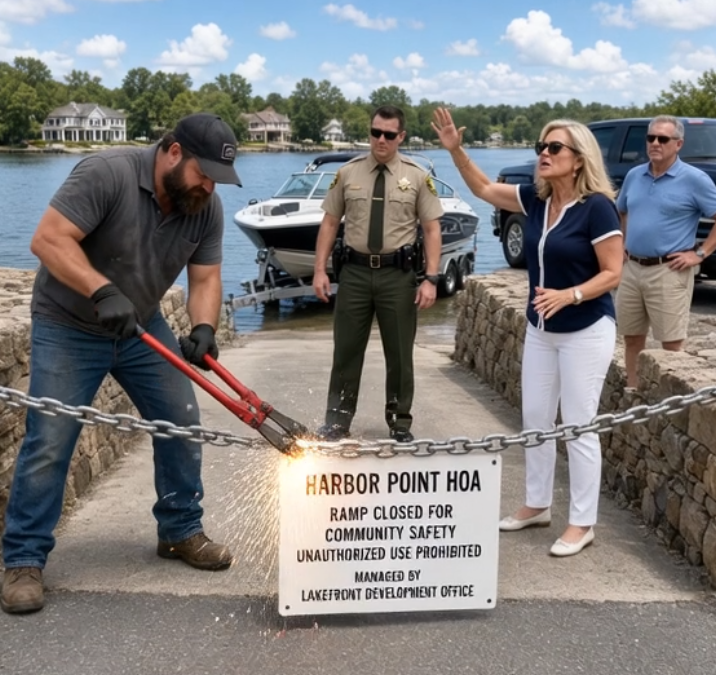
PART3:
A white pickup sat beneath the pines.
Lights off.
Someone inside.
Watching.
That was when I knew this was not a mistaken work order.
They had drilled.
Chained.
Posted.
And hired security before dawn.
They wanted me to discover the closure exactly like this.
I looked at the dark lake beyond the steel.
Twenty yards of concrete.
My boat behind me.
Water in front of me.
And one man-made line pretending forty years of ownership had disappeared overnight.
Whatever Harbor Point thought they were closing, it was bigger than a boat ramp now.
By the time Harbor Point’s office opened, the fog had burned off.
My boat was back in my driveway.
That bothered me more than I expected.
A boat sitting on a trailer is supposed to look temporary.
Mine looked stranded.
The hull was dusty. The launch rope sat coiled where I had left it. The small brass key to the outboard hung from a hook by the garage door, useless.
I changed boots, printed the photographs, and drove to the clubhouse.
Harbor Point called the building the Lakeside Administration Center.
That was typical of them.
A cedar-sided clubhouse became more authoritative if you gave it enough syllables.
It sat above the marina lawn with wide windows overlooking Blue Heron Lake.
Flagpole.
Landscaping.
Carved heron logo.
Same logo that had appeared on the laminated notice bolted across my ramp.
The receptionist looked up when I gave my name.
Her smile stopped halfway.
“Mr. Reed.”
“Yes.”
“Mr. Pruitt is expecting you.”
That was useful.
I had not called ahead.
Russell Pruitt sat inside the glass conference room.
Phone in one hand.
Half-eaten breakfast sandwich on a napkin.
Boat shoes.
No socks.
Quarter-zip sweater with a marina logo stitched over one chest.
Not Harbor Point’s marina.
Another company.
“Graham.”
He waved toward a chair.
“Sit. I’ve got eleven minutes before another call.”
I remained standing.
“Somebody drilled steel posts into my boat ramp this morning. I’d like to know who authorized it.”
He took another bite.
“Lakefront Development Office.”
“Which is?”
“Me.”
“There is no Lakefront Development Office in the governing documents.”
“There is now.”
He wiped his mouth.
“Board created a liaison position in February to streamline shoreline opportunities.”
“Opportunities.”
Russell leaned back.
“I’m not going to dress this up. We have a real opportunity on North Cove, and your ramp sits right in the middle of it.”
At least the word safety had already disappeared.
“What opportunity?”
He turned his laptop.
A polished architectural rendering filled the screen.
Covered slips.
Kayak storage.
A dock bar.
Decorative lights.
Landscaped shoreline.
New signage.
And a company name.
Lakeshore Marina Group — North Cove Expansion Concept
Russell tapped the screen.
“They want exclusivity on the north shoreline.”
“What does my ramp have to do with it?”
“Everything.”
He enlarged the map.
A highlighted access corridor ran through my ramp.
“No competing private launches. Controlled guest traffic. Cleaner branding. Cleaner insurance profile.”
“My ramp is private.”
“It’s the access corridor.”
“It’s my access corridor.”
“For now.”
I looked at him.
“For now?”
He smiled.
“Recorded rights get renegotiated all the time when there’s enough money involved.”
“There’s no negotiation. You chained it before speaking to me.”
“That was supposed to happen after this conversation.”
I stared at him.
“Supposed to.”
“The installation crew got ahead of schedule.”
“That’s a convenient mistake.”
His smile tightened.
“It doesn’t change the opportunity.”
“How much?”
“What?”
“How much is Harbor Point getting?”
Russell’s posture changed slightly.
“Fifteen-year slip-fee participation. About two hundred forty thousand projected over the term.”
He tapped another line.
“Plus sixty thousand in site-improvement credit.”
“Three hundred thousand.”
“Roughly.”
“And what do you get?”
That question landed differently.
He recovered fast.
“There’s a finder’s fee through the management contract.”
“How much?”
“That is standard compensation for development liaison work.”
“That wasn’t my question.”
“It isn’t relevant.”
“It became relevant when you drilled into my concrete.”
Russell checked his phone.
“We don’t need to make this adversarial.”
“You put security on my ramp before sunrise.”
“Because I knew you might react emotionally.”
There it was.
He had expected bolt cutters.
Expected shouting.
Maybe expected me to give him the exact scene he needed to call me unstable.
Instead, I stood there with photographs.
“What do you want?” I asked.
“Lease access.”
“No.”
“License it.”
“No.”
“Name a number.”
“No.”
“Everybody has a number, Graham.”
“My father and I built that ramp. My family has used it freely for forty years.”
“Nobody’s asking you to give up the history.”
“You’re asking me to give up the access.”
“For compensation.”
“No.”
He sat back.
“Think about it through the weekend.”
“There’s nothing to think about.”
“I’d rather pay you than fight you.”
“That sounds like a threat.”
“It’s business.”
“What happens if no number works?”
For the first time, Russell looked genuinely amused.
“I’ve never met someone without a number.”
“You’re about to.”
He laughed.
Short.
Almost friendly.
“We’ll see.”
Then he stood.
Meeting over.
My folder never opened.
He had not looked at a single ownership document.
That told me something more important than if he had argued about them.
Russell was not confused about my paperwork.
He did not care.
He thought money would make the paperwork irrelevant.
My father lived ten minutes up the lake road.
Seventy-eight years old.
Sharp.
Slow in the knees.
Still carried a level in his truck because he did not trust anybody who said something looked straight enough.
I found him on the porch with cold coffee and an unfinished crossword.
He looked at me once.
“You slept badly.”
“Somebody chained the ramp.”
He put the pencil down.
“Our ramp?”
“Yes.”
“Who?”
“Harbor Point.”
That made him sit straighter.
I explained Russell.
The marina plan.
Exclusive access.
The posts.
Security.
The offer.
Dad listened without interrupting.
When I finished, he said, “Get the box.”
“What box?”
Then he frowned at me.
“No. Wait. I gave it to you.”
“The property box?”
“You still have it?”
“In my garage.”
“Then bring it in.”
Twenty minutes later, we spread the Reed property file across his kitchen table.
Recorded covenant.
Blue Heron Lake Commission permit.
Maintenance receipts.
Old surveys.
Reimbursement letters.
One of the documents made him tap the table.
Harbor Point’s former manager had written it twelve years earlier.
The HOA marina lift had broken. Their maintenance crew needed to put a debris boat into North Cove. The letter thanked the Reed family for temporary use of the private launch.
It included reimbursement for concrete wear.
Dad looked at me.
“They paid you to use it.”
“Yes.”
“That matters.”
“I know.”
“No.”
He tapped harder.
“That means they recognized it wasn’t theirs.”
I nodded.
“Russell doesn’t care.”
“He will.”
Dad reached for another paper.
“Curtis Vale.”
“What about him?”
“Former property manager.”
“I remember.”
“He wrote some of these.”
“He retired years ago.”
“Lives near the marina. Plays cards at Lake Diner every Thursday.”
“How do you know that?”
“I’m old, not dead.”
I laughed despite myself.
“Find Curtis.”
“Today?”
“Today.”
He leaned back.
“Men like Pruitt move fast because they count on everyone else moving slow.”
That sounded right.
Before meeting Curtis, I stopped at the county recorder’s office.
I wanted fresh certified copies.
Covenant.
Plat.
Permit.
The clerk recognized the parcel number.
“You want the Lake Commission permit too?”
“Yes.”
She started printing.
Then said, “People are getting interested in this parcel.”
I looked up.
“People?”
“You’re not the first request this month.”
I went still.
“Who else?”
She pulled a request log.
“Property management company. About three weeks ago.”
“Which one?”
She turned the page toward me.
Bellwether Community Management
Attention: Lakefront Development Office
Three weeks earlier.
Before the chain.
Before Russell invited me to discuss a number.
Before any alleged safety closure.
He had researched my parcel first.
But something else caught my attention.
“What did they request?”
“Plat reference only.”
“Not the recorded covenant?”
“No.”
“Not the Lake Commission permit?”
“No.”
The clerk looked at me.
“Odd?”
“Convenient.”
Russell had asked just enough to identify where the ramp sat.
Not enough to learn why it was legally separate.
Or maybe enough to pretend later that he had never seen the inconvenient part.
Either way, it was not an accident.
I left with the certified papers.
That small request log suddenly felt heavier than the whole folder.
Russell had begun planning before speaking to me.
Curtis Vale was exactly where Dad said he would be.
Lake Diner.
Counter seat.
Coffee.
Newspaper folded beside him.
When I said my name, he looked up.
“Reed.”
“Curtis.”
“Your father still cheat at gin rummy?”
“He calls it strategy.”
Curtis laughed.
Then he saw my face.
“What happened?”
I told him.
Ramp chained.
Russell.
Lakeshore Marina Group.
Claim that Harbor Point controlled the access.
Curtis stopped smiling.
“Pruitt.”
“You know him?”
“Never worked with him. Heard enough.”
“What have you heard?”
“He wants to package every loose north-shore access point into one marina agreement.”
“He says ours is negotiable.”
Curtis shook his head.
“Never was.”
“Can you explain that?”
He turned on the stool.
“Every time Harbor Point used that ramp, we asked.”
“Every time?”
“Every single time.”
He counted on his fingers.
“Storm debris. Marina lift breakdown. Search crew. Maintenance skiff. Your father said yes as long as we cleaned up and didn’t block his trailer area.”
“So no standing HOA right.”
“None.”
“No easement.”
“Not for them.”
“No shared control.”
“No.”
He lifted the coffee.
“It was borrowed with permission.”
“That’s what I need in writing.”
“I’ll write it.”
“Would you testify to it?”
“Sure.”
Then he leaned closer.
“Graham.”
“Yes?”
“If Pruitt already told a marina company he controls your ramp before he actually does, that board should know.”
I looked at him.
Curtis shrugged.
“Man can’t sell something he hasn’t bought.”
Simple.
That became the next thread.
That evening, I went through my old Lake Patrol dispatch records.
Twenty-six years leaves habits.
Mine was keeping copies.
Not because I expected a dispute.
Because I spent too many nights learning that memory gets more confident as it gets less accurate.
I searched for North Cove incidents involving the Reed ramp.
Drought year.
Main Harbor Point launch silted in.
Emergency boats used my ramp for six weeks.
Flash flood.
Pontoon capsized near the cove.
First rescue boat launched from my concrete because debris blocked the marina ramp.
Storm night.
Teenager went into the water near Harbor Point dock.
Marina lights were out.
Rescue crew used Reed access.
I had personally logged it.
Launch site: Reed Access, North Cove.
Again.
Again.
Again.
A ramp is boring until someone needs one.
Then it becomes the most important strip of concrete on the shoreline.
I copied the records.
Put them behind the covenant.
Then Curtis’s letter arrived by email from his granddaughter because Curtis did not trust his own computer.
It read:
During my tenure as Harbor Point property manager from 2009 through 2019, the Reed family launch was never under association control. All Harbor Point use was with direct Reed family permission on a case-by-case basis.
Plain.
Clean.
Useful.
Twenty minutes later, Harbor Point emailed me a fine schedule.
I actually laughed when I opened it.
Unauthorized access attempt — $250
I had driven to my own ramp.
Interference with temporary safety equipment — $500
I had photographed the chain.
Failure to comply with lakefront facility closure — $1,000
The ramp was not their facility.
Signed:
Russell Pruitt
Lakefront Development Liaison
One letter tried to fine me for standing on my own concrete.
The other confirmed Harbor Point had never controlled it.
I put both on the table side by side.
Sometimes disputes are complicated.
Sometimes two sheets of paper explain the entire problem.
I returned to the ramp without the boat.
That was intentional.
No trailer.
No bolt cutters.
Nothing that could be described as an attempted launch.
Northline’s white truck sat under the pines.
Victor Martin stood beside it.
Young guy.
Maybe twenty-four.
Sunglasses pushed up.
“Mr. Reed.”
“Victor.”
“Ramp is still closed.”
“I can see that.”
“I’m required to log anyone who approaches.”
“Log away.”
I held up the folder.
“I’m delivering ownership documents and requesting removal of hardware drilled into my property.”
“I’m not authorized to receive legal papers.”
“Fine.”
I looked at the chain.
“Are you authorized to tell me I can’t use this concrete?”
“I’m authorized to enforce the closure.”
“By whom?”
Pause.
“Mr. Pruitt’s office.”
Not the board.
Not counsel.
Not an elected committee.
Russell’s office.
I photographed the chain again.
The post bolts.
The crooked HOA sign screwed into my old depth marker.
Then I called Owen Briggs, Northline’s regional supervisor.
He returned my call within an hour.
“Mr. Reed, Owen Briggs.”
“Mr. Briggs.”
“I received your preservation letter.”
“Good.”
“I can’t discuss everything in our client file.”
“Then tell me only what you can support.”
Pause.
“We installed the chain on Harbor Point’s instruction.”
“Whose instruction?”
“Pruitt’s office.”
“Board work order?”
“No.”
“Management committee?”
“No.”
“Does the internal site description identify the ramp?”
“Yes.”
“How?”
Paper moved.
Then he said, “Reed Ramp, North Cove Access.”
I almost smiled.
“Not Harbor Point Community Ramp.”
“No.”
“Not HOA launch.”
“No.”
“Reed Ramp.”
“Yes.”
“Has it always been labeled that way in your system?”
“As far as I can see.”
That mattered.
Even the contractor hired to shut me out knew whose ramp it was.
“Why are you telling me this?”
Owen sighed.
“Because if law enforcement asks who ordered my guards onto somebody else’s concrete, I’m not letting a twenty-four-year-old security officer take the blame.”
“Fair.”
Then Owen’s voice changed.
“One more thing.”
“What?”
“I looked up Lakeshore Marina Group.”
“And?”
“Small company.”
“How small?”
“Three principals.”
Pause.
“One is Russell Pruitt’s brother-in-law.”
I stopped writing.
“You’re certain?”
“Public corporate filing.”
Russell was not only negotiating for Harbor Point.
His family was tied to the company whose deal required my access.
Owen continued.
“I don’t know what that means legally.”
“Neither do I.”
“But it changes the flavor.”
“That it does.”
Before hanging up, he said, “Don’t go down there alone this weekend.”
“Why?”
“Pruitt requested full Saturday and Sunday coverage.”
“For a temporary safety closure?”
“Exactly.”
“Why?”
“Safety closures don’t usually need two days of private guards unless somebody expects a confrontation.”
That sentence stayed with me.
Two days later, Owen came to my house.
Personal pickup.
No uniform.
He stood at the bottom of the driveway.
“I probably shouldn’t be here.”
“Then why are you?”
He looked toward my boat.
“I’ve spent thirty years installing legitimate safety barriers.”
“Okay.”
“Transformer sites. Sinkholes. Unsafe docks. I know what a closure looks like when the person ordering it believes there’s danger.”
“And this?”
“This wasn’t that.”
He rubbed the back of his neck.
“I knew from the work order.”
“You knew?”
“I knew it didn’t feel right.”
“Still installed it.”
“Yes.”
I waited.
He appreciated that I did not rescue him from the silence.
Finally, he said, “I told myself ownership wasn’t my job.”
“That’s convenient.”
“Yes.”
He nodded.
“That’s why I’m here.”
“What do you want?”
“Nothing.”
He looked toward the road.
“Victor is paying for community college. He didn’t sign up to stand on somebody’s private ramp defending another man’s real-estate deal.”
“And you?”
“I didn’t either.”
He left after ten minutes.
I stood in the driveway watching his taillights.
The strangest part was that the man hired to enforce the chain had become more uncomfortable with it than the HOA officer who ordered it.
That evening, a neighbor named Ellis sent me screenshots from Harbor Point’s resident page.
I was already the story.
Finally getting that ramp situation cleaned up.
Long overdue.
Is this the guy with the old aluminum fishing boat?
He thinks he owns everything down there.
Then:
Heard there’s a great marina deal waiting if certain people would stop being selfish.
I looked outside.
My boat sat in the driveway.
Sixteen feet of scratched aluminum.
Patched bench.
Outboard that needed choke even in July.
Apparently, that was enough to turn me into a man preventing progress.
I saved the screenshots.
Not because they proved ownership.
Because they proved how fast the story had been rewritten.
The next morning, Priya Desai called.
Harbor Point board member.
I knew her by sight.
She was the one at annual meetings who asked questions other people wished she would save until after the vote.
“Mr. Reed?”
“Yes.”
“This is Priya Desai.”
“I know.”
“I’m not calling to take sides.”
“That sentence usually comes before somebody takes one.”
She almost laughed.
“I asked Russell three questions at the development subcommittee meeting.”
“What questions?”
“Whether Lakeshore Marina Group had asked for anything in writing.”
“And?”
“He said yes.”
“Second?”
“Whether the board had authorized him to represent your access as settled.”
“And?”
“He said no.”
“Third?”
“Whether your family had been contacted before the proposal moved forward.”
My grip tightened on the phone.
“What did he say?”
“Yes.”
I looked at the chain photographs on my desk.
“He hadn’t contacted me.”
“I know that now.”
“So at least one answer was false.”
“At least.”
“Why call me?”
“Because somebody on the board needs to be asking the same questions you are.”
She paused.
“You’re not as alone as Russell has been telling people.”
I did not push.
People who say they refuse to make claims they cannot sign their name to usually come back when they are ready.
Priya came back three days later.
This time by email.
Attachment.
One page.
A draft letter of intent between Harbor Point and Lakeshore Marina Group.
Not signed by the full board.
But initialed by Russell Pruitt.
I read one sentence repeatedly.
Exclusive control of the existing Reed access point is a condition precedent to closing.
Then:
Harbor Point will represent to Lakeshore Marina Group that this access has been or will be brought under association control prior to final agreement execution.
There it was.
The reason for the chain.
Russell had already promised access he did not own.
He had not chained the ramp because of safety.
He had not chained it after negotiations failed.
He chained it because the document told Lakeshore he would control it.
The chain made the lie look true.
I called Priya.
“Does the full board know about this letter?”
“No.”
“He told them?”
“Preliminary discussions only.”
“This doesn’t read preliminary.”
“I agree.”
“Will you say that in writing?”
“I already did.”
“To whom?”
“Board chair.”
She paused.
“I sent it to you first because I thought Russell might try to explain it before anyone else saw the actual wording.”
Smart woman.
I added the letter to my file.
The folder was getting heavy.
Not physically.
In the way evidence gets heavy when every new page makes the original explanation smaller.
By the next morning, I had four certified letters.
Russell.
Harbor Point board.
Bellwether Management.
Northline Security.
Plain language.
The chain and steel posts obstructed documented private launch access.
The Reed ramp was tied to my parcel.
Recorded covenant.
County documentation.
Lake Commission permit.
Historical written acknowledgment from former Harbor Point management.
Harbor Point had no written right authorizing unilateral closure.
Russell’s development office had represented exclusive control to a third party before such control existed.
I did not call Russell dishonest.
His own letter did enough.
Then I drove to the county sheriff’s office.
Same low brick building I had called hundreds of times during my dispatch career.
Same smell of burnt coffee.
Same television playing weather with the sound off.
I requested a civil standby for blocked documented access.
The desk deputy took my name.
Ten minutes later, Deputy Cole came through the side door.
Sleeves rolled once.
Legal pad.
Calm eyes.
He looked like a man who had watched thousands of people walk into that building carrying folders and anger.
“Mr. Reed?”
“Graham is fine.”
We sat in a small interview room.
I laid everything out.
Not chronologically.
By strength.
Recorded covenant.
Permit.
Former manager’s letter.
Historic emergency-use logs.
Northline work-order information.
Then the letter of intent.
Cole read that page twice.
Finally, he said, “That isn’t a safety closure.”
“No.”
“That’s a man trying to sell something he hasn’t bought.”
“That’s what I think.”
He looked at me.
“I need to be clear about what I can do.”
“I know.”
“I’m not adjudicating ownership.”
“Understood.”
“I’m not a judge interpreting covenants.”
“Understood.”
“If Harbor Point produces a court order or recorded right authorizing the obstruction, this changes.”
“Understood.”
“But if we get there and you have documentation connecting that ramp to your parcel, their installer identifies it as Reed Ramp, a board member confirms no approval, and Pruitt cannot produce anything stronger…”
He tapped his legal pad.
“Then we’re dealing with an obstruction.”
“Can you make them remove it?”
“Preferably the installer removes it.”
“And if they refuse?”
“We document the refusal and proceed lawfully from there.”
He looked directly at me.
“But you don’t cut it.”
“I won’t.”
“You don’t argue with security.”
“I won’t.”
“You don’t bring twenty neighbors.”
“I wasn’t planning to.”
Cole almost smiled.
“The lake will provide twenty neighbors.”
Fair.
“When?”
“Saturday.”
“Morning.”
“Pick a time when people are awake.”
“Nine.”
He closed his pad.
“One more thing.”
“Yes?”
“Men like Pruitt often think paperwork is something you create after you win.”
He nodded toward my folder.
“You did it in the better order.”
Dad was on his porch that evening.
I told him.
“Sheriff’s coming Saturday.”
“Good.”
“You don’t have to come.”
He looked at me.
“I didn’t ask if I had to.”
“Dad.”
“I poured that ramp beside you.”
“You mostly told me I was doing it wrong.”
“You were.”
I laughed.
He did not.
“I’m not letting you stand there alone when somebody finally has to answer for drilling into it.”
There are some arguments not worth winning.
“Fine.”
Then he pointed his coffee cup at me.
“Sleep Friday.”
“I’ll try.”
“Pruitt wants you angry.”
“I know.”
“He wants you tired enough to give him angry.”
“I know.”
Dad nodded.
“I know you know. I’m saying it because I’m your father.”
Saturday came bright.
By 8:30, Blue Heron Lake already shone under a clean sky.
Boats moved across the cove.
A pontoon radio played somewhere in the distance.
Ropes tapped against cleats.
The kind of morning when everyone on the lake is outside and nobody admits they are watching anything except the water.
I brought the truck.
The folder.
Dad.
No boat yet.
Russell was already at the ramp.
Board shorts this time.
Polo shirt.
Like he expected to resolve the whole matter before lunch.
Victor stood near the chain.
Owen stood closer to his own truck than to Russell.
Residents had gathered along the upper path.
More than I expected.
Two teenagers sat on the seawall with phones already out.
A woman held coffee with both hands.
Priya stood near the marina side.
Dad got out slowly.
Crossed his arms.
Looked at the new posts.
“Morning, Russell.”
Russell looked at me.
“Graham.”
Then at Dad.
“You brought reinforcements.”
Dad answered, “He brought the man who poured half that concrete.”
Russell gave a tight smile.
“This doesn’t need to become a show.”
“I tried your office,” I said.
“That conversation was productive.”
“You told me everybody has a number.”
“I made an offer.”
“And before the offer, you promised my ramp to Lakeshore.”
His face changed.
Barely.
I held up the letter of intent.
“The one where exclusive control of Reed access is a condition of closing.”
Russell looked toward Priya.
“That document is preliminary.”
“Initialed by you.”
“Draft language.”
“Representing Harbor Point.”
“Negotiation language.”
Priya stepped forward.
“Negotiation language the board never authorized.”
Someone behind us said, “Wait. He already promised the ramp?”
That changed the crowd.
Not shouting.
Questions.
People doing arithmetic.
Russell turned toward them.
“This is a development concept that could financially benefit every homeowner.”
Priya answered, “Then every homeowner deserved to know the deal required property Harbor Point doesn’t own.”
Russell’s jaw tightened.
“Priya, this is not the place.”
“It became the place when you installed a chain.”
Before he could answer, Deputy Cole’s cruiser came down the lane.
No siren.
Slow.
Gravel crunching beneath the tires.
He parked.
Got out.
Looked at the chain.
Security.
Russell.
Priya.
Me.
Dad.
Residents.
Then he walked toward the ramp.
“Mr. Pruitt?”
“Yes.”
“I understand you are representing Harbor Point regarding this closure.”
“I am.”
“Do you have a court order authorizing obstruction of this access?”
Russell shifted.
“The association created a shoreline development office with authority to coordinate lakefront improvements.”
“That isn’t what I asked.”
“We’re in active negotiation concerning community access.”
Cole held up the letter of intent.
“Active negotiation usually doesn’t include promising a third party that you already control the thing being negotiated.”
Russell stared at him.
“This document is preliminary.”
“Does the board know about it?”
Priya stepped forward.
“No.”
Russell looked at her.
She continued.
“I’m a sitting Harbor Point director. The board never voted to represent Reed access as association-controlled.”
Cole turned toward Owen.
“You supervise Northline?”
“Yes.”
“Did your company install the obstruction?”
“Yes.”
“At whose direction?”
“Russell Pruitt’s office.”
“Board work order?”
“No.”
“Committee authorization?”
“Not that we received.”
“What does your work order call this location?”
Owen took out his tablet.
“Reed Ramp, North Cove Access.”
“Has your company historically identified it that way?”
“Yes.”
Cole looked back at Russell.
“So your contractor calls it Reed Ramp.”
Russell said nothing.
“Your board member says no board authorization.”
Nothing.
“The former manager’s letter says Harbor Point always sought Reed permission.”
Nothing.
“And your development letter says you promised exclusive control to a third party.”
Russell’s voice finally sharpened.
“This is a civil ownership dispute.”
Cole nodded.
“Correct.”
Russell looked relieved too soon.
“Which is why I’m not declaring title.”
Cole pointed toward the chain.
“But right now I have one party with documented access, historical acknowledgment, and parcel records.”
Then toward Russell.
“And I have another party obstructing it without a court order or recorded document showing authority.”
Russell started, “Our attorneys—”
“Are they here?”
“No.”
“Did they file anything?”
“No.”
“Do you have an injunction?”
“No.”
“Recorded easement giving Harbor Point closure authority?”
Silence.
Cole turned to Owen.
“Mr. Briggs.”
“Yes?”
“Remove the obstruction.”
Russell stepped forward.
“That equipment stays until counsel reviews this.”
Victor looked at Russell.
Then Owen.
Owen’s voice stayed calm.
“Victor.”
“Yes, sir?”
“You work for Northline.”
Victor nodded.
“Whose name is on the install order the deputy is holding?”
“Northline.”
“Then remove it.”
Russell’s face reddened.
“You have a contract with Harbor Point.”
Owen looked at him.
“We have a contract to provide lawful security services.”
Pause.
“This stopped looking like one.”
For three seconds, nobody moved.
Then Victor walked to the truck.
Came back carrying keys and bolt cutters.
The first brass padlock opened normally.
The second had jammed.
Victor positioned the cutters.
The metal handles closed.
One hard snap.
The lock split.
The chain dropped against the wet concrete.
That sound was smaller than I expected.
After everything, I thought it would feel dramatic.
It did not.
It sounded like metal giving up.
The ramp was open.
Not repaired.
Not legally settled forever.
But open.
I looked past the fallen chain.
Down the concrete.
To the lake.
Dad crouched near one of the posts.
He rubbed fresh drill dust between his fingers.
“Bad place for anchors.”
Cole looked over.
“Why?”
“Ramp moves.”
Dad pointed toward the old expansion joint.
“Freeze. Load. Water. Concrete breathes more than people think.”
He traced a faint line.
“You drill too close to that old patch, the crack will travel.”
Cole photographed it.
Then photographed the sign screwed into my old marker.
Russell was already on his phone.
Talking fast.
Walking uphill.
Cole turned toward me.
“You want to launch today?”
I looked at Dad.
He nodded once.
“Yes.”
Then I looked at the posts.
“But document the damage first.”
Cole smiled faintly.
“That’s the retired dispatcher answer.”
“Old habits.”
“Good ones.”
The chain came down Saturday.
Cleanup took three weeks.
Cole’s incident report was plain.
That was what I liked about it.
No victory language.
No villain language.
Just facts.
Obstruction installed at direction of Lakefront Development Office.
No board authorization produced.
Third-party development document referenced access control not held by association.
Security contractor identified location as Reed Ramp.
Obstruction removed during civil standby.
Property damage documented.
Harbor Point held a special meeting the next Wednesday.
I did not attend.
Priya called afterward.
“He tried the same explanation.”
“Preliminary?”
“Exactly.”
“What happened?”
“Somebody made him read the exclusive-access line aloud.”
I laughed.
“What did he say?”
“Nothing for about ten seconds.”
“Then?”
“He resigned the lakefront liaison role.”
“Voluntarily?”
“In the way people voluntarily leave a room after everyone points at the door.”
“And the marina deal?”
“Probably dead.”
“Why?”
“Lakeshore wanted Harbor Point to guarantee exclusive ramp access.”
“And now?”
“Nobody wants to sign it.”
That made sense.
Russell’s promise had been the foundation.
Once the promise disappeared, the numbers stopped working.
Then Priya added, “There’s another issue.”
“What?”
“His brother-in-law connection is being reviewed.”
“By whom?”
“Board counsel and management.”
I did not ask for more.
That was Harbor Point’s problem.
My problem was the concrete.
The repair contractor found a hairline crack running from one anchor point toward the old expansion joint.
Dad had called it before the inspection.
“Whoever installed these posts didn’t understand ramps move.”
Almost the same words.
Northline agreed to pay half the repair.
Harbor Point paid the rest.
Owen signed the Northline letter personally.
It stated that Northline would not perform access-control work at Reed Ramp again without my written authorization, a lawful court order, or documentation of legally established control.
I did not mistake that for kindness.
It was risk management.
That was fine.
Concrete does not care why someone pays the invoice.
Five days after the chain came down, Harbor Point issued a correction.
Same resident portal that had helped turn me into the stubborn guy blocking progress.
This time:
North Cove Reed Ramp is not a general Harbor Point amenity. Future restrictions involving non-HOA property require board approval, legal review, and written authorization from the affected property owner or lawful authority.
Russell’s name was not on it.
His development office disappeared almost as quickly as it had been invented.
Lakeshore Marina Group never closed the North Cove deal.
Priya told me the projected returns no longer worked without exclusive launch control.
I felt nothing about that.
I did not sabotage their deal.
Their deal required something that was not theirs.
Once that became clear, the deal collapsed under its own weight.
Curtis Vale found me at the diner the next Thursday.
Dad usually played cards there.
That week, I stopped for coffee alone.
Curtis sat down beside me.
“Heard it went your way.”
“The ramp is open.”
“Good.”
He stirred his coffee.
“You know, I dealt with three men like Pruitt before he ever moved here.”
“Same marina plans?”
“Different plans.”
He smiled.
“Same arithmetic.”
“What arithmetic?”
“They always think the physical thing is the problem.”
“The ramp.”
“The gate. The road. The dock. The fence.”
He lifted his mug.
“They see something somebody else owns and think ownership is just friction between them and the deal.”
I thought about Russell’s words.
Everybody has a number.
Curtis continued.
“The ramp was never the obstacle.”
“What was?”
“The word no.”
That stayed with me the drive home.
We replaced the old marker.
Simple.
No decorative bird.
No HOA logo.
No development language.
Just:
REED RAMP
PRIVATE LAUNCH ACCESS
NO CLOSURE OR BARRIER WITHOUT WRITTEN AUTHORIZATION OR LAWFUL ORDER
Dad stood beside the contractor.
Hands in his jacket pockets.
“Forty years.”
“What?”
“Forty years and the only man who actually threatened this ramp was somebody who had never once launched a boat from it.”
“Probably true about half the problems in the world.”
Dad frowned.
“Don’t get philosophical.”
Then he pointed at the cooler.
“Help me move that.”
The first evening I launched after repairs, Dad came.
Blue Heron Lake had turned bronze under the setting sun.
The marina was quiet.
Rope tapped metal cleats.
A loon called somewhere beyond the point.
I backed the truck down.
Slowly.
Trailer tires rolled over the repaired concrete.
No chain.
No cones.
No security truck.
No laminated notice.
Halfway down, I stopped.
Dad looked through the passenger window.
“What?”
“Nothing.”
“Then why’d you stop?”
“Because nothing stopped me.”
He smiled.
Barely.
“Keep backing.”
I did.
The rear tires touched the wet section.
Trailer settled.
Boat floated slightly.
Dad got out and walked to the patched anchor holes.
He crouched more slowly than before.
Pressed his palm against the concrete.
Same gesture he had used forty years earlier when the original pour was still wet.
“Looks the same.”
“It basically is.”
“That was the whole fight.”
I looked at him.
He nodded.
“You did the important part right.”
“What part?”
“You didn’t need to be the loudest man at the ramp.”
He stood carefully.
“You only needed to be the most accurate one.”
“Learned that somewhere.”
“Good.”
He brushed dust from his hands.
“I was starting to wonder whether anything I taught you stuck.”
I backed the trailer the rest of the way.
Released the winch.
The boat slid cleanly from the bunks.
Touched the lake.
Drifted backward until the bow line tightened.
Two slow wake lines spread across the cove.
No applause.
No residents standing above us.
No deputy.
No cameras.
Good.
That was what I wanted.
The lake had been there before Russell Pruitt.
Before Harbor Point.
Before marina projections.
Before development offices.
Before anyone decided a chain could convert somebody else’s property into a business asset.
It would be there after all of us.
I thought that would be the end.
It almost was.
Then Priya called one month later.
“Do you have a minute?”
“Sure.”
“Board counsel completed the internal review.”
“That sounds enjoyable.”
“It wasn’t.”
“What happened?”
“Russell’s finder’s-fee arrangement was disclosed to the board.”
“After the fact?”
“Mostly.”
“And the brother-in-law?”
“Confirmed.”
I leaned against the kitchen counter.
“What did the board do?”
“Canceled the development liaison arrangement.”
“Anything else?”
“Adopted conflict-disclosure rules for development negotiations.”
“Russell?”
“He remains a homeowner.”
“Board member?”
“No.”
I paused.
“He resigned?”
“From the board this morning.”
That was more final than I expected.
Priya continued.
“Before you enjoy that too much, he said he was stepping down because the community had become hostile to innovation.”
I laughed.
“That sounds like Russell.”
“Exactly.”
Then she said something I did not expect.
“Some residents want Harbor Point to negotiate emergency-use rights for your ramp.”
I went quiet.
“Why?”
“Because Cole’s report mentioned the historic emergency launches.”
“That doesn’t mean I want an HOA easement.”
“I know.”
“What are they asking?”
“Nothing yet.”
“Good.”
“I told them nobody contacts you until the board knows exactly what it wants.”
“Thank you.”
“Would you ever consider formalizing emergency access?”
I looked out at the lake.
This was different.
No marina bar.
No exclusive developer deal.
No commercial control.
Emergency access had always mattered.
“If it’s limited.”
“Okay.”
“If Lake Patrol and fire rescue are the users.”
“Okay.”
“No recreational HOA access.”
“Understood.”
“No permanent chain, gate, or signage they control.”
“I’ll write that down.”
“And they ask first.”
Priya laughed.
“I suspected that one.”
Several weeks later, Harbor Point adopted a written emergency-use license.
Not ownership.
Not easement.
Not general access.
Emergency agencies could use Reed Ramp when other North Cove launches were unavailable.
Harbor Point would contribute to repair costs caused by emergency use.
No commercial access.
No resident recreation.
No authority to close the ramp.
Dad read the agreement at my kitchen table.
Slowly.
He tapped one sentence.
“Revocable by owner.”
“Yes.”
“Good.”
“You think I should sign?”
He looked at me.
“You always let rescue crews use it.”
“That’s true.”
“Now everybody knows why.”
I signed.
Funny thing about boundaries.
People assume saying no means you never say yes.
That is not what a boundary is.
A boundary tells everybody who gets to decide.
Russell’s mistake was not wanting access.
It was deciding for me.
Winter came early that year.
The lake dropped.
Docks sat slightly lower against their posts.
My boat went into storage.
The repaired concrete darkened under rain.
No crack developed from the patched anchor holes.
Dad inspected them every time he visited anyway.
Then, one cold November morning, Lake Patrol called.
Not the HOA.
Lake Patrol.
The main marina launch had iced along one edge after an overnight freeze. A fisherman had reported an empty kayak drifting near North Point. They needed the safest open ramp for a search boat.
The dispatcher asked, “Mr. Reed, may we use your launch?”
That sentence meant more than it should have.
May we.
Not:
We control.
Not:
Community safety requires.
Not:
Development office.
Not:
Everybody has a number.
“Absolutely.”
Twenty minutes later, a patrol truck backed down Reed Ramp.
Two officers launched.
One thanked me.
They found the kayaker on the opposite shoreline.
Cold.
Embarrassed.
Safe.
After the patrol boat returned, one officer pointed to the new sign.
“Had some trouble here?”
“You could say that.”
He looked at the patched holes.
“What happened?”
“Someone thought a chain changed ownership.”
He laughed.
“Did it?”
“No.”
“Usually doesn’t.”
Then they left.
Dad called that evening.
“Heard they used the ramp.”
“News travels fast.”
“I’m seventy-eight. News is what I have.”
“They found the guy.”
“Good.”
Pause.
“Ramp work?”
“Perfectly.”
“Good.”
That was all.
The conversation lasted less than a minute.
But it reminded me why the fight had mattered.
Not because I needed to prove I owned forty feet of concrete.
Because ownership gave me the right to decide how that concrete was used.
Fishing boat?
Mine to choose.
Rescue boat?
Yes.
Developer’s exclusive commercial corridor?
No.
That distinction was the whole story.
The following summer, Harbor Point installed its marina improvements.
Smaller project.
Existing marina.
No North Cove expansion.
No Reed Ramp.
They added kayak racks.
Repaired two docks.
Updated lighting.
No covered bar.
No exclusive access corridor.
Property values survived.
The lake kept being a lake.
One afternoon, I saw Priya near the marina.
She waved me over.
“Want to see something funny?”
“That depends.”
She opened the new Harbor Point shoreline map.
North Cove.
My parcel.
The ramp was clearly marked.
PRIVATE REED ACCESS — NOT HOA CONTROLLED
I looked at it.
“Very subtle.”
“We wanted future boards to understand.”
“Future boards don’t read maps.”
“Then maybe they’ll notice the bold letters.”
I smiled.
“What about the emergency-use license?”
Separate symbol.
Emergency agency access by owner permission/license only.
Clear.
Accurate.
No gray area.
Priya folded the map.
“Russell used to call that ramp an obstacle.”
“Curtis says ramps are never the obstacle.”
“What is?”
“Someone being told no.”
She nodded.
“Probably right.”
Dad turned seventy-nine that fall.
We took the boat out.
Nothing special.
Sandwiches.
Coffee.
Old rods.
He complained that my anchor line was too short.
I reminded him he had given me the rope.
He said that did not mean I had to keep making the same mistake.
We launched before sunrise.
At the bottom of the ramp, he paused.
Looked at the water.
Then the marker.
“You know what I remember?”
“What?”
“The first day we poured this.”
“I remember you yelling about water ratio.”
“You were using too much.”
“I was eighteen.”
“Concrete doesn’t care.”
“That sounds familiar.”
He smiled.
“You wanted the ramp wider.”
“I did.”
“I told you we didn’t need it.”
“You were wrong.”
“I was.”
That admission alone was worth the trip.
He looked up toward Harbor Point.
“Never thought there’d be that many houses.”
“Neither did I.”
“Never thought somebody would put a chain here.”
“No.”
He touched one boot against the concrete.
“People get strange when land gets expensive.”
“Apparently.”
“Water too.”
We launched.
Spent three hours fishing badly.
Dad caught one bass.
I caught nothing.
He reminded me of the score twice.
On the way back, I thought about Russell.
For weeks, I had imagined the story ending with him standing humiliated while Deputy Cole ordered the chain removed.
That had been satisfying.
But it was not the part that stayed with me.
The part that stayed was simpler.
Dad’s hand on repaired concrete.
A rescue dispatcher asking permission.
A map finally using the correct name.
A boat sliding into open water without anybody standing there pretending I needed authorization.
Those were the things that lasted.
People sometimes asked why I did not sue Harbor Point.
Maybe I could have.
I had damage.
Documents.
Conflict questions.
The chain.
The false fines.
Security orders.
A development letter.
But the board repaired the ramp.
Canceled the fines.
Issued the correction.
Paid its share.
Changed the policy.
Russell lost the authority he had abused and later left the board.
Northline documented its mistake and contributed to repairs.
My access remained mine.
That was enough for me.
I never wanted Harbor Point destroyed.
My neighbors lived there.
Good people.
Some had believed Russell.
Some had not.
Some simply did not know enough to question him.
Institutions get dangerous when ordinary people assume somebody else has read the paperwork.
Russell’s real power had not come from the title Lakefront Development Liaison.
It came from everyone else assuming the title meant somebody had already checked his authority.
Northline assumed.
Residents assumed.
The marina company assumed.
Even some board members assumed.
One person said:
We control it.
And everybody downstream started acting as though the sentence itself transferred ownership.
Until somebody asked:
Show me where.
That was all Deputy Cole really did.
Court order?
No.
Recorded authority?
No.
Board approval?
No.
Ownership?
No.
Historical control?
No.
Then what exactly was holding the chain up?
Russell’s confidence.
Once that disappeared, the steel followed.
Years of dispatching had taught me that emergencies usually sounded messy over the phone.
People screamed.
Forgot addresses.
Called boats cars.
Called docks bridges.
Called creeks rivers.
You learned to strip the panic away.
Where are you?
What happened?
Who owns what?
Who is hurt?
What is blocking access?
What can be proven right now?
The ramp dispute was not so different.
Russell had wrapped it in community safety, development opportunity, property values, marina branding, insurance, economic benefit, and progress.
All those words sounded large.
The answer turned out to be small.
Whose ramp?
Mine.
Who authorized the chain?
Russell.
What authority did he have?
None that covered my property.
Why did he want it closed?
Because he had promised control to somebody else.
Once those questions were answered, the rest became noise.
One evening near the end of summer, I took the boat down alone.
Dad’s knees had started bothering him more.
He stayed home.
The cove was quiet.
I backed slowly.
Stopped exactly where the chain had once crossed.
The repaired anchor patches were almost impossible to see now. Weather had blended the concrete. The new sign was weathering, but the black letters were still clear.
REED RAMP
The water touched the lower edge.
Small waves.
Same rhythm.
I remembered the first morning.
Fog.
Headlights.
Fresh brass locks.
Security truck under the trees.
The feeling that something permanent had changed while I slept.
It had not.
That was the strange thing.
The chain had looked permanent.
Steel often does.
But ownership was older than the chain.
The records were older.
The permission history was older.
The concrete was older.
My father’s memory of pouring it was older.
Russell had mistaken physical control for legal control.
For a few days, steel let him pretend they were the same.
Then the sheriff asked for paper.
I got back into the truck.
Released the brake.
Backed until the boat floated.
It slid off the trailer cleanly.
I tied it to the cleat.
Then I stood at the edge of the open ramp.
Nobody watching.
Nobody arguing.
No laminated notice.
No private security.
No meeting.
No marina proposal.
Just Blue Heron Lake turning orange under the evening light.
The chain was gone.
Russell’s office was gone.
His deal was gone.
But the ramp was still exactly what it had always been.
A way into the water.
A way out when someone needed one.
And mine to decide who used it.