Police Officer Saves a Dying Puppy—But Now the Little Dog Keeps Sulking at Him
PART3:
The puppy had tried to get out.
At some point in the dark, he had used paws barely large enough to leave a mark and scratched at a door no one heard.
Now he could not even stand.
Emmett removed his coat and wrapped it around the puppy before lifting him carefully.
The little dog weighed frighteningly little in his arms.
For a moment, the puppy’s head rested against Emmett’s chest without resistance.
The facility manager stepped aside.
As Emmett carried him into the cold morning air, another employee began lowering the trailer door behind them.
The metal panel slammed shut.
Bang.
The puppy jolted violently.
His entire body tightened in Emmett’s arms. One paw pressed suddenly against Emmett’s chest, as if trying to hold on to something.
Emmett stopped.
The reaction lasted only a moment.
Then the puppy seemed to run out of strength again.
Emmett looked back at the closed trailer.
“Just the noise,” he murmured.
But later, he would remember that moment differently.
Less than twenty minutes later, Emmett carried the puppy through the side entrance of a veterinary clinic.
Dr. Amos Keane was on duty that morning. At fifty-six, Amos had spent more than twenty-five years treating animals from Wabasha and the surrounding rural communities. He was calm by nature, the kind of man who rarely rushed his movements even when the situation was urgent.
But when he saw the puppy, he moved fast.
They warmed the little shepherd slowly. Amos checked his temperature, hydration, breathing, and heart rate. Fluids were started. The puppy was wrapped in a warm blanket, almost entirely hidden except for his head.
Emmett remained nearby.
He told himself he was only staying because he had found the dog.
Because there might be an investigation.
Because someone needed to answer the veterinarian’s questions.
None of those explanations felt completely honest.
After the first examination, Amos shook his head.
“This didn’t start last night.”
Emmett looked through the treatment room opening.
“What do you mean?”
“He was already weakened before he ended up in that trailer. Not enough food. Not enough water. At his age, a puppy can decline quickly. The cold just pushed him closer to the edge.”
Emmett’s eyes went to the tiny head resting on the blanket.
“How close?”
Amos understood.
“Close enough that I’m glad they heard him this morning.”
No one said anything for a moment.
The puppy had no microchip. No collar. No tag. No paperwork. Nothing in the trailer clearly identified who had left him there.
For the time being, there was nowhere obvious for him to go once he was stable enough to leave the clinic.
Emmett told himself what happened next was practical.
The puppy needed somewhere quiet.
The department could continue checking the trailer rental information.
If an owner was found, the situation could be handled then.
So Emmett agreed to take him home temporarily.
Temporarily.
That was the word he used.
By evening, the puppy was more alert. Still weak, but able to lift his head on his own and take a few unsteady steps.
Somewhere between the clinic and home, Emmett began calling him Bixby.
He did not make a ceremony of it.
The name came out once.
The puppy looked at him.
That was enough.
Emmett’s house was small and had changed very little in more than ten years.
His mornings began with coffee at the same kitchen counter. His work boots usually rested beside the same chair. Most evenings ended with a simple meal and the low hum of the television.
There had never been anything wrong with the silence.
At least, that was what Emmett had always told himself.
He placed a soft puppy bed beside the sofa and laid a small fleece blanket across it.
Bixby sniffed the edge of the bed.
Then stepped away.
Emmett watched him slowly cross the rug, dragging the light fleece blanket behind him. The puppy stopped near Emmett’s boots, turned once, lowered himself carefully onto the blanket, and curled into a small black-and-tan shape on the floor.
He did not climb onto Emmett.
He did not ask to be held.
He simply chose a place close enough to know where the man was.
Later that night, Bixby finally fell into a deeper sleep.
Emmett sat quietly in the chair, watching the small chest rise and fall.
After a while, he shifted one foot beneath him, preparing to stand.
Bixby’s eyes opened instantly.
The puppy lifted his head and stared at him.
Emmett stopped moving.
For several seconds, neither of them made a sound.
Then Emmett settled back into the chair.
Only after he did, Bixby slowly lowered his head onto the blanket again.
His eyes closed.
For the first time since leaving the trailer, the little puppy slept without watching the door.
Two weeks after the morning at the moving trailer, Bixby no longer looked like the puppy Emmett had carried into Dr. Keane’s clinic.
He was still small, with oversized paws and the slightly unsteady movements of a young German Shepherd, but strength had returned to his legs. His appetite had improved. His coat was cleaner. His eyes followed nearly everything that happened around him.
The biggest change was that Bixby had decided Emmett was worth following.
Every morning, while Emmett made coffee, the puppy settled just outside the kitchen. He rarely came all the way in. Instead, he chose a spot where he could see Emmett moving between the counter and the refrigerator.
If Emmett disappeared around the corner, Bixby lifted his head until he came back into view.
It became part of the house without Emmett noticing.
The coffee maker clicked on.
A cabinet opened.
A spoon touched the side of a mug.
Somewhere behind him, small paws shifted across the floor.
The house had never seemed especially empty to Emmett before.
He had lived there alone for years and had grown comfortable with quiet.
Now, if Bixby wandered into another room for more than a minute, Emmett caught himself listening for him.
In the evenings, the puppy returned to the fleece blanket near the sofa. Sometimes he slept. Sometimes he watched Emmett read or stare at the television.
He also developed a habit of looking deeply offended whenever Emmett moved the blanket to clean the floor, as if the arrangement of the living room had become Bixby’s responsibility.
“You’ve been here two weeks,” Emmett told him one evening. “You’re already running the place.”
Bixby answered with a long puppy sigh and rested his chin on his paws.
It was difficult not to laugh.
Yet every morning, when Emmett prepared for work, that easy little rhythm changed.
At first, Emmett assumed Bixby disliked seeing him put on the uniform.
The puppy would watch from his blanket while Emmett buttoned his shirt and fastened his duty belt. His playful interest faded. His ears lowered slightly. The bright curiosity in his face became cautious.
But the uniform itself was not the trigger.
Emmett discovered that a few mornings later.
He was nearly ready to leave when he remembered his keys on the kitchen counter. Bixby sat several feet away watching him.
Emmett picked them up.
The keys touched each other with a light metallic jingle.
Bixby’s expression changed immediately.
His ears lowered.
He turned his head away.
Emmett stopped.
“Really?”
Bixby continued looking toward the wall.
Emmett crouched and pulled a small treat from the container near the counter.
Until that morning, Bixby had shown very little interest in pretending he did not like food.
Emmett held it out.
The puppy looked at the treat.
Then he looked at Emmett.
For a second, Emmett thought he would take it.
Instead, Bixby deliberately turned his entire body in the opposite direction.
Emmett stared at the little back now facing him.
“So that’s how this is going to be.”
Bixby did not move.
Emmett smiled despite himself.
“All right. Be angry.”
He placed the treat near the puppy’s blanket and left for work.
By the time he returned that evening, the treat was gone, and Bixby was once again following him from room to room as if the morning disagreement had never happened.
The same pattern repeated.
Warm and attentive while Emmett was home.
Quiet when the uniform appeared.
Then, at the sound of the keys, Bixby turned away.
Emmett began referring to it as the puppy’s morning grudge.
He did not think much more about it.
Someone else did.
Loretta Finch lived two houses down. At sixty-eight, she had been retired from elementary school teaching for several years, but retirement had done little to reduce her habit of noticing small things.
She knew which neighbor forgot trash day, which child had learned to ride a bicycle, and which houses needed someone to bring in mail when their owners traveled.
When she heard that Emmett had temporarily taken in a German Shepherd puppy, she appeared one afternoon with puppy treats and the practical confidence of someone who had spent decades managing rooms full of children.
Bixby studied her carefully at first.
Loretta did not reach for him.
She simply sat down, placed one treat on the floor nearby, and continued talking to Emmett.
A minute later, Bixby collected it.
By the end of the visit, he was sitting close enough to Loretta’s shoe that she could reach down and scratch lightly behind one ear.
After that, Loretta sometimes stopped by when Emmett’s shift kept him away for several hours.
That was how she noticed what happened after his car left.
One morning, Emmett locked the front door, walked to his vehicle, and drove away.
Loretta was outside near her own porch.
Through the lower window of Emmett’s front door, she could see Bixby sitting just inside.
The puppy remained there after the patrol car disappeared.
He did not immediately return to his blanket.
He stayed facing the door.
Several minutes passed.
Then several more.
Only later did he finally move away.
Loretta mentioned nothing when Emmett came home that evening.
There was nothing alarming about a puppy waiting for the person caring for him.
Still, she remembered it.
A few days later, Emmett decided Bixby was ready for a little more time outside. Dr. Keane had advised keeping activity short while the puppy continued recovering, so Emmett carried him for most of the way and allowed him to walk only a small stretch near the house.
The afternoon was cold but clear.
Bixby sniffed patches of dormant grass, inspected the base of a mailbox with great seriousness, and became briefly fascinated by a dry leaf scraping along the sidewalk.
Emmett let him explore at his own pace.
They had gone only a short distance when they reached an intersection about three hundred yards from the house.
One road continued through the neighborhood.
The other led toward the moving and storage facility.
Bixby stopped.
The change was so sudden that Emmett almost stepped ahead of him.
The puppy stood completely still, nose lifted slightly, eyes fixed on the road ahead.
Emmett waited.
“Come on.”
He gave the leash the gentlest pull.
Bixby did not follow.
His little body had become rigid.
There was no barking.
No attempt to run away.
He simply refused to take another step toward that road.
Emmett looked down at him.
Two weeks earlier, he might have worried immediately.
Now he assumed Bixby was tired.
“That’s enough for today.”
He bent down and lifted the puppy into his arms.
Bixby did not resist.
As Emmett carried him home, the little shepherd looked back once over his shoulder toward the intersection.
Then the houses blocked it from view.
By evening, the moment seemed unimportant.
Bixby ate dinner, pushed his fleece blanket into a position that apparently suited him better, and spent part of the night sleeping near the sofa.
Emmett had intended to read for only a few minutes.
Instead, sometime later, the book lowered against his chest, and he fell asleep in the chair.
When he woke, the room was dark except for a lamp in the corner.
For a moment, Emmett did not know what had disturbed him.
Then he felt warmth against his foot.
The fleece blanket had moved.
Bixby had dragged it from its usual place and settled directly beside the chair. His small back rested against Emmett’s boot. His breathing was slow and even.
Emmett looked down at him for a long moment.
Carefully, he pulled one loose corner of the blanket over the puppy’s side.
Bixby did not wake.
The next morning, Emmett made coffee while Bixby followed him into the kitchen doorway.
Everything seemed ordinary.
Then Emmett reached for his keys.
Jingle.
Bixby’s ears lowered.
He looked at Emmett and quietly turned his face away.
By the third week, Emmett had stopped thinking of Bixby as a temporary guest every time he walked through the house.
The puppy’s small bed remained beside the sofa. His food bowl had found a permanent-looking place near the kitchen wall. The soft tapping of little paws had become part of Emmett’s evenings.
Bixby was still young enough to tire quickly, but he had recovered enough strength to greet Emmett when he came home, follow him from room to room, and occasionally carry his fleece blanket several feet before becoming exhausted by his own ambition.
The strange reaction to Emmett’s keys had not disappeared.
Every morning, Bixby watched the same routine.
The uniform.
The duty belt.
The keys.
The moment they jingled, something in the puppy changed.
Emmett still treated it as a small grudge.
Bixby would turn his face away, and Emmett would promise to be back later.
By evening, the disagreement was usually forgotten.
One Thursday afternoon, that routine was interrupted.
Emmett was preparing to finish his shift when he was sent to assist at a traffic accident several miles outside Wabasha. No one knew how long the scene would take to clear.
He stopped at home briefly before heading out again.
Bixby was resting on his blanket near the sofa when Emmett entered.
The puppy immediately stood.
Emmett changed a few things in his gear, picked up what he needed, then crouched beside him.
“I should be back around eight.”
Bixby leaned forward and sniffed his sleeve.
Emmett rubbed the top of his head once before standing.
Then came the familiar sound.
The keys jingled.
Bixby’s ears lowered.
He turned his face away.
“There it is,” Emmett said with a small smile. “The morning grudge has moved to the afternoon.”
He left without thinking much about it.
Bixby remained beside the door.
By early evening, Emmett realized he would not make it home when expected. The accident scene had become more complicated, and traffic was being redirected around the area.
He called Loretta and asked if she could check on the puppy.
She arrived shortly before eight.
Bixby was sitting several feet from the front door.
Loretta expected him to hurry toward her because he had already learned that her visits often included food.
Instead, he looked at her, then returned his attention to the door.
“Well,” she said softly, setting down her bag. “I see where I rank.”
She prepared his dinner and placed the bowl near his usual spot.
Bixby approached it, sniffed once, then walked away.
Loretta waited.
He sat near the door again.
She did not force him to eat.
After a few minutes, she picked him up and carried him to his fleece blanket.
Bixby circled once, lowered himself, and rested his chin between his front paws.
For a while, the house became quiet.
His eyes slowly closed.
Then headlights swept across the front window.
Bixby woke instantly.
Before Loretta could move, the puppy was on his feet. His short legs carried him across the room as quickly as they could manage.
He reached the door and stared upward.
A pickup truck rolled past the house.
The light disappeared.
Bixby stayed there for several seconds.
Then his ears dropped slightly.
Loretta watched him return to the blanket.
This time, he did not settle comfortably.
He kept his head raised toward the hallway.
Another half hour passed.
Bixby finally slept.
Then a car door closed somewhere outside.
He woke again.
He struggled to his feet, hurried toward the entrance, and waited.
Nothing happened.
Loretta walked over and sat on the floor beside him.
“Not yet,” she said.
Bixby looked toward the door.
Loretta gently touched his back.
For a puppy so young, the evening had already been long.
She guided him back to the blanket and encouraged him to drink a little water.
He did.
But he still ignored most of his dinner.
Time moved slowly after that.
Bixby slept in short stretches.
A vehicle passed, and he woke.
A distant engine slowed, and his head came up.
Each time, he seemed to expect the same ending.
Footsteps on the porch.
The lock turning.
Emmett walking inside.
Each time, the house remained unchanged.
Loretta began to understand that Bixby was not simply listening for noises outside.
He was listening for one particular person.
Near eleven, she sent Emmett a message telling him that Bixby was fine but refusing most of his food.
Emmett replied that he would return as soon as possible.
By then, the puppy no longer had the energy to keep walking between his blanket and the door. Loretta found him lying directly beside the entrance. His head rested on the floor.
Even there, every time an engine passed, one ear lifted.
At last, close to midnight, headlights appeared in the driveway.
Bixby’s head rose.
This time, the lights did not continue down the street.
An engine stopped.
For the first time all evening, the puppy stood before Loretta could touch him.
The key entered the lock.
The door opened.
Emmett stepped inside, tired from the long shift.
His first thought was that Bixby would rush toward him. The puppy had done it several times during the previous week.
Usually, there were awkward little paws, a wagging tail, and more enthusiasm than balance.
Tonight, there was none of that.
Bixby stood several feet away.
He stared at Emmett.
Emmett smiled.
“Hey, little man. Sorry I’m late.”
Bixby remained still.
Then slowly, he turned around.
He walked down the hallway without looking back.
Emmett watched him disappear around the corner.
Loretta gathered her things.
“I think you’re in trouble.”
Emmett gave a tired laugh.
“That bad?”
“He waited for you most of the night.”
Emmett glanced toward the hallway.
The behavior seemed almost funny.
A puppy barely old enough to understand where his food came from apparently had strong opinions about punctuality.
“Guess I missed curfew.”
Loretta smiled, but she did not answer immediately.
Before leaving, she told Emmett that Bixby had eaten very little and suggested trying again once the house settled down.
Emmett thanked her and locked the door.
He found Bixby beneath a small table at the end of the hallway. The puppy was curled against the wall.
Emmett crouched a few feet away.
“You’re really going to hold this against me?”
Bixby looked at him.
Then rested his head down again.
Emmett did not pull him out.
He returned to the kitchen, refreshed the puppy’s water, and left a small amount of food nearby before going to bed.
For the first time since Bixby had begun sleeping close to the sofa, the fleece blanket remained empty all night.
The next morning, Emmett woke earlier than usual.
He expected to find Bixby near the kitchen or perhaps waiting outside the bedroom.
Instead, the hallway was quiet.
He walked toward the small table and stopped.
Bixby was still underneath it.
But now something else was there.
Beside one paw lay several pieces of kibble.
Near his chest was the small chew he usually kept by the sofa.
Emmett looked toward the kitchen.
The food bowl still contained most of last night’s meal.
He crouched and examined the few pieces Bixby had carried away.
The puppy watched him without moving.
Emmett had seen dogs hide food before.
But something about this felt different from play.
Bixby had taken only a little.
Just enough to place beside himself in the smallest, most sheltered corner of the house.
Emmett reached forward but stopped before touching him.
For the first time, the puppy’s strange behavior no longer seemed funny.
And Emmett had no idea what Bixby was trying to tell him.
Over the next few days, the distance Bixby had placed between himself and Emmett slowly began to disappear.
He still spent more time under the small table than he had before, but he no longer stayed there all evening.
By the third night, he wandered back into the living room on his own and settled a few feet from the sofa.
Emmett noticed but did not call him closer.
He simply kept reading and allowed the puppy to decide how near he wanted to be.
By the weekend, some of their old rhythm returned.
Emmett had a full day off, something that had become rare over the previous weeks. He woke later than usual and walked into the kitchen wearing an old sweatshirt instead of his uniform.
Bixby followed at a sleepy pace, then settled near the doorway while Emmett started coffee.
The puppy seemed almost entirely relaxed.
Emmett put two slices of bread in the toaster and leaned against the counter while the coffee brewed.
When the toast popped up, he buttered one slice and carried it toward the table.
A small corner broke off and landed on the floor.
Bixby’s head came up immediately.
A moment earlier, his eyes had been half closed.
Now he was staring at the piece of toast with complete attention.
Emmett looked down at him.
“I call your name three times and get nothing. Toast hits the floor and suddenly your hearing is perfect.”
From the front porch came Loretta’s laugh.
She had stopped by to return a container and had heard the exchange through the open inner door.
“I told you,” she said. “He’s training you.”
Emmett shook his head.
Bixby remained focused on the fallen piece.
Emmett picked it up before the puppy could reach it and replaced it with one of Bixby’s treats.
“That was almost a successful robbery.”
Bixby accepted the substitute without complaint.
The moment was ordinary.
That was exactly what made it pleasant.
No waiting at the door.
No unexplained food beneath the hallway table.
No strange silence between them.
For the first time since the night Emmett had returned late, the house felt easy again.
Later that morning, Emmett drove into town while Bixby stayed with Loretta for a short time. He returned with groceries, household supplies, and one small paper bag from the pet store.
Inside was a new collar.
The first collar Bixby had worn since leaving the clinic had been temporary and slightly too large.
This one fit properly.
Emmett sat on the living room floor while Bixby investigated the bag.
“Hold still.”
Bixby did not.
It took two attempts before Emmett managed to fasten the collar without the puppy trying to inspect the buckle at the same time.
A small metal tag hung from it.
BIXBY
EMMETT SEAR
A phone number beneath.
Emmett checked the fit with two fingers.
Then released him.
There was no speech about what the tag meant.
Emmett did not tell Bixby he belonged there.
He did not promise nothing would ever change.
He simply stood and carried the empty package to the trash.
Bixby sat for a moment, listening to the unfamiliar tag make a faint sound against the buckle.
Then he followed Emmett toward the kitchen.
That evening, Emmett took his usual place on the sofa with a book.
Bixby’s fleece blanket had remained near the wall since the night he began sleeping beneath the hallway table.
For several minutes, the puppy lay on it where it was.
Then he stood.
He caught one edge of the blanket in his mouth and pulled.
The fleece slid a few inches.
Bixby stopped, adjusted his grip, and pulled again.
Emmett watched over the top of his book.
It took several determined attempts, but eventually the blanket ended up beside the sofa.
Bixby circled twice and lay down near Emmett’s feet.
Emmett lowered the book for a moment.
“Welcome back.”
Bixby rested his chin on the blanket.
Nothing more was needed.
A few days later, the first real change arrived.
Emmett received confirmation about a position he had applied for months earlier. It was a step he had considered for a long time, one that offered him a fresh assignment and a chance to move forward professionally.
The position was his if he wanted it.
For years, Emmett had found reasons to remain exactly where he was. The house was familiar. His routines worked. Wabasha was easy to understand.
This time, he accepted.
That meant moving.
At first, very little changed inside the house.
Emmett made phone calls, completed paperwork, and began sorting through closets he had ignored for years.
Then the cardboard boxes appeared.
He brought the first few into the living room one afternoon and set them near a bookshelf.
Bixby was sleeping on his fleece blanket.
The sound of cardboard sliding across the floor woke him.
He raised his head.
Emmett opened one box and began placing books inside.
Bixby stood and walked toward it.
Emmett continued working.
The puppy stopped beside the cardboard.
He sniffed one corner, then the strip of packing tape.
His nose moved slowly along the edge of the box.
Something about his posture changed.
The loose, curious puppy from a few moments earlier became still.
Emmett was turned toward the bookshelf and did not see it.
Bixby sniffed the tape once more.
Then he quietly walked out of the room.
Over the next several days, more boxes appeared.
The bookshelf slowly emptied.
Framed photographs disappeared from a side table and were wrapped for the move.
Extra kitchenware went into another box.
Nothing happened all at once.
The house simply began changing a little each day.
Bixby watched.
He did not bark at the boxes.
He did not hide every time Emmett packed something.
He simply became quieter.
Sometimes he sat at the edge of the room while Emmett worked.
Other times he disappeared into the hallway.
Emmett noticed Bixby was less playful, but he assumed the puppy was reacting to unusual activity in the house.
There was packing to finish.
Arrangements to make.
A new job waiting.
Emmett had enough on his mind that he did not connect the change to anything deeper.
Then one evening, he brought an old suitcase down from the bedroom.
He set it beside the front door so he would remember to pack it the next morning.
The soft thud made Bixby look up from his blanket.
His eyes settled on the suitcase.
Emmett walked past him toward the kitchen.
Bixby did not follow.
For several seconds, he remained exactly where he was, staring toward the door.
Later that night, Emmett sat down on the sofa and reached for his book.
Only then did he notice the empty space beside his feet.
The fleece blanket was gone.
He checked the kitchen first.
Then the bedroom.
Finally, Emmett walked down the hallway.
Bixby was beneath the small table again.
The puppy had pulled the fleece blanket into the narrow space beside him.
He was awake.
Emmett stopped several feet away.
Bixby looked past him toward the front of the house.
Toward the boxes.
Toward the suitcase waiting beside the door.
Emmett did not understand what the puppy was seeing.
Not yet.
The next morning, the house felt different before Emmett had even carried the first box outside.
Cardboard cartons stood along the living room wall.
Several shelves were half empty.
The suitcase beside the front door waited exactly where he had left it.
Bixby stayed near the hallway, watching him move from room to room without his usual curiosity.
Emmett noticed he was quiet, but he had too much to finish that morning to think deeply about it.
He carried the suitcase to his vehicle first, then returned for a small box of papers he needed to keep separate.
Because he was moving back and forth between the house and driveway, the small side gate had not closed completely. It rested against the latch with a narrow opening near the bottom.
Emmett passed it twice without noticing.
Bixby did.
The puppy remained near the living room while Emmett gathered another stack of documents.
Then Emmett reached across the kitchen counter and picked up his keys.
Jingle.
Bixby’s head lifted.
His eyes moved toward the front door.
Emmett was already walking outside.
He placed the papers in the vehicle, checked something in the front seat, and returned to the house less than a minute later.
The silence struck him first.
Usually, even when Bixby was hiding beneath the hallway table, there was some small sign of him.
The scrape of a paw.
The faint movement of the fleece blanket.
The sound of his tag touching the floor.
Now there was nothing.
“Bixby?”
Emmett checked beneath the table.
Empty.
He looked beside the sofa.
Then the kitchen.
Then the bedroom.
“Bixby.”
Still nothing.
A cold uneasiness moved through him.
He stepped outside and looked toward the yard.
That was when he saw the side gate.
It was not wide open.
Just slightly ajar.
The gap was small enough that Emmett might not have noticed it on any other morning.
But Bixby was still a tiny puppy.
Small enough to slip through.
Emmett crossed the yard quickly and looked both ways along the street.
No puppy.
He called again.
Nothing answered.
The morning air was cold.
Bixby had only recently recovered from the condition in which Emmett had found him. Three or four hundred yards would not seem like much for an adult dog. For a puppy this young, it was enough to worry him immediately.
Emmett went to Loretta’s house.
She opened the door before he reached the second knock.
“Bixby’s gone.”
Concern appeared on her face at once.
Within minutes, they were checking nearby sidewalks and yards. Loretta took the quieter residential side while Emmett searched toward the main road.
He checked beneath parked cars, behind shrubs, beside fences, anywhere a frightened puppy might try to hide.
There was no sign of Bixby.
Emmett returned to the intersection near his house, forcing himself to think rather than simply move.
Bixby could not have gone far.
Then a memory surfaced.
The afternoon walk.
Bixby stopping without warning.
The little body becoming rigid.
The puppy staring down one particular road and refusing to move another step.
The road leading toward the moving and storage facility.
Emmett turned immediately.
He hurried back to his vehicle and drove the short distance.
The facility looked ordinary when he arrived.
A few trailers parked along the far side of the lot.
Storage doors in neat rows.
Nothing about the place suggested it meant anything to a small dog.
Emmett drove slowly toward the section where he had first found Bixby.
The trailer was gone.
It had been returned to service weeks ago.
Only the parking space remained.
Two faded white lines on cold concrete.
And between them lay Bixby.
Emmett stopped the vehicle.
For a moment, he did not get out.
The puppy looked impossibly small in the empty space. His body was curled near the center of the parking spot, almost exactly where the trailer had once stood around him.
Emmett stared.
Then sounds and images came together in his mind.
The jingle of the keys.
The suitcase beside the door.
The cardboard boxes Bixby had sniffed.
The way he had quietly left the room.
The blanket returning beneath the hallway table.
Emmett understood enough.
Boxes.
Suitcase.
Keys.
Movement toward a vehicle.
To Bixby, those things were not signs of a new job or another house.
They belonged to something older.
Something that had ended with a tiny puppy alone inside a moving trailer.
Emmett opened the vehicle door but did not rush toward him.
Bixby lifted his head.
He was awake and alert, but tired. The short journey had taken more out of him than it would have taken from an older dog.
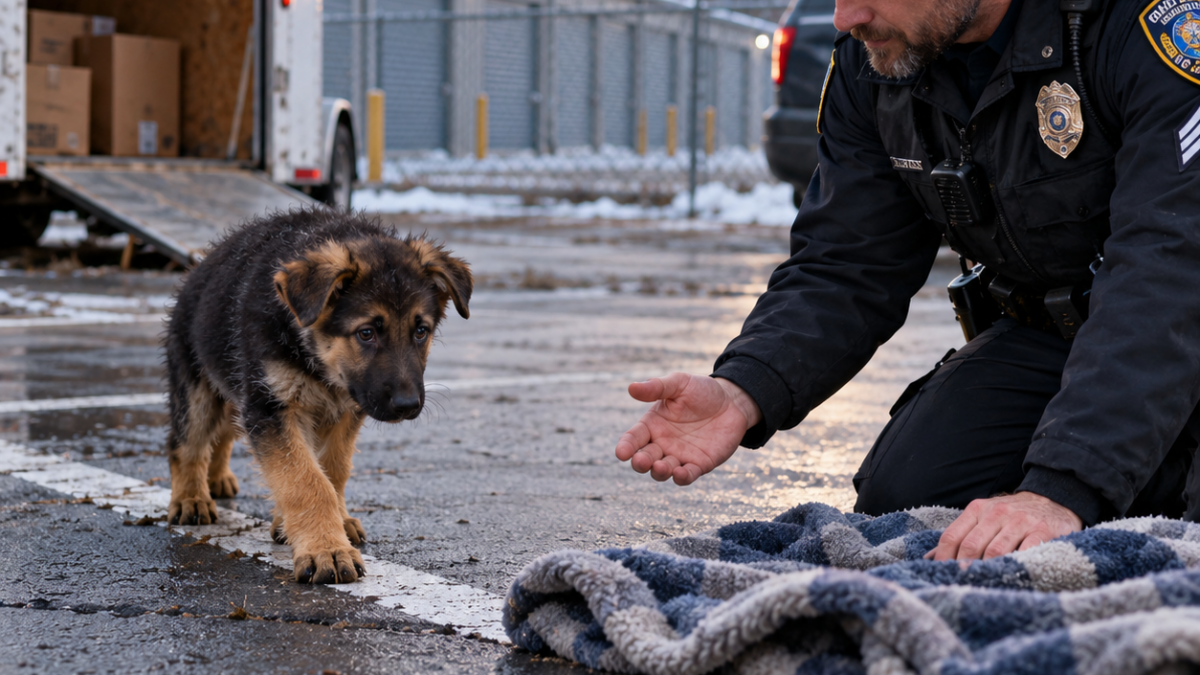
Emmett walked around to the back of the vehicle and took out Bixby’s small fleece blanket.
Then he approached slowly.
He stopped several steps away.
Bixby watched him.
Emmett placed the blanket on the concrete between them.
He did not reach for the puppy.
He sat down.
The cold pavement came through his clothes, but he stayed where he was.
Bixby lowered his head again.
Minutes passed.
Emmett said his name once.
“Bixby.”
Nothing more.
He did not promise he would never leave.
He did not try to explain the boxes or the move.
None of those words would have meant anything to a puppy.
So Emmett stayed.
Eventually, Bixby raised his head again.
His eyes moved from Emmett to the fleece blanket.
He stood.
His legs looked tired beneath him.
For several seconds, he remained inside the empty parking space.
Then one small paw crossed the faded white line.
Another followed.
Bixby stopped.
Emmett did not move.
The puppy took another step.
Then another.
Until his front paws reached the blanket.
He lowered his nose and smelled it.
Home.
Not the building.
Not the trailer.
Something familiar from quiet nights beside the sofa.
Bixby stepped fully onto the fleece.
Emmett slowly extended one hand.
He kept it low and still.
Bixby looked at it.
Then the little shepherd leaned forward and placed his muzzle into Emmett’s palm.
Only then did Emmett touch him.
His fingers moved gently behind one ear.
Bixby closed his eyes.
Emmett stayed there until the tension in the puppy’s body eased.
Then he rose.
He picked up the blanket, but he did not pick up Bixby.
Instead, Emmett turned toward the vehicle and began walking slowly.
After several steps, he stopped.
He did not call.
Behind him, there was only silence.
Then came a faint sound against the concrete.
Tap.
Another tap.
Emmett continued toward the vehicle.
The little footsteps followed.
When he reached the door, he finally looked back.
Bixby was coming toward him on his own.
The first morning they met, Emmett had carried a puppy out of a trailer because Bixby no longer had the strength to leave by himself.
This time, Emmett did not have to carry him away.
Bixby chose to leave that empty space behind.
And he chose to follow Emmett.
A few weeks passed, and the house in Wabasha slowly became a place of boxes instead of rooms.
Books disappeared from shelves.
Kitchen cabinets emptied.
The familiar spaces Bixby had learned to trust changed day by day.
By then, he was about three months old.
Healthier.
Stronger.
More curious.
But still young enough that the world around him often seemed oversized.
Emmett did not change his decision about the new position.
He had worked toward the opportunity for a long time, and after everything that happened at the moving facility, he understood something important.
Keeping Bixby did not require keeping every other part of life unchanged.
Bixby would simply go with him.
On moving day, Loretta arrived early to help with the last boxes.
She found Emmett loading the vehicle while Bixby watched from the open front doorway.
The first things Emmett had packed into the back were not his own.
Bixby’s small bed was already there.
His food and water bowls were secured in a box that would be easy to reach.
A few puppy toys sat beside them.
His familiar fleece blanket was spread across part of the seat.
Loretta looked inside the vehicle, then at Emmett.
“I’m starting to wonder which one of you got the promotion.”
Emmett smiled as he lifted another box.
“He has more luggage.”
“He has better priorities.”
Bixby watched from the doorway.
The morning remained calm until Emmett carried the suitcase outside.
The puppy’s body became still.
He had seen that suitcase before.
Then another cardboard box passed through the door.
Bixby followed it with his eyes.
Emmett put the box into the vehicle and returned for one last group of papers. He moved normally, resisting the urge to keep checking whether Bixby was still there.
After what happened at the storage facility, Emmett had become more careful about doors and gates.
But he also knew that hovering over the puppy would not teach him this day was different.
Everything Bixby feared was appearing again.
Boxes.
A suitcase.
Things disappearing from the house.
A vehicle waiting outside.
Emmett placed the final papers in a small bag.
Then he reached for his keys.
Jingle.
Bixby’s ears lowered.
His front paws shifted slightly beneath him.
Emmett saw it.
For one brief moment, the puppy looked toward the inside of the house, almost as if considering whether there might still be somewhere quiet to hide.
But no one moved toward him.
Emmett walked to the vehicle and opened the rear door.
He left it open.
Inside, Bixby could see his bed.
More importantly, he could see the fleece blanket that had followed him from Emmett’s living room to the empty parking space where the trailer once stood.
Emmett brought over a low, sturdy step and placed it beside the vehicle.
Bixby was healthier now, but the seat was still too high for a three-month-old puppy to climb comfortably on his own.
Emmett stepped away.
He did not lift Bixby.
Did not tug on a leash.
Did not call his name again and again.
Loretta crouched beside the puppy and stroked the top of his head once.
“Go on.”
Bixby looked at her.
Then at Emmett.
Then at the open vehicle.
He remained in the doorway for several seconds.
Emmett waited.
Finally, Bixby stepped onto the porch.
One paw.
Then another.
He walked down to the driveway and stopped several feet from the vehicle.
The keys were still in Emmett’s hand.
The boxes were still visible inside.
Nothing about the scene had been hidden from him.
Bixby approached the low step.
He placed both front paws on it and paused.
His nose lifted.
He had caught the scent of his blanket.
The puppy climbed onto the step.
Then he put one front paw inside the vehicle.
He stopped again.
Emmett stayed where he was.
Bixby sniffed the fleece blanket.
A moment later, the second paw followed.
Then his back legs.
He climbed fully inside.
Loretta let out a quiet breath that almost became a laugh.
Emmett reached forward only after Bixby had settled himself on the blanket.
This time, the door closed with Bixby safely on the same side as Emmett.
There was no grand farewell.
Loretta hugged Emmett, reminded him to call, then leaned toward the open window and told Bixby not to become too important to remember his old neighbor.
The puppy looked at her with solemn attention.
Then the vehicle pulled away.
Wabasha passed slowly beyond the windows.
The porch disappeared.
The street disappeared.
For Bixby, the scene resembled something that had once ended very differently.
A moving vehicle.
Packed belongings.
A home left behind.
But this time, he was not watching from inside an abandoned trailer.
He was going with the person he had learned to follow.
By the time they reached the new house, the afternoon light was beginning to fade.
The place felt unfinished.
Cardboard boxes lined the walls. The table had not been assembled. Half the kitchen remained packed.
Emmett managed to find his takeout dinner before he found the box containing plates.
So he sat on the floor with a container balanced on one knee.
Bixby spent several minutes exploring.
He walked cautiously through the living room, sniffed the doorway to the kitchen, then returned to check where Emmett was.
He disappeared again.
A minute later, he came back.
This time, the fleece blanket trailed from his mouth.
Emmett stopped eating and watched.
At the old house, Bixby had sometimes pulled that blanket under the hallway table whenever fear returned. The first night after Emmett came home late, he had hidden with it. When the moving boxes appeared, he had done the same thing again.
There were plenty of hiding places in this unfamiliar house.
Bixby ignored them.
He dragged the blanket across the floor until it reached Emmett.
Then he climbed onto it, turned in a small circle, and lowered himself beside the man’s leg.
His head came to rest against Emmett’s knee.
Emmett placed one hand gently on his back.
For the first time since leaving Wabasha, Bixby closed his eyes.
The next morning, Emmett prepared for his first day at the new job.
Bixby watched from his blanket as the uniform went on.
Then Emmett reached toward the counter.
The keys lifted.
Jingle.
Bixby looked at him slowly.
He turned his face away.
Emmett stared for a moment before laughing.
“Seriously?”
Bixby maintained his offended expression for only a few seconds.
Then he stood.
He walked to the front door.
Emmett opened it.
Once, Bixby had waited behind a closed door, listening for someone who never returned.
Later, he had waited for Emmett, uncertain whether the same thing was happening again.
This morning, he did not sit down to watch the man leave.
He stepped across the doorway beside him.
Bixby had not forgotten what it felt like to be left behind.
He simply no longer believed every set of keys, every packed box, or every open door had to end that way.
Sometimes a door opened because someone was leaving.
And sometimes it opened because they were going together.
Bixby’s story was never really about a puppy sulking.
It was about memory.
It was about the way fear can attach itself to ordinary sounds—a metal door slamming, keys jingling, cardboard boxes sliding across a floor.
It was about how a creature too young to understand language could still remember abandonment in his body.
And it was about the patience required to teach him that the same signs did not always lead to the same ending.
Emmett did not save Bixby by carrying him out of the trailer only once.
He saved him again and again.
By sitting on the cold concrete instead of grabbing him.
By letting him cross the faded white line on his own.
By packing the blanket first.
By opening the vehicle door and waiting.
By proving, one ordinary morning at a time, that leaving for work was not the same as leaving forever.
Trust did not return all at once.
It came in small choices.
A puppy taking a treat after turning away.
A blanket dragged back beside the sofa.
A muzzle placed into an open palm.
A step into a vehicle that once would have meant terror.
A doorway crossed beside the person he had learned to trust.
Bixby never forgot what hurt him.
But he learned something new could happen afterward.
Home was not the trailer.
Not the old house.
Not even the new one.
Home became the person who came back.
The person who waited.
The person who made sure that, this time, when the keys jingled and the door opened, Bixby was not left behind.