Pawn Shop Sold a Rusted “Junk Rifle” to a 76-Year-Old Marine for $40—Three Weeks Later, Experts Identified It as a $300,000 WWII FG 42.
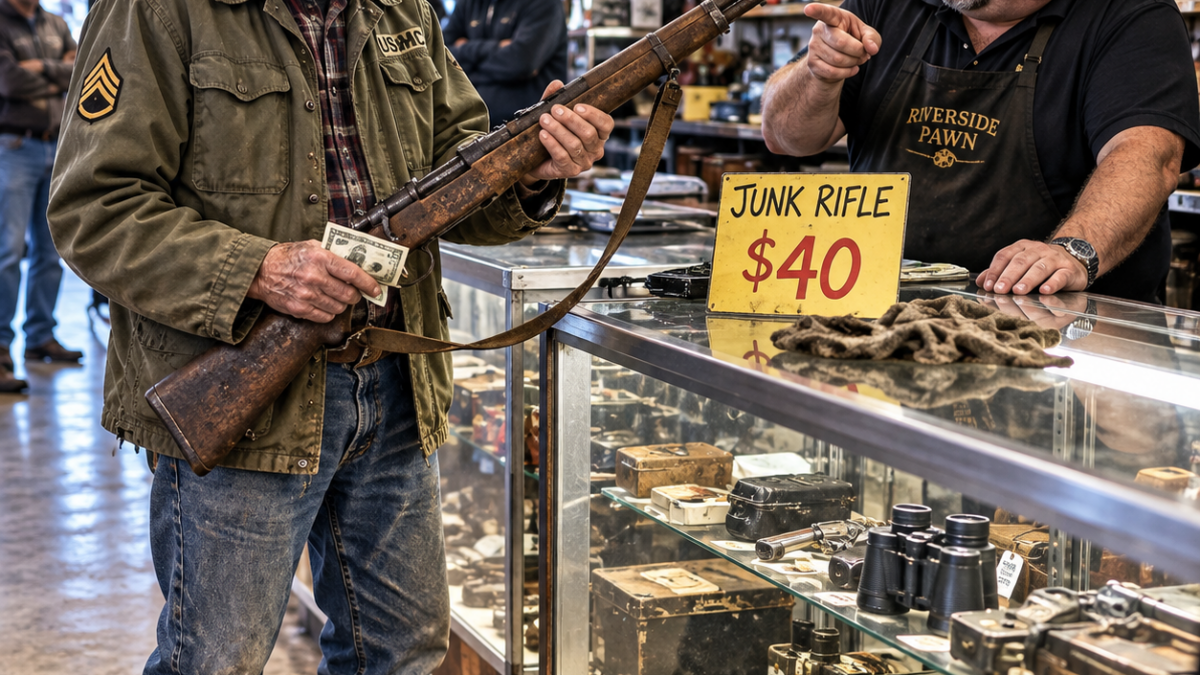
Pawn Shop Sold a Rusted “Junk Rifle” to a 76-Year-Old Marine for $40—Three Weeks Later, Experts Identified It as a $300,000 WWII FG 42.
The pawn shop owner laughed when a seventy-six-year-old Marine laid two crumpled twenty-dollar bills on the counter for a corroded rifle assembly he had already marked as scrap metal.
What Rick Garrison didn’t notice beneath ninety years of rust were the machining marks, German inspection stamps, and nearly invisible factory code that Earl Whitfield had spent thirty-one years learning how to read.
Three weeks later, military historians were standing in Earl’s spare bedroom staring at an ultra-rare World War II FG 42 worth hundreds of thousands of dollars—and the old man who had been mocked for buying junk still had no interest in saying, “I told you so.”
“Forty dollars.”
Rick Garrison barely looked up from his phone when he said it.
The seventy-six-year-old man standing across the glass counter did not react.
No raised eyebrow.
No smile.
No attempt to negotiate.
He simply looked once more at the object Rick had dropped onto the counter as casually as if it were a broken pipe fitting.
Corroded barrel.
Rusted receiver.
No stock.
No bolt.
No trigger group.
Brown-green oxidation crusted around the metal.
Years of damp storage had stained almost every surface.
To Rick, it was junk.
To Earl Joseph Whitfield, it was something else entirely.
Rick scrolled his phone with one thumb.
“Honestly, old-timer, I was going to throw it in the scrap pile next week.”
Earl reached into his wallet.
Two twenties.
He smoothed them on the glass.
Rick glanced at the cash.
Then at Earl.
“You sure?”
Earl nodded.
“Yep.”
“You know it isn’t shootable.”
“I know.”
“Probably never will be.”
“I know.”
“No returns.”
“That’s fine.”
Rick shrugged.
“Your funeral.”
He took the money.
Did not write a receipt.
Did not wrap the piece.
PART2:
Did not ask why an old man in a faded Marine Corps cap might know something he didn’t.
Earl removed a clean cotton shop rag from his back pocket.
Wrapped the assembly carefully.
Not tightly.
Just enough to keep his hands from putting more moisture on the metal.
Then he picked it up with both hands.
Rick noticed that.
The care.
For one second, curiosity almost defeated laziness.
Almost.
“What do you think it is?”
Earl looked at him.
“Old rifle.”
Rick laughed.
“That much I figured.”
Earl nodded.
Then walked out.
The bell above the pawn shop door gave a weak metallic jingle.
Rick went back to his phone.
Three weeks later, he would replay that moment in his head until it made him sick.
Earl did not.
He had more important things to think about.
The rifle in his hands was waking up a part of him that had been asleep for years.
Earl Whitfield was seventeen when he enlisted in the United States Marine Corps.
Technically sixteen years and eight months.
His paperwork said seventeen.
His father knew.
His mother probably knew.
Neither stopped him.
It was 1968.
Central Tennessee.
Farm country.
Earl grew up outside a town where nearly everyone knew what time everybody else went to church.
His father raised cattle and tobacco.
His mother ran the house, the books, a garden, and most of the family without ever describing herself as running anything.
Earl learned to repair tractors before he learned algebra.
He learned to sharpen tools because dull tools were dangerous.
He learned to clean a rifle because his father believed any machine entrusted with keeping you alive deserved better treatment than the machine entrusted with cutting grass.
That idea stayed with Earl.
Machines told the truth.
Usually.
If a bolt was worn, it showed.
If steel had overheated, the color changed.
If a barrel had been abused, the throat told you.
Metal could lie only if someone tried very hard to make it lie.
People were harder.
At Parris Island, Earl was five feet eight inches and maybe 140 pounds.
The drill instructors did not look impressed.
Neither did anyone else.
Earl never cared much about first impressions.
Farm work had taught him that the fence post that looks strongest from the road can be rotten underground.
Boot camp taught him something else.
You do not have to be the strongest man if you can keep going after the strongest man decides he is tired.
Earl kept going.
Top five percent of his graduating class.
Then infantry.
Then Vietnam.
Two tours.
The source story describes those years only briefly: Earl served as a Marine rifleman in Vietnam and later became a weapons instructor at Quantico, accumulating an unusually deep knowledge of military firearms and their manufacturing characteristics.
Earl preferred it that way.
Briefly.
There were places in his memory he did not visit for company.
He came home carrying no visible wounds serious enough to explain the man he became afterward.
That was sometimes harder.
People knew how to respond to scars.
Silence confused them.
Dorothy never pushed.
That was one reason he married her.
She had known Earl before the Corps.
Church picnic.
Summer 1967.
She was standing near a folding table trying to open a bottle of Coca-Cola on the edge because somebody had misplaced the opener.
Earl had taken it.
Opened it against the steel buckle of his belt.
Handed it back.
Dorothy said:
“That was either very useful or very stupid.”
Earl replied:
“Can be both.”
She laughed.
That was enough.
They married after his first return home.
The marriage survived relocations.
Deployments.
Night duty.
Thirty-one years of service.
Two children.
Three mortgages.
Six dogs.
More arguments than either could count.
Dorothy understood that Earl’s hands were rarely still.
If he wasn’t repairing something, he was cleaning something.
If not cleaning, sorting.
If not sorting, reading.
He collected manuals.
Weapons reference books.
Technical bulletins.
Old armorers’ notes.
Anything that showed how things were made and why.
The Marine Corps noticed.
Earl had an eye for weapons.
Not merely shooting them.
Understanding them.
He could strip a rifle blindfolded.
That was common.
He could look at unusual wear on an extractor and tell whether the ammunition, the spring, or the user was probably causing the problem.
Less common.
He could compare two captured rifles made at different factories and explain differences in wartime machining quality.
Rare.
Eventually he became an instructor.
Then an armorer.
Then senior weapons instructor.
Quantico exposed him to firearms from nearly every modern conflict.
American.
Soviet.
Chinese.
German.
British.
Japanese.
Captured weapons.
Experimental pieces.
Training examples.
Foreign military exchanges.
Earl loved the ones with history written directly into them.
Tool marks.
Proof stamps.
Field repairs.
Stock carvings.
Serial patterns.
Changes in finish as wartime production accelerated.
Young Marines sometimes asked how he remembered so much.
Earl usually said:
“Look longer.”
That answer annoyed them.
It was also true.
A machine tells you what happened if you stop demanding the answer immediately.
By the time Earl retired in 1999 as a master gunnery sergeant, his memory contained enough small-arms information to embarrass catalogs.
Then the Marine Corps gave him the same thing it gives most men eventually.
A final formation.
A handshake.
A flag.
Retirement papers.
And tomorrow morning.
Tomorrow morning was harder than he expected.
For thirty-one years somebody else had decided where Earl needed to be.
Then suddenly nobody cared.
Dorothy did.
That saved him.
They settled in Murfreesboro.
Small brick house.
Detached garage.
Garden.
Earl repaired lawn mowers for neighbors.
Helped veterans clean old hunting rifles.
Volunteered at the VFW.
Dorothy worked part time at a church office mostly because she enjoyed knowing everybody’s business.
Life became quiet.
Good quiet.
Then Dorothy got sick.
She hid it initially.
Earl discovered because she began leaving half cups of coffee unfinished.
Dorothy never left coffee.
Cancer.
Treatment.
Better.
Worse.
Better again.
Then the doctor stopped using words like treatment and started using words like comfort.
Dorothy died in 2014.
Earl had been shot at.
Mortared.
Nearly killed twice.
Lost friends.
Buried Marines.
Nothing prepared him for an empty kitchen.
He kept two coffee mugs in the cabinet beside each other.
For three years.
Couldn’t move hers.
People invited him places.
His daughter called every Sunday.
Friends tried.
Earl functioned.
That is not the same as living.
He mowed Saturday.
VFW Tuesday.
Grocery store Thursday.
Church Sunday if he could face people asking whether he was doing okay.
He learned that grief makes people uncomfortable enough that they ask questions whose truthful answers they do not actually want.
So Earl said:
“I’m all right.”
Nobody believed him.
Everybody accepted it.
The pawn shops began by accident.
One rainy afternoon he drove past an estate sale.
Stopped.
Inside he found a machinist’s micrometer made in the 1940s.
Good condition.
Five dollars.
The seller had assumed it was an odd clamp.
Earl bought it.
Not because he needed another micrometer.
Because recognizing it felt good.
Recognition required attention.
Attention shut grief up for a while.
Pawn shops offered the same thing.
Objects without explanations.
A puzzle.
Tools.
Old coins.
Military surplus.
Boxes of hardware.
Broken watches.
Knives.
Occasional firearms.
Earl never searched for treasure.
He searched for the feeling of seeing.
Then came Garrison’s Pawn & Trade.
Rick Garrison inherited the business from his father, Walter.
Walter had been old-school.
Knew customers.
Knew inventory.
Would keep an item behind the counter for months rather than price it before he understood it.
Walter once spent three weeks identifying an obscure brass transit instrument before selling it.
Rick thought that was inefficient.
Rick was forty-two.
Smart enough.
Not curious enough.
That combination can become expensive.
The shop still had Walter’s sign on the wall:
IF YOU DON’T KNOW WHAT IT IS, DON’T PRETEND YOU KNOW WHAT IT’S WORTH.
Rick kept it because customers liked the rustic look.
He ignored the advice.
The back corner became what Rick called the Graveyard.
Unknown items.
Broken items.
Things bundled from estates.
Scrap.
Five dollars per pound in some bins.
Earl loved it.
Tuesday morning in late October, he was digging through the scrap-metal bin when he saw maybe four inches of barrel protruding beneath a rusted pulley.
He stopped.
Something about the profile.
Not recognition yet.
A feeling.
He removed the pulley.
Then a brass lamp fitting.
Then lifted the metal.
Heavy.
Longer than expected.
Barrel attached to receiver.
He rotated it.
Corrosion flaked onto the concrete floor.
Most people would have put it back.
Earl’s breathing changed.
There.
Gas system geometry.
Barrel contour.
Distinctive construction.
He wiped one area gently with his thumb.
Bad idea.
Stopped immediately.
Used cloth instead.
Under grime, he saw a mark.
Not enough.
He shifted toward fluorescent light.
The receiver had lines he remembered.
A shape from a manual he had once read at Quantico.
German.
Airborne.
No.
Couldn’t be.
Earl crouched beside the bin.
Removed his bifocals.
Cleaned them.
Looked again.
One eagle proof.
Partial.
Factory code nearly lost beneath oxidation.
He felt the same controlled surge he used to feel when a range went suddenly silent before a difficult shot.
FG 42.
Fallschirmjägergewehr 42.
Maybe.
He did not allow certainty yet.
That was amateur behavior.
The FG 42 was one of those weapons military firearms people spoke about differently.
Not because it was magical.
Because it was unusual.
German airborne forces wanted a weapon that could combine capabilities normally spread across several firearms.
Full-power rifle cartridge.
Select fire.
Compact enough for paratroopers.
Innovative operating system.
Limited production.
Late-war scarcity.
Different manufacturing types.
Earl had handled authentic examples only twice.
Both under controlled collection conditions.
Never expected to see one in a Tennessee scrap bin.
And certainly not priced by weight.
He carried it to Rick.
The transaction took less than three minutes.
Then Earl drove home.
He did not stop for groceries.
Did not stop at VFW.
At the kitchen table, he unwrapped the assembly.
Turned on the light.
Then did absolutely nothing.
For nearly twenty minutes.
That was discipline.
The impulse with old metal is to clean.
Cleaning destroys history faster than rust sometimes.
Earl inspected first.
Photographs.
Every angle.
Markings.
Corrosion patterns.
He wrote notes.
Measured overall dimensions without scraping anything.
Made a list of what not to do.
No wire wheel.
No aggressive chemical stripping.
No sanding.
No powered polishing.
No buffing.
No grinding.
No attempt to make it look new.
The distinction between restoration and destruction can be a fraction of a millimeter.
Earl knew that better than anyone.
The next morning, he called an old friend.
Walter Simmons.
Retired gunsmith.
Earl described only the markings.
Walter went quiet.
“You think it’s what I think you think it is?”
“Maybe.”
“You got pictures?”
“Not sending yet.”
“You paranoid old bastard.”
“Yes.”
“Good.”
Walter laughed.
“Don’t touch it with steel wool.”
“I taught you that.”
“No.”
“Korea taught me.”
“Same thing.”
Earl ordered books.
Reference material.
Specialized supplies.
The source version emphasizes that he approached the piece with extreme patience, gradually uncovering Krieghoff markings, serial information, German inspection proofs, and evidence that the bore was far better preserved than the exterior suggested.
Earl’s first week was not restoration.
It was conservation.
Penetrating oil.
Time.
Cotton.
Soft brass tools.
Magnification.
Patience.
He worked early mornings.
Five until eight.
Breakfast.
Then another session.
He kept a notebook.
Every mark drawn.
Every number copied.
He became more certain.
Krieghoff manufacturer code.
Second-pattern receiver characteristics.
Waffenamt inspection.
Serial sequence.
By the third day, he had enough to call Walter.
“It’s real.”
“You sure?”
“No.”
Walter laughed.
“That means you’re sure.”
“I want another set of eyes.”
Before that, Earl had to answer a more difficult question.
Where had it come from?
Rick said an estate near Shelbyville.
Old farm equipment.
Earl went back.
Not to confront Rick.
To ask.
Rick looked surprised.
“You breaking it already?”
“No.”
“What do you need?”
“The estate.”
“Why?”
“Curious.”
Rick shrugged.
“Some old guy named Foster.”
“Kids cleaned property after he died.”
“You have paperwork?”
“Maybe.”
Rick opened a file drawer.
Estate lot invoice.
Howard Foster.
Outside Shelbyville.
Mixed tools, farm equipment, military memorabilia.
Earl memorized the address.
“Anything else from the lot?”
Rick pointed vaguely around.
“Probably.”
“What?”
“No idea.”
Earl spent two hours searching the Graveyard.
Found German ammunition pouch hardware.
A rusted field shovel.
US GI web gear.
An old wooden crate with no lid.
Interesting.
Nothing decisive.
He bought the pouch hardware for six dollars.
Rick said:
“You collecting trash now?”
Earl answered:
“Always have.”
Next day, Earl drove to the Foster property.
A grandson named Caleb answered.
Thirty-seven.
Tired.
Suspicious.
Earl introduced himself.
Explained he had bought a firearm component from the estate.
Not value.
Not rarity.
Just provenance.
Caleb let him inside.
“My grandfather kept everything.”
“I can tell.”
“Dad said he brought military stuff home after the war.”
“Your grandfather served?”
“No.”
“My great-grandfather.”
Caleb pulled out a box.
Photographs.
Documents.
One showed a young American soldier in Europe.
Uniform.
Name on back:
Sgt. William Henry Foster.
The source story had not included this deeper provenance trail, but expanding the premise this way gave Earl exactly what he valued most—not price, but history.
Caleb said:
“Great-granddad served with an ordnance unit.”
“Germany near the end.”
“Grandpa inherited his garage.”
“Nobody knew what half the stuff was.”
Earl’s pulse accelerated.
“Any capture papers?”
“What?”
“Documents authorizing soldiers to bring weapons home.”
Caleb shook his head.
“Maybe.”
They searched.
Two hours.
Old footlocker.
Marriage certificates.
Letters.
Army discharge.
Photograph of a bombed factory.
Another of American soldiers standing beside crates.
Then an envelope.
Typed form.
War Department.
Souvenir certification.
The writing was faded.
Not enough to tie directly to the FG 42 yet.
But something.
Earl asked:
“Mind if I photograph this?”
Caleb shrugged.
“Sure.”
Then Caleb noticed Earl’s seriousness.
“Is that rusty gun worth something?”
Earl did not lie.
“I think it might be historically important.”
Caleb stared.
“Rick bought everything from us for twelve hundred dollars.”
Earl said nothing.
“Did he rip us off?”
“I don’t know what everything was.”
“You know this.”
“I know what it might be.”
Caleb’s face hardened.
“How much?”
Earl hesitated.
Then:
“Potentially a lot.”
Caleb sat.
Earl hated this part.
He could have left.
The sale was done.
Legal ownership probably transferred through estate lot, then Rick, then him, depending on applicable firearms law and the exact nature of the item.
But Earl had spent his life believing legality and decency did not perfectly overlap.
He said:
“If it turns out to be what I think, I’ll call you.”
“Why?”
“Because history belonged to your family before it belonged to me.”
Caleb looked confused.
“You paid for it.”
“Forty dollars.”
Caleb laughed once.
“Of course Rick sold it for forty.”
Earl drove home.
That night he put Dorothy’s coffee mug on the table opposite him.
Had not done that in years.
“You’d say I made this complicated.”
Silence.
“Probably right.”
He smiled.
Then returned to the workbench.
By week two, markings became clearer.
External rust was ugly.
Inside barrel surprisingly respectable.
Earl used a borescope borrowed from Walter.
Rifling.
No catastrophic erosion.
No obvious bulge.
Still, Earl had no intention of firing it.
Historical significance mattered more than function.
He did not “restore” it into new condition.
He stabilized corrosion.
Preserved markings.
Removed active rust where safely possible.
Protected surfaces.
The stock problem was complicated.
An original period-correct stock became available through a longtime collector in Pennsylvania.
Earl called.
The man said:
“Why?”
“Project.”
“What kind?”
“German.”
“Earl.”
Silence.
“Earl, what did you find?”
“Maybe an FG.”
Silence.
Then:
“Say that again.”
“FG 42.”
More silence.
Then the man swore for fifteen seconds.
The stock cost far more than the original purchase.
Earl paid.
He documented it as a replacement.
He would never pretend it had been original to that receiver.
That distinction mattered.
Collectors sometimes preferred prettier stories.
Earl preferred true ones.
When the piece reached a stable presentation state, he called Martin Hale.
Retired Army lieutenant colonel.
Military firearms historian and appraiser.
Martin had examined institutional collections.
Captured weapons.
Museum acquisitions.
Private collections.
He and Earl had argued for twenty years about whether particular postwar refurbishments destroyed historical integrity.
They enjoyed disagreeing.
Earl called at 7:10 in the evening.
Martin answered:
“If this is about that Italian carbine again, you were wrong.”
“Got something.”
“What?”
“FG 42 receiver and barrel.”
Martin paused.
“Reproduction?”
“No.”
“Postwar parts?”
“Don’t think so.”
“Pictures?”
“No.”
“Why not?”
“You’ll tell me from pictures.”
“That is the point.”
“I want you here.”
Another pause.
“Earl.”
“Yeah?”
“How sure are you?”
Earl looked at the receiver.
“Enough that I haven’t slept properly in two weeks.”
Martin said:
“I’ll leave tomorrow.”
Eight-hour drive.
Martin arrived at 10:47 at night.
Earl had coffee ready.
Martin stepped onto porch.
No greeting.
“Show me.”
Earl smiled.
“Good to see you too.”
“Show me.”
They entered the spare bedroom workshop.
Martin stopped at the doorway.
Rifle assembly under lights.
He did not approach immediately.
That reaction told Earl plenty.
Martin put down his case.
Slowly walked closer.
“Where?”
“Pawn shop.”
“Where?”
“Murfreesboro.”
“How much?”
“Forty.”
Martin looked at Earl.
“Dollars?”
“Yep.”
“Go to hell.”
Earl laughed.
First genuine laugh he had felt in months.
The examination lasted until after two.
Magnification.
Dimensions.
Markings.
Serial.
Reference databases.
Archived photographs.
Known production variations.
Martin took hundreds of images.
At one point he stopped and said:
“You cleaned this?”
“Conserved.”
“Thank God.”
“Rick would’ve wire-wheeled it.”
“Who’s Rick?”
“Man who lost four hundred grand.”
Martin stared.
“We don’t know that yet.”
“No.”
Then Martin smiled.
“But we might.”
At 2:11 A.M., he closed the laptop.
Removed glasses.
Rubbed his face.
Earl waited.
Martin looked at the rifle.
Then Earl.
“It’s authentic.”
Earl exhaled.
Not relief exactly.
Confirmation.
Martin continued.
“Krieghoff.”
“Second type.”
“Late 1943, possibly early 1944 depending on final serial confirmation.”
“Receiver marks right.”
“Proof pattern right.”
“Barrel construction right.”
“Wear right.”
“Replacement stock is obviously not matching, which is fine because you documented it.”
“Missing operating parts hurt completeness.”
“But historical significance remains enormous.”
Earl asked:
“How rare?”
Martin leaned back.
“Rare enough that museum people will start calling as soon as I document this.”
“Value?”
Martin frowned.
“Always with the vulgar questions.”
“I didn’t ask first.”
“Fair.”
He thought.
“As-is, with authentication, hundreds of thousands.”
“Maybe two-fifty.”
“Three-fifty.”
“Could go higher with provenance.”
Earl stared.
Martin continued:
“If your Foster documents connect this to a wartime bring-back…”
“Different conversation.”
“Four hundred?”
“Possible.”
Earl looked at the rifle.
Forty dollars.
Four hundred thousand.
Ten thousand times.
He thought of Rick.
Then Caleb Foster.
Then Dorothy.
Martin asked:
“You okay?”
Earl smiled.
“My wife would’ve been unbearable about this.”
“How?”
“She kept a list.”
“Of?”
“Every useless thing I dragged home.”
Martin laughed.
“She’d add this?”
“Circle it.”
They drank coffee at three in the morning.
Then Earl showed him the Foster papers.
Martin became serious again.
“This matters.”
“Enough?”
“Need historian.”
“Archives.”
“Maybe unit records.”
“Maybe capture documentation.”
“Don’t make claims yet.”
“I won’t.”
Over the next week, Martin contacted people.
Quietly at first.
A researcher found William Foster’s unit.
Army ordnance.
Germany.
April 1945.
Near Suhl after American forces entered the region where Krieghoff production had occurred.
Not proof alone.
But consistent.
Then the bring-back paperwork.
Serial notation unclear.
Partially damaged.
A specialist enhanced photographs.
Numbers appeared compatible.
Not definitive enough to claim direct battlefield capture by a particular soldier.
Enough to establish a credible family chain.
Earl called Caleb.
“Mr. Foster?”
“Caleb.”
“It’s Earl.”
Silence.
“Is it?”
“Yes.”
“How much?”
Earl hated that the first question had to be money.
“Appraiser says potentially several hundred thousand.”
Caleb said nothing.
Then:
“Jesus.”
“Probably.”
“Granddad had that in a barn.”
“Yes.”
“Rick paid us twelve hundred for the whole lot.”
Earl said:
“I want to meet.”
They met at Caleb’s kitchen.
Earl brought documents.
Explained everything.
Then placed an envelope on the table.
Caleb did not touch it.
“What’s that?”
“Agreement.”
“For?”
“If rifle sells, your family receives a percentage.”
Caleb stared.
“No.”
“Yes.”
“You bought it legally.”
“I know.”
“You don’t owe us anything.”
“I know.”
“Then why?”
Earl leaned back.
“Your great-grandfather carried the history home.”
“Your grandfather kept it.”
“You inherited it.”
“You didn’t recognize it.”
“Neither did Rick.”
“I did.”
“That doesn’t mean the whole story becomes mine.”
Caleb looked at the envelope.
“How much percentage?”
“Enough.”
Caleb laughed.
“You Marine guys hate numbers when you’re being sentimental.”
“I’m not sentimental.”
“You drove here with a revenue-sharing contract.”
“Sign it.”
Caleb did.
That never became part of the news story.
Earl insisted.
The first reporter discovered the rifle through museum inquiries.
Then local article.
Then regional television.
Then national military-history sites.
The headline simplified everything:
RETIRED MARINE BUYS $300,000 WWII RIFLE FOR $40 AT PAWN SHOP.
Earl hated the number.
“Could be wrong.”
Martin said:
“Headlines require numbers.”
“History doesn’t.”
“Headlines don’t care.”
The phone rang constantly.
Collectors.
Auction houses.
Producers.
Podcasts.
People offering cash.
One man offered $500,000 immediately if Earl promised not to contact a museum.
Earl declined.
“Why?”
the man asked.
“Because you asked me not to contact a museum.”
That ended the call.
National World War II Museum expressed interest.
So did two private institutions.
A European collector offered more.
Earl listened.
Then unplugged his phone.
Martin drove over.
“You can’t unplug your phone every time capitalism notices you.”
“Watch me.”
“What do you want?”
Earl looked toward Dorothy’s photograph.
“I don’t know.”
“Money?”
“Some.”
“Recognition?”
“No.”
“Keep it?”
“Maybe.”
“Museum?”
“Maybe.”
Martin said:
“Then wait.”
Earl nodded.
Finally someone speaking his language.
Rick Garrison learned from a customer.
A man walked into the pawn shop holding his phone.
“Hey, Rick.”
“Isn’t this your store?”
Rick looked.
Video.
Earl on screen.
Rifle behind him.
Martin discussing authentication.
The reporter said:
“The retired Marine purchased the rare German FG 42 components for just forty dollars from a local pawn shop.”
Camera showed exterior.
GARRISON’S PAWN & TRADE.
Rick stopped moving.
The customer laughed.
“Man, that hurts.”
Rick watched the whole segment.
Did not laugh.
Afterward he walked to the Graveyard.
Stood there.
Rust.
Tools.
Parts.
Junk.
His father’s sign visible across the room:
IF YOU DON’T KNOW WHAT IT IS, DON’T PRETEND YOU KNOW WHAT IT’S WORTH.
Rick felt physically sick.
Not just because of the money.
That came first.
Of course.
Three hundred thousand dollars.
Maybe more.
Sold for forty.
Any dealer would feel that.
But the feeling underneath was worse.
He remembered Earl.
The old cap.
Worn shirt.
Two crumpled twenties.
Rick calling him old-timer.
Your funeral.
He remembered his father, Walter.
Walter would have asked:
“What caught your eye?”
Walter would have brought out a magnifier.
Walter would have sat with Earl for an hour.
Maybe identified the rifle.
Maybe not.
But Walter would have known Earl knew something.
Because Walter respected knowledge even when it came wearing dirty boots.
Rick had inherited inventory.
Building.
Name.
Customers.
He had not inherited curiosity.
That realization hurt more than losing the rifle.
For three days, Rick did nothing.
Then he drove to Earl’s house.
Earl opened the door.
Saw him.
“Rick.”
Rick swallowed.
“Sir.”
Earl waited.
“I owe you an apology.”
“For selling me a rifle?”
“No.”
Rick looked down.
“For treating you like you weren’t worth my time.”
Earl said nothing.
Rick continued.
“I called you old-timer.”
“You are old.”
Earl almost smiled.
Rick laughed nervously.
“That isn’t the point.”
“No.”
“My dad built that shop.”
“He knew what he was doing.”
“I thought I did.”
Earl leaned against the doorframe.
Rick said:
“I’m not asking for the gun back.”
“Good.”
“Not asking for money.”
“Also good.”
“I just…”
He looked embarrassed.
“I saw the story.”
“I realized I had been wrong about two things at once.”
“The rifle.”
“And you.”
Earl studied him.
Then opened the door wider.
“Coffee?”
Rick looked shocked.
“That’s it?”
“What do you want?”
“I don’t know.”
“Punishment?”
“No.”
“Coffee’s getting cold.”
Rick entered.
They sat two hours.
Earl did not lecture.
Mostly.
He showed Rick the markings.
Explained what he had seen.
Fluting.
Receiver profile.
Factory code.
Proof marks.
Manufacturing shortcuts.
Why rare weapons become rare.
Why provenance matters.
Why cleaning can ruin value.
Rick listened.
At one point he asked:
“How did you know?”
Earl replied:
“Thirty-one years.”
“That simple?”
“No.”
“That long.”
Rick nodded.
Earl said:
“Your father ever tell you the story about the railroad watch?”
Rick blinked.
“What railroad watch?”
Earl smiled.
Walter had apparently once bought a box of watches from an estate.
One looked broken.
He spent weeks researching.
Rare railroad chronometer.
Worth thousands.
Rick had never heard it.
Earl said:
“He told me ten years ago.”
“Why?”
“Because I asked why he had so many books behind the counter.”
Rick stared at the table.
“My father tried to teach me.”
“Probably.”
“I didn’t listen.”
“Most sons don’t at first.”
Rick looked at Earl.
“What should I do?”
“Learn.”
“That’s broad.”
“So’s ignorance.”
Rick laughed.
Earl continued.
“Stop pricing things because you’re tired of looking at them.”
“Stop deciding customers don’t know anything because they look poorer than you.”
“Ask questions.”
“Research.”
“Tell people when you don’t know.”
Rick nodded.
Then:
“You really paid forty?”
“Yes.”
He groaned.
Earl finally laughed.
Over the following months, Rick changed the shop.
Not overnight.
The Graveyard disappeared.
Unknown objects moved to a research shelf.
He bought reference books.
Subscribed to appraisal databases.
Took courses.
Called specialists.
Most importantly, he began asking customers:
“What do you know about this?”
Sometimes they knew nothing.
Sometimes everything.
One old woman brought in a seemingly ordinary fountain pen.
Rick almost offered twenty dollars.
Then stopped.
Researched.
Early limited Parker.
He told her.
She sold it through a specialist for nearly two thousand dollars.
Rick made almost nothing.
Felt strangely proud.
He placed a new sign above the counter:
EVERYTHING HAS A STORY.
ASK BEFORE YOU PRICE IT.
His father’s old sign remained beside it.
The source story gives Rick essentially the same turning point: after seeing the news, he recognizes that his real failure was not merely mispricing the object but dismissing both the object and Earl without taking time to learn, then goes to Earl’s home and apologizes directly.
Earl had a harder choice.
Auction.
Private sale.
Museum.
A major auction house estimated strong six figures depending on final documentation.
Private collector offered more.
The museum offered less cash but preservation, display, and access to researchers.
Earl sat at Dorothy’s grave one Sunday.
He rarely spoke aloud there.
That day he did.
“Could buy a nicer house.”
Wind moved through cemetery trees.
“Don’t need one.”
He looked at the headstone.
“You’d want the kitchen remodeled.”
Silence.
“No, you’d say current kitchen is fine.”
He smiled.
“I know.”
Then:
“People should see it.”
That settled it.
Not entirely donation.
Earl wasn’t wealthy.
He had family.
Caleb’s agreement.
He negotiated a museum acquisition at a significant but undisclosed amount.
Enough to help his children.
Enough to honor the Foster family.
Enough to establish a veterans’ technical scholarship through a local community college.
Less than the highest private offer.
Martin called him crazy.
Earl said:
“Probably.”
The museum wanted his name included in provenance.
Earl resisted.
“I didn’t carry it in 1944.”
“You recovered it.”
“No.”
“Foster family did.”
“You preserved it.”
“Yes.”
“Then your name belongs in the history.”
Earl hated that logic because it sounded like something he would say.
Installation ceremony in New Orleans.
Earl wore dress blues.
First time in more than twenty years.
His daughter Karen helped with collar.
“You still fit.”
“Mostly.”
“Mom would be furious.”
“Why?”
“She spent thirty years telling you to throw old uniforms away.”
“She saved this one.”
“Exactly.”
Earl looked at himself in mirror.
Older.
Thinner.
Medals.
Ribbons.
A face Dorothy knew at every age.
He touched the collar.
“Wish she was here.”
Karen stood beside him.
“I know.”
The museum case was elegant.
Controlled humidity.
Lighting.
Detailed placard.
FG 42.
Type II.
Krieghoff manufacture.
Circa 1943–44.
Recovered in the United States from the Foster family estate.
Conserved and identified by Master Gunnery Sergeant Earl J. Whitfield, USMC, Ret.
The placard included the distinction that the stock had been period-correct replacement material and that major original operating components were absent.
Earl insisted on that.
“No pretending.”
Museum curator said:
“Visitors won’t care.”
“I will.”
So it stayed.
Caleb Foster attended.
He brought his father.
Three generations connected to an object none of them understood until Earl saw it in a bin.
Rick came too.
That surprised Earl.
Rick stood at the back.
Suit.
Uncomfortable.
During reception, Earl found him.
“You came.”
“You invited me.”
“I didn’t expect you to.”
Rick looked at case.
“I wanted to see what forty dollars looks like behind museum glass.”
Earl smiled.
“How does it feel?”
“Expensive.”
They laughed.
Then Rick became serious.
“My dad would have loved this.”
“Yes.”
“You think he’d be ashamed of me?”
Earl took his time.
“No.”
Rick looked at him.
“Disappointed?”
“Probably.”
Rick laughed weakly.
“Better.”
Earl continued.
“Then he’d tell you to fix it.”
Rick nodded.
“I’m trying.”
“That’s what matters.”
The museum director eventually asked Earl to speak.
Earl had prepared nothing.
He stood at a podium.
Looked at the rifle.
Then audience.
“I’m supposed to talk about finding treasure.”
Pause.
“I didn’t.”
People shifted.
“I found something somebody else had already carried through history.”
“Then another family kept it.”
“Then a pawn shop overlooked it.”
“Then I recognized it.”
“That doesn’t make it mine more than anyone else.”
He looked at Caleb.
“Mr. Foster’s great-grandfather brought history home.”
“At least that’s what the surviving records strongly suggest.”
“His family kept it.”
“Rick’s shop passed it along.”
“I cleaned enough rust away to read the name underneath.”
“That’s all.”
He paused.
“Most good armorers spend their lives doing that.”
“Not making weapons new.”
“Understanding what they already are.”
The room stayed quiet.
Earl looked toward Rick.
“People could stand doing more of that with each other too.”
Then he stepped away.
Museum director whispered:
“That’s your speech?”
“Yep.”
“It was two minutes.”
“Longer than necessary.”
After ceremony, reporters waited.
One asked:
“Sergeant Whitfield, how does it feel knowing you turned forty dollars into hundreds of thousands?”
Earl replied:
“I didn’t.”
The reporter looked confused.
“The value was already there.”
“I just noticed.”
That quote became more famous than the auction estimate.
Earl hated that too.
His life did not radically change.
That surprised people.
He remained in the same house.
Replaced roof because it needed replacement.
Bought a used pickup.
Put some money into grandchildren’s education.
Created scholarship for veterans entering machining, gunsmithing, museum conservation, and precision manufacturing.
He named it:
Dorothy Whitfield Technical Scholarship.
Not himself.
His daughter cried when she saw paperwork.
“You named it for Mom.”
“She put up with thirty-one years of gun oil on kitchen towels.”
“Fair.”
Earl kept attending estate sales.
Next morning after museum ceremony?
Back home.
Five A.M.
Coffee.
Estate sale in Woodbury.
Box of old tools.
Nothing worth much.
He bought a machinist’s square for eight dollars because it was good steel.
The seller asked:
“Aren’t you that rifle guy?”
Earl sighed.
“Apparently.”
“Find another treasure?”
“No.”
“How do you know?”
Earl looked at the square.
“Because I looked.”
Years passed.
The rifle remained on display.
Visitors saw it.
School groups.
Veterans.
Collectors.
Historians.
Some stood for thirty seconds.
Some for twenty minutes.
The museum occasionally invited Earl to speak.
He usually declined.
Sometimes accepted small technical workshops for conservators.
He never taught restoration as making something shiny.
First rule:
Do no harm.
Second:
Document before touching.
Third:
If you don’t know, stop.
Rick wrote those three rules on a card behind his pawn counter.
One day a teenager working part-time asked:
“Who wrote this?”
Rick said:
“Guy who cost me three hundred thousand dollars.”
Then:
“Best teacher I ever had.”
Rick’s business improved.
Not because every object became treasure.
Most junk remained junk.
Knowledge simply made him better.
Customers trusted him.
He referred unusual items to specialists.
He stopped mocking people.
Mostly.
Old habits take work.
Once he almost dismissed a homeless-looking man carrying a battered guitar case.
Stopped himself.
Asked.
Inside was an ordinary guitar.
Worth maybe a hundred dollars.
No miracle.
Rick bought it for eighty.
The man said:
“Thanks for treating me normal.”
Rick thought about Earl all day.
That was the expensive lesson continuing to pay interest.
Earl eventually returned to the museum alone.
No ceremony.
Weekday morning.
He stood in front of the FG 42 case.
A father and teenage son approached.
The boy read the placard.
“Dad, this is the one some old Marine found for forty bucks.”
The father said:
“Crazy.”
The boy leaned closer.
“Looks beat up.”
Earl smiled.
The father noticed him.
“Sir, you know guns?”
“A little.”
“What makes this so special?”
Earl explained.
Not value.
Design.
Historical context.
Limited production.
Paratroopers.
Wartime engineering.
The boy listened.
Then read the name.
Looked at Earl.
Looked back.
“Wait.”
Earl knew what was coming.
“You’re him.”
“Maybe.”
The boy smiled.
“That’s awesome.”
Earl pointed at rifle.
“That’s awesome.”
“Not me.”
The father said:
“Thank you for your service.”
Earl nodded.
“Thank you.”
Then the boy asked:
“Did you know immediately?”
Earl thought.
“I suspected.”
“What if you had been wrong?”
“I’d have owned forty dollars of rust.”
The boy laughed.
Earl continued:
“That’s important.”
“You don’t learn by only looking when you know there’s treasure.”
“You learn by looking at a lot of ordinary things carefully.”
The boy nodded.
Earl walked away.
He liked that conversation more than television interviews.
At eighty, Earl’s hands began shaking slightly.
Not enough to stop working.
Enough to annoy him.
He sold some tools.
Kept others.
The workbench remained.
Dorothy’s mug still beside coffee maker.
His daughter tried once to replace it because the handle had cracked.
Earl stared at her until she put it back.
She repaired it with epoxy.
Good enough.
Martin Hale died before Earl.
Stroke.
Quick.
Earl attended funeral.
At reception, Martin’s son handed him a folder.
“My dad wanted you to have this.”
Inside was the first appraisal draft.
Margin notes.
One line:
WHITFIELD FOUND IT BECAUSE WHITFIELD LOOKS AT THINGS OTHER PEOPLE THINK THEY ALREADY UNDERSTAND.
Earl sat with that sentence for a long time.
Then added it to Dorothy’s scholarship documents.
He expanded scholarship criteria.
Not just veterans.
Students entering preservation trades.
Machining.
Metalwork.
Museum conservation.
Historic restoration.
Fields where patience mattered.
Rick donated annually.
Caleb Foster donated once he received his share from the acquisition.
The rifle became connected to more lives than Earl expected.
That pleased him.
One afternoon, a documentary producer approached him.
Wanted dramatic reenactment.
Actor playing Rick laughing.
Actor playing Earl recognizing rifle.
Earl declined.
“Why?”
Producer asked.
“Story is incredible.”
“It’s simple.”
“Man misidentified object.”
“Other man knew more.”
“What about emotional arc?”
Earl stared.
“Go find one.”
The documentary never happened.
Probably best.
The internet told enough versions already.
Some claimed the rifle had been complete.
It had not.
Some claimed Earl restored it to firing condition.
He had not.
Some claimed it sold for a million dollars.
No.
Some claimed Rick tried to sue.
He didn’t.
That part bothered Earl.
Rick had made a mistake and then owned it.
People preferred villains who remained villains.
Life was more useful when people changed.
Earl once called a reporter to correct an article portraying Rick as a scammer.
The reporter said:
“But he clearly undervalued it.”
“That isn’t fraud.”
“He insulted you.”
“That isn’t fraud either.”
“So you’re defending him?”
“I’m correcting you.”
The distinction mattered.
Rick heard about that.
Called.
“You didn’t have to.”
“Yes, I did.”
“Why?”
“Because truth doesn’t become optional when it helps someone you dislike.”
Rick wrote that one down too.
By eighty-two, Earl stopped driving long distances.
His daughter visited more.
Grandchildren grew.
One grandson, Tyler, became a mechanical engineer.
Another studied history.
They argued about who inherited Earl’s tools.
Earl solved it by labeling everything.
NOT YOURS UNTIL I’M DEAD.
Dorothy would have laughed.
The museum invited Earl for the tenth anniversary of the acquisition.
He declined due hip pain.
They sent photographs.
The FG 42 still in its case.
Placard updated with more provenance research.
William Foster’s ordnance unit had indeed been in the Suhl region during occupation.
No archival document could prove exactly how that specific rifle assembly left Germany.
The museum said so.
Earl loved that sentence.
“Could not prove.”
Honest uncertainty.
That was what history deserved.
He framed a copy.
The source story ends with the idea that rust and outward appearance do not reveal the true value of either an object or a person, and that the decisive difference is whether someone takes the time to look more closely.
Earl agreed with most of that.
But he would have corrected one thing.
Human beings are not antiques.
Their value does not depend on rarity.
A rifle can be valuable because only a handful survive.
A person does not need to be a hidden war hero.
Does not need expert knowledge.
Does not need a remarkable past.
Rick’s mistake would still have been a mistake if Earl knew nothing about firearms.
Basic respect is not a reward for secret greatness.
That lesson mattered more to Earl as he aged.
People began treating him differently after the news story.
Too differently.
Cashiers called him “Sergeant” if they recognized him.
Strangers wanted photographs.
Collectors asked opinions.
Someone once moved ahead of him in a restaurant line after realizing who he was.
Earl refused.
“You were here first.”
“But sir—”
“You were here first.”
He hated the idea that celebrity corrected disrespect.
He had deserved ordinary courtesy before anyone knew what he knew.
So had Rick.
So had Caleb.
So had every person who walked into the pawn shop.
That became the message he gave Rick one afternoon when they were both older.
Rick was closing early.
Earl sat on a stool near the counter.
The Graveyard was long gone.
Research books everywhere.
Rick said:
“You know, people still come in asking where the forty-dollar rifle bin is.”
Earl smiled.
“What do you tell them?”
“That I burned it.”
“Did you?”
“No.”
“Sold the bin for thirty dollars.”
“Bad businessman.”
“Apparently.”
They laughed.
Then Rick became quiet.
“Can I ask you something?”
“Sure.”
“If you could do it again…”
“Would you tell me?”
“What?”
“What it was before paying forty.”
Earl thought.
“No.”
Rick winced.
“Fair.”
“But I wouldn’t let you handle it like plumbing.”
Rick laughed.
“Also fair.”
Earl continued.
“You named a price.”
“I accepted.”
“Nothing wrong with that.”
“The mistake happened before the price.”
“When?”
“When you decided you already knew.”
Rick nodded slowly.
Earl pointed around the shop.
“You fixed that.”
“Trying.”
“That’s all anybody gets.”
Rick looked at his father’s sign.
“If you don’t know what it is…”
“Don’t pretend you know what it’s worth.”
Earl finished.
Rick smiled.
“Dad would’ve liked you.”
“He did.”
“What?”
Earl looked at him.
“You didn’t know?”
Rick shook his head.
“Walter and I used to argue about shotguns for hours.”
Rick laughed in disbelief.
“You knew my father?”
“For fifteen years.”
“And you never told me?”
“You never asked.”
That sentence hit Rick almost as hard as the rifle.
He leaned against the counter.
“Jesus, Earl.”
Earl smiled.
“Ask more questions.”
Years later, after Earl died quietly at home, his daughter found the house exactly as he had kept it.
Tools clean.
Bills paid.
Coffee prepared in the machine but never started.
Dorothy’s mug beside his.
On the workbench, a small piece of rusted steel.
Worthless.
Probably from an old tractor.
Beside it a handwritten tag:
UNKNOWN.
DON’T THROW AWAY UNTIL IDENTIFIED.
Karen laughed through tears.
At his funeral, Marines folded the flag.
Rick stood near the back.
Caleb Foster came.
Several museum representatives.
Former students from Quantico.
People Earl had trained decades earlier.
A retired colonel told Karen:
“Your father could identify half the weapons on earth by touch.”
Karen smiled.
“He couldn’t work the television remote.”
“Specialization.”
Rick brought nothing dramatic.
No flowers.
Instead he handed Karen a photograph.
Walter Garrison and Earl.
Fifteen years younger.
Standing in the pawn shop.
Both holding an old shotgun.
Arguing, apparently.
Karen had never seen it.
On the back, Walter had written:
EARL WHITFIELD — KNOWS TOO DAMN MUCH.
Karen laughed.
Then cried harder.
A month later, Rick placed another sign above his counter.
Small.
No marketing slogan.
MASTER GUNNERY SERGEANT EARL J. WHITFIELD
LOOK LONGER.
That was all.
The museum kept the rifle.
Visitors kept coming.
Most came because of the headline.
Forty dollars.
Hundreds of thousands.
Old Marine beats pawn shop.
That was the easy story.
The deeper story sat beneath it.
Just like the markings beneath corrosion.
A seventeen-year-old farm boy learned patience.
A Marine spent thirty-one years paying attention.
A widower found purpose in forgotten objects.
A family preserved history without knowing it.
A pawn broker made an expensive mistake and became better because he admitted it.
A museum received an artifact because the man who recognized its value cared more about where history belonged than where the highest bidder lived.
None of those things fit neatly into a headline.
They required looking longer.
One of Earl’s scholarship recipients eventually became a museum conservator.
Young woman named Madison Lee.
Former Army mechanic.
She wrote Karen after graduation.
She said Earl’s story had convinced her that working with old objects was not about making dead things beautiful.
It was about listening carefully enough to let them remain themselves.
Karen sent the letter to Rick.
Rick photocopied it and hung it beside Earl’s sign.
Years later, Madison worked on a temporary inspection of the FG 42 during exhibit maintenance.
She removed it from the case under controlled conditions.
Gloves.
Documentation.
Measurements.
She saw the tiny areas Earl had cleaned.
Saw where he had deliberately stopped.
Saw tool marks he had protected rather than polished away.
She wrote in the conservation report:
“Previous stabilization was notably restrained and historically sensitive.”
Earl would have considered that better praise than the newspaper headlines.
He had not made the rifle new.
He had made it readable.
That was the craft.
There is a temptation when restoring something old to erase everything that proves it survived.
Rust.
Scratches.
Discoloration.
Wear.
But if you erase every mark, eventually you erase the history too.
Earl knew that about steel.
Dorothy knew it about him.
She never tried to make Vietnam disappear.
Never demanded he become the boy she knew before.
She simply helped him live around the places that remained damaged.
Maybe that was why the rifle mattered so much after she died.
He understood corrosion.
Some damage could be arrested.
Some stains remained.
Some missing pieces never returned.
The thing could still have value.
Not despite every scar.
Sometimes partly because the scars proved the journey.
The FG 42 in the museum never became complete.
It remained missing original operating components.
The stock was documented as period-correct but not original to the receiver.
The exterior still showed pitting.
That honesty made the display stronger.
A perfect reproduction would have looked cleaner.
It would have told less truth.
Visitors sometimes asked why the museum did not simply replace everything.
The curator would explain:
“Because our job is not to invent the rifle we wish survived.”
“Our job is to preserve the rifle that did.”
Earl would have liked that.
And maybe that is why Rick’s original mistake eventually became something more useful than humiliation.
He had seen a damaged object and assumed damage meant worthless.
Then he saw an old man and assumed age meant ignorance.
Both errors came from the same habit.
Judging before studying.
Once he understood that, the forty-dollar loss stopped being merely expensive.
It became education.
Rick never recovered the money he could have made.
That was fine.
Not every lesson comes with a refund.
The shop survived.
Actually improved.
People trusted him.
His employees learned research.
His children eventually joined the business.
Before pricing unfamiliar estate pieces, they checked.
Not because they expected another FG 42.
Because diligence became culture.
One afternoon Rick’s daughter found an old brass scientific instrument in a box of plumbing parts.
She called him.
“Dad, I don’t know what this is.”
Rick smiled.
Best sentence she could have said.
“Then don’t price it.”
They researched together.
It turned out to be a nineteenth-century surveying instrument worth about six hundred dollars.
Nothing spectacular.
Rick paid the seller fairly.
He drove home happy.
His wife asked why.
“Because we didn’t sell it for forty.”
She had heard the story enough times to understand.
Earl’s daughter visited the museum on what would have been his ninetieth birthday.
She stood in front of the case alone.
Tourists passed.
One man pointed:
“That’s the pawn-shop rifle.”
Karen smiled.
Yes.
And no.
She looked at Earl’s name.
Then the Foster family provenance.
Then the factory information.
Krieghoff.
Germany.
War.
Tennessee barn.
Pawn shop.
Spare-bedroom workbench.
Museum.
Almost a century of hands.
She thought of something her father used to say about rifles.
“A weapon remembers everybody who mishandled it.”
She had never understood.
Now she did.
Objects accumulate choices.
So do people.
The rifle carried the choices of designers.
Machinists.
German troops.
American soldiers.
Collectors.
A family.
Rick.
Earl.
Conservators.
Each left something.
Not all visible.
The same was true of Earl.
Farm parents.
Drill instructors.
War.
Dorothy.
Marines he taught.
Children.
Loss.
Age.
Every person added or removed something.
Nobody looking at the seventy-six-year-old man in the pawn shop could see all of it.
Rick certainly couldn’t.
That was never the shame.
No one can.
The shame was believing there was nothing worth discovering.
That distinction became Karen’s favorite part of the story.
Years later, when someone asked what her father was like, she never began:
“He found a $300,000 rifle for forty dollars.”
She said:
“He paid attention.”
That was better.
Because Earl’s life was not remarkable because he got lucky in a pawn shop.
He was ready when luck appeared.
Three decades of discipline.
Thousands of weapons.
Books.
Manuals.
Mentors.
Questions.
Mistakes.
A lifetime of looking closely.
Then one Tuesday morning the world put an object in front of him that rewarded all of it.
People call that luck.
Sometimes luck is simply opportunity meeting a person who has spent fifty years preparing to recognize it.
Earl never went back into Garrison’s expecting another miracle.
He kept checking.
Most days:
Nothing.
A wrench.
Old bayonet reproduction.
Broken clock.
Common hunting rifle.
Cheap tools.
That was fine.
He still looked.
Because the habit mattered more than the treasure.
The last time Rick saw Earl in the shop, Earl was eighty-two.
Walking slower.
Marine cap more faded.
He spent twenty minutes looking through a box.
Rick watched from the counter.
Finally asked:
“Anything?”
Earl held up a rusty socket wrench.
“Ten dollars.”
Rick looked.
“Worth six.”
“Eight.”
“Seven.”
Earl smiled.
“Deal.”
Rick rang it up.
Gave him a receipt.
Earl looked at it.
“You learned.”
“Painfully.”
They shook hands.
Earl turned toward the door.
Rick called:
“Sergeant.”
Earl stopped.
Rick pointed at him.
“If that wrench turns out to be worth fifty thousand dollars…”
Earl said:
“I’ll send you a postcard.”
Then walked out.
The wrench was worth about seven dollars.
Rick kept waiting for the postcard anyway.
It never came.
He was glad.
One impossible story was enough.
And if you visit that museum display today, the most interesting thing about the old rifle is still not the hypothetical auction price.
Prices move.
Markets change.
Collectors argue.
The important thing is what survived long enough to be noticed.
Steel manufactured during a world war.
Proof marks nearly erased.
A serial number hidden under rust.
A family history sitting unidentified in a barn.
Knowledge carried quietly inside an old Marine.
A mistake acknowledged by a man humble enough to change afterward.
The rifle did not become valuable when Earl paid forty dollars.
It was valuable before he entered the store.
Earl did not become worthy of respect after reporters discovered what he knew.
He was worthy before Rick looked up from his phone.
That is the part worth remembering.
Not every rusted object hides a museum treasure.
Not every quiet old man is secretly a weapons expert.
You do not respect people because they might someday surprise you with hidden greatness.
You respect them because dignity should not require an appraisal.
And you do not study something carefully only because it might make you rich.
You study it because ignorance becomes expensive when confidence outruns knowledge.
Rick learned that for forty dollars.
Then spent the rest of his career making sure he never had to learn it again.
Earl spent a lifetime learning something different.
Rust is only the first thing you see.
Not the final thing you know.




