Old Lady Stumbled on a Hell’s Angel Wife Chained to a Tree — Then 3,500 Riders Took Action
PART3:
She moved faster than she had moved in years.
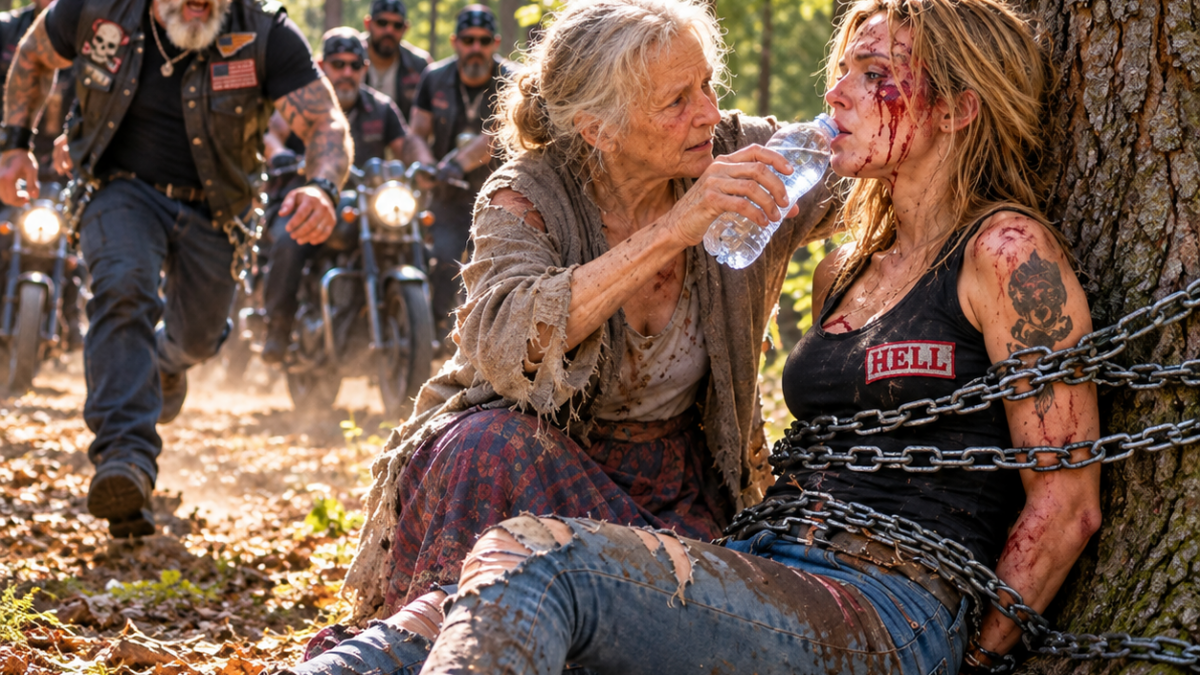
Her knees protested when she lowered herself into the dirt, but she ignored them and put one hand against the young woman’s cheek.
Hot.
Too hot.
Skin dry and tight.
“Honey,” Edna said. “Honey, can you hear me?”
The woman’s eyelids fluttered.
Opened barely.
Her eyes were unfocused, glassy with heat and terror. She tried to speak, but nothing came out except a dry click.
The dog pressed close, whining.
“All right,” Edna told him. “All right, I see her.”
She pulled one water bottle from her bag, uncapped it, and wet her fingers. Carefully, she dabbed water onto the woman’s cracked lips.
Not poured.
Dabbed.
Edna knew better than to force water down the throat of someone half-conscious. You could choke a person trying to save them. She had learned that years ago from Ray, who had learned it from a medic in Vietnam, who had apparently learned most things the hard way.
“Just a little,” Edna whispered. “That’s it. I’ve got you.”
The woman’s tongue moved weakly toward the moisture.
Edna dabbed again.
Then she looked at the chain.
It was not rope.
Not wire.
A real chain.
The kind you would use to tow a truck.
It had been wrapped twice around the old mesquite trunk and padlocked tight near the woman’s wrists. The metal was heavy and deliberate. Whoever had done this had not acted in a moment of anger and left in panic.
They had planned it.
They had chosen the road.
Chosen the tree.
Chosen the chain.
Chosen the heat.
They had wanted someone to find her.
Or worse, they had wanted no one to find her until it was too late.
Edna’s fear turned into something sharper.
She reached into the canvas bag and dragged out Ray’s bolt cutters.
They were old. The handles were rusted near the hinge. The jaws were duller than they should have been. Ray had always meant to sharpen them before his heart gave out beside the tractor shed, but like most chores that belonged to dead men, the cutters had stayed exactly as he left them.
Edna set the jaws around one link.
Pressed.
Nothing.
She shifted her grip.
Pressed again.
The metal did not give.
Her hands ached.
The dog whined.
“Don’t you start,” she told him. “I know.”
She braced one handle against the dirt and put her whole weight on the other.
Still nothing.
The young woman made a sound.
Not a word.
Pain.
Edna’s eyes filled.
“Come on, Ray,” she whispered. “Help me out here.”
She set the cutters again.
This time she placed them at the side of the link, where rust had eaten a dark seam into the metal. She leaned down with everything left in her old bones.
The link snapped.
Sharp.
Clean.
The chain dropped.
The young woman’s arms fell into the dirt.
The dog pushed forward instantly and shoved his nose beneath one of her hands.
Her fingers curled weakly into his fur.
Edna swallowed hard.
“There you are,” she said. “You held on, didn’t you?”
The woman’s eyes opened a little wider.
“You’re safe,” Edna told her.
She did not know if that was true.
She said it anyway.
Sometimes the first mercy you give someone is a sentence they cannot yet believe.
“You’re safe now. I’ve got you.”
The woman breathed shallowly.
Edna looked up and down the road.
Nothing.
Heat shimmered above the asphalt. A hawk circled far off. The desert stretched flat and gold in every direction.
Nobody coming.
Nobody but whoever might come back.
Edna got one arm beneath the woman’s shoulders.
“We’re going to my truck,” she said. “It’s not far. Can you stand? Lean on me. I’m stronger than I look.”
That had been true most of Edna’s life.
The woman tried.
Her legs folded immediately.
Edna nearly went down with her.
“Easy,” Edna said. “All right. Slow, then.”
It took them nearly twelve minutes to cover the distance back to Edna’s old Ford pickup parked on the shoulder. Twelve minutes of stumbling, stopping, water, breath, and dust. The dog walked pressed against the woman’s leg the whole way, as if he refused to let even daylight come between them.
That was the first thing that told Edna this was not a stray who had happened upon suffering.
This dog knew her.
This dog had been left out there too.
By the time Edna got the young woman onto the bench seat, the girl could speak.
Barely.
“They’re coming.”
Edna froze with one hand on the gearshift.
“Who’s coming, honey?”
The woman’s eyes rolled toward the road behind them.
“They’ll come back to make sure.”
The dog climbed into her lap, planted his front paws on the dashboard, and stared through the windshield like a soldier watching a tree line.
“Make sure of what?”
The woman’s voice cracked.
“That I was found.”
Edna stared at her.
Then she put the truck in gear.
Most fear is noise.
Edna knew that.
She had raised classrooms of frightened nine-year-olds who feared spelling tests, bullies, new schools, angry fathers, and the dark corners of their own houses. She had learned the difference between fear that needed patience and fear that needed a locked door.
This girl’s fear needed a locked door.
The diner sat three miles outside Barstow proper, at the crossroads where the county road met the state highway. It was called Dot’s Diner and had been called Dot’s since before Edna was born, though Dot herself had been dead nearly forty years.
At that hour, there was one truck in the lot and the smell of bacon and coffee drifting through the propped-open door.
Edna pulled in hard enough that gravel spat beneath the tires.
She came around the truck, helped the young woman down, and half-carried her inside. The dog followed so closely his nose almost touched the back of the girl’s knee.
The waitress behind the counter, Rhonda Bell, took one look and dropped the rag in her hand.
Rhonda was broad-shouldered, big-hearted, and built like she could throw a sack of flour into the next county. Edna had taught her in fourth grade, back when Rhonda wore pink barrettes and got into fistfights with boys twice her size.
“Lord have mercy,” Rhonda said. “What happened to her?”
“Booth in the back,” Edna said. “Ice water, wet towels, and lock that front door.”
Rhonda did not ask questions.
Out there, when Edna Pruitt gave a plain instruction in a plain voice, you followed it. She had taught half that town how to read. You did not argue with the woman who taught you vowels.
They laid the young woman in the back booth. Rhonda brought ice wrapped in a bar towel and pressed it carefully to the burned wrists. The girl flinched, then sagged against the cracked vinyl seat. The dog crawled beneath the table and placed his head on her foot.
Edna sat across from her and folded her hands the way she had at her classroom desk for thirty-four years.
“What’s your name, honey?”
The girl swallowed.
“Cassie.”
“Cassie what?”
“Doyle.”
“And this fellow?” Edna nodded toward the dog.
For the first time, something almost like life moved across Cassie’s face.
“Scout.”
“Well, Cassie Doyle and Scout,” Edna said, “you are going to tell me who did this. Then we are going to decide the next plain thing.”
Cassie looked toward the locked front door.
Then the window.
Then the road beyond it.
“You don’t want to be near me,” she whispered.
Rhonda stood by the counter with the ice bucket forgotten in her hands.
Edna leaned forward.
“I’ve been near plenty of trouble.”
“Not like this.”
“Try me.”
Cassie’s voice dropped lower.
“My husband rides with the Devil’s Own.”
The room went quiet.
Everybody in that part of the desert knew the name.
The Devil’s Own was a motorcycle club with charters across three states. Not weekend hobby riders. Not parade riders. Men who moved like thunder when they came through town. Men with patches people noticed and then pretended not to notice. Women rode with them too, hard-eyed and dangerous in their own right.
Edna had never had trouble with them.
But she had also never gone looking for any.
“My husband is Danny Doyle,” Cassie said.
Rhonda breathed out.
Even she knew that name.
Danny Doyle, president of the western charter. Gray-streaked beard, quiet voice, dangerous reputation. Some called him fair. Some called him ruthless. Most called him nothing at all unless he was far away.
“The men who chained me up,” Cassie continued, “they wanted to send Danny’s club a message.”
“Who are they?” Edna asked.
Cassie’s hands started trembling.
“They call themselves the Vultures. A crew out of the desert. They’ve been moving product through this county for a year. Danny’s club shut down two of their routes last month.”
She closed her eyes.
“This was them getting even.”
Rhonda crossed herself.
“They said you don’t hit a man first,” Cassie whispered. “You hit what he loves and leave it where he’ll see.”
Edna felt something cold settle beneath her ribs.
“They told me before they left they’d come back before dark. To see who came sniffing. To deal with whoever found me too.”
Rhonda moved to the window.
“Then we don’t have much time,” Edna said. “Is there someone we can call? Your husband? His people?”
Cassie shook her head weakly.
“They took my phone. I don’t know Danny’s number by heart. Nobody knows numbers by heart anymore.”
She stopped.
Something changed in her eyes.
“Wait.”
“What?”
“My boot.”
Edna looked down.
Cassie wore worn brown boots, one scuffed nearly white at the toe.
“Danny scratched a number inside my boot months ago. For emergencies. In case I couldn’t reach him.”
She gave a small, broken laugh.
“I told him it was stupid. I said, ‘Who writes a number in a boot?’ He said, ‘The day you need it, you’ll be glad it’s somewhere they can’t take.’”
Edna was already kneeling in the aisle.
She eased the boot from Cassie’s swollen foot, careful not to jostle her. Then she turned it toward the light.
There it was.
Ten digits scratched into the inner leather with a knife point.
Faded.
But clear enough.
Edna stared at the number.
She was a retired schoolteacher. A widow. A woman who fed abandoned dogs and bought her coffee with exact change. She had never once in seventy-one years called a motorcycle club for help.
Some part of her knew that once she dialed those numbers, whatever came next could not be undone.
She dialed anyway.
The phone rang twice.
A man answered.
Rough voice.
Careful voice.
A voice that did not hand out names to strangers.
“Who’s this?”
Edna kept her voice steady.
The same voice she had used on the first day of school every August for thirty-four years.
“My name is Edna Pruitt. I’m sitting in Dot’s Diner outside Barstow with a young woman named Cassie Doyle. I found her chained to a tree this morning. She’s alive. She’s hurt, but she’s alive. There’s a dog named Scout under the table with her.”
Silence.
Long enough that Edna thought the call had dropped.
Then she heard the man breathe.
“Say the name of that diner again.”
“Dot’s. The crossroads three miles east of town.”
“Don’t move her. Don’t let anybody through that door but me and mine. Keep her drinking water.”
“How long?”
A pause.
“Ma’am,” the man said quietly, “you just made a call a whole lot of men have been waiting a year to get.”
Edna’s hand tightened around the phone.
“We’re already coming.”
The line went dead.
For a moment, nobody in the diner said anything.
Cassie had slipped into a thin, exhausted sleep, her burned hands still buried in Scout’s fur. The ice had brought her fever down a little. Rhonda made fresh coffee, though no one asked for it. The smell filled the diner, warm and ordinary and almost cruel.
Outside, the desert lay flat and gold and quiet.
It felt, for one strange moment, like the worst was over.
Cassie was alive.
The call had been made.
Help was coming.
Edna poured herself coffee with a hand that had finally stopped shaking.
Rhonda squeezed her shoulder.
Scout let out a long dog sigh beneath the table and closed his eyes.
Then the sheriff’s cruiser rolled into the lot around ten.
Deputy Sheriff Cole Hartley stepped out with his hat in one hand.
Edna felt her shoulders drop another inch.
She had taught Cole to read. He had been a skinny boy with ears too large for his head and a habit of chewing pencils down to splinters. Now he was thirty-one, married, with a little girl in Sunday school and a badge on his chest.
The law was here.
The law would handle it.
Cole walked through the door.
“Miss Pruitt.”
“Cole, thank God. This girl was chained to a tree out on County Road Twelve. Men called the Vultures did it. She says they’re coming back.”
That should have been the moment danger passed.
It wasn’t.
Because Cole Hartley did not go to the back booth.
He did not reach for his radio.
He stood in the middle of the diner and looked at Cassie. Then he looked at the dog. Then Edna. Something moved across his young face that she had never seen there before.
Fear.
And shame.
“Miss Pruitt,” he said quietly, “you need to give that girl to me right now. And you need to forget you ever made that call.”
The coffee cup stopped halfway to Edna’s mouth.
“Say that again.”
Cole swallowed.
His hand rested on his belt. Not near his gun. Just resting there like he needed to hold onto himself.
“The Vultures own half this county now.”
Rhonda went still behind the counter.
“They own more than that,” Cole said. “They came to me eight months ago and made it real simple. I look the other way, or my family pays. I’ve got a wife, Miss Pruitt. I’ve got a little girl.”
His voice broke.
“You know her. She’s in your Sunday class.”
Edna did know her.
Little Annie Hartley.
Missing front tooth.
Always drawing horses in the margins of prayer coloring sheets.
Cole’s eyes kept sliding to the window.
“They already called me this morning. They know that girl’s alive. They know somebody found her. They told me to bring her in quiet and make the problem disappear, or they’d make my problem disappear instead.”
The room seemed to shrink.
It was no longer just a gang of men out in the desert.
The rot had reached the badge.
The one person who should have protected Cassie had walked into the diner asking Edna to hand her back.
Edna set down her cup.
Very slowly.
“Cole Hartley,” she said, “I taught you the word courage in third grade. I had you spell it at the board because you kept mixing up the vowels. Do you remember?”
Tears stood in his eyes.
“Miss Pruitt—”
“And now you want me to hand this child to the men who chained her to a tree so your conscience can stay comfortable?”
“I want to keep my family alive.”
“I understand fear,” Edna said. “I cut a girl loose from a tree this morning. I understand exactly what these men do.”
Cole looked like he might be sick.
“But you listen to me. You are not taking her anywhere. And you are going to make a choice today about what kind of man you are, because it turns out that’s a thing that gets decided. Not a thing you’re born with.”
Before Cole could answer, Rhonda spoke from the window.
Her voice had gone flat and strange.
“Edna.”
Everybody turned.
A black pickup was slowing at the crossroads.
Then a second one behind it.
Dust boiled gold behind their tires.
They were not in a hurry.
That was the worst part.
They rolled toward Dot’s slow and easy, like men who owned the road, the diner, the badge, and everything breathing inside.
The Vultures had come back before dark.
Exactly like Cassie said.
Only early.
The two trucks stopped nose-to-nose across the lot, blocking the exit.
Six men climbed out.
No colors. No patches. Work shirts. Sunglasses. Boots. The kind of calm that comes from doing ugly things and never once paying for them.
The one in front was big, thick through the neck, with a shaved head and a tire iron hanging loose in one hand.
Boyd.
Cassie had said the name once while half-conscious.
Boyd Vance.
The man who wrapped the chain.
The man who smiled while he did it.
He walked to the glass door and peered inside.
His smile widened when he saw Deputy Cole.
“Well, look at that,” Boyd called through the glass. “Cole came through after all. Good boy. Open the door, deputy. We’ll take it from here.”
Every eye turned to Cole Hartley.
His hand shook on his belt.
He looked at Boyd.
Then Cassie.
Then Scout, who had crawled from beneath the booth and now stood in front of her, teeth bared, body low.
Then he looked at Edna Pruitt.
The woman who had taught him to read.
The woman watching him with those steady schoolteacher eyes that had never let him get away with a lie.
Cole reached for the deadbolt.
Rhonda sucked in a breath.
Edna did not move.
Cole turned the lock.
Locked.
Not open.
The door stayed shut.
“Door stays locked, Boyd,” Cole called. His voice shook, but it held. “Girl stays here. I’m calling the state police.”
Boyd’s smile vanished.
“You’re a dead man.”
Cole’s face went white.
“You and your wife and that little girl,” Boyd said softly. “All of you. You just signed it.”
He raised the tire iron and swung it into the glass door.
The first hit cracked the pane.
Rhonda screamed and grabbed a cast iron pan from the flat top.
The second hit spread the crack wider.
Cassie woke with a gasp in the back booth.
Scout barked.
Edna stepped in front of the booth with Ray’s old bolt cutters clutched in both hands.
A tiny old woman.
Seventy-one years old.
Canvas sneakers planted on the diner floor.
Standing between a chained woman and the men who had come to finish the message.
The third swing shattered the glass.
Boyd reached through toward the deadbolt.
That was when they all heard it.
At first, it was almost nothing.
A hum.
Low.
Distant.
A vibration more than a sound.
The kind you feel in your teeth before your ears catch up.
Boyd stopped with his hand halfway through the broken glass.
The men in the lot turned.
The hum grew.
The coffee cups rattled on the counter.
The windows buzzed in their frames.
The sound rose and thickened until it seemed the whole sky had started to growl.
Then the first motorcycle crested the rise to the north.
Sunlight hit chrome.
Then another appeared.
Then ten.
Then fifty.
Then too many to count.
Edna stood behind the broken door and watched the horizon fill with motorcycles.
They came over the hill and kept coming.
Headlight after headlight.
A river of steel and leather and thunder filling both lanes, both shoulders, and then spilling into the desert on either side. Engines roared until the sound stopped being sound and became weather. Dust rose behind them in a wall. Chrome flashed like moving fire.
Three thousand five hundred riders.
Every Devil’s Own charter within a day’s ride.
Every club that owed them a favor.
Every rider who had ever heard what the Vultures did to a woman on a lonely road.
The call had gone out the second Edna hung up.
And they had been rolling ever since.
Boyd pulled his hand back through the broken glass very slowly.
The motorcycles filled the lot.
Then the road.
Then the world.
Engines cut one after another.
Hundreds of them.
Then thousands.
The silence afterward was somehow louder.
Riders dismounted.
Big men. Lean men. Gray-bearded men. Hard-eyed women. Veterans. Mechanics. Ranchers. Widows. People with scars visible and invisible. They did not shout. Did not rush. Did not have to.
They walked forward and made a circle around the two black pickups.
Six Vultures in the middle.
Three thousand five hundred riders around them.
One man came through the crowd.
Forty or so. Lean. Gray streaking his beard. A patch on his chest that said PRESIDENT. Beneath it, a small name rocker.
DANNY.
He was not looking at Boyd.
He walked past the six men as if they were already handled, came to the broken door, and looked through the jagged glass toward the back booth.
Cassie was sitting up now.
Awake.
Her burned hand pressed to her mouth.
“Cassie,” Danny said.
Just her name.
His voice broke clean in half on it.
“Danny,” she whispered.
He did not kick in the door.
He reached through carefully, avoiding the broken glass, and unlocked it.
Then he crossed the diner in four strides, dropped to his knees in front of the booth, and took his wife’s ruined wrists in his hands like they were made of glass.
This enormous, frightening man bowed his head over her hands.
His shoulders shook.
Scout came out from under the table and licked his face.
For a long moment, nobody moved.
Even the desert seemed to hold still.
Then Danny stood.
The man who had been weeping a second earlier was gone.
In his place stood something cold, quiet, and absolutely certain.
“Which one?” he asked.
Cassie did not answer with words.
She looked at Boyd.
That was all.
Just looked.
Danny turned and walked back through the broken door into the ring of riders.
He stopped in front of Boyd, who still held the tire iron but no longer seemed to know what it was for.
“You put a chain on my wife,” Danny said.
Boyd tried to find his voice.
“The club shut down our routes. This is business. You know how—”
“This is not business.”
Danny’s voice stayed low.
“You made it something else the second you touched her.”
Boyd swung the tire iron.
He was big.
He was fast.
If there had been one man in front of him, it might have mattered.
There was not one man.
There was a wall.
Danny stepped inside the swing, took the iron out of his hand almost gently, and the riders closed just enough to make clear there would be no second swing.
What happened next was fast.
It was not the bloodbath Boyd expected.
It was not the war he had come to start.
It was six men stripped of weapons, forced to their knees in the dirt, and surrounded by more witnesses than they had ever imagined.
Boyd ended up kneeling exactly where he had wanted others to kneel.
Head bowed.
Dust on his shirt.
No road left to run.
No badge left to protect him.
No fear left to hide behind.
Danny turned toward Deputy Cole Hartley, who stood in the busted doorway white as a sheet.
“You locked that door,” Danny said.
Cole swallowed.
“When it cost you something,” Danny added. “My wife says she watched you do it. Why?”
Cole looked at Edna.
Then at Cassie.
Then at Boyd.
“Because a woman I respect asked me what kind of man I was,” he said. “And I didn’t like the answer I’d been giving.”
Danny studied him for a long moment.
Then nodded once.
“Call your state police,” he said. “The real ones. Not the ones on their payroll. Call them now, in front of me, and tell them everything. These six. The men above them. Every name you know.”
He glanced at the circle of riders.
“We’ll wait right here and make sure nobody wanders off before your friends arrive.”
A thin smile crossed his face.
“Consider it a citizen’s arrest. Three thousand five hundred citizens.”
That is exactly what happened.
Cole Hartley stood in the middle of that parking lot and called the state police.
This time, he told the truth.
A year of it.
Every route.
Every payment.
Every threat.
Every time he looked the other way and hated himself a little more.
Every name he had swallowed because he loved his wife and daughter and was too afraid to understand that fear had already made them prisoners.
The Vultures knelt in the dirt in a ring of headlights and could not move because there was nowhere left on earth to move to.
The state troopers arrived an hour later in a long line.
They must have thought they had lost their minds when they crested the hill and saw a two-lane desert road turned into a sea of motorcycles three miles deep.
But the riders parted for them.
Calm.
Orderly.
Silent.
They handed over six men, a broken chain, photographs of Cassie’s wrists, Edna’s testimony, Rhonda’s statement, Cole’s confession, and enough names to start a fire that would burn through three counties.
By the following spring, the Vulture operation and three crooked officials above them were in federal court.
Boyd Vance got twenty-two years.
Two others got nearly as much.
The sheriff resigned before he was indicted, which did not save him.
Cole Hartley kept his badge after testifying, though some said he deserved to lose it. Edna said a man who finally told the truth should spend the rest of his life proving it was not a one-time accident.
So that was what he did.
But all of that came later.
That evening, in the gold desert light with the engines cooling and the worst danger passed, there was only Dot’s Diner, the broken glass, the smell of coffee, and the people left standing.
Danny sat beside Cassie and held her.
He did not say much.
He didn’t need to.
Somebody brought a proper first-aid kit and dressed her wrists. Someone else arranged a doctor, a good one, quiet and careful. Cassie kept one hand on Scout the whole time, and Scout did not leave her side.
Nobody tried to make him.
After a while, Danny stood and walked to the counter.
Edna sat there with a cold cup of coffee in front of her, bolt cutters on the stool beside her, hands folded the way she always folded them when she was pretending not to be tired.
Danny Doyle, president of the Devil’s Own western charter, the man whose name had made people lower their voices for years, looked at this seventy-one-year-old retired schoolteacher like he did not quite know what to do with her.
“You’re the one who called,” he said.
“I am.”
“You could have driven past her this morning.”
Edna looked at him.
“No, I couldn’t.”
“Most would have.”
“That’s not the same thing.”
He let out a breath that was almost a laugh and almost something else.
“The men who took her wanted the whole world to learn a lesson from what they did to my wife,” Danny said. “That you don’t cross them. That if you do, this is what happens. Everybody keeps their head down.”
He looked around the diner.
At Rhonda.
At Cole.
At the riders outside.
At Cassie breathing behind him.
“You know what lesson the world actually learned today, Miss Pruitt?”
Edna lifted one eyebrow.
“Tell me.”
“That there’s still an old woman out there who will kneel down in the dirt for a stranger. And if you hurt somebody, you’d best pray it’s not a woman like that who finds them, because she’ll pick up the phone.”
He shook his head slowly.
“You lit this whole thing. All three thousand five hundred of us. One phone call from a schoolteacher.”
Edna reached out and patted his big scarred hand the same way she had patted Cassie’s that morning.
“I didn’t light anything, son. I just refused to walk by.”
Danny looked down at her hand.
“Anybody could have done that,” Edna said. “Most folks just talk themselves out of it.”
The club tried to give her things afterward.
Money.
A newer truck.
A paved road.
A new roof.
A security system.
A man posted outside her house.
She refused almost everything.
She let them fix her fences because Ray would have liked that.
She let them repair the old Ford because, as Rhonda pointed out, pride was not a replacement for a working engine.
But when Danny asked what she really wanted, her answer surprised every rider in the room.
“There’s a stretch of County Road east of here,” Edna said. “People dump dogs there when they’re done with them. I feed what I can, but I’m getting old. I can’t lift the big bags like I used to.”
Danny stared at her.
“You want dog food?”
“I want help carrying it.”
So every Saturday morning after that, if you drove three miles east of Barstow, you saw the strangest sight in the desert.
A line of motorcycles parked along the shoulder.
Hard-looking men and women kneeling in the dirt, setting out bowls of food and water for stray dogs that came trotting from the brush like they had been waiting all week.
Scout usually rode out with them.
Healthy now.
Ear healed.
Sitting proudly in a sidecar like he had always known he was meant for important work.
Cassie came too once her wrists healed enough. The scars remained, pale bands around both arms, but she stopped hiding them after Edna told her scars were proof the ending had changed.
Danny never let her out of his sight for long.
Not in a controlling way.
In the way a man watches the sunrise after years in the dark.
As for Edna, she walked down the middle of it all with her canvas bag on her shoulder, seventy-one years old, calling dogs by names only she remembered.
The old lady who had stumbled on a chained woman one July dawn never did think of herself as brave.
If you asked her, she would tell you she only did the plain next thing.
You see somebody hurt.
You kneel down.
You cut the chain.
You get them water.
You pick up the phone.
That was all it ever was, she’d say.
Then she would hoist the bag a little higher on her shoulder, whistle for the dogs, and keep walking down the road she had walked ten thousand times.
Feeding the ones nobody else would feed.
At the quiet end of the world where, for one long summer day, 3,500 engines came roaring to answer an old woman’s call.





